
Alaska-class cruisers of the US Navy, USS Alaska (CB-1), USS Guam (CB-2), USS Hawaii (CB-3)
The Alaska-class were six large cruisers ordered before the Second World War for the United States Navy (USN), of which only two were completed and saw service late in the war. The USN designation for the ships of this class was ‘large cruiser’ (CB), a designation unique to the Alaska-class, and the majority of leading reference works consider them as such. However, various other works have alternately described these ships as battlecruisers despite the USN having never classified them as such, and having actively discouraged the use of the term in describing the class. The Alaska class were all named after territories or insular areas of the United States, signifying their intermediate status between larger battleships (which were mostly named after states) and smaller heavy and light cruisers (which were named after cities).
The idea for a large cruiser class originated in the early 1930s when the USN sought to counter the Deutschland-class “pocket battleships” being launched by Germany. Planning for ships that eventually evolved into the Alaska-class began in the late 1930s after the deployment of Germany’s Scharnhorst-class battleships and rumours that Japan was constructing a new large cruiser class, the B-65 “super cruiser.” To serve as “cruiser-killers” capable of seeking out and destroying these post-treaty heavy cruisers, the class was given large guns of a new and expensive design, limited armour protection against 12-inch shells, and machinery capable of powering these warships at speeds of about 31–33 knots (57–61 km/h; 36–38 mph).
Of the six planned, Alaska and Guam were the only two to be commissioned; a third, Hawaii, was close to completion at the war’s end and had its construction suspended on 16 April 1947, while the remaining three were cancelled. Alaska and Guam served with the USN for the last year of the Second World War as bombardment ships and fast carrier escorts. They were decommissioned in 1947 after spending only 32 and 29 months in service, respectively. (Wikipedia)
USS Alaska (CB-1)
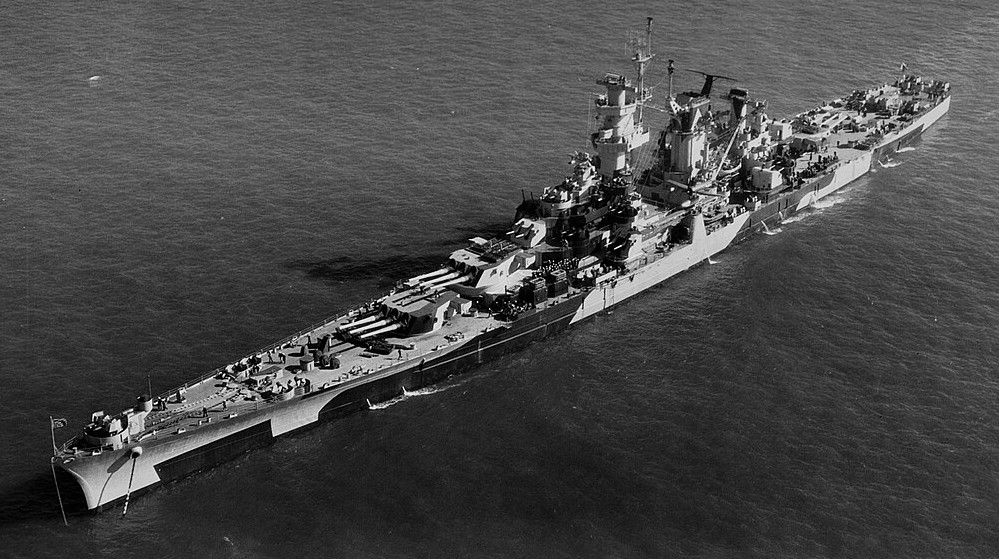
(USN Photo, NH97126)
USS Alaska (CB-1) photographed from the air on 13 November 1944.
USS Alaska was the lead ship of theAlaska-class “large cruisers” which served with the United States Navy during the end of the Second World War. She was the first of two ships of her class to be completed, followed only by Guam; four other ships were ordered but were not completed before the end of the war. Alaska was the third vessel of the US Navy to be named after what was then the territory of Alaska, and was assigned the hull number CB-1. She was laid down on 17 December 1941, ten days after the United States entered the war, was launched in August 1943 by the New York Shipbuilding Corporation, in Camden, New Jersey, and was commissioned in June 1944. She was armed with a main battery of nine 12 in (305 mm) guns in three triple turrets and had a top speed of 33 kn (61 km/h; 38 mph).
Due to being commissioned late in the war, Alaska saw relatively limited service. She participated in operations off Iwo Jima and Okinawa in February–July 1945, including providing anti-aircraft defense for various carrier task forces and conducting limited shore bombardment operations. He anti-arcraft crews shot down several Japanese aircraft off Okinawa, including a possible Ohka piloted missile. In July–August 1945 she participated in sweeps for Japanese shipping in the East China and Yellow Seas. After the war, she assisted in the occupation of Korea and transported a contingent of US Army troops back to the United States. She was decommissioned in February 1947 and placed in reserve,where she remained until she was stricken in 1960 and sold for scrapping the following year. (Wikipedia)
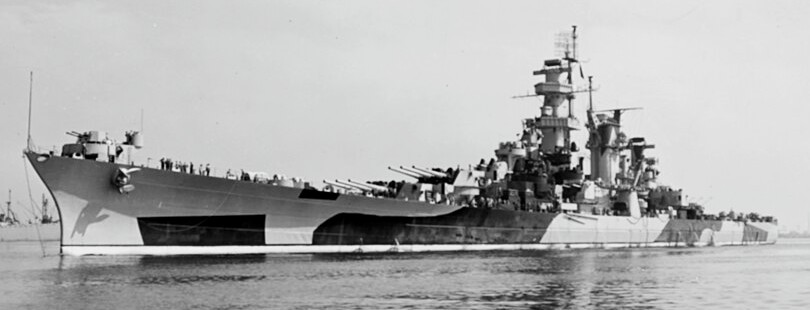
(USN Photo)
USS Alaska (CB-1) photographed on 30 July 1944 off the Philadelphia Navy Yard, Pennsylvania.

(USN Photo)
USS Alaska (CB-1) photographed from USS Missouri (BB-63) off the U.S. East Coast during their shakedown cruise together in August 1944. Note her Measure 32 camouflage.

(USN Photo)
USS Alaska (CB 1), port bow while at anchor, altitude of 150’. Photographed by Naval Air Station Lakehurst, New Jersey, ZP-12, lighter-than-air aircraft, November 13, 1944.

(USN Photo)
USS Alaska (CB-1) off the Philadelphia Naval Shipyard, Pennsylvania, on 30 July 1944. She wears Camouflage Measure 32, Design 1D.
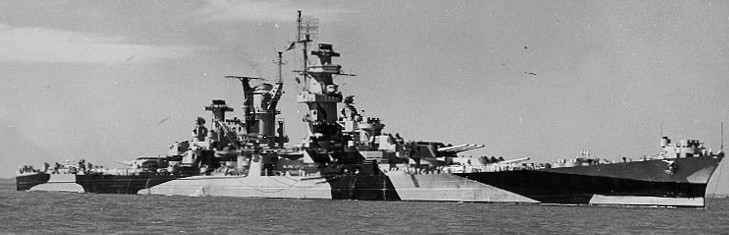
(USN Photo)
USS Alaska (CB-1) photographed in the summer or autumn of 1944, probably in the Hampton Roads area, Virginia.

(USN Photo)
USS Alaska (CB-1) underway on 11 September 1944.

(USN Photo)
Aerial view of warships at the base piers of Norfolk Naval Base, Virginia, cAug 1944. Battleship USS Missouri (BB-63), the largest ship, and the battlecruiser USS Alaska (CB-1).
USS Guam (CB-2)

(USN Photo)
USS Guam (CB-2) underway during her shakedown cruise off Trinidad, 13 November 1944.
USS Guam was an Alaska-class large cruiser which served with the United States Navy during the last year of the Second World War. She was the second and last ship of her class to be completed. The ship was the second vessel of the US Navy to be named after the island of Guam, an American territory in the Pacific, and she was assigned the hull number CB-2. Due to her commissioning late in the war, Guam saw relatively limited service during the war. She participated in operations off Okinawa in March–July 1945, including providing anti-aircraft defense for the carrier task force and conducting limited shore bombardment operations. She participated in sweeps for Japanese shipping in the East China and Yellow Seas in July–August 1945. After the end of the war, she assisted in the occupation of Korea and transported a contingent of US Army troops back to the United States. She was decommissioned in February 1947 and placed in reserve, where she remained until she was stricken in 1960 and sold for scrapping the following year. (Wikipedia)
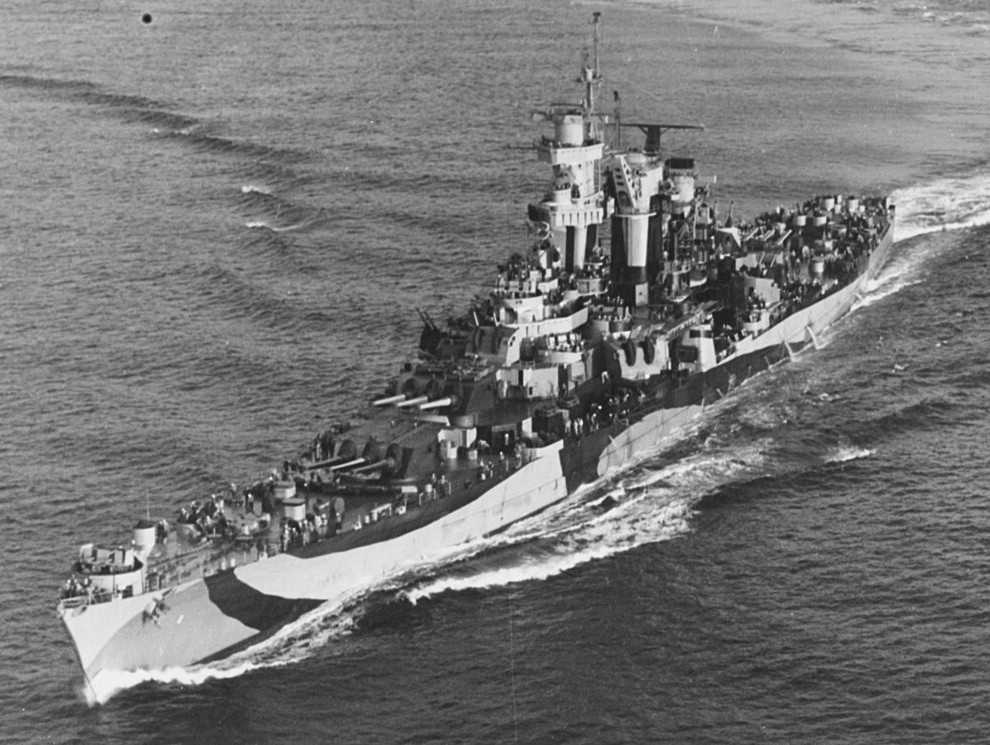
(USN Photo)
USS Guam (CB-2) coming out of a turn, circa 1944. She is painted in Camouflage Measure 32, Design 7C.

(USN Photo)
USS Guam (CB-2) moored at Pearl Harbor on 21 February 1945. The port catapult and aircraft crane are trained over the side.
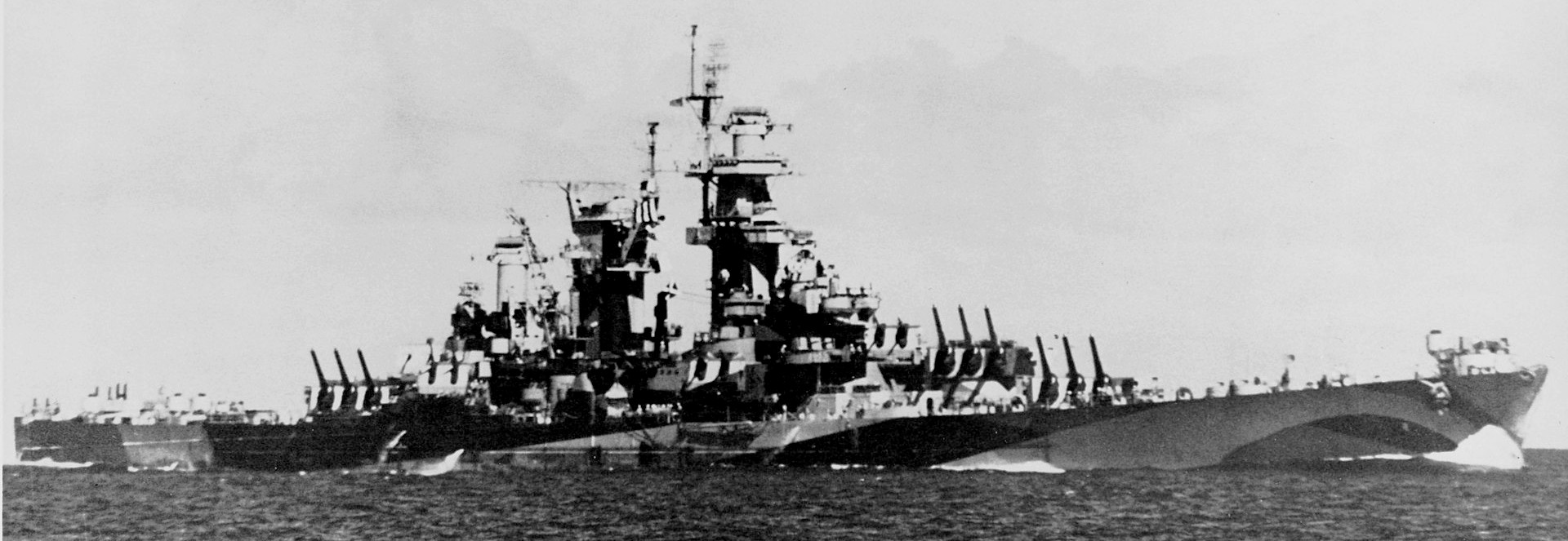
(USN Photo)
USS Guam (CB-2) conducting main battery gunnery practice during shakedown off Trinidad, November-December 1944.

(USN Photo)
USS Guam (CB-2) underway off Trinidad on 13 November 1944 during shakedown training.
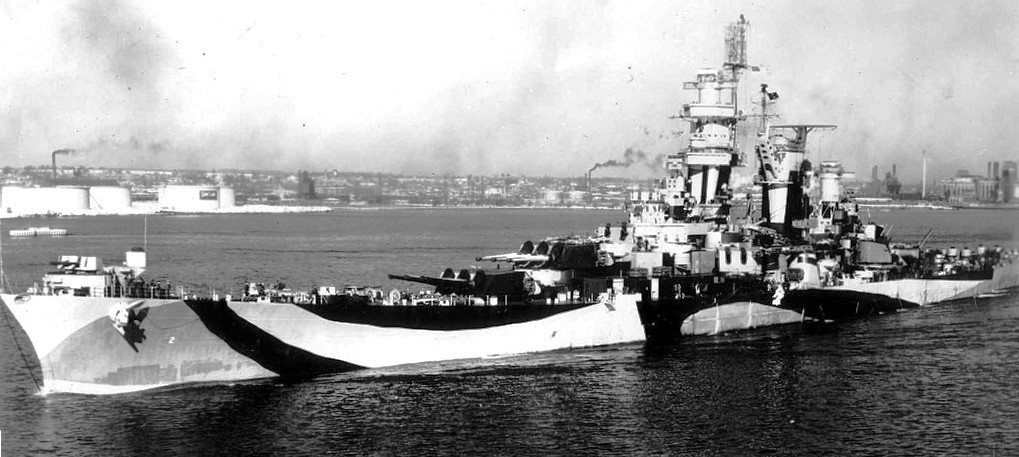
(USN Photo)
USS Guam (CB-2) at Philadelphia Navy Yard, October 1944.
(CB-3) Hawaii – construction stopped after launching, conversion to a missile ship (CBG-3) and then a command ship (CBC-1) canceled.
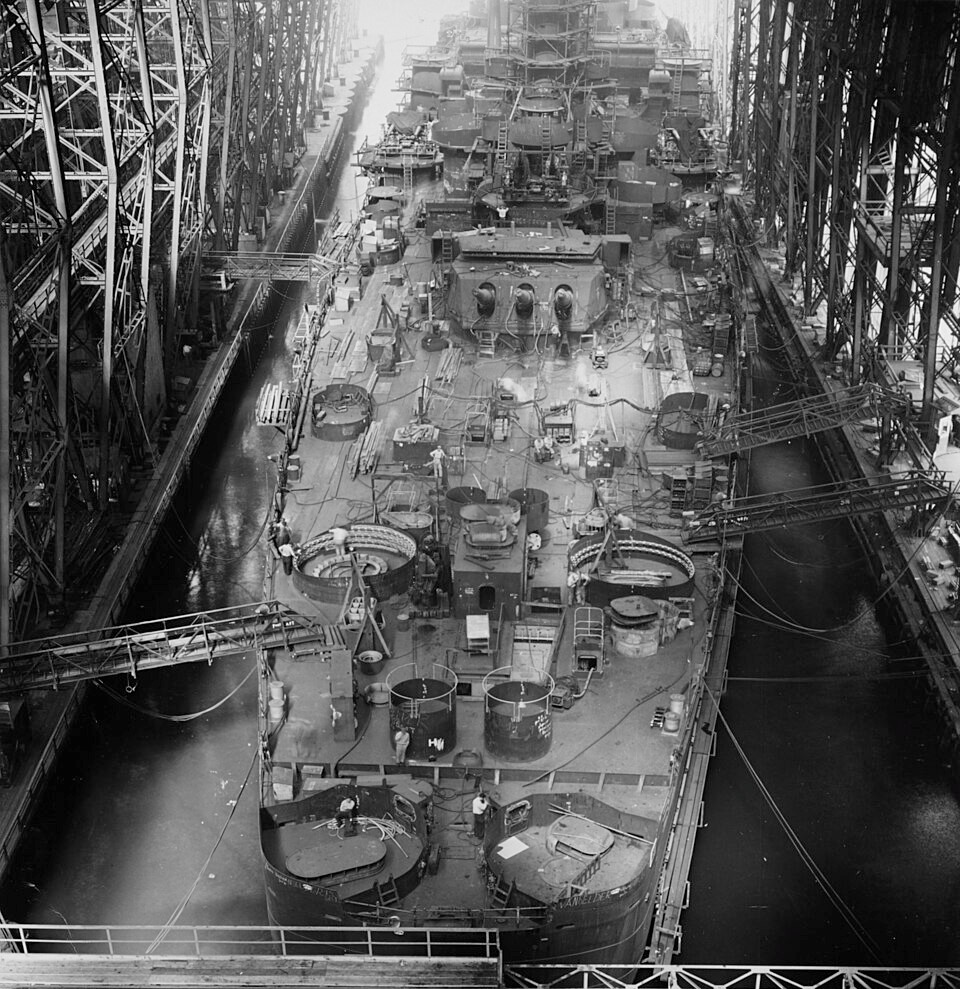
(U.S. Naval Historical Center Photo)
USS Hawaii (CB-3) under construction at the New York Shipbuilding Corp., Camden, New Jersey on 3 July 1946. The after 12″ turret and three after 5″ mounts are in place–the latter without their shields. Shipyard gear and men on deck indicate that construction was still underway, but little additional visible progress was made before work was officially suspended on 17 February 1947.
USS Hawaii (CB-3) was intended to be the third member of the Alaska-class large cruisers. It was the first United States Navy ship to be named after the then-Territory of Hawaii. Because Hawaii’s construction was delayed by higher-priority ships like aircraft carriers, her keel was not laid until December 1943, about two years after her sister ship Guam.
USS Hawaii was launched in late 1945, but post-war budget cutbacks necessitated her cancellation in 1947. The Alaska-class large cruisers were seen as requiring a crew almost as large as a South Dakota or Iowa-class battleship, while the armor and protection of the capital ship-sized Hawaii was no better than a Baltimore-class cruiser and this was particularly significant as the underwater protection designed into Hawaii was poor. In a famous Proceedings article in January 1949, Frank Uhlig dismissed the performance of the class in 1944–1945 and concluded the battlecruiser had no place in the postwar USN. For a time, the US Navy planned to convert the ship into the United States’s first guided missile cruiser, but this did not come to fruition. A conversion to a large command ship was later contemplated and planning went far enough that money was allocated in the 1952 budget for this purpose. However, with one command ship already completed, Northampton, and a second already chosen, Wright, no work was started upon Hawaii. Having been laid up for twelve years, the still incomplete ship was towed to breakers to be scrapped in 1959. (Wikipedia)
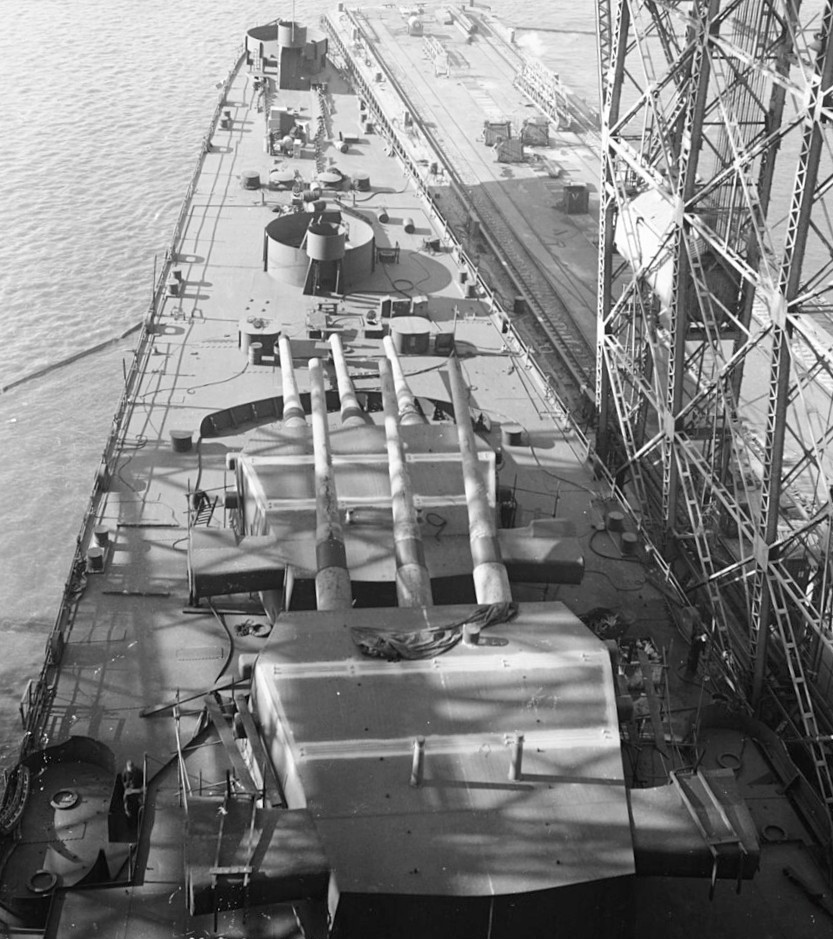
(USN Photo)
View of the forward portion of the U.S. Navy large cruiser USS Hawaii (CB-3) during construction at the New York Shipbuilding Corporation, Camden, New Jersey (USA), on 8 January 1947. Construction was officially suspended on 17 February 1947. Hawaii‘s three 305 mm gun turrets were removed when the ship was moved to the Philadelphia Reserve Fleet.
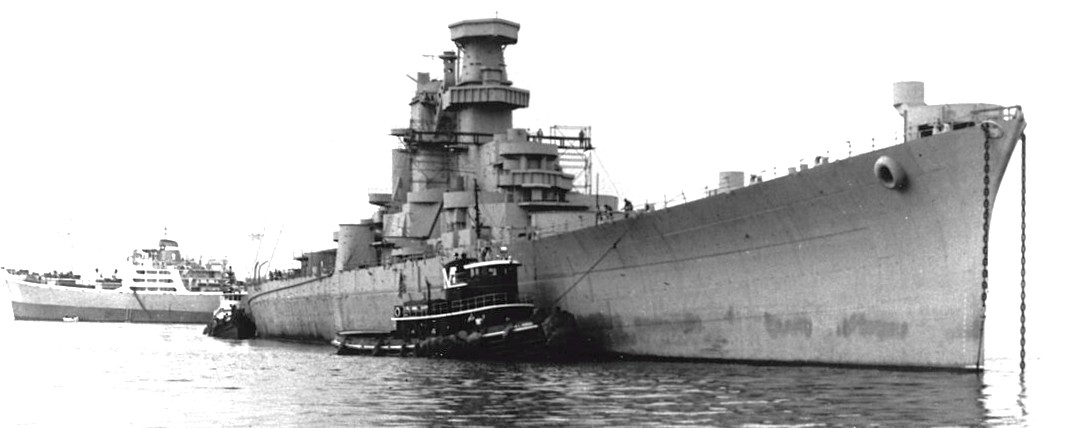
(USN Photo)
USS Hawaii (CB-3) being towed away for scrapping on 20 June 1959.
(CB-4) Philippines – canceled.
(CB-5) Puerto Rico – canceled.
(CB-6) Samoa – canceled.
All comments are subject to our Comment Policy. You must be at least 18 years old to comment.
See a comment that violates our guidelines? Report it here.