
Royal Navy light armoured cruisers: HMS Birmingham, HMS Lowestoft, HMS Nottingham, HMAS Adelaide, HMS Birkenhead, HMS Chester
The light armoured cruiser – light cruiser – succeeded the protected cruiser; improvements in machinery and armour rendering the latter obsolete. The Town class of 1910 were rated as second-class protected cruisers, but were effectively light armoured cruisers with mixed coal and oil firing. The Arethusa class of 1913 were the first oil-only fired class. This meant that the arrangement of coal bunkers in the hull could no longer be relied upon as protection and the adoption of destroyer-type machinery resulted in a higher speed. This makes the Arethusas the first “true example” of the warship that came to be recognised as the light cruiser. In the London Naval Treaty of 1930, light cruisers were officially defined as cruisers having guns of 6.1 inches (155 mm) calibre or less, with a displacement not exceeding 10,000 tons. (Wikipedia)
Birmingham group 5,440 tons, nine 6-in guns. HMS Birmingham, HMS Lowestoft, HMS Nottingham, HMAS Adelaide.
HMS Birmingham
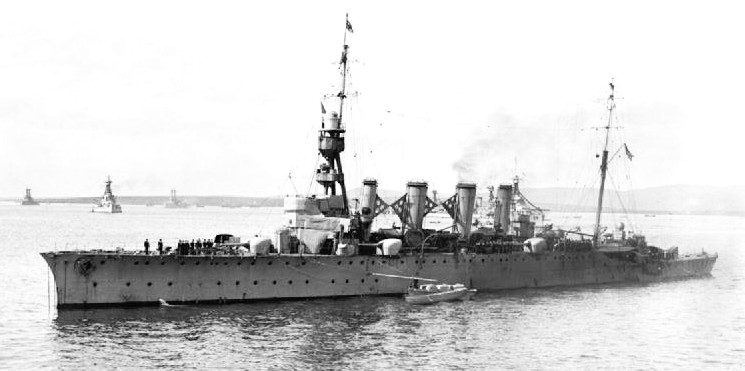
(IWM Photo, SP 1812)
HMS Birmingham was the lead ship of the Birmingham group of three ships of the Town-class light cruisers built by the Royal Navy shortly before the start of the First World War in 1914. Her sister ships were Lowestoft and Nottingham. The three ships were virtually identical to the third group of Town-class ships, but with an additional 6 in (152 mm) gun worked in on the forecastle.
Birmingham, a two-screw ship, was built at Elswick, launched on 7 May 1913 and completed on 30 January 1914. She joined the 1st Light Cruiser Squadron of the Grand Fleet in 1914, visiting Kiel in June that year.
On 9 August 1914, she spotted the U-15, whose engines had failed as she lay stopped on the surface in heavy fog, off Fair Isle. The crew of Birmingham could hear hammering from inside the boat from attempted repairs, and so fired on her but missed. As the U-boat began to dive, she rammed her, cutting her in two. U-15 went down with all hands, the first U-boat loss to an enemy warship.[1] Birmingham also sank two German merchant ships that year and took part in the Battle of Heligoland on 28 August, and the Battle of Dogger Bank in January 1915.
In February, she joined the 2nd Light Cruiser Squadron, attacking a U-boat on 18 June 1915 without success.
She also took part in the Battle of Jutland as a member of the 2nd Light Cruiser Squadron, during which she sustained damage caused by splintering during the night of the battle.
After the First World War, she was flagship to the 6th Light Cruiser Squadron in 1919–1920, after which she was transferred to the Nore from 1920 to 1922. Considered (with two other two shaft ‘Towns’) for conversion to a minelayer, but the idea was not pursued. She was recommissioned in November 1923 to the Africa Station with the 6th Light Cruiser Squadron as Flagship, relieving Lowestoft. She then continued to serve in foreign stations until being sold in 1931. She arrived at the yards of Thos. W. Ward, of Pembroke Dock on 12 March that year to be broken up. (Wikipedia)
HMS Lowestoft
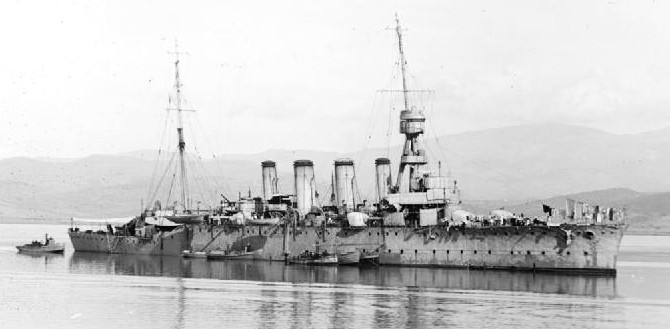
(IWM Photo, SP 561)
HMS Lowestoft was a Town-class light cruiser built for the Royal Navy in the 1910s. She was a member of the Birmingham sub-class of the Town class. She survived World War I and was sold for scrap in 1931.
The ship was laid down on 29 July 1912 by Chatham Royal Dockyard and launched on 23 April 1913. Upon completion in April 1914, Lowestoft was assigned to the 1st Light Cruiser Squadron of the Grand Fleet, and in August 1914 she sank a German merchant ship. On 28 August 1914, she participated in the Battle of Heligoland Bight, and on 24 January 1915 Lowestoft took part in the Battle of Dogger Bank. In February 1915, she was reassigned to the 2nd Light Cruiser Squadron, and in 1916 reassigned again to the 8th Light Cruiser Squadron, operating in the Mediterranean. She survived the war[1] and was sold for scrap on 8 January 1931 to Thos. W. Ward, of Milford Haven. (Wikipedia)
HMS Nottingham
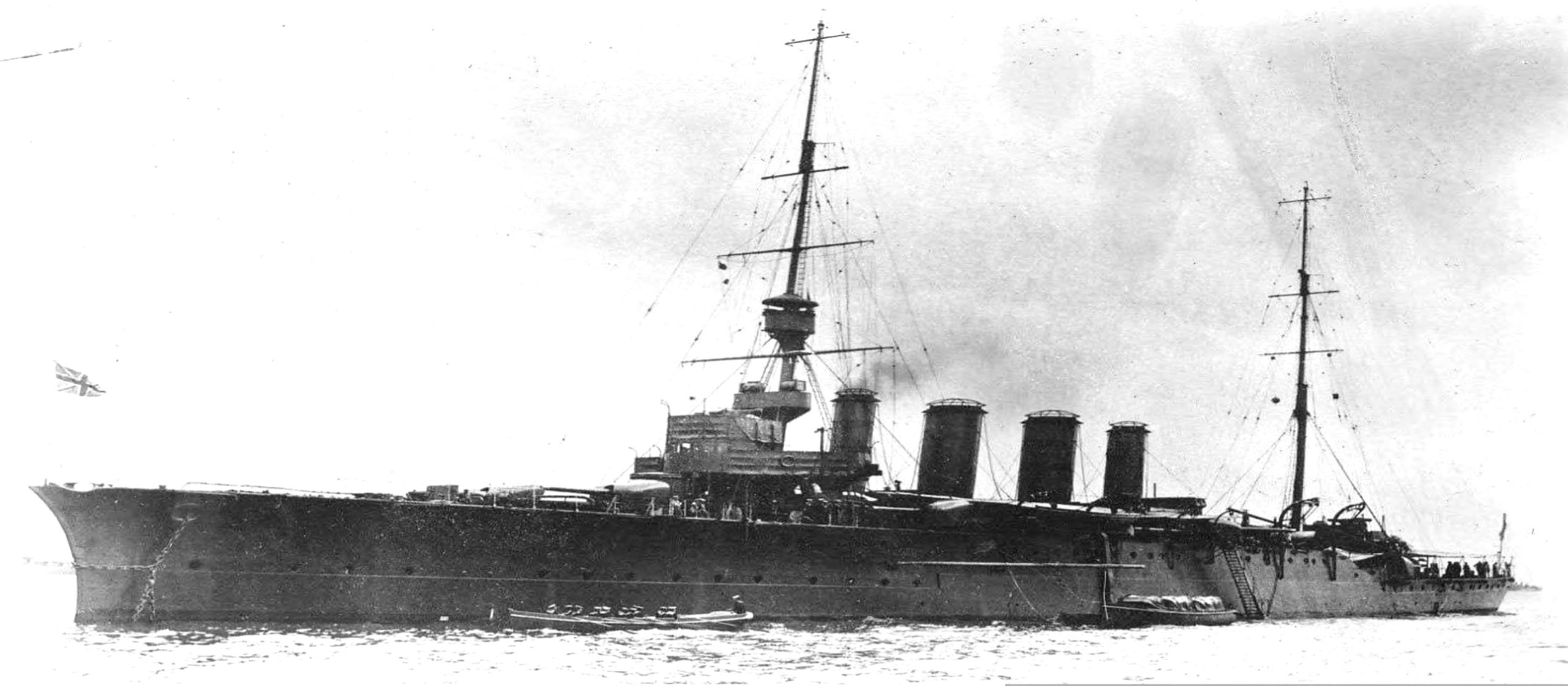
(Royal Navy Photo)
HMS Nottingham was a Town-class light cruiser built for the Royal Navy just before the First World War. She was one of three ships of the Birmingham sub-class and was completed in early 1914. The ship was assigned to the 1st Light Cruiser Squadron (LCS) of the Home and Grand Fleets for her entire career. Nottingham participated in most of the early fleet actions, including the battles of Heligoland Bight, Dogger Bank, and Jutland, helping to sink several German ships during the battles. The ship was sunk by the German submarine U-52 during the Action of 19 August 1916.
Nottingham, the third ship of her name to serve in the Royal Navy,[8] was named after the eponymous city. She was laid down on 13 June 1912, launched on 18 April 1913 and completed in April 1914.[9] Upon commissioning that same month, the ship was assigned to the 1st LCS, together with both of her sisters.[10] On 24 June, Nottingham was one of seven warships from the Royal Navy present in Kiel, Germany, to celebrate the re-opening of the Kiel Canal.
A few weeks after the start of World War I on 4 August, the Admiralty decided to attack German patrols in the Heligoland Bight on 28 August with the destroyers and cruisers of the Harwich Force and a flotilla of submarines. Despite some confusion at the highest levels of the Admiralty, Admiral John Jellicoe, commander of the Grand Fleet, dispatched the 1st LCS and five of his battlecruisers to reinforce the Harwich Force. During the battle, Nottingham helped to sink the light cruiser SMS Mainz and was not damaged herself.
Several months later, the Germans bombarded Scarborough, Hartlepool and Whitby on 16 December and the 1st LCS was escorting Vice-Admiral David Beatty’s battlecruisers in response when it encountered a German light cruiser and a half-flotilla of torpedo boats. Nottingham was not in range to engage before the squadron turned away to follow the battlecruisers. During the Battle of Dogger Bank, the ship helped to sink the armoured cruiser SMS Blücher on 23 January 1915. After the battle, the squadron helped to escort the crippled battlecruiser Lion home. Shortly after the battle, Nottingham and her sisters were transferred to the 2nd Light Cruiser Squadron by 18 March, although the squadron was also assigned to Beatty’s battlecruisers. On 18 June 1915, the ship was detached to reinforce the 3rd Cruiser Squadron during a patrol across the North Sea. Nottingham and the other ships were attacked several times by German submarines, and the armoured cruiser Roxburgh was hit in the bow by a single torpedo from SM U-39 on 20 June, but managed to return to Rosyth under her own power.
Almost a year later, the ship participated in the Battle of Jutland on 31 May–1 June 1916. The 2nd LCS screened the battlecruisers during the battle. Nottingham helped to repel an attack by German torpedo boats around 16:26[Note 2] during the first phase of the battle, the “Run to the South”. After spotting the main German battlefleet at 16:30, the 2nd LCS followed Beatty’s ships in a turn to the north fifteen minutes later. During the turn and afterwards, they were fired upon by eleven German battleships at very long range without significant effect. Their late turn meant that they now trailed Beatty’s battlecruisers and were now even with the battleships of the attached 5th Battle Squadron by about 18:50. About 10 minutes later, the 2nd LCS engaged the crippled light cruiser SMS Wiesbaden, but were forced to disengage by the German battleships and took up station at the rear of the Grand Fleet. About a half-hour later, they fired at the disabled torpedo boat SMS V48.
Around nightfall, the squadron attacked a group of three German torpedo boats without apparent effect at 20:52, although one ship had a boiler knocked out. Less than two hours later, the squadron encountered the seven light cruisers of German 4th Scouting Group at very close range in the darkness. Nottingham was not hit during the engagement, but the squadron flagship, her half-sister Southampton, was extensively damaged and sank one of the opposing cruisers. The squadron returned home the next day without further excitement. Nottingham was not hit during the battle and expended 136 six-inch shells and one torpedo.
On the evening of 18 August, the Grand Fleet put to sea in response to a message deciphered by Room 40 that indicated that the High Seas Fleet, minus II Squadron, would be leaving harbour that night. The German objective was to bombard Sunderland the following day, based on extensive reconnaissance conducted by Zeppelins and submarines. Part of the German plan was to draw the British ships through a series of submarine ambushes and Nottingham fell victim to one of the awaiting U-boats, U-52, about 06:00 the following morning. The submarine was spotted about a half-hour prior despite the morning haze, but she was believed to be a small fishing boat and disregarded. U-52 initially hit the cruiser with two torpedoes that knocked out all power, but Nottingham was not in danger of sinking until she was hit with another torpedo 25 minutes later. Her half-sister Dublin had reported the first attack; in response, Beatty dispatched two destroyers to render assistance and they arrived about 10 minutes before Nottingham sank at 07:10. The ship lost 38 crewmen in the attack.
The majority of the casualties have no known grave with thirty-one casualties commemorated on the Plymouth Naval Memorial, two casualties commemorated on the Chatham Naval Memorial, and two casualties commemorated on the Portsmouth Naval Memorial. Three casualties were later recovered from the sea and are buried in cemeteries in the UK and Norway.
The Union Jack flown by the ship at Jutland hangs in St Mary’s Church, Nottingham. It was presented by Admiral Sir William George Tennant. In December 1993, during a ceremony at Emden, Germany, Flottillenadmiral Otto H. Ciliax of the Federal German Navy presented the commanding officer of the latest HMS Nottingham with a boat’s badge and ensign from the cruiser sunk in 1916, as a gesture of goodwill and reconciliation. Admiral Ciliax’s father, Otto Ciliax, who was the executive officer of U-52, recovered these items off a lifeboat from the ship while picking up survivors.
In July 2025, a team of divers from ProjectXplore discovered and identified the wreck of HMS Nottingham, sixty miles (97 km) off the coast of Scotland at a depth of 82 m (269 ft). (Wikipedia)
HMAS Adelaide
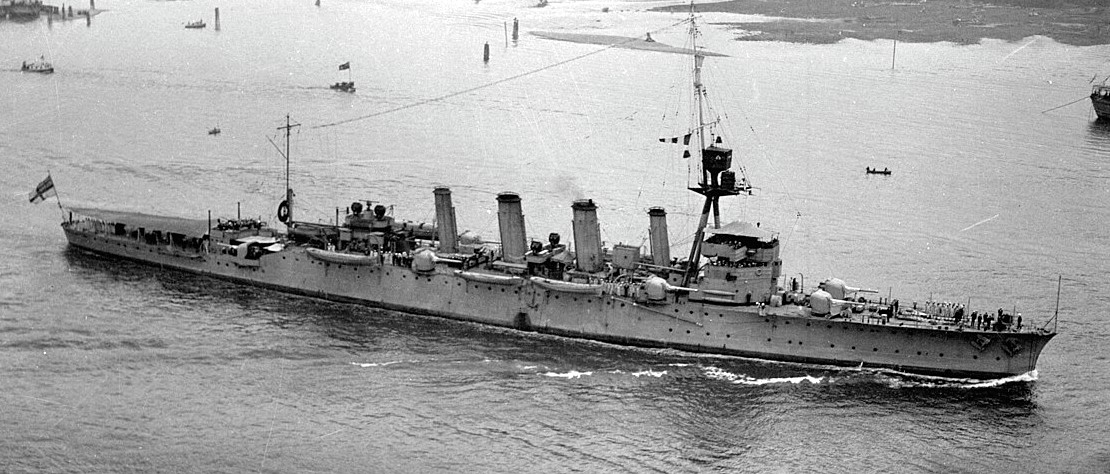
(City of Vancouver Archives Photo)
HMS Adelaide sailing into Burrard Inlet in British Columbia, Canada, during the 1924 Special Service Squadron world cruise.
HMAS Adelaide was a Town-class light cruiser of the Royal Australian Navy (RAN), named after Adelaide, the capital city of South Australia. Laid down in 1915, wartime shortages and design modifications meant the ship was not completed until 1922, earning her the nickname “HMAS Longdelayed”.
Adelaide served with the Royal Navy’s Special Service Squadron during 1924 and 1925, and was involved in the 1927 Malaita massacre. She was decommissioned in 1928, but was modernised and returned to service just before World War II began. During the war, Adelaide was involved in successful efforts to secure the colony of New Caledonia for Free France, was present during the Japanese midget submarine attack on Sydney Harbour, and intercepted the German blockade runner Ramses. The cruiser was decommissioned in 1946, and broken up for scrap in 1949. (Wikipedia)
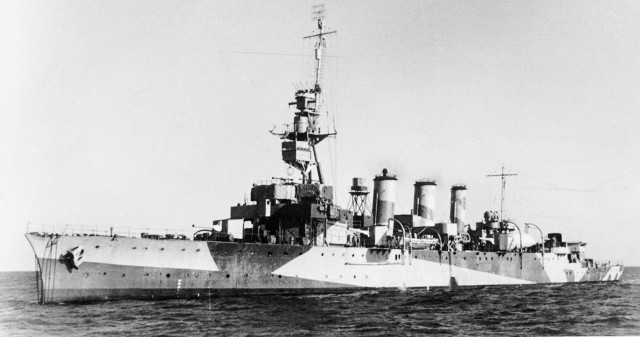
(AWM Photo)
Port bow view of the cruiser HMAS Adelaide. She is shown in her third armament configuration, armed with seven 6 inch and two 4 inch AA guns. Two 6 inch guns have been replaced in the waist by depth charge throwers; one of the guns has been remounted on the centreline aft, replacing a 4 inch AA gun. 20 mm Oerlikon AA guns are mounted port and starboard in the bridge wings, amidships and on the searchlight platform. The cruiser has been fitted with air search radar on her foremast, gunnery control radar on her main armament director and surface search radar on a platform forward of the fore funnel.
Birkenhead group 5,185 tons, ten 5.5-in guns. HMS Birkenhead, HMS Chester.
HMS Birkenhead
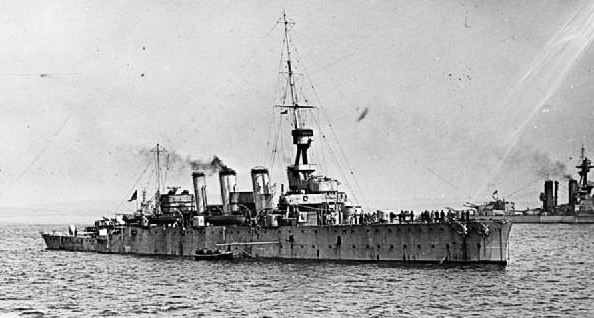
(IWM Photo, SP 1808)
HMS Birkenhead was one of two Town-class light cruisers originally ordered for the Greek Navy in 1914. She was to be named Antinavarchos Kountouriotis after Vice Admiral Pavlos Kountouriotis. The order was placed with Cammell Laird and production continued for the Greek account after the outbreak of the First World War in August 1914. In 1915, however, the two cruisers were purchased by the British government, and entered service with the Royal Navy.
The ship was laid down as Yard number 809 on 27 March 1914. Despite the outbreak of the First World War in August 1914, Greece continued to pay for the two cruisers, and construction continued for Greece, with Antinavarhos Kountoriotis being launched on 18 January 1915. However, with the war dragging on with no sign of a quick result, the Admiralty soon decided to purchase the two ships, with Antinavarhos Kountoriotis being renamed Birkenhead. She was completed in July 1915.
Like her sister, Chester, Birkenhead was assigned to the 3rd Light Cruiser Squadron of the Grand Fleet. On 26 September 1915, the accommodation ship Caribbean got into difficulties in heavy weather off Cape Wrath when on passage to Scapa Flow. On receipt of Caribbean’s distress signals, Birkenhead set out from Scapa to assist, and together with several tugs and yachts, rescued all but 15 of Caribbean’s crew before the accommodation ship sank on the next morning. Birkenhead continued her work-up and training before formally joining the 3rd Light Cruiser Squadron on 6 November. On 31 May to 1 June 1916, Birkenhead and Chester both took part in the Battle of Jutland. Birkenhead survived the battle, and the war and was sold for scrap on 26 October 1921 to Cashmore, of Newport. (Wikipedia)
HMS Chester
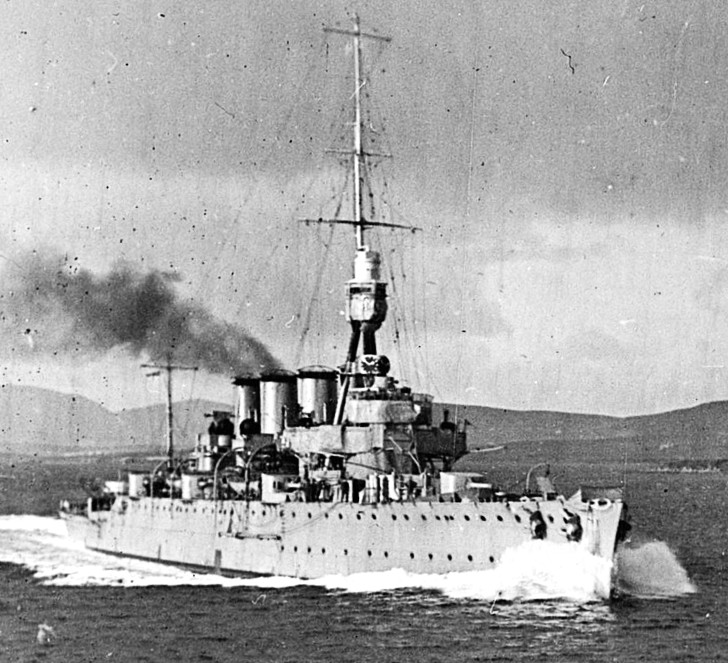
(IWM Photo, SP 892)
HMS Chester was a Town-class light cruiser of the Royal Navy, one of two ships forming the Birkenhead subtype. Along with sister ship, Birkenhead, she was originally ordered for the Greek Navy in 1914 and was to be named Lambros Katsonis. The order was placed with Cammell Laird and production continued for the Greek account after the outbreak of the First World War in August 1914. In 1915 the two cruisers were purchased by the British government. She fought at the Battle of Jutland where casualties included John ‘Jack’ Cornwell who was awarded the highest honour, aged 16.
The ship was laid down on 7 October 1914, launched on 8 December 1915 and entered service in May 1916, three weeks before the Battle of Jutland. At Jutland she fought as part of the 3rd Battle Cruiser Squadron and came under withering fire from German forces. She was hit by 17 150mm shells and suffered 29 men killed and 49 wounded; many of the wounded lost legs because the open backed gun-shields did not reach the deck and give adequate protection. Amongst the gun crew fatalities was 16-year-old John ‘Jack’ Cornwell who received the Victoria Cross for his dedication to duty though mortally injured. Chester served with the 3rd Light Cruiser Squadron until the Armistice and was subsequently placed in reserve. She was offered for re-sale to Greece but the offer was declined and the ship was sold for scrapping on 9 November 1921 to Rees, of Llanelly. The gun served by Cornwell is preserved in the Imperial War Museum in London. Mount Chester in the Canadian Rockies was named after this ship and nearby Mount Cornwell after John Cornwell. (Wikipedia)
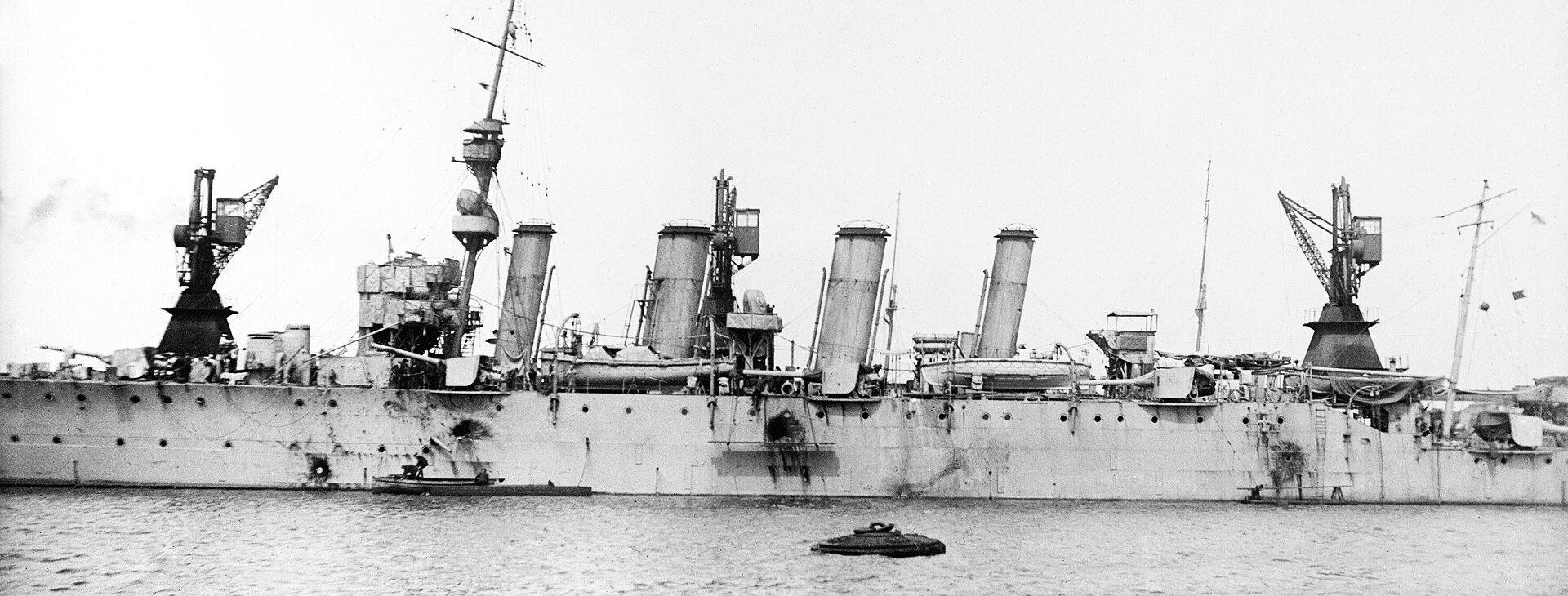
(IWM Photo, SP 1587)
HMS Chester, showing damage sustained at the Battle of Jutland, 31 May 1916.