Royal Navy light armoured cruisers: HMS Arethusa, HMS Aurora, HMS Galatea, HMS Inconstant, HMS Penelope, HMS Phaeton, HMS Royalist, HMS Undaunted.
The light armoured cruiser – light cruiser – succeeded the protected cruiser; improvements in machinery and armour rendering the latter obsolete. The Town class of 1910 were rated as second-class protected cruisers, but were effectively light armoured cruisers with mixed coal and oil firing. The Arethusa class of 1913 were the first oil-only fired class. This meant that the arrangement of coal bunkers in the hull could no longer be relied upon as protection and the adoption of destroyer-type machinery resulted in a higher speed. This makes the Arethusas the first “true example” of the warship that came to be recognized as the light cruiser. In the London Naval Treaty of 1930, light cruisers were officially defined as cruisers having guns of 6.1 inches (155 mm) calibre or less, with a displacement not exceeding 10,000 tons. (Wikipedia)
Arethusa class, 3,750 tons, two 6-in & six 4-in guns. HMS Arethusa, HMS Aurora, HMS Galatea, HMS Inconstant, HMS Penelope, HMS Phaeton, HMS Royalist, HMS Undaunted.
The Arethusa-class cruisers were intended to lead destroyer flotillas and defend the fleet against attacks by enemy destroyers. The ships were 456 feet 6 inches (139.1 m) long overall, with a beam of 49 feet 10 inches (15.2 m) and a deep draught of 15 feet 3 inches (4.6 m). Displacement was 3,512 long tons (3,568 t) at normal[2] and 4,400 long tons (4,500 t) at full load. Arethusa was powered by four Brown-Curtis steam turbines, each driving one propeller shaft, which produced a total of 40,000 shaft horsepower (30,000 kW). The turbines used steam generated by eight Yarrow boilers which gave her a speed of about 28.5 knots (52.8 km/h; 32.8 mph).[3] She carried 840 long tons (853 t) of fuel oil[2] that gave a range of 3,200 nautical miles (5,900 km; 3,700 mi) at 16 knots (30 km/h; 18 mph).
The main armament of the Arethusa-class ships consisted of two BL 6-inch (152 mm) Mk XII guns that were mounted on the centreline fore and aft of the superstructure and six QF 4-inch (102 mm) Mk V guns in waist mountings. They were also fitted with a single QF 3-pounder 47 mm (1.9 in) anti-aircraft gun and four 21-inch (533 mm) torpedo tubes in two twin mounts.
HMS Arethusa
(IWM Photo, SP 1161)
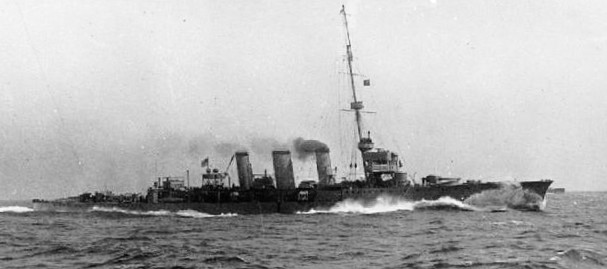
HMS Arethusa was the name ship of her class of eight light cruisers built for the Royal Navy in the 1910s. She saw a considerable amount of action during the early years of the First World War, participating in the Battle of Heligoland Bight and the Battle of Dogger Bank.
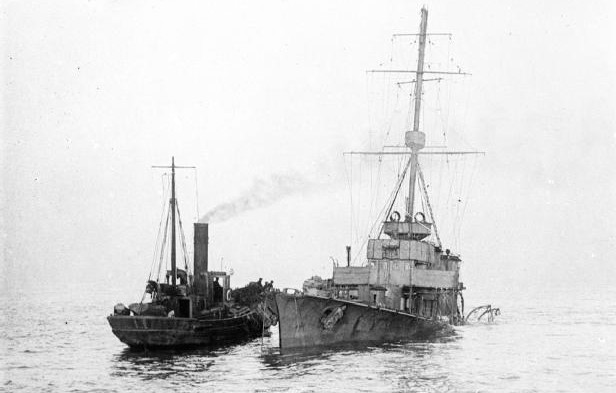
She was laid down at Chatham Dockyard in October 1912, launched on 25 October 1913, and commissioned in August 1914 as flotilla leader for the Harwich Force. On 28 August 1914, she fought at the Battle of Heligoland Bight, flying the flag of Commodore Reginald Tyrwhitt. She was seriously damaged by the German cruisers SMS Frauenlob and Stettin and had to be towed home. On 25 December, Arethusa took part in the Cuxhaven Raid and on 24 January 1915 she fought at the Battle of Dogger Bank. Later in the same year, she was transferred to the 5th Light Cruiser Squadron of the Harwich Force. In September 1915, she captured four German trawlers. On 11 February 1916, she struck a mine off Felixstowe, drifted onto a shoal while under tow, and broke her back.Approximately near Harwich (51.925, 1.295). (Wikipedia)
(IWM Photo, SP 1179)
A tug alongside the wreck of Arethusa after Arethusa was badly damaged by a mine off Felixstowe, 11 February 1916.
HMS Aurora
(Canadian Navy Heritage website. Image Negative Number E-6546-2)
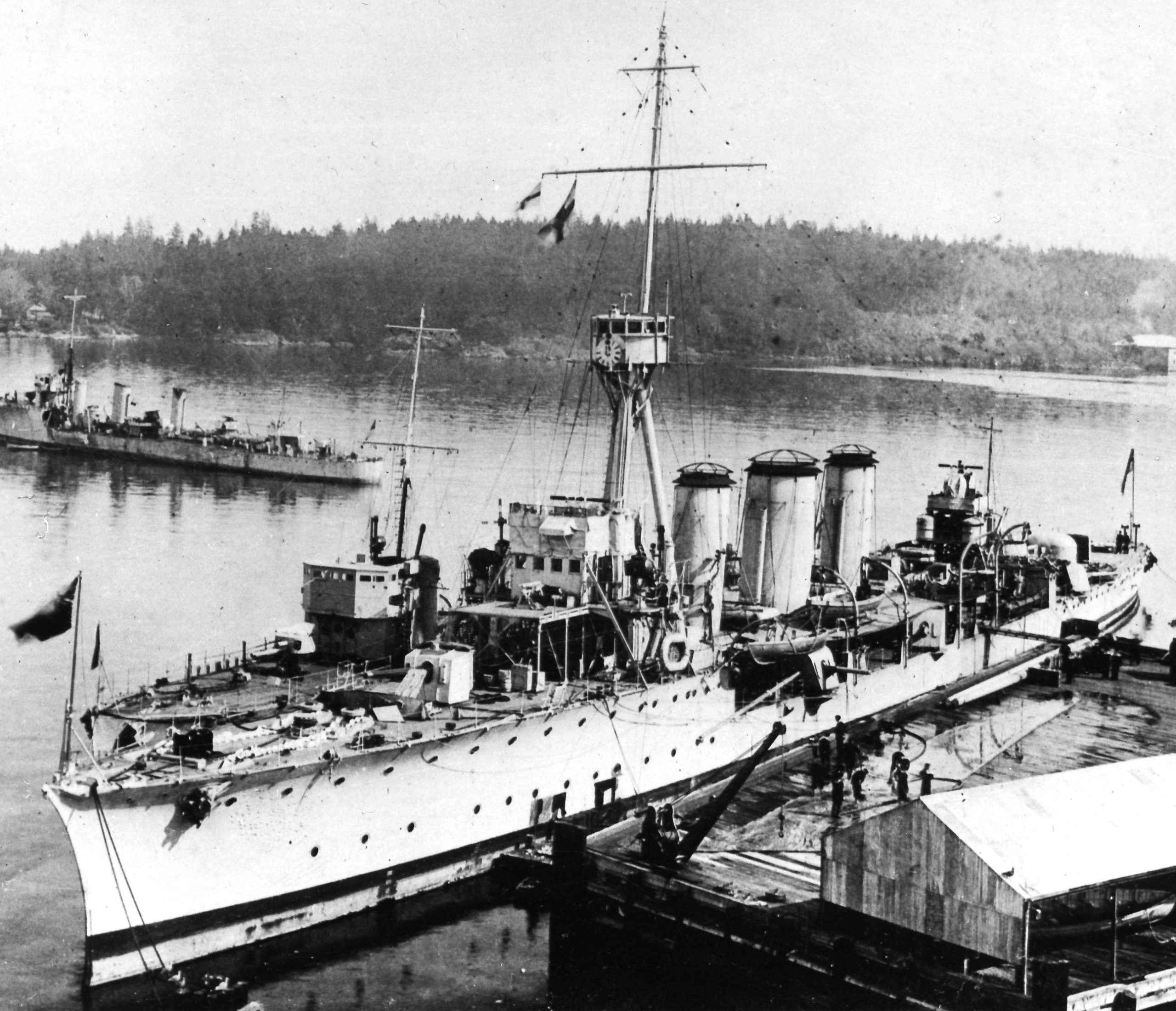
HMCS Aurora (foreground) and destroyers HMCS Patriot and HMCS Patrician in Esquimalt Harbour, British Columbia, c1921.
HMS Aurora was an Arethusa-class light cruiser that saw service in World War I with the Royal Navy. During the war, the cruiser participated in the Battle of Dogger Bank and was a member of the Grand Fleet when the main fleet of the Imperial German Navy surrendered to it in 1918. Following the war, Aurora was placed in reserve and in 1920, the cruiser was transferred to the Royal Canadian Navy. Her service with the Royal Canadian Navy was brief, being paid off in 1922. The cruiser was sold for scrap in 1927 and broken up.
Designed to augment the destroyer flotillas of the fleet, the Aurora-class cruisers displaced 3,750 long tons (3,810 t) normal and 4,400 long tons (4,500 t) at deep load. They were 436 feet (133 m) long overall with a beam of 39 feet (12 m) and a mean draught of 13 feet 5 inches (4.09 m). The cruisers were propelled by four shafts driven by Parsons turbines powered by steam from eight boilers creating 40,000 shaft horsepower (30,000 kW). This gave the ships a maximum speed of 28+1⁄2 knots (52.8 km/h; 32.8 mph). The cruisers carried 875 long tons (889 t) of fuel oil.
Aurora had an armoured belt of 3 inches (76 mm) that tapered to 1 inch (25.4 mm). The cruiser also had an armoured deck of 1 inch (25.40 mm). The cruiser was armed with two breech-loading (BL) 6-inch (152 mm)/45 calibre Mk XII guns and six quick-firing (QF) 4-inch (102 mm)/45 calibre Mk IV guns. For secondary armament the cruiser sported a single 3-pounder 1.9 in (47 mm) gun for anti-aircraft purposes and four 21-inch (533 mm) torpedo tubes in two twin mounts. The class had a maximum complement of 282. (Wikipedia)
The cruiser’s keel was laid down at Devonport Dockyard on 24 October 1912 and Aurora was launched on 30 September 1913. The ship was commissioned into the Royal Navy in September 1914.
Aurora saw service as part of Harwich Force from September 1914 to February 1915, as leader of the 1st Destroyer Flotilla. Based at Harwich under the command of Commodore Reginald Tyrwhitt, the unit was ordered to sea on 14 December 1914 as part of the force sent to intercept a German fleet under Admiral Franz von Hipper raiding towns on the east coast of England. However, the flotilla was prevented from intervening in the resulting engagement due to poor weather and returned to Yarmouth.
In January 1915, German command ordered a reconnaissance mission of the Dogger Bank by Hipper. At his disposal were three battlecruisers, one armoured cruiser, four light cruisers and nineteen destroyers.[6] The message ordering the German mission was intercepted by the Admiralty and Tyrwhitt’s force was among the units deployed for the coming battle.[7] Tyrwhitt’s force began to depart Harwich at 5:30 pm on 23 January. Aurora was among the ships that had departed after their commander and when Tyrwhitt met with Admiral David Beatty’s force the next morning, Aurora and the majority of Tyrwhitt’s force was 12 nautical miles (22 km; 14 mi) astern. However, Aurora and the majority of Tyrwhitt’s force encountered Hipper’s fleet at 7:05 am on 24 January, with the cruiser spotting a three-funneled cruiser and four destroyers on the horizon. Aurora closed to 8,000 yards (7,300 m) and challenged the ship, believing it to be Tyrwhitt’s flagship, Arethusa. The German cruiser SMS Kolberg opened fire on Aurora in response, hitting the ship three times. Aurora returned fire and sent a signal to the fleet that she was in battle.[8] The German armoured cruiser SMS Blücher was sunk. The light cruisers were ordered to standby to assist the crew of the sunken German cruiser. However, they came under air attack and the rescue efforts were cancelled.
In February 1915, she was assigned as leader of the 10th Destroyer Flotilla of the Harwich Force, guarding the eastern approaches to the English Channel. While a member of this unit, the cruiser was fitted with an aircraft flying-off platform over the forecastle allowing Aurora to launch a French monoplane. This was installed to counter the Zeppelin threat that harassed the Harwich Force. The design was ultimately unsuccessful as the aircraft could not intercept the Zeppelin fast enough and was uninstalled in August. The cruiser left the 10th Destroyer Flotilla in June and joined the 5th Light Cruiser Squadron, which Aurora remained with until the end of the war. That year, the cruiser also had her 3-pounder gun replaced with a QF 3-inch (76 mm) 20 cwt gun placed on the centreline aft.
In August 1915 she took part in sinking of the German raider Meteor. In September/October, the cruiser captured two naval trawlers In March 1916, Aurora covered the seaplane raid on Hoyer. In May 1917 the cruiser was fitted with chutes and rails for naval mines, which discharged over the stern. The ship carried 74 mines. Over the course of three mine-laying missions, the cruiser laid 212 mines. In 1917, the cruiser had her pole foremast replaced with a tripod carrying a light director and her torpedo tube armament was further augmented by a pair of tubes placed on the upper deck in front of the 6-inch gun. They were later moved ahead of the other torpedo tubes. In March 1918 Aurora was again reassigned, to the 7th Light Cruiser Squadron of the Grand Fleet. Aurora was one of the ships present at the surrender of the German High Seas Fleet in November 1918.
Between 1918 and 1920, Aurora was decommissioned to relieve financial pressures of the Home Fleet by the Admiralty. Her manning was reduced to a custodian crew and the relieved personnel were sent to other units. The cruiser remained in commission at Devonport from March 1919 to August 1920 and was paid off in September after being transferred to the Royal Canadian Navy. (Wikipedia)
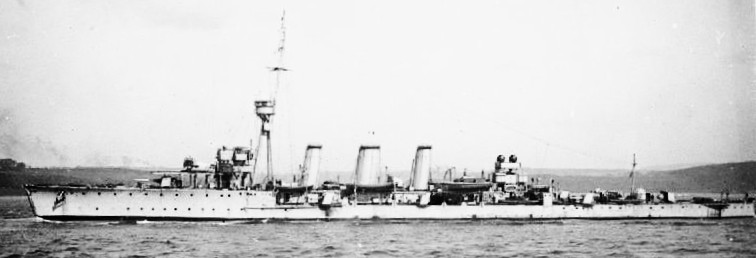
(IWM Photo, SP 1043)
HMS Aurora fitted with tripod mast and airplane platform forward, 1918.
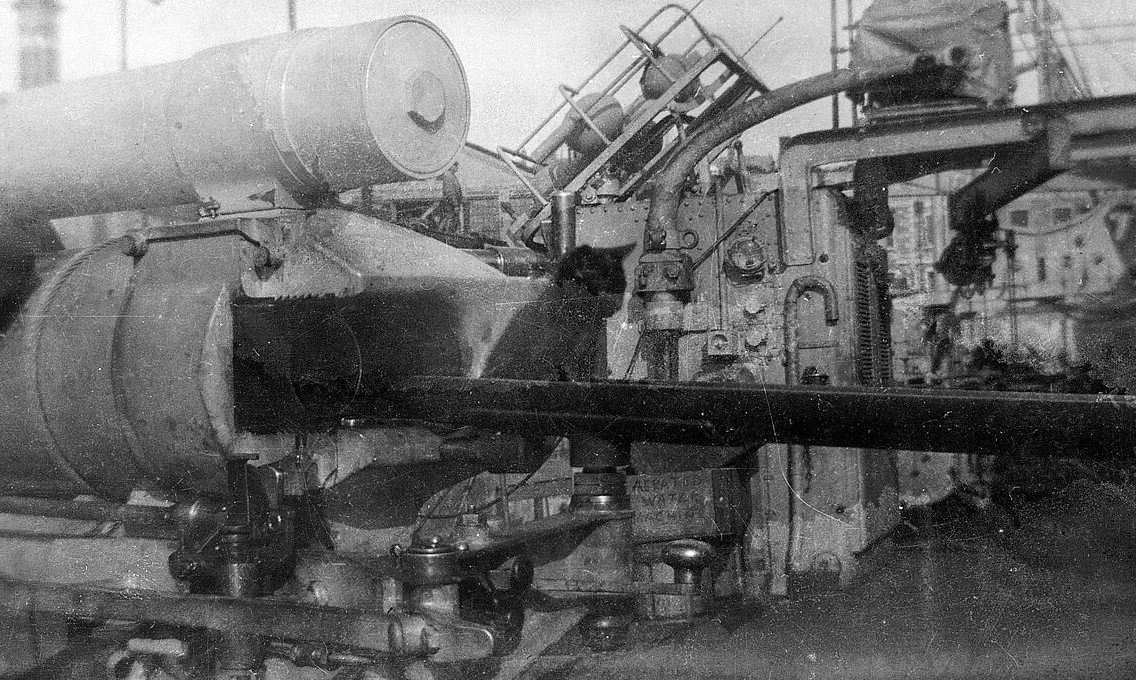
(National Maritime Museum Photo)
Black kitten on the shell loading tray of a QF 4-inch Mk. V gun, on the British cruiser HMS Aurora.
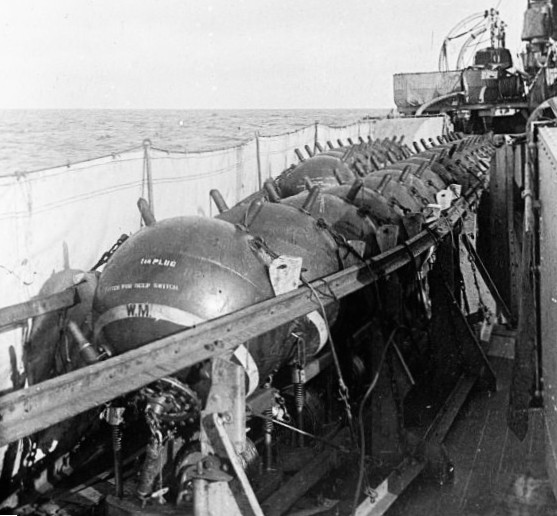
(IWM Photo, SP 1196)
Closeup of mines carried on port side aft, on Arethusa class cruiser HMS Aurora. The mines are shielded behind canvas screens.
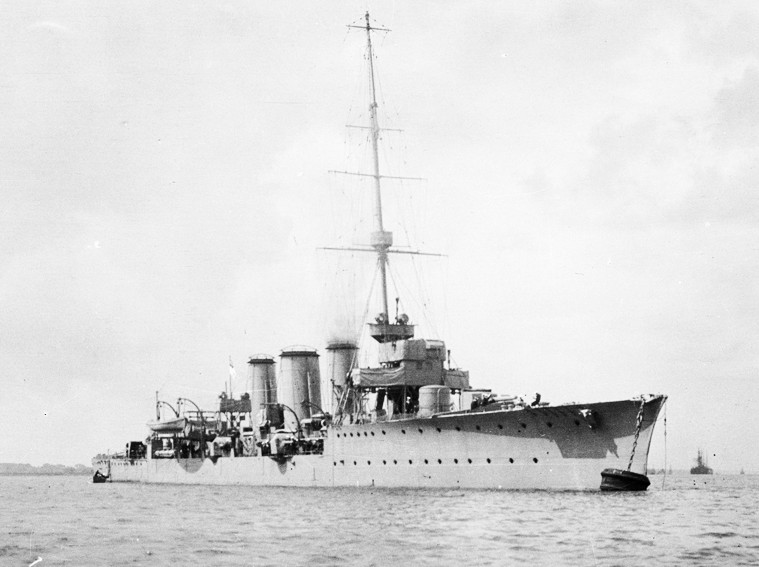
(British Film Institute Photo, N-590640)
HMS Aurora at moorings, Harwich, UK, 1915.
On 25 March 1920, the Canadian government accepted a British offer of one light cruiser and two destroyers to replace the two decrepit cruisers currently owned by Canada. Originally a Bristol-class cruiser was offered, however they ran on coal and the Canadian government negotiated for an oil-burning cruiser.[12] In 1920 Aurora was re-activated to outfit her for transfer to the Royal Canadian Navy. The cost of fitting out the cruiser for service in the northern Atlantic cost $10,495, exclusive of machinery and a refrigeration plant.
The Royal Canadian Navy commissioned her on 1 November 1920. She sailed shortly afterward from the United Kingdom for Halifax, Nova Scotia, arriving on 21 December with two ex-Royal Navy destroyers that had also been transferred.
After a minimal time in port at HMC Dockyard, the three ships set out for a training cruise via the Caribbean Sea to Esquimalt, British Columbia. The cruise masked the secret mission of carrying secret documents from the Admiralty to British consulates throughout Central and North America. While on the cruise, the squadron was ordered to Puntarenas, Costa Rica, where their presence was used to strengthen the Canadian government position in negotiations over oil concessions. Aurora returned to Halifax on 30 July 1921 via the same route.
In August 1921, drastic budget cuts resulted in the decommissioning of Aurora.[15] She was paid off on 1 July 1922 and disarmed. Her weapons were placed ashore in training facilities and on other active ships. Her crew was reduced to non-manned, much of her up-to-date equipment was salvaged for use in other Canadian warships. Aurora’s hulk was left alongside a jetty at the Canadian naval base in Halifax until 1927 when her deterioration resulted in city officials demanding the navy move her. The Royal Canadian Navy immediately sold her for scrap in August 1927 to A.A. Lasseque of Sorel, Quebec, and she was broken up. (Wikipedia)
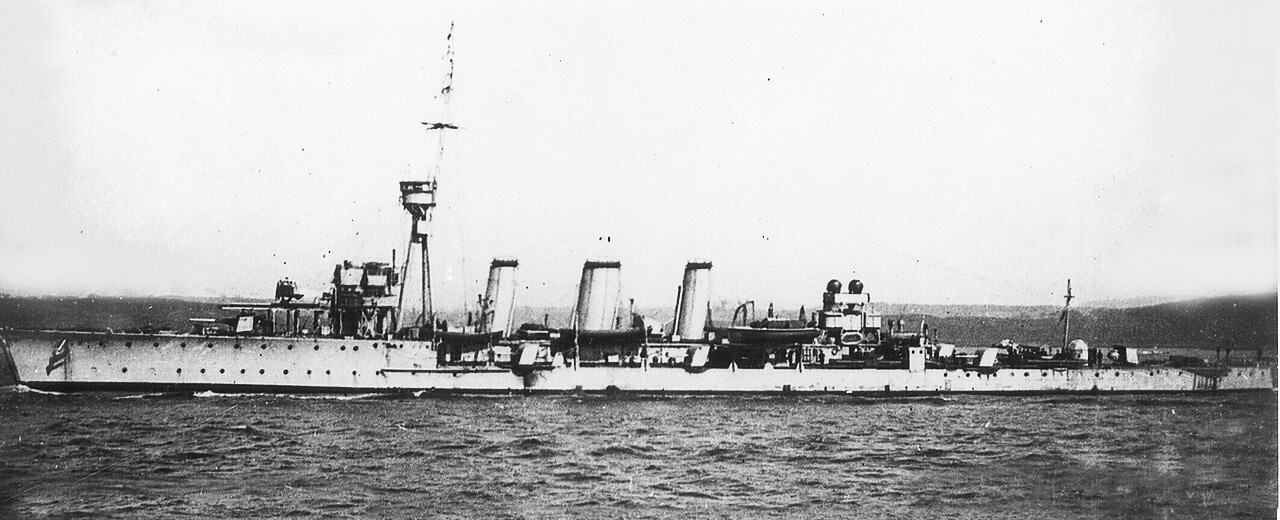
HMS Galatea
(Fotoafdrukken Koninklijke Marine Photo)
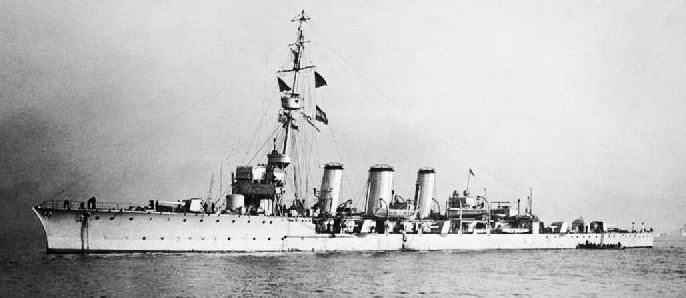
HMS Galatea was one of eight Arethusa-class light cruisers built for the Royal Navy in the 1910s. She fought in the First World War, participating in the Battle of Jutland. Following the war, she was scrapped.
She was launched on 14 May 1914 at William Beardmore and Company shipyard. On her commissioning she was assigned as the leader to the 2nd Destroyer Flotilla of the Harwich Force, guarding the eastern approaches to the English Channel. On 4 May 1916, she took part in the shooting down of Zeppelin L 7. At the Battle of Jutland, she was the flagship of the 1st Light Cruiser Squadron under Commodore E.S. Alexander-Sinclair. She was the first ship to report the presence of German ships, triggering the battle. Galatea was also the first to receive a hit by the German light cruiser SMS Elbing, but no explosion occurred. She was sold for scrapping on 25 October 1921. Mount Galatea in Alberta, Canada is named after this ship. (Wikipedia)
(IWM Photo, SP 1918)
HMS Galatea with original rig and 1914 armament.
HMS Inconstant
(IWM Photo, SP 1385)
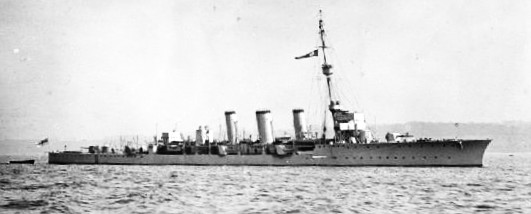
HMS Inconstant was one of eight Arethusa-class light cruisers built for the Royal Navy in the 1910s. She fought in the First World War, participating in the Battle of Jutland. Following the war, she was scrapped.
The ship was launched on 6 July 1914 at William Beardmore and Company shipyard. On being commissioned, she was assigned to the 1st Light Cruiser Squadron of the Grand Fleet. On 31 May to 1 June 1916 Inconstant took part in the Battle of Jutland. She survived the battle and the First World War, and was sold for scrapping on 9 June 1922 to Cashmore, of Newport. (Wikipedia)
HMS Penelope
HMS Penelope was one of eight Arethusa-class light cruisers built for the Royal Navy in the 1910s. She fought in the First World War, following the war, she was scrapped. She was launched on 25 August 1914 at Vickers Limited’s shipyard. Unlike her sisters, she carried an extra 4-inch anti-aircraft gun in place of two 3-inch anti-aircraft guns. In August 1915, she was assigned to the 5th Light Cruiser Squadron of the Harwich Force, guarding the eastern approaches to the English Channel. On 25 April 1916 Penelope was damaged by a torpedo from the German submarine UB-29 off the Norfolk coast. She was repaired and in March 1918 was reassigned to the 7th Light Cruiser Squadron of the Grand Fleet. She survived to the end of the First World War, and was sold for scrap in October 1924 to Stanlee, of Dover. (Wikipedia)
HMS Phaeton
HMS Phaeton was one of eight Arethusa-class light cruisers built for the Royal Navy in the 1910s. She fought in the First World War, participating in the Battle of Jutland. Following the war, she was scrapped. The ship was launched on 21 October 1914 at Vickers Limited’s shipyard. On being commissioned, she was assigned to the 4th Light Cruiser Squadron of the Grand Fleet, and between February and March 1915 was operating in the Dardanelles in support of the Allied landings at Gallipoli. On Phaeton’s return to home waters, she was assigned to the 1st Light Cruiser Squadron of the Grand Fleet and by mid-April 1915 she was operating out of Scapa Flow. On 4 May 1916 she took part in shooting down the Zeppelin L 7. On 31 May to 1 June 1916 Phaeton took part in the Battle of Jutland. She survived the First World War, and was sold for scrapping on 16 January 1923 to King, of Troon. (Wikipedia)
HMS Royalist
(IWM Photo, Q 75362)
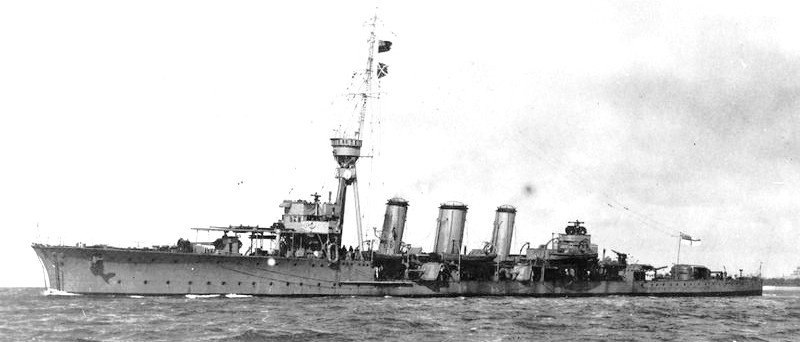
HMS Royalist was one of eight Arethusa-class light cruisers built for the Royal Navy in the 1910s. She fought in the First World War, participating in the Battle of Jutland. Following the war, she was scrapped. She was launched on 14 January 1915 at William Beardmore and Company’s shipyard. On being commissioned, she was assigned to the 4th Light Cruiser Squadron of the Grand Fleet. From 31 May to 1 June 1916 Royalist took part in the Battle of Jutland. She survived the battle and in February 1917 was reassigned to the 1st Light Cruiser Squadron of the Grand Fleet. She survived the First World War, and was sold for scrapping on 24 August 1922 to Cashmore, of Newport. (Wikipedia)
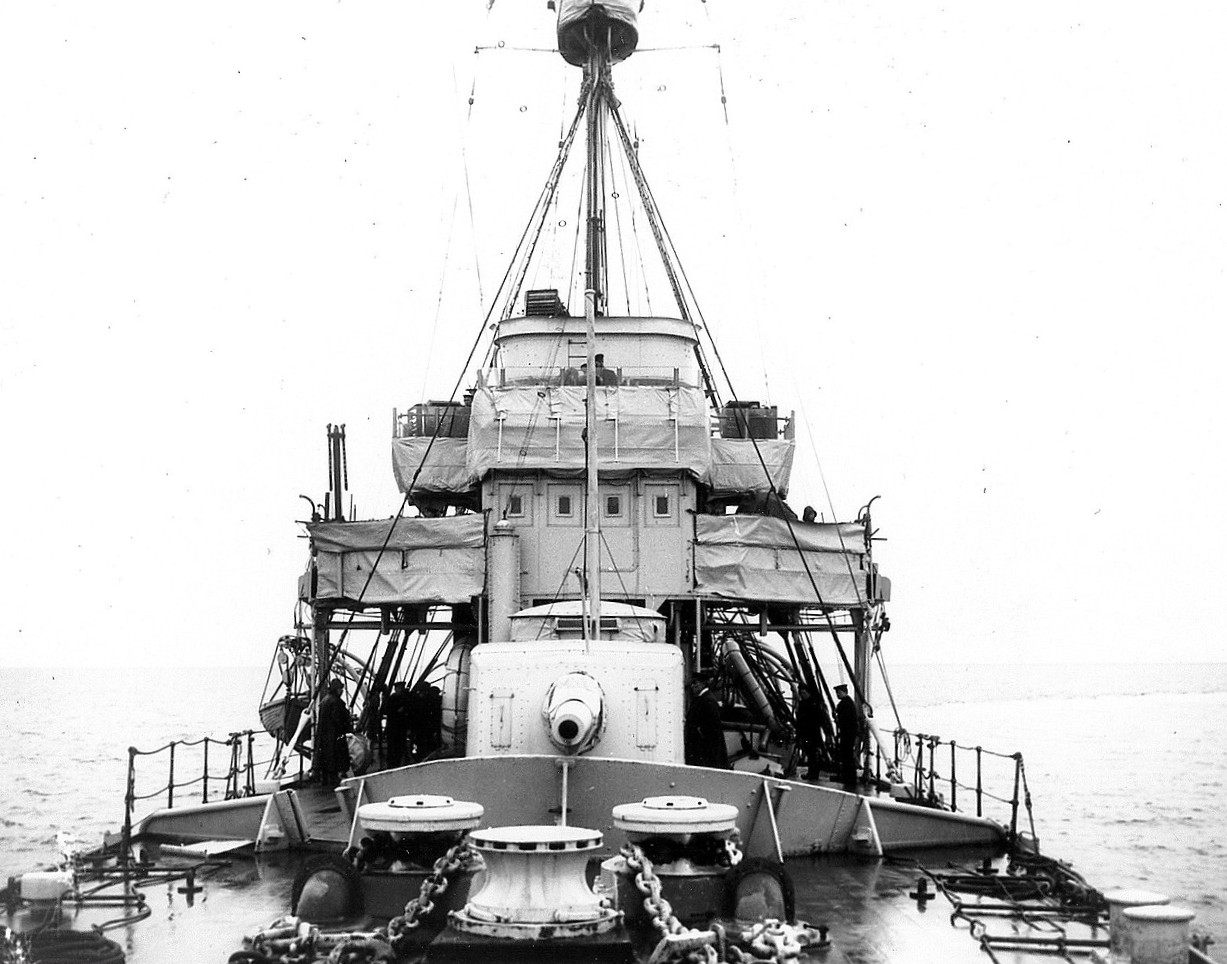
(Library and Archives Canada Photo, PA-006533)
HMS Royalist forward 6-inch gun.
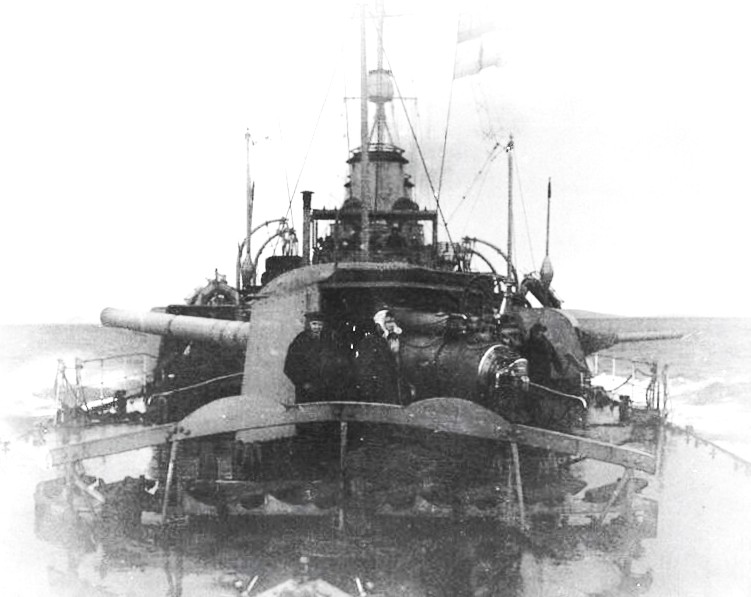
(Library and Archives Canada Photo, MIKAN No. 3404656)
Firing practice on the aft 6-inch gun of British cruiser HMS Royalist.
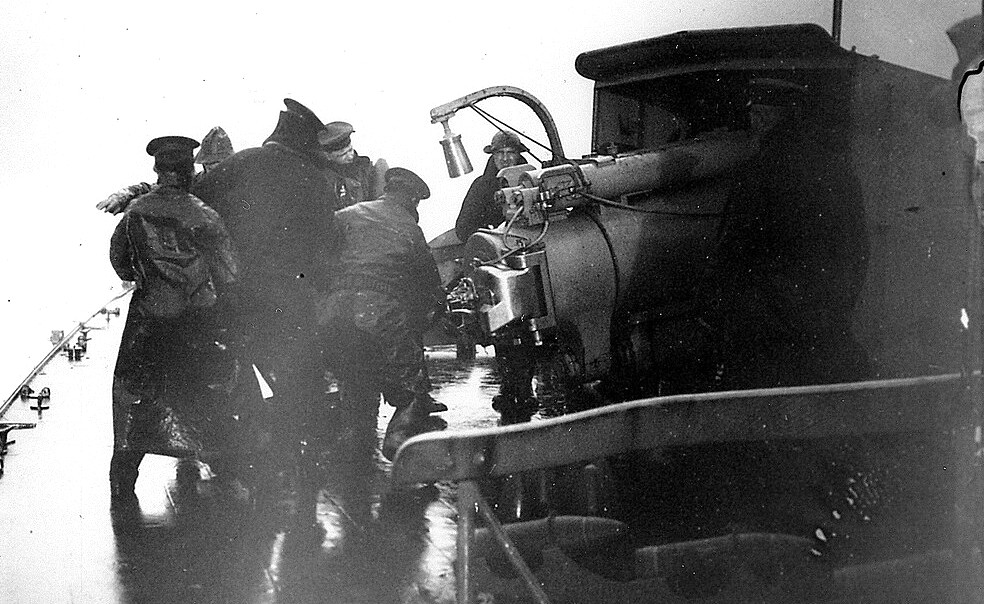
(Library and Archives Canada Photo, MIKAN No. 3404654)
Firing practice on the aft 6-inch gun of British cruiser HMS Royalist.
HMS Undaunted
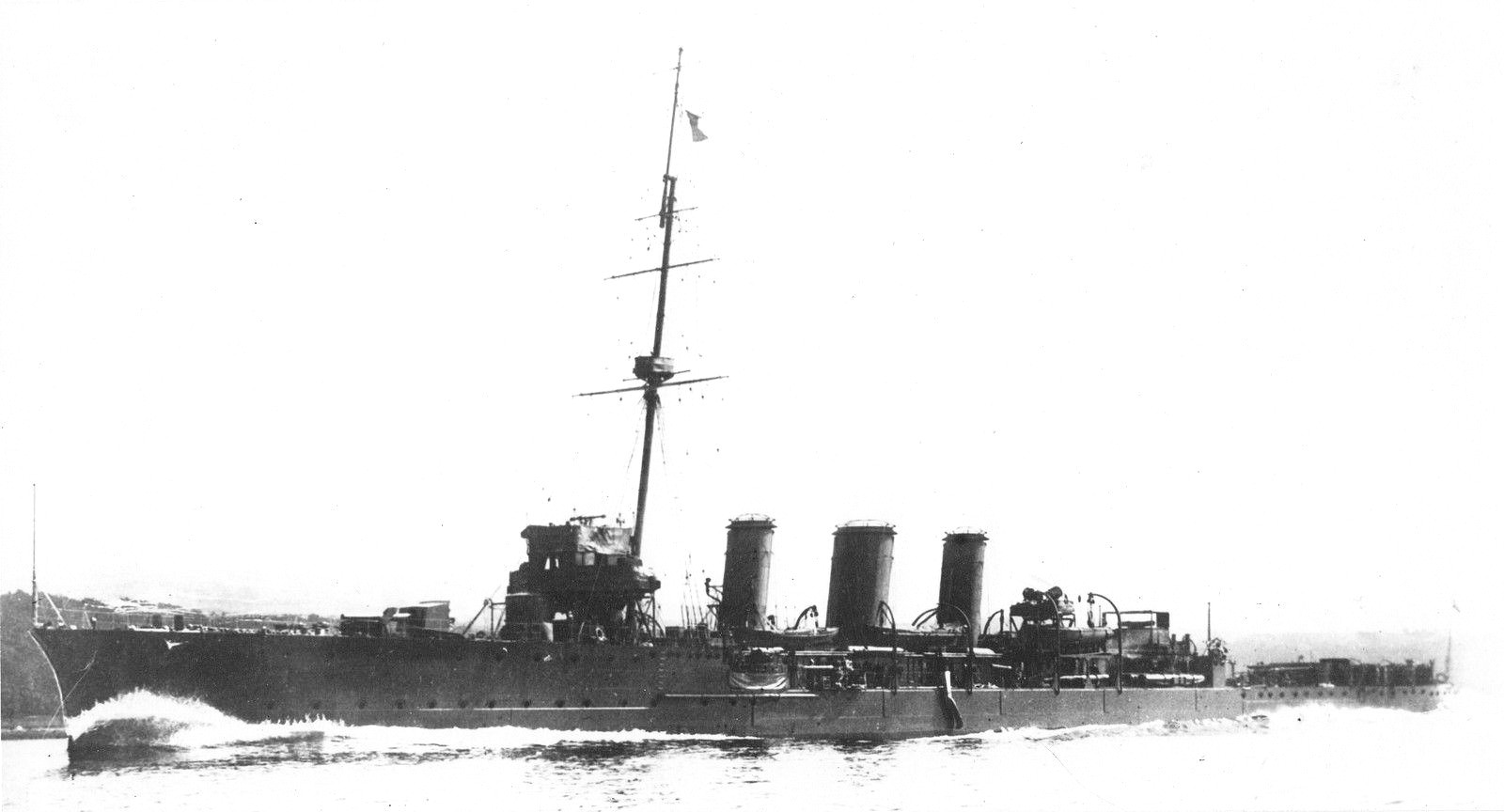
(Royal Navy Photo)
HMS Undaunted was one of eight Arethusa-class light cruisers built for the Royal Navy in the 1910s. She was launched on 28 April 1914 at Fairfield Shipbuilding and Engineering Company’s shipyard at Govan. Undaunted participated in numerous naval operations during the First World War. On commissioning she was assigned as the leader of the 3rd Destroyer Flotilla of the Harwich Force, guarding the eastern approaches to the English Channel. On 28 August 1914, Undaunted took part in the Battle of Heligoland Bight, and on 17 October 1914 she was involved in an action off the Dutch island of Texel with German torpedo boats. On 25 December 1914 she participated in the Cuxhaven Raid, and on 24 January 1915 she took part in the Battle of Dogger Bank. In April 1915 Undaunted was damaged in collision with the destroyer Landrail, and on 24 March 1916 she was again damaged in a collision, this time with the light cruiser Cleopatra while covering the a raid on a Zeppelin base believed to be at Hoyer in Schleswig-Holstein. In November 1918 was reassigned to the 4th Light Cruiser Squadron of the Grand Fleet. She survived to see the end of the First World War, and was sold for scrap on 9 April 1923 to Cashmore, of Newport. (Wikipedia)