
Royal Navy dreadnought-class battleships: HMS Agincourt, HMS Erin, HMS Canada
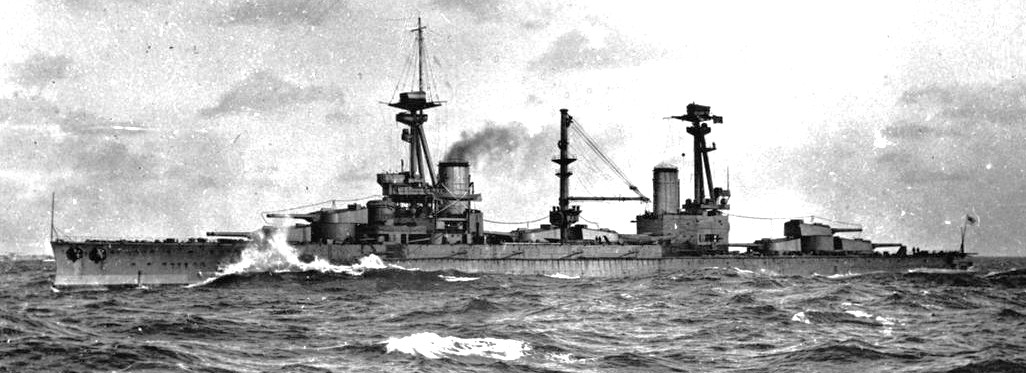
(Royal Navy Photo)
HMS Agincourt was laid down in Newcastle upon Tyne in 1911 as the Brazilian battleship Rio de Janeiro, but was sold to the Ottoman Empire in December 1913, named Sultân Osmân-ı Evvel, and was seized by the British government and given her final name when Turkey entered the First World War for the Central Powers. Agincourt, 671 feet 6 inches (205 m) long and displacing 27,850 long tons (28,300 t), was powered by four Parsons steam turbines and shafts for a top speed of 22 knots (41 km/h; 25 mph).[134] She was armed with fourteen 45-calibre Mk XIII 12-inch (305 mm) main guns, and eighteen 50-calibre Mk XIII 6-inch (152 mm) naval guns for its secondaries, and was protected by belt armour 9 inches (229 mm) thick.
After being commissioned into the Royal Navy on 7 August 1914, Agincourt joined the Grand Fleet’s 4th Battle Squadron on 7 September 1914 but was reassigned to the 1st Battle Squadron on 31 May 1916, just in time for the Battle of Jutland. She engaged a German battlecruiser and destroyers and a Kaiser-class battleship with her main and secondary guns,[138][139] firing a total of 144 of her main battery shells and secondary shells, but is not known to have hit any enemy ship. Agincourt’s participation in the Royal Navy’s sorties after Jutland is not well explored, but she did sortie once with HMS Hercules from Scapa Flow to protect merchant convoys from Norway to the United Kingdom on 23 April 1918. After being transferred to the 2nd Battle Squadron, Agincourt was present for the surrender of the High Seas Fleet and was then placed in reserve in March 1919. The Brazilian government was not interested in purchasing her, so Agincourt was listed for disposal and then sold for scrap on 19 December 1922 in accordance with the Washington Naval Treaty. (Wikipedia)
HMS Erin
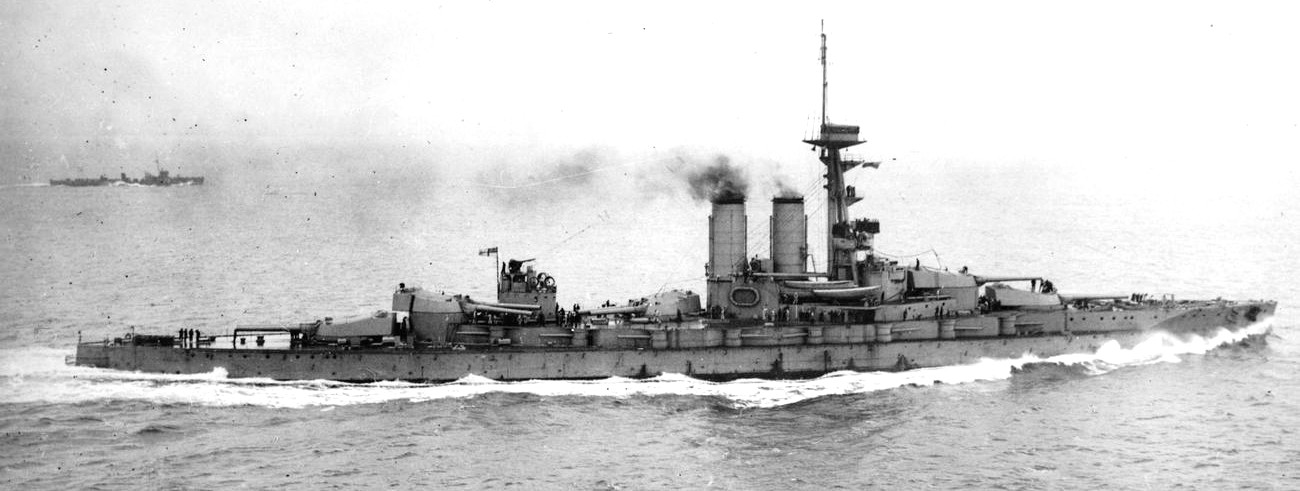
(IWM Photo, SP 531)
HMS Erin, originally the Turkish battleship Reşadiye, was one of two battleships being built for the Ottoman Empire (the other being HMS Agincourt) and was derived from the King George V class. She had Krupp 12-inch (300 mm) armour belt and was equipped with ten 45-calibre Mk VI 13.5-inch (340 mm) guns, similar to the King George V class’s main guns, but had the Orion class’s sixteen 50-calibre Mk XVI 6-inch (150 mm) secondary guns. She was shorter in length at 559 feet 6 inches (171 m) and displaced 22,780 long tons (23,150 t). Unlike either the Orion or King George V-class battleships, Erin had four Parsons steam turbines driving four shafts for a top speed of 21 knots (39 km/h; 24 mph).
On 29 July 1914, Reşadiye was seized under the orders of First Lord of the Admiralty Winston Churchill, and on the 31st it entered the Royal Navy as HMS Erin.[147] She joined the Grand Fleet’s 4th Battle Squadron on 5 September of the same year and participated in the fleet’s early war sorties and drills, most importantly in response to the German attack on Scarborough, Hartlepool and Whitby.[148] At some point from September to December 1915, Erin was transferred to the 2nd Battle Squadron. She participated in the Battle of Jutland, but was hindered by poor visibility and was the only British capital ship to not fire her main battery guns and only fired six 6-inch shells. After Jutland, Erin returned to active participation in the Grand Fleet’s North Sea operations, sortieing against High Seas Fleet raids on merchant convoys and at the end of war was present for the surrender of the High Seas Fleet at Rosyth, Scotland on 21 November 1918. On 1 May 1919, Erin was assigned to the Home Fleet’s 3rd Battle Squadron, but entered the reserves at Portland Harbour in October at the Nore. From July to August 1920 Erin underwent a refit as a gunnery practice ship, but came to be in violation of the Washington Naval Treaty of 1922 and was sold for scrap on 19 December 1922. (Wikipedia)
HMS Canada
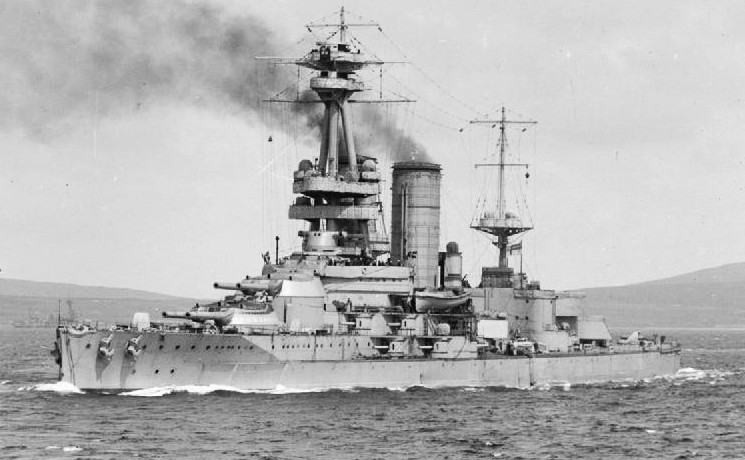
(IWM Photo, SP 1938)
In 1911, Chile ordered two battleships, Almirante Latorre and Almirante Cochrane (later HMS Eagle) from the Armstrong Whitworth company. Canada resembled the British Iron Duke-class battleships, but had changes in its above-deck structures and was longer at 625 feet (191 m). She was also more heavily armed, sporting ten 45-calibre 14-inch (360 mm) main guns and sixteen 50-calibre Mk XI 6-inch (150 mm) secondary guns, but lightly armoured with only 9 inches (230 mm) on her belt, making her an oddity in the Royal Navy. Her propulsion means was also unusual for British battleships. Four shafts were powered by two sets of Brown & Curtis and Parsons steam turbines gave Canada a top speed of 24 kn (44 km/h; 28 mph), making her one of the Royal Navy’s fastest battleships.
On 9 September 1914, the British government purchased Almirante Latorre from Chile and christened her HMS Canada and undertook some minor alterations. She was commissioned on 15 October 1915, and assigned to the 4th Battle Squadron. She participated in the Battle of Jutland on 31 May 1916, firing a totality of 42 shells from her main guns and 109 secondary shells at SMS Wiesbaden, an unspecified German capital ship, and several destroyers, but did not make or receive any hits. Canada was transferred to the 1st Battle Squadron on 12 June 1916 and subsequently underwent more modification, and was placed in the reserves in March 1919. In April of the next year, she was sold back to Chile and resumed her original name. (Wikipedia)