
Squadron Leader Ian Willoughby Bazalgette, VC, DFC
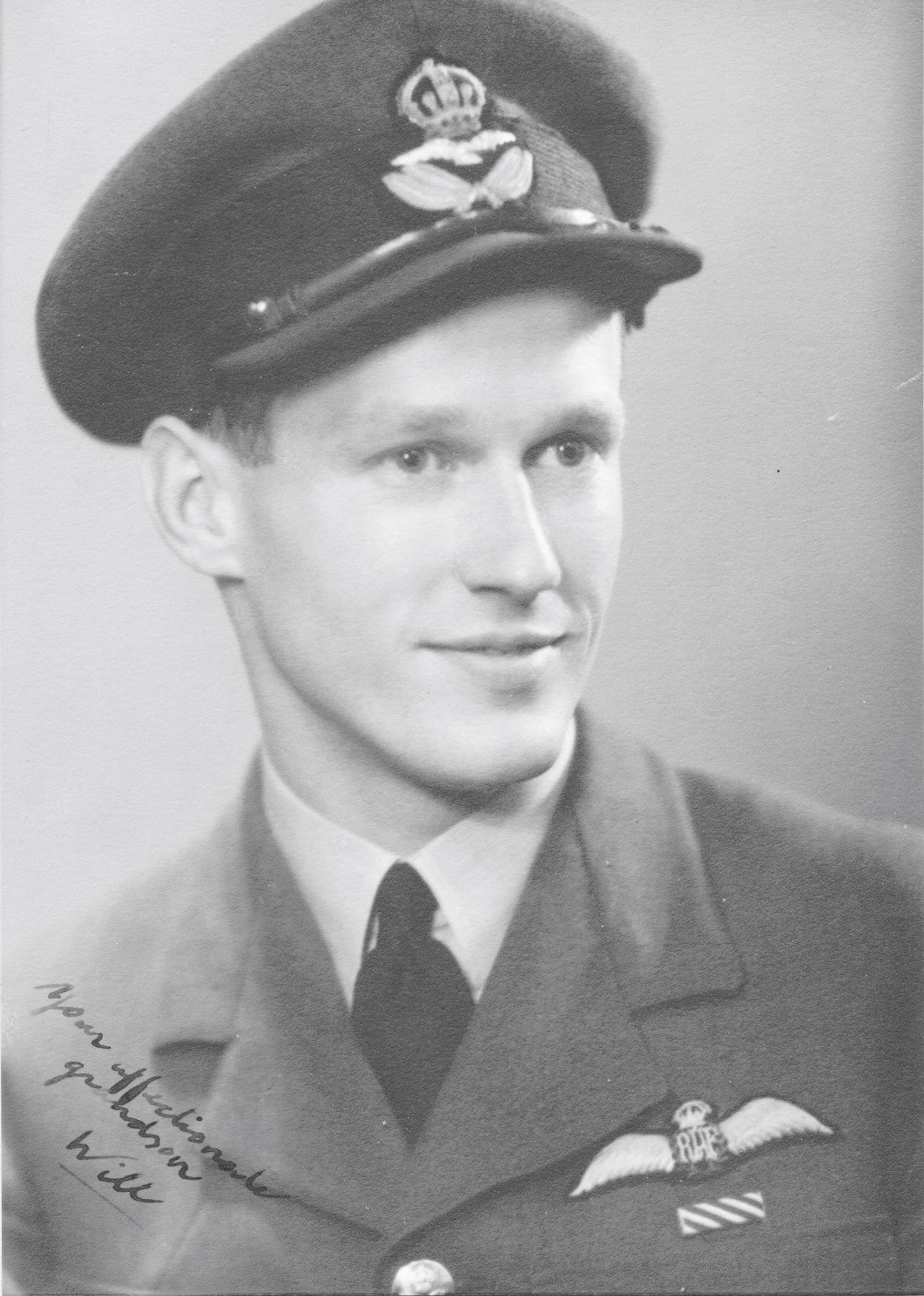
(Bomber Command Museum Photo)
Squadron Leader Ian Willoughby Bazalgette, VC, DFC (19 October 1918 – 4August 1944) was a Canadian-British pilot in the Royal Air Force during the Second World War. S/L Bazalgette was the “Master Bomber” of a Pathfinder Squadron detailed to mark an important target for the main bomber force. On 4 August 1944, while piloting an Avro Lancaster in a pathfinder role, Bazalgette and crew flew to Trossy St. Maximin in France to mark a V-1 flying bomb storage cave.
When nearing the target, his Lancaster came under heavy anti-aircraft fire. Both starboard engines were put out of action and serious fires broke out. The bomb aimer was badly wounded. As the deputy ‘Master Bomber’ had already been shot down, the success of the attack depended on S/L Bazalgette and this he knew. Despite the appalling conditions in his burning aircraft, he pressed on to the target, marking and bombing it accurately. After the bombs had been dropped the Lancaster dived, practically out of control. By expert airmanship and great exertion, S/L Bazalgette regained control. The port inner engine then failed and the whole of the starboard main-plane became a mass of flames. S/L Bazalgette fought to bring his aircraft and crew to safety. The mid-upper gunner was overcome by fumes.
S/L Bazalgette then ordered the members of his crew who were able to leave by parachute to do so. F/L Charles Godfrey DFC, Sgt George Turner, F/O Douglas Cameron DFM, and F/L Geoffrey Goddard bailed out. He remained at the controls and attempted the almost hopeless task of landing the crippled and blazing aircraft in a last effort to save the wounded bomb aimer and helpless air gunner near Senantes (Oise).
With superb skill and taking great care to avoid a small French village nearby, he brought the aircraft down safely. Unfortunately, it then exploded, killing him and the remaining two wounded crew members, F/L Ivan Hibbert DFC and F/S Vernon Leeder. S/L Bazalgette was posthumously awarded the VC.
Ian Willoughby Bazalgette was born in Calgary, Alberta, Canada on 19 October 1918 to parents of English and Irish background, Charles Ian Bazalgette (1888–1956) and Marion Edith, née Bunn (1891–1977). His great-grandfather was the civil engineer Sir Joseph Bazalgette. Bazalgette was always known as “Will” in his family, to distinguish him from his father, who was known as “Ian”. Bazalgette began his schooling at the Toronto Balmy Beach School, but his family returned to England in 1927. He grew up in New Malden, England and attended Rokeby School in Wimbledon (1927–1932) and then Beverley Boys Secondary School as well as receiving private tutelage. In his childhood he suffered from poor health, and at 13 was diagnosed with clinical tuberculosis, which required four months of treatment at the Royal Sea-Bathing Hospital, Margate, in 1931.
When the Second World War broke out, Bazalgette enlisted in the Royal Artillery, being commissioned as a second lieutenant in 1940. After serving in the Searchlight Section as an instructor, he transferred to the Royal Air Force Volunteer Reserve. He soloed within a week of beginning his flight training at RAF Cranwell and swiftly completed his ab initio flying by 24 January 1942, given the rank of pilot officer. His first posting was to No. 25 Operational Training Unit (OTU) but by September 1942, he had joined an operational bomber squadron, No. 115 Squadron RAF at RAF Mildenhall, Suffolk. Flying the venerable Vickers Wellington bomber, “Baz” was sent out initially on “gardening” sorties, laying mines in the North Sea. After 13 operations, Bazalgette and his squadron transitioned to the Avro Lancaster, completing their training in March 1943.
After completing 10 more operations successfully on raids against heavily defended targets, including Berlin, Essen, Kiel and St. Nazaire, and surviving some harrowing escapes including a crash landing, Bazalgette was awarded the Distinguished Flying Cross (DFC) on 29 May 1943. The award noted his “great courage and determination in the face of the enemy”. With the end of his tour of 28 operations, Bazalgette was posted as an instructor and Flight Commander to No. 20 OTU in Lossiemouth, Scotland, before he was “recruited” for the Pathfinders. He transferred in April 1944 to No. 635 Squadron RAF, part of No. 8 (Pathfinder Force) Group, based at RAF Downham Market in Norfolk.
When his conversion training was completed, 25-year-old “Baz” flew as an acting squadron leader, taking part in a number of operations during and after the D-Day campaign. As the assigned Master Bomber, Bazalgette’s 58th and final operation was the bombing of V-1 rocket storage caves at Trossy St. Maximin.
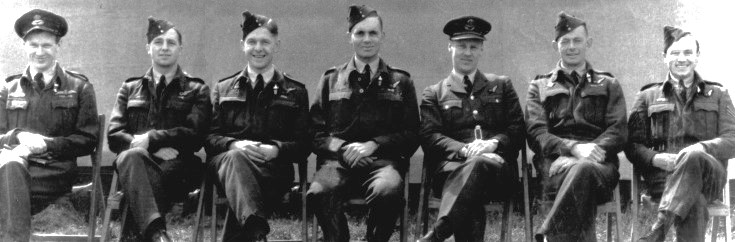
Baz’s Crew; (l-r) Ian Bazalgette, Geoff Goddard, Ivan Hibbert, Chuck Godfrey, Bob Hurnall, Douglas Cameron, George Turner.
A memorial to Bazalgette, Hibbert, and Leeder can be seen along the road beside the farm where he landed the plane. Bazalgette Gardens in New Malden, Surrey, where he had attended Beverley Boys School, was named in his honour during the early 1950s. A school in Calgary, Ian Bazalgette Junior High School, is also named after him.
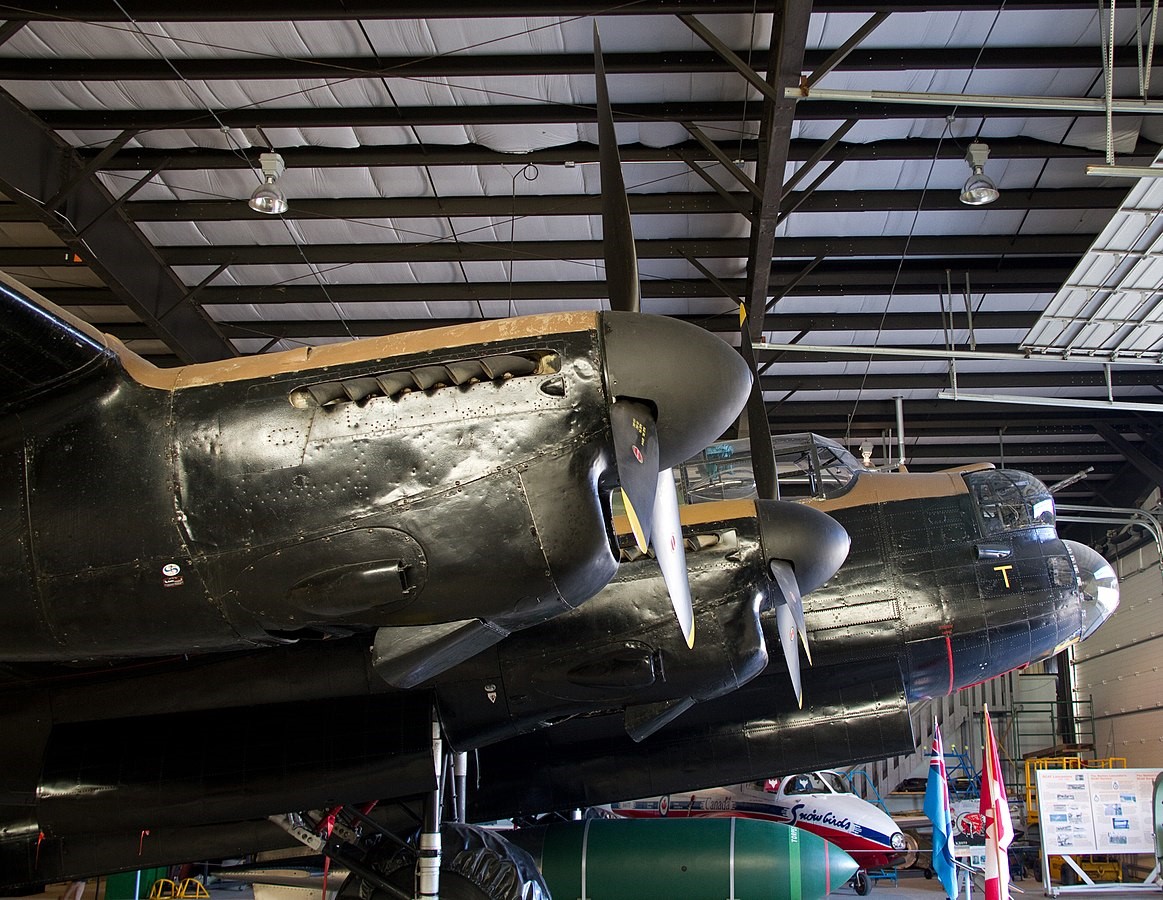
(Tony Hisgett Photo)
Avro Lancaster (Serial No. FM159),Nanton, Alberta.
The Bomber Command Museum of Canada at Nanton, Alberta, south of S/L Bazalgette’s hometown of Calgary, has restored and painted Avro Lancaster(Serial No. FM159), in the colours and markings of S/L Bazalgette’s aircraft. A dedication ceremony was held in 1990. Group Captain T.G. “Hamish” Mahaddie, who had honored Bazalgette’s request to be transferred into the Pathfinders, came from England to speak at the ceremony. Ethel Broderick, Bazalgette’s sister, unveiled a plaque and the markings of the Bazalgette aircraft, coded F2-T, were unveiled by two of Bazalgette’s crew members, Chuck Godfrey and George Turner.
All comments are subject to our Comment Policy. You must be at least 18 years old to comment.
See a comment that violates our guidelines? Report it here.