
Royal Navy light armoured cruisers: C class, Caroline group: HMS Caroline, HMS Carysfort, HMS Cleopatra, HMS Comus, HMS Conquest, HMS Cordelia, HMS Calliope, HMS Champion.
The light armoured cruiser – light cruiser – succeeded the protected cruiser; improvements in machinery and armour rendering the latter obsolete. The Town class of 1910 were rated as second-class protected cruisers, but were effectively light armoured cruisers with mixed coal and oil firing. The Arethusa class of 1913 were the first oil-only fired class. This meant that the arrangement of coal bunkers in the hull could no longer be relied upon as protection and the adoption of destroyer-type machinery resulted in a higher speed. This makes the Arethusas the first “true example” of the warship that came to be recognized as the light cruiser. In the London Naval Treaty of 1930, light cruisers were officially defined as cruisers having guns of 6.1 inches (155 mm) calibre or less, with a displacement not exceeding 10,000 tons. (Wikipedia)
The C class was a group of twenty-eight light cruisers of the Royal Navy, and were built in seven groups known as the Caroline class (six ships), the Calliope class (two ships), the Cambrian class (four ships), the Centaur class (two ships), the Caledon class (four ships), the Ceres class (five ships) and the Carlisle class (five ships). They were built for the rough conditions of the North Sea, and proved to be rugged and capable vessels, despite being somewhat small and cramped.
C class, Caroline group 4,219 tons, two 6-in & eight 4-in guns. HMS Caroline, HMS Carysfort, HMS Cleopatra, HMS Comus, HMS Conquest, HMS Cordelia.
HMS Caroline
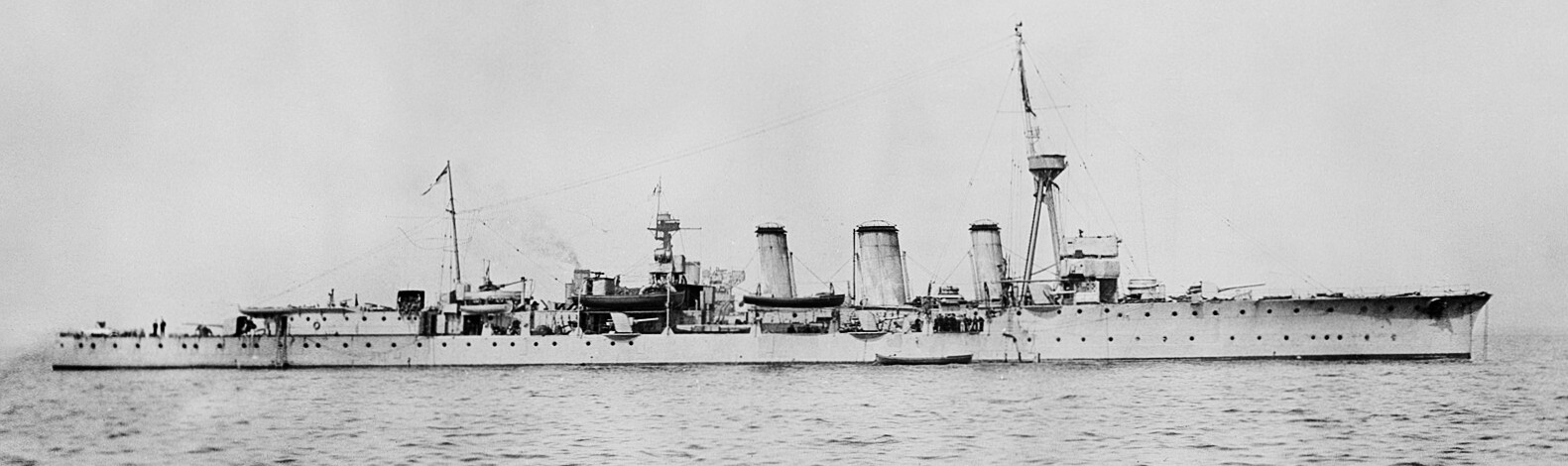
(IWM Photo, SP 1310, 1917)
HMS Caroline is a decommissioned C-class light cruiser of the Royal Navy that was the lead ship of her sub-class. Completed in 1914, she saw combat service during the First World War and served as an administrative centre in the Second World War. The ship served as a static headquarters and training ship for the Royal Naval Reserve, based in Alexandra Dock, Belfast, Northern Ireland, for the later stages of her career. At the time of her decommissioning in 2011, she was the second-oldest ship in Royal Navy service, after the ship-of-the-line HMS Victory. Caroline was converted into a museum ship after she was decommissioned. From October 2016, she underwent inspection and repairs to her hull at Harland and Wolff and opened to the public on 1 July 2017 at Alexandra Dock in the Titanic Quarter in Belfast.
HMS Caroline was the last remaining British First World War light cruiser in service, and she is the last survivor of the Battle of Jutland still afloat. She is also one of only three surviving Royal Navy warships of the First World War, along with the 1915 monitor HMS M33 (in Portsmouth dockyard), and the Flower-class sloop HMS President, (formerly HMS Saxifrage) usually moored on the Thames at Blackfriars but as from February 2016, in Number 3 Basin, Chatham. (Wikipedia)

(Reading Tom Photo)
HMS Caroline, a C-class light cruiser of the Royal Navy launched in 1914 that saw combat service in the First World War and served as an administrative centre in the Second World War. Caroline was launched and commissioned in 1914. After serving as a static headquarters and training ship for the Royal Naval Reserve, based in Alexandra Dock, Belfast, Northern Ireland, she was decommisioned in 2011. Now owned by National Museum of the Royal Navy, it is being restored with lottery funding.
HMS Carysfort
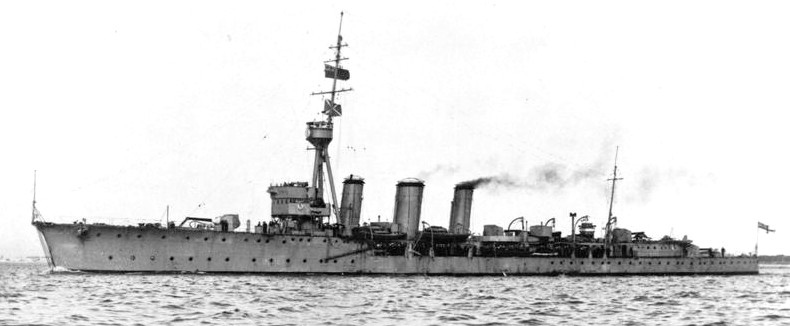
(IWM Photo, Q 75360)
HMS Carysfort was a C-class light cruiser built for the Royal Navy during the First World War. She was one of six ships of the Caroline sub-class and was completed in 1915. Assigned to the Grand Fleet, the Harwich Force, and the Dover Patrol during the war, the ship served as a flagship for part of the war. Her only known combat was a short battle against German torpedo boats in the English Channel, although she was very active patrolling the North Sea and unsuccessfully searching for German ships. Carysfort was assigned to the Home and Atlantic Fleets after the war and was sent to the Mediterranean Fleet during the Chanak Crisis of 1922–23 to support British interests in Turkey. In 1922, she patrolled off the Irish coast during the Irish Civil War. The ship was placed in reserve after returning home in 1923 and, aside from ferrying troops overseas, remained in reserve until she was sold for scrap in 1931. (Wikipedia)
HMS Cleopatra
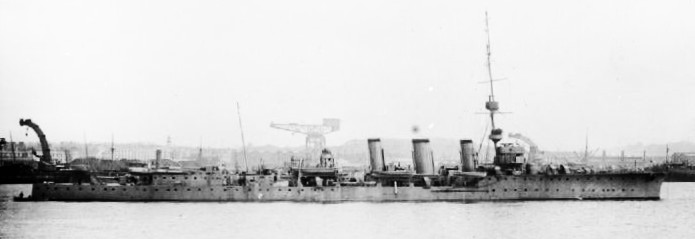
(IWM Photo, SP 3078, 1910)
The fourth HMS Cleopatra was a C-class light cruiser of the Royal Navy that saw service during the First World War and the Russian Civil War. She was part of the Caroline group of the C class. Commissioned into service in the Royal Navy in June 1915, Cleopatra was assigned to the 5th Light Cruiser Squadron in Harwich Force, which operated in the North Sea to guard the eastern approaches to the Strait of Dover and English Channel. In 1915, she was fitted with a runway on her forecastle to launch French-made Royal Naval Air Service monoplanes to attack German airships flying over the North Sea, but the aircraft proved unable to achieve the altitude necessary to attack the airships, and the runway had been removed by early 1916.[6] In August 1915, she took part in the hunt in the North Sea for the Imperial German Navy auxiliary cruiser SMS Meteor. In February 1916, she replaced the recently lost light cruiser HMS Arethusa as flagship for Harwich Force’s commander, Commodore Reginald Tyrwhitt. She was part of the force covering a Royal Naval Air Service seaplane raid against the Imperial German Navy airship hangars at Tondern, then in northern Germany, on 24 March 1916 and, during the return journey, sighted the German destroyer G 194 ahead of her. She turned toward G 194 and rammed her, cutting the destroyer in half and sinking her immediately, but the maneuver took Cleopatra across the bows of the light cruiser HMS Undaunted, and the two cruisers collided; Cleopatra returned to base with the force despite the damage she suffered in the two collisions, but Undaunted was so badly damaged that it took her four days to reach port.
Cleopatra completed repairs and returned to service in time to take part in Royal Navy operations opposing the Lowestoft Raid – a German naval bombardment of Yarmouth and Lowestoft – on 24–25 April 1916, and was part of the force under Commodore Tyrwhitt that found the German battlecruisers carrying out the raid. She was involved in an engagement with German destroyers in the North Sea on 18 July 1916. On 4 August 1916, she struck a mine off Thornton Ridge off the coast of Belgium,[8][9] but soon returned to action after repairs.
In January 1917, Cleopatra participated in an unsuccessful operation to attack German destroyers off the Belgian coast.[9] She underwent modernisation during 1917,[8] and in October 1917 joined the other Harwich Force cruisers in a patrol zone to intercept any German attempt to intercept convoys steaming to and from Scandinavia.[9] She was assigned to the 7th Light Cruiser Squadron of the Grand Fleet in August 1918 as squadron flagship, and served in that capacity through the end of World War I in November 1918 and until March 1919.
After leaving the 7th Light Cruiser Squadron in March 1919, Cleopatra rejoined the 2nd Light Cruiser Squadron in April 1919 and served in the Baltic Sea from 1919 to 1920 during the British campaign there against Bolshevik and German forces during the Russian Civil War. After returning to the United Kingdom, she recommissioned in October 1920 to serve in the Atlantic Fleet. She was decommissioned in 1921 and placed in the Nore Reserve.
Cleopatra recommissioned in 1923 to serve in the 3rd Light Cruiser Squadron, then entered the Devonport Reserve in 1924. She again recommissioned in January 1925 and was assigned to the 2nd Light Cruiser Squadron in the Atlantic Fleet, serving until decommissioned again in December 1926 and placed under dockyard control. In December 1927, she commissioned into the Nore Reserve, and was its flagship from September 1928 to March 1931. While in the Nore Reserve, she transported troops to the Mediterranean in October 1928 and to China in 1929. In March 1931, she was decommissioned and placed under dockyard control at Chatham Dockyard. (Wikipedia)
HMS Comus
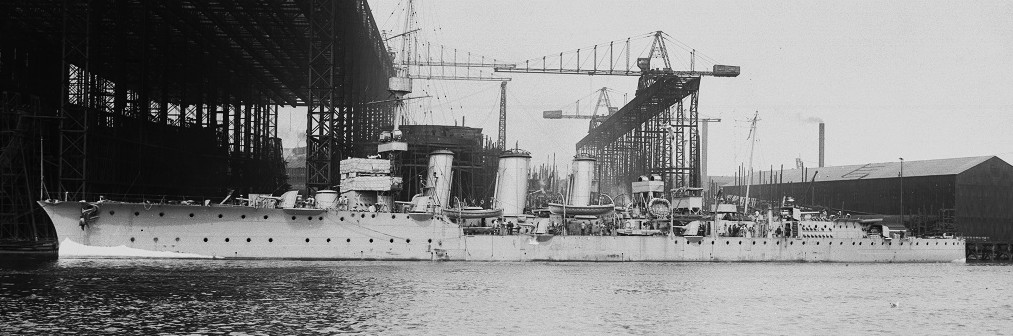
(Tyne & Wear Archives & Museums Photo)
HMS Comus alongside Swan Hunter & Wigham Richardson shipyard, seen from south side of River Tyne, c1915.
The fourth HMS Comus was a C-class light cruiser of the Royal Navy that saw service in World War I. She was part of the Caroline group of the C class. Built by Swan Hunter at Wallsend, Comus was laid down on 13 November 1913 and launched on 16 December 1914. Commissioned into service in the Royal Navy on 15 May 1915, Comus was assigned to the 4th Light Cruiser Squadron in the Grand Fleet. She and the destroyer HMS Munster sank the Imperial German Navy merchant raider Greif in the North Sea on 29 February 1916, and she fought in the Battle of Jutland on 31 May-1 June 1916 under the command of Captain Alan Hotham. During the battle, at about 8:40 p.m. 31 May Comus sent information to the Grand Fleet Commander, Admiral John Jellicoe, about the location of the German fleet. This information coupled with additional information from HMS Falmouth, Southampton and Lion gave Jellicoe the information he needed to decide on his nighttime fleet movements on the night of 31 May-1 June 1916.
After the conclusion of World War I, Comus served in the 1st Light Cruiser Squadron from March to April 1919, then underwent a refit at Rosyth, Scotland. She recommissioned in October 1919 for another tour of duty with the 4th Light Cruiser Squadron, and served on the East Indies Station until June 1923, temporarily serving as the station’s flagship in 1921. While still assigned to the East Indies Station in November 1922, she began a refit at Portsmouth that lasted until July 1923. She then was attached to the 3rd Light Cruiser Squadron in the Mediterranean Fleet until December 1924, when she entered the Nore Reserve.
Comus left the reserve in September 1925 to commission for service in the 2nd Light Cruiser Squadron in the Atlantic Fleet. After a refit, she recommissioned for the same service in August 1927. The new heavy cruiser HMS Norfolk relieved her in May 1930, and she went into reserve at Devonport, becoming the Senior Naval Officer’s flagship there in April 1931 and remaining flagship until being decommissioned in December 1933 and placed under dockyard control. Comus was sold on 28 July 1934 to Thos. W. Ward of Barrow-in-Furness for scrapping. (Wikipedia)
HMS Conquest
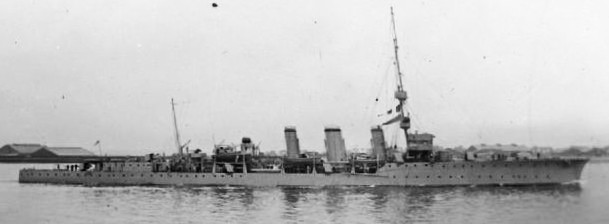
(IWM Photo, SP 2964)
HMS Conquest was a C-class light cruiser of the Royal Navy that saw service during the First World War. She was part of the Caroline group of the C class. Constructed by Chatham Dockyard, Conquest was laid down on 3 March 1914, launched on 20 January 1915, and completed in June 1915.
Conquest was commissioned into service in the Royal Navy in June 1915. She was assigned to the 5th Light Cruiser Squadron in Harwich Force, which operated in the North Sea to guard the eastern approaches to the Strait of Dover and English Channel. In August 1915, she was among the ships which took part in the pursuit of the Imperial German Navy auxiliary cruiser Meteor[9] in the North Sea which resulted in Meteor scuttling herself on 9 August 1915. She covered the force that carried out the Royal Naval Air Service seaplane raid on the German Navy airship hangars at Tondern, then in northern Germany, on 24 March 1916.[10] On 28 March 1916 38 men were lost in a snowstorm off Harwich on one of the ship’s boats, listed as a whaler, when returning from shore leave.[citation needed] During the Lowestoft Raid – the German naval bombardment of Yarmouth and Lowestoft – on 25 April 1916, German battlecruisers opened fire on Conquest and she suffered a 12-inch (305-mm) shell hit which destroyed her aerials and killed 25 and wounded 13 of her crew, but was able to maintain 20 knots.
Back in service after repairs, Conquest sortied along with much of the rest of Harwich Force and the Grand Fleet in August 1916 in an unsuccessful attempt to bring the German High Seas Fleet to action in the North Sea; while at sea, she opened fire on the German Navy Zeppelin L 13 but was unable to shoot the airship down.[10] In January 1917, she took part in an unsuccessful attempt to attack German destroyers off the coast of Belgium. On 5 June 1917, she and the light cruisers HMS Canterbury and HMS Centaur sank the German torpedo boat S20 in the North Sea near the Schouwen Bank off Zeebrugge, Belgium, during a Royal Navy raid on Ostend, Belgium. She was damaged by a mine in July 1918 and was decommissioned on 13 July 1918 for repairs which lasted through the end of the First World War and until April 1919.
After her repairs were complete, Conquest went into the Nore Reserve, and underwent a refit in 1921 while in reserve. She was recommissioned in February 1922 to serve as flagship of the 1st Submarine Flotilla in the Atlantic Fleet, continuing in this capacity until January 1927, when she transferred to the Mediterranean Fleet. She left the Mediterranean in April 1928 and returned to the United Kingdom to enter the commissioned reserve at Portsmouth, in which she remained until 1930.
Conquest was sold on 29 August 1930 to Metal Industries of Rosyth, Scotland, for scrapping. While in the North Sea bound for the shipbreaker’s yard under tow off Flamborough Head in bad weather on 26 September 1930 with a skeleton crew of six men on board, her tow line broke, and she was adrift and missing until 28 September 1930, when she was found and her tow to Rosyth resumed. (Wikipedia)
HMS Cordelia
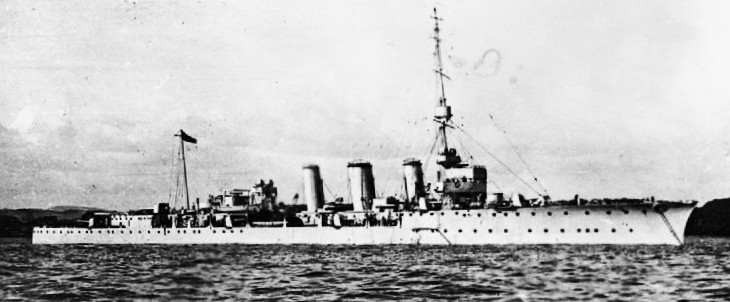
(IWM Photo, SP 894)
HMS Cordelia was a C-class light cruiser built for the Royal Navy during the First World War. She was one of six ships of the Caroline sub-class and was completed at the beginning of 1915. The ship was assigned to the 1st and 4th Light Cruiser Squadrons (LCS) of the Grand Fleet for the entire war and played a minor role in the Battle of Jutland in mid-1916. Cordelia spent most of her time on uneventful patrols of the North Sea. She served as a training ship for most of 1919 before she was recommissioned for service with the Atlantic Fleet in 1920. The ship was placed in reserve at the end of 1922 and was sold for scrap in mid-1923. (Wikipedia)
HMS Cordelia, the third ship of her name in the Royal Navy, was laid down by Pembroke Dockyard in Pembroke Dock, Wales, on 21 July 1913. She was launched on 23 February 1914, and completed in January 1915. Commissioned into service in the Royal Navy that same month, Cordelia was assigned to the 1st Light Cruiser Squadron (LCS) of the Grand Fleet.
In early August 1914, Cordelia and the rest of her squadron were among the ships dispatched to hunt for the German commerce raider SMS Meteor, which was trying to return to Germany. Although the squadron did not find her, the German ship was forced to scuttle herself by other British cruisers on 9 August to avoid being captured.
During the Battle of Jutland on 31 May-1 June 1916, the 1st LCS was assigned to screen Vice-Admiral David Beatty’s battlecruisers and were the first British ships to spot and engage the ships of the German High Seas Fleet on the afternoon of 31 May. Cordelia fired four rounds from her main armament at the light cruiser Elbing, but they fell short of the target. The ship was not heavily engaged during the battle and only fired a total of a dozen rounds from her six-inch guns and three from her four-inch guns. So far as is known, she did not hit anything, nor was she damaged herself. By October 1917, she had been transferred to the 4th Light Cruiser Squadron.
Cordelia remained with the 4th LCS through at least 1 February 1919.[14] Later that month, she was reduced to reserve at Devonport.[15] By 1 May 1919, however, she had been assigned to the Devonport Gunnery School, and by 18 January 1920 she had recommissioned for service in the 2nd Light Cruiser Squadron in the Atlantic Fleet. and remained there through 18 December 1920.
In 1921, Cordelia joined the light cruisers Caledon, Castor, and Curacoa and the destroyers Vanquisher, Vectis, Venetia, Viceroy, Violent, Viscount, Winchelsea, and Wolfhound in a Baltic cruise, departing British waters on 1 September. The ships crossed the North Sea and transited the Kaiser Wilhelm Canal to enter the Baltic Sea, where they called at Danzig in the Free City of Danzig; Memel in the Klaipėda Region; Liepāja and Riga, Latvia; Tallinn, Estonia; Helsinki, Finland; Stockholm, Sweden; Copenhagen, Denmark; Gothenburg, Sweden; and Kristiania, Norway. The ships left Kristiania on 13 September, making for Invergordon.
Cordelia patrolled off the coast of Ireland in 1922 during the Irish Civil War. In December 1922, she was decommissioned and placed in the Nore Reserve. She was sold for scrap in July 1923. (Wikipedia)
Calliope group 4,228 tons, two 6-in & eight 4-in guns. HMS Calliope, HMS Champion.
HMS Calliope
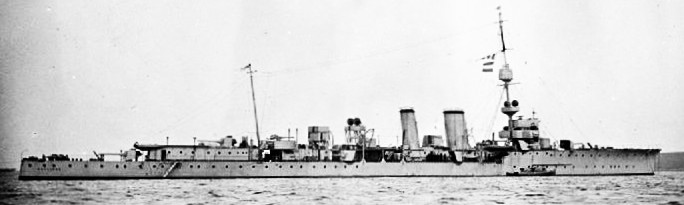
(IWM Photo, SP 1375)
HMS Calliope was a C-class light cruiser of the Royal Navy under construction at the outbreak of the First World War. Both Calliope and her sister ship Champion were based on the earlier cruiser Caroline. They were effectively test ships for the use of geared turbines which resulted in the one less funnel. They also received slightly thicker armour. They led into the first of the Cambrian subclass.
Commissioned in June 1915, Calliope was assigned to the Grand Fleet for service as flagship of the 4th Light Cruiser Squadron.[5] She was badly damaged by a fuel oil fire in her boiler room while at sea on 19 March 1916, but was repaired in time to be one of the five ships in the 4th Light Cruiser Squadron at the Battle of Jutland on 31 May-1 June 1916. Under the command of Commodore Charles E. Le Mesurier, HMS Calliope received a number of hits just before nightfall on 31 May (notably by the German battleships Kaiser and Markgraf), and 10 of her crew were killed. In September 1917, Calliope helped to sink four German trawler minesweepers in the North Sea off the coast of Jutland.
In March 1919, Calliope was commissioned for service with the 8th Light Cruiser Squadron on the North America and West Indies Station, based at the Royal Naval Dockyard in the Imperial fortress colony of Bermuda, with which she suffered another engine room fire in the Atlantic Ocean off the Azores in October 1919.[7] She returned to Devonport for repairs, which were carried out between November 1919 and March 1920, and then recommissioned for continued service on the North America and West Indies Station. She returned to the United Kingdom in December 1920 for a refit and paid off at the Nore in January 1921. She was in the Nore Reserve from October 1921 to May 1924, when she was commissioned for service with the 2nd Cruiser Squadron in the Atlantic Fleet.
Between 1925 and 1926, Calliope was used to transport troops before paying off into dockyard control at the Nore in April 1926 for a refit. Between 1927 and 1928 she was used for trooping runs again, becoming the Senior Naval Officer’s ship in the Nore Reserve in December 1927. In September 1928 received her last commission, this time with the 3rd Cruiser Squadron in the Mediterranean Fleet, which ended in January 1930 when she paid off into reserve at Portsmouth Dockyard. Calliope was transferred to dockyard control in January 1931. She was sold for scrap on 28 August 1931 to Thos. W. Ward of Inverkeithing, Scotland. (Wikipedia)
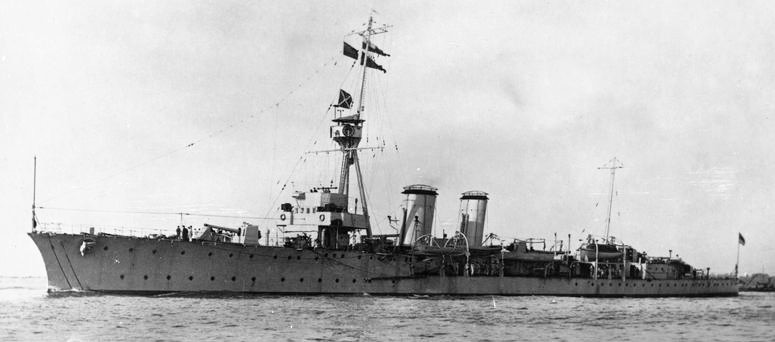
(IWM Photo, Q 75350)
HMS Calliope.
HMS Champion
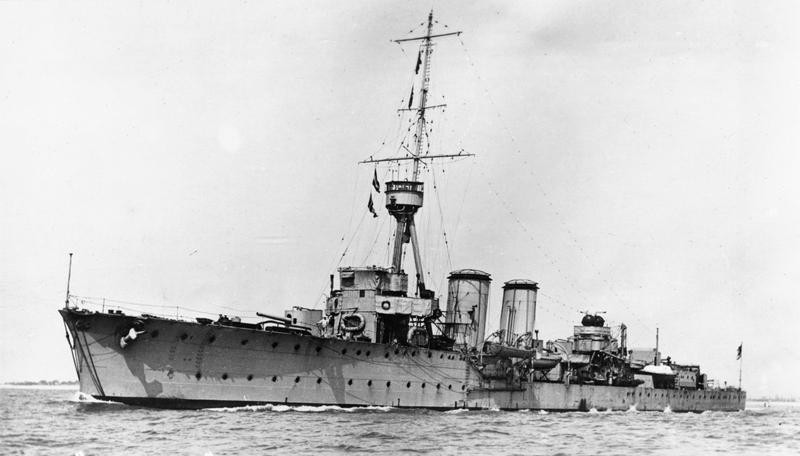
(IWM Photo, Q 75355)
HMS Champion was a C-class light cruiser of the Royal Navy that saw service during the First World War. She was part of the Calliope group of the C class. Eight light cruisers were ordered for the Royal Navy in the 1913 budget. The six ships of the Caroline class used conventional direct-drive steam turbines but two, Champion and Calliope, had experimental engine designs using geared reduction to match optimum working speeds of turbines and propellers. This followed experimental designs ordered in 1911 using geared high-pressure turbines for the destroyers Badger and Beaver and in 1912 using gearing for both high-pressure and low-pressure turbines in the destroyers Leonidas and Lucifer. Champion and Calliope tested different designs.
Built by Hawthorn Leslie and Company at Tyneside, England, Champion was laid down on 9 March 1914, launched on 29 May 1915, and completed in December 1915. Champion had two propeller shafts, the port one being driven from the sternmost engine room and the starboard one from forward. Gearing increased overall engine efficiency, allowing a reduction in boiler and turbine size for a given force provided by the propellers, so the initial design reduced the boiler room size and dropped the nominal developed power from 40,000 shaft horsepower (shp) (29.8 megawatts/MW) to 37,500 shp (28 MW). However, during construction modifications were made to again increase boiler capacity and add cruising turbines which returned to the nominal power output of the Caroline class ungeared ships. Maximum propeller speed was a nominal 340 revolutions per minute. Trials comparing Champion to Caroline showed that at actual developed power of 41,000 shp (30.6 MW) in both ships, Champion achieved a speed of 29.5 knots using 470 tons of fuel per day, while Caroline achieved 29 knots using 550 tons of fuel per day. The ship could achieve 28 knots operating at the lower power of 31,000 shp (23 MW).
Champion was commissioned into service in the Royal Navy on 20 December 1915. She was assigned to the Grand Fleet upon completion, serving as the leader of the 13th Destroyer Flotilla through the end of the First World War and until early 1919. She fought in the Battle of Jutland on 31 May–1 June 1916, during which she also was the flagship of Commodore (D), the senior commander of the fleet’s destroyers. Champion briefly served in the 2nd Light Cruiser Squadron during 1919. She then was attached to the Royal Navy Torpedo School, HMS Vernon, from 1919 to 1924, undergoing a refit in 1923. She was decommissioned and placed under dockyard control at Portsmouth in October 1924.[4]
In May 1925, Champion was recommissioned to serve as Gunnery Firing Ship. She was attached to the Signal School in 1928,[4] and was used as a testbed for the Royal Navy’s first remote-power-control (RPC) gunnery systems that year. She was decommissioned in December 1933 and placed under dockyard control. Champion was sold on 28 July 1934 to Metal Industries of Rosyth, Scotland, for scrapping. (Wikipedia)