
Royal Navy light armoured cruisers: Cambrian group: HMS Cambrian, HMS Canterbury, HMS Castor, HMS Constance, Centaur group: HMS Centaur, HMS Concord.
Cambrian group 4,320 tons, two 6-in & eight 4-in guns. HMS Cambrian, HMS Canterbury, HMS Castor, HMS Constance.
HMS Cambrian
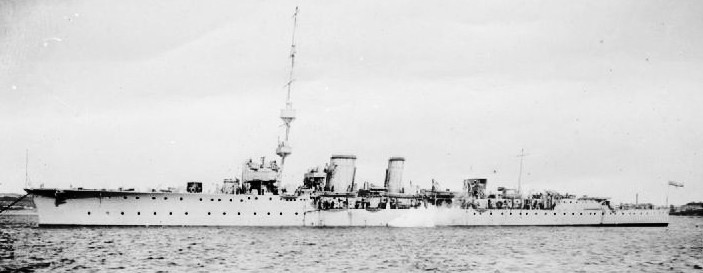
(IWM Photo, SP 3064)
HMS Cambrian was a C-class light cruiser built for the Royal Navy during the First World War. She was the name ship of her sub-class of four ships. Assigned to the Grand Fleet upon completion in 1916, the ship played only a small role during the war. Cambrian was assigned to the Atlantic and Mediterranean Fleets during the 1920s and was sent to support British interests in Turkey during the Chanak Crisis of 1922–1923. The ship was placed in reserve in late 1929. She was sold for scrap in 1934.
Cambrian, the fourth ship of her name in the Royal Navy, was laid down by Pembroke Dockyard in Pembroke Dock, Wales, on 8 December 1914, launched on 3 March 1916, and completed in May 1916. She was commissioned into service that same month and was assigned to the 4th Light Cruiser Squadron of the Grand Fleet in which she served through the end of the First World War and until 1919. The squadron was generally tasked with screening the battleships of the Grand Fleet during the war. The ship did not participate in the inconclusive Action of 19 August 1916 with the rest of her squadron. The squadron was briefly detached from the Grand Fleet in March 1917 to fruitlessly patrol off the Norwegian coast when news of a blockade runner was received by the Admiralty.
At the beginning of 1919, Cambrian was refitted in Rosyth before she sailed for Devonport where she was visited by the Edward, Prince of Wales on 13 June. The ship was assigned to the 8th Light Cruiser Squadron on the North America and West Indies Station, based at the Royal Naval Dockyard, on Ireland Island in the Imperial fortress colony of Bermuda the following month, where she served until 1923. Cambrian’s crew spent several days in August trying to tow off the schooner Bella Scott after she had run aground near Kingston, Jamaica and received a brief refit in Bermuda in March–April 1920. The Prince of Wales again visited the ship on 26 September in Dominica. On 25 January 1921, she was inspected by Vice-Admiral Sir William Pakenham at Bermuda and again on 17 June. The ship arrived at Plymouth, Massachusetts to participate in the Pilgrim Tercentenary celebrations on 31 July.
She was part of the 2nd Light Cruiser Squadron of the Atlantic Fleet from August 1922 until June 1924, and was detached to support British interests during the Chanak Crisis of 1922–23.[4] She escorted the seaplane carrier Ark Royal from the UK to Turkey from 27 September to 8 October and was later guard ship at Smyrna in December.
The ship was decommissioned in June 1924 and began a refit that lasted into 1926, during which her aft control tower and searchlight platform was removed, when she was recommissioned to serve in the 2nd Light Cruiser Squadron of the Mediterranean Fleet where she participated in a fleet exercise in March 1929. After transporting troops to China in 1929, she was decommissioned in November 1929 and assigned to the Reserve at Nore. She was recommissioned as the flagship of the Nore Reserve in March 1931 and was then decommissioned in July 1933 at Sheerness and listed for sale. Cambrian was sold for scrap on 28 July 1934. (Wikipedia)
HMS Canterbury
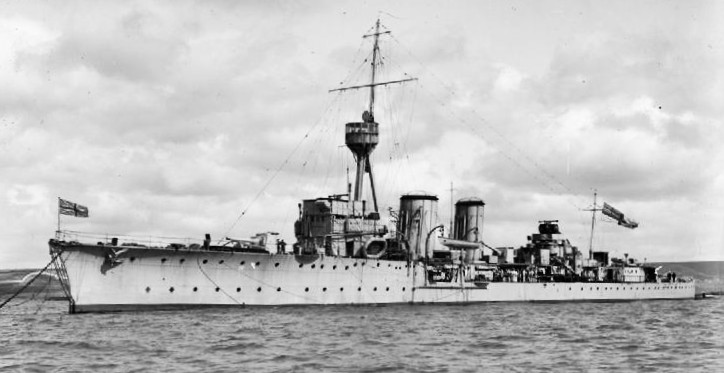
(IWM Photo, SP 212)
HMS Canterbury was a C-class light cruiser of the Royal Navy that saw service in the First World War and the Russian Civil War. She was part of the Cambrian group of the C class. Canterbury was laid down on 28 October 1914, launched on 21 December 1915, and completed in May 1916.[1] Unlike the rest of the Cambrian subclass, Canterbury was armed with six torpedo tubes instead of the usual four.
Commissioned into the Royal Navy in April or May (sources differ) 1916, Canterbury was attached to the 3rd Battle Squadron in the Grand Fleet, commanded by Captain Percy M. R. Royds, and participated in the Battle of Jutland on 31 May – 1 June 1916. From 1916 to 1918, she was assigned to the 5th Light Cruiser Squadron, operating as part of Harwich Force in the North Sea to defend the eastern approaches to the Strait of Dover and English Channel. On 5 June 1917, she and the light cruisers HMS Centaur and HMS Conquest sank the German torpedo boat S 20 in the North Sea near the Shouwen Bank off Zeebrugge, Belgium. On St George’s day, 23 April 1918, she was present at the great naval raid on Zeebrugge and Ostend. Later in 1918, she was assigned to operate in the Aegean Sea, where she served out the rest of the war.
After the First World War, Canterbury served in the Black Sea in 1919 during the British intervention in the Russian Civil War. She commissioned at Portsmouth in November 1919 for service in the 1st Light Cruiser Squadron in the Atlantic Fleet. She was attached to the Gunnery School at Portsmouth from 1920 to 1922, then in the Portsmouth Reserve from 1922 to 1924. Following a refit, her 3 funnels were reduced to two. She was recommissioned again at Portsmouth in May 1924 to serve in the 2nd Cruiser Squadron in the Atlantic Fleet, before beginning another refit in June 1925.
Canterbury recommissioned out of the Nore Reserve in November 1926 for another tour of duty in the Atlantic Fleet with the 2nd Cruiser Squadron. She transported troops to China from 1930 to 1931, reentered the Nore Reserve in March 1931, and resumed duty carrying troops in August 1932. She was decommissioned in December 1933. Canterbury was sold on 27 July 1934 to Metal Industries of Rosyth, Scotland, for scrapping. (Wikipedia)
HMS Castor
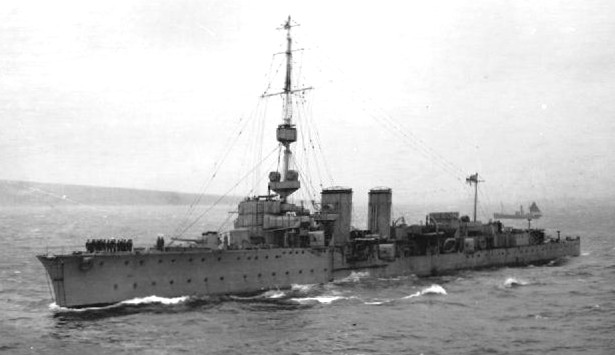
(IWM Photo, SP 2750)
HMS Castor was one of the Cambrian subclass of the C class of light cruisers. She saw service during the First World War and the Russian Civil War. Design of the Cambrian subclass was based on the earlier light cruisers HMS Champion and HMS Calliope, which, in turn, were based on the Caroline subclass, using the same hull as the Carolines but with two funnels and a maximum armor thickness of 4 inches (102 mm) as opposed to 3 in (76 mm) in the Carolines.
Castor was built by Cammell Laird at Birkenhead, England. Laid down on 28 October 1914, she was launched on 28 July 1915 and completed in November 1915. Commissioned in November 1915, Castor was the flagship of Commodore (D), assigned to the 11th Destroyer Flotilla in the Grand Fleet. She fought in the Battle of Jutland, in which she was damaged by German gunfire and suffered 10 casualties.
On 4 October 1917, the United States Navy patrol vessel USS Rehoboth suffered an uncontrollable leak in her hull while on patrol duty off France. Rehoboth’s crew had to be taken off, and Castor sank her with gunfire.
After the First World War, Castor served in the Black Sea from 1919 to 1920 during the British intervention in the Russian Civil War. In April 1920, she recommissioned at Chatham Dockyard for service in the 2nd Light Cruiser Squadron in the Atlantic Fleet.
In 1921, Castor joined the light cruisers HMS Caledon, Cordelia, and Curacoa and the destroyers Vanquisher, Vectis, Venetia, Viceroy, Violent, Viscount, Winchelsea, and Wolfhound in a Baltic Sea cruise, departing the United Kingdom on 31 August 1921. The ships crossed the North Sea and transited the Kaiser Wilhelm Canal to enter the Baltic, where they called at Danzig in the Free City of Danzig; Memel in the Klaipėda Region; Liepāja, Latvia; Riga, Latvia; Tallinn, Estonia; Helsinki, Finland; Stockholm, Sweden; Copenhagen, Denmark; Gothenburg, Sweden; and Kristiania, Norway, before crossing the North Sea and ending the voyage at Port Edgar, Scotland, on 15 October 1921.
Castor patrolled off the coast of Ireland in 1922 during the Irish Civil War. She was assigned to the Gunnery School at Portsmouth from 1923 to 1924, then was in the Nore Reserve from 1924 to 1925.
Castor underwent a refit from November 1925 to September 1926, then began transporting troops to China in October 1927. She recommissioned at Devonport in June 1928 to serve on the China Station. She entered the Devonport Reserve in July 1930, then was decommissioned in May 1935. Castor was sold on 30 July 1936 for scrapping and arrived at the shipbreaker’s yard at Rosyth in August 1936. (Wikipedia)
HMS Constance
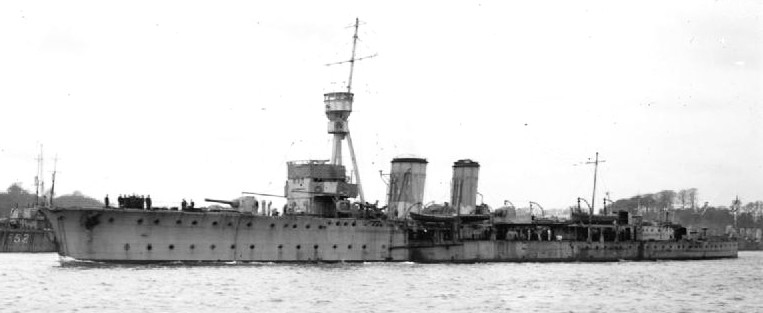
(IWM Photo, SP 579)
HMS Constance was a C-class light cruiser of the Royal Navy that saw service in the First World War. She was part of the Cambrian group of the C class. Constance was laid down on 25 January 1915, launched on 12 September 1915, and completed in January 1916. Commissioned into service in the Royal Navy in January 1916, Constance was assigned to the 4th Light Cruiser Squadron of the Grand Fleet from her commissioning until 1919, taking part in the Battle of Jutland on 31 May-1 June 1916.
After the conclusion of the First World War, Constance was assigned to the 8th Light Cruiser Squadron on the North America and West Indies Station (subsequently the America and West Indies Station) from 1919 to 1926, based at the Royal Naval Dockyard in the Imperial fortress colony of Bermuda, where she escaped damage though torn free from the wharf when a hurricane struck on 21 September, 1922, recommissioning at Devonport in January 1923 to continue this service. From September 1926 to December 1927, she underwent a refit at Chatham Dockyard, becoming the flagship of the Portsmouth Reserve upon its completion. She was assigned to the 5th Cruiser Squadron on the China Station from 1928 to November 1930.
In March 1931, Constance was decommissioned, transferred to the Reserve Fleet, and placed in reserve at Portsmouth, remaining in reserve there until July 1935. Constance was sold in January 1936 or on 8 June 1936 (sources differ) to Arnott Young, of Dalmuir, Scotland, to be scrapped. (Wikipedia)
Centaur group 4,165 tons, five 6-in guns. HMS Centaur, HMS Concord.
HMS Centaur
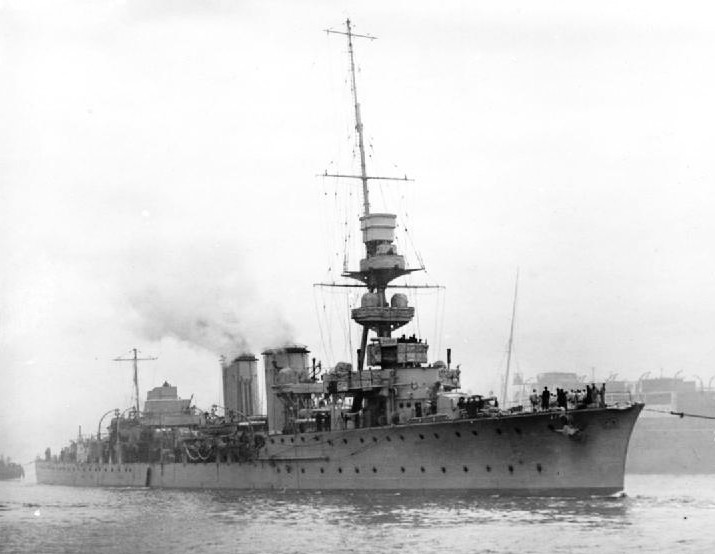
(IWM Photo, SP2599)
HMS Centaur was a C-class light cruiser of the Royal Navy that served in the First World War and the Russian Civil War. She was the name ship of the Centaur group of the C-class of cruisers. The Ottoman Empire had ordered a pair of scout cruisers in 1914. When the First World War started, construction was halted. A considerable amount of material had already been prepared, and much of this was used in the construction of HMS Centaur and her sister HMS Concord. Built by Vickers Limited, Centaur was laid down in January 1915 and launched on 1 January 1916.
Upon being commissioned into the Royal Navy in August 1916, Centaur was assigned to the 5th Light Cruiser Squadron, which operated as a part of Harwich Force in the North Sea to defend the eastern approaches to the Strait of Dover and English Channel. On 5 June 1917 she and the light cruisers HMS Canterbury and HMS Conquest sank the German torpedo boat S20 in the North Sea near the Schouwen Bank off Zeebrugge, Belgium. On 13 June 1918 she struck a mine and had to undergo repairs at Hull.
After the First World War, Centaur was sent to the Baltic Sea in December 1918 to take part in the British campaign there against Bolshevik and German forces during the Russian Civil War. In March 1919, she was reassigned from Harwich Force to the 3rd Light Cruiser Squadron in the Mediterranean Fleet, recommissioning at Malta in June 1920 and Gibraltar in October 1922 to continue that service.
In October 1923, Centaur was decommissioned, transferred to the Reserve Fleet, and placed in reserve at Devonport Dockyard. After undergoing a refit in 1924 and 1925, she was recommissioned at Portsmouth on 8 April 1925 to serve as the flagship of Commodore (D) – the officer in command of all destroyers – in the Atlantic Fleet, recommissioning in February 1928 and September 1930 to continue in this role. She was decommissioned again in March 1932 and placed in reserve at Portsmouth.
Centaur was placed on the sale list in 1933 and sold in February 1934 to King, of Troon, Scotland, for scrapping. She arrived at their yards on 6 March 1934 to be scrapped. (Wikipedia)
HMS Concord
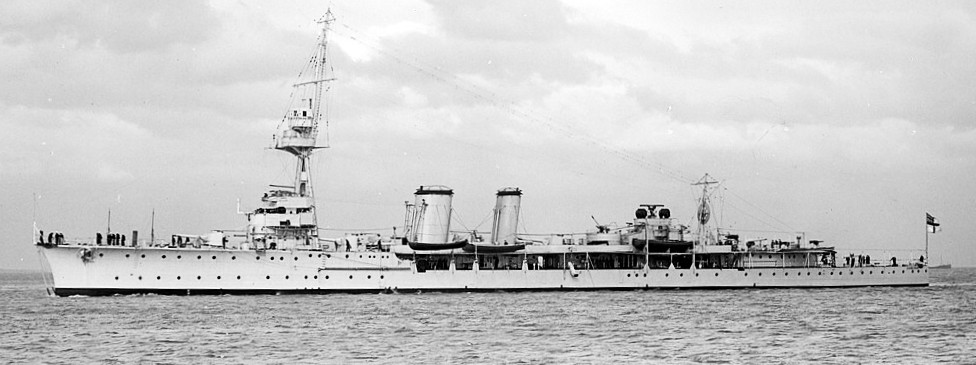
(Alan C. Green Photo)
HMS Concord was a C-class light cruiser of the Royal Navy that saw service during the First World War. She was part of the Centaur group of the C class.
On 25 December 1918 Ignacy Jan Paderewski, Polish pianist and composer, a member of the Polish National Committee re-organising Polish state after 123 years of partitions, arrived at Gdańsk (Danzig) on board HMS Concord on his way to Poznań and Warsaw. He formed the first Cabinet of the re-born Poland which on 26 January 1919 organized the first elections.
The Ottoman Empire had ordered a pair of scout cruisers in 1914. When the First World War started, construction was halted. A considerable amount of material had already been prepared, and much of this was used in the construction of HMS Concord and her sister HMS Centaur. Built by Vickers Limited, Concord was laid down in February 1915 and launched on 1 April 1916. Upon being commissioned into the Royal Navy in December 1916, Concord was assigned to the 5th Light Cruiser Squadron, which operated as part of Harwich Force in the North Sea to defend the eastern approaches to the Strait of Dover and English Channel. She remained in the squadron through the end of the war in November 1918 and until March 1919.
After the Armistice she visited the Baltic, where her duties included a courtesy visit with Cardiff to Copenhagen in December 1918, and liberating British prisoners of war from Danzig on 25 December 1918 and from Stettin on 1 January 1919. Concord recommissioned in October 1919 at Devonport for service in the 3rd Light Cruiser Squadron in the Mediterranean Fleet, recommissioning in August 1921 to continue this duty until July 1923, when she was decommissioned.
After undergoing a refit at Devonport, Concord recommissioned in May 1924 to return to the Mediterranean Fleet for more duty with the 3rd Light Cruiser Squadron. In 1925 she was attached to the Australian Station (where she replaced HMAS Brisbane), then from 1925 to 1926 to the China Station. She returned to the 3rd Light Cruiser Squadron in the Mediterranean in 1926, remaining in service there until decommissioned, transferred to the Reserve Fleet, and placed in reserve at Portsmouth in October 1927. She returned to service to transport troops to China in February 1928, and from October to November 1928 underwent a refit. She then was assigned to the Signals School at Portsmouth, remaining in service there until January 1933. After the death of the exiled King Manuel II of Portugal, she transported his coffin to Lisbon, Portugal, on 2 August 1932.
Concord was decommissioned in January 1933 and placed under dockyard control. Concord was placed on the sale list in November 1934 and was sold in August 1935 for scrapping. She arrived at the yards of Metal Industries of Rosyth, Scotland, on 16 September 1935 to be broken up. (Wikipedia)