
US Navy Heavy and Light Cruisers: USS New Haven (CL-76), USS Huntington (CL-77), USS Dayton (CL-78), USS Wilmington (CL-79), USS Biloxi (CL-80), USS Houston (CL-81), USS Providence (CL-82), USS Manchester (CL-83), USS Buffalo (CL-84), USS Fargo (CL-85), USS Vicksburg (CL-86), USS Duluth (CL-87), USS Newark (CL-88), USS Miami (CL-89), USS Astoria (CL-90), USS Oklahoma City (CL-91), USS Little Rock (CL-92), USS Galveston (CL-93), USS Youngstown (CL-94)
Early Second World War
When the United States entered the Second World War it had three major classes of cruisers under construction: the Atlanta and Cleveland light cruiser classes (with 5-inch and 6-inch main batteries, respectively), and the Baltimore-class of heavy cruisers. The Cleveland-class was an improvement of the Brooklyn design, while the Baltimore-class was an improved Wichita. These ships would form the bulk of the cruiser war construction effort, with eight Atlanta-class, twenty-seven Cleveland-class, and fourteen Baltimore-class cruisers ultimately completed. Early in the war nine Cleveland hulls would be diverted for conversion into Independence class light aircraft carriers (CVLs). By the end of the war three Cleveland hulls would be canceled, and one incomplete hull would later be converted to a guided missile cruiser. (Wikipedia)
Cleveland class
(CL-76) New Haven (completed as Belleau Wood (CVL-24)).
(CL-77) Huntington (completed as Cowpens (CVL-25)).
(CL-78) Dayton (completed as Monterey (CVL-26)).
(CL-79) Wilmington (completed as Cabot (CVL-28)).
(CL-80) Biloxi (1943) – WW2: 9 battle stars.
(CL-81) Houston (ex-Vicksburg) (1943) – WW2: 3 battle stars.
(CL-82) Providence (1945) – later converted to CLG-6.
(CL-83) Manchester (1946) – Korea: 9 battle stars.
(CL-84) Buffalo – canceled.
(CL-85) Fargo (completed as Langley (CVL-27)).
(CL-86) Vicksburg (1944) – WW2: 2 battle stars.
(CL-87) Duluth (1944) – WW2: 2 battle stars.
(CL-88) Newark – canceled.
(CL-89) Miami (1943) – WW2: 6 battle stars.
(CL-90) Astoria (ex-Wilkes-Barre) (1944) – WW2: 5 battle stars.
(CL-91) Oklahoma City (1944) – WW2: 2 battle stars, later converted to CLG-5.
(CL-92) Little Rock (1945) – later converted to CLG-4.
(CL-93) Galveston (completed as CLG-3).
(CL-94) Youngstown – canceled after construction started.
USS New Haven (CL-76)
The ship was originally named New Haven, but was renamed Belleau Wood after conversion work had begun, after the Battle of Belleau Wood of the First World War. USS Belleau Wood was a United States Navy Independence-class light aircraft carrier active during World War II in the Pacific Theater from 1943 to 1945. The Independence class were ordered as light cruisers of the Cleveland class, but during construction, they were converted into light carriers owing to the need for additional vessels of that type during the war.
USS Huntington (CL-77)
The ship was originally named Huntington, but was converted into the light carrier USS Cowpens (CV-25/CVL-25/AVT-1). Nicknamed The Mighty Moo, was an 11,000-ton Independence-class light aircraft carrier that served the United States Navy from 1943 to 1947. Cowpens, named for the Battle of Cowpens of the Revolutionary War, was launched on 17 January 1943 at the New York Shipbuilding Corporation, in Camden, New Jersey, sponsored by Mrs. Margaret Bradford Spruance (née Halsey, daughter of Fleet Admiral William F. Halsey Jr.) and commissioned on 28 May 1943 by Captain R. P. McConnell. She was reclassified CVL-25 on 15 July 1943. Cowpens completed her active service at the end of 1946.
USS Dayton (CL-78)
Originally laid down as light cruiser Dayton (CL-78) on 29 December 1941 by New York Shipbuilding, Camden, New Jersey, the ship was reclassified CV-26 on 27 March 1942 and renamed Monterey four days later, launched on 28 February 1943, sponsored by Mr. Patrick N. L. Bellinger, and commissioned on 17 June 1943, Captain Lestor T. Hundt in command. It was the third US Navy vessel to be named after the Battle of Monterey. Future U.S. President Gerald R. Ford served aboard the ship during the Second World War.
USS Wilmington (CL-79)
Originally laid down as Wilmington (CL-79), a Cleveland-class light cruiser, redesignated CV-28 on 2 June 1942, renamed Cabot on 23 June 1942 and converted while building. She was launched on 4 April 1943 by New York Shipbuilding Company, Camden, New Jersey; sponsored by Mrs. A. C. Read. She was reclassified CVL-28 on 15 July 1943 and commissioned on 24 July 1943.
USS Biloxi (CL-80)
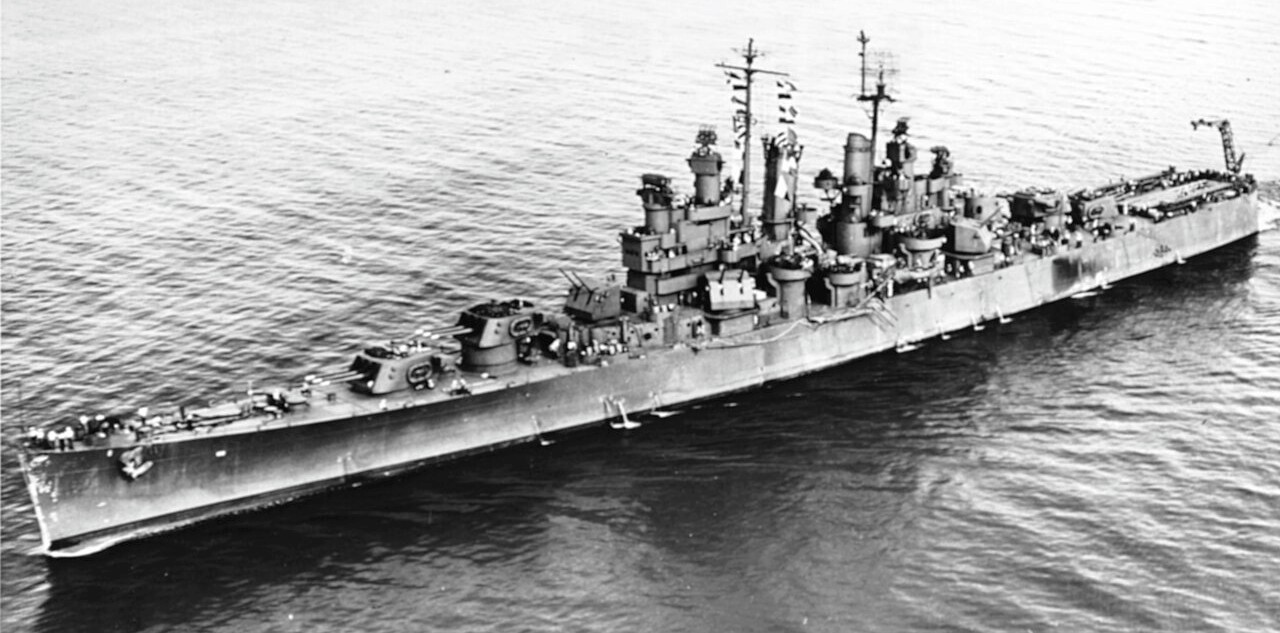
(USN Photo)
USS Biloxi (CL-80) underway at sea. The photo is dated 19 February 1945, but was probably taken during the ship’s shakedown cruise, circa in October 1943.
USS Biloxi (CL-80) was a Cleveland-class light cruiser of the United States Navy, which were built during World War II. The class was designed as a development of the earlier Brooklyn-class cruisers, the size of which had been limited by the First London Naval Treaty. The start of the war led to the dissolution of the treaty system, but the dramatic need for new vessels precluded a new design, so the Clevelands used the same hull as their predecessors, but were significantly heavier. The Clevelands carried a main battery of twelve 6-inch (152 mm) guns in four three-gun turrets, along with a secondary armament of twelve 5 in (127 mm) dual-purpose guns. They had a top speed of 32.5 knots (60.2 km/h; 37.4 mph).
The ship was laid down on 9 July 1941 at Newport News, Virginia, by the Newport News Shipbuilding & Dry Dock Co. and launched on 23 February 1943, sponsored by Mrs. Katharine G. Braun, wife of the Mayor of Biloxi. She was commissioned at the Norfolk Navy Yard on 31 August 1943, with Captain Daniel M. McGurl in command. (Wikipedia)
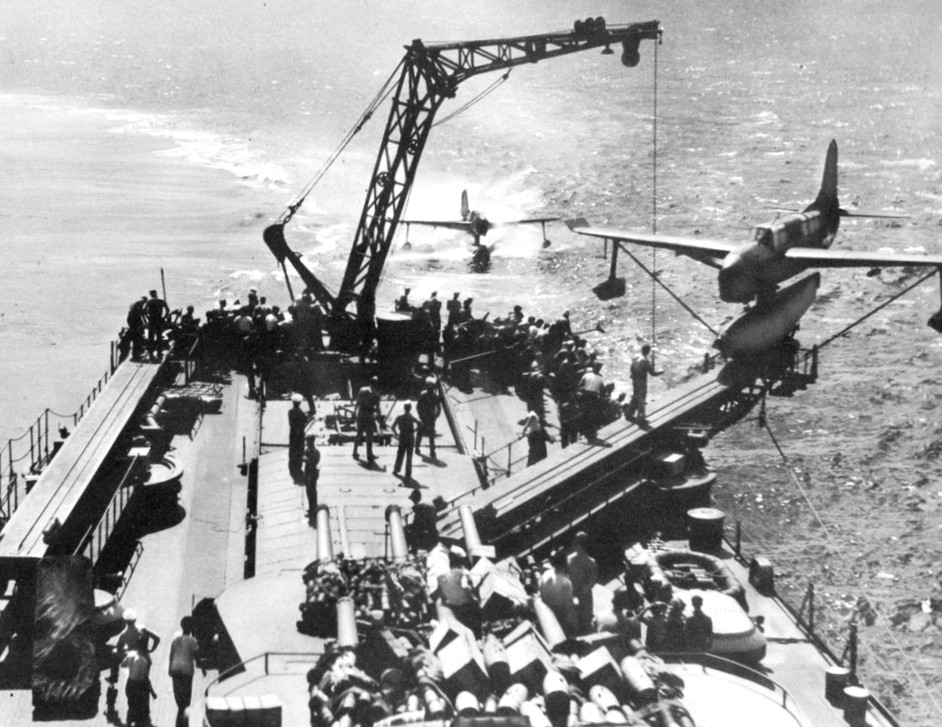
(USN Photo)
A Curtiss SO3C-3 Seamew returns to the U.S. Navy light cruiser USS Biloxi (CL-80). Biloxi was one of the few ships briefly equipped with the SO3C in 1943.
USS Houston (CL-81)
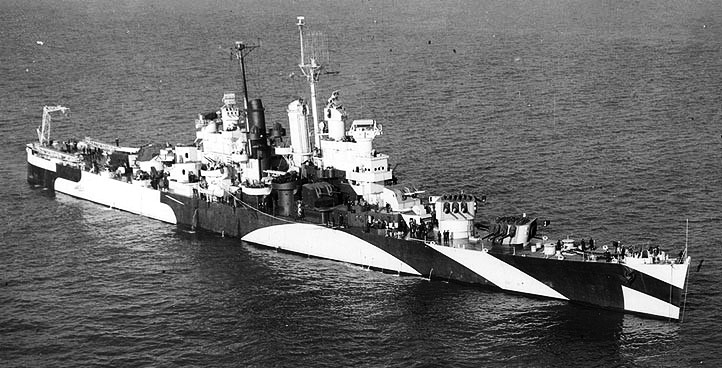
(USN Photo)
USS Houston (CL-81) off Norfolk, Virginia (USA), on 12 January 1944. She is painted in Camouflage Measure 32, Design 1d.
USS Houston (CL-81) was a Cleveland-class light cruiser of the United States Navy, which were built during World War II. The class was designed as a development of the earlier Brooklyn-class cruisers, the size of which had been limited by the First London Naval Treaty. The start of the war led to the dissolution of the treaty system, but the dramatic need for new vessels precluded a new design, so the Clevelands used the same hull as their predecessors, but were significantly heavier. The Clevelands carried a main battery of twelve 6-inch (152 mm) guns in four three-gun turrets, along with a secondary armament of twelve 5 in (127 mm) dual-purpose guns. They had a top speed of 32.5 knots (60.2 km/h; 37.4 mph).
She was active in the Pacific War and survived two separate aerial torpedo hits in October 1944. (Wikipedia)
USS Providence (CL-82)
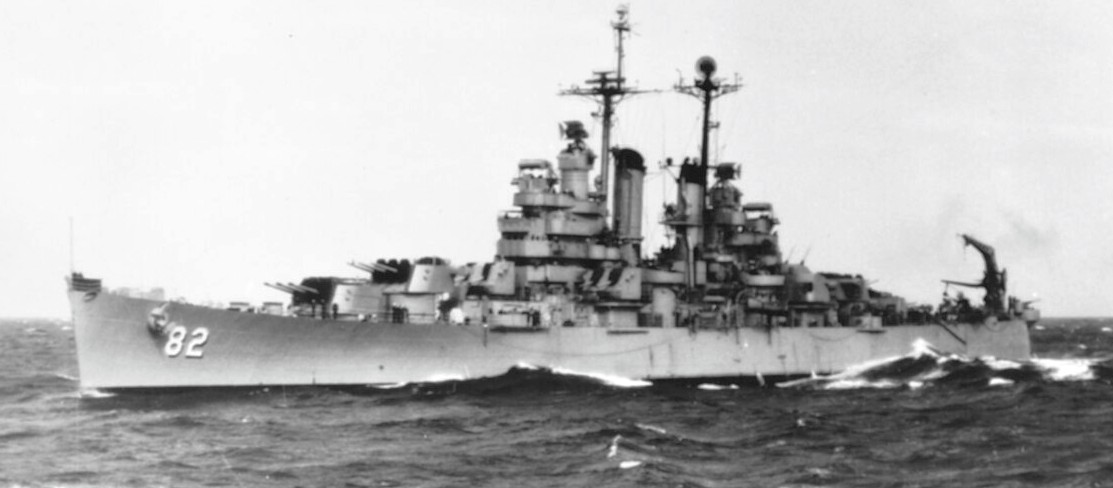
(USN Photo)
USS Providence (CL-82) underway in the Mediterranean Sea. She was deployed to the U.S. 6th Fleet in the Mediterranean from 23 September 1948 to 14 January 1949, before she was decommissioned on 14 June 1949.
USS Providence (CL-82/CLG-6/CG-6) was a Cleveland-class light cruiser and the fourth ship of the United States Navy to be named after the city of Providence, Rhode Island. Providence was commissioned between 1945 and 1949. From 1957 to 1959, she was converted to a guided missile cruiser and flagship. She served in that role from 1959 to 1973. After her decommissioning, she was finally scrapped in 1980. (Wikipedia)
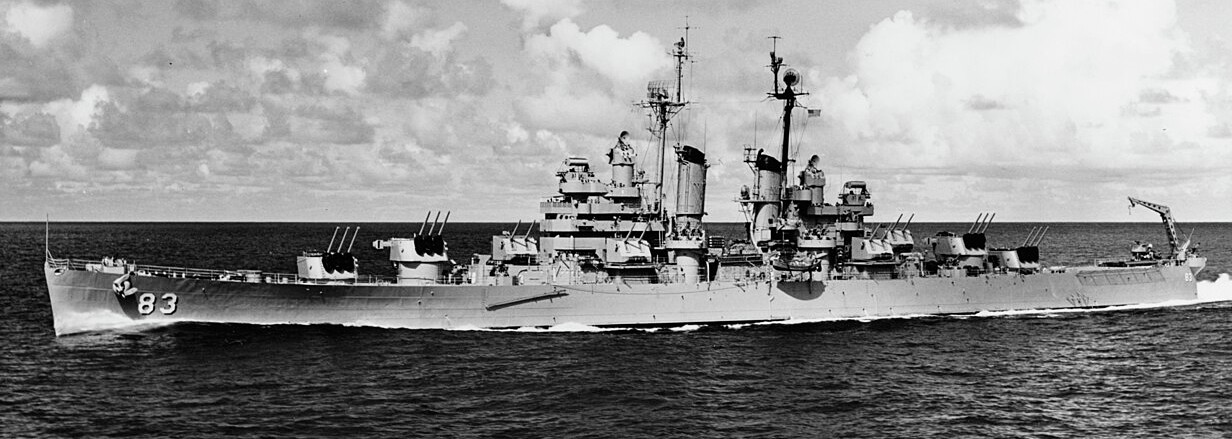
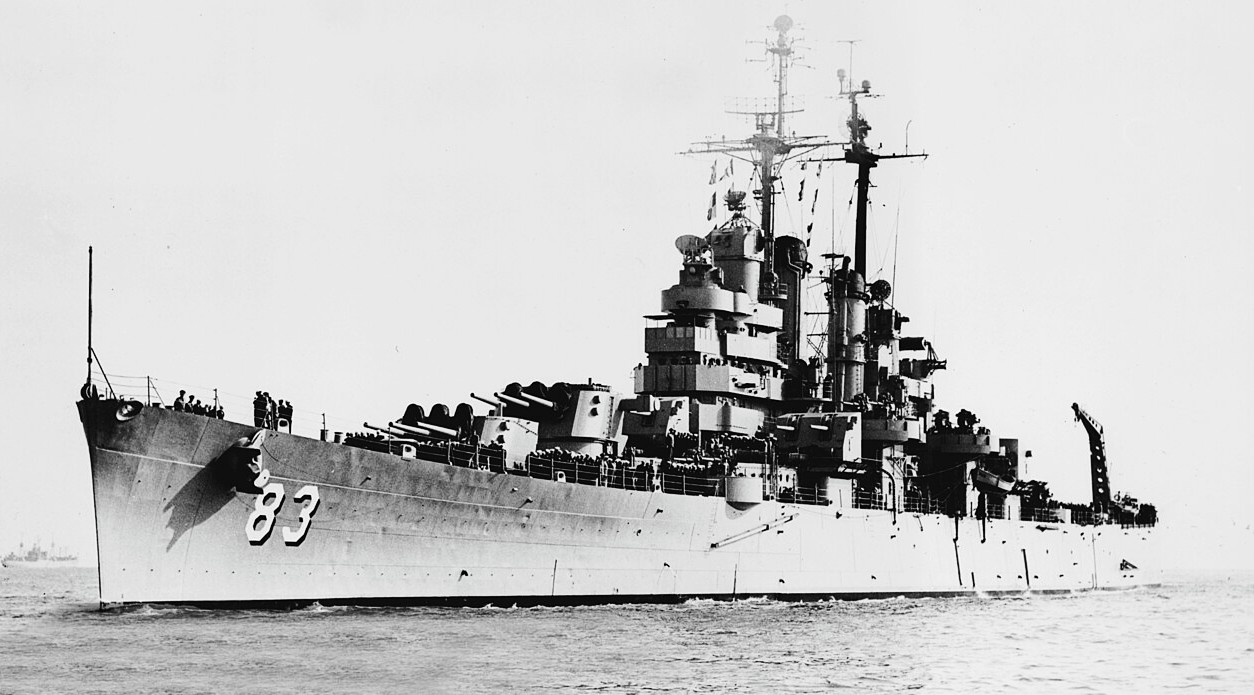
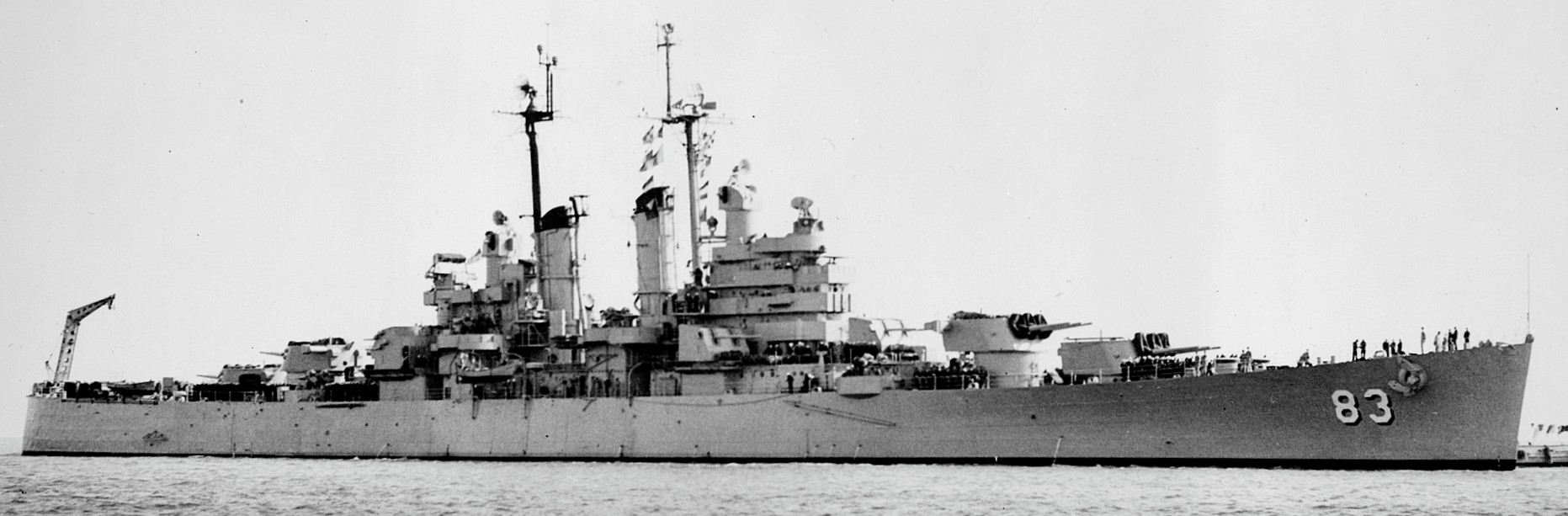
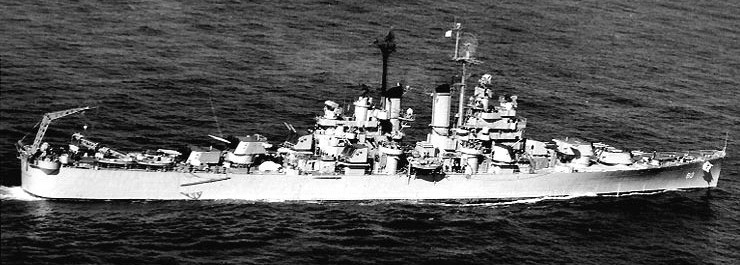
USS Manchester (CL-83)
(USN Photo)
USS Manchester (CL-83) underway off Korea. All of her 6-inch gun turrets, four of her 5/38 gun mounts and all of her main and secondary gun directors are trained on the port beam. The photo was taken during Manchester‘s first two Korean War tours, 1950-52.
USS Manchester (CL-83) was a Cleveland-class light cruiser of the United States Navy, which were built during World War II. The class was designed as a development of the earlier Brooklyn-class cruisers, the size of which had been limited by the First London Naval Treaty. The start of the war led to the dissolution of the treaty system, but the dramatic need for new vessels precluded a new design, so the Clevelands used the same hull as their predecessors, but were significantly heavier. The Clevelands carried a main battery of twelve 6-inch (152 mm) guns in four three-gun turrets, along with a secondary armament of twelve 5 in (127 mm) dual-purpose guns. They had a top speed of 32.5 knots (60.2 km/h; 37.4 mph).
The ship was laid down 25 September 1944 by the Bethlehem Shipbuilding Corporation’s Fore River Shipyard, Quincy, Massachusetts; launched 5 March 1946; sponsored by Mrs. Ernest J. Gladu; and commissioned 29 October 1946, Capt. Peter G. Hale in command. (Wikipedia)
(USN Photo)
USS Manchester (CL-83) underway on 31 October 1952 following a regular overhaul at the San Francisco Naval Shipyard, California.
(USN Photo)
USS Manchester (CL-83) following a regular overhaul at the San Francisco Naval Shipyard, California, in October 1952.
(USN Photo)
USS Manchester (CL-83) photographed from a USS Philippine Sea plane while operating in the Mediterranean Sea, 9 March 1948. Note that the ship still retained one aircraft catapult at this time.
USS Buffalo (CL-84)
Building by Federal Shipbuilding and Drydock Company, Kearny, New Jersey, cancelled on 16 December 1940.
USS Fargo (CL-85)
USS Fargo (CL-85) was originally laid down as a Cleveland-class light cruiser; it was completed as USS Langley (CVL-27), an Independence-class light aircraft carrier.
USS Vicksburg (CL-86)
(USN Photo)
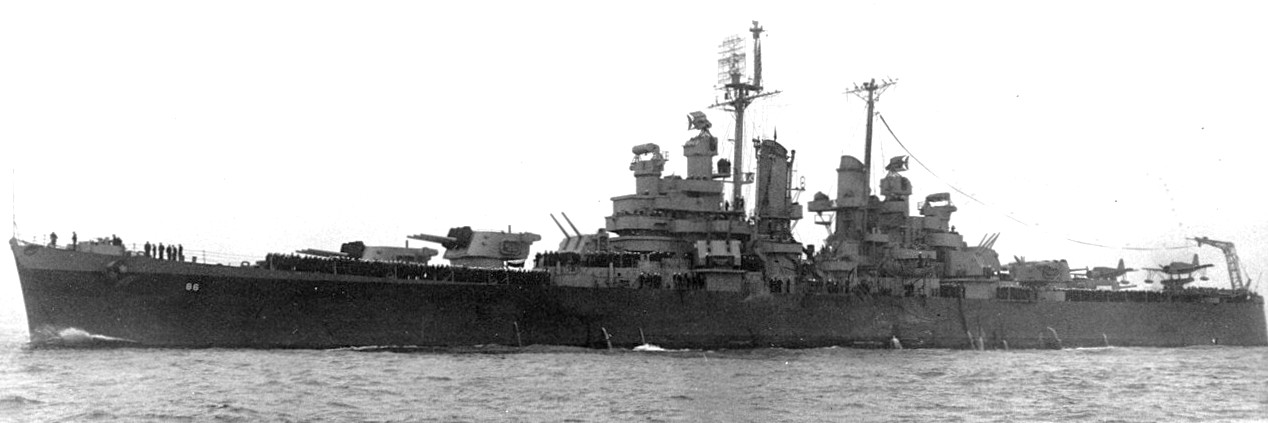
USS Vicksburg (CL-86) arrives off San Francisco, California (USA), soon after the end of the Second World War, probably in October 1945. She is flying a long “homeward bound” pennant from her mainmast.
USS Vicksburg (CL-86) was a Cleveland-class light cruiser of the United States Navy, which were built during World War II. The class was designed as a development of the earlier Brooklyn-class cruisers, the size of which had been limited by the First London Naval Treaty. The start of the war led to the dissolution of the treaty system, but the dramatic need for new vessels precluded a new design, so the Clevelands used the same hull as their predecessors, but were significantly heavier. The Clevelands carried a main battery of twelve 6-inch (152 mm) guns in four three-gun turrets, along with a secondary armament of twelve 5 in (127 mm) dual-purpose guns. They had a top speed of 32.5 knots (60.2 km/h; 37.4 mph).
Vicksburg was first laid down as Cheyenne on 26 October 1942 at Newport News Shipbuilding & Dry Dock Company, Newport News, Virginia, but, exactly one month later, was renamed Vicksburg. The light cruiser was launched on 14 December 1943; sponsored by Miss Muriel Hamilton, the daughter of Mayor J. C. Hamilton, of Vicksburg, Mississippi; and commissioned at the Norfolk Navy Yard on 12 June 1944, with Captain William C. Vose in command. Vicksburg received two battle stars for her Second World War service. (Wikipedia)
(USN Photo)
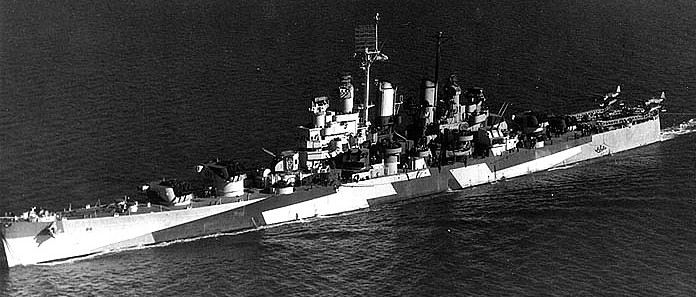
USS Vicksburg (CL-86) underway off the U.S. East Coast, 17 October 1944. The ship is painted in Camouflage Measure 33, Design 6d.
USS Duluth (CL-87)
(USN Photo)
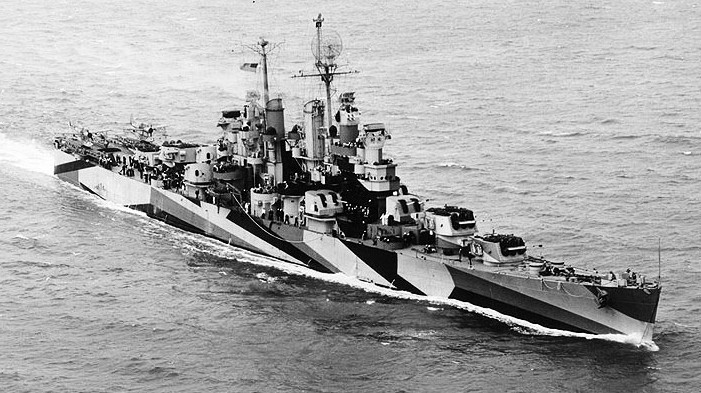
USS Duluth (CL-87) underway in the Hampton Roads area, Virginia (USA), 10 October 1944, while en route to the southern Chesapeake Bay for sea training. Her camouflage is Measure 32, Design 11a.
USS Duluth (CL-87) was a Cleveland-class light cruiser of the United States Navy, which were built during World War II. The class was designed as a development of the earlier Brooklyn-class cruisers, the size of which had been limited by the First London Naval Treaty. The start of the war led to the dissolution of the treaty system, but the dramatic need for new vessels precluded a new design, so the Clevelands used the same hull as their predecessors, but were significantly heavier. The Clevelands carried a main battery of twelve 6-inch (152 mm) guns in four three-gun turrets, along with a secondary armament of twelve 5 in (127 mm) dual-purpose guns. They had a top speed of 32.5 knots (60.2 km/h; 37.4 mph).
She was launched 13 January 1944 by Newport News Shipbuilding & Dry Dock Company, Newport News, Virginia; sponsored by Mrs. E. H. Hatch, wife of the Mayor of Duluth, Minnesota; and commissioned 18 September 1944, Captain Donald Roderick Osborn, Jr., US Naval Academy class of 1920, in command. (Wikipedia)
USS Newark (CL-88)
USS Newark (CL-88) was a planned Cleveland-class light cruiser; construction was cancelled in 1940.
USS Miami (CL-89)
(USN Photo)
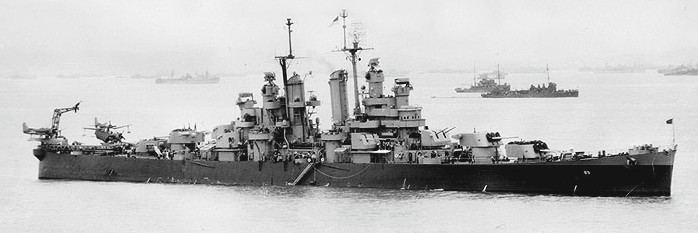
USS Miami (CL-89) in a Pacific Ocean anchorage, soon after the end of the war with Japan, circa September-October 1945. Two Curtiss SC-1 Seahawks are on the catapults, a third is placed on the hangar. An old flush-deck destroyer converted to a high speed transport (APD) is anchored in the background.
USS Miami (CL-89) was a Cleveland-class light cruiser of the United States Navy, which were built during World War II. The class was designed as a development of the earlier Brooklyn-class cruisers, the size of which had been limited by the First London Naval Treaty. The start of the war led to the dissolution of the treaty system, but the dramatic need for new vessels precluded a new design, so the Clevelands used the same hull as their predecessors, but were significantly heavier. The Clevelands carried a main battery of twelve 6-inch (152 mm) guns in four three-gun turrets, along with a secondary armament of twelve 5 in (127 mm) dual-purpose guns. They had a top speed of 32.5 knots (60.2 km/h; 37.4 mph).
Miami was commissioned in December 1943, and saw service in several campaigns in the Pacific. Like almost all her sister ships, she was decommissioned shortly after the end of the war, and never saw active service again. Miami was scrapped in the early 1960s. (Wikipedia)
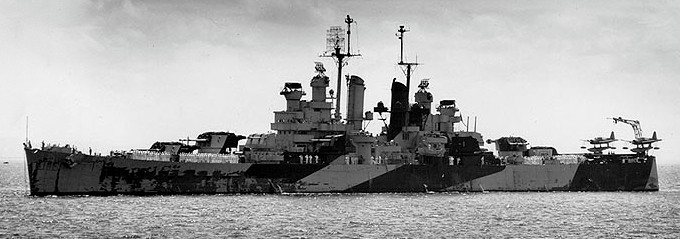
(USN Photo)
USS Miami (CL-89) at Trinidad, British West Indies, with her crew at quarters on deck, 19 February 1944. Note her Measure 32, Design 1D camouflage, considerably worn away forward by wave action. Miami was then on her shakedown cruise.
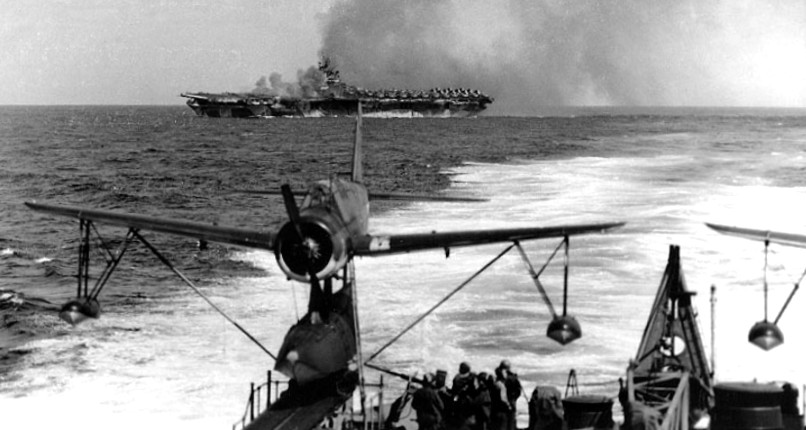
(USN Photo)
USS Ticonderoga (CV-14) afire after she was hit by a “Kamikaze” attack off Formosa, 21 January 1945. Photographed from USS Miami (CL-89). A Vought OS2U “Kingfisher” floatplane is on the cruiser’s starboard catapult, in the foreground.
USS Astoria (CL-90)
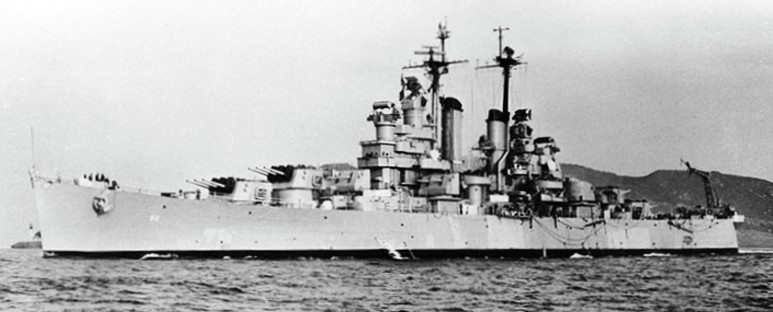
(USN Photo)
USS Astoria (CL-90), probably while leaving San Diego, California, c1947.
The third USS Astoria (CL-90) was a Cleveland-class light cruiser of the United States Navy, which were built during World War II. The class was designed as a development of the earlier Brooklyn-class cruisers, the size of which had been limited by the First London Naval Treaty. The start of the war led to the dissolution of the treaty system, but the dramatic need for new vessels precluded a new design, so the Clevelands used the same hull as their predecessors, but were significantly heavier. The Clevelands carried a main battery of twelve 6-inch (152 mm) guns in four three-gun turrets, along with a secondary armament of twelve 5 in (127 mm) dual-purpose guns. They had a top speed of 32.5 knots (60.2 km/h; 37.4 mph).
The ship was laid down on 6 September 1941 at William Cramp & Sons Shipbuilding Company, Philadelphia, as Wilkes-Barre. It was subsequently renamed to Astoria in honor of the heavy cruiser Astoria (CA-34) which was sunk on 9 August 1942 during the Battle of Savo Island. Astoria was launched on 6 March 1943, sponsored by Mrs. Robert Lucas (wife of the editor of the Astorian-Budget), and commissioned at the Philadelphia Navy Yard on 17 May 1944. (Wikipedia)
USS Oklahoma City (CL-91)
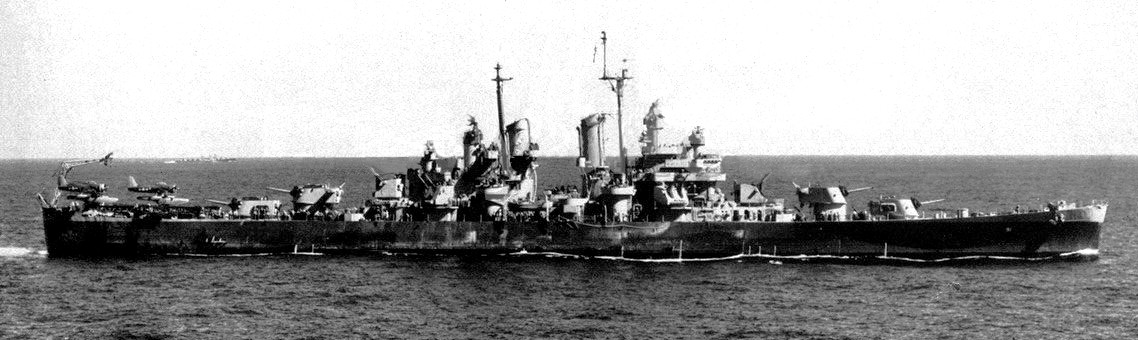
(USN Photo)
USS Oklahoma City (CL-91) underway in 1945. She is painted in Measure 22 Camouflage.
USS Oklahoma City (CL-91/CLG-5/CG-5) was one of 27 United States Navy Cleveland-class light cruisers completed during or shortly after World War II, and one of six to be converted to guided missile cruisers. She was the first US Navy ship to be named for Oklahoma City, Oklahoma. Commissioned in late 1944, she participated in the latter part of the Pacific War in anti-aircraft screening and shore bombardment roles, for which she earned two battle stars. She then served a brief stint with the occupation force. Like all but one of her sister ships, she was retired in the post-war defense cutbacks, becoming part of the Pacific Reserve Fleet in 1947.
In the late 1950s she was converted to a Galveston-class guided missile cruiser, which involved removing all her guns except for her forward 6-inch (152 mm) turret and 5-inch (127 mm) mount, and rebuilding her entire superstructure to accommodate the Talos missile system and flagship office spaces and accommodation. Like her three sister ships (Providence, Little Rock, and Springfield) of the Cleveland-class ships converted to missile ships, she was also extensively modified forward to become a flagship. This involved removal of most of her forward armament to allow for a greatly enlarged superstructure. She was recommissioned in 1960 as CLG-5 (and in 1975 redesignated CG-5).
In her second career she served extensively in the Pacific, playing a prominent role in the Vietnam War, including participation in the evacuation of Saigon. Oklahoma City was worked hard in shore bombardment duty during the war. As she was extensively well fitted with flagship accommodations and communications, there were plans for an extensive overhaul (of both her and Little Rock) starting in 1977. The ship would have received two 8-cell NATO Sea Sparrow surface-to-air missile (SAM) launchers and two Vulcan Phalanx CIWS systems, in addition to extensive rehabilitation of her propulsion systems, electrical systems, her hull and superstructure. This would have given her an additional 10 years of service life. While this work package was formally planned, and funding was appropriated, it was diverted elsewhere. She received enough maintenance to soldier on for a few more years and was decommissioned for the last time in December 1979. At the time of her decommissioning, she was the last Cleveland-class ship in service, and had served longer (a total of 21 years and 10 months) than any other ship of that class. Oklahoma City was sunk by a torpedo fired from ROKS Lee Chun during SINKEX exercise, Tandem Thrust 99, on 26 March 1999. (Wikipedia)
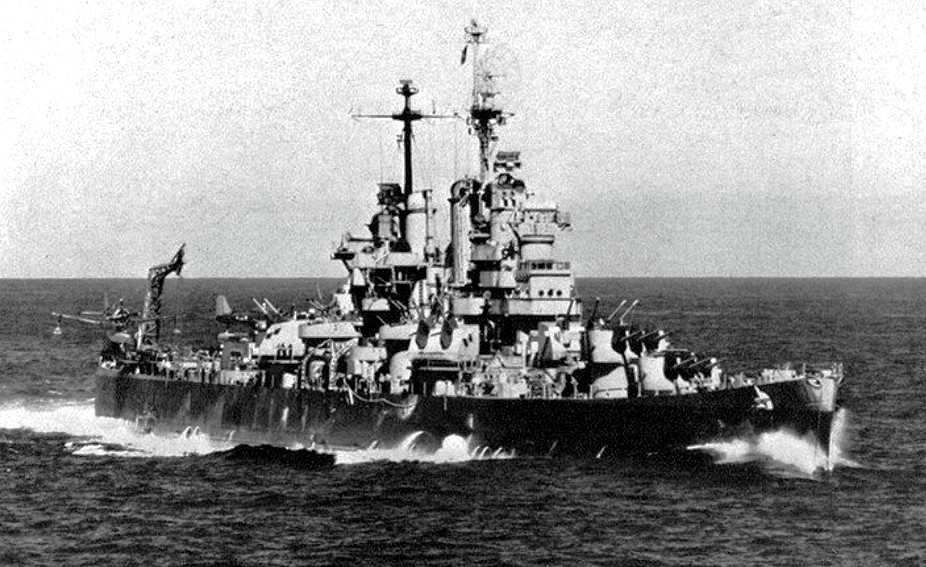
(USN Photo)
USS Oklahoma City (CL-91) underway in 1945. She is painted in Measure 22 Camouflage.
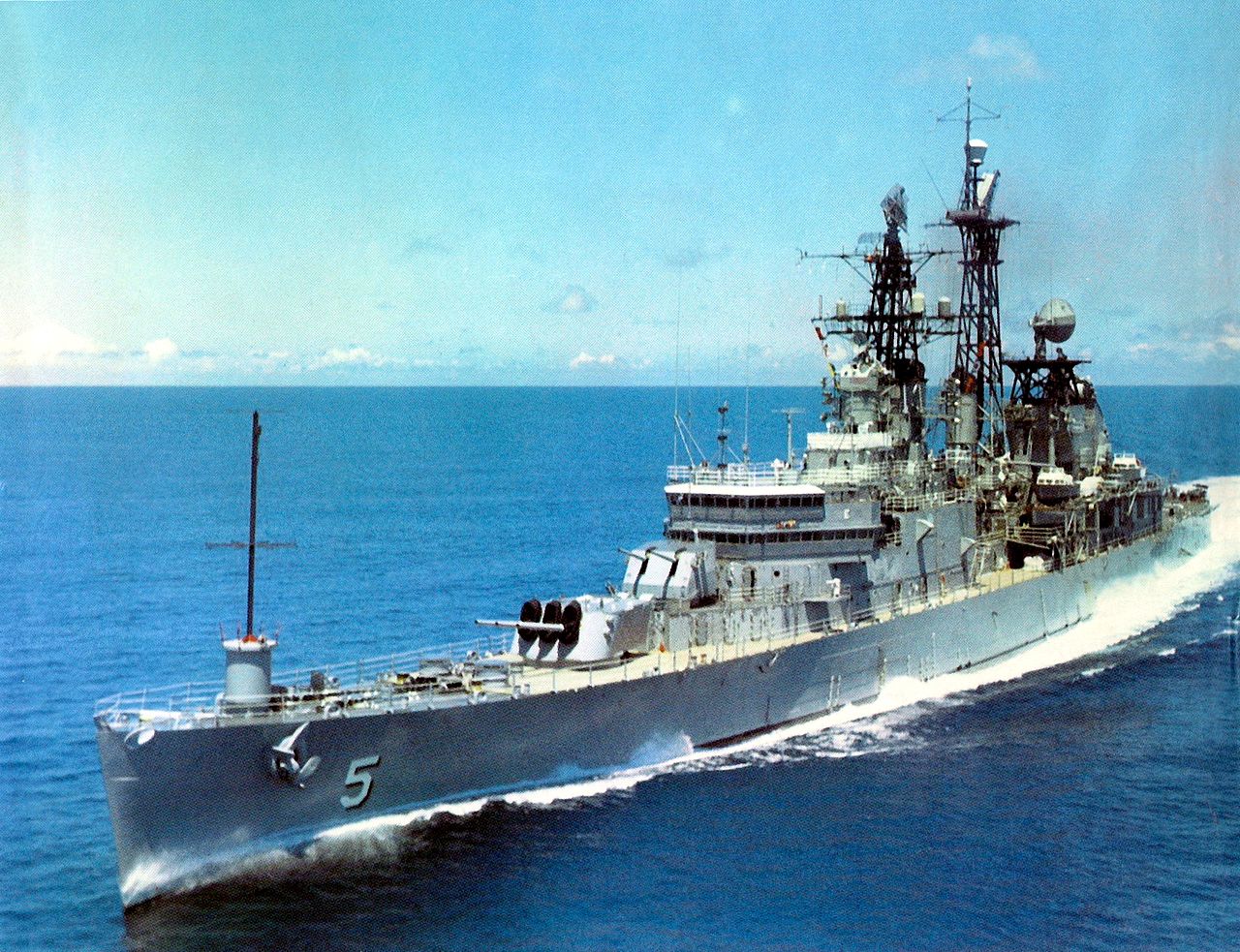
(USN Photo)
U.S. Navy guided missile cruiser USS Oklahoma City (CLG-5) underway in the early 1960s.
USS Little Rock (CL-92)
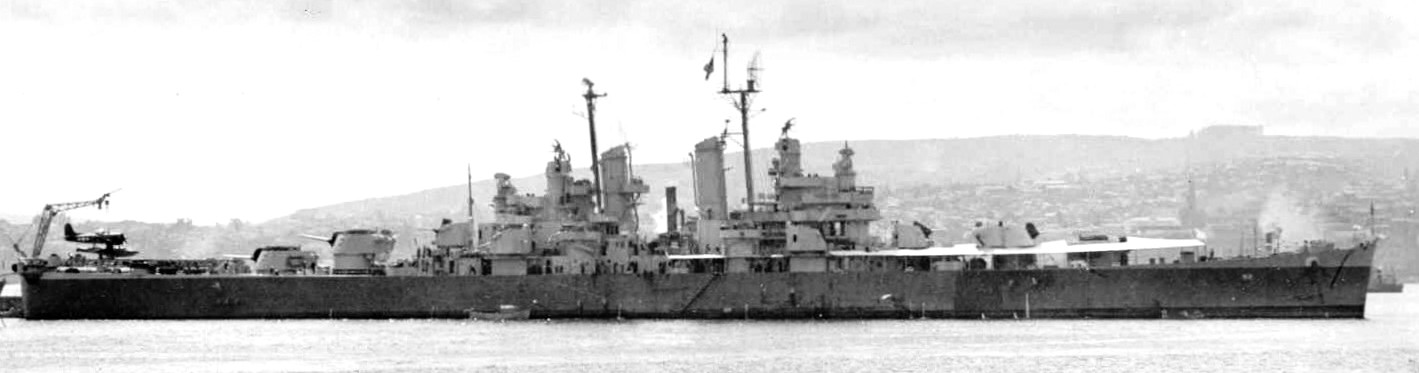
(USN Photo)
USS Little Rock (CL-92) moored at Valparaiso (Chile), 1 February 1946. The cruiser is painted in Measure 22 camouflage and carries a Curtiss SC-1 Seahawk aft.
USS Little Rock (CL-92/CLG-4/CG-4) is a Cleveland-class light cruiser and one of 27 completed for the United States Navy during or shortly after World War II. She is one of six to be converted to guided missile cruisers and the first US Navy ship to be named for Little Rock, Arkansas. Commissioned in mid-1945, she was completed too late to see combat duty during World War II and was retired post-war, becoming part of the Atlantic Reserve Fleet in 1949.
In the late 1950s, she was converted to a Galveston-class guided-missile cruiser, removing her aft six-inch and five-inch guns to accommodate the Talos missile system. Like three other of her sister Cleveland ships converted to missile ships, she was also extensively modified forward to become a flagship. This involved removal of most of her forward armament to allow for an enlarged superstructure and was recommissioned in 1960 as CLG-4 (redesignated CG-4 in 1975). In this configuration, she served in the Mediterranean, often as the Sixth Fleet flagship.
She decommissioned for the final time in 1976 and is now a museum ship, located in Buffalo, New York. She is the last surviving Cleveland-class cruiser. (Wikipedia)
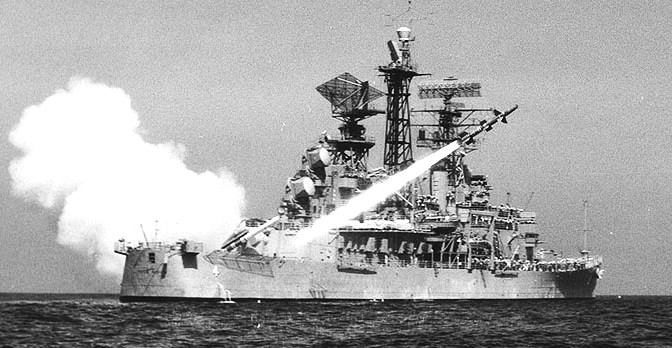
(USN Photo)
U.S. Navy guided missile cruiser USS Little Rock (CLG-4) fires a RIM-8 Talos guided missile, during exercises in the Mediterranean Sea, 4 May 1961. Note her massive AN/SPS-2 radar.
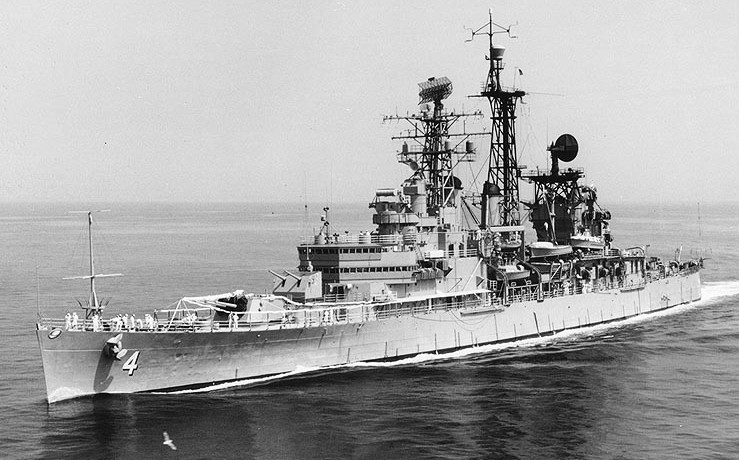
(USN Photo)
U.S. Navy guided missile cruiser USS Little Rock (CLG-4) leaving Naples Bay, Italy, on 31 July 1967, while serving as flagship of the U.S. Sixth Fleet.
USS Galveston (CL-93)
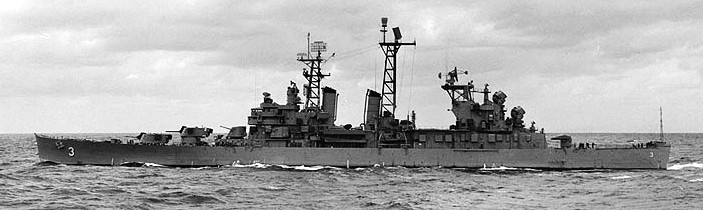
(USN Photo)
U.S. Navy guided missile cruiser USS Galveston (CLG-3) underway at sea, 11 January 1959. Galveston´s original radar equipment consisted of the following radars (front to back): Mark 34/Mk 13 fire control radar for the 15.5 cm artillery; Mk 37/Mk 25 fire control radar for the 12.7 cm artillery; SPS-10 and SPS-17 (foremast); TACAN URN-3 and SPS-42 (main mast); SPS-8B; SPG-49/SPW-2 fire control radar for the RIM-8 Talos.
USS Galveston (CL-93/CLG-3) was a Cleveland-class light cruiser of the United States Navy that was later converted to a Galveston-class guided missile cruiser. She was launched by William Cramp & Sons Shipbuilding Company, Philadelphia 22 April 1945, sponsored by Mrs. Clark Wallace Thompson. The cruiser’s construction was suspended when nearly complete on 24 June 1946; and the hull assigned to the Philadelphia Group of the Atlantic Reserve Fleet. She was reclassified CLG-93 on 4 February 1956; then reclassified to CLG-3 on 23 May 1957; and commissioned at Philadelphia 28 May 1958. (Wikipedia)
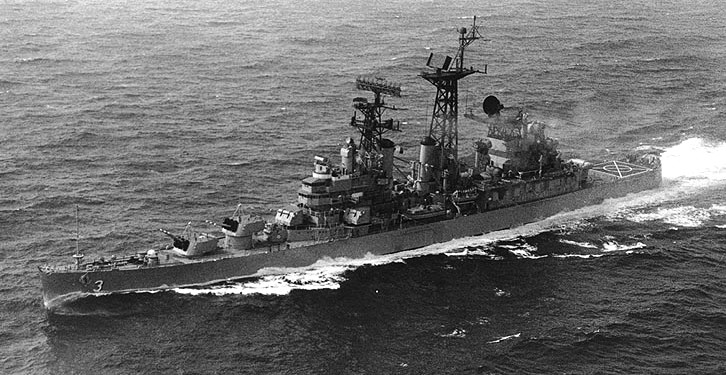
(USN Photo)
U.S. Navy guided missile cruiser USS Galveston (CLG-3) underway in the Mediterranean Sea, 10 May 1967.
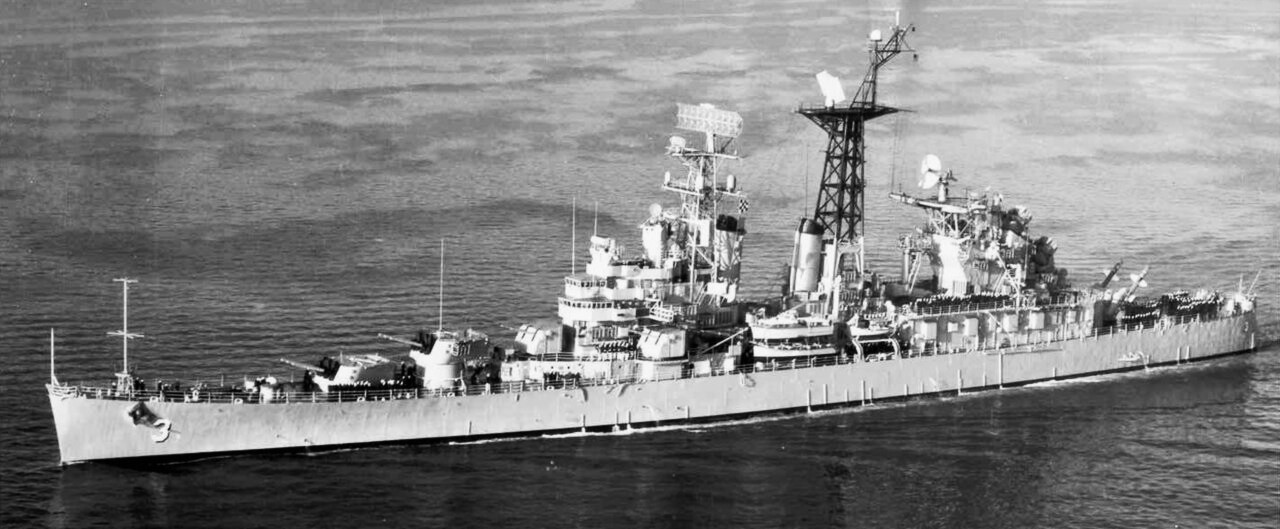
(USN Photo)
U.S. Navy guided missile cruiser USS Galveston (CLG-3) entering San Francisco Bay (USA) just after passing beneath the Golden Gate Bridge.
USS Youngstown (CL-94)
USS Youngstown (CL-94) was to have been a United States Navy Cleveland-class light cruiser. She was laid down 4 September 1944. Because of the end of hostilities in the Pacific, the contract was canceled 12 August 1945, when the ship was slightly more than half completed, and she was scrapped on the ways in 1946. She was to be named after Youngstown, Ohio, a city in Northeast Ohio.