
US Navy Heavy and Light Cruisers: USS Cleveland (CL-55), USS Columbia (CL-56), USS Montpelier (CL-57), USS Denver (CL-58), USS Amsterdam (CL-59), USS Santa Fe (CL-60), USS Tallahassee (CL-61), USS Birmingham (CL-62), USS Mobile (CL-63), USS Vincennes (CL-64), USS Pasadena (CL-65), USS Springfield (CL-66), USS Topeka (CL-67)
Early Second World War
When the United States entered the Second World War it had three major classes of cruisers under construction: the Atlanta and Cleveland light cruiser classes (with 5-inch and 6-inch main batteries, respectively), and the Baltimore-class of heavy cruisers. The Cleveland-class was an improvement of the Brooklyn design, while the Baltimore-class was an improved Wichita. These ships would form the bulk of the cruiser war construction effort, with eight Atlanta-class, twenty-seven Cleveland-class, and fourteen Baltimore-class cruisers ultimately completed. Early in the war nine Cleveland hulls would be diverted for conversion into Independence class light aircraft carriers (CVLs). By the end of the war three Cleveland hulls would be canceled, and one incomplete hull would later be converted to a guided missile cruiser. (Wikipedia)
Cleveland class
(CL-55) Cleveland (1942) – WW2: 13 battle stars.
(CL-56) Columbia (1942) – WW2: 10 battle stars.
(CL-57) Montpelier (1942) – WW2: 13 battle stars.
(CL-58) Denver (1942) – WW2: 11 battle stars.
(CL-59) Amsterdam (completed as Independence (CVL-22)).
(CL-60) Santa Fe (1942) – WW2: 13 battle stars.
(CL-61) Tallahassee (completed as Princeton (CVL-23)).
(CL-62) Birmingham (1943) – WW2: 8 battle stars.
(CL-63) Mobile (1943) – WW2: 11 battle stars.
(CL-64) Vincennes (ex-Flint) (1944) – WW2: 6 battle stars.
(CL-65) Pasadena (1944) – WW2: 5 battle stars.
(CL-66) Springfield (1944) – WW2: 2 battle stars, later converted to CLG-7.
(CL-67) Topeka (1944) – WW2: 2 battle stars, later converted to CLG-8.
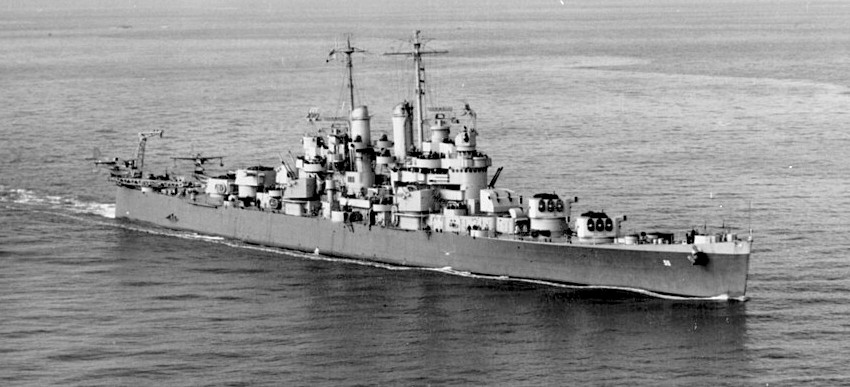
USS Cleveland (CL-55)
(USN Photo)
USS Cleveland (CL-55) underway at sea in late 1942. Note that the ship’s forward 152 mm gun turrets and gun director appear to be tracking the photo aircraft.
USS Columbia (CL-56)
(USN Photo)
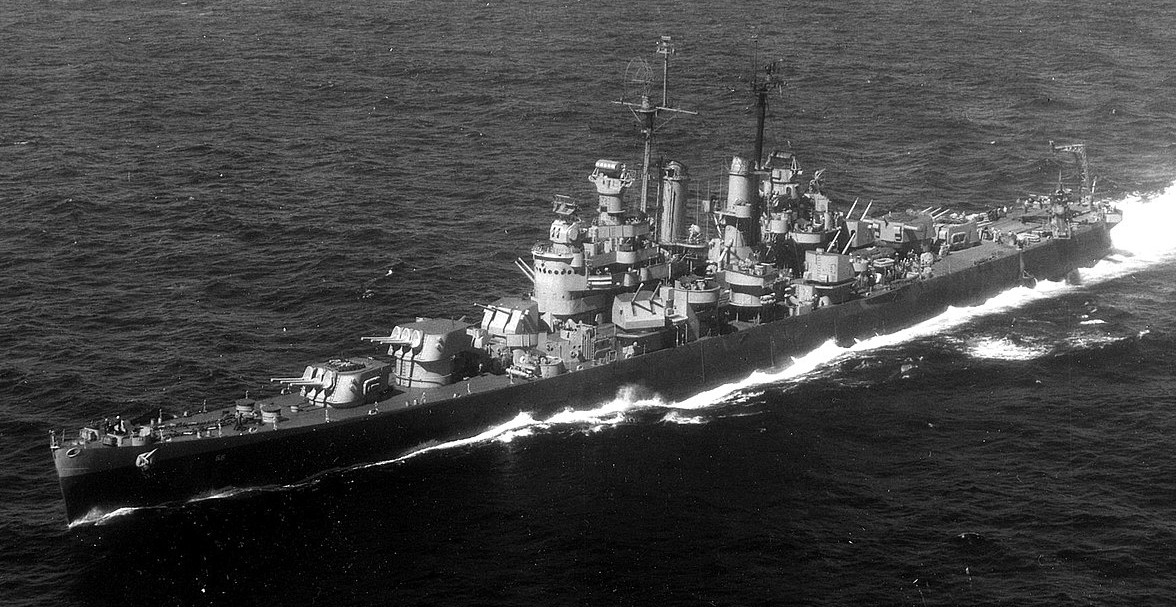
USS Columbia (CL-56) underway off San Pedro, California, in 1945. She is painted in Camouflage Measure 22.
USS Columbia was a Cleveland-class light cruiser of the United States Navy, which were built during World War II. The class was designed as a development of the earlier Brooklyn-class cruisers, the size of which had been limited by the First London Naval Treaty. The start of the war led to the dissolution of the treaty system, but the dramatic need for new vessels precluded a new design, so the Clevelands used the same hull as their predecessors, but were significantly heavier. The Clevelands carried a main battery of twelve 6-inch (152 mm) guns in four three-gun turrets, along with a secondary armament of twelve 5 in (127 mm) dual-purpose guns. They had a top speed of 32.5 knots (60.2 km/h; 37.4 mph).
The ship, the sixth US Navy ship to bear the name, was named for the city of Columbia, South Carolina. Columbia was commissioned in July 1942, and saw service in several campaigns in the Pacific. Like almost all her sister ships, she was decommissioned shortly after the end of the war, and never saw active service again. Columbia was scrapped in the early 1960s. A memorial to the ship and crew who served on her exists in Columbia. (Wikipedia)
USS Montpelier (CL-57)
(USN Photo)
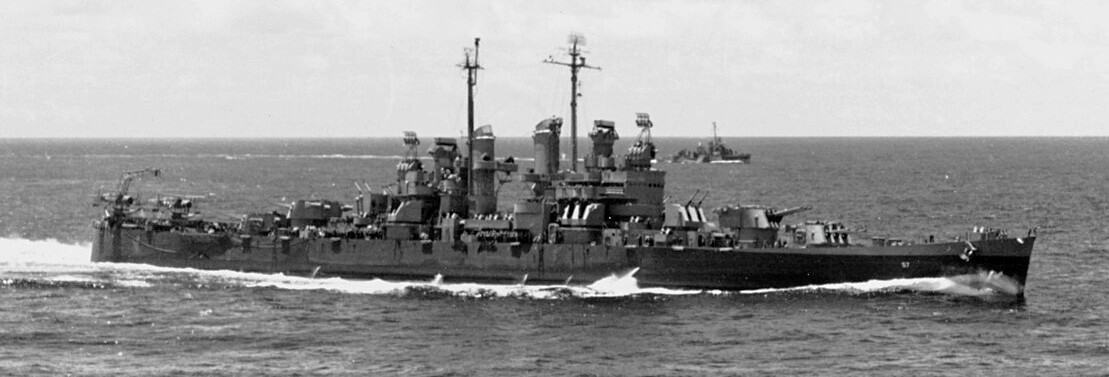
USS Montpelier (CL-57) and a destroyer en route from the Marshall Islands to take part in the invasion of Saipan, 11 June 1944.
USS Montpelier (CL-57) was one of 27 United States Navy Cleveland-class light cruisers completed during or shortly after World War II. She was the second US Navy ship to be named for the city of Montpelier, Vermont. Montpelier was commissioned in September 1942 and saw service in several campaigns in the Pacific. Like almost all her sister ships, she was decommissioned shortly after the end of the war, and never saw active service again. Montpelier was scrapped in the early 1960s. (Wikipedia)
USS Denver (CL-58)
(USN Photo)
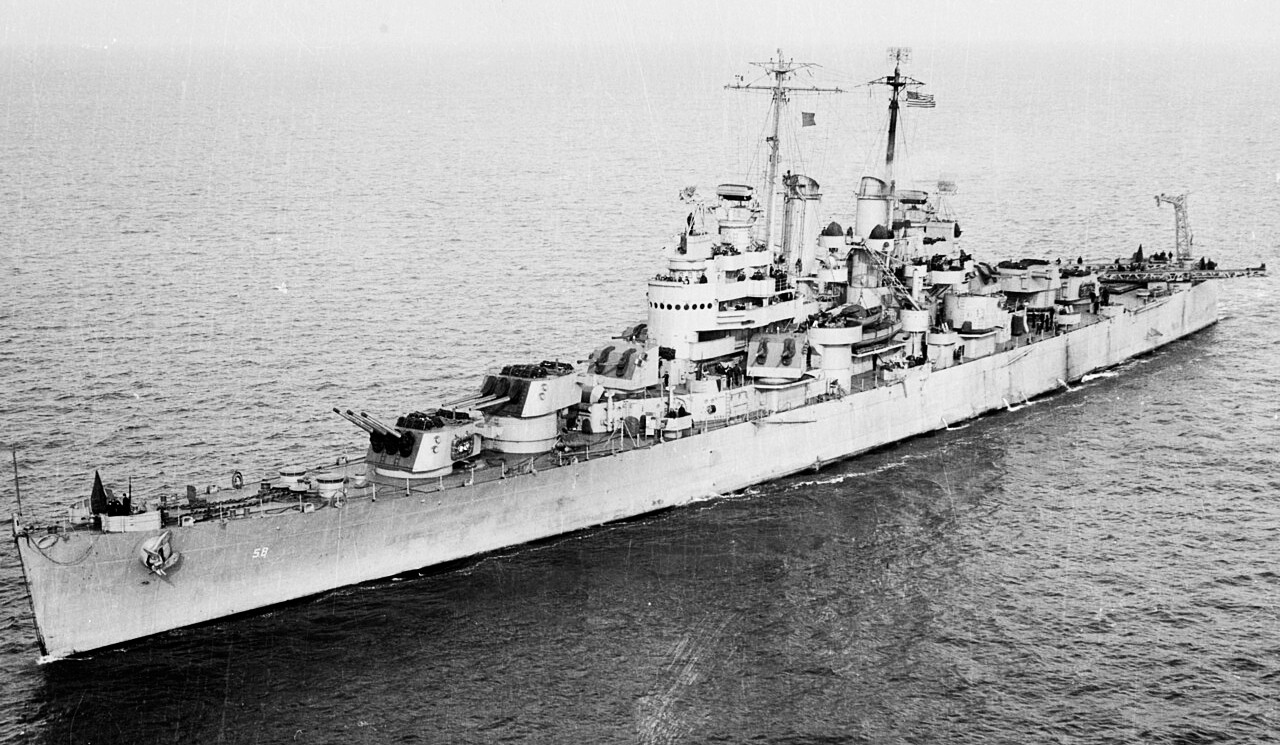
USS Denver (CL-58) underway, circa in December 1942.
USS Denver (CL-58) was a Cleveland-class light cruiser. Denver launched on 4 April 1942 by New York Shipbuilding Corp., Camden, New Jersey; sponsored by Miss L. J. Stapleton, daughter of the Mayor of Denver; and commissioned on 15 October 1942, Captain Robert Carney in command. It was the second ship named for the city of Denver, Colorado. (Wikipedia)
USS Amsterdam (CL-59)
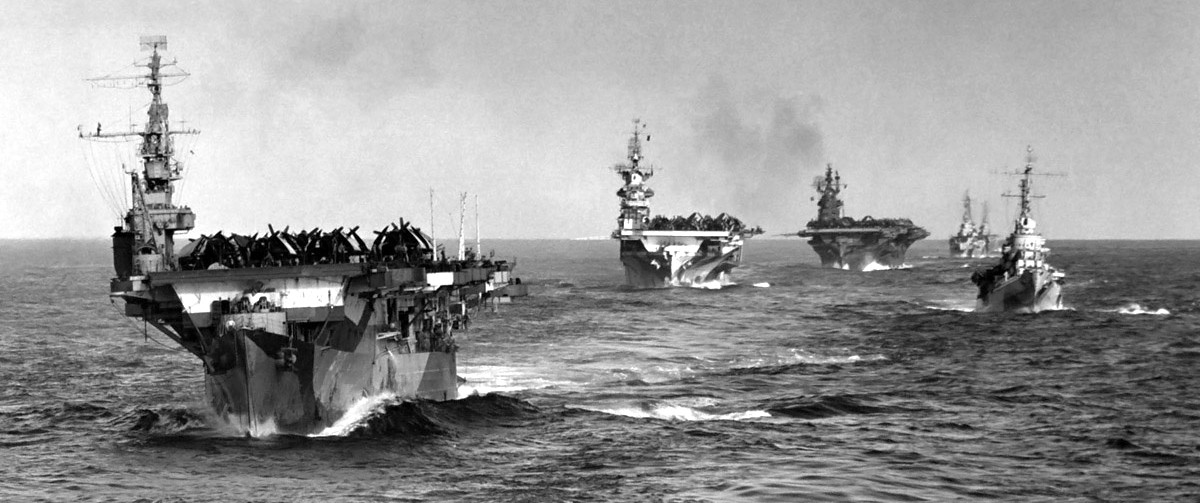
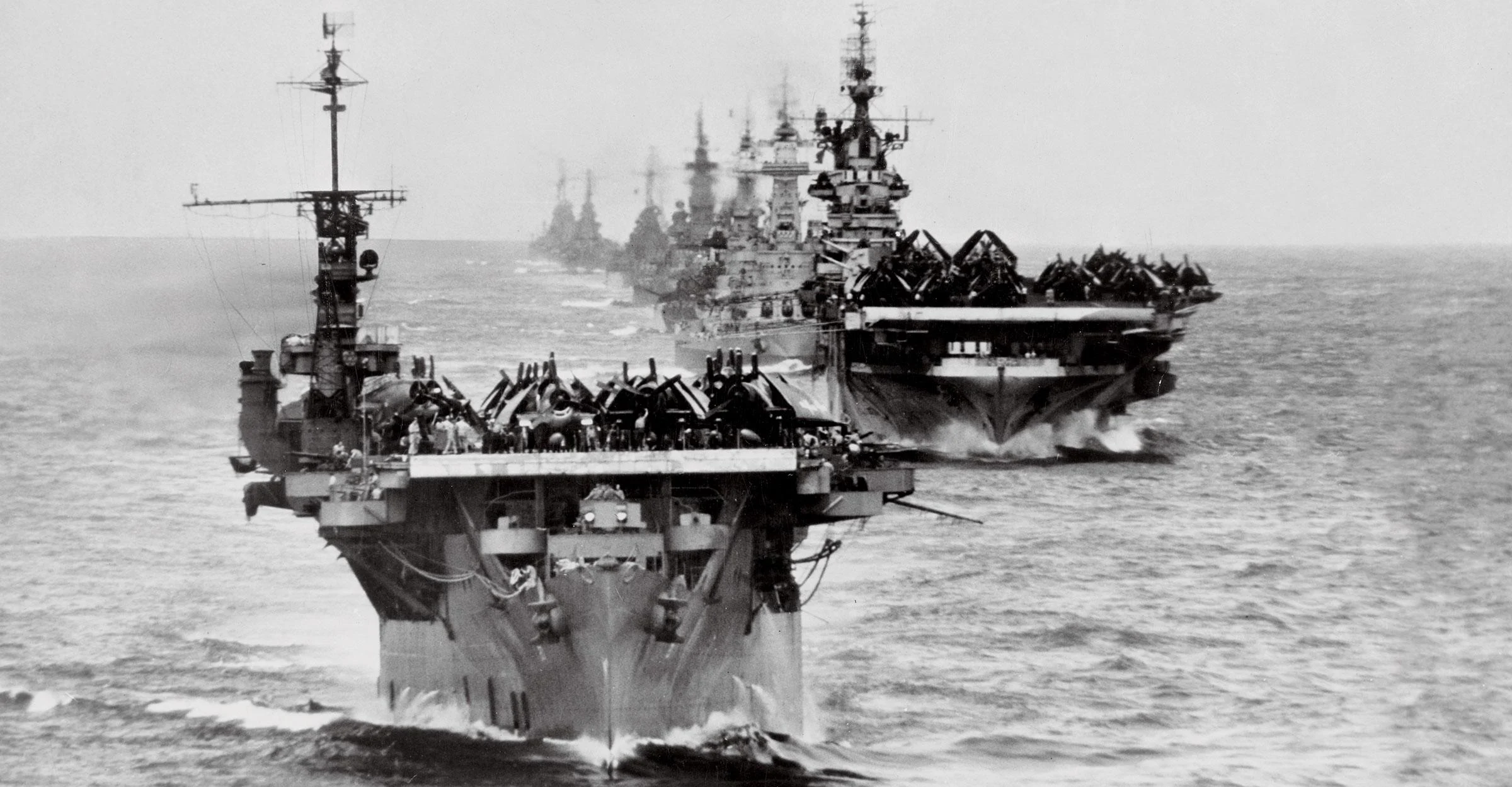
USS Amsterdam (CL-59), was to have been a light cruiser numbered CL-59, but she was completed as the light aircraft carrier Independence (CVL-22).
(USN Photo)
Another view of the U.S. Navy Task Group returning to anchorage at Ulithi Atoll in the Pacific Ocean on 12 Dec 1944. The lead carrier is the USS Independence (CVL-22), followed by the large Essex-class fleet carriers USS Hornet (CV-12) and USS Lexington (CV-16). They are accompanied by battleships and cruisers.
(USN Photo)
A Second World War U.S. Navy Task Group turning to port in formation as they return to anchorage at Ulithi Atoll in the Pacific Ocean on 12 Dec 1944. The lead carrier is the USS Independence (CVL-22), followed by the large Essex-class fleet carriers USS Hornet (CV-12) and USS Lexington (CV-16). They are accompanied by battleships and cruisers at the rear of the line.
USS Santa Fe (CL-60)
(USN Photo)
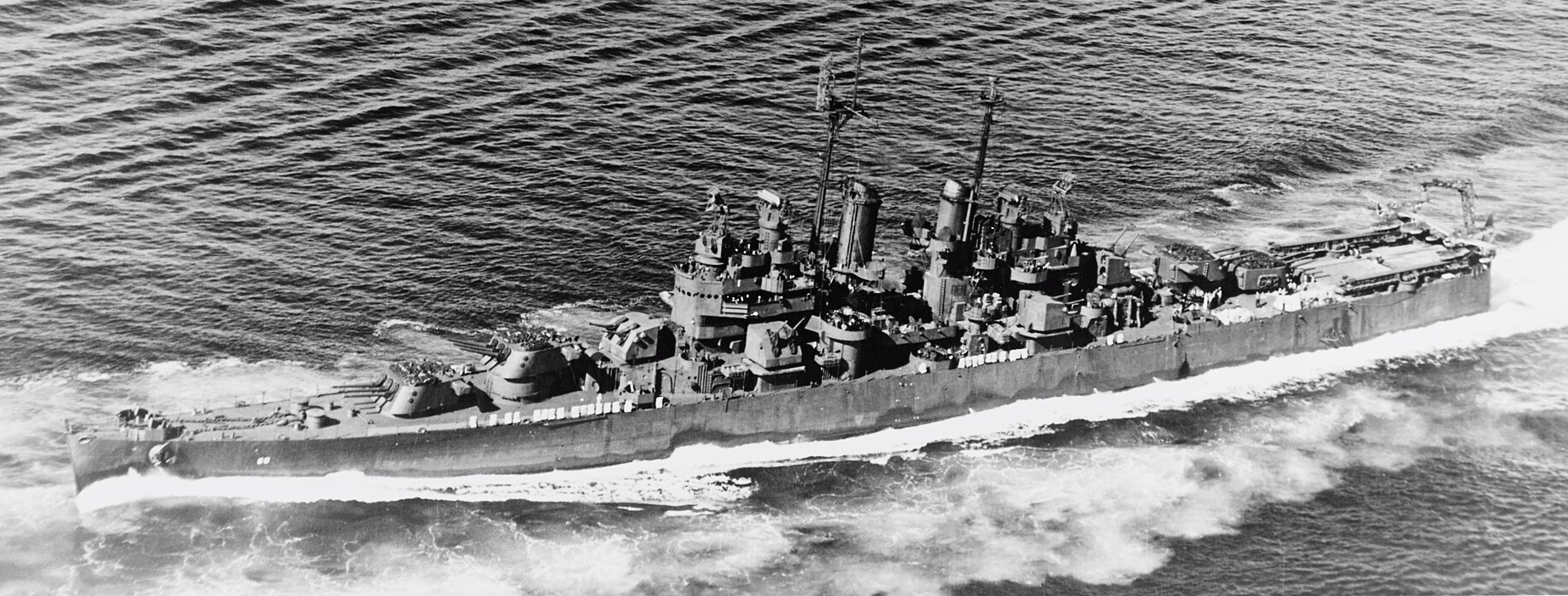
USS Santa Fe (CL-60) underway off the U.S. West Coast on 13 January 1944, the day she sailed to take part in the Marshalls operation.
USS Santa Fe (CL-60) was a Cleveland-class light cruiser of the United States Navy, which were built during the Second World War. The class was designed as a development of the earlier Brooklyn-class cruisers, the size of which had been limited by the First London Naval Treaty. The start of the war led to the dissolution of the treaty system, but the dramatic need for new vessels precluded a new design, so the Clevelands used the same hull as their predecessors, but were significantly heavier. The Clevelands carried a main battery of twelve 6-inch (152 mm) guns in four three-gun turrets, along with a secondary armament of twelve 5 in (127 mm) dual-purpose guns. They had a top speed of 32.5 knots (60.2 km/h; 37.4 mph). (Wikipedia)
(USN Photo)
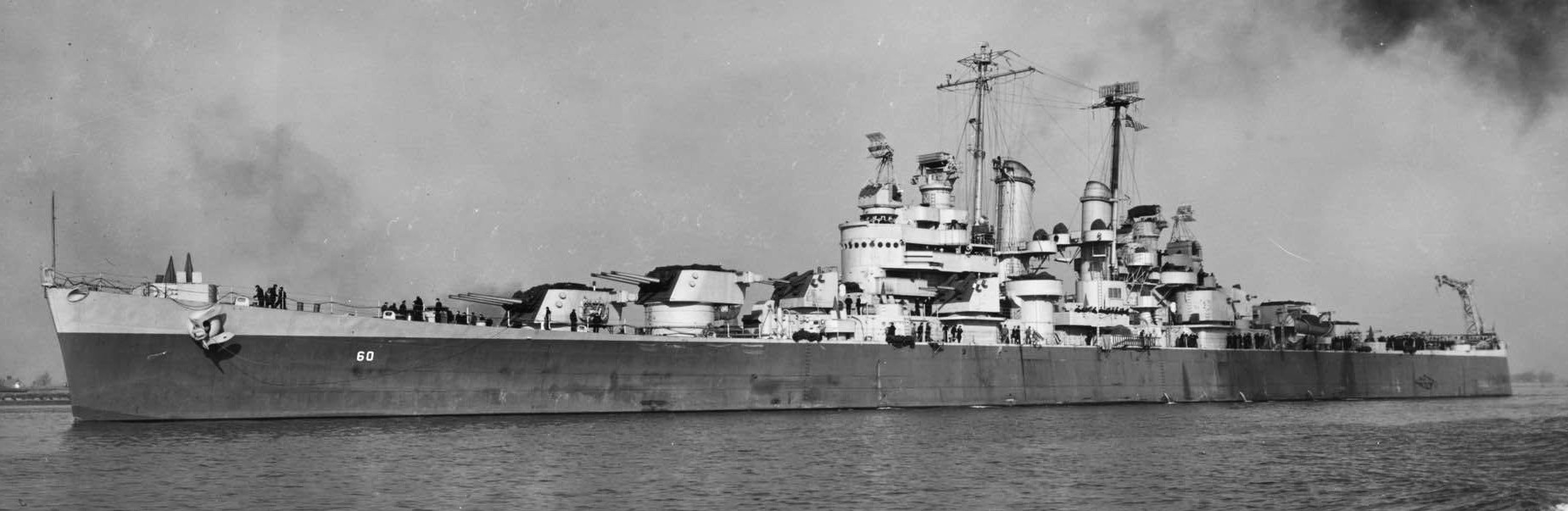
USS Santa Fe (CL-60). The 11,744 long tons Cleveland-class light cruiser USS Santa Fe off the Philadelphia Navy Yard, Pennsylvania, January 9th 1943. Capable of 32.5 knots, Santa Fe was armed with 12 × 6 in (152 mm) Mark 16 guns, 12 × 5 in (127 mm)/38 caliber guns, 24 × 40 mm (1.6 in) Bofors anti-aircraft guns and 21 × 20 mm (0.79 in) Oerlikon anti-aircraft guns. Commissioned on November 24th 1942 Santa Fe only had a active service life of 4 years being decommissioned October 19th 1946 and assigned to the Bremerton Group of the Pacific Reserve Fleet, where she remained for the next thirteen years. She was ultimately struck from the Naval Vessel Register on 1 March 1959, and sold for scrap on 9 Nov 1959 to Zidell Explorations, Inc. For her wartime service Santa Fe received thirteen battle stars. (Bill Cox)
USS Tallahassee (CL-61)
USS Tallahassee (CL-61) was converted from a Cleveland-class light cruiser to the Independence-class aircraft carrier USS Princeton (CVL-23) before launching.
USS Birmingham (CL-62)
(USN Photo)
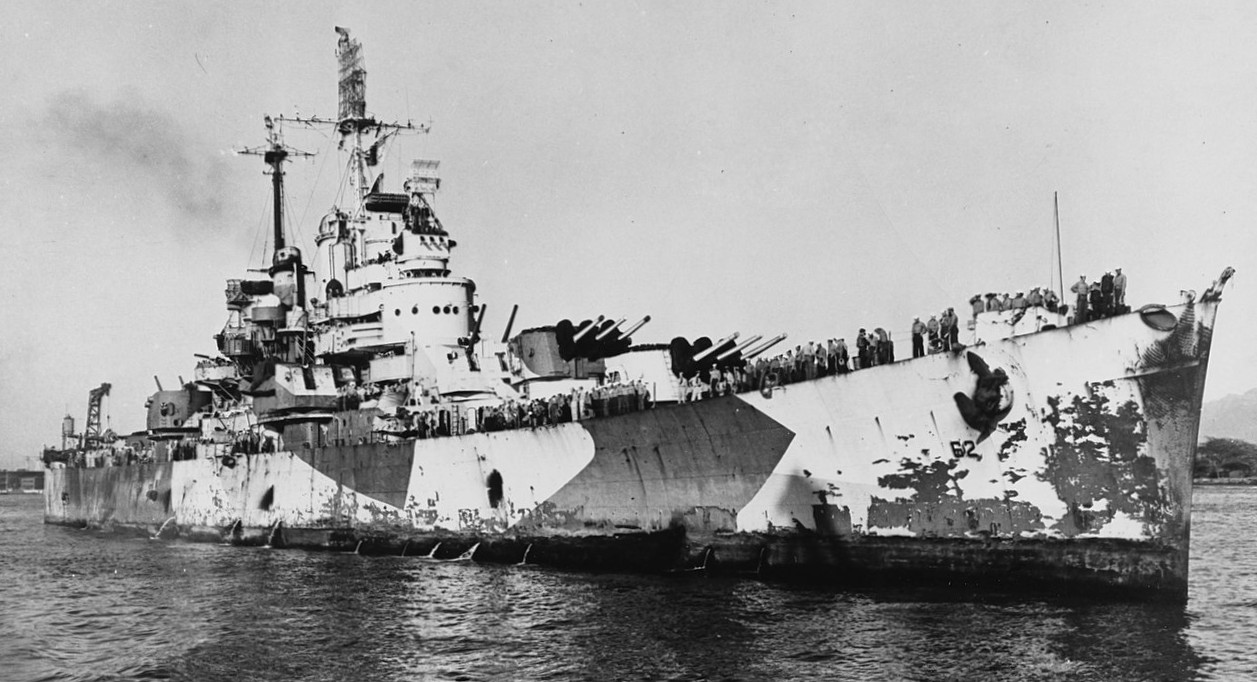
USS Birmingham (CL-62), returning to the United States for repair of damage received during the Battle of Leyte Gulf, 24 October 1944. She was assisting with firefighting on USS Princeton (CVL-23) when carrier’s after bomb stowage detonated, causing severe topside damage to Birmingham and heavy casualties among her crew. Birmingham’s camouflage scheme is Measure 33, Design 6d.
USS Birmingham (CL-62) was a Cleveland-class light cruiser of the United States Navy, which were built during World War II. The class was designed as a development of the earlier Brooklyn-class cruisers, the size of which had been limited by the First London Naval Treaty. The start of the war led to the dissolution of the treaty system, but the dramatic need for new vessels precluded a new design, so the Clevelands used the same hull as their predecessors but were significantly heavier. The Clevelands carried a main battery of twelve 6-inch (152 mm) guns in four three-gun turrets, along with a secondary armament of twelve 5 in (127 mm) dual-purpose guns. They had a top speed of 32.5 knots (60.2 km/h; 37.4 mph).
She was laid down at the Newport News Shipbuilding and Dry Dock Company of Newport News, Virginia, on 17 February 1941 and launched on 20 March 1942 by Mrs. Cooper Green, wife of the president of the Birmingham City Commission. She was commissioned on 29 January 1943, Captain John Wilkes in command. Birmingham earned eight battle stars, receiving heavy damage on at least three occasions. (Wikipedia)
USS Mobile (CL-63)
(USN Photo)
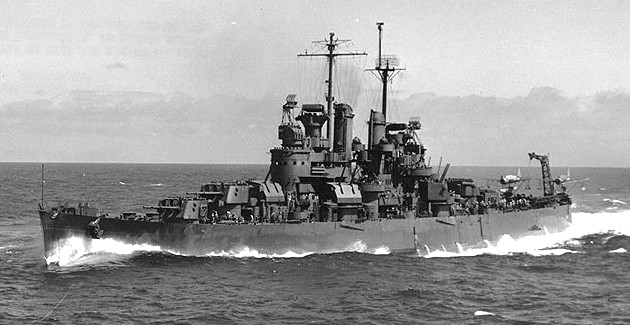
USS Mobile (CL-63) was a Cleveland-class light cruiser of the United States Navy, which were built during the Second World War. The class was designed as a development of the earlier Brooklyn-class cruisers, the size of which had been limited by the First London Naval Treaty. The start of the war led to the dissolution of the treaty system, but the dramatic need for new vessels precluded a new design, so the Clevelands used the same hull as their predecessors, but were significantly heavier. The Clevelands carried a main battery of twelve 6-inch (152 mm) guns in four three-gun turrets, along with a secondary armament of twelve 5 in (127 mm) dual-purpose guns. They had a top speed of 32.5 knots (60.2 km/h; 37.4 mph). (Wikipedia)
USS Vincennes (CL-64)
(USN Photo)
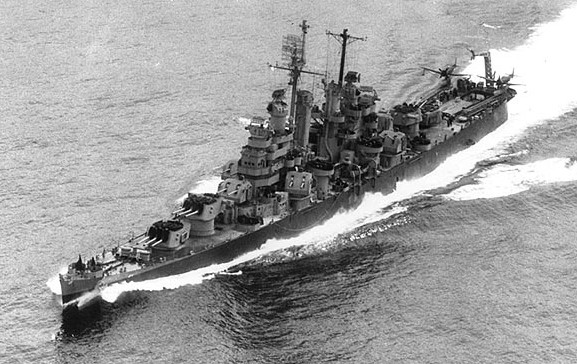
USS Vincennes (CL-64) steaming in San Francisco Bay, California, on 29 August 1945. She is painted in Camouflage Measure 22.
USS Vincennes (CL-64) was a Cleveland-class light cruiser of the United States Navy, which were built during the Second World War. The class was designed as a development of the earlier Brooklyn-class cruisers, the size of which had been limited by the First London Naval Treaty. The start of the war led to the dissolution of the treaty system, but the dramatic need for new vessels precluded a new design, so the Clevelands used the same hull as their predecessors, but were significantly heavier. The Clevelands carried a main battery of twelve 6-inch (152 mm) guns in four three-gun turrets, along with a secondary armament of twelve 5 in (127 mm) dual-purpose guns. They had a top speed of 32.5 knots (60.2 km/h; 37.4 mph). (Wikipedia)
USS Pasadena (CL-65)
(USN Photo)
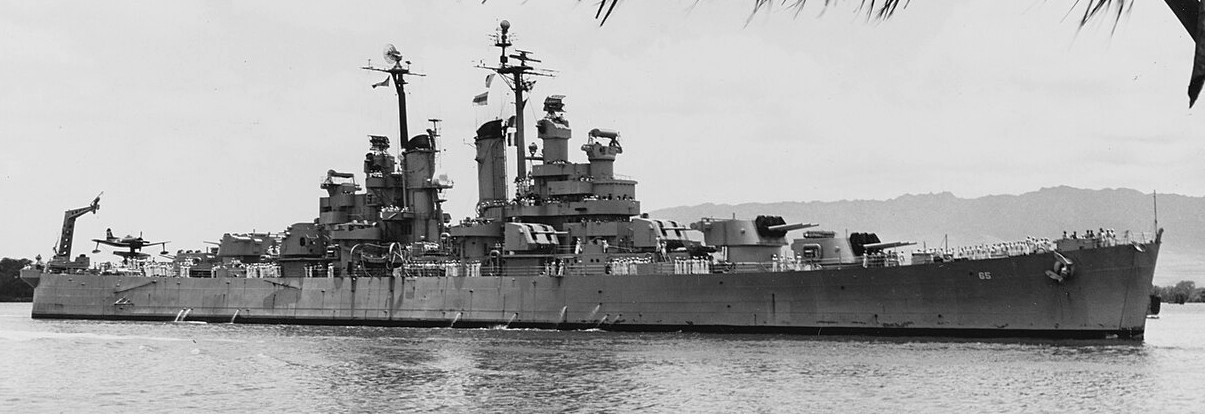
USS Pasadena (CL-65), entering Pearl Harbor, Hawaii, during a NROTC Midshipmen’s cruise in the Summer of 1948.
USS Pasadena (CL-65) was a Cleveland-class light cruiser of the United States Navy, which were built during the Second World War. The class was designed as a development of the earlier Brooklyn-class cruisers, the size of which had been limited by the First London Naval Treaty. The start of the war led to the dissolution of the treaty system, but the dramatic need for new vessels precluded a new design, so the Clevelands used the same hull as their predecessors, but were significantly heavier. The Clevelands carried a main battery of twelve 6-inch (152 mm) guns in four three-gun turrets, along with a secondary armament of twelve 5 in (127 mm) dual-purpose guns. They had a top speed of 32.5 knots (60.2 km/h; 37.4 mph). (Wikipedia)
USS Springfield (CL-66)
(USN Photo)
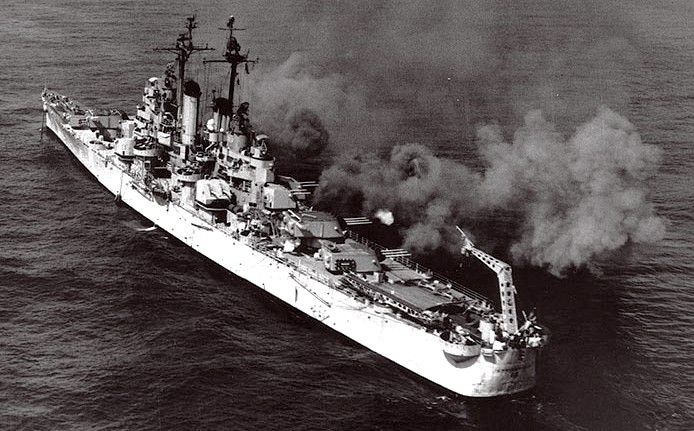
USS Springfield (CL-66) fires her 6/47 and 5/38 guns, during gunnery practice in the Pacific, circa 1947-1948. Note that the cruiser still retained one aircraft catapult.
USS Springfield (CL-66) was a Cleveland-class light cruiser of the United States Navy, which were built during World War II. The class was designed as a development of the earlier Brooklyn-class cruisers, the size of which had been limited by the First London Naval Treaty. The start of the war led to the dissolution of the treaty system, but the dramatic need for new vessels precluded a new design, so the Clevelands used the same hull as their predecessors, but were significantly heavier. The Clevelands carried a main battery of twelve 6-inch (152 mm) guns in four three-gun turrets, along with a secondary armament of twelve 5 in (127 mm) dual-purpose guns. They had a top speed of 32.5 knots (60.2 km/h; 37.4 mph).
She was the third US Navy ship to be named after Springfield, Illinois. Commissioned in 1944, she served briefly in the Atlantic before transferring to the Pacific. There she served with fast carrier task forces, primarily in an anti-aircraft role, but also in a shore bombardment role in the last stages of the Pacific War. She earned two battle stars for wartime service. Like all but one of her sister ships, she was decommissioned and laid up soon after the end of the Second World War.
In the late 1950s she was one of three Cleveland-class ships to be converted into Providence-class guided missile cruisers. As part of this conversion, she was modified to become a flagship, which involved expanding her forward superstructure and removing most of her forward armament. She was recommissioned in 1960 as CLG-7 (later redesignated as CG-7). In her second career, she served entirely in the Atlantic and Mediterranean. She was decommissioned for the final time in 1974 and sold for scrap six years later. (Wikipedia)
(USN Photo)
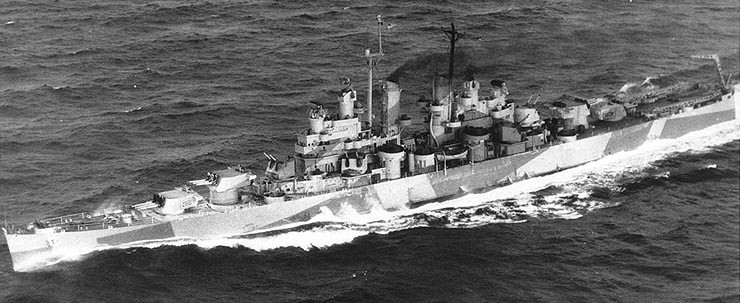
USS Springfield (CL-66) underway off Boston, Massachusetts (USA), on 6 January 1945. The ship’s camouflage is Measure 33, Design 24d.
USS Topeka (CL-67)
(USN Photo)
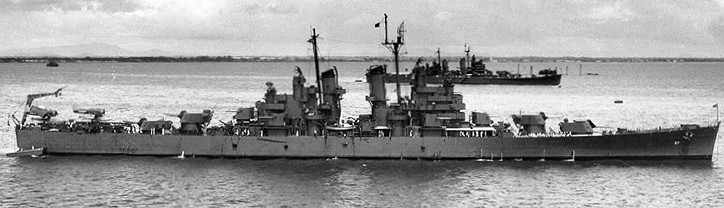
USS Topeka (CL-67) in Manila Bay, Philippine Islands, in July 1946. A Baltimore-class heavy cruiser is in the background.
USS Topeka (CL-67), a Cleveland-class light cruiser in service with the United States Navy from 1944 to 1949. From 1957 to 1960, she was converted to a Providence-class guided missile cruiser and redesignated CLG-8. The cruiser served again from 1960 to 1969 and was finally scrapped in 1975. (Wikipedia)