
Kaiserliche Marine (Imperial German Navy) pre-dreadnaught battleships: Deutschland class (1905): SMS Deutschland, SMS Hannover, SMS Pommern, SMS Schlesien, SMS Schleswig-Holstein.
SMS Deutschland
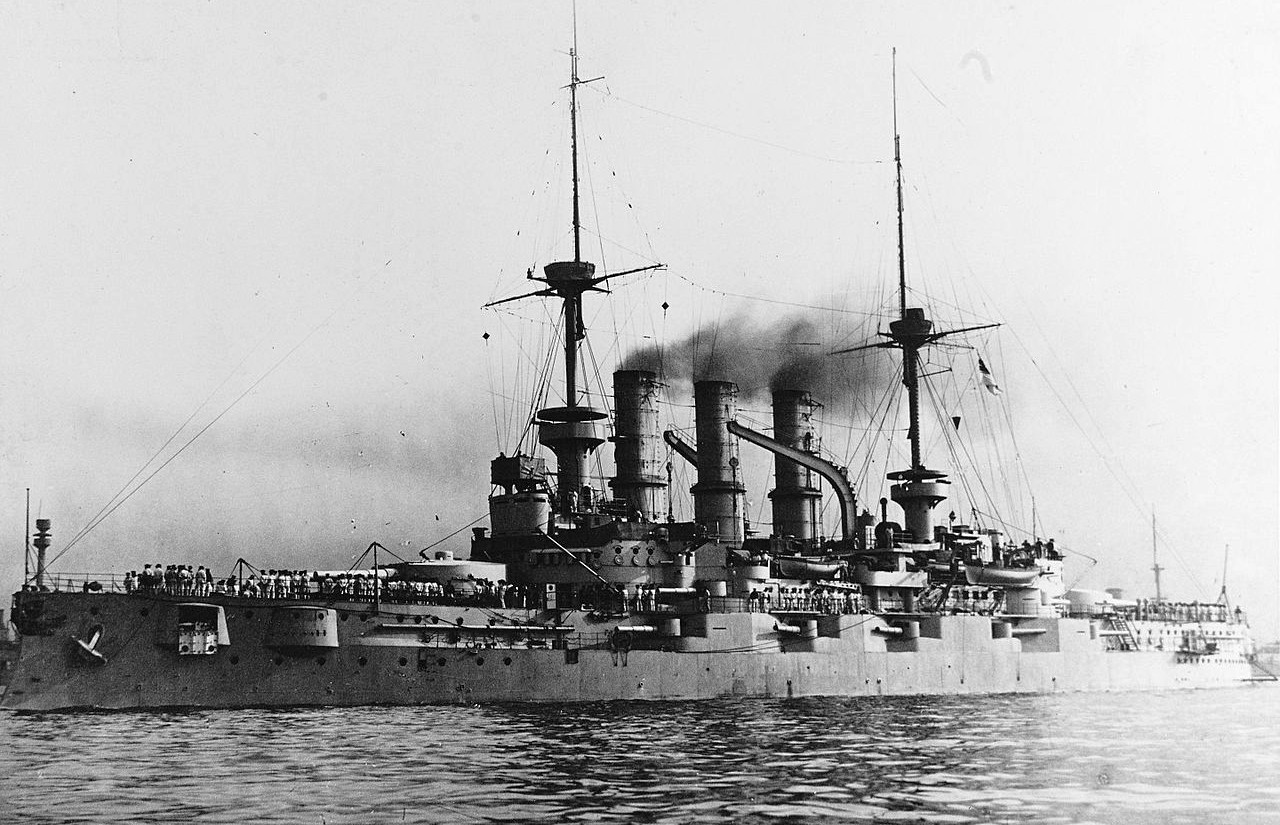
(Kaiserliche Marine Photo)
SMS Deutschland (His Majesty’s Ship Germany)[a] was the first of five Deutschland-class pre-dreadnought battleships built for the German Kaiserliche Marine (Imperial Navy). The ship was armed with a main battery of four 28 cm (11 in) guns in two twin turrets. She was built at the Germaniawerft shipyard in Kiel, where she was laid down in June 1903 and launched in November 1904. She was commissioned on 3 August 1906, a few months ahead of HMS Dreadnought. The latter, armed with ten large-caliber guns, was the first of a revolutionary new standard of “all-big-gun” battleships that rendered Deutschland and the rest of her class obsolete.
Deutschland served as the flagship of the High Seas Fleet until 1913, when she was transferred to II Battle Squadron. With the outbreak of World War I in July 1914, she and her sister ships were tasked with defending the mouth of the Elbe and the German Bight from possible British incursions. Deutschland and the other ships of II Battle Squadron participated in most of the large-scale fleet operations in the first two years of the war, culminating in the Battle of Jutland on 31 May – 1 June 1916. Late on the first day of the battle, Deutschland and the other pre-dreadnoughts briefly engaged several British battlecruisers before retreating.
After the battle, in which pre-dreadnoughts proved too vulnerable against more modern battleships, Deutschland and her three surviving sisters were assigned to coastal defense duties. By 1917, they had been withdrawn from combat service completely, disarmed, and tasked with auxiliary roles. Deutschland was used as a barracks ship in Wilhelmshaven until the end of the war. She was struck from the naval register on 25 January 1920, sold to ship breakers that year, and broken up for scrap by 1922. (Wikipedia)
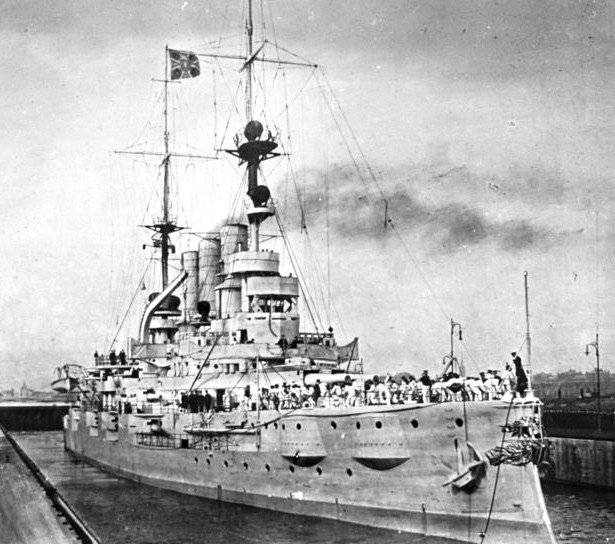
(Bundesarchiv, DVM 10 Bild-23-61-08)
SMS Deutschland.
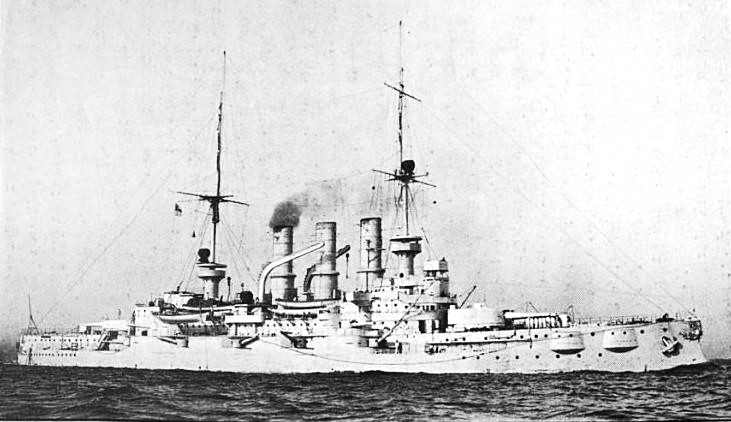
(Kaiserliche Marine Photo)
SMS Deutschland, c1908.
SMS Hannover
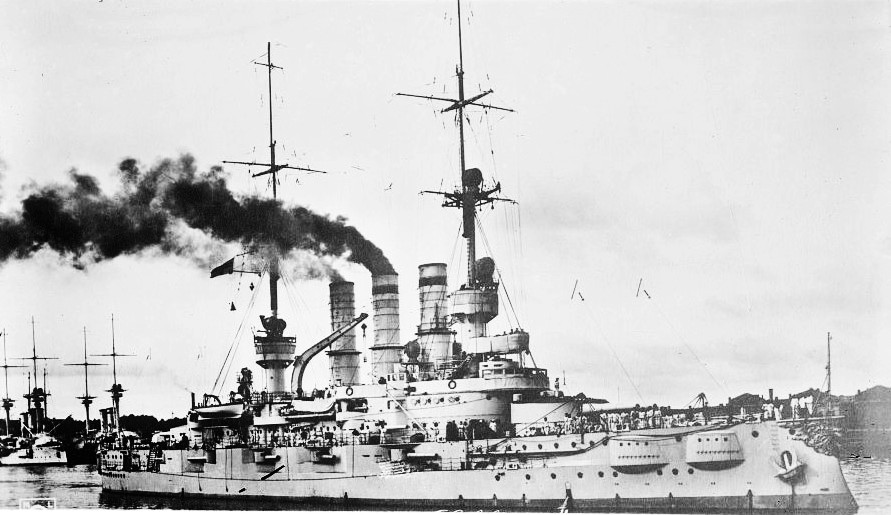
(Library of Congress Photo)
SMS Hannover (“His Majesty’s Ship Hannover”) was the second of five Deutschland-class pre-dreadnought battleships of the German Imperial Navy (Kaiserliche Marine). Hannover and the three subsequently constructed ships differed slightly from the lead ship Deutschland in their propulsion systems and slightly thicker armor. Hannover was laid down in November 1904, launched in May 1905, and commissioned into the High Seas Fleet in October 1907. The ship was armed with a battery of four 28 cm (11 in) guns and had a top speed of 18 knots (33 km/h; 21 mph). The ships of her class were already outdated by the time they entered service, being inferior in size, armor, firepower, and speed to the revolutionary new British battleship HMS Dreadnought.
Hannover and her sister ships saw extensive service with the fleet. The ship took part in all major training maneuvers until the First World War broke out in July 1914. Hannover and her sisters were immediately pressed into guard duties at the mouth of the Elbe River while the rest of the fleet mobilized. The ship took part in several fleet advances, which culminated in the Battle of Jutland on 31 May – 1 June 1916. During the battle, Hannover served as the flagship for IV Division of II Battle Squadron; she was not heavily engaged during the battle, nor was she damaged by enemy fire. After the battle, which exposed the weakness of pre-dreadnoughts like Hannover, she and her three surviving sisters were removed from active duty with the fleet to serve as guard ships. Hannover served in this capacity for the remainder of the war, first in the Elbe and, starting in 1917, in the Danish Straits. She was decommissioned in December 1918, shortly after the end of the war.
The ship was brought back to active service in the Reichsmarine, the post-war German navy. She served with the fleet for ten years, from 1921 to 1931, during which time she took part in several major overseas cruises to Spain and the Mediterranean Sea. Hannover was again decommissioned in September 1931; the navy planned to convert the ship into a radio-controlled target ship, but this was never carried out and she was instead used in explosive tests. Hannover was ultimately broken up for scrap between 1944 and 1946 in Bremerhaven. Her bell is preserved at the Military History Museum of the Bundeswehr in Dresden. (Wikipedia)
SMS Pommern
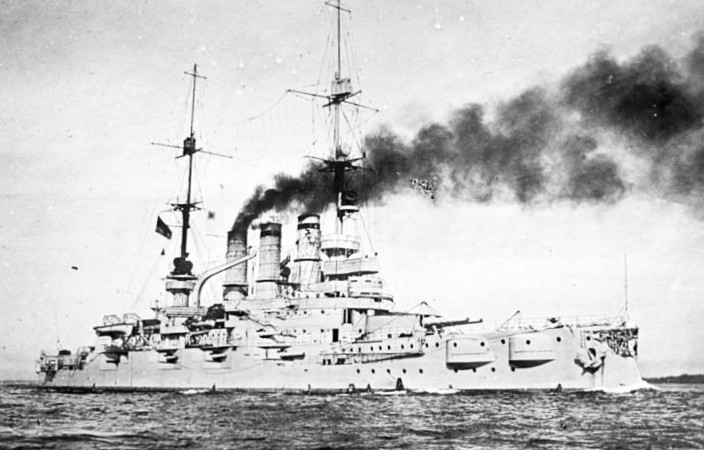
(Bundesarchiv, DVM 10 Bild-23-61-21 / CC-BY-SA 3.0)
SMS Pommern was one of five Deutschland-class pre-dreadnought battleships built for the German Kaiserliche Marine (Imperial Navy) between 1904 and 1906. Named after the Prussian province of Pomerania, she was built at the AG Vulcan yard at Stettin, Germany (now Szczecin, Poland), where she was laid down on 22 March 1904 and launched on 2 December 1905. She was commissioned into the navy on 6 August 1907. The ship was armed with a battery of four 28 cm (11 in) guns and had a top speed of 18 knots (33 km/h; 21 mph). The ships of her class were already outdated by the time they entered service, being inferior in size, armor, firepower, and speed to the revolutionary new battleship HMS Dreadnought.
After commissioning, Pommern was assigned to II Battle Squadron of the High Seas Fleet, where she served throughout her peacetime career and the first two years of World War I. Before the war, the fleet was primarily occupied with cruises and extensive training exercises, developing strategic concepts for use in a future conflict. At the start of the war, Pommern and the rest of II Battle Squadron were tasked with supporting the defenses of the German Bight, and were stationed at the mouth of the Elbe. They also participated in several fruitless sorties into the North Sea in attempts to lure out and destroy a portion of the British Grand Fleet.
These offensive operations culminated in the Battle of Jutland on 31 May – 1 June 1916. Pommern and her sisters briefly engaged the British battlecruisers commanded by David Beatty late on the first day, and Pommern was hit once by a 12 in (30.5 cm) shell from the battlecruiser HMS Indomitable. During the confused night actions in the early hours of 1 June, she was hit by one, or possibly two, torpedoes from the British destroyer HMS Onslaught, which detonated one of Pommern’s 17-centimeter (6.7 in) gun magazines. The resulting explosion broke the ship in half and killed the entire crew. Pommern was the only battleship of either side sunk during the battle. (Wikipedia)
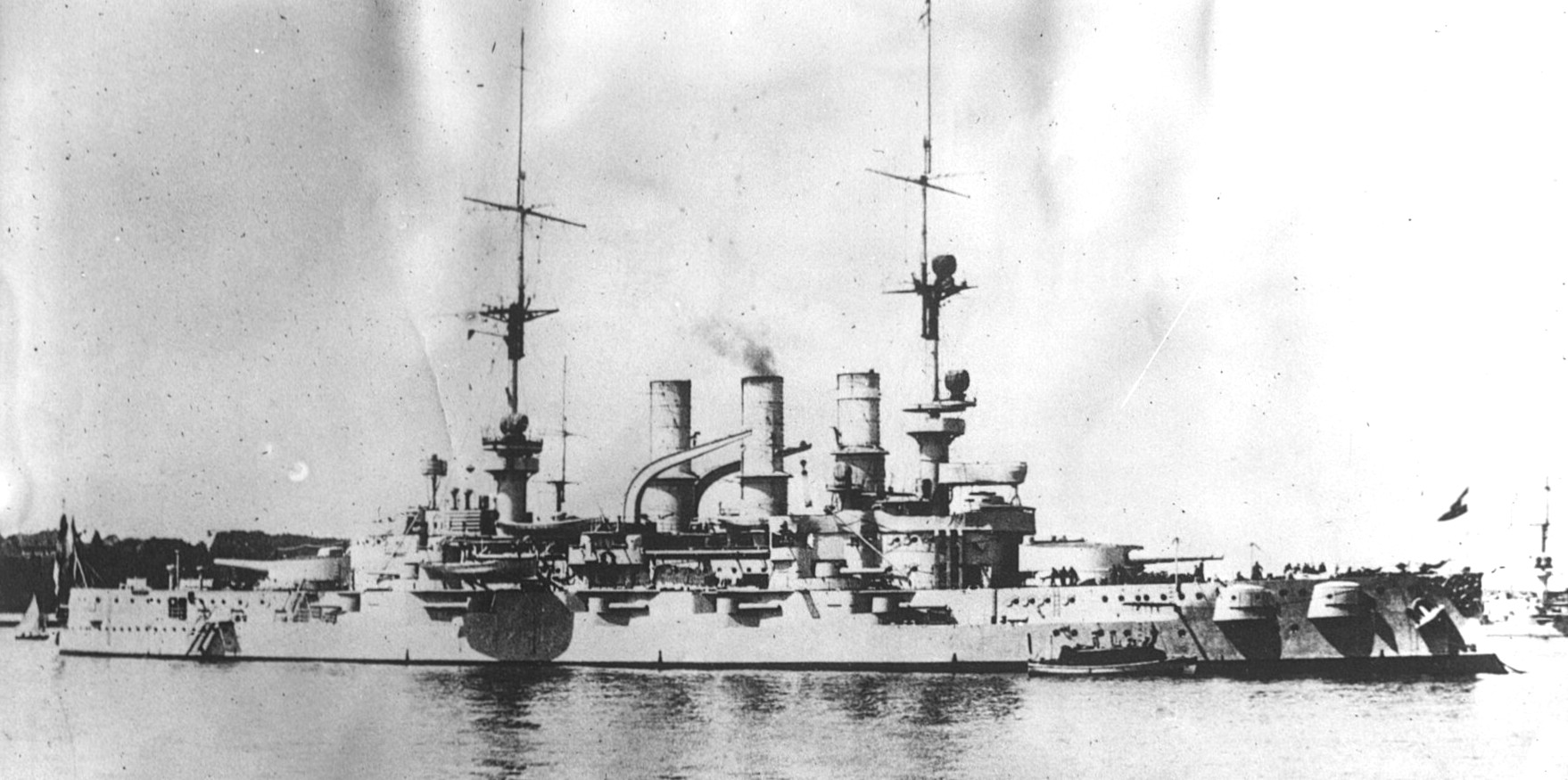
(Kaiserliche Marine Photo)
SMS Pommern, c1914.
SMS Schlesien

(Kaiserliche Marine Photo)
SMS Schlesien was one of five Deutschland-class pre-dreadnought battleships built for the German Kaiserliche Marine (Imperial Navy) between 1904 and 1906. Named after the German province of Silesia, Schlesien was laid down at the Schichau-Werke shipyard in Danzig on 19 November 1904, launched on 28 May 1906, and commissioned on 5 May 1908. She was armed with a battery of four 28 cm (11 in) guns and had a top speed of 18 knots (33 km/h; 21 mph). The ships of her class were already outdated by the time they entered service, as they were inferior in size, armor, firepower, and speed to the revolutionary new British battleship HMS Dreadnought.
After commissioning, Schlesien was assigned to I Battle Squadron of the High Seas Fleet, later being transferred to II Battle Squadron. She was primarily occupied with training cruises and fleet maneuvers in her early career. She served with the fleet throughout the first two years of World War I, seeing action at the Battle of Jutland on 31 May – 1 June 1916, where she was briefly actively engaged in combat. After Jutland, the Imperial Navy relegated Schlesien to guard duties before withdrawing her altogether in 1917, when she became a training ship. The Treaty of Versailles permitted the German navy to keep eight obsolete battleships, including Schlesien, to defend the German coast. Initially kept in reserve, she was modernized in the mid-1920s and saw extensive service with the reorganized Reichsmarine.
Schlesien saw limited combat during World War II, briefly bombarding Polish forces during the invasion of Poland in September 1939. She escorted minesweepers during Operation Weserübung, the invasion of Norway and Denmark in April 1940. After the operation, she was given secondary duties, primarily serving as a training ship and icebreaker. She ended her career providing fire support in the Baltic coast. While off Swinemünde on 3 May 1945, she struck a mine and was towed into Swinemünde, where she was sunk by her crew in shallow water, though much of her superstructure, including her main battery, remained above water. In the remaining days of the war, Schlesien used her anti-aircraft guns to defend the city from air attack. After the end of the war, she was broken up, though some parts of the ship remained visible until the 1970s. (Wikipedia)
SMS Schleswig-Holstein
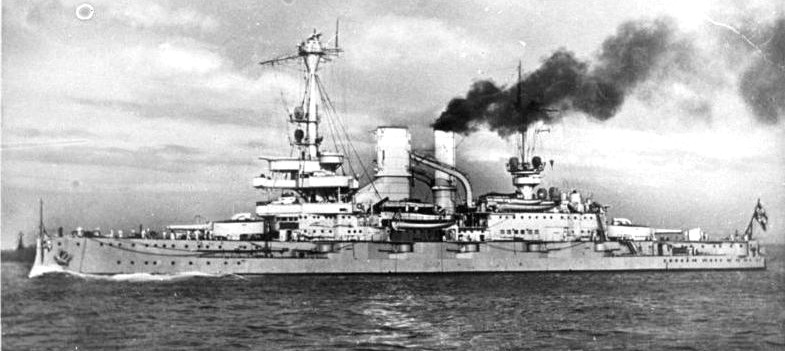
(Bundesarchiv, DVM 10 Bild-23-63-47 / CC-BY-SA 3.0)
SMS Schleswig-Holstein was the last of the five pre-dreadnought Deutschland-class battleships built by the German Kaiserliche Marine. The ship, named for the province of Schleswig-Holstein, was laid down in the Germaniawerft dockyard in Kiel in August 1905 and commissioned into the fleet nearly three years later. The ships of her class were already outdated by the time they entered service, being inferior in size, armor, firepower and speed to the new generation of dreadnought battleships.
Schleswig-Holstein fought in both World Wars. During World War I, she saw front-line service in II Battle Squadron of the High Seas Fleet, culminating in the Battle of Jutland on 31 May – 1 June 1916. Schleswig-Holstein saw action during the engagement, and was hit by one large-caliber shell. After the battle, Schleswig-Holstein was relegated to guard duty in the mouth of the Elbe River before being decommissioned in late 1917. As one of the few battleships permitted for Germany by the terms of the Treaty of Versailles, Schleswig-Holstein was again pressed into fleet service in the 1920s. In 1935, the old battleship was converted into a training ship for naval cadets.
Schleswig-Holstein fired the first cannon shots of the Second World War when she bombarded the Polish base at Danzig’s Westerplatte in the early morning hours of 1 September 1939. The ship was used as a training vessel for the majority of the war, and was sunk by British bombers in Gotenhafen in December 1944. Schleswig-Holstein was subsequently salvaged and then beached for use by the Soviet Navy as a target. As of 1990, the ship’s bell was on display in the Bundeswehr Military History Museum in Dresden. (Wikipedia)
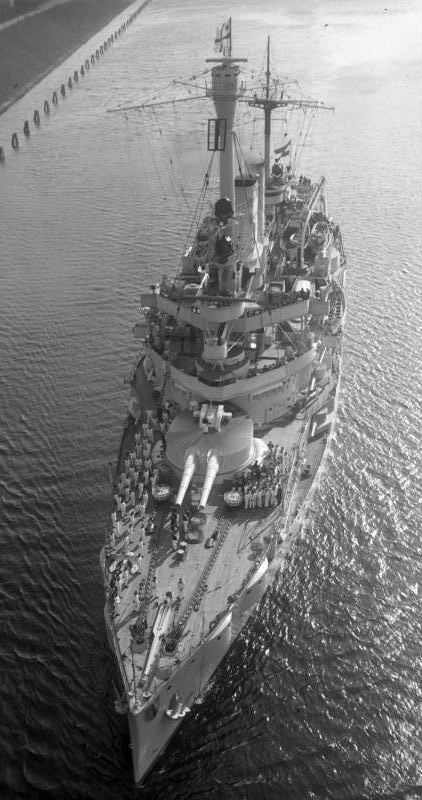
(German Federal Archives Photo)
SMS Schleswig-Holstein.