
Imperial Japanese Navy protected cruisers (Bōgo jun’yōkan): Tsushima, Yodo, Hirado, Yahagi
Imperial Japanese Navy protected cruiser Tsushima
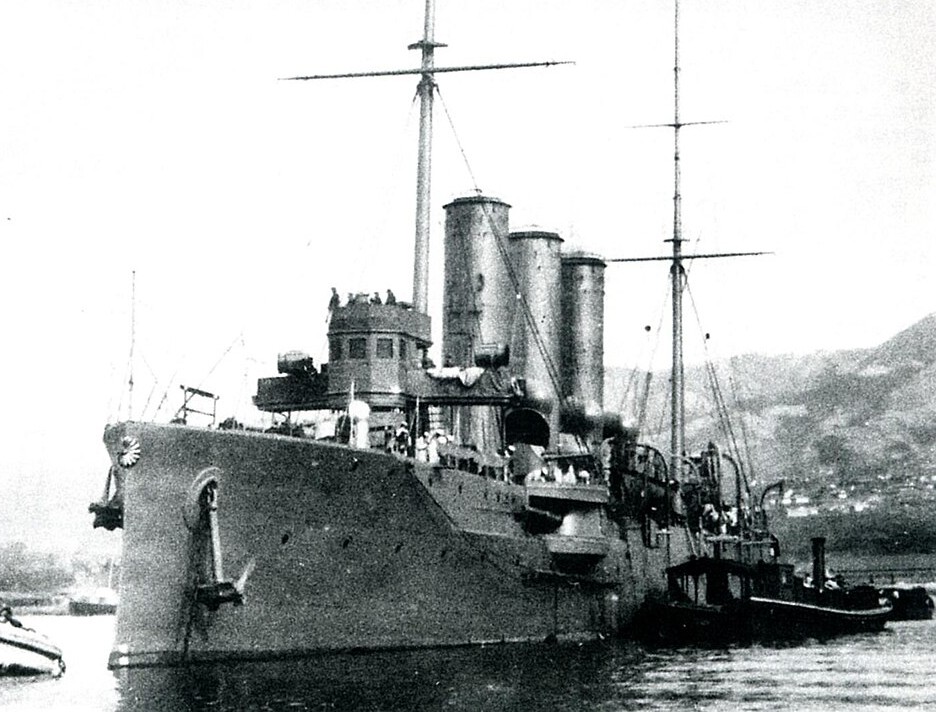
( Mikasa Memorial Museum Photo, 1904)
Tsushima. Kure Naval Arsenal Niitaka-class protected cruiser 3,366, 14 February 1904, 1 April 1939; Sunk off Miura 1944.
Tsushima (対馬) was a Niitaka-class cruiser of the Imperial Japanese Navy. The vessel was a sister ship to Niitaka and was named for Tsushima Province, one of the ancient provinces of Japan, and corresponding to the strategic island group between Japan and Korea. (Wikipedia)
Imperial Japanese Navy protected cruiser Yodo
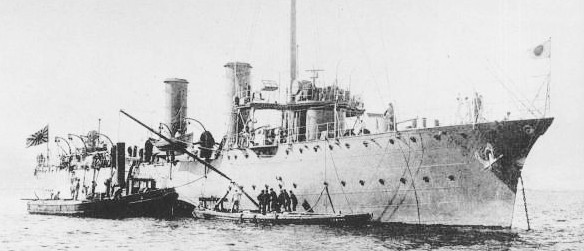
(IJN Photo)
Yodo. Kawasaki Yards, Kobe Yodo-class protected cruiser 1,250, 8 April 1908, 1 April 1940; Decommissioned; scrapped 1945.
Yodo (淀) was the lead ship in the Yodo class of high speed protected cruisers in the Imperial Japanese Navy. Officially rated as a tsūhōkan, meaning dispatch boat or aviso, Yodo was named after the Yodo River outside Osaka, Japan. Her sister ship was Mogami. Yodo had a clipper bow and two smokestacks, whereas Mogami had a straight raked bow with three smokestacks. (Wikipedia)
Imperial Japanese Navy protected cruiser Hirado
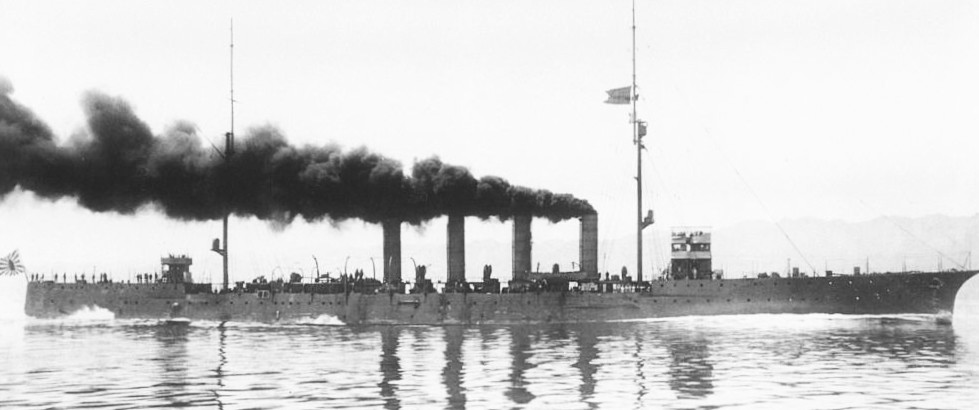
(MChew Photo, 1912)
Hirado. Kawasaki Yards, Kobe Chikuma-class protected cruiser 5,040, 17 June 1912, 1 April 1940; Decommissioned; scrapped 1947.
Hirado (平戸) was the third and final vessel built of the Chikuma-class protected cruisers of the Imperial Japanese Navy. Hirado had two sister ships, Chikuma and Yahagi. She was named for after the island of Hirado, Nagasaki. (Wikipedia)
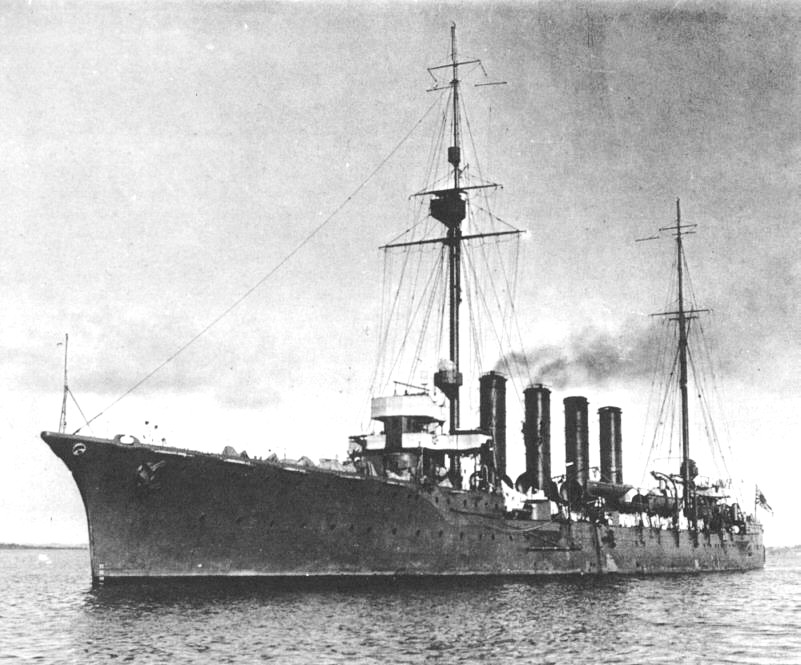
IJN Photo)
Japanese cruiser Hirado at Auckland, New Zealand, 1912.
Imperial Japanese Navy protected cruiser Yahagi
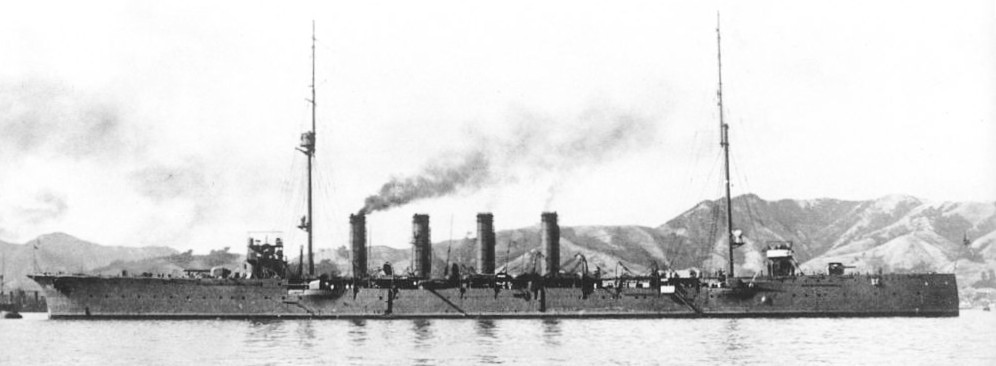
(IJN Photo, 1916)
Yahagi. Mitsubishi Yards, Nagasaki Chikuma-class protected cruiser 5,040, 27 June 1912, 1 April 1940; Decommissioned; scrapped 1947.
Yahagi (矢矧) was the second vessel in the Chikuma class of protected cruisers of the Imperial Japanese Navy. Yahagi had two sister ships, Chikuma and Hirado. She was named after the Yahagi River, which runs through Nagano, Gifu and Aichi prefectures. (Wikipedia)
Imperial Japanese Navy unprotected cruiser (Mubōbina jun’yōkan): Chihaya
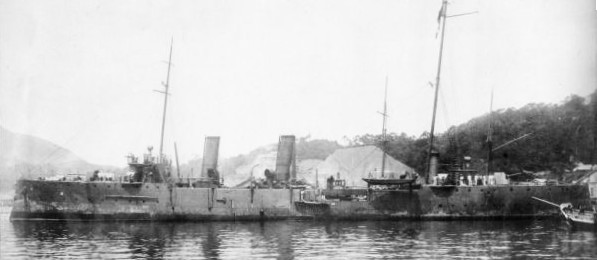
(IJN Photo, 1906)
Imperial Japanese Navy unprotected cruiser Chihaya. Yokosuka Naval Arsenal Unprotected cruiser 1,238, 9 September1901, 1 September 1929; training hulk to the end of the Second World War.
Chihaya (千早) was an unprotected cruiser of the Imperial Japanese Navy. The name Chihaya comes from Chihaya Castle, near Osaka, the site of one of the battles of the Genkō War of 1333. Chihaya was laid down on 7 May 1898 and launched on 26 May 1900[3] in a ceremony attended by Emperor Meiji. She was completed on 9 September 1901. On the afternoon of 18 June 1901 while still on trials before formal commissioning, Chiyaha collided off Tateyama, Chiba with the destroyer Akebono, which was on a torpedo training exercise. Both vessels suffered from minor damage.
During the Russo-Japanese War of 1904–1905, Chiyaha participated in the naval Battle of Port Arthur and subsequent blockade of that port. She was subsequently at the Battle of the Yellow Sea and the Battle of Tsushima. At this battle, Chiyaha commanded a squadron of destroyers which sank the Russian battleship Knyaz Suvorov and repair ship Kamchatka. On 26 August 1912, Chiyaha was re-classified as a first-class gunboat .
During the First World War, Chiyaha was assigned to patrols of former German Micronesia, which has been occupied by Japan during the early stages of the war.
From 1918 to 1923, Chiyaha was assigned to provide support for the Japanese intervention in Siberia in support of the White Movement armies against the Bolshevik Red Army by making patrols of the eastern coast of Russia. From May to October 1928, Chiyaha was converted at the Yokosuka Naval Arsenal to be a training vessel, and was removed from the navy list on 1 September 1928. She was subsequently transferred to the Imperial Japanese Naval Academy, where she served as a training hulk until 25 July 1939. Her hulk was still afloat at Etajima at the end of the Second World War, when she was scrapped. (Wikipedia)