
What do we know about Archangels and Archeias?
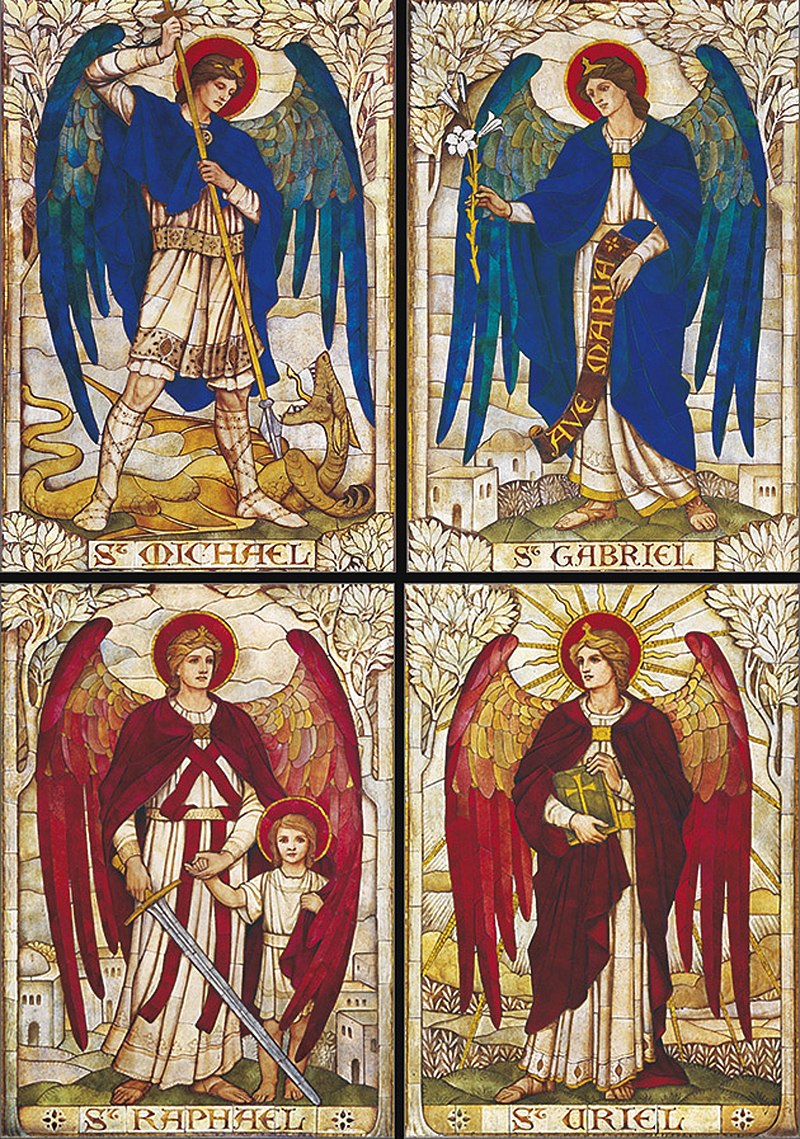
(James Powell and Sons of the Whitefriars Foundry)
Mosaics of the four archangels in Anglican tradition in St John’s Church, Boreham Road, Warminster, Wiltshire, England.
The concept of Seven Archangels is found in some works of early Jewish literature and in Christianity. In those texts, they are referenced as the angels who serve God directly. The Catholic Church venerates seven archangels: in Latin Christianity, three are invoked by name (Michael, Gabriel, and Raphael) while the Eastern Catholic Churches name seven. Lutheranism and Anglicanism’s traditions generally recognize four known archangels: Michael, Gabriel, Raphael and sometimes Uriel. Most Protestant churches often venerate only Gabriel and Michael.
In the Coptic tradition, the Seven Archangels are Michael, Gabriel, Raphael, Surael, Zadkiel, Sarathael, and Ananael. In parts of Oriental Orthodox Christianity and Eastern Orthodox Christianity, Eight Archangels may be honoured, including Michael, Gabriel, Raphael, Uriel, as well as Salathiel, Jegudiel, Barachiel, and Jeremiel.[1] The Eight Archangels are commemorated on the Feast of the Archangels. (Wikipedia)
Bible references
The term archangel itself is not found in the Hebrew Bible or the Christian Old Testament, and in the Greek New Testament the term archangel only occurs in 1 Thessalonians 4 (1 Thessalonians 4:16) and the Epistle of Jude (Jude 1:9), where it is used of Michael, who in Daniel 10 (Daniel 10:12) is called ‘one of the chief princes,’ and ‘the great prince’. In the Septuagint, this is rendered “the great angel.”
The idea of seven archangels is most explicitly stated in the deuterocanonical/apocryphal Book of Tobit when Raphael reveals himself, declaring: “I am Raphael, one of the seven angels who stand in the glorious presence of the Lord, ready to serve him.” (Tobit 12,15) The other two angels mentioned by name in the Bibles used by Catholics and Protestants are the archangel Michael and the angel Gabriel; Uriel is named in 2 Esdras (4:1 and 5:20) and Jerahmeel is named in 2 Esdras 4:36, a book that is regarded as canonical by the Ethiopian Orthodox Church, the Georgian and Russian Orthodox Churches, and falls within the Apocrypha section of the Protestant Bible used by Lutherans and Anglicans. The names of other archangels come from tradition.
Zechariah 4,10 tells about “seven rejoices” that are “the eyes of the Lord, Which scan to and from throughout the whole earth.” Revelation 8 (Revelation 8:2) mentions seven angels (Ancient Greek: ἀγγέλους[8]) who “stand before God, and to them were given seven trumpets.” Similarly, Revelation 16 (Revelation 16:1) indicates: “and I heard a loud voice from the temple saying to the seven angels: Go and pour out the seven bowls of the wrath of God into the earth.” Lastly, Revelation 4 and Revelation 5 (Revelation 4:5) mention “seven Spirits” (Ancient Greek: τα ἑπτά Πνεύματα, transliterated into “ta hepta Pneumata”) – whose identity is not well specified – who are the “seven lamps of fire [that] were burning before the throne”. (Wikipedia)
The earliest specific Christian references are in the late 5th to early 6th century: Pseudo-Dionysius gives them as Michael, Gabriel, Raphael, Uriel, Camael, Jophiel, and Zadkiel. In Western Christian traditions, Michael, Gabriel and Raphael are referred to as archangels. Through its Byzantine tradition, however, the Catholic Church recognizes seven archangels altogether, sometimes named, sometimes unnamed other than the three mentioned.
The Bible names three categories of heavenly beings that appear to be types of angels: cherubim, seraphim, and “living creatures.”
Cherubim are mentioned in several places, noting that “they guarded the entrance to the Garden of Eden” (Genesis 3:24), “God is enthroned above them” (Ezekiel 10:1–22), “God rides on them” (Psalm 18:10), and, “two golden figures of cherubim sit above the Ark of the Covenant, where God promised to dwell among his people” (Exodus 25:22, see also verses 18–21).
Seraphim, are only mentioned once in the Bible. They appear in Isaiah 6:2–7, where they continually worship the Lord, saying, “Holy, holy, holy is the Lord of hosts; the whole earth is full of his glory” (Isaiah 6:3). Ezekiel and Revelation speak of other kinds of heavenly beings known as “living creatures” around God’s throne (Ezekiel 1:5–14, Revelation 4:6–8). They appeared like a lion, an ox, a man, and an eagle, representing various parts of God’s creation (wild beasts, domesticated animals, human beings, and birds). They, too, worship God continually: “Day and night they never cease to sing, ‘Holy, holy, holy, is the Lord God Almighty, who was and is and is to come!’” (Revelation 4:8). (https://zondervanacademic.com/blog/biblical-facts-angels)
Angels in the Bible appear to have a rank and order. The angel hierarchy is supported by Jude 9, when the angel Michael is called an “archangel”—a title that indicates rule or authority over other angels. He’s also called “one of the chief princes” in Daniel 10:13, and appears to lead God’s angelic army in Revelation 12: “Now war arose in heaven, Michael and his angels fighting against the dragon; and the dragon and his angels fought, but they were defeated” (Revelation 12:7–8). Paul also tells us that the Lord will return from heaven “with the archangel’s call” (1 Thessalonians 4:16). Scripture doesn’t tell us if this refers to Michael, or if there are other archangels as well.
Only two angels are specifically named in the Bible. The archangel Michael is mentioned in Jude 9, Revelation 12:7–8, and Daniel 10:13 and 21. Gabriel is mentioned in Daniel 8:16 and 9:21 as a messenger who comes from God to speak to Daniel. He’s also identified as God’s messenger in Luke 1. He tells Zechariah, “I am Gabriel, who stand in the presence of God” (Luke 1:19). Then we read, “In the sixth month the angel Gabriel was sent from God to a city of Galilee named Nazareth, to a virgin . . . and the virgin’s name was Mary” (Luke 1:26–27). Michael and Gabriel are recognized as archangels in Judaism, Islam and most Christians. Raphael is also considered highly.
The named archangels in Islam are Jibrael, Mikael, Israfil, and Azrael. Jewish literature also mentions Metatron as an archangel, called the “highest of the angels”. Various religions have mentioned Uriel, Sariel, Raguel, Joel, Saraquel, Selaphiel, Jegudiel, Barachiel, Sielteal, Jerameel, Suriel, Remiel, Zedekiel, Sarathiel, Phanuel, and Ananiel. In the Kabbalah there are twelve archangels, each assigned to a certain sephira: Metatron, Raziel, Cassiel, Zadkiel, Samael, Michael, Uriel & Haniel, Raphael & Jophiel, Gabriel, and Sandalphon.
The New Testament makes over a hundred references to angels, but uses the word “archangel” only twice, in 1 Thessalonians 4:16 (“For the Lord himself shall descend from heaven with a shout, with the voice of the archangel, and with the trumpet of God: and the dead in Christ shall rise first”, KJV) and Jude 1:9.
Unlike God, who is omnipresent, angels are finite creatures, limited to one place at one time. The Bible doesn’t tell us how many angels God created. But apparently, there are a lot of them. On Mount Sinai, God “came from the ten thousands of holy ones, with flaming fire at his right hand” (Deuteronomy 33:2). Also, “the chariots of God are tens of thousands and thousands of thousands” (Psalm 68:17 NIV). When we come to worship, we come into the presence of “innumerable angels” (Hebrews 12:22). John says, “I heard around the throne and the living creatures and the elders the voice of many angels, numbering myriads of myriads and thousands of thousands” (Revelation 5:11). Every biblical reference to the total number of angels suggests that they’re beyond counting. (https://zondervanacademic.com/blog/biblical-facts-angels)
The Bible clearly tells us that God sends angels to protect people: “He will give his angels charge of you to guard you in all your ways. On their hands they will bear you up, lest you dash your foot against a stone” (Psalm 91:11–12). Angels are called “mighty ones who do his word” (Psalm 103:20), “powers” (see Ephesians 1:21), and “dominions” and “authorities” (Colossians 1:16). They are certainly “greater in might and power” than humans (2 Peter 2:11, see also Matthew 28:2). Angels use their power to battle against Satan’s demonic forces (Daniel 10:13, Revelation 12:7–8, 20:1–3). Genesis 2:1 tells us that the angels were made at some point before the seventh day of creation: “Thus the heavens and the earth were finished, and all the host of them” (“host” here refers to the heavenly beings).
Angels patrol the earth as God’s representatives (Zechariah 1:10–11).
Archangels are both male and female, with the feminine aspect referred to as Archeias. Archangels and their Archeia were traditionally thought to have never incarnated as human beings. However, they have been known to appear in human form at crucial times, and there are many wonderful stories of them appearing to help a soul in trouble and then simply disappearing afterwards. It would appear that they are here to help and guide, but not to interfere.
In the Kabbalah there are twelve archangels, each assigned to a certain sephira: Metatron, Raziel, Cassiel, Zadkiel, Samael, Michael, Uriel & Haniel, Raphael & Jophiel, Gabriel, and Sandalphon.
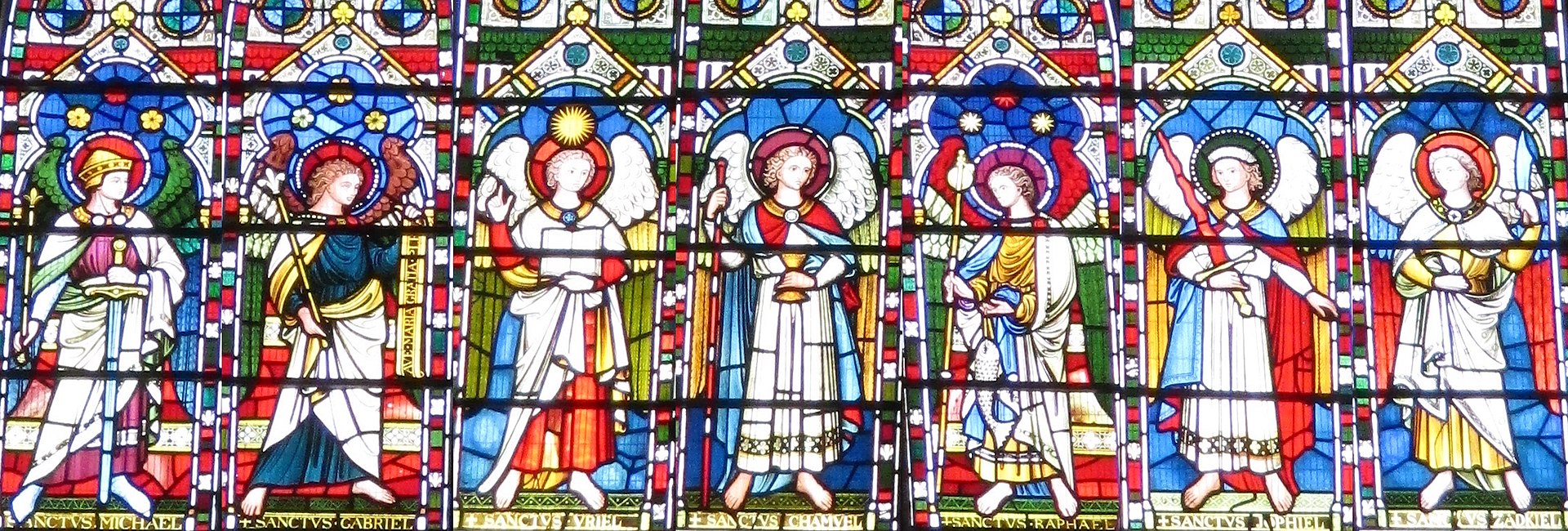
(Antiquary Photo)
Seven Archangels, from left to right: Michael, Gabriel, Uriel, Chamuel (Camael), Raphael, Jophiel and Zadkiel. Stained glass made in 1862 at St Michael and All Angels Church, Brighton, East Sussex, England.
Hilary Stanley has provided the following list of names:
Archangels Archeias
Michael Faith
Jophiel (Iophiel) Christine
Chamuel (Camael) Charity
Gabriel Hope
Raphael Mary
Uriel Aurora
Zadkiel Holy Amethyst
Raguel Harmony
Sandalphon Cybele
Haniel Purity
Jeremiel Hosanna
Metatron Constance
Azrael Mercy
Traditional names for other angels:
Ariel, Asherah (wife of El), Cassiel, El Elyah, Ezekiel, Fanuel, Haniel, Israel (Israfil), Metatron, Raziel, Remiel, Sammael, Sananda, Suriel, Saraqael, or Sauriel, Shekinah, Sophia, Uzziel, Zophiel.
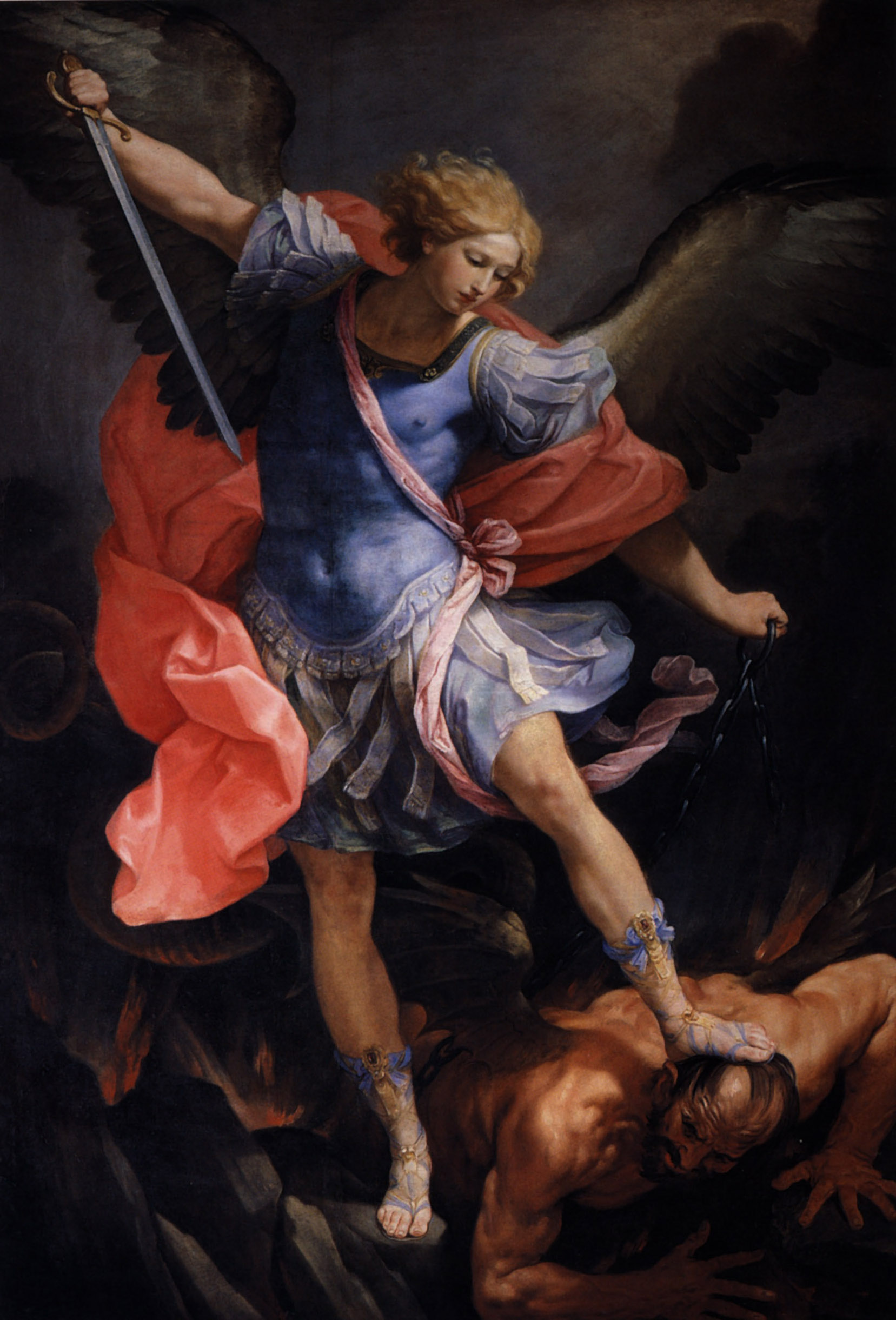
Archangel Michael defeats Satan, painting by Guido Reni (between 1630-1635)
Archangel Michael is the warrior of God in Judaism, Christianity, and Islam while additionally being venerated as a saint in some Christian traditions. The earliest surviving mentions of his name are in third- and second-century BC Jewish works, often but not always apocalyptic, where he is the chief of the angels and archangels, and he is the guardian prince of ancient Israel and is responsible for the care of the Israelites. Christianity conserved nearly all the Jewish traditions concerning him, and he is mentioned explicitly in Revelation 12:7–12, where he battles with Satan, and in the Epistle of Jude, where the archangel and the devil dispute over the body of Moses.
The Book of Enoch lists Michael as one of seven archangels (the remaining names are Uriel, Raguel, Raphael, Sariel, Gabriel, and Remiel), who in the Book of Tobit “stand ready and enter before the glory of the Lord”.[11] The fact that Michael is introduced implies the knowledge of him and the other named angels.[10][16] He is mentioned again in the last chapters of the Book of Daniel, a Jewish apocalypse composed in the second century BC, in which a man clothed in linen (never identified, but matching a description given to John in Revelation regarding the Alpha and Omega) tells Daniel that he and “Michael, your prince” are engaged in a battle with the “prince of Persia”, after which, at the end-time, “Michael, the great prince who protects your people, will arise”.
Enoch was instrumental in establishing the pre-eminent place of Michael among the angels and archangels, and in later Jewish works, he is said to be their chief, mediating the Torah (the Law of God), and standing at the right hand of the throne of God.[8] In the traditions of the Qumran community, he defends or leads the people of God in the eschatological (i.e., end-time) battle.[19] In other writings, he is responsible for the care of Israel and acts as commander of the heavenly armies; he is Israel’s advocate contesting Satan’s claim to the body of Moses; he intercedes between God and humanity and serves as High Priest in the heavenly sanctuary; and he accompanies the souls of the righteous dead to Paradise. (Wikipedia)
The seven archangels (or four, as traditions differ but always include Michael) were associated with the branches of the menorah, the sacred seven-branched lampstand in the Temple as the seven spirits before the throne of God, and this is reflected in the Book of Revelation 4:5 (“Coming from the throne are flashes of lightning and rumblings and peals of thunder, and in front of the throne burn seven flaming torches, which are the seven spirits of God,” – NRSVue). Michael is mentioned explicitly in Revelation 12:7–12, where he does battle with Satan and casts him out of heaven so that he no longer has access to God as accuser (his formal role in the Old Testament). The fall of Satan at the coming of Jesus marks the separation of the New Testament from Judaism. In Luke 22:31, Jesus tells Peter that Satan has asked God for permission to “sift” the disciples, the goal being to accuse them, but the accusation is opposed by Jesus, who thus takes on the role played by angels, and especially by Michael, in Judaism.
Michael is mentioned by name for the second time in the Epistle of Jude, which is an impassioned plea for the believers to engage in battle against the incursion of the error. In verses 9–10, the author denounces the heretics by contrasting them with the archangel Michael, who, in disputing with Satan over the body of Moses, “did not presume to pronounce the verdict of ‘slander’ but said, ‘The Lᴏʀᴅ rebuke you!’” (Wikipedia)
Mikail, an angel who influences the decisions of monarchs, nobles and governors, is also useful in uncovering conspiracies against states.
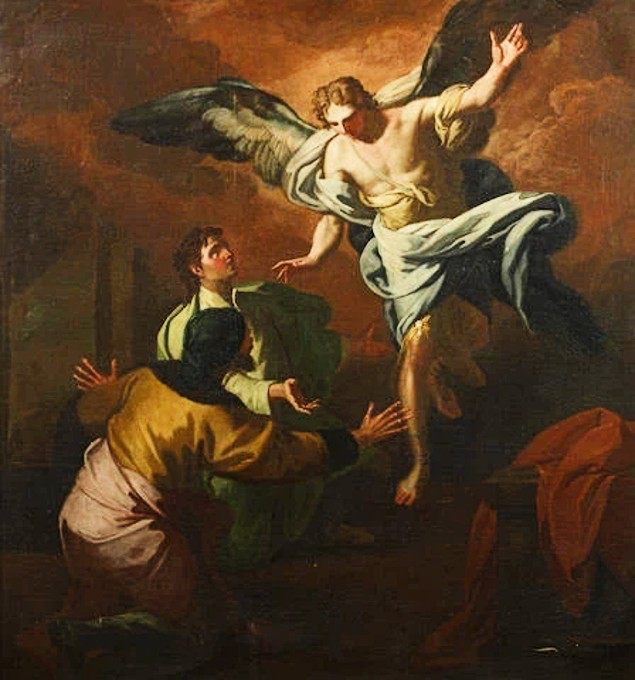
The Archangel Gabriel appears to the Prophet Daniel, attributed to Francesco Solimena (1657–1747).
Archangel Gabriel is an archangel with the power to announce God’s will to humankind as the messenger of God. In Judaism, Christianity, Islam, and other Abrahamic religions, Gabrie is mentioned in the Hebrew Bible, the New Testament and the Quran.
In the Book of Daniel, Gabriel appears to the prophet Daniel to explain his visions. Gabriel also appears in the Jewish apocryphal First Book of Enoch (e.g., 1 Enoch 20:7–8) and other ancient Hebrew writings incompletely preserved or wholly lost in Hebrew. Alongside the archangel Michael, Gabriel is described as the guardian angel of the Israelites, defending them against the angels of the other peoples.
In the New Testament Gospel of Luke, Gabriel appears to Zechariah foretelling the birth of John the Baptist. Gabriel later appears to Mary, mother of Jesus to announce that she would conceive and bear a son (i.e., Jesus) via virgin birth. Many branches of Christianity—including Eastern Orthodoxy, the Catholic Church, Lutheranism, and Anglicanism—revere Gabriel as a saint.
Islam regards Gabriel as an archangel sent by God to various prophets, including Muhammad. The first five verses of the Al-Alaq, the 96th chapter of the Quran, are believed by Muslims to have been the first verses of the revelations given by Gabriel to Muhammad. He is associated with communication. (Wikipedia)
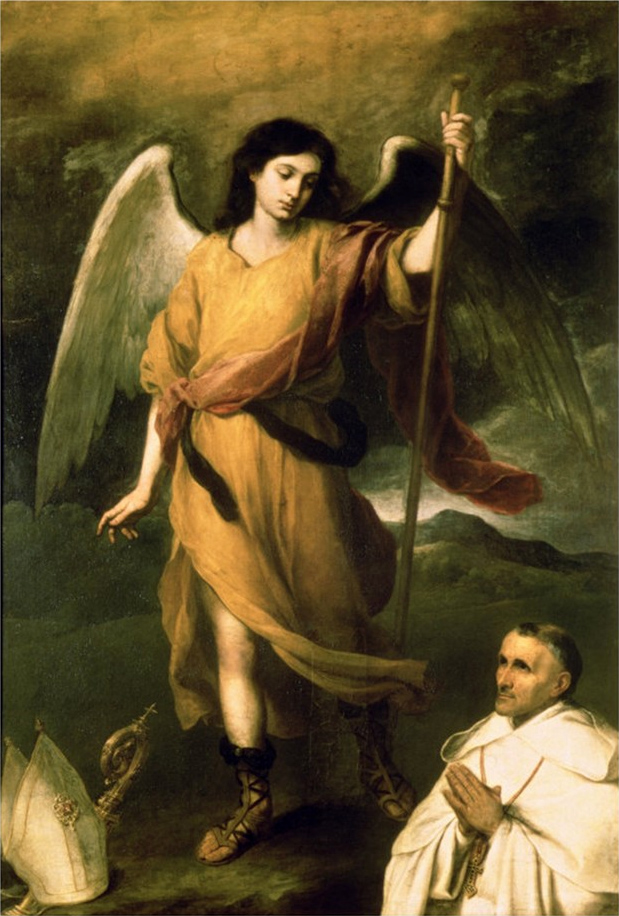
Saint Raphael the Archangel by Bartolomé Esteban Murillo (1617–1682).
Archangel Raphael (“God has healed”) is an archangel first mentioned in the Book of Tobit and in 1 Enoch, both estimated to date from between the 3rd and 2nd century BC. In later Jewish tradition, he became identified as one of the three heavenly visitors entertained by Abraham at the Oak of Mamre. He is not named in either the New Testament or the Quran, but later Christian tradition identified him with healing and as the angel who stirred waters in the Pool of Bethesda in John 5:2–4, and in Islam, where his name is Israfil, he is understood to be the unnamed angel of Quran 6:73, standing eternally with a trumpet to his lips, ready to announce the Day of Judgment. In Gnostic tradition, Raphael is represented on the Ophite Diagram. Raphael is an archangel of healing.
According to the Babylonian Talmud, Raphael was one of the three angels who appeared to Abraham in the oak grove of Mamre in the region of Hebron (Genesis 18; Bava Metzia 86b); Michael, as the greatest, walked in the middle, with Gabriel to his right, and Raphael to his left (Yoma 37a). Each was commanded to carry out a specific mission, Gabriel to destroy Sodom, Michael to inform Sarah that she would give birth to Isaac, Raphael to heal Abraham from his recent circumcision and save Lot. Rashi writes, “Although Raphael’s mission included two tasks, they were considered a single mission since they were both acts that saved people.” The Life of Adam and Eve lists him with the archangels Michael, Gabriel, Uriel, and Joel, and the medieval Jewish philosopher Maimonides included his name in his Jewish angelic hierarchy.
The New Testament names only two archangels, Michael and Gabriel (Luke 1:9–26; Jude 1:9; Revelation 12:7), but Raphael, because of his association with healing, became identified with the unnamed angel of John 5:1–4 who periodically stirred the pool of Bethesda “and he that went down first into the pond after the motion of the water was made whole of whatsoever infirmity he lay under”. The Catholic Church accordingly links Raphael with Michael and Gabriel as saints whose intercession can be sought through prayer. (Wikipedia)
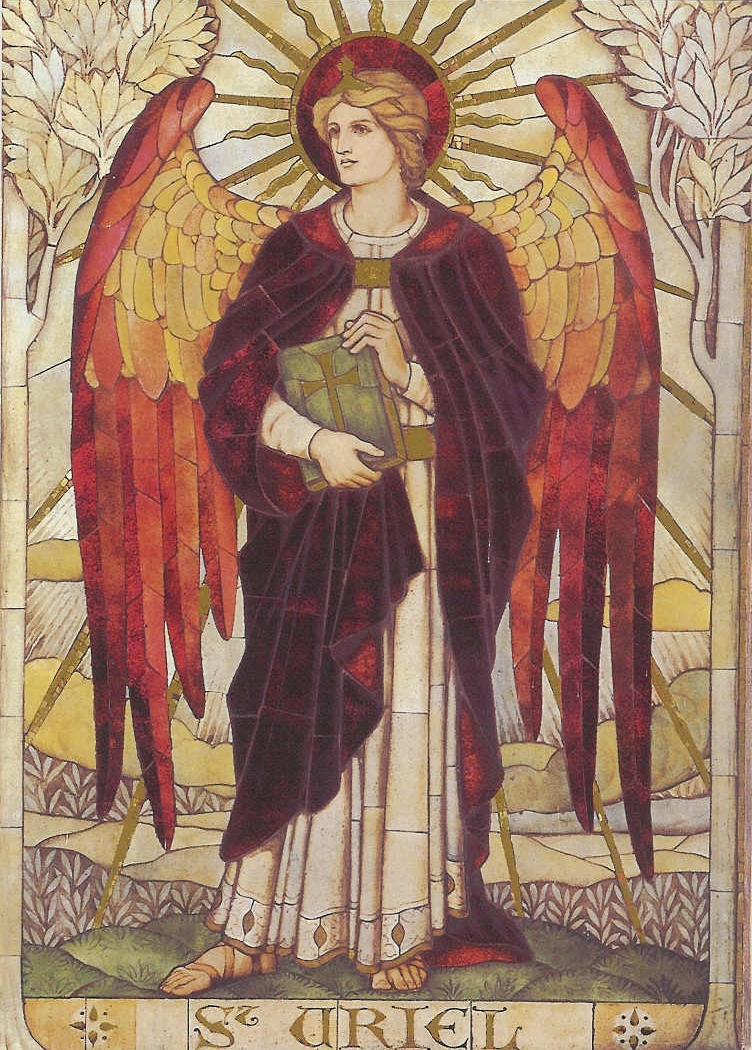
Mosaic of the archangel Uriel in St John’s Church, Boreham Road, Warminster, Wiltshire, England, 1888.
Archangel Uriel “God is my Flame”; “God is my Light”) is the name of one of the archangels who is mentioned in Rabbinic tradition and in certain Christian traditions. Uriel is associated with the truth. He is recognised in Anglicanism as the fourth archangel. Uriel is also known as a master of knowledge and the archangel of wisdom.
Where a fourth archangel is added to the named three, to represent the four cardinal points, Uriel is generally the fourth. Uriel appears in the Second Book of Esdras, which is found in the Biblical apocrypha (and called “Esdras IV” in the Vulgate): Et respondit ad mē angelus, quī missus est ad mē, cui nōmen Ūriel,
“And the angel, who was sent to me, whose name [was] Uriel, answered me”.
In this, the prophet Ezra asks God a series of questions, and God sends Uriel to instruct him. According to the Revelation of Esdras,[citation needed] the angels who will rule at the end of the world are Michael, Gabriel, Uriel, Raphael, Gabuthelon, Beburos, Zebuleon, Aker, and Arphugitonos. The final five listed appear only in this book and nowhere else in apocryphal or apocalyptic works.
In Christian apocryphal gospels, Uriel plays a role, differing between the sources, in the rescue of Jesus’ cousin John the Baptist from the Massacre of the Innocents ordered by King Herod. He carries John and his mother Saint Elizabeth to join the Holy Family after their Flight into Egypt.
The Book of Enoch, which presents itself as written by Enoch, mentions Uriel in many of its component books. In chapter IX, part of “The Book of the Watchers” (2nd century BCE), only four angels are named. Those angels are Michael, Uriel, Raphael, and Gabriel (though some versions have a fifth angel: Suryal or Suriel). However, chapter XX later lists seven angels’ names and functions. Those angels are “Uriel, one of the holy angels, who is over the world and over Tartarus”, Raphael, Raguel, Michael, Saraqâêl, Gabriel, and Remiel.
The Book of the Watchers (in the Book of Enoch), says that Uriel, Raphael, and Gabriel were present before God to testify on behalf of humankind. They asked for divine intervention during the reign of the fallen Grigori (fallen watchers). These fallen ones took human wives and produced half-angel, half-human offspring called the nephilim. Uriel is responsible for warning Noah about the upcoming great flood. (Wikipedia)

(whispygypsy image)
Archangel Sariel (God is my ruler) is the angel of guidance and healing, mainly from Judaic tradition. Other possible versions of his name are Suriel, Suriyel (in some Dead Sea Scrolls translations), Seriel, Sauriel, Saraqael, Sarakiel, Suruel, Surufel, and Souriel. In 1 Enoch (20:6), he is said to be “one of the [seven] holy angels [who watch], who is set over the spirits, who sin in the spirit”. Origen identified Suriel as one of seven angels who are considered primordial powers by the Ophites. In Gnosticism, Sariel is invoked for his protective powers. He is commemorated by the Coptic Orthodox Church on 27 Tobi in the Coptic calendar.
In 1 Enoch (8:1), he is said to have taught humans the course of the moon. In traditional texts, the archangel Sariel is one of the holy angels, who is set over the spirits that sin in the spirit, and is one of the angels who look upon the
The book of War of the Sons of Light Against the Sons of Darkness, from the Dead Sea Scrolls, lists the name of Sariel (שריאל, “God is my Ruler”) along with Michael, Raphael, and Gabriel as names to write upon the shields of soldiers in a tower during maneuvers (1QM 9,15). It is used on the shields of the third Tower (1QM 9,16). bloodshed on Earth, along with Gabriel, Michael, Raphael and Uriel. In the book of 2 Enoch he is listed, with the name of Samuil or Sariel, as one of the angels that brought Enoch to heaven.
The angel Suriyel is briefly mentioned in the Conflict of Adam and Eve with Satan as bearing Adam and Eve from the top of a high mountain to the Cave of Treasures. “… bring what he had brought, and give it to Adam. And they did so, one by one. 6 And God commanded Suriyel and Salathiel to bear up Adam and Eve, and bring them down from the top of the high mountain…”
In the Ladder of Jacob, Sariel is dispatched by the Lord to Jacob to explain to him the meaning of the dream about the ladder. (Wikipedia)
Archangel Zadkiel (God is my Righteousness), also known as Hasdiel, is an archangel in Jewish and Christian angelology. Zadkiel is the archangel of kindness, benevolence and mercy.
As an angel of mercy, some texts claim that Zadkiel is the unnamed biblical Angel of the Lord who holds back Abraham to prevent the patriarch from sacrificing his son, Isaac. Because of this, he is usually shown holding a dagger. Other texts cite Michael or Tadhiel or some other angel as the angel intended, while others interpret the Angel of the Lord as a theophany.
Archangel Sarathiel or Serathiel is described as having dominion over discipline and penance.
Archangel Ananiel according to the tradition of the Coptic Orthodox Church, is the name of one of the seven holy archangels. Anânêl was the 14th Watcher of the 20 leaders of the 200 fallen angels who are mentioned in the Book of Enoch, an ancient Jewish religious text. The name Ananiel is sometimes translated as “Rain of God” though it is often confused with the name Hananiel. Michael Knibb interprets the name as “cloud of God”, which is the literal meaning of the name in Hebrew. The Arabic form of the name entered the language through Coptic translations from Greek.
Ananiel was entrusted by God with “all the trees of the earth, its plants, the rain, the dew, the heat, the simoom, the wind and as many [atmospheric phenomena] as there are in summer and winter.” He is also known as an angelic guard of the gates of the South Wind, one of three gates that control the weather, described in The Book of Enoch. (Wikipedia)
Archangel Selaphiel Carrying a Thurible (metal incense burner), by Bartolomé Román, 17th century.
Archangel Selaphiel or Saint Sealtiel, Selatiel, or Selathiel (“I have asked God”) is one of the archangels in Eastern Orthodox traditions. Selaphiel appears in verse 31:6 of the 6th century apocryphal Christian text The Conflict of Adam and Eve, which describes how God sends him and Suriyel to help rescue Adam and Eve from Satan’s deception, commanding Selaphiel “to bring them down from the top of the high mountain and to take them to the Cave of Treasures.”
Some Christian traditions consider Selaphiel as the angel in Revelation 8:3–4 in the New Testament, who presents the prayers of people on Earth to God in heaven: “Another angel, who had a golden censer, came and stood at the altar. He was given much incense to offer, with the prayers of all God’s people, on the golden altar in front of the throne. The smoke of the incense, together with the prayers of God’s people, went up before God from the angel’s hand.” Prayer is considered his special attribute. (Wikipedia)
Notes:
Apparently, angels don’t have a set colour or colour palette in the Bible. However, many believe that the (seven) archangels each represent a different colour in the spectrum. Remiel is red, Gabriel is orange, Raguel is yellow, Uriel is green, Michael is blue, Sariel is indigo, and the archangel Raphael is purple.
Sariel (God is my Ruler) is an angel mainly from Judaic tradition. Other possible versions of his name are Säraquyael, Suriel, Suriyel (in some Dead Sea Scrolls translations), Seriel, Sauriel, Saraqael, Sarakiel, Suruel, Surufel, and Souriel. The book of War of the Sons of Light Against the Sons of Darkness, from the Dead Sea Scrolls, lists the name of Sariel (שריאל, “God is my Ruler”) along with Michael, Raphael, and Gabriel as names to write upon the shields of soldiers in a tower during maneuvers (1QM 9,15). It is used on the shields of the third Tower (1QM 9,16).
…you have come from many sources, from many times, from many races around the galactic universe.
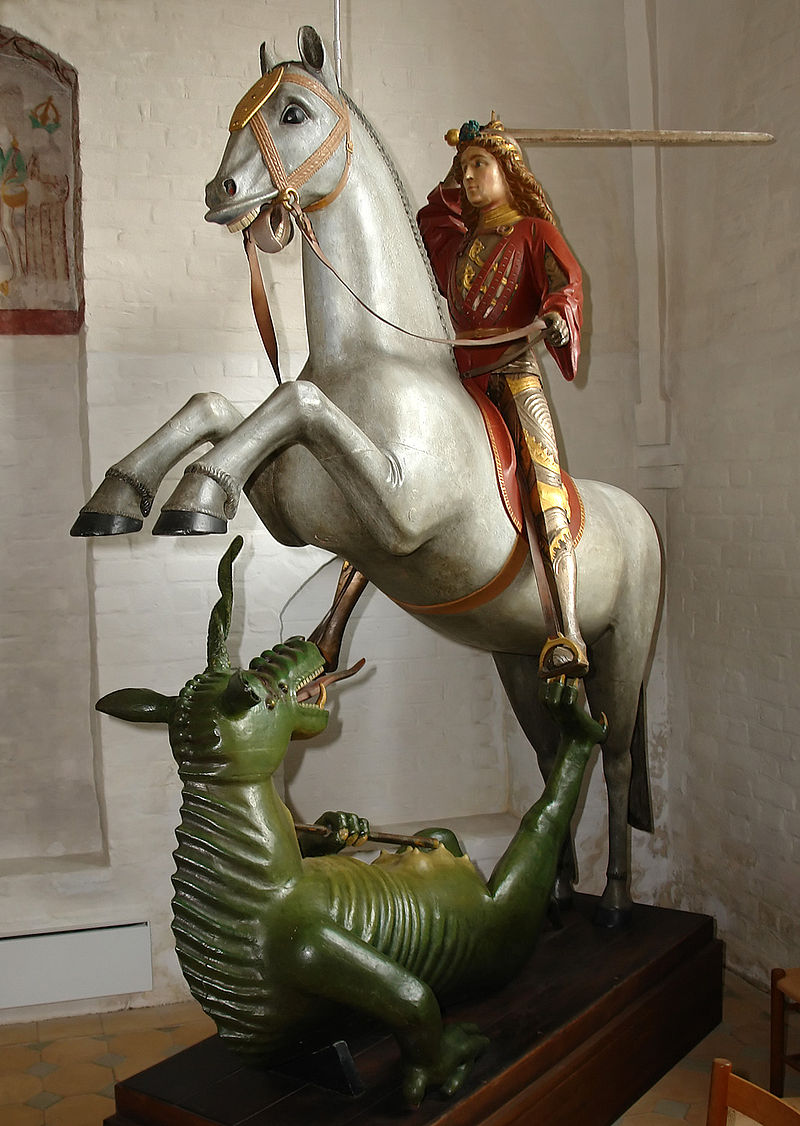
(Jurgen Howalt Photo)
St. George and the Dragon sculpture, (1490), Broager Church, Denmark.
All comments are subject to our Comment Policy. You must be at least 18 years old to comment.
See a comment that violates our guidelines? Report it here.