
THE IMPACT
Illustration of airburst over the Euphrates floodplain. Artist: Jennifer Rice.
…
According to the journal *Nature*, in the article “Evidence of Cosmic Impact at Abu Hureyra, Syria at the Younger Dryas Onset,” around 10,794 B.C., approximately 12,800 years ago, Earth was struck by one of the most catastrophic events in its recent history: a shower of cometary debris struck our planet, with impacts recorded on at least four continents. The event produced two main effects: on the one hand, localized explosions with the power of hydrogen bombs, which wiped out all forms of life in the affected areas; on the other, a sudden global cooling, triggered by the dust cloud raised by the impacts and by chain reactions in biogeochemical cycles. This event is known today as the beginning of the Younger Dryas, a brief but intense ice age.

(Illustration for an article by Eric Ralls)
…
The journal *Science* describes the impact as follows: “A white fireball, four times larger than the Sun, streaked across the sky. The explosion vaporized rock and ice. The shock wave was felt hundreds of kilometers away.” Further support for this scenario comes from the Tunguska event (1908), where an object exploded in the atmosphere over Siberia, felling 80 million trees and producing an explosion a thousand times more powerful than the Hiroshima bomb. No crater was ever found. This example suggests that large atmospheric explosions can leave devastating traces even without a direct impact on the ground.
…
According to an estimate proposed by Kennett et al. (PNAS, 2015), the mortality indirectly caused by the Younger Dryas may have affected between 30% and 60% of the human populations in the affected areas. Based on a conservative estimate of 5 million humans in the late Pleistocene, this means between 1.5 and 3 million deaths in the first two centuries following the event.
…
The comet impact, the Younger Dryas, rising sea levels, and the desertification of the Sahara created the greatest period of crisis for the human species since the Toba supervolcano disaster. Before this catastrophe, a sort of global maritime civilization had formed along the tropical belt, traveling from east to west along the equator. Starting from Sundaland, this civilization had reached Yonaguni, Nan Madol, and the Pacific islands, then landed in Central and South America, and from there set out again toward northwestern Africa, the Richat Structure, and perhaps southern Turkey, including Göbekli Tepe. It was a global culture, technologically advanced and tied to celestial and marine cycles. But all of this was wiped out in just a few centuries: the comet impact, global cooling, rising sea levels, and the desertification of the Sahara marked the end of this era. People had to start all over again. But the traces—whether buried or submerged—continue to tell us a forgotten story.
…
From the book “Before us there was someone“.
Evidence of Cosmic Impact at Abu Hureyra, Syria at the Younger Dryas Onset (~12.8 ka):
High-temperature melting at >2200 °C.
Andrew M T Moore, James P Kennett, William M Napier, Ted E Bunch, James C Weaver, Malcolm LeCompte, A Victor Adedeji, Paul Hackley, Gunther Kletetschka, Robert E Hermes, James H Wittke, Joshua J Razink, Michael W Gaultois, Allen West.
Andrew M T Moore, James P Kennett, William M Napier, Ted E Bunch, James C Weaver, Malcolm LeCompte, A Victor Adedeji, Paul Hackley, Gunther Kletetschka, Robert E Hermes, James H Wittke, Joshua J Razink, Michael W Gaultois, Allen West.
At Abu Hureyra (AH), Syria, the 12,800-year-old Younger Dryas boundary layer (YDB) contains peak abundances in meltglass, nanodiamonds, microspherules, and charcoal. AH meltglass comprises 1.6 wt.% of bulk sediment, and crossed polarizers indicate that the meltglass is isotropic. High YDB concentrations of iridium, platinum, nickel, and cobalt suggest mixing of melted local sediment with small quantities of meteoritic material. Approximately 40% of AH glass display carbon-infused, siliceous plant imprints that laboratory experiments show formed at a minimum of 1200°–1300 °C; however, reflectance-inferred temperatures for the encapsulated carbon were lower by up to 1000 °C. Alternately, melted grains of quartz, chromferide, and magnetite in AH glass suggest exposure to minimum temperatures of 1720 °C ranging to >2200 °C. This argues against formation of AH meltglass in thatched hut fires at 1100°–1200 °C, and low values of remanent magnetism indicate the meltglass was not created by lightning. Low meltglass water content (0.02–0.05% H2O) is consistent with a formation process similar to that of tektites and inconsistent with volcanism and anthropogenesis. The wide range of evidence supports the hypothesis that a cosmic event occurred at Abu Hureyra ~12,800 years ago, coeval with impacts that deposited high-temperature meltglass, melted microspherules, and/or platinum at other YDB sites on four continents.
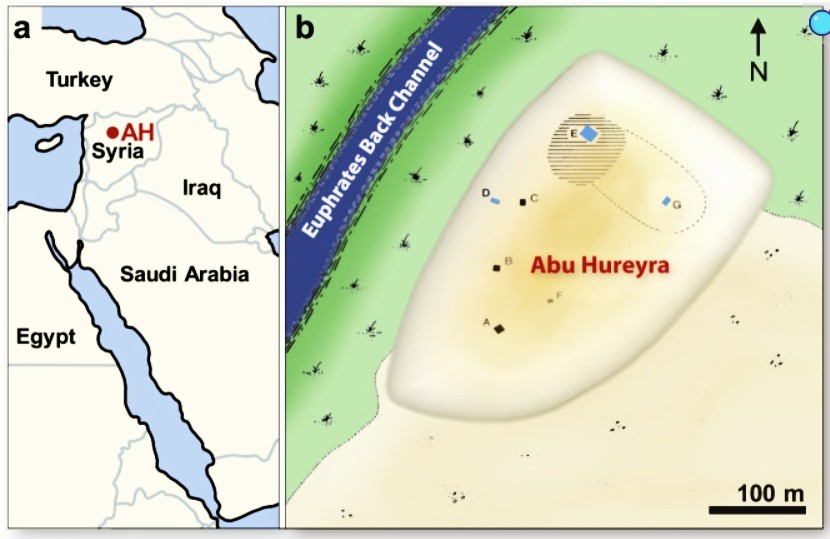
Abu Hureyra is a mound settlement (commonly known as a “tell”) located in northern Syria along the Euphrates River.
References – where to look for more information on this subject:
- 1.Firestone, R. B. et al. Evidence for an extraterrestrial impact 12,900 years ago that contributed to the megafaunal extinctions and the Younger Dryas cooling. Proc Nat Acad Sci104, 16016–16021 (2007). [DOI] [PMC free article] [PubMed] [Google Scholar]
- 2.Kennett, J. P. et al. Bayesian chronological analyses consistent with synchronous age of 12,835-12,735 Cal B.P. for Younger Dryas boundary on four continents. Proc Nat Acad Sci112, E4344–4353 (2015). [DOI] [PMC free article] [PubMed] [Google Scholar]
- 3.Napier, W. M. Palaeolithic extinctions and the Taurid Complex. Mon Not R Astron Soc405, 1901–1906 (2010). [Google Scholar]
- 4.Napier, W. The hazard from fragmenting comets. Monthly Notices of the Royal Astronomical Society488, 1822–1827 (2019). [Google Scholar]
- 5.Wittke, J. H. et al. Evidence for deposition of 10 million tonnes of impact spherules across four continents 12,800 y ago. Proc Nat Acad Sci110, E2088-E2097 (2013). [DOI] [PMC free article] [PubMed]
- 6.LeCompte, M. A. et al. Independent evaluation of conflicting microspherule results from different investigations of the Younger Dryas impact hypothesis. Proc Nat Acad Sci109, E2960-2969 (2012). [DOI] [PMC free article] [PubMed]
- 7.Wu, Y., Sharma, M., LeCompte, M. A., Demitroff, M. N. & Landis, J. D. Origin and provenance of spherules and magnetic grains at the Younger Dryas boundary. Proc Nat Acad Sci110, E3557-3566 (2013). [DOI] [PMC free article] [PubMed]
- 8.Bunch, T. E. et al. Very high-temperature impact melt products as evidence for cosmic airbursts and impacts 12,900 years ago. Proc Nat Acad Sci109, E1903–E1912 (2012). [DOI] [PMC free article] [PubMed] [Google Scholar]
- 9.Pino, M. et al. Sedimentary record from Patagonia, southern Chile supports cosmic-impact triggering of biomass burning, climate change, and megafaunal extinctions at 12.8 ka. Sci Rep9, 4413 (2019). [DOI] [PMC free article] [PubMed] [Google Scholar]
- 10.Kletetschka, G. et al. Cosmic-impact event in lake sediments from Central Europe postdates the Laacher See eruption and marks onset of the younger Dryas. The Journal of Geology126, 561–575 (2018). [Google Scholar]
- 11.Israde-Alcántara, I. et al. Evidence from central Mexico supporting the Younger Dryas extraterrestrial impact hypothesis. Proc Nat Acad Sci109, E738-E747 (2012). [DOI] [PMC free article] [PubMed]
- 12.Kinzie, C. R. et al. Nanodiamond-rich layer across three continents consistent with major cosmic impact at 12,800 cal BP. J Geol122, 475–506 (2014). [Google Scholar]
- 13.Wolbach, W. S. et al. Extraordinary biomass-burning episode and impact winter triggered by the Younger Dryas cosmic impact ∼12,800 years ago. 1. Ice cores and glaciers. J Geol126, 165–184 (2018). [Google Scholar]
- 14.Wolbach, W. S. et al. Extraordinary biomass-burning episode and impact winter triggered by the Younger Dryas cosmic impact ∼12,800 years ago. 2. Lake, marine, and terrestrial sediments. J Geol126, 185–205 (2018). [Google Scholar]
- 15.Moore, C. R. et al. Widespread platinum anomaly documented at the Younger Dryas onset in North American sedimentary sequences. Sci Rep7, 44031, 10.1038/srep44031 (2017). [DOI] [PMC free article] [PubMed] [Google Scholar]
- 16.Moore, C. R. et al. Sediment cores from White Pond, South Carolina, contain a platinum anomaly, pyrogenic carbon peak, and coprophilous spore decline at 12.8 ka. Scientific Reports9, 1–11 (2019). [DOI] [PMC free article] [PubMed] [Google Scholar]
- 17.Petaev, M. I., Huang, S., Jacobsen, S. B. & Zindler, A. Large Pt anomaly in the Greenland ice core points to a cataclysm at the onset of Younger Dryas. Proc Nat Acad Sci110, 12917–12920 (2013). [DOI] [PMC free article] [PubMed] [Google Scholar]
- 18.Andronikov, A. V. et al. Implications from chemical, structural and mineralogical studies of magnetic microspherules from around the lower Younger Dryas boundary (New Mexico, USA). Geogr Ann A98, 39–59 (2016). [Google Scholar]
- 19.Firestone, R. B. et al. Analysis of the Younger Dryas impact layer. J Siberian Fed Univ1, 30–62 (2010). [Google Scholar]
- 20.Kurbatov, A. V. et al. Discovery of a nanodiamond-rich layer in the Greenland ice sheet. J Glaciol56, 747–757 (2010). [Google Scholar]
- 21.Kennett, D. J. et al. Nanodiamonds in the Younger Dryas boundary sediment layer. Science323, 94 (2009). [DOI] [PubMed] [Google Scholar]
- 22.Kennett, D. J. et al. Shock-synthesized hexagonal diamonds in Younger Dryas boundary sediments. Proc Nat Acad Sci106, 12623–12628 (2009). [DOI] [PMC free article] [PubMed] [Google Scholar]
- 23.Anderson, D. G., Goodyear, A. C., Kennett, J. & West, A. Multiple lines of evidence for possible human population decline/settlement reorganization during the early Younger Dryas. Quat Int242, 570–583 (2011). [Google Scholar]
- 24.Moore, A. & Kennett, D. Cosmic impact, the Younger Dryas, Abu Hureyra, and the inception of agriculture in Western Asia. Eurasian Prehist10, 57–66 (2013). [Google Scholar]
- 25.Van Hoesel, A., Hoek, W. Z., Pennock, G. M. & Drury, M. R. The Younger Dryas impact hypothesis: a critical review. Quat Sci Rev83, 95–114 (2014). [Google Scholar]
- 26.Boslough, M. et al. Arguments and evidence against a Younger Dryas impact event in Climates, landscapes, civilizations, Geophysical Monograph Series Vol. 198 (eds. Giosan, L. et al.) 13–26 (Am Geophys Union, 2012).
- 27.Holliday, V., Surovell, T. & Johnson, E. A blind test of the Younger Dryas impact hypothesis. PloS One11, e0155470 (2016). [DOI] [PMC free article] [PubMed] [Google Scholar]
- 28.Holliday, V. T., Surovell, T., Meltzer, D. J., Grayson, D. K. & Boslough, M. The Younger Dryas impact hypothesis: a cosmic catastrophe. Quat Sci29, 515–530 (2014). [Google Scholar]
- 29.Surovell, T. A. et al. An independent evaluation of the Younger Dryas extraterrestrial impact hypothesis. Proc Nat Acad Sci106, 18155–18158 (2009). [DOI] [PMC free article] [PubMed] [Google Scholar]
- 30.Thy, P., Willcox, G., Barfod, G. H. & Fuller, D. Q. Anthropogenic origin of siliceous scoria droplets from Pleistocene and Holocene archaeological sites in northern Syria. J Archaeol Sci54, 193–209 (2015). [Google Scholar]
- 31.Moore, A. M. T., Hillman, G. C. & Legge, A. J. Village on the Euphrates: from foraging to farming at Abu Hureyra. 585 (Oxford University Press, 2000).
- 32.Heide, K. & Heide, G. Vitreous state in nature—Origin and properties. Chem Erde71, 305–335 (2011). [Google Scholar]
- 33.Schultz, P. H., Harris, R. S., Clemett, S. J., Thomas-Keprta, K. L. & Zárate, M. Preserved Flora and Organics in Impact Melt Breccias. Geology42, 515–518 (2014). [Google Scholar]
- 34.Ascough, P. L. Charcoal reflectance measurements: implications for structural characterization and assessment of diagenetic alteration. J Archaeol Sci37, 1590–1599 (2010). [Google Scholar]
- 35.Braadbaart, F. & Poole, I. Morphological, chemical and physical changes during charcoalification of wood and its relevance to archaeological contexts. J Archaeol Sci35, 2434–2445 (2008). [Google Scholar]
- 36.Gurov, E. P., Permiakov, V. & Koeberl, C. Chromferide Found in Impact Melt Rocks of the El’gygytgyn Crater, Chukotka, Russia. 50th Lunar and Planetary Science Conference 2019 (2019).
- 37.Ebel, D. S. & Grossman, L. Condensation in dust-enriched systems. Geochim Cosmochim Acta64, 339–366 (2000). [Google Scholar]
- 38.Eliopoulos, D. G., Economou-Eliopoulos, M., Apostolikas, A. & Golightly, J. P. Geochemical features of nickel-laterite deposits from the Balkan Peninsula and Gordes, Turkey: The genetic and environmental significance of arsenic. Ore Geol Rev48, 413–427 (2012). [Google Scholar]
- 39.Koeberl, C. The geochemistry and cosmochemistry of impacts. Planets, Asteriods, Comets And The Solar System, 73–118 (2014).
- 40.Sheffer, A. & Melosh, H. J. Why Moldavites are reduced. 36th Annual Lunar and Planetary Science Conference (2005).
- 41.Hikichi, Y. & Nomura, T. Melting Temperatures of Monazite and Xenotime. J Am Ceram Soc70, 252–253 (1987). [Google Scholar]
- 42.Nagata, T., Yama-Ai, M. & Akimoto, S. Memory of Initial Remanent Magnetization and Number of Repeating of Heat Treatments in Low-temperature Behaviour of Haematite. Nature190, 620–621 (1961). [Google Scholar]
- 43.Wasilewski, P. & Kletetschka, G. Lodestone: Natures only permanent magnet‐What it is and how it gets charged. Geophys Res Lett26, 2275–2278 (1999). [Google Scholar]
- 44.Kletetschka, G., Acuna, M. H., Kohout, T., Wasilewski, P. J. & Connerney, J. E. P. An empirical scaling law for acquisition of thermoremanent magnetization. Earth Planet Sci Lett226, 521–528 (2004). [Google Scholar]
- 45.Fu, R. R. & Weiss, B. P. Detrital remanent magnetization in the solar nebula. J Geophys Res117, 1–19 (2012). [Google Scholar]
- 46.Crawford, D. A. & Schultz, P. H. Laboratory observations of impact–generated magnetic fields. Nature336, 50 (1988). [Google Scholar]
- 47.Crawford, D. A. & Schultz, P. H. Laboratory investigations of impact-generated plasma. Journal of Geophysical Research: Planets96, 18807–18817 (1991). [Google Scholar]
- 48.Kletetschka, G., Kohout, T. & Wasilewski, P. J. Magnetic remanence in the Murchison meteorite. Meteorit Planet Sci38, 399–405 (2003). [Google Scholar]
- 49.Kletetschka, G., Wasilewski, P. J., Kohout, T., Adachi, T. & Mikula, V. Protocol for first order paleofields estimation. Meteorit Planet Sci41, A97-A97 (2006).
- 50.Kohout, T., Kletetschka, G., Donadini, F., Fuller, M. & Herrero-Bervera, E. Analysis of the natural remanent magnetization of rocks by measuring the efficiency ratio through alternating field demagnetization spectra. Stud Geophys Geod52, 225–235 (2008). [Google Scholar]
- 51.Kletetschka, G. & Wieczorek, M. A. Fundamental Relations of Mineral Specific Magnetic Carriers for Paleointensity Determination. Phys Earth Planet Inter272, 44–49 (2017). [Google Scholar]
- 52.Beran, A. & Koeberl, C. Water in tektites and impact glasses by Fourier‐transformed infrared spectrometry. Meteorit Planet Sci32 (1997).
- 53.Newman, S., Stolper, E. M. & Epstein, S. Measurement of water in rhyolitic glasses; calibration of an infrared spectroscopic technique. American Mineralogist71, 1527–1541 (1986). [Google Scholar]
- 54.Zhang, Y., Martin, A., Berndt, H., Lücke, B. & Meisel, M. FTIR investigation of surface intermediates formed during the ammoxidation of toluene over vanadyl pyrophosphate. Journal of Molecular Catalysis A: Chemical118, 205–214 (1997). [Google Scholar]
- 55.El Goresy, A. Baddeleyite and its significance in impact glasses. Journal of Geophysical Research70, 3453–3456 (1965). [Google Scholar]
- 56.Thy, P., Segobye, A. K. & Ming, D. W. Implications of prehistoric glassy biomass slag from east-central Botswana. J Archaeol Sci22, 629–637 (1995). [Google Scholar]
- 57.Scott, A. C. et al. Fungus, not comet or catastrophe, accounts for carbonaceous spherules in the Younger Dryas “impact layer”. Geophys Res Lett37, 1–5 (2010). [Google Scholar]
- 58.van Hoesel, A. et al. Nanodiamonds and wildfire evidence in the Usselo horizon postdate the Allerød-Younger Dryas boundary. Proc Nat Acad Sci109, 7648–7653 (2012). [DOI] [PMC free article] [PubMed] [Google Scholar]
- 59.Garde, A. A. et al. Organic Carbon from the Hiawatha Impact Crater, North-West Greenland. 50th Lunar and Planetary Science Conference 2019 (2019).
- 60.Hermes, R. E. & Strickfaden, W. B. J. A new look at trinitite. Nucl Weap J.2, 2–7 (2005). [Google Scholar]
- 61.Glasstone, S. & Dolan, P. J. The Effects of Nuclear Weapons. 653 (US Dept of Defense, U.S. Government Printing Office, 1977).
- 62.Osinski, G. R. et al. The Dakhleh Glass: product of an impact airburst or cratering event in the Western Desert of Egypt? Meteorit Planet Sci43, 2089–2106 (2008). [Google Scholar]
- 63.Schultz, P. H. et al. The record of Miocene impacts in the Argentine Pampas. Meteoritics & Planetary Science41, 749–771 (2006). [Google Scholar]
- 64.Daly, R. T. & Schultz, P. H. The delivery of water by impacts from planetary accretion to present. Science Advances4, eaar2632 (2018). [DOI] [PMC free article] [PubMed] [Google Scholar]
- 65.Harris, R., Schultz, P. & King, P. The fate of water in melts produced during natural and experimental impacts into wet, fine-grained sedimentary targets in Bridging the Gap II: Effect of Target Properties on the Impact Cratering Process. 57–58 (2007).
- 66.Koeberl, C. Geochemistry and origin of Muong Nong-type tektites. Geochim Cosmochim Acta56, 1033–1064 (1992). [Google Scholar]
- 67.Howard, K. T. et al. Biomass preservation in impact melt ejecta. Nat Geosci6, 1018–1022 (2013). [Google Scholar]
- 68.Andronikov, A., Lauretta, D., Andronikova, I. & Maxwell, R. On the possibility of a late Pleistocene extraterrestrial impact: LA-ICP-MS Analysis of the Black Mat and Usselo Horizon Samples. 74th Annual Meteoritical Society Meeting46, A11–A11 (2011). [Google Scholar]
- 69.Andronikov, A. et al. In search for fingerprints of an extraterrestrial event: Trace element characteristics of sediments from the lake Medvedevskoye (Karelian Isthmus, Russia). Dokl Earth Sci457, 819–823 (2014). [Google Scholar]
- 70.Andronikov, A. V. & Andronikova, I. E. Sediments from Around the Lower Younger Dryas Boundary (USA): Implications from LA-ICP-Analysis. Geogr Ann A98, 221–236 (2016). [Google Scholar]
- 71.Andronikov, A. V., Hoesel, A., Andronikova, I. E. & Hoek, W. Z. Trace Element Distribution and Implications in Sediments Across the Allerød-Younger Dryas Boundary in the Netherlands and Belgium. Geogr Ann A98, 325–345 (2016). [Google Scholar]
- 72.Andronikov, A. V. et al. Geochemical evidence of the presence of volcanic and meteoritic materials in Late Pleistocene lake sediments of Lithuania. Quat Int386, 18–29 (2015). [Google Scholar]
- 73.Schultz, P. et al. Late Pleistocene Fireballs Over the Atacama Desert, Chile. Lunar and Planetary Science Conference50 (2019).
- 74.Harris, R. & Schultz, P. When Rubble Piles Attack: The Menagerie of Microscopic Meteorite Debris in Pica Impact Glass. Lunar and Planetary Science Conference50 (2019).
- 75.Thackeray, J. F. & Scott, L. The Younger Dryas in the Wonderkrater sequence, South Africa? Annals of the Transvaal Museum43, 111–112 (2006). [Google Scholar]
- 76.Mahaney, W., Krinsley, D. H., Milner, M. W., Fischer, R. & Langworthy, K. Did the Black-Mat Impact/Airburst Reach the Antarctic? Evidence from New Mountain Near the Taylor Glacier in the Dry Valley Mountains. J Geol126, 285–305 (2018). [Google Scholar]
- 77.Mahaney, W. C. Evidence from the northwestern Venezuelan Andes for extraterrestrial impact: The black mat enigma. Geomorphology116, 48–57 (2010). [Google Scholar]
- 78.Mahaney, W. C. Cosmic airburst on developing Allerød substrates (soils) in the Western Alps, Mt. Viso Area. Stud Quat35, 1–21 (2018). [Google Scholar]
- 79.Napier, W. M. The influx of comets and their debris in Accretion of Extraterrestrial Matter Throughout Earth’s History (eds. Peucker-Ehrenbrink, B. & Schmitz, B.) 51–74 (Springer, 2001).