
Whiz Bangs & Woolly Bears, Walter Estabrooks First World War Diary, Part 4 of 4
Detailed to advance party from Jamappes. Rode through the city of Mons. Flags flying. People waving, shouting Vive le Canadiennes. A Provost Captain halted us with the information that the stretch was being cleared for General Currie and his staff’s triumphant entry into the square, and for us to detour, tout de goddam suit. Most of the boys had a girl in the saddle with them and nobody was insulted. We rode through Mons to the adjoining town of Nimy. We were shown where the different batteries would go into position, and streets to billet the men. Inspected the houses, marked with chalk on the doors, or gatepost number that could be accommodated. Joined the party. Returned to Jemappes and guided 43rd Battery to their lines, gun position and billets. 32nd Battery had been guided into the right front of Nisy where the Belgian army had put up such a desperate resistance to the invading Germans in 1914.
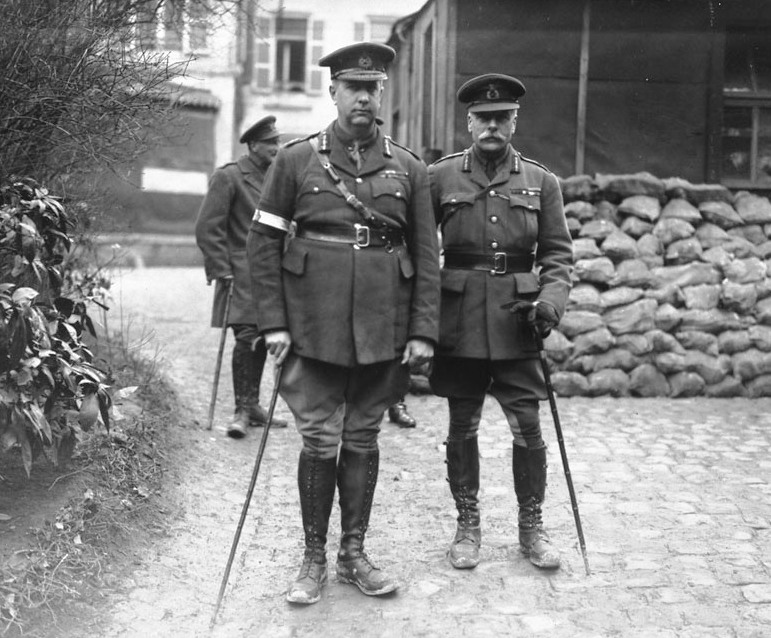
(Garitan Photo)
General Sir Arthur William Currie GCMG, KCB (5 December 1875 – 30 November 1933), Canadian commander of the four divisions of the unified Canadian Corps of the Canadian Expeditionary Force (CEF), and Field Marshal Douglas Haig, 1st Earl Haig of Bemersyde, KT, GCB, OM, GCVO, KCIE, ADC, (19 June 1861 – 29 January 1928) ,commander of the British Expeditionary Force (BEF) from 1915 to the end of the war.
General Sir Arthur William Currie GCMG, KCB began his military service as a pre-war militia gunner, rising through the ranks to become the first Canadian to attain the rank of full general. Currie’s success was based on his ability to rapidly adapt brigade tactics to the exigencies of trench warfare, using “set piece” operations and “bite-and-hold” tactics. He is generally considered to be among the most capable commanders of the Western Front, and one of the finest commanders in Canadian military history.
Currie was not afraid to voice his disagreement with orders or to suggest strategic changes to a plan of attack, something that his British Army superiors were unused to hearing from a former militia officer from the colonies. Often these disagreements were taken all the way up to BEF Field Marshal Sir Douglas Haig. Haig sometimes agreed with Currie – allowing a strategic change to the attack on Hill 70 outside Lens, and approving Currie’s audacious plan to cross the Canal du Nord- but he also insisted on the Passchendaele attack, to which Currie, who was skeptical that the strategic value justified the expected casualties, agreed with great reluctance. British Prime Minister David Lloyd George claimed to his biographer that had the war continued into 1919, he would have sought to replace Field Marshal Haig with Arthur Currie, with Australian General John Monash as Currie’s chief of staff.[64]
My favourite story of the war that Gramp told me is about his experience the day the war ended. He was sent through Mons on 11 November 1918 and passed General Currie and a platoon of Lancers lined up for the triumphant entry into the city.
“There were five of us on the long track going through to Nerring to arrange billets for the Eighth Brigade. The military police headed us off at the square and shunted us through another part of the city. Before we had progressed very far, everyone had a girl on horseback with him. I followed my good resolution until we passed the hospital. A busty looking woman came running down the steps. I gigged the sorrel to the sidewall, pulled my foot from the stirrup. “Ascendez Mademoiselle.” “Mon Monsieur, j’ allez a l’ apothecarie. Viens tout de suit.” I slipped to the back of the old universal saddle, and she came up sideways. I promptly took her in my arms. I was enjoying a hug that smelled like chloroform, until she slipped off and went into the drug store saying, “merci pour le souvenir.” She had snipped every button but the top two off my overcoat while I was enjoying myself.”
November 12th
Took transport to Jemappes through Mons, Belgium, loaded with kids singing “Le Barbanconne,Le Marsellaise”. More shouting than singing.
November 14th
Billeted in houseswith Belgian people. I often think of the widow Le Grand in her little house onthe hill. She showed Earnie Bennett and I her best room, bare of furniture,which we promptly took over and spread our blankets on the floor. Thatnight we got an extra ladle of tea and poured her cup full. The next day foundour blankets spread on a nice bed of straw. The next day we jockeyed forposition in line to get the heel of the loaf because they were thicker andshared with her. The next day she put milk in our tea, the source of supply amystery to us. Later, one early morning in a bushy pasture over the hill, alarge ewe was discovered standing on a box eating some vegetable scrap, fromwhich madam obtained a bowl full of milk.
November 27th, 1918
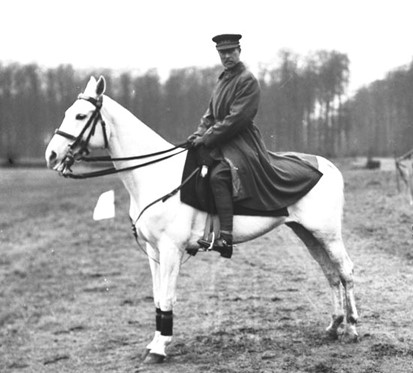
(Library and Archives Canada Photo, MIKAN No. 3522654)
King Albert of Belgium, March 1919.
In Mons, saw King Albert of Belgium as he passed through the square.
November 30th
Saw the Dumbbells concert party in HMS Pinafore.
December 5th
Went with Walter Tees, Frank Gourlay and Oliver Eastman by train to Brussels on weekend leave. Over the weekend, the engineers had repaired the east and west railroads and discontinued the north and south service. We had to walk back to Mons, reaching there December 11th. To tell of the fun and happenings on that trip would fill a book.
December 11th
Battery moved to Breceniques.
December 12th, 1918
Battery moved to Famillereaux. Civilians invited us to a dance. My partner for the evening, Lea Paradene, 5 feet 10 and beautiful.
December 14th
Battery moved to Grez Doiceau.
December 18th
Battery moved to Gastouche and stayed there the winter.
Postscript from the official war records.
“In the First World War the Canadian Corps achieved a reputation unsurpassed in the Allied armies. After the Somme, its record had been one of unbroken victory. It emerged successfully from every test, no matter how severe, and its professional ability had proved second to none. Canada had begun the war with little military experience and with practically nothing in the way of a standing army. She ended it with a superb fighting machine; “the greatest national achievement of the Canadian people since the Dominion came into being.” A total of 619,636 men and women served in the Canadian Army in the First World War and of these 59,544gave their lives and another 172,950 were wounded. That such a war record would carry Canada to full autonomy had been foreseen by Sir Robert Borden, and so it proved. A separate Canadian signature on the Peace Treaty signified that the status of nationhood had been achieved.”[65]
Walter’s closing diary entries are as follows.
February-March 1919
Late in February, moved to Le Harve. In March, moved to Whitley camp in England. Took long leave to Ireland, crossed the Irish sea from Holly Head to Kingstown. Went to Dublin. Too many discharged soldiers still wearing khaki thronging the streets, so went to Belfast. Not much better there. Sgt. Brennan had given me a letter of introduction and address of relatives living between Magherafelt and Coolshinny, so went there. Such hospitality could not be excelled. The neighbours called and invited me to their homes. The Wileys, the Palmers, the Stewards, and others, whom I did not have time to visit. I walked the hills with the young people. Climbed Slevegallon Mountain. Could see into three countries, also, Loch Neagh to the north. Bannwater to the south, and Giants Causeway to the northeast. Where the road we returned to met the main road, there were broad turns to the right and left, leaving a three cornered grassed over space. This was Margaret’s grave, buried about a hundred years ago. The legend, she was a witch and feared by the people, lived alone, and cursed everyone that came near her. When she was found dead, she was not allowed a lot in the cemetery, so a grave was dug here 100 feet deep and she was buried face down, so, if perchance, she decided to go places she would go in a hotter direction.
Came back to Belfast. Toured the city with some relatives of the Wileys. Caught the Fleetwood boat from Belfast back to England. Took the train to Liverpool and London. Made contact with my old friend, Sam Price. We bought a camera and hardly slept the next four days seeing the city. When we returned to Whitley, the brigade had sailed. We were transferred to Ripon. I can only describe our stay there as a wonderful holiday. Bounds 15 miles in any direction. We roamed the surrounding country. Played Crown and Anchor until one or the other of us won enough to buy a feed downtown. Obtained extra clothing. Washed during the day and every second night, went to the Spa baths. One morning roll call, Sam’s name was called, and he was sent on his way rejoicing. Jack Young had been released from hospital and arrived at camp. We did a lot of boating on the Ripon River. Joined a picnic party one afternoon and Jack met the girl he later married. His first wife had passed away a year before, while in France.
May 1919
About May 1st, transferred to Ryl camp in Wales. Met Harley Olmstead. Visited the grave of young McLean, a Woodstock boy that had died there. My only duty there: meet the train and guide any New Brunswick men to our section of the camp. Only one man, Sgt LeRoy Mooers, a boy I knew in high school 1907-1908 arrived.
May 15th
Embarked at Liverpool.
May 24th
Arrived in Halifax. Anchored in harbour to let the Acquatania dock first.
May 25th
Entrained, arriving in Saint John the morning of 26th.
May 26th, 1919
Sgt. Melvin Lawrence marched us to barracks mess hall, and we enjoyed our last army ration. We turned in our blankets, rubber sheet, gas mask, etc. Received our pay. Chase, Cogger, Adams, Diamond and I were given transportation to Woodstock, arriving there 11:00 p m.
That’s all.
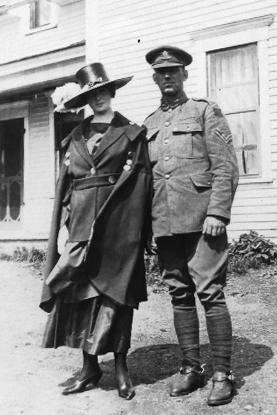
Walter and Myrtle Estabrooks, post war.
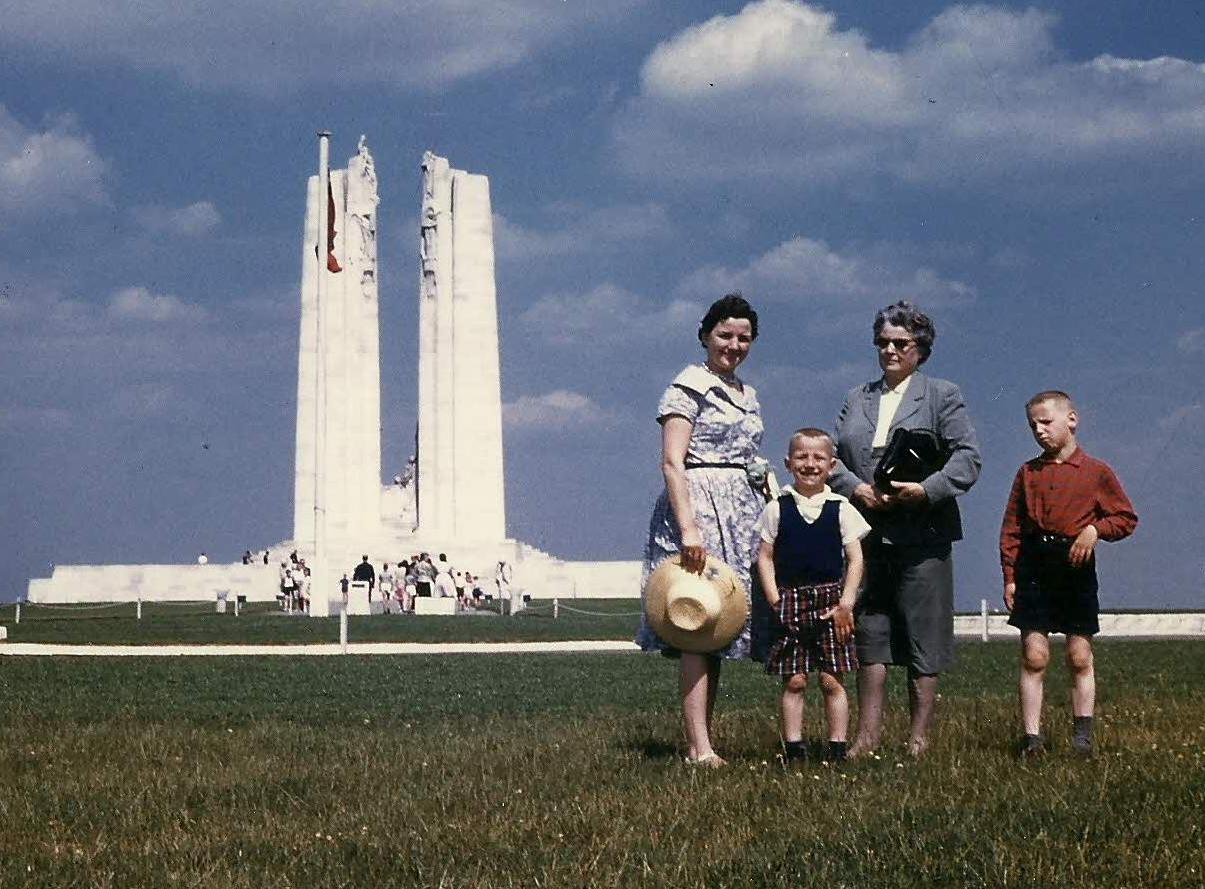
Vimy Ridge memorial, Beatrice Skaarup, Dale Skaarup, Myrtle Estabrooks, Harold Skaarup, summer 1960.
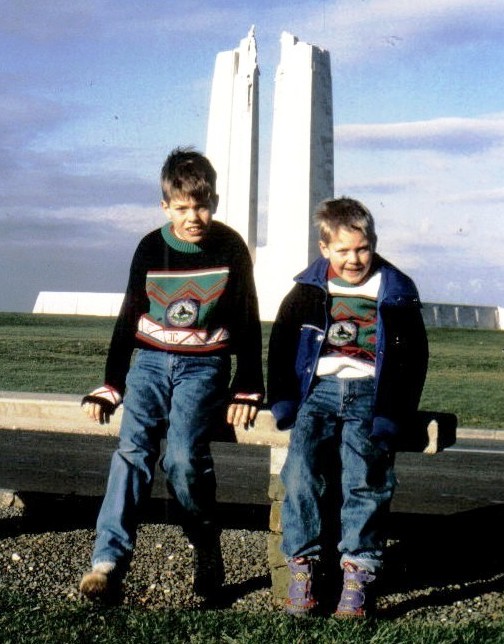
Jonathan and Sean Skaarup, Vimy Ridge memorial, 1991.
All comments are subject to our Comment Policy. You must be at least 18 years old to comment.
See a comment that violates our guidelines? Report it here.