
Artillery preserved in Canada: Nova Scotia: Oak Island
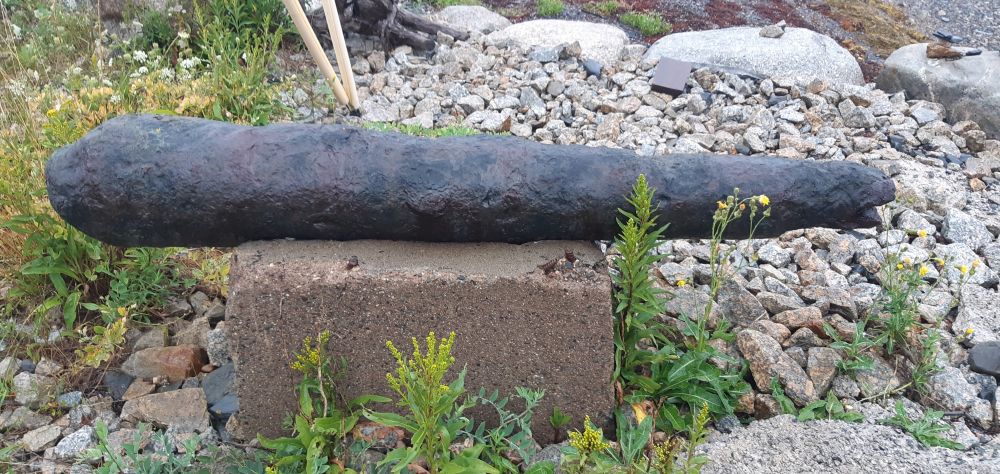
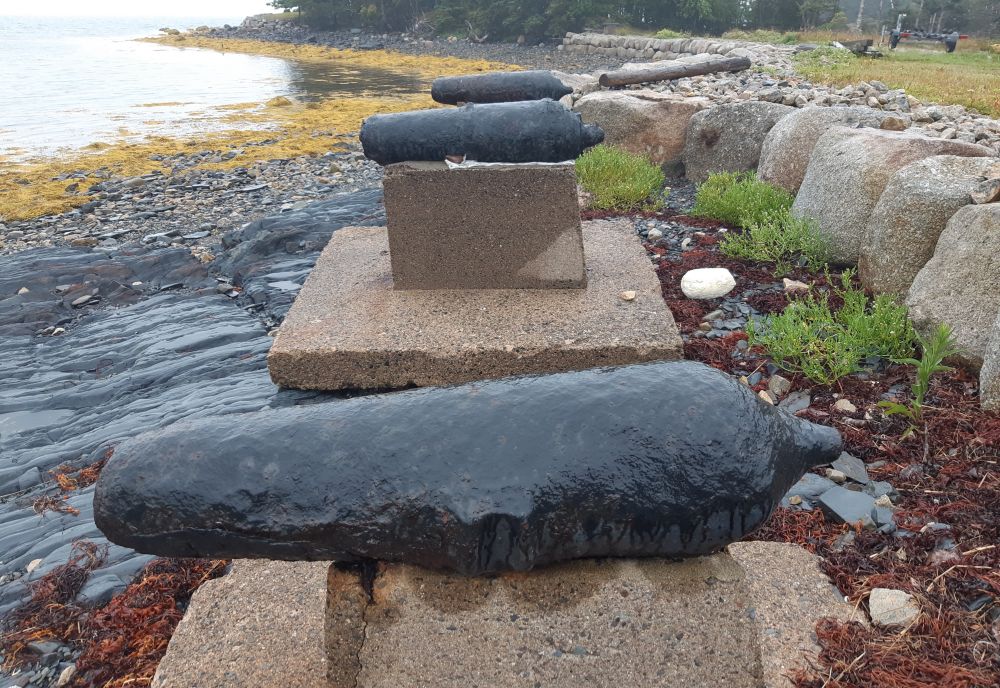
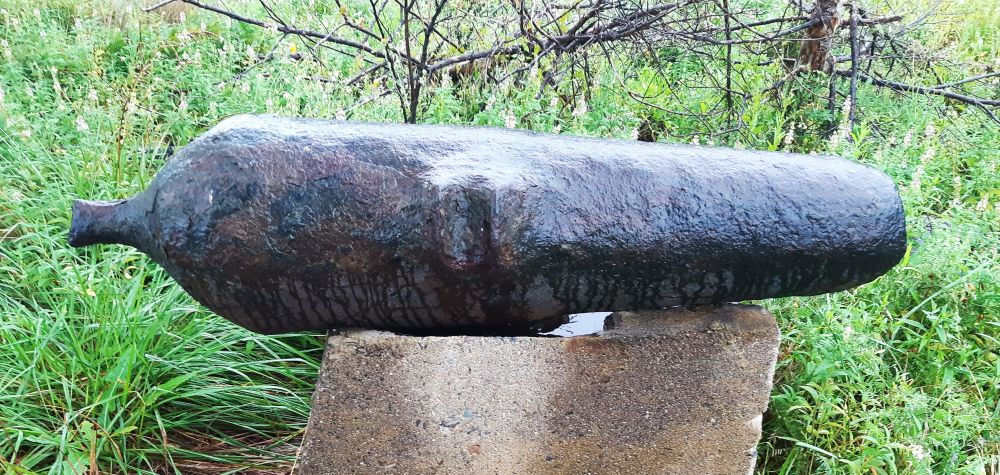
(Author Photos, Aug 2026)
There are six heavily corroded Royal Navy smoothbore muzzleloading cannon mounted on concrete stands facing the causeway to Oak Island. Most of them are carronades that were recovered from the Royal Navy warship Sovereign, which was wrecked of Sovereign Cove, Saint Paul Island, Cape Breton. They were recovered by Ed Barrington of “Off Shore Diving and Salvage: in n1969, and sold to Fred Nolan.
Oak Island, Nova Scotia
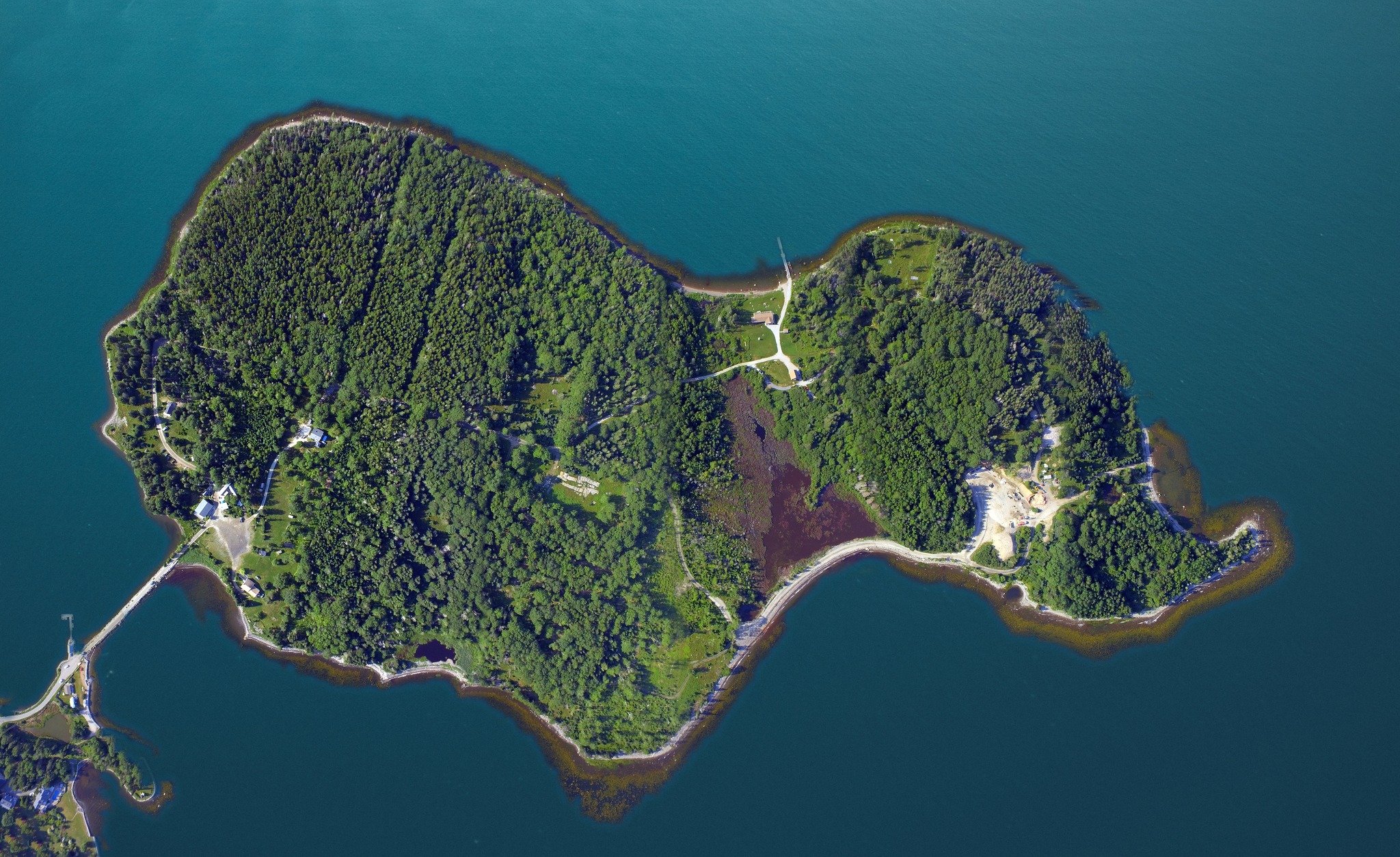
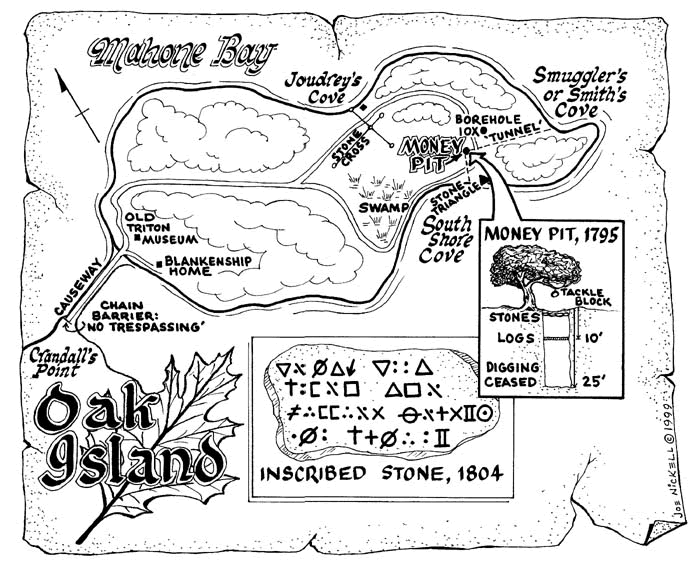
Oak Island is a privately owned island in Lunenburg County on the south shore of Nova Scotia, Canada. The tree-covered island is one of several islands in Mahone Bay, and is connected to the mainland by a causeway. The nearest community is the rural community of Western Shore which faces the island, while the nearest village is Chester.
The island is best known for theories about buried treasure and historical artifacts, and for the many attempts to find them. Treasure hunters have searched the island since the late 18th century, and accounts of its “Money Pit” have been published since 1857. Repeated excavations and investigations have not resolved the mystery, which has become part of North American folklore. (Wikipedia)
The mystery
Oak Island has been a subject for treasure hunters ever since the late 1700s, with rumours that Captain Kidd’s treasure was buried there. While there is little evidence to support what went on during the early excavations, stories began to be published and documented as early as 1857. Since that time there have been many theories that extend beyond that of Captain Kidd which include stories of religious artifacts, manuscripts, and Marie Antoinette’s jewels. The “treasure” has also been prone to criticism by those who have dismissed search areas as natural phenomena.
Areas of interest on the island include a location on its east side known as the “Money Pit”, the site of the original excavation. According to the often-retold story, a local youth named Daniel McInnis noticed a depression in the ground there in 1795 and began to dig with two friends; they reported finding a layer of flagstones and, about 10 feet (3.0 m) down, a tier of oak logs. The Onslow Company, which took up the search in the following decade, was said to have found oak platforms at intervals of about 10 feet (3.0 m) to a depth of about 90 feet (27 m), where the work was halted by flooding.
There is also a formation of boulders known as “Nolan’s Cross”, named after Fred Nolan, the surveyor and treasure hunter who identified it, and a triangle-shaped swamp. There has also been activity at a beach known as “Smith’s Cove”, where objects including non-native coconut fibre have been found. More recent archaeological discoveries in the Smith’s Cove area have included an allegedly pre-15th-century lead cross and various wooden earthworks.
More than fifty books have been published recounting the island’s history and exploring competing theories.[26] Several works of fiction have also been based upon the Money Pit, including The Money Pit Mystery, Riptide, The Hand of Robin Squires, and Betrayed: The Legend of Oak Island. In January 2014, the History Channel began airing a reality TV show called The Curse of Oak Island about a group of modern treasure hunters. These hunters include brothers Rick and Marty Lagina of the “Michigan Group”. The series has documented finds such as centuries-old coins, an antique brooch, and a lead cross that was allegedly made between 1200 and 1600 A.D. (Wikipedia)
Oak Island “Money Pit” excavation
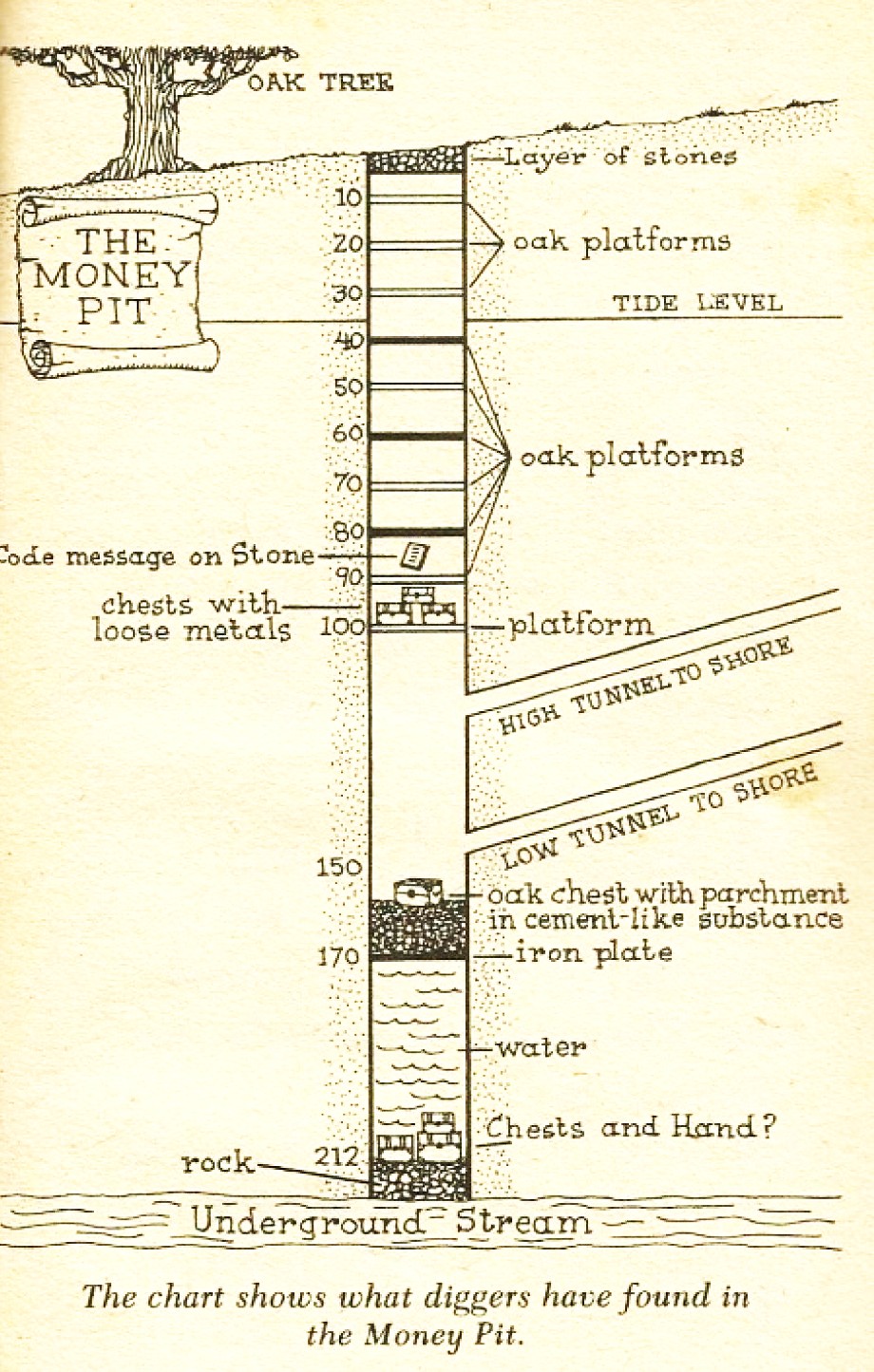
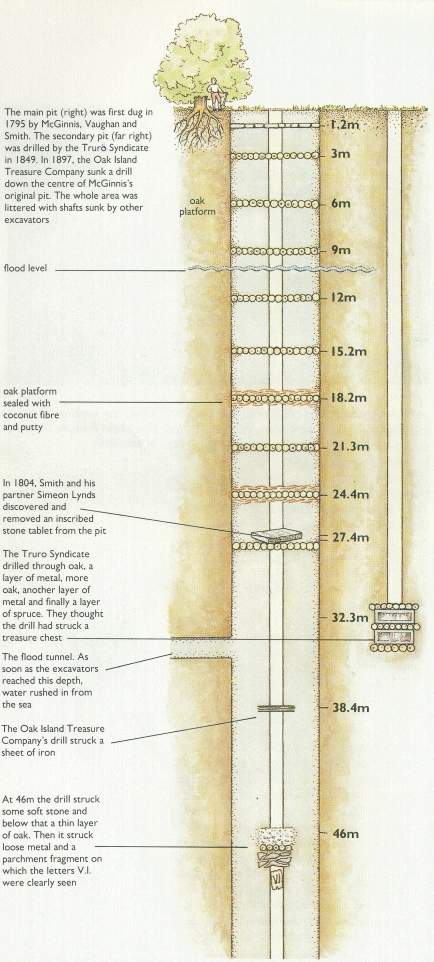
At the heart of the Oak Island mystery is the original pit first discovered by Daniel McInnis, John Smith, and Anthony Vaughn in the summer of 1795. Soon and forever after known as the “Money Pit”. Undoubtedly named for what was expected to come out of it but alas, a name equally appropriate to represent the vast sums of money which have been poured into it over these many decades of searching.
Like many of Oak Island’s secrets, it is not known whether a “treasure” still rests at the bottom of the Money Pit, or once existed but was previously removed, or whether it was, as some speculate, a cunning diversion from the real location of the treasure, in whatever form that may take.
As previously stated there are conflicting views as to what was encountered at various levels as searches excavated the original pit, but it is reasonable to say that there were at least two or three oak log platforms and possibly more, as well as “marks” to denote ten foot intervals i.e. putty or charcoal.
From 1804 onward, when the search had resumed, there appears to have been more detailed records kept. This allowed for a more accurate picture of the shaft to emerge and yet there are still conflicting facts. One of the most intriguing of the early finds occurred at the 80-90′ level. A stone with crude symbols cut on the surface was found face down in the shaft. You can learn more about this “inscribed stone” in another article.
It was shortly after encountering the stone that the searches were introduced to Oak Island’s most enduring and frustrating defense mechanism… water. In an excerpt from a highly regarded book on Oak Island, “The Oak Island Mystery” written by R.V. Harris in 1958, we learn that:
“Until the ninety-foot level was reached, no water had been encountered. At ninety feet, however, the earth in the centre of the Pit become softer and water began to show itself. At ninety-three feet it increased and they took out one tub of water to two of earth. Night coming on, they, as was their usual practice, probed the bottom with a crowbar to if they could strike anything below. At the depth of ninety-eight feet, five feet below, they met a hard, impenetrable substance, bounded by the sides of the Pit. Some supposed it was wood and others called it a chest. Then they left for the night to resume in the morning, when they fully expected to solve the mystery. This circumstance put them all in good spirits and during the evening a good deal of discussion arose as to who should have the largest share of the treasure. But their great expectations were shattered, for the next morning they found sixty feet of water in the Pit! Nothing daunted, they set to work to clear the water with their bailing buckets, but all to no purpose, for there it stood at the same height. They soon found that their appliances were not sufficient for the emergency.”
The searches had unwittingly sprung the trap set by the original architects of the Money Pit to conceal and protect whatever it is they were protecting. The “Flood Tunnel” as it was deemed triumphed over numerous attempts to dig around it, under it, or avert its flow. The flood tunnel system is covered in greater detail in another article.
Many questions are often put forward regarding the Money Pit:
Did the original builders/architects of the Money Pit have a way to turn off the water?
Was the actual treasure buried in another chamber above the high water mark and yet concealed from the surface?
Was there another way into the “treasure chamber(s)” that did not involve the Money Pit?
Is the Money Pit simply a decoy to avert and occupy the searcher’s efforts i.e. why leave the tackle block (if it actually existed)?
What if “what” was deposited there, was never intended to be recovered?
Regardless, reaching the bottom of the Money Pit should expose a connection to what was created on the Island and hopefully the nature of its purpose.
(Oak Island Money Pit – the world’s longest running Treasure Hunt!)
Inscribed Stone
Reports of the size of the stone found in 1804 somewhere between the 80-90′ level in the Pit varied to between 2-3′ long by 12-16″ wide. It was said to resemble dark Swedish granite and to have an olive tinge, and was not a stone common to the area.
A rendering of the symbols claimed to be on the stone are shown below but once again, this exists largely from the memory of an earlier viewer. No tracings or rubbings of the original have survived even though it was said to have been viewed by hundreds of people while in the home of the Smith family. The stone was last seen in the window of a Halifax merchant where it was being displayed in an effort to stimulate interest in the sale of shares.
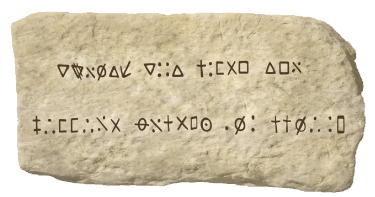
The mysterious inscription continues to engage researches and cryptologists. The most famous, and generally accepted, translation is that offered by Reverend A.T. Kempton in 1949.
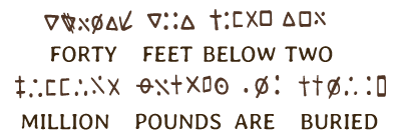
A recent discovery of a similar cipher by the late Zena Halpern, a Knights Templar researcher from New York, has introduced fresh possibilities into this piece of the Oak Island puzzle. Referred to as La Formule, the incomplete document does appear to work with the Kempton cipher, when transcribing the symbols into the French language. It also adds additional letters to help complete the cipher.
Flood tunnels
Oak Island’s “security system” is water and what many searchers have discovered, to their great frustration, is that it is very difficult to bail out the ocean. The architects of the Money Pit devised a trap whereby when a certain depth in the pit was reached an air-lock was breached. This allowed a flood tunnel system to deliver a steady source of water and fill the pit to tide level.
Some people when hearing that water entered the Money Pit say “but of course” i.e. dig any hole in the ground and at a certain depth water will be encountered just as with digging a well. But the water in the Pit was seawater, not groundwater, and there had been many other shafts dug in the vicinity of the Money Pit to greater depths without encountering any water.
Once the early searchers discerned that it was salt water they were dealing with they set about to uncover its source. This led them to Smith’s Cover where a number of very important discoveries were subsequently made and the understanding of the scope and effort by the creators of the Money Pit began to broaden.
Examining Smith’s Cove the searchers noticed that as the tide withdrew, water was seen escaping from the shoreline at various locations. As they dug to ascertain the reason they soon revealed a well engineered system of box drains with a manmade filter comprised of a layer of fibre (like that found in the Pit and deemed to be coconut fibre), eel grass, and beach stones. Below this was five “box drains” made from flat stones with flat stones on top. They were in a fan shape and converged to a common point near the high water mark. The whole undertaking designed to provide a way to keep the supply of water to the Pit from becoming clogged. It was a very simple, yet highly effective, solution. In fact, it was recorded that tons of this fibre was removed and stacked on the beach as one would with stacks of hay!
From this network of box drains it was subsequently learned that a deep underground tunnel was dug for a distance of some 460′ from the drain sump at Smith’s Cove to the 111′ level in the pit at an approximate 22.5 degree incline. The shaft was 2’6″ wide by 4′ high which has great resemblance to historical Cornish mines “old men’s” crosscuts which were often 2’4″ wide by 4′ high. Once completed, the tunnels were back-filled with round rocks and beach stones, presumably to prevent collapse of the shaft which would choke the flow of water. A second flood tunnel is also suspected, but yet unproven, leading from the South Shore Cove to an even lower level in the Money Pit.
There were several times over the many years of investigation when clay and dyes were used to definitively prove the connection between the sea and the Money Pit.
Flood Tunnels protect the Oak Island Money Pit, Smith’s Cove
Nova Scotia Timeline
early Nova Scotia timeline, shows that the area was known and being frequented by various parties:
| 1398 | A compelling case for Prince Henry Sinclair to be in the area after sailing from the Orkneys with a dozen ships and 300 men. (Also, a possible Templar connection and rumour that he was the man who inspired the Glooscap legend) |
| 1490 | Bristol fishermen claimed to be fishing the Grand Banks |
| 1497 | John Cabot makes his discoveries |
| 1521 | Portuguese explorer Joao Alvares Fagudes was said to have visited Nova Scotia around the year 1521 and erected a cross near Advocate. He may have also established a colony in the Cape Breton area. |
| 1534 | Jacques Cartier crosses but didn’t sail Nova Scotia’s coast |
| 1604 | The first settlement at Port Royal by DeMonts and Champlain (they also named LaHave on their crossing). |
| 1632 | Isaac de Razilly settles LaHave and builds Fort Sainte Marie de Grace. Many settlers moved to Port Royal following Razilly’s death in 1636 but the fort was still a trading post when LaHave was attacked in 1652. |
| 1690 | LaHave was reported to be a haven for pirates for approximately 20 years. |
| 1717 | The great fortress of Louisbourg began construction which lasted for 20 years, becoming one of the largest ports on the Atlantic coast. |
| 1749 | Halifax is founded |
| 1753 | Lunenburg is settled |
| 1754 | Mahone Bay is settled |
| 1759 | Chester is settled |
| 1795 | The Oak Island Money Pit is discovered |