
Royal Canadian Naval Air Branch
Article by Richard Gimblett
The Royal Canadian Naval Air Branch was established in 1945 and disbanded upon unification of the Canadian Armed Forces in 1968. During that period, the Royal Canadian Navy (RCN) operated a succession of three aircraft carriers: HMC Ships Warrior, Magnificent and Bonaventure. The ability to exercise air power at sea was fundamental to the RCN’s core role of anti-submarine warfare (ASW) against the Cold War Soviet submarine fleet. As the nature of that threat evolved, the RCN Air Branch underwent a nearly continuous process of adaptation to incorporate new equipment and tactics, with increasingly higher performance aircraft and supporting equipment.
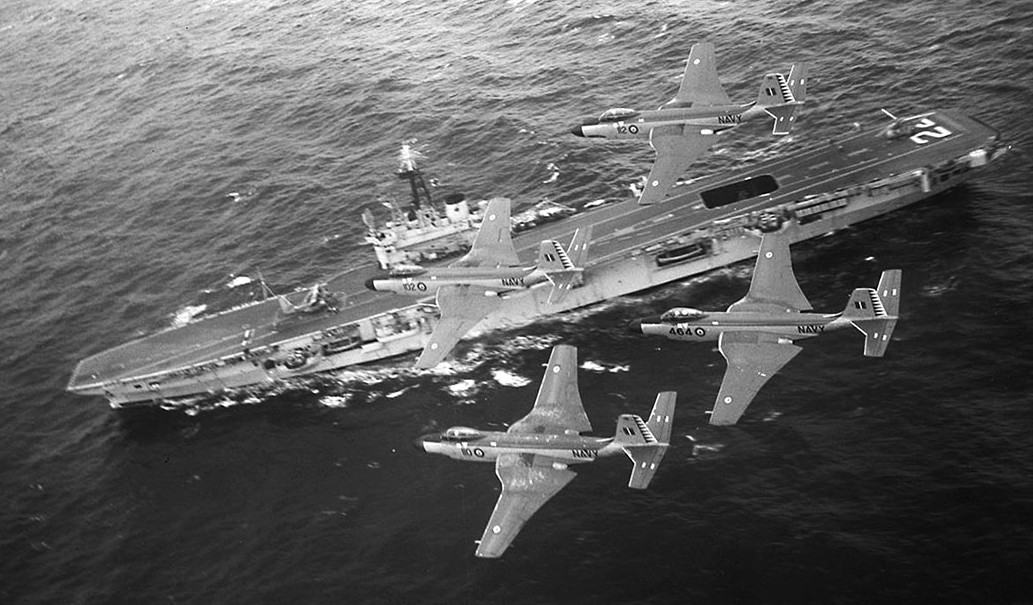
(RCN Photo courtesy of the Shearwater Aviation Museum)
McDonnell F2H-3 Banshees, coded 80, 102, 112 and 464, over HMCS Bonaventure. The Royal Canadian Navy formed the first Banshee air demonstration team with VF 870 at RCNAS Shearwater in 1956 under the command of LCdr Robert Falls to showcase the exceptional flying skills of naval aviators. It was in 1958 that the team adopted the name “Grey Ghosts” under the command of LCdr Wally Walton after he had taken command of the squadron. They flew a five-plane show in 1958 but in 1959 a sixth Banshee joined the team for the Shearwater shows to add an opposing solo routine as Canada celebrated its Golden Anniversary of Flight. Here, the Grey Ghosts overfly HMCS Bonaventure. Number 4, Serial No. 126464, coded 464 (previously coded 104) in the slot position is preserved in the Canada Air and Space Museum in Ottawa.
Origins
Aviation was only in its early stages when the Royal Canadian Navy (RCN) was established in 1910; moreover, it was not immediately appropriate to the needs of the small force. During the First World War, more than 900 Canadians served with Britain’s Royal Naval Air Service (RNAS), including Red Mulock, Raymond Collishaw and Wilfred Curtis. But as the war progressed, enemy U-boat submarines became a serious threat in home waters. Thus, on 5 September 1918, the Borden government established the Royal Canadian Naval Air Service (RCNAS) as Canada’s first air force, to undertake flying boat patrols off the east coast. However, the war ended before any RCNAS airmen completed their training and the organization was disbanded in December 1918.
There was renewed interest in naval aviation during the Second World War, although Canada still did not have its own naval air branch. As in the First World War, many Royal Canadian Naval Volunteer Reserve (RCNVR) recruits were seconded to the Royal Navy’s Fleet Air Arm (FAA, as the RNAS had been re-styled). They included Lieutenant Robert Hampton “Hammy” Gray, who earned a posthumous Victoria Cross flying off the British carrier HMS Formidable on 9 August 1945.
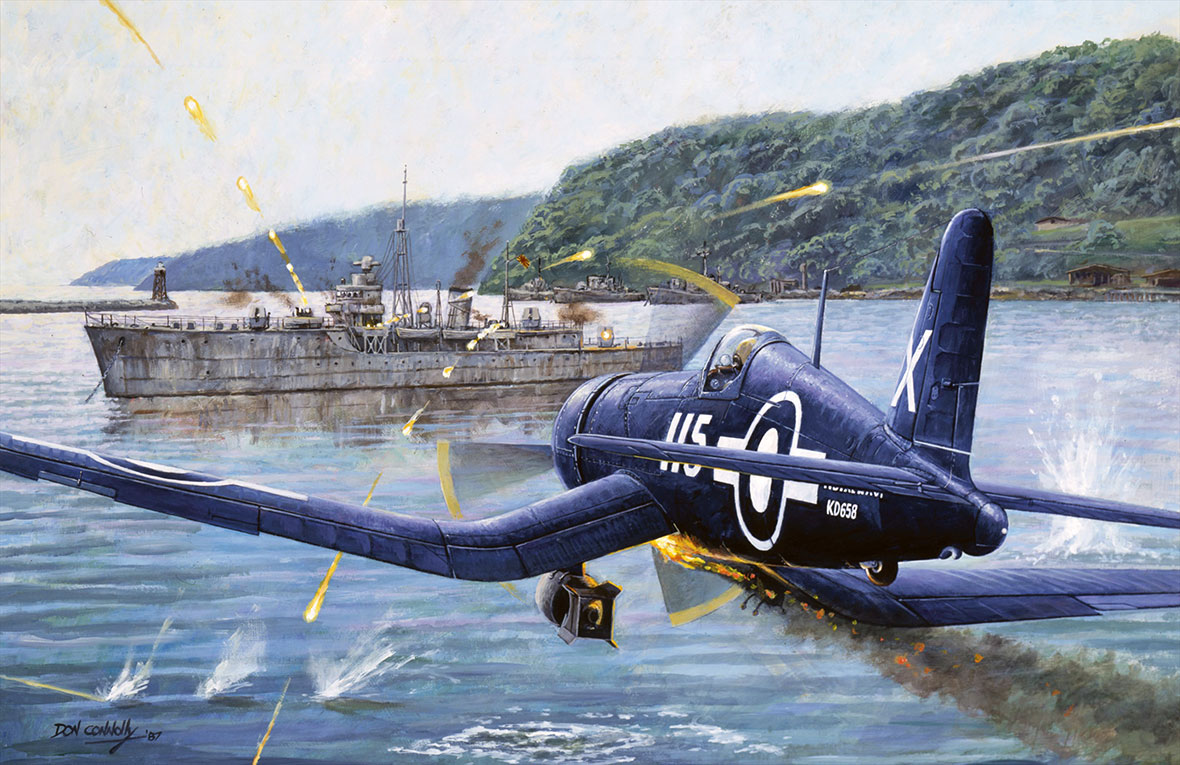
Donald Connolly, Finale, picturing the action in Onagawa Bay, Japan, 9 August 1945, from which Lieutenant Robert Hampton Gray, VC, DSC, was posthumously awarded the RCN’s only Victoria Cross.
(courtesy Government of Canada, Royal Canadian Navy Centennial Image Gallery)
The Victoria Cross awarded to Hammy Gray is unique in many ways. It is the only VC earned by a member of the Royal Canadian Navy, as well as the last VC ever awarded to a Canadian. He is also the last VC recipient of any Commonwealth nation for the Second World War.
By early 1944, the RCN itself was manning two British escort carriers, HM Ships Nabob and Puncher, with British FAA squadrons embarked. (The Nabob was torpedoed in August 1944 while attacking the German battleship Tirpitz and was taken out of service.) Importantly, the Canadian Cabinet War Committee approved the establishment of a “Royal Canadian Naval Air Branch” in October 1943; plans for the Pacific theatre included two aircraft carriers and ten Naval Air Squadrons, totalling nearly 2,000 personnel.

(Bruce Jones Photo)
HMS Nabob (D77), (RCN-manned) (Capt H N Lay RCN), damaged 22 August 1944, Arctic Ocean, north west of North Cape in Barents Sea (71.42N, 19.11E) – torpedoed by German ‘U.354’ (Sthamer).
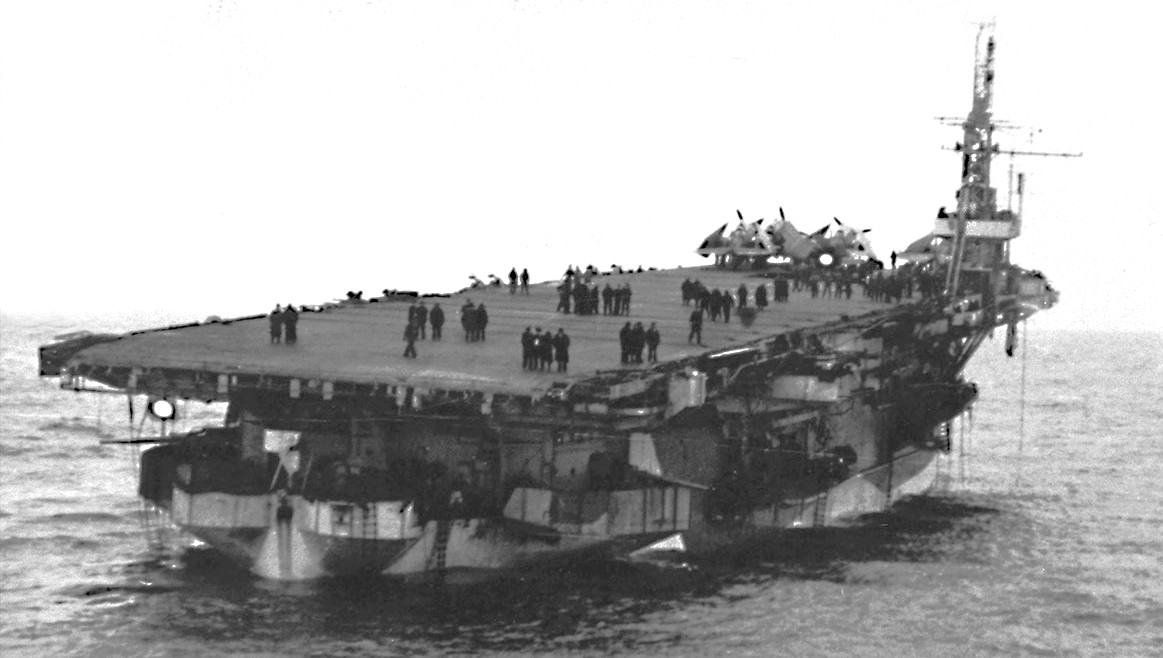
The safe return to Scapa Flow of the Canadian-operated aircraft carrier HMS Nabob, after being torpedoed by a U-boat on 22 August 1944, was an amazing feat of seamanship.

(RN Photo)
HMS Nabob (D77), down by the stern after the torpedo strike.
HMS Nabob had lost 21 men. She was eventually judged not worth repairing, was beached and abandoned, and then cannibalized for other ships. She was decommissioned on 30 September 1944, but was retained as part of the Reserve Fleet. She was returned to USN at Rosyth and stricken for disposal 16 March 1946. She was sold for scrapping in the Netherlands in March 1947, but was resold and converted as the merchant ship Nabob of Norddeutscher Lloyd (she was later renamed Glory and registered in Panama). She was sold for scrap in Taiwan in 1977. HMS Nabob was one of three Royal Navy escort carriers built in the United States which were listed as lost in action (2 sunk and 1 heavily damaged and never repaired) during the Second World War.
These ships were all larger and had a greater aircraft capacity than all the preceding American built escort carriers. They were also all laid down as escort carriers and not converted merchant ships. All the ships had a complement of 646 men and an overall length of 492 feet 3 inches (150.0 m), a beam of 69 feet 6 inches (21.2 m) and a draught of 25 ft 6 in (7.8 m). Propulsion was provided a steam turbine, two boilers connected to one shaft giving 9,350 brake horsepower (SHP), which could propel the ship at 16.5 knots (30.6 km/h; 19.0 mph). Aircraft facilities were a small combined bridge–flight control on the starboard side, two aircraft lifts 43 feet (13.1 m) by 34 feet (10.4 m), one aircraft catapult and nine arrestor wires. Aircraft could be housed in the 260 feet (79.2 m) by 62 feet (18.9 m) hangar below the flight deck. Armament comprised: two 4 inch Dual Purpose guns in single mounts, sixteen 40-mm Bofors anti-aircraft guns in twin mounts and twenty 20-mm Oerlikon anti-aircraft cannons in single mounts. They had a maximum aircraft capacity of twenty-four aircraft which could be a mixture of Grumman Martlet, Vought F4U Corsair or Hawker Sea Hurricane fighter aircraft and Fairey Swordfish or Grumman Avenger anti-submarine aircraft.
RCN Air Branch
On 19 December 1945, Cabinet confirmed the establishment of the Royal Canadian Naval Air Branch, but with only a single carrier. The first Canadian aircraft carrier, HMCS Warrior (a larger “fleet” type on loan from the Royal Navy), was commissioned in January 1946. It was served by 803 and 825 Canadian Naval Air Squadrons, which flew Supermarine Seafire fighters and Fairey Firefly anti-submarine aircraft, respectively.
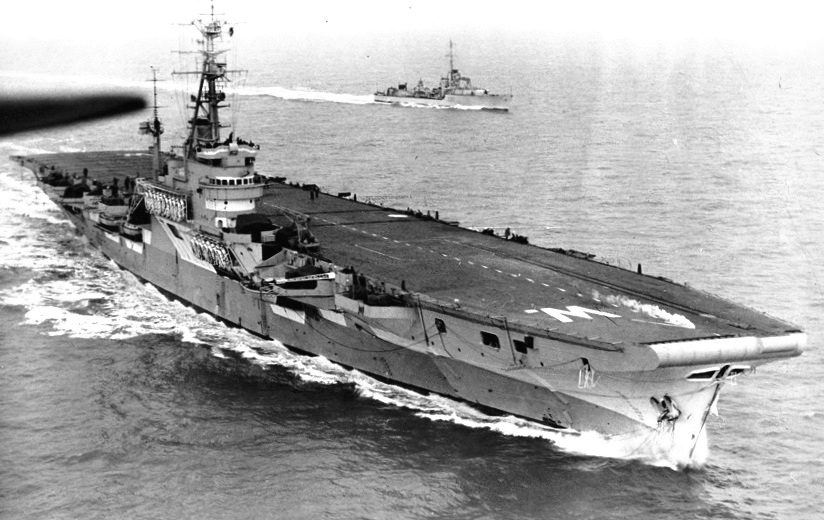
(Shearwater Aviation Museum Photo)
HMCS Warrior (R31).
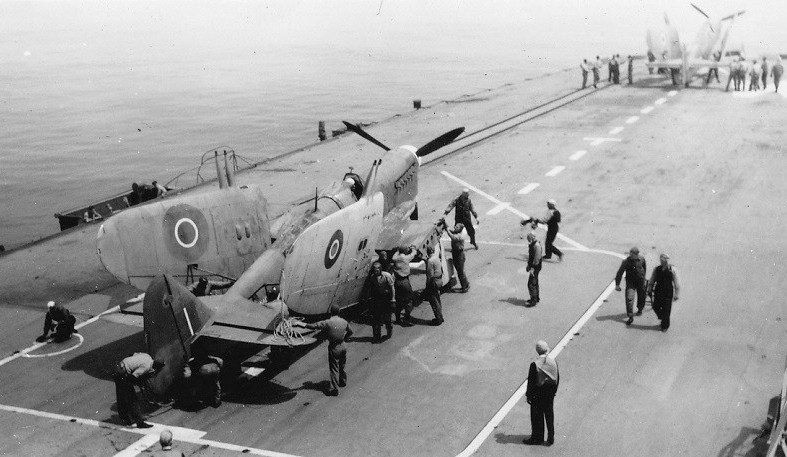
(George Crewe Photo)
HMCS Warrior (R31), with Fairey Firefly preparing to lower wings for launch.
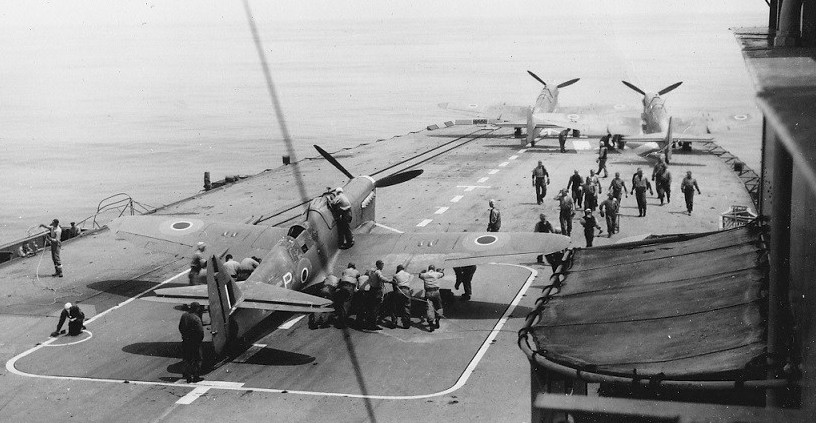
(George Crewe Photo)
HMCS Warrior (R31), with Fairey Firefly wings lowered and ready for launch.
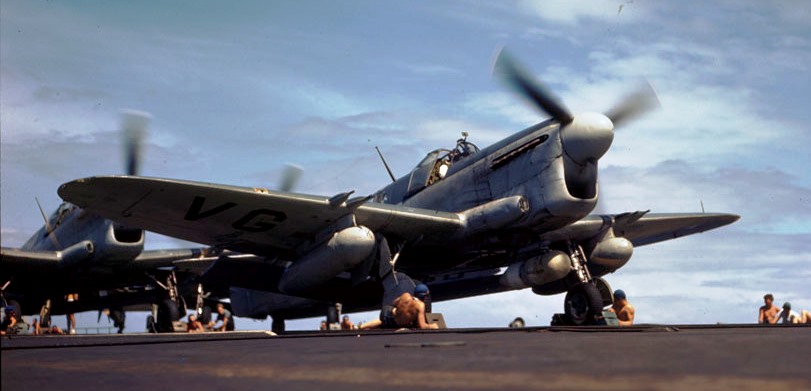
(Library and Archives Canada Photo, MIKAN No. 4820989)
HMCS Warrior (R31), with Fairey Firefly warming up on deck.
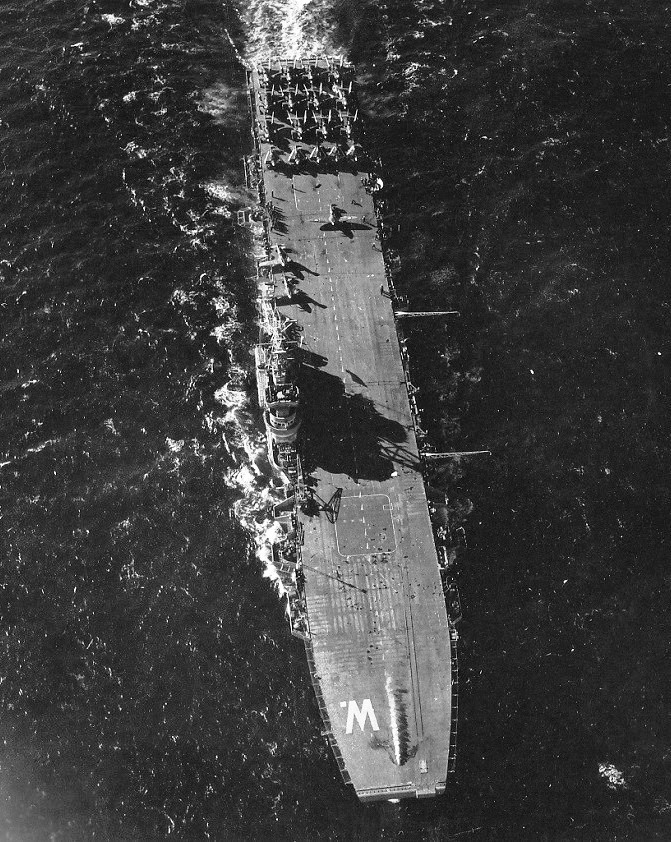
(James A. Senior Photo)
HMCS Warrior (R31), aerial view, ca 1947.
In December 1948, the navy took over RCAF Station Dartmouth in Nova Scotia as its ashore base, renaming it HMCS Shearwater. The same year, Warrior was returned to the Royal Navy and exchanged for the updated carrier HMCS Magnificent.
By 1949, the RCN Air Branch was flying the more advanced (but still piston-engined) Hawker Sea Fury fighters and Grumman Avenger torpedo bombers. Helicopters were introduced with three Bell helicopters in 1951; a year later, Sikorsky HO4S Sea Horse helicopters were introduced in both Search and Rescue (SAR) and antisubmarine warfare (ASW) variants.
.jpeg)
(RCN Photo courtesy of the Shearwater Aviation Museum)
General Motors (Grumman) TBM-3E Avenger AS 3, coded ABF, ABO, and ABJ, formation flight, Royal Canadian Navy.
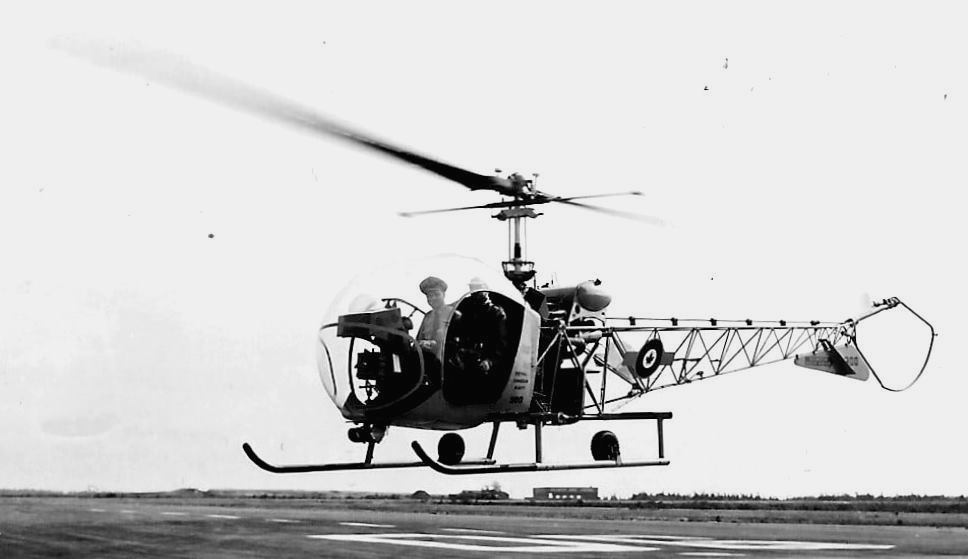
(DNS Photo 5819, Shearwater Aviation Museum via Barrie MacLeod)
Bell HTL-4/6 Sioux Helicopter, RCN (Serial No. 300). RCN photo of the first RCN helicopter. 300 was an HTL-4 when arriving in August 1951 and later up-rated to HTL-6.
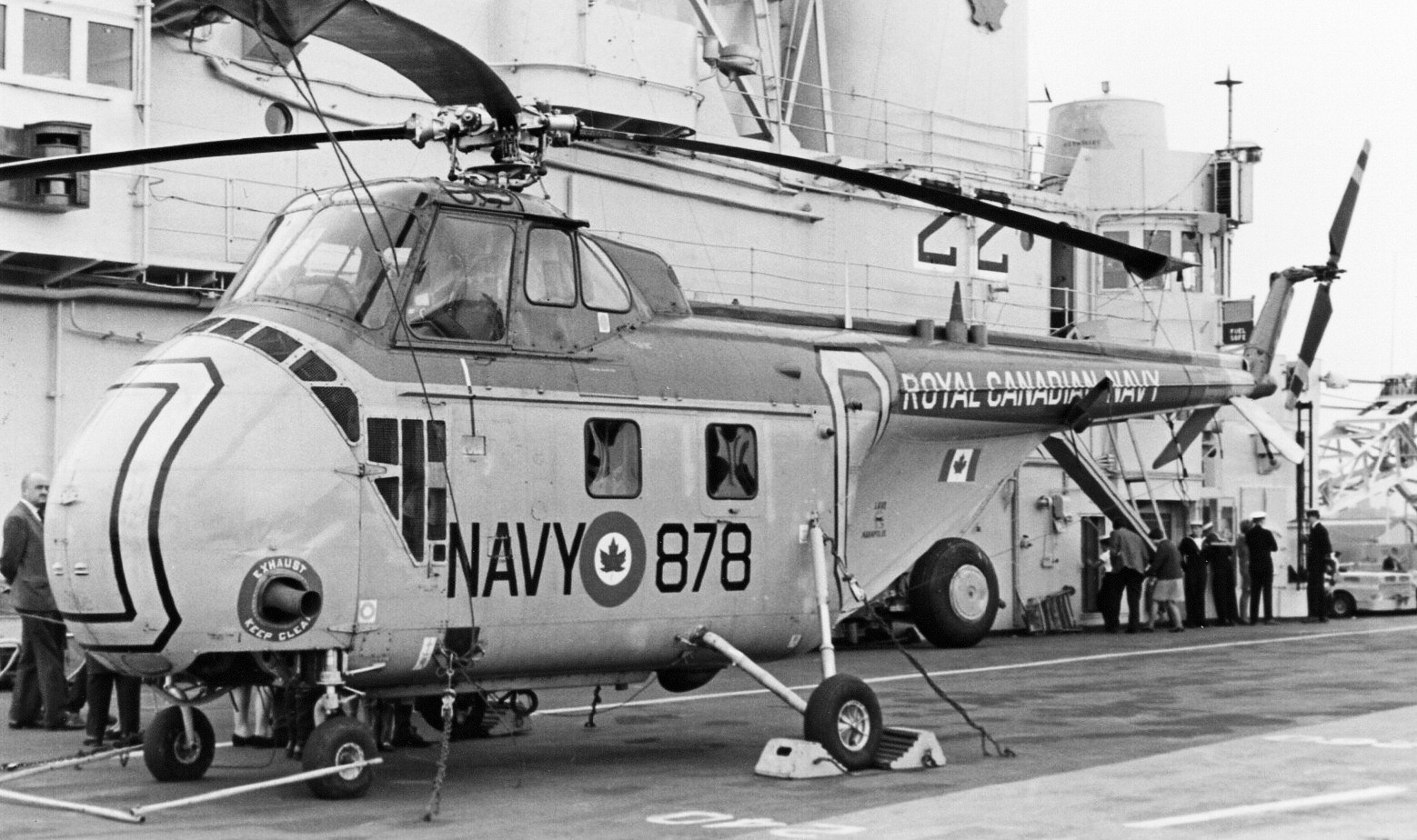
(RCN Photo via Mark Proulx)
Sikorsky HO4S-3 Sea Horse, (Serial No. 55878), coded 878, HMCS Bonaventure, 1968.
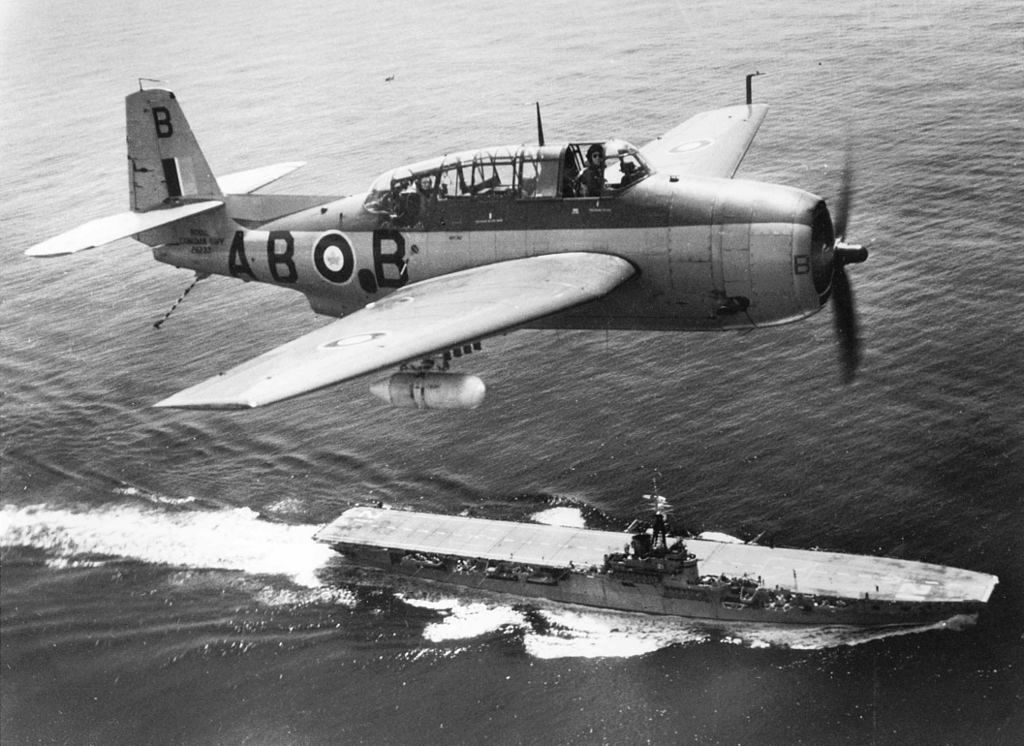
(USN Photo)
General Motors (Grumman) TBM-3E Avenger AS 3, RCN (Serial No. 86233), coded ABB, flying over HMCS Magnificent (CVL 21), circa 1953.
In 1957, HMCS Magnificent (“Maggie”) was returned to the RN for a new carrier, HMS Powerful (renamed HMCS Bonaventure for RCN service), which was purchased rather than loaned from the RN. “Bonnie” featured an angled landing deck, mirror landing sight, the latest steam catapult technology and carrier approach radar and carried McDonnell F2H-3 Banshee jet fighters and Grumman S-2F Tracker anti-submarine aircraft.
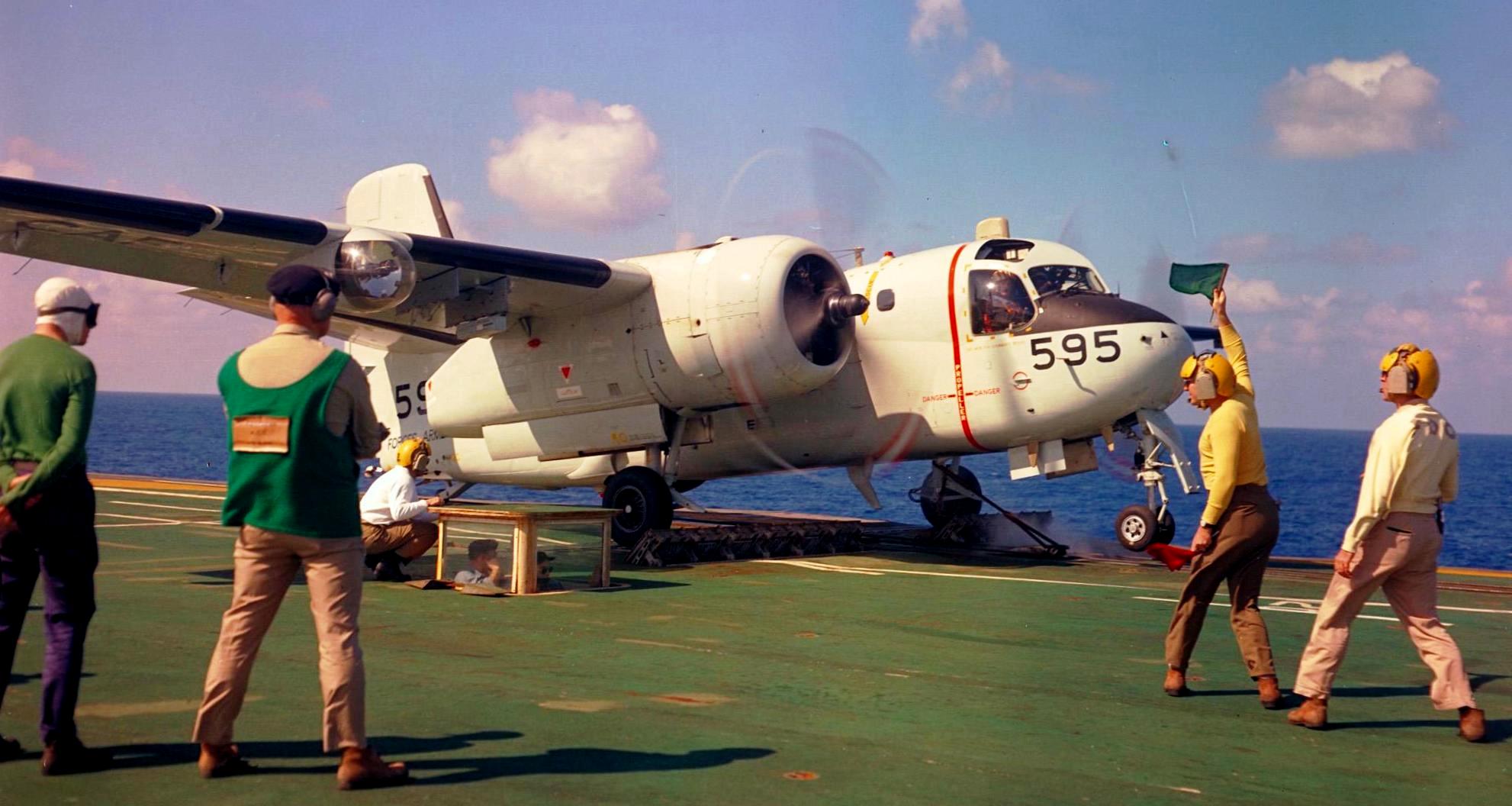
(RCN Photo via Mike Kaehler)
de Havilland Canada (Grumman) CS-2F Tracker, RCN (Serial No. 1595), preparing to launch from the deck of HMCS Bonaventure, 1969. Note how the nose wheel is off the deck and how the catapult cable hooks onto the fuselage. This aircraft survived its life at sea and went on to become C-FKUF. It served with Conair in 1991 and was Turbo Firecat 577 in 1992.
(RCN Photo)
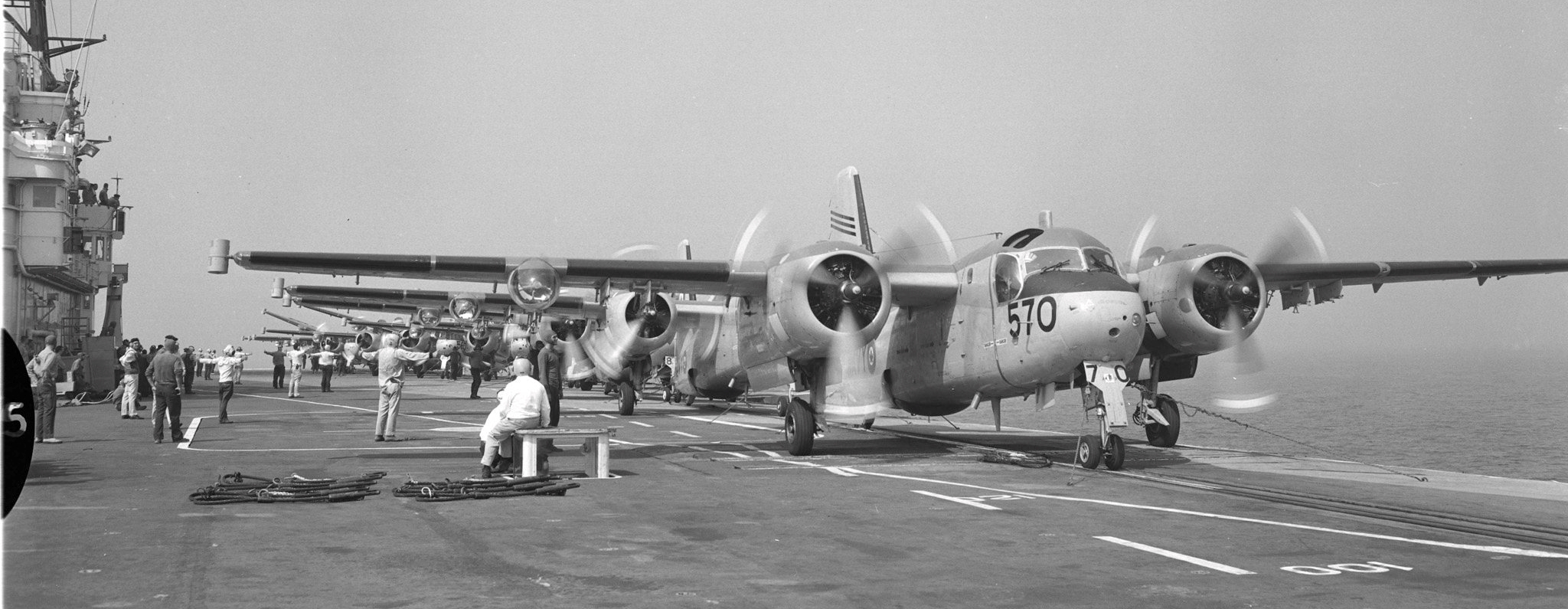
12 Tracker aircraft preparing to take off from HMCS Bonaventure‘s flight deck, 1968.
(RCN Photo courtesy of the Shearwater Aviation Museum)
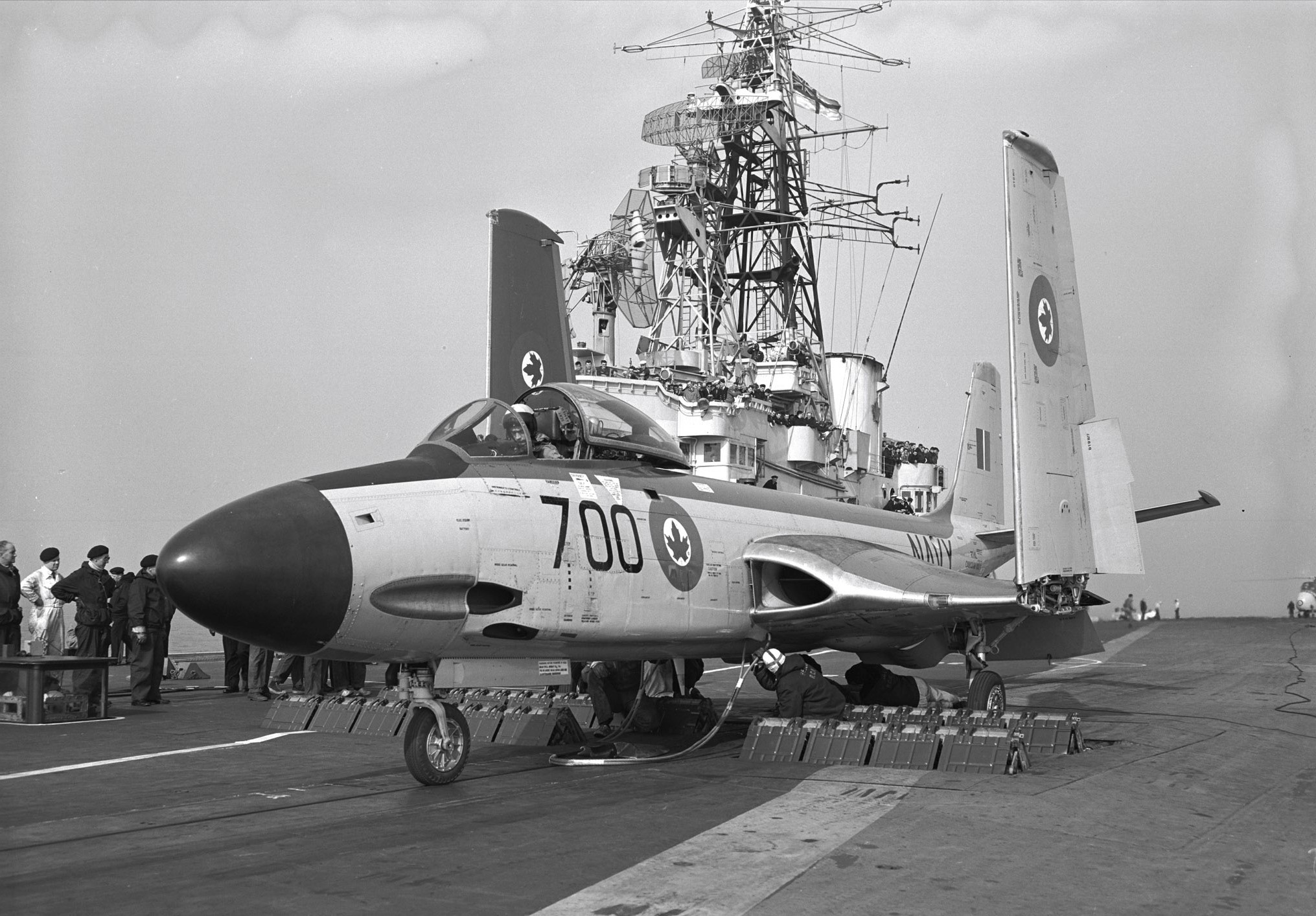
McDonnell F2H-3 Banshee, RCN Serial No. 126381, coded 700, on the flight deck of HMCS Bonaventure, 1957.
(RCN Photo)
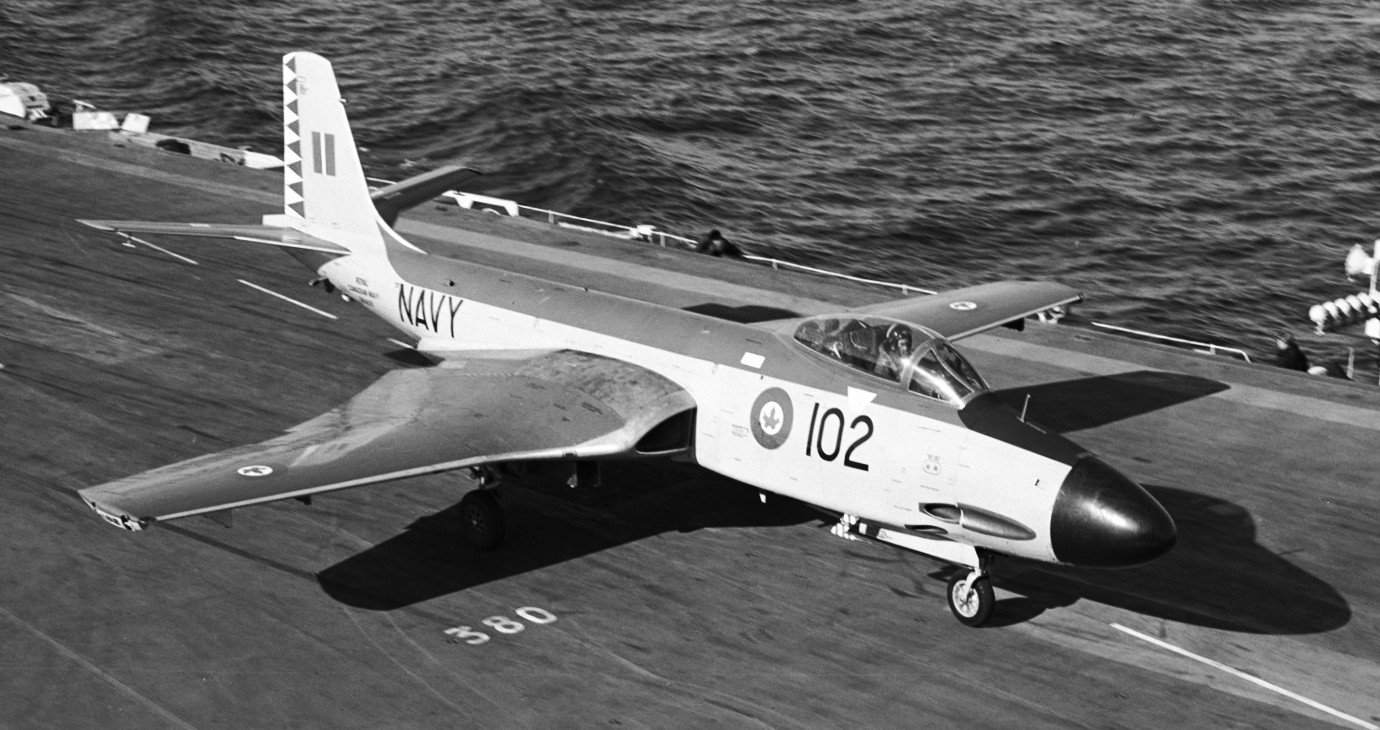
McDonnell F2H-3 Banshee, RCN (Serial No. 126443), 102.
After the Banshees were retired in 1962, Bonaventure became a dedicated ASW carrier and embarked Sikorsky CHSS-2 / CH-124 Sea King helicopters to supplement the Trackers. Meanwhile, the RCN had spear-headed development of the helicopter-carrying destroyer (DDH) concept, with all seven of the original St Laurent-class destroyer-escorts being converted to this configuration. The DDH subsequently became the organizing principle for navies everywhere, including the Royal Navy and the United States Navy.
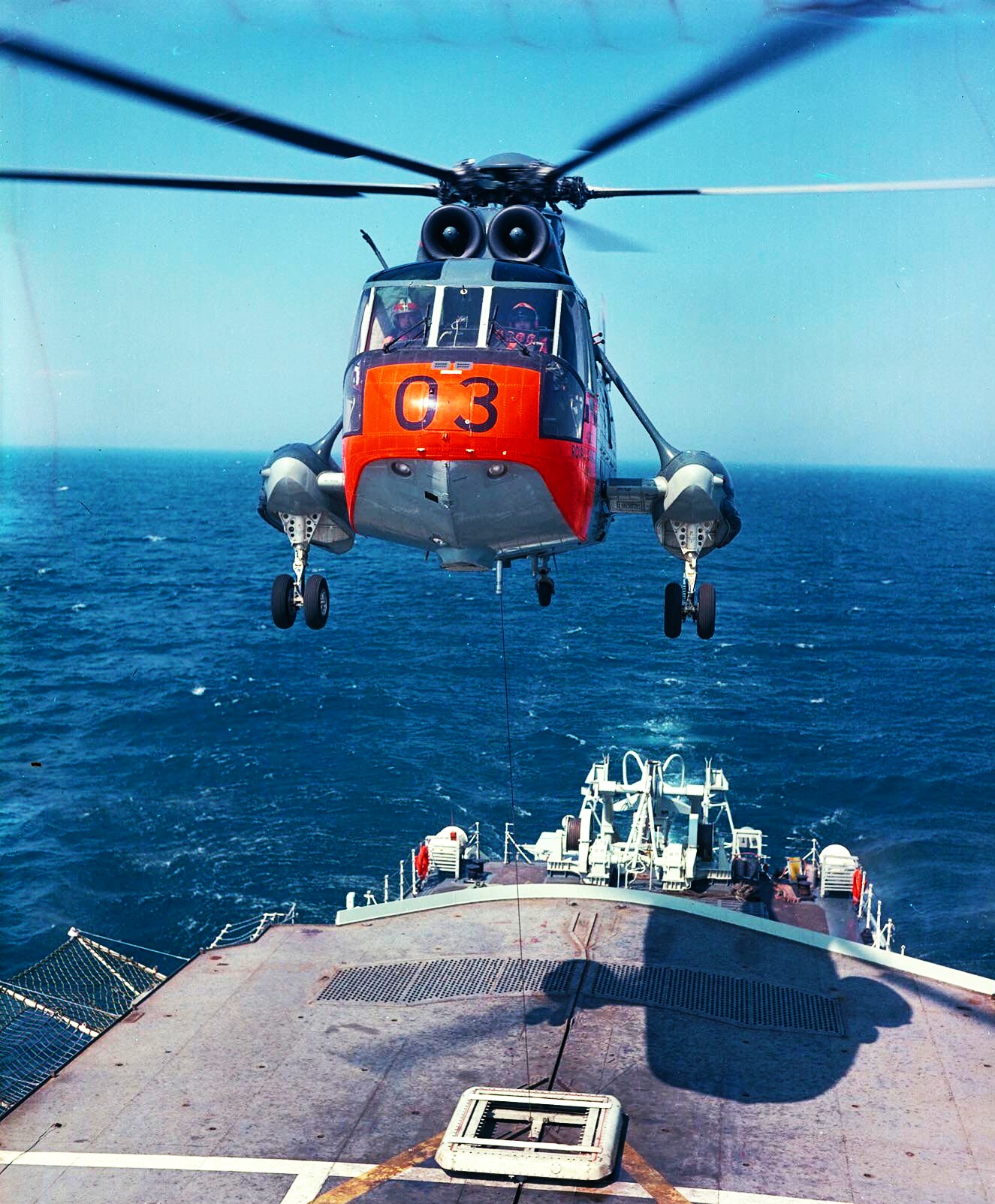
Operational demands led to other technological developments as well. In the 1960s, the Air Branch Experimental Air Squadron, VX10, developed the Helicopter Haul Down and Rapid Securing Device known as the “Beartrap.” This system allowed crew to rapidly secure helicopters on deck, even in rough seas. The RCN also pioneered the ASW Tactical Navigation System (ASWTNS), which during trials in July 1959 enabled an RCN VX10 Tracker crew to continuously track the newly-developed American nuclear submarine USS Skipjack for an extended period — a task deemed “impossible.”
(RCN Photo)
Sikorsky CH-124A Sea King (Serial No. 4003), hauled down by a Bear Trap to a landing on the deck of HMCS Assiniboine (DDH 234), 25 May 1967.
Disbandment
The Royal Canadian Naval Air Branch was effectively disbanded upon the unification of the Canadian Armed Forces in 1968. At that point, it became part of Maritime Air Group, a sub-unit of the integrated Maritime Command. In 1970, Bonaventure was taken out of service without replacement, and the Tracker fleet became shore-based, although Sea King helicopters continued to fly as air detachments from destroyer decks. The Naval Air Branch was truly relegated to history in 1975, when Air Command assumed control of Maritime Air Group.
Although the era of the Royal Canadian Naval Air Branch had come to an end, air service remained an essential component of Canada’s navy and continues to this day as embarked shipboard elements of the reconstituted Royal Canadian Air Force. (thecanadianencyclopedia.ca)