Royal Navy Cruisers (Town class), Gloucester group: HMS Gloucester (C62), HMS Liverpool (C11), HMS Manchester (C15), HMS Edinburgh (C16), HMS Belfast (C35)
The Town class consisted of 10 light cruisers built for the Royal Navy during the 1930s. The Towns were designed within the constraints of the London Naval Treaty of 1930. The ships were built in the sub-classes, Southampton, Gloucester and Edinburgh, each sub-class adding more weaponry. (Wikipedia)
HMS Gloucester (C62)
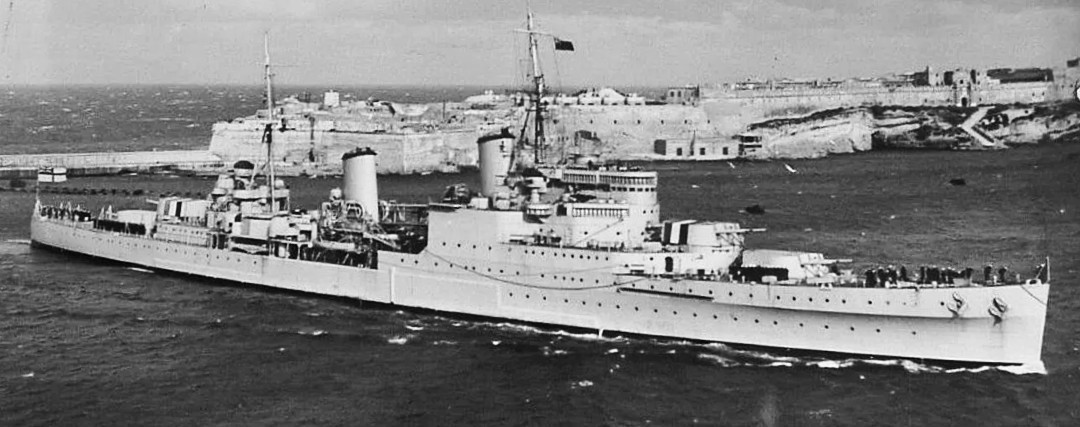
(RN Photo)
HMS Gloucester (C62). Commissioned shortly before the start of the Second World War in August 1939, the ship was initially assigned to the China Station and was transferred to the Indian Ocean and later to South Africa to search for German commerce raiders. She was transferred to the Mediterranean Fleet in mid-1940 and spent much of her time escorting Malta Convoys. Gloucester played minor roles in the Battle of Calabria in 1940 and the Battle of Cape Matapan in 1941. She was sunk by German dive bombers on 22 May 1941 during the Battle of Crete with the loss of 722 men out of a crew of807.
Gloucester acquired the nickname “The Fighting G” after earningfive battle honours in less than a year.The ship was transferred to the 7th Cruiser Squadron of the Mediterranean Fleet at Alexandria, Egypt, in May 1940. A few days after Italy joined the war on10 June, Gloucester and her sister ship, Liverpool, bombarded Tobruk, Libya,sinking a small auxiliary minesweeper on the 12th. Several weeks later, the 7th CS was covering several convoys to and from Malta when British Short Sunderland flying boats spotted an Italian convoy on the 28th. The squadron was ordered to intercept and sank the destroyer Espero with a prodigious expenditure of ammunition. On 7 July, the Mediterranean Fleet sortied to cover more Malta convoys, but they were spotted by the Italians that evening. The next day, a bomb dropped by Savoia-Marchetti SM.79 bombers struck the ship’s bridge, killing 18 crew members instantly, including the captain. As a result of the attack, the ship could not be steered from the bridge and was uncontrolled for a time before the aft steering position could take over. Despite an inoperable bridge, the ship remained with the fleet and participated in the Battle of Calabria on the 9th, although she was ordered away from the battleline to escort the aircraft carrier Eagle.
Repairs were completed by the end of August when Gloucester, now assigned to the 3rd Cruiser Squadron, participated in Operation Hats. At the end of September, the ship ferried 1,200 troops to Malta, together with Liverpool. Gloucester spent most of the rest of the year escorting convoys to and from Greece and Malta, although she escorted the aircraft carrier Illustrious during the Battle of Taranto on 11 November and ferried troops to Piraeus, Greece, on the 17th. On 11 January 1941, while supporting Operation Excess (several coordinated convoys), Gloucester and sister ship Southampton came under attack from Junkers Ju 87 “Stuka” dive bombers from StG 2 while leaving Malta. Gloucester was hit by a 250-kilogram (550 lb) bomb which failed to explode after penetrating through five decks. Southampton was hit by at least two bombs and caught fire. She was heavily damaged and without power. The ship was scuttled by torpedoes from the light cruiser Orion. (Wikipedia)
n 27 March, Gloucester, now reassigned to the 7th CS, departed Piraeus bound for Souda Bay, Crete as part of Vice-Admiral Andrew Cunningham’s plan to trap and destroy a large portion of the Italian Fleet which was at sea in an attempt to intercept British convoys operating between Greece and Egypt. British signals intelligence had revealed the Italian plan and Cunningham attempted to consolidate his ships, but was delayed and missed his rendezvous with the 7th CS scheduled for the following morning. The Italians located the squadron first and the 3rd Cruiser Division with three heavy cruisers, escorted by three destroyers, opened fire at 08:12 at very long range. Only Gloucester returned fire as the British attempted to disengage, but the Italians followed, against orders, when Admiral Angelo Iachino recalled them at 08:55. The 7th CS turned around to observe the Italian manoeuvre and Iachino attempted to pincer the British cruisers between his 3rd Cruiser Division and his flagship, the battleship Vittorio Veneto.
Although Vice-Admiral Henry Pridham-Wippell knew that the Italians had a battleship at sea, he was still caught by surprise when Vittorio Veneto opened fire at 10:55 at Orion. The 3rd Cruiser Division joined in shortly afterwards, but gunnery problems plagued the Italians and they scored no hits against their primary targets, Gloucester and Orion. The British ships laid smoke screens and turned south towards the main body of the Mediterranean Fleet. An unsuccessful attack by torpedo bombers from the aircraft carrier Formidable persuaded Iachino to turn back at 11:40. The 7th CS was able to keep up the pursuit that afternoon after another torpedo bomber attack damaged the Vittorio Veneto at 15:20 and reduced her speed. A subsequent attack crippled the heavy cruiser Pola and Orion’s radar picked up Pola, and the two other heavy cruisers that had been sent to her assistance, at 20:15. Cunningham’s three battleships quickly sank all three heavy cruisers at point-blank range later that night.
Gloucester repeatedly bombarded targets inLibya during April. After covering another convoy to Malta, the ship, togetherwith the battleships Warspite, Valiant, and Barham, and various destroyers,attacked Tripoli harbour on the night of 20/21 April with some success. At theend of the month, the ship was briefly transferred to Force H at Gibraltarbefore escorting a convoy eastward to Malta and rejoining the MediterraneanFleet in Operation Tiger in early May.
To counter the German invasion of Crete, Cunningham split his fleet intoseveral forces, which would act independently to intercept German seatransports. After German paratroopers landed on Crete on 20 May, Gloucester wasassigned as the command ship of Force B and tasked with interdicting anyefforts to reinforce the German forces on the island. Force B was ordered on anight patrol between Cape Elephonsi and Cape Matapan but encountered no enemiesand joined up with Rear Admiral Rawlings’ Force A1 on the morning of 21 May. AGerman and Italian convoy was sighted by allied reconnaissance later that dayand Forces B, C and D were ordered to intercept and engage, with Force D makingcontact at 23:30.
Force B again encountered no enemy naval vessels but came under attack fromfifty “Stuka”s of VIII. Fliegerkorps at 06:30 on 22 May, as theyreturned westwards to rejoin Rawlings and Force A1. Gloucester and the lightcruiser Fiji took damage from near misses. Force B made the rendezvous withForce A1 and Force D (Rear Admiral Irvine Glennie) at about 08:30 and the combined force was ordered to report on their levels of high-angle anti-aircraft ammunition at 09:30. Of the cruisers, Ajax had 40%, Orion 38%, Fiji 30%, Dido 25% and Gloucester only 18%. Ajax, Orion and Dido were ordered to return to Alexandria with Glennie’s Force D to rearm but Gloucester and Fiji remained with Rawlings’ Force A1.
At 12:25 Force A1, stationed 20 to 30 miles west of Antikythera, received a request from Rear Admiral Edward Leigh Stuart King to support the damaged Naiad and the rest of his Force C. Force A1 headed east into the Kythira Strait, rendezvousing with Force C between 13:30 and 14:00. As the more senior admiral, King took command, with air attacks now inflicting damage on both forces. At 14:02 and 14:07 respectively, Fiji and Gloucester were detached to provide anti-aircraft support for the destroyers Kandahar and Kingston. The two destroyers having already been ordered to rescue the survivors of the destroyer Greyhound, which had been sunk at 13:50. Writing in despatches after the battle, Cunningham stated that King was unaware of the shortage of anti-aircraft ammunition in Fiji and Gloucester. At 14:13 King and Rawlings exchanged messages about the shortage of ammunition within both Force C and Force A1,with Rawlings expressing concern about the orders given to Gloucester and Fiji. Following this communication, King issued an order to recall both Gloucester and Fiji at 14:57.
While in the Kythira Strait, about 14 miles (12 nmi; 23 km) north of Crete, Gloucester and Fiji were attacked by Ju 87 Stuka dive bombers of StG 2. Between 15:30 and 15:50, while attempting to rejoin Force A1, Gloucester was hit by several bombs and the decision was taken to leave her behind due to the air attacks. Fiji, under heavy fire, dropped rafts as she passed Gloucester but was unable to stop and was herself sunk within a few hours.
The 5th Destroyer Flotilla, led by Kelly, was dispatched to search for survivors of both the Gloucester and the Fiji in the evening but was diverted to bombard the Germans at Maleme airfield before reaching the search area. Eventually the Germans picked up the survivors and brought them to Kythira. Of the 807 men aboard at the time of her sinking, only 85 survived to reach shore; two more subsequently died after being taken into captivity, one in 1941 and another in 1945. (Wikipedia)
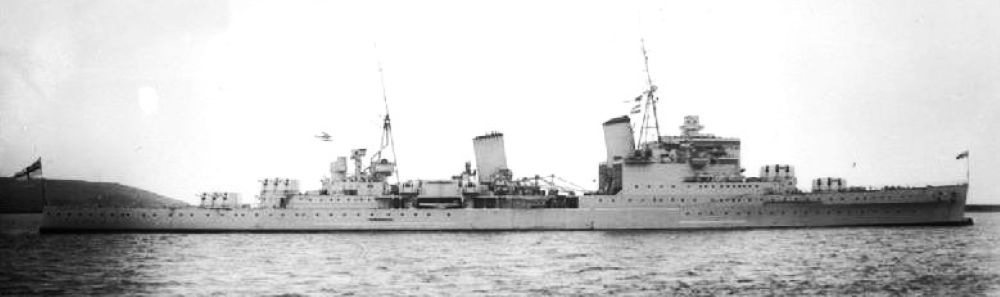
(IWM Photo, FL 3923)
HMS Gloucester (C62), 1939.
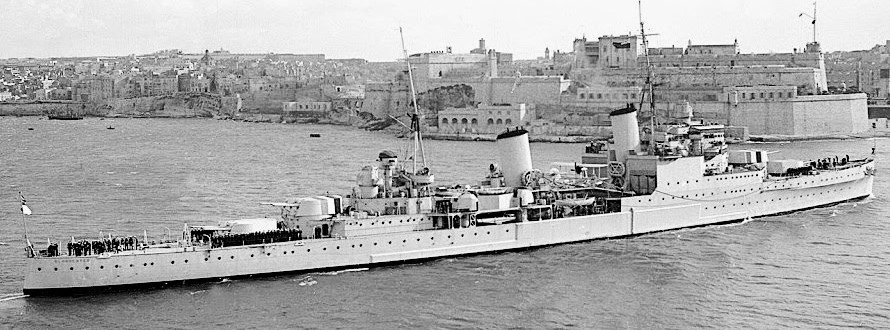
(RN Photo)
HMS Gloucester (C62), 1941.
HMS Liverpool (C11)
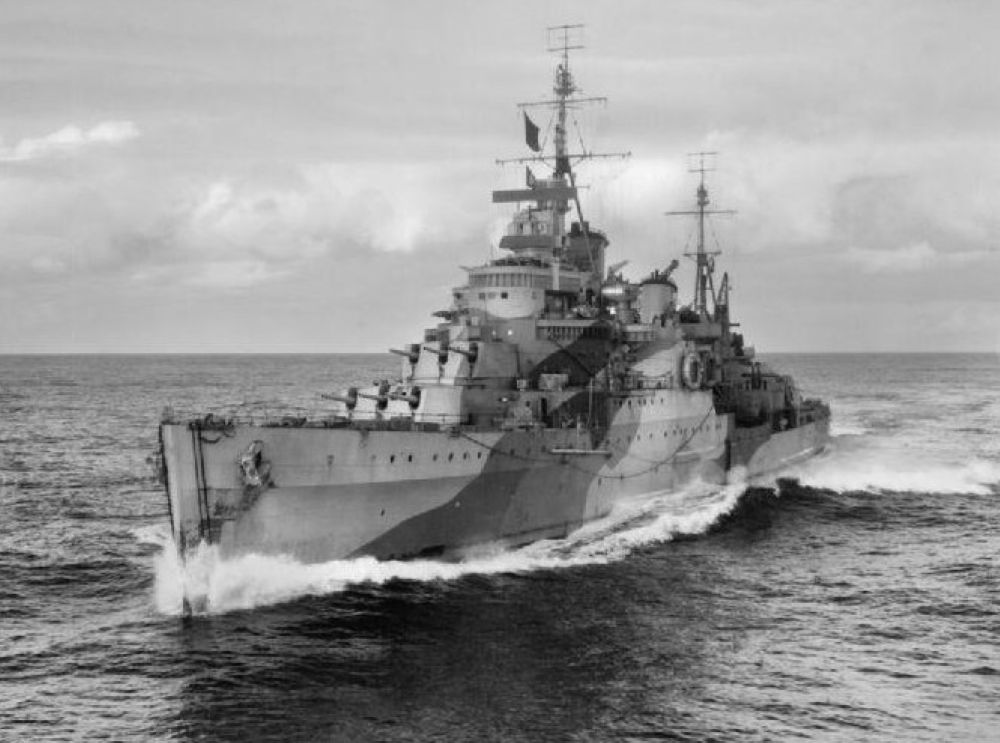
(IWM Photo, FL 004984)
HMS Liverpool (C11). During the Second World War, Liverpool gained four battle honours and was seriously damaged in two attacks by Italian torpedo bombers. The cruiser operated variously with the naval stations in the East Indies and China and with the Mediterranean and Home fleets. While assigned as flagship to the China Station in January 1940, the cruiser instigated a diplomatic incident with Japan when she intercepted the liner Asama Maru off the coast of Japan. Liverpool took part in the battles of the Espero Convoy and Calabria, the Arctic Convoys, and Operation Harpoon during the Malta Convoys. On 14 June 1942, during Operation Harpoon, Liverpool suffered an air attack and had to undergo repairs and refitting at Rosyth, Scotland for the remainder of the war.Liverpool returned to service in 1945 and was assigned as flagship to the Mediterranean Fleet. In the early 1950s, the cruiser harboured in Port Said to support the British Administration of the Suez Canal Zone, when Egyptian guerrillas campaigned against it. The cruiser was decommissioned in 1952 at a time when the Royal Navy was rapidly contracting in strength. Liverpool was broken up in 1958, at Rosyth. (Wikipedia)
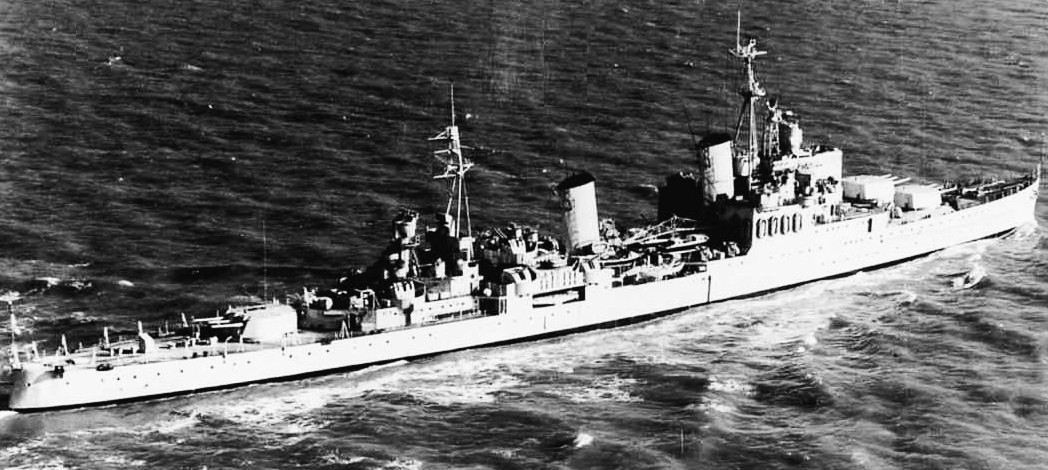
(RN Photo)
HMS Liverpool (C11).
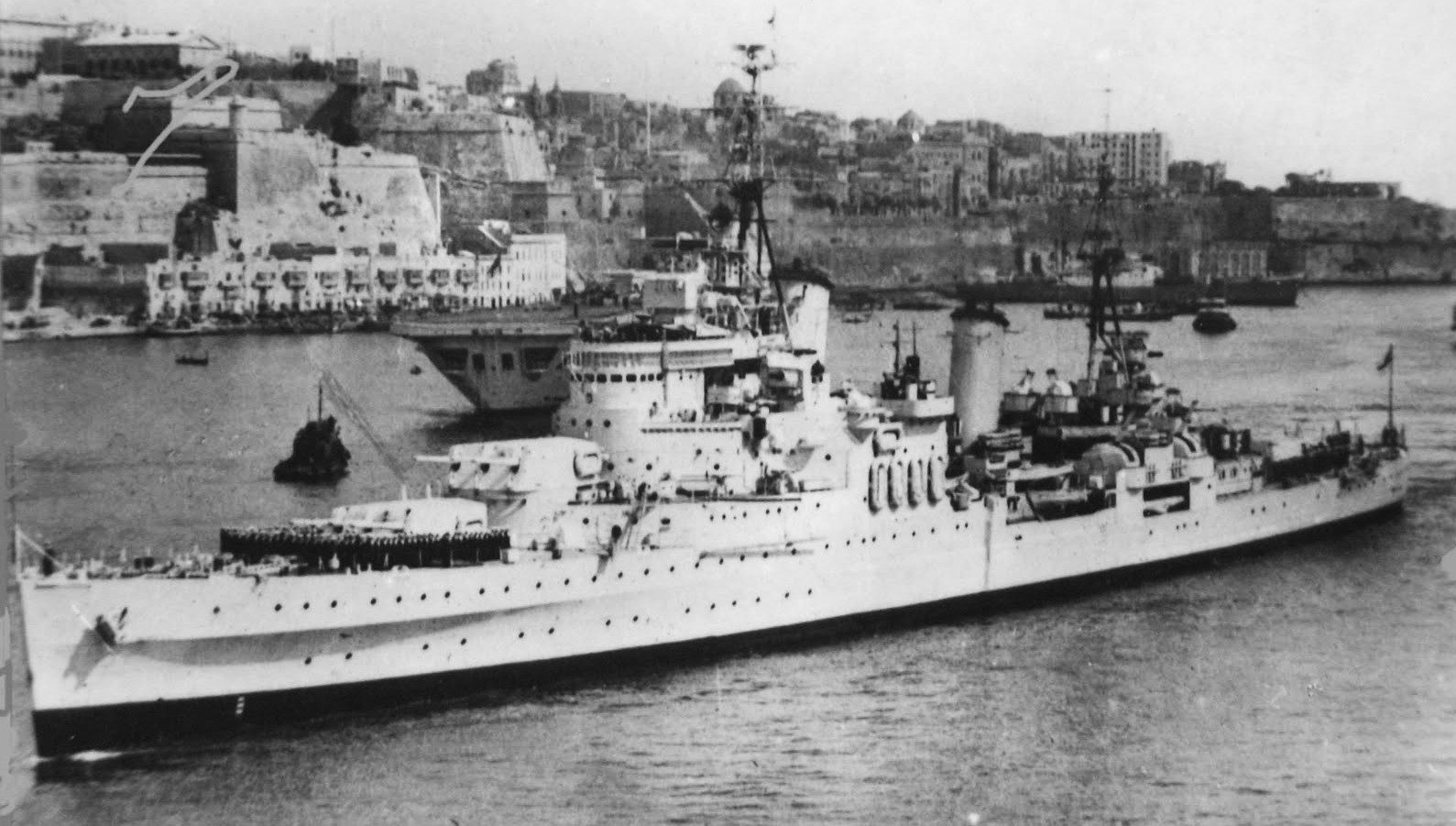
(RN Photo)
HMS Liverpool (C11).
HMS Manchester (C15)
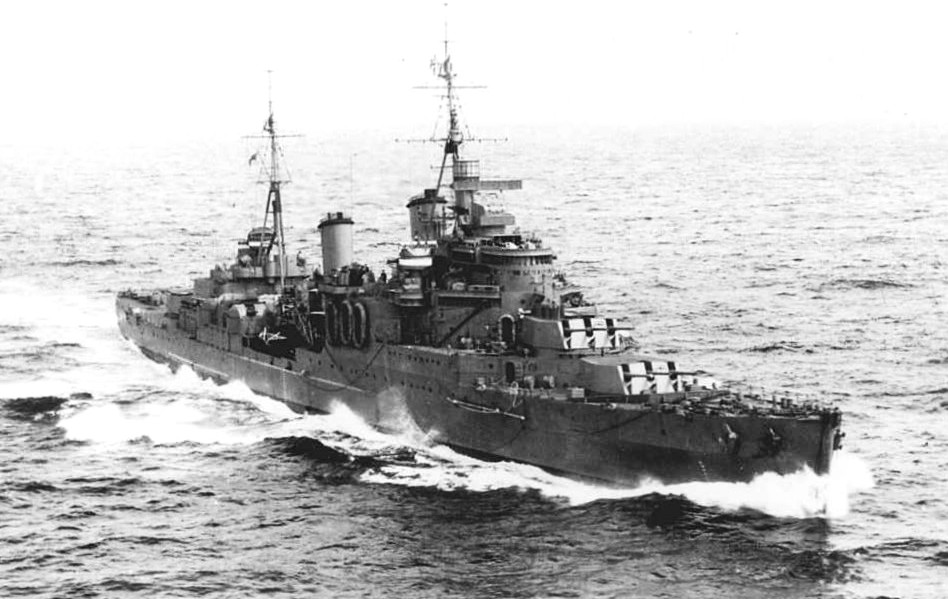
(IWM Photo, FL 4159)
HMS Manchester (C15), 29 May 1942. In September 1939, the cruiser began escorting convoys in the Indian Ocean until she was ordered home two months later. In late December Manchester began conducting patrols in the Norwegian Sea enforcing the blockade of Germany. Beginning in April 1940 the ship played a minor role in the Norwegian Campaign, mostly escorting convoys. She was assigned to anti-invasion duties in May–November in between refits.In November the cruiser was tasked to escort a convoy through the Mediterranean and participated in the Battle of Cape Spartivento. Manchester was refitting during most of early 1941, but began patrolling the southern reaches of the Arctic Ocean in May. The cruiser was detached to escort a convoy to Malta in July and she was badly damaged by an aerial torpedo en route. Repairs were not completed until April 1942 and the ship spent the next several months working up and escorting convoys.
Manchester participated in Operation Pedestal, another Malta convoy, in mid-1942; she was torpedoed by two Italian motor torpedo boats and subsequently scuttled by her crew. Casualties were limited to 10 men killed by the torpedo and 1 who drowned as the crew abandoned ship. Most of the crew were interned by the Vichy French when they drifted ashore. After their return in November, the ship’s leadership was court martialled; the captain and four other officers were convicted for prematurely scuttling their ship. (Wikipedia)
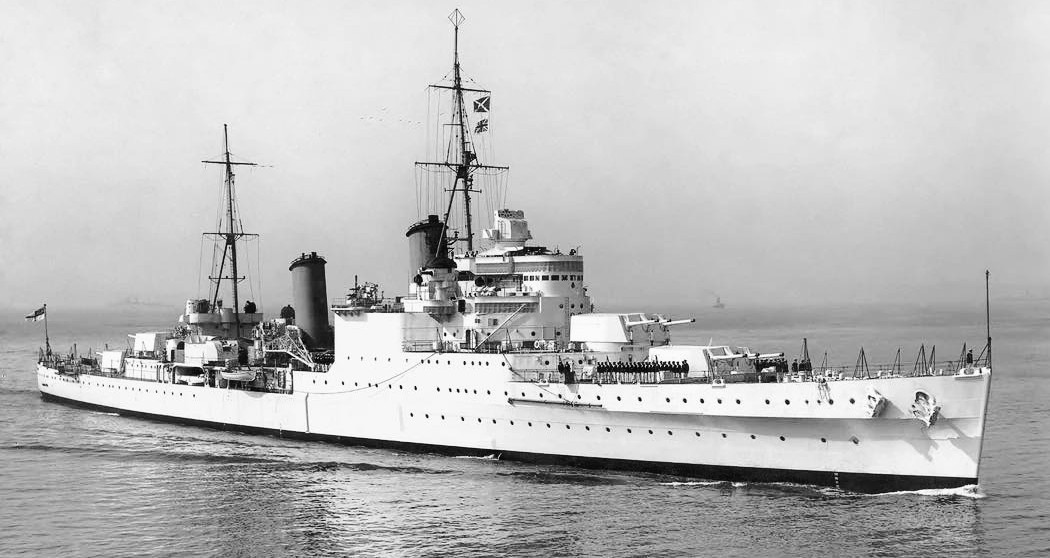
(RN Photo)
HMS Manchester (C15) in 1938 as part of the the 4th Cruiser Squadron in the East Indies. Wright & Logan photo showing Manchester fresh from her builders gliding into Portsmouth Harbour one morning late summer 1938. The Isle of Wight in the background is almost completely obscured by mist.
Edinburgh group
HMS Edinburgh (C16)
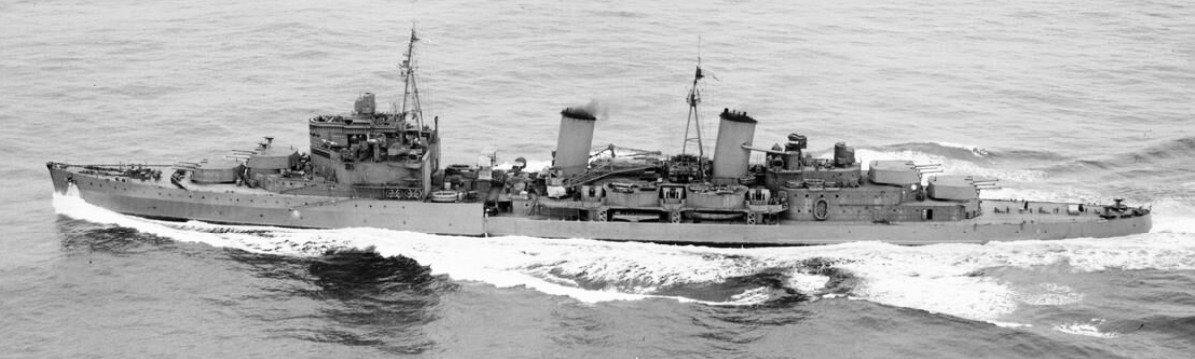
(IWM Photo, A 6160)
HMS Edinburgh (C16), Scapa Flow, October 1941. Edinburgh was launched on 31 March 1938,and after commissioning in July 1939 was immediately attached to the 18thCruiser Squadron at Scapa Flow, in Scotland, as part of the British Home Fleet.For a time, she was assigned to patrol between Iceland and the Faroe Islands, but in 1939, she was transferred to the 2nd Cruiser Squadron, serving with the Humber Force.
However, Edinburgh was still in the Firth of Forth when the Luftwaffe madetheir first raid on the naval bases at Rosyth on 16 October 1939. She sustainedminor damage from the attack, but no direct hits. Between the three shipsdamaged in the raid including Edinburgh, the cruiser Southampton, and destroyerMohawk; sixteen Royal Navy crew died and a further 44 were wounded, although this information was not made public at the time. She left Rosyth on 23 October, on escort duties with the convoys heading to andfrom Narvik, in Norway. When the armed merchant cruiser Rawalpindi was attackedand sunk defending her convoy on 23 November, Edinburgh was among the flotilladetached to search for the German commerce raider, the battleship Scharnhorst,responsible. However, the search was unsuccessful, and Edinburgh returned toescort duties.
On 18 March 1940, she arrived in the Tyne for a lengthy refit which lasteduntil 28 October. After these repairs, she was re-attached to the 18th CruiserSquadron, and on 18 November left Faslane Naval Base, on the Clyde, escortingthe troop convoy WS4B as far as Freetown (now Sierra Leone) before returning toScapa Flow on 12 November. Shortly before Christmas, Edinburgh participated ina hunt for a German surface raider that had been reported as breaking out intothe North Atlantic. The force consisted of the battlecruiser Hood, Edinburgh,and the destroyers Electra, Echo, Escapade, and Cossack. After spending a weekat sea, including Christmas Day, after the report turned out to be false, shereturned to port on New Year’s Eve.
During the winter of 1940, Edinburgh took part in several minor operations withthe Home Fleet. She escorted convoy WS7 to the Middle East, returning to ScapaFlow on 15 April. She supported several mine-laying operations off the Danishcoast, and supported Operation Claymore, the successful Allied raid on theGerman-occupied Lofoten Islands, on 4 May 1941. Edinburgh also played a minor role in the hunt for the German battleshipBismarck in May 1941. She was on patrol in the Bay of Biscay, where sheintercepted the German vessel Lech on 22 May 1941. Edinburgh was sent tointercept Bismarck on her projected course for Brest, and then shadow her, butBismarck never reached that area. On 1 June, she was sent to relieve the Dido-class light cruiser Hermione on theDenmark Strait patrol route. After an uneventful assignment, she was ordered tocover another Middle East-bound convoy, WS 9B, and docked in Gibraltar again inearly July. Later that month, Edinburgh took part in Operation Substance,arriving in Malta on 24 July. The next day, she had a close call when a Germantorpedo bomber attacked her. However, the ship sustained no damage, andcontinued on her course back to the Clyde.
In August 1941, Edinburgh escorted convoy WS10 to Simonstown, South Africa, andlater sailed to Malta once more, this time as part of Operation Halberd,arriving at Malta on 28 September. She returned to Gibraltar shortlyafterwards, departing from there on 1 October 1941, with supplies and prisonersof war aboard, and bound once more for the Clyde. After repairs at Faslane, sherejoined the Home Fleet on Iceland Forces Patrol during November. In December 1941, she provided cover to Arctic convoys bringing aid to theSoviet Union. From January 1942, she refitted in the Tyne, until 4 March, whenshe was once again placed on the Iceland-Faroes patrol. She escorted twoconvoys to the Soviet Union (QP4 and PQ13), returning to Scapa Flow on 28March. On 6 April, she left Scapa Flow to escort convoy PQ 14 to Murmansk. Ofthe 24 ships in PQ14, 16 were forced by unseasonal ice and bad weather toreturn to Iceland, and another was sunk by a U-boat. Edinburgh and theremaining seven vessels arrived in Murmansk on 19 April.
Edinburgh was the flagship of Rear-Admiral Stuart Bonham Carter, commanding theescort of returning Convoy QP 11: 17 ships which left Murmansk on 28 April1942.[3] On 30 April, the German submarine U-456 fired a torpedo into herstarboard side, hitting her just forward of the space in which the gold she wascarrying as part of the Soviet payment for war materials was stored.[4] TheU-boat, on her fifth patrol, had been alerted to the convoy by German aerialreconnaissance.[5] The ship began to list heavily, but the crew reacted quicklyand competently by closing watertight bulkheads, which prevented the ship fromsinking immediately. Soon after, U-456 put a second torpedo into Edinburgh’sstern, wrecking her steering equipment and crippling her. In anticipation ofEdinburgh’s sinking, Stoker Francis James Dawson recovered her flag, laterreturning it to the Leith Museum in Edinburgh.
Edinburgh was taken in tow, and tried to return to Murmansk with destroyersForesight and Forester, and four Halcyon-class minesweepers; Gossamer, Harrier,Niger, and Hussar. Along the way she was hounded constantly by German torpedobombers. On 2 May, as she progressed at a snail’s pace under tow and her ownpower, she was attacked off Bear Island by three large German destroyers,Hermann Schoemann, Z24 and Z25.
Edinburgh cast off the tow, so that she started to sail in circles. Althoughher guns were in disarray, she fired on the attacking German ships. Edinburgh’ssecond salvo hit Hermann Schoemann, leaving her in a sinking condition.[6]Edinburgh’s escorts drove off Z24 and Z25, but she was struck by a torpedo thathad missed another ship.[7] The torpedo struck Edinburgh amidships, exactlyopposite the first torpedo hit from U-456. She was now held together only bythe deck plating and keel, which was likely to fail at any time, so the crewabandoned ship. Gossamer took off 440 men and Harrier about 400. Two officersand 56 ratings were killed in the attacks. The vigorous action of theminesweepers led the Germans to mistake the power of the force they were facing. Harrier tried to scuttle Edinburgh with 4 inch gunfire, but 20 shots did notsink her. Depth charges dropped alongside also failed. Finally, Foresight sank Edinburgh with her last torpedo (the others having been expended against theGerman destroyers), the torpedo being fired by David Loram (later to becomeVice-Admiral Sir David Loram).
On the return journey, Edinburgh was carrying 4.5 long tons (4,570 kg) of goldbullion back to the UK. The consignment, which had a value of about £1.5million sterling in 1942 (£88 million in 2023 without taking into account theincrease in the value of gold), was a partial payment by the USSR for thesupplies of war material and military equipment from the Western Allies.[8] Intotal the ship had 465 gold ingots in 93 wooden boxes stored in the bomb-roomjust aft of where the first torpedo – fired from U-456 – struck. On 15 September 1981, diver John Rossier found the first bar of gold. By 7October, when bad weather finally forced the cessation of the diving operation,431 of 465 ingots had been recovered.[9] At the time the haul was worth inexcess of £40,000,000 sterling (in 2020 worth around £140,000,000). Thisbullion recovery project created a world record in deep diving which stands tothis day.[citation needed][dubious – discuss][clarification needed] At the timethe salvage set a new depth record for sustained commercial saturation diving. A further 29 bars were brought up in 1986 by the Consortium, bringing the totalto 460, leaving five unaccounted for. The 1981 salvage of the gold on HMS Edinburgh at 256m was the first commercial use of helium reclaim systems. (Wikipedia)
HMS Belfast (C35)
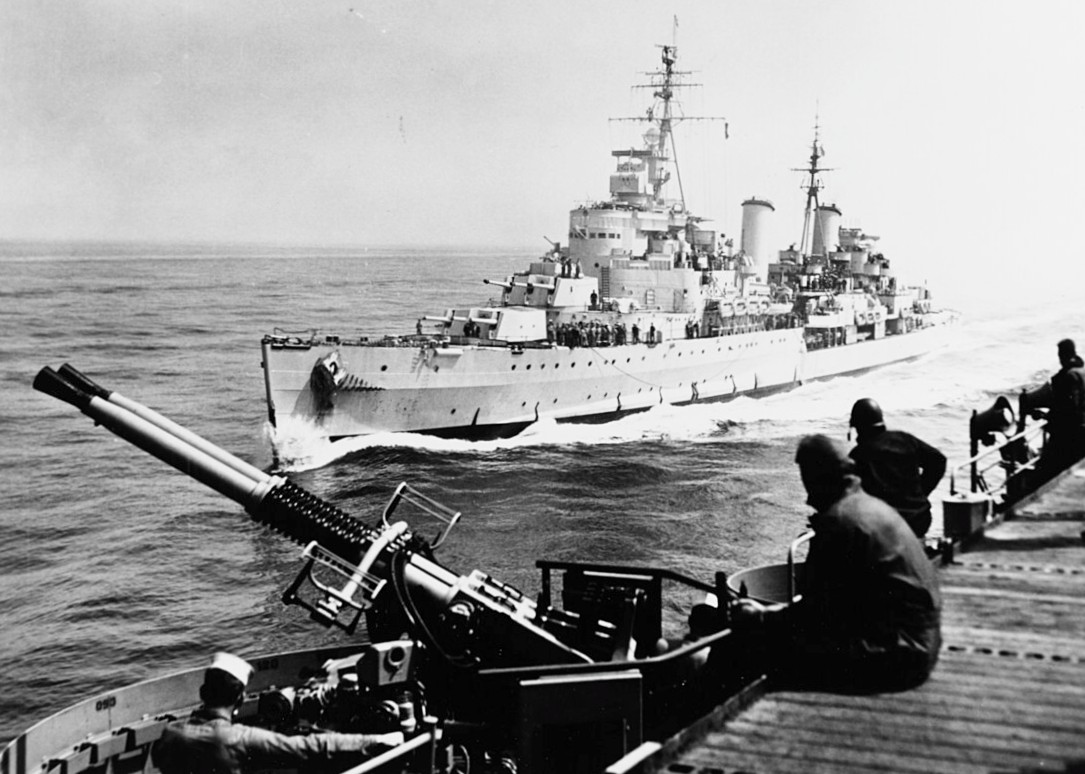
(USN Photo)
HMS Belfast (C35) coming alongside the U.S. Navy light ciarcraft carrier USS Bataan (CVL-29) off the coast of Korea on 27 May 1952. Commissioned in early August 1939 shortly before the outbreak of the Second World War, Belfast was initially part of the British naval blockade against Germany. In November 1939, Belfast triggered a German mine and, in spite of fears that she would be scrapped, spent more than two years undergoing extensive repairs. Belfast returned to action in November 1942 with improved firepower, radar equipment and armour. She saw action escorting Arctic convoys to the Soviet Union during 1943 and in December 1943 played an important role in the Battle of North Cape, assisting in the destruction of the German warship Scharnhorst. In June 1944, Belfast took part in Operation Overlord supporting the Normandy landings. In June 1945, she was redeployed to the Far East to join the British Pacific Fleet, arriving shortly before the end of the Second World War. Belfast saw further combat action in 1950–52 during the Korean War and underwent an extensive modernisation between 1956 and 1959. A number of further overseas commissions followed before she entered reserve in 1963.
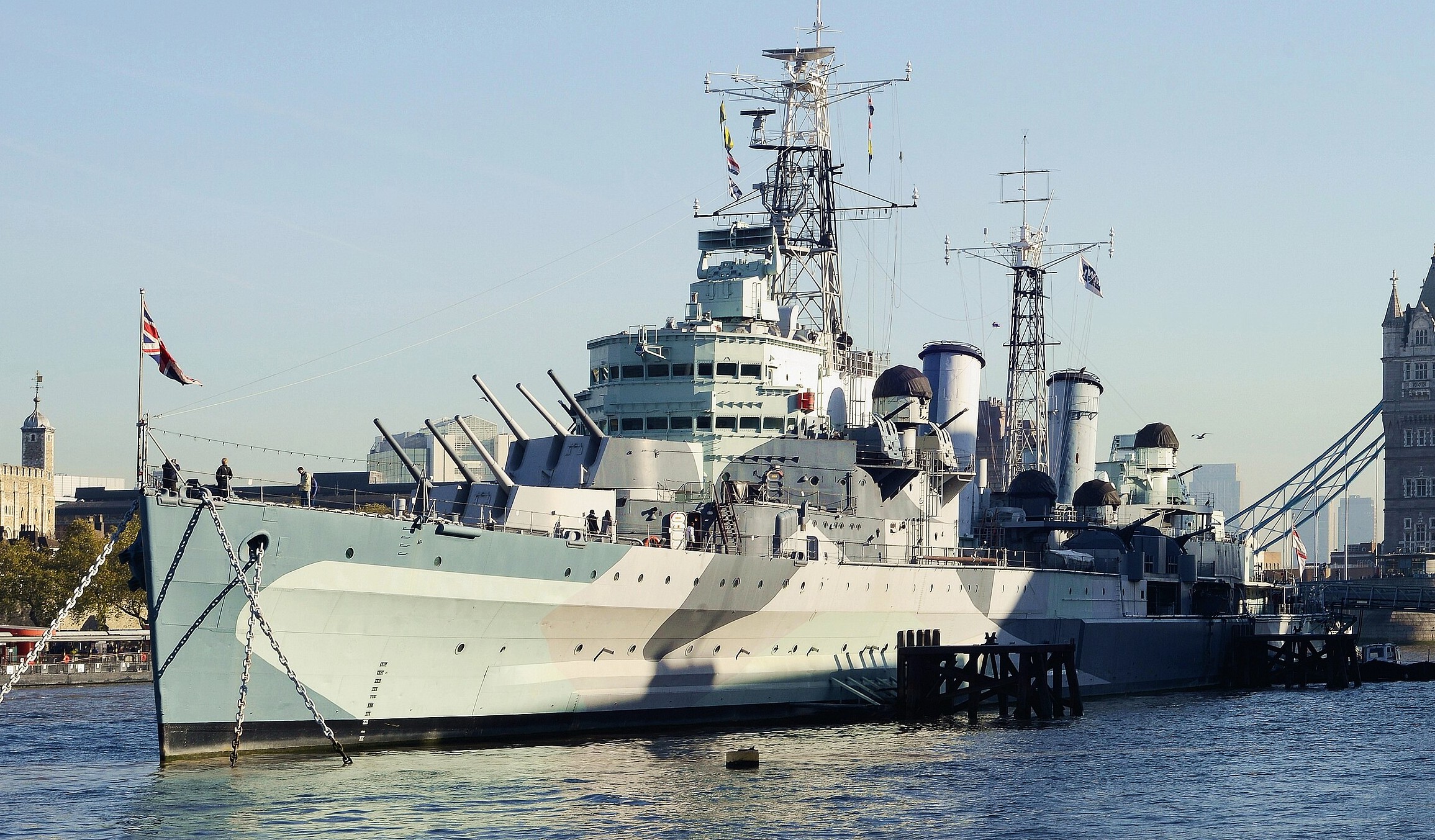
In 1967, efforts were initiated to avert Belfast’s expected scrapping and to preserve her as a museum ship. A joint committee of the Imperial War Museum, the National Maritime Museum and the Ministry of Defence was established and then reported in June 1968 that preservation was practical. In 1971, however, the government decided against preservation, prompting the formation of the private HMS Belfast Trust to campaign for her preservation. The efforts of the Trust were successful and the government transferred the ship to the Trust in July 1971. Brought to London, she was moored on the River Thames near Tower Bridge in the Pool of London. Opened to the public in October 1971, Belfast became a branch of the Imperial War Museum in 1978. Since 1973 she has been home to the City of London Sea Cadets who meet on board twice a week.[8] A popular tourist attraction, Belfast received over 327,000 visitors in 2019.[9] As a branch of a national museum and part of the National Historic Fleet, Belfast is supported by the Department for Culture, Media and Sport, admissions income and the museum’s commercial activities. (Wikipedia)
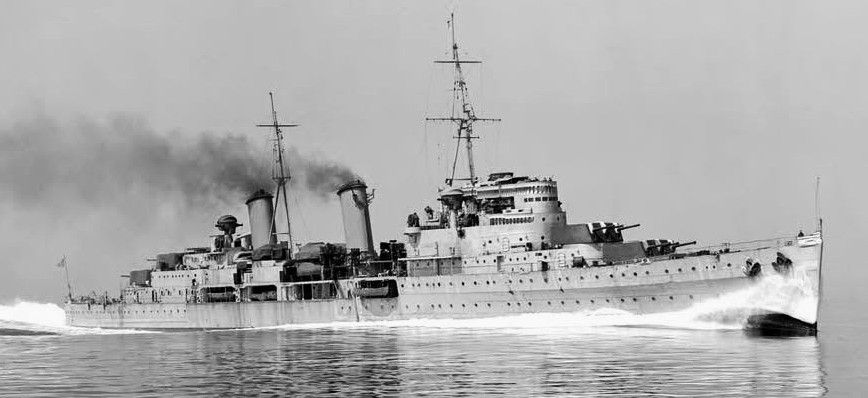
(Royal Navy Photo)
HMS Belfast on her acceptance speed trials in the Clyde estuary, Scotland, in 1939, shortly before being commissioned. The ship achieved over 32 knots during her trials. Following commissioning August 5th 1939, she conducted various working-up exercises, including speed and gunnery, at Scapa Flow.
(RN Photo)
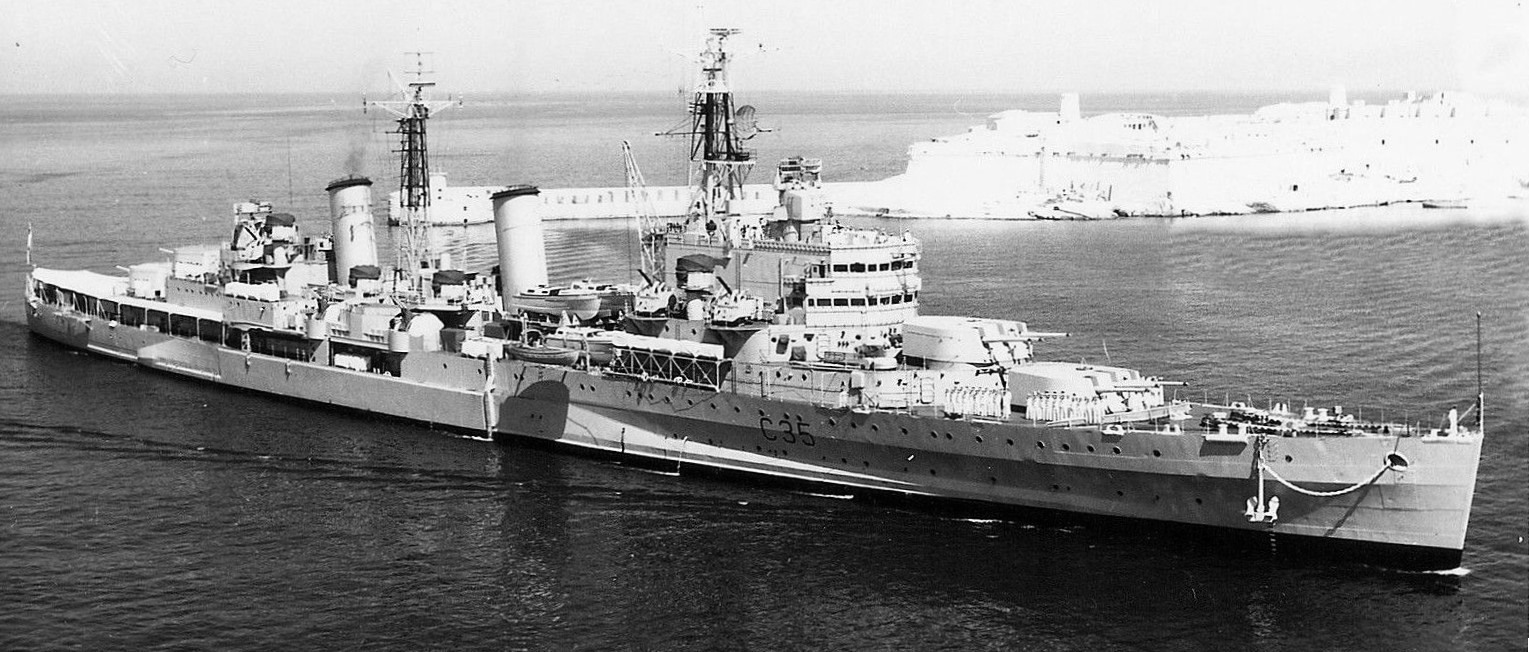
HMS Belfast (C35) entering Grand Harbour, Valletta, Malta.
(IWM Photo)
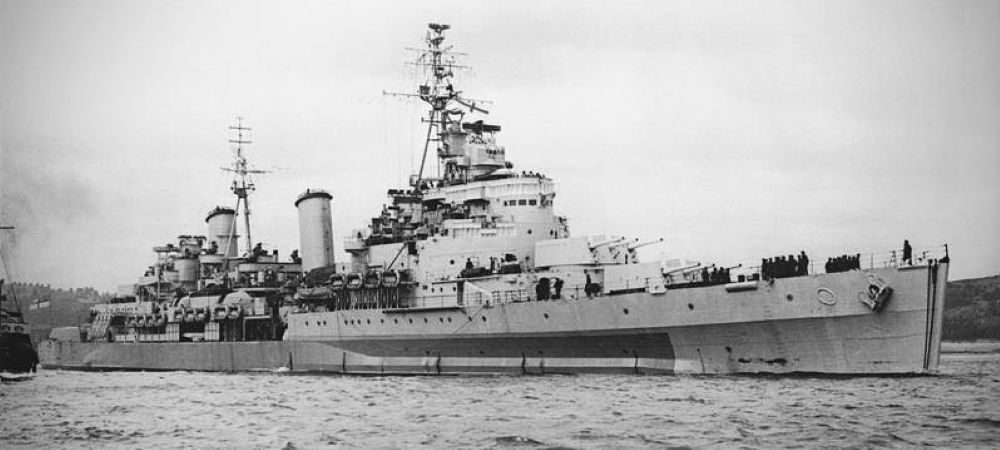
HMS Belfast (C35( leaving the Tyne after a refit to prepare her for service in the Far East in 1945. From August 1944 until April 1945 Belfast underwent a refit to prepare for service against Japan in the Far East which improved her accommodation for tropical conditions, and updated her anti-aircraft armament and fire control in order to counter expected kamikaze attacks by Japanese aircraft. Belfast then mounted thirty-six 2-pounder guns in two eight-gun mounts, four quadruple mounts and four single mounts. She also mounted fourteen 20 mm Oerlikons. Her two aftmost 4-inch mountings were removed and the remainder fitted with Remote Power Control. Her empty hangars were converted to crew accommodation and her aircraft catapult was removed.
(Alvesgaspar Photo)
HMS Belfast (C35), London, 2013.
All comments are subject to our Comment Policy. You must be at least 18 years old to comment.
See a comment that violates our guidelines? Report it here.