
Royal Navy County class Cruisers: HMS Norfolk (78), HMS Dorsetshire (40), HMS Charybdis (88).
The County class was a class of heavy cruisers built for the Royal Navy and Royal Australian Navy in the years between the First and Second World Wars. They were the first ‘post-war’ cruisers constructed for the Royal Navy and were designed within the limits of the Washington Naval Treaty of 1922. Such ships, with a limit of 10,000 tons standard displacement and 8-inch calibre main guns may be referred to as “treaty cruisers” (the term “heavy cruiser” was not defined until the London Naval Treaty of 1930. The thirteen Counties were built in the Kent, London and Norfolk sub-classes. They were the only 10,000-ton 8-inch gun, or “A”, cruisers that the Royal Navy built. The Counties are remembered for their distinctive three-funnel layout and service in all the major naval theatres of the Second World War. (Wikipedia)
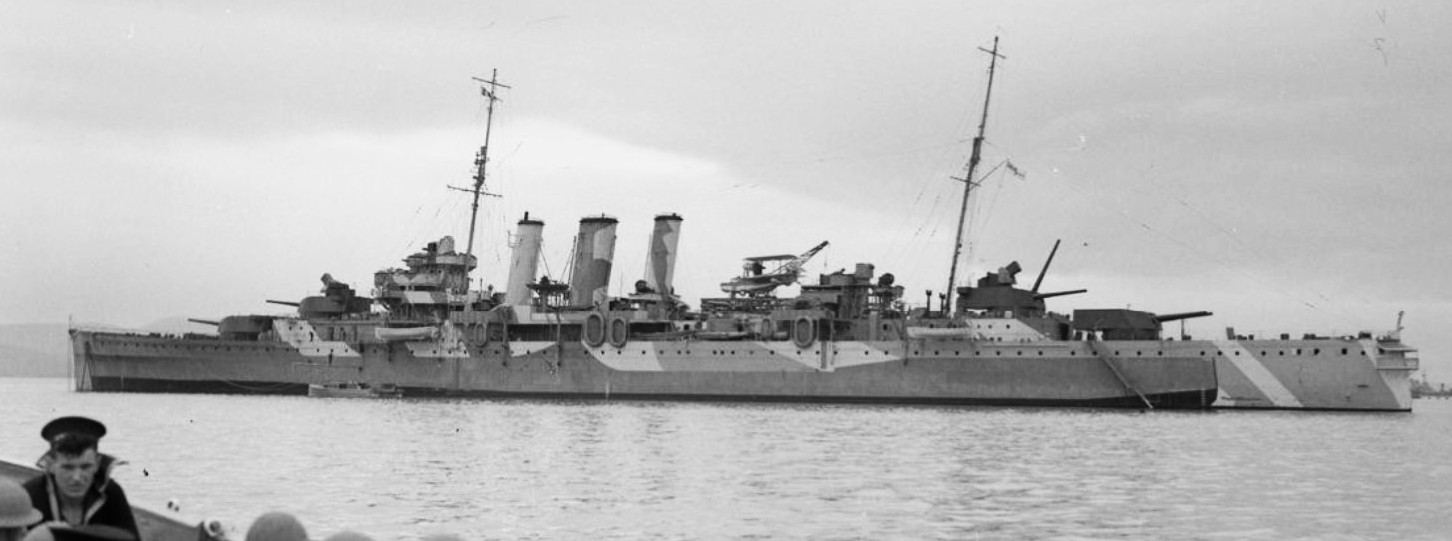
HMS Norfolk (78)
(IWM Photo)
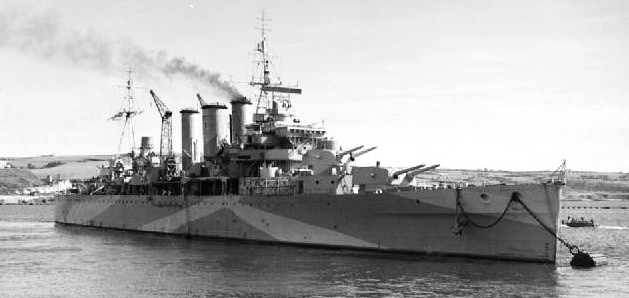
HMS Norfolk was a County-class heavy cruiser of the Royal Navy. The ship was the Lead ship of the Norfolk-subclass of which only two were built: Norfolk and Dorsetshire. She served throughout the Second World War. During 1939-41 she operated in the Atlantic against German raiders and blockade runners. In March 1940 she was damaged by a German dive bomber in the anchorage of Scapa Flow.
In May 1941 Norfolk and her sister ship Suffolk detected the German battleship Bismarck and the heavy cruiser Prinz Eugen while on patrol in Denmark Strait. The two cruisers guided the battleship Prince of Wales and the battlecruiser Hood to the German ships, but in the Battle of the Denmark Strait on 24 May, Hood was sunk and both Prince of Wales and Bismarck were damaged. Norfolk and Suffolk kept contact with the German ships and guided the Home Fleet to the scene. Norfolk directed a torpedo bomber attack from Victorious to the Bismarck, but these aircraft could only score one insignificant hit on Bismarck. Finally Bismarck shook off the shadowing Norfolk, Suffolk and Prince of Wales, and headed to port in France. When Bismarck was found back on 26 May, Norfolk was one of the few ships left with enough fuel, to continue the pursuit of Bismarck. In the evening of 26 May, torpedo bombers from the aircraft carrier Ark Royal rendered Bismarck steerless, allowing her persuers to catch up. In the morning of 27 May, the battleships Rodney and King George V, Norfolk and the heavy cruiser Dorsetshire destroyed the Bismarck with gunfire and torpedoes.
From 1942 onwards she operated in the Arctic, usually as part of the close covering force of Arctic convoys to Russia, where she was involved in the sinking of the German battleship Scharnhorst during the Battle of the North Cape. (Wikipedia)
(IWM Photo)
HMS Norfolk.
(RN Photo)
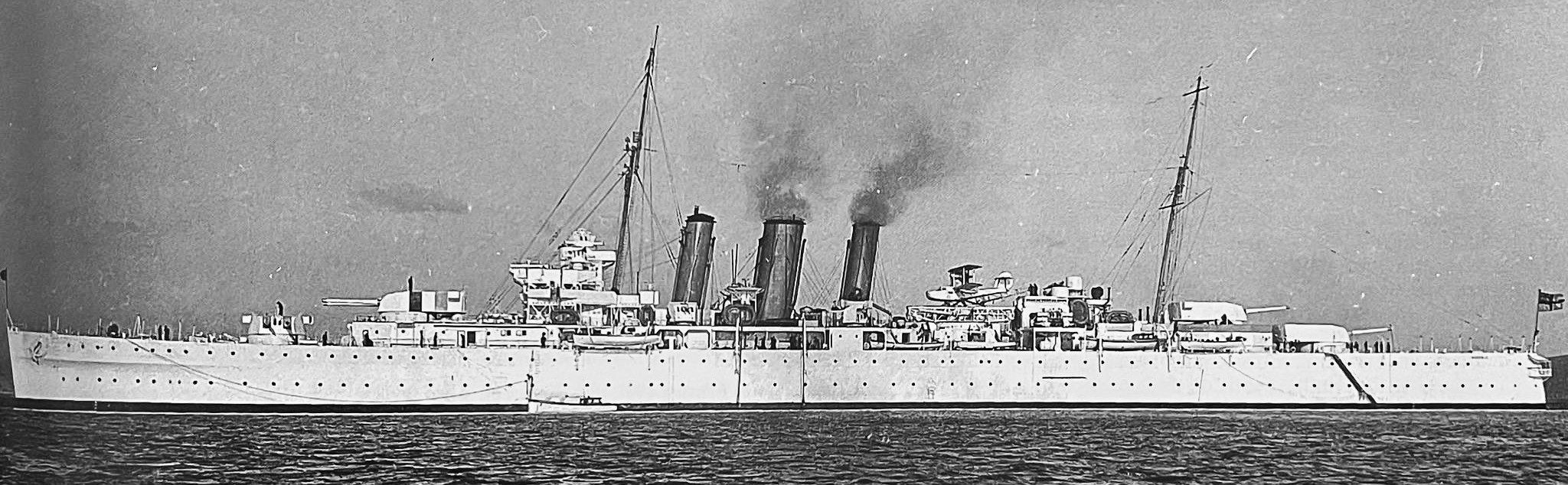
HMS Norfolk in her East Indies colorers in 1937.
HMS Dorsetshire (40)
(IWM Photo, Q 83436)
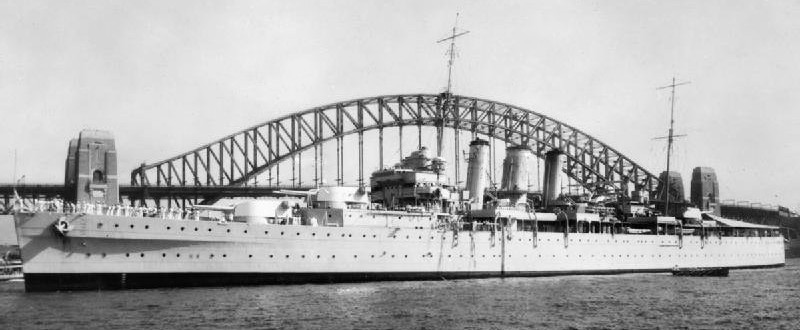
HMS Dorsetshire (40)
HMS Dorsetshire (pennant number 40) was a County-class heavy cruiser of the British Royal Navy, named after the English county, now usually known as Dorset. The ship was a member of the Norfolk sub-class, of which Norfolk was the only other unit; the County class comprised a further eleven ships in two other sub-classes. Dorsetshire was built at the Portsmouth Dockyard; her keel was laid in September 1927, she was launched in January 1929, and was completed in September 1930. Dorsetshire was armed with a main battery of eight 8 in (203 mm) guns, and had a top speed of 31.5 knots (58.3 km/h; 36.2 mph).
Dorsetshire served initially in the Atlantic Fleet in the early 1930s, before moving to become the flagship of the Commander-in-Chief, Africa in 1933, and then to the China Station in late 1935. She remained there until the outbreak of the Second World War in September 1939, when she was transferred to the South Atlantic. There, she reinforced the search for the German heavy cruiser Admiral Graf Spee. In late May 1941, Dorsetshire took part in the final engagement with the battleship Bismarck, which ended when Dorsetshire was ordered to close and torpedo the crippled German battleship. She joined searches for the heavy cruiser Admiral Hipper in August and the auxiliary cruiser Atlantis in November.
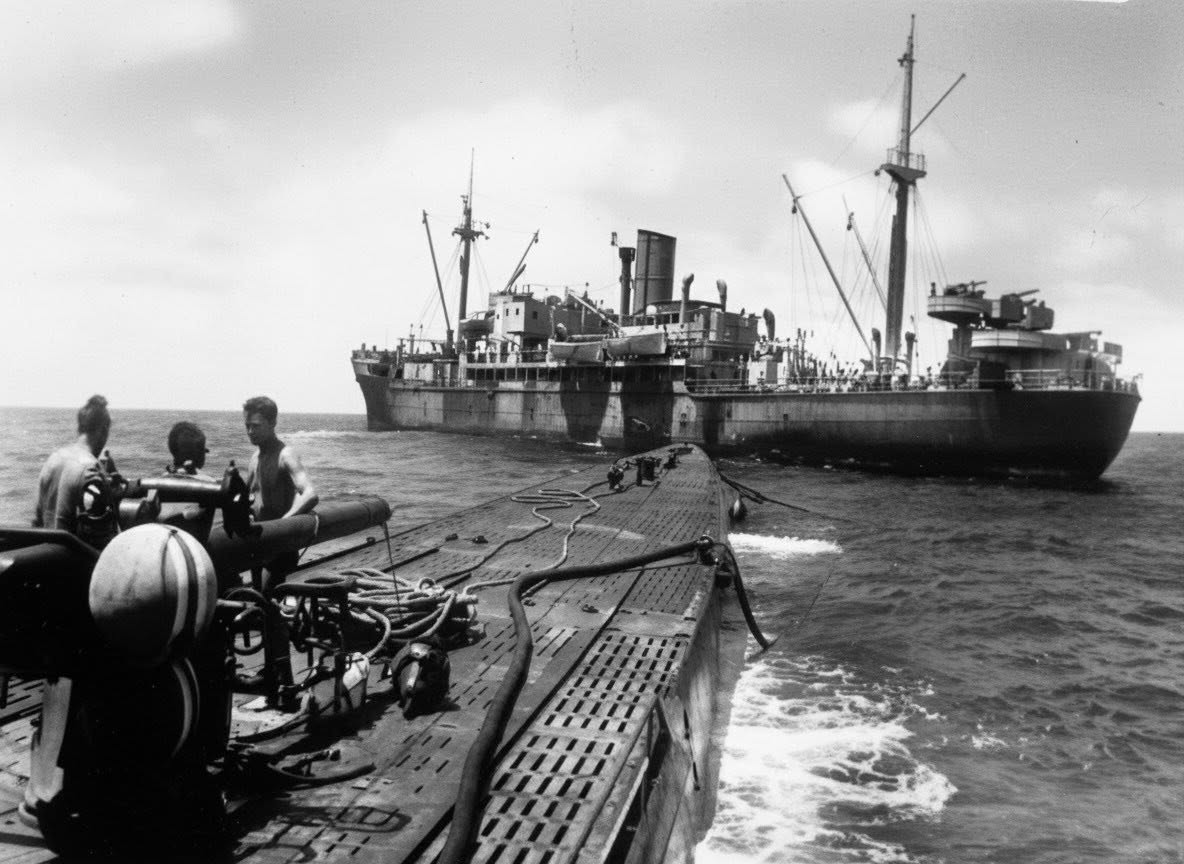
(Kriegsmarine Photo)
On 1 Dec 1941 based on Ultra intelligence HMS Dorsetshire under the command of Captain Augustus Willington Shelton Agar VC, DSO, RN intercepted the German supply ship Python. At the time Python was refuelling a pair of U-boats, UA and U-68, in the South Atlantic. On sighting the Dorsetshire the two U-Boats crash dived while Python tried to flee. UA under the command of Korvettenkapitän Hans Eckermann fired five torpedoes at the Dorsetshire but all missed her due to her evasive manoeuvres. Dorsetshire fired a salvo to stop Python and the latter’s crew abandoned the ship, after detonating scuttling charges. Dorsetshire left the Germans in their boats, since the U-Boats still presented too much of a threat for the Dorsetshire to pick up the Germans. The loss of the Python and other supply ships in the June of 1941 caused a major set back to U-Boat operations in the South Atlantic. (Bill Cox)
In March 1942, Dorsetshire was transferred to the Eastern Fleet to support British forces in the recently opened Pacific Theatre of the war. At the end of the month, the Japanese fast carrier task force, the Kido Butai, launched the Indian Ocean raid. On 5 April, Japanese aircraft spotted Dorsetshire and her sister Cornwall while en route to Colombo; a force of dive bombers then attacked the two ships and sank them. More than 1,100 men were rescued the next day, out of a combined crew of over 1,500. (Wikipedia)
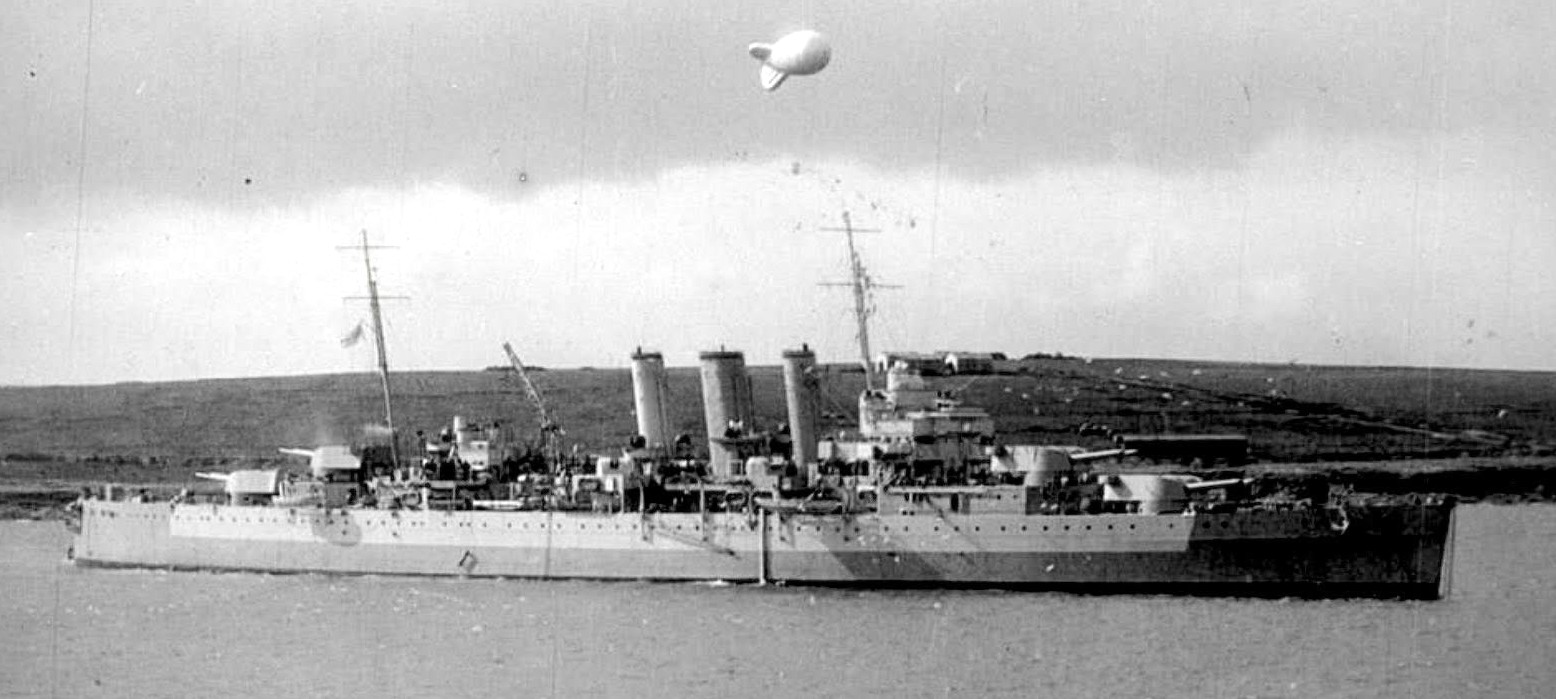
(RN Photo)
HMS Dorsetshire (40) at anchor at Scapa Flow , August 1941.
HMS Charybdis (88)
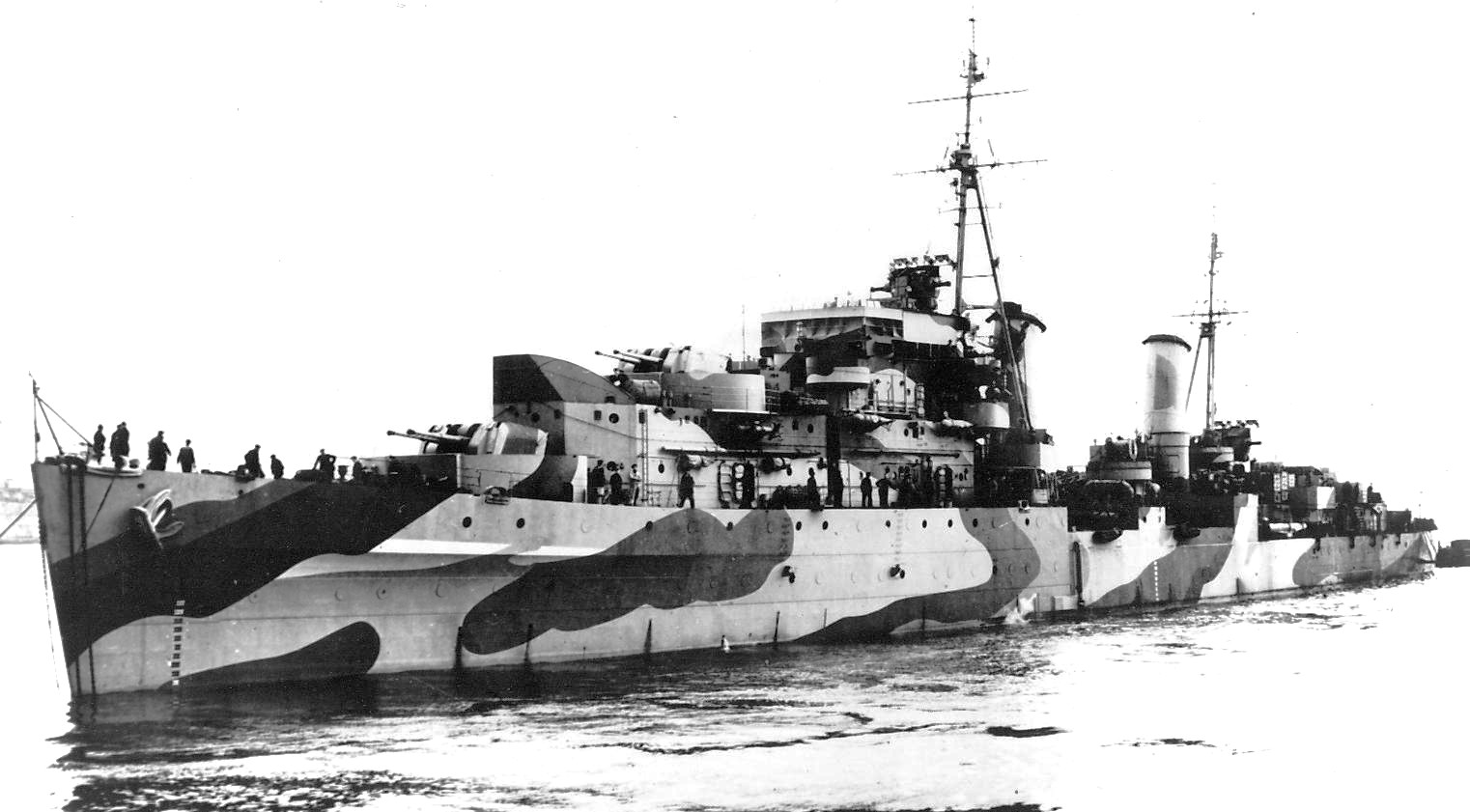
RN Photo)
HMS Charybdis (88) was a Dido-class cruiser built for the Royal Navy during the Second World War and was sunk with heavy loss of life by German torpedo boats in an action in the English Channel in October 1943.
In late 1943, the British authorities were aware of the approach of the German blockade runner Münsterland, which was carrying an important cargo of latex and strategic metals. The Germans had a well-rehearsed procedure for escorting such vessels. The British reacted by executing “Operation Tunnel”, a standard operation whereby available ships would attempt to intercept. Of the planning of this operation Lieutenant-Commander Roger Hill voiced his reservations to senior staff, but his advice was not heeded. Charybdis was assigned to the operation on 20 October, and on 22 October the British force put to sea. With Charybdis were the fleet destroyers HMS Grenville and Rocket, and four Hunt-class destroyers: Limbourne, Wensleydale, Talybont and Stevenstone.[4] Münsterland’s escorts consisted of five Type 39 torpedo boats of the 4th Torpedo Boat Flotilla, commanded by Franz Kohlauf.
Charybdis picked up the convoy on her radar at a range of 7 nautical miles (13 km; 8.1 mi), but did not intercept radio transmissions, Limbourne heard radio transmissions but could not pick up the ships on radar as Charybdis was blocking her view. At 1:38am the German torpedo boat T23, under the command of Friedrich-Karl Paul, spotted Charybdis, which was hit on the port side by two torpedoes out of a salvo of six fired by T23 and T27.[2][9]: 129 Limbourne was also hit during this action and was later scuttled by HMS Rocket. The German force escaped unharmed. Charybdis sank within half an hour, in position 48°59′N 3°39′W, with the loss of over 400 men including her captain George Voelcker. Four officers and 103 ratings survived.[4][8] Münsterland was eventually forced ashore and destroyed west of Cap Blanc-Nez on 21 January 1944 by fire from British coastal artillery after she ran aground. (Wikipedia)
All comments are subject to our Comment Policy. You must be at least 18 years old to comment.
See a comment that violates our guidelines? Report it here.