
Royal Navy County class Cruisers: London class: HMS Devonshire (39), HMS London (69), HMAS Shropshire (73), HMS Sussex (96)
HMS Norfolk (78), HMS Dorsetshire (40), HMS Charybdis (88) (listed on a separate page on this website)
The County class was a class of heavy cruisers built for the Royal Navy and Royal Australian Navy in the years between the First and Second World Wars. They were the first ‘post-war’ cruisers constructed for the Royal Navy and were designed within the limits of the Washington Naval Treaty of 1922. Such ships, with a limit of 10,000 tons standard displacement and 8-inch calibre main guns may be referred to as “treaty cruisers” (the term “heavy cruiser” was not defined until the London Naval Treaty of 1930. The thirteen Counties were built in the Kent, London and Norfolk sub-classes. They were the only 10,000-ton 8-inch gun, or “A”, cruisers that the Royal Navy built. The Counties are remembered for their distinctive three-funnel layout and service in all the major naval theatres of the Second World War. (Wikipedia)
London class
HMS Devonshire (39)
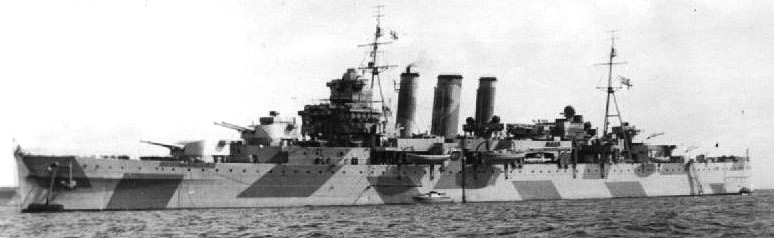
(IWM Photo, FL 5884)
HMS Devonshire (39), was a County-class heavy cruiser of the London sub-class built for the Royal Navy in the late 1920s. The ship spent most of her pre-Second World War career assigned to the Mediterranean Fleet aside from a brief tour with the China Station. She spent the first two months of the Second World War in the Mediterranean until she was transferred to the Home Fleet and became flagship of a cruiser squadron. Devonshire took part in the Norwegian campaign in mid 1940 and evacuated much of the Norwegian government in June. Several months later, she participated in the Battle of Dakar, a failed attempt to seize the Vichy French colony of Senegal in September. The ship remained in the South Atlantic afterwards and supported Free French efforts to take control of French Equatorial Africa in addition to searching for German commerce raiders.
Devonshire returned home in early 1941 and briefly rejoined the Home Fleet, during which time she escorted several aircraft carriers as they attacked German forces in Norway and Finland and covered the first convoy to the Soviet Union. Shortly afterwards, the ship was sent to the South Atlantic where she sank the auxiliary cruiser Atlantis. Devonshire was then assigned to the Eastern Fleet in the Indian Ocean and supported the Allied invasion of Madagascar in mid-1942. She then spent the next year escorting convoys before returning home to begin a lengthy refit. After it was completed in early 1944, the ship escorted various aircraft carriers for the rest of the war as they attacked targets in Norway.After the German surrender in May 1945, she sailed to Norway and escorted two surrendered German cruisers from Denmark to the UK. Devonshire then began ferrying British troops home from Australia for the rest of the year. In 1947, the ship was converted into a training ship for naval cadets and served until she was sold for scrap in 1954. (Wikipedia)
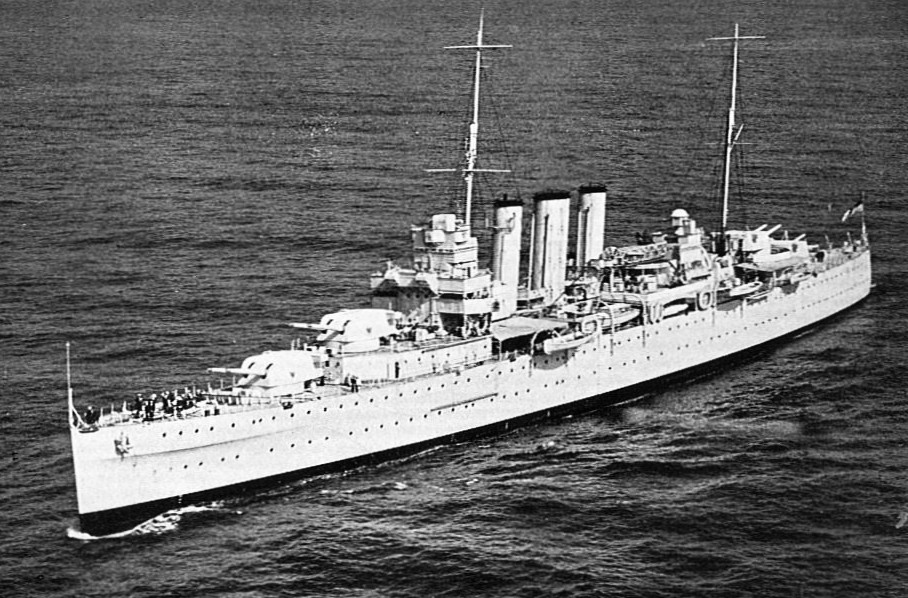
(RN Photo)
HMS Devonshire (39), 1936.
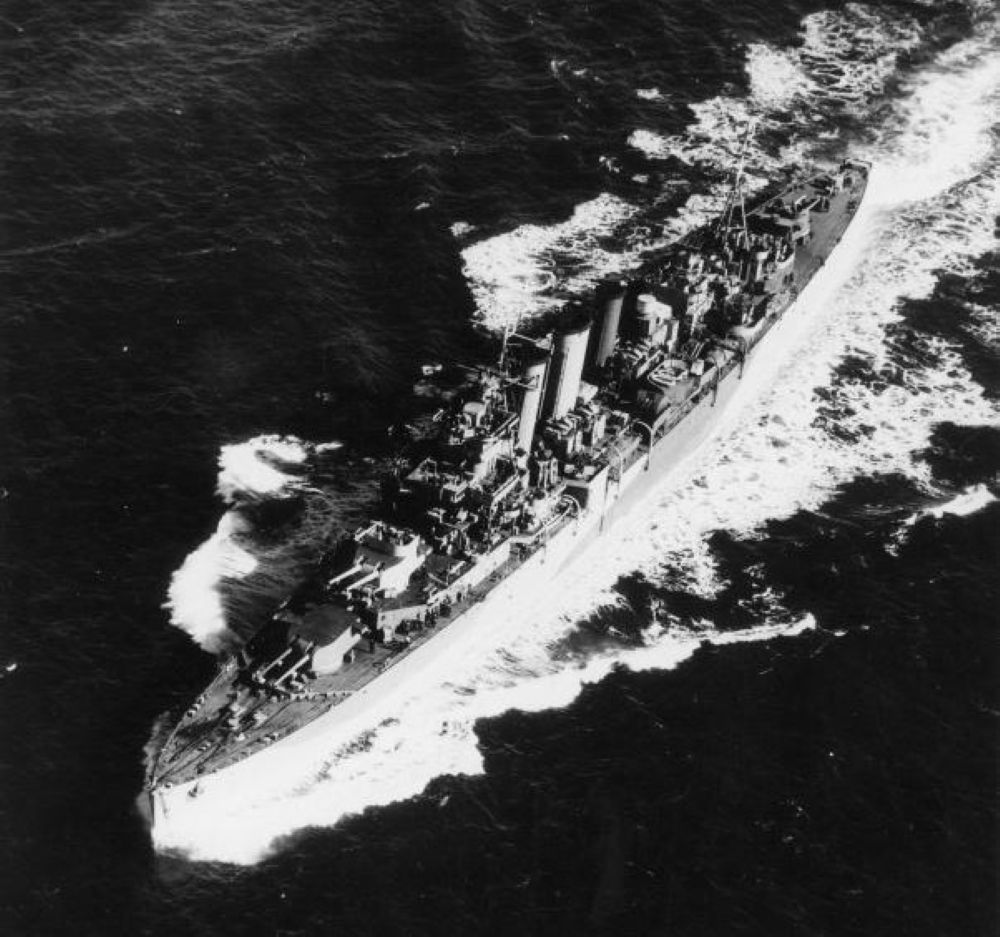
(IWM Photo, FL5895)
HMS Devonshire (39), underway after her refit in 1944.
HMS London (69)
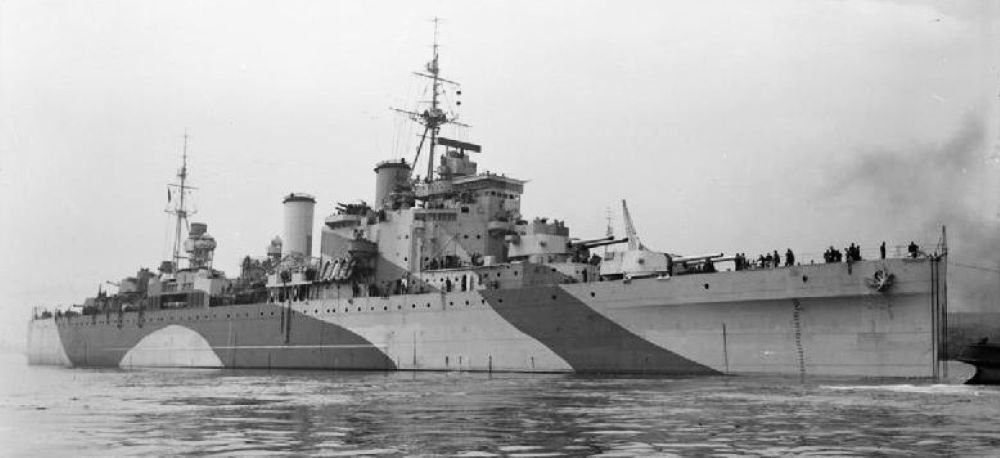
(IWM Photo, FL 2968)
HMS London (69).
HMS London (C69), was a member of the second group of the County-class heavy cruisers of the RoyalNavy. She and her sisters; Sussex, Shropshire, and Devonshire differed from theearlier group of Counties (known as the Kent class) by having a smaller forwardsuperstructure, which was positioned slightly further aft, and little armourplating. HMS London’s career spanned over twenty years. London was involved in the pursuit of the German battleship Bismarck in May1941. During this time at sea, many cracks appeared in her upper deck and hull,due to the weight of the new superstructure causing stresses. She entered acommercial shipyard on the River Tyne in October 1941 and was under repairuntil February 1942. London then spent from March 1942 to November 1942 in the North Atlantic onconvoy protection duties in the company of several US Navy warships.
This phase of operations in the heavy North Atlantic seas caused hull cracks and popped rivets in her lower hull, necessitating the ship again going into the dry-dock in December 1942 for strengthening of the hull and for the fitting of newer and more refined radar, and of more light anti-aircraft guns. This refit rectified her hull and was completed in May 1943, with the ship ready for sea in July. After sea trials and loading of ammunition, she was assigned to operate off the South African coast and then to the Eastern Fleet for the rest of the war.
After the Second World War, and being the Royal Navy’s only modernized 8-inchgun cruiser, London was refitted for further service in early 1946 to let herserve in the postwar fleet. Following the refit, she sailed for the far east in1946 and served there for the next three years on the China Station.
In the spring of 1949, the frigate Amethyst became trapped by advancing Communist Chinese forces up the Yangtze River. London sailed up the river as a show of strength in an attempt to help free the frigate. The Communist forces were not intimidated and took the cruiser under fire. London returned fire with her 8-inch and 4-inch guns, firing hundreds of rounds, but was hit several times. Her two forward 8-inch turrets and “X” turret aft were damaged and rendered inoperable, and her bridge sustained several hits. London retreated down river and returned to Hong Kong for repairs which lasted until the end of July.
London remained in Chinese waters until August 1949, when she was relieved by HMS Kenya, and she returned to the UK in the autumn of 1949. London was surveyed to determine if an extensive repair and refit for further service was feasible, but the condition of her machinery (dating back to 1928 and not replaced during her rebuild in the 1930s), as well as the large crew she required made her too expensive a proposition, given Britain’s post-war financial difficulties. She was retired to reserve in the River Fal until sold for scrapping in 1950. (Wikipedia)
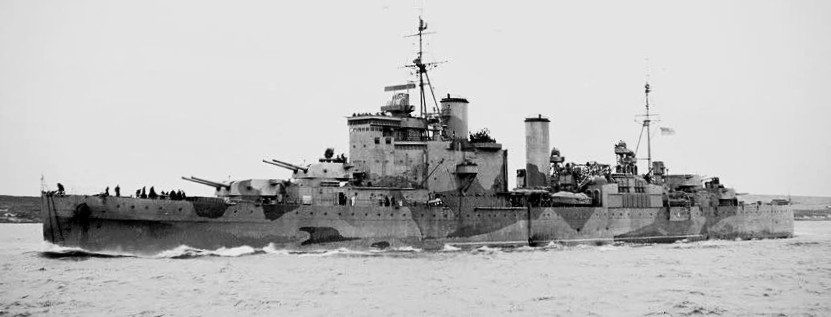
(RN Photo)
HMS London (69) underway at Scapa Flow.
HMAS Shropshire (73)
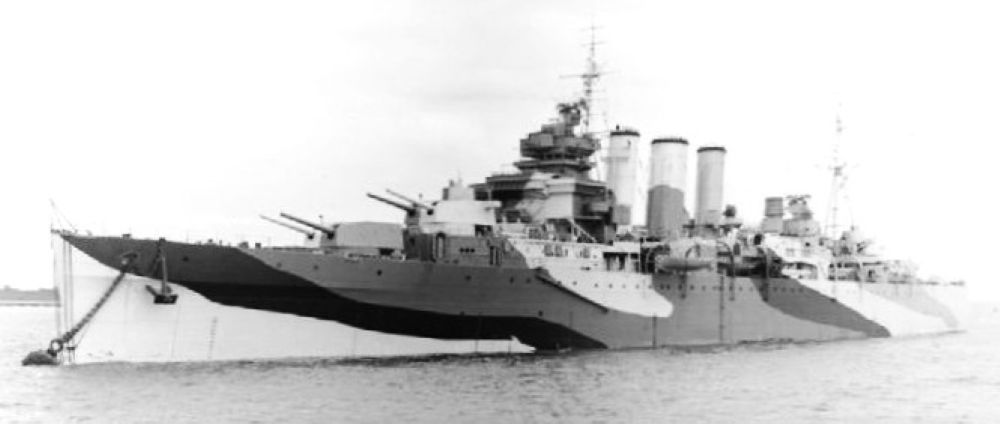
(IWM Photo, FL 5928)
HMAS Shropshire (73)
HMS Shropshire (73) was a Royal Navy (RN) heavycruiser of the London sub-class of County-class cruisers. She is the only warship to have been named after Shropshire, England. Completed in 1929, Shropshire served with the RN until 1942, when she was transferred to the Royal Australian Navy (RAN) following the loss of sister ship HMAS Canberra. Commissioned as HMAS Shropshire, the ship remained in RAN service until 1949,and was sold for scrap in 1954.
After post-commissioning workups, Shropshire was assigned to the 1st Cruiser Squadron of the British Mediterranean Fleet in November 1929. During 1935 and 1936, the cruiser was involved in the British response to the Abyssinia Crisis. Shropshire was also present for the Spanish Civil War, and between 22 August and 16 September 1936, supported the evacuation of refugees from Barcelona. She remained in the Mediterranean (apart from returning to theUnited Kingdom for refits) until the outbreak of the Second World War in September 1939, at which point the cruiser was reassigned to the South Atlanticfor trade protection patrols.
On 9 December 1939, Shropshire intercepted the German merchant Adolf Leonhardt,which was scuttled by her own crew. The cruiser returned to Britain for a refit in early 1940, before proceeding to the Indian Ocean, where she was employed on convoy cover duties between Cape Town-Durban-Mombassa and Aden. She also participated in the campaign against Italian Somaliland during 1941, bombardingboth Mogadishu and Kismayu during the advance of the South African Army from Kenya to Abyssinia, and sinking the Italian vessel Pensilvania off Mogadishu on 13 February. She remained in the South Atlantic, undergoing a refit at Simon’s Town between March and June 1941, then came home in October 1941 for a further major refit at Chatham between October 1941 and March 1942 before returning to the South Atlantic until the end of theyear, when she was recalled to Chatham prior to transfer to the RAN. The cruiser earned the RN battle honours “Atlantic 1941” and “Arctic 1941” for her wartime service.
HMS Shropshire underwent refit at Chatham from December 1942 until 20 June 1943. Sources differ on the date of commissioning: although the commissioning ceremony was performed on 20 April, Captain John Augustine Collins successfully argued to have the ship recognised administratively as a commissioned Australian warship from 17 April, in order to keep Australian personnel (arriving that day) away from the RN rum issue. The refit was not completed until 25 June.
HMAS Shropshire left the United Kingdom in August, as part of the escort for aconvoy to Gibraltar. After this, she continued on to Australia, and arrived in Sydney on 2 October. At the end of the month, she joined Task Force 74 at Brisbane, and supported the amphibious landings at Arawe and Cape Gloucester during December. In March 1944, Shropshire was involved in the AdmiraltyIslands campaign. During April, the cruiser participated in the landing atHollandia. In May, while operating in the Wakde-Sarmi-Biak area, a bomb was accidentally dropped by a United States aircraft between Shropshire and HMAS Warramunga. Although the bomb missed both ships and appeared to cause no damage, the cruiser’s engines began to malfunction four days later, and Shropshire returned to Australia for repairs.
The ship returned to service on 12 July, and provided naval gunfire support for operations in Aitape and Cape Sansapore during July and August, Morotai in September, and Leyte Gulf in early October. Shropshire was reassigned to Task Force 77, and participated in the Battle of Surigao Strait on 25October. The cruiser was involved in the Battle of Luzon during January 1945, during which she was attacked by two kamikaze aircraft: one narrowly missed, while the second was shot down by HMAS Gascoyne close enough for debris to hit Shropshire. Shropshire fired in anger for the last time during the Corregidor landings, then briefly returned to Australia.
Shropshire returned to the Philippines in time for the Japanese surrender of the islands, then proceeded to Japan, and was present at Tokyo Bay on 2 September 1945 for the signing of the Japanese Instrument of Surrender. The cruiser’s wartime service with the RAN was recognised with five battle honours: “New Guinea 1943–44”, “Leyte Gulf 1944″, Lingayen Gulf 1945”, “Borneo 1945”, and “Pacific 1945”. Only five personnel died during the ship’s RAN service, but although all five occurred during the Second World War, none were the result of enemy action; one drowned,and the other four were the result of accidents.
The cruiser remained in Japanese waters until 17 November, when she sailed for Sydney. In May 1946, Shropshire transported the Australian contingent to England for the British Empire victory celebrations. The ship returned home in August. From January until March 1947, Shropshire was again in Japanese waters. After returning to Sydney in March 1947, Shropshire was prepared for decommissioning, although she was not paid off into reserve until 10 November 1949. The ship was sold to Thos. W. Ward of Sheffield, England, acting on behalf of the British Iron & Steel Corporation, on 16 July 1954, for £82,500 sterling. On 9 October 1954, the Dutch tug Oostzee began the voyage from Sydney to Dalmuir, Scotland. Breaking commenced in Dalmuir on 20 January 1955, with the ship’s hull then transported to Troon, where scrapping resumed on 19 September. (Wikipedia)
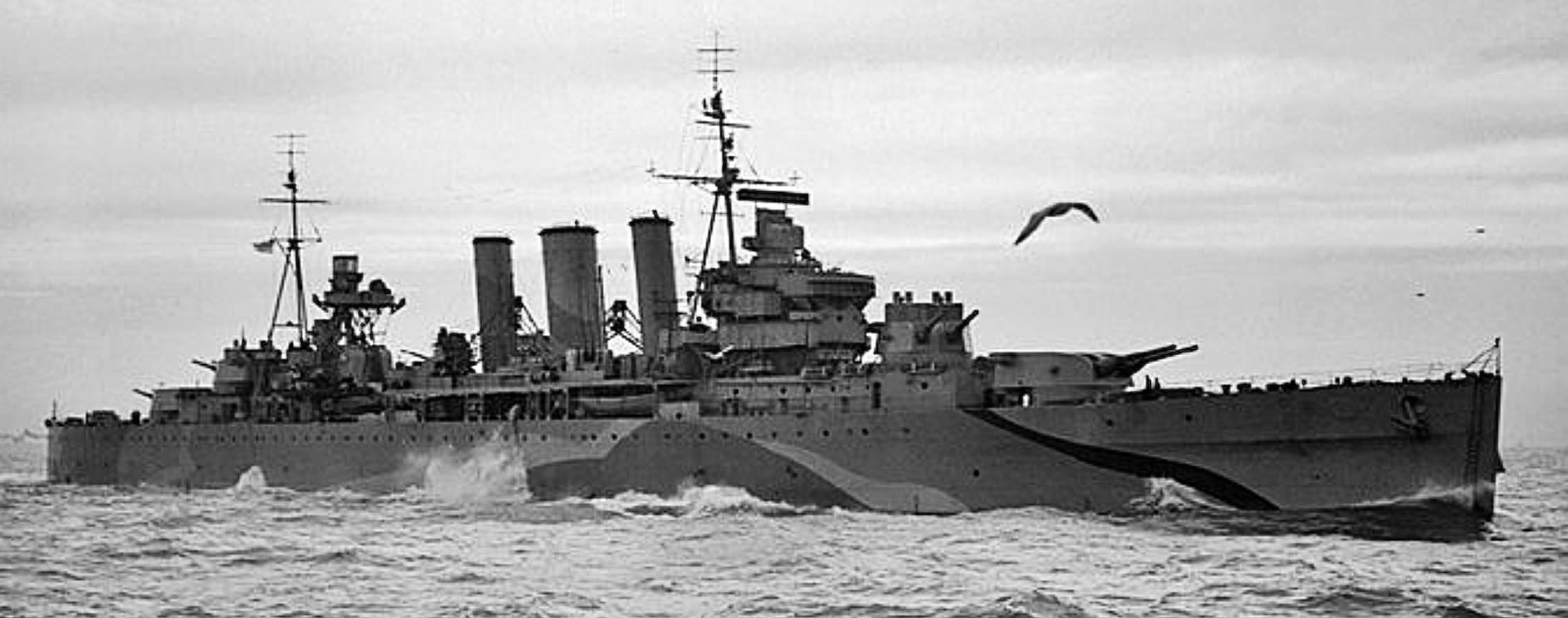
(RN Photo)
HMS Shropshire (73).
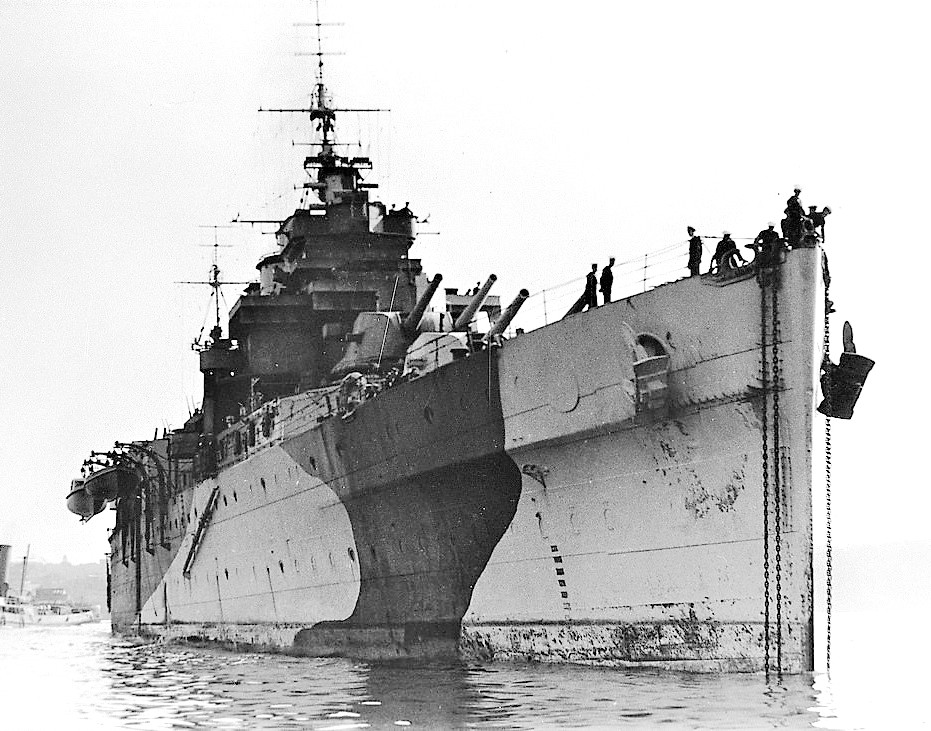
(RAN Photo)
HMAS Shropshire (73) in Sydney Harbour for the first time on 2 October 1943 following the loss of HMAS Canberra.
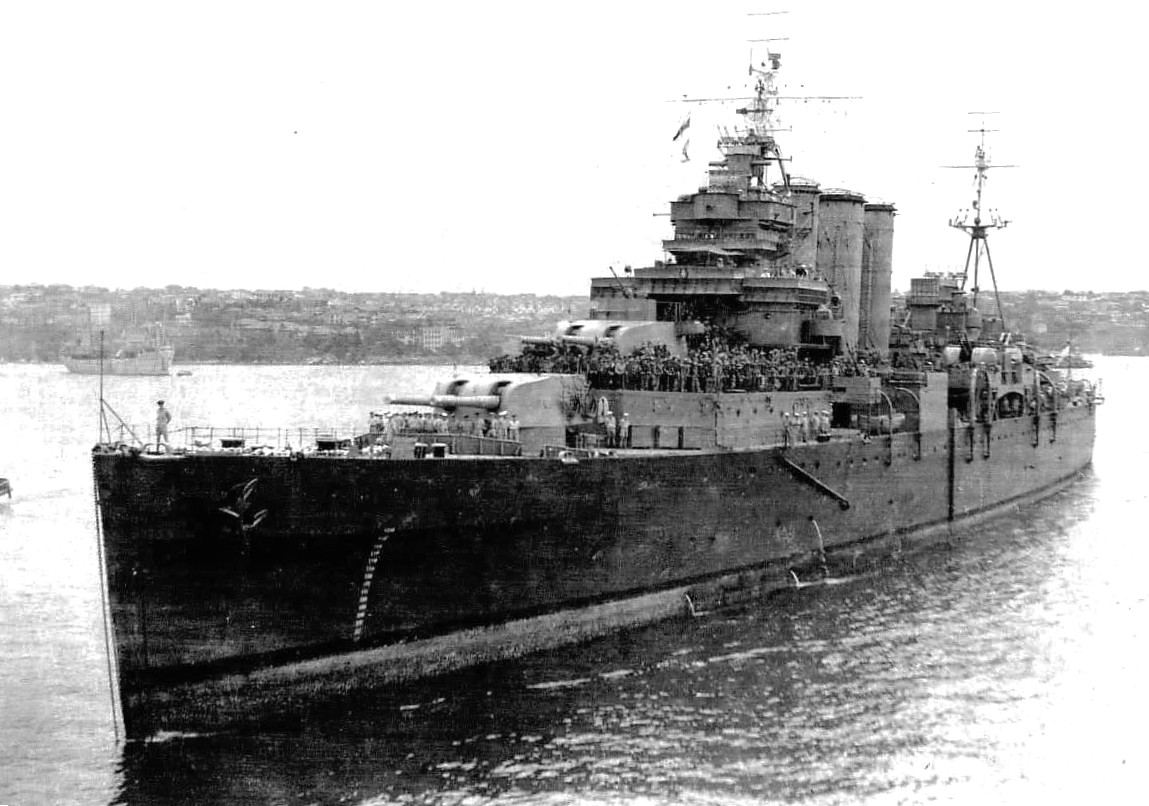
(John Vaughan Photo)
HMAS Shropshire with returning troops and crew members as she prepares to berth at the Oil Wharf, Garden Island, on her arrival in Sydney 30 Nov 1945.
HMS Sussex (96)
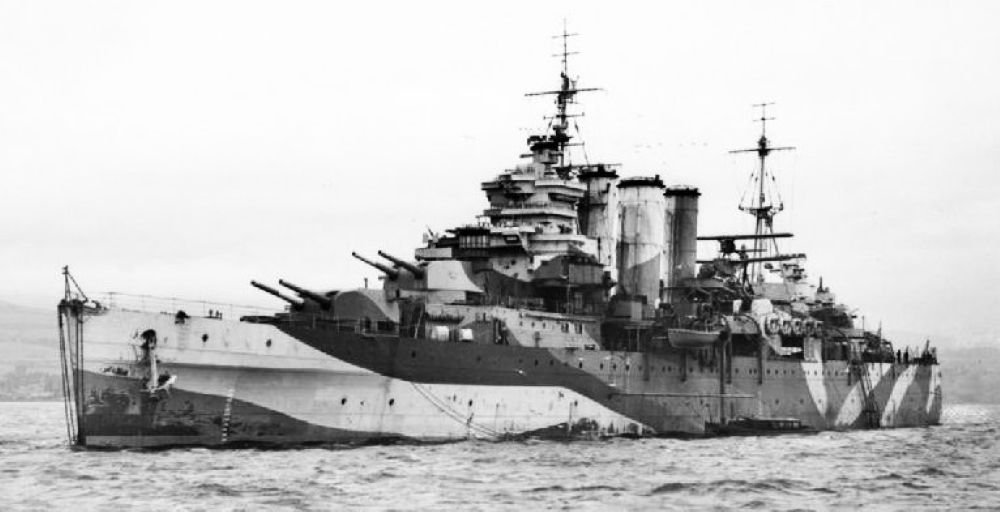
(IWM Photo, FL 5880)
HMS Sussex (96), 1940.
HMS Sussex (96) was one of the London sub-classof the County-class heavy cruisers in the Royal Navy. She was laid down by R.and W. Hawthorn, Leslie and Company, Limited, at Hebburn-on-Tyne on 1 February1927, launched on 22 February 1928 and completed on 19 March 1929. Sussex served in the Mediterranean until 1934, when she was sent to serve with the Royal Australian Navy while HMAS Australia operated with the Mediterranean Fleet. Sussex’s exchange tour concluded in 1936, and then sheresumed her presence in the Mediterranean until 1939. During this tour of duty,she defended neutral shipping along the eastern Spanish coast in the last daysof the Spanish Civil War, supported by the destroyers HMS Intrepid and HMS Impulsive. She obtained the release of at least four British cargo ships arrested by Spanish nationalist forces in open seas, but the cruiser was unable to prevent the capture of the London-registered freighter Stangate by the nationalist merchant raider Mar Negro off Valencia on 16 March 1939.
In September 1939 she operated with Force H in the South Atlantic and Indian Ocean during the search for the enemy German raider Admiral Graf Spee. On 2 December she and the battlecruiser HMS Renown intercepted the German passenger ship Watussi. Before the German ship could be captured she was scuttled by her own crew. Following the scuttling of Admiral Graf Spee in December 1939, Sussex returned to the UK, and served with the Home Fleet during the Norwegian Campaign. She entered refit at Liverpool in March 1940 and in May after seatrials joined 1st Cruiser Squadron in Scapa Flow where she was deployed insearch patrols and convoy duties. In August her crew detected a defect with her propulsion machinery so she was sent to Glasgow for repairs to her turbine blades, but while undergoing work, was struck by bombs on 18 September 1940. These caused serious fires, gutting the aft end, and she settled on the bottom with a heavy list. She needed extensive repairs and did not return to service until August 1942.
During these repairs at Stephen’s shipyards, Govan she was fitted with new radar equipment, fire control equipment, ten Oerlikon 20 mm cannon and two eight-barreled Pom Pom Guns. Having returned to her squadron in Scapa flow for more interception duties and exercises she was then sent for another refit in November, this time at the Tyne shipyard. Having spent January 1943 back with the 1st Cruiser Squadron, Sussex then took passage to Mombasa and was redeployed with the 4th Cruiser Squadron of the Eastern Fleet in the Indian Ocean. On her way she intercepted and sank the German tanker Hohenfriedburg just south west of Cape Finisterre on 26 February but was then attacked by German submarine U-264. Sussex avoided the four torpedoes fired at her.
Sussex spent 1944 in the Pacific, and covered operations in the Netherlands East Indies following the cessation of hostilities. On 26 July 1945 her Task Force was attacked by two attack bombers acting as kamikaze suicide weapons. One made an imprint on the side of Sussex, from which it could be identified as a Mitsubishi Ki-51 “Sonia”. On Wednesday, 5 September 1945 at 11:30am, HMS Sussex entered Singapore Harbour carrying the Flag of the Rear-Admiral Cedric Holland. General Seishirō Itagaki, the commander of the garrison at Singapore was brought on board, where he signed the formal surrender of the army, thus completing Operation Tiderace, the Allied plan to recapture Singapore. HMS Sussex was paid off in 1949, handed over to the British Iron & Steel Corporation on 3 January 1950, and arrived at Dalmuir in Scotland on 23 February 1950 where she was broken up by W. H. Arnott, Young and Company, Limited. (Wikipedia)
All comments are subject to our Comment Policy. You must be at least 18 years old to comment.
See a comment that violates our guidelines? Report it here.