
Royal Navy Cruisers: C class: HMS Caledon (D53), HMS Calypso (D61), HMS Caradoc (D60), HMS Cardiff (D58), HMS Ceres (D59), HMS Coventry (D43), HMS Curacoa (D41), HMS Curlew (D42),
Royal Navy Cruisers: C class: HMS Cairo (D87), HMS Calcutta (D82), HMS Capetown (D88), HMS Carlisle (D67), HMS Colombo (D89) (listed on a separate page)
Cruisers of the Royal Navy of the United Kingdom have existed since 1877 (when the category was created by amalgamating the two previous categories of frigate and corvette) until the last cruiser was decommissioned more than a century later. No cruisers are currently in service with the Royal Navy.
Armoured cruisers were protected by a belt of side armour and an armoured deck. In the Royal Navy this classification was not actually used, the term first class cruiser being used instead for both armoured cruisers and large protected cruisers. Thus, the first class cruisers built between the Orlando class (1886) and the Cressy class (1897) were, strictly speaking, protected cruisers as they lacked an armoured belt. The first class cruiser was succeeded by the battlecruiser in the Royal Navy.
Protected cruisers were so-called because their vital machinery spaces were protected by an armoured deck and the arrangement of coal bunkers. The ships below are all protected cruisers, but were rated as second and third class cruisers by the Royal Navy. The third class cruiser was not expected to operate with the fleet, was substantially smaller than the second class and lacked the watertight double-bottom of the latter. With the advent of turbine machinery, oil firing and better armour plate the protected cruiser became obsolete and was succeeded by the light cruiser.
The scout cruiser was a smaller, faster, more lightly armed and armoured cruiser than the protected cruiser, intended for fleet scouting duties and acting as a flotilla leader. Essentially there were two distinct groups – the eight vessels all ordered under the 1903 Programme, and the seven later vessels ordered under the 1907-1910 Programmes. The advent of better machinery and larger, faster destroyers and light cruisers effectively made them obsolete.
The light armoured cruiser – light cruiser – succeeded the protected cruiser; improvements in machinery and armour rendering the latter obsolete. The Town class of 1910 were rated as second-class protected cruisers, but were effectively light armoured cruisers with mixed coal and oil firing. The Arethusa class of 1913 were the first oil-only fired class. This meant that the arrangement of coal bunkers in the hull could no longer be relied upon as protection and the adoption of destroyer-type machinery resulted in a higher speed. This makes the Arethusas the first “true example” of the warship that came to be recognised as the light cruiser. In the London Naval Treaty of 1930, light cruisers were officially defined as cruisers having guns of 6.1 inches (155 mm) calibre or less, with a displacement not exceeding 10,000 tons.
The heavy cruiser was defined in the London Naval Treaty of 1930 as a cruiser with a main gun calibre more than 6 inches but not exceeding 8 inches. The earlier Hawkins class were therefore retrospectively classified as such, although they had been initially built as “improved light cruisers”. The County were built as light cruisers with most of them in service at the time of the Treaty of London, after which they were also redesignated as heavy cruisers. A further three Countys were cancelled. The York class was a reduced version of the County to build more ships within tonnage limits.
The “large light cruisers” were a pet project of Admiral Fisher to operate in shallow Baltic Sea waters and they are often classed as a form of battlecruiser.
Minelaying cruisers were the only purpose-built oceangoing minelayers of the Royal Navy. The Abdiel class could reach 38 knots and in practice were used as fast transports to supply isolated garrisons, such as those at Malta and Tobruk. (Wikipedia)
C class cruisers
The C class was a group of twenty-eight light cruisers of the Royal Navy, and were built in seven groups known as the Caroline class (six ships), the Calliope class (two ships), the Cambrian class (four ships), the Centaur class (two ships), the Caledon class (four ships), the Ceres class (five ships) and the Carlisle class (five ships). They were built for the rough conditions of the North Sea, and proved to be rugged and capable vessels, despite being somewhat small and cramped. (Wikipedia)
Caroline group
HMS Caroline (1914), HMS Carysfort (1914), HMS Cleopatra (1915), HMS Comus (1914), HMS Conquest (1915), HMS Cordelia (1914). Not in service during the Second World War.
Calliope group
HMS Calliope (1914), HMS Champion (1915). Not in service during the Second World War.
Cambrian group
HMS Cambrian (1916), HMS Canterbury (1915), HMS Castor (1915), HMS Constance (1915). Not in service during the Second World War.
Centaur group
HMS Centaur (1915), HMS Concord (1916). Not in service during the Second World War.
Caledon group
HMS Caledon (D53)
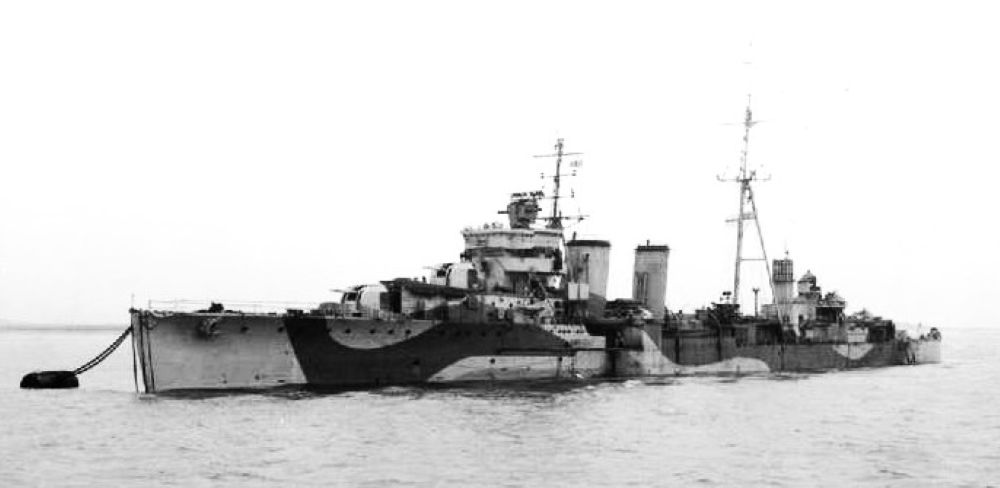
(IWM Photo, FL 5354)
HMS Caledon (D53). Caledon was converted at the end of 1943 to an anti-aircraft cruiser, replacing the entire former armament with three QF 4-inch (100 mm) Mk XVI twin and two Bofors 40-millimetre (1.6 in) Mk IV “Hazemeyer” twin mounts. By 1944 this was supplemented by six Bofors 40 mm Mk III and one Oerlikon 20-millimetre (0.79 in) Mk III single mounts. The ship’s tonnage increased to 5,240 long tons (5,320 t) at full load, including 200 tons of lead ballast. She was old for scrap, 22 January 1948.
HMS Calypso (D61)
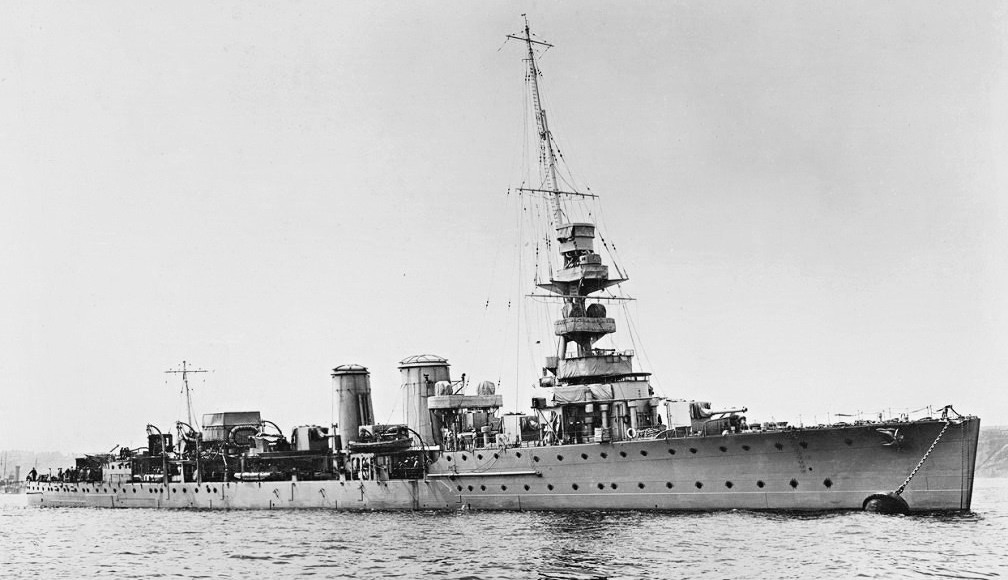
(IWM Photo, SP 1482)
HMS Calypso (D61), launched in 1917. HMS Calypso was the first British naval vessel to be sunk by the Regia Marina in the Second World War. Two days after Italy declared war on Great Britain, Calypso was on an anti-shipping patrol against Italian ships travelling to Libya when she was struck by a torpedo from the Italian submarine Alpino Bagnolini (Capitano di corvetta (Lieutenant Commander) Franco Tosoni Pittoni, about 50 mi (80 km) south of Cape Lithion in Crete in the Eastern Mediterranean at 00:59 on 12 June 1940. Thirty nine sailors from Calypso perished in the sinking. The majority of her survivors were rescued by the destroyer HMS Dainty and taken to Alexandria.
HMS Cassandra, commissioned in June 1917. She struck a mine and sank during the British intervention in the Russian Civil War on 5 December 1918.
HMS Caradoc (D60)
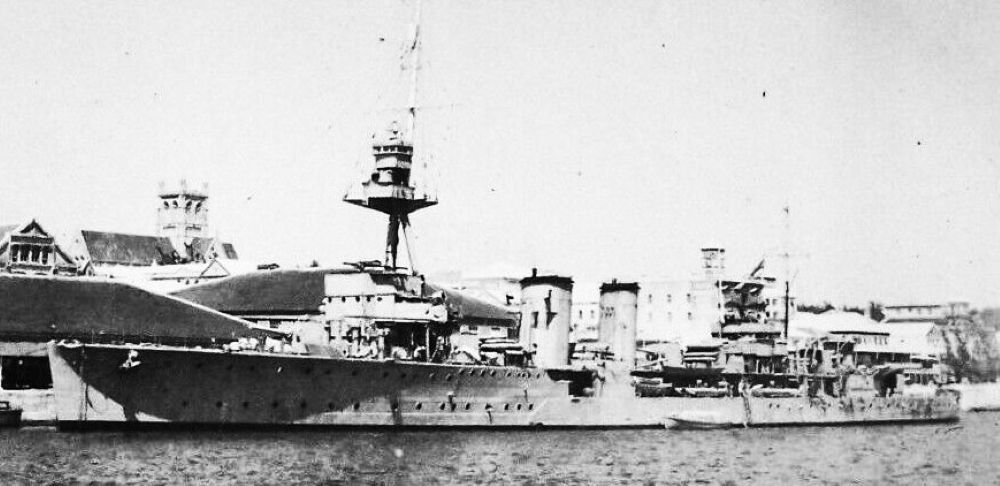
(RN Photo)
HMS Caradoc (D60) shown here in 1928, was recommissioned before the start of the Second World War in September 1939. She returned to the North American Station where she helped to intercept two German blockade-runners. The ship was transferred to the Eastern Fleet in early 1942, but saw no action before she was converted into a training ship in mid-1943 in South Africa. Caradoc was sent to Ceylon where she became an accommodation ship in 1944. She briefly became the fleet flagship in August 1945 before returning home later in the year. The ship was placed in reserve at the end of the year and sold for scrap in early 1946.
Ceres group
HMS Cardiff (D58)
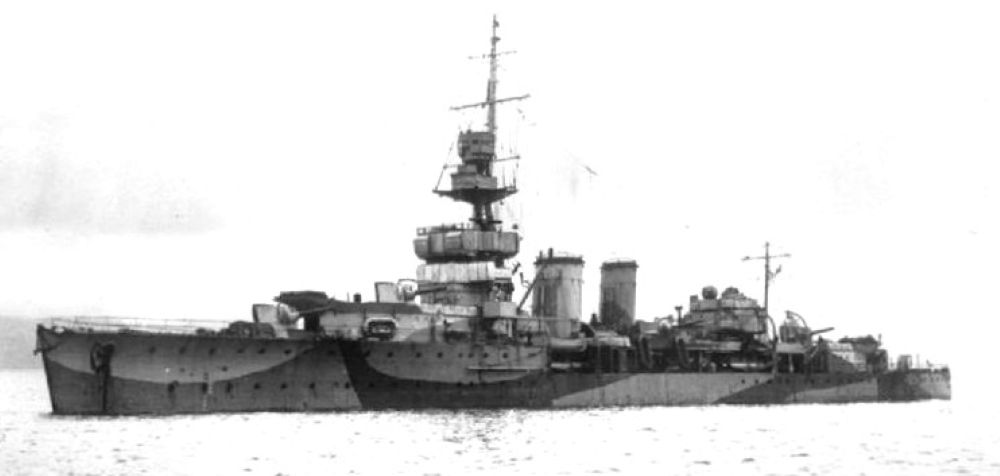
(IWM Photo, FL 7510)
HMS Cardiff (D58), shown here in 1942. During the Second World War, she was initially assigned to the Northern Patrol, but became a training ship in late 1940 and continued in that role for the rest of the war. Cardiff was sold for scrap in early 1946 and subsequently broken up.
HMS Ceres (D59)
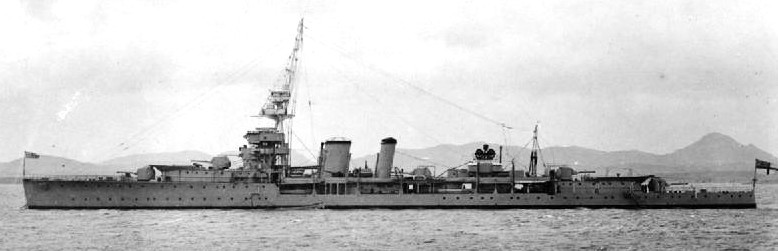
(IWM Photo, Q 73427)
HMS Ceres (D59). On the outbreak of war in 1939 Ceres was recommissioned from the Reserve Fleet and placed on the Northern Patrol in the Denmark Strait between Iceland and Greenland. She served throughout the war. After the end of the war, she was again placed in reserve and used as an accommodation/base ship at Portsmouth. Ceres was sold and broken up for scrap at Bolckow, Blyth in July 1946, after 29 years in service.
HMS Coventry (D43)
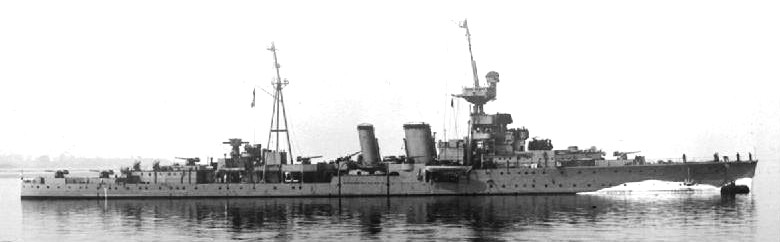
(IWM Photo, FL5186)
HMS Coventry (D43). In 1935, Coventry went into Portsmouth Dockyard to be refitted as an anti-aircraft cruiser. This refit involved the removal of her 6-inch guns and torpedo tubes, and the fitting of 10 QF 4-inch Mk V guns on single high-angle mountings and 2 octuple-mounted 2-pounder ‘pom-pom’ guns. The after one of these was replaced in 1936/7 by two quadruple Mark I mounts for the 0.5 inch (12.7 mm) Vickers Mark III machine gun. At the outbreak of the Second World War HMS Coventry was serving with the Home Fleet between 1939 and 1940, and was damaged on 1 January 1940 in a German air attack on the Shetland Islands, north of Scotland. She was assigned to the Mediterranean fleet in 1940, and was torpedoed and damaged by the Italian submarine Neghelli in the eastern Mediterranean. Coventry also participated in the Battle of Cape Spartivento. HMS Coventry was heavily damaged in the Eastern Mediterranean, northwest of Alexandria, Egypt, by 16 German Junkers Ju 88s of I./Lehrgeschwader 1 under the command of Joachim Helbig, whilst participating in Operation Agreement. 8./StG 3 also took part in the attack. The ship was on fire and had to be scuttled by HMS Zulu.
On 18 May 1941 the first Victoria Cross of the Mediterranean campaign was awarded posthumously to Petty Officer Alfred Edward Sephton for “great courage and endurance” while on HMS Coventry as she was being attacked on 17 May 1941 by German Stuka dive bombers while off Crete. The Coventry had gone to the assistance of hospital ship Aba,[5] which was being attacked by German dive-bombers. When the enemy engaged Coventry, raking her with machine-gun fire, Petty Officer Sephton was mortally wounded, a bullet actually passing through his body and injuring an able seaman beside him. Although in great pain and partially blinded, he stuck to his instruments and carried out his duties until the attack was over. He died of his injuries next day. Petty Officer Sephton was buried at sea.
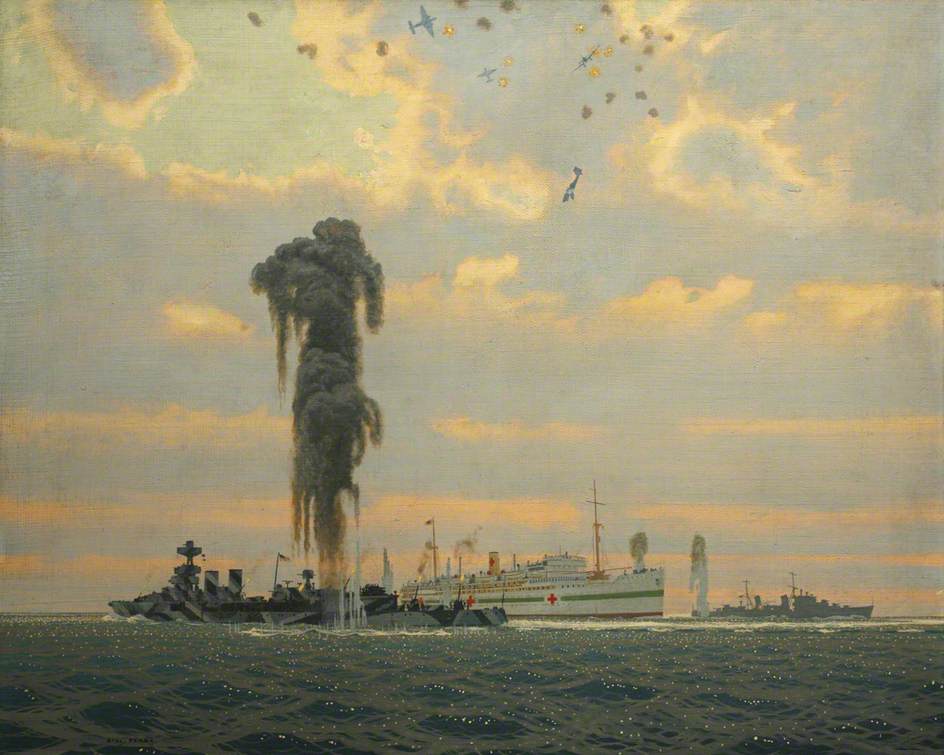
(Charles Pears – Art UK)
Rescue of the Hospital Ship Aba by HMS Coventry on 17 May 1941. (HMHS Aba). Royal Cornwall Museum.
HMS Curacoa (D41)
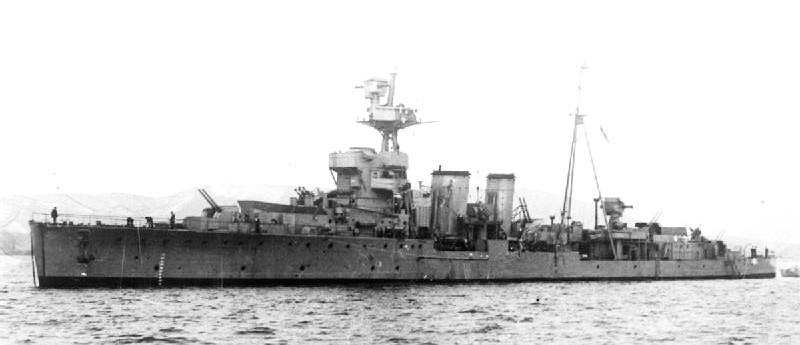
(IWM Photo, A 5808)
HMS Curacoa (D41). In 1933, Curacoa became a training ship and in July 1939, two months before the start of the Second World War, she was converted into an anti-aircraft cruiser. She returned to service in January 1940 and, while providing escort in the Norwegian Campaign that April, was damaged by German aircraft. After repairs were completed that year, she escorted convoys in and around the British Isles for two years. In late 1942, during escort duty, she was accidentally sliced in half and sunk by the ocean liner RMS Queen Mary, with the loss of 337 men.
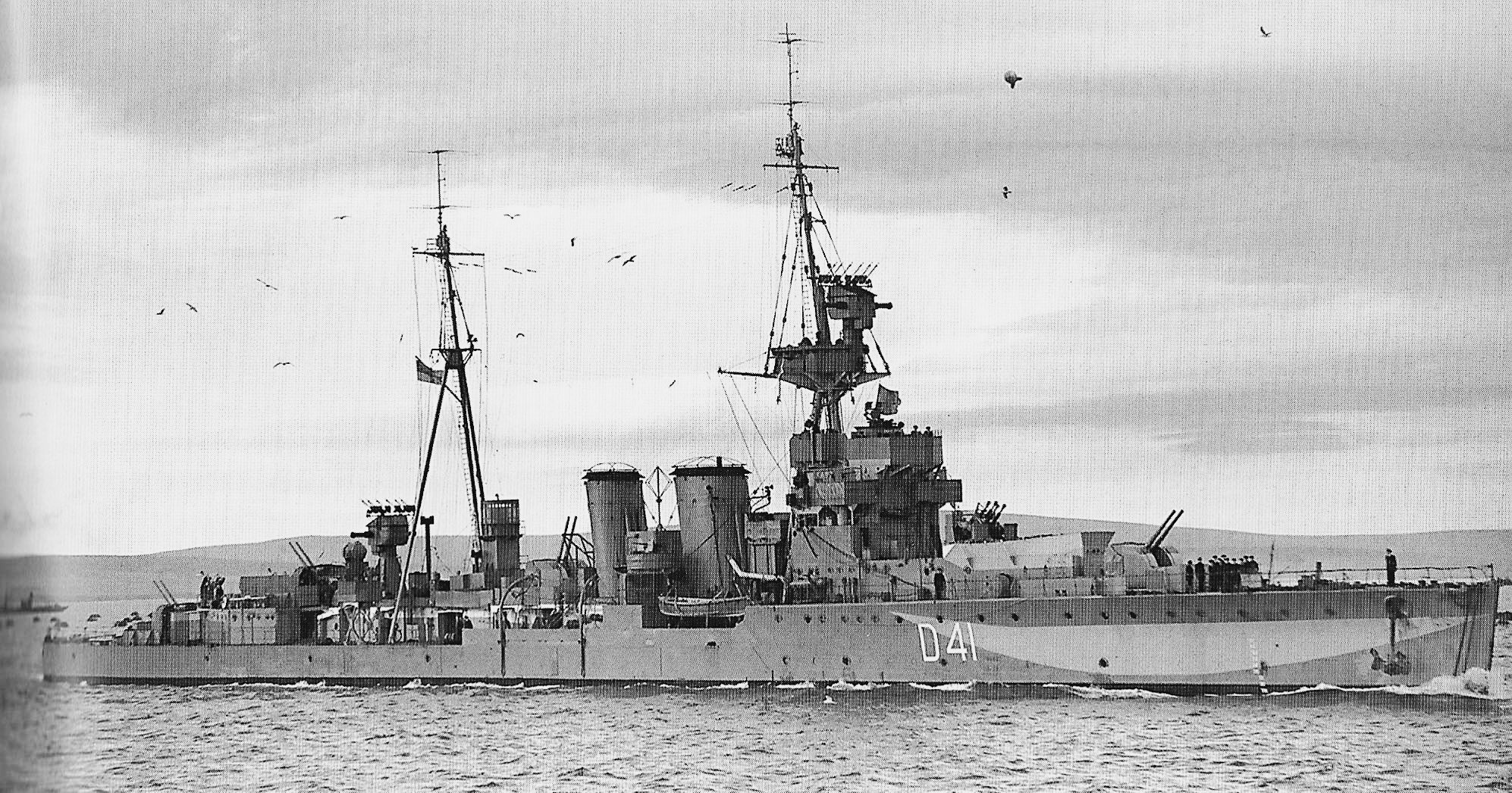
(Royal Navy Photo)
The C class light cruiser HMS Curacoa in her AA configuration. In July 1939 the conversion into an anti-aircraft cruiser at Chatham Dockyard began. This consisted of replacing all of her six-inch guns with eight QF 4-inch Mk XVI dual purpose guns in four twin gun turrets, in the positions formerly occupied by Nos. 1, 3, 4, and 5 six-inch guns. A quadruple mount for the two-pounder Mk VII “pom-pom” light AA gun was installed in No. 2 gun’s position. Quadruple Vickers 0.5 inch AA machinegun mounts replaced the three inch guns and her torpedo tubes were removed. Her masts were cut down and her existing fire-control systems were replaced by a pair of High-Angle Control System Mk III systems and a pom-pom director. A Type 279 early-warning radar was also installed. To counter the additional weight high in the ship, 200 long tons of ballast was added. Although the weight of the ballast alone was more than that of the new equipment, it increased her metacentric height from 2.93 to 3.41 feet at deep load which was approximately 4,950 long tons. The conversion was completed on January 24th 1940.On October 2nd 1942 while escorting RMS Queen Mary while zig zagging Curacoa crossed Queen Mary’s bow and was sliced in two with the loss of 337 officers and men of her crew.
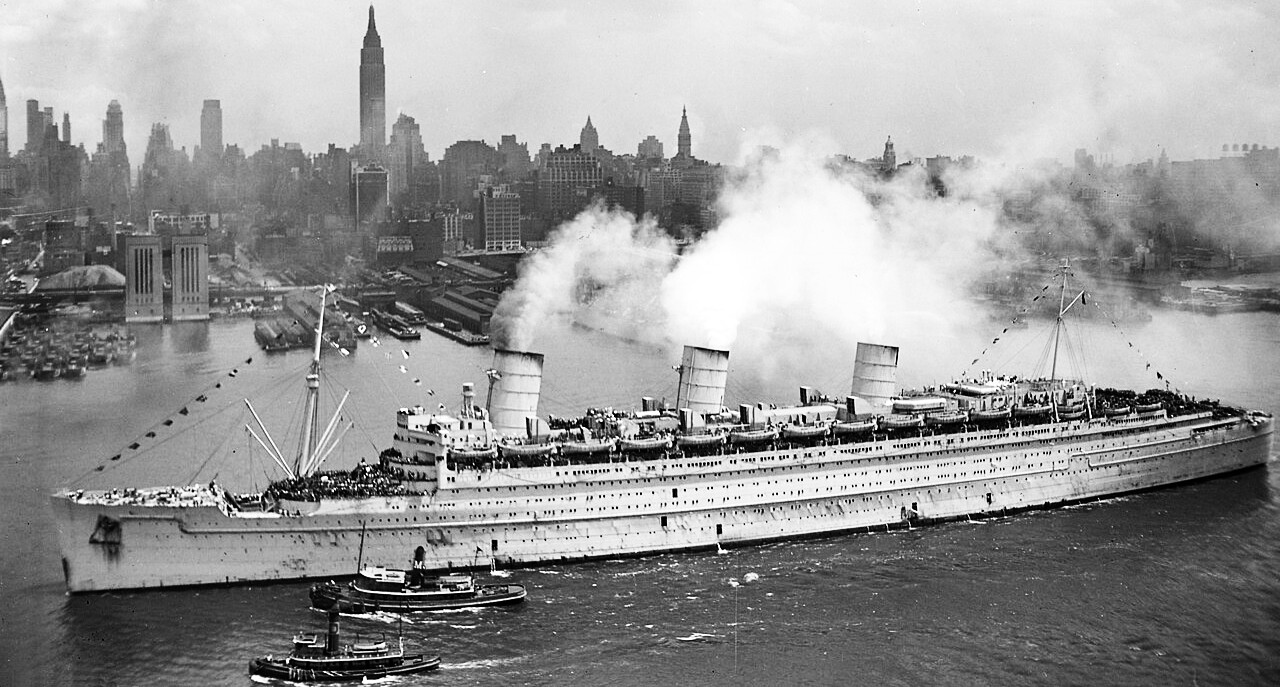
(USN Photo)
RMS Queen Mary arriving in New York harbour, 20 June 1945, with thousands of U.S. troops from Europe. RMS Queen Mary was still wearing her light grey war paint. Seen from near Hamilton Avenue, Weehawken.
HMS Curlew (D42)
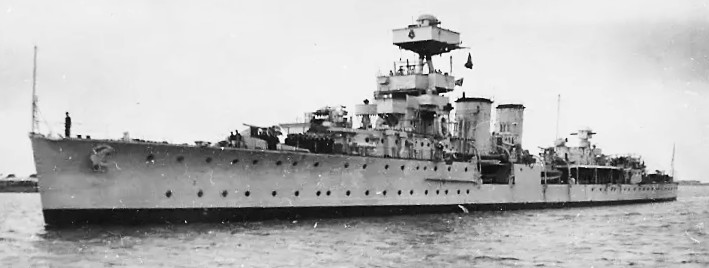
(RN Photo)
HMS Curlew (D42) survived the First World War, but was sunk by German aircraft during the Norwegian Campaign in 1940.
All comments are subject to our Comment Policy. You must be at least 18 years old to comment.
See a comment that violates our guidelines? Report it here.