
Royal Navy C class Cruisers: Carlisle group: HMS Cairo (D87), HMS Calcutta (D82), HMS Capetown (D88), HMS Carlisle (D67), HMS Colombo (D89)
HMS Cairo (D87)
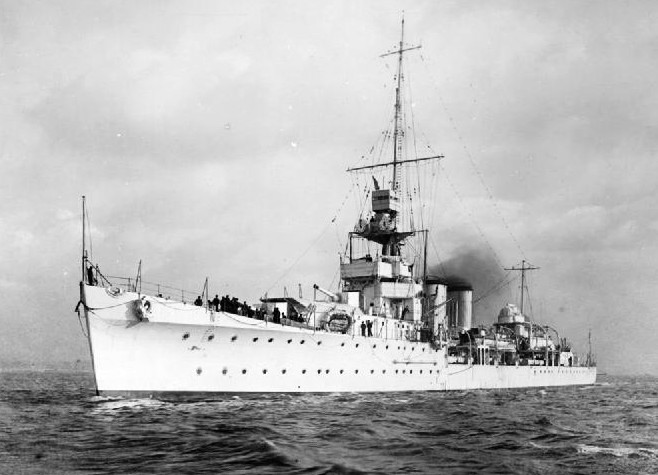
(IWM Photo, Q 20272)
HMS Cairo (D87). During the Second World War, she took part in the Norwegian Campaign, where she was damaged by German aircraft off Narvik on 28 May 1940. 10 sailors were killed and the ship was out of action for two months. In the Mediterranean she led the escort of a six cargo-ship convoy from Gibraltar to Malta, code named Operation Harpoon, which endured intense air strikes. The British squadron also faced the attack of an Italian light cruiser division in the Sicilia channel. Four merchantmen and two destroyers were sunk, while Cairo was hit by two 6-inch rounds from the Italian cruiser Eugenio di Savoia, killing two members of her crew.
In August 1942, Cairo took part in Operation Pedestal, the escort of a convoy to Malta. During the operation she was torpedoed and sunk by the Italian submarine Axum north of Bizerta, Tunisia, on 12 August 1942. One torpedo blew off part of the stern, the port propeller was gone, the engine room flooded and gun mount Y fell off in the sea. As during the battle it was impossible to tow her to safety, it was decided to scuttle her. The destroyer HMS Pathfinder fired four torpedoes but only one hit. A series of depth charges did not finish her off, so finally the escort destroyer HMS Derwent received orders to sink her with gunfire. Twenty-four seamen went down with the ship.
HMS Calcutta (D82)
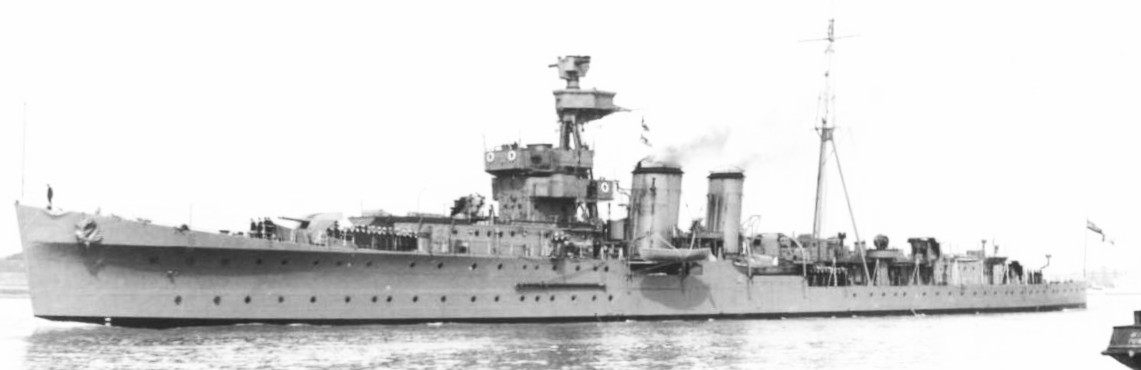
(RN Photo)
HMS Cairo (D87) underway in 1939.
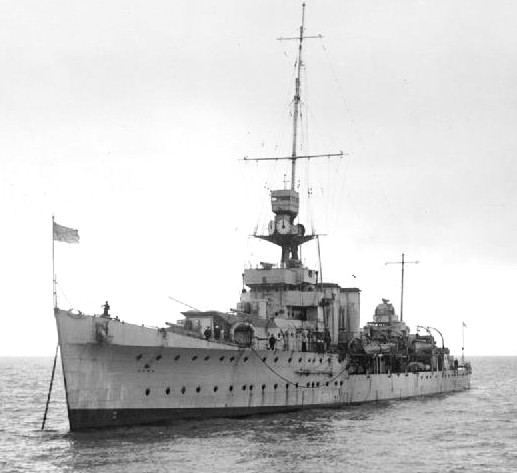
(IWM Photo, SP 2553)
HMS Calcutta (D82). She was converted to an anti-aircraft cruiser in 1939. Calcutta served during the Norwegian Campaign and the evacuation from Dunkirk in 1940. She was used to escort allied convoys across the Mediterranean and was sunk on 1 June 1941 by Luftwaffe aircraft off Alexandria, Egypt.
HMS Capetown (D88)
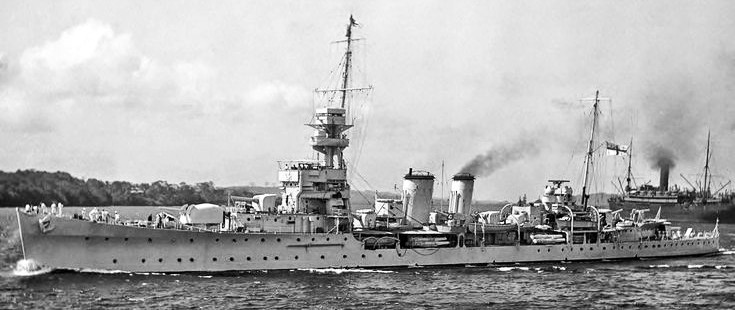
(RN Photo)
HMS Capetown (D88). Capetown spent a large part of her career with the Eastern Fleet, including a period between the wars from July 1934 until August 1938, when she returned to the United Kingdom for a refit. She rejoined the Mediterranean Fleet in August 1940. While deployed in the Red Sea, she was torpedoed and severely damaged by the Italian motor torpedo boat MAS 213 off Massawa, on 6 April 1941. Seven members of her crew lost their lives. After a year of repairs at Bombay, she served with the Eastern Fleet until 1943. She then returned to the UK and joined the Home Fleet.
During the Normandy landings in June 1944 Capetown was deployed as a Shuttle Control/Depot ship at Mulberry A placed to seaward in order to direct incoming convoys to berths or anchorages. Ceres was anchored inshore to control returning convoys of unloaded vessels with Shuttle Control Command for both ships being embarked in Capetown. Shuttle Control Command was responsible for keeping the Army informed of expected arrivals and directing them to the proper unloading sectors. She survived the war and was sold on 5 April 1946. She arrived at the yards of Ward of Preston for breaking up on 2 June 1946.
HMS Carlisle (D67)
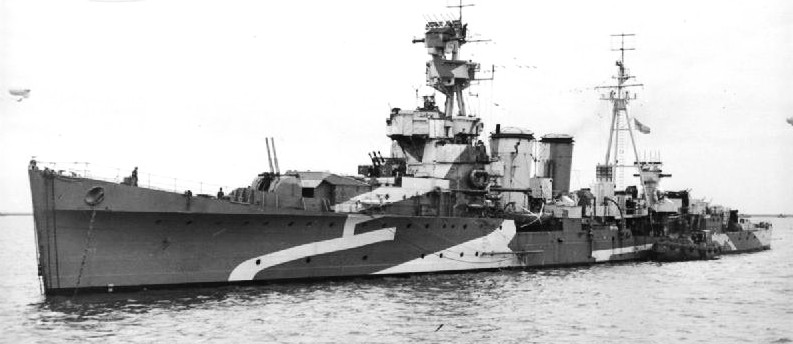
(IWM Photo, FL 5448)
HMS Carlisle (D67). Carlisle was credited with shooting down eleven Axis aircraft during the Second World War and was the top scoring anti-aircraft ship in the Royal Navy. In July 1943, she escorted the support force for the Allied invasion of Sicily. In September–October, during the German counter-attack in the Aegean Sea, Carlisle made a sortie into the area south of Piraeus with the destroyers HMS Panther and HMS Rockwood; intercepting German convoys in the Scarpanto Strait. On 9 October 1943, they were spotted by German Ju 87 dive bombers from I. StG 3 from the Megara air base which succeeded in sinking Panther at 12.05 and later on seriously damaged Carlisle; killing 24 members of the ship’s company. She was taken in tow to Alexandria by Rockwood. She was considered to be beyond economical repair as a warship and was converted to serve as a base ship in the harbour of Alexandria in March 1944. She was last listed as a hulk in 1948 after the war had ended, and was broken up in 1949.
HMS Colombo (D89)
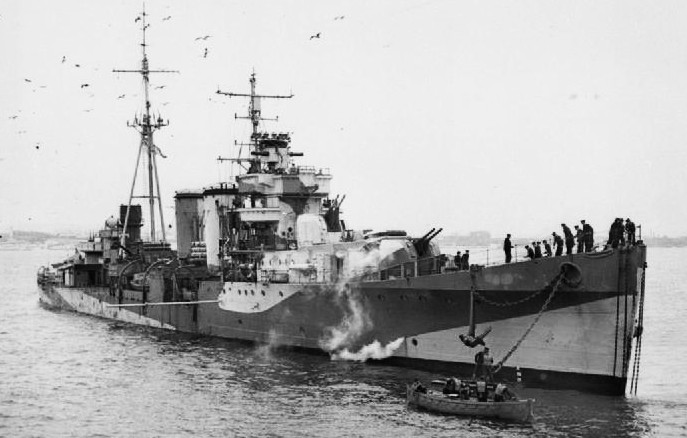
(IWM Photo, FL 8184)
HMS Colombo (D89). Shown here moored to a buoy in Plymouth Sound, 17 July 1943. Configured as a Anti-Aircraft Ship.Colombo spent the early part of the war in service with the Home Fleet, during which time she captured the German merchant ship Henning Oldendorff south-east of Iceland. She then returned to the Eastern Fleet between August 1940 and June 1942 before again returning to the UK to undergo a refit and conversion into an anti-aircraft cruiser between June 1942 and March 1943. Colombo survived the war and was sold on 22 January 1948, arriving at the yards of Cashmore, Newport on 13 May 1948 to be broken up.
All comments are subject to our Comment Policy. You must be at least 18 years old to comment.
See a comment that violates our guidelines? Report it here.