RN Auxiliary anti-aircraft ships
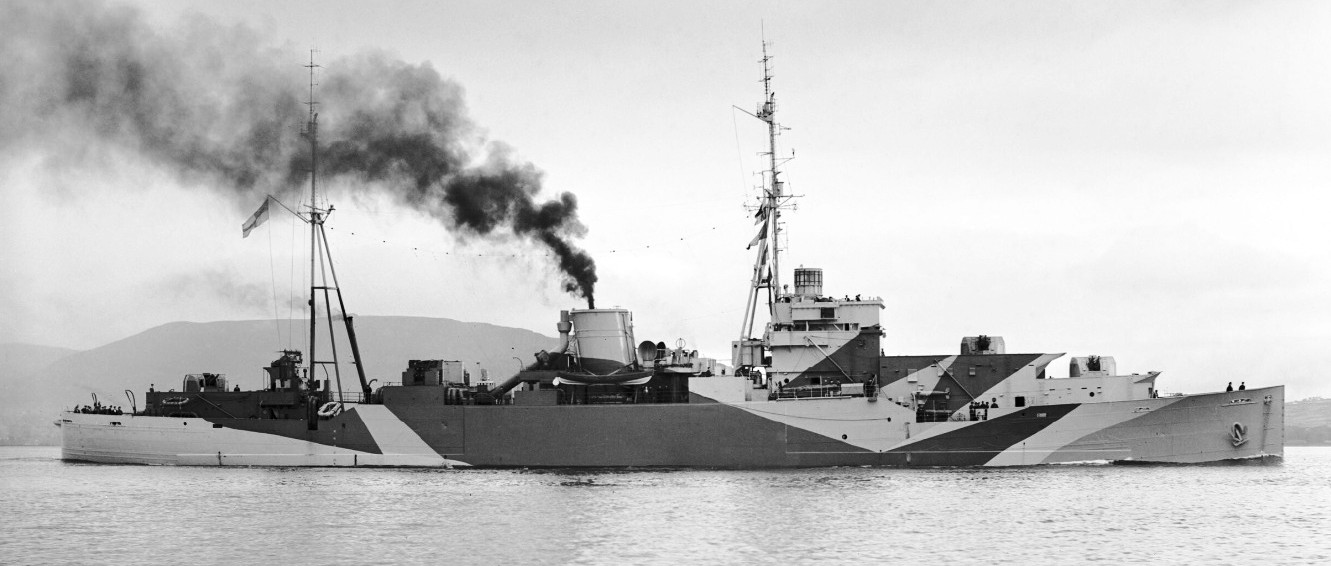
HMS Ulster Queen anti-aircraft cruiser
(IWM Photo, FL12412)
HMS Ulster Queen, underway in coastal waters, 8 June 1943.
MV Ulster Queen was a passenger ferry operated across the Irish Sea between 1930 and 1940. Requisitioned by the Admiralty as an auxiliary anti-aircraft cruiser, she was substantially modified. Her boat deck and one funnel were removed and armour plating was added to the hull. She was armed with six 4-inch guns in three turrets and smaller AA weapons. Commissioned as HMS Ulster Queen, she was purchased outright by the Admiralty and served with the Russian convoys, in the Mediterranean and in the Far East before being paid off on 1 April 1946. The modifications were too substantial for her to return to passenger service. She was laid up, and eventually scrapped in 1950.
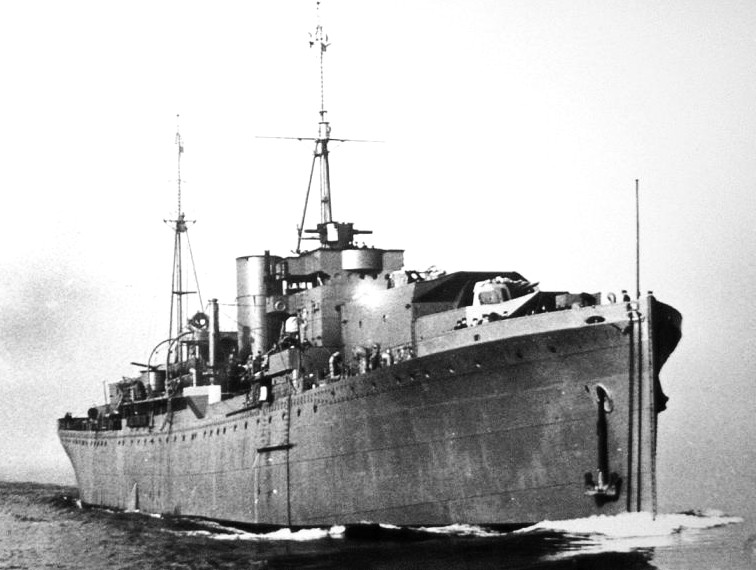
HMS Foylebank
(RN Photo)
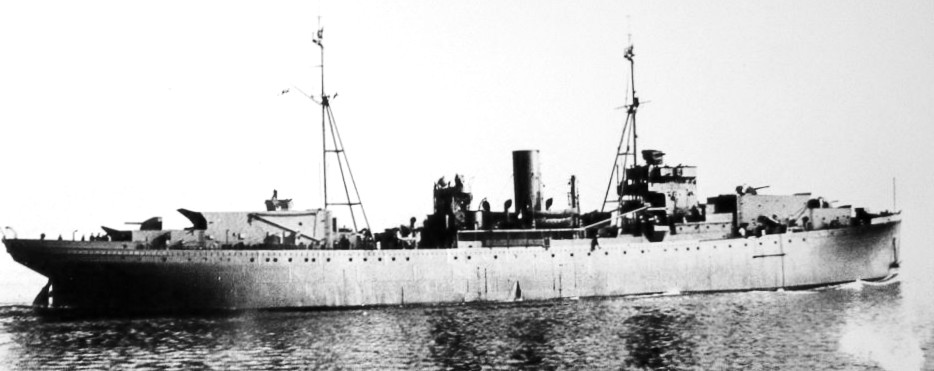
HMS Foylebank was a Royal Navy anti-aircraft ship active during the early part of the Second World War. She entered service in June 1940 and was sunk in a German air attack in July 1940. Foylebank was launched on 12 June 1930 as the 5,500-gross register ton motor merchant ship MV Foylebank for the Bank Line (Andrew Weir Shipping) and requisitioned by the Royal Navy when the Second World War broke out in September 1939.[1] She was converted into an anti-aircraft ship, equipped with 0.5 inch (12.7 mm) machine guns, two quad 2-pounder pom-poms and four twin high-angle 4-inch (102 mm) gun turrets. Commissioned as HMS Foylebank on 6 June 1940, with Captain Henry P. Wilson in command, she arrived in Portland Harbour next to the Isle of Portland in Dorset, England, on 9 June 1940 for a work-up for anti-aircraft duties. She subsequently saw action at Portland.
On 4 July 1940 whilst the majority of her crew were at breakfast, unidentified aircraft were reported to the south. These were originally thought to be Allied aircraft returning to base but they turned out to be 26 Luftwaffe Junkers Ju 87 Stuka dive bombers. These aircraft had the objective of disabling Foylebank, which the Germans saw as a threat to their plans to destroy the United Kingdom’s coastal shipping. During an eight-minute attack, Foylebank shot down two aircraft, but an estimated 22 bombs hit the ship and she listed to port, shrouded in smoke, with 176 out of a total crew of 298 killed and many more wounded.. She sank on 5 July 1940. One of the ship’s company, Jack Foreman Mantle, was posthumously awarded the Victoria Cross for his actions in defending the ship from aircraft whilst mortally wounded. (Wikipedia)
(RN Photo)
HMS Foylebank, 1940.
HMS Palomares
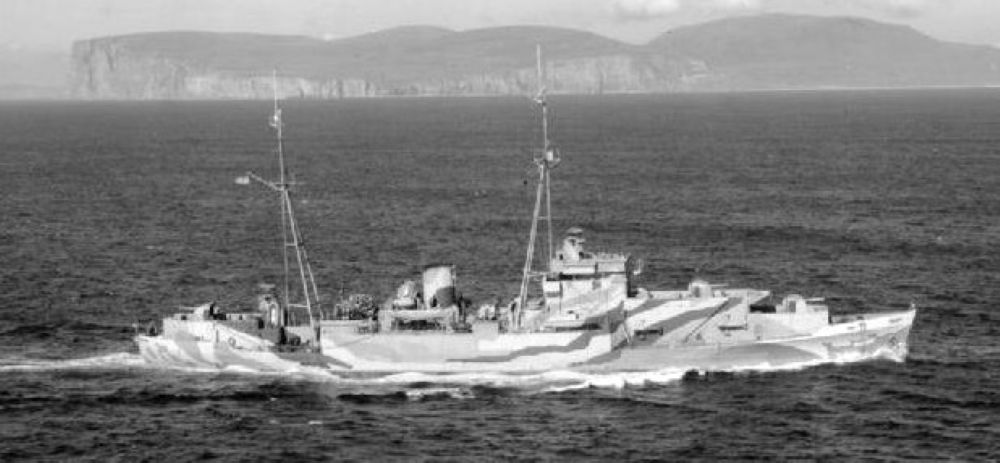
(IWM Photo, FL 12840)
HMS Palomares was a British anti-aircraft ship of the Second World War. Originally MV Palomares, built by William Doxford & Sons, Sunderland yard in 1937, it operated as a merchant fruit carrier ship (a 13.5 kn (25.0 km/h; 15.5 mph) banana boat) for service on the MacAndrews Line in January 1938 with their Spanish service. She was purchased by the Admiralty in 1940, as these fruit ships were considered to be fast and manoeuvrable. In 1941 the Admiralty converted her to an anti-aircraft ship and then to a fighter direction ship (“seagoing anti-aircraft auxiliaries”). Most likely the conversion took place at Fairfields yard in Govan on the River Clyde with her sister ship HMS Pozarica.
In March 1942, she sailed with Pozarica, and the corvettes HMS Poppy, Lotus, La Malouine and Dianella for the port of Seyðisfjörður in Iceland. In June 1942, she sailed as an escort in Convoy PQ 17, where 25 out 36 ships were lost to the Germans, while working around Murmansk and Archangel.[1]In November 1942, Palomares took part in the Operation Torch landings in Algiers as an anti-aircraft ship. The ship left Gibraltar on 3 November and arrived on 8 November. The next day Palomares was hit by a bomb that caused many casualties, caused a large fire and put the steering gear was put out of action. Deceased seamen were transferred to the corvette HMS Samphire for burial at sea and her steering gear was repaired by 10 November.[1]In September 1943, during the Salerno landings of Italy on 9 September, Palomares was a fighter direction ship, directing fighters with her radar system.In January 1944, Palomares again served as a fighter direction ship during the Anzio landings. Arriving at the beachhead on 22 January, she struck a mine and was towed back to Naples by the tugs Edenshaw and Evea. In September 1945, Palomares was to have participated in the Malaya landings but could not, as a fire had damaged her engine room.Upon conversion to an anti-aircraft ship, HMS Palomares was equipped with eight 4-inch AA guns in four turrets and eight 2-pounder (40mm) pom-poms in two quadruple mounts. In December 1942, to take the role of a fighter-direction ship, Palomares was fitted with radar for directing fighter aircraft.[2] HMS Palomares had a weight of 1,896 GRT and could move at 13.5 kn (25.0 km/h; 15.5 mph).Surviving the war, Palomares was returned to the MacAndrews Line in 1946, where she continued service with the company until 1959. She was then sold, being renamed Mary Sven and in 1961 sold again becoming Sarabande. On 5 October 1961 following a fire she drifted aground and was wrecked. (Wikipedia)
HMS Springbank
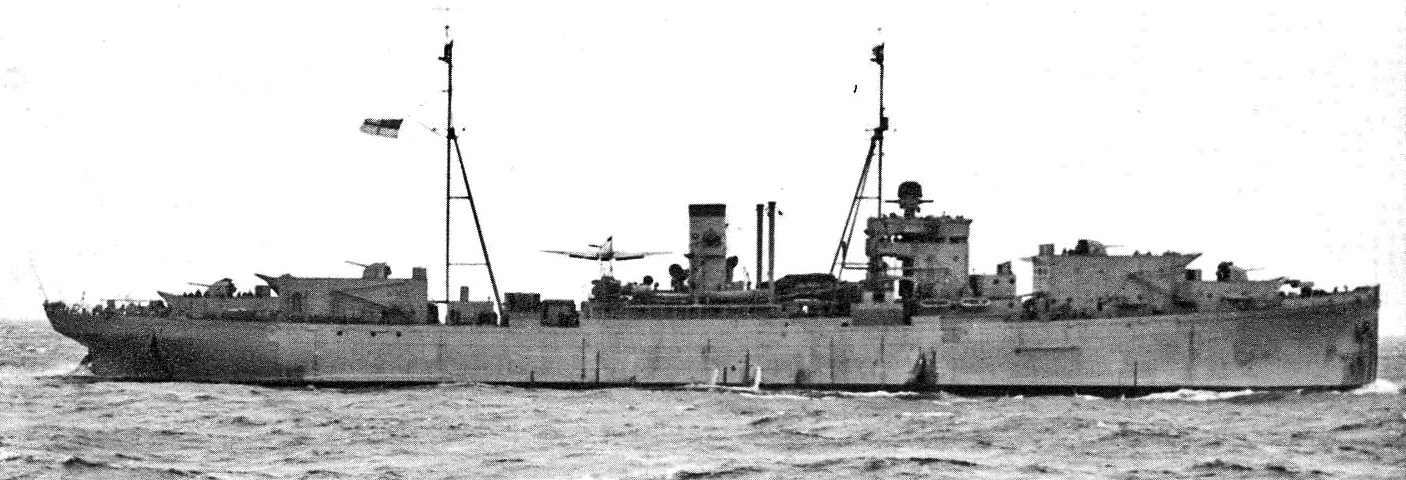
(RN Photo)
HMS Springbank was a Royal Navy fighter catapult ship of the Second World War. Originally a cargo ship built in 1926 for Bank Line it was acquired by the Admiralty at the start of the war and converted to an “auxiliary anti-aircraft cruiser” by the addition of four twin 4-inch (102 mm) gun turrets and two quadruple 2 pdr (40 mm) “pom-pom”s.In March 1941 a catapult for a single Fairey Fulmar naval fighter (from 804 Naval Air Squadron) was fitted midships as a means to give further protection for convoys from enemy aircraft.
Springbank was part of the escort for Convoy HG 73 from Gibraltar to Liverpool. Springbank’s Fulmar was launched to drive off a German Focke-Wulf Fw 200 reconnaissance aircraft; the Fulmar landed at Gibraltar afterwards. The convoy was attacked by Italian and German submarines over the following days. In the night of 27 September 1941 Springbank was torpedoed in the North Atlantic by the German submarine U-201. After her surviving crew were taken off by three ships, the ship was sunk by the Flower-class corvette HMS Jasmine by a combination of depth charges and 4-inch gunfire rather than leave her as a hazard to shipping. (Wikipedia)
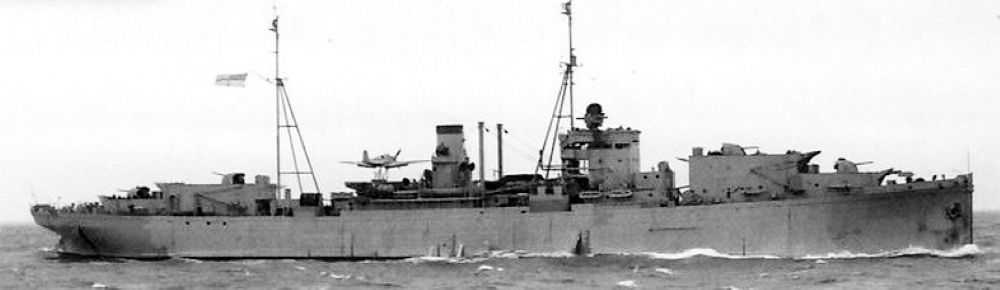
(Rick Fox Photo)
HMS Springbank
HMS Tynewald
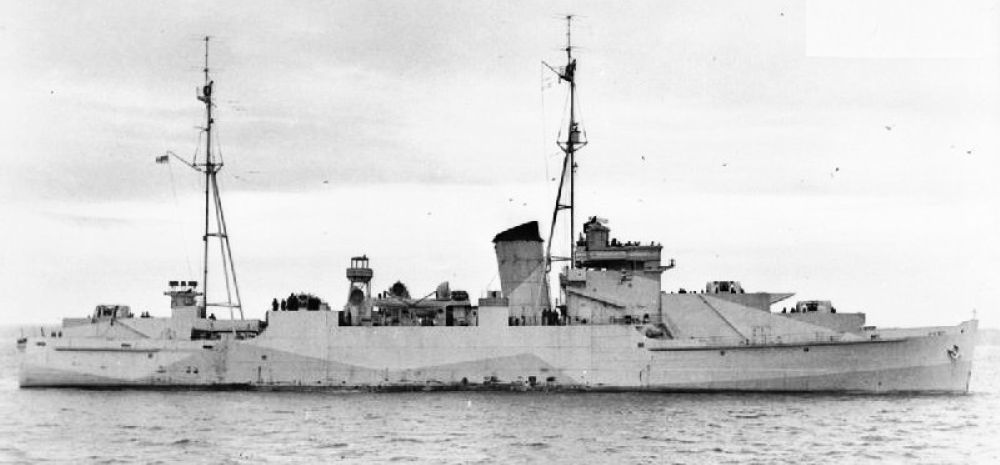
(IWM Photo, A 7112)
TSS (RMS) Tynwald No. 165281 was a passenger vessel which served with the Isle of Man Steam Packet Company from 1937 until she was requisitioned for war service at the end of 1940. She was the fourth ship in the line’s history to bear the name. HMS Tynwald was sunk in November 1942 off the coast of French North Africa.
Along with Fenella, Tynwald was requisitioned as a personnel vessel in the first week of the war. Her log was largely uneventful until the German onslaught on Belgium and France during the spring of 1940, the plight of the British Expeditionary Force became apparent, and she was dispatched to assist with the evacuation of troops from Dunkirk. During the course of Operation Dynamo, Tynwald, initially under the command of Captain J H Whiteway, and then under Captain W A Qualtrough, had the distinction of embarking more troops that any other company vessel. She made her first mission to the shattered port on 28 May, and was one of ten personnel ships that lifted a total of 14,760 troops from the eastern mole the following day. The same day, her sister ship Fenella was lost.
In the late evening of 30 May, she was one of four personnel vessels back at the mole and withdrew 1,153 troops. On 2 June, she made her third trip andembarked 1,200 troops, leaving for Dover in the early morning of 3 June. The last day of the operation was 4 June; shortly after 14:00hrs, the Admiralty announced that Operation Dynamo was over. By then Tynwald had already left the eastern mole after her fourth trip. She was the last ship to leave, landing 3,000 French troops in England later that day. Her total in the operation is officially given as 8,953 troops.
At the end of 1940, she was compulsorily acquired, fitted out as an auxiliaryanti-aircraft ship and commissioned as HMS Tynwald on 1 October 1941. Armed with 6 4-inch AA guns (3×2), and eight 2-pdr (40mm) AA guns (2×4). After a year on convoy escort duties around Britain she was assigned to Operation Torch, the Allied landing in North Africa, and was involved in the amphibious assault on Algiers on 8 November 1942. Three days later the ship was part of a task force sent to capture an airfield near Bougie (modern Béjaïa) 100 miles east of Algiers. At the centre of the force were infantry landing craft, and the covering force included the cruiser HMS Sheffield, the monitor HMS Roberts, HMS Tynwald and fourteen other supporting vessels. The first landing met with little or no opposition, and the Bougie harbour was occupied. However, it proved impossible to capture the airfield from the sea owing to adverse weather conditions. Instead, the attacking force that was still at sea came under heavy enemy air attack in the Battle of Béjaïa.
On 12 November 1942, Tynwald was hit by a torpedo fired by the Italian submarine Argo. She had been standing by the monitor Roberts, which was on fire and badly damaged. Tynwald went down in 7 fathoms (13 m) of water, her wreck position is given as LAT:36°51’N LON:005°04’E. Survivors were rescued by Roberts and the corvette HMS Samphire. Three officers and seven ratings were listed as casualties. (Wikipedia)
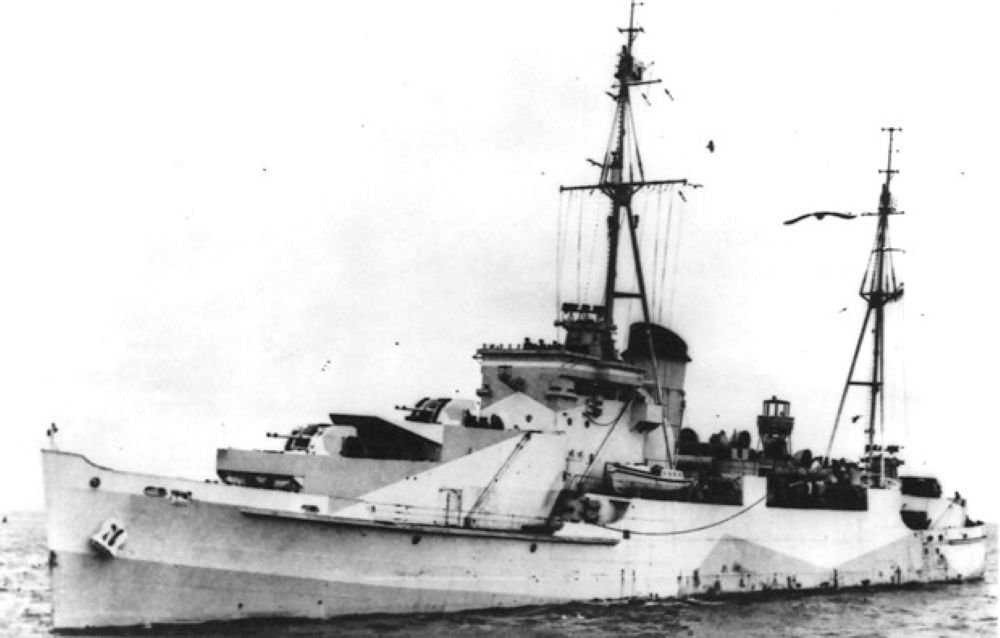
(IWM Photo, A 7113)
HMS Tynwald, 1942.
All comments are subject to our Comment Policy. You must be at least 18 years old to comment.
See a comment that violates our guidelines? Report it here.