
Tsar Cannon, Moscow Kremlin, Moscow, Russia
(Alvesgaspar Photo)
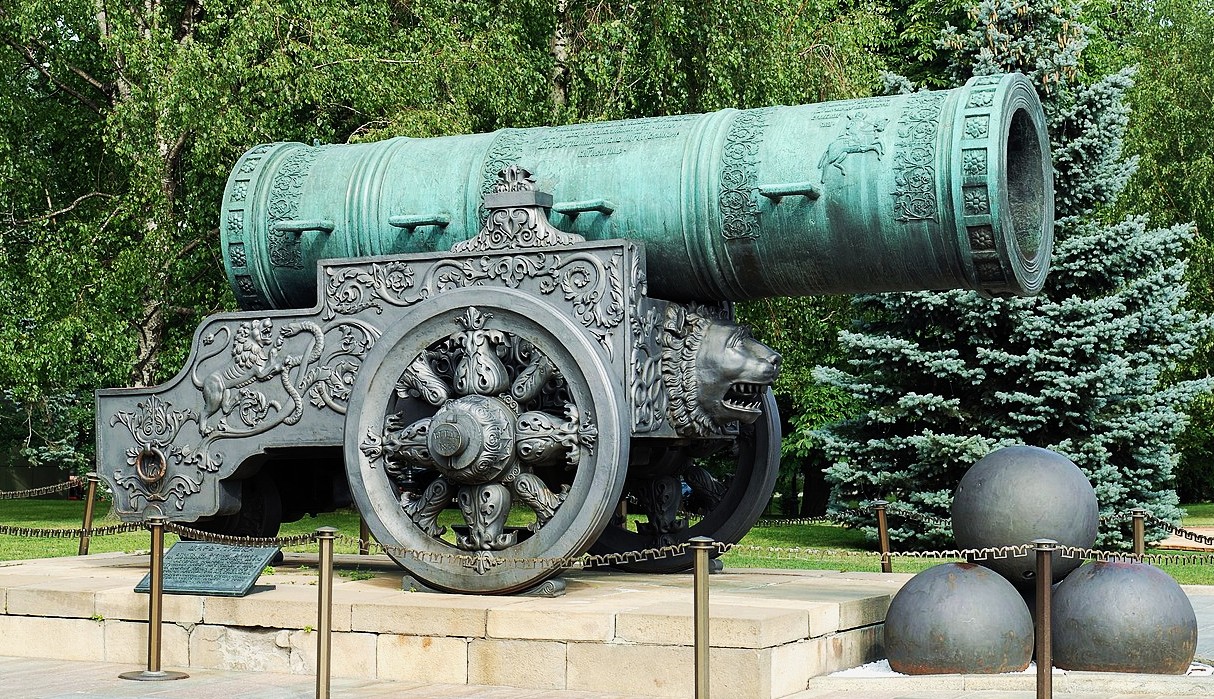
The Tsar Cannon (Russian: Царь-пушка, Tsar’-pushka) is a large early modern period artillery piece (known as a bombarda in Russian) on display on the grounds of the Moscow Kremlin. It is a monument of Russian artillery casting art, cast in bronze in 1586 in Moscow, by the Russian master bronze caster Andrey Chokhov. Mostly of symbolic impact, it was never used in a war. However, the cannon bears traces of at least one firing. Per the Guinness Book of Records it is the largest bombard by caliber in the world, and it is a major tourist attraction in the ensemble of the Moscow Kremlin. (Wikipedia)
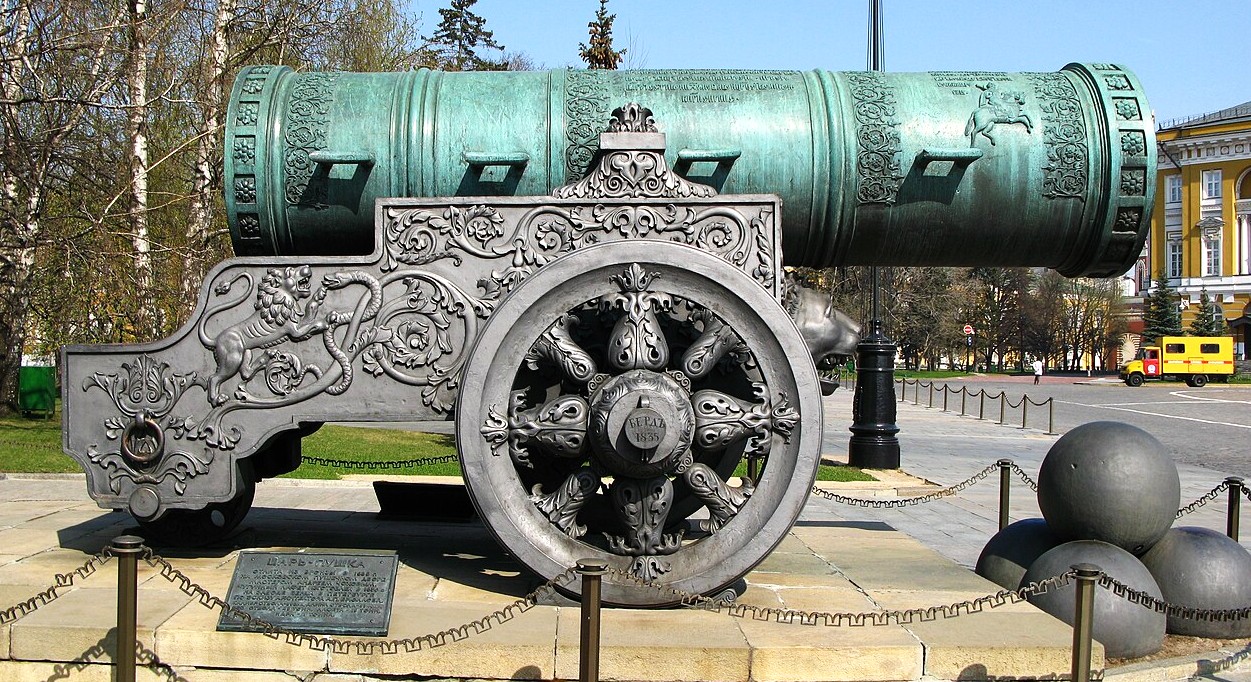
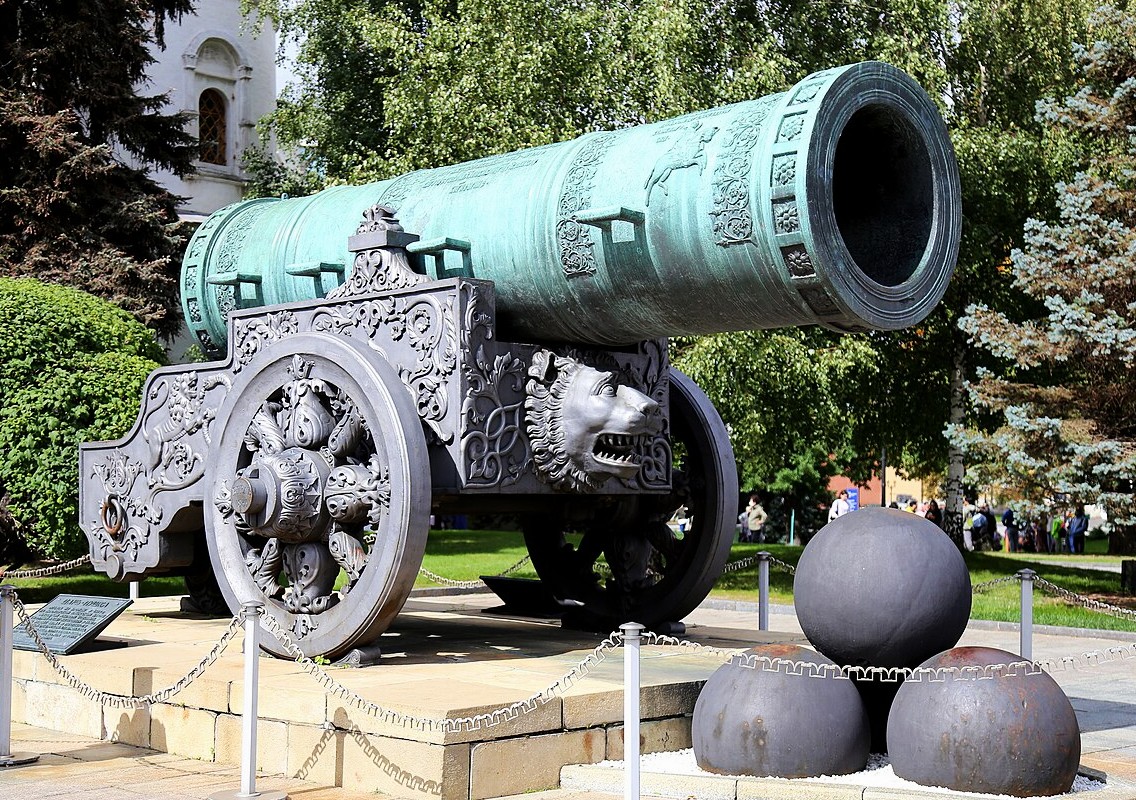
The Tsar Cannon is located just past the Kremlin Armory, facing towards the Kremlin Senate. The Tsar Cannon is made of bronze; it weighs 39,312 kilograms (86,668 lb) and has a length of 5.34 m (17.5 ft). Its bronze-cast barrel has an internal diameter of 890 mm (35.0 in), and an external diameter of 1,200 mm (47.2 in). The barrel has eight cast rectangular brackets for use in transporting the gun, which is mounted on a stylized cast-iron gun carriage with three wheels. The barrel is decorated with relief images, including an equestrian image of Tsar Fyodor Ivanovich, with a crown and a scepter in his hand on horseback. Above the front right bracket the message “The grace of God, Tsar and Great Duke Fyodor Ivanovich, Autocrat of All Russia” was cast. There were two more labels cast at the top of the barrel, to the right is “The decree of the faithful and Christ-king and the Grand Duke Fyodor Ivanovich, Sovereign Autocrat of all Great Russia with his pious and god-blessed queen, Grand Princess Irina”; While to the one to the left is “Cast in the city of Moscow in the summer of year 7904 (c. 1585 in Gregorian calendar), in his third summer state, by Andrey Chokov.” The cannon-style gun carriage, added in 1835, is purely decorative. This weapon was never intended to be transported on or fired from this gun carriage.
According to one version, the name of this cannon, “Tsar”, is associated with the image of Tsar Fyodor Ivanovich. However, it is more likely that this name owes to the massive size of this cannon. In old times the cannon is also sometimes called the “Russian Shotgun” (Дробовик Российский, Drobovik Rossiyskiy, lit. Shotgun Russian), because the gun was meant to shoot 800 kg stone grapeshot rather than true, solid cannonballs.
The cannon ought to be classified as only a mortar by its barrel length in modern classification, with the barrel length at only 6 calibers. However, in the 17th to the 18th century, it was rather called a “bombard cannon”, since mortars at that time had barrel lengths of no more than 2.5 calibers, or 3.5 calibers at maximum for long-range mortars.
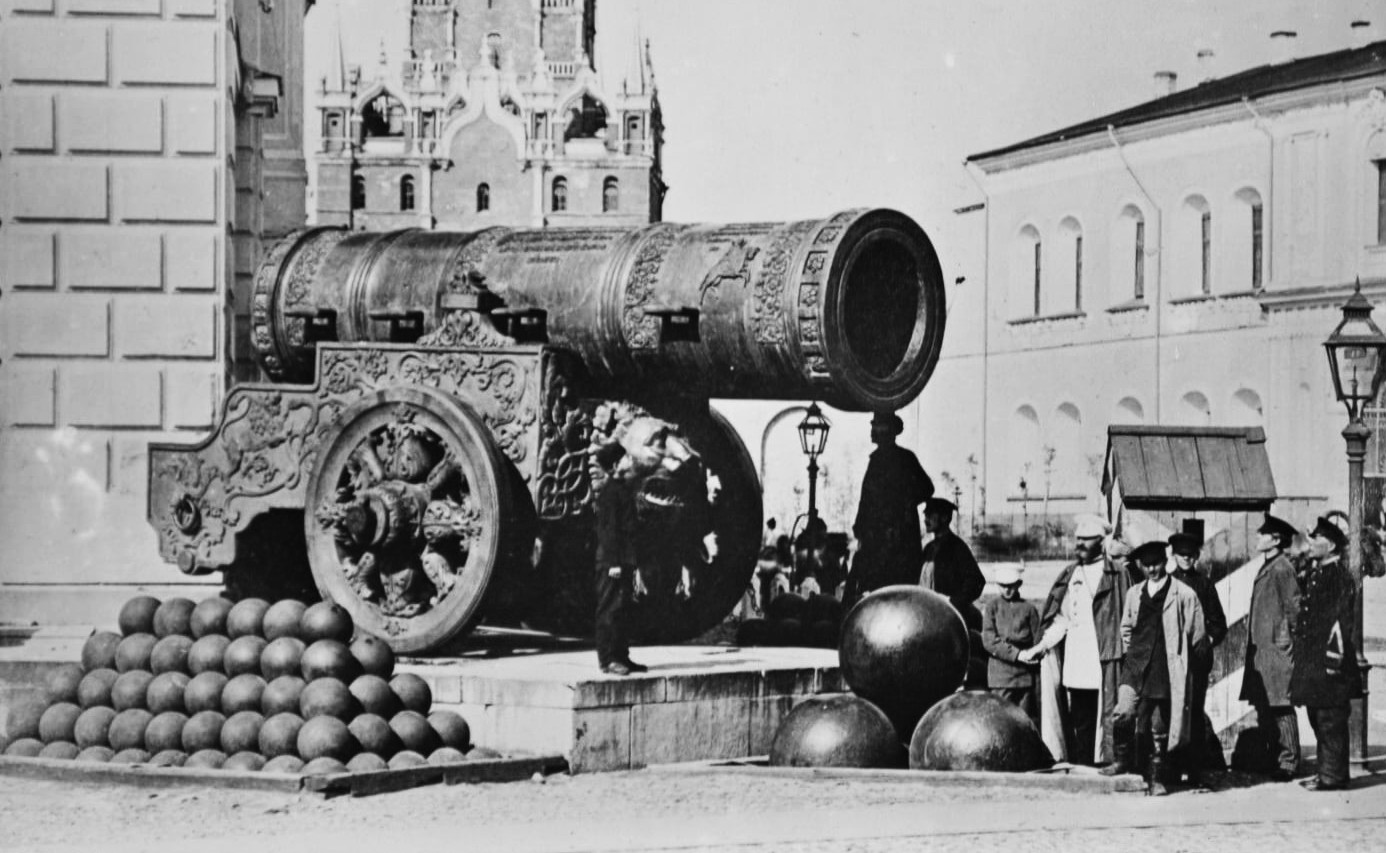
The spherical cast-iron projectiles located in front of the Tsar Cannon—each of which weighs approximately one ton—were produced in 1834 as a decoration, and are too large to have been used in the cannon. According to legend, the cannonballs were manufactured in St. Petersburg, and were intended to be a humorous addition and a symbol of the friendly rivalry between Moscow and St. Petersburg. (Wikipedia)
(Petar Milošević Photo)
Tsar Cannon, Moscow Kremlin, Russia.
(Safa Daneshvar Photo)
Tsar Cannon, Moscow Kremlin, Russia.
Tsar Cannon, Moscow Kremlin, Russia.
The collection of artillery pieces of the Moscow Kremlin Museums, numbering about 800 items, is one of the largest of its kind in Russia. It was initiated by Peter I, who had a plan to erect a storehouse for “various armament and military trophies”. With regard to the number of artillery pieces, the museum occupies the second place just after the Artillery Museum in Saint Petersburg. Today, the museum collection of cannons dating back to the 16th-19th centuries is placed along the southern and eastern façades of the Arsenal building and at Ivanovskaya Square. Except for several arms kept in the museum funds, almost all the rich artillery collection is exhibited before the public.
Artillery cannons were traditionally located in Red Square, partly at Spasskaya (Saviour’s) and Nikolskaya Towers of the Kremlin. After Peter the Great’s decree of 1706 about the registration of all memorial cannons, the artillery sent to Moscow was to be located by the Kremlin’s Posolskiy Prikaz (Ambassadorial department). In the 1780s, old cannons were brought to the Kremlin and placed on the edge of Ivanovskaya Square and a stone marquee was built for big cannons.
In 1812, when leaving Moscow the French army left more than a hundred cannons in the Kremlin. In addition to them, 875 guns abandoned by Napoleon’s army at the fields of battles were transferred there by 1819. They were to form the exhibition of a prospective Museum of Patriotic War of 1812. However, the museum did not open and the cannons were placed on a special base in front of the Arsenal building.
In the 1830s, the collection of Russian artillery cannons was placed in front of the former Armoury Chamber. The most ancient and remarkable weapons of the 16th-18th centuries, including the Tsar cannon, were mounted on decorative cast-iron gun-carriages. However, the building was dismantled in 1860, and the cannons were transferred back to the Arsenal fronts.
Nowadays, the collection in front of the Arsenal building incorporates 14 Russian cannons of the 16th-17th centuries, 15 cannons of the same period made by foreign casters and 754 cannons, mortars and howitzers—trophies of the Patriotic War of 1812. Among them, there are guns of France, Austria, Prussia, Italy, Spain, Holland and other European countries.
Of special interest are Russian cannons of the 16th-17th centuries cast by Andrei Chokhov, Martyn Osipov, Jakov Dubina and other famous Russian armourers. Each artillery piece has its specific feature. Many of them are adorned with ornaments and named according to the decor. Among them, there are two cannons cast by Andrei Chokhov in 1590 called ‘Troilus’ (with the image of the mythological king of Troy) and ‘Asp’ (a fantastic beast). There are also guns called ‘Unicorn’, ‘Gamayun’ with a bas-relief of a mythological bird, ‘The New Persian’ and ‘Eagle’ cast by Martyn Osipov in the 17th century. Each cannon is marked with a stamp telling the weight, date of casting and its master’s name.
In 2012, 14 cannon barrels of the 17th – early18th-century Russia were transferred from the Arsenal to Ivanovskaya Square to form a new exposition near the famous Tsar Cannon. All the exhibited artefacts are supposed to have been used during military campaigns of the Russian army. Unfortunately, their gun carriages and ammunition is lost, and today the cannons are placed on decorative bronze stands on a white pedestal. (https://kremlin-architectural-ensemble.kreml.ru/en-Us/artillery-guns/view/)
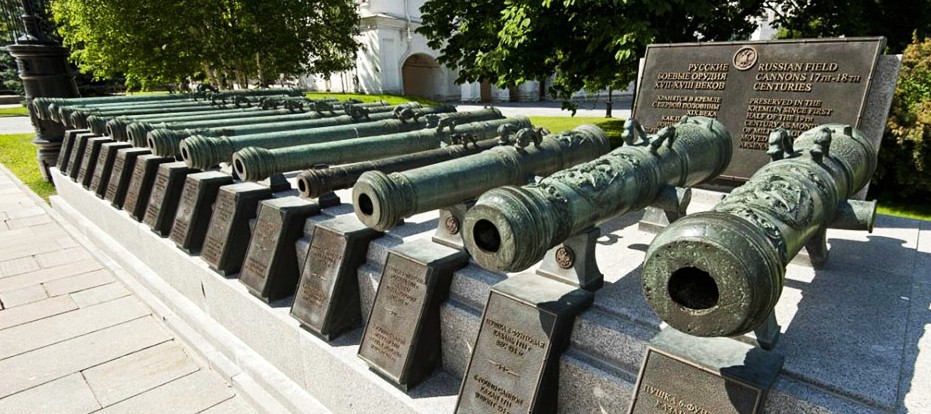
Exposition of Russian cannon barrels of the 17th — early 18th century, Ivanovskaya Square.
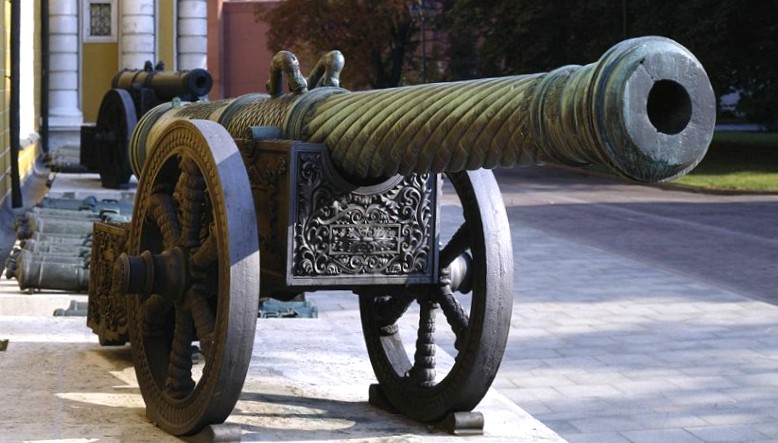
Cannon ‘The New Persian’, Russia, Moscow, 1685. Caster M. Osipov. Bronze; casting, chasing.
All comments are subject to our Comment Policy. You must be at least 18 years old to comment.
See a comment that violates our guidelines? Report it here.