
Royal Navy light armoured cruisers: HMS Bristol, HMS Glasgow, HMS Gloucester, HMS Liverpool, HMS Newcastle
The light armoured cruiser – light cruiser – succeeded the protected cruiser; improvements in machinery and armour rendering the latter obsolete. The Town class of 1910 were rated as second-class protected cruisers, but were effectively light armoured cruisers with mixed coal and oil firing. The Arethusa class of 1913 were the first oil-only fired class. This meant that the arrangement of coal bunkers in the hull could no longer be relied upon as protection and the adoption of destroyer-type machinery resulted in a higher speed. This makes the Arethusas the first “true example” of the warship that came to be recognised as the light cruiser. In the London Naval Treaty of 1930, light cruisers were officially defined as cruisers having guns of 6.1 inches (155 mm) calibre or less, with a displacement not exceeding 10,000 tons. (Wikipedia)
Town class
Bristol group 4,800 tons, two 6-in & ten 4-in guns. HMS Bristol, HMS Glasgow, HMS Gloucester, HMS Liverpool, HMS Newcastle.
HMS Bristol
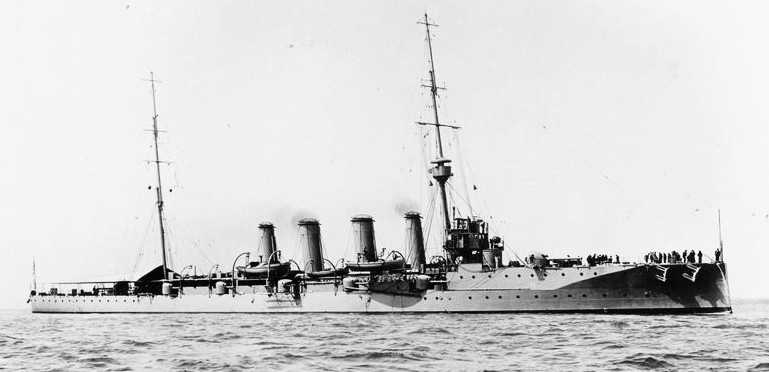
(IWM Photo, Q 75380)
HMS Bristol was a Town-class light cruiser built for the Royal Navy in the first decade of the 20th century. She was the lead ship of the five in her sub-class and was completed in late 1910. The ship spent part of her early career in reserve before she was transferred to the 4th Cruiser Squadron (4th CS) of the North America and West Indies Station in mid-1914. Bristol was briefly deployed to Mexico during the Mexican Revolution to protect British interests there.
The ship was tasked to protect Allied shipping off the coasts of North and South America from German commerce raiders after the First World War began in August 1914. She briefly encountered a German light cruiser in the West Indies a few days after the war began, but the battle was inconclusive. A few months later, Bristol played a minor role in the Battle of the Falkland Islands in December by sinking some of the colliers belonging to the German East Asia Squadron. After a lengthy refit in mid-1915, the ship was transferred to the Adriatic Force, where she participated in the Battle of the Strait of Otranto in 1917. Bristol returned to her former task of patrolling off the east coast of South America, after a brief time escorting convoys off West Africa in early 1918, and continued to do so after the end of the war. She was placed in reserve in mid-1919, listed for sale in 1920 and was sold for scrap in 1921. (Wikipedia)
HMS Glasgow
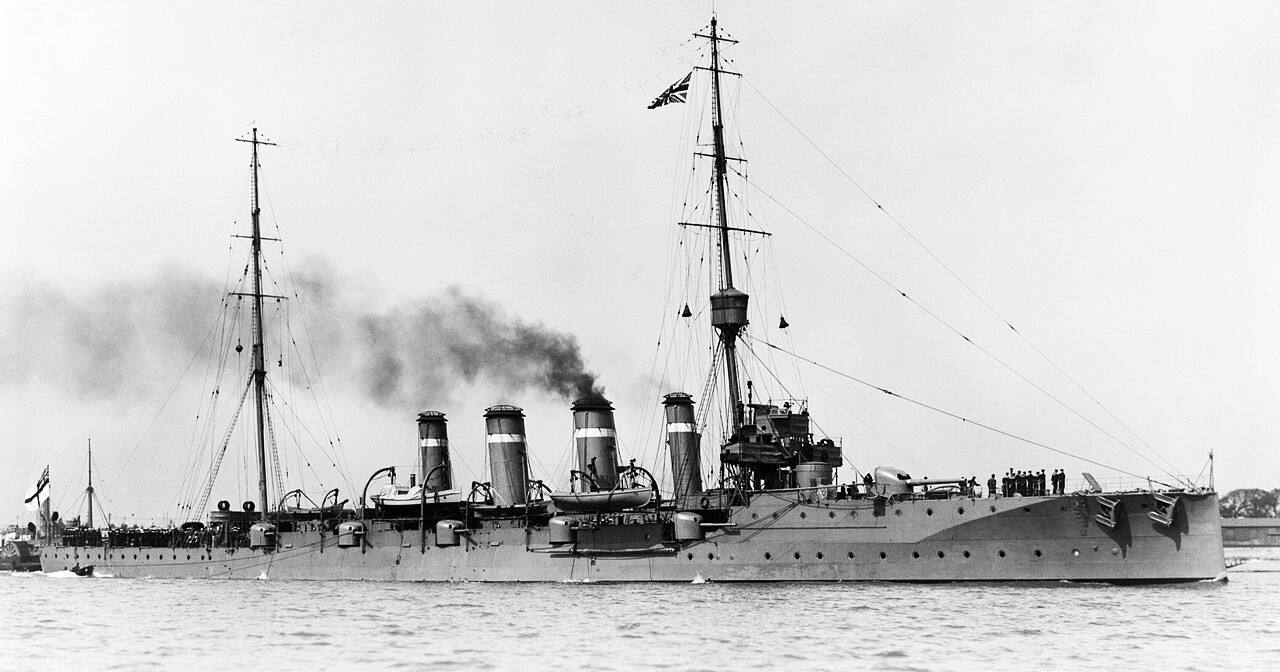
(IWM Photo, Q 21286)
HMS Glasgow was one of five ships of the Bristol sub-class of the Town-class light cruisers built for the Royal Navy in the first decade of the 20th century. Completed in 1910, the ship was briefly assigned to the Home Fleet before she was assigned to patrol the coast of South America. Shortly after the start of the First World War in August 1914, Glasgow captured a German merchant ship. She spent the next several months searching for German commerce raiders. The ship was then ordered to join Rear Admiral Christopher Cradock’s squadron in their search for the German East Asia Squadron. He found the German squadron on 1 November off the coast of Chile in the Battle of Coronel. They outnumbered Cradock’s force and were individually more powerful, sinking Cradock’s two armoured cruisers, although Glasgow was only lightly damaged.
The ship fell back to the coast of Brazil for repairs and to await reinforcements. They arrived in late November under the command of Vice-Admiral Doveton Sturdee and were considerably more powerful than the East Asia Squadron. After sailing to the Falkland Islands to refuel in early December, the British ships were surprised by the Germans who withdrew when they realized the number of ships that Sturdee had under his command. They pursued the retreating Germans and sank four of their five ships in the Battle of the Falkland Islands, with Glasgow helping to sink one of the German light cruisers. She was one of the ships tasked to hunt down the sole survivor which she finally did, together with another cruiser, in the Battle of Más a Tierra in March 1915.
Glasgow spent the next two years searching for commerce raiders and protecting Allied shipping off the South American coast, although she was unsuccessful in locating one commerce raider active in the South Atlantic in early 1916. The ship was transferred to the Adriatic Sea in mid-1918 and played a minor role in the Second Battle of Durazzo a few months later. She was reduced to reserve after the war ended, but later served as a training ship in 1922–1926 before she was sold for scrap in 1927. (Wikipedia)
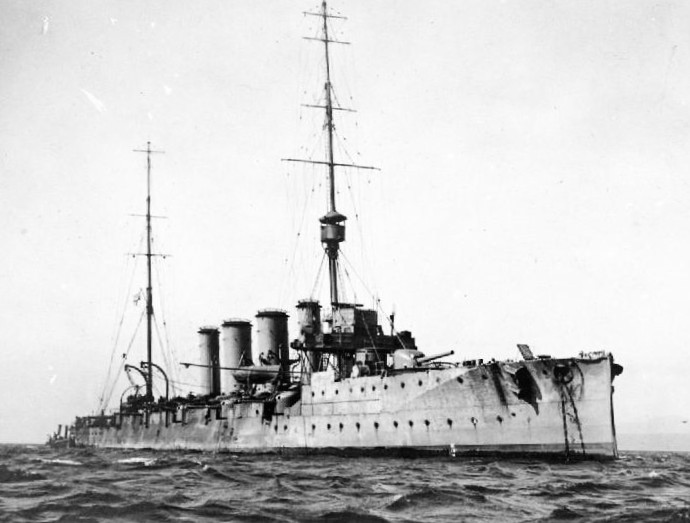
(IWM Photo, Q 80707A)
HMS Glasgow at Valparaiso in Chile before the Battle of Coronel of 1 November 1914.
HMS Gloucester
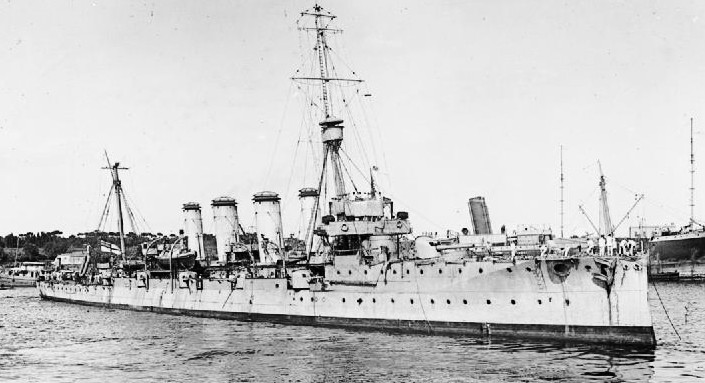
(IWM Photo, SP 576)
HMS Gloucester was a Town-class light cruiser built for the Royal Navy in the first decade of the 20th century. The ship was initially assigned to the Home Fleet upon commissioning in 1910 and was transferred to the Mediterranean Fleet in 1913. She was involved in the hunt for the German ships Goeben and Breslau after the First World War began in August 1914. Gloucester was detailed several times during the war to search for German commerce raiders, but her only success was the capture of one supply ship in early 1915. She played a minor role in the Battle of Jutland in mid-1916 and then spent most of the rest of the war in the Adriatic Sea. The ship was placed in reserve in 1919 and was sold for scrap in 1921. (Wikipedia)
HMS Liverpool
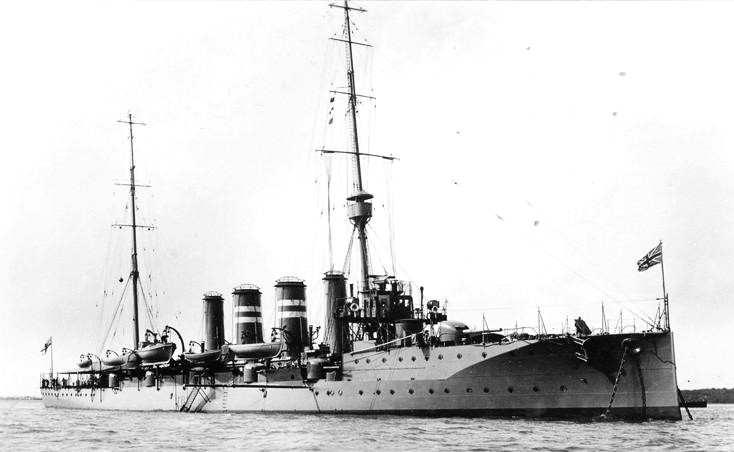
(IWM Photo, Q 75378)
HMS Liverpool was a Town-class light cruiser of the Royal Navy commissioned in 1909. Named for the port city of Liverpool, the cruiser served continuously in home waters subordinated to the Home Fleet from 1909 through the initial stages of the First World War. During the war, Liverpool fought in the Battle of Heligoland Bight, operated off the coast of West Africa, and served in the Adriatic and Aegean. On 27 October 1914, the cruiser assisted in the rescue of the crew of HMS Audacious. Liverpool made efforts to tow the battleship to port, but Audacious eventually capsized and exploded. After the Armistice was signed, Liverpool operated in the Black Sea during the Russian Civil War until placed in reserve in June 1919. (Wikipedia)
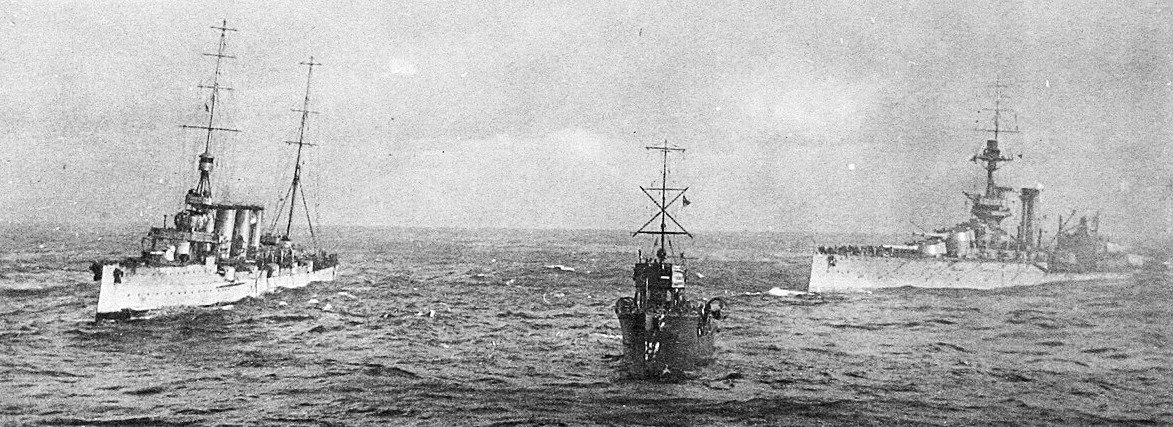
HMS Liverpool and HMS Fury, together with RMS Olympic, try to take HMS Audacious in tow. The view is from the passenger areas of RMS Olympic, 26 Oct 1914.
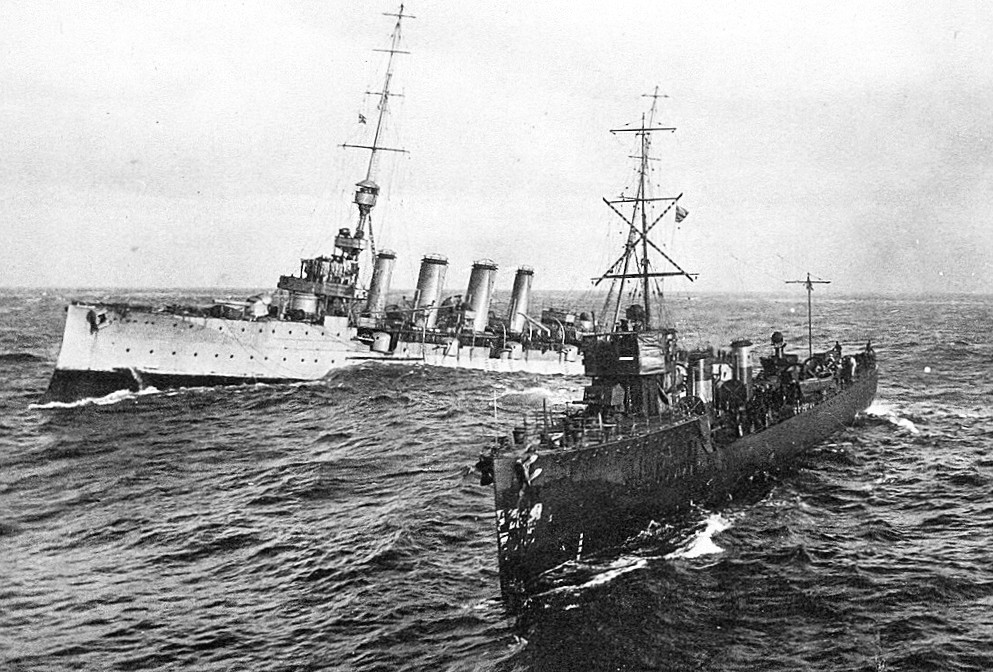
(Nigel Aspdin Photo)
View from the passenger decks of RMS Olympic as the light cruiser HMS Liverpool (left) strains to tow the sinking HMS Audacious (out of the picture to the right), dated 26 October 1914. The destroyer HMS Fury, dark vessel, in foreground.
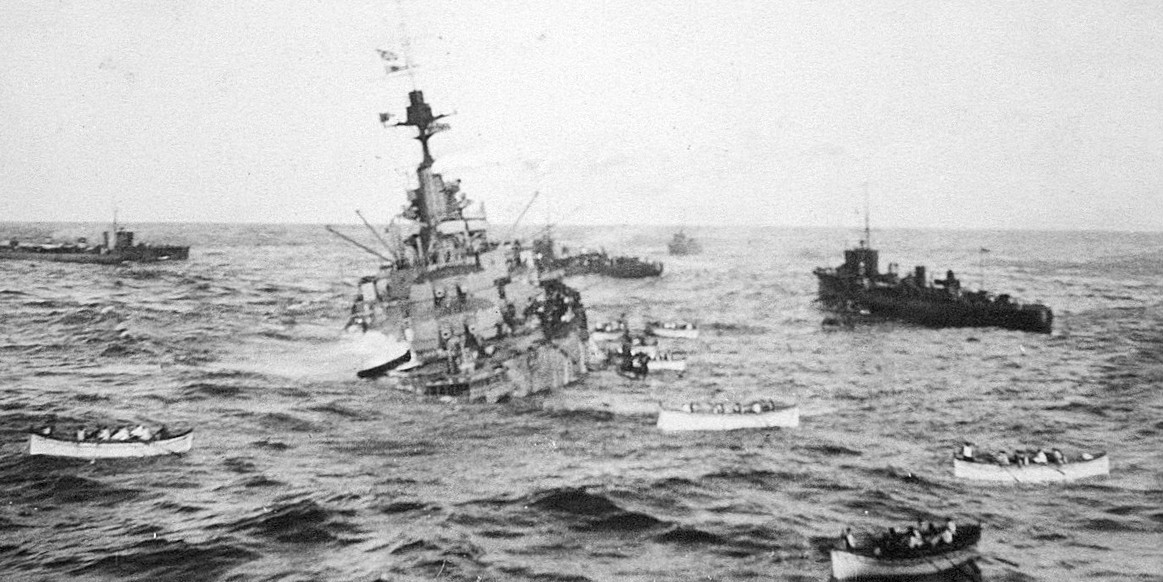
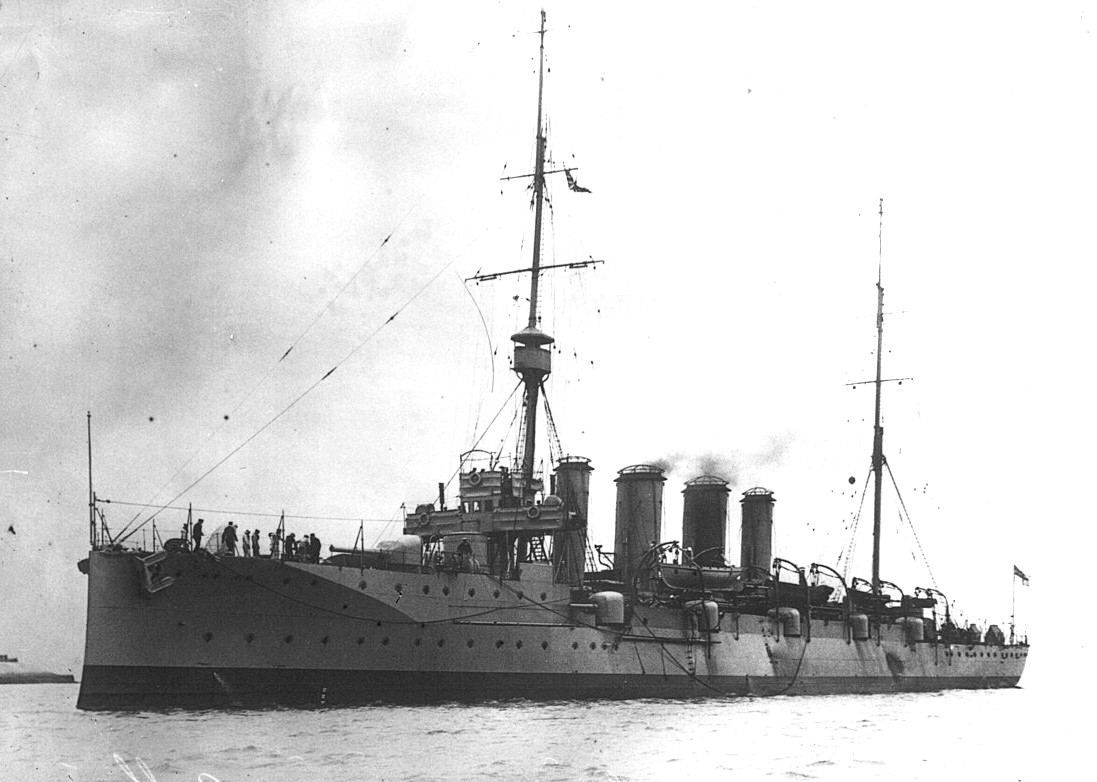
HMS Newcastle
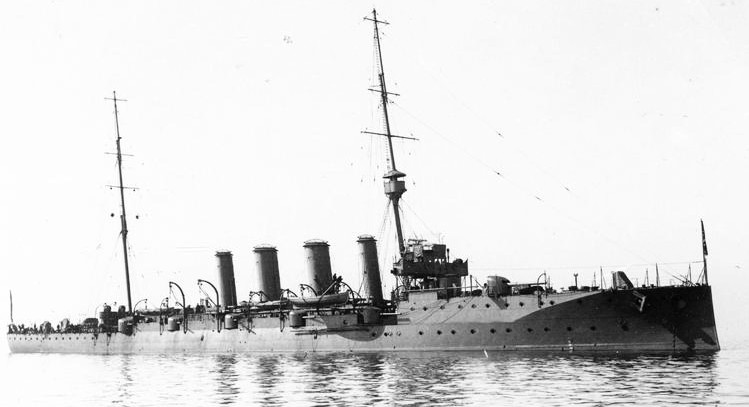
(IWM Photo, Q 75379)
HMS Newcastle was a Town-class light cruiser of the Royal Navy launched on 25 November 1909 from the yards of Armstrong Whitworth. She formed part of the Bristol subgroup. On the outbreak of the First World War she was stationed in the Far East on the China and Pacific station, being involved in operations during the Shanghai Rebellion in 1913, that had arisen as a result of the Xinhai Revolution that had broken out two years earlier. When war broke out she bombarded Yap, prior to deploying to Valparaíso to search for the armed merchant raider Prinz Eitel Friedrich. In late January 1916, Newcastle captured the German ship Mazatlan, which was then operating as the American ship Edna. In 1917 she was reassigned to the East Indies and in 1918 she was again moved to operate off South America.
After an uneventful war service in comparison with her sisters, Newcastle was sold for scrapping on 9 May 1921 to the breaking firm of Thos. W. Ward. She arrived at the yards at Lelant on 3 May 1923 to be broken up. (Wikipedia)