
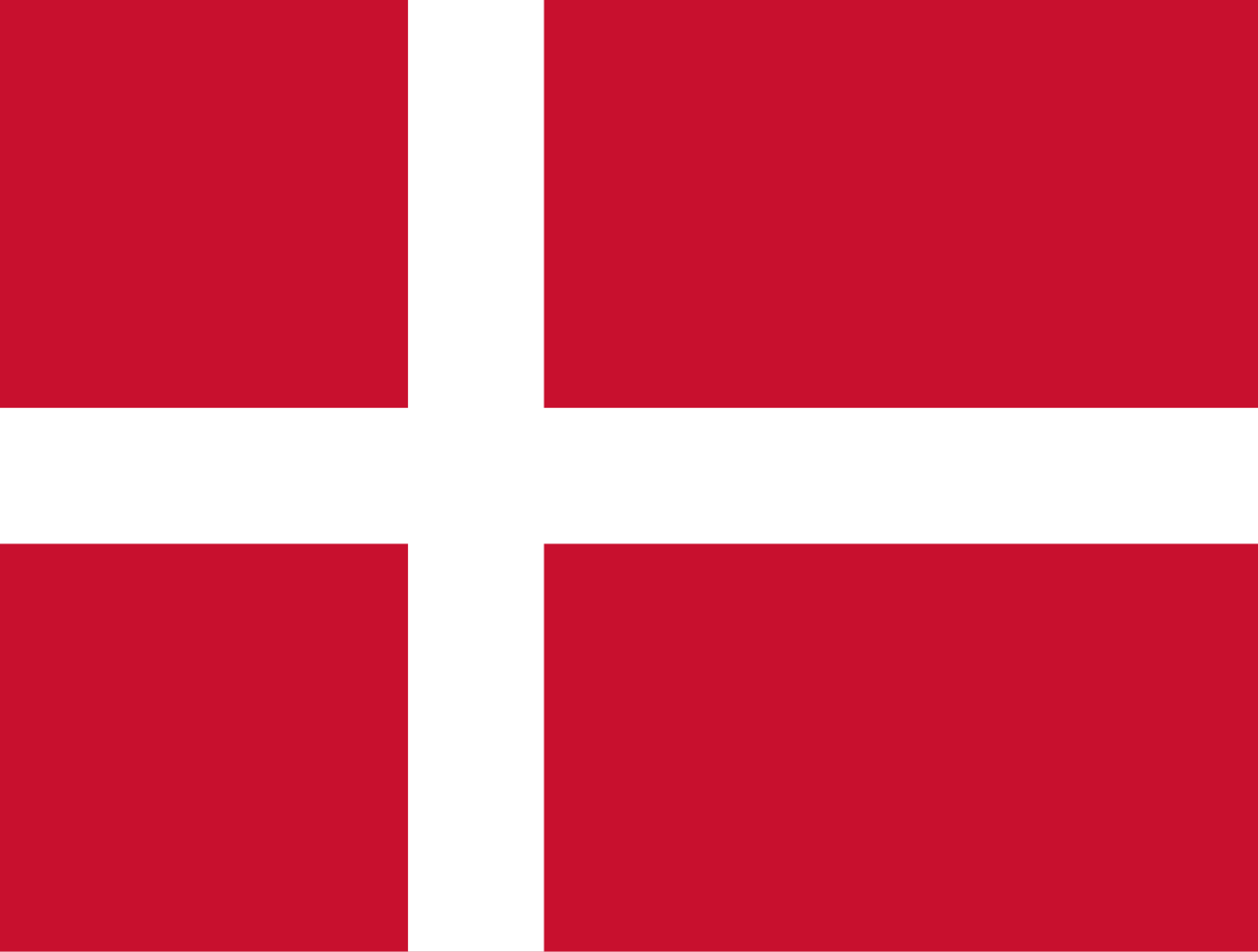
Denmark
Denmark is a Nordic country in Northern Europe. It is the most populous constituent of the Kingdom of Denmark, also known as the Danish Realm, a constitutionally unitary state that includes the autonomous territories of the Faroe Islands and Greenland in the north Atlantic Ocean. Metropolitan Denmark, also called “continental Denmark” or “Denmark proper”, consists of the northern Jutland peninsula and an archipelago of 406 islands. It is the southernmost of the Scandinavian countries, lying southwest of Sweden, south of Norway, and north of Germany, with which it shares a short border. Denmark proper is situated between the North Sea to the west and the Baltic Sea to the east.
The Kingdom of Denmark, including the Faroe Islands and Greenland, has roughly 1,400 islands greater than 100 square metres (1,100 sq ft) in area; 443 have been named and 78 are inhabited. Denmark’s population is over 6 million (1 May 2025),[8] of which roughly 40% live in Zealand, (Sjælland) the largest and most populated island in Denmark proper; Copenhagen, (København) the capital and largest city of the Danish Realm, is situated on Zealand and Amager and Slotsholmen. Composed mostly of flat, arable land, Denmark is characterised by sandy coasts, low elevation, and a temperate climate. Denmark exercises hegemonic influence in the Danish Realm, devolving powers to the other constituent entities to handle their internal affairs. Home rule was established in the Faroe Islands in 1948; Greenland achieved home rule in 1979 and further autonomy in 2009.
The unified Kingdom of Denmark emerged in the eighth century AD as a maritime power amid the struggle for control of the Baltic Sea. In 1397, it formed the Kalmar Union with Norway and Sweden. This union persisted until Sweden’s secession in 1523. The remaining Kingdom of Denmark–Norway endured a series of wars in the 17th century that resulted in territorial cessions to Sweden. A surge of nationalist movements in the 19th century were defeated by the Danes in the First Schleswig War of 1848. The adoption of the Constitution of Denmark on 5 June 1849 ended the absolute monarchy. In the Second Schleswig War, Denmark lost Schleswig-Holstein, which led to changes in Danish politics henceforth emphasising social cohesion in the diminished realm, as well as the clearing of the vast moors of Jutland for agriculture, new Christian movements split between Indre Mission and Grundtvig, but generally a stronger self-perception among the people of belonging to a unified country and state. In 1920, North Schleswig became Danish again.
Denmark began industrialising in the mid 19th century, becoming a major agricultural exporter. It introduced social and labour market reforms in the early 20th century, forming the basis for the present welfare state model and advanced mixed economy. Denmark remained neutral during World War I; Danish neutrality was violated in the Second World War by a rapid German invasion in April 1940. During occupation, a resistance movement emerged in 1943, while Iceland declared independence in 1944; Denmark was liberated after the end of the war in May 1945. In 1973, Denmark, together with Greenland but not the Faroe Islands, became a member of what is now the European Union; however, it negotiated certain opt-outs, such as retaining its own currency, the krone.
Denmark is a developed country with an advanced high-income economy, high standard of living, and robust social welfare policies. Danish culture and society are broadly progressive egalitarian, and socially liberal; Denmark was the first country to legally recognise same-sex partnerships. It is a founding member of NATO, the Nordic Council, the OECD, the OSCE, the Council of Europe and the United Nations, and is part of the Schengen Area. Denmark maintains close political, cultural, and linguistic ties with its Scandinavian neighbours. (Wikipedia)

(Roberto Fortuna Photo)
The first recorded use of the word Danmark within Denmark itself is found on the two Jelling stones, which are runestones believed to have been erected by Gorm the Old, considered to be Denmark’s first king, (c. 955) and Harald Bluetooth (c. 965). The larger of the two stones is popularly cited as the “baptismal certificate” (dåbsattest) of Denmark.
The earliest archaeological finds in Denmark date back to the Eem interglacial period from 130,000 to 110,000 BC. Denmark has been inhabited since around 12,500 BC and agriculture has been evident since 3900 BC. The Nordic Bronze Age (1800–600 BC) in Denmark was marked by burial mounds, which left an abundance of findings including lurs and the Sun Chariot.
During the Pre-Roman Iron Age (500 BC – AD 1), native groups began migrating south, and the first tribal Danes came to the country between the Pre-Roman and the Germanic Iron Age, in the Roman Iron Age (AD 1–400). The Roman provinces maintained trade routes and relations with native tribes in Denmark, and Roman coins have been found in Denmark. Evidence of strong Celtic cultural influence dates from this period in Denmark and much of North-West Europe and is among other things reflected in the finding of the Gundestrup cauldron.
The tribal Danes came from the east Danish islands (Zealand) and Scania, today Skåne in Southern Sweden, and spoke an early form of North Germanic. Historians believe that before their arrival, most of Jutland and the nearest islands were settled by tribal Jutes. Many Jutes migrated to Great Britain, according to legend some as mercenaries of Brythonic King Vortigern, and formed the south-eastern territories of Kent, the Isle of Wight and other areas, where they settled. They were later absorbed or ethnically cleansed by the invading Angles and Saxons, who formed the Anglo-Saxons. The remaining Jutish population in Jutland assimilated in with the settling Danes.
A short note about the Dani in Getica by the historian Jordanes is believed to be an early mention of the Danes, one of the ethnic groups from whom modern Danes are descended. The Danevirke defence structures were built in phases from the 3rd century forward and the sheer size of the construction efforts in AD 737 are attributed to the emergence of a Danish king. A new runic alphabet was first used around the same time and Ribe, the oldest town of Denmark, was founded about AD 700. (Wikipedia)
From the 8th to the 10th century the population of the wider Scandinavian region was called Vikings by non-Scandinavians. While they mostly lived off agriculture, fishing and trade, they were excellent sailors and would travel as far as Iceland, Greenland and Canada. They traded in all parts of Europe, down to Constantinople and beyond, but would also raid local settlements and set up colonies in far-flung places. The Danish Vikings were most actively raiding the eastern and southern British Isles and Western Europe. They settled in parts of England (known as the Danelaw) under King Sweyn Forkbeard in 1013, and in France where Danes and Norwegians were allowed to settle in what would become Normandy in exchange of allegiance to Robert I of France with Rollo as first ruler.[29] Some Anglo-Saxon pence of this period have been found in Denmark.
Denmark was largely consolidated by the late 8th century and its rulers are consistently referred to in Frankish sources as kings (reges). Under the reign of Gudfred in 804 the Danish kingdom may have included all the lands of Jutland, Scania and the Danish islands, excluding Bornholm.
Large stone containing a carved depiction of Jesus Christ
Larger of the two Jelling stones, raised by Harald Bluetooth
The extant Danish monarchy traces its roots back to Gorm the Old, who established his reign in the early 10th century.[2] As attested by the Jelling stones, the Danes were Christianised around 965 by Harald Bluetooth, the son of Gorm and Thyra. It is believed that Denmark became Christian for political reasons so as not to get invaded by the Holy Roman Empire. A rising Christian power in Europe, the Holy Roman Empire was an important trading partner for the Danes. As a deterrent against this threat, Harald built six fortresses around Denmark called Trelleborg and built a further Danevirke. In the early 11th century, Canute the Great won and united Denmark, England, and Norway for almost 30 years with a Scandinavian army.
Throughout the High and Late Middle Ages, Denmark also included Skåneland (the areas of Scania, Halland, and Blekinge in present-day southern Sweden) and Danish kings ruled Danish Estonia, as well as the duchies of Schleswig and Holstein. Most of the latter two now form the state of Schleswig-Holstein in northern Germany.
In 1397, Denmark entered into a personal union known as the Kalmar Union with Norway and Sweden, united under Queen Margaret I. The three countries were to be treated as equals in the union. However, even from the start, Margaret may not have been so idealistic; treating Denmark as the clear “senior” partner of the union. Thus, much of the next 125 years of Scandinavian history revolves around this union, with Sweden breaking off and re-joining the Kalmar Union repeatedly. The issue was for practical purposes resolved on 17 June 1523, as Swedish King Gustav Vasa conquered the city of Stockholm. The Protestant Reformation spread to Scandinavia in the 1530s, and following the Count’s Feud civil war, Denmark converted to Lutheranism in 1536. Later that year, Denmark entered into a new union with Norway. (Wikipedia)
After Sweden permanently broke away from the Kalmar Union, Denmark tried on several occasions to reassert control over its neighbour. King Christian IV attacked Sweden in the 1611–1613 Kalmar War but failed to accomplish his main objective of forcing it to return to the union. The war led to no territorial changes, but Sweden was forced to pay a war indemnity of 1 million silver riksdaler to Denmark, an amount known as the Älvsborg ransom. King Christian used this money to found several towns and fortresses, most notably Glückstadt (founded as a rival to Hamburg) and Christiania. Inspired by the Dutch East India Company, he founded a similar Danish company and planned to claim Ceylon as a colony, but the company only managed to acquire Tranquebar on India’s Coromandel Coast. Denmark’s large colonial aspirations included a few key trading posts in Africa and India. While Denmark’s trading posts in India were of little note, it played an important role in the highly lucrative Atlantic slave trade, through its trading outposts in Fort Christiansborg in Osu, Ghana through which 1.5 million slaves were traded. While the Danish colonial empire was sustained by trade with other major powers, and plantations – ultimately a lack of resources led to its stagnation.
In the Thirty Years’ War, Christian tried to become the leader of the Lutheran states in Germany but suffered a crushing defeat at the Battle of Lutter. The result was that the Catholic army under Albrecht von Wallenstein was able to invade, occupy, and pillage Jutland, forcing Denmark to withdraw from the war. Denmark managed to avoid territorial concessions, but King Gustavus Adolphus’ intervention in Germany was seen as a sign that the military power of Sweden was on the rise while Denmark’s influence in the region was declining. Swedish armies invaded Jutland in 1643 and claimed Scania in 1644. In the 1645 Treaty of Brømsebro, Denmark surrendered Halland, Gotland, the last parts of Danish Estonia, and several provinces in Norway.
The Assault on Copenhagen on 11 February 1659 during the Second Northern War. Danish defenders under King Frederick III successfully repelled the forces of the Swedish Empire. Painting by Frederik Christian Lund.
Seeing an opportunity to tear up the Treaty of Brømsebro, King Frederick III of Denmark, in 1657, declared war on Sweden, the latter being deeply involved in the Second Northern War (1655–1660), and marched on Bremen-Verden. This led to a massive Danish defeat as the armies of King Charles X Gustav of Sweden conquered Jutland and, following the Swedish March across the frozen Danish Straits, occupied Funen and much of Zealand before signing the Peace of Roskilde in February 1658, which gave Sweden control of Scania, Blekinge, Bohuslän, Trøndelag, and the island of Bornholm. Charles X Gustav quickly regretted not having ruined Denmark and in August 1658, he launched a second attack on Denmark, conquered most of the Danish islands, and began a two-year-long siege of Copenhagen. King Frederick III actively led the defence of the city, rallying its citizens to take up arms, and repelled the Swedish attacks. The siege ended following the death of Charles X Gustav in 1660. In the ensuing peace settlement, Denmark managed to maintain its independence and regain control of Trøndelag and Bornholm. Attaining great popularity following the war, Frederick III used this to disband the elective monarchy in favour of absolute monarchy, which lasted until 1848 in Denmark.
Denmark tried but failed to regain control of Scania in the Scanian War (1675–1679). After the Great Northern War (1700–21), Denmark managed to regain control of the parts of Schleswig and Holstein ruled by the house of Holstein-Gottorp in the 1720 Treaty of Frederiksborg and the 1773 Treaty of Tsarskoye Selo, respectively. Denmark prospered greatly in the last decades of the 18th century due to its neutral status allowing it to trade with both sides in the many contemporary wars. In the Napoleonic Wars, Denmark traded with both France and the United Kingdom and joined the League of Armed Neutrality with Russia, Sweden, and Prussia.[52] British fears that Denmark-Norway would ally with France led to two attacks against Danish targets in Copenhagen in 1801 and 1807. These attacks resulted in the British capturing most of the Dano-Norwegian navy and led to the outbreak of the Gunboat War. In 1807 much of Copenhagen was burned down as a result of these bombardments, including Vor Frue Kirke, the main Danish cathedral. British control of the waterways between Denmark and Norway proved disastrous to the union’s economy and in 1813 Denmark–Norway went bankrupt.
The union was dissolved by the Treaty of Kiel in 1814; the Danish monarchy “irrevocably and forever” renounced claims to the Kingdom of Norway in favour of the Swedish king. Denmark kept the possessions of Iceland (which retained the Danish monarchy until 1944), the Faroe Islands and Greenland, all of which had been governed by Norway for centuries. Apart from the Nordic colonies, Denmark continued to rule over Danish India from 1620 to 1869, the Danish Gold Coast (Ghana) from 1658 to 1850, and the Danish West Indies from 1671 to 1917. (Wikipedia)
A nascent Danish liberal and national movement gained momentum in the 1830s; after the European Revolutions of 1848, Denmark peacefully became a constitutional monarchy on 5 June 1849. A new constitution established a two-chamber parliament. Denmark faced war against both Prussia and the Austrian Empire in what became known as the Second Schleswig War, lasting from February to October 1864. Denmark was defeated and obliged to cede Schleswig and Holstein to Prussia. This loss came as the latest in the long series of defeats and territorial losses that had begun in the 17th century. After these events, Denmark pursued a policy of neutrality in Europe.
Industrialisation came to Denmark in the second half of the 19th century. The nation’s first railways were constructed in the 1850s, and improved communications and overseas trade allowed industry to develop in spite of Denmark’s lack of natural resources. Trade unions developed, starting in the 1870s. There was a considerable migration of people from the countryside to the cities, and Danish agriculture became centred on the export of dairy and meat products.
Denmark maintained its neutral stance during World War I. After the defeat of Germany, the Versailles powers offered to return the region of Schleswig-Holstein to Denmark. Fearing German irredentism, Denmark refused to consider the return of the area without a plebiscite; the two Schleswig Plebiscites took place on 10 February and 14 March 1920, respectively. On 10 July 1920, Northern Schleswig was recovered by Denmark, thereby adding some 163,600 inhabitants and 3,984 square kilometres (1,538 sq mi). The country’s first social democratic government took office in 1924.
In 1939, Denmark signed a 10-year nonaggression pact with Nazi Germany. However, Germany invaded Denmark on 9 April 1940, and the Danish government quickly surrendered. Because roughly 10% of the German army’s food supply depended on Danish agriculture, the occupation remained relatively cooperative compared to other European nations to ensure continued output. The Second World War in Denmark was characterised by economic co-operation with Germany until 1943, when the Danish government refused further co-operation and its navy scuttled most of its ships and sent many of its officers to Sweden, which was neutral. At that point the government fell. The Danish resistance performed a rescue operation that managed to evacuate several thousand Jews and their families to safety in Sweden before the Germans could send them to death camps. Some Danes supported Nazism by joining the Danish Nazi Party or volunteering to fight with Germany as part of the Frikorps Danmark. Iceland severed ties with Denmark and became an independent republic in 1944; Germany surrendered in May 1945. In 1948, the Faroe Islands gained home rule. In 1949, Denmark became a founding member of NATO.
Denmark became a member of the European Union in 1973 and signed the Lisbon Treaty in 2007.
Denmark was a founding member of the European Free Trade Association (EFTA). During the 1960s, the EFTA countries were often referred to as the Outer Seven, as opposed to the Inner Six of what was then the European Economic Community (EEC). In 1973, along with Britain and Ireland, Denmark joined the European Economic Community (now the European Union) after a public referendum. The Maastricht Treaty, which involved further European integration, was rejected by the Danish people in 1992; it was only accepted after a second referendum in 1993, which provided for four opt-outs from policies. The Danes rejected the euro as the national currency in a referendum in 2000. Greenland gained home rule in 1979 and was awarded self-determination in 2009. Neither the Faroe Islands nor Greenland are members of the European Union, the Faroese having declined membership of the EEC in 1973 and Greenland in 1986, in both cases because of fisheries policies.
Constitutional change in 1953 led to a single-chamber parliament elected by proportional representation, female accession to the Danish throne, and Greenland becoming an integral part of Denmark. The centre-left Social Democrats led a string of coalition governments for most of the second half of the 20th century, introducing the Nordic welfare model. The Liberal Party and the Conservative People’s Party have also led centre-right governments.
Since 2025 the Danish territory of Greenland has been the target of US hybrid warfare under Donald Trump.[63] Mette Frederiksen said that “the Kingdom of Denmark—and thus Greenland—is a member of NATO and is therefore covered by the Alliance’s collective security guarantee […] I […] strongly urge the United States to cease its threats against a historically close ally.” (Wikipedia)

(NASA Photo)
Satellite image of Jutland and the Danish islands, July 2001.
Located in Northern Europe, Denmark consists of the northern part of the Jutland peninsula and an archipelago of 406 islands.[14] Of these, the largest island is Zealand, on which the capital Copenhagen is situated, followed by the North Jutlandic Island, Funen, and Lolland.[66] The island of Bornholm is located some 150 km east of the rest of the country, in the Baltic Sea. Many of the larger islands are connected by bridges; a bridge-tunnel across the Øresund connects Zealand with Sweden; the Great Belt Fixed Link connects Funen with Zealand; and the Little Belt Bridge connects Jutland with Funen. Ferries or small aircraft connect to the smaller islands. The four cities with populations over 100,000 are the capital Copenhagen on Zealand; Aarhus and Aalborg in Jutland; and Odense on Funen. (Wikipedia)
The Kingdom of Denmark is a unitary state that comprises, in addition to metropolitan Denmark, two autonomous territories in the North Atlantic Ocean: the Faroe Islands and Greenland. They have been integrated parts of the Danish Realm since the 18th century; however, due to their separate historical and cultural identities, these parts of the Realm have extensive political powers and have assumed legislative and administrative responsibility in a substantial number of fields. Home rule was granted to the Faroe Islands in 1948 and to Greenland in 1979, each having previously had the status of counties.
The Faroe Islands and Greenland have their own home governments and parliaments and are effectively self-governing in regards to domestic affairs apart from the judicial system and monetary policy. High Commissioners (Rigsombudsmand) act as representatives of the Danish government in the Faroese Løgting and in the Greenlandic Parliament, but they cannot vote.[114] The Faroese home government is defined to be an equal partner with the Danish national government, while the Greenlandic people are defined as a separate people with the right to self-determination. (Wikipedia)
Danish Armed Forces
Denmark’s armed forces are known as the Danish Defence (Danish: Forsvaret). The Minister of Defence is commander-in-chief of the Danish Defence, and serves as chief diplomatic official abroad. During peacetime, the Ministry of Defence employs around 33,000 people in total. The main military branches employ almost 27,000: 15,460 in the Royal Danish Army, 5,300 in the Royal Danish Navy and 6,050 in the Royal Danish Air Force (all including conscripts).[citation needed] The Danish Emergency Management Agency employs 2,000 (including conscripts), and about 4,000 are in non-branch-specific services like the Danish Defence Command and the Danish Defence Intelligence Service. Furthermore, around 44,500 serve as volunteers in the Danish Home Guard.
Denmark is a long-time supporter of international peacekeeping, but since the NATO bombing of Yugoslavia in 1999 and the War in Afghanistan in 2001, Denmark has also found a new role as a warring nation, participating actively in several wars and invasions. This relatively new situation has stirred some internal critique, but the Danish population has generally been very supportive, in particular of the War in Afghanistan. The Danish Defence has around 1,400 staff in international missions, not including standing contributions to NATO SNMCMG1. Danish forces were heavily engaged in the former Yugoslavia in the UN Protection Force (UNPROFOR), with IFOR, and now SFOR. Between 2003 and 2007, there were approximately 450 Danish soldiers in Iraq.[137] Denmark also strongly supported American operations in Afghanistan and has contributed both monetarily and materially to the ISAF. These initiatives are often described by the authorities as part of a new “active foreign policy” of Denmark. (Wikipedia)
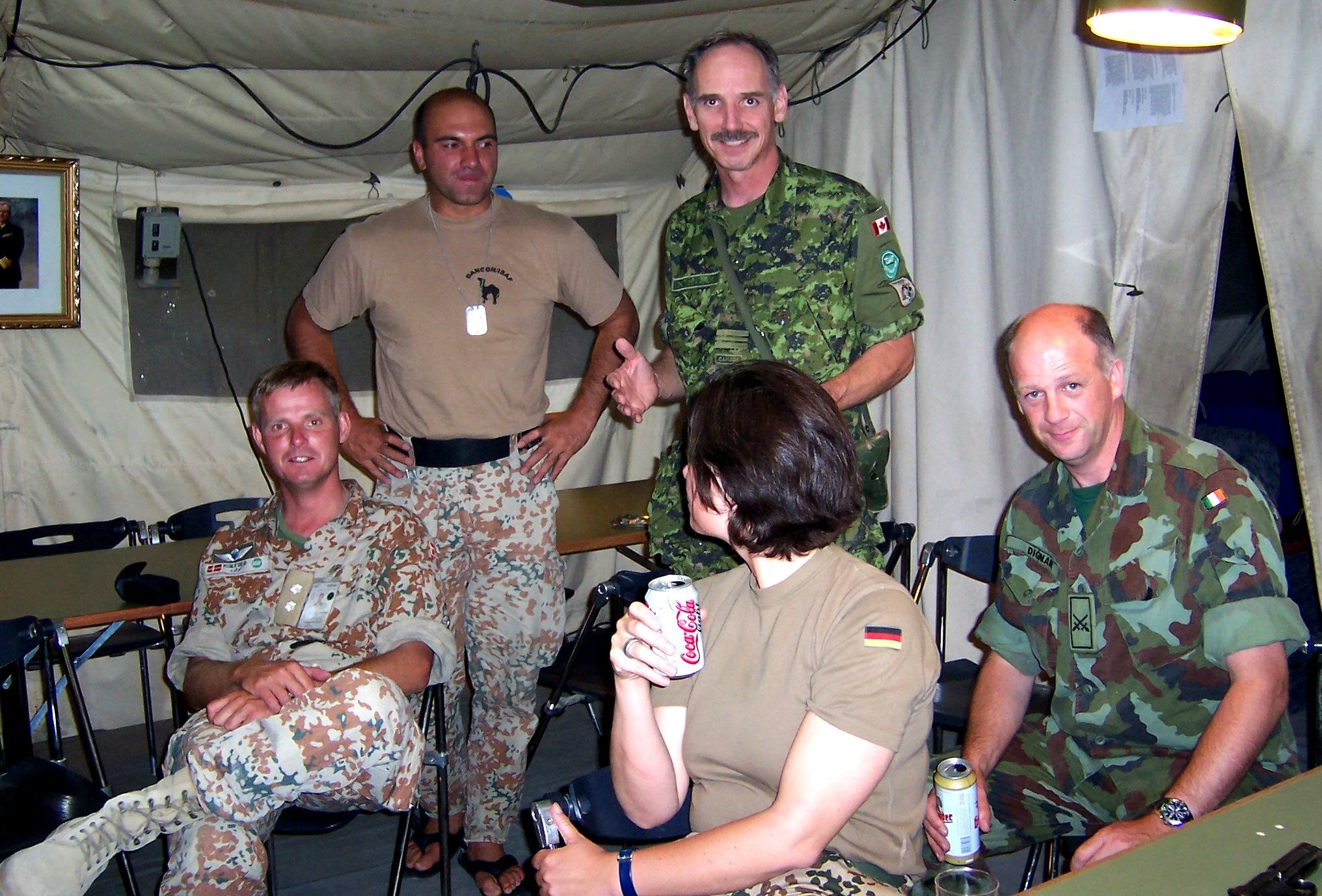
DK LCol Niels Koefoed and DK Abdallah Parmach. GE Dr E. Stanek farewell at DANCON with IR Maj Dignam, June 2004.
The author had the privilege of serving alongside Danish soldiers while deployed in Nicosia, Cyprus with the United Nations, in Sarajevo, Bosnia-Herzegovina with the NATO-led Peace Stabilization Force, and in Afghanistan with the International Security Assistance Force in the Kabul Multi-national Brigade.