Royal Danish Navy training cruiser HDMS Niels Juel
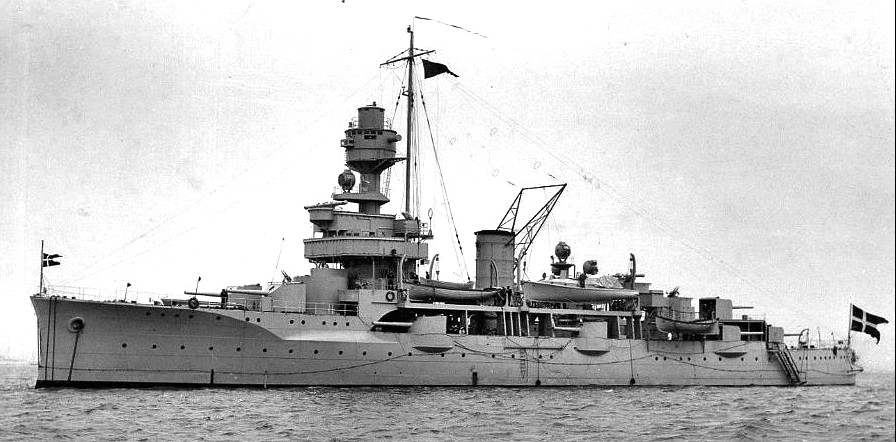
(HDMS Photo)
Danish training cruiser HDMS Niels Juel, 1938.
HDMS Niels Juel was a training ship built for the Royal Danish Navy between 1914 and 1923. Originally designed before World War I as a monitor, construction was slowed by the war and she was redesigned as a training cruiser. Completed in 1923 she made training cruises to the Black and Mediterranean Seas, South America and numerous shorter visits to ports in northern Europe. The ship often served as a flagship and occasionally was used as a royal yacht for visits to overseas possessions and other countries.
Niels Juel was extensively modernized in the mid-1930s and remained operational after Nazi Germany occupied Denmark in 1940. When the Germans attempted to seize the Danish Fleet in August 1943, the ship attempted to escape to Sweden, but was attacked and damaged by German bombers. She was deliberately run aground by her crew to deny the ship to the Germans, but Niels Juel was not badly damaged. The ship was refloated several months later and repaired by the Germans. They renamed her Nordland and used her as a training ship. She was scuttled by them in May 1945 and her wreck was salvaged in 1952. (Wikipedia)
Niels Juel was originally intended to be an improved version of Peder Skram, a Herluf Trolle-class coastal defence ship. Like that class, she had a very low freeboard, and was intended to be armed with two 30.5-centimeter (12 in) guns in single gun turrets fore and aft of the superstructure and a secondary armament of eight 10.5-centimeter (4.1 in) guns. The Danes ordered the main guns and their turrets from Krupp of Germany in July, a month before the start of World War I, but the order was suspended when the war began. After being laid down in September 1914, construction of the ship was severely delayed by shortages of labor and material and she was not launched until 1918.
Reports from battles between the British and the Germans caused the Danes to change her secondary armament to 120-millimeter (4.7 in) guns in 1917, but work stopped completely when the war ended on 11 November 1918. Danish politicians believed that the 30.5-centimeter guns could be viewed as provocative by their neighbors and they decided to convert the ship into an innocuous training ship by adding an extra deck to the existing hull and changing the main armament to 15-centimeter (5.9 in) guns. The new design was approved in 1920 and the ship was completed in 1923. (Wikipedia)
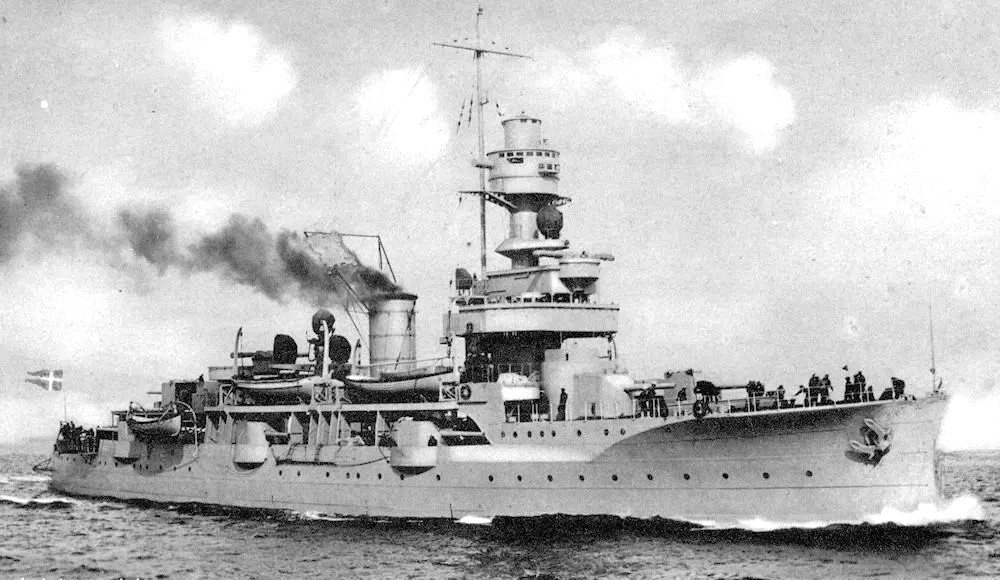 (NH Photo, 8849)
Danish training cruiser HDMS Niel Juel, 1938, following a refit to receive a new mainmast.
(HMDS Photo)
HDMS Niel Juel.
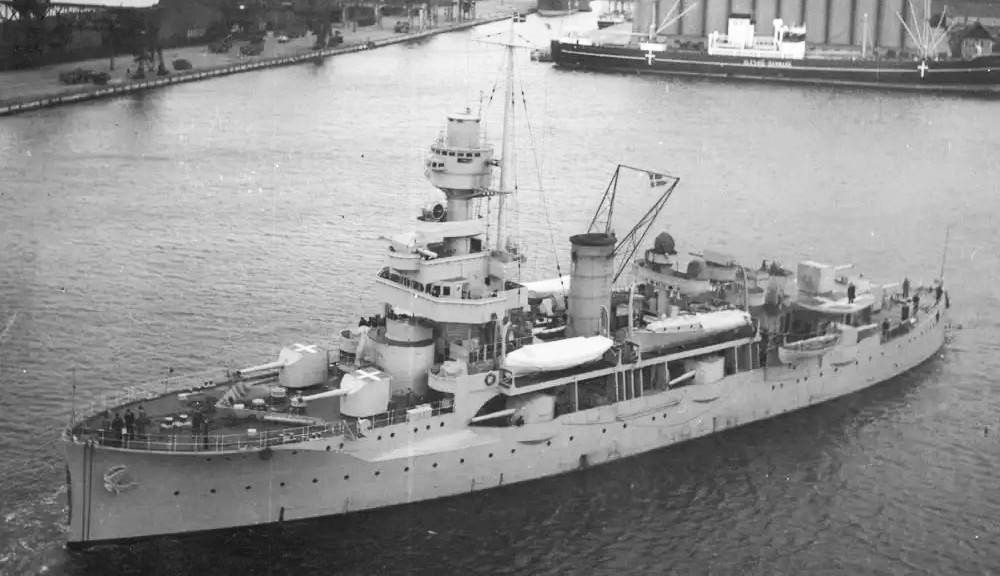
(HMDS Photo)
HDMS Niel Juel.
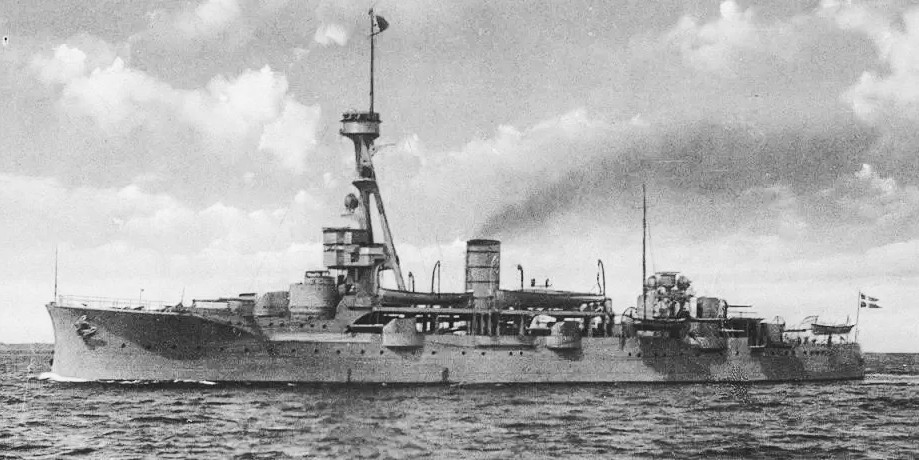
(HMDS Photo)
HDMS Niel Juel.
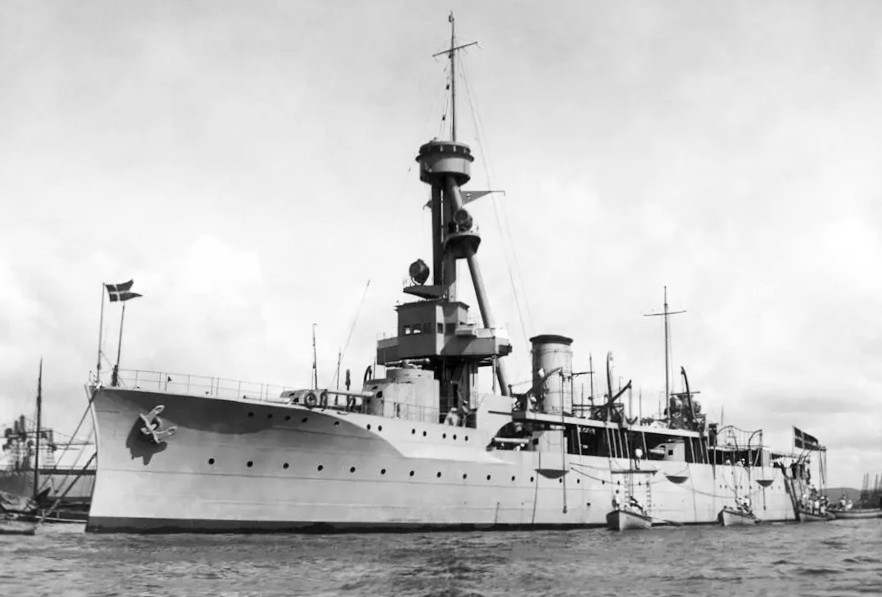
(HMDS Photo)
HDMS Niel Juel, c1938.
Wartime service
In late August 1939, the ship was preparing for a visit to Oslo, Norway, but that was cancelled when she was ordered to fuze all her shells in preparation for war. Her crew was filled out as the Navy mobilized and Niels Juel joined the rest of the fleet near Aarhus. Winter ice forced the ship to return to Copenhagen in January 1940, even though that port was ice-bound as well. With little possibility of action, her crew was given leave. Her crew was recalled on 8 April, but Niels Juel was not ready for war when the Germans invaded the following day. The Germans permitted the Danes to keep their ships and allowed them to train in Danish waters.
(HMDS Photo)
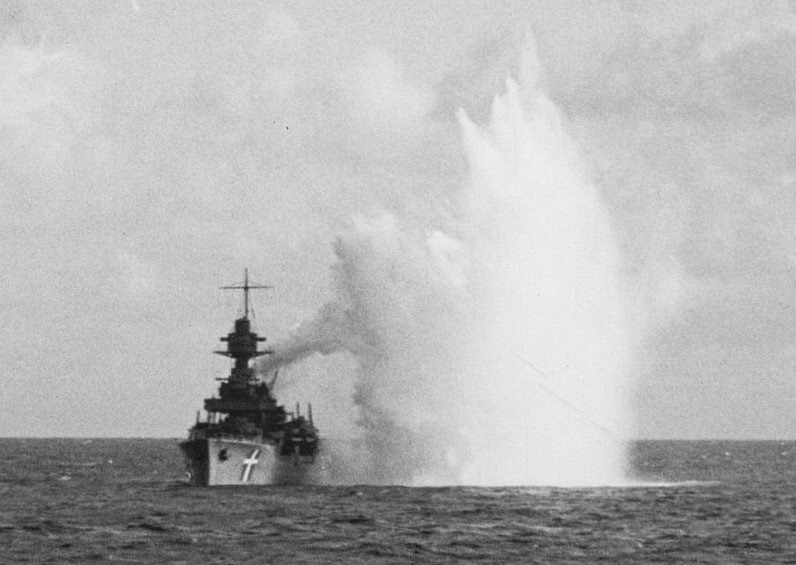
Dannish coastal defence ship Niels Juel trying to escape to Swedish waters, but attacked by German fighter planes on 29 August 1943
Following increasing Danish resistance to German rule and the institution of martial law on 28 August 1943, the German army moved to seize the Danish fleet in Copenhagen harbour the following morning, an action codenamed Operation Safari. Niels Juel was in Holbæk when her captain, Commander Carl Westermann, was ordered take his ship to be interned in Sweden. The Germans spotted her after she raised steam and departed. Before the ship could exit the Isefjord, Westermann was informed that the Germans had claimed they had mined the exit, and he spotted three German ships in the distance, the torpedo boat T17 and two E-boats. German aircraft attacked the ship with bombs and by strafing. None of the bombs hit Niels Juel, but shock damage from near misses knocked out electrical power and deformed some of the hull plating and bulkheads. Realising there was little hope of reaching Sweden, Westermann decided to run the ship aground near Nykøbing Sjælland. The crew then tried to scuttle the ship, but an initial attempt to blow up the ship failed. The crew settled for flooding the magazine, opening the sea-cocks to flood the rest of the hull as well as systematically destroying the equipment before the Germans could take over the ship. (Wikipedia)
A Danish salvage company inspected the grounded ship a few days later and did not see any damage to the hull, rudder or propellers, but noted that the ship was flooded with water up to a height of 1.5 meters (4 ft 11 in) below the armored deck. The Germans used a German company to salvage the ship in October and towed it to Kiel, Germany, for repair. She was disarmed, renamed Nordland, and commissioned into the Kriegsmarine in September 1944 after which she became a stationary training ship at Stolpmünde (modern Ustka, Poland). On 18 February 1945 the ship steamed to Kiel to avoid the advancing Russian forces. On 3 May, she was scuttled for the second time in the Eckernførde inlet. The wreck was partially dismantled by unauthorized salvagers before the Danes sold it to a German firm in 1952 for scrap. They removed everything above the sea bed, but its remains lie under 28 meters (92 ft) of water. (Wikipedia)
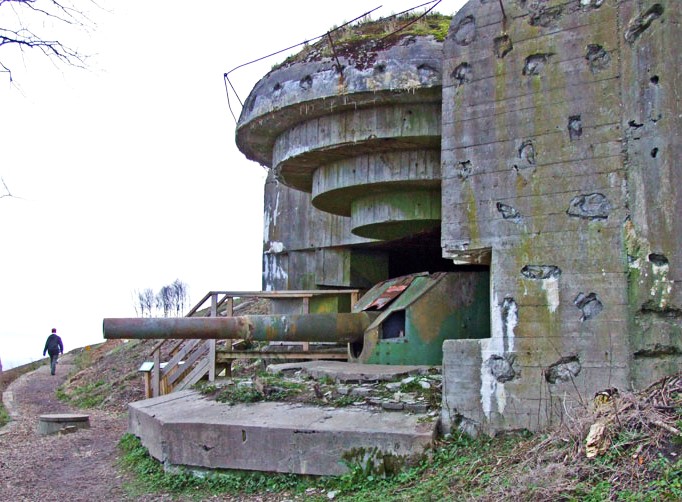
(Jørgen Larsen Photo)
15 cm cannon salvaged in 1944 from the Danish light cruiser Niels Juel and installed as armament in the German built Fort Bangsbo in Denmark.
The Navy had difficulties procuring the 15-centimeter guns that it wanted for the ship’s main battery, rejecting proposals from French, British and Swedish manufacturers as unsatisfactory. Although Krupp was not allowed to deliver finished guns by the terms of the Versailles Treaty, it worked out a deal with the Swedish Bofors company, which would finish and deliver the guns to the Danes. Niels Juel mounted ten 15-centimeter P.K. L/45[Note 2] guns, a pair side-by-side on the forecastle forward of the superstructure, three on each broadside amidships, and a superfiring pair aft of the superstructure, all protected by gun shields. The mounts had a range of elevation from -10° to +30° and the guns fired 46-kilogram (101 lb) projectiles at a muzzle velocity of 835 m/s (2,740 ft/s) at a rate of five to seven rounds per minute. The guns had a range of 17,800 meters (19,500 yd).
A pair of 57-millimeter (2.2 in) A.B.K. L/30 anti-aircraft guns were mounted on a platform abaft the funnel. The mounts had a maximum elevation of 70° and the gun had an effective rate of fire of about 16 rounds per minute. Its projectiles were fired at a muzzle velocity of 500 to 530 m/s (1,600 to 1,700 ft/s), which gave it a range of 7,500 meters (8,200 yd). The ship was fitted with a pair of submerged 450-millimeter (17.7 in) torpedo tubes, one on each broadside. The Type H torpedo had a 121.5-kilogram (268 lb) warhead and a range of 8,000 meters (8,700 yd) at 27 knots (50 km/h; 31 mph).
The ship was provided with a pair of 3-meter (9 ft 10 in) Zeiss stereoscopic rangefinders, one on the roof of the conning tower and the other on a platform abaft the mainmast. Data from the rangefinders was sent to the transmitting station located on the main deck beneath the conning tower, where it was converted into elevation and deflection data for use by the guns. (Wikipedia)
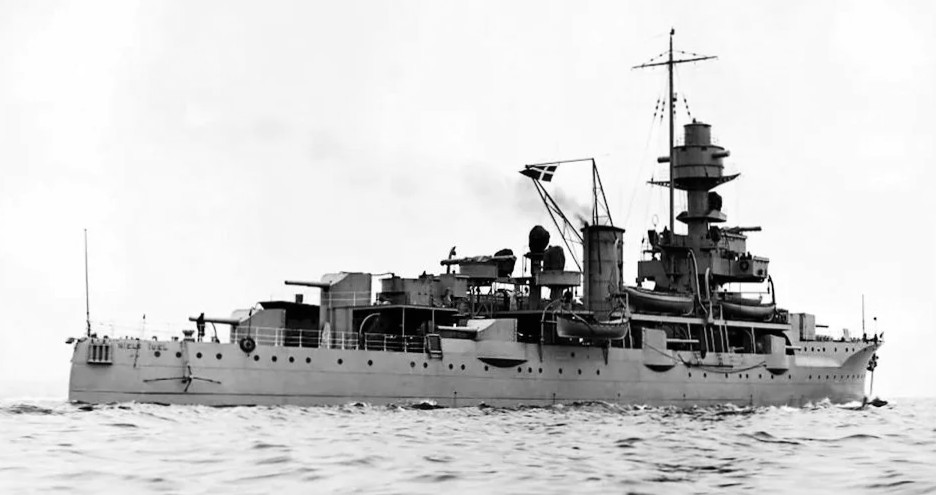
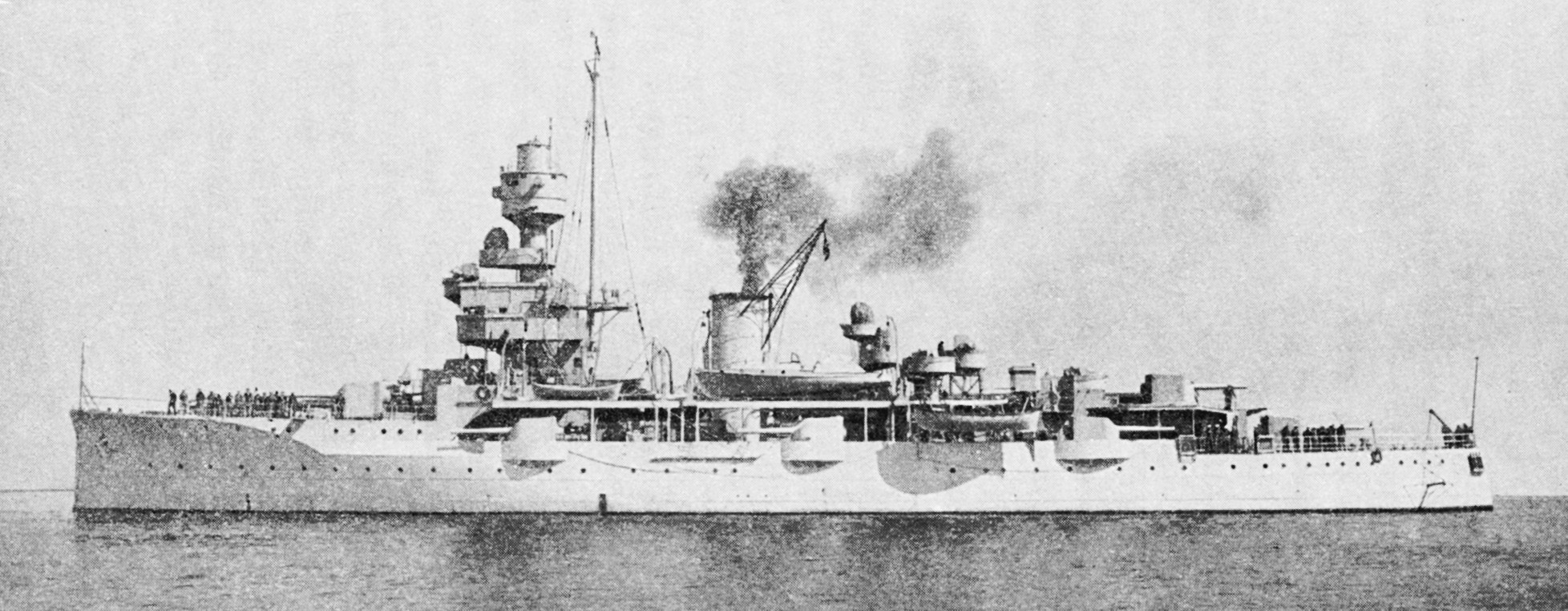
(HDMS Photo)
HDMS Niels Juel pictured on sea trials at Copenhagen post her major refit on 10 July 1936.