Royal Canadian Air Force in the Korean War, 1950-1953
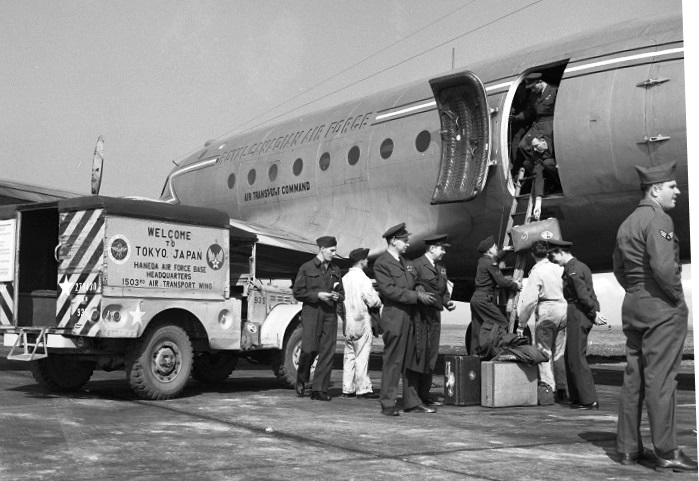
(DND Photo)
The crew of a Canadair CL-2 North Star, No. 426 Squadron, unloading baggage at Haneda Air Base near Tokyo after a flight from McChord Field.
RCAF Public Affairs article
The North Korean Army crossed into South Korea on 25 June 1950. The resulting drive forced South Korean and United States troops into a small corner of the Korean Peninsula that became known as the Pusan Perimeter. The United Nations responded to the attack and appointed the US as the organizing nation under General Douglas MacArthur.
Over the three-year combat period and the subsequent peacekeeping era until 1957 (for Canada), some 27,000 Canadian personnel – 23,000 Canadian Army, 3,000 Royal Canadian Navy (RCN), and 1,000 Royal Canadian Air Force (RCAF) – and other Canadian aviators, contributed to the action.
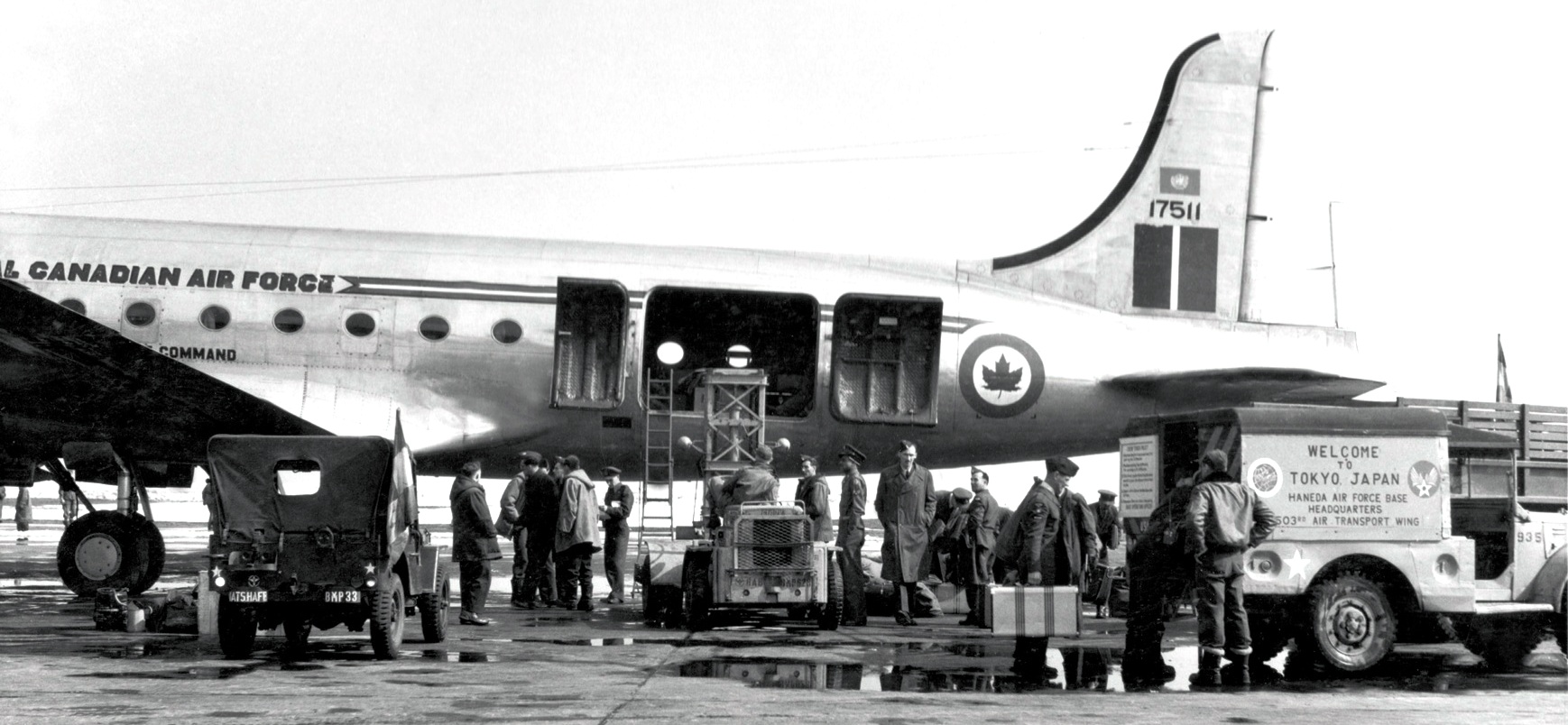
(DND Photo)
Canadair CL-2 North Star Mk. I, RCAF (Serial No. 17511), No. 426 Squadron, with cargo being unloaded in Tokyo, Japan by American troops during the Korean War.
About 800 RCAF personnel were from No. 426 (Transport) Squadron, at RCAF Station Lachine, Québec; the remainder were fighter pilots; flight nurses; supply, technical, and photo intelligence personnel; and a judge advocate general. Airmen from the RCN and the Canadian Army also participated, as did civilian flight crews from Canadian Pacific Airlines (CPA). Some Canadians joined the US Army or the US Air Force (USAF) directly.
Canada’s ongoing commitments to the North American Treaty Organization (NATO) included 16 day-fighter squadrons in Europe, flying the Canadian-built version of the F-86E Sabre jet. Other wings were established and equipped in Germany and France in the early 1950s. In addition, nine squadrons were re-equipped with the Canadian-designed and-built Avro CF-100 Canuck all-weather fighter interceptor.
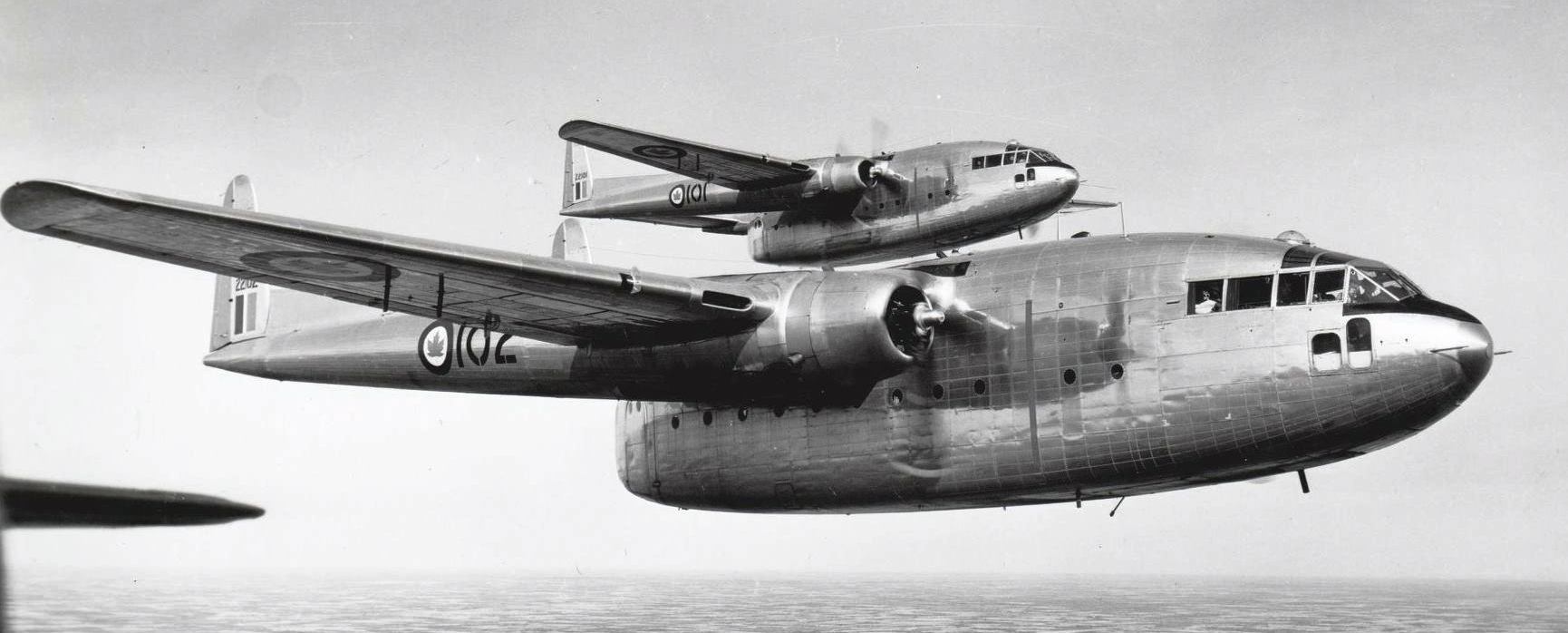
(Library and Archives Canada Photo, MIKAN No. 3228256)
Fairchild C-119F Flying Boxcars, (Serial Nos. 22101 and 22102), No. 435 Squadron, 22 Sep 1952.
April 1953 saw the Fairchild C-119 Flying Boxcar added to the RCAF transport fleet. In May, the de Havilland Comet jet airliner and the Canadian version of the T-33 Silver Star trainer, which first flew in late 1952, were added to the RCAF inventory.
It was a busy time for the RCAF, and squadron-level participation in the Korean War, other than airlift capabilities provided by No. 426 Squadron was not feasible. Still, Canada contributed a significant number of airmen and airwomen to the Korean air war effort.
Aircraft
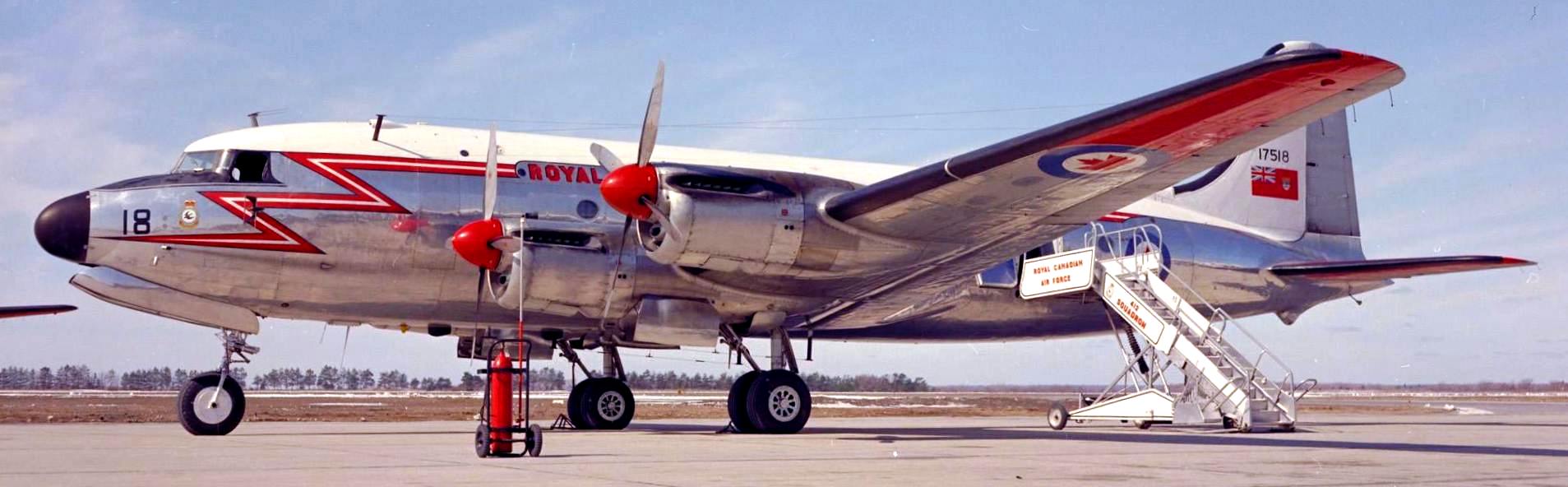
(DND Photo via James Craik)
Canadair CL-2 North Star Mk. II, RCAF (Serial No. 17518).
Canadian-built aircraft in the Korean War included the Canadair North Stars flown by No. 426 Squadron; hundreds of de Havilland Canada DHC-2 Beavers in service with the US Army (known there as the L-20) and the USAF; and 60 older-model Canadair F-86 Mk. II Sabre aircraft flying with the USAF.
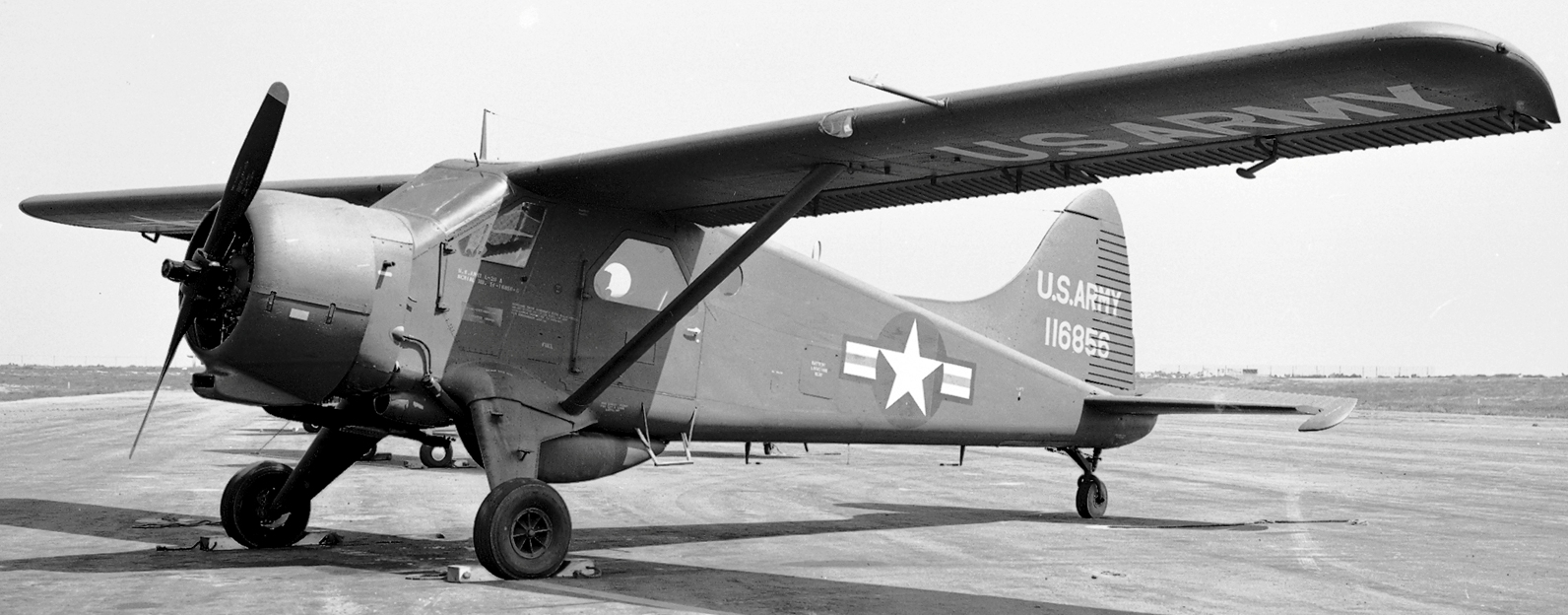
(Bill Larkins Photo)
de Havilland Canada DHC-2/U6A Beaver (Serial No. 116856), Torrance, California, March 1953.
No. 426 Squadron made 599 round-trip flights between McChord Air Force Base (AFB), near Tacoma, Washington, and Haneda airfield in Tokyo while working with the USAF’s Material Air Transport Service.
RCAF fighter pilot logbooks show that about 20 percent of all combat missions, including some MiG aircraft “kills” by Canadian Sabre pilots in Korea, were flown in Canadian-built Sabres.
(Library and Archives Canada Photo, MIKAN No. 4818176)
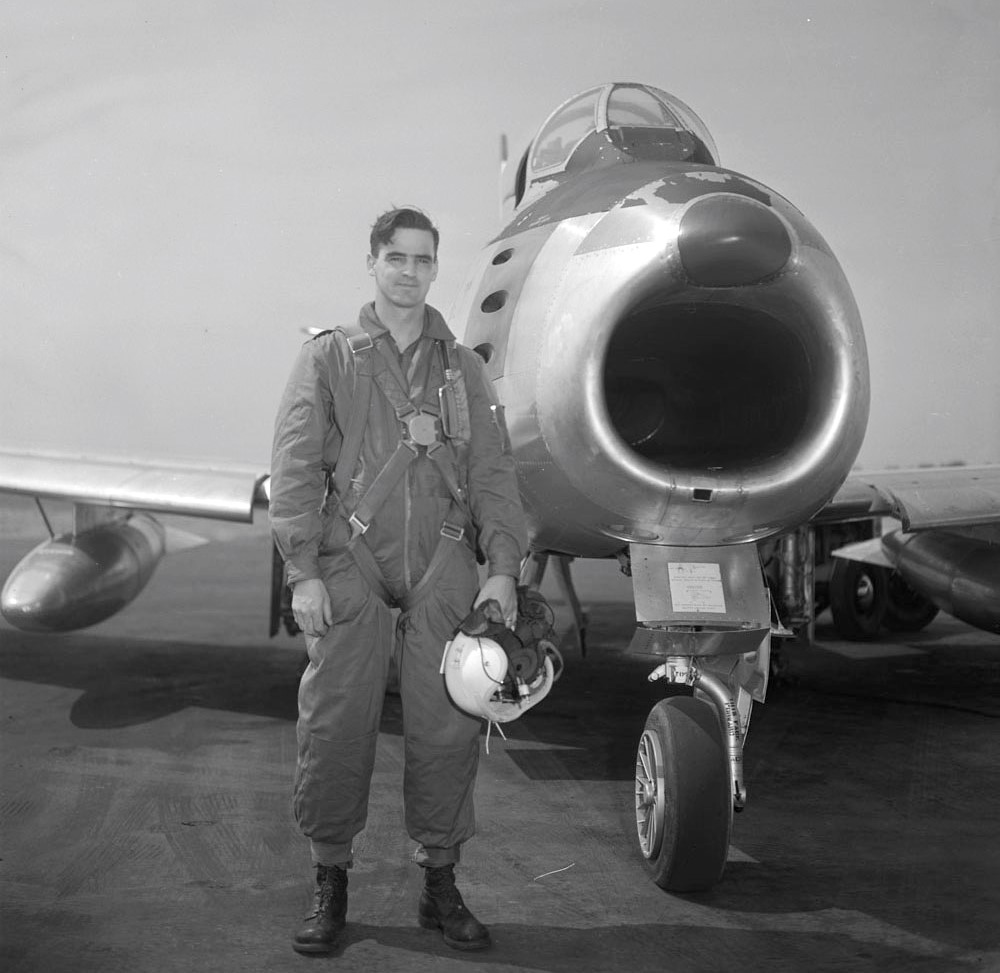
F/L Earnest A. (Ernie) Glover, RCAF (1922-1991) flew North American F-86 Sabre fighters while attached to the USAF during the Korean War. On 23 Jan 1953, while attached to the USAF in Korea, F/L E.A. Glover destroyed three MiG-15’s and damaged two others. He was the leading Royal Canadian Air Force (RCAF) scorer, and was awarded the Commonwealth Distinguished Flying Cross (DFC) in 1953. He was also awarded the American DFC.
On 8 Oct 1952, F/L Glover was flying number four position when a two-ship element of MiG-15s was intercepted. The F-86 flight closed, but in the evasive action the MIGs made a hard-right turn which the number one and two men were unable to follow. Flight Lieutenant Glover, being in a more advantageous position, fired, observing immediate hits. The MIGs dived from 40,000 to 15,000 feet and during one violent pull up, the number two MIG went out of control and plunged into the ground. The lead MIG with Flight Lieutenant Glover still firing reached the sanctuary of the Yalu River. By this demonstration of tactical skill Flight Lieutenant Glover destroyed one MiG-15 and inflicted damage on another. He destroyed another MiG-15 on 9 Oct 1952, and a third MiG-15 on 16 Oct 1952.
Ernie Glover entered air combat during the Second World War flying night fighter missions in a Hawker Hurricane. Gaining valuable combat experience in Hurricanes, Ernie soon moved into the more powerful and formidable Hawker Typhoon, flying fighter missions into occupied Europe. On one such mission in 1943 over France, Ernie was blasted by German flak that downed his Typhoon forcing him into the hands of the Germans and a Prisoner Of War.
RCAF pilots in USAF marked Sabres flew over 900 combat missions with 9 confirmed MIG kills. Ernie happened to down 3 of those nine MIGs, the highest score of any RCAF pilot in Korea making him a distinguished combat pilot. Flight Lieutenant Ernest A. Glover, joined the USAF’s 334th Fighter Squadron at Kimpo (Seoul) in June 1952. Up until 26 Aug 1952, he never saw a MiG; from then until the end of September he saw them nearly every day. He was ultimately credited with three MiG-15s destroyed, and two damaged, for which he was awarded both the American and Commonwealth DFC. (aircrewremembered.com/KoreanWarDatabase/Canada)
(DND Photo)
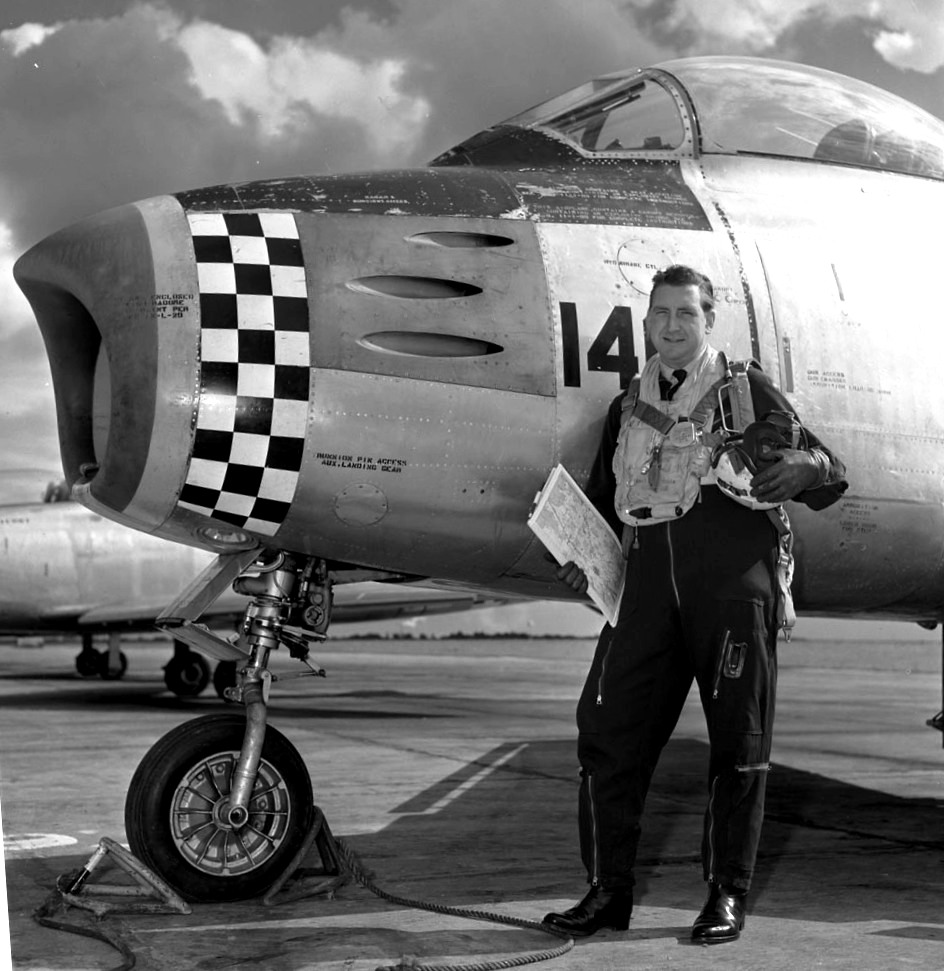
Squadron Leader Andy Mackenzie, DFC, RCAF Second World War fighter ace (8.5 victories); was taken POW when his F-86 was shot down while flying a North American F-86 Sabre while on exchange with the USAF 51 FIW in Korea in 1952.
Early air participants
The first Canadian airman to be involved in the Korean War was RCAF Wing Commander Harry Malcolm. He and Canadian Army Lieutenant-Colonel Frank White were sent to report first-hand on the status of the war as Canadian participants in the UN Commission on Korea.
In October 1950, the RCN sent Lieutenant-Commander Pat Ryan, a naval aviator. His duty was to investigate “anything naval air” that might require the participation of a squadron of RCN Sea Fury fighters. However, similar to the RCAF, the RCN was otherwise committed – in their case, to an anti-submarine warfare role with NATO in the North Atlantic.

(DND Photo)
FLt Omer Levesque gets a last-minute briefing from Maj. E.C. Fletcher of the 334th Fighter Interceptor Squadron before a mission.
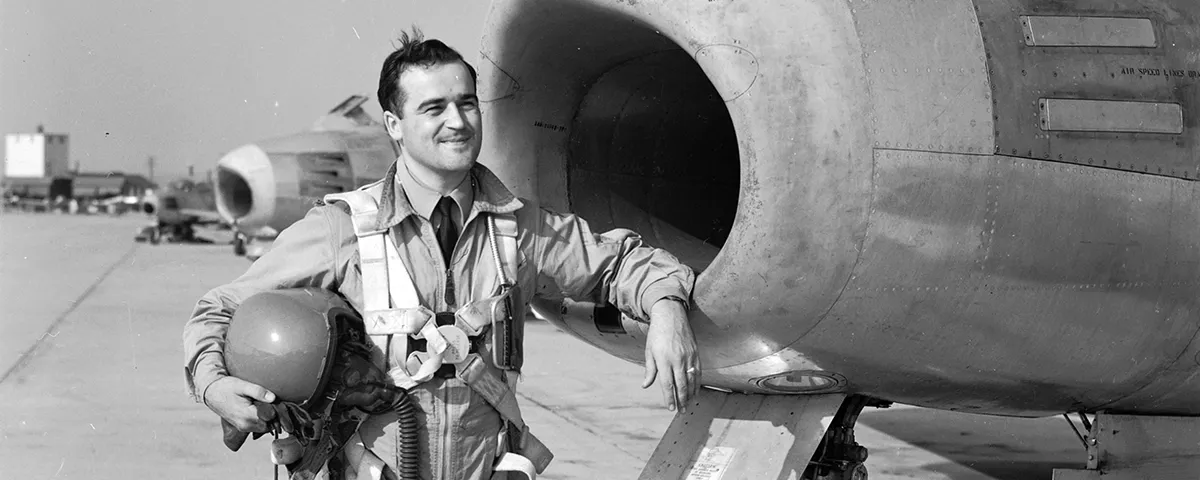
In November, 1950, the first RCAF combatant, Flight Lieutenant Omer Levesque, on a one-year exchange duty with the USAF, flew to Korea with his squadron. Sitting beside him was Flying Officer Joan Fitzgerald, the first RCAF flight nurse to participate in the war. Flight Lieutenant Levesque completed his tour of duty in June 1951 while Flying Officer Fitzgerald returned to Canada in March 1951.
(DND Photo)
In December 1950, FLt Levesque arrived in Korea with the first Sabres. He would become the first Canadian to fly air combat missions in the Korean War. The Sabre impressed Levesque: “It was like being on a bucking bronco—I didn’t ride it, I just hung on! It had lots of power and could turn on a dime. When you pull back you get a whole lot of air—the stabilizer doesn’t fight the elevator. This made the aircraft tremendous.” He earned the U.S. Air Medal for flying 20 missions between 17 and 21 Dec 1950, inclusive, an average of four missions a day.
On March 31, 1951, Levesque was with two squadrons of Sabres protecting a large flight of B-29s attacking the bridges spanning the Yalu River, the boundary between North Korea and its Communist Chinese ally. He was flying as wingman to Major E.C. Fletcher when suddenly the squad leader called out that bandits were coming from the right. The Sabres dropped their auxiliary fuel tanks as two additional MiGs were spotted at 9 o’clock, “off our left wings and above us a bit.” Levesque’s flight turned toward these two enemy planes, which separated and banked away to evade the pursuing Sabres.
Levesque later reported: “My MiG pulled up into the sun, probably trying to lose me in the glare. This was an old trick the Germans used to like to do—but this day I had dark sunglasses on, and I kept the MiG in sight.” The MiG leveled off, likely not realizing Levesque was still on his tail. The Canadian adjusted his illuminated gunsight for deflection shooting and banked steeply to turn inside the MiG, triggering a twisting dogfight that quickly spiraled down from 40,000 feet to 17,000 feet. Levesque was about 1,500 feet from the MiG when he opened fire. His aim was good: Six streams of .50-caliber bullets smashed into the MiG, which rolled violently to the right and continued rolling until it crashed into the ground.
“I started to pull up, and saw another MiG diving from above me,” he continued. “I climbed into the sun at full throttle and started doing barrel rolls. The MiG disappeared.” His combat with the MiGs concluded, Levesque faced another danger, this time from friendly fire: “I went right through the B-29 formation and they all shot at me! Thank God they missed. I waggled my wings and they stopped firing, but lots of shells had just missed me.”
Levesque suddenly realized that his fuel was approaching “bingo,” the point where he had just enough to get him back to base at Suwon, South Korea. As he headed home, alone with his thoughts, he could take pride in the fact that he was at last an ace.
Omer Levesque was awarded the U.S. Distinguished Flying Cross for his role in the March 31 battle. He would complete 71 operational sorties with the 334th FIS before being sent home in June 1951.
In addition to his other decorations, Levesque received the Queen’s Coronation Medal in 1953. Following a variety of peacetime assignments, he retired from the RCAF in 1965. Inducted into the Quebec Air and Space Hall of Fame, he served on the Canadian government’s Air Transport Committee for 22 years, until 1987. Levesque died in June 2006, at age 86. (Herb Kugel)
Flight Nurses
The Canadian Army entered the war in February 1951, and the first Canadian casualties soon followed.
In the early part of the war, No. 426 Squadron flew some wounded US personnel to Honolulu, Hawaii, and, later, some of the Canadian walking wounded home to Canada. RCAF nurses, who’d been taking training in the US, increased this commitment when the Korean War broke out.
Seven weeks of nursing classes and practical training, including familiarization flights and ditching drills, were held at Gunter AFB, in Alabama; immediately following was a three-month tour carrying out medical air evacuations from the Korean War in the Pacific. All flight nursing graduates (RCAF, USAF and USN) were stationed in Honolulu.
The RCAF flight nurses program in the Pacific ran from November 1950 to March 1955 and involved some 40 nurses who served in pairs. They did not serve in Korea, nor did they fly with the RCAF’s 426 Squadron during their Pacific tours with the USAF.
No. 435 Squadron, stationed at RCAF Station Edmonton and later at Namao, Alberta, transported Canadian wounded from McChord AFB across Canada as required. 435 was equipped with DC-3 Dakotas powered by three supercharged, high-altitude engines. The aircraft carried 16 litter patients, with oxygen. On occasion, 412 Squadron from RCAF Station Rockcliffe, near Ottawa, Ontario, and 426 Squadron also evacuated Canadian wounded from McChord.
Flight nurses who had completed their tour of duty in the US or the Pacific were stationed at various Canadian airfields and at least one qualified flight nurse always accompanied RCAF medical evacuation flights in Canada.
Volunteer fighter pilots
Twenty-one RCAF volunteer fighter pilots (not including Flight Lieutenant Levesque) were sent to Korea for F-86 combat duties and they served from March 1952 until November 1953 in small scheduled groups.
They flew exclusively with the USAF’s 4th Fighter Interceptor Wing at Kimpo, northwest of Seoul, or the 51st, at Suwon, south of Seoul. Both fighter interceptor wings had three fighter squadrons and Canadians served in all six of them. A few had extra duties at the wing level.
RCAF pilots served for six months or 50 combat missions, whichever came first. Fifty missions normally took three to four months. On arrival at their assigned squadron, pilots were usually given a short on-squadron introductory flying program called “Clobber College”. After that, they went into combat.
A combat mission normally consisted of flying about 322 kilometres over enemy territory to the infamous “MiG Alley”, near the Chinese border, patrolling, contacting and fighting with the communist’s MiG-15s, and returning home.
A round-trip mission usually took about 90 minutes: 30 minutes to MiG Alley on drop tanks (external, often jettisonable auxiliary fuel tanks) and 60 minutes on internal fuel. Double-mission days were frequent and there were some triple-mission days.
MiGs were sighted on only about 10 per cent of all missions to MiG Alley, and even fewer missions involved combat. MiGs had sanctuary across the Yalu River in China, but it was found that an estimated 75 per cent of MiG “kills” were across the Yalu.
There were no fatalities in this group, but many close calls. RCAF pilot Squadron Leader Andy Mackenzie had to eject, and was a PoW for two years. Flight Lieutenant Bob Carew experienced an engine failure over enemy territory and, while his squadron flew top cover, he glided to the coast, ejected over a friendly island and was rescued by the USAF.
Squadron Leader Eric Smith and Squadron Leader Doug Lindsay endured head-on shooting passes with MiGs. While on patrol near the Yalu River, Squadron Leader Smith encountered a MiG with its two 23-millimetre cannons and one 37-millimetre cannon firing. He fired back. Their second pass lasted just a few seconds, then the MiG withdrew.
Flight Lieutenant Bob Lowry and Flying Officer Gene Nixon were returning to base when they spotted an enemy train in a valley. The Sabres strafed the train but a trap had been set at the end of the valley, and several anti-aircraft batteries opened fire from the adjacent hills. The flak was intense but they both escaped.
The RCAF accounted for nearly 900 combat missions with nine MiG “kills”, two “probables”, and 10 “damaged”. RCAF pilots received eight U.S. Distinguished Flying Crosses and 10 U.S. Air Medals. Flight Lieutenant Ernest Glover was the last and only RCAF pilot to be awarded the Commonwealth Distinguished Service Cross since the Second World War.
Transport
Just two weeks after the North Koreans invaded South Korea, No. 426 Transport Squadron was alerted to move to McChord AFB to participate in Operation Hawk, the Canadian military portion of the Korean War airlift. The squadron had 12 “war-strength” North Star aircraft, and would integrate with the USAF’s Military Air Transport Service, cease all domestic flights except those that were essential, and operate into Japan but not into Korea.
The flights over the North Pacific route called for careful planning to deal with the severe and unpredictable weather, and the flights over the mid-Pacific route required precision to deal with the long legs over open water.
Radio navigation aids existed at each end of the Aleutian-Islands-to-Japan leg, but were only good for about 161 kilometres at each end. Land to the west was Russian territory; radio jamming was a way of life. The northern route required two refuelling stops, one at Elmendorf AFB (near Anchorage, Alaska) and one at Shemya Island in the Aleutians. The southern route went via Travis AFB in California, Honolulu, and at least two other Pacific islands, usually Midway and Guam. The southern route was the longer route by 10 hours.
Shemya Airfield, located 1,770 kilometres from the west coast of Alaska at the remote end of the Aleutian Islands, was a crucial stop-over point for all flights to and from Japan. Weather along the Aleutians is as bad as anywhere in the world.
To combat this, the USAF provided a ground controlled approach system with top-quality operators to ensure safe arrivals even when the weather was below limits. In spite of this, in December 1953, an RCAF North Star, after making a safe but difficult landing in a blinding snow storm and in a heavy cross-wind, was blown off the slippery runway. Although there were no injuries or cargo lost, the aircraft was completely destroyed.
Senior RCAF officers
The three most senior RCAF officers in Korea were Group Captain Ed Hale, who flew F-86 combat missions with the USAF at Suwon in 1952, and was the commander of the RCAF’s No. 1 (Fighter) Wing, North Luffenham; Group Captain Robert “Buck” McNair, the air attaché at the Canadian Embassy in Japan; and Group Captain Ken Patrick, commander of the Air Force Reserve in Montréal and founder and CEO of Canadian Aviation Electronics in Montréal.
Group Captain Patrick had served as a communications expert during the Second World War and, because of his in-depth knowledge, was invited by the Canadian and U.S. governments to carry out top-secret interrogation flights over North Korea. To achieve this, he spent five weeks (November to December 1951) flying with the USAF’s 343rd Bomber Squadron out of Yokota, Japan.
He flew on six B-29 bombing missions and acted as the radar officer to analyse enemy radar and the available counter-measures equipment. On each mission, one or two of the six B-29s in the bombing formations was either shot down or badly damaged.
The final tally
During the Korea War, 516 Canadian military personnel and seven Canadian Pacific Airlines personnel died. Thirty-three Canadian prisoners of war were held, most of whom were Army personnel, but also included RCAF Squadron Leader Andy MacKenzie.
Thirty-three Canadians have no known graves, including 16 Army personnel who were reported missing in action. The last official Canadian casualty of the Korean War, Major Edward Gower, was on his return flight from Korea to Calgary in December 1956 when his TCA North Star hit Mount Slesse (near Hope, British Columbia). The wreckage was found in May 1957 and the remains of all 62 crew and passengers rest on the mountain to this day.
In all, Canadian airmen flew more than 2,200 combat missions and more than 1,500 round-trip airlift flights during the Korean War. RCAF nurses were involved in about 250 medical evacuation flights in the Pacific and many more throughout Canada.
Canadians received 57 Commonwealth and US awards, medals, and commendations. This number would have been higher except for a strange rule imposed by the Canadian military directing that only one US medal could be awarded to each Canadian serving member.
Canadian military personnel and civilians served with courage and distinction during the Korean War. Thankfully, today, the Korean War is no longer “the forgotten war”.
An Armistice was signed on July 27, 1953.
The Canadian contribution to the air effort during the Korean War began early in the war when 426 Transport Squadron was attached to the USAF’s Military Air Transport Service. It moved to McChord Air Force Base in Washington to carry out its duties. The squadron flew Canadair 12 “war strength” North Stars (similar to the C-54GM), on 599 round trips over the north Pacific, transporting 13,000 personnel and three million kilograms of freight and mail to Japan. There, cargo was offloaded for onward transit to Korea. The intense, challenging route, which involved long legs over open water, terrible weather and a treacherous landing strip at the midway point in Alaska, took them perilously close to the Soviet Union. Although there were some close calls and incidents, there were no fatalities and no cargo was lost during the airlift. (RCAF in Korea, 1950-1953)