Royal Canadian Navy in the Korean War, 1950 – 1953
On 12 July 1950 three Canadian destroyers, HMCS Cayuga, HMCS Athabaskan, and HMCS Sioux sailed for Korean waters to serve under United Nations Command. From then until the cease-fire in 1953, three Canadian warships on a rotation basis served continuously in the Korean War theatre.
The Royal Canadian Navy, along with navies of other UN Forces including the Republic of Korea, maintained blockades of enemy coasts, engaged enemy shore batteries, protected friendly islands, took part in the Inchon landing and, on the enemy East Coast had great success in “trainbusting”-the destruction of enemy supply trains.
“Train Busting” – These 8 Canadian Destroyers with a total of 3,621 crew members helped to destroy enemy supply trains advancing to South Korea during the Korean War and they patrolled the Korean waters during the UN Peace Keeping Mission until 1955.
HMCS Athabaskan, HMCS Cayuga, HMCS Sioux, HMCS Nootka, HMCS Huron, HMCS Iroquois, HMCS Crusader, and HMCS Haida.
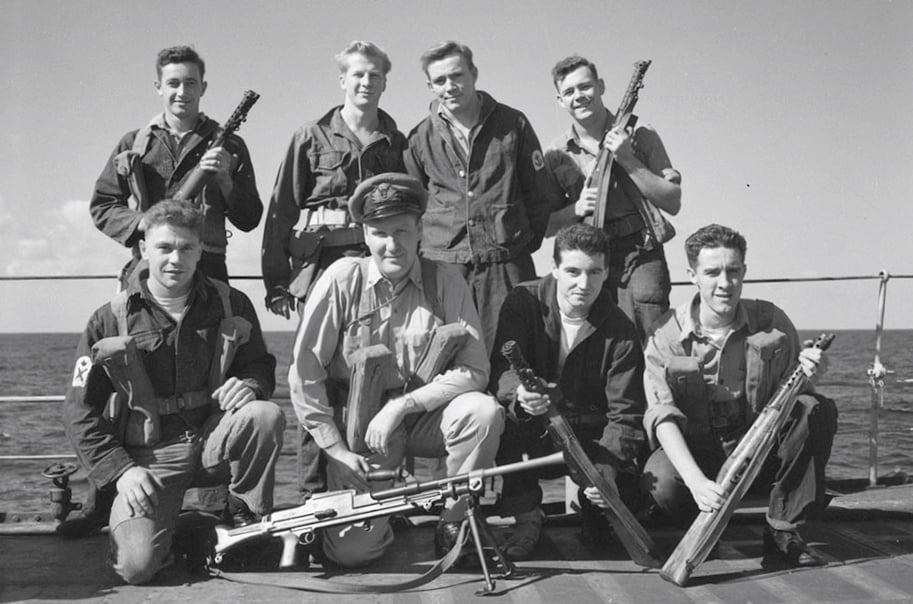
(Library and Archives Canada Photo, MIKAN No. 3207657)
RCN in the Korean War, No. 2 Sam Pan Boarding Party on HMCS Nootka. Front row: L/STO D. McCoy, LT/CDR F.P.R. Saunders, ABSM M. Messervey, L/SCV W.F. Wickson. At the back: ABTD W. Murray, LSCR G. Mason, LSCR R. Hornecastle, ABCR J. MacKinnon, 7 July 1952. The boarding party is armed with a Bren Gun and Lanchester sub-machine guns.
The Lanchester is a submachine gun (SMG) manufactured by the Sterling Armaments Company between 1941 and 1945. It is a copy of the German MP28/II and was manufactured in two versions, Mk.1 and Mk.1*; the latter was a simplified version of the original Mk.1, with no fire selector and simplified sights. It was primarily used by the Royal Navy during the Second World War, and the RCN in Korea. It was also used by RAF Regiment (for airfield protection. It was given the general designation of Lanchester after George Herbert Lanchester, who was charged with producing the weapon at the Sterling Armaments Company.The Lanchester is an open-bolt, self-loading blowback-operated weapon with a selective-fire option (located in front of the trigger) on early versions. A tubular receiver was attached to the front of the wooden stock, which could be pivoted barrel down for maintenance and disassembly. The wooden stock was patterned after that of Lee–Enfield rifle, and a bayonet lug centred below the muzzle accepted the Pattern 1907 sword-bayonet as used on the Lee–Enfield No. 1 Mk. III* (previously called the S.M.L.E.)
It used a straight 50-round magazine containing 9×19mm Parabellum cartridges (special pouches were produced to hold three magazines each) which fit into the magazine housing from the left, with spent cartridges ejected on the right. It was interchangeable with the shorter 32-round Sten magazine. A magazine lo ading tool was needed to load both 32- and 50-round magazines more easily. One of the two magazine pouches had a special pocket on the front for this loader. Mk.1s featured a front blade sight with adjustable rifle-type sights, marked between 100 and 600 yards. Mk.1* featured a much simplified flip-up sight marked 100 or 200 yards.
Manual safety is made in the form of locking cut, made in the receiver, which engages the bolt handle to lock bolt in open (cocked) position. It proved notoriously susceptible to accidental discharge if the weapon were dropped. For cleaning, the weapon had a brass oiler bottle and pull through held inside the butt stock (similar to the Lee–Enfield rifle).
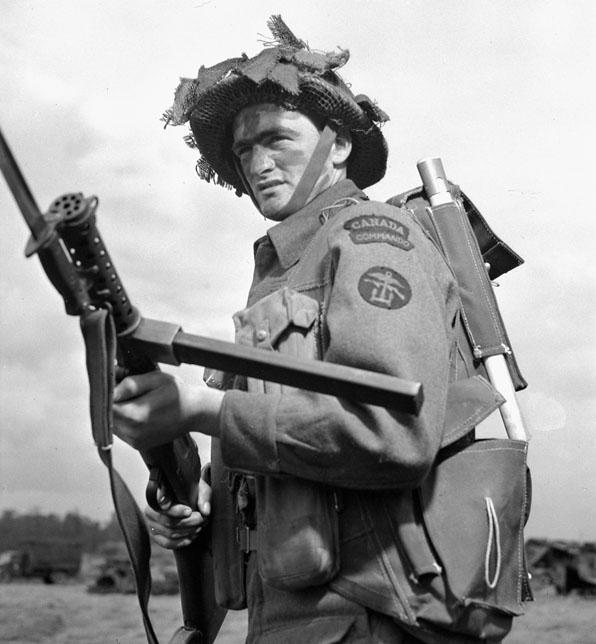
(Library and Archives Canada Photo, MIKAN No. 3201854)
Able Seaman Armand Therien of the Royal Canadian Navy Beach Commandos, armed with a Lanchester sub-machine gun, England, 20 July 1944.
(Cathy Robinson Photo)
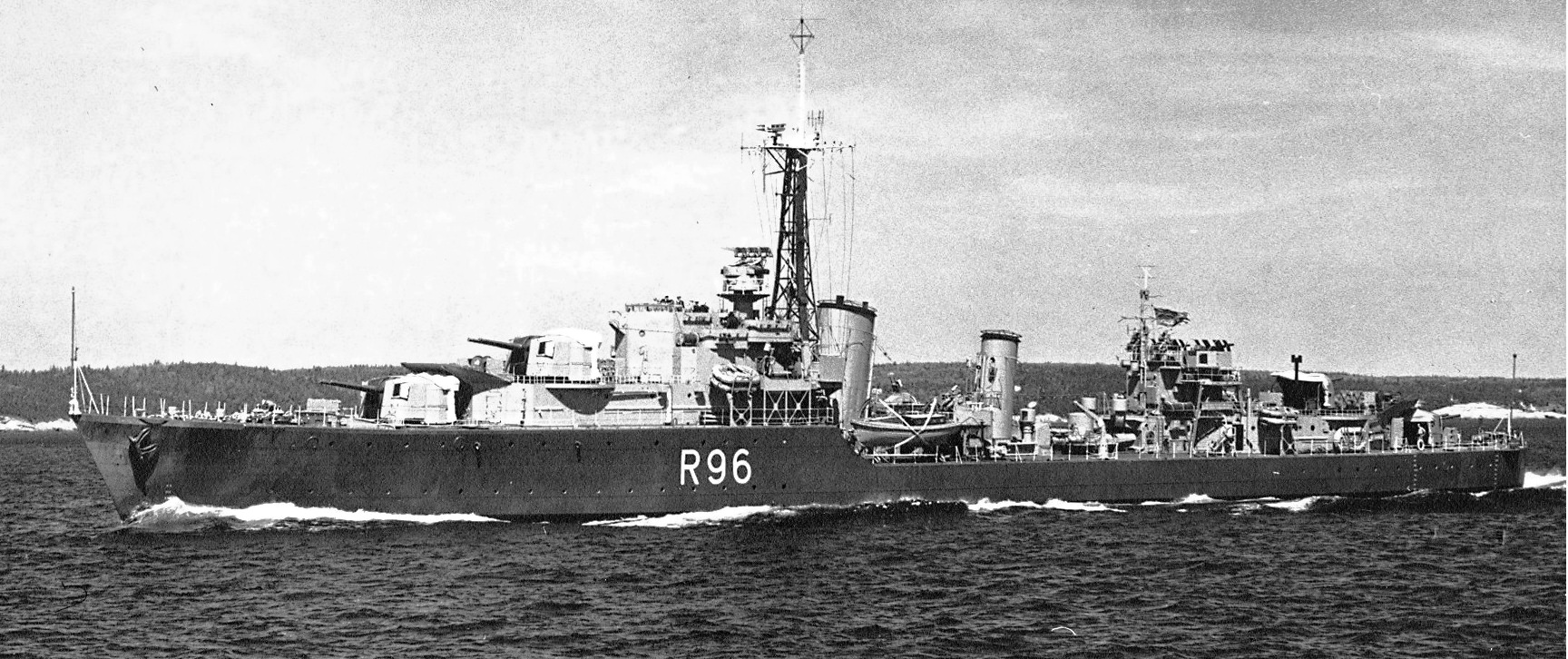
HMCS Nootka (R96). Built by Halifax Shipyards Ltd., HMCS Nootka was commissioned on 7 Aug 1946, at Halifax. She served as a training ship on the east coast and in the Caribbean until her conversion to a destroyer escort (213) in 1949 and 1950. Ear-marked for Korean duty, she transited the Panama Canal in Dec 1950, for the first of two tours of duty in that theatre of war. Returning to Halifax via the Mediterranean at the end of 1952, she became the second RCN ship to circumnavigate the globe. During 1953 and 1954 she underwent further conversion and modernization, afterward resuming her original training duties. In 1963, with HMCS Haida, she toured the Great lakes in the course of a summer’s cruising. She was paid off at Halifax on 6 Feb 1964, and broken up at Faslane, Scotland in 1965.
(Library and Archives Canada Photo, MIKAN No. 3205249)
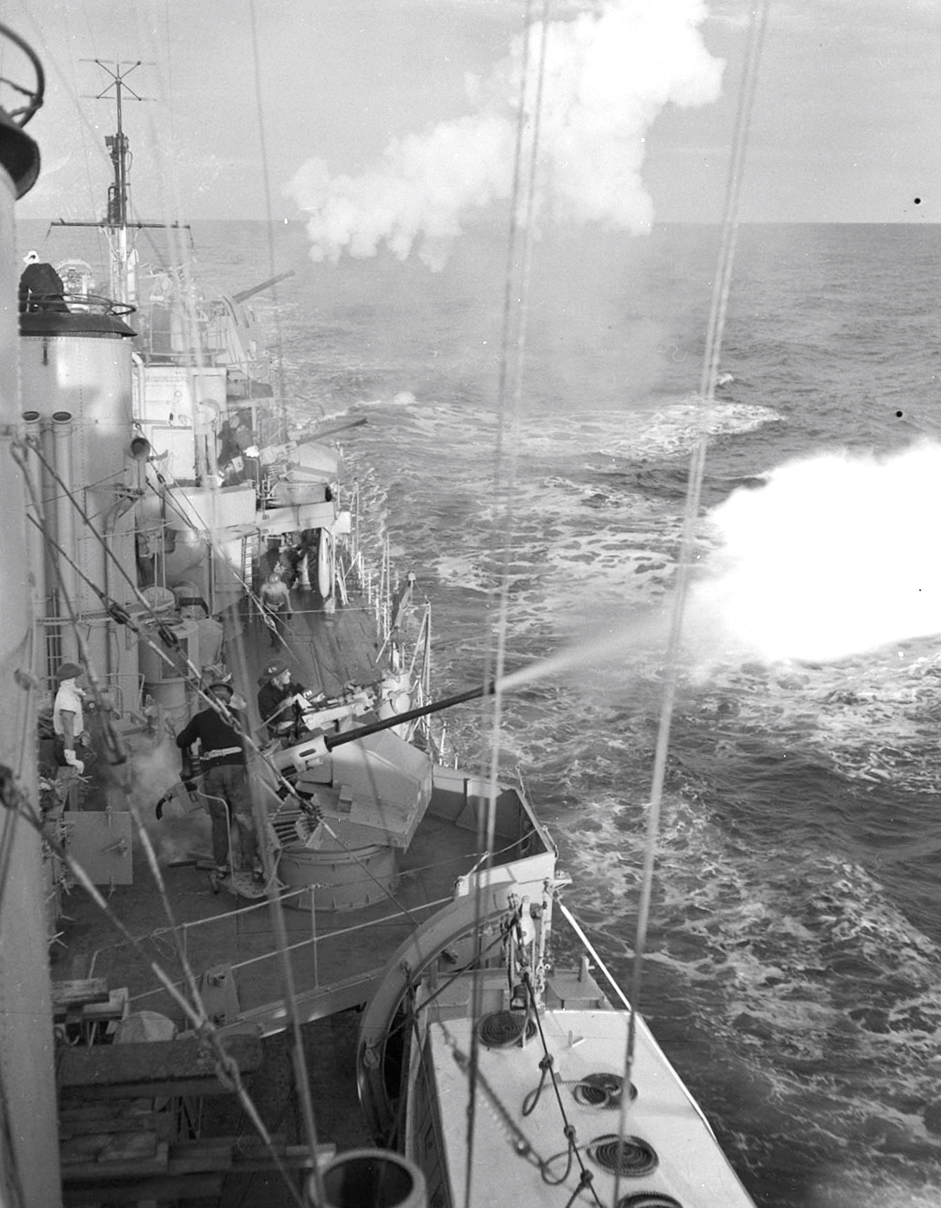
HMCS Nootka’s port A/A Batteries during gunnery training between San Pedro and Pearl Harbour, 22 December 1950.
(TheEastCoastRoys Photo)
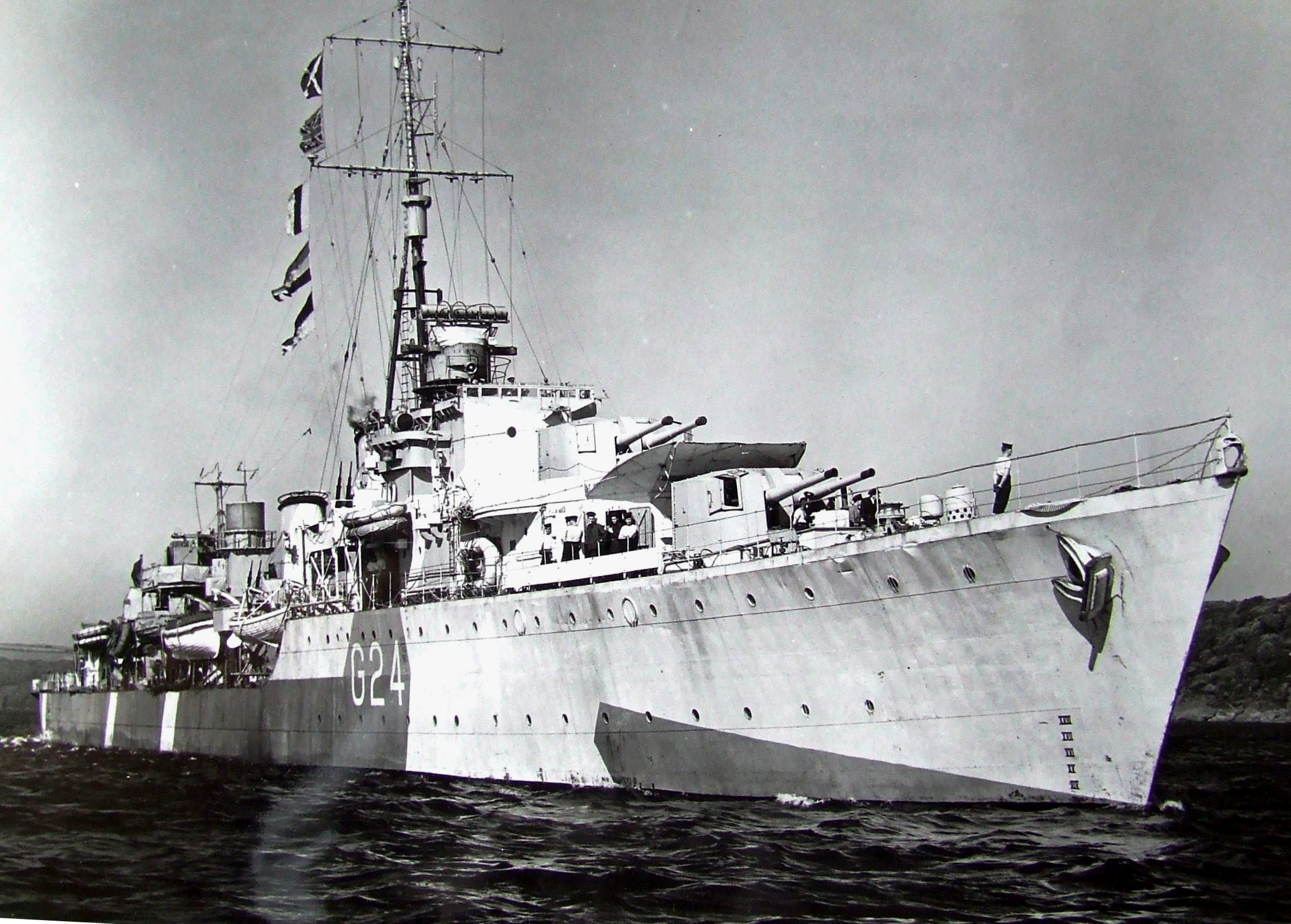
HMCS Huron (G24). Built by Vickers-Armstrong, Ltd., at Newcastle-on-Tyne, she was commissioned there on 19 Jul 1943. She was assigned, like HMCS Haida, to the 3rd Destroyer Flotilla of the British Home fleet. She made a trip in Oct 1943 to Murmansk with technical personnel and special naval stores, and for the rest of the year escorted convoys to and from North Russia. In Feb 1944, she joined the 10th Flotilla at Plymouth for invasion duties, spending the next seven months in the Channel and the Bay of Biscay. She was present on D-Day. HMCS Huron assisted HMCS Haida in sinking torpedo boat T29 and destroyer Z 32, and in Aug 1944 made her first visit to Canada for refit at Halifax. In Nov 1944 she returned to the UK to carry out escort duties in the Western Approaches. In April 1945, HMCS Haida G63, HMCS Huron G24 and HMCS Iroquois G89 made one more round trip escorting a convoy to and from Kola Inlet.
Departing Greenock on 4 Jun 1945, HMCS Huron returned to Halifax with HMCS Haida and HMCS Iroquois, arriving there on 10 Jun 1945, and began tropicalization refit, but this was discontinued owing to VJ-Day and she was paid off on 9 Mar 1946. She was re-commissioned at Halifax (216) for training purposes in 1950, but sailed on 22 Jan 1951 on the first of three tours of duty in Korean waters. Following her Korean tours, she returned to her training role.
On 30 Jul 1962, the RCN sent the 3rd Destroyer Escort Squadron (Atlantic) under Capt. Gordon Edwards, on a good will / work up tour. The squadron consisted of HMCS Sioux 225, HMCS Huron 216 and HMCS Iroquois 217 (as flagship). The ships sailed from Halifax NS to Bermuda and then on to Jamaica, arriving on 05 Aug 1962. The squadron joined a large fleet of naval vessels already assembled, as all Royal Navies and the United States Navy, had sent “good will” ships of various classes to Jamaica. In essence, it served to form one of the largest allied fleets to be assembled since the Second World War, and spent six days in Jamaica celebrating their independence from Briton which occurred on the 6 Aug 1962. The squadron then sailed back to Bermuda before heading to Prince Edward Island to par-take in their official Lobster Festival. From PEI the squadron returned to Halifax for fuel and provisions, and again departed for Bermuda. From Bermuda it was on to Trinidad & Tobago to take part in their independence celebrations. From 12 Sep to 17 Sep 1962, the 3rd Destroyer Escort Squadron paid a visit to Newfoundland to take part in the 67th annual meeting of the National Council of the Navy League of Canada.
Huron was paid off at Halifax on 30 Apr 1963. She was broken up at La Spezia, Italy, in 1965.
(RCN Photo)
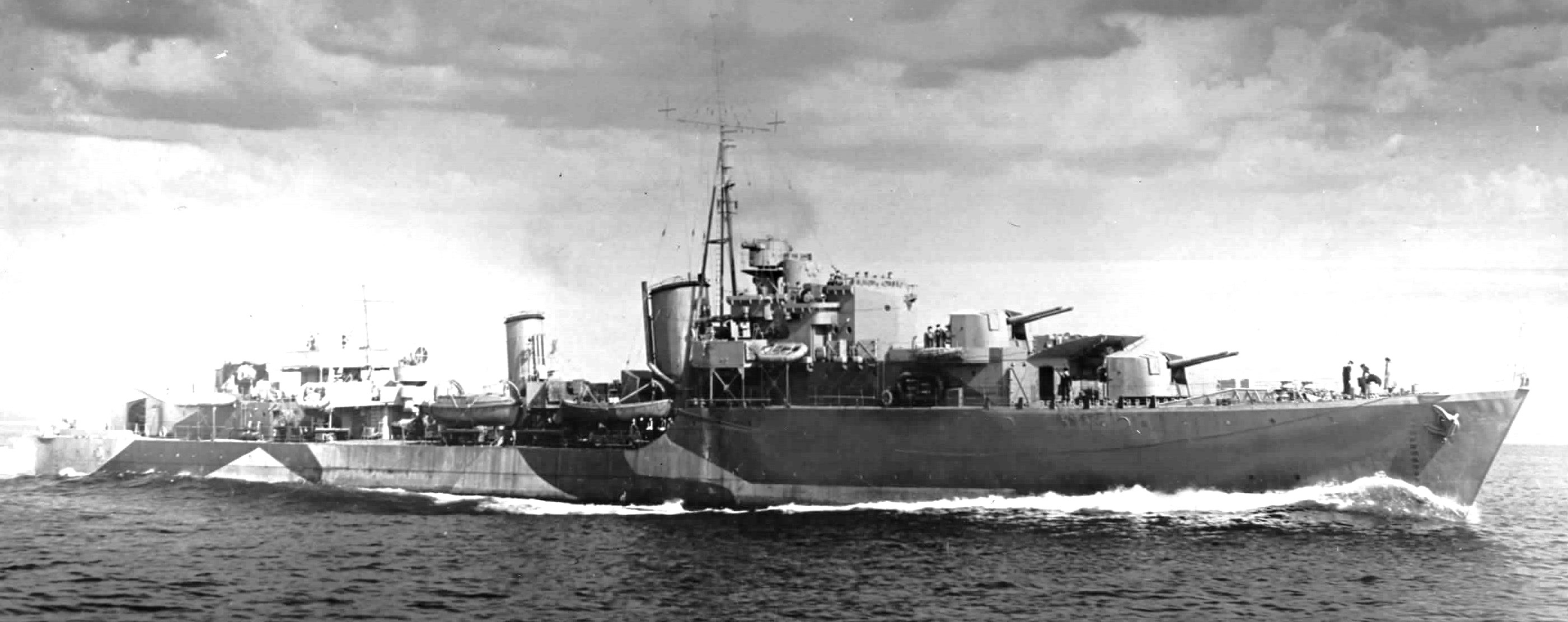
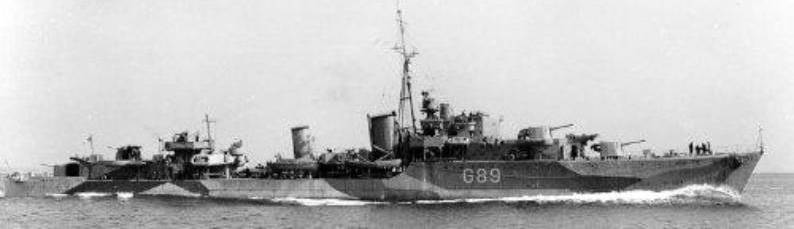
HMCS Iroquois (G89).
(RCN Photo)
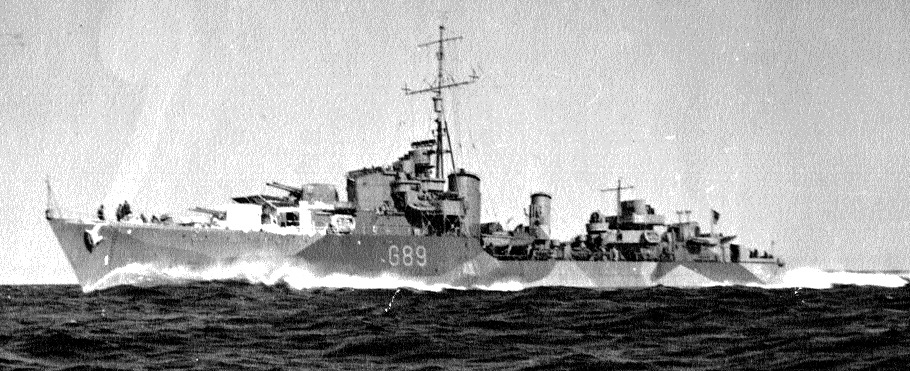
HMCS Iroquois (G89). The first of the Canadian Tribals to commission, she did so at Newcastle-on-Tyne, on 30 Nov 1942. HMCS Iroquois was assigned to the 3rd Flotilla, Home Fleet, but proved to have structural flaws and was not fully operational until 30 Jan 1943. On a quick round trip to Canada in Mar 1943 she incurred weather damage that kept her under repairs at Plymouth until early Jun 1943, following which she was employed on Gibraltar convoys. In Jul 1943 three troopships she was escorting to Freetown were attacked by German aircraft 300 miles off Vigo, Spain, and two were sunk, HMCS Iroquois rescuing 680 survivors from the Duchess of York. HMCS Iroquois then spent several months escorting Russian convoys. In Feb 1944, she arrived at Halifax for a refit, returning to Plymouth early in Jun 1944 to join the 10th Flotilla for invasion duties. After D-Day she carried out patrols in the Channel and the Bay of Biscay, and for some months escorted capital ships and troopships in UK coastal waters. She rejoined the Home Fleet at Scapa Flow in Mar 1945. On 16 Apr 1945, HMCS Haida G63, HMCS Huron G24 and HMCS Iroquois G89 departed Clyde with convoy JW.66 for Kola Inlet; arriving at Kola Inlet on 25 Apr 1945. They departed Kola Inlet for Clyde with convoy RA.66 on 29 Apr 1945. On 29 Apr 1945 HMCS Haida G63 and HMCS Iroquois were G89 attacked by U-427 (Oblt Karl-Gabriel Graf von Gudenus). The attack resulted in near misses by U-427. They arrived at Clyde on 8 May 1945. Following D-Day, she sailed to Oslo as an escort to Crown Prince Olaf, who was returning to liberated Norway. Shortly afterward she visited Copenhagen, Denmark, whence she escorted the German cruisers Prinz Eugen and Nurnberg to Kiel for their formal surrender. On 4 Jun 1945 she left Greenock with HMCS Haida and HMCS Huron, arriving at Halifax on 10 Jun 1945. The end of the Pacific war brought a halt to her tropicalization refit, and Iroquois was paid off on 22 Feb 1946. The following year she began a long refit and on 24 Jun 1949, was re-commissioned (219)as a cadet training ship. HMCS Iroquois completed 3 tours of duty in the Korean theatre. During her first tour, on 2 Oct 1952, HMCS Iroquois was making a daylight interdiction bombardment on a coastwise stretch of the main North Korean railway line when she received fire from the shore battery. A shell hit “B” gun deck and killed LCdr Quinn and AB Baikie instantly. AB Burden was critically wounded and died several hours later.
Following her Korean tours, she returned to her training role. In Dec 1959, during a 6-week deployment that included a NATO Exercise, HMCS Bonaventure, in company with HMCS Algonquin, HMCS Iroquois, HMCS Sioux and, HMCS Athabaskan encountered a major storm that battered the squadron. On 30 Jul 1962, the RCN sent the 3rd Destroyer Escort Squadron (Atlantic), under Capt. Gordon Edwards, on a good will / work up tour. The squadron consisted of HMCS Sioux 225, HMCS Huron 216 and HMCS Iroquois 217 (as flagship). The ships sailed from Halifax, NS, to Bermuda and then on to Jamaica, arriving on 5 August 1962. The squadron joined a large fleet of naval vessels already assembled, as all Royal Navies and the United States Navy, had sent “good will” ships of various classes to Jamaica. In essence, it served to form one of the largest allied fleets to be assembled since the Second World War, and spent six days in Jamaica celebrating their independence from Briton which occurred on 6 Aug 1962. The squadron then sailed back to Bermuda before heading to Prince Edward Island to par-take in their official Lobster Festival. From PEI the squadron returned to Halifax for fuel and provisions, and again departed for Bermuda. From Bermuda it was onto Trinidad & Tobago to take part in their independence celebrations.
Shortly after entering the Caribbean Sea, the fresh water evaporator broke down. The Admiralty in Halifax was advised, and a replacement was requested. This was easier said than done. HMCS Iroquois was a Second World War Tribal class Destroyer, built in the UK in 1941. Although some spares were on hand in Halifax, an evaporator was not one of them. A request was sent to the Royal Navy in Britain, and they in turn advised that they could supply. When HMCS Iroquois reached Port of Spain, she received the replacement evaporator. The unit was brought onboard, still packed in its original crate. There was the usual adornment of numbers and code letters printed on the wooden crate. What caught everyone’s eye however was the name printed on the crate in block letters “HMS Hood“. Apparently not all of the spares for HMS Hood were disposed of. The unit was identical and fitted nicely, but not everyone was happy. Some of the older members of the crew (veterans of the Battle of the Atlantic) saw it as an “omen”. They predicted it was the end of HMCS Iroquois. HMCS Iroquois departed Port of Spain and headed for Bermuda again.
From Bermuda, the Squadron proceeded to Newfoundland where on 12 Sep to 17 Sep 1962. While at St. John’s, the squadron’s actives included onboard entertainment of local dignitaries, day cruises for members of HMCS Avalon, HMCS Cabot and RCSCC Terra Nova and open house to the general public. Prior to leaving port, HMCS Iroquois was advised to wear its “Paying off Pennant” upon leaving harbour, as this was to be her last port of call. On 24 Oct 1962, HMCS Iroquois was paid off at Halifax and placed in operation reserve (Moth balled), at Point Edward Naval Station, Cape Breton NS. She was broken up at Bilbao, Spain, in 1964.
(Dave Shirlaw Photo)
HMCS Iroquois (G89).
(USN Photo)
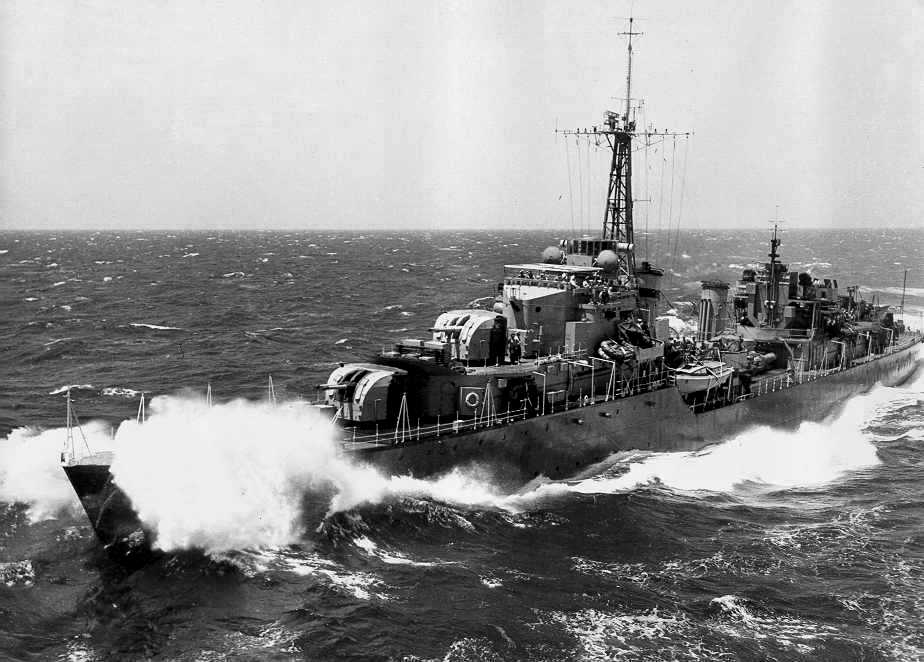
HMCS Athabaskan (R79), off the Korean coast, ca 1950. The last of her class to be completed, “Athabee” was commissioned at Halifax on 20 Jan 1948, and sailed in mid-May 1948 for the west coast, where she trained new entries and officer cadets until the outbreak of the Korean War. She sailed from Esquimalt on 05 Jul 1950, for the first of three tours of duty in Korean waters, returning 11 Dec 1953, from the last of them.
(Steven Hlasny Photo)
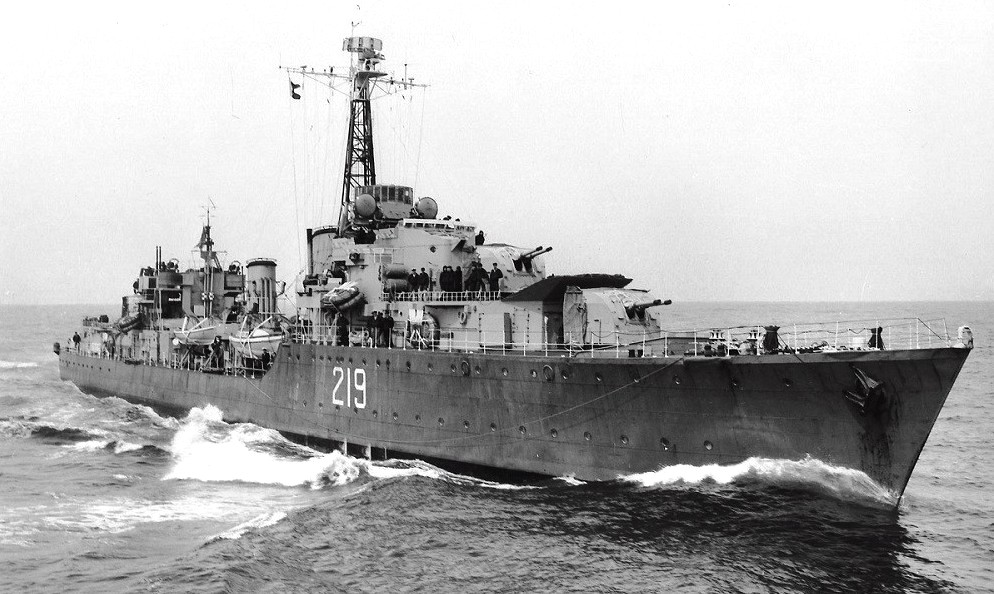
HMCS Athabaskan (219), off the Korean coast, ca 1950.
(Bob Theriault Photo)
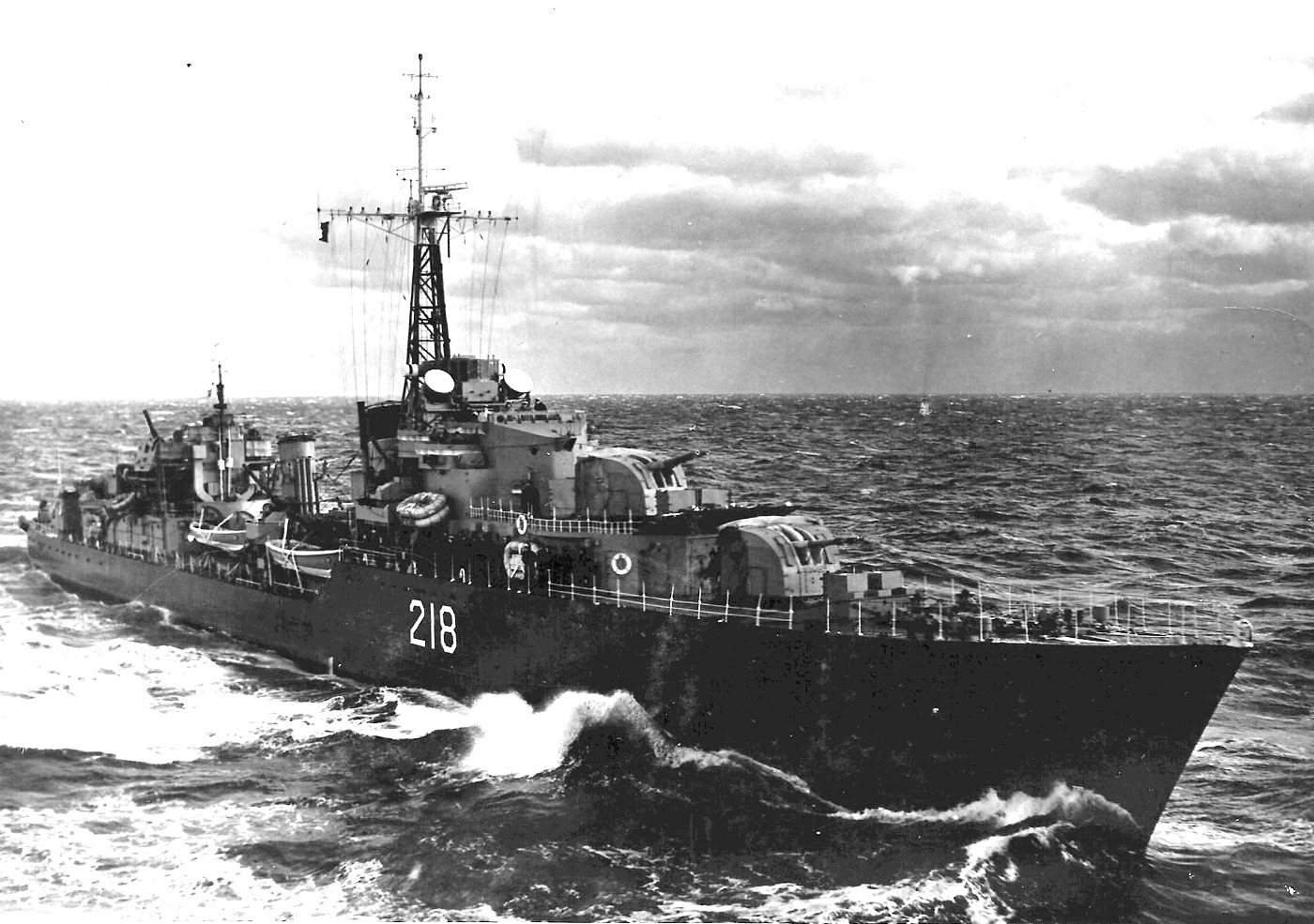
HMCS Cayuga (218), Korea, 1950.
(RCN Photo)
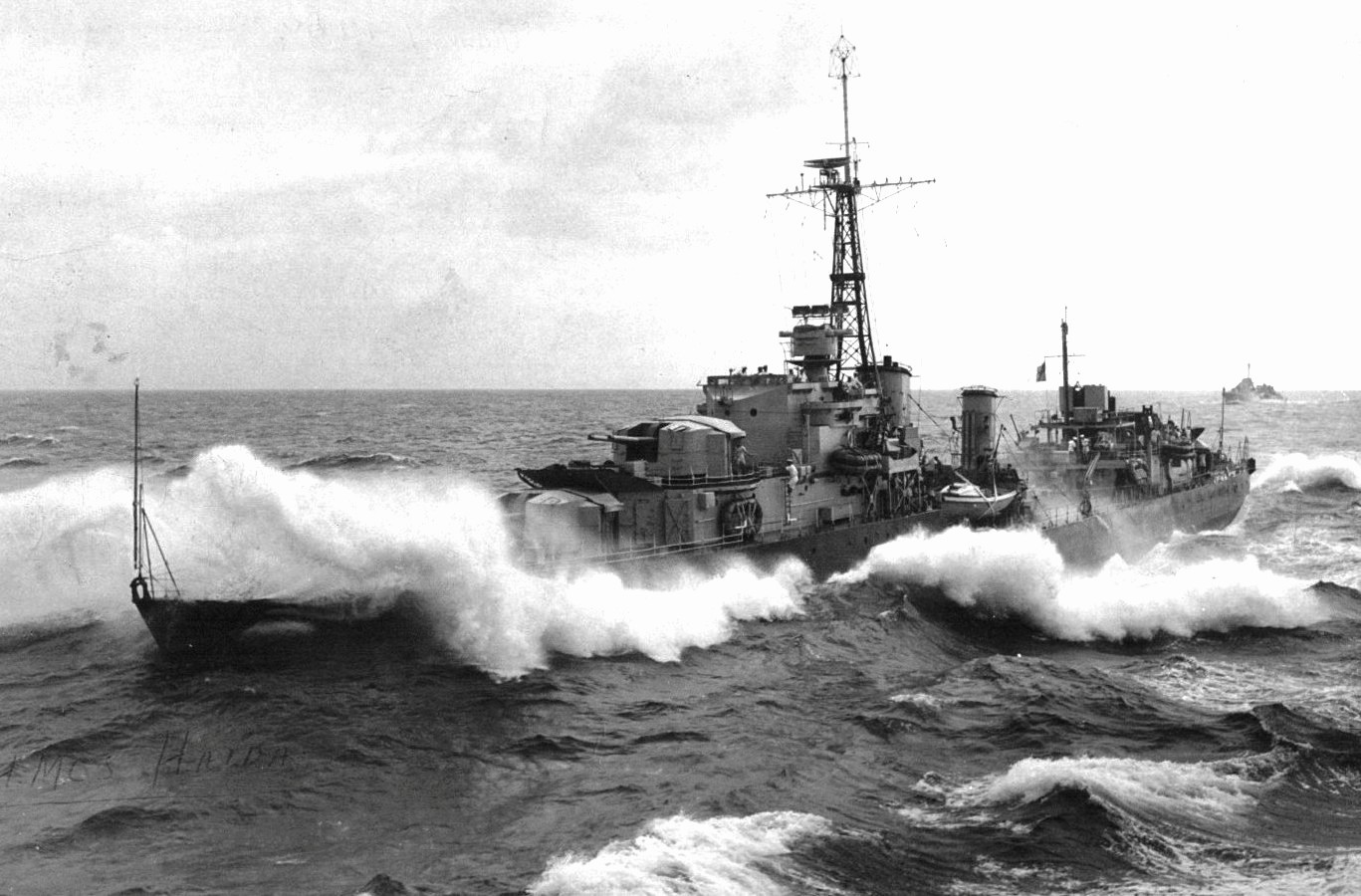
HMCS Haida (G63), 16 March 1949. She gained entry in the Trainbusters Club, destroying a Chinese supply train and engine off Tanch’on, South Korea.
(RCN Photo)
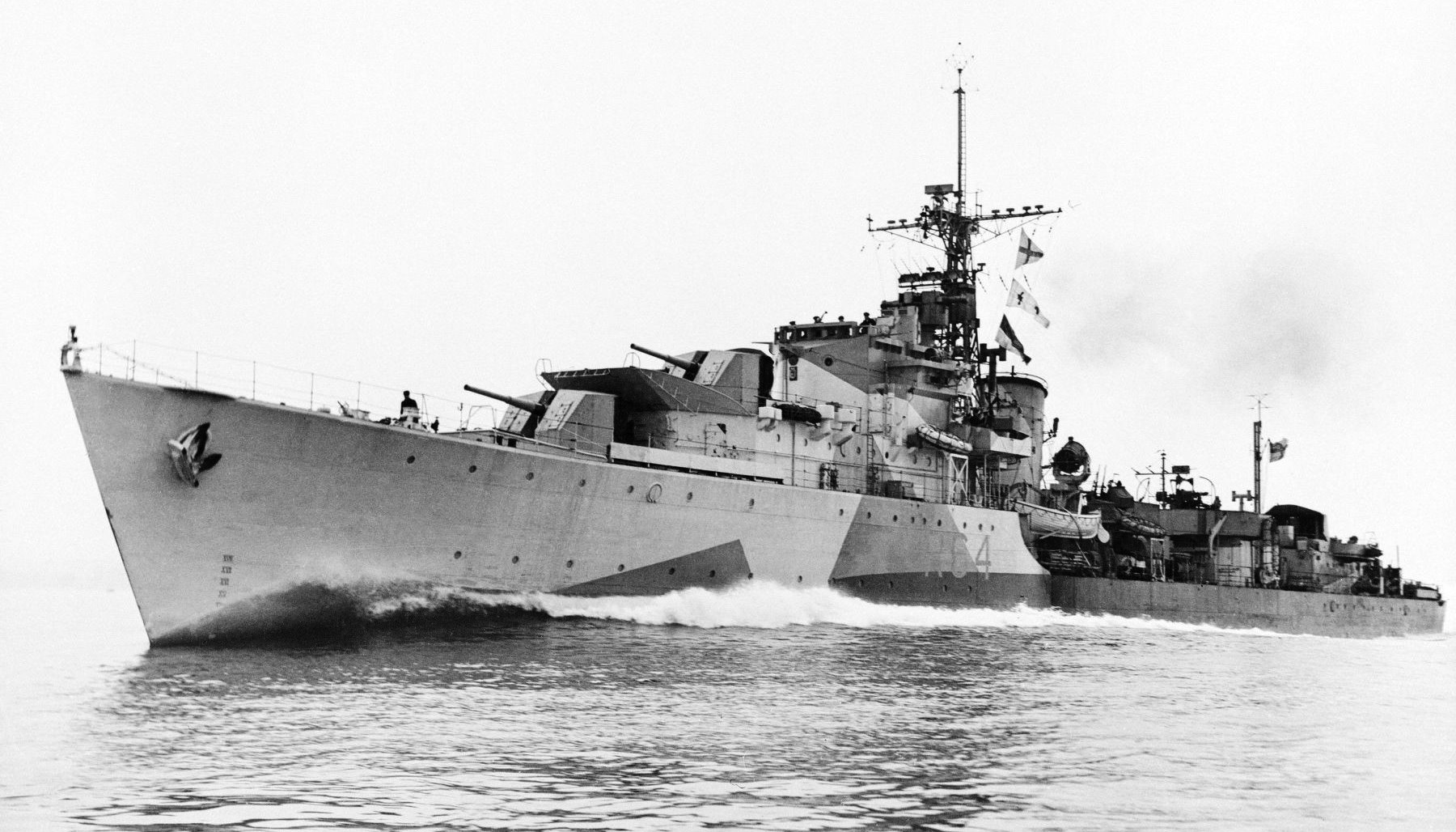
HMCS Sioux (R64) (V-class). Laid down as HMS Vixen, she was commissioned HMCS Sioux at Cowes, Isle of Wight, on 21 Feb 1944, and assigned to the 26th Flotilla of the British Home Fleet. She took part in escorting carrier attacks against the Tirpitz and against German shipping off Norway, and on 28 May 1944 left Scapa for Portsmouth for D-Day duties, bombarding shore targets on the Normandy coast. Returning to Scapa Flow in Jul 1944, she resumed her previous occupation and also escorted four convoys each way to and from Murmansk.
She left the UK on 6 Apr 1945, for her first trip to Canada and, upon arrival underwent a major refit at Halifax. In Nov 1945 Sioux was transferred to Esquimalt, where she was paid off into reserve on 27 Feb 1946. After some modernization she was re-commissioned (225) in 1950, and did three tours of duty in Korean waters, from 1951 to 1955. Following her Korean tours, she returned to her training role.
(Stuart Lory Photo)
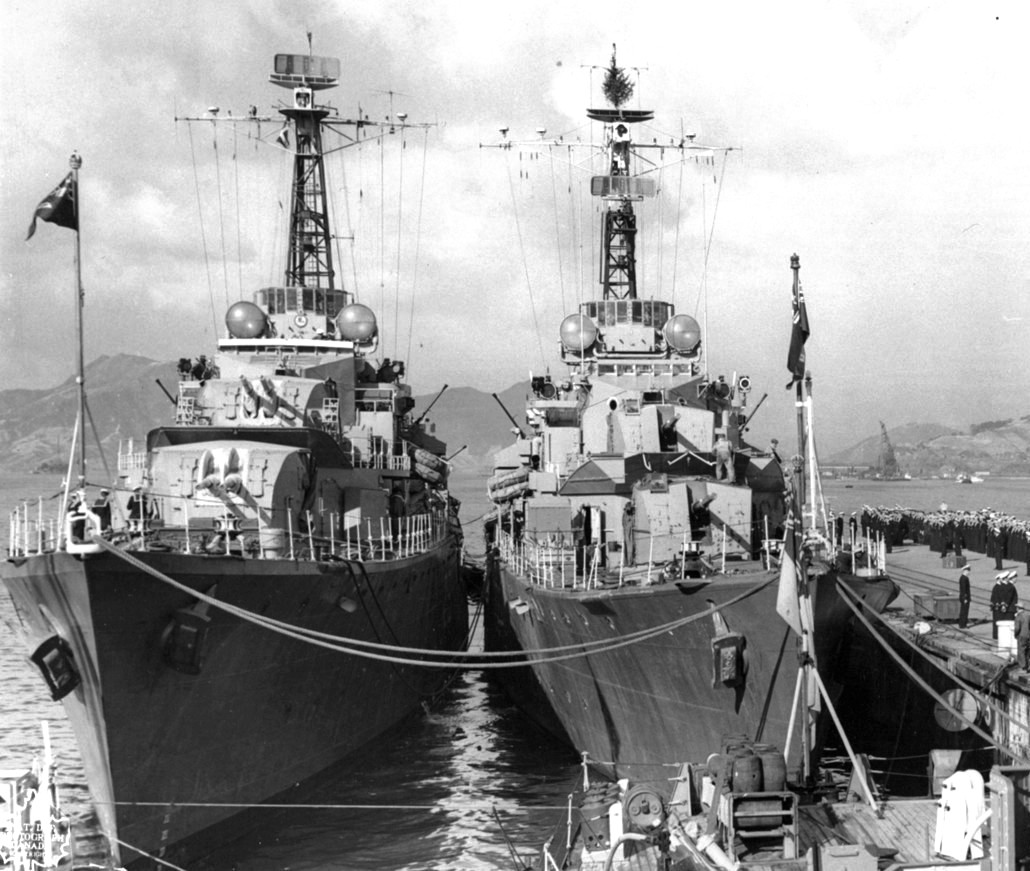
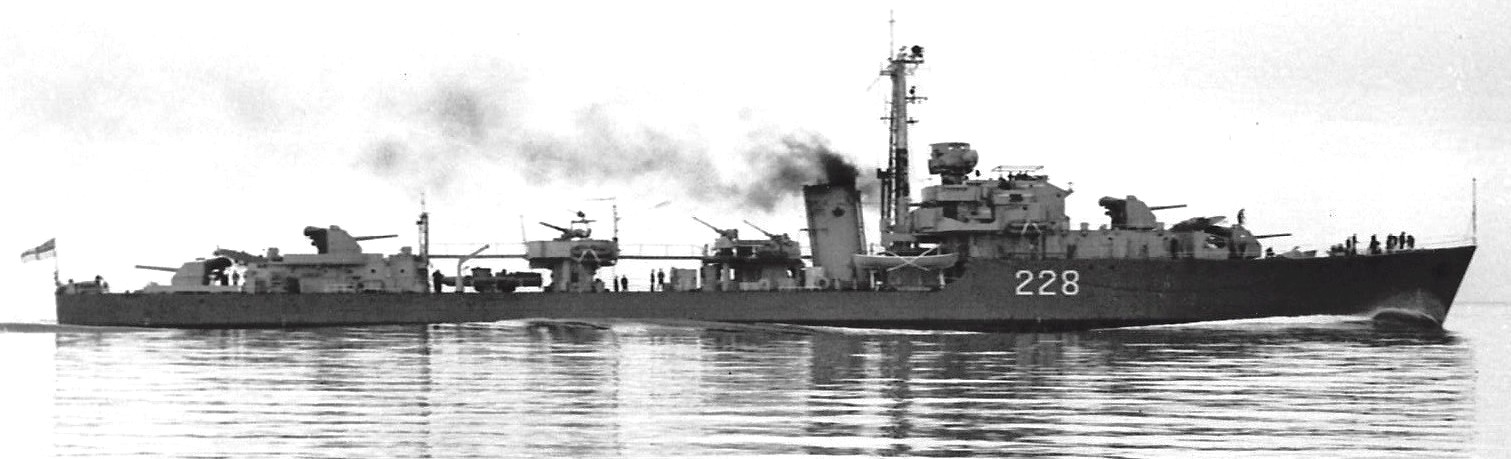
HMCS Athabaskan (219), left, and HMCS Crusader (228), at a jetty in Kure, Japan. HMCS Crusader had been in Korean waters for eight months, while HMCS Athabaskan was on her third tour of Korean duty.
(Steve Hlasny Photo)
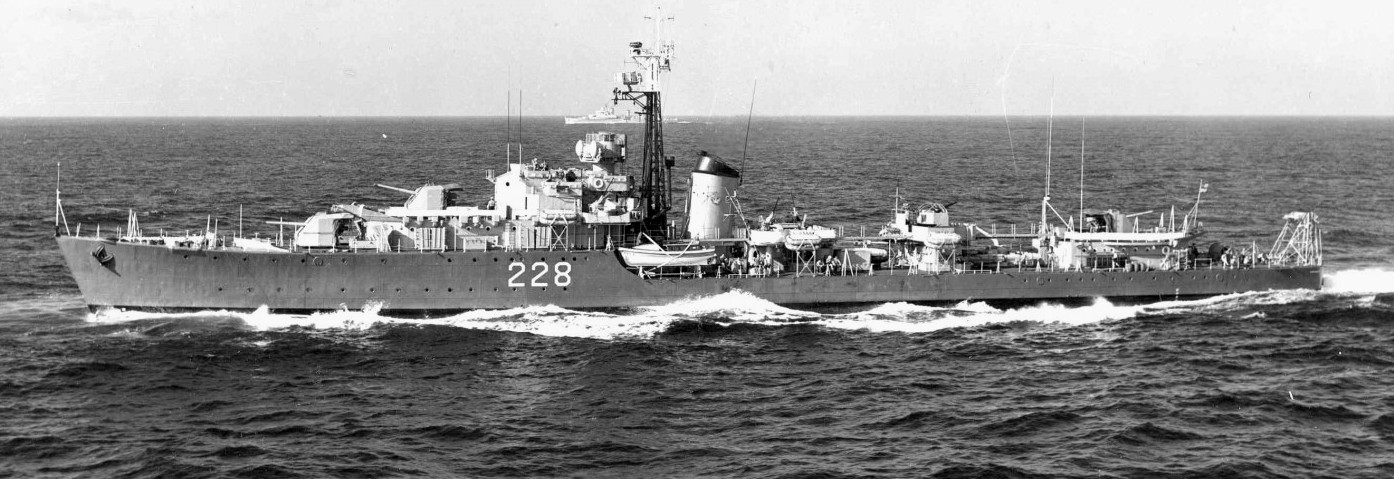
HMCS Crescent (228). In Jan 1945, after a year’s discussion, the British Admiralty agreed to lend the RCN a flotilla of “C” Class destroyers for use against the Japanese. The Pacific war ended, however, before any of the eight ships had been completed, and only two were transferred. The previous ships to bear their names, HMCS Crescent and HMCS Crusader, had been lost during the war as HMCS Fraser and HMCS Ottawa. This time they retained their names although the transfer was made permanent in 1951. HMCS Crescent and HMCS Crusader were virtually identical to HMCS Algonquin and HMCS Sioux, differing principally in having only one set of torpedo tubes and in being armed with 4.5-inch guns instead of 4.7-inch guns. Both ships were commissioned on the Clyde in 1945, HMCS Crescent on 10 Sep 1945 and HMCS Crusader on 15 Nov 1945. HMCS Crusader arrived at Esquimalt in Jan 1946, having made the journey via the Azores and the West Indies and was almost immediately paid off into reserve, a state in which she was to spend several years. After being brought out of reserve, HMCS Crusader carried out two tours of duty in the Korean theatre, the first between Jun 1952 and Jun 1953, the second after the armistice, from Nov 1953 to Aug 1954. Reverting then to her former training role, she was paid off on 16 Jan 1960, at Halifax. She had earlier served as a test vehicle for a prototype VDS (variable depth sonar) outfit, a more permanent installation of which was made in HMCS Crescent in 1960. HMCS Crusader was sold for scrapping in 1963.
(DND Photo via the CFB Esquimalt Naval Museum)
HMCS Crusader (228).