
Amelia Mary Earhart, Aviator
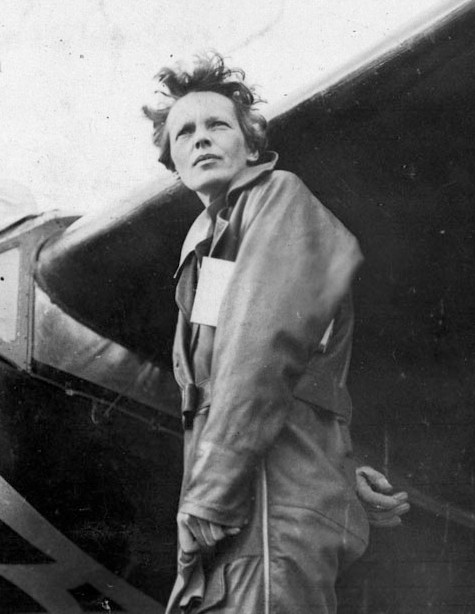
(Library and Archives Canada Photo, MIKAN No. 3598252)
Mrs. Amelia Earhart Putnam with Lockheed “Vega” aircraft before trans-Atlantic flight, Harbour Grace, Newfoundland, 21 May 1932.
Amelia Mary Earhart, born 24 July 1897; disappeared on 2 July 1937; declared dead 5 January 1939) was an American aviator and aviation pioneer who became one of the most celebrated figures of early flight. Earhart’s accomplishments in aviation inspired a generation of female aviators, including more-than 1,000 female pilots of the Women Airforce Service Pilots (WASP), who served during the Second World War.
In 1928, she was the first female passenger to cross the Atlantic by airplane. In 1932, she became the first woman to make a nonstop solo transatlantic flight, and was awarded the Distinguished Flying Cross for her achievement. She was one of the first aviators to promote commercial air travel, wrote best-selling books about her flying experiences, and helped found the Ninety-Nines, an organization for female pilots.
On July 2, 1937, she disappeared over the Pacific Ocean while attempting to become the first female pilot to circumnavigate the world. Since her disappearance, Earhart has become a global cultural figure and numerous films, documentaries, and books have recounted her life. (Wikipedia)
On 20 May 1932, 34-year-old Earhart set off from Harbour Grace, Newfoundland, with a copy of the Telegraph-Journal, given to her by journalist Stuart Trueman to confirm the date of the flight. She intended to fly to Paris in her single engine Lockheed Vega 5B to emulate Charles Lindbergh’s solo flight five years earlier. Her technical advisor for the flight was the Norwegian-American aviator Bernt Balchen, who helped prepare her aircraft and played the role of “decoy” for the press because he was ostensibly preparing Earhart’s Vega for his own Arctic flight. After a flight lasting 14 hours, 56 minutes, during which she contended with strong northerly winds, icy conditions and mechanical problems, Earhart landed in a pasture near Culmore, north of Derry, Northern Ireland. The landing was witnessed by Cecil King and T. Sawyer. When a farm hand asked, “Have you flown far?” Earhart replied, “From America.”
As the first woman to fly solo nonstop across the Atlantic, Earhart received the Distinguished Flying Cross from Congress, the Cross of Knight of the Legion of Honor from the French government, and the Gold Medal of the National Geographic Society from President Herbert Hoover. As her fame grew, Earhart developed friendships with many people in high office, most notably First Lady Eleanor Roosevelt, who shared many of Earhart’s interests, especially women’s causes. After flying with Earhart, Roosevelt obtained a student permit but did not further pursue her plans to learn to fly. Earhart and Roosevelt frequently communicated with each other. Another flyer, Jacqueline Cochran, who was said to be Earhart’s rival, also became her confidante during this period. (Wikipedia)
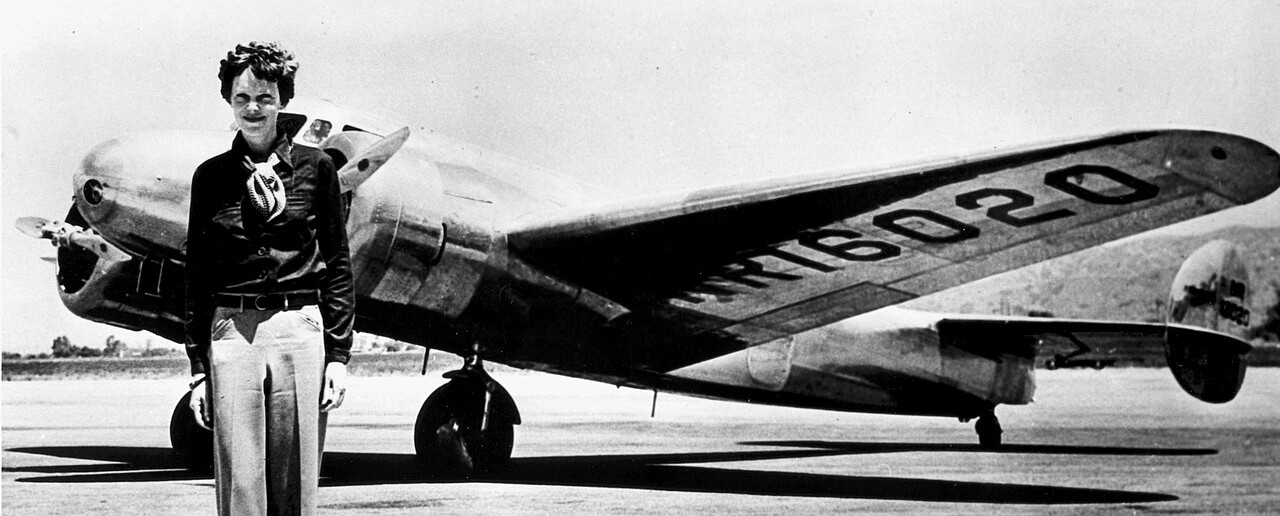
(NASA Photo)
Amelia Earhart standing in front of the Lockheed Electra in which she disappeared in July 1937. Born in Atchison, Kansas in 1897, Amelia Earhart did not begin flying until after her move to California in 1920. After taking lessons from aviation pioneer Neta Snook in a Curtiss Jenny, Earhart set out to break flying records, breaking the women altitude records in 1922. Earhart continually promoted women in aviation and in 1928 was invited to be the first women to fly across the Atlantic. Accompanying pilots Wilmer Stultz and Louis Gordon as a passenger on the Fokker Friendship, Earhart became an international celebrity after the completion of the flight. In May 1932 Earhart became the first woman to fly solo across in the Atlantic. In 1935 she completed the first solo flight from Hawaii to California. In the meantime Earhart continued to promote aviation and helped found the group, the Ninety-Nines, an organization dedicated to female aviators. On June 1, 1937, Earhart and navigator, Fred Noonan, left Miami, Florida on an around the world flight. Earhart, Noonan and their Lockheed Electra disappeared after a stop in Lae, New Guinea on June 29, 1937. Earhart had only 7,000 miles of her trip remaining when she disappeared. While a great deal of mystery surrounds the disappearance of Amelia Earhart, her contributions to aviation and womens issues have inspired people over 80 years.
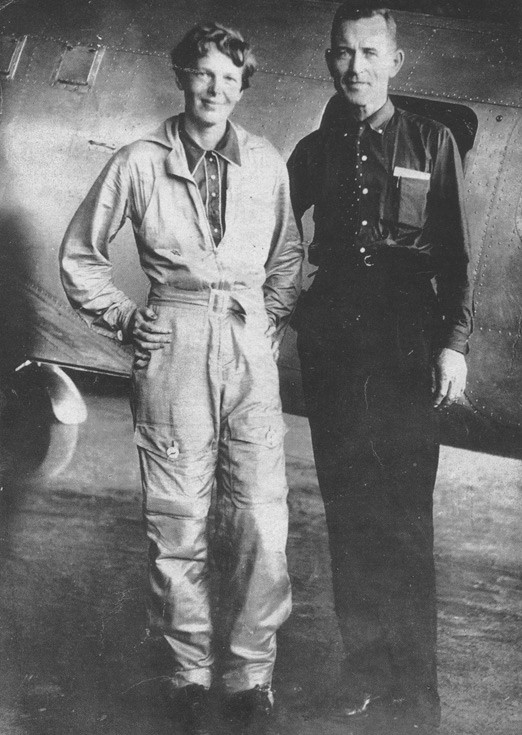
(SDASM Archives Photo)
Amelia Earhart and her navigator Fred Noonan, c1937.Amelia’s Canadian connections
(Major William March)
Given her status as an aviation icon, it is interesting to note that she may have been bitten by the flying “bug” in Canada. Amelia Earhart grew up in the American mid-West, with her family’s fortunes dependant upon a father who had a drinking problem. While attending junior college at Ogontz School in Rydal, Pennsylvania, she decided to visit her sister Muriel, who was attending St. Margaret’s College in Toronto over the Christmas holidays in 1917. It was while strolling down King Street with her sister, that Amelia was first exposed to the human cost of the European war that America had so recently joined (April 1917). An athletic “tomboy”, Amelia was immediately struck by the plight of the large number of wounded soldiers.
“There for the first time I realized what the World War meant. Instead of new uniforms and brass bands, I saw only the results of four years’ desperate struggle; men without arms and legs, men who were paralyzed and men who were blind. One day I saw four one-legged men at once, walking as best they could down the street together.”
When the holiday break was over she returned to Pennsylvania, remaining there only long enough to pack her things and withdraw from school. Returning to Toronto, she volunteered as a member of a Voluntary Aid Detachment, working where required in the Spadina Military Hospital, located in what is now part of the University of Toronto.
Often working twelve-hour shifts, Ms Earhart went wherever an extra pair of hands was required. During her infrequent days off she often visited a nearby stable where she won the trust of a spirited horse named “Dynamite” which the owner let her ride for free. During these outings that she met several pilots attached to the Royal Flying Corps Canada (RFCC). Captivated by the vivacious young American, they invited her to visit them at their aerodrome at Armour Heights.
Canada did not establish a flying corps of its own until the end of the First World War. Therefore, Canadians who flew in combat did so as members of either the Royal Flying Corps (RFC) or Royal Naval Air Service (RNAS) until April 1, 1918, when both of these organizations were combined to from the Royal Air Force (RAF).
During the first two years of the war, the importance of military aviation had grown exponentially to the point where, by the end of 1916, virtually all of the functions that we take for granted in a modern air force (surveillance, targeting, bombing, counter-air, ground-attack, etc.) were being undertaken. The increased need to “control the air” brought with it both the requirement to expand the RFC and RNAS and to deal with the horrendous losses, or “wastage”, experienced at the front.
In December 1916, it was finally decided to establish a training organization in Canada that would be self-sufficient, tap into a pool of “air-minded” Canadian youth, and take advantage of the abundance of space and resources available.
Eventually, the RFCC would grow to 20 Canadian Training Squadrons (CTS), plus schools, repair parks and supporting units, located primarily at Borden, Leaside, Deseronto, downtown Toronto and Armour Heights – all in Ontario.
At Armour Heights, Amelia would have been the guest of No. 21 CTS, which during the winter of 1918 was the only squadron left in Canada. The rest, and a sizeable portion of the support elements, had been temporarily shifted to Texas as part of a reciprocal agreement with the United States Government. As a new combatant, the United States was anxious to expand its air service and wanted to take advantage of British expertise.
The British, not quite sure how flying training would be effected by the Canadian winter, wanted a warmer climate under which to continue training. By mutual agreement, the RFCC would use Texas airfields from November 1917 until April 1918 for which the British would train the equivalent of 10 squadrons for the Americans. No. 21 CTS was tasked to experiment with winter flight training.
It is hard to imagine what Amelia would have thought of her visit. Although flying was still a new and exciting undertaking, flying with the temperature below zero was an exercise in endurance.
The principle training aircraft of the RFCC was the Curtiss J.N. 4, affectionately known as the “Jenny”. A two-seater, open cockpit biplane, the Jenny was just being “introduced” to skis at Armour Heights. The pilot and student, bundled up against the cold to the point where they could barely move, would have waddled to their aircraft for a training flight. Climbing with difficulty into their respective seats, attended by groundcrew jumping up and down to stay warm, pilot and student would have made last-minute adjustments to their wraps prior to the roaring cough of the engine.
Using hand signals – radio communications were not a regular feature yet – the instructor directed the student to takeoff straight ahead, across a field that had been cleared of the night’s snow either by hand, or with a horse-drawn snowplough. With the skis bucking over various ruts and bumps, the Jenny was finally airborne to the relief of the instructor, the thrill of the student and the amazement of the onlookers.
Amelia was thrilled and wrote of her experience: “Though I had seen one or two [airplanes] at country fairs before, I now saw many of them, as the officers were trained at the various fields around the city. Of course no civilian had a chance of going up. But I hung around in spare time and absorbed all I could. I remember the sting of the snow on my face when it was blown back from the propellers when the training plan took off on skis.”
Later in life, as Amelia began to take an active interest in learning how to fly, she credited “the interest aroused in me in Toronto led me to all the air circuses in the vicinity.” At one such field in California she made her first flight and the rest – as they say – is history.
But you have to wonder. If she had closed her eyes in the balmy Californian sky, did she think of a cold winter’s day at Armour Heights and a Jenny on skis?