
Élisa Léontine Deroche
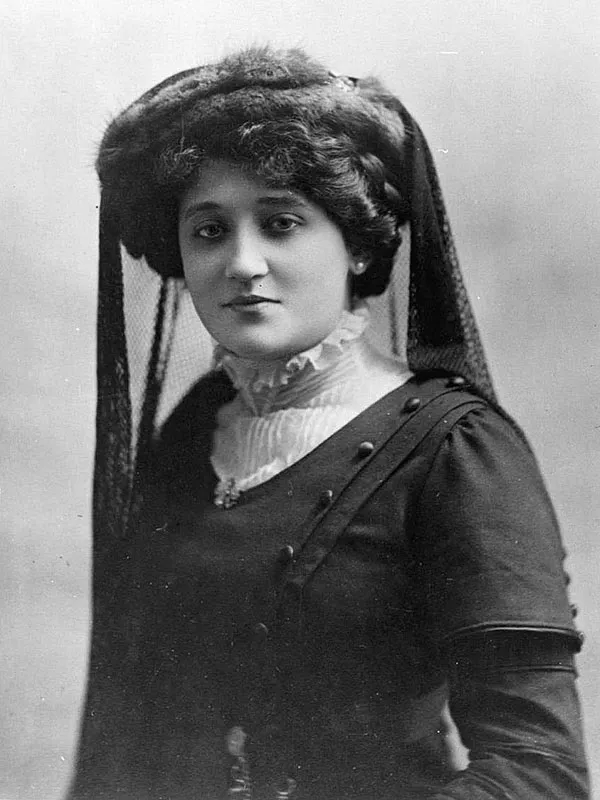
Élisa Deroche, known under the pseudonym Baroness Raymonde de Laroche, was a French actress and aviator born on 22 August, 1882 in Paris (4th arrondissement). She died on 18 July 1919 in a plane crash at Le Crotoy (Somme). She was the first woman in the world to obtain her pilot-aviator license on 8 March 1910, a milestone in the history of women’s aviation.
Her parents were Charles-François Deroche, a leather goods maker, founder of the Maison Deroche in Paris, and Christine Calydon Gaillard. As a young woman, she began an artistic career. It was during this period that she took the pseudonym “Baroness Raymonde de Laroche”, in memory of her daughter, Raymonde Marguerite Charlotte Thadome, who died on 25 March 1902 at the age of seven and a half months. She also devoted herself to painting, sculpture and motorsport. Around 1902, she drove a motorcycle made by the Werner brothers. It was also in 1902 that she obtained her driver’s license.
On 13 September 1906, Raymonde de Laroche was present at Bagatelle, when Santos-Dumont made a successful first flight. On 13 January 1908, she was in Issy-les-Moulineaux, when Henri Farman completed a one-kilometre loop.
Raymonde de Laroche was interested in the studies and experiments of Blériot, Ernest Archdeacon and the Voisin brothers. After studying various aircraft, she chose the Voisin biplane for its qualities of maneuverability, stability and ease of flying, and in 1909 she met Charles Voisin, founder with his brother Gabriel of the company Voisin Frères.
Raymonde de Laroche was determined to fly. She decided to train to make her first solo flight. Flying engineer Édouard Chateau took charge of her training at the Châlons camp in Mourmelon.
On 22 October 1909, she made her first flight alone aboard a Voisin biplane over a distance of 300 meters. The next day, she made a 6-kilometer flight, still under the vigilance of Mr. Château.
On 1 January 1910, she took delivery of her Voisin biplane and made a seven-minute flight. She ran out of daylight, which prevented her from completing the requirements for her pilot’s license.
On 4 January 1910, Raymonde de Laroche was training to obtain her pilot’s license on the Bouy airfield. She took flight around 3 p.m., in light winds, made a first lap of the runway flying at a height of four meters in perfect conditions, when on the second lap, having taken a turn too far offshore and not having been able to climb high enough, she hit the poplar trees that lined the road. That same day, Léon Delagrange was killed on the field of La Croix-d’Hins in Gironde.
She obtained her pilot’s license during the Heliopolis meeting in Egypt, which was held from 6 to 13 February 1910. The Aéro-Club de France validated it, and the license was issued to her on 8 March 1910, No. 36 of the Aéro-Club de France. She was the first woman in the world to obtain it, although she was not the first woman to have flown an aeroplane solo (Thérèse Peltier preceded her, by making a flight in September 1908 without having her license).
Raymonde de Laroche then took part in numerous air gatherings, both in France and abroad, such as the Heliopolis meeting, the Tours meeting from 30 April to 5 May 1910, the Saint Petersburg meeting from 8 May to 15 May 1910, in front of Tsar Nicholas II; Raymonde de Laroche made a spectacular flight on this occasion: at an altitude of one hundred metres, she cut the engine of her biplane to land in gliding flight[24]. She also performed at the Touraine Aviation Week, the Budapest Air Show from 5 to 15 June 1910 and the Grande Semaine d’Aviation de Rouen from 19 to 26 June 1910.
From 3 to 10 July 1910, she appeared during the second major Champagne aviation week in Reims. She was seriously wounded during this meeting, on 8 July 1910, her plane having crashed; she was taken to Doctor Roussel’s clinic in Reims. Recovered, she left the clinic on 7 October to return to her home in Paris.
On 20 May 1911, Raymonde de Laroche was appointed Officer of the Academy by Théodore Steeg, Minister of Public Instruction and Fine Arts. During the First World War, she provided transportation to the Army. After the war she set several records: altitude (4,663 m) and distance (323 km).
On 18 July 1919, she went to the Crotoy aerodrome to test an aircraft. A seasoned engineer, she intended to become the first female test pilot. On this occasion, she co-piloted an experimental aircraft. During the approach maneuvers for landing, the plane dived and crashed, killing both. She is buried in the Père-Lachaise cemetery (division 92). (Wikipedia)
Article by Jérôme Prod’homme
Élisa Léontine Deroche was born in Paris on August 22, 1882, into a family of no means. Her father was a leatherworker, her mother a seamstress. Nothing predestined her to become an aviatrix. And yet, right from childhood, she stood out for her insatiable curiosity. She loves movement, speed, thrills. In a modernizing Paris, she took an interest in technical innovations, notably the bicycle, the automobile and the motorcycle. Early on, she realized that to exist in a world where women were rarely visible, she had to create a character for herself. She embarked on an artistic career: a stage actress, she adopted an elegant stage name, Raymonde de Laroche, which sounded like that of an aristocrat. This pseudonym would become her public identity, the one by which history would remember her. Her marriage to Louis Léopold Thadome in 1900, followed by her divorce in 1909, marked the beginning of an independent life. In 1915, she remarried Jacques Vial. But between these two unions, an unexpected passion was to change her destiny: aviation.
At the end of the 19th century and the beginning of the 20th, the conquest of the sky was at the heart of modern dreams. The Wright brothers flew in 1903 in the United States, Santos-Dumont fascinated Paris with his airships, and European pioneers multiplied their experiments. Raymonde de Laroche, fascinated, attended demonstrations. She wants to fly. In an almost exclusively male world, she dares to ask to learn to fly. She turns to the Voisin brothers, renowned aircraft builders. In 1909, the Voisins agreed to teach her the basics of flying. She soon showed exceptional qualities: courage, control and composure. On 22 October 1909, she made her first solo flight, aboard a Voisin biplane. She became the first woman in the world to take to the skies alone.
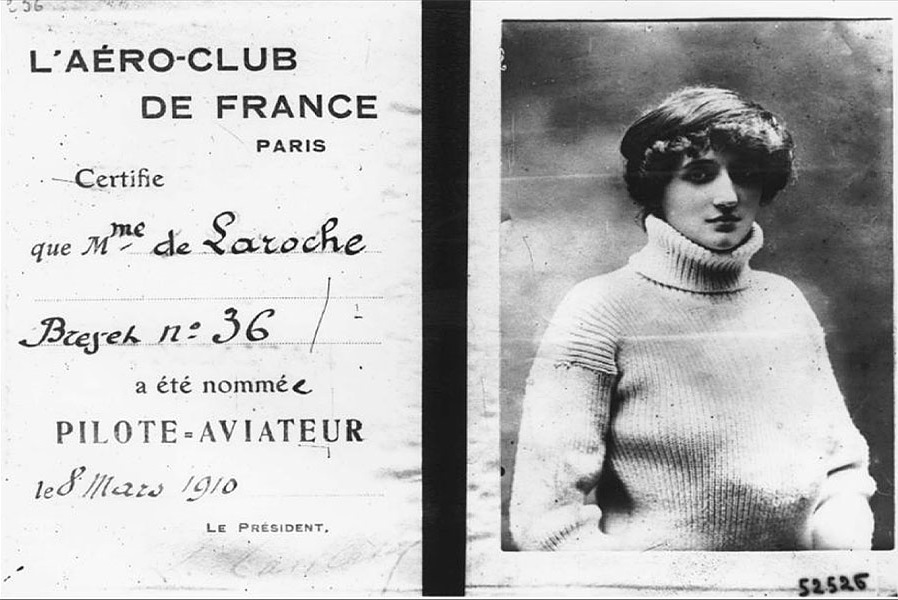
Pilot Certificate number 36 of the l’Aéro-Club de France was issued to Mme. de Laroche. (Musee de l’Air at l’Espace
On 8 March 1910, the Aéro-Club de France awarded her the brevet de pilote n° 36. The number may seem insignificant, but it’s historic: of the first 35 licensed pilots, all were men. She, Elisa Deroche, is the first woman to break this barrier. The press seized on the event. She was dubbed “the Baroness of Laroche”. The title of nobility was invented by journalists to accentuate the romantic aspect, but it remained attached to her name. This patent made her a part of the universal history of aviation. She became a symbol: a woman could fly, a woman could equal men in this new and risky field.
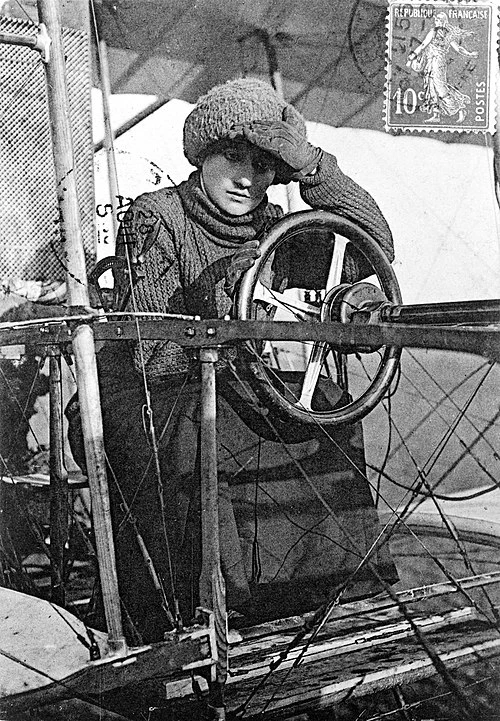
(United States Library of Congress Photo)
Baroness Deroche in her Voisin biplane in 1907.
As soon as she obtained her license, Raymonde de Laroche was asked to take part in airshows. These events attracted huge crowds, eager to see planes take off, turn and land. Female aviators were rare, which accentuated her aura. She took part in demonstrations in Rouen, Reims and Lyon, as well as abroad. In St Petersburg, she was received by Tsar Nicholas II, impressed by her audacity. She also flew in Egypt and Germany, multiplying her experiences and encounters. Every appearance is an event: seeing a woman master a flying machine fascinates as much as it shocks some conservative minds.

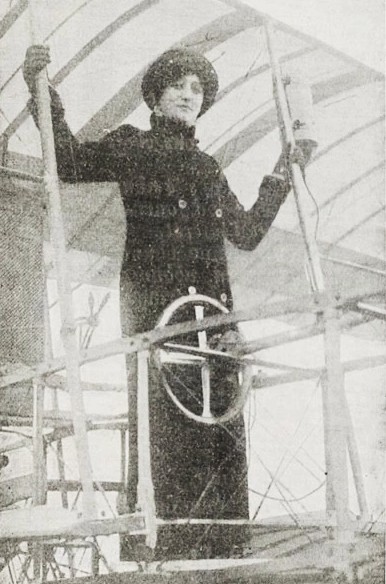
In 1913, she trained for a long time in Farman biplanes in Buc, France.
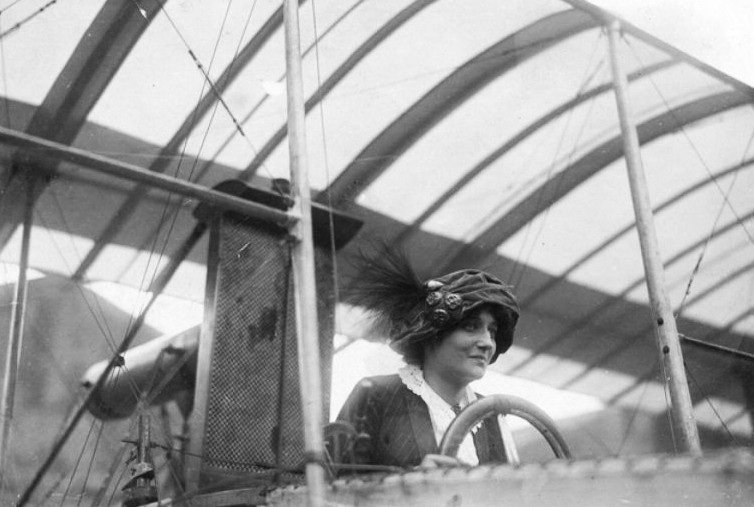
(Smithsonian Institution Photo)
Élisa Léontine Deroche at the controls of one of her biplane trainers.
Early aviation was extremely dangerous. Aircraft were fragile, unstable and often capricious. Accidents were frequent. Raymonde de Laroche herself suffered several. In 1910, she was seriously injured in a crash. She escaped, but had to stop flying for several months. But these ordeals did not stop her. She returned to the stick as soon as she could. Her determination impresses. She showed that her passion transcended fear and pain.
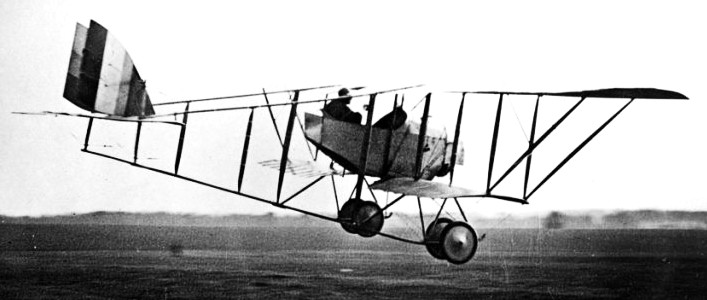
Société des Avions Caudron G.3, the same type airplane flown by Adrienne Bolland when she crossed the Andes Mountains of South America nearly two years later.
The Caudron G.3 was a World War I reconnaissance airplane and flight trainer manufactured by Société des Avions Caudron. It is called a sesquiplane because the lower wing is significantly shorter than the upper. The G.3 was a single-engine aircraft that was built in single- and two-place variants. The engine and cockpit are contained in a very short fuselage, supporting the wings and landing gear. Tail control surfaces are mounted on an open framework tail boom.
After graduating, Raymonde de Laroche didn’t just want to fly, she wanted to push the limits. She entered competitions, breaking women’s records and proving that a woman could excel in this field. In November 1913, she completed a four-hour non-stop flight. A feat at a time when mechanics were uncertain and every minute of flight was a victory. This feat earned her the Coupe Fémina, a distinction awarded by the Aéro-Club de France to the most successful female aviators. Her name began to circulate throughout Europe. She is invited to the most prestigious meetings, admired for her tenacity and courage. Everywhere she goes, she embodies a modern image of the woman, free and daring.
When the First World War broke out in 1914, Raymonde de Laroche was determined to offer her talents to her country. But women were not allowed to fly in the military. Rejected as an aviatrix, she made a different commitment. She became an automobile driver for the front, transporting wounded and supplies. This experience reinforces her image as a determined and courageous woman. Even deprived of a plane, she finds the means to serve, proving once again that her life is guided by daring and surpassing oneself.
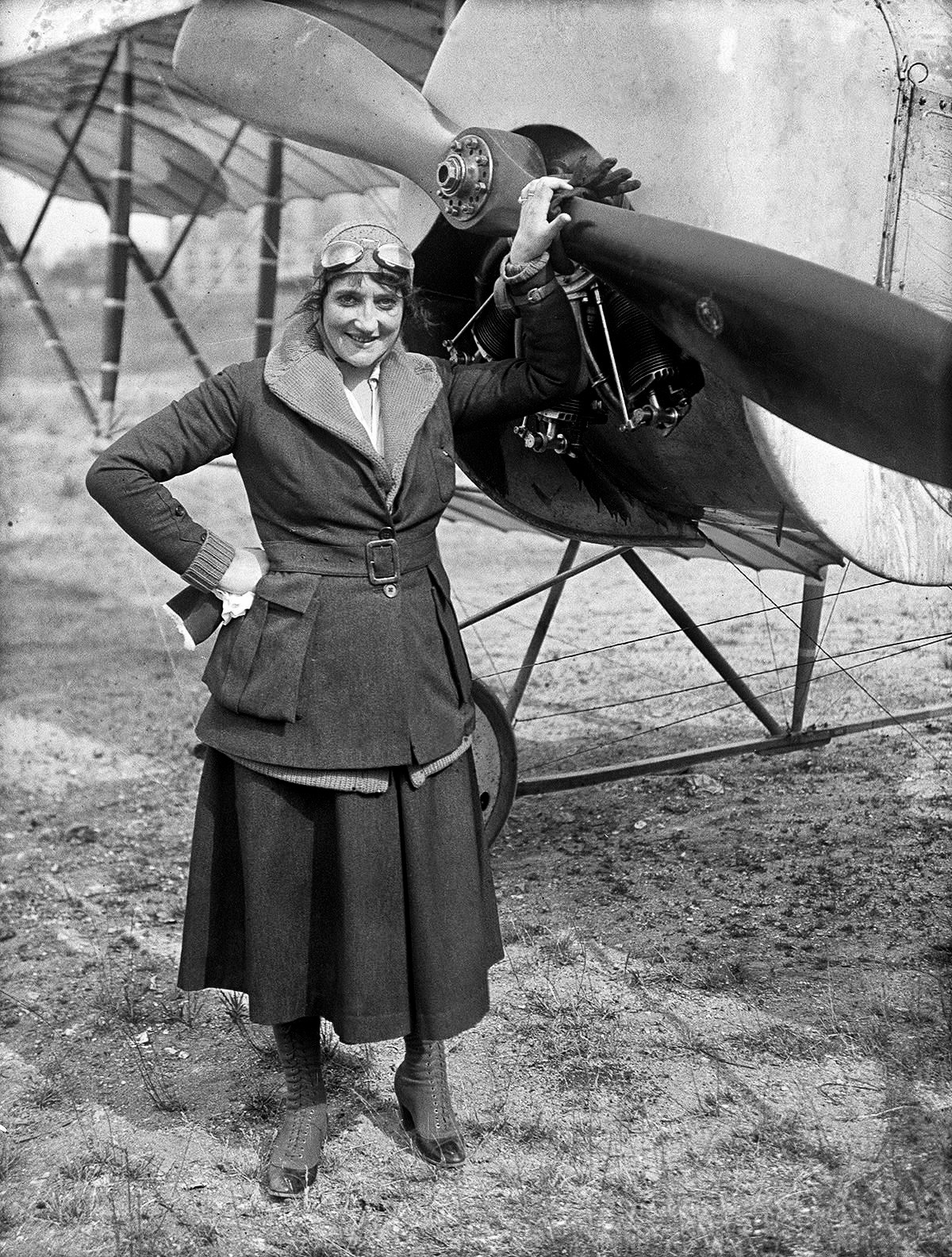
(Bettmann/Corbis Photo)
”Élise Léontine Deroche poses with the airplane in which she would later be killed, at Le Crotoy, France, 18 July 1919.
After the war, Raymonde de Laroche returned to flying airplanes. She dreamed of even more impressive records. In June 1919, she reached an altitude of over 5,000 metres, according to some accounts. But a few weeks later, on 18 July 1919, tragedy struck. During a test flight in Le Crotoy, Picardy, the aircraft she was co-piloting with aviat eur eur Barrault crashed. She died instantly, aged just 36. Her death shocked the aviation world. Newspapers salute her courage and recall her exploits. She disappeared just as aviation was entering a more modern era, leaving her name engraved as that of a pioneer. She is buried in the Père-Lachaise cemetery in Paris. Her sober tomb is regularly decorated with flowers in tribute.
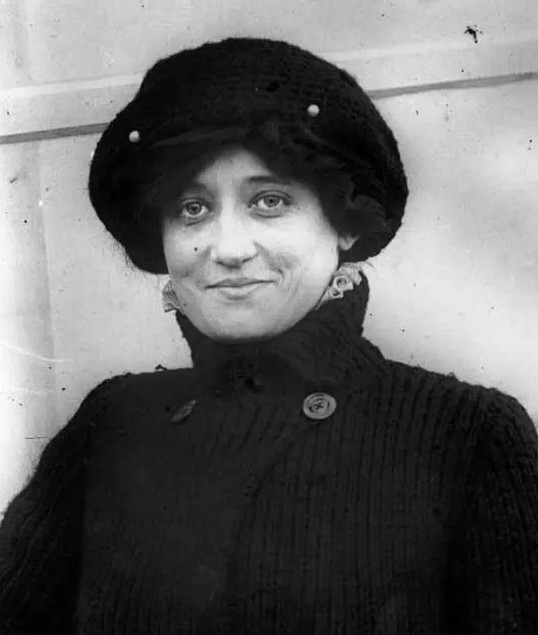
(Elisa Deroche / Library of Congress of the United States of America Photo)