
US Navy Essex-class aircraft carriers in the Second World War:
USS Essex (CV-9), USS Yorktown (CV-10), USS Intrepid (CV-11), USS Hornet (CV-12), USS Franklin (CV-13), USS Ticonderoga (CV-14), USS Randolph (CV-15), USS Lexington (CV-16), USS Bunker Hill (CV-17), USS Wasp (CV-18), USS Hancock (CV-19), USS Bennington (CV-20), USS Boxer (CV-21), USS Bon Homme Richard (CV-31), USS Shangri-La (CV-38)
The Essex class is a retired class of aircraft carriers of the United States Navy. The 20th century’s most numerous class of capital ship, the class consisted of 24 vessels which came in “short-hull” and “long-hull” versions. Thirty-two ships were ordered, but as the Second World War wound down, six were canceled before construction and two were canceled after construction had begun. Fourteen saw combat during the Second World War. None was lost to enemy action although several sustained crippling damage due to aerial attacks. Essex-class carriers were the backbone of the U.S. Navy from mid-1943 and, with the three Midway-class carriers added just after the war, continued to be the heart of U.S. naval strength until supercarriers joined the fleet starting in the 1950s. Several of the carriers were rebuilt to handle heavier and faster aircraft of the early jet age and saw service in the Vietnam War, with Lexington decommissioned as a training carrier in 1991. Of the 24 ships in the class, four – Yorktown, Hornet, Lexington, and Intrepid – have been preserved as museum ships. (Wikipedia)
USS Essex (CV-9)
USS Essex (CV-9). Commissioned 31 Dec 1942. She was the lead ship of the Essex class, and participated in multiple campaigns in the Pacific, including Wake Island, Palau, Leyte Gulf, and Okinawa. Following the war, she underwent modernization and was recommissioned as an attack carrier and later an anti-submarine aircraft carrier. Serving primarily in the Atlantic, Essex played a role in the Cuban Missile Crisis and the Korean War. She was also the primary recovery carrier for the Apollo 7 space mission. Essex earned the Presidential Unit Citation and 13 battle stars for her involvement in the Second World War.
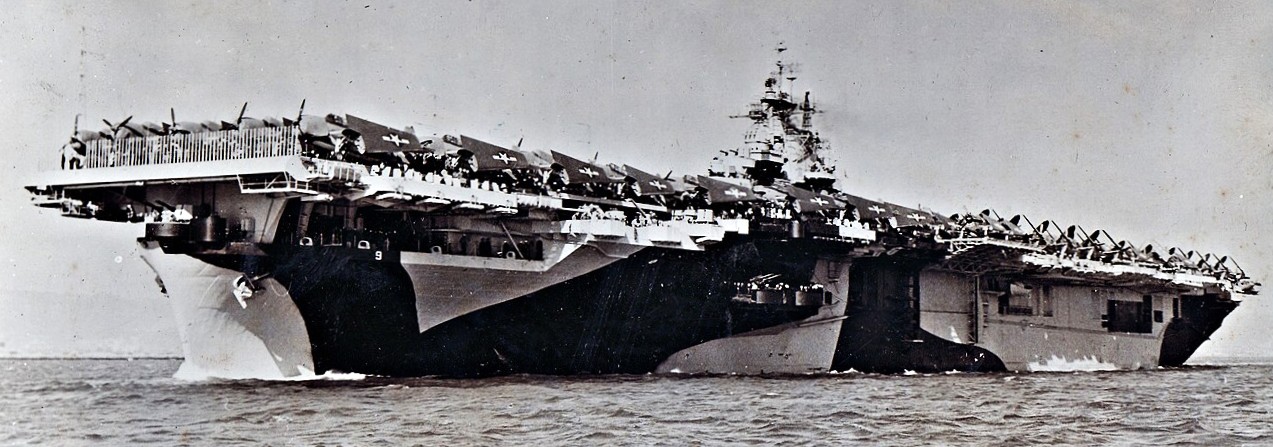
(USN Photo)
USS Essex leaving San Francisco harbour on 15 April 1944.
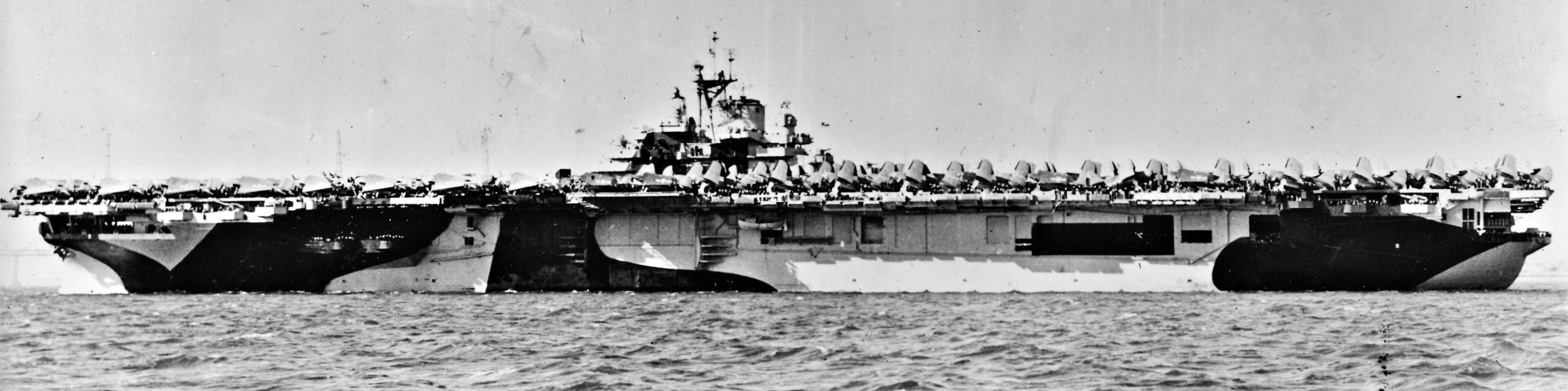
(USN Photo)
USS Essex (CV-9) Okinawa 1945.
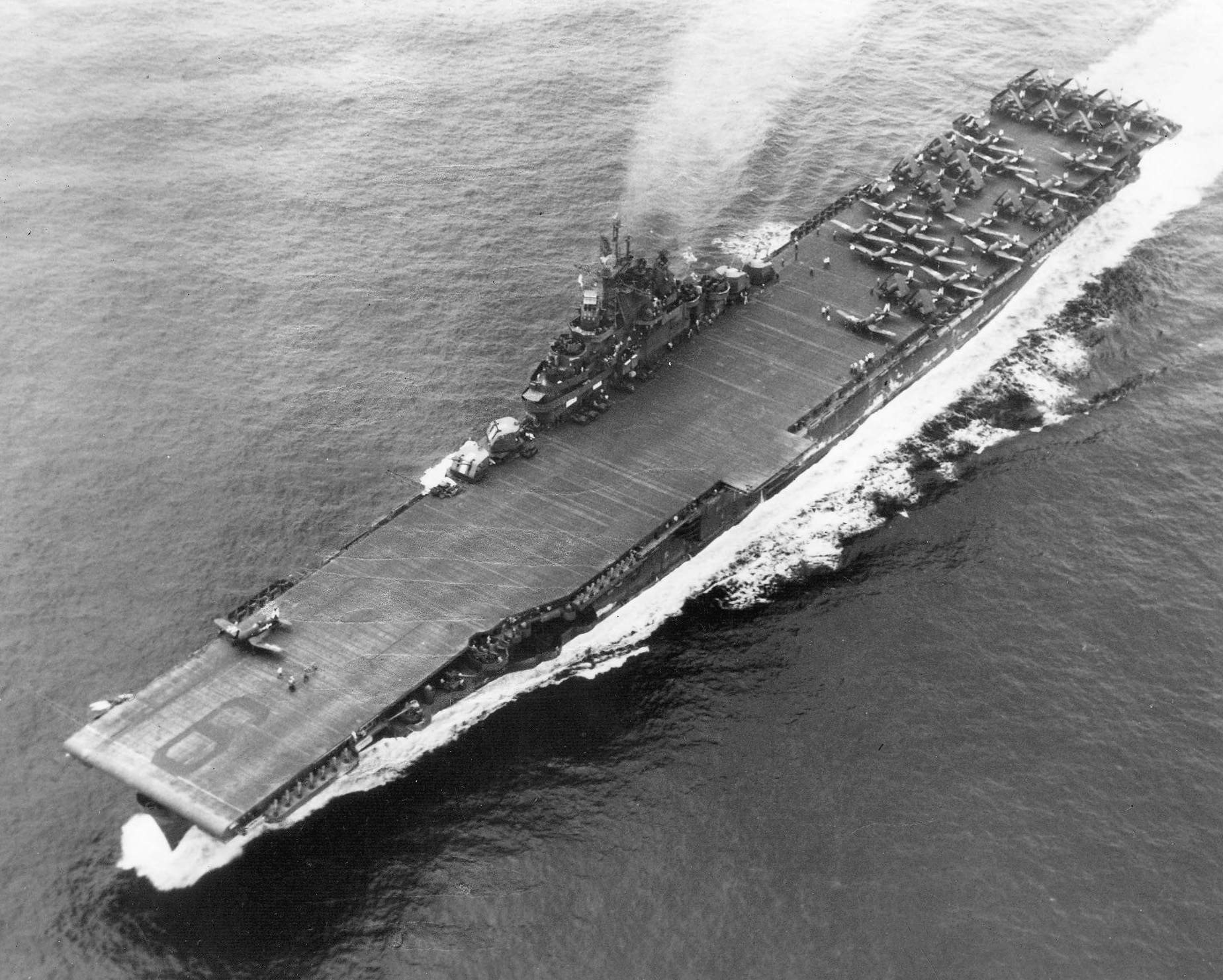
(USN Photo)
USS Essex (CV-9) underway at sea during the Okinawa Campaign, 20 May 1945. Note that her Carrier Air Group 83 (CVG-83) contains both Vought F4U-1 Corsair and Grumman F6F-5 Hellcat fighters of VBF-83 and VF-83.
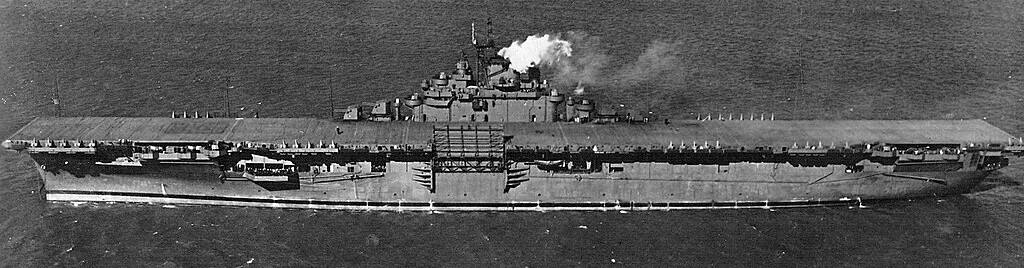
(USN Photo)
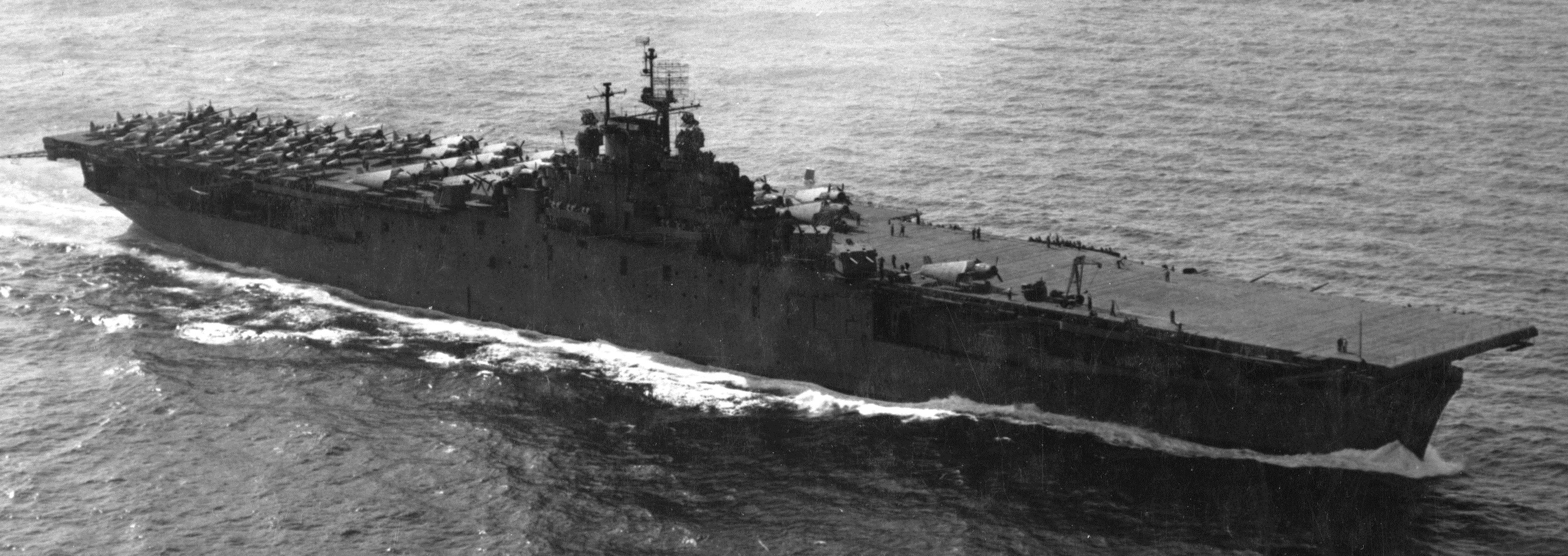
USS Essex (CV-9) in Hampton Roads on 1 February 1943.
(USN Photo)
USS Essex (CV-9) underway in the Atlantic Ocean at 1615 hrs on 10 May 1943, circa 160 km off the coast of Virginia.
USS Yorktown (CV-10)
USS Yorktown (CV-10). Commissioned 15 April 1943. Originally named Bon Homme Richard, Yorktown was the second carrier bearing its name to serve in the war. Shewas named in honour of the carrier sunk at the Battle of Midway. During the war, she played a significant role in the Pacific offensive, earning 11 battle stars and the Presidential Unit Citation. She underwent modernization in the 1950s and operated as an attack and anti-submarine carrier. Yorktown also participated in the Vietnam War and played a crucial role in recovering the Apollo 8 astronauts. Decommissioned in 1970, she is now part of Patriots Point Naval & Maritime Museum in Charleston.
(USN Photo)
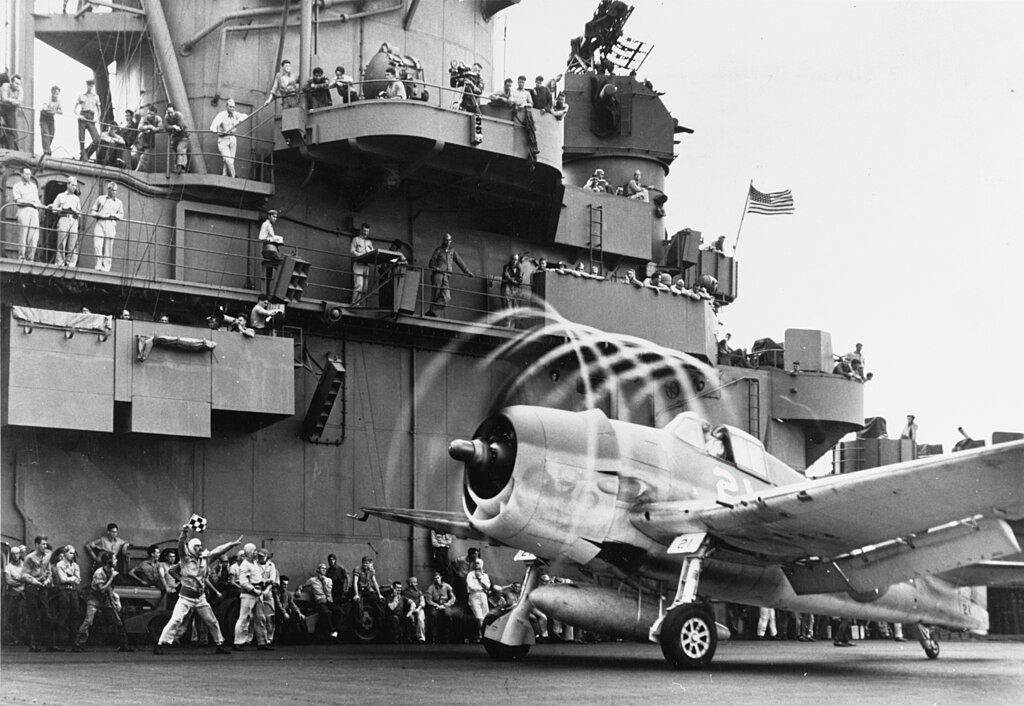
A U.S. Navy Grumman F6F-3 Hellcat from Fighting Squadron Five (VF-5) makes condensation rings as it awaits the take-off flag aboard the aircraft carrier USS Yorktown (CV-10), 20 November 1943. Yorktown was then hitting targets in the Marshall Islands to cover the landings in the Gilberts.
(USN Photo)
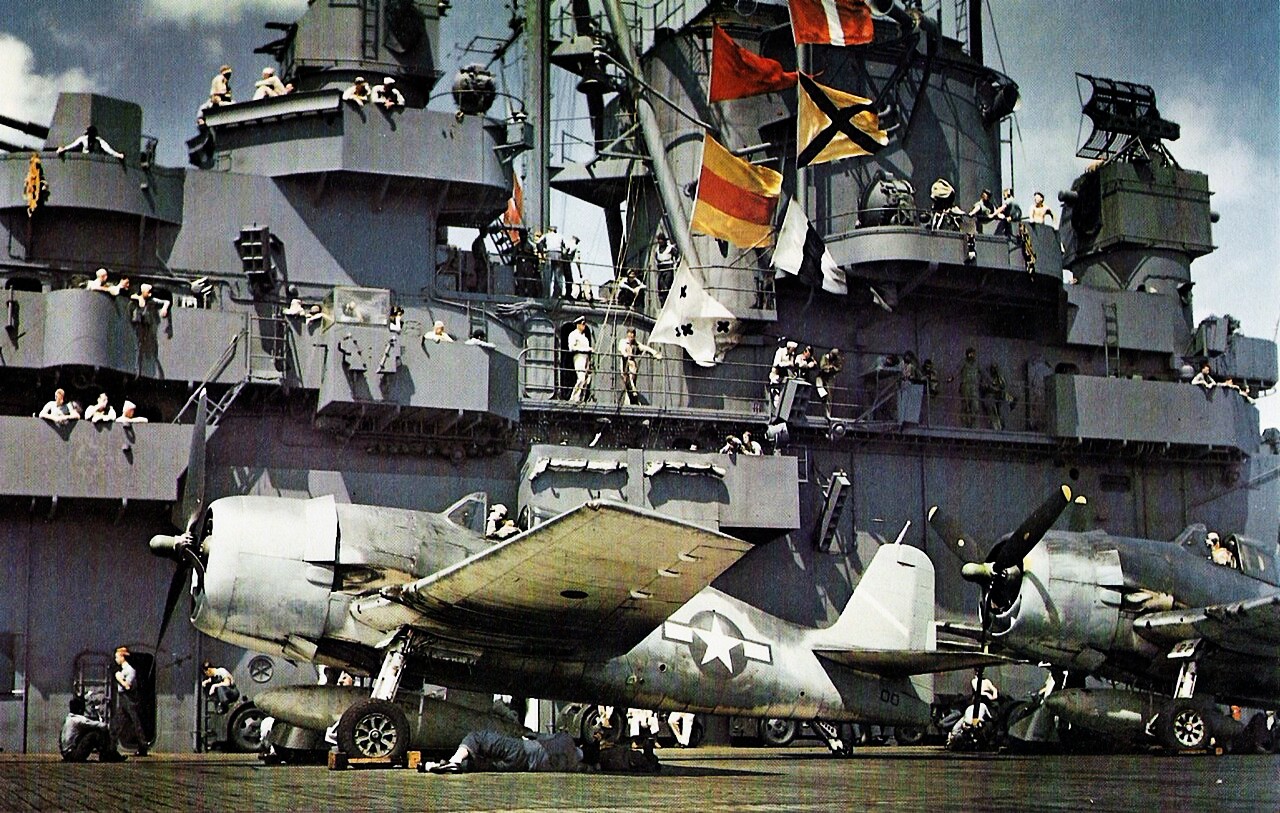
USS Yorktown (CV-10) during the Marcus Island raid on 31 August 1943: Lt. Comdr. James H. “Jimmy” Flatley,Commander of Air Group 5 (CAG-5), sits in his Grumman F6F-3 Hellcat (code “00”), painted in a tricolor-scheme (certainly an “in the field” application) before takeoff. An Aviation Boatswain Mate stands ready to remove chock from wheels. A non-specular insignia white diagonal stripe on the tail and the green propeller hub signified CAG-5 aboard the Yorktown.
(USN Photo)
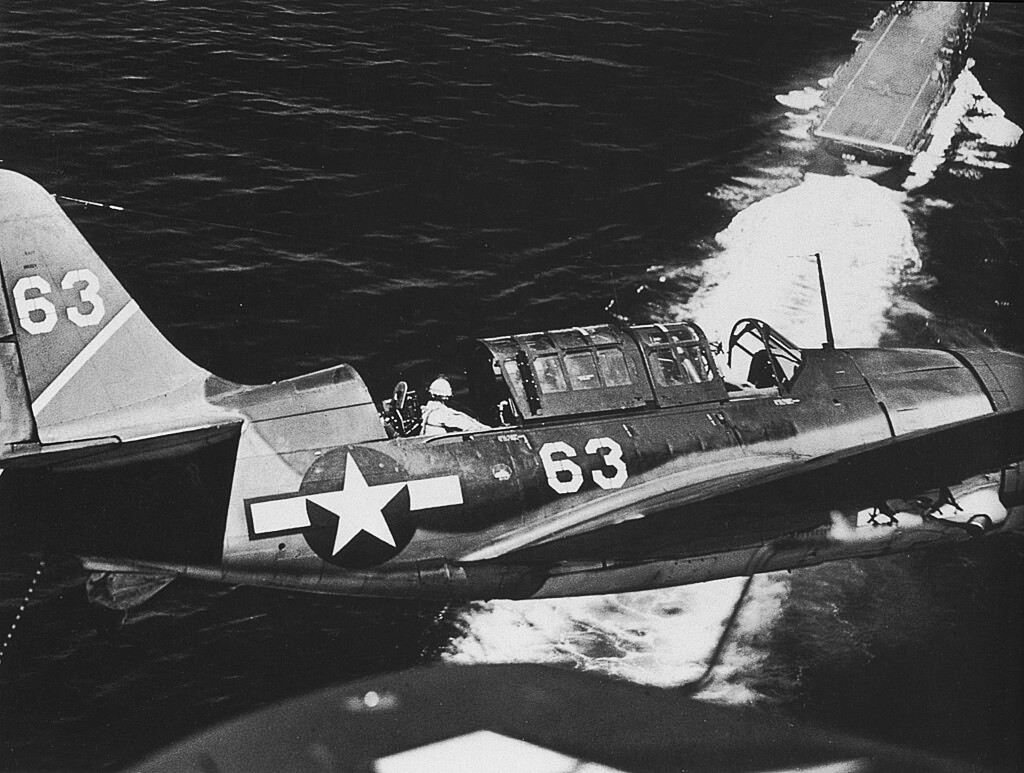
Two U.S. Navy Curtiss SB2C Helldiver dive bombers of bombing squadron VB-1 in the landing circle of the aircraft carrier USS Yorktown (CV-10) in July 1944.
(USN Photo)
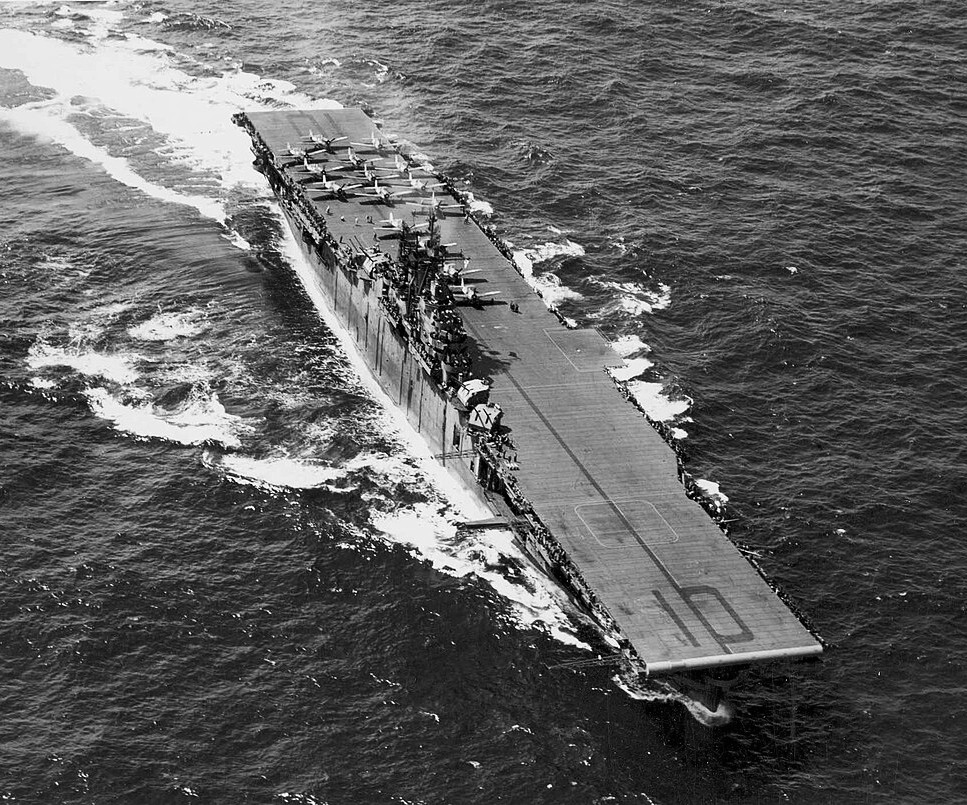
USS Yorktown (CV-10) in 1943. Note that the forward hull number on the flight deck is turned around, so that it was readable for aircraft approaching from the bow. 15 Grumman F6F-3 Hellcat fighers of fighting squadron VF-5 are visible on deck. Note the extended hangar catapult on the starboard side forward of the gun turrets.
(USN Photo)
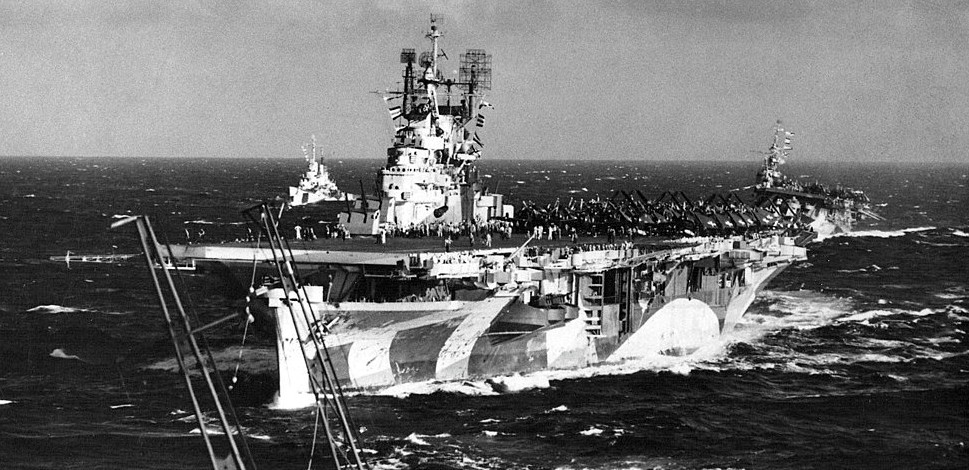
USS Yorktown (CV-10) and other ships of Task Group 58.4 steaming off Kyushu on 18 March 1945.
USS Intrepid (CV-11)
USS Intrepid (CV-11). Commissioned 16 Aug 1943. She contributed to the invasion of the Marshall Islands and conducted successful raids on Japanese positions. Intrepid was involved with the sinking of the battleship Musashi and attacks on Japanese carriers. It also supported the amphibious assault on Okinawa. Despite enduring multiple kamikaze attacks, Intrepid remained afloat. After the war, Intrepid underwent modernization and participated in the recovery of astronauts during the Mercury and Gemini programs. Today, it is a museum in New York City.
(USN Photo)
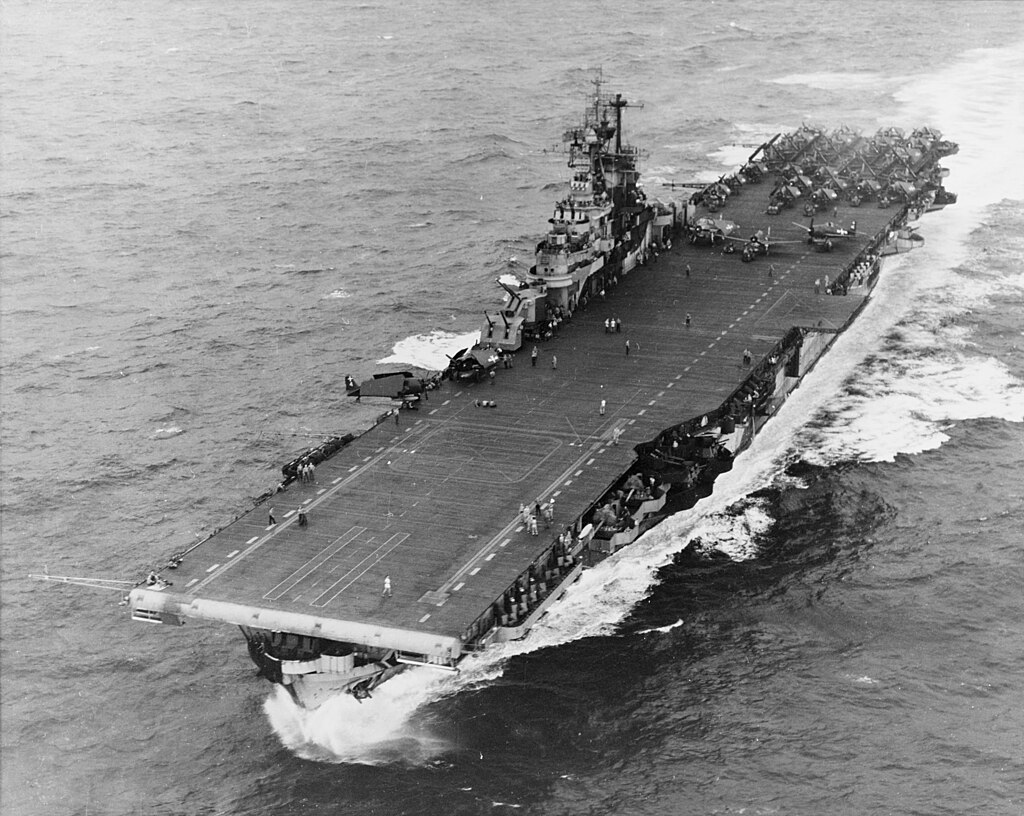
USS Intrepid (CV-11) operating in the Philippine Sea in November 1944. Note the Grumman F6F Hellcat fighter parked on an outrigger forward of her island.
(USN Photo)
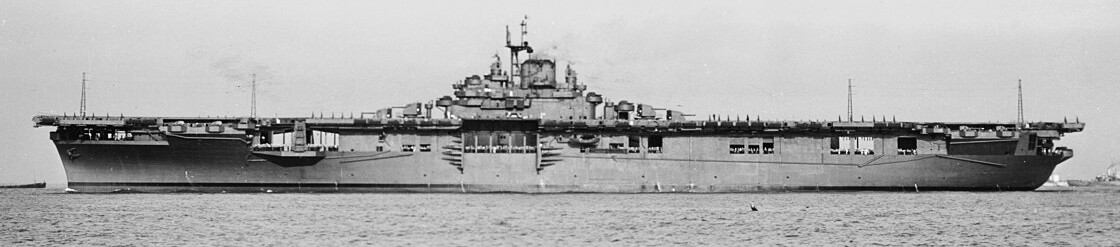
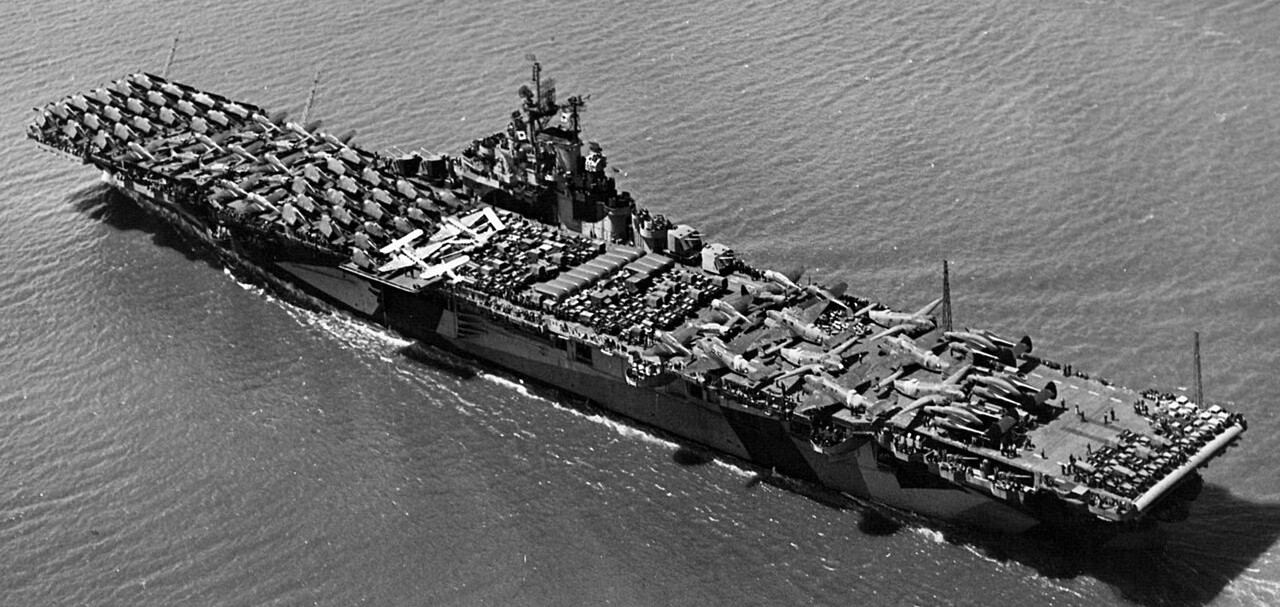
USS intrepid (CV-11) off Newport News, Virginia, on 16 August 1943, the day she went into commission.
(USN Photo)
USS Intrepid (CV-11) off Hunter’s Point in June 1944, her deck loaded with aircraft to be transported to the Pacific Theater.
USS Hornet (CV-12)
USS Hornet (CV-12). Commissioned 29 Nov 1943. As part of the Fast Carrier Task Force 20, she participated in the Battle of the Philippine Sea, known as “The Marianas Turkey Shoot,” where her aircraft shot down numerous enemy planes. The carrier continued to conduct strikes in the Philippines and supported ground troops. The ship was decommissioned in 1970 but became a museum in Alameda, California, as well as a national historic landmark.
(USN Photo)
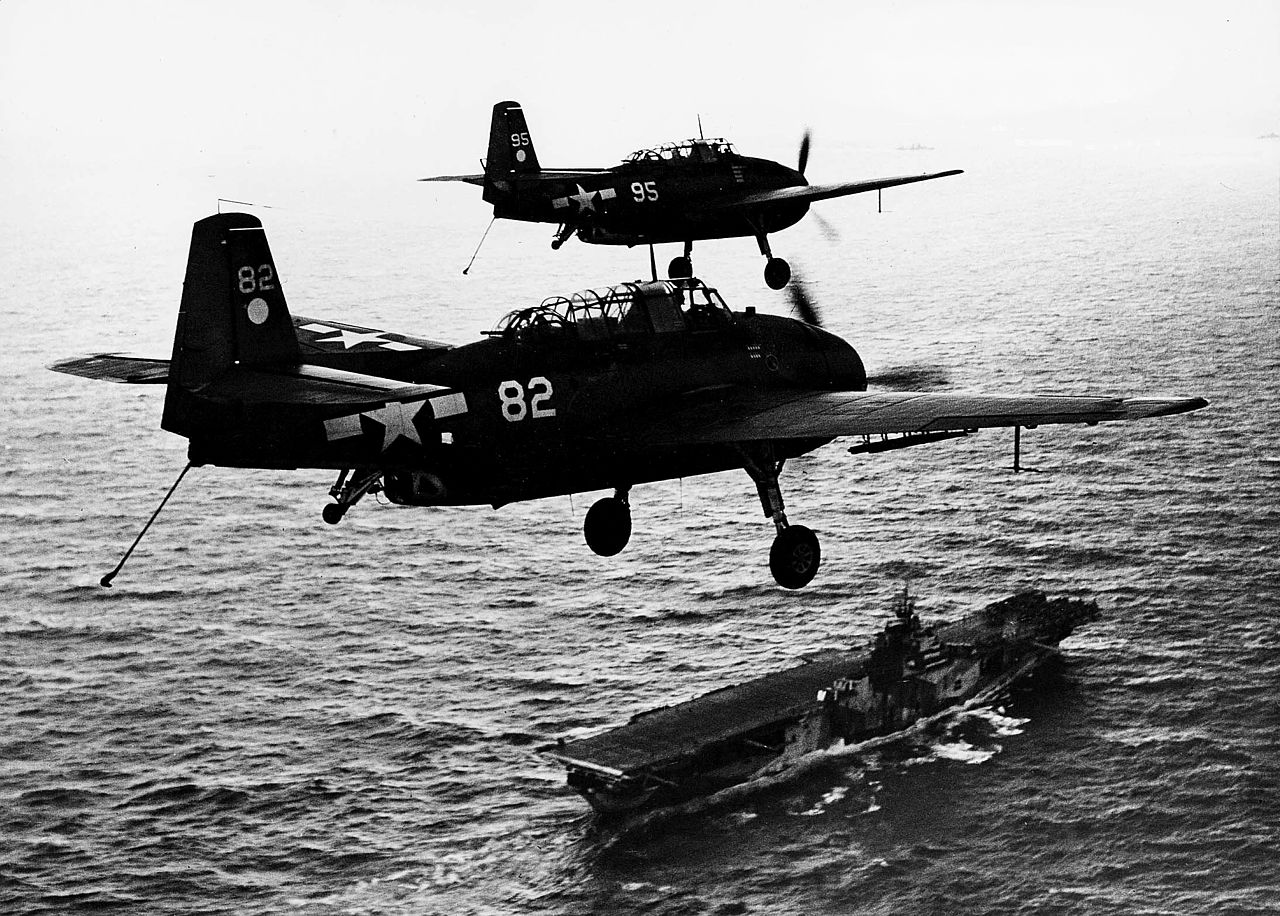
Grumman Avengers belonging to Torpedo Squadron 2 (VT-2) overflying USS Hornet (CV-12) mid-1944.
(USN Photo)
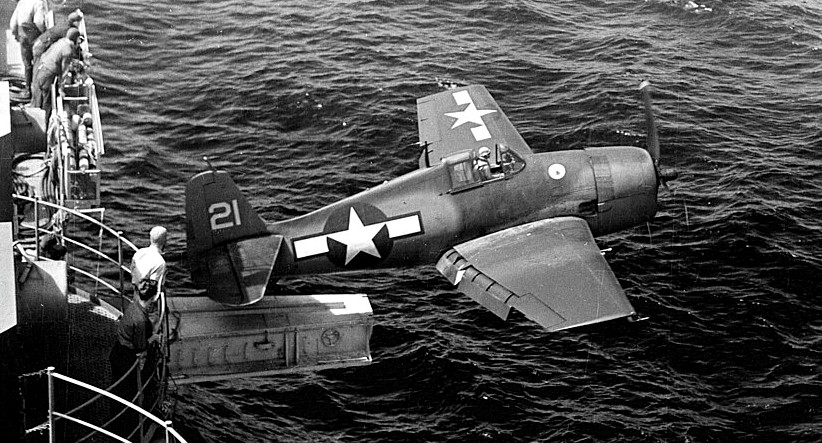
Grumman F6F-3 Hellcat fighter of VF-15 being catapulted from USS Hornet (CV-12) via the hangar catapult, 25 February 1944.
(USN Photo)
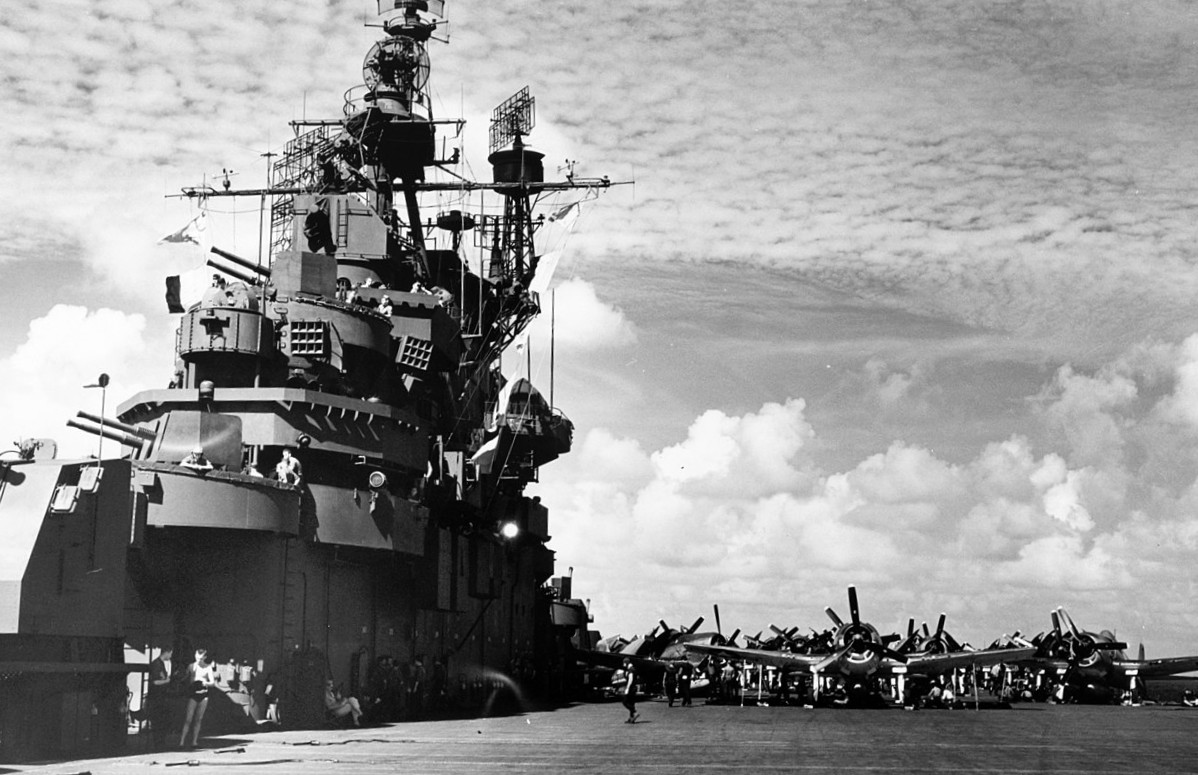
View of the island of the U.S. Navy aircraft carrier USS Hornet (CV-12) April 1945. Grumman F6F Hellcat fighters from Fighting Squadron VF-17 Jolly Rogers are visible on deck.
USS Franklin (CV-13)
USS Franklin (CV-13). Commissioned 31 Jan 1944. Her aircraft conducted strikes in the Mariana Islands, supported amphibious landings at Peleliu and Leyte, and fought battles at Sibuyan Sea and Cape Engano. The ship survived kamikaze attacks in 1944, underwent repairs and returned to the Pacific in time for the Okinawa landings, during which a Japanese bomb hit the flight deck, killing 807 troops on board. Lt. Cmdr. Joseph T. O’Callahan and Lt. Donald A. Gary received the Medal of Honor for their heroic actions during the bombings. After the war, Franklin was decommissioned and later sold for scrap. (USN)
(USN Photo)
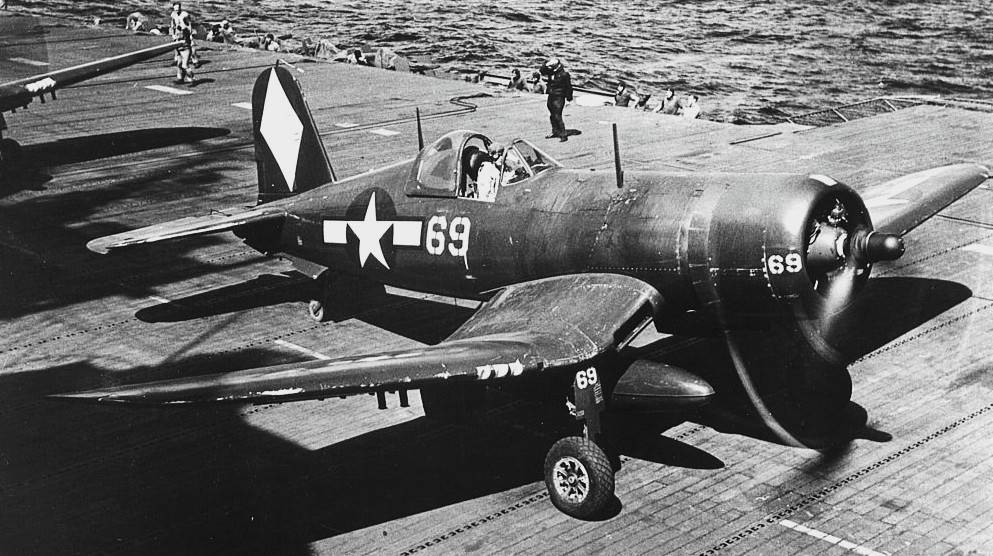
A U.S. Navy Vought F4U-1D Corsair of Fighting Squadron 5 (VF-5) “Fighting Hellcats” on the flight deck of the aircraft carrier USS Franklin (CV-13). Note Franklin´s geometric air group identification symbol on the Corsair.
(USN Photo)
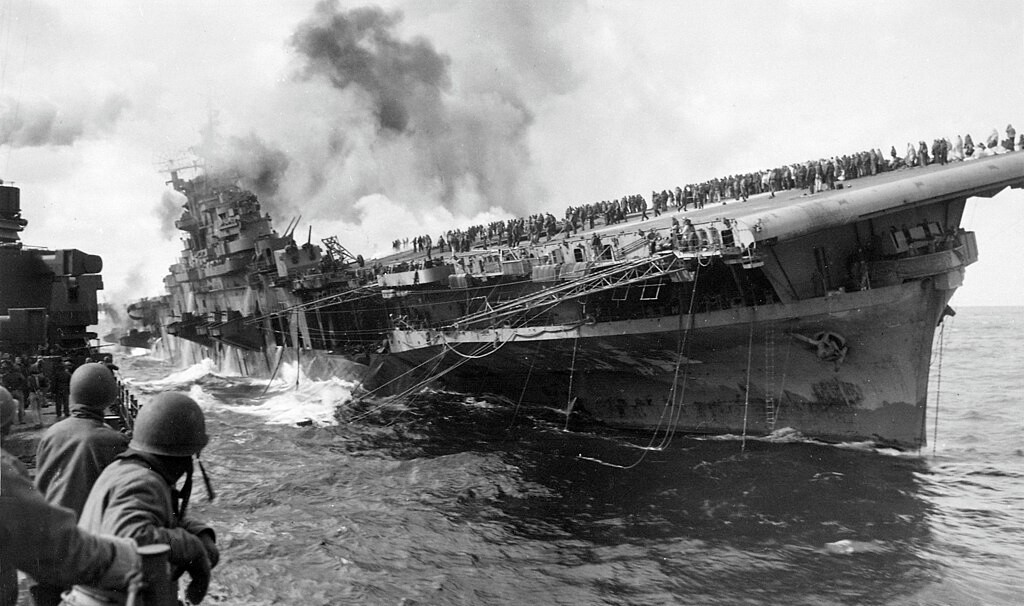
USS Franklin (CV-13) on fire and listing after she was hit by a Japanese air attack while operating off the coast of Japan on 19 March 1945. The crew is clearly seen on flight deck. After the attack the vessel lay dead in the water, took a 13° starboard list, lost all radio communications, and broiled under the heat from enveloping fires. Many of the crewmen were blown overboard, driven off by fire, killed or wounded, but the hundreds of officers and enlisted who voluntarily remained saved their ship through sheer tenacity. The casualties totaled 724 killed and 265 wounded, and would have far exceeded this number if it were not for the exemplary work of many survivors. (USN)
(USN Photo)
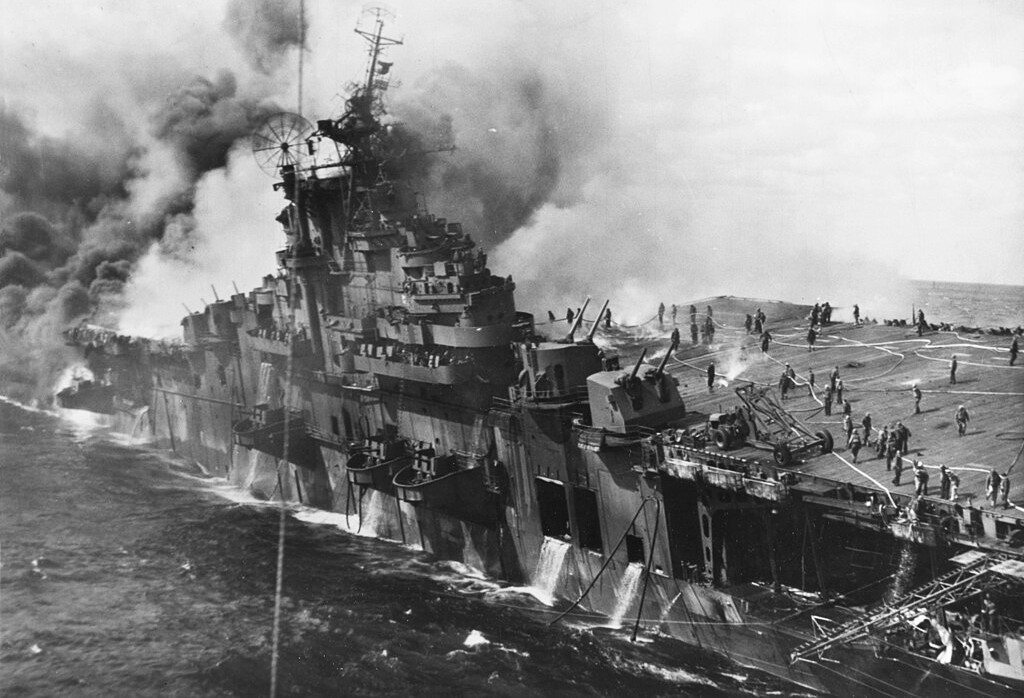
USS Franklin (CV-13) afire and listing after a Japanese air attack, off the coast of Japan, 19 March 1945. Note the fire hoses and the crewmen on her forward flight deck, and water streaming from her hangar deck.
(USN Photo)
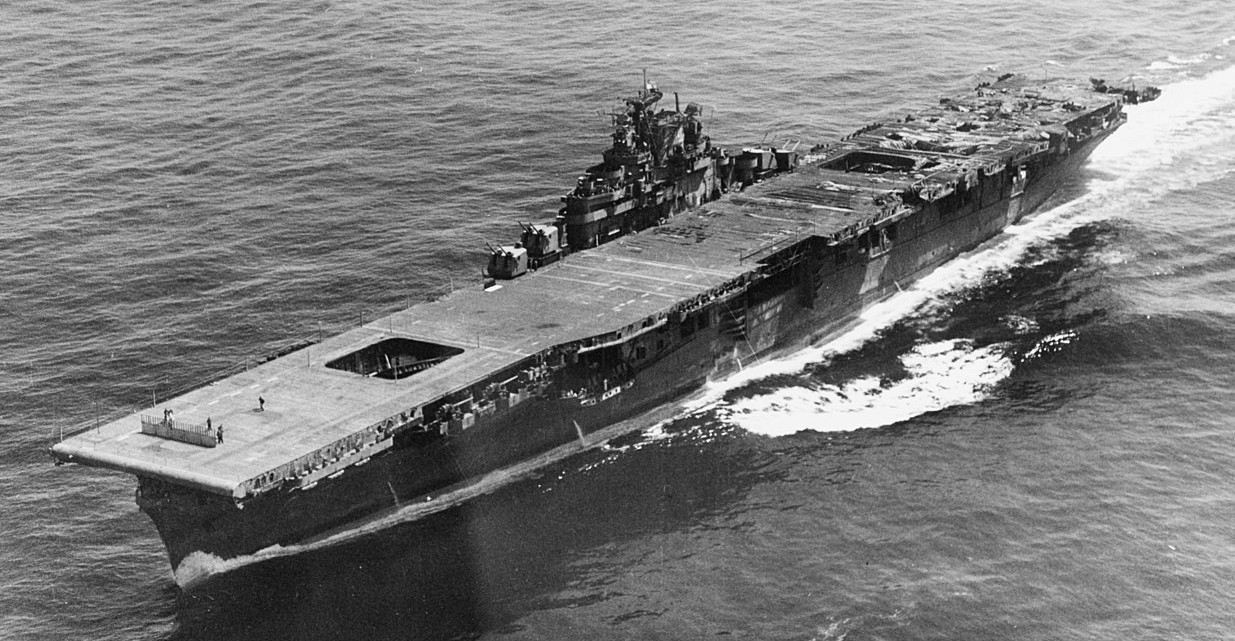
USS Franklin (CV-13) approaches New York City (USA), while en route to the New York Naval Shipyard for repairs, 26 April 1945. Note the extensive damage to her aft flight deck, received when she was hit by a Japanese air attack off the coast of Japan on 19 March 1945.
USS Ticonderoga (CV-14)
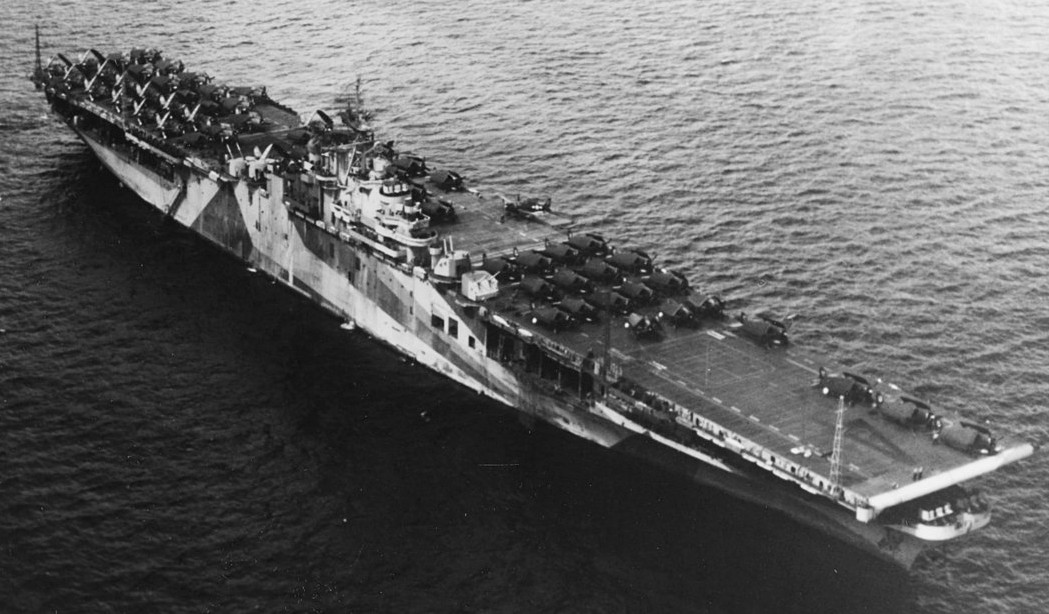
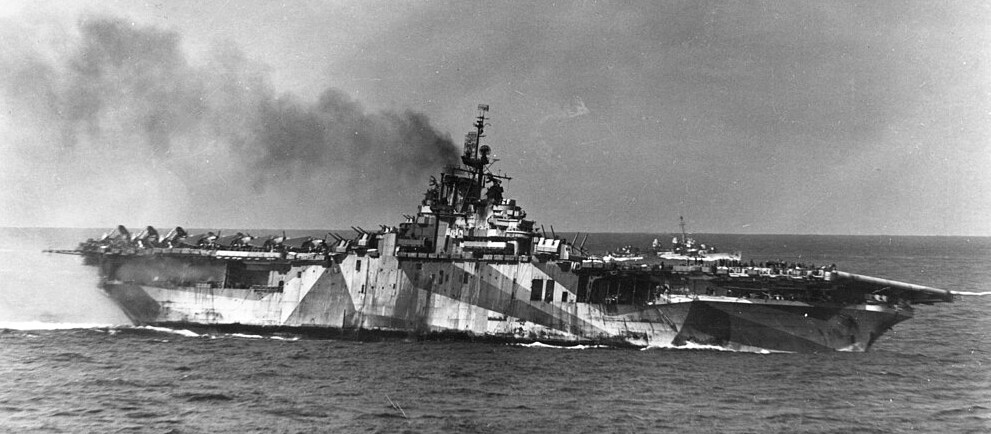
USS Ticonderoga (CV-14). Commissioned 8 May 1944. During her service during the Second World War she earned five battle stars. Decommissioned after the war, she was modernized and recommissioned in the 1950s as an attack carrier and then as an anti-submarine carrier. Ticonderoga played an active role in the Vietnam War. The carrier was decommissioned in 1973 and subsequently sold for scrap in 1975.
(USN Photo)
USS Ticonderoga (CV-14) at Ulithi on 8 December 1944. An Independence-class carrier wearing Camouflage Measure 33, Design 7A is visible in the distance, either USS Cowpens (CVL-25) or USS San Jacinto (CVL-30).
(USN Photo)
USS Ticonderoga (CV-14) lists to port in the aftermath of a kamikaze attack in which four suicide planes hit the ship, 21 January 1945. Note her camouflage scheme measure 33/10A and the Fletcher-class destroyer in the background.
USS Randolph (CV-15)
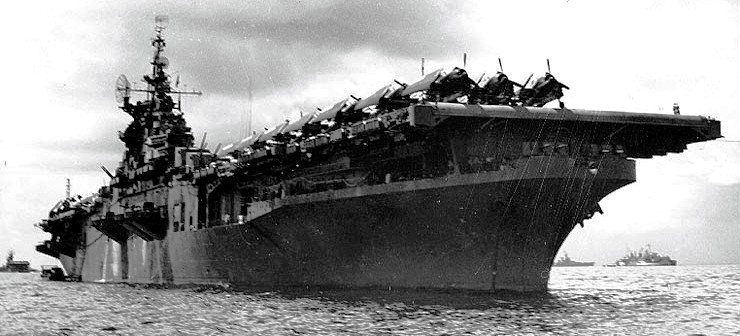
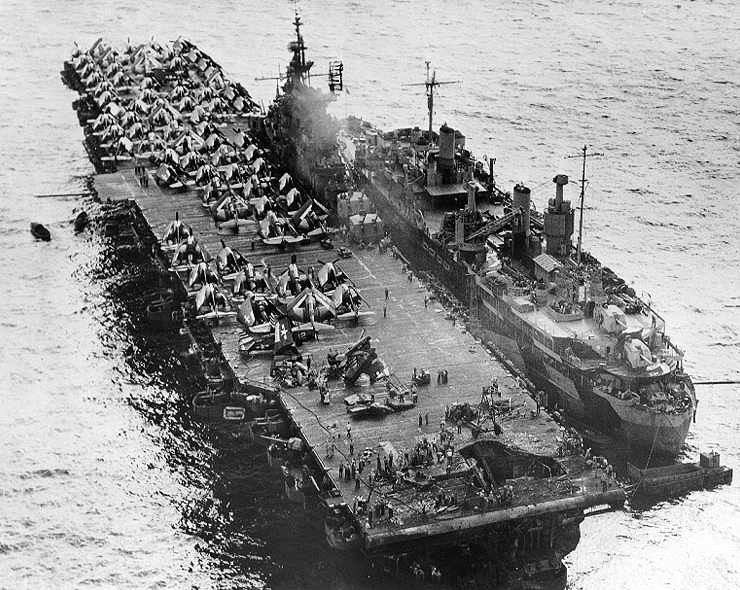
USS Randolph (CV-15). Commissioned 9 Oct 1944. She deployed to the Pacific in February 1945. She conducted airstrikes against Japanese targets in the Bonins and supported the Iwo Jima invasions. After being hit by a kamikaze in March, Randolph underwent repairs and returned to action in April. It actively participated in the Okinawa campaign and launched strikes against Japan until the war ended. Randolph later served in the Atlantic Fleet, underwent several modernizations, and was eventually decommissioned in 1969 and scrapped in 1975. (USN)
(USN Photo)
USS Randolph (CV-15) at anchor in the western Pacific, June 1945.
(USN Photo)
USS Randolph (CV-15) alongside repair ship USS Jason (ARH-1) at Ulithi Atoll, Caroline Islands, 13 March 1945, showing damage to her aft flight deck resulting from a kamikaze hit on 11 March. The photograph was taken from a floatplane from the light cruiser USS Miami (CL-89).
USS Lexington (CV-16)
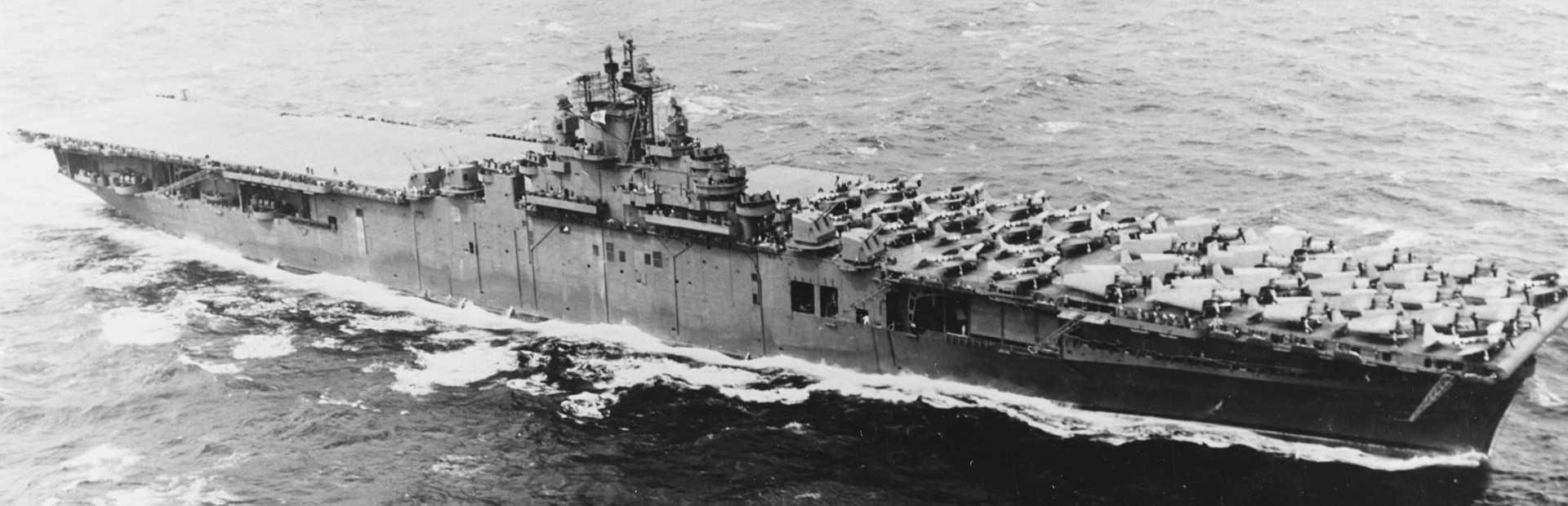
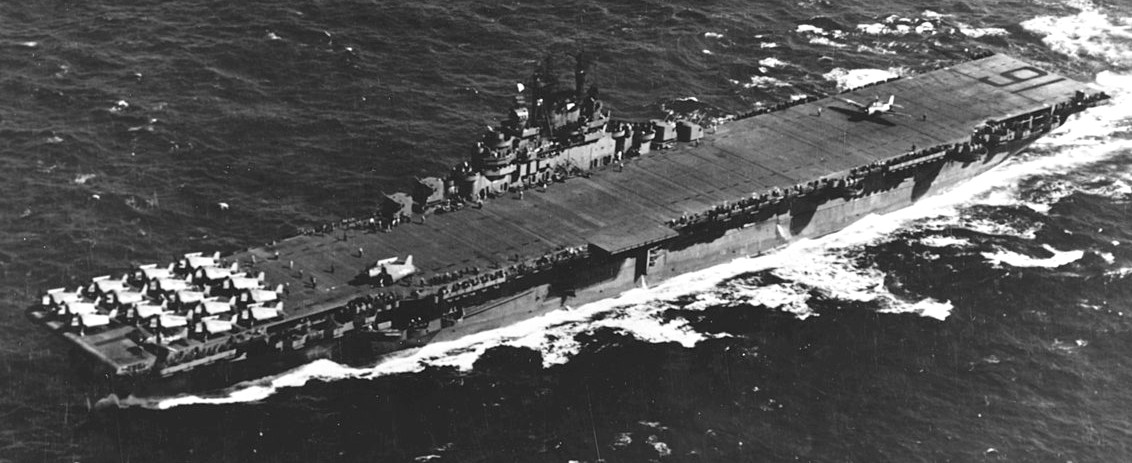
USS Lexington (CV-16). Commissioned 17 Feb 1943. Originally planned to be named Cabot, she was instead called the Lexington after its predecessor, which was sunk the previous year. The aircraft carrier played an important role in the Pacific, notably at the Battle of the Philippine Sea, a key American victory that signaled the demise of the Japanese Navy. Redesignated several times after the war, the historic vessel eventually became the USS Lexington Museum on the Bay, a National Historic Landmark in Corpus Christi, Texas. It is the oldest existing fleet carrier on Earth.
(USN Photo)
USS Lexington (CV-16) underway on 12 November 1943.
(USN Photo)
USS Lexington (CV-16) underway on 10 March 1944. Rear Admiral Marc Mitscher took command of the newly formed Task Force 58 (TF 58) on 8 March. Mitscher took Lexington as his flagship, and after a warm-up strike against Mili atoll, the Fast Carrier Task Force began a series of operations against the Japanese positions in the Central Pacific. She supported U.S. Army landings at Hollandia on 13 April, and then raided Truk on 28 April.
USS Bunker Hill (CV-17)
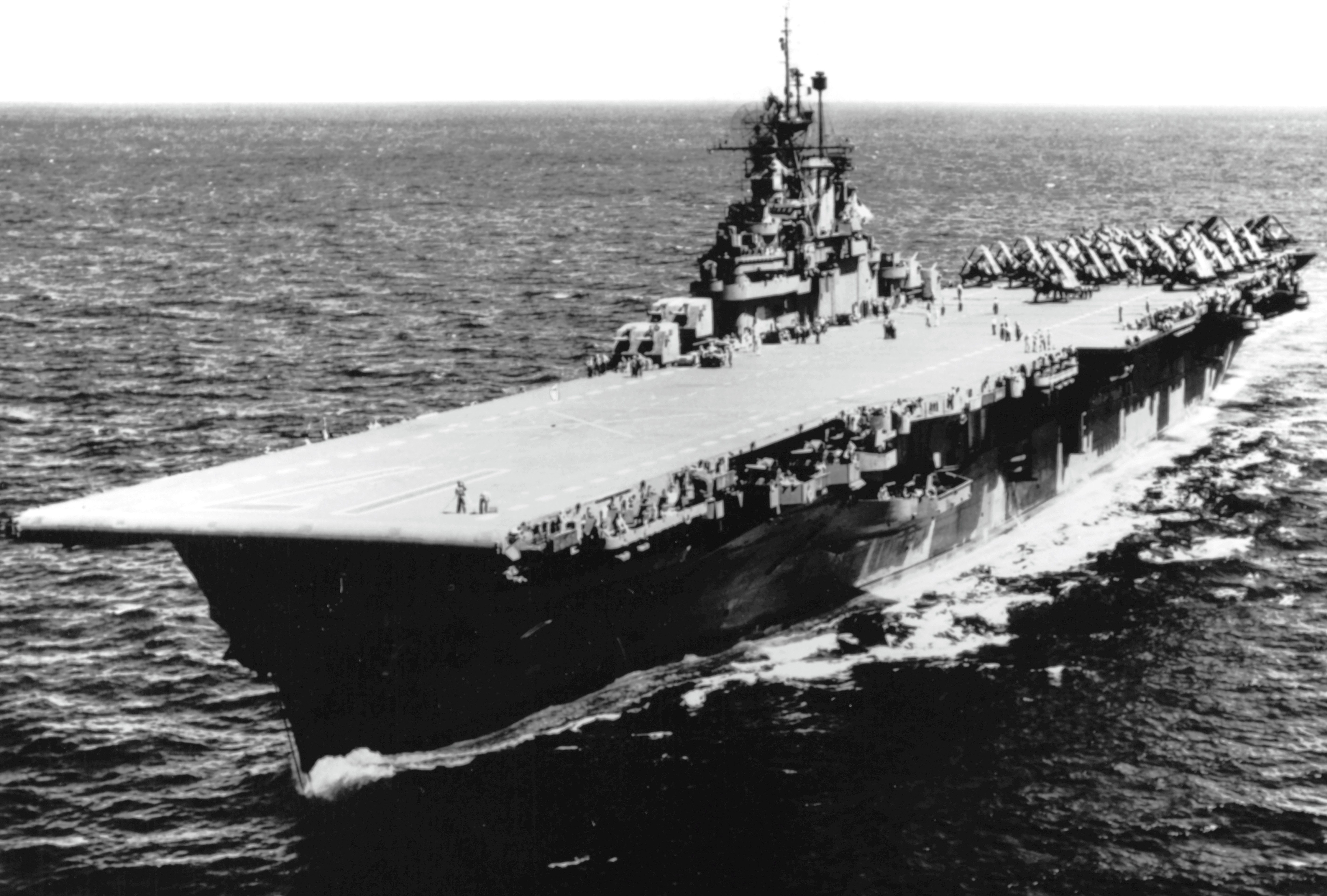
USS Bunker Hill (CV-17). Commissioned 25 May 1943. She was an Essex-class aircraft carrier, fought in battles across the Pacific Theater, including at Iwo Jima and Okinawa. It suffered heavy casualties during the invasion of Okinawa, when it was struck by two kamikazes, resulting in a devastating fire. Although the ship returned to the United States for repairs, it was never recommissioned and was eventually decommissioned in 1947. Efforts to preserve it as a museum ship were unsuccessful, and it was sold for scrap in 1973 after serving as an electronics test platform.
(USN Photo)
USS Bunker Hill (CV-17) at sea, 16 October 1945. Bunker Hill was still under repair at the Puget Sound Naval Shipyard, Bremerton, Washington, from kamikaze damage received on 11 May 1945 when the war ended in mid-August. On 27 September 1945, she sailed from Bremerton to report for duty with the Operation Magic Carpet fleet, being equipped to transport troops to return veterans from the Pacific as a unit of TG 16.12. The vessel made return trips to the U.S. West Coast from Pearl Harbor, the Philippines, and Guam and Saipan. In January 1946 the ship was ordered to Bremerton for deactivation, and was decommissioned into reserve on 9 January 1947.
(USN Photo)
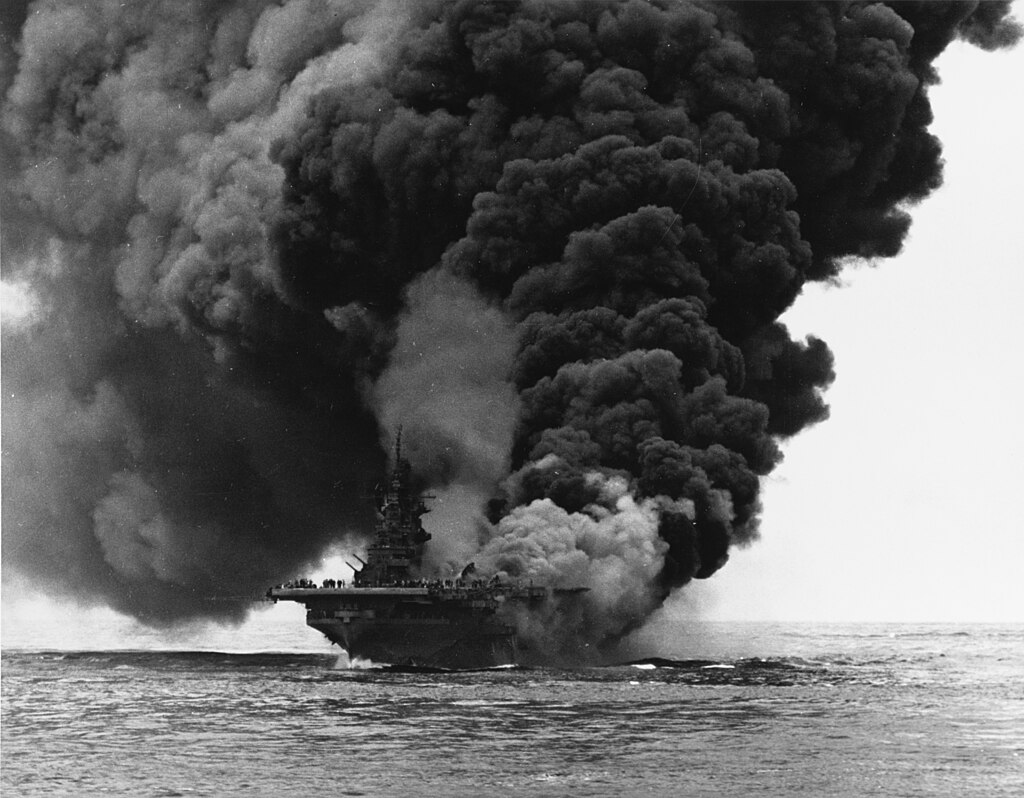
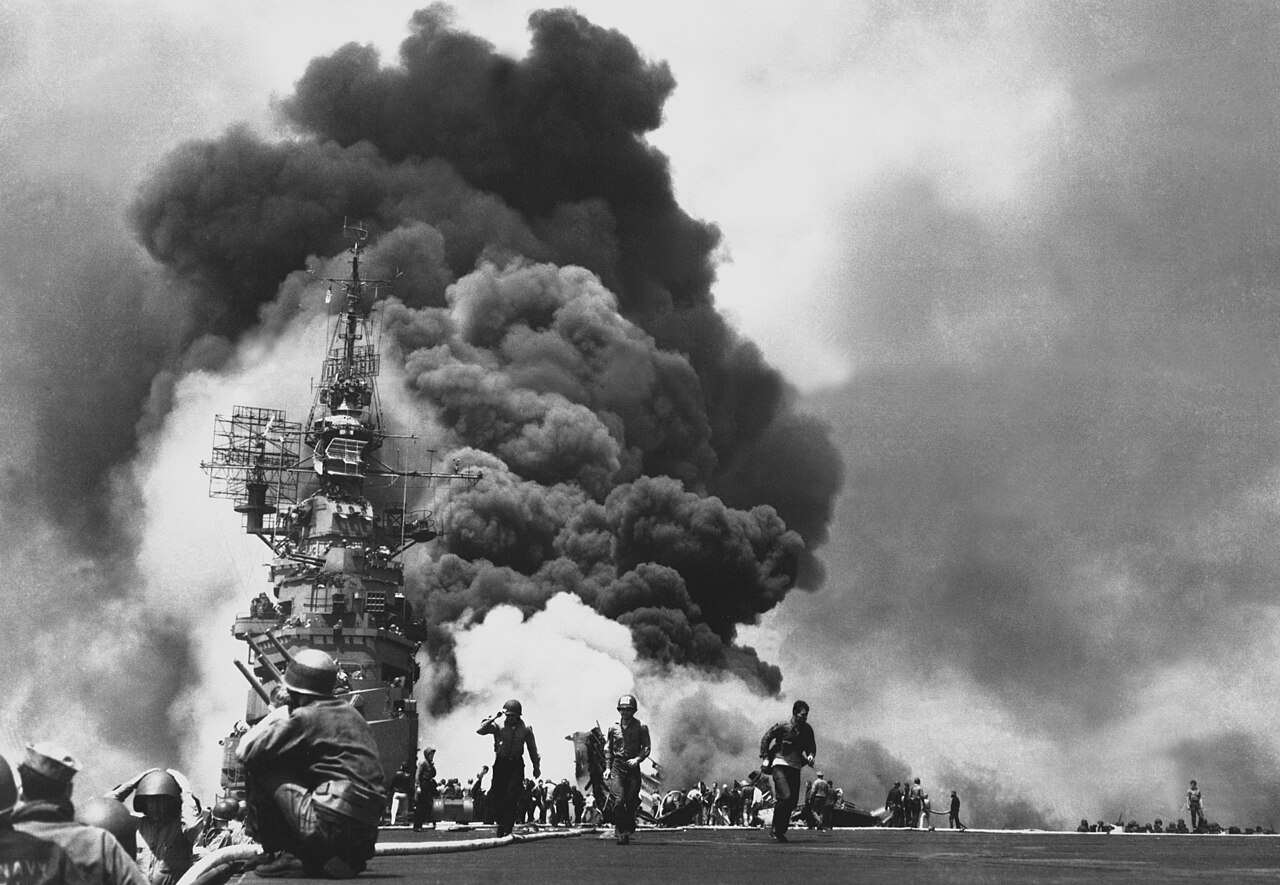
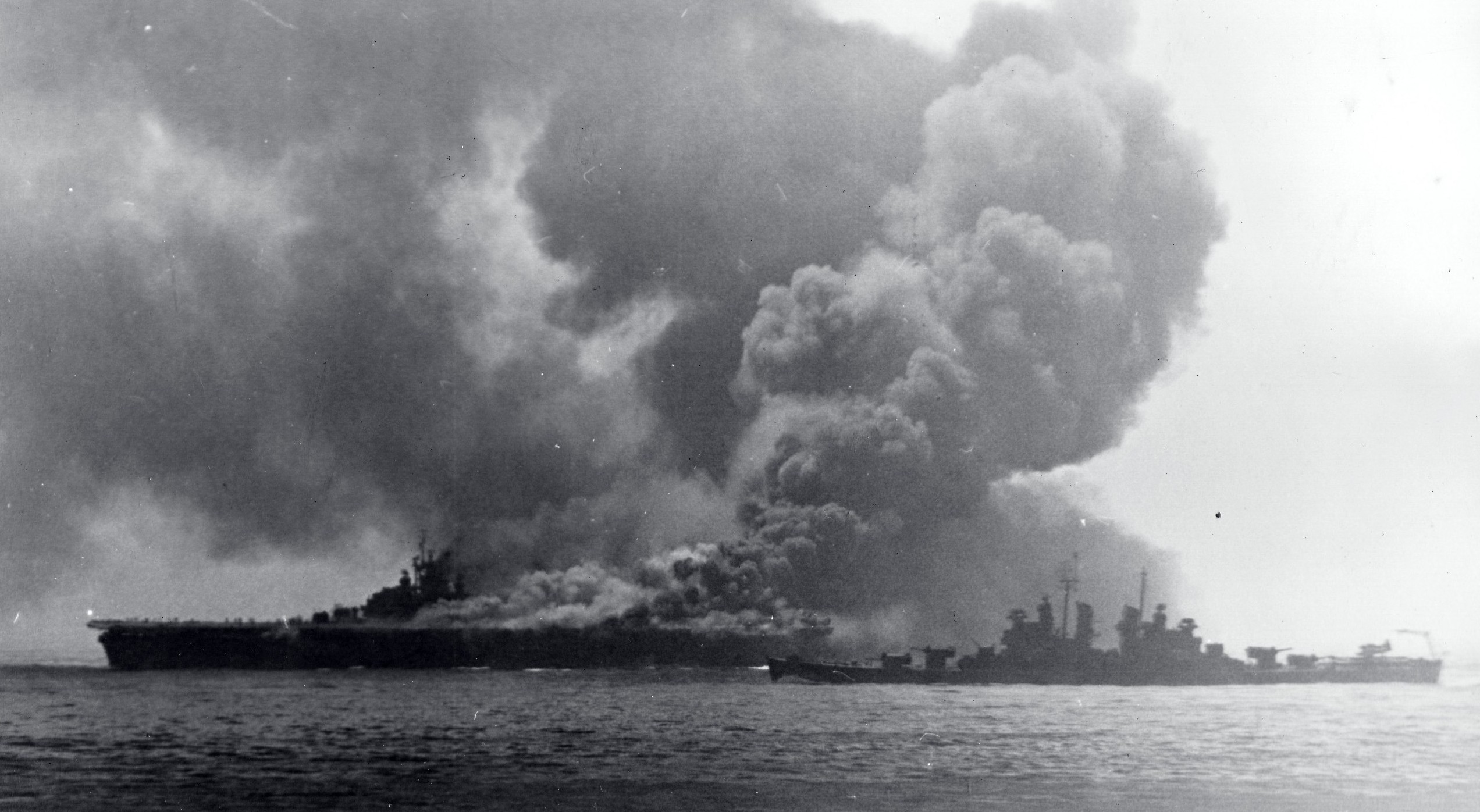
Smoke fills the sky as the fire rages on Bunker Hill on 11 May 1945.
On the morning of 11 May 1945, while supporting the invasion of Okinawa, Bunker Hill was struck and severely damaged by two Japanese kamikaze planes. A Mitsubishi A6M Zero fighter plane piloted by Lieutenant Junior Grade Seizō Yasunori emerged from low cloud cover, dove toward the flight deck on the starboard quarter and dropped a 550-pound (250 kilogram) bomb that penetrated the flight deck and exited from the side of the ship at gallery deck level before exploding in the ocean. The Zero then crashed onto the carrier’s flight deck, destroying parked warplanes full of aviation fuel and ammunition, causing a large fire. The remains of the Zero went over the deck and dropped into the sea. Then 30 seconds later, a second Zero, piloted by Ensign Kiyoshi Ogawa, plunged into its suicide dive despite facing antiaircraft fire, dropped a 550-pound bomb, and then crashed into the flight deck near the carrier’s “island”, as kamikazes were trained to aim for the island superstructure. The bomb carried by the second kamikaze penetrated to the pilots’ ready room, where 22 members of VF-84 lost their lives. Gasoline fires flamed up and several explosions took place. The two kamikaze strikes killed 396 sailors and airmen, including 43 missing and never found, and wounded 264. Among the casualties were three officers and eleven enlisted men from Mitscher’s staff. Mitscher’s flag cabin was also destroyed, along with all of his uniforms, personal papers, and possessions. The admiral relinquished command by visual signal; he and his remaining staff were transferred by breeches buoy to the destroyer USS English and then to the USS Enterprise, which became the flagship. Despite the heavy damage, Bunker Hill was able to steam at 20 knots to Ulithi, where the Marine pilots of VMF-221, who had been aloft during the kamikaze attack and were diverted to other carriers, rejoined their ship. The carrier returned home by way of Pearl Harbor, and was sent to the Bremerton Naval Shipyard for repairs. She was still in the shipyard when the war ended in mid-August 1945. (Wikipedia)
(USN Photo)
USS Bunker Hill (CV-17) hit by two Kamikazes in 30 seconds on 11 May 1945 off Kyushu. Dead-372. Wounded-264.
(USN Photo)
USS Bunker Hill (CV-17) burning on 11 May 1945. The Cleveland-class cruiser USS Pasadena (CL-65) is visible on the right.
The Essex-class aircraft carriers USS Wasp (CV-18), USS Hancock (CV-19), USS Bennington (CV-20), USS Boxer (CV-21), USS Bon Homme Richard (CV-31), USS Shangri-La (CV-38), are listed on a separate page on this website.