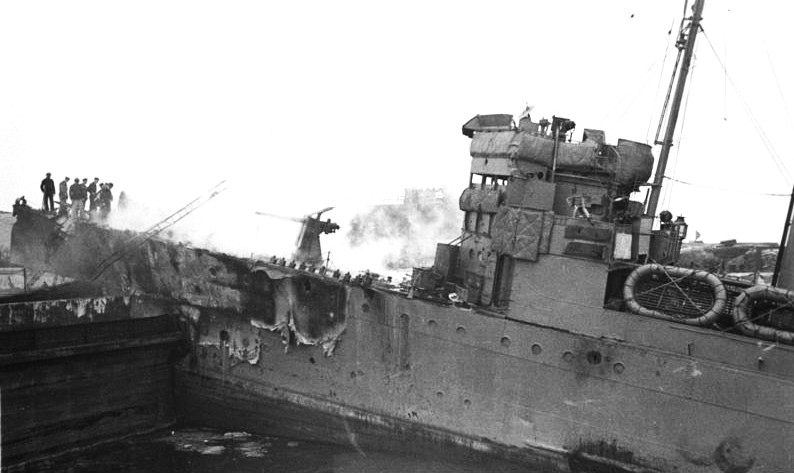
Royal Navy Town-class destroyer HMS Campbeltown (I42), Operation Chariot, the Sainte Nazaire Raid
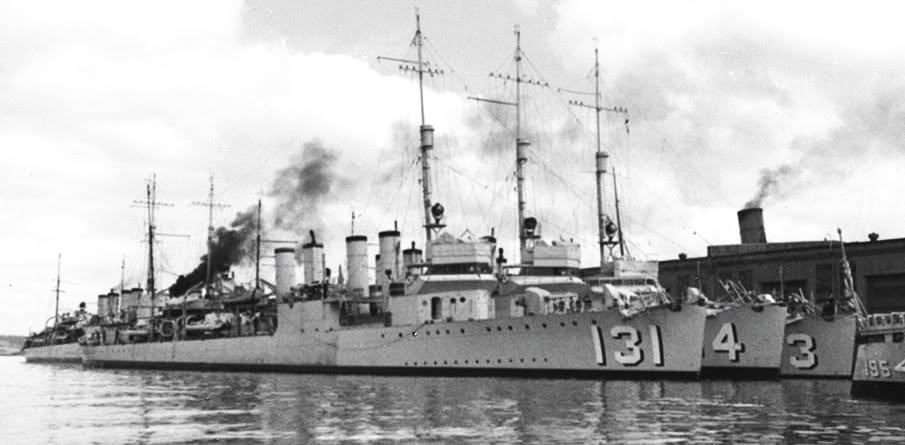
(Library and Archives Canada Photo, MIKAN No. 3566374)
Destroyers of the U.S. Navy awaiting transfer to the Royal Navy. The ship nearest camera is the USS Buchanan (131), later re-named HMS Campbeltown (I42). Halifax, Nova Scotia, September 1940.
HMS Campbeltown was a Town-class destroyer of the Royal Navy (RN) during the Second World War. She was originally a USN Wickes-class destroyer, USS Buchanan (131), one of 50 obsolescent US Navy destroyers transferred to the RN in 1940 as part of the Destroyers for Bases Agreement. Between 17 January 1941 and 15 October 1941 she also briefly served in the Royal Netherlands Navy as HNLMS Campbeltown before being returned to the RN. Campbeltown became one of the most famous of these ships when she was used in the Sainte Nazaire Raid in 1942. (Wikipedia)
The Sainte Nazaire Raid or Operation Chariot was a British amphibious attack on the heavily defended Normandie dry dock at St. Nazaire in German-occupied France during the Second World War. The operation was undertaken by the Royal Navy (RN) and British Commandos under the auspices of Combined Operations Headquarters on 28 March 1942.
Sainte Nazaire was attacked because the loss of its dry dock would force Germany’s largest battleship, Tirpitz, to return to home waters if she were damaged. This would expose her to attack by British forces including the Home Fleet in the English Channel or the North Sea.
The obsolete destroyer HMS Campbeltown, accompanied by 18 smaller craft, crossed the English Channel to the Atlantic coast of France and rammed into the Normandie dry dock south gate. The ship had been packed with delayed-action explosives, well hidden within a steel and concrete case, that detonated later that day, putting the dock out of service until 1948.
A force of commandos landed to destroy machinery and other structures. German gunfire sank, set ablaze or immobilized virtually all the small craft intended to transport the commandos back to England. The commandos fought their way through the town to escape overland but many surrendered when they ran out of ammunition or were surrounded by the Wehrmacht defending Sainte Nazaire.
Of the 612 men who undertook the raid, 228 returned to Britain, 169 were killed and 215 became prisoners of war. German casualties included over 360 dead, some of whom were killed after the raid when Campbeltown exploded. To recognise their bravery, 89 members of the raiding party were awarded decorations, including five Victoria Crosses. After the war, Sainte Nazaire was one of 38 battle honours awarded to the commandos. The operation has been called “the greatest raid of all” in British military circles. (Wikipedia)
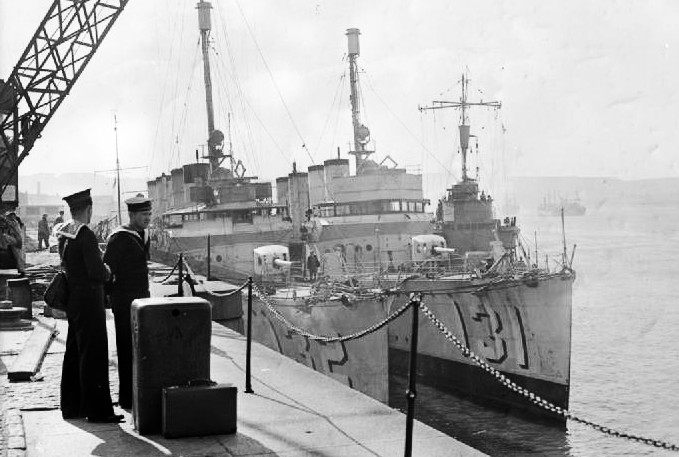
(IWM Photo, A 952)
Two destroyers, HMS Castleton (132) and HMS Campbelton (131) photographed shortly after the Royal Navy acquired them from America under the Destroyers for Bases agreement, lying side by side while undergoing refit, Sep 1940. The ships were sailed across the Atlantic by British crews. On the left are two Polish sailors.
The Sainte Nazaire Raid
In January 1942, HMS Campbeltown was selected for a special operation and was withdrawn from regular service for modifications. She was to be used in Operation Chariot, a planned assault operation on the docks at Saint-Nazaire. In 1942 the German battleship Tirpitz, anchored at Trondheim in Norway, was considered to present a grave threat to Atlantic convoys. Should Tirpitz enter the Atlantic, the Louis Joubert drydock at Saint-Nazaire, which had originally been built for the liner SS Normandie, was a vital target; it was the only German-held drydock on the European coast of the Atlantic that was large enough to service the battleship. If this drydock could be put out of action, any offensive sortie by Tirpitz into the Atlantic would be much more dangerous for the Kriegsmarine to carry out, making it less likely that they would risk deploying her.
Operation Chariot was a plan to ram an explosive-laden warship into the dock gates. Accompanying her would be 18 small boats carrying British Commandos, who would destroy the dock’s pumping and winding machinery and other infrastructure. The troops would then be evacuated by the small boats before the explosives in the ship detonated. A particular difficulty was that the dock was located several miles up the estuary of the Loire River. As an obsolescent destroyer, HMS Campbeltown was considered to be expendable and was selected to be the ram-ship. She spent February undergoing modifications. These included removing her third and fourth funnels and having the remaining two funnels raked to simulate the structure and appearance of a German Raubvogel-class torpedo boat. A 12-pounder gun was installed forward and eight 20 mm (0.79 in) Oerlikon anti-aircraft cannon were mounted on the upper deck. Some extra armour was provided to protect the bridge structure, and unnecessary stores and equipment were removed to lighten the destroyer.
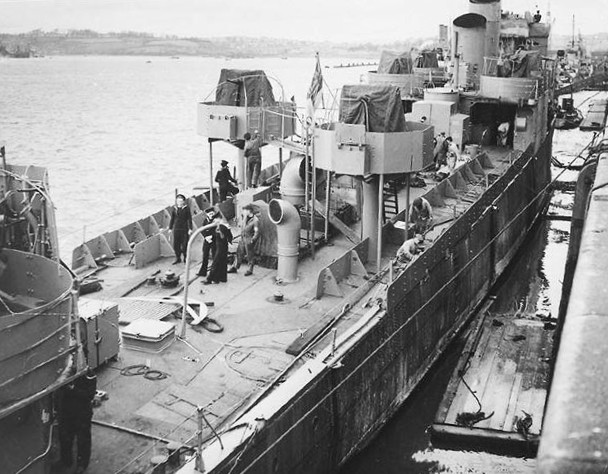
(Royal Navy Photo)
HMS Campbeltown being converted for the Sainte Nazaire Raid.
An explosive charge consisting of 24 Mark VII depth charges containing a total of 4.5 short tons (4.1 t) of amatol high explosive, was fitted into steel tanks installed just behind the steel pillar that supported her most forward gun mount. The charges were to be detonated by multiple eight-hour time pencils connected together by cordtex, set before steaming out and cemented in to prevent any interference with the detonation. HMS Campbeltown steamed from Devonport to Falmouth, Cornwall on 25 March to join the other ships that would take part in the operation. The crew, which would be evacuated with the commandos, was reduced to 75 men, under the command of Lieutenant Commander Stephen Beattie.
A flotilla of 21 vessels, HMS Campbeltown, 16 Fairmile B motor launches, one motor torpedo boat and a Fairmile C motor gun boat acting as the troops’ headquarters, left Falmouth at 14:00 on 26 March 1942, escorted for most of the crossing to France by two Hunt-class escort destroyers. (HMS Tynedale and HMS Atherstone). Apart from a brief clash with German submarine U-593, whose captain misreported the task force’s course and composition, the ships reached France unmolested. One motor launch suffered mechanical problems and had to return to England.
The preliminary air raid carried out through heavy cloud by 35 Armstrong Whitworth Whitleys and 25 Vickers Wellingtons was much smaller than originally planned and was ineffective, merely alerting the defenders of something unusual happening. Nevertheless, by flashing genuine German recognition signals, the force, with Campbeltown flying the flag of the Kriegsmarine, approached to within less than 1 mi (1.6 km) of the harbour before being fired upon. Campbeltown, as the largest target, drew most of the fire. During the final approach, the crew of Campbeltown lowered the emblem of the Kriegsmarine and hoisted the battle ensign of the Royal Navy.
At 01:34 on 28 March, four minutes later than planned, Campbeltown rammed the dock gate. The Commandos and ship’s crew came ashore under heavy German fire and set about demolishing the dock machinery. 169 of the raiders were killed (64 commandos and 105 sailors) out of the 611 men in the attacking force. Of the survivors, 215 were captured and 222 were evacuated by the surviving small craft. A further five evaded capture and travelled overland through France to Spain and then to Gibraltar, a British territory.
(Bundesarchiv_Bild_101II-MW-3722-22)
German photo of HMS Campbeltown, taken before it exploded at Sainte Nazaire, France, 28 March 1942. Note the single QF 12-pounder 12-cwt gun/
The charges in Campbeltown exploded at noon, an hour and a half later than the British had expected. Although the ship had been searched by the Germans, the explosives had not been detected. The explosion killed around 250 German soldiers and French civilians and demolished both the front half of the destroyer and the 160 short tons (150 t) caisson of the drydock, with the rush of water into the drydock washing the remains of the ship into it. The Sainte Nazaire drydock was rendered unusable for the rest of the war and was not repaired until 1947, and only resumed normal service in 1948.
The delayed-action torpedoes fired by the motor torpedo boat into the outer lock gate to the submarine basin detonated, as planned, on the night of 30 March. This later explosion led to panic, with German forces firing on French civilians and on each other. Sixteen French civilians were killed and around thirty wounded. Later, 1,500 civilians were arrested and interned in a camp at Savenay and most of their houses were demolished, even though they had had nothing to do with the raid. Beattie, who was taken prisoner, received the Victoria Cross for his valour and in 1947 received the French Légion d’honneur. His Victoria Cross was one of five awarded to participants in the raid, along with 80 other military decorations.
The ship’s bell of HMS Campbeltown was given to the town of Campbelltown, Pennsylvania, as a gesture of appreciation towards the United States for the Destroyers for Bases Agreement programme. This ship’s bell was later lent by the town to the subsequent HMS Campbeltown, a Type 22 frigate, when she was commissioned in 1989 and was returned on 21 June 2011 after HMS Campbeltown was decommissioned. (Wikipedia)
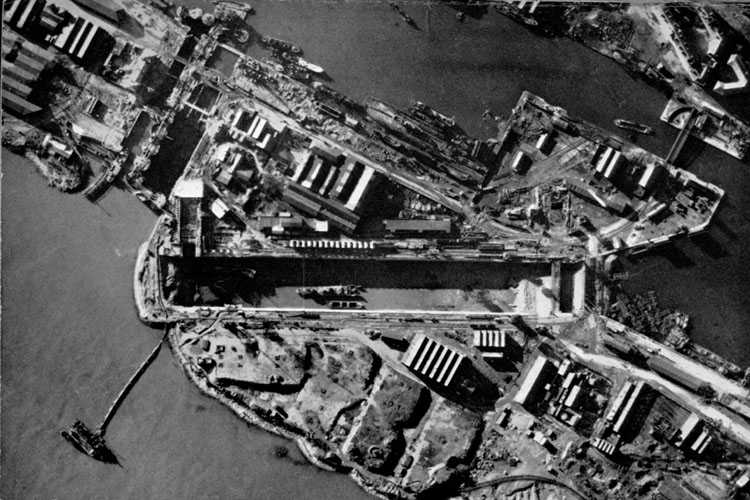
(IWM Photo, C3398)
Aerial photograph of Normandie Dock taken couple of months after Operation Chariot. The wreck of HMS Campbeltown still lies inside the dock.
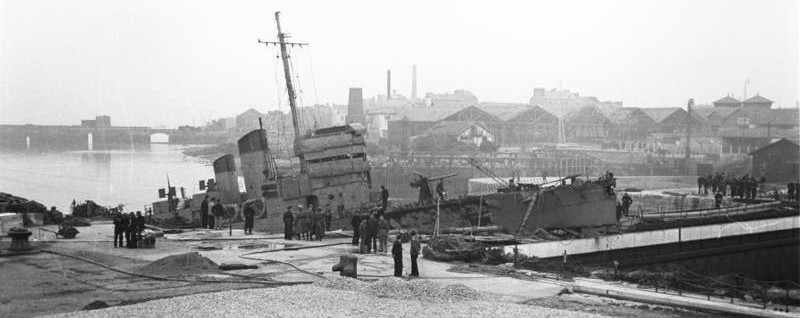
(Bundesarchiv Bild 101II-MW-3724-03)
German photo of HMS Campbeltown, taken before it exploded at Sainte Nazaire, France, 28 March 1942.
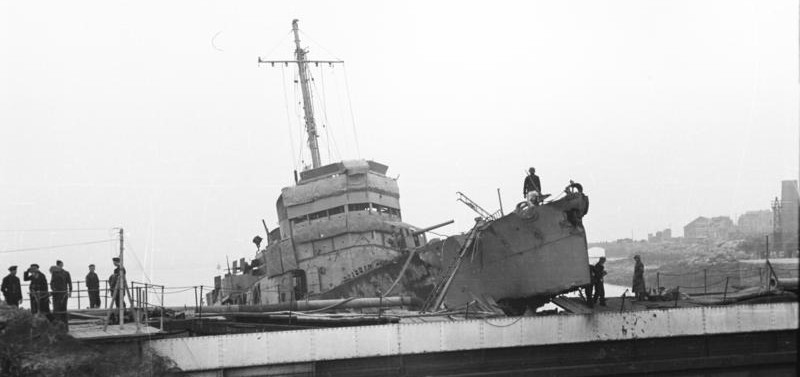
(Bundesarchiv, Bild 101II-MW-3724-02)
German photo of HMS Campbeltown, taken before it exploded at Sainte Nazaire, France, 28 March 1942.
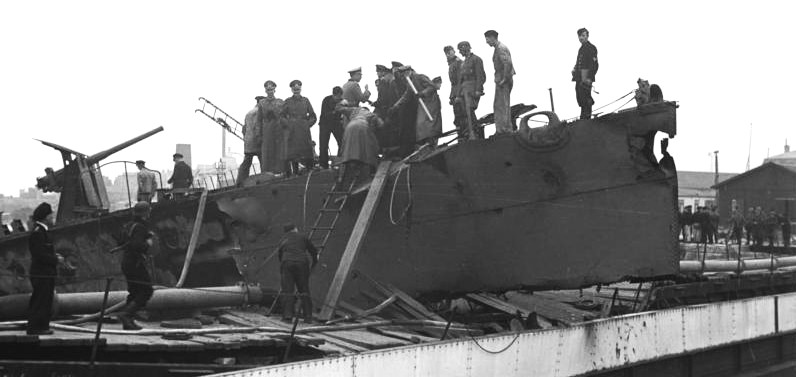
(Bundesarchiv, Bild 101II-MW-3724-16)
German photo of HMS Campbeltown, taken before it exploded at Sainte Nazaire, France, 28 March 1942.
(Duch Photo)
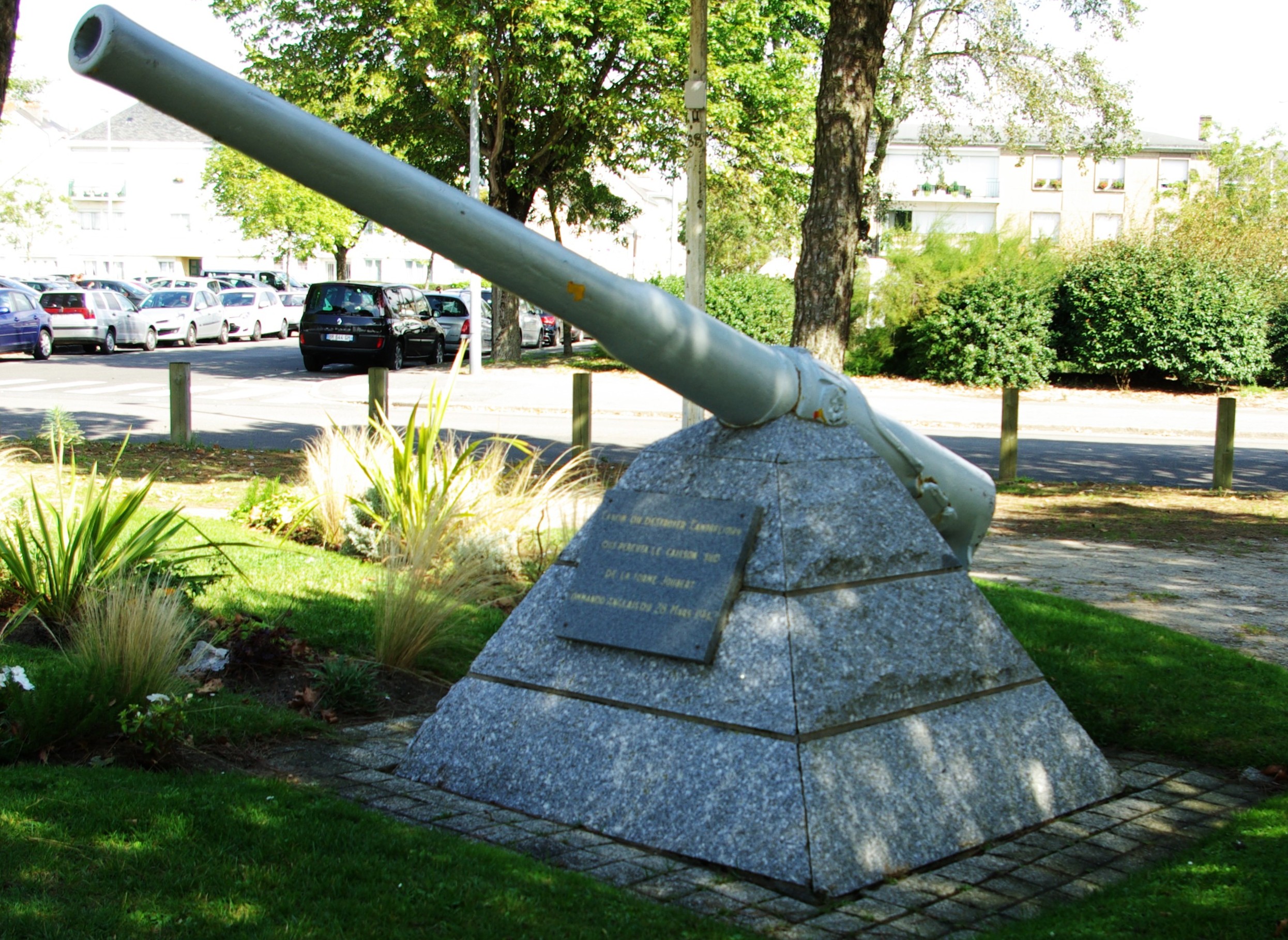
QF 12-pounder 12-cwt gun serving as a memorial to HMS Campbelton, Sainte Nazaire, France.
The QF 12-pounder 12-cwt gun (Quick-Firing) (abbreviated as Q.F. 12-pdr. [12-cwt.]) was a common, versatile 3-inch (76.2 mm) calibre naval gun introduced in 1894 and used until the middle of the 20th century. It was produced by Armstrong Whitworth, Elswick and used on Royal Navy warships, exported to allied countries, and used for land service. In British service “12-pounder” was the rounded value of the projectile weight, and “12 cwt (hundredweight)” was the weight of the barrel and breech, to differentiate it from other “12-pounder” guns. (Wikipedia)