
The Grand Fleet
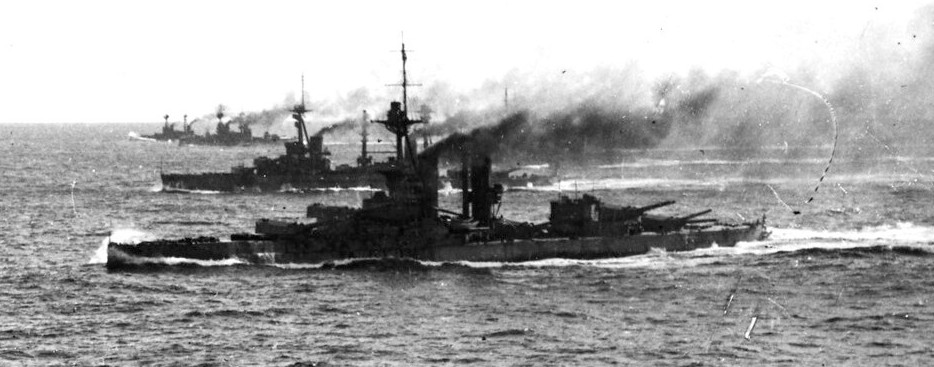
(Royal Navy Photo)
The British 4th Battle Squadron underway in the North Sea in 1915.
The Grand Fleet was the main battlefleet of the Royal Navy during the First World War. It was established in August 1914 and disbanded in April 1919. Its main base was Scapa Flow in the Orkney Islands.
Formed in August 1914 from the First Fleet and part of the Second Fleet of the Home Fleets, the Grand Fleet included 25–35 modern capital ships. It was commanded initially by Admiral Sir John Jellicoe.
The 10th Cruiser Squadron carried out the Northern Patrol between Shetland and Norway and cruisers from Cromarty and Rosyth operated a second line (and screened the fleet) in enforcing the blockade of Germany. The administrative complications of the distant blockade across the northern exits of the North Sea overwhelmed the capacity of Vice Admiral Francis Miller, the Base Admiral in Chief from 7 August 1914, devolving on the commander in chief, Admiral John Jellicoe. To relieve the administrative burdens on Miller and Jellicoe, the post of the Admiral of the Orkneys and Shetlands was created to oversee the defence of the islands, naval bases and shore duties. Vice-Admiral Stanley Colville was appointed to the command (7 September 1914 – 19 January 1916) with Miller under his authority.
Admiral Jellicoe was significantly concerned about the possibility of submarine or destroyer attacks on Scapa Flow. While the Grand Fleet spent almost the first year of the war patrolling the west coast of the British Isles, their base at Scapa was defensively reinforced, beginning with over sixty blockships sunk in the many entrance channels between the southern islands to enable the use of submarine nets and booms. These blocked approaches were backed by minefields, artillery and concrete barriers.
Admiral Jellicoe was succeeded by Admiral Sir David Beatty in December 1916.
The Grand Fleet was based first at Scapa Flow in the Orkney Islands, and later at Rosyth on the Firth of Forth. It participated with the biggest fleet action of the war – the Battle of Jutland – in June 1916. After the Battle of Jutland, the German High Seas Fleet rarely ventured out of its bases at Wilhelmshaven and Kiel in the last two years of the war to engage with the British fleet.
Following the German defeat, 74 ships of the High Seas Fleet (Hochseeflotte) of the Imperial German Navy (Kaiserliche Marine) were interned in Gutter Sound at Scapa Flow pending a decision on their future in the peace Treaty of Versailles. During April 1919 the Grand Fleet was disbanded, with much of its strength forming a new Atlantic Fleet.[8] Most of the interned German warships were later scuttled by their crews despite Royal Navy attempts to save them on 21 June 1919.
Order of Battle
Not all the Grand Fleet was available for use at any one time, because ships required maintenance and repairs. At the time of the Battle of Jutland in May 1916, it had 32 dreadnought and super-dreadnought battleships. Of these, 28 were in the order of battle at Jutland.
The actual strength of the fleet varied through the war as new ships were built and others were transferred or sunk but the number of battleships steadily increased, adding to the margin of superiority over the German fleet. After the USA joined the war, the US Battleship Division Nine was attached to the Grand Fleet as the Sixth Battle Squadron, adding four, later five, dreadnought battleships.
The order of battle of the Grand Fleet at the end of the war in 1918 included 35 dreadnought battleships and 11 battlecruisers.[b] Twenty ships had been completed since the outbreak of war. Five of these ships were from the United States Navy and one HMAS Australia from the Royal Australian Navy.[12][c] It had five battle squadrons, each of four to ten capital ships, plus the flagship HMS Queen Elizabeth, three cruiser squadrons, the “Flying Squadron” of seaplane carriers, and six destroyer flotillas, with another destroyer flotilla and three minesweeper flotillas under its command. The Battle Cruiser Force was two battle squadrons and the flagship HMS Lion (9 ships in total), and five cruiser squadrons (21 ships). (Wikiprdia)
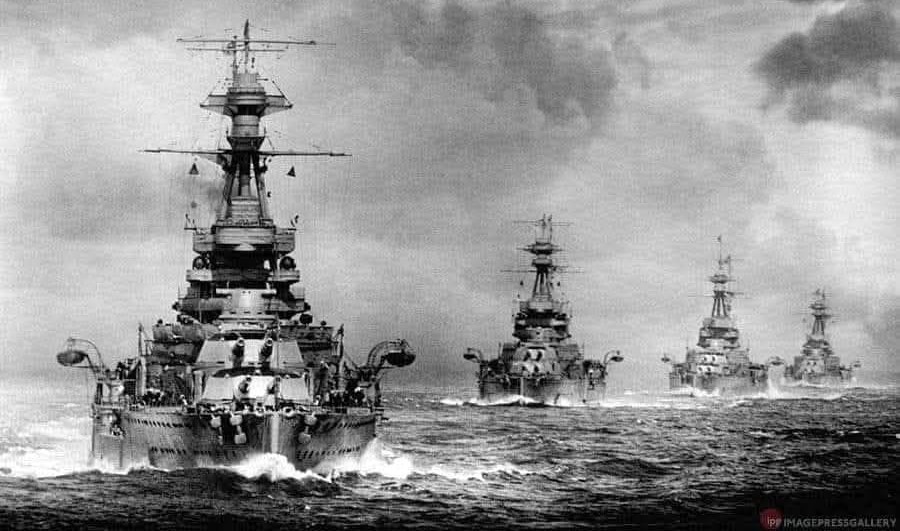
(Royal Navy Photo)
HMS Revenge leading HMS Royal Oak, followed by HMS Resolution, HMS Royal Sovereign, and HMS Ramilies in the Atlantic c.1922/23.
The Grand Fleet (Article by Alex Ray)
In March 1919 with the War in Europe now over and peace negotiations well underway the Grand Fleet – the Linchpin of Allied Grand Strategy throughout the Great War was finally formally dissolved.
Already many of the older and more obsolete 12″ gunned dreadnoughts found themselves hard worn after 4 hard years of war placed in reserve, or reduced to becoming Training Ships for Cadets, Midshipmen and RNR Ratings.
Dreadnought, Collingwood, Colossus and Hercules had been in reserve since just after the Armistice came into effect in November 1918, HMS Neptune followed shortly afterwards in February 1919, with St. Vincent joining them in March that year, and on leaving the Grand Fleet Bellerophon was converted into a Training Ship Conducting Cruises for Boy Cadets operating out of Portland.
The Battlecruisers Inflexible and Indomitable likewise found themselves quickly reduced to Reserve Status in March 1919.
Of the remaining 12″ Gunned Dreadnoughts Superb and Temeraire were still on Active Duty as the core of the Mediterranean Fleet, with both sisters returning to Portsmouth and being placed in Reserve in April 1919. New Zealand was at Portsmouth under Refit in preparation for a Tour of her Homeland with Sir John Jellicoe onboard to take him to his Tour of the Dominions as part of his Duties with the Committee of Imperial Defence.
In March 1919 HMAS Australia undertook a short refit also at Portsmouth before making her way back home to resume her duties as Flagship of the fledgling Royal Australian Navy.
The War Purchases HMS Agincourt and HMS Canada likewise were laid up in Reserve.
Of the remaining Capital Ships in Service in the Spring of 1919 the Admiralty had to reorganise into Squadrons for dispersal in order to meet a myriad of international situations that were developing or already underway.
Defence of the Home British Isles was split between three Fleets. The Home Fleet, the Atlantic Fleet and the Reserve Fleet.
The Atlantic Fleet, based primarily at Devonport, but with units also using Portsmouth would be the larger force and consist of HMS Queen Elizabeth (Fleet Flagship)
1st Battle Squadron: Revenge (VAdm), Ramillies, Resolution (RAdm), Royal Oak, Royal Sovereign
2dn Battle Squadron: Barham (VAdm), Malaya, Valiant, Warspite
Battlecruiser Squadron: Lion (VAdm) Princess Royal, Tiger, Renown.
Repulse would join this fleet later on, but had been taken into dockyard hands and was under a Refit that would last until the end of January 1921.
6 Light Cruisers and 54 Destroyers made up the rest of the Fleet as well as Auxilliary Units.
The Home Fleet based primarily at Portsmouth consisted of the Older Super Dreadnoughts:
3rd Battle Squadron: King George V (VAdm) Ajax, Conqueror, Monarch, Orion (RAdm), Thunderer, Erin.
Nominally under the Command of the 3rd Battle Squadron were the 12″ Battleships of the Reserve Fleet.
Overseas the main Fleet would continue to be as it had been before the Great War the Mediterranean Fleet:
4th Battle Squadron: Iron Duke (VAdm) Benbow, Emperor of India, Marlborough, Centurion.
Of this Force Emperor of India would spend considerable time on detached duty in the Black Sea operating against Bolshevik forces.
Added to this were Cruiser Squadrons at the China Station, Cape of Good Hope, South America and Western Atlantic (Formerly the West Indies Squadron) the Royal Navy of early 1919 to face the Post World War era consisted of 33 Battleships 8 Battlecruisers, 60 Light Cruisers and 352 Destroyers.
Despite the Hard Knocks of War, and several painful lessons the Senior Service found itself still the most Powerful Naval Force Afloat, not just that but also the doldrums and cobwebs of the late Victorian Era had been well and truly blown out.
The Royal Navy was also the most effective fighting force afloat, and still a huge piece to be used in International Power Politics of the period.

(IWM Photo, SP 1885)
HMS Benbow with other battleships in line ahead, 1917.