
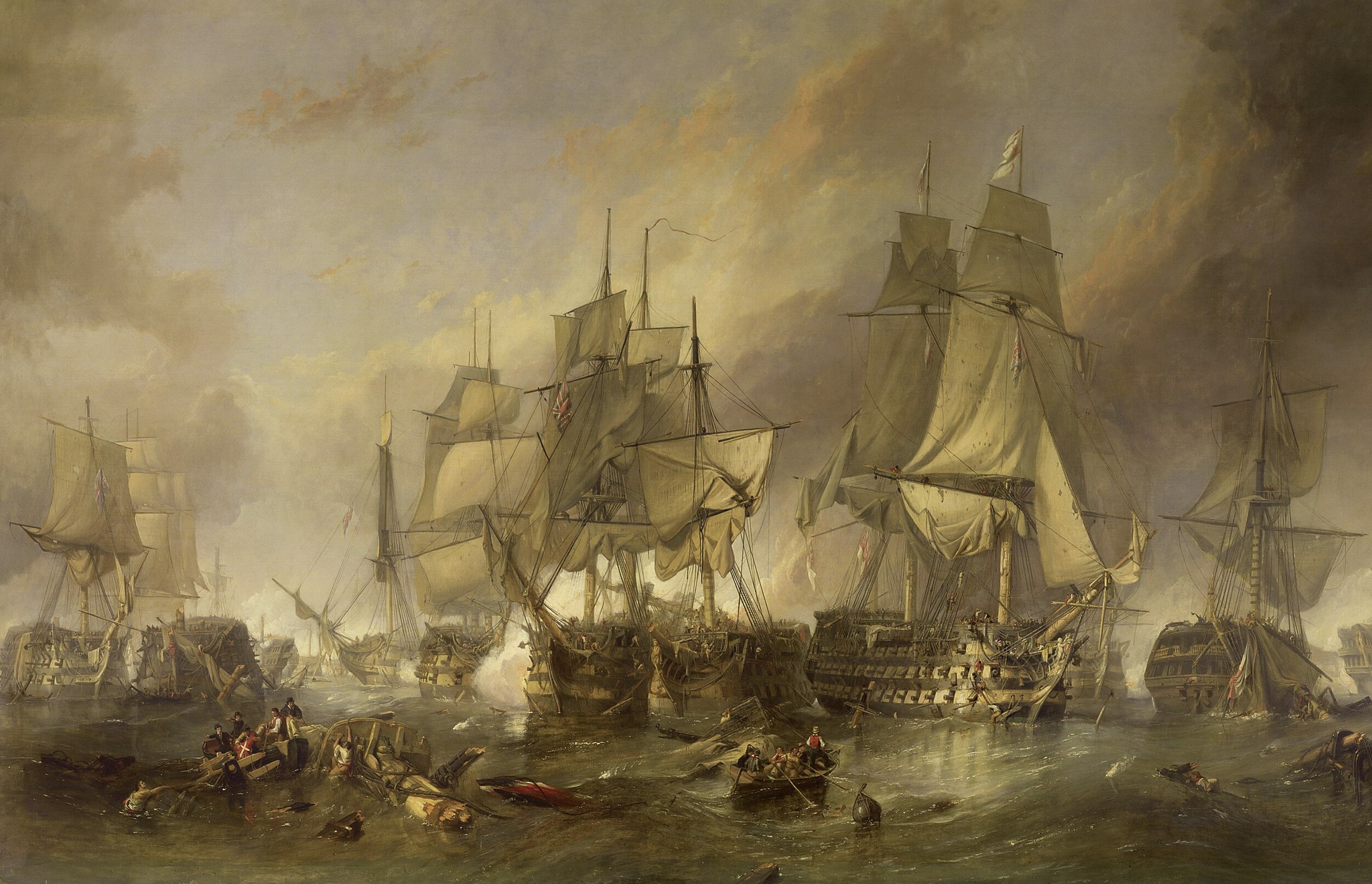
The Battle of Trafalgar by William Clarkson Stanfield.
HMS Victory is a 104-gun first-rate wooden sailing ship of the line. With 247 years of service as of 2025, she is the world’s oldest naval vessel still in commission. She was ordered for the Royal Navy in 1758, during the Seven Years’ War and laid down in 1759. That year saw British victories at Quebec, Minden, Lagos and Quiberon Bay and these may have influenced the choice of name when it was selected in October the following year. In particular, the action in Quiberon Bay had a profound effect on the course of the war; severely weakening the French Navy and shifting its focus away from the sea. There was therefore no urgency to complete the ship and the signing of the Treaty of Paris in February 1763 meant that when Victory was finally floated out in 1765, she was placed in ordinary. Her construction had taken 6,000 trees, 90% of them oak.
Victory was first commissioned in March 1778 during the American Revolutionary War, seeing action at the First Battle of Ushant in 1778, shortly after France had openly declared her support for Britain’s rebel colonies in North America, and the Second Battle of Ushant in 1781. After taking part in the relief of Gibraltar in 1782, Victory, and the fleet she was sailing with, encountered a combined Spanish and French force at the Battle of Cape Spartel. Much of the shot from the allied ships fell short and the British, with orders to return to the English Channel, did not bother to reply. This was her last action of the war; hostilities ended in 1783 and Victory was placed in ordinary once more.
In 1787, Victory was ordered to be fitted for sea following a revolt in the Netherlands but the threat had subsided before the work had been completed. She was ready for the Nootka Crisis and Russian Armament in 1790 but both events were settled before she was called into action. During the French Revolutionary War, Victory served in the Mediterranean Fleet, co-operating in the occupation of Toulon in August and the Invasion of Corsica between February and August 1794. She was at the Battle of the Hyeres Islands in 1795 and the Battle of Cape St Vincent in 1797. When Admiral Horatio Nelson was appointed Commander-in-Chief of the Mediterranean Fleet in 1803, he hoisted his flag aboard Victory and in 1805 took her into action at the Battle of Trafalgar. She served as a harbour ship from 1824 until 1922, when she was placed in dry dock at Portsmouth, England. Here she was repaired and is now maintained as a museum ship. From October 2012 Victory has been the flagship of the First Sea Lord. (Wikipedia)
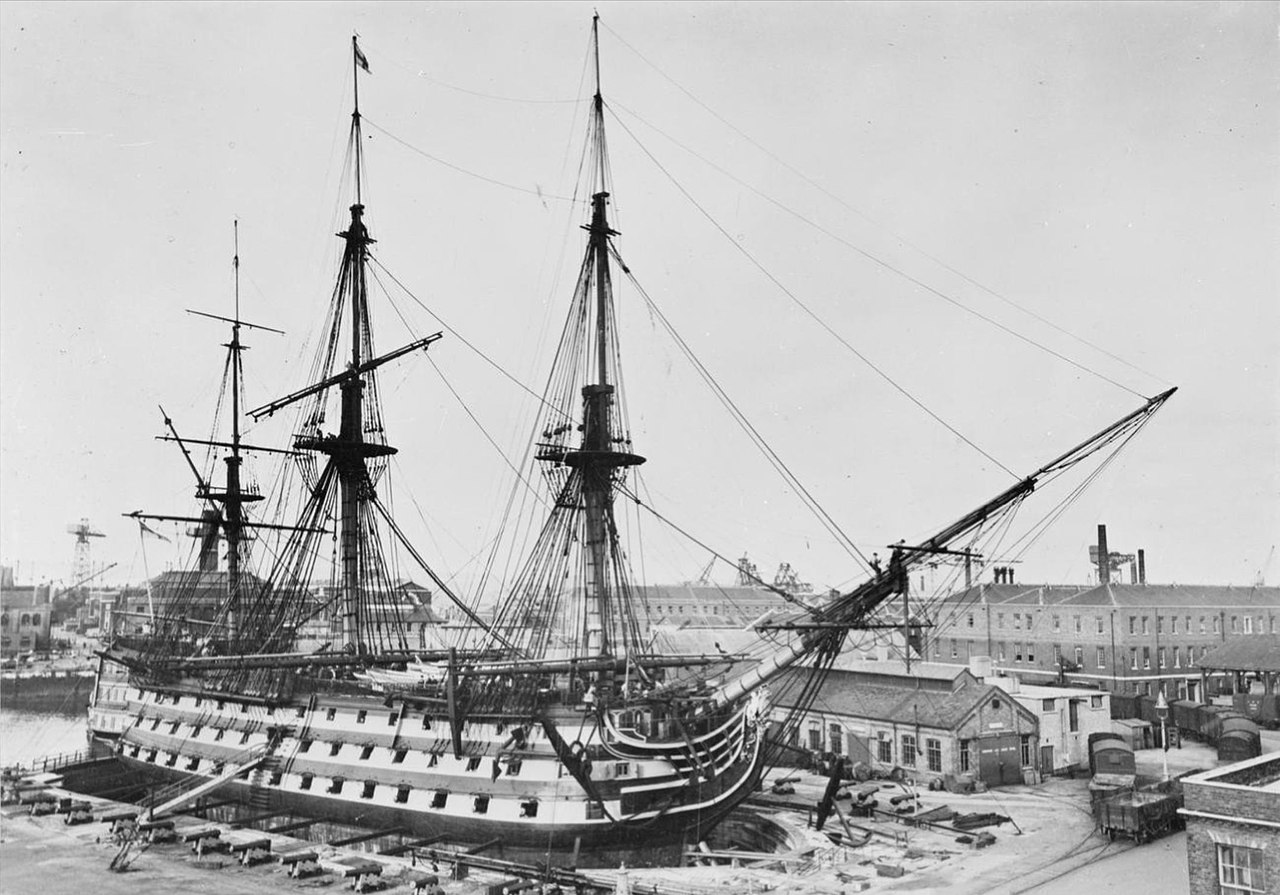
(tormentor4555 Photo)
Installation of a main-beam rack of the British first-class Battleship HMS Victory, the flagship of Admiral Horatio Nelson, after the end of the war, 28 August 1945. Since the Germans knew the exact location of Victory, no serious attempts were made to disguise it. The British limited themselves to dismantling the upper masts and most of the rigging during the war. The ship was closed to the public. However, at that time Victory received many visitors, including King George VI, other members of the royal family, and Allied leaders who visited England. In a way, Victory returned to active duty: the ship was used as a floating barracks for privates from the Royal Naval Barracks and anti-aircraft artillery crews. In April 1941, Admiral William Milbourne James, the commander of the Portsmouth Naval Base, transferred his department aboard the ship when a German bomb hit the Admiralty House. After one of the raids in 1941, the Germans announced the destruction of the ship. This statement was soon refuted by the British, but in March 1941 the ship barely escaped an unenviable fate: a German 500-pound (226 kg) bomb fell into a dry dock and exploded on the left under the nose of the battleship. The explosion made a hole in the hull measuring 8 x 15 feet (2.5 x 4.5 m) and a pothole of 20 feet (6 m) in the masonry of the dock. Some steel support blocks flew hundreds of meters. In November 1945, the ship was again open to the public. (Wikipedia)
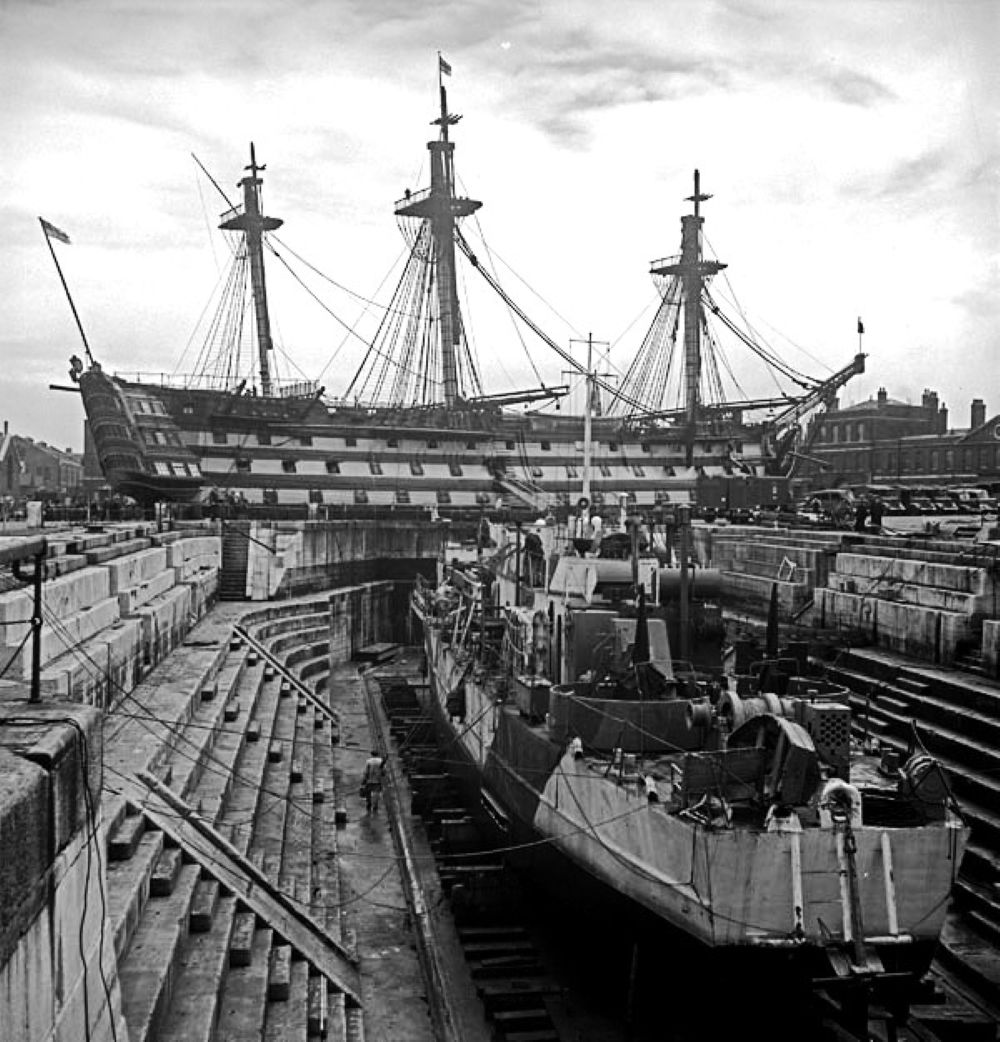
(Library and Archives Canada Photo, MIKAN No. 3715774)
HMS Victory, c1944, Portsmouth, England facing. The winch aft appears to be for the large stern anchor, which was a feature of the LCI(L), or Landing Craft Infantry (Large), used for amphibious landings. It was used as a kedge anchor to haul the boat off the beach after delivering its load. There appear to be two AA tubs just forward of the winch. This was not typical of corvettes, but it was typical of the LCI(L). The famous actor, Sir Alec Guinness, commanded one of these during the Second World War.
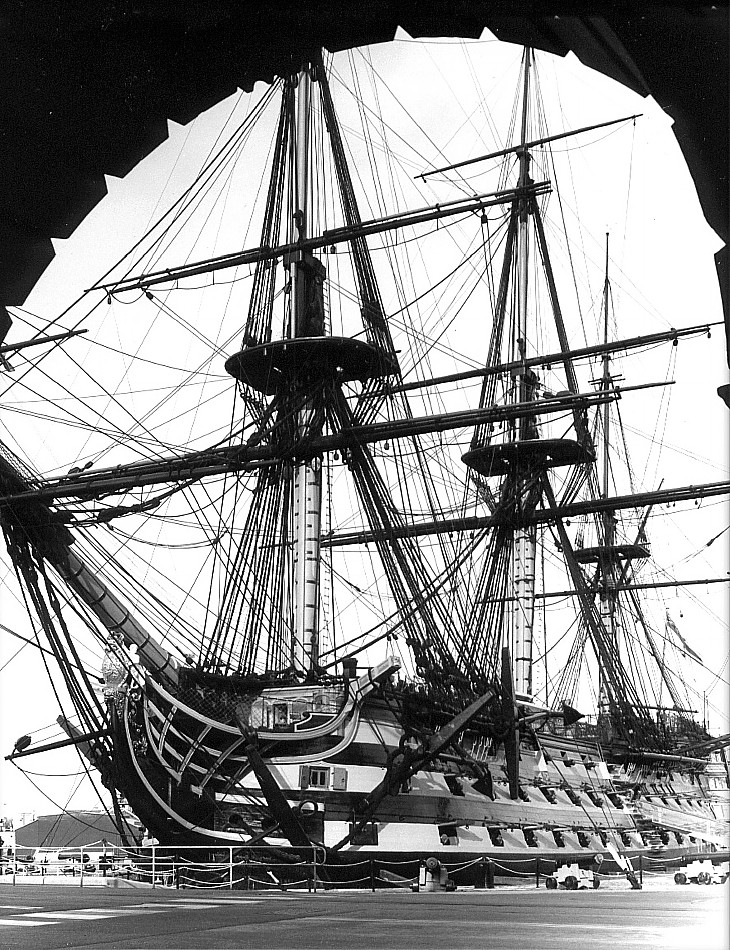
(RCN Photo)
HMS Victory, Oct 1968.
(UK Gov Photo)
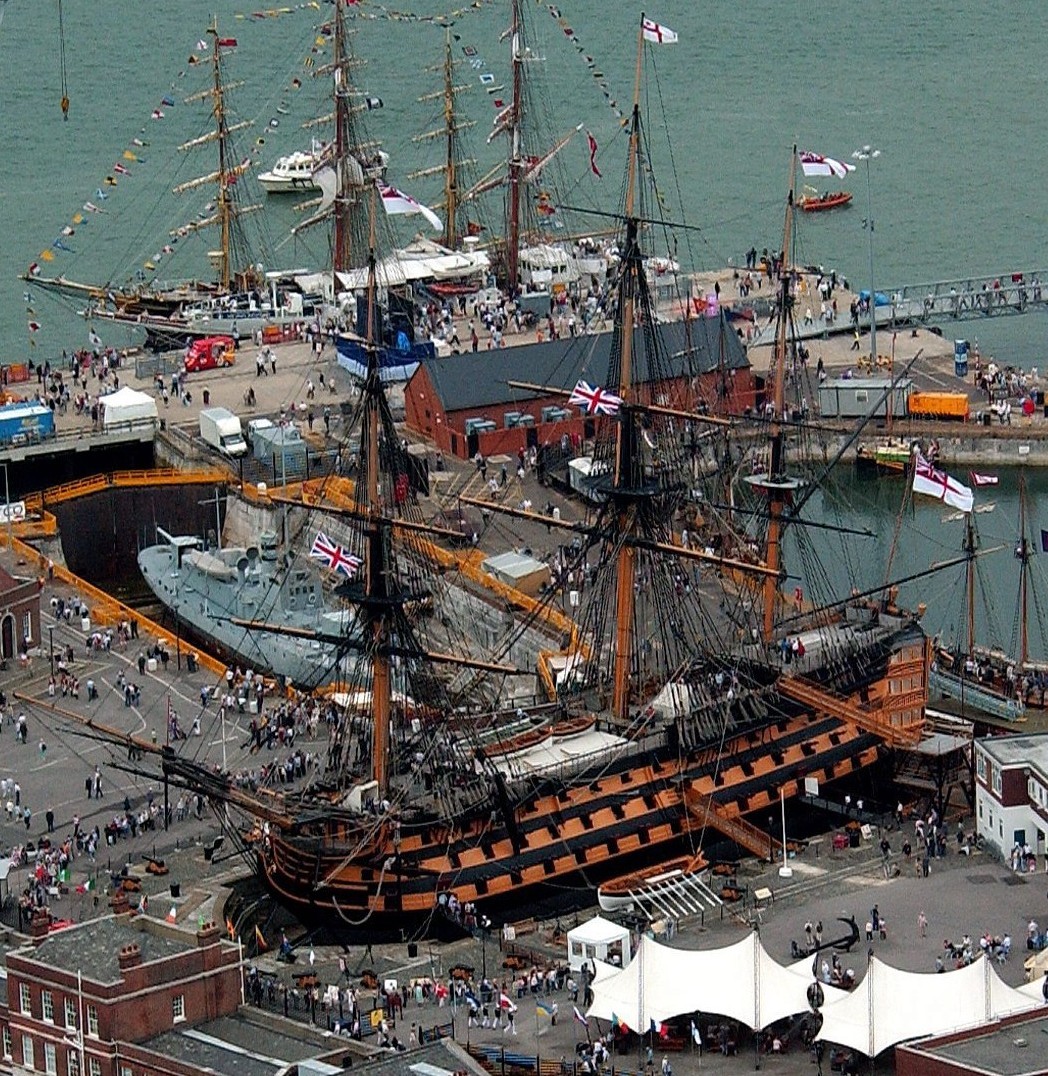
Aerial view of Portsmouth Dockyard, showing HMS Victory during the Trafalgar 200 celebrations.
(Geoff Parselle/MOD Photo)
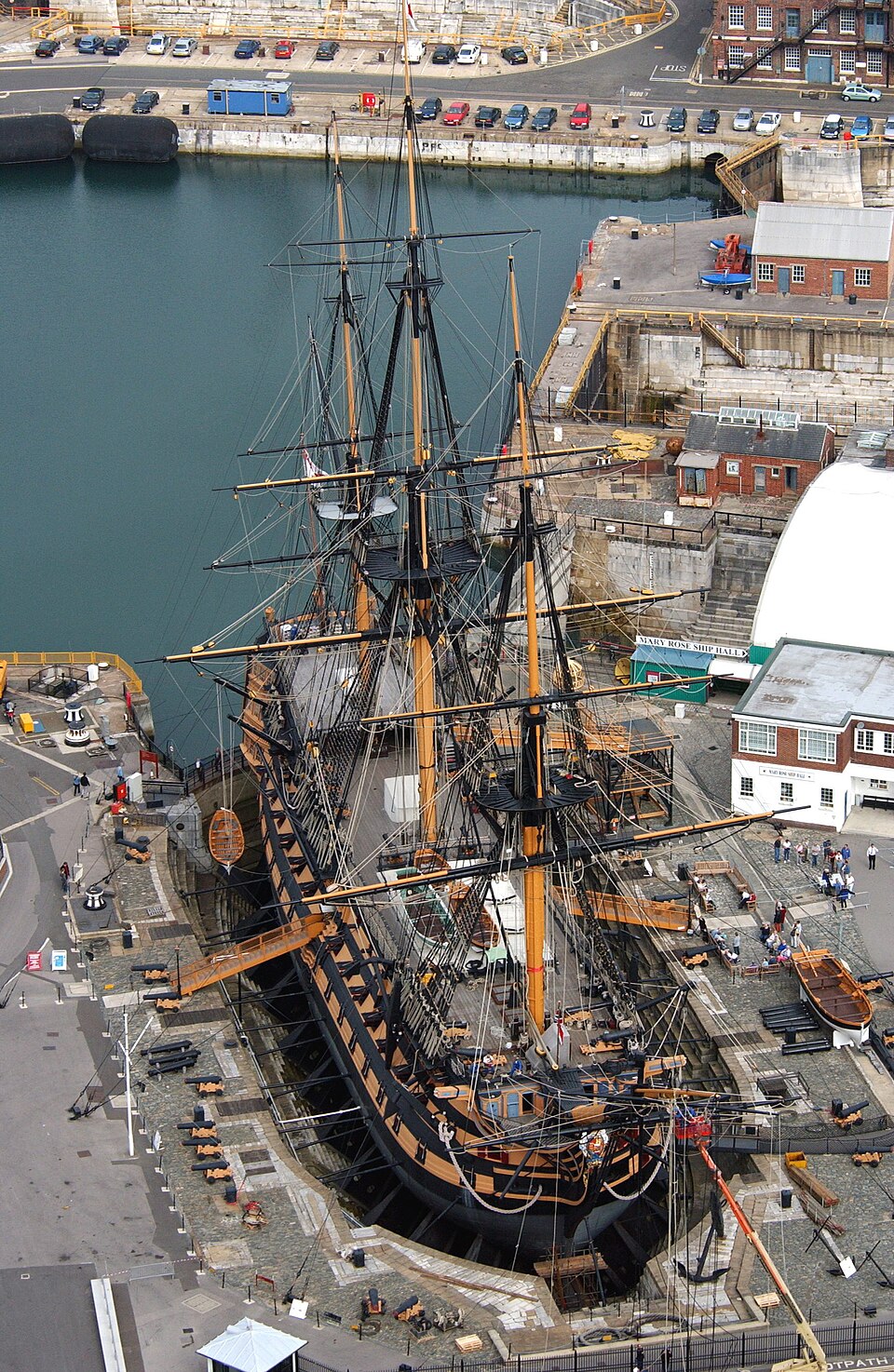
HMS Victory, Admiral Lord Nelson’s flagship during the Battle of Trafalgar, is now preserved in dry dock in Portsmouth Naval Dockyard.
(Tony Hisgett Photo)
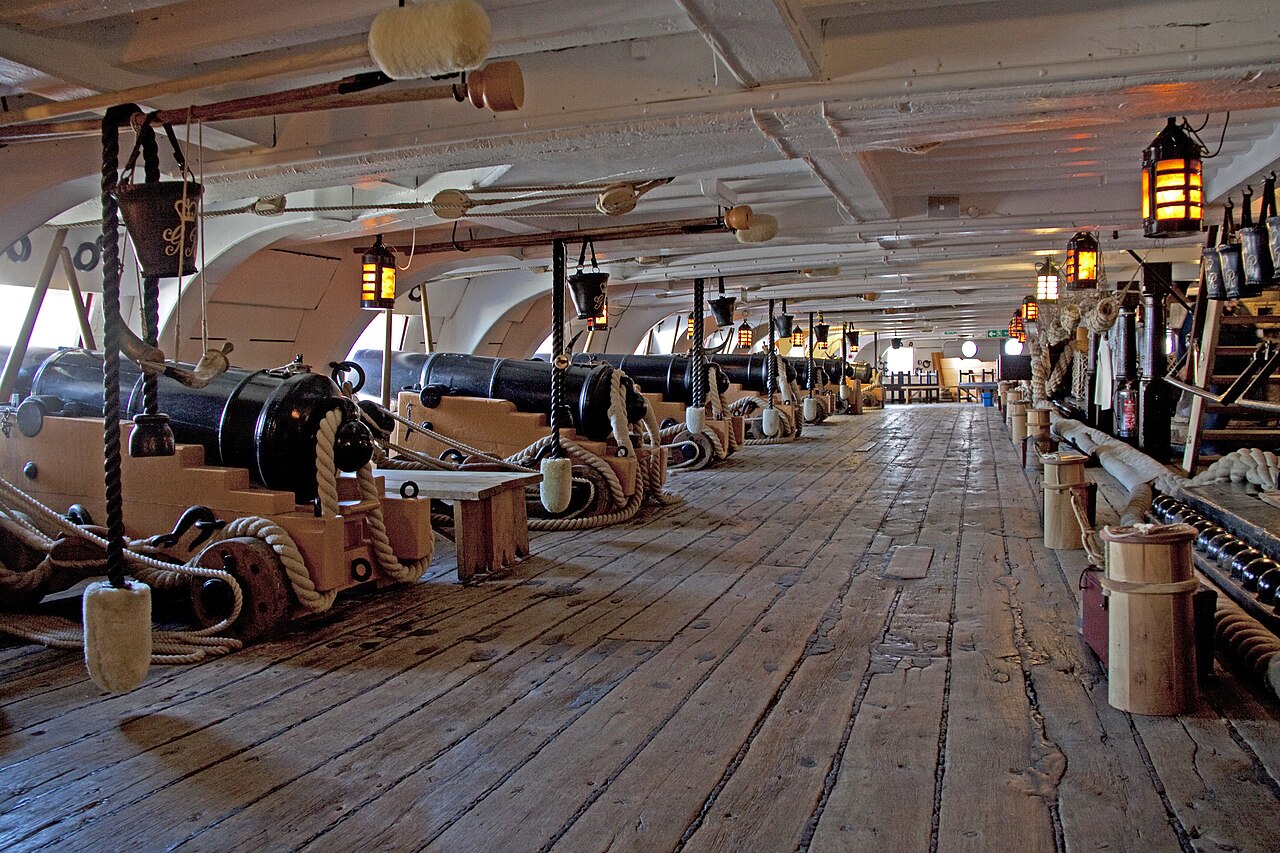
Replica Blomefield Cast Iron 32-pounder 56-cwt Smoothbore Muzzleloading Guns, on HMS Victory’s lower gundeck.
(Lemuel Francis Abbott portrait)
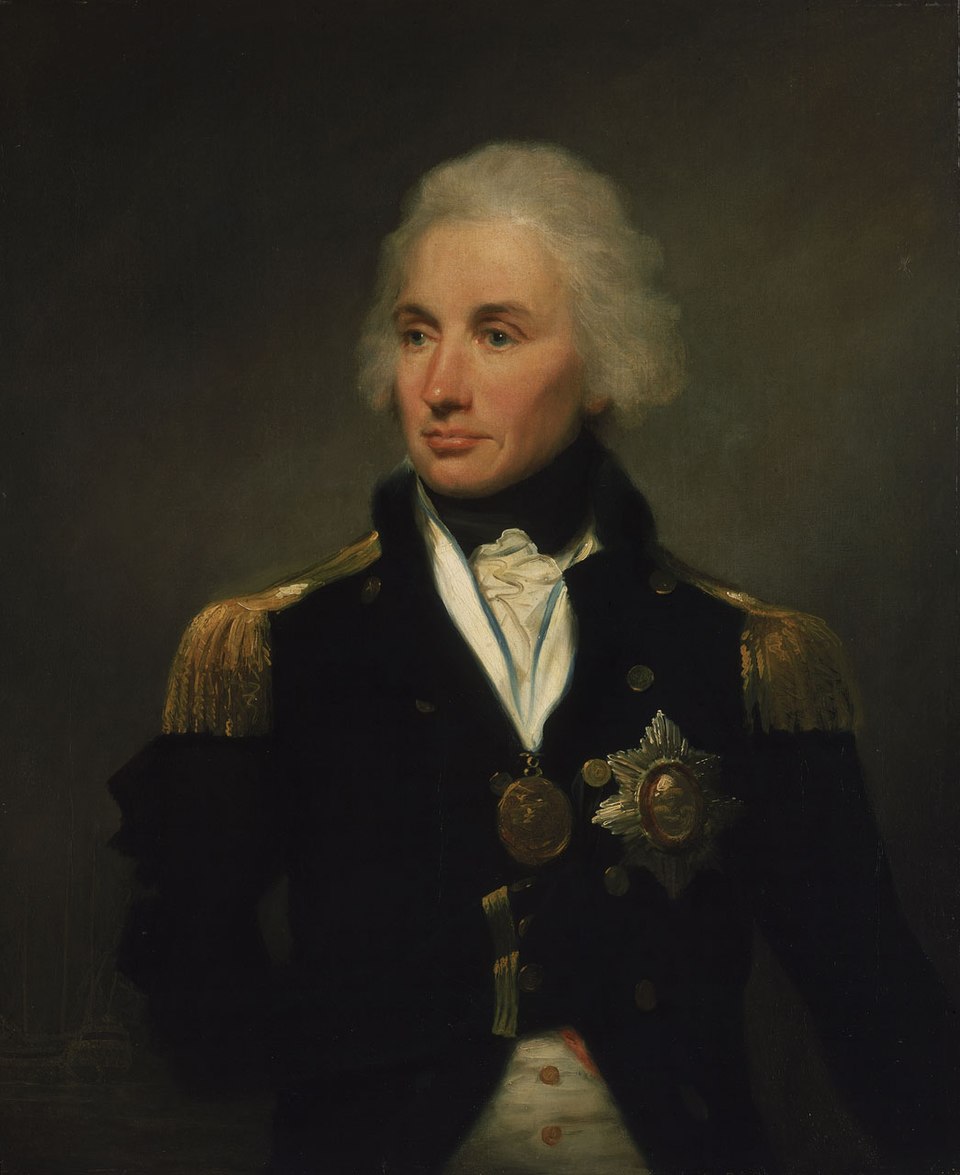
Vice-Admiral Horatio Nelson, 1758-1805, 1st Viscount Nelson, in a half-length portrait facing left in rear-admiral’s undress uniform, 1795–1812, with the St Vincent medal and the star of a Knight of the Bath. The empty right sleeve is pinned across with the upper part slit and tied with ribbons to accommodate the wound dressing following the loss of Nelson’s right arm at Santa Cruz, Tenerife, in July 1797.
Battle of Trafalgar
The Battle of Trafalgar was a naval engagement that took place on 21 October 1805 between the Royal Navy and a combined fleet of the French and Spanish navies during the War of the Third Coalition.As part of Napoleon’s planned invasion of the United Kingdom, the French and Spanish fleets combined to take control of the English Channel and provide the Grande Armée safe passage. The allied fleet, under the command of French admiral Pierre-Charles Villeneuve, sailed from the port of Cádiz in the south of Spain on 18 October 1805. They encountered a British fleet under Lord Nelson, recently assembled to meet this threat, in the Atlantic Ocean along the southwest coast of Spain, off Cape Trafalgar.
Nelson was outnumbered, with 27 British ships of the line to 33 French and Spanish, including the largest warship in either fleet, the Spanish Santísima Trinidad. To address this imbalance, Nelson sailed his fleet directly at the allied battle line’s flank in two columns, hoping to break the line into pieces. Villeneuve had worried that Nelson might attempt this tactic, but for various reasons, failed to prepare for it. To add to the French crisis, their crews were inexperienced and poorly trained. The British plan worked almost perfectly; Nelson’s columns split the Franco-Spanish fleet in three, isolating the rear half from Villeneuve’s flag aboard Bucentaure. The allied vanguard sailed off while it attempted to turn around, giving the British temporary superiority over the remainder of their fleet. In the ensuing fierce battle 18 allied ships were captured or destroyed, while the British lost none.
The offensive exposed the leading British ships to intense crossfire as they approached the Franco-Spanish lines. Nelson’s own HMS Victory led the front column and was almost knocked out of action. Nelson was shot by a French musketeer during the battle, and died shortly before it ended. Villeneuve was captured along with his flagship Bucentaure. He attended Nelson’s funeral while a captive on parole in Britain. The most senior Spanish commander, Admiral Federico Gravina, escaped with the surviving third of the Franco-Spanish fleet; he died six months later of wounds sustained during the battle. The victory confirmed British naval supremacy, and was achieved in part through Nelson’s departure from prevailing naval tactical orthodoxy. (Wikipedia)