Royal Navy Cruisers (Town class), Southampton group: HMS Southampton (83), HMS Birmingham (C19), HMS Glasgow (C21), HMS Newcastle (C76), HMS Sheffield (C24).
Gloucester group: HMS Gloucester (C62), HMS Liverpool (C11), HMS Manchester (C15), HMS Edinburgh (C16), HMS Belfast (C35) listed on a separate page on this website
The Town class consisted of 10 light cruisers built for the Royal Navy during the 1930s. The Towns were designed within the constraints of the London Naval Treaty of 1930. The ships were built in the sub-classes, Southampton, Gloucester and Edinburgh, each sub-class adding more weaponry. (Wikipedia)
Southampton group
HMS Southampton (83)
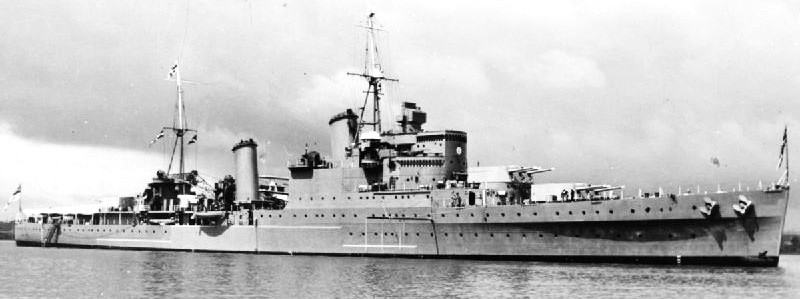
(IWM Photo, HU 69048)
HMS Southampton (83), 1937. She nitially served as the flagship of the 2nd Cruiser Squadron with the Home Fleet. On 5 September 1939 she intercepted the German merchant Johannes Molkenbuhr off Stadtlandet, Norway, but her crew scuttled the ship before she could be captured. The crew was taken off by the destroyer Jervis, and Johannes Molkenbuhr was then finished off by destroyer Jersey.Southampton was later damaged on 16 October 1939 whilst lying at anchor off Rosyth, Scotland, when she was struck by a 500 kg bomb in a German air raid. The bomb was released from only 150 metres (490 ft) height by a Ju 88 of I/KG.30, and hit the corner of the pom-pom magazine, passed through three decks at an angle and exited the hull, detonating in the water. There was minor structural damage and temporary failure of electrical systems. She was repaired and at the end of the year she was one of the ships involved in the hunt for the German battleships Scharnhorst and Gneisenau after the sinking of the armed merchant cruiser Rawalpindi. She then served with the Humber Force until February 1940, and then went to the 18th Cruiser squadron at Scapa Flow. On 9 April 1940, Southampton was operating off the Norwegian coast when she sustained splinter damage in a German air attack. The main battery director was temporarily knocked out. After being repaired, she had anti-invasion duties on the south-coast of England until she returned to Scapa Flow in October.
On 15 November Southampton sailed for the Mediterranean. She participated in the action off Cape Spartivento on 27 November. In December the cruiser was moved to the Red Sea to escort troop convoys, and at the same time took part in the bombardment of Kismayu during the campaign in Italian East Africa. On 1 January 1941 she joined the 3rd Cruiser Squadron and took part in Operation Excess. In the early afternoon of 11 January, both she and fellow cruiser Gloucester came under attack from 12 Stuka dive bombers of II Gruppe, Sturzkampfgeschwader 2, Luftwaffe. She was hit by at least two bombs south-east of Malta and caught fire; the resulting blaze spread from stem to stern and trapped a number of men below decks. 81 men were killed with the survivors being picked up by Gloucester and the destroyer Diamond. Heavily damaged and without power, Southampton was sunk by one torpedo from Gloucester and four from the cruiser Orion.A week after the sinking Admiral Cunningham, Commander-in-Chief of the Mediterranean Fleet, wrote a private letter to the First Sea Lord, Sir Dudley Pound, “I don’t like these ‘Southampton’ class. They are fine ships but that great hangar structure seems to provide a good point of aim, they are always being hit there.” Despite this concern, the other four ships in the Southampton sub-class served through the entire war, and only two of the ten overall Town class ships were lost due to air attack (two others were lost to torpedo attack). (Wikipedia)
HMS Birmingham (C19)
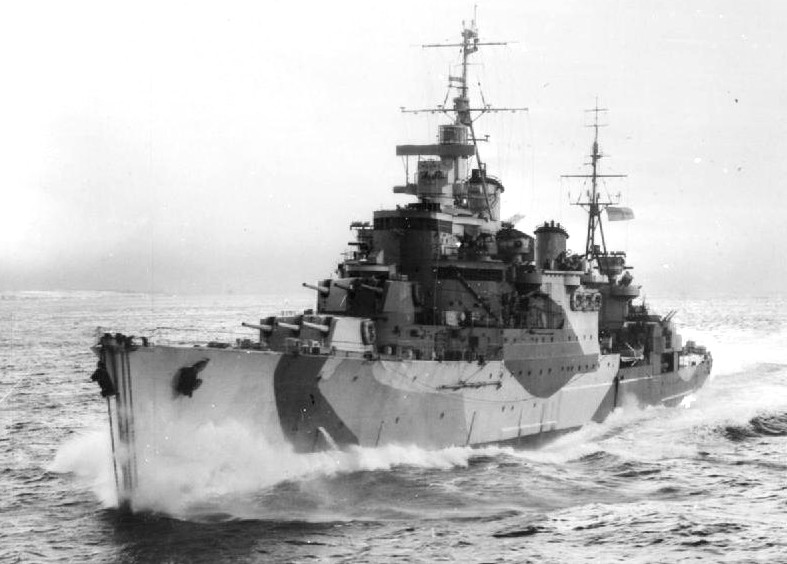
(IWM Photo, FL 2080)
HMS Birmingham (C19), 24 Oct 1943. Birmingham initially joined the 5th CruiserSquadron on the China Station in January 1938. On the outbreak of the SecondWorld War in September 1939, she left for Malta for a refit before joining theHome Fleet in March–April 1940. Birmingham was a unit of the 18th CruiserSquadron of the Home Fleet, initially used to patrol off the coast of Norway to prevent German fishing vessels operating in this area. In mid-April Birmingham, Manchester, and Cairo escorted a troop convoy to Norway. On 26 April she shelled and sank the German patrol boat Schiff 37 after Schiff 37 rammed and damaged the destroyer Arrow off Norway. In May, Birmingham, in company with Manchester,evacuated 1,500 troops from Åndalsnes. She returned to the UK and was in refit between September–December 1940.
From January until April 1941 Birmingham escorted troop convoys to the MiddleEast, around the Cape of Good Hope. In May she returned to home waters, and was involved in the hunt for the German battleship Bismarck and heavy cruiser Prinz Eugen. Birmingham had already put to sea from Scapa Flow on a patrol of theIceland-Faroes passage, and did not end up engaging the German ships. Birmingham then escorted convoy WS-9A from the UK to South Africa arriving on 4July 1941. Whilst in South African waters, she docked in the Selborne dry dockat Simon’s Town for a minor refit, where she was fitted with the Mk 284 and 291radars and several new anti-aircraft weapons.
On completion in February 1942, Birmingham was transferred to the Eastern Fleet, returning to South Africa in March. InJune she was reassigned to operate in the Mediterranean as a member of the 4thCruiser Squadron under Rear Admiral Tennant. She was part of the covering forcefor the double convoy operation codenamed Operations “Harpoon” and”Vigorous” from Gibraltar and Alexandria to supply the island ofMalta. In March, she was attacked and damaged by 15 Ju 87 from Sturzkampfgeschwader 3 and Italian Cant 1007 aircraft. Though they failed to hit Birmingham directly, she was damaged by several near misses. In September she returned to the Indian Ocean and was involved in the British operation to occupy Madagascar, codenamed Operation “Stream”. In November Birmingham escorted a convoy to Mahajanga West Coast where the 10th Infantry Brigade was landed under air cover provided by the aircraft carrier Illustrious.
In April 1943 Birmingham was again refitted in the UK, a process completed in October. She returned to the Mediterraneanand on 28 November was torpedoed by the German submarine U-407 off the coast ofCyrenaica. The torpedo struck the keel, in line with the ‘B’ turret and rightunder the seaman boys’ mess deck, killing about seventy men in thatcompartment. Seriously damaged, and with her bow almost severed, she succeededin returning to Alexandria where temporary repairs were carried out.[1] In June1944, she sailed for the United States where more permanent repairs werecarried out. ‘X’ 6 inch turret was removed and replaced by 16 (4×4) Bofors 40mm gun plus an increase to 27 (10×2, 7×1) Oerlikon 20 mm cannon. In November1944, the repairs were completed and she returned to home waters to join the10th Cruiser Squadron at Scapa Flow.
In May 1945, as the war drew to a close, a force consisting of the cruisers Birmingham, Dido, and several destroyers was tasked with occupying ports in theBaltic. The force passed through the German mine barrage off the Skagerrak,reaching Copenhagen on 9 May, taking control of the German cruisers Prinz Eugen and Nürnberg after their surrender. On 13 May Birmingham was relieved by the cruiser Devonshire and she returned to the UK.
In 1948 Birmingham was transferred to the South Atlantic Command. On 4 January 1947, she embarked the departing governor of Burma on its independence.[3] She served in the East Indies Fleet with the 4th Cruiser Squadron between 1949 and 1950. During 1950 and 1952 Birmingham underwent a modernisation, receiving new bridgework, a lattice foremast and air conditioning rendering her suitable forservice in the Far East. Birmingham was paid off at HMNB Devonport on 3December 1959. By this time she was the last of her class in service. She wasbroken up in September 1960. (Wikipedia)
HMS Glasgow (C21)
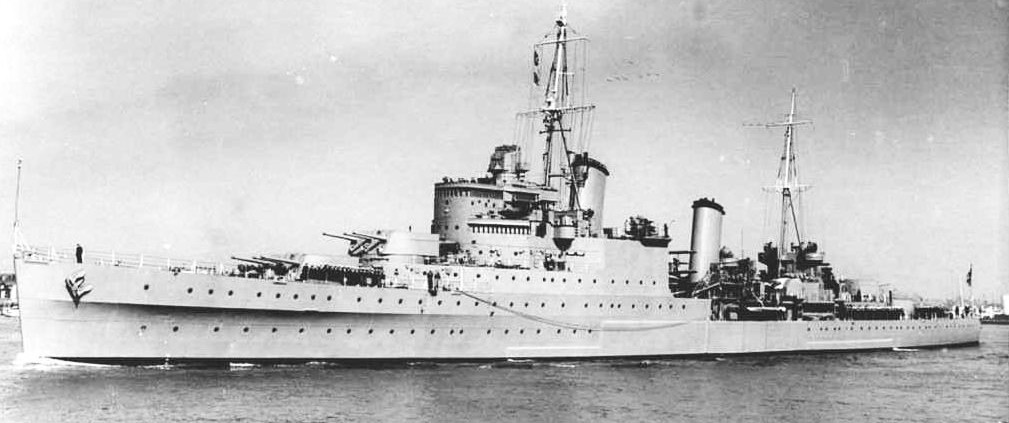
(Royal Navy Photo)
HMS Glasgow (C21), 1937. Upon entering service Glasgow was allocatedto the 2nd Cruiser Squadron of the Home Fleet. Her service was mostlyuneventful, consisting of fleet exercises and ‘flag showing’. Her mostglamorous operation was when together with her sister HMS Southampton sheescorted the liner Empress of Australia on the outward and the liner Empress ofBritain on the return voyage carrying King George VI and Queen Elizabeth toCanada on their royal visit to the United States and Canada in May and June1939. Glasgow remained allocated to the Home Fleet during the first year of theSecond World War, under the command of Captain Frank Pegram from July 1939 to April 1940. With war approaching, Glasgow sailed on 2 September 1939 from Grimsby to patroloff the Norwegian coast with Humber Force to intercept any German commerceraider attempting to reach the Atlantic or any blockade runner returning toGermany. While operating with the Humber Force she in company with the cruisersSouthampton and Edinburgh was subjected to a heavy air attack by the Luftwaffeon 9 October 1939, but suffered no damage despite 120 bombs being dropped onthe ships. On the outbreak of war, she operated off the Scandinavian coast, and inNovember was off the coast of Norway with two destroyers in the hope ofintercepting the German passenger ship SS Bremen which had sailed fromMurmansk. This was unsuccessful, but on 12 February 1940, she captured theGerman trawler Herrlichkeit off Tromsø.
On 9 April 1940, she was attacked off Bergen by Junkers Ju 88 and Heinkel He111 aircraft and damaged by two near misses. Both bombs fell about 15 feet (4.6m) from the ship’s side, one bursting on impact abreast station 70 and theother under water further forward. A large proportion of the bomb which burston impact entered the ship three feet (0.91 m) above the lower deck level,holing an area of approximately six by three feet (1.83 by 0.91 m) with about60 scattered splinters entering the ship’s side in all. The ship’s movementallowed a considerable quantity of water to enter the hull causing themessdecks between stations 53 – 74 to be flooded by one foot (30 cm) of water.Some minor underwater damage and a small amount of flooding occurred furtherforward, probably as a result of the other bomb. In addition the forward ‘A’turret was temporarily out of action. Two crew members were killed and fivewere wounded. After returning to Scapa Flow on 10 April for temporary repairsand transfer of the dead and wounded the ship returned to sea 22 hours later.
On 11 April 1940, during the Allied campaign in Norway in World War II,Glasgow, along with HMS Sheffield and six Tribal-class destroyers landed troopsnear Harstad and three days later on 14 April, again in company with Sheffieldand ten destroyers, landed an advance force of Royal Marines at Namsos to seizeand secure the wharves and approaches to the town, preparatory to the landingof a larger Allied force. On 23 April Glasgow, Sheffield, HMS Galatea and sixdestroyers landed the first part of the 15th Infantry Brigade in Åndalsnes. On29 April, she evacuated King Haakon and Crown Prince Olav of Norway,Nygaardsvold’s Cabinet and part of the Norwegian gold reserves when they fledfrom Molde to Tromsø, escaping the advancing German forces.[5] She thendeparted to the United Kingdom on 1 May, carrying among others the Minister ofForeign Affairs Halvdan Koht and the Minister of Defence Birger Ljungberg. Whilstoperating in home waters after the withdrawal from Norway, Glasgow accidentallyrammed and sank the destroyer HMS Imogen in thick fog off Duncansby Head on 16July 1940. Glasgow was able to rescue the majority of the destroyer’s crew but 19 lost their lives as well as two crew members of Glasgow. Following repairs Glasgow was transferred to the Mediterranean where she wasemployed as a convoy escort and as a reinforcement of the 3rd Cruiser Squadronbased at Alexandria. She took part in the Fleet Air Arm raid that crippled theItalian Fleet at Taranto; on 14 November, Glasgow, along with Berwick, HMASSydney and HMS York, landed 3,400 troops from Alexandria in Piraeus. On 26November, Glasgow, HMS Gloucester and York escorted a supply convoy fromAlexandria to Malta.
On 3 December Glasgow was attacked by Italian aircraft while anchored in SudaBay, Crete. She was hit by two torpedoes fired by a Savoia-Marchetti SM.79flown by Carlo Emanuele Buscaglia. The torpedoes struck far forward and aft,the latter putting two of her propeller shafts out of service. Other than thatshe received only moderate damage. She was able to return to Alexandria,where as the shipyard did not have the resources and capability to make a fullrepair, she was repaired to a level that allowed her to return to secondary duties.[1]During this period she was temporarily replaced by HMS Southampton.
As a result of her diminished capability Glasgow was allocated to the Indian Ocean, leaving Alexandria on 12 February1941 and passing through the Suez Canal. On 18 February she joined East Indies Fleet at Aden. In February the German cruiser Admiral Scheer sank the freighters Canadian Cruiser and Rantaupandjang in the Indian Ocean. Both managed to transmit distress signals, that were picked up by Glasgow, which deployed in search of the German ship. On 22 January, Admiral Scheer was sighted by the spotter aircraft from Glasgow, the East Indies Task Force was deployed to the reported area. However, Admiral Scheer had escaped by turningaway to the southeast and further searches were in vain. In March Glasgow, in company with HMS Caledon, two auxiliary cruisers, two destroyers and two anti-submarine trawlers of the Indian Navy, escorted two troop transport vessels containing two Indian battalions and one Somali commando detachment, who were landed on either side of Berbera, in Somaliland, which had previously been occupied by the Italians. The town was taken after only slight Italian resistance, which was soon broken by naval gunfire from Glasgow and the other escorts.
At midnight on 9 December 1941, Glasgow sank the RIN patrol vessel HMIS Prabhavati with two lighters in tow en route to Karachi, with 6-inch shells at 6,000 yards (5,500 m). Prabhavati was alongside the lighters and was mistaken for a surfaced Japanese submarine. Glasgow picked up the survivors and took them to Bombay, arriving there later that day.
On 19 March 1942, Glasgow escorted convoy WS-16 from the UK to South Africa. InApril Glasgow again underwent temporary repairs, this time in Simonstown, SouthAfrica. She subsequently sailed to the US for permanent repairs at the Brooklyn Navy Yard from 6 May onwards. As well as repairing the damage from her 1940torpedo attack, additional 20 mm Oerlikon cannons were added to improve her close-rangeanti-aircraft capability. It was also decided to improve her radar suite byreplacing her existing Type 286M radar with the new Type 271, while a Type 284fire-control radar to control her main armament, type 285 and 282 aircraftwarning fire-control and Type 281 aircraft warning radars were installed.
Following the completion of her shipyard work, she returned to the UK in August to complete work on her radar installations at Portsmouth. On 3 September shejoined the 10th Cruiser Squadron at Scapa Flow where she was assigned tocovering forces for the Arctic convoys. Glasgow escorted Arctic convoys betweenJanuary and February 1943. In March she intercepted the German blockade runner Regensburg in the Denmark Strait as it returned from the Far East with valuable rubber, tungsten and other commodities. Her crew managed to scuttle the ship, but most of the crew drowned in the heavy seas while abandoning her, with Glasgow being able to recover only six survivors. During June and July shesupplied cover for escort groups in the Bay of Biscay.
Between August and September she entered the HM Dockyard at Devonport where heraircraft facilities were removed and more 20 mm weapons were installed to improve her air defences. She received a new Fire-Control Type 283. The opportunity was also taken to install IFF equipment and VHF radio-telephone outfits. Upon completion of her refit she was transferred to join the Commander-in-Chief, Plymouth. On 26 October she took to sea the First Sea Lord, Admiral Sir Andrew Cunningham to undertake the interment of the ashes of Admiral Sir Dudley Pound and his late wife in the Solent.
In December 1943 she formed part of Operation Stonewall, the interception of German blockade runners. In late December, Glasgow and the cruiser HMSEnterprise in the Battle of the Bay of Biscay fought a three-hour battle with eleven German destroyers and torpedo boats of which three were sunk and fourdamaged by gunfire. After this engagement Glasgow returned to Plymouth in spite of several air attacks where glider bombs were used.
On 6 June 1944 Glasgow was part of Operation Neptune, (the Normandy landings).Along with the battleships USS Texas and USS Arkansas, the French cruisersMontcalm and Georges Leygues, nine US destroyers and three Hunt-classdestroyers, she made up the Gunfire Bombardment Support Force C for OmahaBeach. On 25–26 June, in support of the attack by the 7th US Corps onCherbourg, she conducted the Bombardment of Cherbourg shelled German artillerybatteries near Querqueville. During this exchange of fire Glasgow was hit and damaged. In August 1945 she set sail for the East Indies, where she was the flagship of the Commander-in-Chief.
With the demand for cruisers in the European theatre decreasing it was decided to withdraw Glasgow and moderniseher in preparation for the ongoing war in the Pacific. Entering a shipyard onthe River Tyne on 3 July 1944 her aft 6-inch turret (‘X’) was removed tocompensate for the additional weight of adding the more powerful anti-aircraftarmament needed to counter the threat of kamikaze attacks. The space freed bythe removal of the aft turret was used to mount two quad 40 mm Bofors guns. Newradar systems were fitted including a single aerial air warning Type 281B (which replaced an earlier twin mast Type 281), a surface warning Type 293(which replaced the existing Type 273), while the main armament’s Type 284 gunnery radar was replaced by a Type 274. She was also fitted with a US madeYE homing beacon to help her undertake the high risk role of a radar picket.The beacon issued coded directions to Allied aircraft returning from missions,which would allow Glasgow to be stationed on an outer screen around the mainfleet to separate Allied aircraft from accompanying enemy aircraft and sodestroy enemy aircraft before they reached the fleet.[1] The modernisation wascompleted on 29 June 1945. She then spent July working up for operationalwar service.
On 22 August 1945 Glasgow set out with HMSJamaica for the East Indies as acting flagship. She transferred to the IndianOcean arriving in Colombo on 5 October to relieve HMS Phoebe as the flagship of5th Cruiser Squadron. After serving for two years in the Indian Ocean Glasgow returned to Portsmouth and was placed in the Reserve. Following a refit she was re-commissioned in September 1948 and on 26 October, 1948, Glasgow replaced HMS Sheffield at her new base, the Royal Naval Dockyard in the Imperial fortress colony of Bermuda, as the flagship on the America and West Indies Station. She attended the Halifax bicentenary celebrations in Nova Scotia in 1949, returning to the UK in October 1950.
She was then refitted at Chatham in 1951 before becoming in 1952 the flagship of the Mediterranean Fleet based at Malta under Admiral the Earl Mountbatten of Burma. In 1953, she took part in the film Sailor of the King. In the sameyear she took part in the Fleet Review to celebrate the Coronation of Queen Elizabeth II.
Together with HMS Gambia, HMS Bermuda, HMS Eagle, seven destroyers and two frigates she escorted Queen Elizabeth II and Duke of Edinburgh on board the royal yacht Britannia at the end of their world tour to Malta where they arrived on 2 May 1954. She was still in the Mediterranean Fleet when together with HMS Gambia she participated in August 1954 in the withdrawal of 40Commando Royal Marines from Port Said.
In 1955 Glasgow returned to the UK, and in May 1955 onwards rejoined the HomeFleet as flagship of the Flag Officer D (Flotillas) before being paid off at Portsmouth in November 1956. The Suez crisis in 1956 caused Glasgow to be temporarily re-commissioned. After the Suez Crisis it was decided that Glasgow was surplus to requirements and was paid off in November 1956. The warship was placed on the disposal list in March 1958 and was sold to BISCO for demolition. Departing Portsmouth on 4 July Glasgow arrived under tow on 8 July at Hughes Bolckow’s yard in Blyth for breaking up. (Wikipedia)
HMS Newcastle (C76)

(USN Photo)
HMS Newcastle (C76), steaming in formation with a U.S. Navy carrier task force, off Korea, 3 March 1954. HMS Newcastle was under refit on the outbreak of the Second World War, joining the newly established 18th Cruiser Squadron on the refit’s completion. Duties included trade protection duties in the Western Approaches and operation with the Northern Patrol in the waters between Scotland, Iceland and Greenland, enforcing the blockade of Germany by intercepting merchant ships suspected of carrying contraband to Germany.
On 25–26 September 1939, Newcastle sailed with the Home Fleet as it sortied to cover the 2nd Cruiser Squadron which was escorting the submarine Spearfish, which had been damaged by German trawlers, back to Britain. The covering force came under attack by German bombers, with the battleship HMS Hood hit by a bomb that failed to explode, while air attack against the cruisers of the 18th Cruiser Squadron proving ineffective. On 12 November 1939, Newcastle intercepted the German blockade runner Parana in the Denmark Strait. Parana‘s crew set the German merchant ship on fire before abandoning ship, and Newcastle scuttled Parana with gunfire the next day. On 23 November 1939, the German battleships Scharnhorst and Gneisenau, on a sortie into the North Atlantic, encountered and quickly sank the British armed merchant cruiser Rawalpindi of the Northern Patrol. HMS Newcastle, the next ship to the west in the British patrolline, responded to Rawalpindi‘s contact report and attempted to come to Rawalpindi’s aid, but when Newcastle was spotted by the two German battleships, they broke off attempts to rescue Rawalpindi‘s crew, and made off at high speed, behind a smoke screen, with Newcastle, not yet fitted with radar, soon losing sight of the German ships in a rain squall.
On 23 March 1940, Newcastle began a refit on the Tyne which continued until 3 June that year, thus missing the majority of the Norwegian campaign. From 7 July, she was detached to Plymouth to guard against a potential German invasion. On the night of 10/11 October 1940, Newcastle provided illuminationwith star shells while the battleship HMS Revenge bombarded the French port of Cherbourg in an attempt to destroy shipping that could be used in a German invasion. On 17 October 1940, Newcastle set out from Plymouth with the cruiser Emerald and the destroyers Jackal, Jupiter, Kashmir, Kelvin and Kipling to investigate reports of German destroyers. Later that day, the British force encountered the German destroyers Hans Lody, Friedrich Ihn, Erich Steinbrinck and Karl Galster. The German destroyers turned back at full speed making for Brest, with the British force in pursuit. Newcastle launched her Walrus seaplane to direct the British force’s fire, but while Hans Lody was hit twice and Erich Steinbrinck received splinter damage, the German force escaped to safety in Brest.
On 13 November 1940, Newcastle set out for the Mediterranean, carrying 200 RAF personnel and a cargo of aircraft spare parts for Malta, where she arrived on 19 November. Newcastle‘s next mission was Operation Collar, in which a convoy of merchant ships would be escorted westwards from Alexandria in Egypt to Malta, while more merchant ships would be escorted eastwards from Gibraltar to Malta and Egypt, with the opportunity taken to transfer warships, including Newcastle from the Mediterranean to the North Atlantic. On 27 November, the Italian Fleet attempted to intercept the British convoy, resulting in the inconclusive Battle of Cape Spartivento.
Newcastle was then ordered to the South Atlantic, taking part in an unsuccessful search for the German auxiliary cruiser Thor that month. Newcastle remained continually at sea from 10 December 1940 to 21 April 1941, a total of 133 days, with 109 days out of sight of land, a record for Royal Navy warships during the Second World War, before a brief refit at Simonstown, South Africa. In May that year, Newcastle returned to commerce protection duties in the South Atlantic, and on 18 May 1941, captured the Vichy French merchant ship Lieutenant Saint Loubert Bie south of Saint Helena. On 25 July, Newcastle intercepted the German blockade runner Erlangen off the mouth of the River Plate estuary, with Erlangen being scuttled by her crew. Newcastle continued duties in the South Atlantic until August, when she made passage to the United States for refit.
Newcastle was refitted at Boston from September to December 1941, and after returning to Britain on 29 December, was further modified at Devonport dockyard, including revisions to her radar outfit. In February 1942, Newcastle left to join the Eastern Fleet, becoming the flagship of the 4th Cruiser Squadron. In June 1942, Newcastle was loaned to the Mediterranean Fleet to take part in Operation Vigorous, an attempt to run a convoy from Egypt to Malta at the same time as Operation Harpoon attempted to reach Malta from the West. The Vigorous convoy left Alexandria on 13 July, coming under air attack from 14July. Early on 15 June, as a result of a sortie of the Italian Fleet, the convoy was ordered to temporarily turn to the east, and while this manoeuvre was underway, the German motor torpedo boat S-56 took advantage to attack the convoy, hitting Newcastle with a single torpedo. The torpedo blew a 15 ft × 20ft (4.6 m × 6.1 m) hole on the starboard side of Newcastle‘s bow. While thecruiser’s speed was temporarily reduced to 6 kn (6.9 mph; 11 km/h), damage control was successful, and Newcastle soon was able to increase speed to 12 kn (14 mph; 22 km/h), allowing her to keep up with the convoy, while she reached 20 kn (23 mph; 37 km/h) later that day when avoiding the torpedo attack that sank the destroyer Hasty. Newcastle‘s armament was undamaged, and she claimed a share in shooting down four enemy aircraft before the convoy returned to Alexandria on 16 June.
It was decided to repair Newcastle at Simonstown, leaving Alexandria on 19June, and calling in at Aden to reinforce the ship’s temporary repairs. On 27June, Newcastle encountered heavy weather while crossing the Indian Ocean, with a hole being torn on the port side of the ship’s bow of similar size to that on the starboard side, and badly damaging the internal structure in the damaged region of the ship. Newcastle returned to Aden for more shoring-up of the damaged areas, and underwent further temporary repairs at Bombay, with the holes in the bow being patched over and temporary decks being installed. Permanent repairs were carried out at the Brooklyn Navy Yard, New York in October–November 1942, followed by further modifications at Devonport until March 1943.
After work up at Scapa Flow, Newcastle left to rejoin the Eastern Fleet on 15April 1943, arriving at Kilindini Harbour in Kenya on 27 May, where she resumedher role as the flagship of the 4th Cruiser Squadron. Newcastle continued to beemployed on commerce protection duties, as well being employed in attempting tointercept supply ships used for the replenishment of German U-boats. In lateJune 1943, Newcastle, together with the cruiser Suffolk and the destroyersRacehorse and Relentless, was deployed on Operation Player, a search for aU-boat supply ship believed to be operating in the Indian Ocean, but the searchproved unsuccessful and was called off on 30 June. Newcastle was refitted atSimonstown from 26 August to 17 September 1943, with her anti-aircraft armamentbeing strengthened.In February 1944, Newcastle, together with Relentless andCatalina flying boats, were deployed in a search for the U-boat supply shipCharlotte Schliemann based on intelligence from decrypted radio messages. TheBritish ships found Charlotte Schliemann on the night of 11/12 February, andwhen Relentless opened fire, the supply ship’s crew scuttled her. On 12 March1944, Newcastle together with the escort carrier, Battler, the cruiser Sussexand the destroyers Roebuck and Quadrant, were sent to intercept the U-boatsupply ship Brake, again in response to signals intelligence. Brake was spottedby aircraft from Battler, and Roebuck rushed to intercept, with Brake’s crewscuttling the tanker.
From 16–24 April 1944, Newcastle took part in Operation Cockpit, an airstrikefrom the carriers Illustrious and USS Saratoga against Sabang, off Sumatra,with Newcastle forming part of the covering force and battleships and cruisers,and on 17 May, Newcastle took part in Operation Transom, another carrier strikeby Illustrious and Saratoga, this time against Surabaya, Java. On 17 December1944, Newcastle left Ceylon as part of the escort force for Operation Robson, acarrier strike by Illustrious and Indomitable against targets in Sumatra on 20December, with the fleet returning to Ceylon on 22 December.
From early 1945, Newcastle began to be involved in direct support for theBritish Fourteenth Army in their campaigns in Burma. On 2 January 1945,Newcastle was deployed in support of landings on the north tip of Akyab Island,but the landings were unopposed as the Japanese had already evacuated Akyab. On26 January, Newcastle, together with the cruisers Nigeria and Kenya and thedestroyers Paladin and Rapid, landed Royal Marines on Cheduba Island. She alsocarried out shore bombardment duties during the Battle of Ramree Island.Newcastle returned to Britain for a refit on the Tyne in May 1945, and wasstill being refitted at the end of the war. Newcastle was decommissioned andsold for scrap in 1959, and subsequently broken up at Faslane. (Wikipedia)
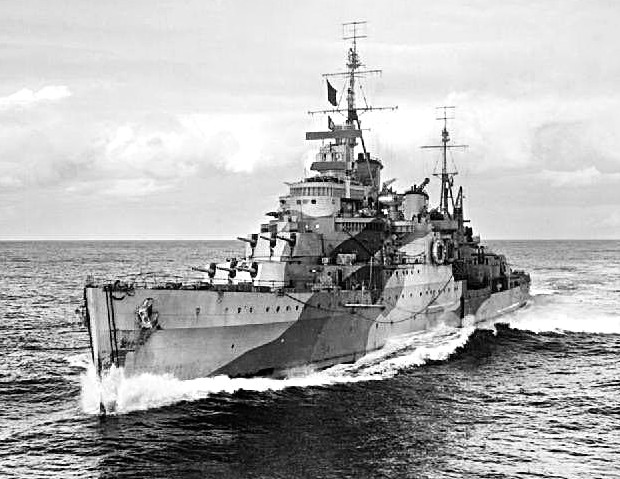
(RN Photo)
HMS Newcastle (C76) at sea on February 28th 1942 as part of the 4th Cruiser Squadron which she had joined on February 25th. The 4th cruiser squadron was deployed for trade defence in Indian OceanNewcastle had been part of the escort for troop convoy WS-16 which left Liverpool on February 16th and arrived at Freetown on March 1st. The prefix WS stood for Winston’s Special. These troop convoys were bound for Egypt around the cape, into the Indian Ocean, the Red Sea and then into the Suez Canal.
HMS Sheffield (C24)
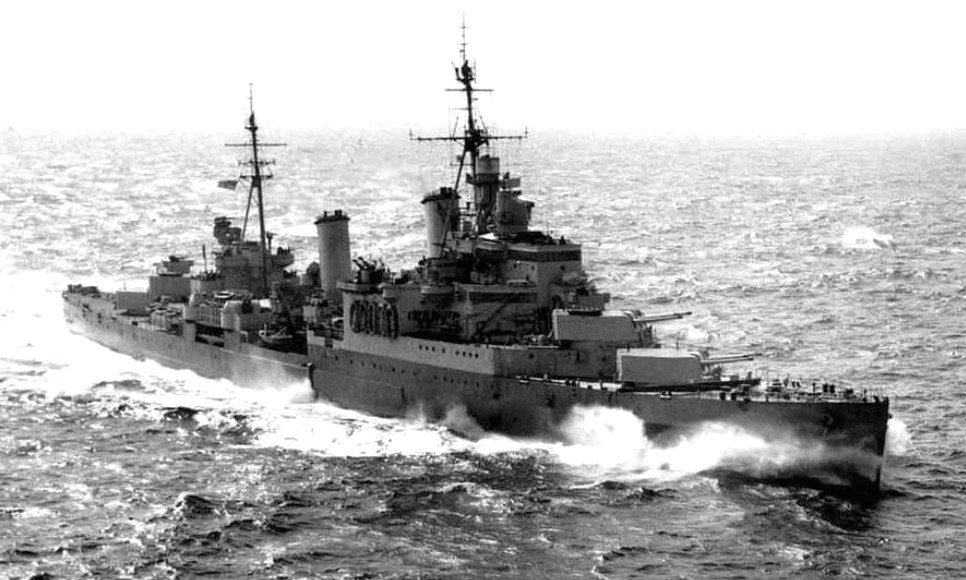
(IWM Photo, FL 1938)
HMS Sheffield (C24), 1944. The ship was laid down in January 1935,launched in July 1936, and commissioned in August 1937. She was active in allmajor naval European theatres of the Second World War, in the Atlantic Ocean,the Mediterranean Sea and the Arctic Ocean. Her career started with service in the Home Fleet, which took her on patrols against German blockade runners and on actions during the Norwegian Campaign. In August 1940, Sheffield was transferred to Force H stationed in Gibraltar. During her service with Force H, most of the operations involved either ferrying aircraft or escorting convoys to Malta. Sheffield also operated against German surface raiders in the Atlantic, and took part in the chase for the German battleship Bismarck. On 26 May 1941, she directed torpedo bombers from the aircraft carrier Ark Royal to Bismarck, but took no part in the sinking of Bismarck one day later.
In January 1942, Sheffield was assigned to the escort of Arctic convoys to Northern Russia; in March, she was damaged by a mine and needed four months’ repair. In September, Sheffield went back to the Arctic, but in October Arctic convoys were suspended in preparation for Operation Torch. The cruiser participated in Operation Torch as part of the Eastern Task Force, which covered the landings at Algiers. Arctic convoys resumed in December 1942, and Sheffield went back to the Arctic. In that same month, she was part of a cruiser force that repelled a German attack on Convoy JW 51B in the Battle of the Barents Sea. During the battle, Sheffield damaged the German heavy cruiser Admiral Hipper and sank the destroyer Friedrich Eckoldt.
In March 1943, Arctic convoys were suspended once more, this time due to the threat of the German surface fleet stationed in Norway. Sheffield moved again to the Mediterranean and took part in Operation Avalanche. Arctic convoys were resumed in November when the threat of the German surface fleet was reduced after the disabling of the German battleship Tirpitz in September. In December 1943, during the Battle of the North Cape, Sheffield assisted in the sinking of the German battleship Scharnhorst while escorting Convoy JW 55B. Sheffield went in for an extended refit in 1944 and saw no more service during the war. She was placed in reserve for a first time in 1959, and after a short reactivation she was decommissioned in 1964 and finally scrapped in 1967. (Wikipedia)
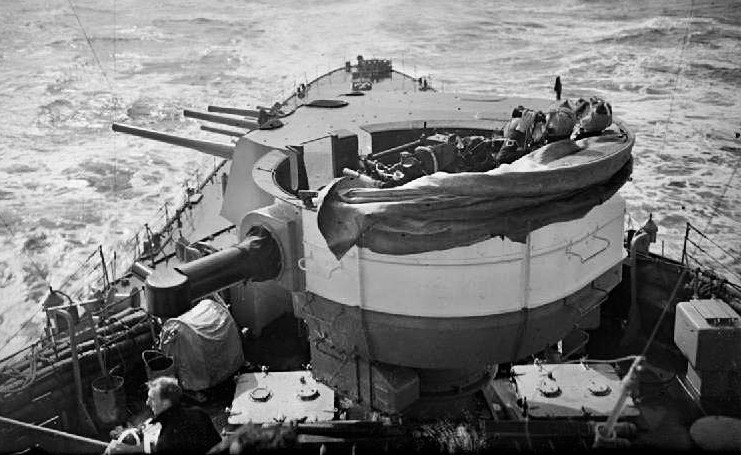
(RN Photo)
Aft gunnery director tower on HMS Sheffield, during the war.