
Royal Navy Cruisers: Leander class
HMNZS Achilles (32), HMNZS Leander (75), HMS Orion (85), HMS Neptune (20), HMS Ajax (22), HMS Amphion/HMAS Perth (D29), HMS Apollo/HMAS Hobart (63), HMS Phaeton/HMAS Sydney (48)
The Leander class was a class of eight light cruisers built for the Royal Navy in the early 1930s that saw service in the Second World War. They were named after mythological figures, and all ships were commissioned between 1933 and 1936. The three ships of the second group were sold to the Royal Australian Navy (RAN) before the Second World War and renamed after Australian cities. (Wikipedia)
Leander group
HMNZS Achilles (32),
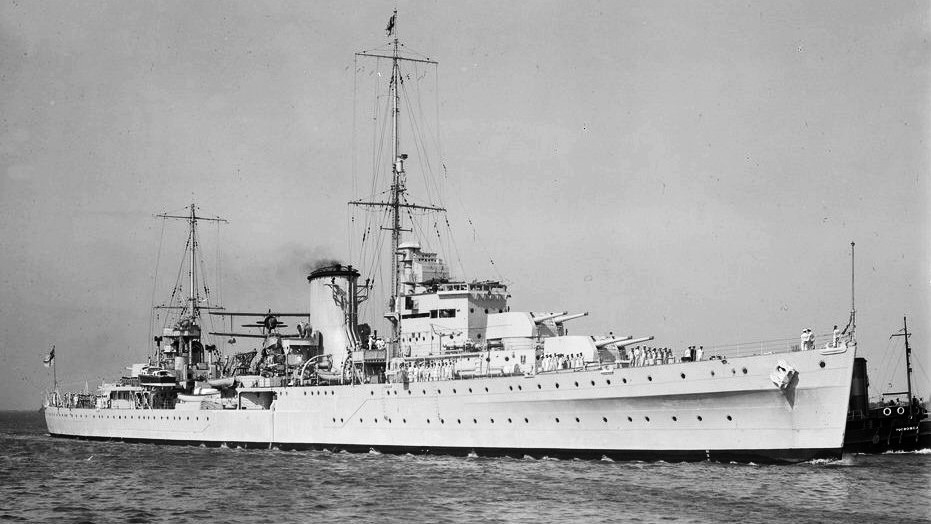
(State Library of Victoria Photo)
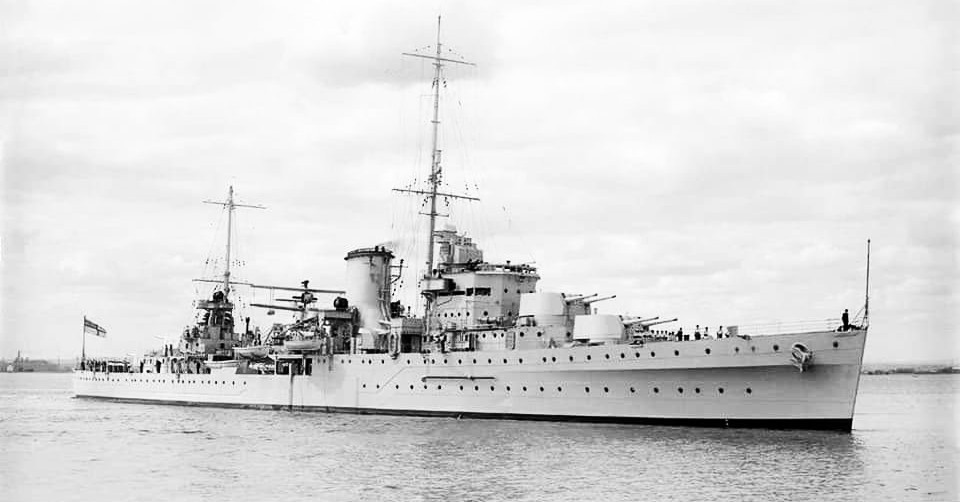
HMNZS Achilles served in the Royal New Zealand Navy in the Second World War. She was launched in 1931 for the Royal Navy, loaned to New Zealand in 1936 and transferred to the new Royal New Zealand Navy in 1941. She became famous for her part in the Battle of the River Plate, alongside HMS Ajax and HMS Exeter and notable for being the first Royal Navy cruiser to have fire control radar, with the installation of the New Zealand-made SS1 fire-control radar in June 1940. After her Second World War service in the Atlantic and Pacific, she was returned to the Royal Navy. She was sold to the Indian Navy in 1948 and recommissioned as INS Delhi. She was scrapped in 1978.
(RN Photo)
HMS Achilles.
HMNZS Leander (75)
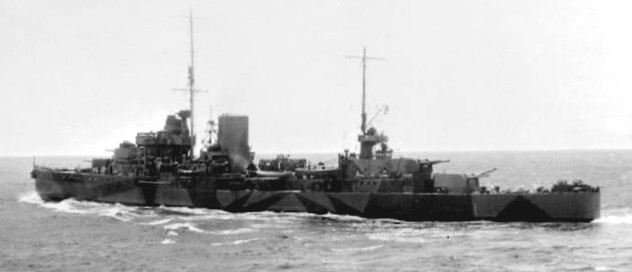
(IWM Photo, A 31349)
HMNZS Leander (75), initially served as HMS Leander in the Royal Navy before her transfer to New Zealand in 1937. During the Second World War, HMS Leander served initially in the Pacific and Indian Oceans. Commander Stephen Roskill, in later years the Royal Navy’s Official Historian, was posted as the ship’s executive officer in 1941. In the action on 27 February 1941, she sank the Italian armed merchantman Ramb I near the Maldives, rescuing 113 of her crew and taking slight damage. On 23 March 1941, Leander intercepted and captured the Vichy French merchant Charles L.D. in the Indian Ocean between Mauritius and Madagascar. On 14 April, Leander deployed for support of military operations in Persian Gulf and, on 18 April, joined the aircraft carrier Hermes and the light cruiser Emerald. On 22 April, Leander was released from support duties in the Persian Gulf and took part in search for the German raider Pinguin south of the Maldives.
In June 1941, Leander was transferred to the Mediterranean Fleet and was active against the Vichy French during the Syria-Lebanon Campaign. After serving in the Mediterranean, Leander returned to the Pacific Ocean in September 1941. In 1941 the New Zealand Division became the Royal New Zealand Navy (RNZN) and she was commissioned as HMNZS Leander in September 1941.On 13 July 1943, Leander was with Rear Admiral Walden Lee Ainsworth’s Task Group 36.1 of three light cruisers: Leander and the US ships Honolulu and St. Louis. The task group also included ten destroyers. At 01:00 the Allied ships established radar contact with the Japanese cruiser Jintsu, which was accompanied by five destroyers near Kolombangara in the Solomon Islands. In the ensuing Battle of Kolombangara, Jintsu was sunk and all three Allied cruisers were hit by torpedoes and disabled. Leander was hit by a single torpedo just abaft ‘A’ boiler room. 26 crew from the boiler room and the No.1 4-inch gun mount immediately above were killed or posted missing. The ship was so badly damaged that she took no further part in the war. She was first repaired in Auckland, then proceeded to a full refit in Boston.She returned to the Royal Navy on 27 August 1945. In 1946 she was involved in the Corfu Channel Incident. She was scrapped in 1950. (Wikipedia)
HMS Orion (85)
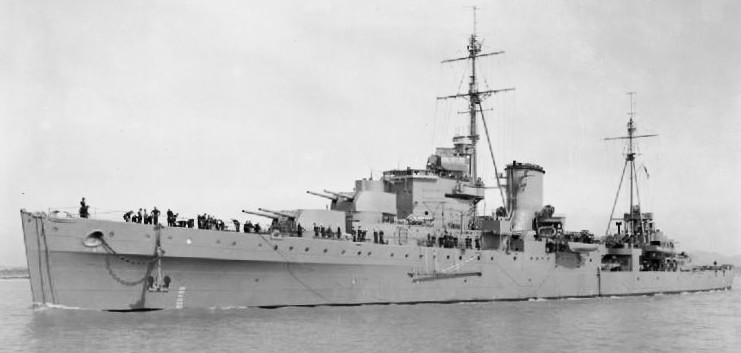
(IWM Photo), FL 4708)
HMS Orion (85). In June 1940 she was transferred to the Mediterranean, where she was with the 7th Cruiser Squadron as John Tovey’s flagship. She took part in the bombardment of Bardia, and the Battle of Calabria in July 1940. Late in that month, she sank the small Greek freighter Ermioni which was ferrying supplies to the Italian-held Dodecanese islands. During the rest of 1940 she escorted Malta convoys and transported troops to Greece. In the early part of 1941 she was in the Crete and Aegean areas and was also at the Battle of Cape Matapan in March 1941.
During an attack on a German convoy headed for Crete on 22 May, she was damaged in a duel with its escort, the Italian torpedo boat Lupo. On 29 May 1941, during the evacuation of Crete, she was bombed and badly damaged while transporting 1900 evacuated troops. Around 360 people died, of whom 100 were soldiers. Orion reported damage from friendly fire as the cruisers tried to hit Lupo. After extensive damage control had been undertaken she limped to Alexandria at 12 knots (22 km/h; 14 mph), providing a spectacular sight in the harbour with the mast wedged into the ship’s funnel and significant battle damage. On 29 June Orion sailed for passage to Simonstown, South Africa via Aden for temporary repairs and then sent to the Mare Island Naval Shipyard in Vallejo, California for major repairs.
Orion’s repairs were completed in March 1942 and she returned initially to Plymouth where new radar was installed. During mid 1942, she was widely employed, in home waters and on convoy escort duties to Africa and the Indian Ocean.Orion returned to the Mediterranean in October 1942. This time she was with the 15th Cruiser Squadron. She was involved in convoy escort duties and supported the army in the invasion of Sicily. She spent most of the rest of the war around the Mediterranean. James Gornall the former English first-class cricketer, promoted to Captain in 1941 was placed in command of her in 1943. She also took part in the Normandy Landings in June 1944, where she fired the first shell.
Orion was involved in the Corfu Channel Incident in 1946, a conflict between Britain and Albania involving the navigation of British ships in the channel between the Greek island of Corfu and the Albanian coast. Orion ended service in 1947, was sold for scrap to Arnott Young (Dalmuir, Scotland) on 19 July 1949 and was scrapped in August 1949. (Wikipedia)
HMS Neptune (20)
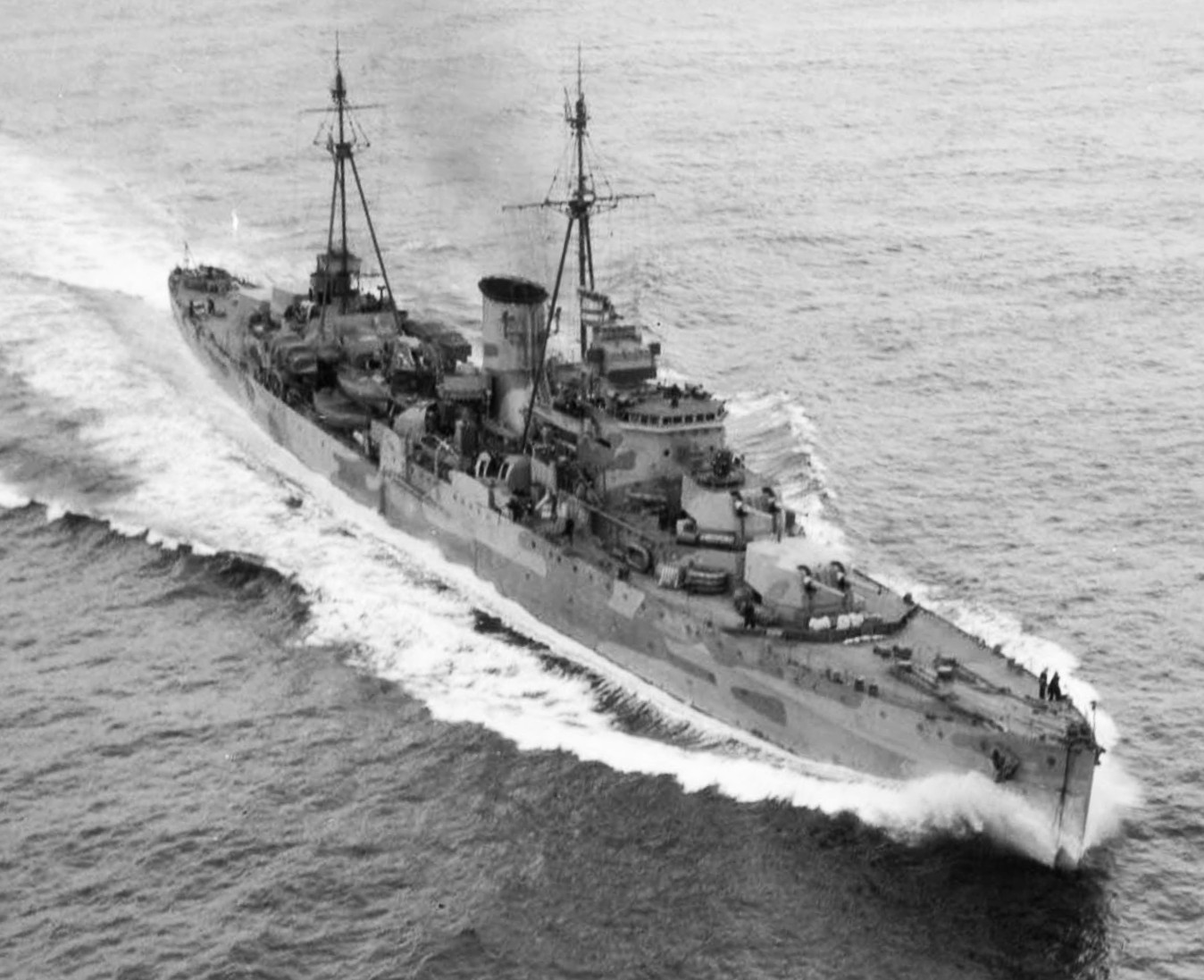
(IWM Photo, FL 2929)
HMS Neptune (20). During the Second World War, Neptune operated with a crew drawn predominantly from the New Zealand Division of the Royal Navy. The ship also carried a large contingent of seconded South African personnel.In December 1939, several months after war was declared, Neptune was patrolling in the South Atlantic in pursuit of German surface raider heavy cruiser Admiral Graf Spee. Neptune, with other patrolling Royal Navy heavy units, was sent to Uruguay in the aftermath of the Battle of the River Plate. However, she was still in transit when the Germans scuttled Graf Spee off Montevideo on 17 December.
HMS Neptune was the first British ship to spot the Italian Fleet in the battle of Calabria, on 9 July 1940, marking also the first time since the Napoleonic Wars that the Mediterranean Fleet received the signal “enemy battle fleet in sight”. During the subsequent engagement, she was hit by the Italian light cruiser Giuseppe Garibaldi. The 6-inch shell splinters struck the aircraft catapult and damaged her floatplane beyond repair, its wreckage being thrown into the sea. Minutes later, Neptune‘s main guns scored three hits on the heavy cruiser Bolzano, inflicting some damage on her torpedo room, below the waterline and the “B” turret.
During 1941, she led Force K, a raiding squadron of cruisers. Their task was to intercept and destroy German and Italian convoys en route to Libya. The convoys were supplying Rommel’s Afrika Korps in North Africa with troops and equipment.Force K was sent out on 18 December 1941, to intercept a convoy bound for Tripoli, right after the brief fleet engagement at sunset known as First Battle of Sirte.On the night of 19–20 December, Neptune, leading the line, struck two mines, part of an Italian minefield laid by an Italian cruiser force in June 1941. The first struck the anti-mine screen, causing no damage. The second struck the bow hull. The other cruisers present, Aurora and Penelope, also struck mines.While reversing out of the minefield, Neptune struck a third mine, which took off her propellers and left her dead in the water. Aurora was unable to render assistance as she was already down to 10 knots (19 km/h) and needed to turn back to Malta. Penelope was also unable to assist.The destroyers Kandahar and Lively were sent into the minefield to attempt a tow. The former struck a mine and began drifting. Neptune then signalled for Lively to keep clear. Kandahar was later evacuated and scuttled with a torpedo by the destroyer Jaguar, to prevent her capture.
Neptune hit a fourth mine and quickly capsized, killing 737 crew members. Initially some 30 others survived the sinking, but they also died of wounds and exposure in the subsequent days. As a result, only one was still alive when their carley float was picked up five days later by the Italian torpedo boat Generale Achille Papa. The sole survivor, Norman Walton, spent 15 months in an Italian prisoner of war camp. In 1991, Walton travelled to the small city of Nelson, New Zealand, to unveil a memorial to Neptune. Of the 764 that perished, 150 were New Zealand sailors, including four from Nelson. A memorial service to Neptune and her crew is held each year in Nelson. (Wikipedia)
HMS Ajax (22)
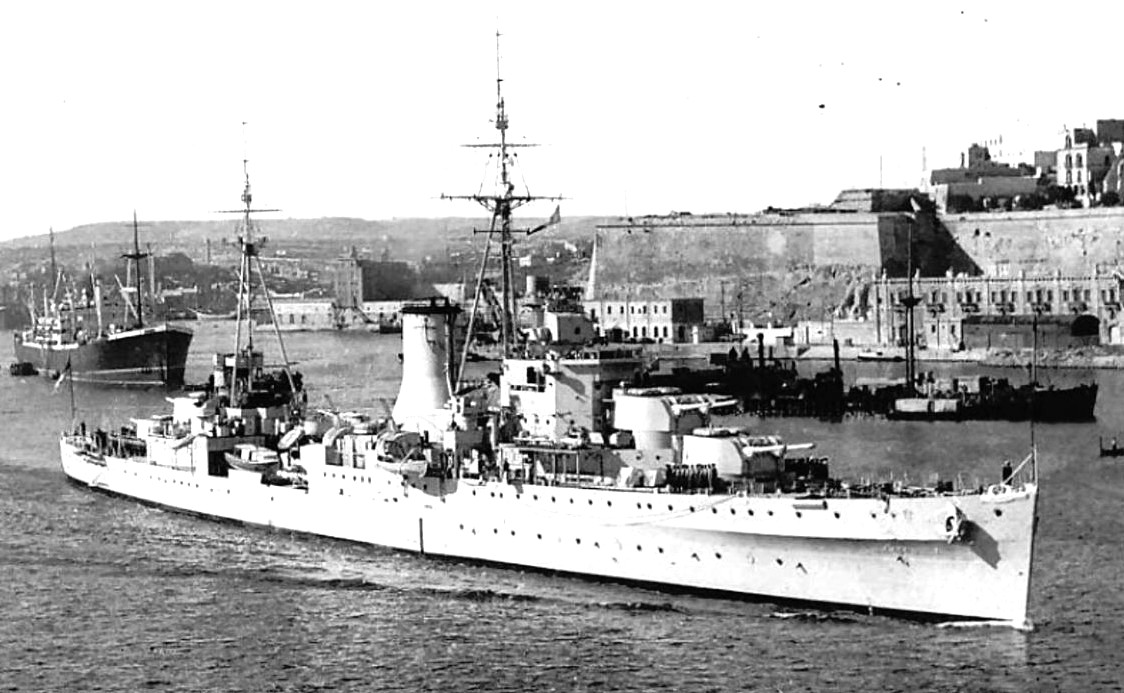
(RN Photo)
HMS Ajax (22), became famous for her part in the Battle of the River Plate, the Battle of Crete, the Battle of Malta and as a supply escort in the siege of Tobruk. Ajax was decommissioned in February 1948.
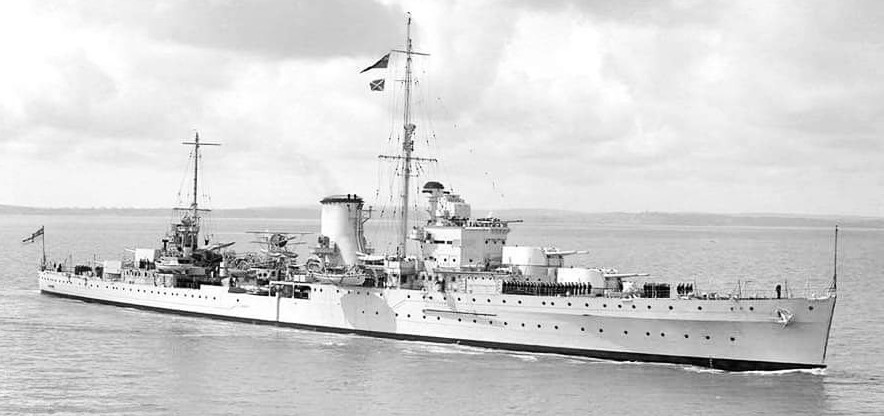
(RN Photo)
HMS Ajax (22).
Amphion group
HMS Amphion/HMAS Perth (D29)
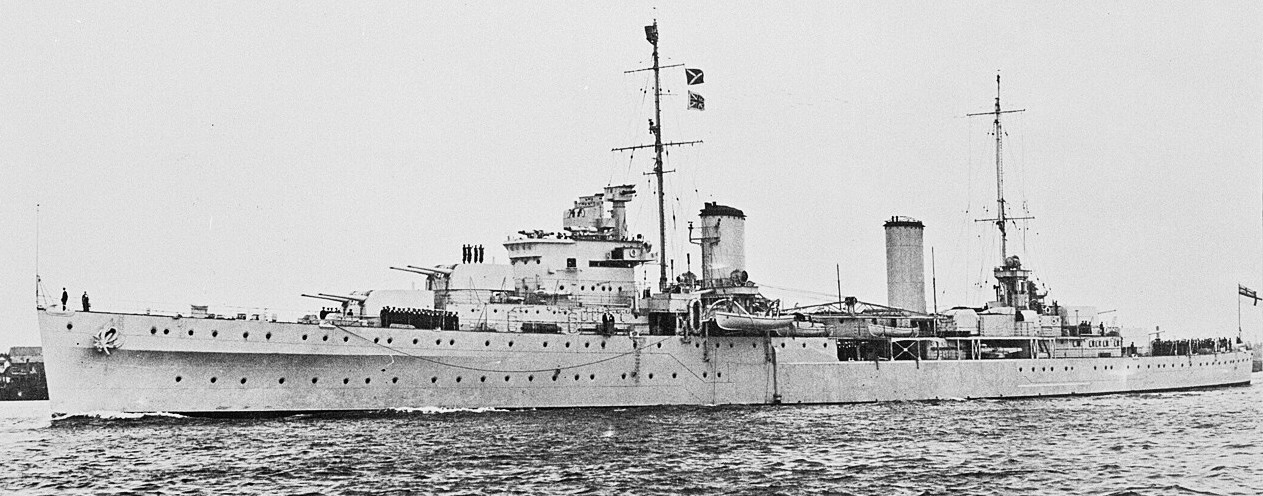
(Fotoafdrukken Koninklijke Marine Photo)
HMS Amphion/HMAS Perth (D29). She was built for the Royal Navy in the mid-1930s and was commissioned as HMS Amphion in 1936. The ship spent the next several years as flagship of the Commander-in-Chief, Africa before she was transferred to the RAN in 1939 and renamed as HMAS Perth. At the start of the Second World War in September, the ship patrolled the Western Atlantic and the Caribbean in search of German shipping and escorting convoys for six months before she was ordered home in early 1940. The ship continued the same types of duties in Australian waters before she was transferred to the Mediterranean Fleet at the end of 1940. Perth then helped to escort numerous convoys to Malta in early 1941 and played a minor role in the Battle of Cape Matapan in March. She escorted convoys to Greece and Crete and helped to evacuate Allied troops from both places in the face of the victorious Axis forces. The ship was badly damaged by Axis aircraft in May during the evacuation of Crete.
After repairs were completed in June, Perth provided naval gunfire support to Allied forces ashore during the Syria-Lebanon Campaign and bombarded Vichy French targets. She returned to Australia in mid-1941 and was tasked with the same sorts of missions as she had been performing at the beginning of the war. The ship continued to perform these tasks after the start of the Pacific War in December until she was transferred to the American-British-Dutch-Australian Command in February 1942 to help defend the Dutch East Indies against the Japanese. Perth was not damaged during the Battle of the Java Sea, but was torpedoed and sunk by the Imperial Japanese Navy at the Battle of Sunda Strait immediately afterwards. Over half her crew was killed in the battle and only about two-thirds of the survivors survived captivity to return home after the war. The ship’s wreck was discovered in 1967 and was essentially intact; by 2013 the wreck had been partially stripped by unauthorised Indonesian marine salvagers and was in even worse condition four years later. (Wikipedia)
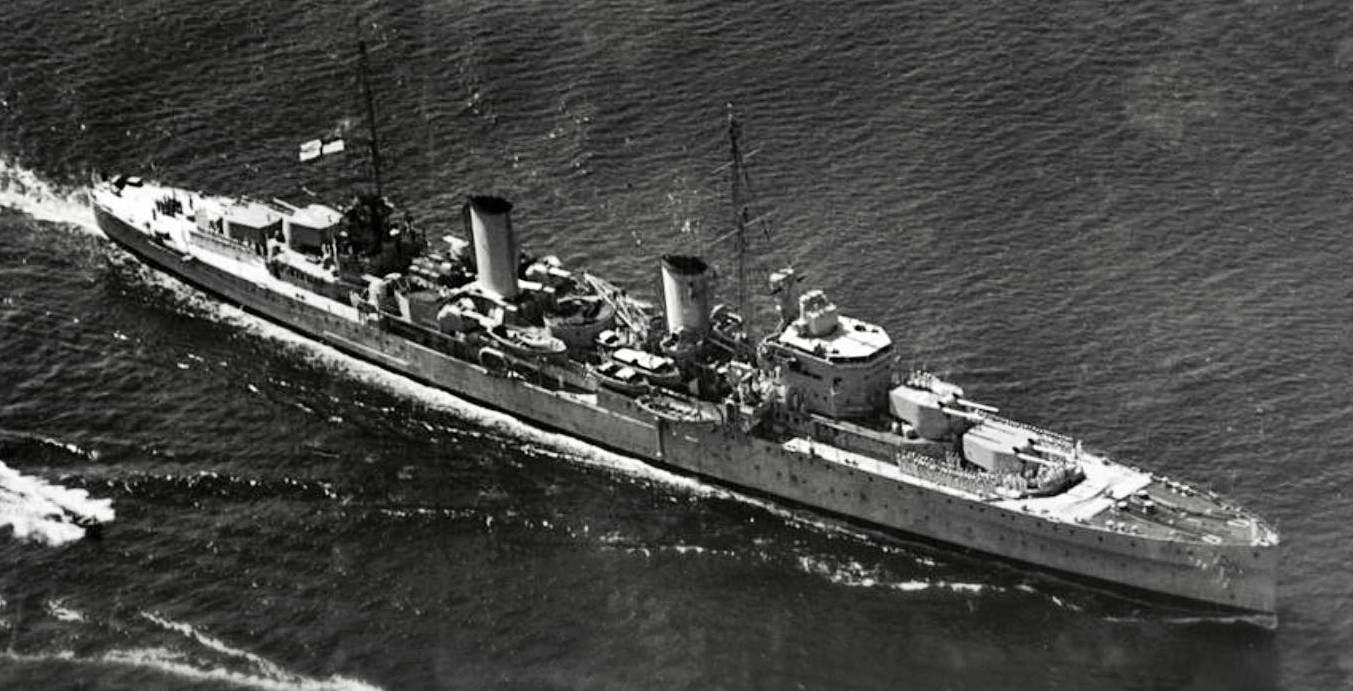
(RAN Photo)
Aerial view of HMAS Perth (D29) arriving in Port Jackson, Sydney, Australia, in March 1940.
HMS Apollo/HMAS Hobart (63)
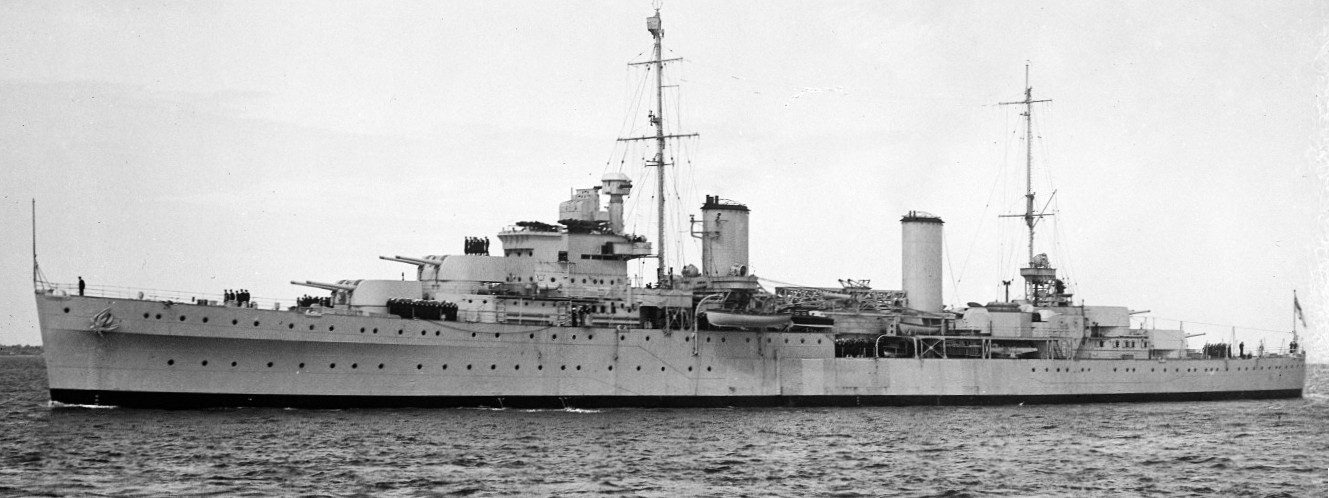
(State Library of Victoria Photo)
HMS Apollo/HMAS Hobart (63). Originally constructed for the Royal Navy as HMS Apollo, the ship entered service in 1936, and was sold to Australia two years later. During the war, Hobart was involved in the evacuation of British Somaliland in 1940, fought at the Battle of the Coral Sea and supported the amphibious landings at Guadalcanal and Tulagi in 1942. She was torpedoed by a Japanese submarine in 1943, then returned to service in 1945 and supported the landings at Tarakan, Wewak, Brunei, and Balikpapan. Hobart was placed in reserve in 1947, but plans to modernise her and return her to service as an aircraft carrier escort, training ship, or guided missile ship were not followed through. The cruiser was sold for scrapping in 1962. (Wikipedia)
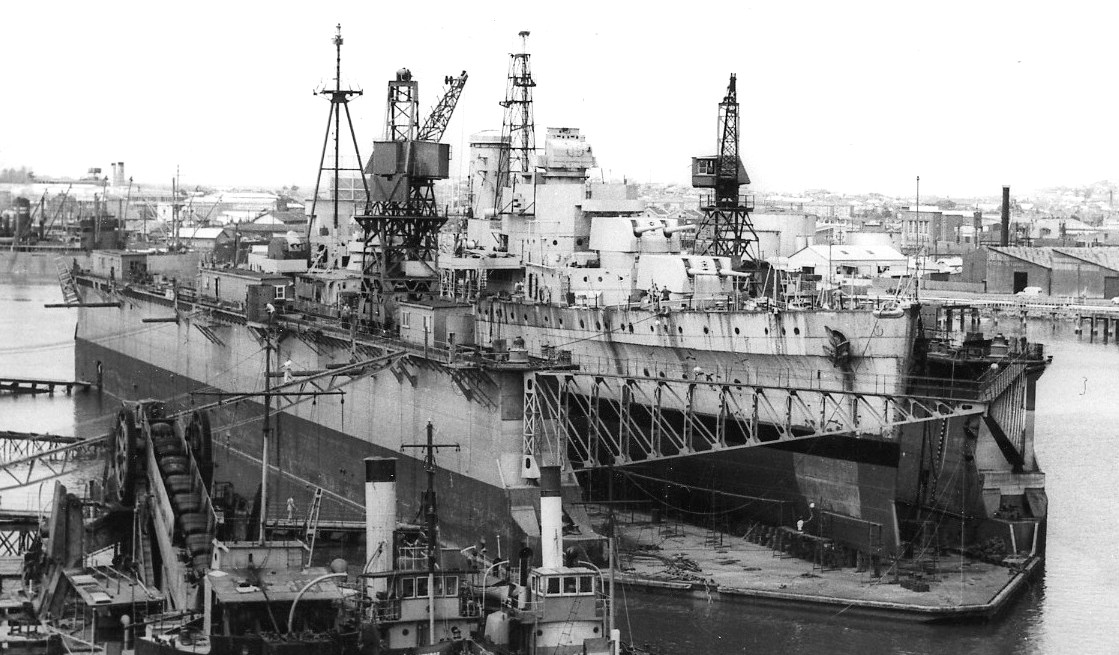
HMAS Hobart (63) in a floating dock at Newcastle, NSW, Australia, 22 Feb 1955.
HMS Phaeton/HMAS Sydney (48)
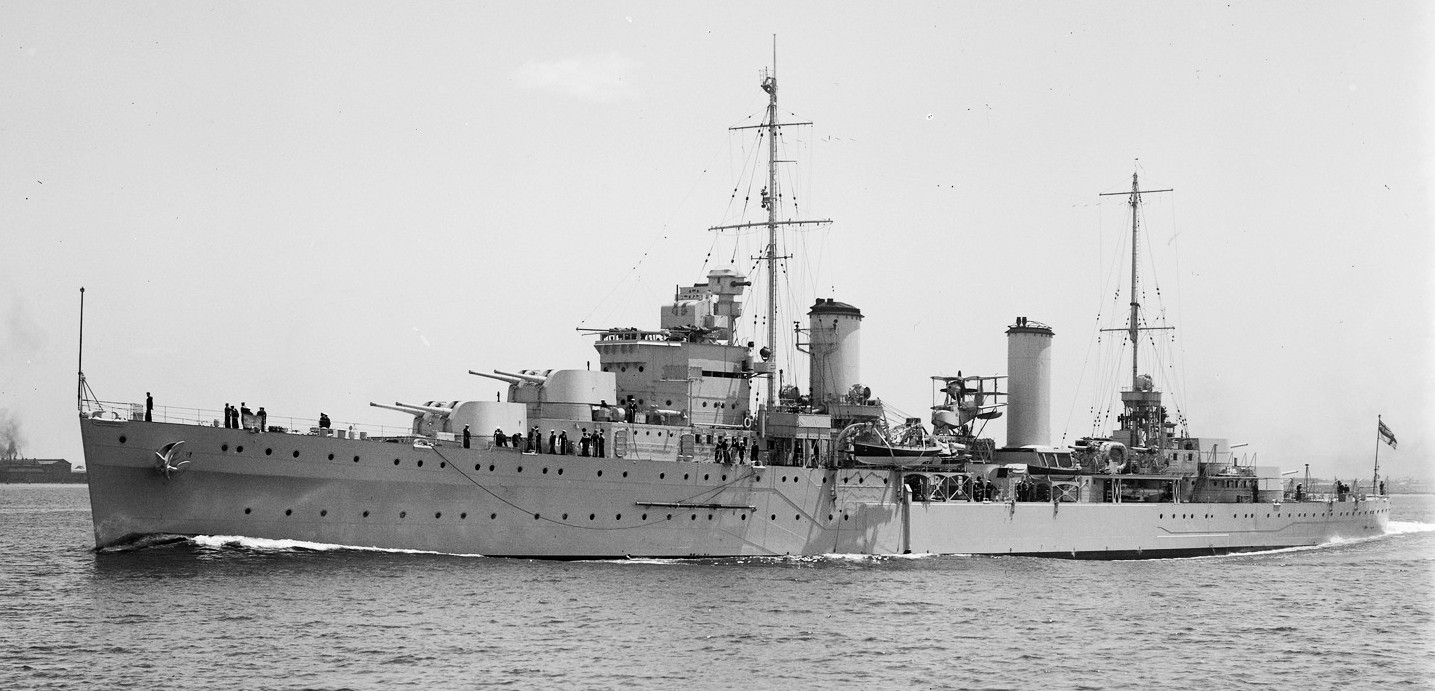
(Green Collection Shipping Photograph)
HMS Phaeton/HMAS Sydney (48). HMAS Sydney, named for the Australian city of Sydney, was one of three modified Leander-class light cruisers operated by the Royal Australian Navy (RAN). Ordered for the Royal Navy as HMS Phaeton, the cruiser was purchased by the Australian government and renamed prior to her 1934 launch.During the early part of her operational history, Sydney helped enforce sanctions during the Abyssinian Crisis, and at the start of the Second World War, was assigned to convoy escort and patrol duties in Australian waters. In May 1940, Sydney joined the British Mediterranean Fleet for an eight-month deployment, during which she sank two Italian warships, participated in multiple shore bombardments, and provided support to the Malta Convoys, while receiving minimal damage and no casualties. On her return to Australia in February 1941, Sydney resumed convoy escort and patrol duties in home waters.
On 19 November 1941, Sydney was involved in a mutually destructive engagement with the German auxiliary cruiser Kormoran, and was lost with all hands (645 aboard). The wrecks of both ships were lost until 2008; Sydney was found on 17 March, four days after her adversary. Sydney’s defeat is commonly attributed to the proximity of the two ships during the engagement, and Kormoran’s advantages of surprise and rapid, accurate fire. However, the cruiser’s loss with all hands compared to the survival of most of the Germans has resulted in conspiracy theories alleging that the German commander used illegal ruses to lure Sydney into range, that a Japanese submarine was involved, and that the true events of the battle are concealed behind a wide-ranging cover-up, despite the lack of evidence for these allegations. (Wikipedia)
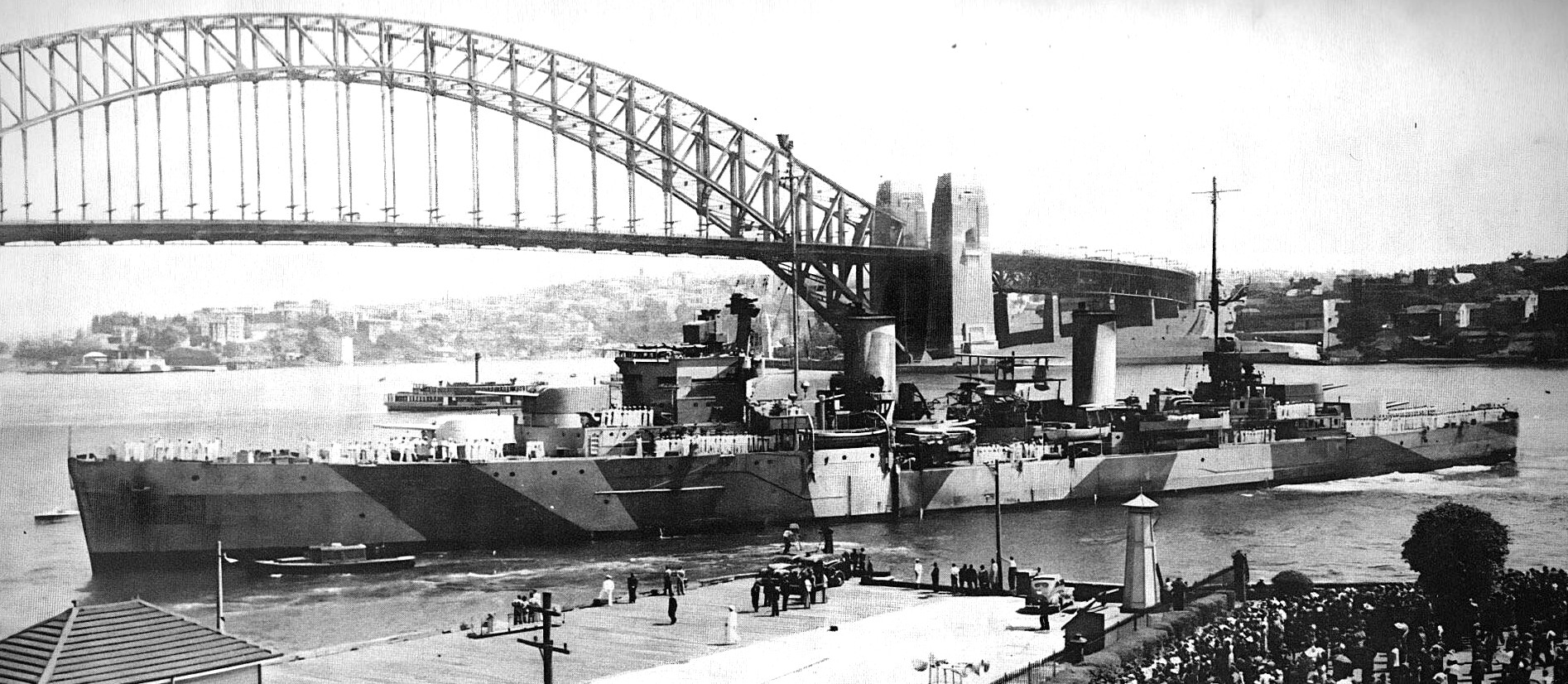
(RAN Photo)
The Leander class light cruiser HMAS Sydney manoeuvring to come alongside at Sydney Cove on 10 Feb 1941. Sydney under the command of Captain Joseph Burnett RAN would be lost 122 miles off Dirk Hartog Island along with her opponent the German auxiliary cruiser Kormoran commanded by Fregattenkapitän Theodor Detmers on November 19th 1941. Captain Burnett along with all of Sydney’s ships complement were lost.
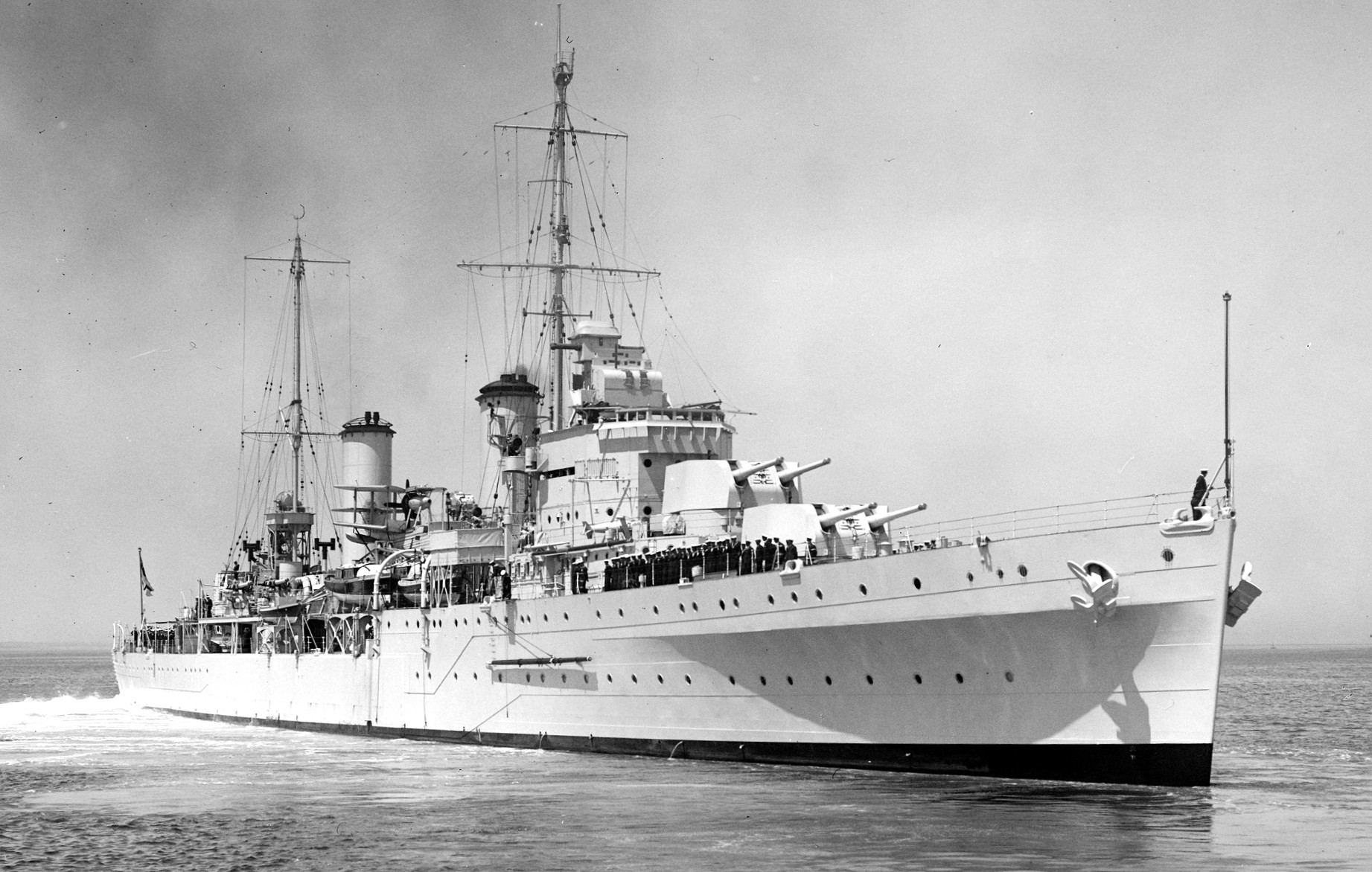
(RAN Photo)
19 Nov 1941 HMAS Sydney engaged the German Commerce Raider Kormoran in a single ship action off the coast of Western Australia. Both ships would be sunk but where as 317 of the crew of the German Raider survived Sydney was lost with all hands 645 officers and men and until 2008 her final resting place was unknown. Kormoran had set off from Germany in December 1940 and in the 11 months at sea had captured or sunk 11 merchant ships. She was looking for merchant ships off the coast of Western Australia when at 1600hrs on the 19th November she sighted what she believed to be a sailing ship on closing it was actually identified as HMAS Sydney one of 3 Modified Leander- or Perth-class light cruisers of the RAN.
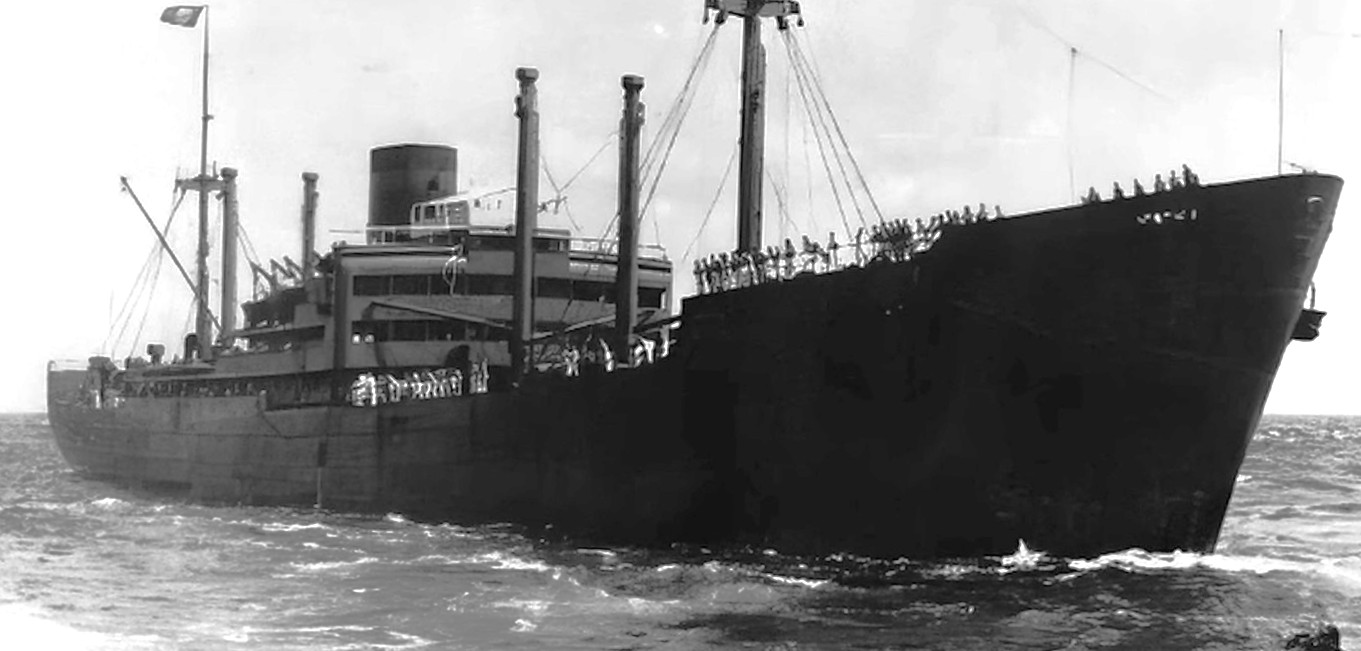
(Bundesarchiv, Bild 146-1985-074-27)
German Commerce Raider Kormoran, 1940. The German auxiliary cruiser Kormoran (HSK-8)[a] was a Kriegsmarine (German navy) merchant raider of World War II. Originally the merchant vessel Steiermark (lit. ’Styria’), the ship was acquired by the navy following the outbreak of war for conversion into a raider. Administered under the designation Schiff 41 (lit. ’Ship 41′), to the Allied navies she was known as Raider G. The largest merchant raider operated by Germany during World War II, Kormoran (lit. ’cormorant’) was responsible for the destruction of 10 merchant vessels and the capture of an 11th during her year-long career in the Atlantic and Indian oceans. She is also known for sinking the Australian light cruiser HMAS Sydney during a mutually destructive battle off Western Australia on 19 November 1941. (Wikipedia)
Capt Detmers immediately turned his ship away and made off at best speed 15 knots. At the time the Kormoran was disguised as the Dutch Merchant Ship Straat Malakka. HMAS Sydney gave chase at 25 knots and soon closed on the Kormoran. After several attempts by Sydney to get a suitable acknowledgement from Kormoran as to identity and destination and then a failure of Kormoran to be able to show the secret signal off the Straat Malakka, Capt Detmers realised his ships real identity was about to be discovered. He ordered the Dutch Ensign lowered and the Kriegsmarine ensign raised and for all guns and torpedoes to open fire. Sydney also fired at this time but as the majority of this salvo passed over the Kormoran its believed it was a warning one, where as the opening salvos from Kormoran where deadly effective and due to the extremely close range all her weapons could inflict damage on Sydney.
Sydney’s bridge, radio room and gun direction control tower were quickly hit and destroyed this was promptly followed by A & B turrets being disabled and the Walrus Aircraft being destroyed. Sydney’s X Turret however managed to hit back scoring damaging hits to Kormoran in the machinery spaces and starting a deck fire. At this time 1 torpedo from Kormoran hit Sydney below A turret this caused a massive hole in her side and her bow to slope down. Sydney veered out of control and looked intent on ramming Kormoran but passed astern receiving more damaging fire.
It was 1735 the engagement had been going 5 minutes. The ships were now steaming apart with Sydney now heading south and slowing, while Kormoran maintained her course and speed. Sydney’s main armament was completely disabled (the forward turrets were damaged or destroyed, while the aft turrets were jammed facing port, away from Kormoran), and her secondary weapons were out of range. Sydney was wreathed in smoke from fires burning in the engine room and forward superstructure, and around the aircraft catapult.
Kormoran discontinued salvo firing, but the individually firing aft guns scored hits as Sydney crossed the raider’s stern. Detmers now decided to sink Sydney and turned to re engage. Sydney fired torpedoes at this time but they all missed. Now the effects of X turrets gunnery had an effect as Kormorans engines suddenly stopped. Kormoran still fired a further 400 rounds into Sydney as she slowly steamed away until she passed out of range still heading south. Sydney was soon out of sight visually but the crew of Kormoran claimed they could still see the glow from her fires at midnight. HMAS Sydney sank during the night, the Kormoran was abandoned and scuttled due to her engines being beyond repair and the damage that had been caused to her unarmoured decks and superstructure.
When Sydney had not returned to base by the 23rd of November a search was begun to locate her. Over the course of the next few days the survivors from the Kormoran were located but no trace of Sydney could be found. The search was terminated at sunset on 29 November. All of the German lifeboats were accounted for and 318 of crew rescued. However none of 645 from Sydney were found, and the only definite remains from her were an inflatable lifebelt located by HMAS Wyrallah on 27 November and a damaged Carley float discovered by HMAS Heros on 28 November. A second Carley float, which washed up on Christmas Island in February 1942, is believed to be linked with the cruiser.
What happened to the crew of Sydney has long been debated. The crew of Kormoran were interrogated and the details put together from their statements is accepted as an accurate version of events that led to Sydney’s destruction as described above. However until the wreck could be found there would always be allegations of massacre and slaughter of defenceless men in the water and even suggestion of Japanese involvement 3 weeks before the attack on Pearl. In 1996 David Mearns a famous American ship wreck hunter become aware of the story and began looking into the details and slowly formulated an idea of a search area. in October 2007 funding and a go ahead was received. Mearns focused first on finding the Kormoran and this was achieved on the afternoon of 12th March 2008. The wreck showed she had been torn apart by the mine deck detonation, with two large pieces sitting 2,560 metres below sea level and 1,300 metres apart, with an oval-shaped debris field between them.
The raider’s discovery was announced by Australian Prime Minister Kevin Rudd on the morning of 17 March and a matter of hours later Mearns located HMAS Sydney at 1100 hrs 17th March 2008. Sydney’s wreck was located at 2,468 metres below sea level. The bow of the cruiser had broken off as the ship sank, and was located at the opposite end of a debris field stretching 500 metres north-west from the hull. The two wrecks were 11.4 nautical miles apart, with Sydney to the south-east.
On discovery, both wrecks were placed under the protection of the Historic Shipwrecks Act 1976. The wrecks were added to the Australian National Heritage List on 14 March 2011. The ROV footage of Sydney corroborated the testimony of the Kormoran survivors as to the course of that fateful engagement between the 2 ships. The main memorial for the loss of Sydney is located on Mount Scott at Geraldton.The memorial included four major elements – a steel of the same size and shape of the ship’s prow, a granite wall listing the ship’s company, a bronze statue of a woman looking out to sea and waiting in vain for the cruiser to come home, and a dome (dubbed the “dome of souls”) onto which 645 stainless steel seagulls were welded.
The memorial was dedicated on 18 November 2001, and used the next evening for a commemoration ceremony marking the battle’s 60th anniversary. By 2011, a pool of remembrance containing a map of the region and the marked position of Sydney’s wreck had been added. Other memorials commemorating the loss of Sydney include an oak tree planted at the Melbourne Shrine of Remembrance, and an avenue in Carnarvon lined with 645 trees. The service of Sydney, along with the other ships of the same name, is commemorated by a stained-glass window at the Garden Island Naval Chapel. The names of those killed aboard Sydney are inscribed at the Australian War Memorial, while those from Kormoran are inscribed in the Laboe Naval Memorial.
The “HMAS Sydney Replacement Fund” was established to help finance the acquisition of a replacement ship. The AU£ 426,000 raised was used to help purchase Australia’s first aircraft carrier in the late 1940s, the Majestic-class carrier was named HMAS Sydney upon her commissioning in December 1948. The Kormoran name was carried on by the German fast attack craft Kormoran, a Seeadler-class fast attack craft of the Bundesmarine (West German Navy) commissioned in 1959. East Germany also operated a Kormoran, a small corvette borrowed from the Soviet Navy from 1970 to 1974. (Jeff Hancock)
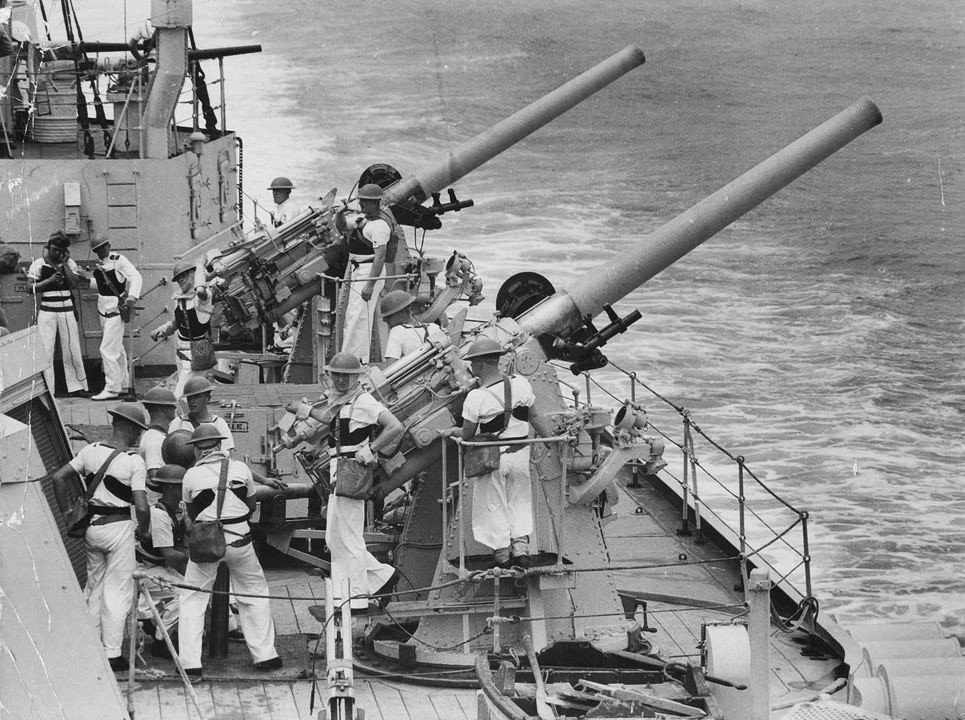
(RAN Photo)
HMAS Sydney. Her secondary armament consisted of four single 4″ dual purpose mounts.