Royal Navy Fiji class Cruisers: HMS Bermuda (52), HMS Fiji (58),HMS Gambia (48), HMS Jamaica (44), HMS Kenya (14), HMS Mauritius (80), HMS Nigeria (60), HMS Trinidad (46), HMS Ceylon (30), HMS Uganda (66), HMS Newfoundland (59)
Cruisers of the Royal Navy of the United Kingdom have existed since 1877 (when the category was created by amalgamating the two previous categories of frigate and corvette) until the last cruiser was decommissioned more than a century later. No cruisers are currently in service with the Royal Navy.
Armoured cruisers were protected by a belt of side armour and an armoured deck. In the Royal Navy this classification was not actually used, the term first class cruiser being used instead for both armoured cruisers and large protected cruisers. Thus, the first class cruisers built between the Orlando class (1886) and the Cressy class (1897) were, strictly speaking, protected cruisers as they lacked an armoured belt. The first class cruiser was succeeded by the battlecruiser in the Royal Navy.
Protected cruisers were so-called because their vital machinery spaces were protected by an armoured deck and the arrangement of coal bunkers. The ships below are all protected cruisers, but were rated as second and third class cruisers by the Royal Navy. The third class cruiser was not expected to operate with the fleet, was substantially smaller than the second class and lacked the watertight double-bottom of the latter. With the advent of turbine machinery, oil firing and better armour plate the protected cruiser became obsolete and was succeeded by the light cruiser.
The scout cruiser was a smaller, faster, more lightly armed and armoured cruiser than the protected cruiser, intended for fleet scouting duties and acting as a flotilla leader. Essentially there were two distinct groups – the eight vessels all ordered under the 1903 Programme, and the seven later vessels ordered under the 1907-1910 Programmes. The advent of better machinery and larger, faster destroyers and light cruisers effectively made them obsolete.
The light armoured cruiser – light cruiser – succeeded the protected cruiser; improvements in machinery and armour rendering the latter obsolete. The Town class of 1910 were rated as second-class protected cruisers, but were effectively light armoured cruisers with mixed coal and oil firing. The Arethusa class of 1913 were the first oil-only fired class. This meant that the arrangement of coal bunkers in the hull could no longer be relied upon as protection and the adoption of destroyer-type machinery resulted in a higher speed. This makes the Arethusas the first “true example” of the warship that came to be recognised as the light cruiser. In the London Naval Treaty of 1930, light cruisers were officially defined as cruisers having guns of 6.1 inches (155 mm) calibre or less, with a displacement not exceeding 10,000 tons.
The heavy cruiser was defined in the London Naval Treaty of 1930 as a cruiser with a main gun calibre more than 6 inches but not exceeding 8 inches. The earlier Hawkins class were therefore retrospectively classified as such, although they had been initially built as “improved light cruisers”. The County were built as light cruisers with most of them in service at the time of the Treaty of London, after which they were also redesignated as heavy cruisers. A further three Countys were cancelled. The York class was a reduced version of the County to build more ships within tonnage limits.
The “large light cruisers” were a pet project of Admiral Fisher to operate in shallow Baltic Sea waters and they are often classed as a form of battlecruiser.
Minelaying cruisers were the only purpose-built oceangoing minelayers of the Royal Navy. The Abdiel class could reach 38 knots and in practice were used as fast transports to supply isolated garrisons, such as those at Malta and Tobruk. (Wikipedia)
Crown Colony/Fiji class cruisers
The Fiji-class cruisers were a class of eleven light cruisers of the Royal Navy that saw extensive service throughout the Second World War. Each ship of the class was named after a Crown colony or other constituent territory of the British Commonwealth and Empire. The class was also known as the Colony class, or Crown Colony class. Developed as more compact versions of the preceding Town-class cruisers, the last three were built to a slightly modified design and were sometimes also called the Ceylon class. (Wikipedia)
Fiji class
HMS Bermuda (52)
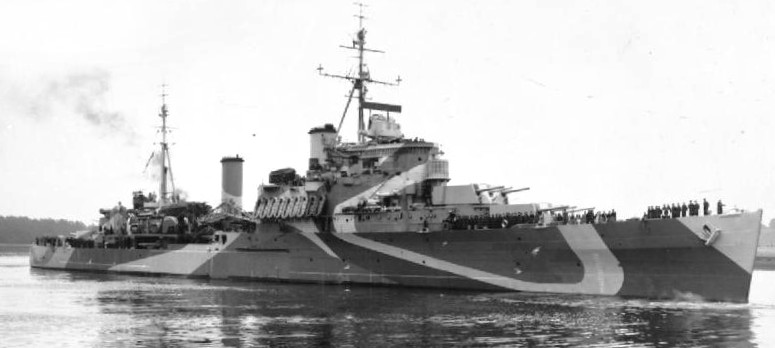
(IWM Photo, FL 1808)
HMS Bermuda (52). Bermuda was built by John Brown & Company of Clydebank and launched on 11 September 1941. In the same year, the lead ship of the class, Fiji, was sunk while participating in the evacuation of Crete. Through 1942, Bermuda participated in the North Africa campaign, including Operation Torch, as part of the 10th Cruiser Squadron. With the cruiser Sheffield, she was detached from Force H to attack a small coastal fort, where both came under attack from Italian torpedo bombers. She covered the landing at Bougie and managed to escape heavy air attacks unscathed. Bermuda then returned to service in the Atlantic to escort ships in the Bay of Biscay, and in June 1943, she transported men and supplies to Spitsbergen. She then participated in anti-submarine operations against German U-boats operating in the Bay of Biscay, and the North Atlantic.
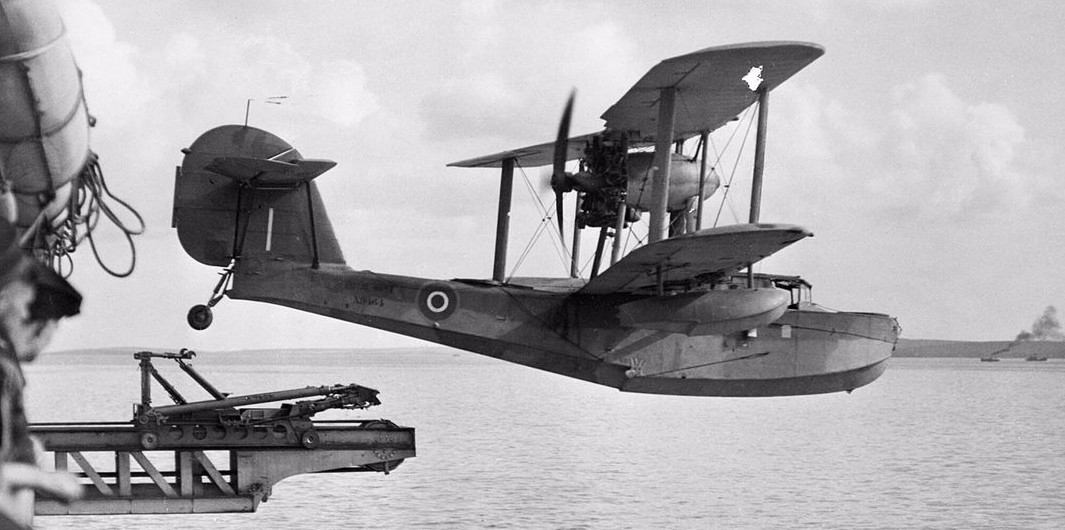
(IWM Photo, A 15215)
A Supermarine Walrus amphibian airplane being launched from the catapult deck of HMS Bermuda. The aircraft has just left the catapult. 1943.
After more service in the Arctic, she returned to Glasgow in June 1944 for a refit.The refit removed her ‘X’ turret and in May 1945 she was then dispatched to the Pacific as the war in Europe was ending. She arrived in Fremantle on 1 July to take on fuel and stores, before continuing on to Sydney, where she arrived on 7 July. There she undertook exercises with other Royal Navy ships serving in the Far East, including the battleship Anson. Whilst in Sydney, news reached them of the atomic bombings of Hiroshima and Nagasaki and the subsequent surrender of Japan. Bermuda then sailed for the Philippines, arriving on 23 August. She then became part of an operation to recover allied prisoners of war from the previously occupied Japanese territories.On 6 September Bermuda was attacked by Japanese aircraft, apparently unaware of the end of the war, or otherwise unwilling to surrender. Bermuda fought off the attack and was able to continue on her way. She then transported allied prisoners of war to Shanghai for repatriation.
HMS Bermuda remained in the Far East as the flagship of the 5th Cruiser Squadron, under the command of Clarence Howard-Johnston, until 1947, when she returned to the UK for a refit at Chatham Dockyard. She was then placed in reserve. In 1950 she was restored to active service, and served in the South Atlantic as the flagship of the Commander in Chief, South Atlantic Station until 1953. Bermuda was decommissioned in 1962, after 21 years in service. She was scrapped by Thos W Ward, Briton Ferry, Wales starting on 26 August 1965. (Wikipedia)
HMS Fiji (58)
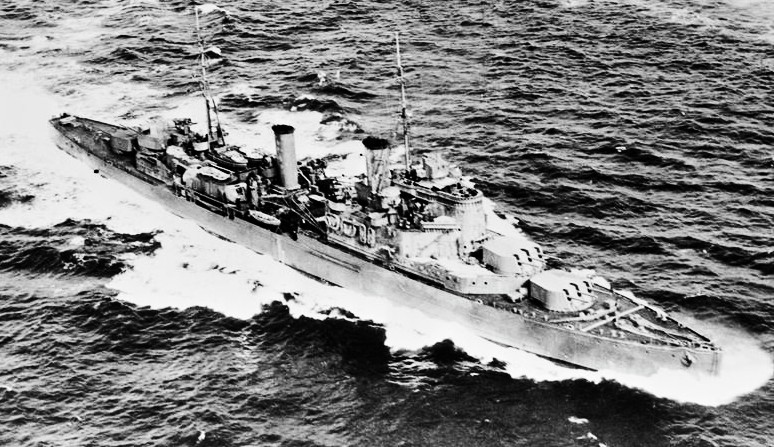
(IWM Photo, FL 13125)
HMS Fiji (58). She was the lead ship of her class of 11 light cruisers built for the Royal Navy shortly before the Second World War. Completed in mid-1940, she was initially assigned to the Home Fleet and was detached to escort a force tasked to force French West Africa to join the Free French. The ship was torpedoed en route and required six months to be repaired. Fiji was then assigned to Force H where she helped to escort convoys to Malta. The ship was transferred to the Mediterranean Fleet in early May 1941. After the Germans invaded Crete a few weeks later, she was sunk by German aircraft on 22 May after having fired off all of her anti-aircraft ammunition. (Wikipedia)
HMS Gambia (48)
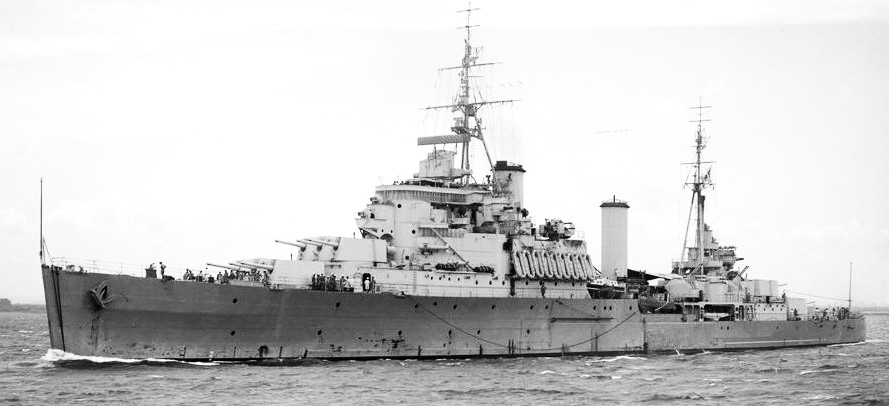
(State Library of Victoria Photo)
HMS Gambia (48). She was in the service of the Royal New Zealand Navy (RNZN) as HMNZS Gambia from 1943 to 1946. The cruiser saw active service in the East Indies with the British Eastern Fleet, and was involved in the Battle of Madagascar in September 1942. She then carried out trade protection duties in the Indian Ocean, but returned to home waters, calling at the territory of the Gambia on the way, where West African Chiefs in full regalia led thousands of their subjects to visit the ship named after their colony. She refitted at Liverpool between June and September.Because New Zealand’s two other cruisers of the time, HMNZS Leander and HMNZS Achilles were damaged, it was decided in discussions with the Royal Navy Admiralty that Gambia would be recommissioned as HMNZS Gambia, for the use of the Royal New Zealand Navy.
HMNZS Gambia subsequently served with the British Pacific Fleet and participated in attacks on Japanese positions throughout the Pacific. In February 1944 she searched for blockade runners in the Cocos Islands area. She also supported a series of carrier raids against oil installations and airfields. She saw action off Okinawa, Formosa and Japan and took part in the bombardment of the Japanese city of Kamaishi on 9 August. She was attacked by a Japanese kamikaze aircraft[2] as a ceasefire was announced, and fired some of the last shots of the Second World War. She was present on 2 September 1945 in Tokyo Bay for the signing of the Japanese Instrument of Surrender.Gambia was returned to the Royal Navy at Portsmouth on 27 March 1946. She underwent a refit and was recommissioned on 1 July 1946 for the 5th Cruiser Squadron with the Far East Fleet. She returned to the UK on 6 January 1948, and in January 1950 she was assigned to the 2nd Cruiser Squadron in the Mediterranean, later serving with the 1st Cruiser Squadron on the same station until October 1954. She left Portsmouth under tow on 2 December 1968 and arrived at Inverkeithing for breaking up on 5 December. (Wikipedia)
HMS Jamaica (44)
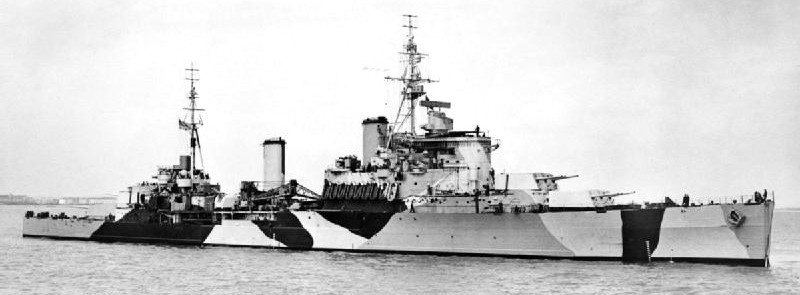
(IWM Photo, FL 10556)
HMS Jamaica (44). This light cruiser spent almost her entire wartime career on Arctic convoy duties, except for a deployment south for the landings in North Africa in November 1942. She participated in the Battle of the Barents Sea in 1942 and the Battle of North Cape in 1943. Jamaica escorted several aircraft carriers in 1944 as they flew off airstrikes that attacked the German battleship Tirpitz in northern Norway. Late in the year she had an extensive refit to prepare her for service with the British Pacific Fleet, but the war ended before she reached the Pacific.
Jamaica spent the late 1940s in the Far East and on the North America and West Indies Station. When the Korean War began in 1950 she was ordered, in cooperation with the United States Navy, to bombard North Korean troops as they advanced down the eastern coast. The ship also provided fire support during the Inchon Landing later that year. Jamaica was refitted late in the year and returned to Great Britain in early 1951 where she was placed in reserve.She was recommissioned in 1954 for service with the Mediterranean Fleet. In 1955 Jamaica was used to play the cruiser HMS Exeter in the film Battle of the River Plate, in company with her wartime partner HMS Sheffield as HMS Ajax. In 1956 the ship participated in Operation Musketeer, the Anglo-French invasion of Egypt to seize control of the Suez Canal. Jamaica was paid off in 1958 and sold for scrap in 1960. (Wikipedia)
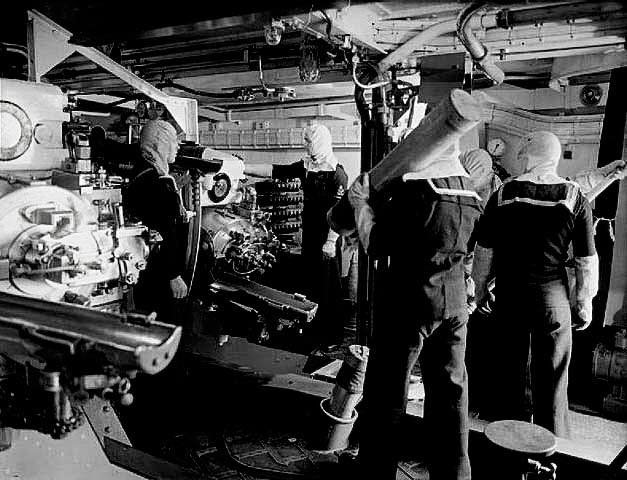
(IWM Photo)
Inside the 6 inch gun turret on HMS Jamaica (44).
HMS Kenya (14)
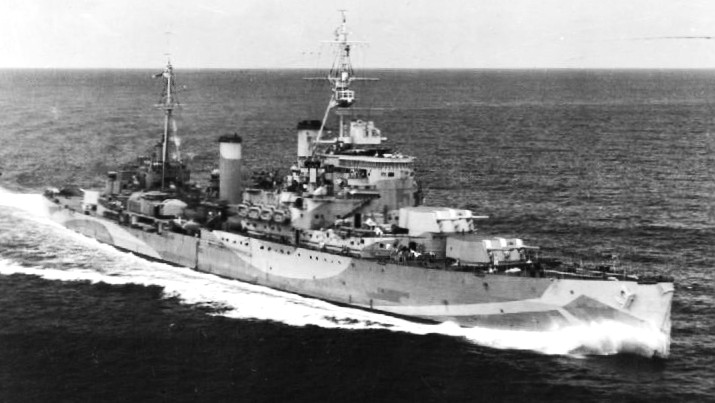
(IWM Photo, FL 9253)
HMS Kenya (14). Kenya was launched on 18 August 1939 from the yards of Alexander Stephen and Sons, Glasgow, Scotland and after working up was commissioned on 27 September 1940. She took part in the hunt for the German battleship Bismarck in May 1941 whilst part of the 2nd Cruiser Squadron, Home Fleet, based at Scapa Flow. On 3 June Kenya and the cruiser Aurora surprised and sank the German tanker Belchen which was supplying German submarine U-93 in the Davis Straits.During September and October 1941, the Royal Navy devised Operation Stonewall, to intercept U-boats which were escorting outbound blockade runners through the Bay of Biscay into the Atlantic. After providing escort to the Malta convoy Operation Halberd on 24 September on 1 October, Kenya and the cruiser Sheffield made to intercept the blockade runner Rio Grande, destined for Japan and escorted by U-204. Rio Grande escaped but another blockade runner, Kota Pinang, was sunk on 3 October west of Cape Finisterre.
On 19 March 1942, Kenya transported 10 tons of gold from the Soviet Union to the United States as payment for loans and war materials.Kenya also avoided damage in air attacks by the Germans on 27–28 March. She had by now received the nickname “The Pink Lady”, due to her Mountbatten Pink camouflage paint, during the commando raid against installations on Vågsøy Island off the Norwegian coast. This was attributed to her Mountbatten Pink camouflage blending in with the pink marker dye the Germans were using in their shells, preventing German spotters from distinguishing between shell splashes and the ship. The force returned to Scapa Flow in early January 1942.
HMS Kenya returned to escorting Arctic convoys between March and May 1942. On 22 March after escorting PQ12 to Murmansk Kenya was loaded with 10 tonnes of Russian bullion and took it back to Britain for safe keeping. Kenya played a prominent role in Operation Pedestal during August 1942. Pedestal was a Royal Navy operation to escort a convoy of 14 merchant ships through the western Mediterranean to relieve and resupply the besieged island of Malta. The convoy escort was the largest ever assembled in World War II, comprising 2 battleships, 3 aircraft carriers (Eagle, Victorious and Indomitable), 7 light cruisers (including Kenya) and 26 destroyers. Through 11 and 12 August, it successfully fought off massed air attacks by the German Luftwaffe and the Italian Regia Aeronautica, with the loss of only 1 merchant ship and 1 destroyer. The aircraft carrier HMS Eagle was also lost to a lone submarine attack on 11 August.The heavily mined waters between Sicily and Tunisia (the Narrows) made it too dangerous for the battleships and surviving aircraft carriers to escort the convoy all the way to Malta, and for the last 300 kilometres (190 mi), the escort comprised a smaller force (Force X) of cruisers and destroyers, including Kenya. During the night of 12 August and during the following day, the convoy was heavily attacked by Axis air forces, submarines and motor torpedo boats. During these actions, Kenya’s bow was blown off by a torpedo fired by the Italian submarine Alagi. This necessitated emergency shoring of the forward bulkhead and a reduced maximum speed of 25 knots (46 km/h; 29 mph).In all, a further two cruisers and eight merchant ships were lost in the night action of 12/13 August; Only Rochester Castle, Port Chalmers, Melbourne Star, Brisbane Star and the oil tanker Ohio made it to Grand Harbour Valletta, and Kenya was left as the most powerful surviving ship in Force X. After leading the surviving ships of the convoy to the safety of Malta’s fighter screen. Kenya then led Force X safely back to Gibraltar, despite further air attacks.
HMS Kenya joined the America and West Indies Station with the 8th Cruiser Squadron, based at the Royal Naval Dockyard in the Imperial fortress colony of Bermuda, in October 1946, but in December of the following year, she returned to the UK and was placed in the reserve. The cruiser had a comprehensive modernisation in 1945–1946 [2] with new standardised, twin 40 mm light anti aircraft guns and updated surface and long-range early-warning radar and fire control for the anti-aircraft armament. She was reactivated to replace the cruiser London on the Far East station, in 1949 after another extensive refit.Kenya took part in naval operations in the Korean War. In March she bombarded Choda Island in preparation for landing 200 Republic of Korea troops there. She paid off into reserve in August 1958, the ship was declared for disposal in February 1959 and was scrapped in 1962. (Wikipedia)
HMS Mauritius (80)
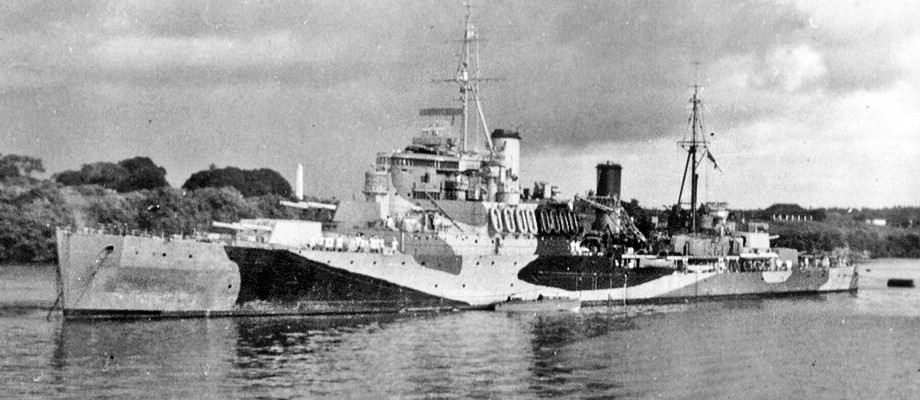
(Instituut voor Maritieme Historie Photo)
HMS Mauritius (80). She joined the Eastern Fleet in 1942, but was withdrawn in April 1943 to reinforce the Mediterranean Fleet. After repairs following grounding, she was operational in June 1943 and thereafter participated in the landings in Sicily, (Operation Husky), in July as a unit of Support Force East, when she carried out shore bombardment duties.In September she was part of the covering force for the Salerno landings, but by the end of the year had been transferred to the Bay of Biscay to carry out anti-blockade-runner patrols, as part of Operation Stonewall. However, she soon returned to the Mediterranean, this time for Operation Shingle, the Anzio landings, in January 1944.
In June 1944 she covered the landings in Normandy as part of Force D off Sword Beach, then carried out offensive patrols of the Brittany coast in August to mop up the remnants of the German shipping in the area. Operating with destroyers, she sank Sperrbrecher 157 on 14/15 August and during the Battle of Audierne Bay sank five Vorpostenboote on 22/23 August. After this she returned to the Home Fleet, covering the carrier raids along the Norwegian coast and making anti-shipping strikes. On the night of 27/28 January 1945, in company with the cruiser Diadem, she fought the action of 28 January 1945 with German destroyers in which Z31 was badly damaged. Following this action she was refitted at Cammell Laird’s between February 1945 and March 1946.She then served in the Mediterranean, including passing through the Corfu Channel during the Corfu Channel Incident in 1946, with the 15th (later lst) Cruiser Squadron, returning to the UK in 1948.
After a spell in reserve and in refit, she recommissioned in 1949 for the 1st Cruiser Squadron in the Mediterranean, sailing on 6 May 1949. The years 1949 to 1951 were spent on the East Indies Station with the 4th Cruiser Squadron until she returned to Chatham on 18 December 1951. Mauritius was placed in reserve in 1952 and remained there until 1965, when she was sold for scrapping to Thos. W. Ward. She arrived at their yard at Inverkeithing, on 27 March 1965. (Wikipedia)
HMS Nigeria (60)
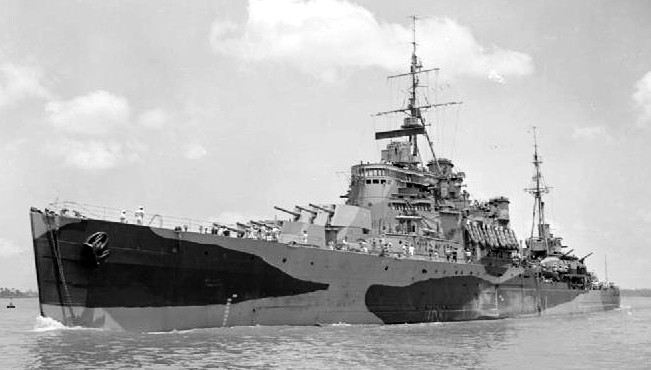
(IWM Photo, FL 16793)
HMS Nigeria (60). Nigeria served in Home waters and off the Scandinavian coast for the early part of the war. On 28 June 1941 Nigeria, in company with the destroyers Bedouin, Tartar and Jupiter intercepted the German weather ship Lauenburg in thick fog north-east of Jan Mayen Island. The German ship was detected through the use of HF/DF. The crew of Lauenburg abandoned ship after they were fired upon, allowing the British to board her. Valuable codebooks and parts of the Enigma machine were found aboard and recovered. This was one of the earliest captures of Enigma material of the war, and came a few weeks after the destroyer Bulldog had captured the first complete Enigma machine from the German submarine U-110 on 9 May 1941.In July 1941, Nigeria became the flagship of Force K, commanded by Rear Admiral Philip Vian. During this period, Force K made two expeditions to Spitsbergen (Norwegian territory), the first to ascertain the situation and the second, in September, to escort a troopship, Empress of Australia,[2] with Canadian troops and a team of demolition experts (see Operation Gauntlet). Their task was to evacuate Norwegian and Soviet personnel from the archipelago and destroy coalmines and fuel stocks that might be of use to the enemy. Bear Island was also visited to destroy a German weather station. The two cruisers of the task force, Nigeria and Aurora diverted to intercept a German convoy. During this action, Nigeria sank the German training ship Bremse, but suffered serious damage to her bow, possibly having detonated a mine.
On return to Britain, she was sent to Newcastle for repairs.Nigeria was then assigned to operate in the Mediterranean. On 12 August 1942 she was participating in Operation Pedestal, escorting a convoy bound for Malta. She was the flagship of the close escort group, commanded by Admiral Harold Burrough. Nigeria was torpedoed and damaged by the Italian submarine Axum but managed to make it back to Gibraltar escorted by three destroyers. 52 crew were killed in the attack. Admiral Burrough meanwhile transferred his flag to the destroyer Ashanti whilst Nigeria returned to Gibraltar.She was sent from there to the United States for repairs, which took nine months to complete. After these were complete, she operated off the South African coast, and on 12 March 1943 she picked up 30 survivors from the American merchant James B. Stephens that was torpedoed and sunk on 8 March 1943 by the German submarine U-160 about 150 nautical miles (280 km) north-east of Durban. Nigeria was then assigned to operate with the Eastern Fleet from February 1944 until December 1945, when she returned to the UK to be refitted.
During her time in the far east, she participated in raids on Sumatra.Nigeria survived the war and continued in service with the Royal Navy, as the only Colony-class cruiser, maintaining four triple 6-inch turrets, ‘X’ turret finally being removed in 1954. In 1954 she was sold to India and went under reconstruction, largely on the pattern of the rebuild of HMS Newfoundland, possibly incorporating some of the electronics and radar intended by the RAN to be used on the refit of HMAS Hobart, which was abandoned. On 29 August 1957 she was recommissioned into the Indian Navy, who renamed her Mysore. During her time with the Indian Navy, she collided with the destroyer HMS Hogue, severely damaging Hogue’s bow. Mysore was in service for a further 28 years until she was decommissioned on 20 August 1985. (Wikipedia)
HMS Trinidad (46)
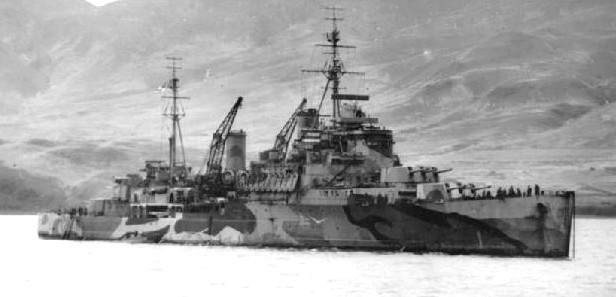
(IWM Photo, FL A 7683)
HMS Trinidad (46). Trinidad was built by HM Dockyard Devonport. She was laid down on 21 April 1938, launched 21 March 1941 and commissioned on 14 October 1941. The ship served with the British Home Fleet during her brief career. While escorting Convoy PQ 13 in March 1942, she and other escorts were in combat with German Narvik-class destroyers. She hit and damaged the German destroyer Z26 and then launched a torpedo attack. One of her torpedoes had a fault, possibly affected by the icy waters and sub zero conditions common in the Atlantic en route to Russia; causing the torpedo to limp across the water at a speed far below the 46 knots expected, the reduced speed causing the torpedo to strike Trinidad as she performed evasive zigzags in its path, killing 32 men. Survivors included Lieutenant Commander Williams as well as composer George Lloyd, a Royal Marines bandsman who had earlier written the ship’s official march. This was performed at the Last Night of the Proms on 7 September 2013, in the presence of the last surviving crewman from Trinidad.
HMS Trinidad was towed clear of the action, and was then able to proceed under her own power towards Murmansk. The German submarine U-378[2] attempted to engage and sink the damaged cruiser, but was spotted and attacked by the destroyer Fury.[3] On arrival in Murmansk, Trinidad underwent partial repairs.She set out to return home on 13 May 1942, escorted by the destroyers Foresight, Forester, Somali and Matchless. Other ships of the Home Fleet were providing a covering force nearby. Her speed was reduced to 20 knots (37 km/h) owing to the damage she had sustained. En route, she was attacked by more than twenty Ju 88 bombers on 14 May 1942. All attacks missed, except for one bomb that struck near the previous damage, starting a serious fire. Sixty-three men were lost,[4] including twenty survivors from the cruiser Edinburgh, which had been sunk two weeks earlier. The decision was taken to scuttle her and on 15 May 1942 she was torpedoed by Matchless and sank in the Arctic Ocean, north of North Cape. Four Czechoslovak airmen en route to Great Britain – Sergeant Vratislav Laštovička, Corporals Jan Ferák, Josef Návesník and Bohuslav Zikmund – were killed and three other airmen rescued. (Wikipedia)
Ceylon-group
HMS Ceylon (30)
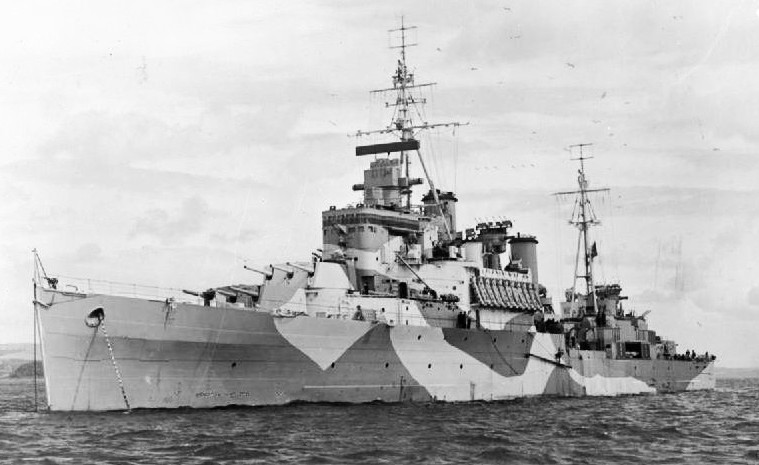
(IWM Photo, FL 7789)
HMS Ceylon (30). The cruiser saw service in the Atlantic and Pacific theatres during the Second World War. In the postwar era, she participated in actions in Egypt and the Korean War. In 1960 she transferred to the navy of Peru and renamed Coronel Bolognesi. The cruiser was scrapped in 1985.
Built by Stephens at Govan and launched on 30 July 1942, she was completed on 13 July 1943. After two months in the Home Fleet she was transferred to the 4th Cruiser Squadron, with the Eastern Fleet and took part in many carrier raids, bombardments and patrols against Japanese-held territory, including Operations Cockpit, Meridian and Diplomat. In November 1944 she joined the British Pacific Fleet and sailed from Trincomalee on 16 January, taking part in a raid on Pankalan Bradan en route. By May 1945, however, she was back in the Indian Ocean, shelling the Nicobar Islands, and remained in that theatre until the end of the war. In October 1945 she returned to England for refit and lay-up.
HMS Uganda (66)
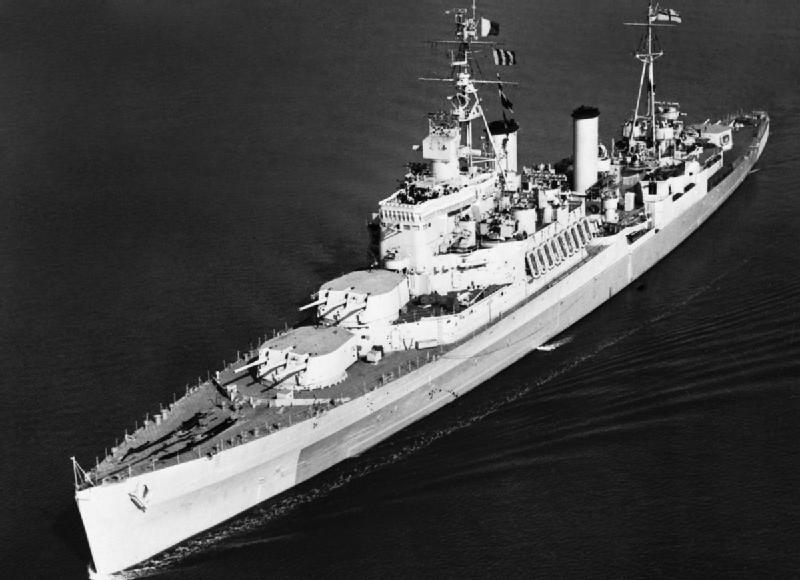
(IWM Photo, FL 17797)
HMS Uganda (66). She was a Second World War-era Fiji-class light cruiser launched in 1941. She served in the Royal Navy during 1943 and 1944, including operations in the Mediterranean, and was transferred to the Royal Canadian Navy as HMCS Uganda in October 1944. She served in the Pacific theatre in 1945 and was put into reserve in 1947. When she was reactivated for the Korean War in 1952 she was renamed HMCS Quebec. She was decommissioned for the last time in 1956 and scrapped in Japan in 1961.
HMS Uganda was one of the Ceylon sub-class (the second group of three ships built in 1939) of the Fiji-class cruisers, and built by Vickers-Armstrong at their Walker yard. She was launched on 7 August 1941 and commissioned on 3 January 1943. In March 1943 after training at Scapa Flow, Uganda sailed as convoy escort to protect a Sierra Leone-bound convoy from the German Narvik-class destroyers operating from the Bay of Biscay. After two such convoy duties, she was sent as escort for the ocean liner RMS Queen Mary carrying Winston Churchill and his staff to Washington. The journey was made at 30 knots (56 km/h; 35 mph), and the ship sailed into Naval Station Argentia, in Newfoundland, low on fuel. Upon return from that duty Uganda returned to Plymouth for a refit.
With her refit completed, she was sent to the Mediterranean Sea as escort to one of the largest troop convoys of the war heading to Sicily. In July the ship joined the 15th Cruiser Squadron of the Mediterranean Fleet. Uganda was part of the bombardment fleet for Operation Husky, the invasion of Sicily, on 10 July 1943. She was then assigned to close support for major bombardments throughout Sicily. Uganda sailed as part of the support force for Operation Husky from Alexandria along with three cruisers and six destroyers. Uganda was part of Support Force East during the Operation Husky landings. Within the British bridgehead, Uganda, with the cruisers Orion and Mauritius and the monitor Erebus supported the British Eighth Army.[6] On 10 August, again in support of the Eighth Army, Uganda and the Dutch gunboat Flores bombarded positions north of Reposto.[7] On 12 August, Uganda, the monitor Roberts and the Dutch gunboats Scarab and Soemba shelled the east coast of Sicily.
On the opening of Operation Avalanche, 9 September 1943, she was part of the fleet bombardment covering the invasion of Italy at Salerno. As part of Operation Avalanche, Uganda was a member of the Northern Attack Force, which landed the British X Corps. The cruiser was a member of the support and escort group for the force. The landings are successful, however the Germans counterattacked and created a serious situation on the beachhead. Uganda was among the ships forced to lie inshore to provide direct naval gunfire support. The fleet then suffered air attacks using FX 1400 radio-controlled and Hs 293 glider bombs.[9] While serving off Salerno at 1440 on 13 September 1943 she took a direct hit from a new German radio controlled 1.4 tonne glide bomb Fritz X dropped by a KG 100 bomber. The Fritz X passed through seven decks and straight through her keel, exploding underwater just under the keel. The concussive shock of the Fritz X’s underwater detonation close to Uganda’s hull extinguished all her boiler fires, and resulted in sixteen men being killed, with Uganda taking on 1,300 tons of water. Damage control under Lieutenant Leslie Reed managed to get the ship moving with one engine. She was towed to Malta by USS Narragansett, where temporary repairs were made.
There being no dry dock available in the European Theatre that could handle the repairs, Uganda was sent to the US shipyard at Charleston, South Carolina. The heavily damaged ship, with only one of her four propellers working, proceeded across the Atlantic Ocean to Charleston, arriving on 27 November 1943. During the repairs, Uganda had two hangars designed for carrying Supermarine Walrus reconnaissance aircraft removed. These hangars were used for radio and radar equipment as well as crew amenities.
While under repair the Government of Canada negotiated with Britain to obtain Uganda for the Royal Canadian Navy (RCN). The official transfer took place on Trafalgar Day, 21 October 1944, at Charleston and she was renamed HMCS Uganda, out of respect for the British colony.[3][10] Uganda’s first crew in RCN service was notable. The commanding officer was Captain Rollo Mainguy, who later became chief of the Naval Staff. The first officer (executive officer) was Commander Hugh Pullen, and other officers including Lieutenant Commander William Landymore were all eventually promoted to flag rank following the war. Lieutenant John Robarts, Aircraft Recognition Officer, went on to become Premier of Ontario. The other members of her crew of 907 comprised a carefully selected group; additional training on cruisers was provided through personnel exchanges with the RN. The first crew for Uganda was drawn from every province in Canada as well as the Dominion of Newfoundland. Eighty-seven per cent were reservists (RCNVR and RCNR) while the balance were regular members of the Royal Canadian Navy.
Uganda’s first assignment came shortly after her recommissioning. She was tasked to join the British Pacific Fleet’s operational area south of Sakishima Gunto. She joined the 4th Cruiser Squadron and spent the rest of the month working up. The conditions for the crew were arduous since the ship had not been modified for tropical conditions, which would have provided better air circulation throughout the ship and more fresh water capacity. Uganda left Halifax, Nova Scotia, on 31 October 1944 and steamed via the United Kingdom where following her reconstruction at Charleston, the cruiser underwent further modification.[3] She departed the United Kingdom in January 1945 and sailed to the Pacific, stopping at Gibraltar, Alexandria, Egypt, the Suez Canal, and on via Aden and Colombo, Ceylon, to the fleet base at Fremantle, Western Australia, where she arrived on 4 March 1945.
As the flagship for the RCN, Uganda served in the Pacific War with the British Pacific Fleet, joining it at Sydney, Australia, in February 1945.[10] Assigned to Task Force 57, British Pacific Fleet, because her radar and aircraft identification capabilities were amongst the best in the fleet, owing to her 1944 refit in Charleston. On 10 April 1945, the strike against Sakishima Gunto was cancelled and the task force was ordered to attack Formosa instead. From 11 to 13 April 1945, Uganda, as part of Task Force 57 in the Pacific, she attacked airfields and installations in northern Formosa,[11] before being redirected back to Sakishima Gunto. The cruiser took part in the bombardment of the Japanese airbases on Sakishima Gunto between 15–20 April before the fleet was tasked to Leyte Gulf. During her time with Task Force 57, Uganda came under kamikaze attack.[12] She received battle honours for operations during the Battle of Okinawa and was involved in attacking Truk, Formosa and Sakishima Gunto.
At Leyte she joined the United States Third Fleet, 300 nautical miles (560 km) east of Japan and became the only Royal Canadian Navy warship to fight in the Pacific Theatre against the Imperial Japanese Navy. In May 1945, Task Force 57 sailed from Leyte to attack Sakishima Gunto for nearly the entire month. Uganda was among the ships ordered to bombard the island group. The task force suffered kamikaze attacks, forcing two of the aircraft carriers to retire and damaging another.
In the aftermath of the Conscription Crisis of 1944, on 4 April 1945, the Canadian government changed the manning policy for all ships deploying to the Pacific theatre. All those heading to the Pacific would have to re-volunteer. Upon volunteering again, the serviceman would be eligible for 30 days leave in Canada before deployment. Controversially this policy change was applied to those already there and Uganda’s RCN crew were polled by the Canadian government on 7 May 1945 to determine whether they would volunteer for further duties in the Pacific War.[12][14] Widespread discontent had grown amongst the crew, due to poor living conditions, kamikaze attacks and the lack of a Canadian identity for the ship (for instance, the Canadian Red Ensign was not flown and no maple leaf was painted on the funnel, which many crewmen saw as an insult to Canada). The crew of Uganda felt that they had enlisted for “hostilities only” (i.e., hostilities against Nazi Germany), but now found themselves fighting a different enemy in a quite different part of the world. The policy also signalled the Canadian government’s lack of commitment to the Pacific War. Captain Mainguy later acknowledged that: “The next signal we got fairly shortly was: ‘Do you volunteer to fight against the Japanese?’ It seemed pretty stupid. [There] were those incentives just to be annoyed and say, ‘Well, if we’re not wanted, of course, we don’t want to fight the Japs if it’s not necessary.'” In addition, when the “volunteers only” policy became public knowledge in Canada, family obligations became an increasing burden, as this left the crew with a difficult decision to prioritize their families or their sense of duty that had driven them to volunteer in the first place.
As a result, the vote on 7 May was held onboard Uganda and 605 crew out of 907 refused to re-volunteer for continuing operations against Japan. The British Admiralty was furious and said it could not replace the ship until 27 July at the earliest. However, the cruiser continued her deployment in the Pacific throughout June and July while the Naval Staff sought an answer to the problem. An embarrassed Royal Canadian Navy offered to replace Uganda with HMCS Prince Robert, an anti-aircraft flak ship that was being refitted in Vancouver.
HMCS Uganda took part in Operation Inmate, a carrier raid on Japanese installations at Truk. Sailing on 12 June from Manus Island, the cruiser was among the ships detailed to bombard the island of Dublon. The force returned to Manus Island on 17 June. In July, Uganda, now part of Task Force 37, sailed to join up with the Americans performing carrier air strikes on the Tokyo area, arriving on 16 July. On 27 July, Uganda was relieved by HMS Argonaut. HMCS Uganda was detached from the US Navy’s Third Fleet on 27 July when Argonaut arrived. Uganda proceeded to Eniwetok, and then to Pearl Harbor for refuelling before heading for Esquimalt. En route to Pearl Harbor, one boiler suffered a liner collapse which would have resulted in the ship’s withdrawal from active combat at any rate. Uganda limped into Pearl Harbor on 4 August but was not welcomed because of the resentment that her crew was “quitting” the war. Uganda departed after refuelling and proceeded for Esquimalt. En route to Canada, the crew heard news about the atomic bombs being dropped on Japan. They arrived in Esquimalt on 10 August, the day that Japan announced its acceptance of the Instrument of Surrender. HMCS Uganda remained on the Pacific coast following the war serving in a training capacity. The cruiser was paid off on 1 August 1947 into the RCN reserve. (Wikipedia)
HMS Newfoundland (59)
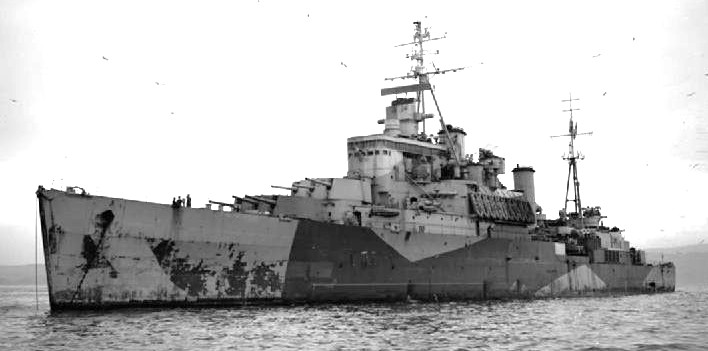
(IWM Photo, A 23435)
HMS Newfoundland (59). She was a Fiji-class light cruiser of the Royal Navy. Named after the Dominion of Newfoundland, she participated in the Second World War and was later sold to the Peruvian Navy and renamed BAP Almirante Grau. Newfoundland was built by Swan Hunter and launched 19 December 1941 by the wife of the then British Minister of Labour, Ernest Bevin. The ship was completed in December 1942 and commissioned the next month. After commissioning Newfoundland joined the 10th Cruiser Squadron, Home Fleet. Early in 1943 the ship became flagship of the 15th Cruiser Squadron, Mediterranean. On the night of 13/14 July 1943, during Sicily Campaign, she provided effective support for 1st Parachute Brigade helping to secure the Primasole Bridge, linking Catania with Syra.
On 23 July 1943, she was torpedoed by the Italian submarine Ascianghi. Some sources attribute the torpedo to the German submarine U-407. One crewman was killed in the attack. Her rudder having been blown off, temporary repairs were carried out at Malta. Later, steering by her propellers only, and with the assistance of “jury rigged” sails between her funnels, she steamed to the Boston Navy Yard for major repairs. In 1944 the ship was re-commissioned for service in the Far East. While at Alexandria an exploding air vessel occurred in one of the torpedoes in the port tubes which caused severe damage and one casualty. The repairs delayed her arrival in the Far East for service with the British Pacific Fleet (BPF). Newfoundland went to New Guinea to support the Australian 6th Division in the Aitape-Wewak campaign. On 14 June 1945, as part of a BPF task group, Newfoundland attacked the Japanese naval base at Truk, in the Caroline Islands during Operation Inmate.
On 6 July Newfoundland left the forward base of Manus in the Admiralty Islands with other ships of the BPF to take part in the Allied campaign against the Japanese home islands. On 9 August she took part in a bombardment of the Japanese city of Kamaishi. Newfoundland was part of a British Empire force which took control of the naval base at Yokosuka. The ship was present in Tokyo Bay when the Instrument of Surrender was signed aboard the US battleship USS Missouri, on 2 September 1945. Newfoundland was then assigned the task of repatriating British Empire prisoners of war. She returned to Great Britain in December 1946.
Newfoundland was initially in reserve, and was used as a training ship as part of the stokers’ training establishment HMS Imperieuse, before starting a 20-month reconstruction at Plymouth in 1951.[4] The modernisation was one of the more extensive of those applied to the Colony or Town-class cruisers in the 1950s with Newfoundland receiving extensive new electrical and fire control systems, a new bridge, comprehensive nuclear spraydown capability and lattice masts, particularly for the 960 radar in a similar structure to that later fitted to the cruisers Royalist and Belfast. The integrated 275 and MRS-1 fire control for the 4 twin and 40mm mounts was the most comprehensive fitted to a modernised Royal Navy cruiser but possibly not as reliable as the simpler installations on the cruisers Ceylon and Belfast.
Recommissioned on 5 November 1952,[7] she became flagship of the 4th Cruiser Squadron in the East Indies. The cabinet of Sri Lanka met on board her during the Hartal of 1953.[8] From December 1953 Newfoundland underwent a three-month refit at Singapore before transferring to the Far East Station, shelling Malayan National Liberation Army targets near Penang in June 1954 when on passage to the Far East.
On 31 October 1956, the Egyptian frigate Domiat was cruising South of the Suez Canal in the Red Sea, when Newfoundland encountered her and ordered her to heave to. Aware of tensions between Britain and Egypt that would lead to the Suez Crisis, Domiat refused and opened fire on the cruiser, causing some damage and casualties. The cruiser, with the destroyer Diana, then returned fire and sank her opponent, rescuing 69 survivors from the wreckage. One man from the Newfoundland was killed and five were wounded.
HMS Newfoundland then returned to the Far East until paid off to the reserve at Portsmouth on 24 June 1959. She was sold to the Peruvian Navy on 2 November 1959, and subsequently renamed Almirante Grau and then to Capitán Quiñones in 1973. The cruiser was hulked in 1979 and used as a static training ship in Callao, before being decommissioned and scrapped later that year. (Wikipedia)
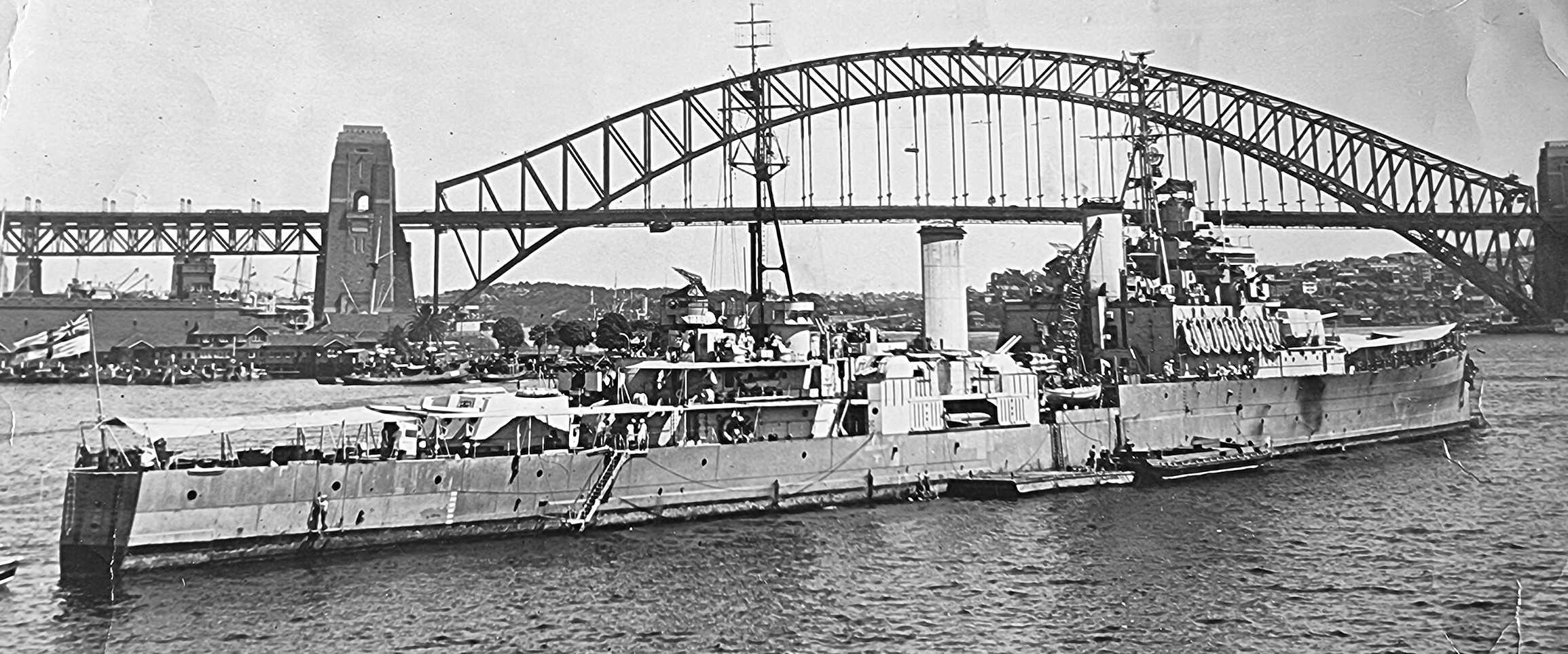
(Geoff soper Photo)
HMS Newfoundland, moored at Sydney, late 1945.