Royal Navy Cruisers: Emerald class
HMS Emerald (D66), HMS Enterprise (D52)
The Emerald class or E class was a class of two light cruisers built for the Royal Navy. Following the Cavendish class, three ships of a new class were ordered in March 1918, towards the end of the First World War, designed to emphasise high speed at the cost of other qualities, for use against rumoured new high-speed German cruisers – like the Brummer class – and particularly minelayers, in the North Sea. The third ship was cancelled in November 1918. (Wikipedia)
HMS Emerald (D66)
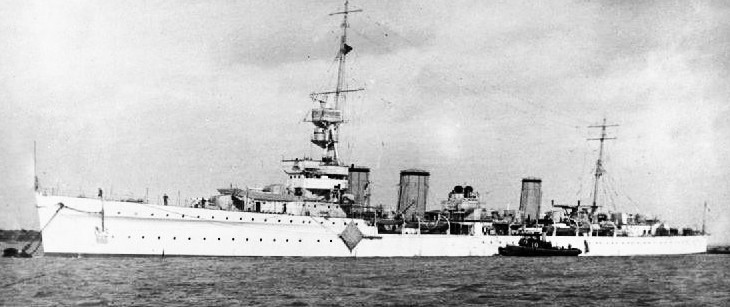
(IWM Photo, Q 045940)
HMS Emerald (D66). Recommissioned for war service, she joined the 12th Cruiser Squadron on Northern Patrol duties in September 1939. However, the appearance of German raiders in the Atlantic resulted in her transfer to Halifax in October to escort homeward-bound convoys, where she remained into 1940. During the early part of the war, until May 1940, her captain was the noted officer Augustus Agar, V.C. On 24 June 1940 Emerald departed Greenock carrying £58 million in gold, and reached Halifax on 1 July where the gold was transferred to a Canadian National Railway train for safe storage in Canada until the threat of German invasion of England had passed. Her sister ship Enterprise shipped another £10 million for Operation Fish.In 1941 Emerald was transferred to the Indian Ocean, where she escorted troop convoys to the Middle East and stood by in the Persian Gulf during the operations in Iraq in April 1941. After Japan’s entry into the war, in December 1941, Emerald joined the Eastern Fleet as part of the ‘Fast Group’, and in March 1942 was flagship.
For the period 30 December 1941 to 13 January 1942 HMS Emerald was an escort for convoy DM 1. At 1000 on 30 December 1941, about 370 miles east of Mombasa, convoy WS12ZM (Malaya) (P&O’s SS Narkunda,[8] MV Aorangi, P&O’s MV Sussex, and MS Abbekerk) detaches from convoys WS12ZA (Aden) and WS12ZB (Bombay), and with USS Mount Vernon and escort HMS Emerald form convoy DM 1 (Durban Malaya). Convoy DM 1 reaches ‘Port T’ – Addu Atoll in the Maldives at 1000 on 4 January 1942. On 11 January 1942, the convoy passes through the Sunda Strait. On 12 January 1942, the convoy passes through the Bangka Strait. On 13 January 1942, convoy DM 1 arrives in Singapore. In August 1942 the ship returned home to refit at Portsmouth, and did not return to service until early April 1943.She rejoined the Eastern Fleet, 4th Cruiser Squadron, for escort duties, then returned home once more for the Invasion of Normandy, when she served with Force “K” in support of Gold Beach. By January 1945 Emerald had joined the reserve fleet and, in 1947, was allocated for ship target trials. As a result of these trials the ship foundered in Kames Bay, Rothesay, on 24 October, and was not refloated until 9 June 1948, after which she was docked, examined, and then handed over to BISCO on 23 June 1948 for breaking up. She was scrapped at Arnott Young (Troon, Scotland) where she arrived on 5 July 1948.
HMS Enterprise (D52)
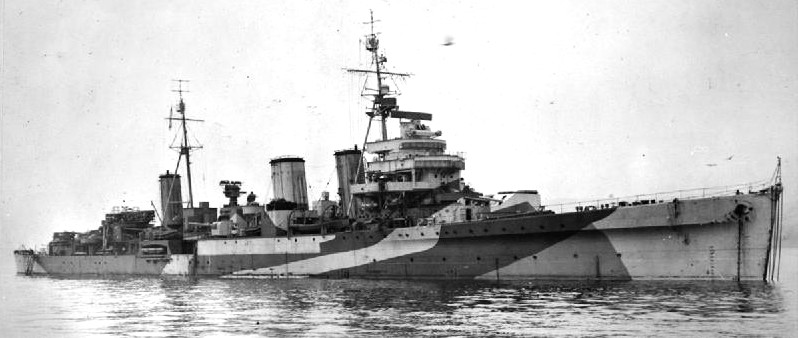
(IWM Photo, FL 5389)
HMS Enterprise (D52). At the start of the Second World War in September 1939, Enterprise was recommissioned and joined Atlantic patrols with the 4th Cruiser Squadron. She later joined the North America and West Indies Squadron. Enterprise was employed on Atlantic escort duties with the Halifax Escort Force in 1939–1940. In October 1939, she oversaw the transfer of £10 million (£783 million in today’s currency) in gold bullion to Canada during Operation Fish.In April 1940, she was transferred to the Home Fleet for the Norwegian campaign. In April–May, she supported the British Army ashore by bombardments in and around Narvik, Norway, and on 19 April was attacked unsuccessfully by the German submarine U-65. On 25 May, she left Harstad with a third of the Norwegian National Treasury bound for Britain. She sailed first to Scapa Flow, surviving two German air attacks on the way, then proceeded to Greenock, where the gold was taken ashore.
After some repairs, Enterprise joined the newly formed Force H in June 1940 and set sail for the Mediterranean Sea where, in July, she participated in negotiations with the French Navy regarding the future of the French fleet in the war. Following the unsatisfactory outcome of the negotiations, she participated in Operation Catapult at Mers-El-Kébir. She also participated in the delivery of aircraft to Malta in late July.
Force H was then re-organised and Enterprise was sent to Cape Town after which she became the flagship for operations in South America, primarily involved in trade defence and interception duties. In December 1940, she was deployed with the cruisers Cumberland and Newcastle in an unsuccessful search for the German auxiliary cruiser Thor which had attacked and damaged the armed merchant cruiser Carnarvon Castle.
In early 1941, she was redeployed to the Indian Ocean where, accompanied by a sizeable fleet of Royal Navy and Royal Australian Navy ships led by the aircraft carrier Hermes, she participated in a search for the German cruiser Admiral Scheer. After the search was abandoned, Enterprise took up convoy escort duty before being sent to Basra after a pro-German revolt by Rashid Ali al-Gaylani started the Anglo-Iraqi War. The war was won by the end of May, after which Enterprise was released back into convoy escort duty in the Indian Ocean.
In November, she was under refit and repair in Colombo, which was finished just in time for the start of the War with Japan in December 1941. She escorted troop ships to Singapore and Rangoon, Burma, and then joined the Eastern Fleet under Admiral Sir James Somerville, taking part in protection of trade for the next year. On 6 April 1942, together with the destroyers Paladin and Panther, she picked up some of the 1,120 survivors of the cruisers Cornwall and Dorsetshire, which had been sunk by the Japanese in their Easter Sunday Raid. The Easter Sunday Raid was part of the larger Japanese Indian Ocean raid, which threatened British Ceylon. Enterprise participated in yet another fruitless search for enemy ships during this period, when it was believed the Japanese were preparing to strike and possibly invade the Indian Ocean island.
On 25 December 1942, she returned to Clyde for extensive refit and modernisation works, which were completed only in October 1943. Trials and tests continued throughout November.In late December 1943, she was deployed with the cruisers Gambia and Glasgow for Operation Stonewall. On 28 December, she engaged a force of 11 German destroyers and torpedo boats, the tardy escort for their blockade runner Alsterufer (which had been sunk the previous day by air attack). Enterprise sank the torpedo boat T26 with a torpedo, while T25 and Z27 were also sunk. Four other German ships were damaged in the engagement. From 3–29 February 1944, Enterprise was docked at Devonport for refit, and from 27–31 March she was fitted for missile jamming gear at Devonport.
In May, Enterprise was then assigned to Bombardment Force “A” with British ships Hawkins, Black Prince, Erebus, Netherlands ship Soemba, and US ships Nevada, Tuscaloosa, and Quincy. She was in sub-group Assault Force “U” (for Utah Beach), of which she was the lead ship.When the Normandy Landings started on 6 June 1944, Bombardment Force “A” bombarded St. Martin de Varreville. Enterprise engaged the coastal defences of Cherbourg; in the ensuing action, her Captain and her Commander were both wounded, and the ship was brought back to Portland by the First Lieutenant, Lieutenant Commander Brown. Twenty days later, she was also involved in the bombardment of Querqueville, silencing the German guns there. German shore batteries opened fire, but caused no significant damage to Enterprise. During the D-day operations, Enterprise fired about 9,000 6-inch shells and required two overnight gun changes at Portsmouth. In July, she was deployed off the French coast in support of British operations, and on 17 July, she provided naval gunfire for two days in support for British attacks near Caen with the cruiser Mauritius and the monitor Roberts. In September, she was deployed in a similar capacity off the Dutch coast in support of the Second Army; however, she was not required to support the troops.
In October, after a contemplated transfer to the Royal Canadian Navy was not implemented, Enterprise was taken out of active service and placed in reserve at Rosyth. Starting in May 1945, Enterprise helped return British troops from Asia and Africa. On 13 January 1946, she returned to the United Kingdom for the final time. She was handed over to BISCO for scrapping on 11 April, arriving at J Cashmore in Newport, Wales, on 21 April for breaking-up.