
HMS Dreadnought
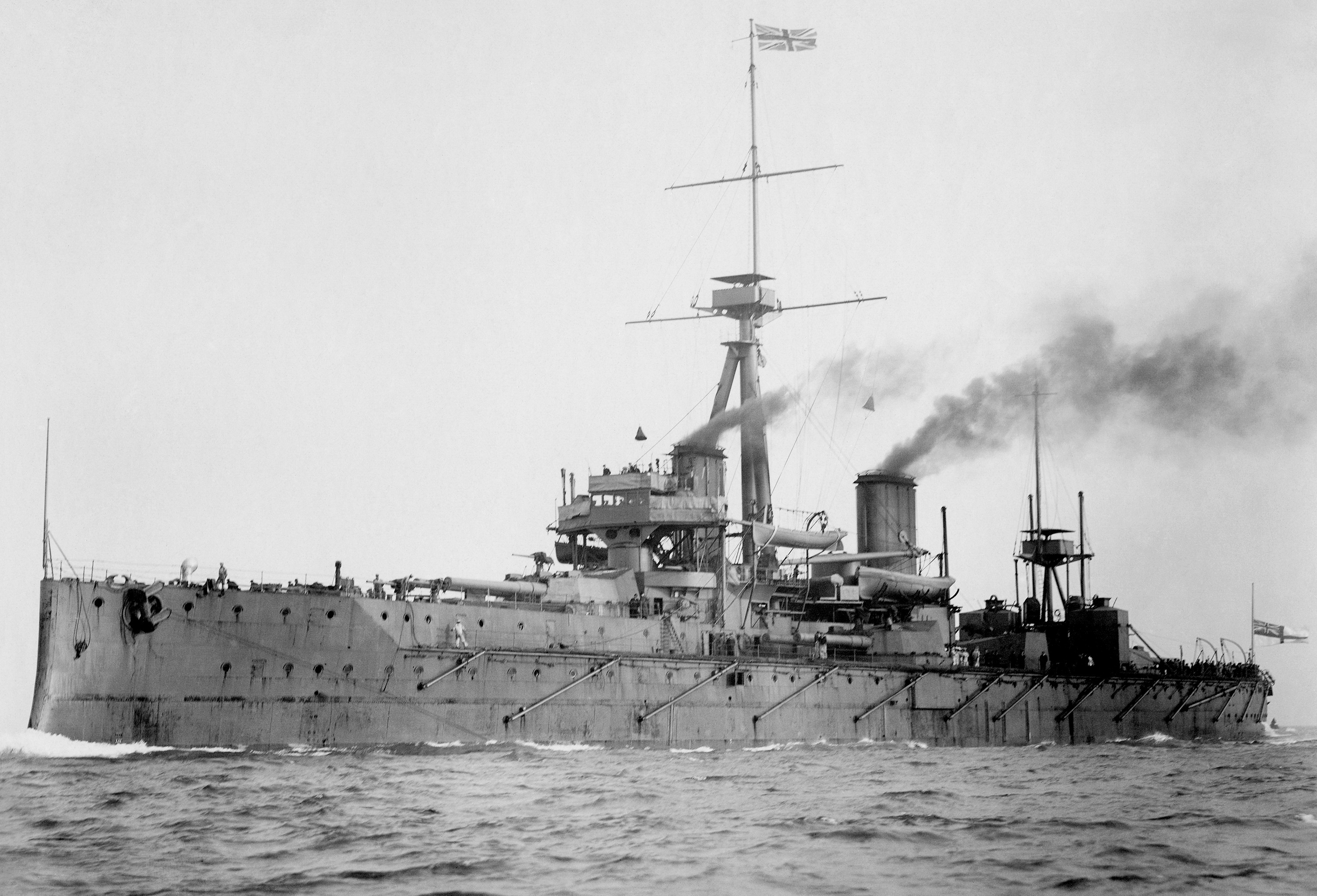
(RN/USN Photo)
HMS Dreadnought underway, circa 1906-07.
HMS Dreadnought was a Royal Navy battleship, the design of which revolutionised naval power. The ship’s entry into service in 1906 represented such an advance in naval technology that her name came to be associated with an entire generation of battleships, the Dreadnoughts, as well as the class of ships named after her. Likewise, the generation of ships she made obsolete became known as pre-dreadnoughts. Admiral Sir John “Jacky” Fisher, First Sea Lord of the Board of Admiralty, is credited as the father of Dreadnought. Shortly after he assumed office in 1904, he ordered design studies for a battleship armed solely with 12 in (305 mm) guns and a speed of 21 knots (39 km/h; 24 mph). He convened a Committee on Designs to evaluate the alternative designs and to assist in the detailed design work.
Dreadnought was the first battleship of her era to have a uniform main battery, rather than having a few large guns complemented by a heavy secondary armament of smaller guns. She was also the first capital ship to be powered by steam turbines, making her the fastest battleship in the world at the time of her completion. Her launch helped spark a naval arms race as navies around the world, particularly the Imperial German Navy, rushed to match it in the build-up to the First World War.
Although designed to engage enemy battleships, her only significant action was the ramming and sinking of German submarine SM U-29; thus she became the only battleship confirmed to have sunk a submarine. Dreadnought did not participate in the Battle of Jutland in 1916 as she was being refitted, nor did she participate in any of the other naval battles in the First World War. In July 1916 she was relegated to coastal-defence duties in the English Channel, before rejoining the Grand Fleet in 1918. The ship was reduced to reserve in 1919 and sold for scrap two years later. (Wikipedia)
Dreadnought was significantly larger than the two ships of the Lord Nelson class, which were under construction at the same time. She had an overall length of 527 ft (160.6 m), a beam of 82 ft 1 in (25 m), and a draught of 29 ft 7.5 in (9 m) at deep load. She displaced 18,120 long tons (18,410 t) at normal load and 20,730 long tons (21,060 t) at deep load, almost 3,000 long tons (3,000 t) more than the earlier ships. She had a metacentric height of 5.6 ft (1.7 m) at deep load and a complete double bottom.
Officers were customarily housed aft, but Dreadnought reversed the old arrangement, so that the officers were closer to their action stations. This was very unpopular with the officers, not least because they were now berthed near the noisy auxiliary machinery while the turbines made the rear of the ship much quieter than they had been in earlier steamships. This arrangement lasted among the British dreadnoughts until the King George V class of 1910. The crew numbered 700 officers and ratings in 1907, but increased to 810 in 1916.
Dreadnought carried 2,868 long tons (2,914 t) of coal, and an additional 1,120 long tons (1,140 t) of fuel oil that was to be sprayed on the coal to increase its burn rate. At full capacity, she could steam for 6,620 nautical miles (12,260 km; 7,620 mi) at a speed of 10 knots (19 km/h; 12 mph).
Dreadnought’s main armament consisted of ten 45-calibre BL 12-inch Mark X guns in five twin Mark BVIII gun turrets. The forward turret (‘A’) and two aft turrets (‘X’ and ‘Y’) were located along the centreline of the ship. Two wing turrets (‘P’ and ‘Q’) were located port and starboard of the forward superstructure respectively. Dreadnought could deliver a broadside of eight guns between 60° before the beam and 50° abaft the beam. Beyond these limits she could fire six guns aft, and four forward. On bearings 1° ahead or astern she could fire six guns, although she would have inflicted blast damage on the superstructure.
The guns could be depressed to −3° and elevated to +13.5°. They fired 850 lb (390 kg) projectiles at a muzzle velocity of 2,725 ft/s (831 m/s), giving a maximum range of 16,450 yd (15,040 m) with armour-piercing (AP) 2 crh shells. Using the more aerodynamic, but slightly heavier, 4 crh AP shells extended the range to 18,850 yd (17,240 m). The rate of fire of these guns was about two rounds per minute. The ships carried 80 rounds per gun.
The secondary armament initially consisted of twenty-seven 50-calibre, quick-firing (QF) 3 in (76 mm) 12-pounder 18 cwt Mark I guns. The guns had an elevation range between −10° and +20°. They fired 12.5 lb (5.7 kg) projectiles at a muzzle velocity of 2,660 ft/s (810 m/s). The guns had a rate of fire of 20 rounds per minute. The ship carried three hundred rounds for each gun.
The original plan was to dismount the eight guns on the forecastle and quarterdeck and stow them on chocks on the deck during daylight to prevent them from being damaged by muzzle blast from the main guns. Gun trials in December 1906 proved that this was more difficult than expected and the two port guns from the forecastle and the outer starboard gun from the quarterdeck were transferred to turret roofs, giving each turret two guns. The remaining forecastle guns and the outer port gun from the quarterdeck were removed by the end of 1907, which reduced the total to twenty-four guns. During her April–May 1915 refit, the two guns from the roof of ‘A’ turret were reinstalled in the original positions on the starboard side of the quarterdeck. A year later, the two guns at the rear of the superstructure were removed, reducing the ship to twenty-two guns. Two of the quarterdeck guns were given high-angle mounts for anti-aircraft duties and the two guns abreast the conning tower were removed in 1917.
A pair of QF six-pounder (2.2 in (57 mm)) Hotchkiss anti-aircraft guns on high-angle mountings were mounted on the quarterdeck in 1915. They had a maximum depression of −8° and a maximum elevation of +60°.[26] The 6 lb (2.7 kg) shell was fired at a muzzle velocity of 1,765 ft/s (538 m/s). They were replaced by a pair of QF 3-inch 20 cwt guns on high-angle Mark II mounts in 1916. These guns had a maximum depression of 10° and a maximum elevation of 90°. They fired a 12.5-pound shell at a muzzle velocity of 2,517 ft/s (767 m/s) at a rate of 29 rounds per minute. They had a maximum effective ceiling of 23,500 ft (7,200 m).
Dreadnought carried five 18-inch (450 mm) submerged torpedo tubes, two on each broadside and one in the stern. Twenty-three torpedoes were carried for them. In addition six 14 in (356 mm) torpedoes were carried for her steam picket boats.
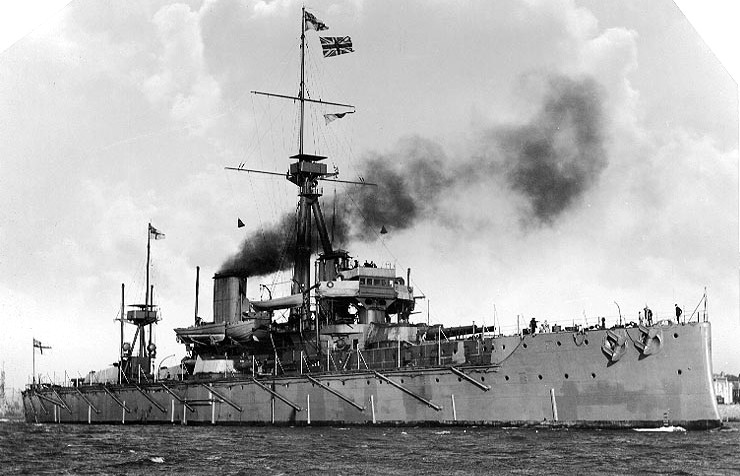
(USN Photo)
HMS Dreadnought in harbour, with flags flying from both masts and from the sternpost, c1906-07.
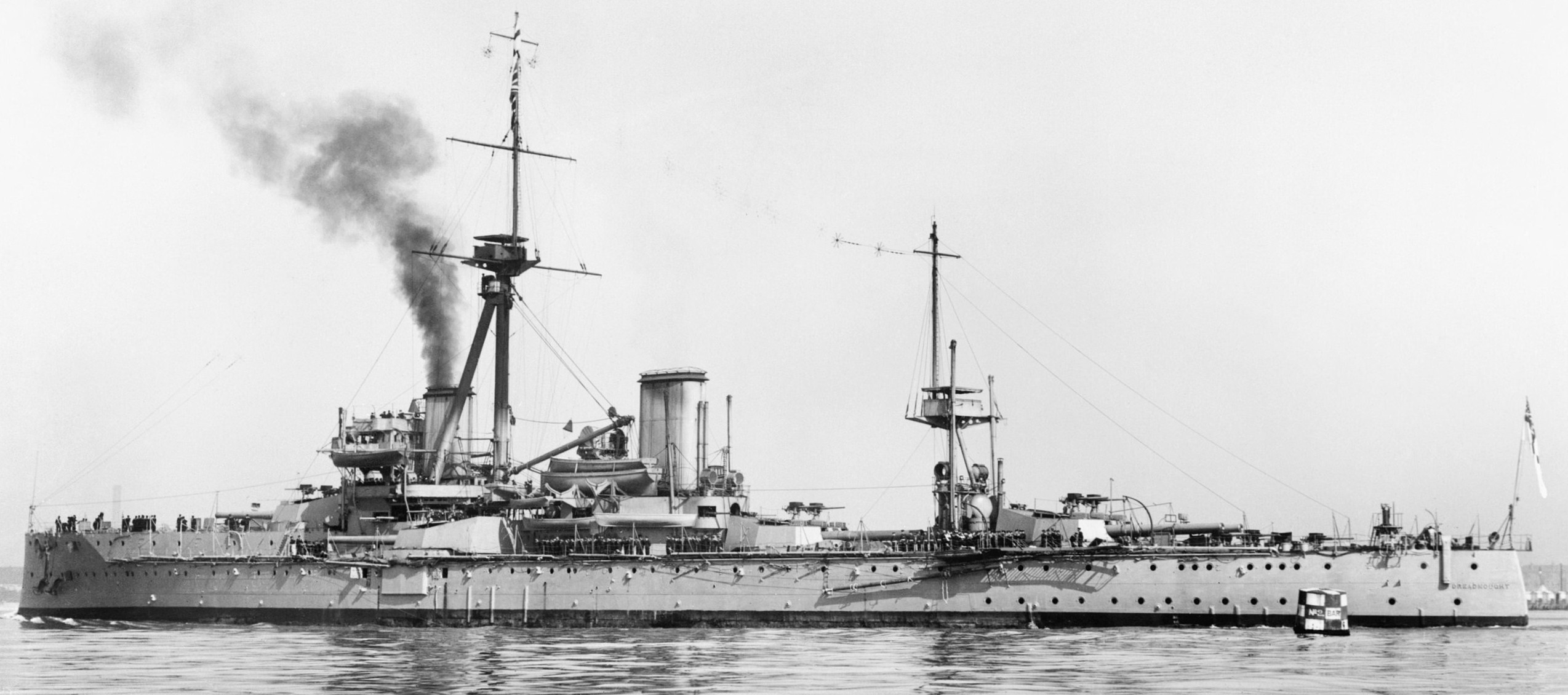
(IWM Photo, Q21183)
HMS Dreadnought, 1907.
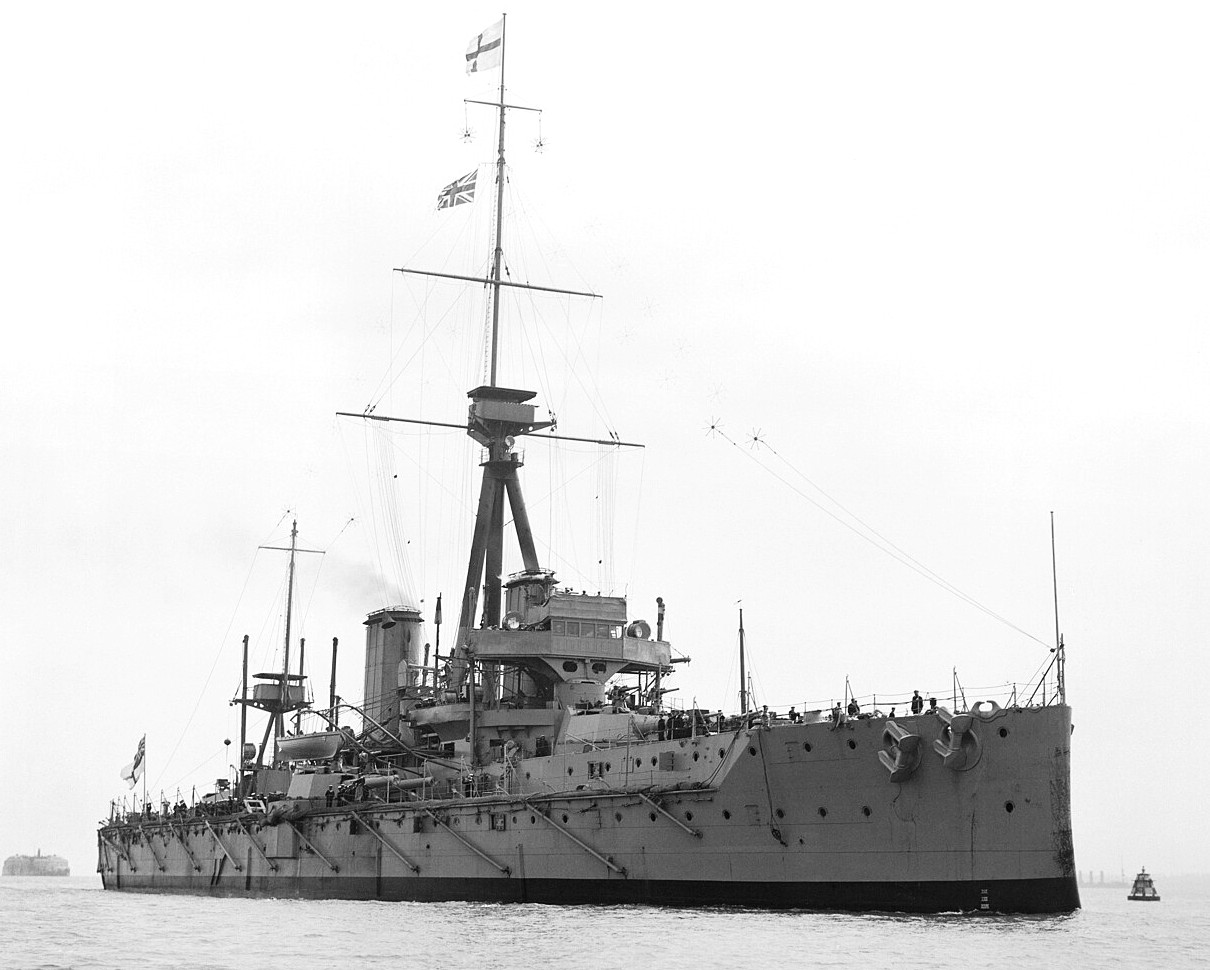
(IWM Photo, Q38712)
HMS Dreadnought, starboard bow portrait of the battleship, 1912.
(Nationaal Archief Photo)
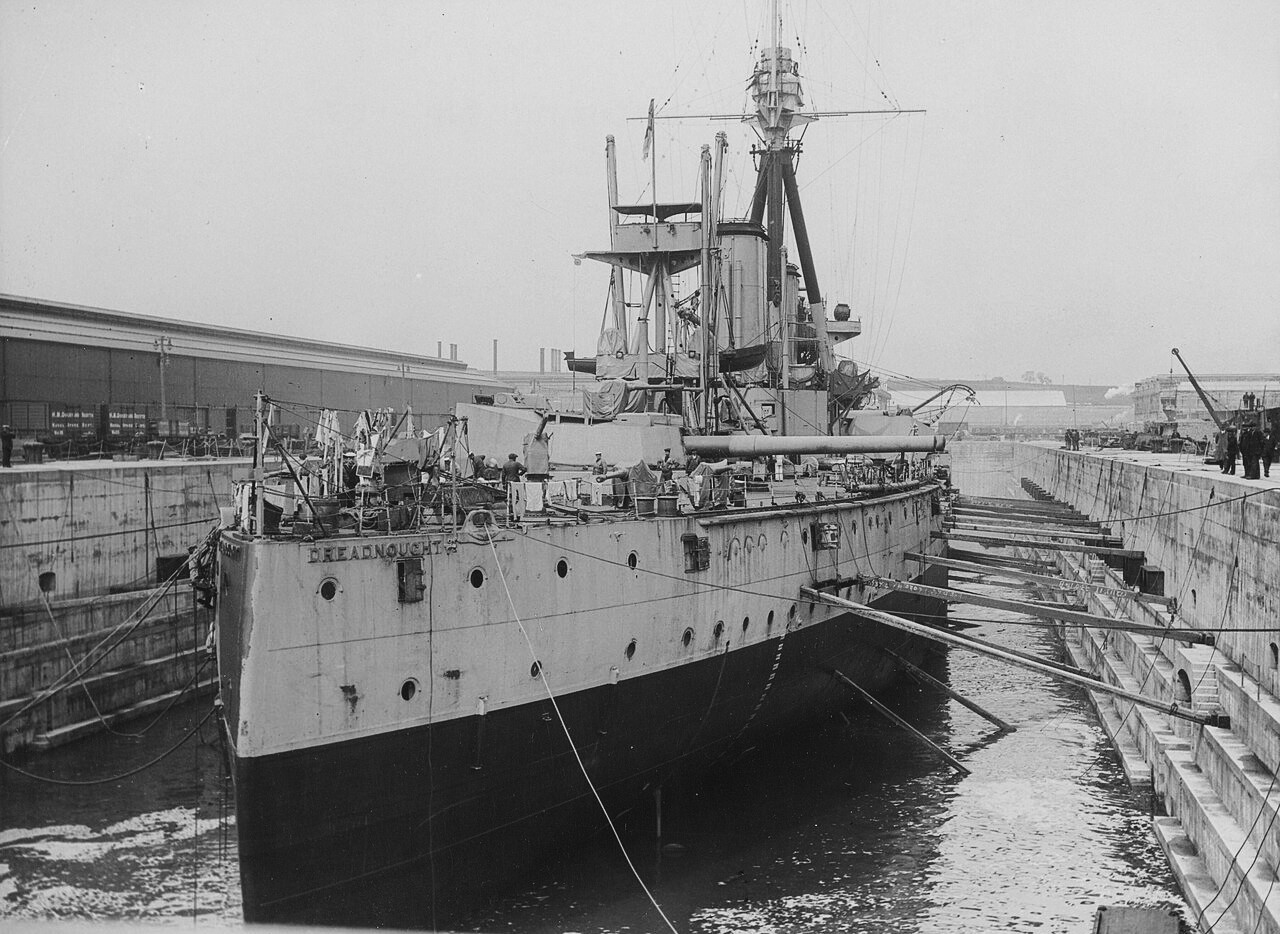
HMS Dreadnought, in dry dock, 1914.
(USN Photo)
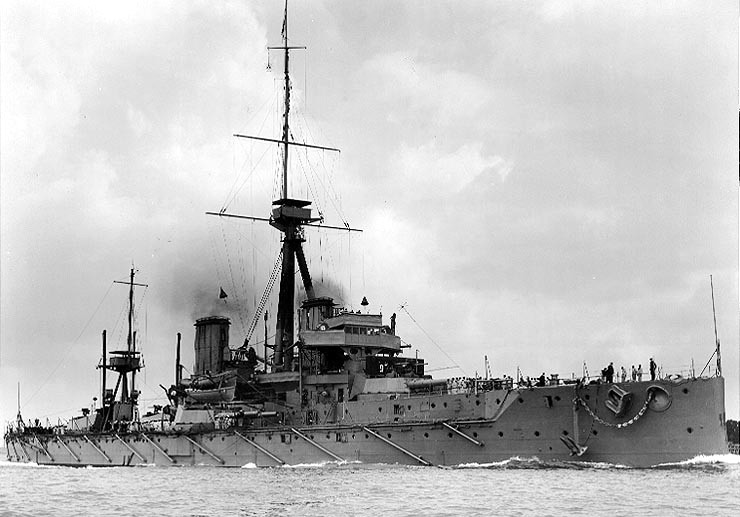
HMS Dreadnought underway, with an anchor suspended from the starboard deck edge, c1906-07.
(IWM Photo, Q 75229)
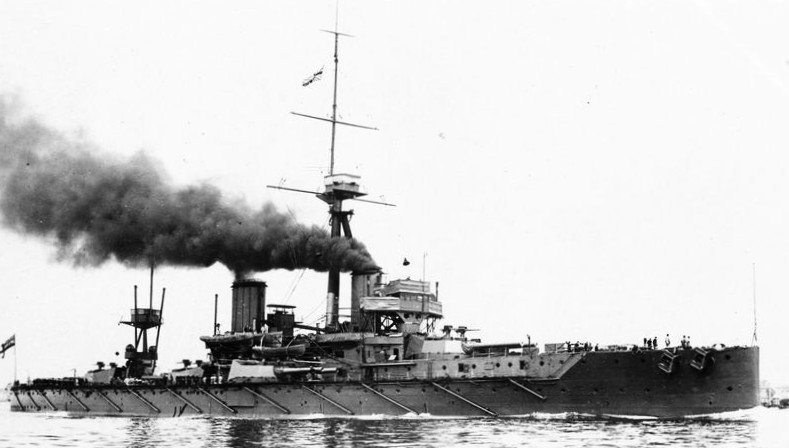
HMS Dreadnought underway during the First World War.