
Royal Navy Aircraft Carriers in the Second World War: HMS Argus, HMS Eagle, HMS Hermes, HMS Furious, HMS Courageous, HMS Glorious, HMS Ark Royal, HMS Formidable, HMS Illustrious, HMS Implacable, HMS Indefatigable, HMS Indomitable, HMS Victorious, HMS Unicorn
HMS Argus
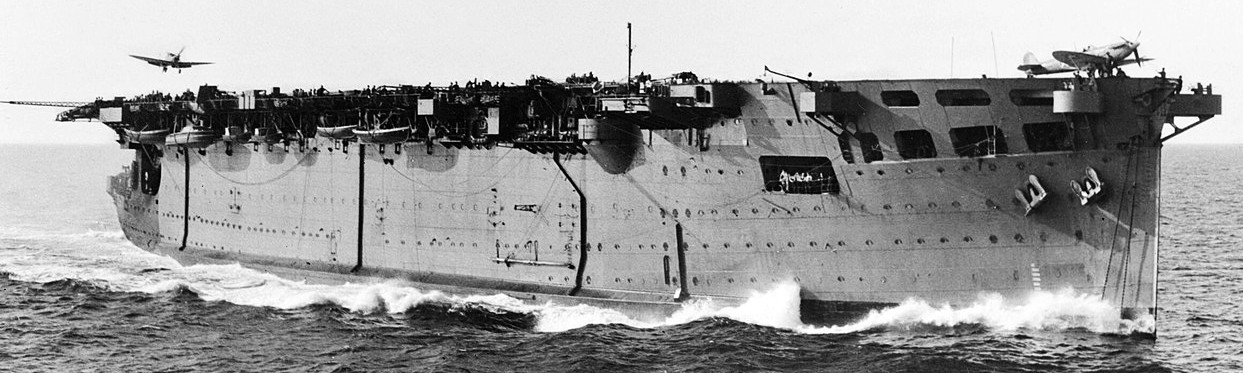
(IWM Photo, A 12882)
HMS Argus operating off the North African coast during combined operations for the ‘Torch’ landings in 1942.
HMS Argus, 14,000 tons, 20 knots, 20 aircraft, 370 crew plus aircrew, laid down in 1918. Survived the Second World War. HMS Argus was a British aircraft carrier that served in the Royal Navy from 1918 to 1944. She was converted from an ocean liner that was under construction when the First World War began and became the first aircraft carrier with a full-length flight deck that allowed wheeled aircraft to take off and land. After commissioning, the ship was involved for several years in the development of the optimum design for other aircraft carriers. Argus also evaluated various types of arresting gear, general procedures needed to operate a number of aircraft in concert and fleet tactics. The ship was too top-heavy as originally built, and had to be modified to improve her stability in the mid-1920s. She spent one brief deployment on the China Station in the late 1920s before being placed in reserve for budgetary reasons.
Argus was recommissioned and partially modernised shortly before the Second World War and served as a training ship for deck-landing practice until June 1940. The following month she made the first of her many ferry trips to the Western Mediterranean to fly off fighters to Malta; she was largely occupied in this task for the next two years. The ship also delivered aircraft to Murmansk, Russia, Takoradi in the Gold Coast, and Reykjavík, Iceland. By 1942, the Royal Navy was very short of aircraft carriers, and Argus was pressed into front-line service despite her lack of speed and armament. In June, she participated in Operation Harpoon, providing air cover for the Malta-bound convoy. In November, the ship provided air cover during Operation Torch, the invasion of French North Africa, and was slightly damaged by a bomb. After returning to the UK for repairs, Argus was used again for deck-landing practice until late September 1944. In December, she became an accommodation ship, and was listed for disposal in mid-1946. The ship was sold in late 1946 and scrapped the following year. (Wikipedia)
HMS Eagle
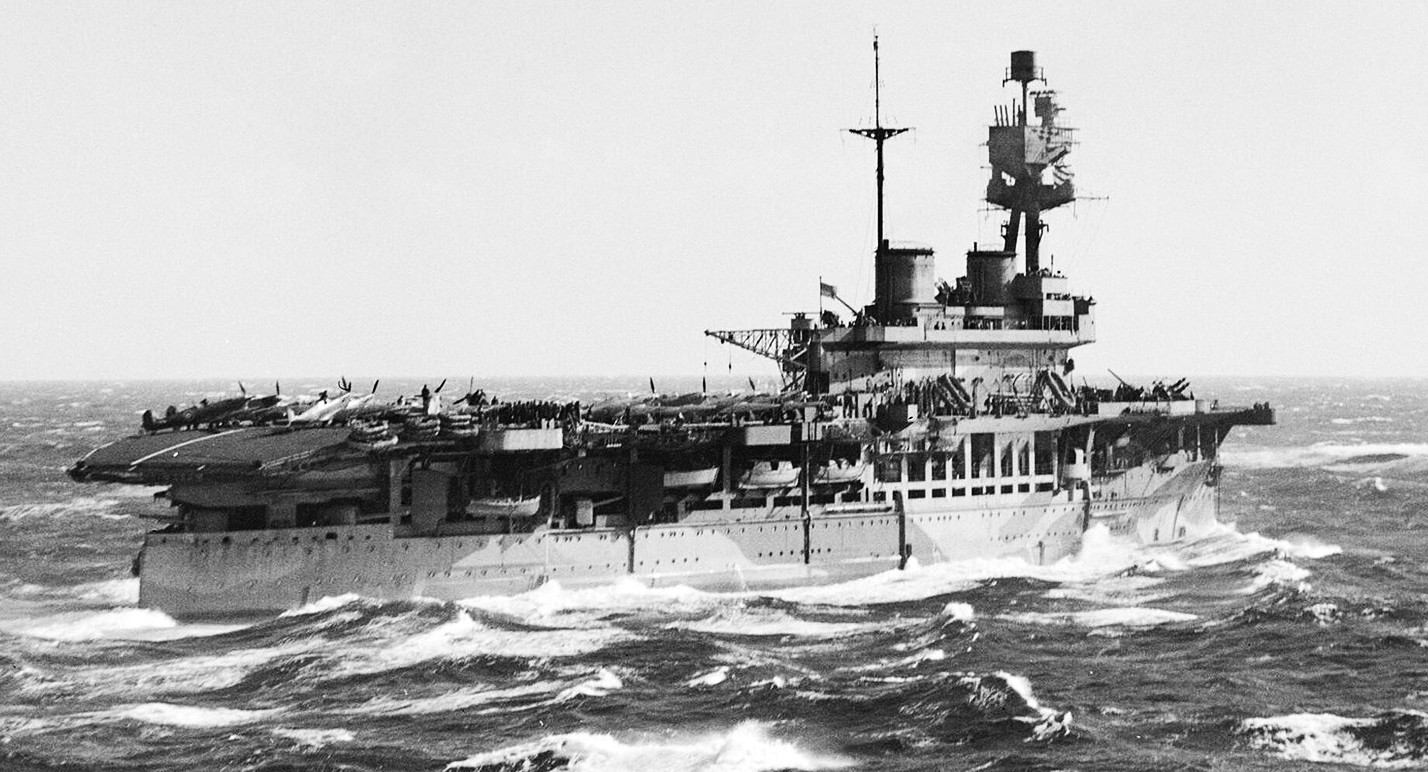
(IWM Photo, A 7840)
HMS Eagle in the Mediterranean during Operation ‘Spotter’, which delivered 16 RAF Spitfire Mk. Vs to Malta on 7 March 1942. HMS Eagle was serving with Force H in the Mediterranean. Supermarine Spitfires are ranged on the deck of HMS Eagle.
HMS Eagle, 22,600 tons, 24 knots,20 aircraft, 750 crew plus aircrew, laid down in 1920, lost: (Capt L DMackintosh), 11th August 1942, Western Mediterranean, north of Algiers, Algeria (38.05N, 03.02E) – torpedoed by German ‘U.73’ (Rosenbaum). Providing air cover for Gibraltar/Malta convoy ‘Pedestal’; 159 men lost out of a wartime crew of 1,160 (Casualty List) (Mediterranean – Malta Convoys).
HMS Eagle was an early aircraft carrier of the Royal Navy. Ordered by Chile during the South American dreadnought race as the Almirante Latorre-class battleship Almirante Cochrane, she was laid down before the First World War. In early 1918 she was purchased by Britain for conversion to an aircraft carrier; this work was finished in 1924. Her completion was delayed by labour troubles and the possibility that she might be repurchased by Chile for reconversion into a battleship, as well as the need for comparative trials to determine the optimum layout for aircraft carriers. The ship was initially assigned to the Mediterranean Fleet and later to the China Station, spending very little time in home waters other than for periodic refits.
Eagle spent the first nine months of the Second World War in the Indian Ocean searching for German commerce raiders. During the early part of the war, the Fleet Air Arm was desperately short of fighters and Eagle was equipped solely with Fairey Swordfish torpedo bombers until late 1940. She was transferred to the Mediterranean in May 1940, where she escorted convoys to Malta and Greece and attacked Italian shipping, naval units and bases in the Eastern Mediterranean. The ship also participated in the Battle of Calabria in July but her aircraft failed to score any hits when they attempted to torpedo Italian cruisers during the battle. Whenever Eagle was not at sea, her aircraft were disembarked and used ashore. The ship was relieved by a more modern carrier in March 1941 and ordered to hunt for Axis shipping in the Indian Ocean and the South Atlantic. Her aircraft sank a German blockade runner and disabled a German oil tanker in mid-1941 but did not find any other Axis ships before the ship was ordered home for a refit in October. After completing an extensive refit in early 1942, the ship made trips delivering fighter aircraft to Malta to boost its air defences in the first half of 1942. The German submarine U-73 torpedoed and sank Eagle on 11 August 1942 with 131 lives lost as the ship was escorting a convoy to Malta during Operation Pedestal. (Wikipedia)
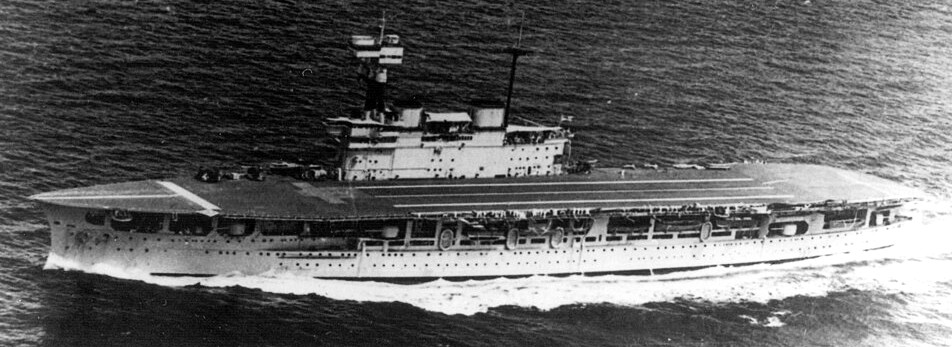
(RN Photo)
HMS Eagle.
HMS Hermes
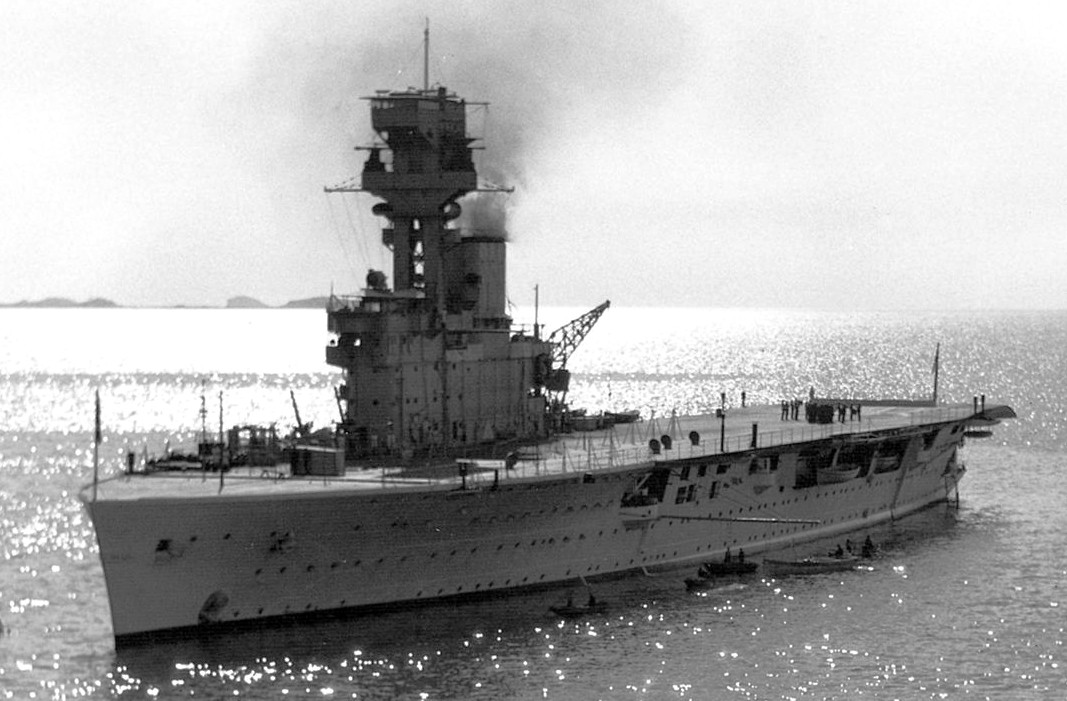
(USN Photo)
HMS Hermes (95) off Yantai China, c1931.
HMS Hermes, 10,800 tons, 25 knots,15 aircraft, 660 crew plus aircrew, laid down in 1923, lost: (Capt R F Onslow+), 9th April 1942, Indian Ocean off south east coast of Ceylon (07.35N,82.05E) – by Japanese carrier dive-bombers. Part of British Eastern Fleet returning to Trincomalee; 293 crew lost (Casualty List) (Japanese Conquests -Carrier Attacks on Ceylon).
HMS Hermes was a British aircraft carrier built for the Royal Navy and was the world’s first ship to be designed as an aircraft carrier, although the Imperial Japanese Navy’s Hōshō was the first to be commissioned.[2] The ship’s construction began during the First World War, but she was not completed until after the end of the war, having been delayed by multiple changes in her design after she was laid down. After she was launched, the Armstrong Whitworth shipyard which built her closed, and her fitting out was suspended. Most of the changes made were to optimise her design, in light of the results of experiments with operational carriers. Finally commissioned in 1924, Hermes served briefly with the Atlantic Fleet before spending the bulk of her career assigned to the Mediterranean Fleet and the China Station. In the Mediterranean, she worked with other carriers developing multi-carrier tactics. While showing the flag at the China Station, she helped to suppress piracy in Chinese waters. Hermes returned home in 1937 and was placed in reserve before becoming a training ship in 1938.
When the Second World War began in September 1939, the ship was briefly assigned to the Home Fleet and conducted anti-submarine patrols in the Western Approaches. She was transferred to Dakar in October to cooperate with the French Navy in hunting down German commerce raiders and blockade runners. Aside from a brief refit, Hermes remained there until the fall of France and the establishment of Vichy France at the end of June 1940. Supported by several cruisers, the ship then blockaded Dakar and attempted to sink the Richelieu by exploding depth charges underneath her stern, as well as sending Fairey Swordfish torpedo bombers to attack her at night. While returning from this mission, Hermes rammed a British armed merchant cruiser in a storm and required several months of repairs in South Africa, then resumed patrolling for Axis shipping in the South Atlantic and the Indian Ocean.In February 1941, the ship supported Commonwealth forces in Italian Somaliland during the East African Campaign and did much the same two months later in the Persian Gulf during the Anglo-Iraqi War. After that campaign, Hermes spent most of the rest of the year patrolling the Indian Ocean. She was refitted in South Africa between November 1941 and February 1942 and then joined the Eastern Fleet at Ceylon.
HMS Hermes was berthed in Trincomalee on 8 April when a warning of an Indian Ocean raid by the Japanese fleet was received, and she sailed that day for the Maldives with no aircraft on board. On 9 April a Japanese scout plane spotted her near Batticaloa, and she was attacked by several dozen dive bombers shortly afterwards. With no air cover, the carrier was quickly sunk by the Japanese aircraft. Most of the survivors were rescued by a nearby hospital ship, although 307 men from Hermes were lost in the sinking.The wreck of the ship was discovered in the Bay of Bengal some sixty years after she was sunk roughly 45 mile northeast of Batticaloa. Hermes is in water shallow enough to be visited by recreational divers and is frequently visited by tourists. (Wikipedia)
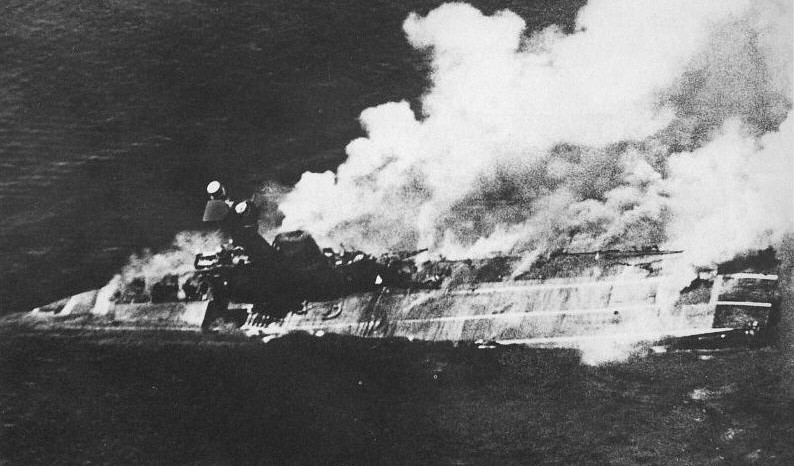
(IJNAF Photo)
HMS Hermes sinking after a Japanese carrier air attack on 9 April 1942. Photo taken from a Japanese aircraft.
HMS Furious
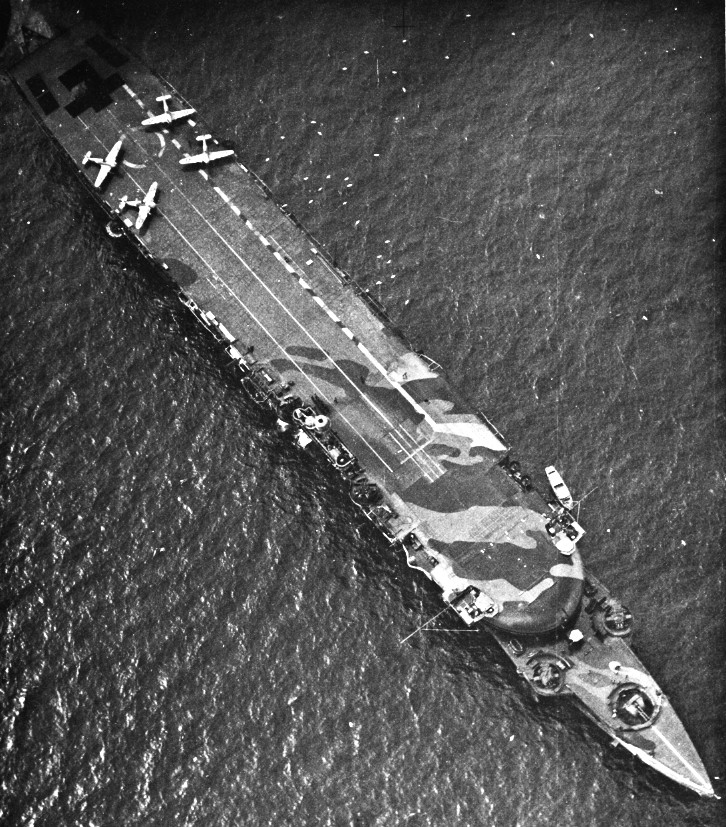
(UK MoD Photo)
Aerial view of HMS Furious in August 1941.
HMS Furious, 22,400 tons, 30 knots,36 aircraft, 1,200 crew, laid down in 1925.
HMS Furious was a modified Courageous-class battlecruiser built for the Royal Navy (RN) during the First World War. Designed to support the Baltic Project championed by the First Sea Lord, Lord Fisher, the ship was very lightly armoured and designed with a main battery of only two 18-inch (457 mm) guns. Furious was modified as an aircraft carrier while under construction. Her forward turret was removed and a flight deck was added in its place, such that aircraft had to manoeuvre around the superstructure to land. Later in the war, the ship had her rear turret removed and a second flight deck installed aft of the superstructure, but this was less than satisfactory due to air turbulence. Furious was briefly laid up after the war before she was reconstructed with a full-length flight deck in the early 1920s. Her half-sisters Courageous and Glorious were also rebuilt as aircraft carriers around that time.
After her conversion, Furious was used extensively for trials of naval aircraft, and later as a training ship once large, modern fleet carriers such as Ark Royal entered service in the 1930s. During the early months of the Second World War, the carrier spent her time hunting for German raiders in the North Atlantic and escorting convoys. This changed dramatically during the Norwegian Campaign in early 1940, when her aircraft provided air support to British troops ashore in addition to attacking German shipping. The first of what would be numerous aircraft ferry missions was made by the carrier during the campaign. After the withdrawal of British troops in May, Furious made several anti-shipping strikes in Norway with little result before beginning a steady routine of ferrying aircraft for the Royal Air Force. At first, Furious made several trips to West Africa, but she began to ferry aircraft to Gibraltar in 1941. An unsuccessful attack on German-occupied ports on the Arctic Ocean interrupted the ferry missions in mid-1941. Furious was given a lengthy refit in the United States and spent a few months training after her return in April 1942. She made several more ferry trips in mid-1942 before her aircraft attacked airfields in Vichy French Algeria as part of the opening stages of Operation Torch in November 1942. The ship remained in the Mediterranean until February 1943 when she was transferred to the Home Fleet.Furious spent most of 1943 training, but made a number of attacks on the German battleship Tirpitz and other targets in Norway during the first half of 1944. By September 1944, the ship was showing her age and she was placed in reserve. Furious was decommissioned in April 1945, but was not sold for scrap until 1948. (Wikipedia)
Courageous-class, Courageous, Glorious, 2 ships – 22,500 tons, 30 knots, 48 aircraft, 1,200 crew, laid down in 1928/30, both lost:
HMS Courageous
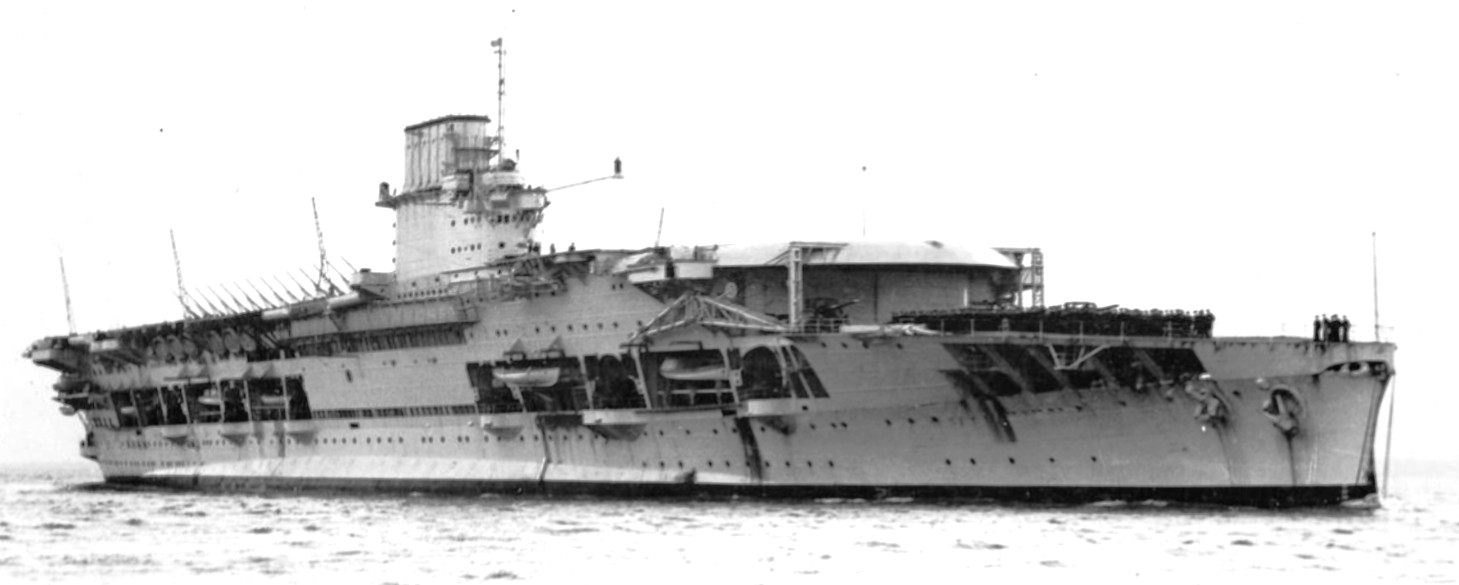
(IWM Photo, Q 65672)
HMS Courageous, 1935.
HMS Courageous (Capt W T Makeig-Jones+), 17th September 1939, North Atlantic, south west of Ireland (50.10N, 14.45W) – torpedoed by German ‘U.29’ (Schuhart). On anti-U-boat patrol with destroyer screen in Western Approaches to British Isles; 520 men including36 RAF personnel lost (Casualty List) (Battle of the Atlantic).
HMS Courageous was the lead ship of her class of three battlecruisers built for the Royal Navy in the First World War. Designed to support the Baltic Project championed by First Sea Lord John Fisher, the ship was very lightly armoured and armed with only a few heavy guns. Courageous was completed in late 1916 and spent the war patrolling the North Sea. She participated in the Second Battle of Heligoland Bight in November 1917 and was present when the German High Seas Fleet surrendered a year later. Courageous and Glorious were decommissioned after the war and laid up, then rebuilt as aircraft carriers in the mid-1920s. Courageous and Glorious could carry 48 aircraft, compared with 36 carried by their half-sister Furious with about the same displacement. After recommissioning, Courageous spent most of her career operating off Great Britain and Ireland. She briefly became a training ship, but reverted to her normal role a few months before the start of the Second World War in September 1939. Later that month, German U-boat torpedoed Courageous which sank with the loss of more than 500 of her crew. (Wikipedia)
HMS Glorious
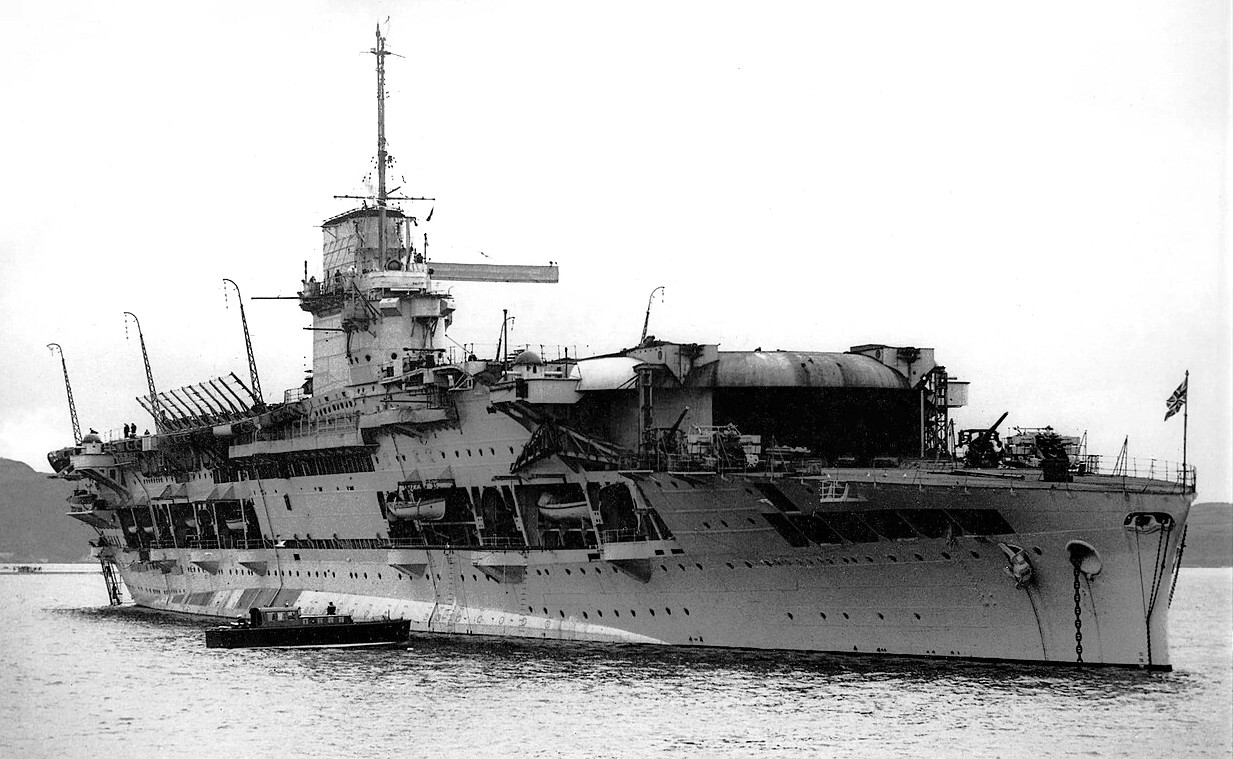
(IWM Photo, FL 22991)
HMS Glorious at anchor in Plymouth Sound, 1935.
HMS Glorious (Capt G D’Oyly-Hughes+), 8th June 1940, Western Europe, west of Lofoten Islands in Norwegian Sea (c69.00N, 05.00E) – by 11-in gunfire of German battlecruisers ‘Scharnhorst‘ and ‘Gneisenau’. Sailing independently from northern Norway at the end of the Allied evacuation; 1,159 crew and 59 RAF personnel sailing from Norway were lost. There were 39 RN and 3 RAF survivors, of whom 3 died. Escorting destroyers Acasta and Ardent were also sunk (Casualty List) (Norwegian Archives)
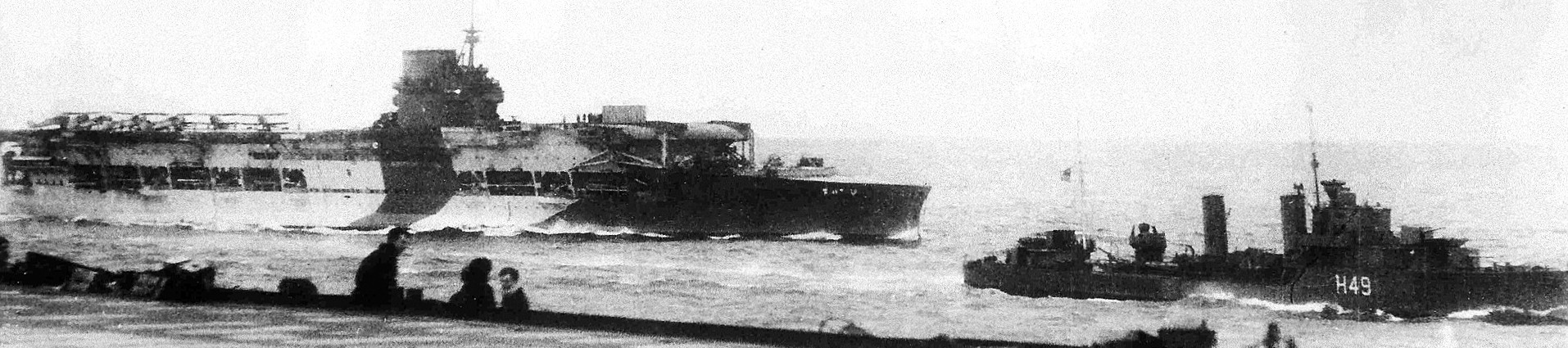
(U.S. Naval Historical Photograph No. NH60793)
HMS Glorious photographed in May 1940 from the deck of HMS Ark Royal, the destroyer with her is HMS Diana.
HMS Glorious was the second of the three Courageous-class battlecruisers built for the Royal Navy during the First World War. Designed to support the Baltic Project championed by the First Sea Lord, Lord Fisher, they were relatively lightly armed and armoured. Glorious was completed in late 1916 and spent the war patrolling the North Sea. She participated in the Second Battle of Heligoland Bight in November 1917 and was present when the German High Seas Fleet surrendered a year later. Glorious was paid off after the war, but was rebuilt as an aircraft carrier during the late 1920s. She could carry 30 per cent more aircraft than her half-sister Furious which had a similar tonnage. After re-commissioning in 1930, she spent most of her career operating in the Mediterranean Sea. After the start of the Second World War in 1939, Glorious spent the rest of the year hunting for the commerce-raiding German cruiser Admiral Graf Spee in the Indian Ocean before returning to the Mediterranean. She was recalled home in April 1940 to support operations in Norway. While evacuating British aircraft from Norway in June, the ship was sunk by the German battleships Scharnhorst and Gneisenau in the North Sea with the loss of over 1,200 lives. (Wikipedia)
HMS Ark Royal
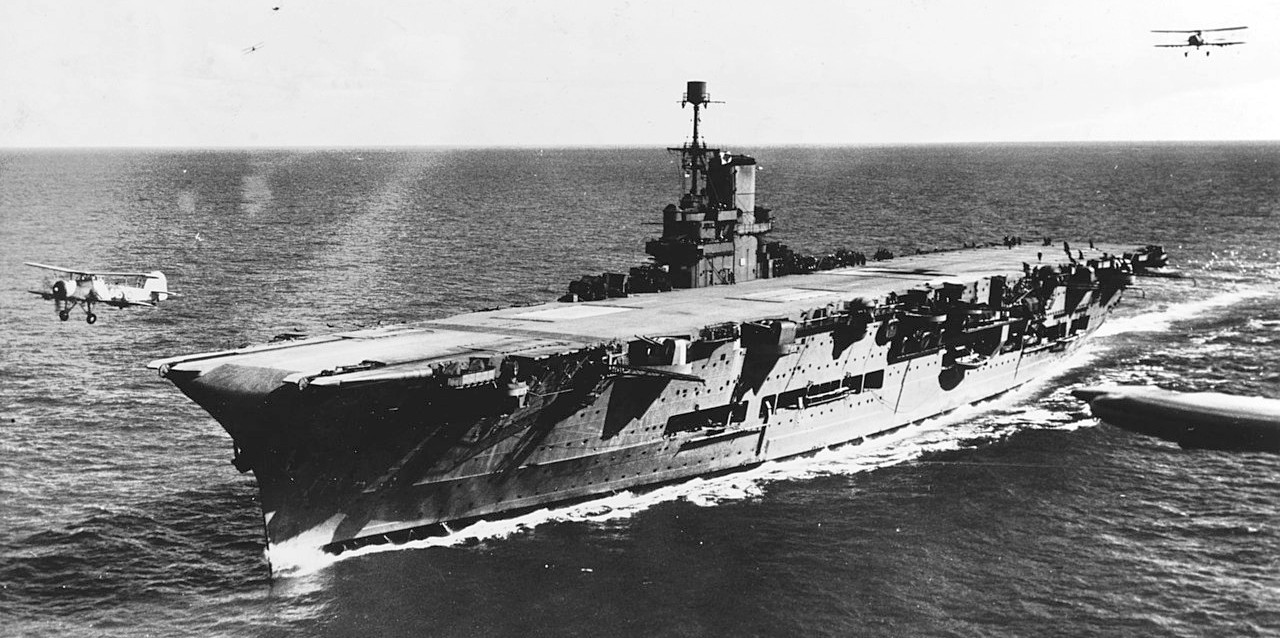
(USN Photo)
Royal Navy aircraft carrier HMS Ark Royal (91) c1939. A Fairey Swordfish aircraft is taking off as another approaches from astern.
HMS Ark Royal, 22,000 tons, 31knots, 60 aircraft, 1,570 crew, laid down in 1938, lost: (Capt L E Maund), 14th November 1941, foundered while under tow in the Western Mediterranean, 30 miles east of Gibraltar – by 1 torpedo on the 13th from German ‘U.81’ (Guggenberger) in 36.03N, 04.45W. Returning with Force H to Gibraltar after ferrying Hurricane fighters within flying range of Malta; 1 man killed. (Casualty List) (Mediterranean – Battle for Malta).
HMS Ark Royal (pennant number 91) was an aircraft carrier of the Royal Navy that was operated during the Second World War. Designed in 1934 to fit the restrictions of the Washington Naval Treaty, Ark Royal was built by Cammell Laird at Birkenhead, England, and completed in November 1938. Her design differed from previous aircraft carriers. Ark Royal was the first ship on which the hangars and flight deck were an integral part of the hull, instead of an add-on or part of the superstructure. Designed to carry a large number of aircraft, she had two hangar deck levels. She was used during a period that first saw the extensive use of naval air power; several carrier tactics were developed and refined aboard Ark Royal.
Ark Royal operated in some of the most active naval theatres of the Second World War. She was involved in the first aerial U-boat kills of the war, operations off Norway, the search for the German battleship Bismarck, and the Malta Convoys. Ark Royal survived several near misses and gained a reputation as a ‘lucky ship’. She was torpedoed on 13 November 1941 by the German submarine U-81 and sank the following day. One of her 1,488 crew members was killed. Witnesses reported the carrier rolling to 90°, where she remained for three minutes before inverting. Ark Royal then broke in two, the aft sinking within a couple of minutes, followed by the bow.
Her sinking was the subject of several inquiries, with investigators keen to know how the carrier was lost in spite of efforts to save the ship and tow her to the naval base at Gibraltar. They found that several design flaws contributed to the loss, which were rectified in new British carriers. The wreck was discovered in December 2002 by an American underwater survey company using sonar mounted on an autonomous underwater vehicle, under contract from the BBC for the filming of a documentary about the ship, at a depth of about 3,300 feet (1,000 m) and approximately 30 nautical miles (56 km; 35 mi) from Gibraltar. (Wikipedia)
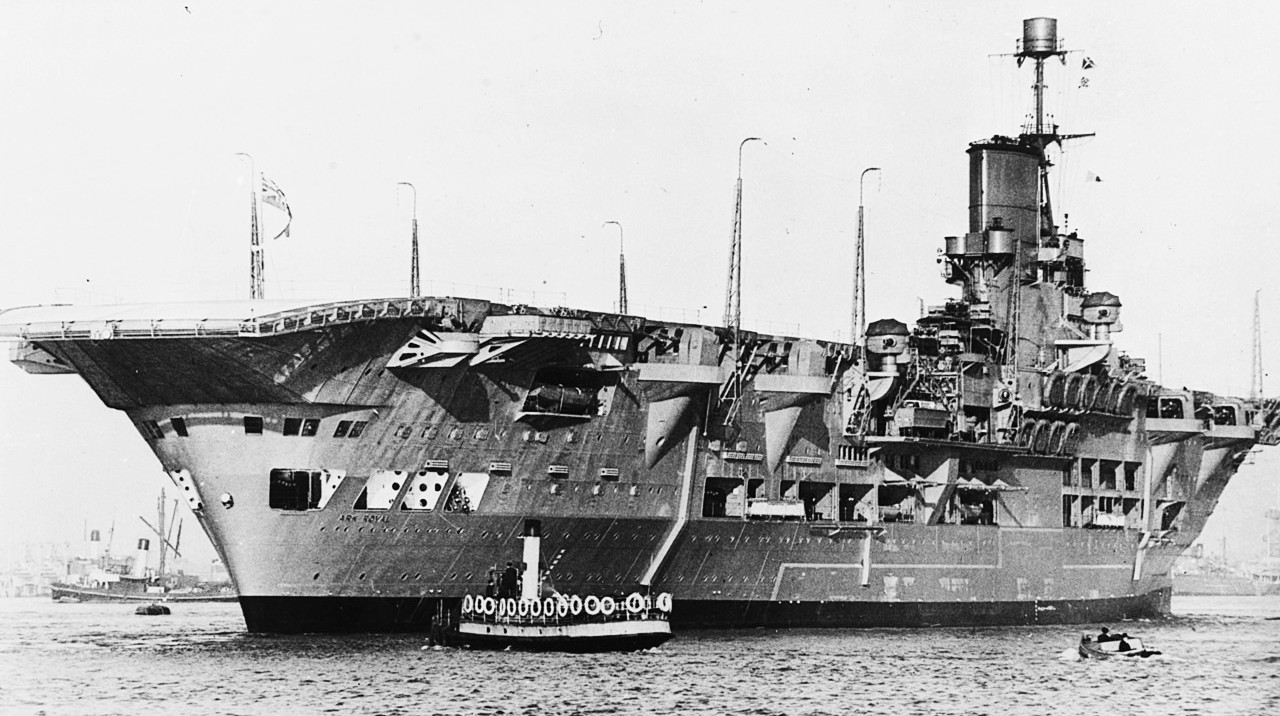
(USN Photo)
Royal Navy aircraft carrier HMS Ark Royal (91) photographed soon after completion, circa late 1938 or early 1939.
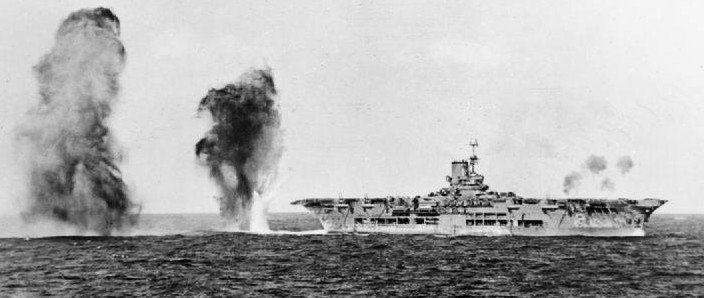
(IWM Photo, A2298)
Bombs falling astern of HMS Ark Royal (91) during an attack by Italian aircraft during the Battle of Cape Spartivento The photograph was taken from the cruiser HMS Sheffield (C24). 27 Nov 1940.
The Hunt for the Bismarck
On 18 May 1941, the German battleship Bismarck and heavy cruiser Prinz Eugen began Operation Rheinübung by breaking into the Atlantic to raid shipping. After sinking the battlecruiser Hood and damaging the battleship Prince of Wales during the Battle of the Denmark Strait, Bismarck shook off her pursuers and headed for the French Atlantic coast. Ark Royal, Renown, and Sheffield—accompanied by destroyers Faulknor, Foresight, Forester, Fortune, Foxhound, and Fury—were dispatched to the Atlantic on 23 May to search for the battleship. On 26 May, a Swordfish from Ark Royal located Bismarck and began to shadow her, while the Home Fleet was mobilised to pursue.One of Ark Royal’s Fairey Swordfish returns at low level over the sea after making a torpedo attack on Bismarck.
At the time of detection, the British ships were 130 nmi (240 km; 150 mi) away and would not catch Bismarck before she reached Saint-Nazaire, putting her safely under the air cover of the Luftwaffe once in range and while being repaired at the Normandie drydock. Fifteen Swordfish bombers were armed with torpedoes and sent to delay the ship. Sheffield, also shadowing Bismarck, was between Ark Royal and Bismarck. The aircraft mistook the British cruiser for their target and fired torpedoes. The torpedoes were fitted with unreliable magnetic detonators, which caused most to explode on contact with the water, while Sheffield evaded the rest. After realising his mistake, one of the pilots signalled ‘Sorry for the kipper’ to Sheffield.
On return to the carrier, the Swordfish were re-armed with contact-detonator warhead torpedoes, and launched at 19:15 for a second attack; locating and attacking Bismarck just before sunset. Three torpedoes hit the battleship: two detonated forward of the engine rooms, while the third struck the starboard steering compartment and jammed her rudder in a 15° port turn. Bismarck was forced to sail in circles until a combination of alternating propeller speeds was found which would keep her on a reasonably steady course which, in the prevailing force 8 wind and sea state, forced her to sail towards the British warships with almost no manoeuvring capability.[88] The German battleship was harassed by British destroyers during the night of 26–27 May and suffered heavy attack the next morning, finally sinking at 10:39 hours on 27 May. (Wikipedia)

(IWM Photo, A6329)
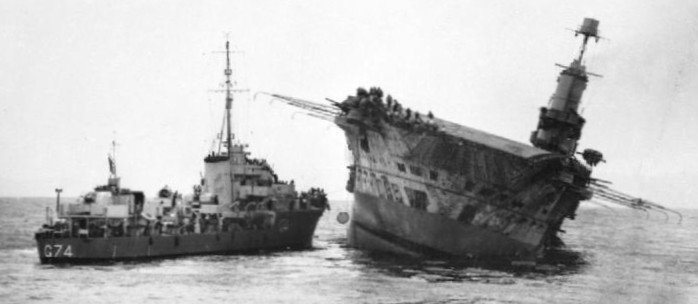
HMS Ark Royal sinking after being torpedoed by U-81. HMS Legion is alongside taking off survivors, 13 Nov 1941.
(IWM Photo, A6332)
HMS Legion and HMS Ark Royal, 13 Nov 1941.
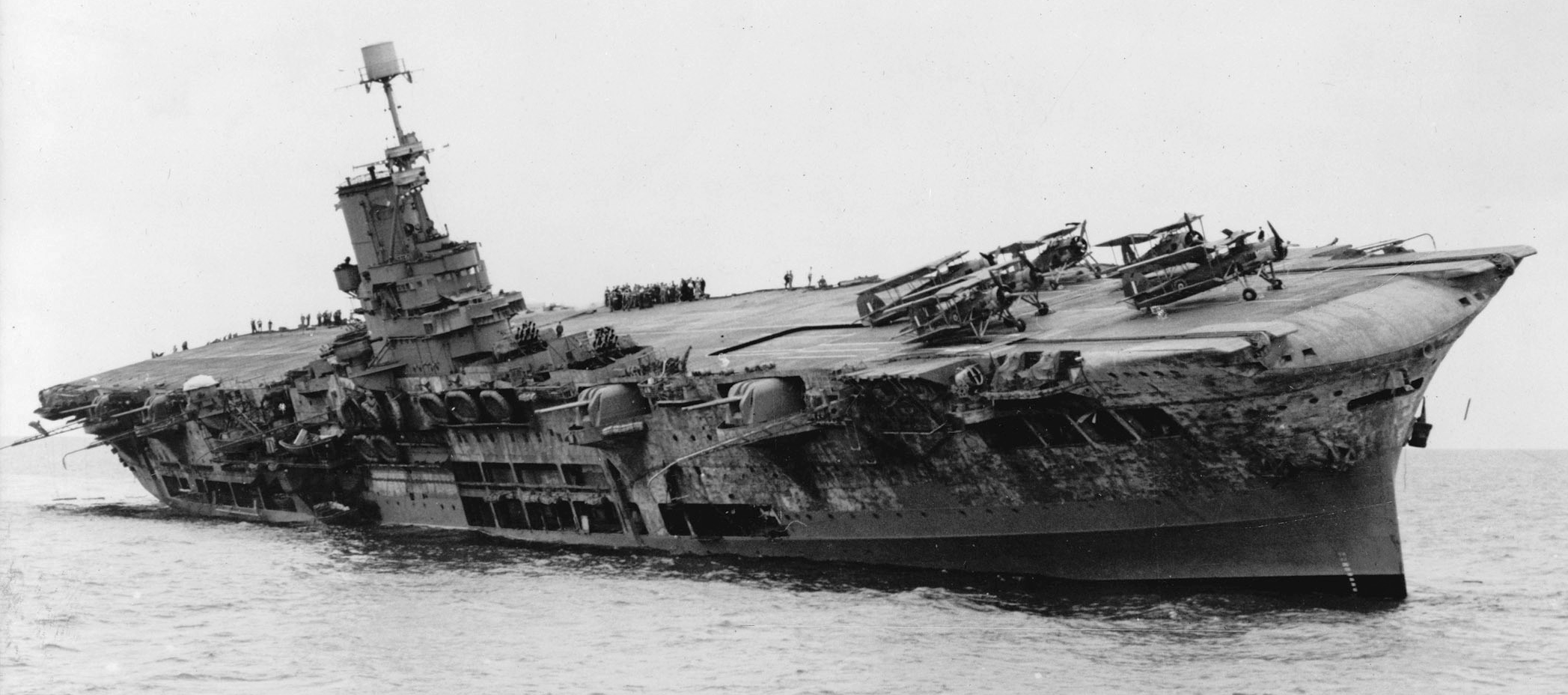
(IWM Photo)
HMS Ark Royal, after being torpedoed by the German submarine U-81, 13 Nov 1941.
Illustrious-class, Formidable, Illustrious, Implacable, Indefatigable, Indomitable, Victorious,6 ships – 23,000 tons, 31 knots, 36+ aircraft, 1,400 crew, laid down 1940-44.
HMS Formidable
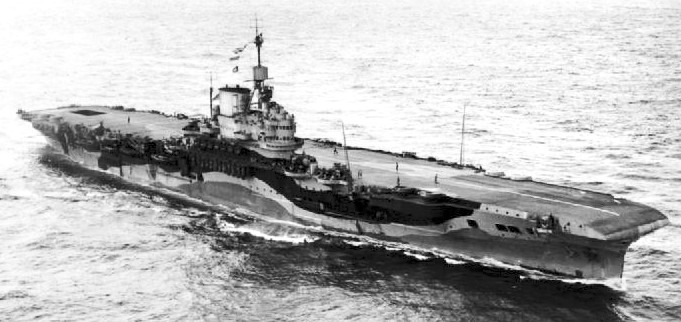
(IWM Photo, A 11660)
HMS Formidable underway, 3 August 1942.
HMS Formidable was an Illustrious-class aircraft carrier ordered for the Royal Navy before the Second World War. After being completed in late 1940, she was briefly assigned to the Home Fleet before being transferred to the Mediterranean Fleet as a replacement for her crippled sister ship Illustrious. Formidable’s aircraft played a key role in the Battle of Cape Matapan in early 1941, and they subsequently provided cover for Allied ships and attacked Axis forces until their carrier was badly damaged by German dive bombers in May.
Assigned to the Eastern Fleet in the Indian Ocean in early 1942, Formidable covered the invasion of Diego Suarez in Vichy Madagascar in mid-1942 against the possibility of a sortie by the Japanese into the Indian Ocean. Formidable returned home for a brief refit before participating in Operation Torch, the invasion of French North Africa in November. She remained in the Mediterranean and covered the invasions of Sicily and mainland Italy in 1943 before beginning a lengthy refit. Formidable made several attacks on the German battleship Tirpitz in Norway in mid-1944 as part of the Home Fleet. She was subsequently assigned to the British Pacific Fleet (BPF) in 1945 where she played a supporting role during the Battle of Okinawa and later attacked targets in the Japanese Home Islands. The ship was used to repatriate liberated Allied prisoners of war and soldiers after the Japanese surrender and then ferried British personnel across the globe through 1946. She was placed in reserve the following year and sold for scrap in 1953. (Wikipedia)
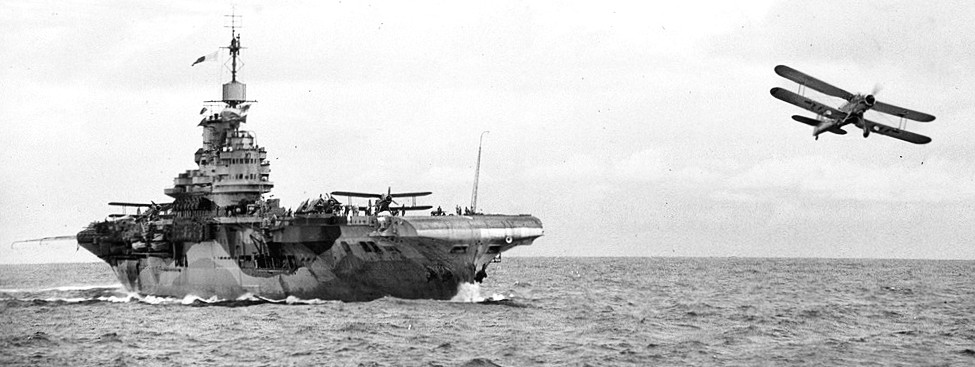
(IWM Photo, A 10657)
Fairey Albacores of No. 820 Squadron Fleet Air Arm from HMS Formidable in the Indian Ocean. One of the aircraft has just flown off the aircraft carrier whilst two more can be seen on deck.
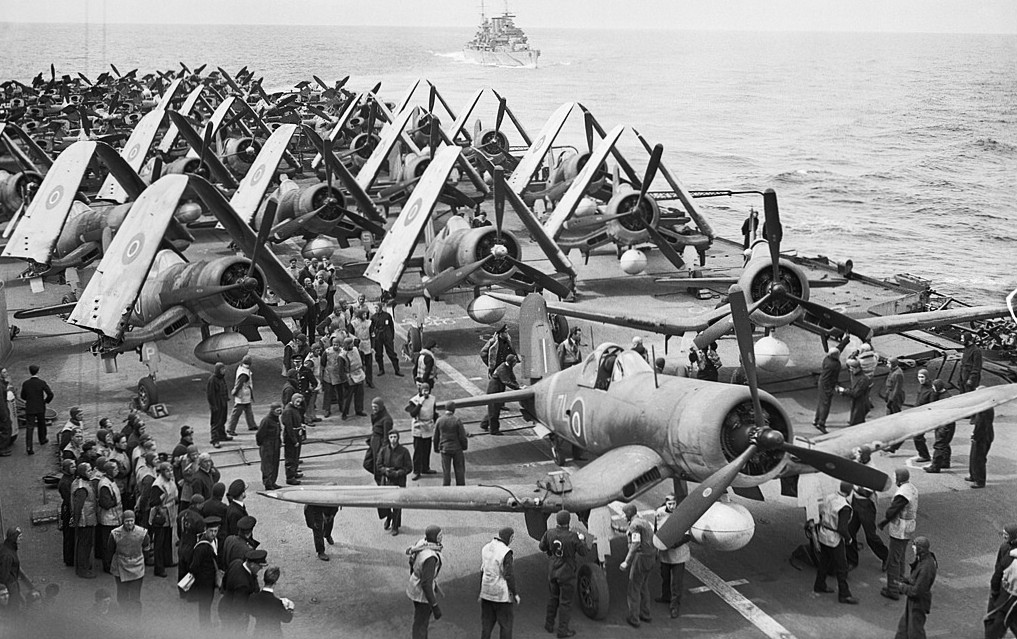
(IWM Photo, A 24787)
Fleet Air Arm Chance-Vought Corsair fighters, with Fairey Barracuda torpedo bombers behind, ranged on the flight deck of HMS Formidable, off Norway, July 1944.
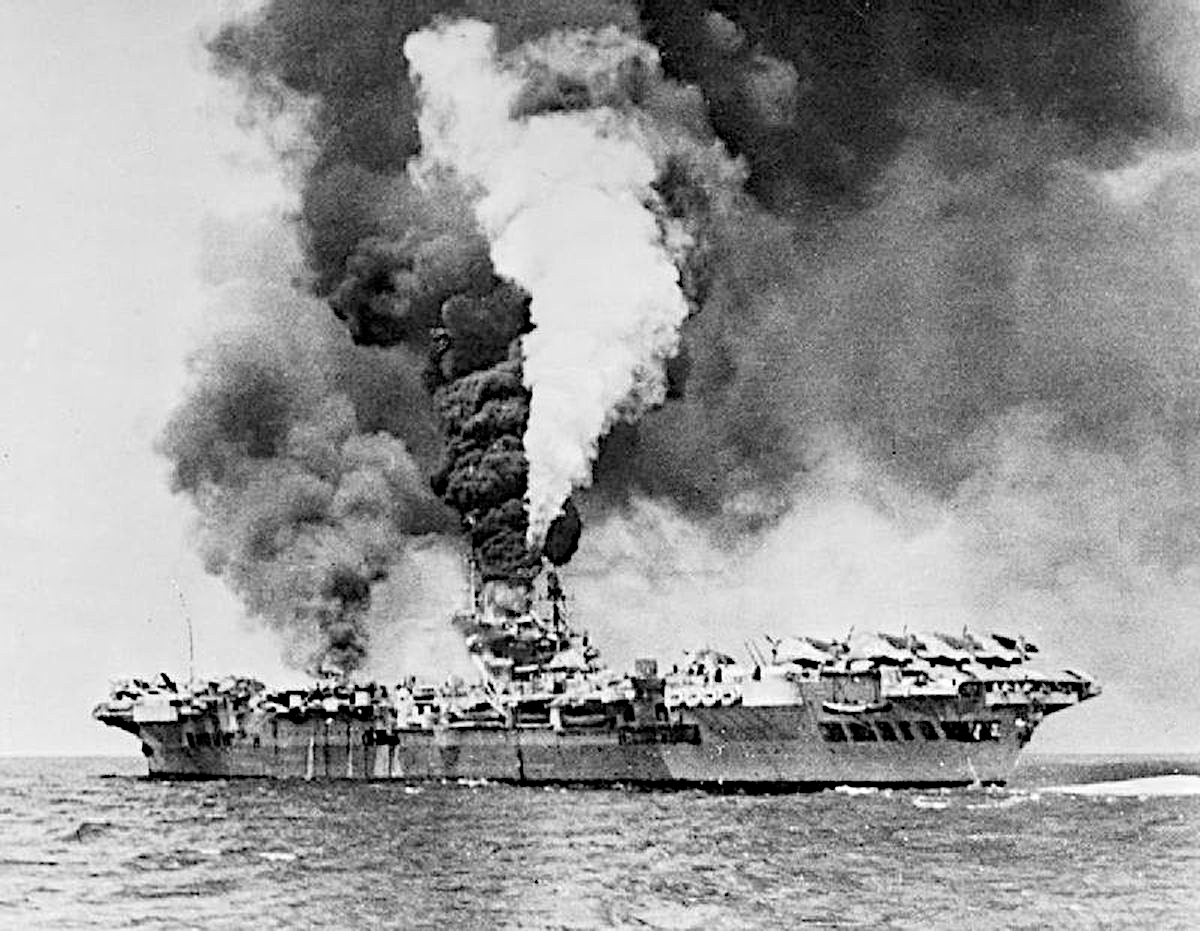
(IWM Photo)
The aircraft carrier HMS Formidable (R67) on fire after being struck by a Kamikaze off Sakishima Gunto. Formidable was hit at 1130 hrs, the kamikaze making a massive dent about 3 m long, 0.6 m wide and deep in the armoured flight deck. A large steel splinter speared down through the hangar deck and the centre boiler-room, where it ruptured a steam line, and came to rest in a fuel tank, starting a major fire in the aircraft park. Eight crew members were killed and forty-seven were wounded. One Vought Corsair and ten Grumman Avengers were destroyed.
British, Commonwealth, and Dutch nations taking part in the war in the Pacific theatre
Brian Walter wrote the following:
Regarding the activation of the British Pacific Fleet in November 1944, I will start by fully acknowledging that the United States was overwhelmingly the dominant player in the naval/air war against Japan. As documented in my book, Forgotten War, American ships, submarines, mines and aircraft accounted for more than 90 percent of the Japanese warships and merchant vessels sunk during this contest. Still, while fully acknowledging America’s dominant position in the Asia/Pacific theatre, it is also reasonable to recognise the contributions made by the other Allied nations in helping bring about the defeat of Japan.
In terms of the maritime contest, British and Commonwealth forces sank or participated in the destruction of 42 principal Japanese warships during the course of the war. This British/Commonwealth contribution (either solely or partially) accounted for 5.4 percent of all Japanese principal warship losses. Some highlights of this included the contributions made by the Australian cruiser Shropshire and destroyer Arunta in destroying the Japanese battleship Yamashiro during the battle of Surigao Strait. In other joint actions, British and Commonwealth air and naval units also participated with American forces in destroying the Japanese cruisers Jintsū and Isuzu in 1943 and 1945 respectively. Meanwhile, British submarines sank the Japanese cruisers Kuma and Ashigara in conventional attacks in 1944 and 1945 while British XE-craft midget submarines rendered the cruiser Takao, a total loss in Singapore harbour during this latter year. Likewise, in the last major naval surface action of the war, British destroyers sank the Japanese cruiser Haguro off Penang. Finally, in July and August 1945 British aircraft carriers launched a series of air strikes against the Japanese home islands that destroyed some 50,000 tons of Japanese military and commercial shipping including the auxiliary escort carrier Shimane Maru and 11 lesser warships.
British and Commonwealth forces were also responsible for the loss of at least 56 Japanese merchant ships (of 500 tons or greater) worth 138,529 tons and contributed to the destruction of a further 11 merchant ships worth 56,931 tons. Added to this were several hundred minor craft worth at least 100,000 tons along with further ships (ranging from 25,000 to 100,000 tons) that were likely sunk by British or Commonwealth means. Finally, Dutch forces, which usually operated under British or Australian control, added at least another 16 Japanese merchant ships worth 62,594 tons to this total. When added together, these British, Commonwealth and Dutch successes accounted for about 4 percent of Japan’s total merchant shipping losses of vessels of 500 tons or greater accrued during the war. While clearly minor compared to the American record, these results were not inconsequential.
Beyond these direct results, Britain’s greatest contribution to the maritime conflict in the Asia/Pacific theatre was the fact that it shouldered most of the burden in fighting the Germans and Italians in the Atlantic and Mediterranean. By doing so, the British essentially freed the United States to devote most of its naval strength in combatting the Japanese. Thus, to those critics who claim that the Royal Navy was late in joining the Asia/Pacific conflict, this was only because it was engaged in more pressing (and quite frankly more important) duties in the other theatres. The successful execution of these duties not only benefitted Britain, but was essential in facilitating the entire Allied war effort.
This British role was particularly relevant in the struggle in the Atlantic, which constituted the war’s premier maritime contest in terms of its size, duration and relevance and was the most important military campaign waged by the Western Allies. One example of the scale of this conflict is the fact that the Germans lost more principal warships in the Atlantic theatre alone than did all of the combatants in the Asia/Pacific war combined. Of these German losses, British and Commonwealth forces solely or partially accounted for 100 percent of their capital ships, 75 percent of their cruisers, 86 percent of their destroyers, 75 percent of their torpedo boats and escort destroyers, 86 percent of their fleet minesweepers, 77 percent of their U-boats and 73 percent of their merchant and commercial vessels. The British enjoyed similar success against the Italians accounting for 86 percent of Italy’s principal warship losses during their time as an Axis partner.
These statistics clearly indicate the prevailing role that British maritime power played in the naval contests against Germany and Italy, and it was this regional British predominance that allowed the Americans to dedicate most of their naval strength against the Japanese. Thus, while Britain’s direct contributions to the naval contest in the Asia/Pacific theatre were limited, it was this indirect contribution of carrying the burden in the Atlantic and Mediterranean that had the greatest British impact on the Asia/Pacific contest as well as the entire Allied war effort.
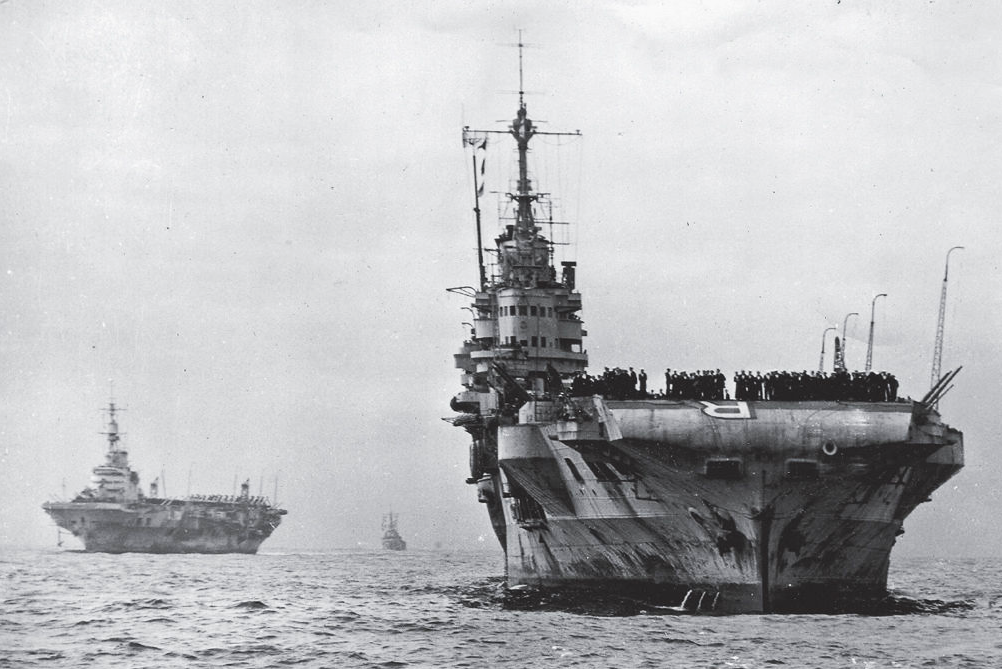
(Royal Navy Photo)
HMS Formidable and HMS Implacable, operating as part of the British Pacific Fleet, 24 Aug 1945. HMS Victorious also took part in operations against Japan in July 1945. Prior to their deployments to the Far East, all three of these aircraft carriers saw extensive action in the European conflict with HMSVictorious and HMS Formidable serving in both the Atlantic and Mediterranean while the more recently commissioned HMS Implacable operated in the waters off northern Europe. For more information on this and other related topics, see Forgotten War, the British Empire and Commonwealth’s Epic Struggle Against Imperial Japan, 1941-1945.
HMS Illustrious
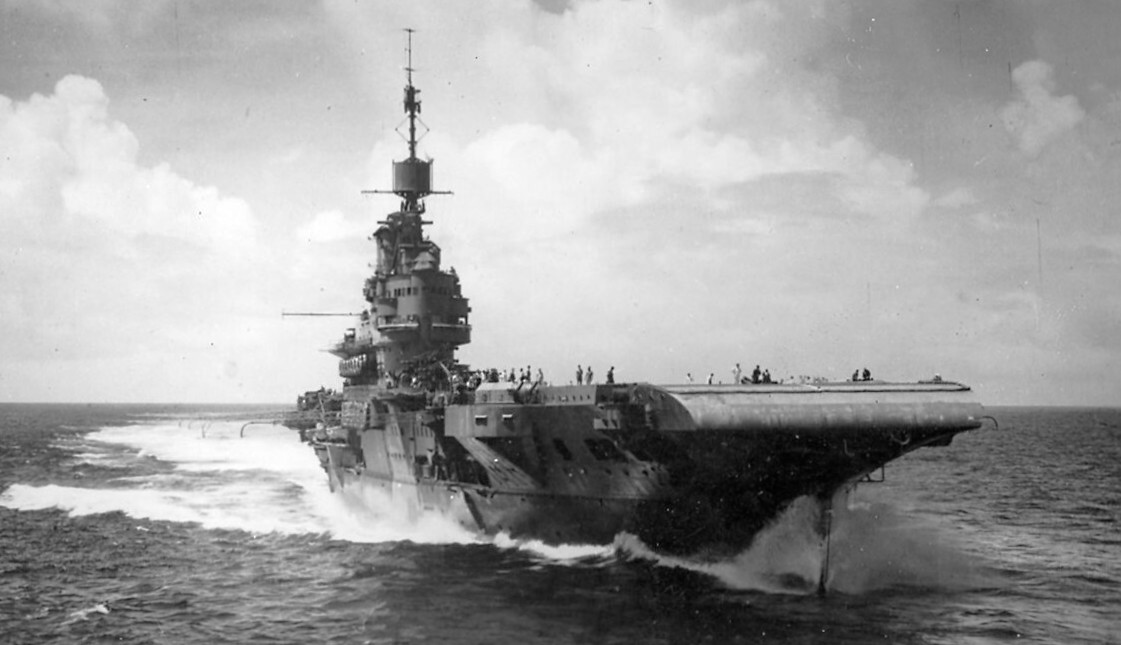
(USN Photo)
HMS Illustrious (87) at sea in the Indian Ocean between 27 March and 18 May 1944, while operating with the U.S. Navy carrier USS Saratoga (CV-3).
HMS Illustrious was the lead ship of her class of aircraft carriers built for the Royal Navy before the Second World War. Her first assignment after completion and working up was with the Mediterranean Fleet, in which her aircraft’s most notable achievement was sinking one Italian battleship and badly damaging two others during the Battle of Taranto in late 1940. Two months later the carrier was crippled by German dive bombers and was repaired in the United States. After sustaining damage on the voyage home in late 1941 by a collision with her sister ship Formidable, Illustrious was sent to the Indian Ocean in early 1942 to support the invasion of Vichy French Madagascar (Operation Ironclad). After returning home in early 1943, the ship was given a lengthy refit and briefly assigned to the Home Fleet. She was transferred to Force H for the Battle of Salerno in mid-1943 and then rejoined the Eastern Fleet in the Indian Ocean at the beginning of 1944. Her aircraft attacked several targets in the Japanese-occupied Dutch East Indies over the following year before Illustrious was transferred to the newly formed British Pacific Fleet (BPF). The carrier participated in the early stages of the Battle of Okinawa until mechanical defects arising from accumulated battle damage became so severe she was ordered home early for repairs in May 1945.
The war ended while she was in the dockyard and the Admiralty decided to modify her for use as the Home Fleet’s trials and training carrier. In this role she conducted the deck-landing trials for most of the British post-war naval aircraft in the early 1950s. She was occasionally used to ferry troops and aircraft to and from foreign deployments as well as participating in exercises. In 1951, she helped to transport troops to quell rioting in Cyprus after the collapse of the Anglo-Egyptian treaty of 1936. She was paid off in early 1955 and sold for scrap in late 1956. (Wikipedia)
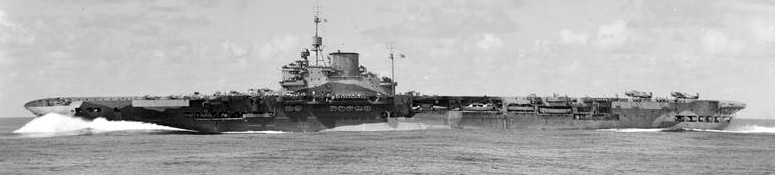
(IWM Photo, A 13452)
HMS Illustrious (87) at sea.
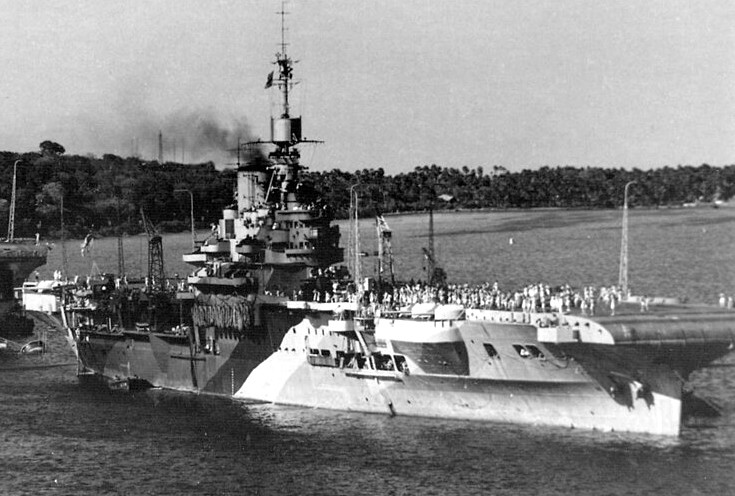
(USN Photo)
HMS Illustrious (87), possibly at Trincomalee, Ceylon, in 1944.
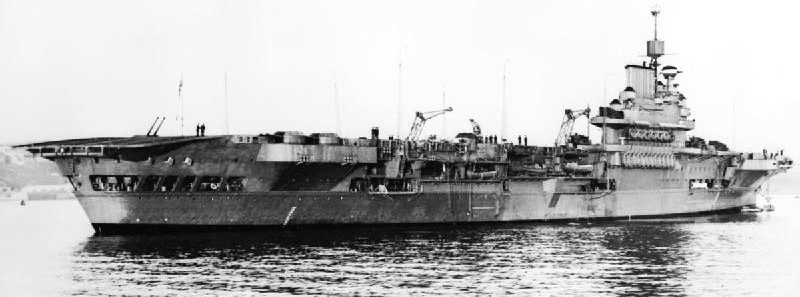
(IWM Photo, FL 2425)
HMS Illustrious at anchor, 1940.
HMS Implacable
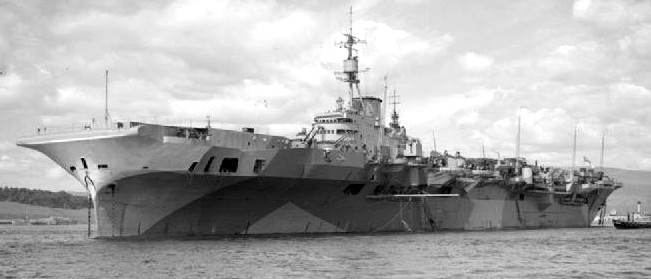
(IWM Photo, A 24112)
HMS Implacable at anchor in Greenock, 14 June 1944.
HMS Implacable was the name ship of her class of two aircraft carriers built for the Royal Navy during the Second World War. Upon completion in 1944, she was initially assigned to the Home Fleet and attacked targets in Norway for the rest of the year. She was subsequently assigned to the British Pacific Fleet (BPF) where she attacked the Japanese naval base at Truk and targets in the Japanese Home Islands in 1945. The ship was used to repatriate liberated Allied prisoners of war (PoWs) and soldiers after the Japanese surrender, for the rest of the year. Implacable returned home in 1946 and became the Home Fleet’s deck-landing training carrier, a role that lasted until 1950. She briefly served as flagship of the Home Fleet in 1950. During this time she participated in many exercises and made a number of port visits in Western Europe. She was placed in reserve in 1950 and converted into a training ship in 1952, and served as flagship of the Home Fleet Training Squadron. The ship was considered for a major modernisation in 1951–1952, but this was rejected as too expensive and time-consuming. Implacable was decommissioned in 1954 and sold for scrap the following year. (Wikipedia)
(IWM Photo, A 26648)
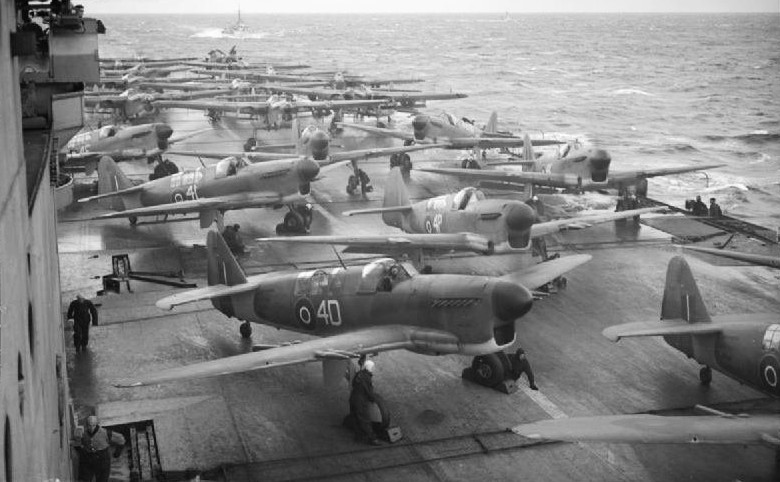
Fairey Fireflies (1771 Squadron), Fairey Barracudas (828 Squadron), and Supermarine Seafires (880 Squadron) of the Fleet Air Arm on the flight deck of HMS Implacable (R86) warming up ready to make strike on enemy shipping at the entrance to Alten Fjord, Norway, 26 Nov 1944.
HMS Indefatigable
(IWM Photo, A 21197)
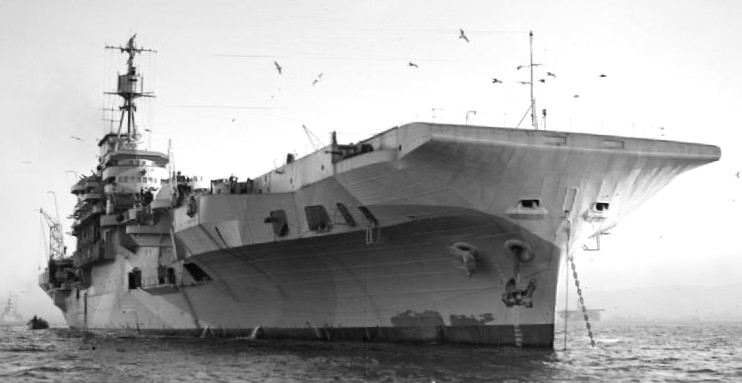
HMS Indefatigable was one of two Implacable-class aircraft carriers built for the Royal Navy (RN) during the Secon World War. Completed in 1944, her aircraft made several attacks that year against the German battleship Tirpitz, inflicting only light damage; they also raided targets in Norway. The ship was transferred to the British Pacific Fleet (BPF) at the end of the year and attacked Japanese-controlled oil refineries in Sumatra in January 1945 before joining the American forces in March as they prepared to invade the island of Okinawa in Operation Iceberg. Indefatigable and the BPF joined the Americans in attacking the Japanese Home Islands in July and August. Following the end of hostilities she visited ports in Australia, New Zealand and South Africa.
After returning to the UK in early 1946, Indefatigable was modified for transport duties, and ferried troops and civilians for the rest of the year before she was reduced to reserve. She was recommissioned in 1950 as a training ship for service with the Home Fleet Training Squadron, participating in exercises and making several port visits overseas. The Board of Admiralty decided that she was redundant in early 1954 and decommissioned her later that year. Indefatigable was sold for scrap the following year. (Wikipedia)
(National Library New Zealand Photo)
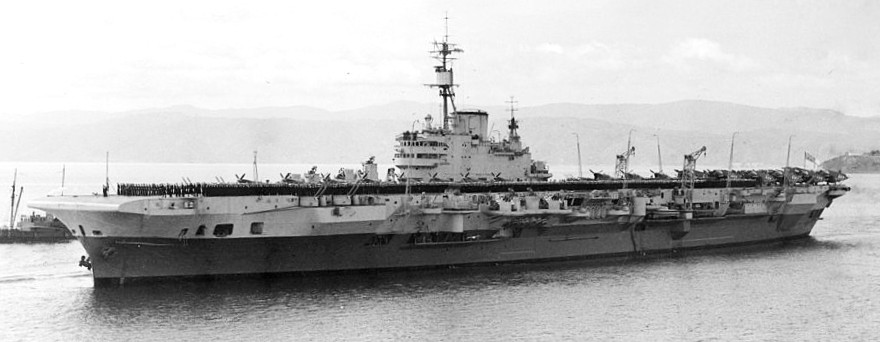
HMS Indefatigable, Wellington Harbour, 1 November 1945.
HMS Indomitable
(IWM Photo, FL 6374)
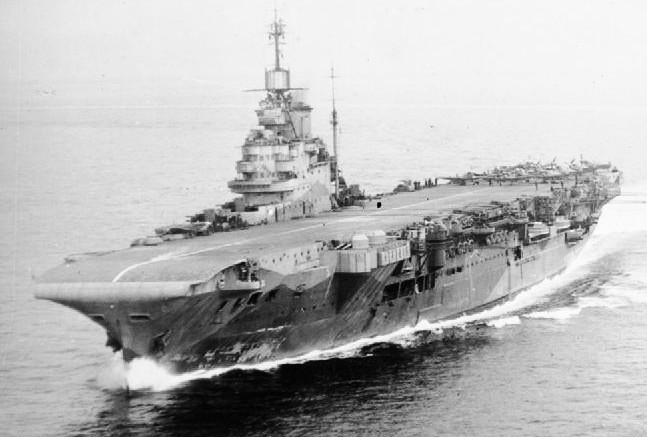
HMS Indomitable (92) underway 1943.
HMS Indomitable was a modified Illustrious-class aircraft carrier built for the Royal Navy during the Second World War. Originally planned to be the fourth of the class, she was redesigned to enable her to operate more aircraft, 48 instead of 36. A second hangar was added above the original, raising the flight deck by 14 feet (4.3 m), although the hangar-side armour had to be reduced to compensate. The lower hangar was made shorter than the upper hangar due to the need for extra workshops and accommodation to support the added aircraft. (Wikipedia)
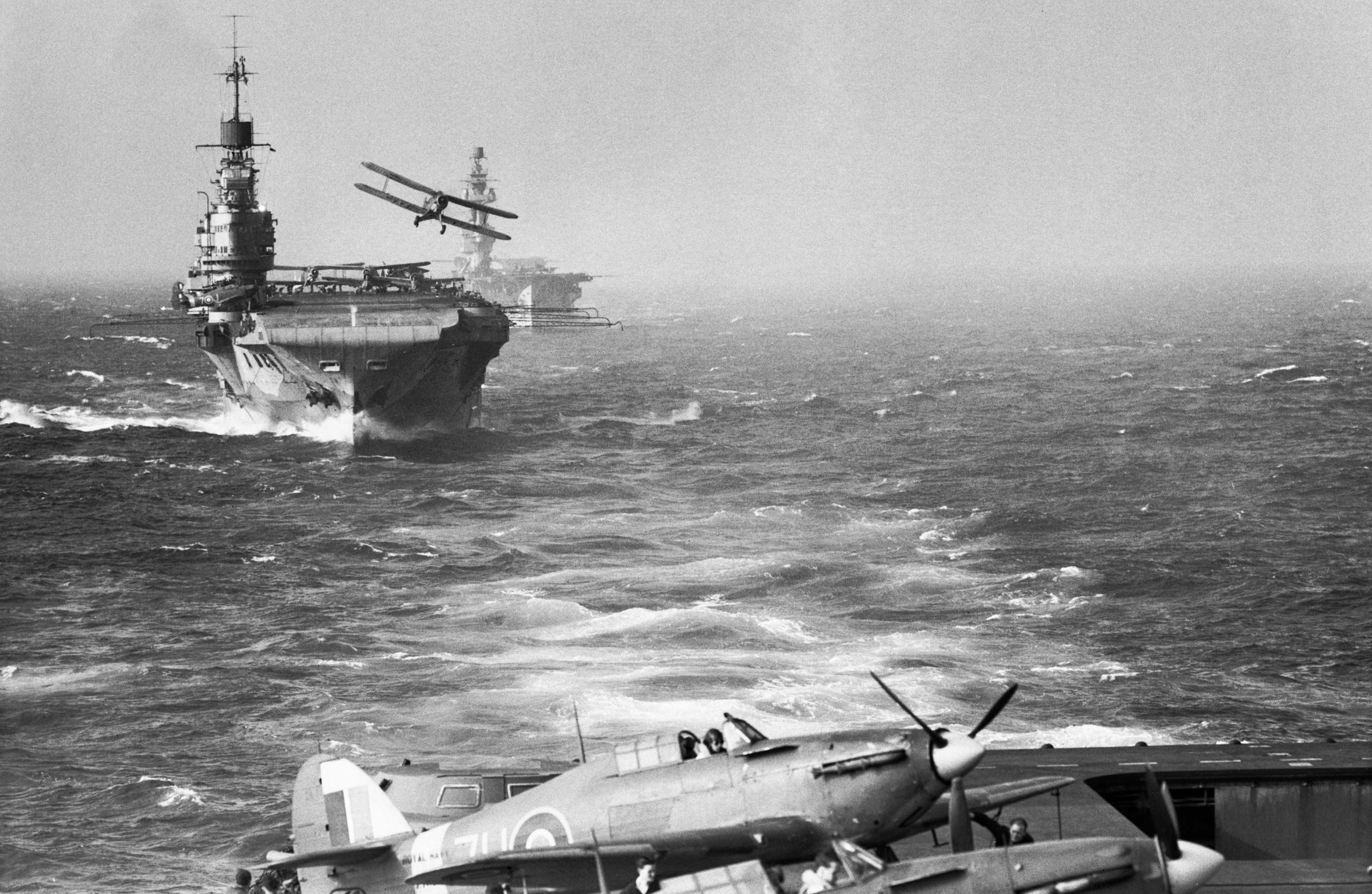
(IWM Photo, A 15961)
A Fairey Albacore takes off from HMS Indomitable, while HMS Eagle brings up the rear, a seen from the flight deck of HMS Victorious, 1 Aug 1942.
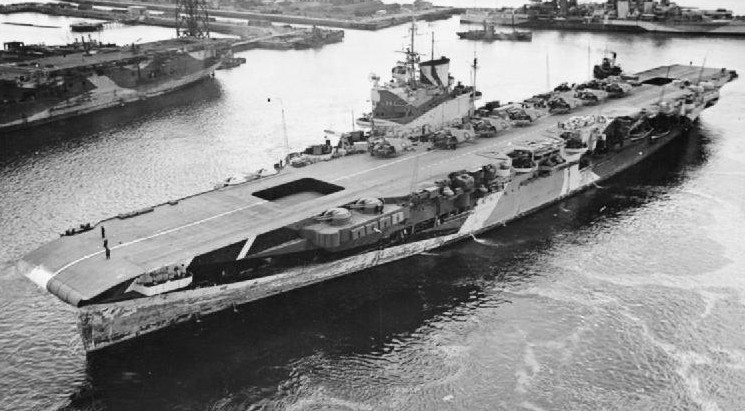
(IWM Photo, A 23377)
HMS Indomitable, with Grumman Avenger planes on deck, seen from the top of a large crane as she enters the basin from the Loch on her way to No 2 Dry Dock at Rosyth Dockyard.
HMS Victorious
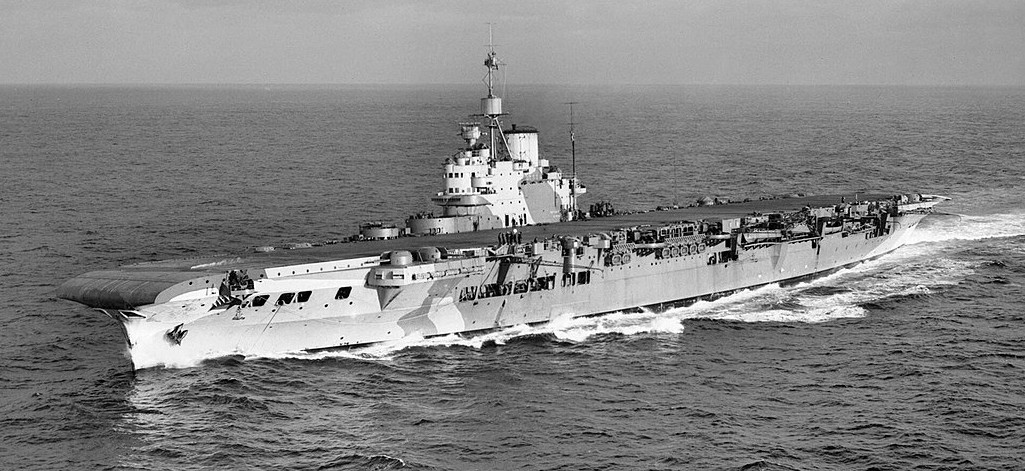
(IWM Photo, A 6153)
HMS Victorious underway at near Scapa Flow, 28 October 1941.
HMS Victorious was the third Illustrious-class aircraft carrier after Illustrious and Formidable. Ordered under the 1936 Naval Programme, she was laid down at the Vickers-Armstrong shipyard at Newcastle upon Tyne in 1937 and launched two years later in 1939. Her commissioning was delayed until 1941 due to the greater need for escort vessels for service in the Battle of the Atlantic. Her service in 1941 and 1942 included famous actions against the battleship Bismarck, several Arctic convoys, and Operation Pedestal. She was loaned to the United States Navy in 1943 and served in the south west Pacific as part of the Third Fleet. In 1944 Victorious contributed to several attacks on the Tirpitz. The elimination of the German naval threat allowed her redeployment first to the Eastern Fleet at Colombo and then to the Pacific for the final actions of the war against Japan.
After the war, her service was broken by periods in reserve and, between 1950 and 1958, the most complete reconstruction of any Royal Navy carrier. This involved the construction of new superstructure above the hangar deck level, a new angled flight deck, new boilers and the fitting of Type 984 radar and data links and heavy shipboard computers, able to track 50 targets and assess their priority for interrogation and interception. The reduction of Britain’s naval commitment in 1967, the end of the Indonesia–Malaysia confrontation, and a fire while under refit, prompted her final withdrawal from service, three to five years early, and she was scrapped in 1969. (Wikipedia)
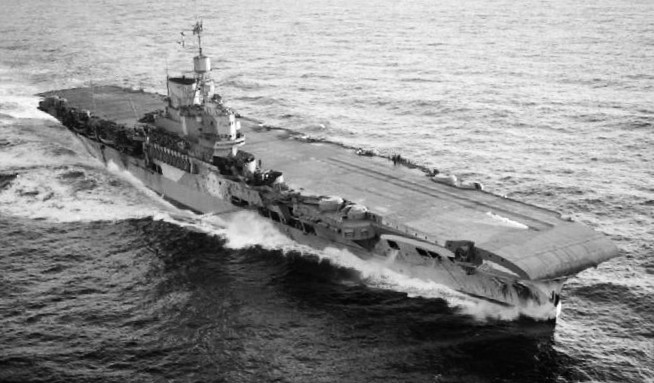
(IWM Photo, A 6152)
HMS Victorious at sea. Steam can be seen venting from the catapult towards the front of the flight deck, 21 Oct 1941.
(IWM Photo, A 25750)
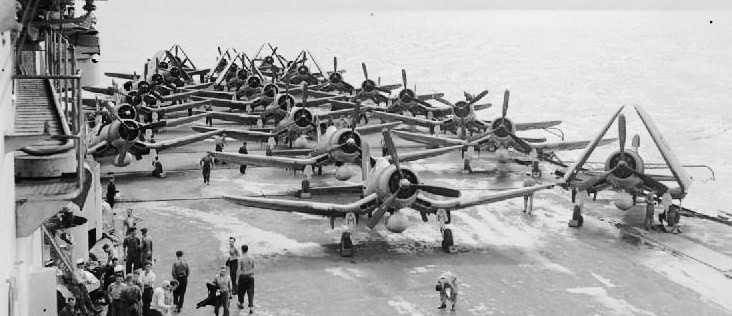
Chance Vought Corsairs of 1834 Naval Air Squadron and 1836 Naval Air Squadron, Fleet Air Arm fitted with extra petrol tanks and ranged ready for attack on the carrier’s flight deck on board HMS Victorious during the carrier-borne air attack against the Japanese repair and maintenance centre at Sigli, Sumatra, September 1944.
(USN Photo)
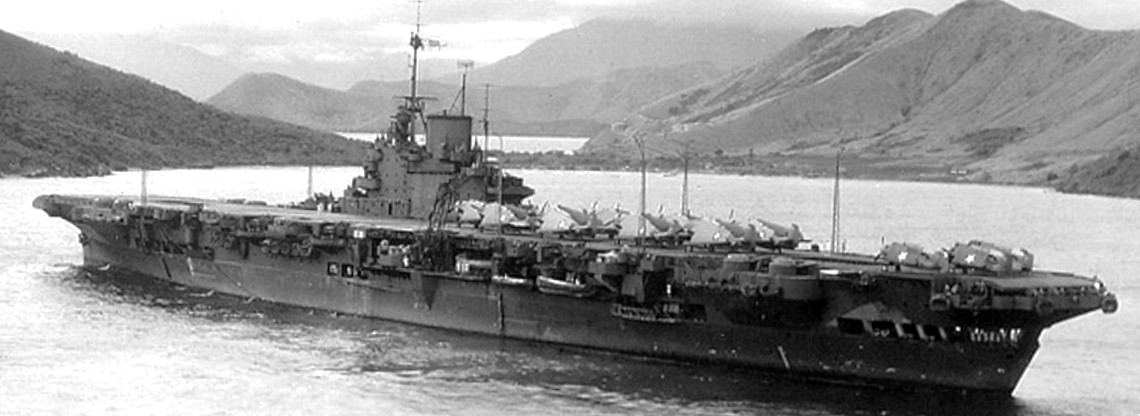
HMS Victorious (R38) during operations with the U.S. Navy Task Force 36 in the Solomons, between May and September 1943. The photo was taken probably at Noumea, New Caledonia. Note the Grumman TBF-1 Avenger torpedo bombers and the Grumman F4F-4 Wildcat fighters on deck wearing U.S. markings.
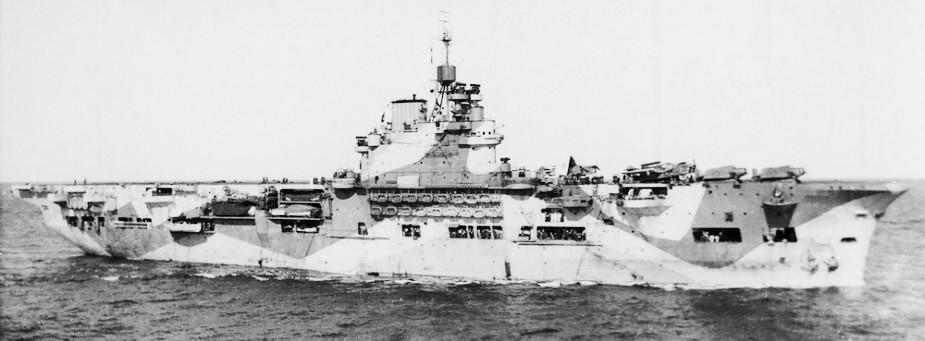
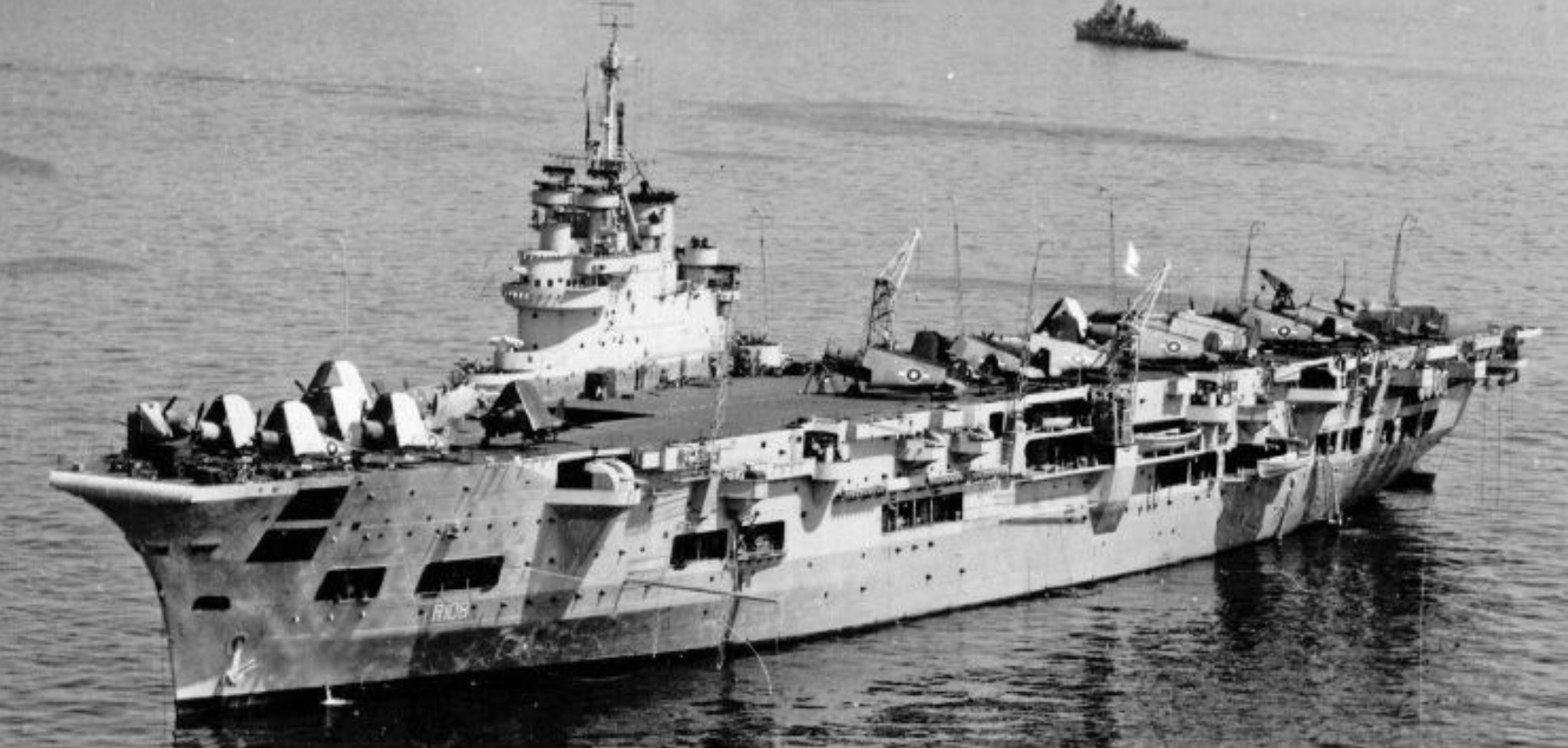
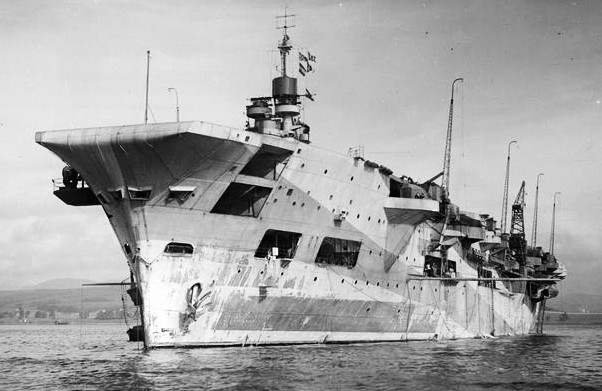
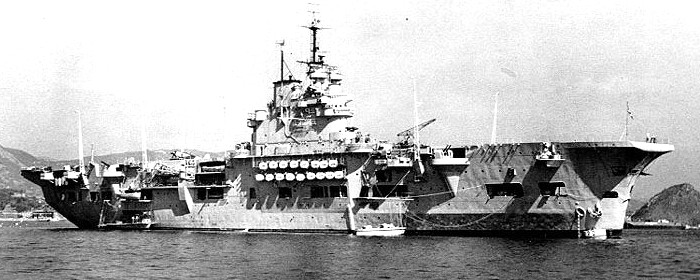
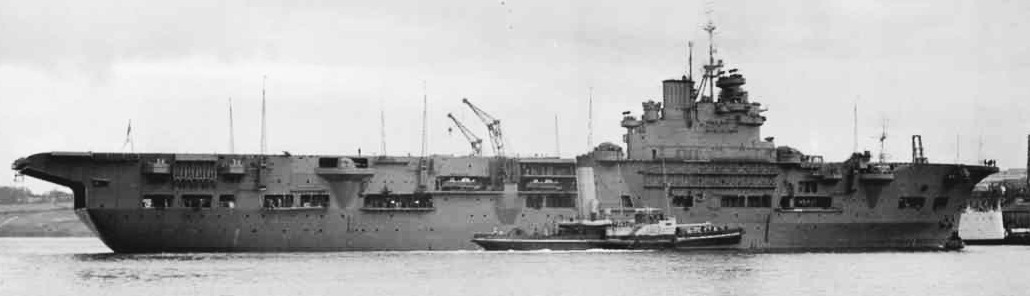
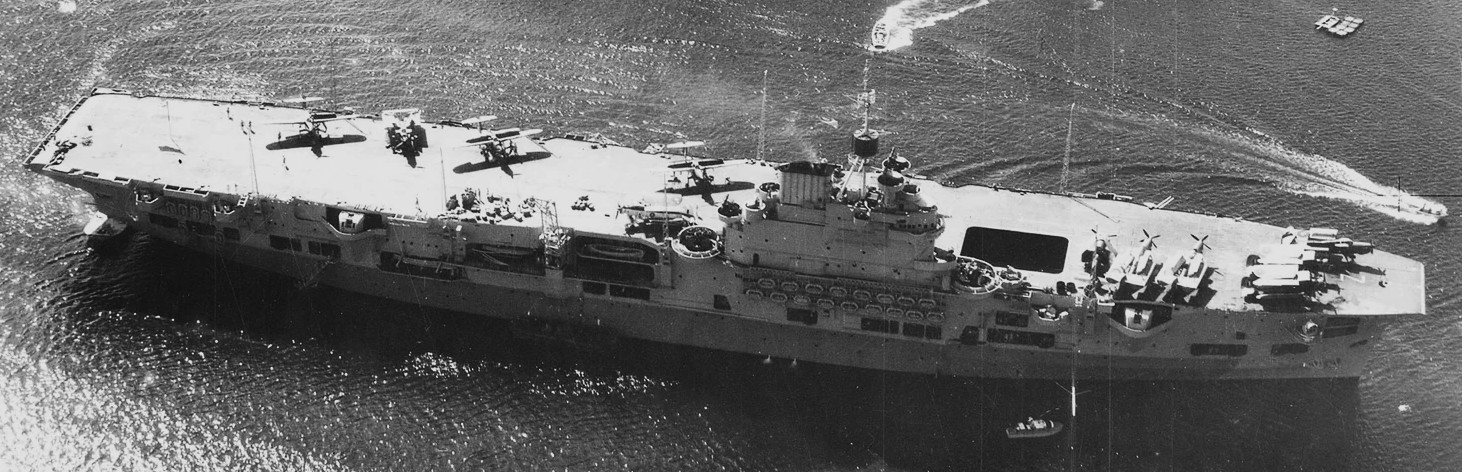
HMS Unicorn (I72), built as aircraft maintenance ship – 14,700 tons, 24 knots, 35 aircraft, 1,200 crew, laid down in 1943.
(RN Photo)
HMS Unicorn (I72), British Aircraft Maintenance Carrier
HMS Unicorn was an aircraft repair ship and light aircraft carrier built for the Royal Navy in the late 1930s. She was completed during the Second World War and provided air cover over the amphibious landing at Salerno, Italy, in September 1943. The ship was transferred to the Eastern Fleet in the Indian Ocean at the end of the year. Unicorn supported the aircraft carriers of the fleet on their operations until the British Pacific Fleet (BPF) was formed in November 1944. She was transferred to Australia in early 1945 to support the BPF’s operations during Operation Iceberg, the Allied invasion of Okinawa in May. To shorten the time required to replenish the BPF’s carriers, the ship was based in the Admiralty Islands and in the Philippine Islands until the Japanese surrender in August. Unicorn was decommissioned and placed in reserve when she returned to the UK in January 1946.
The ship was recommissioned in 1949 to support the light carrier of the Far East Fleet, as the Eastern Fleet had been redesignated after the end of World War II. She was unloading aircraft and equipment in Singapore in June 1950 when the Korean War began. She spent most of the war ferrying aircraft, troops, stores and equipment in support of Commonwealth operations in Korea. Unicorn supported other carriers during operations in Korea, but she became the only aircraft carrier to conduct a shore bombardment with her guns during wartime when she attacked North Korean observers on the coast during the war. The ship returned to the UK after the end of the war and was again placed in reserve. She was listed for disposal in 1958 and sold for scrap in 1959. (Wikipedia)
(RN Photo)
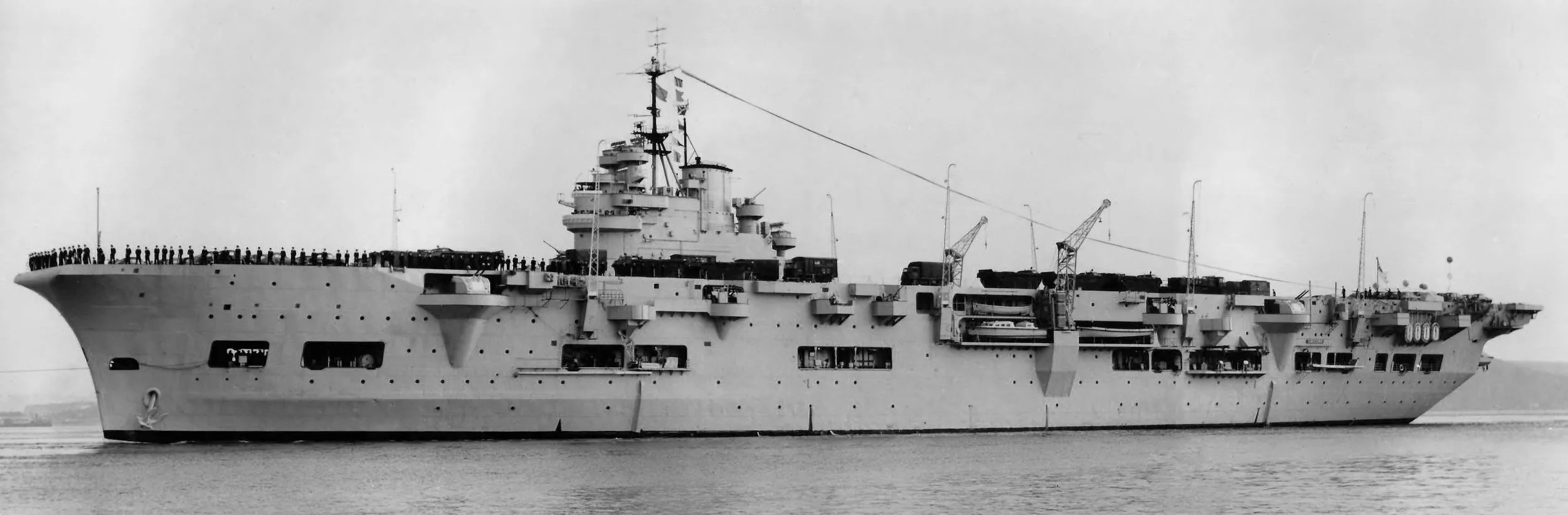
HMS Unicorn (I72), British Aircraft Maintenance Carrier.
(RN Photo)
HMS Unicorn (I72), British Aircraft Maintenance Carrier.
(RN Photo)
HMS Unicorn (I72), British Aircraft Maintenance Carrier.
(USN Photo)
HMS Unicorn (I72), British Aircraft Maintenance Carrier, 1951. Moored in a southern Japanese port (probably Sasebo) after a tour of duty in Korean waters.
(RN Photo)
HMS Unicorn (I72), British Aircraft Maintenance Carrier.
(RN Photo)
HMS Unicorn (I72), British Aircraft Maintenance Carrier.