
Kriegsmarine Heavy Cruisers: Admiral Hipper, Prinz Eugen, Admiral Scheer, and Admiral Graf Spee
Admiral Hipper-class (14,000 tons, 8 × 203 mm guns)
The Admiral Hipper class was a group of five heavy cruisers built by Nazi Germany’s Kriegsmarine beginning in the mid-1930s. The class comprised Admiral Hipper, the lead ship, Blücher, Prinz Eugen, Seydlitz, and Lützow. Only the first three ships of the class saw action with the German Navy during the Second World War. Work on Seydlitz stopped when she was approximately 95 percent complete; it was decided to convert her into an aircraft carrier, but this was not completed either. Lützow was sold incomplete to the Soviet Union in 1940.
Admiral Hipper and Blücher took part in Operation Weserübung, the invasion of Norway in April 1940. Blücher was sunk by Norwegian coastal defenses outside Oslo while Admiral Hipper led the attack on Trondheim. She then conducted sorties into the Atlantic to attack Allied merchant shipping. In 1942, she was deployed to northern Norway to attack shipping to the Soviet Union, culminating in the Battle of the Barents Sea in December 1942, where she was damaged by British cruisers. Prinz Eugen saw her first action during Operation Rheinübung with the battleship Bismarck. She eventually returned to Germany during the Channel Dash in 1942, after which she too went to Norway. After being torpedoed by a British submarine, she returned to Germany for repairs. Admiral Hipper, while decommissioned after returning to Germany in early 1943, was partially repaired and recommissioned in the fall of 1944 for a refugee transport mission in 1945. Only Prinz Eugen continued to serve in full commission and stayed in the Baltic until the end of the war.
Admiral Hipper was scuttled in Kiel in May 1945, leaving Prinz Eugen as the only member of the class to survive the war. She was ceded to the United States Navy, which ultimately expended the ship in the Operation Crossroads nuclear tests in 1946. Seydlitz was towed to Königsberg and scuttled before the advancing Soviet Army could seize the ship. She was ultimately raised and broken up for scrap. Lützow, renamed Petropavlovsk, remained unfinished when the Germans invaded the Soviet Union. The ship provided artillery support against advancing German forces until she was sunk in September 1941. She was raised a year later and repaired enough to participate in the campaign to relieve the Siege of Leningrad in 1944. She served on in secondary roles until the 1950s, when she was broken up. (Wikipedia)
Kriegsmarine Heavy Cruiser Admiral Hipper
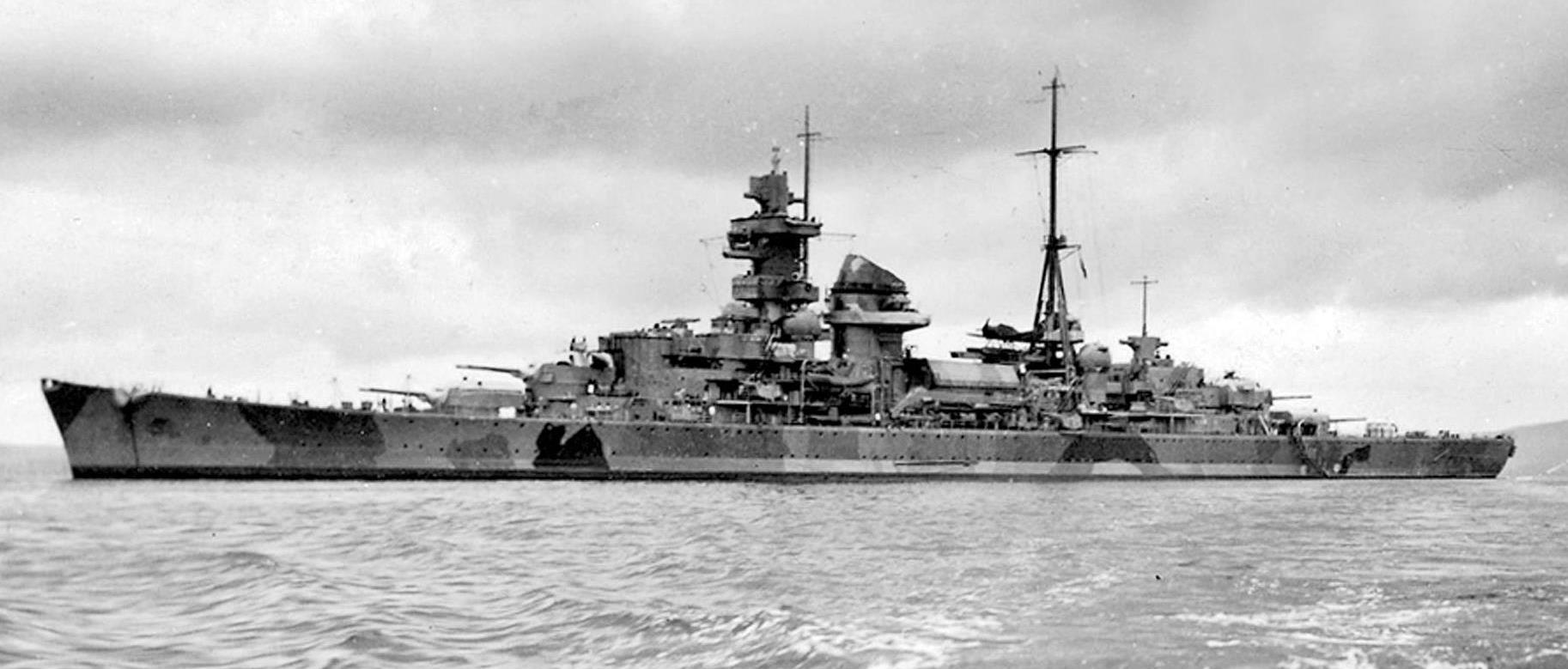
(Kriegsmarine Photo)
Kriegsmarine Heavy Cruiser Admiral Hipper, Laid down 1935, Commissioned 1937, Completed 1939, Scuttled 1945.
Admiral Hipper was the lead ship of the Admiral Hipper class of heavy cruisers which served with Nazi Germany’s Kriegsmarine during World War II. The ship was laid down at the Blohm & Voss shipyard in Hamburg in July 1935 and launched in February 1937; Admiral Hipper entered service shortly before the outbreak of war, in April 1939. The ship was named after Admiral Franz von Hipper, commander of the German battlecruiser squadron during the Battle of Jutland in 1916 and later commander-in-chief of the German High Seas Fleet. She was armed with a main battery of eight 20.3 cm (8 in) guns and, although nominally under the 10,000-long-ton (10,160 t) limit set by the Anglo-German Naval Agreement, actually displaced over 16,000 long tons (16,260 t).
Admiral Hipper saw a significant amount of action during the war, notably in the Battle of the Atlantic. She also led the assault on Trondheim during Operation Weserübung; while en route to her objective, she sank the British destroyer HMS Glowworm. In December 1940, she broke out into the Atlantic Ocean to operate against Allied merchant shipping. This operation ended without significant success, but in February 1941, Admiral Hipper sortied again, sinking several merchant vessels before eventually returning to Germany via the Denmark Strait. The ship was then transferred to northern Norway to participate in operations against convoys to the Soviet Union, culminating in the Battle of the Barents Sea on 31 December 1942, in which she sank the destroyer Achates and the minesweeper Bramble, but was in turn damaged and forced to withdraw by the light cruisers HMS Sheffield and Jamaica.
Disappointed by the failure to sink merchant ships in that battle, Adolf Hitler ordered the majority of the surface warships scrapped, though Admiral Karl Dönitz was able to persuade Hitler to retain the surface fleet. As a result, Admiral Hipper was returned to Germany and decommissioned for repairs. The ship was never restored to operational status, however, and on 3 May 1945, Royal Air Force bombers severely damaged her while she was in Kiel, Germany. Her crew scuttled the ship at her moorings, and in July 1945, she was raised and towed to Heikendorfer Bay. She was ultimately broken up for scrap in 1948–1952; her bell is currently on display at the Laboe Naval Memorial near Kiel. (Wikipedia)
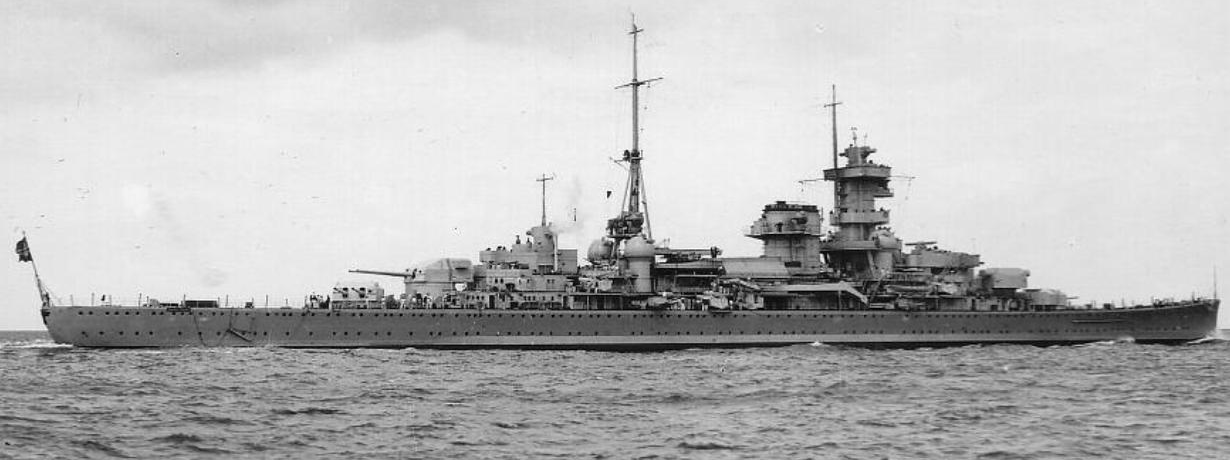
(Kriegsmarine Photo)
Kriegsmarine Heavy Cruiser Admiral Hipper.
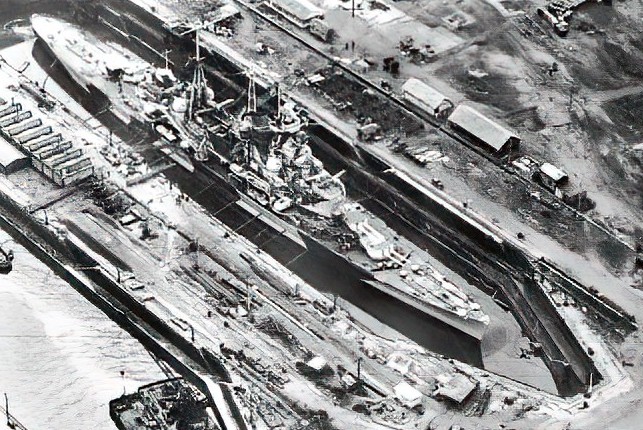
(RAF Photo)
Kriegsmarine Heavy Cruiser Admiral Hipper, Brest, France, 1941.
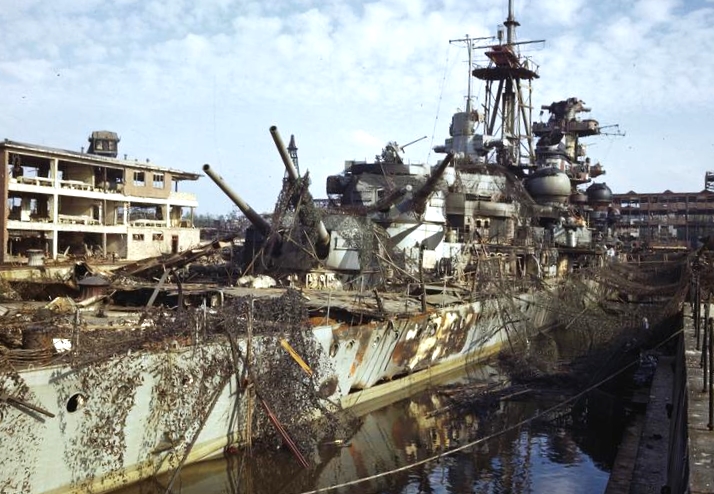
(IWM Photo, TR 2882)
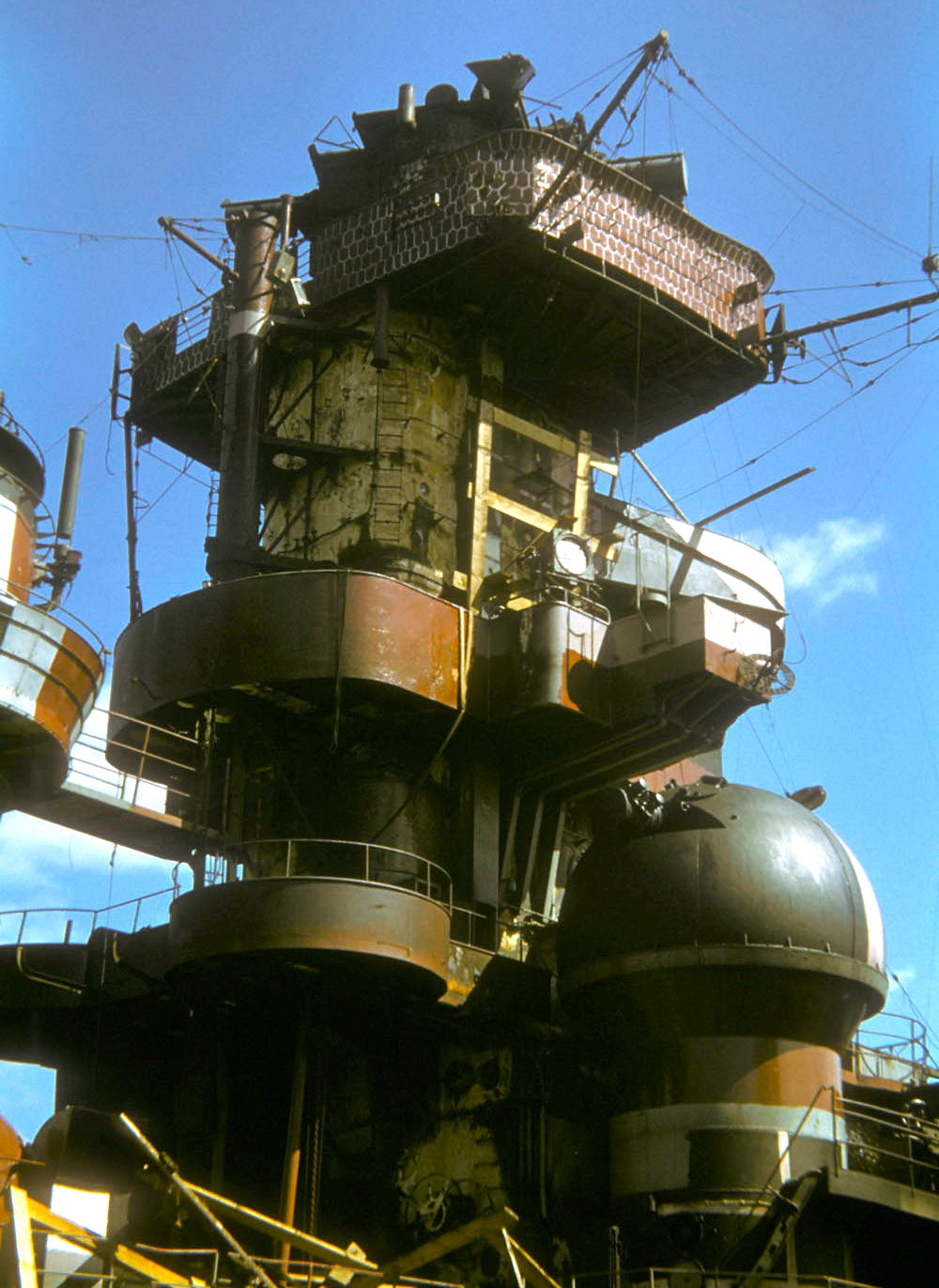
Kriegsmarine Heavy Cruiser Admiral Hipper, as found by Canadian troops when they entered the ruins of Kiel in North West Germany. The warship was in dry dock at Kiel when the harbour was captured by the Allies. Both the German attempts to camouflage her and the damage caused by Allied bombers can be seen.
(Library and Archives Canada Photo, MIKAN No. 4233461)
Kriegsmarine Heavy Cruiser Admiral Hipper, which was in dry dock at Kiel when the harbour was captured by the Allies. Note the RN flag. (For some reason I picture a Canadian soldier entering the base, seeing the ship, and running over to plant the flag and telling his mates, “this one is mine!”)
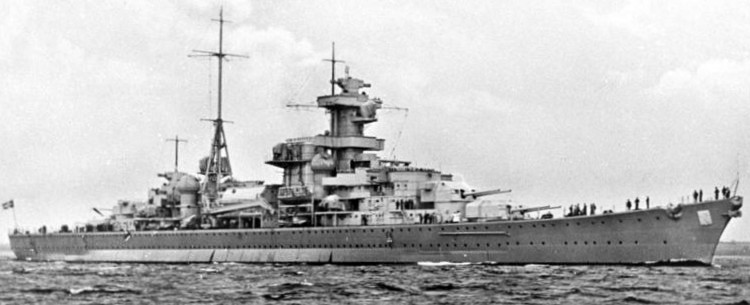
Kriegsmarine Heavy Cruiser Blücher
(Bundesarchiv, DVM 10 Bild-23-63-09 / CC-BY-SA 3.0)
Kriegsmarine Heavy Cruiser Blücher, Commissioned 1937. Sunk in battle, 1940.
Blücher was the second of five Admiral Hipper-class heavy cruisers of Nazi Germany’s Kriegsmarine (lit. ’War Navy’), built after the rise of the Nazi Party and the repudiation of the Treaty of Versailles. Named for Gebhard Leberecht von Blücher, the Prussian victor of the Battle of Waterloo, the ship was laid down in August 1935 and launched in June 1937. She was completed in September 1939, shortly after the outbreak of the Second World War. After completing a series of sea trials and training exercises, the ship was pronounced ready for service with the fleet on 5 April 1940. She was armed with a main battery of eight 20.3 cm (8 in) guns and, although nominally under the 10,000-long-ton (10,160 t) limit set by the Anglo-German Naval Agreement, actually displaced over 16,000 long tons (16,260 t).
Immediately upon entering service, Blücher was assigned to the task force that supported the invasion of Norway in April 1940. Blücher served as the flagship of Konteradmiral (Rear Admiral) Oskar Kummetz, the commander of Group 5. The ship led the flotilla of warships into the Oslofjord on the night of 8 April, to seize Oslo, the capital of Norway. Two old 28 cm (11 in) coastal guns in the Oscarsborg Fortress engaged the ship at very close range, scoring two hits, as did several smaller guns in other batteries. Two torpedoes fired by a torpedo battery in the fortress struck the ship, causing serious damage. A major fire broke out aboard Blücher, which could not be contained. The fire spread to one of her anti-aircraft gun magazines, causing a large explosion, and then spread further to the ship’s fuel bunkers. Blücher then capsized and sank with major loss of life. The wreck lies at the bottom of Oslofjord, and in 2016 was designated as a war memorial to protect it from looters. Several artifacts have been raised from the wreck, including one of her Arado 196 floatplanes, which was recovered during an operation to pump out leaking fuel oil from the ship in 1994. (Wikipedia)
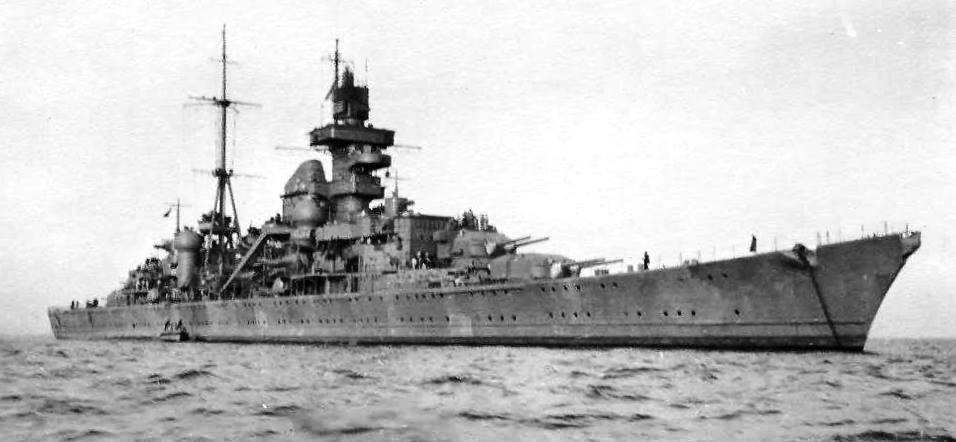
Kriegsmarine Heavy Cruiser Prinz Eugen
(Kriegsmarine Photo)
Kriegsmarine Heavy Cruiser Prinz Eugen, laid down 1936, commissioned 1938, completed 1940, sunk in the South Pacific after gthe atomic bomb tests at Bikini Atoll during Operation Crossroads, 1946.
(Kriegsmarine Photo)
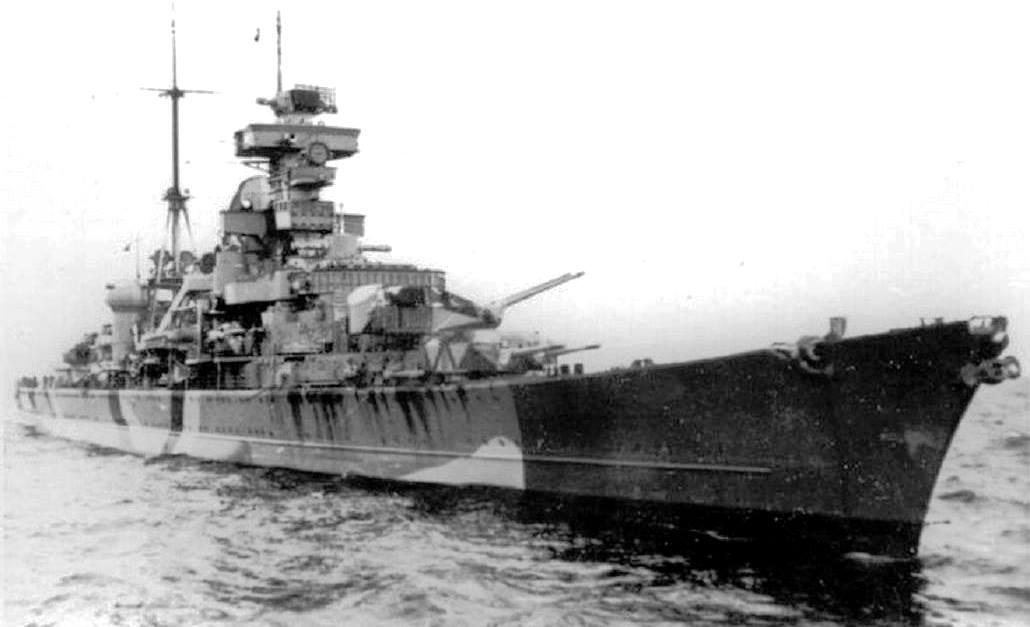
Kriegsmarine Heavy Cruiser Prinz Eugen.
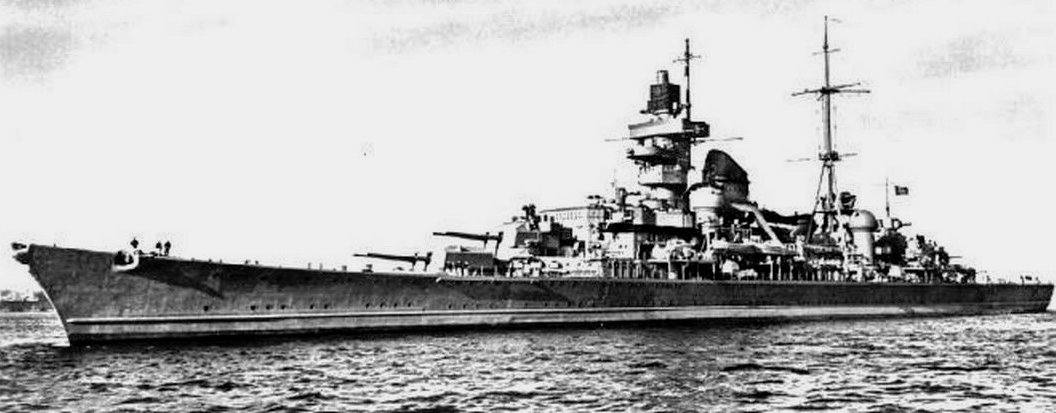
(Kriegsmarine Photo)
Kriegsmarine Heavy Cruiser Prinz Eugen.
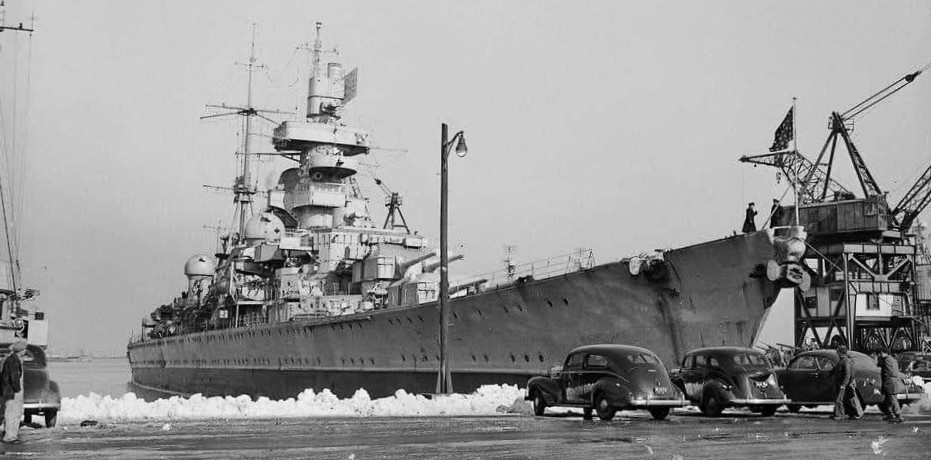
(USN, Official U.S. Naval Archives Photos)
Kriegsmarine Heavy Cruiser Prinz Eugen, Boston Harbor, Jan 1946. By this point, she would have been newly commisioned USS Prinz Eugen after the United States Navy took posession of her after the war.
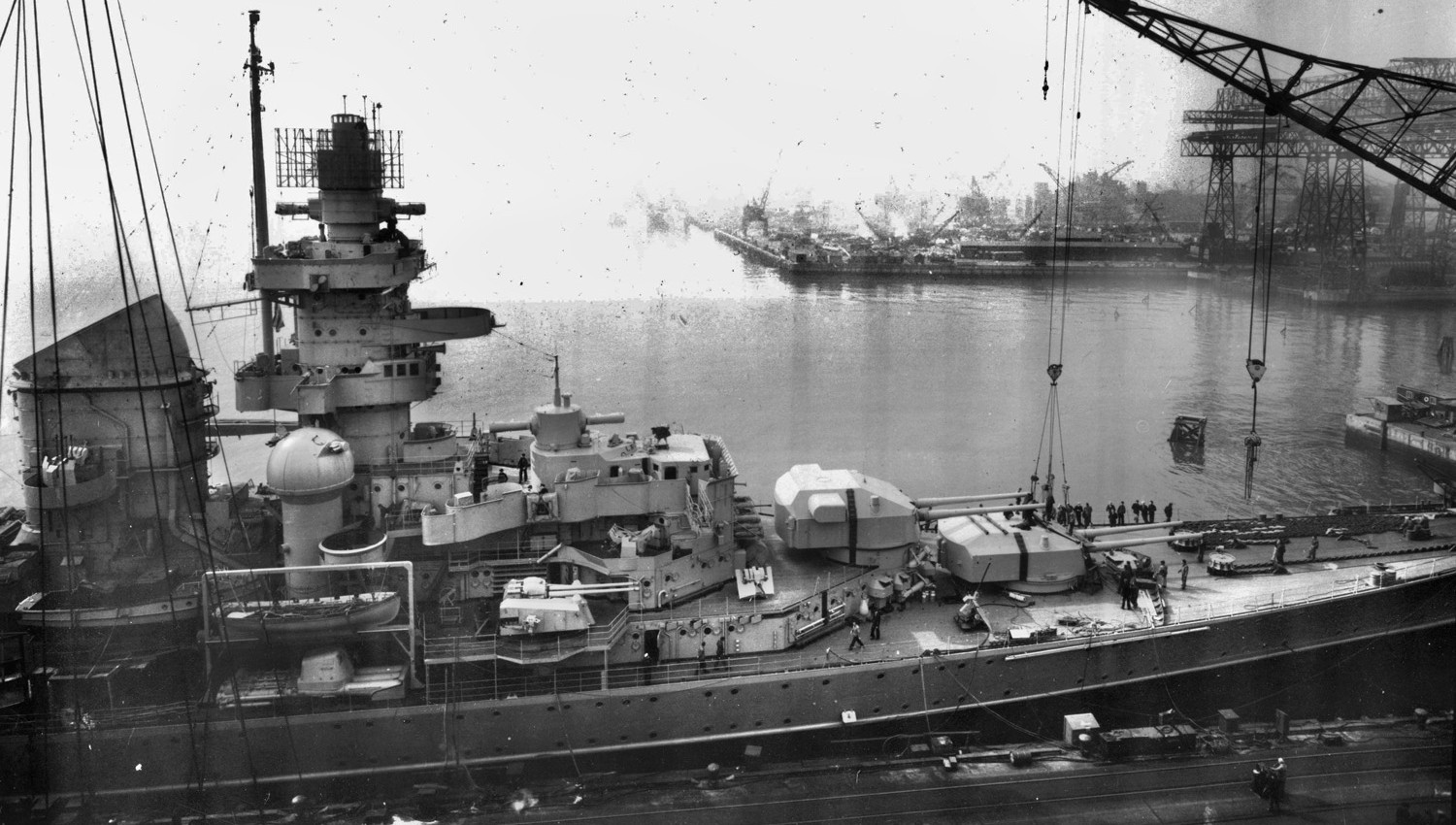
(USN, Official U.S. Naval Archives Photos)
Kriegsmarine Heavy Cruiser Prinz Eugen, Boston Harbor, Feb 1946.
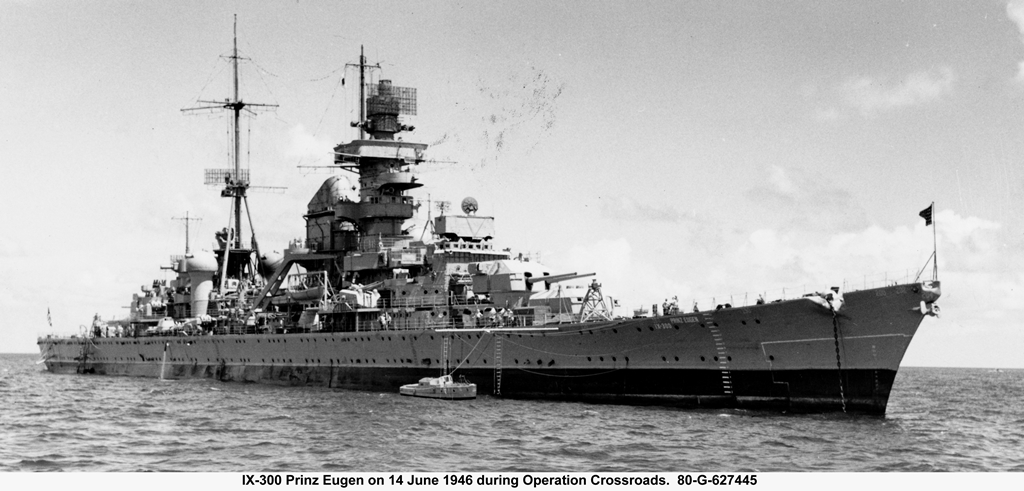
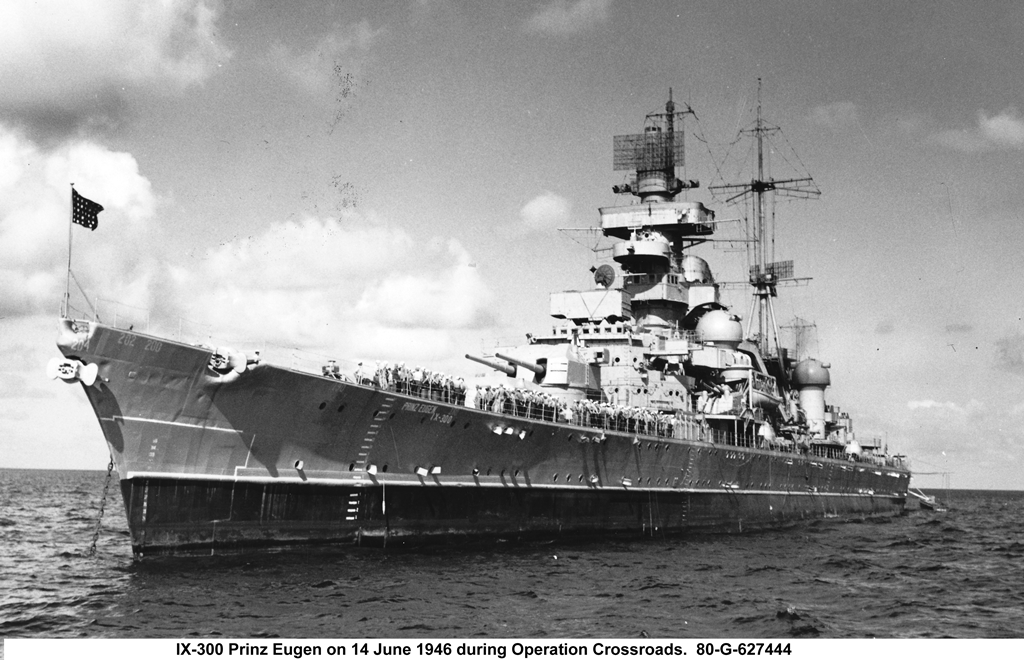
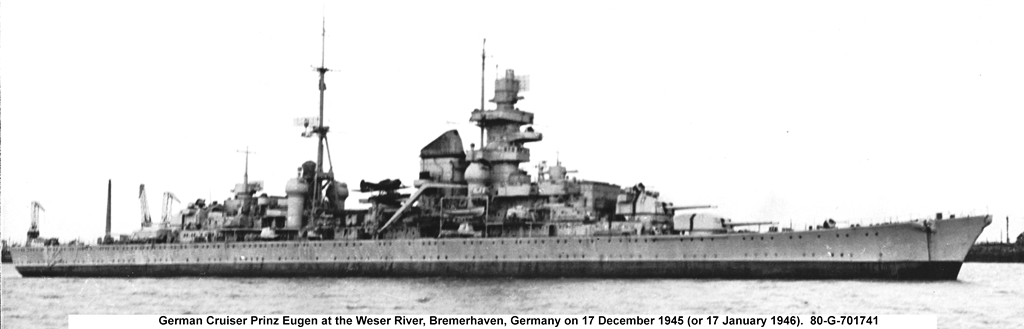
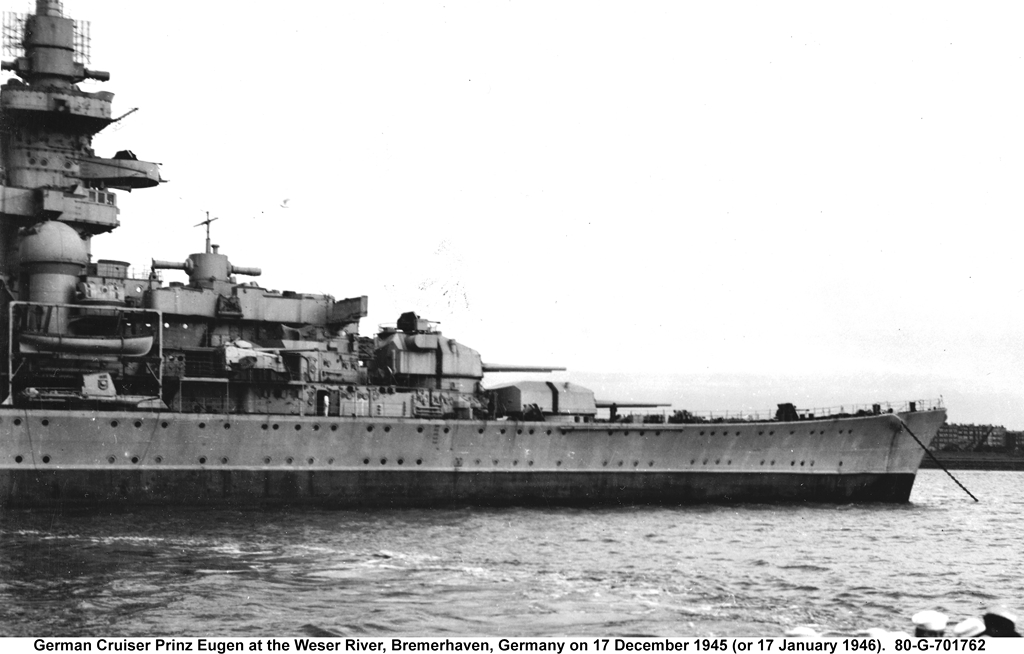
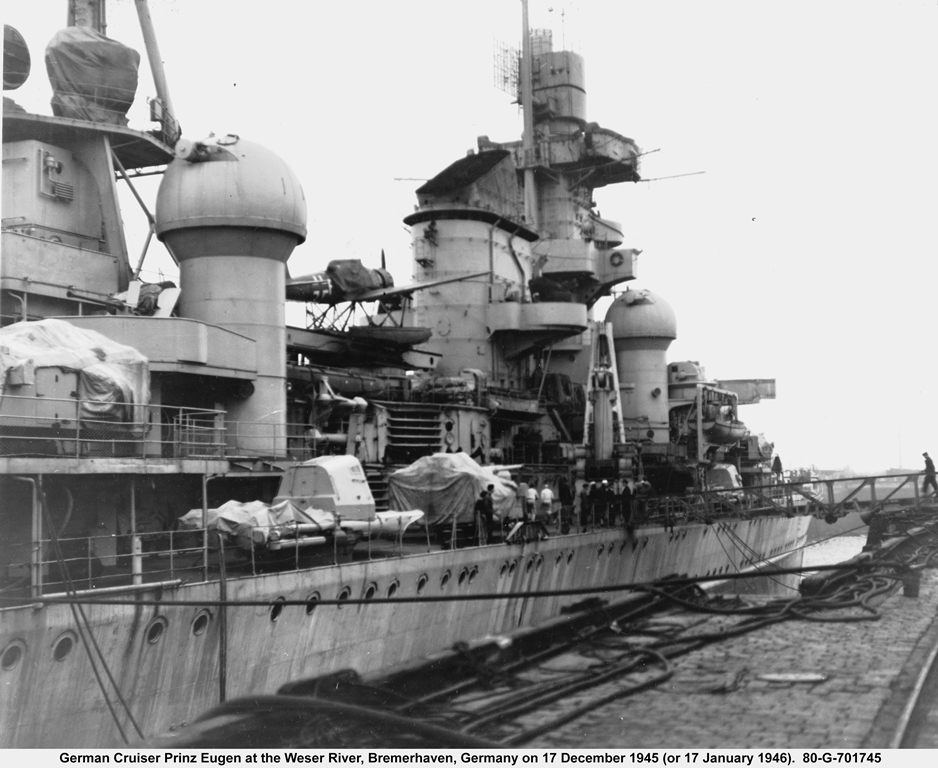
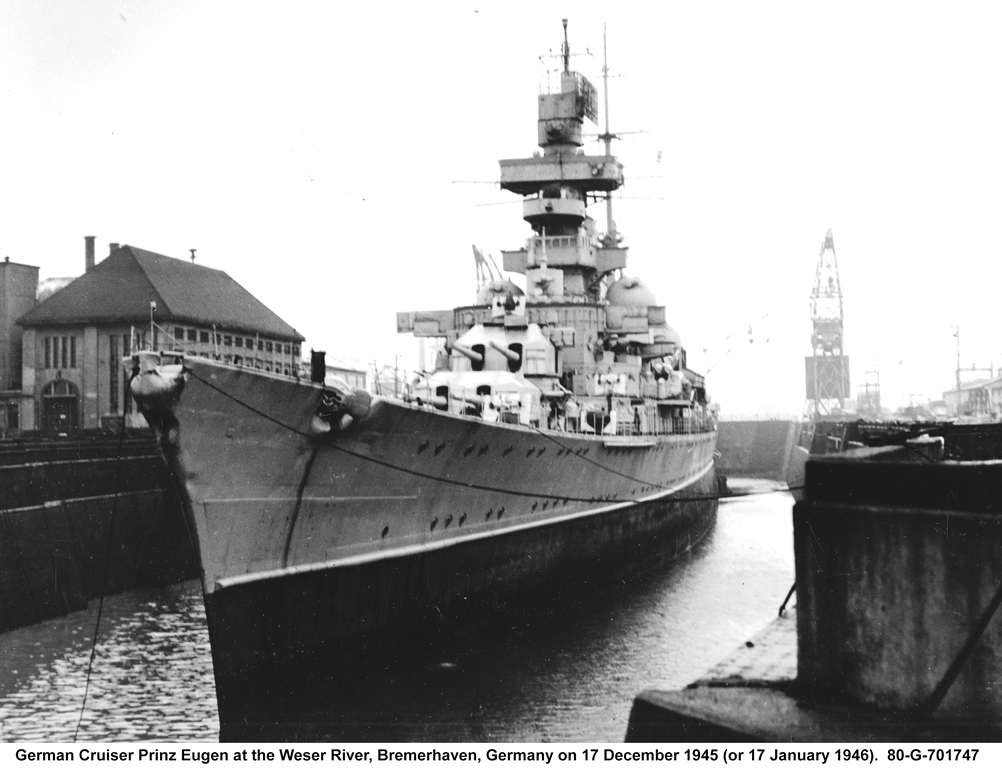
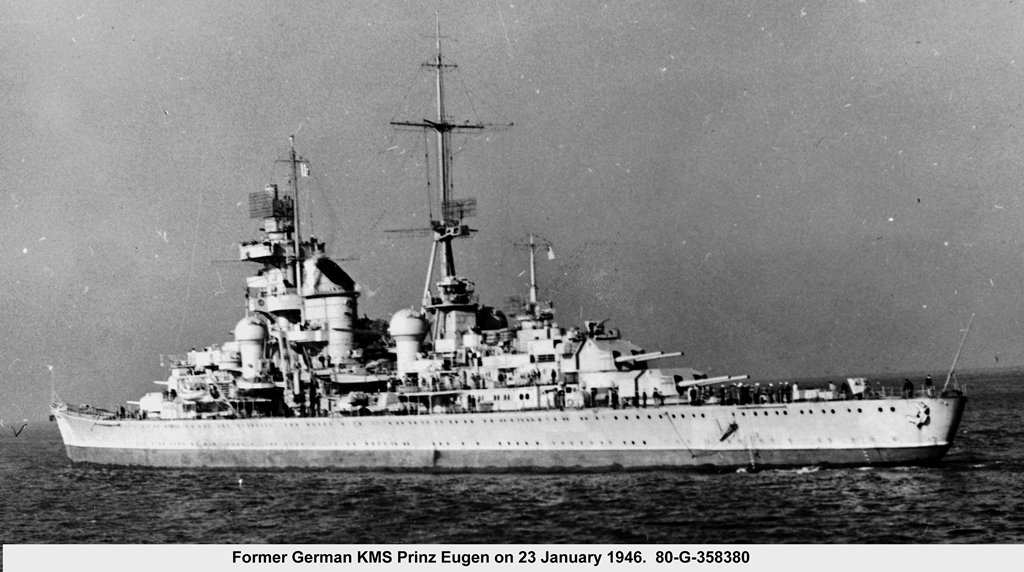
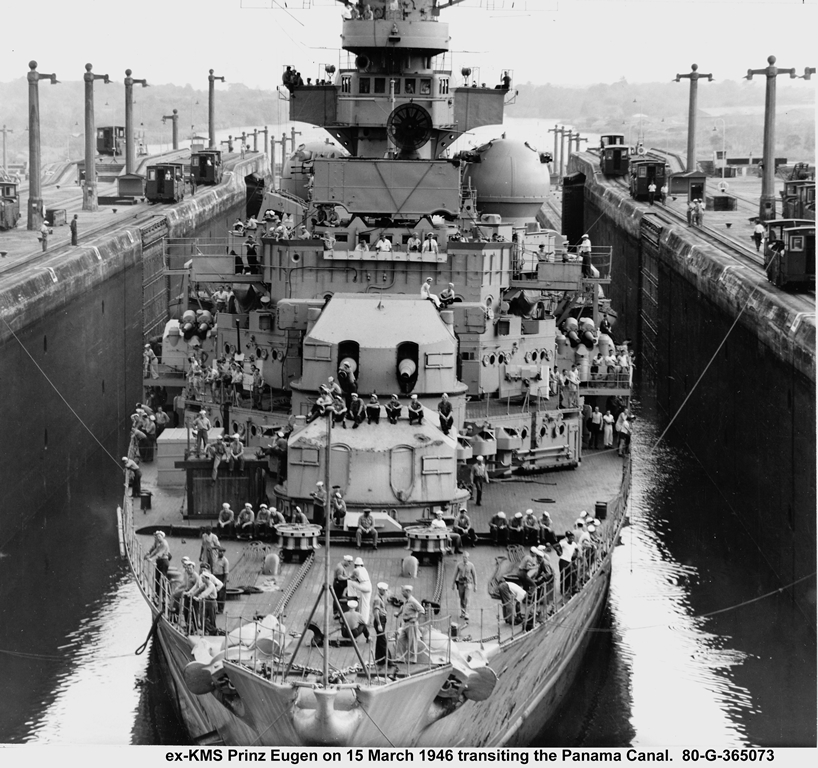
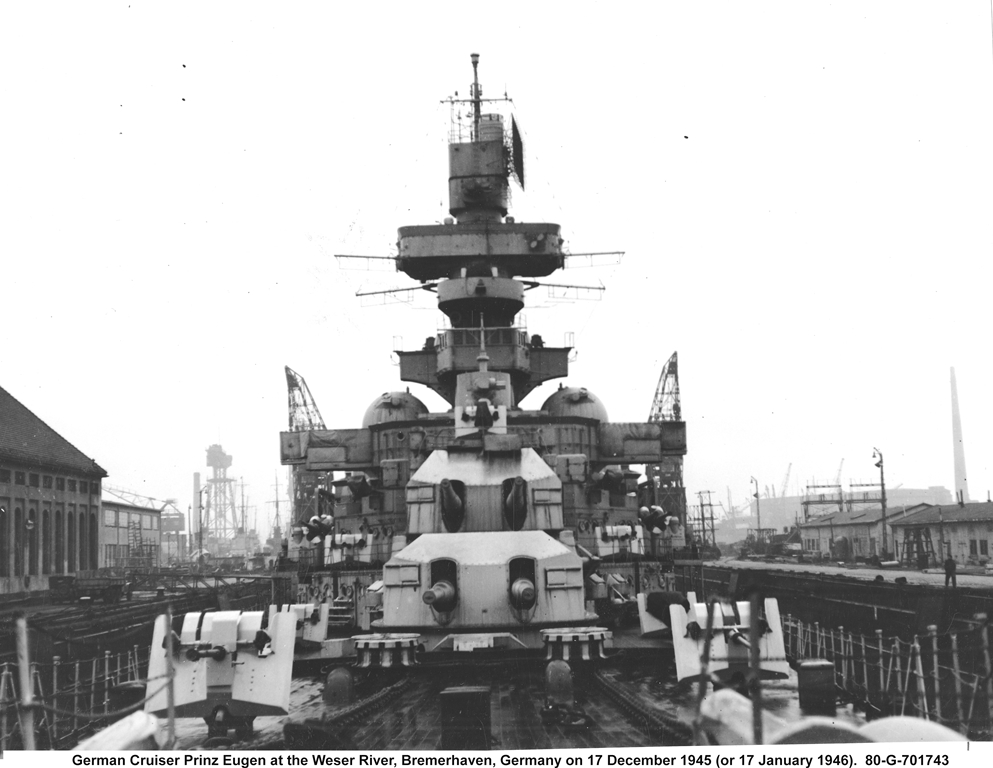
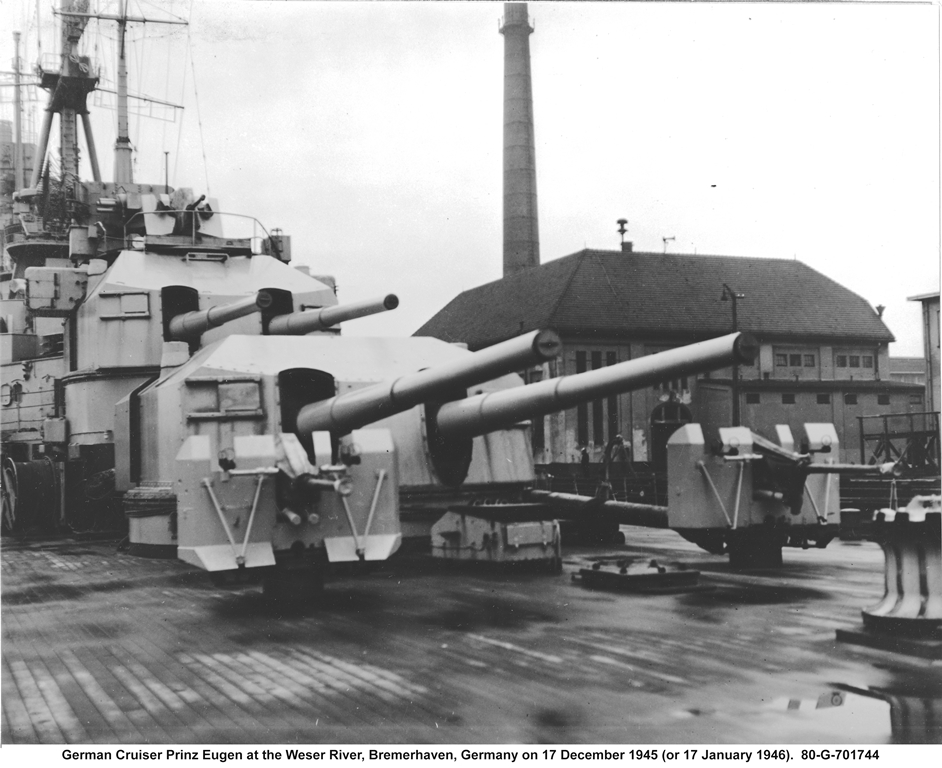
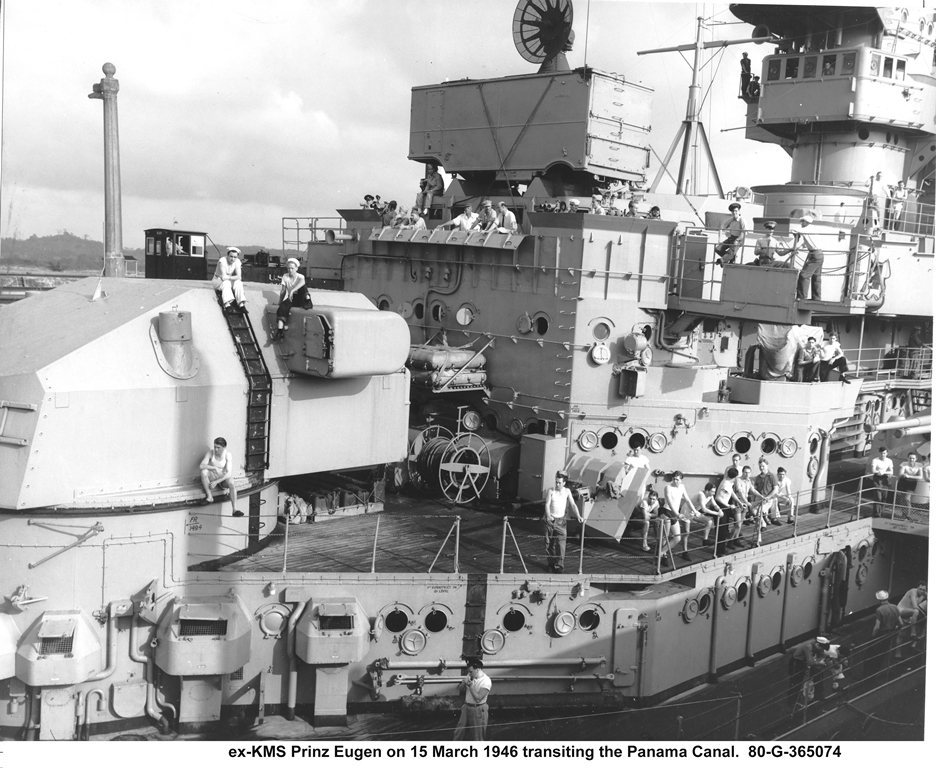
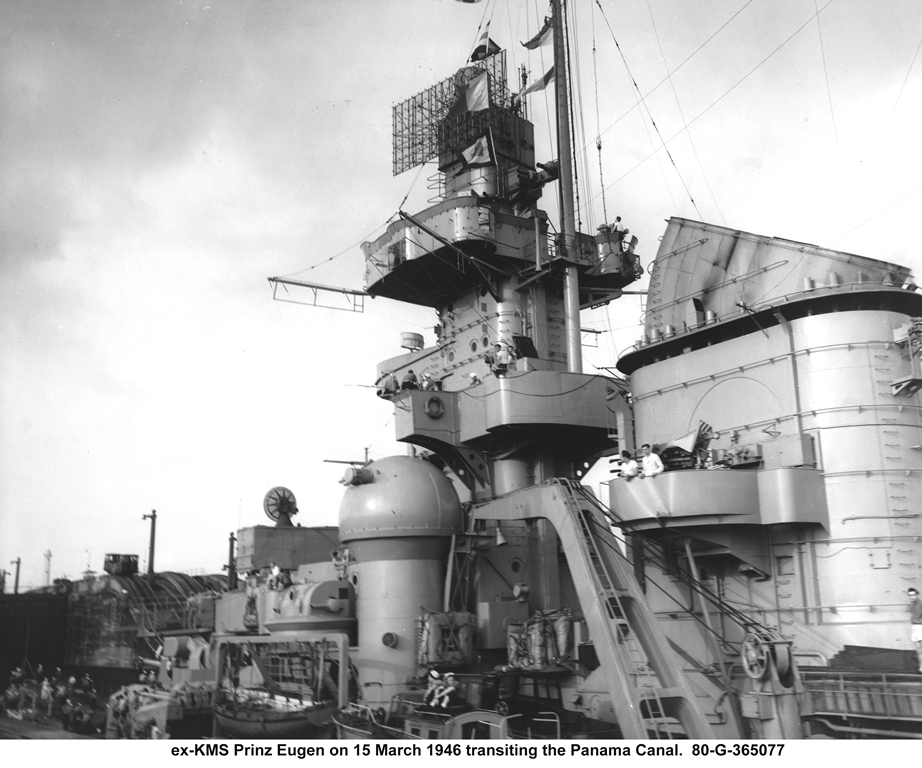
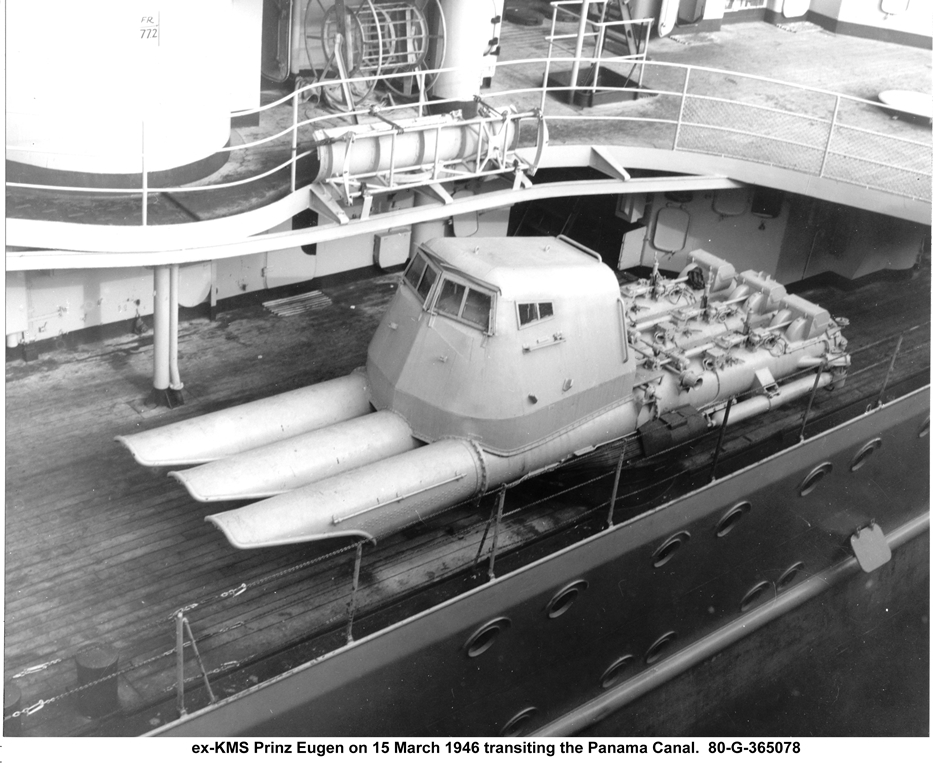
Prinz Eugen was an Admiral Hipper-class heavy cruiser, the third of a class of five vessels. She served with Germany’s Kriegsmarine during the Second World War and was one of the few to survive. The ship was laid down in April 1936, launched in August 1938, and entered service after the outbreak of war, in August 1940. She was named after Prince Eugene of Savoy, an 18th-century general in the service of Austria. She was armed with a main battery of eight 20.3-cm (8-inch) guns and, although nominally under the 10,000-long-ton (10,160 t) limit set by the Anglo-German Naval Agreement, actually displaced over 16,000 long tons (16,257 t).Prinz Eugen saw action during Operation Rheinübung, an attempted breakout into the Atlantic Ocean with the battleship Bismarck in May 1941. The two ships destroyed the British battlecruiser HMS Hood and moderately damaged the battleship HMS Prince of Wales in the Battle of the Denmark Strait. Prinz Eugen was detached from Bismarck during the operation to raid Allied merchant shipping, but this was cut short due to engine troubles. After putting into occupied France and undergoing repairs, the ship participated in Operation Cerberus, a daring daylight dash through the English Channel back to Germany. In February 1942, Prinz Eugen was deployed to Norway, although her time stationed there was curtailed when she was torpedoed by the British submarine HMS Trident days after arriving in Norwegian waters. The torpedo severely damaged the ship’s stern, which necessitated repairs in Germany.Upon returning to active service, the ship spent several months training officer cadets in the Baltic before serving as artillery support for the retreating German Army on the Eastern Front. After the German collapse in May 1945, she was surrendered to the Royal Navy before being transferred to the US Navy as a war prize. After examining the ship in the United States, the US Navy assigned the cruiser to the Operation Crossroads nuclear tests at Bikini Atoll. Having survived the atomic blasts, Prinz Eugen was towed to Kwajalein Atoll, where she ultimately capsized and sank in December 1946. The wreck remains partially visible above the water approximately two miles northwest of Bucholz Army Airfield, on the edge of Enubuj. One of her screw propellers was salvaged and is on display at the Laboe Naval Memorial in Germany. (Wikipedia)
Deutschland-class (12,000 tons, 6 × 280 mm guns)
Kriegsmarine heavy cruiser Deutschland (renamed Lützow)
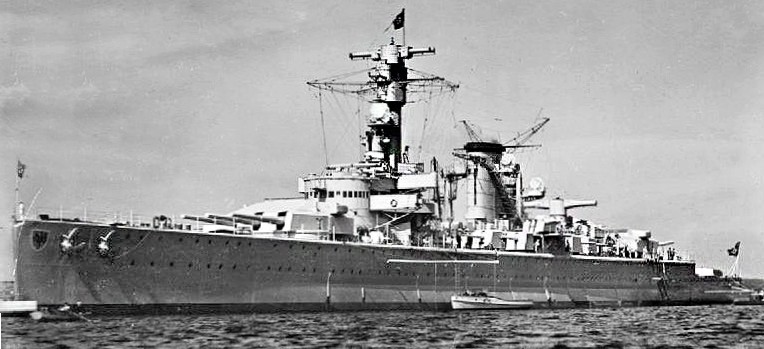
(IWM Photo, HU 1049)
Kriegsmarine heavy cruiser Deutschland (renamed Lützow), Laid Down, 1929, Commissioned 1931, Completed 1933, Disabled 1945, Raised and Sunk as Target 1947.
Deutschland was the lead ship of her class of heavy cruisers (often termed pocket battleships) which served with theKriegsmarine of Nazi Germany during the Second World War. Ordered by the Weimargovernment for the Reichsmarine, she was laid down at the Deutsche Werkeshipyard in Kiel in February 1929 and completed by April 1933. Originally classified as an armoured ship (Panzerschiff) by the Reichsmarine, in February1940 the Germans reclassified the remaining two ships of this class as heavycruisers. In 1940, she was renamed Lützow, after the unfinished AdmiralHipper-class heavy cruiser Lützow was sold to the Soviet Union the previousyear.
The ship saw significant action with the Kriegsmarine, including severalnon-intervention patrols in the Spanish Civil War, during which she was attacked by Republican bombers in the Deutschland incident. At the outbreak ofthe Second World War, she was cruising the North Atlantic, prepared to attack Allied merchant traffic. Bad weather hampered her efforts, and she sank or captured only a handful of vessels before returning to Germany. She then participated in Operation Weserübung, the invasion of Norway. Damaged at the Battle of Drøbak Sound, she was recalled to Germany for repairs. While enroute, she was torpedoed and seriously damaged by a British submarine.
Repairs were completed by March 1941, and in June she left Germany for a commerce raiding operation in the Atlantic. Before reaching the Atlantic, she was torpedoed by a British aircraft and had to return. After repairs, Lützow returned to Norway to join the forces arrayed against Allied shipping to the Soviet Union. She ran aground during Operation Rösselsprung, a planned attack on Convoy PQ 17, and returned to Germany for repairs. She next saw action at the Battle of the Barents Sea with the heavy cruiser Admiral Hipper, which ended with a failure to destroy Convoy JW 51B. Engine problems forced a series of repairs culminating in a complete overhaul at the end of 1943, after which the ship remained in the Baltic as a training ship. In October 1944 Lützow re-entered front line service with Task Force Thiele, participating in shore bombardments of Russian positions in support of the German army. Sunk in shallow waters in the Kaiserfahrt in April 1945 by Royal Air Force (RAF) bombers, Lützow was used as a stationary gun battery until 4 May 1945, when she was disabled by her crew. Raised by the Soviet Navy in 1947, she was subsequently sunk as a target in the Baltic. (Wikipedia)
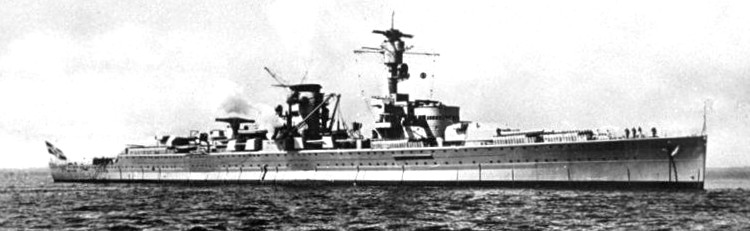
(Bundesarchiv, DVM 10 Bild-23-63-51)
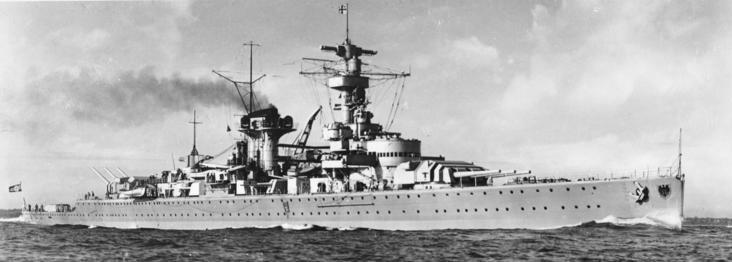
German heavy cruiser Deutschland (later re-named “Lützow”). One of three heavy cruisers of the Deutschland Class (sister ships Admiral Scheer and Admiral Graf Spee). Deutschland was built by the Deutsche Werke shipyard at Kiel, being laid down on 5 February 1929. She was launched on 19 May 1931 and commissioned on 1 April 1933. Following the scuttling of the Admiral Graf Spee in the River Plate estuary on 17 December 1939, Hitler ordered the Deutschland to be renamed Lutzow, to avoid the possibility of the loss of a ship bearing the symbolic name of Germany. She was scuttled on 4 May 1945 at Swinemunde after suffering heavy damage from near misses from ‘Tallboy’ bombs dropped by the RAF. The ship was raised by the Soviets and sunk during weapon tests in 1947. (Wikipedia)
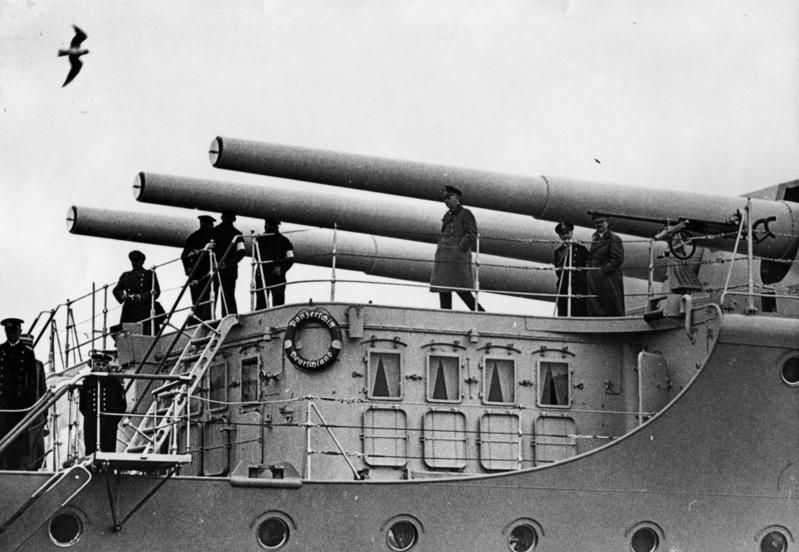
(Bundesarchiv, Bild 183-2008-0421-500)
German heavy cruiser Deutschland (later re-named “Lützow”), 1934.
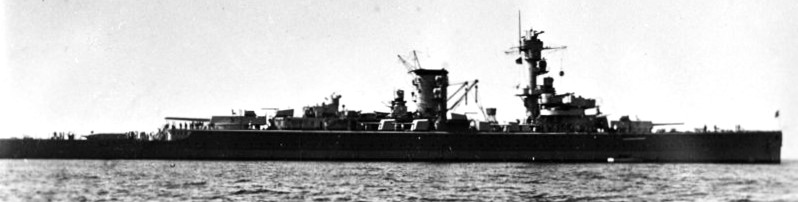
(Bundesarchiv, DVM 10 Bild-23-63-68)
German heavy cruiser Deutschland (later re-named “Lützow”).
(Bundesarchiv, Bild 146-1973-077-63)
German heavy cruiser Deutschland (later re-named “Lützow”), 1938.
Kriegsmarine heavy cruiser Admiral Scheer
(Kriegsmarine Photo)
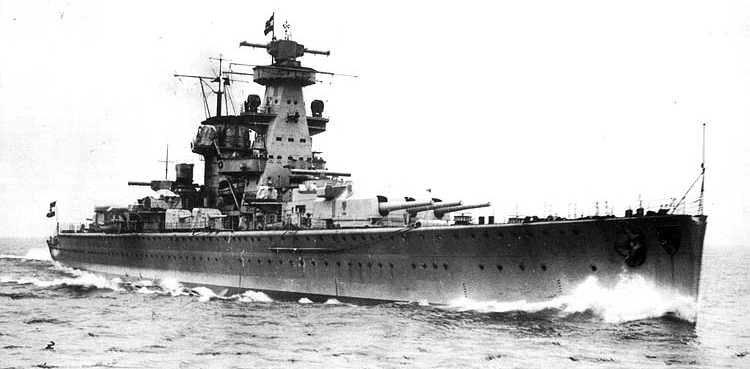
Admiral Scheer, Laid down 1931, Commissioned 1933, Completed 1934, Sunk by Bombing 1945.
(Kriegsmarine Photo)
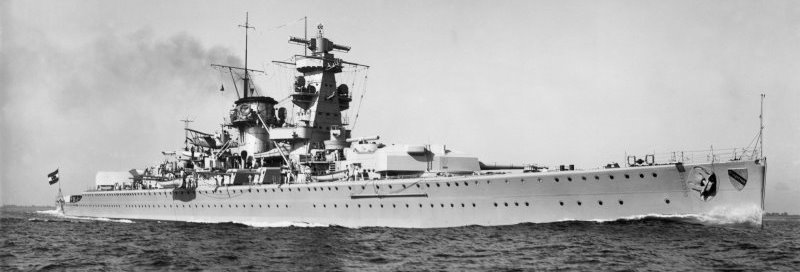
The Admiral Scheer.
(Kriegsmarine Photo)
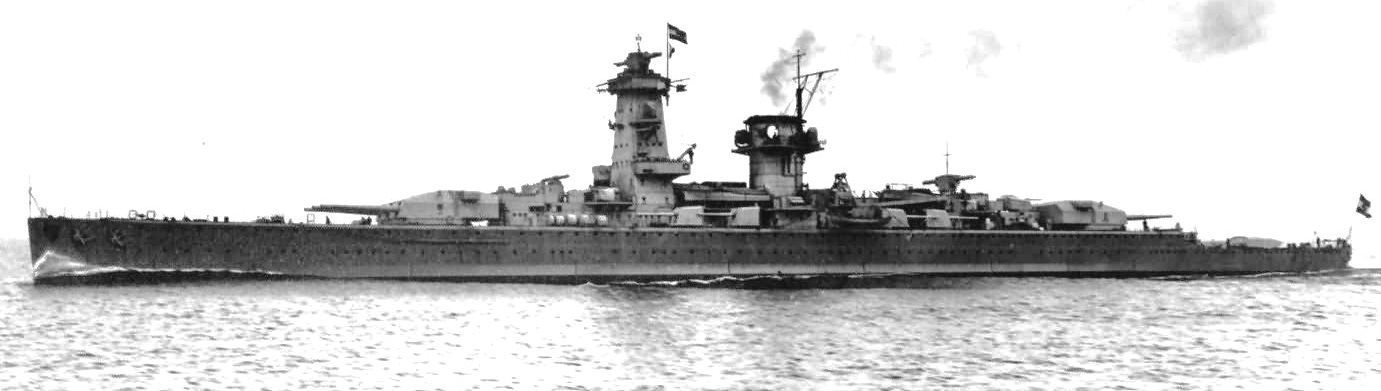
The Admiral Scheer.
Kriegsmarine heavy cruiser Admiral Graf Spee
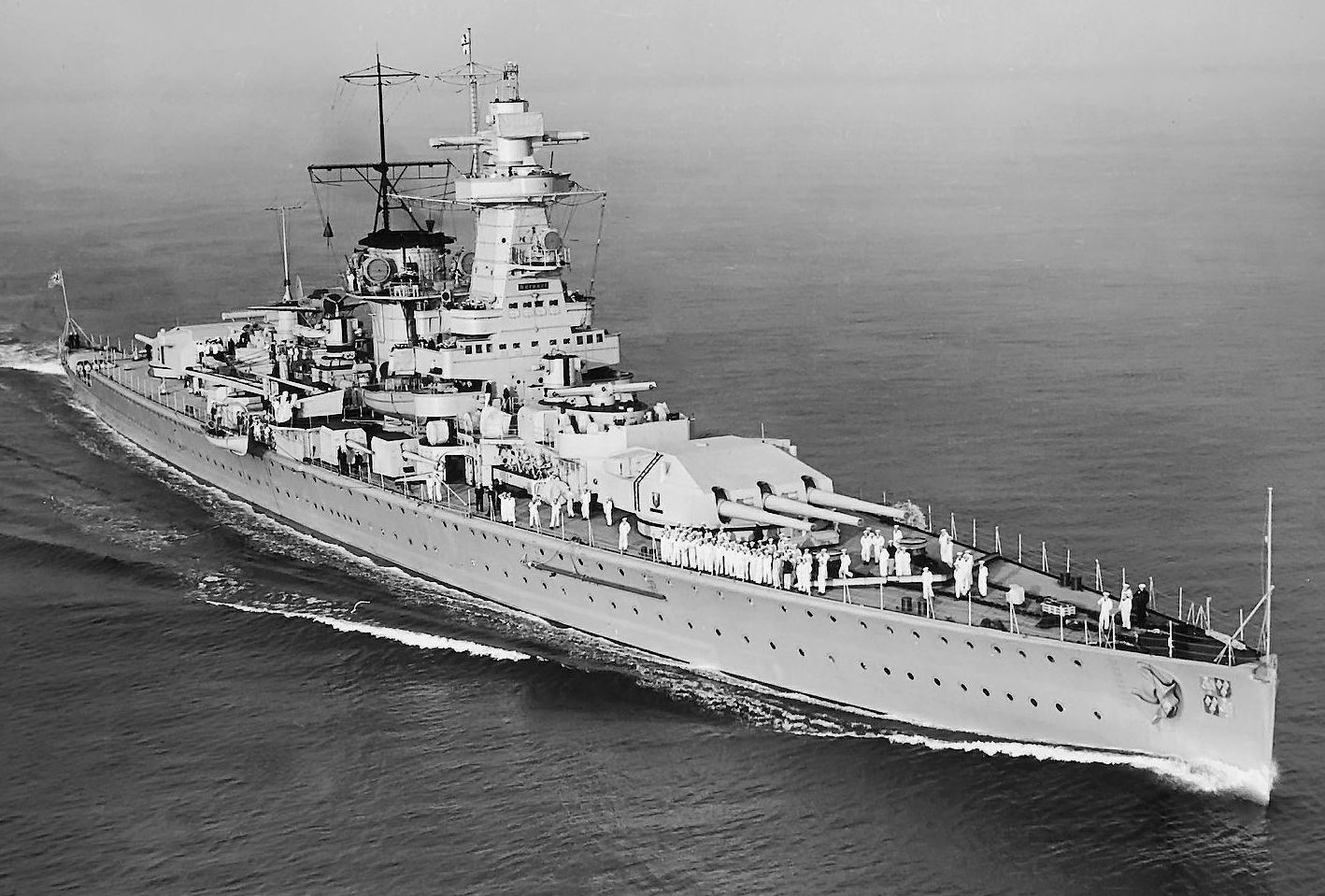
Admiral Graf Spee, Laid down 1932, Commissioned 1934, took part in the Battle of the River Plate, was fought in the South Atlantic on 13 December 1939 as the first naval battle of the Second World War. She was scuttled at Montevideo, Uruguay, 1939.
(Kriegsmarine Photo)
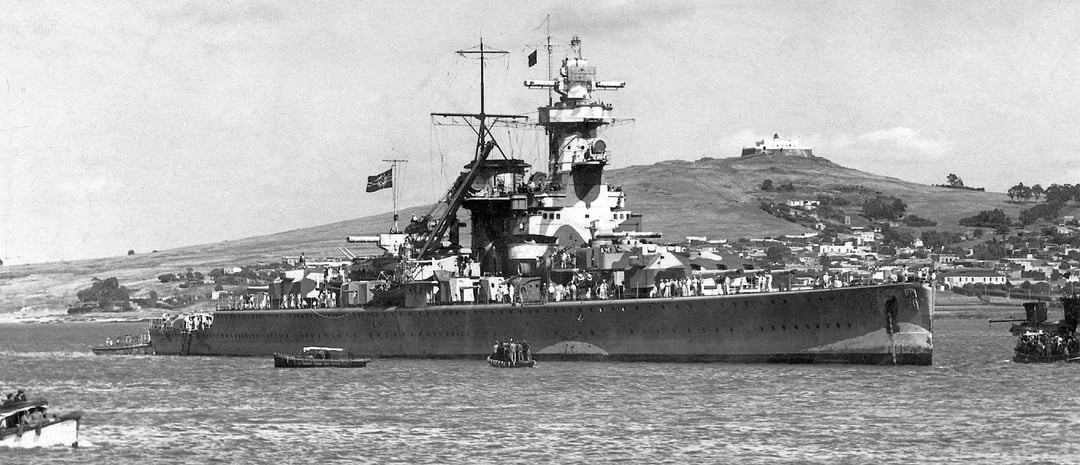
Admiral Graf Spee, in Montevideo Bay after the Battle of the River Plate, 14 December 1939.
(Kriegsmarine Photo)
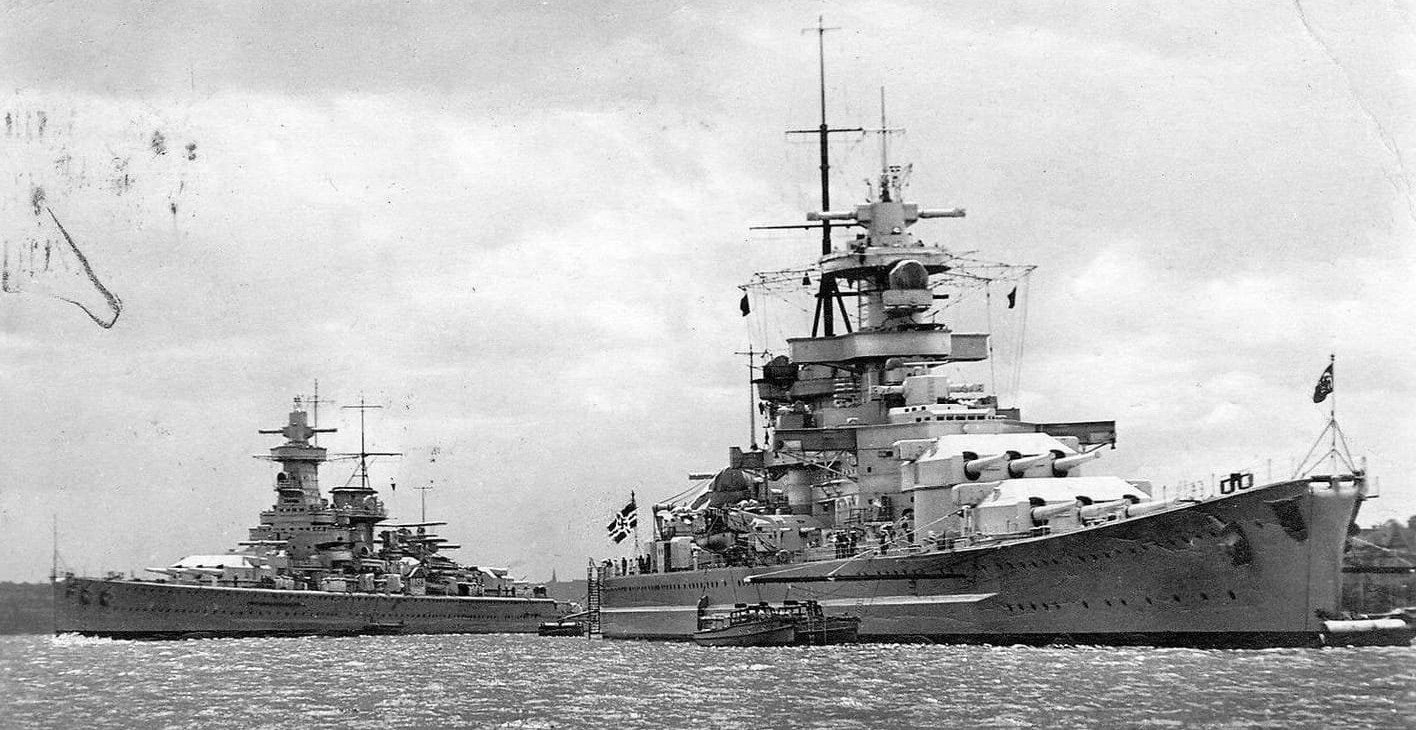
Admiral Graf Spee, and Gneisenau.
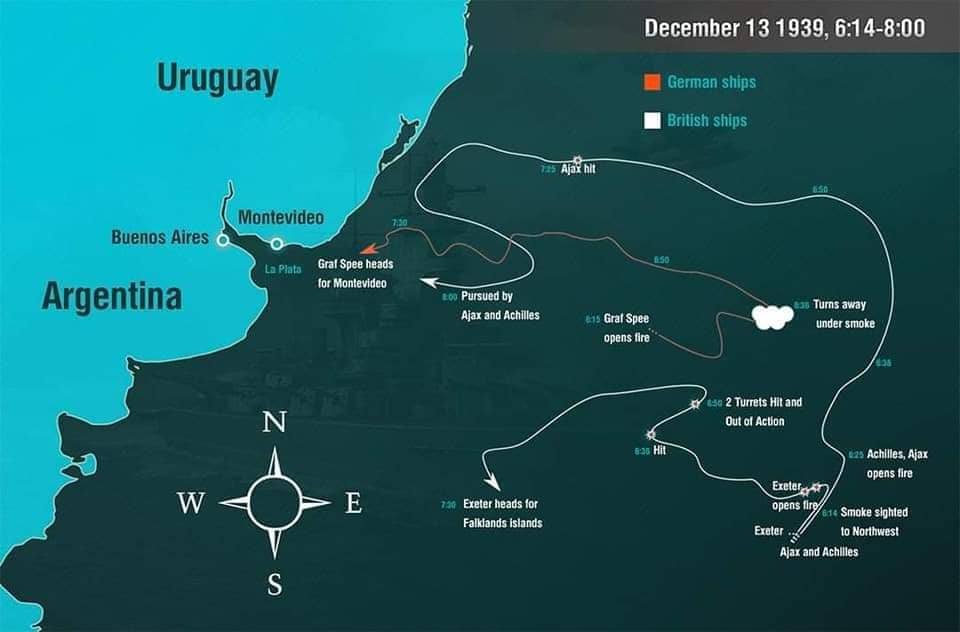
Map of the Battle.
13 December 1939 at 05:20hrs, a British squadron sailing at 14knts in line ahead, HMS Ajax, HMS (HMNZS) Achilles & HMS Exeter in the rear, was proceeding on a course of 060°, around 390 nmi east of Montevideo.
At 06:10hrs, smoke was sighted on a bearing of Red-100, or 320°
06:14hrs HMS Exeter is despatched by Commodore Harwood to investigate smoke
06:16hrs HMS Exeter signals “I think it is a pocket battleship.” The smoke is actually from the German Heavy Cruiser Graf Spee
Captain Langsdorff on Graf Spee, identifies Exeter as a cruiser, but believes Ajax and Achilles to be destroyers and that the 3 ships are escorting a convoy. With this in mind he decides to engage
06:18hrs Admiral Graf Spee opens fire, Harwoods squadron immediately set in motion his plan for attacking Graf Spee from different sides, thus splitting the German ships fire. HMS Ajax & HMNZS Achilles turned to 340° to close range & engage enemy from the eastward, whilst HMS Exeter turned westward at full speed to engage the enemy from the southward
06:20hrs HMS Exeter opened fire to starboard at 18,700yards with her forward 8in turrets. Capt Bell had mistakenly called the enemy ship Scheer, in fact his exact words are recorded as ‘There’s the fucking Scheer! Open fire at her!’
06:21hrs Achilles opens fire becoming the first New Zealand unit to engage in WW2, and in fact she was the first New Zealand warship to take part in a naval battle. As the prospect of battle had loomed her signal man had run aft with the New Zealand ensign shouting “Make way for the Digger Flag”
06:22hrs Ajax opens fire
The plan had succeeded in dividing the Admiral Graf Spee’s fire for a while, but due to Exeter’s heavier 8 inch guns she slowly attracted more attention
06:23hrs Graf Spee’s third concentrated salvo, burst short amidships, killing HMS Exeter’s starboard tubes’ crews and damaged her searchlights, communications, funnels and aircraft.
06:24hrs whilst HMS Exeter had fired eight salvos, one shell of Graf Spee’s 4th salvo knocked out “B” turret, its splinters swept the bridge, killing or wounding all the personnel there except Captain ‘Hooky’ Bell & 2 colleagues, it also wrecked the wheelhouse and communications
Shortly after this Exeter’s spotter plane was riddled with splinters causing the fuel tanks too leak. The threat of a fire led to the aircraft being ditched overboard. Communications were now being carried out through a chain of messengers
06:30hrs Graf Spee could not afford to concentrate & close for the kill, because despite the best efforts of her secondary 5.9in, Ajax & Achilles were closing, concentrating their fire, so Exeter was reprieved as Langsdorff turned his attention to the 2 light cruisers.
06:31hrs three salvos in quick succession straddled Ajax, forcing her & Achilles to turn away a point or two to confuse the Graf Spee’s fire
06:32hrs Exeter manages to fire her starboard torpedoes under local control
06:34hrs the turn away didn’t last long though, now after three minutes the light cruisers turned back to port, to close the range as quickly as they could Ajax in the lead but only just.
06:37hrs Ajax launches her aircraft, this gave Harwood an eye in the sky to guide his actions and thinking
06:38hrs Langsdorff decides to not a slug it out but to extend the range to his advantage and orders a 150° turn, retiring north-west under cover of a smoke screen…
06:40hrs, Exeter turns to starboard to bring her port torpedo tubes to bear, at the same time Achilles is hit killing/seriously wounding of 4 ratings in her director control tower, however despite her gunnery officer being stunned, her rate of fire continued unabated
06:43hrs Exeter fires her port torpedo tubes at Graf Spee, before steering north-east to close Ajax & Achilles
06:45hrs Exeter is by now burning fiercely amidships, her remaining aft turret is firing under local control, her compasses are destroyed
06:46hrs Achilles fire control wireless set broke down, from which point she continued on individual control giving her great difficulty in finding range for a while. Further confusion was caused by reports of Achilles misses being reported to Ajax, which interpreted as her own corrections, causing her to lose the range also
06:50hrs Exeter is still in the fight, her remaining turret still firing, with a 7° list to starboard and several compartments flooded
07:08hrs Ajax after nearly quarter of an hour of being off on range, finally gets it right when the earlier confusion is cleared up and starts to make contact with the Graf Spee again.
07:10hrs realising the range to the Graf Spee had reached 16,000yards Ajax & Achilles turned westward at full speed
07:16hrs Graf Spee made a large turn to port, under cover of a smoke screen, heading straight for HMS Exeter with the aim of finishing her off. Ajax & Achilles, charge Graf Spee, firing accurately and setting fire to Graf Spee amidships, forcing her to turn away from Exeter. Graf Spee soon straddled Ajax at 11,000yard with three salvos from her 11 inch guns, though the 5.9in continued to shoot wildly according to all British reports
07:25hrs an 11in shell knocked out Ajax’s after turrets, Ajax then launched 4 torpedoes at 9,000yards range. Graf Spee avoided the torpedoes with a wide turn to port
07:28hrs Ajax & Achilles turn to close the range still further. Meanwhile Exeter is dropping astern for a while, after turret still firing, but at 07:30hrs pressure in this turret failed
07:31hrs Harwood receives a report from his aircraft, “Torpedoes approaching; they will pass ahead of you”, taking no chances he turns south, to engage the enemy from the starboard side
07:32hrs Graf Spee turns westward under cover of smoke to try to confuse the at that point quite accurate gunfire Ajax & Achilles
07:36hrs Graf Spee now turns south-west, bringing all her guns to bear on the 2 light cruisers
07:38hrs Ajax is hit losing her topmast & wireless aerial
07:40hrs Exeter now turns slowly south-east to repair damage. Ajax now only has 20% of her ammunition left
At this point Harwood decides the prospects of a continuing successful daylight action were anything but rosy, so acts to break of the fight till dark, when there would be a better chance of closing to successful torpedo range
07:42hrs Ajax & Achilles turn away under cover of smoke
07:45hrs it is considered that at this point the first phase of the battle is over and what now happens is more of a chase, the battle had lasted an hour & 22 minutes
08:00hrs Ajax & Achilles are now 15 miles astern of Graf Spee
08:07hrs HMS Ajax broadcast the enemy’s position, course and speed, both to inform the Admiralty & to help merchants keep out of danger
08:14hrs HMS Exeter was now out of sight, so Harwood ordered the aircraft to signal her to close with the rest of the squadron
09:10hrs the aircraft signalled that HMS Exeter was closing as best she could – although by this point Captain ‘Hooky’ Bell was steering by boat compass
09:12hrs HMS Ajax recovered the aircraft, Harwood decided to reduce speed to try to help HMS Exeter catch up
09:46hrs Harwood sent a message for HMS Cumberland to make best speed for the plate, his signal didn’t get through in time though, so when she sailed at 12:00hrs it was on the initiative of Captain Fallowfield
10:00hrs Achilles, over-estimating the speed of the Graf Spee, closes to 23,000yards. Graf Spee turns suddenly and fires on her, second salvo straddling her. Achilles retires rapidly out of range
11:04hrs Ajax sights the SS Shakespeare, stopped near the Admiral Graf Spee, which a few minutes later signalled the merchant’s lifeboats would need to be picked up, however this turned out to be a ruse, to buy Graf Spee some time
11:05hrs HMS Exeter signals that she was flooded forward, all turrets out of action, but could still steam at 18knts.
13:40 HMS Exeter was ordered by Harwood to make for the Falklands – so at 15:10hrs she would turn south.
Ajax and Achilles continued to shadow Graf Spee and it became apparent she was heading into the River Plate estuary
19:15hrs Graf Spee fires on Ajax and she turns away under a smoke screen
20:48hrs Achilles again strays within range and Graf Spee opens fire
00:10hrs Dec 14 Graf Spee enter Montevideo Harbour
The battle was over, the British had suffered 100 killed and wounded, Exeter heavily damaged, Ajax and Achilles moderately so. Graf Spee had suffered 96 killed and wounded.
Graf Spee would sail again on 17 Dec with a Skeleton crew and be scuttled in the estuary of the River Plate.
The crew of Graf Spee were taken to Buenos Aires, where Captain Langsdorff committed suicide on 19 December. He was buried there with full military honours, and several British officers who were present attended. (Jeff Hancock)
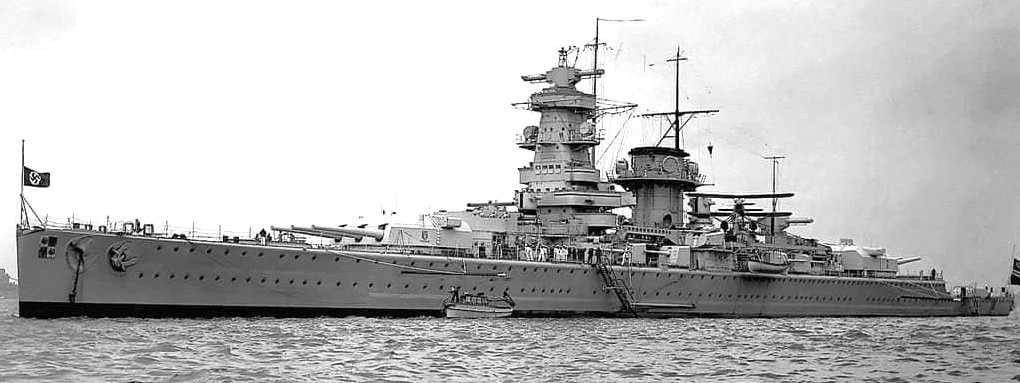
(Kriegsmarine Photo)
Admiral Graf Spee.