
Kaiserliche Marine pre-dreadnought Battleships
Pre-dreadnought battleships: Brandenburg class (1892): SMS Brandenburg, SMS Wörth, SMS Weissenburg, SMS Kurfürst Friedrich Wilhelm. (*These pre-dreadnought battleships are recorded on a separate page on this website).
Pre-dreadnought battleships: Wittelsbach class (1900): SMS Wittelsbach, SMS Wettin, SMS Zähringen, SMS Schwaben, SMS Mecklenburg. (*These pre-dreadnought battleships are recorded on a separate page on this website).
Pre-dreadnought battleships: Braunschweig class (1902): SMS Braunschweig, SMS Elsass, SMS Hessen, SMS Preussen, SMSBayern Lothringen. (*These pre-dreadnought battleships are recorded on a separate page on this website).
Pre-dreadnought battleships: Kaiser Friedrich III class (1904): SMS Kaiser Friedrich III, SMS Kaiser Wilhelm II, SMS Kaiser Wilhelm der Grosse, SMS Kaiser Barbarossa, SMS Kaiser Karl der Grosse. (*These pre-dreadnought battleships are recorded on a separate page on this website).
Pre-dreadnought battleships: Deutschland class (1905): SMS Deutschland, SMS Hannover, SMS Pommern, SMS Schlesien, SMS Schleswig-Holstein. (*These pre-dreadought battleships are recorded on a separate page on this website).
Kaiserliche Marine dreadnought Battleships
Dreadnought battleships: Nassau class (1906): SMS Nassau, SMS Westfalen, SMS Rheinland, SMS Posen. (*These dreadnought battleships are recorded on a separate page on this website).
Dreadnought battleships: Helgoland class (1909): SMS Helgoland, SMS Ostfriesland, SMS Thüringen, SMS Oldenburg. (*These dreadnought battleships are recorded on a separate page on this website).
Dreadnought battleships: Kaiser class (1911): SMS Kaiser, SMS Friedrich der Grosse, SMS Kaiserin, SMS Prinzregent Luitpold, SMS König Albert. (*These dreadnought battleships are recorded on a separate page on this website).
Dreadnought battleships: König class (1913): SMS König, SMS Grosser Kurfürst, SMS Markgraf, SMS Kronprinz. (*These dreadnought battleships are recorded on a separate page on this website).
Kaiserliche Marine Dreadnought battleships: Bayern class battleships (1916): SMS Bayern, SMS Baden. (*These dreadnought battleships are recorded on a separate page on this website).
Kaiserliche Marine (Imperial German Navy) Dreadnought battleships: Sachsen class (launched): SMS Sachsen (1916), SMS Württemberg (1917). (*These dreadnought battleships are recorded on a separate page on this website).
Kaiserliche Marine Dreadnought battleships: L 20e α. The L20 Alpha (project) was a design for a class of battleships to be built in 1918 for the German Kaiserliche Marine (Imperial Navy) during the First World War. Design work on the class of battleship to succeed the Bayern-class battleships began in 1914, but the outbreak of the First World War in July 1914 led to these plans being shelved. Work resumed in early 1916 and lessons from the Battle of Jutland, fought later that year, were incorporated into the design. Reinhard Scheer, the commander of the fleet, wanted larger main guns and a higher top speed than earlier vessels, to combat the latest ships in the British Royal Navy. A variety of proposals were submitted, with armament ranging from the same eight 38 cm (15 in) guns of the Bayern class to eight 42 cm (16.5 in) guns.
Work on the design was completed by September 1918, but by then there was no chance for them to be built. Germany’s declining war situation and the reallocation of resources to support the U-boat campaign meant the ships would never be built. The ships would have been significantly larger than the preceding Bayern-class battleships, at 238 m (780 ft 10 in) long, compared to 180 m (590 ft 7 in) for the preceding ships. The L 20e α class would have been significantly faster, with a top speed of 26 knots (48 km/h; 30 mph), compared to the 21-knot (39 km/h; 24 mph) maximum of the Bayerns and would have been the first German warships to have mounted guns larger than 38 cm.
Kaiserliche Marine Battlecruisers
Kaiserliche Marine (Imperial German Navy) battlecruisers: SMS Blücher (1908), SMS Von der Tann (1909), SMS Moltke (1910), SMS Goeben (1910), SMS Seydlitz (1912), SMS Derfflinger, SMS Lützow, SMS Hindenburg. (*These battlecruisers are recorded on a separate page on this website).
SMS Blücher (1908), was the last armoured cruiser built for the Kaiserliche Marine beginning in 1907.
SMS Von der Tann (1909), was the first battlecruiser built for the German Kaiserliche Marine (Imperial Navy), as well as Germany’s first major turbine-powered warship. At the time of her construction, Von der Tann was the fastest dreadnought-type warship afloat, capable of reaching speeds in excess of 27 knots (50 km/h; 31 mph).
Moltke class (1910): The Moltke class was a class of two “all-big-gun” battlecruisers of the German Imperial Navy built between 1909 and 1911. Named SMS Moltke and SMS Goeben, they were similar to the previous battlecruiser Von der Tann, but the newer design featured several incremental improvements. The Moltkes were slightly larger, faster, and better armored, and had an additional pair of 28 cm (11 in) guns.
SMS Seydlitz (1912): She was ordered in 1910 and commissioned in May 1913, the fourth battlecruiser built for the High Seas Fleet. Named after Friedrich Wilhelm von Seydlitz, Seydlitz represented the culmination of the first generation of German battlecruisers, which had started with the Von der Tann in 1906 and continued with the pair of Moltke-class battlecruisers ordered in 1907 and 1908. Seydlitz featured several incremental improvements over the preceding designs, including a redesigned propulsion system and an improved armor layout. The ship was also significantly larger than her predecessors—at 24,988 metric tons (24,593 long tons; 27,545 short tons), she was approximately 3,000 metric tons heavier than the Moltke-class ships.
Derfflinger class (1913), three battlecruisers of the Kaiserliche Marine: SMS Derfflinger, SMS Lützow, SMS Hindenburg. All three of the ships saw active service with the High Seas Fleet during the First World War.
SMS Hindenburg (1915), the third ship of the Derfflinger class, built to a slightly modified design.
Mackensen class (1917), the last class of battlecruisers to be built by Germany in the First World War. The design initially called for seven ships, but three of them were redesigned as the Ersatz Yorck class. Of the four ships of the Mackensen class, SMS Mackensen, SMS Graf Spee, and SMS Prinz Eitel Friedrich were launched, and SMS Fürst Bismarck was not. None, however, were completed, after wartime shipbuilding priorities were redirected towards U-boats, and the ships were broken up in the early 1920s
Ersatz Yorck class was a group of three battlecruisers ordered but not completed for the Kaiserliche Marine in 1916: SMS Ersatz Yorck, SMS Ersatz Gneisenau, and SMS Ersatz Scharnhorst.
Kaiserliche Marine protected Cruisers: SMS Irene, SMS Prinzess Wilhelm, SMS Kaiserin Augusta, SMS Victoria Louise, SMS Hertha, SMS Freya, SMS Vineta, SMS Hansa. (*These protected cruisers are recorded on a separate page on this website).
Kaiserliche Marine unprotected Cruisers
At the same time that Caprivi began ordering new protected cruisers, he also authorized the construction of smaller unprotected cruisers for use in Germany’s overseas colonies. The first of these, the Schwalbe class, were laid down in 1886 and 1887. A further six vessels of the Bussard class, which were improved versions that were larger and faster than their predecessors, followed over the next five years. A final, much larger vessel, SMS Gefion, was laid down in 1892; her design was based on contemporary protected cruisers like SMS Kaiserin Augusta. She represented another attempt to merge the colonial cruiser and fleet scout, which was unsuccessful. As a result, the German naval designers began work on the Gazelle class, which provided the basis for all future German light cruisers.
All nine cruisers served extensively in Germany’s colonies, particularly in Africa and Asia. They participated in the suppression of numerous rebellions, including the Abushiri Revolt in German East Africa in 1889–1890, the Boxer Uprising in China in 1900–1901, and the Sokehs Rebellion in the Caroline Islands in 1911. Most of the ships had been recalled to Germany and decommissioned by the early 1910s, having been replaced by the newer light cruisers. Bussard and Falke were scrapped in 1912, but the rest continued on in secondary roles. Of the remaining seven ships, only Cormoran and Geier remained abroad at the start of the First World War in August 1914. Cormoran was stationed in Qingdao, but her engines were worn out, so she was scuttled to prevent her capture. Geier briefly operated against British shipping in the Pacific before running low on coal. She put into Hawaii, where she was interned by the US Navy. After the United States declared war on Germany in April 1917, she was seized and commissioned into American service as USS Schurz, though she was accidentally sunk in a collision in June 1918. Seeadler, employed as a mine storage hulk in Wilhelmshaven during the war, was destroyed by an accidental explosion in 1917. Condor, Schwalbe, and Sperber were all broken up for scrap in the early 1920s, while Gefion was briefly used as a freighter, before she too was scrapped, in 1923. (Wikipedia)
SMS Schwalbe, SMS Bussard, SMS Falke, SMS Seeadler, SMS Condor, SMS Cormoran, SMS Geier, SMS Gefion. (*These unprotected cruisers are recorded on a separate page on this website).
Kaiserliche Marine armoured Cruisers
The first armoured cruiser, Fürst Bismarck, was ordered shortly after the Victoria Louise class of protected cruisers. Fürst Bismarck was an improved version of the earlier type, with heavier armament, more extensive armor protection, and a significantly greater size. A further seven units, divided between four different designs, followed over the next ten years; each design provided incremental improvements over earlier vessels. A ninth armored cruiser, Blücher, was a much larger vessel representing an intermediate step between armored cruisers and battlecruisers. Indeed, her design had been influenced by the misinformation Britain had released about its Invincible-class battlecruisers, which were then under construction. Once the characteristics of the new ships were revealed, Germany began building battlecruisers in response.
Germany’s armored cruisers served in a variety of roles, including overseas as flagships of the East Asia Squadron, and in the fleet reconnaissance forces. All of them, save Fürst Bismarck, saw action during the First World War in a variety of theaters. Blücher served with the battlecruisers in the I Scouting Group and was sunk at the Battle of Dogger Bank in 1915, and the two Scharnhorst-class cruisers formed the core of Maximilian von Spee’s squadron that defeated the British at the Battle of Coronel in November 1914 before being annihilated at the Battle of the Falkland Islands.[35] Yorck was accidentally sunk by a German mine in November 1914 outside Wilhelmshaven, and the two Prinz Adalbert-class cruisers were sunk in the Baltic Sea. Only Prinz Heinrich and Roon survived the war; both were scrapped in the early 1920s. (Wikipedia)
SMS Fürst Bismarck, SMS Prinz Heinrich, SMS Prinz Adalbert, SMS Friedrich Carl, SMS Roon, SMS Yorck, SMS Scharnhorst, SMS Gneisenau, SMS Blücher. (*These armoured Cruisers are recorded on a separate page on this website).
Kaiserliche Marine light Cruisers
Starting in the late 1890s, the Kaiserliche Marine began developing modern light cruisers, based on experience with the unprotected cruisers and a series of avisos it had built over the preceding decade. The ten-ship Gazelle class set the basic pattern, which was gradually improved over successive classes. The Pillau class introduced more powerful, 15-centimeter (5.9 in) main guns, and the Magdeburg class added a waterline main belt to improve armor protection. Between 1897 and the end of the First World War, the German Navy completed forty-seven light cruisers; all of these ships saw service during the war in a variety of theaters and roles. Some, such as Emden and Königsberg, served as commerce raiders, while others, such as the two Wiesbaden-class cruisers, served with the High Seas Fleet and saw action at the Battle of Jutland in 1916. Several fleet cruiser design studies were prepared in 1916, but no work was begun before the war ended in November 1918.
Following the war, the Treaty of Versailles forced Germany to cede all of its most modern light cruisers; only eight Gazelle and Bremen-class cruisers were permitted under the terms of the treaty. These ships could be replaced after twenty years from the time they were launched, and the first new vessel, Emden, was laid down in 1921. Five more ships of the Königsberg and Leipzig classes were built between 1926 and 1935. These six cruisers all saw combat during the Second World War; two, Königsberg and Karlsruhe, were sunk during the invasion of Norway in April 1940. Emden and Köln were destroyed by Allied bombers in the closing months of the war, and Leipzig was discarded after being badly damaged in a collision with the heavy cruiser Prinz Eugen. This left Nürnberg as the only vessel of the type to survive the war. She was seized by the Soviet Union as a war prize and continued in Soviet service until she was scrapped in 1960. (Wikipedia)
SMS Gazelle, SMS Niobe, SMS Nymphe, SMS Thetis, SMS Ariadne, SMS Amazone, SMS Medusa, SMS Frauenlob, SMS Arcona, SMS Undine, SMS Bremen, SMS Hamburg, SMS Berlin, SMS Lübeck, SMS München, SMS Leipzig, SMS Danzig, SMS Königsberg, SMS Nürnberg, SMS Stuttgart, SMS Stettin, SMS Dresden, SMS Emden, SMS Kolberg, SMS Mainz, SMS Cöln, SMS Augsburg, SMS Magdeburg, SMS Breslau, SMS Strassburg, SMS Stralsund, SMS Karlsruhe, SMS Rostock, SMS Graudenz, SMS Regensburg, SMS Pillau, SMS Elbing, SMS Wiesbaden, SMS Frankfurt, SMS Königsberg, SMS Karlsruhe, SMS Emden, SMS Nürnberg, SMS Brummer, SMS Bremseall, SMS Cöln, SMS Bremen.
Wiesbaden, Magdeburg, Leipzig, Rostock, Frauenlob, Ersatz Cöln, Ersatz Emden, Ersatz Karlsruhe, (all scrapped).
FK 1, FK 1a, FK 2, FK 3, FK 4 (design studies only).
SMS Emden, Königsberg, Karslruhe, Köln, Leipzig, Nürnberg.
M, N, O, P, Q, R (scrapped).
Reichsmarine Heavy Cruisers
In addition to restricting the number of light cruisers Germany could possess, the Treaty of Versailles also limited the capital ship strength of the new Reichsmarine to six old pre-dreadnought battleships and placed restrictions on the size of replacement ships, with the intent of prohibiting ships more powerful than coastal defense ships from being built.[96] The Reichsmarine responded by designing the Deutschland class; these heavy cruisers armed with 28 cm (11 in) guns were intended to break the naval clauses of Versailles by significantly outgunning the new treaty cruisers being built by Britain and France under the terms of the Washington Naval Treaty, which were limited to 20.3 cm (8.0 in) guns. If Britain and France agreed to abrogate the naval clauses of the Versailles treaty, Germany would abandon the new cruisers. France rejected the proposal, and so the three Deutschlands were built,[97] and a further two of the D-class were planned, though these were cancelled in favor of a larger derivative, the Scharnhorst class of fast battleships. When Germany signed the Anglo-German Naval Agreement in 1935, the Reichsmarine was permitted to build five new heavy cruisers—the Admiral Hipper class. Plan Z, approved in early 1939, projected a dozen P-class cruisers based on the Deutschland design.
Owing to the outbreak of the Second World War, only three of the Admiral Hipper class were completed and the P-class ships were cancelled. Admiral Graf Spee was scuttled following the Battle of the River Plate in December 1939, and Blücher was sunk during the invasion of Norway. Admiral Scheer and Admiral Hipper were destroyed by Allied bombers in the last month of the war. In 1942 the Kriegsmarine decided to convert the Admiral Hipper-class cruiser Seydlitz into an aircraft carrier, though the project was not completed. Deutschland, renamed Lützow, and Prinz Eugen both survived the war; the former was sunk in Soviet weapons tests in 1947 and the latter sank after enduring two nuclear detonations in Operation Crossroads in 1946. The two unfinished Admiral Hippers, Seydlitz and Lützow, were scrapped in the Soviet Union in the late 1950s; the former was a war prize but the latter had been sold to the Soviets before the German invasion of the Soviet Union in 1941. (Wikipedia)
Deutschland, Admiral Scheer, Admiral Graf Spee, Admiral Hipper, Blücher, Prinz Eugen, Seydlitz, Lützow. (*These heavy Cruisers are recorded on a separate page on this website).
D, E, P1-P-12 (cancelled)
Kaiserliche Marine U-Boats
Brandtaucher, Forelle, U-1, U-2, U-3 class, U-5 class, U-9 class, U-13 class, U-17 class, U-19 class, U-23 class, U-27 class, U-31 class, U-43 class, U-51 class, U-57 class, U-63 class, U-66 class, U-71 class, U-81 class, U-87 class, U-93 class, U-139 class, U-142 class, U 151 class, UA, UB-I class, UB-II class, UB-III class, UC-I class, UC-II class, UC-III, UE-I class, UE-II class, U-Projects.
The Imperial Navy was the first to operate submarines successfully on a large scale in wartime, with 375 submarines commissioned by the end of the First World War, and it also operated zeppelins. Although it was never able to match the number of ships of the Royal Navy, it had technological advantages, such as better shells and propellant for much of the Great War, meaning that it never lost a ship to a catastrophic magazine explosion from an above-water attack,[although the elderly pre-dreadnought SMS Pommern sank rapidly at Jutland after a magazine explosion was caused by an underwater attack.
Kaiserliche Marine Commerce Raiders
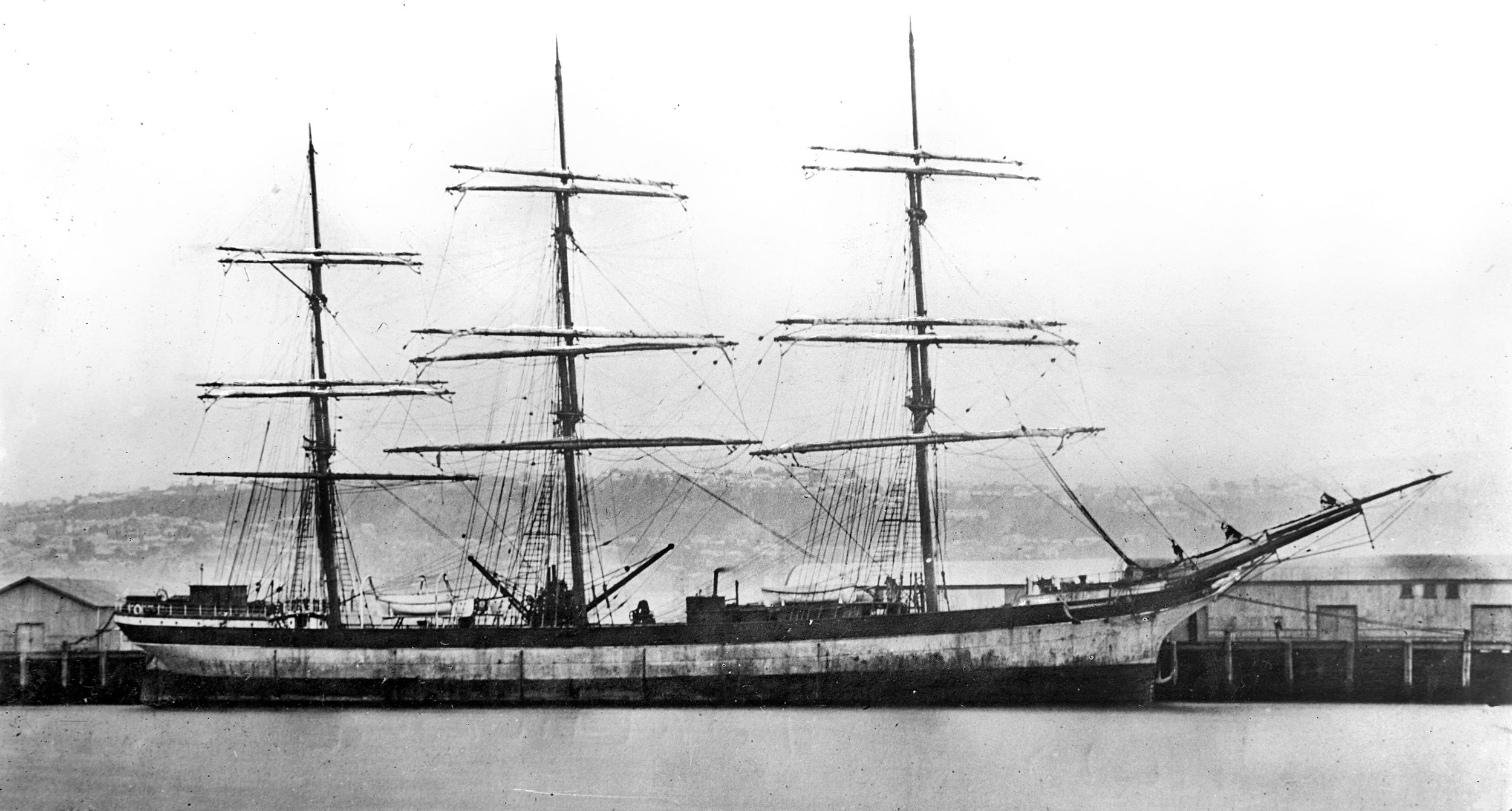
(Kaiserliche Marine Photo)
SMS Seeadler (1888), (sea eagle) was a three-masted steel-hulled sailing ship. She was one of the last fighting sailing ships to be used in war when she served as a merchant raider with Imperial Germany in the First World War. Built as the British-flagged Pass of Balmaha, she was captured by the German submarine SM U-36, and in 1916 converted to a commerce raider. As Seeadler she had a successful raiding career, capturing and sinking 15 ships in 225 days until she was wrecked, in 2 August 1917, in French Polynesia.
Kaiserliche Marine Destroyers
Kaiserliche Marine Torpedo Boats
Kaiserliche Marine gunboats
Kaiserliche Marine minesweepers
Kaiserliche Marine MTBs
In 1890 there were 13 battleships, 23 Cruisers, 30 TBDs, 15 misc. ships. In 1914 these figures turned to 47 battleships, 57 cruisers, 143 destroyers, 91 TBDs, about 45 submarines and 6 misc. ships.