
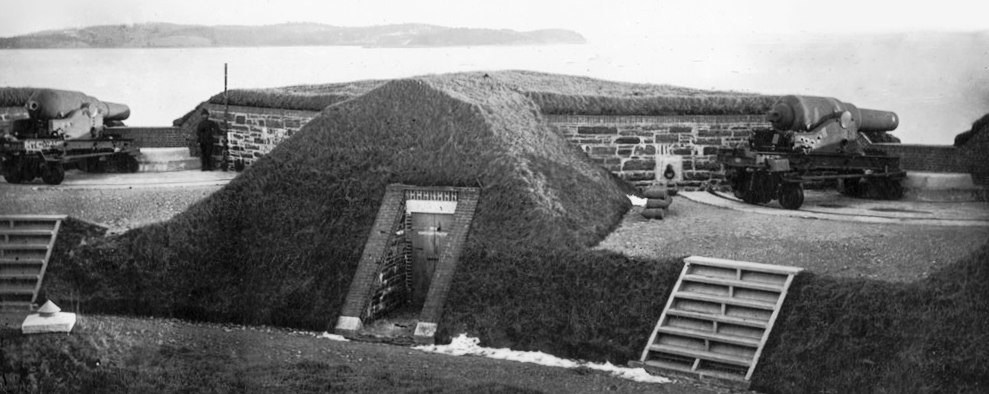
Artillery preserved at Fort Charlotte, George’s Island, Halifax, Nova Scotia
(Library and Archives Canada Photo, MIKAN No. 3349677)
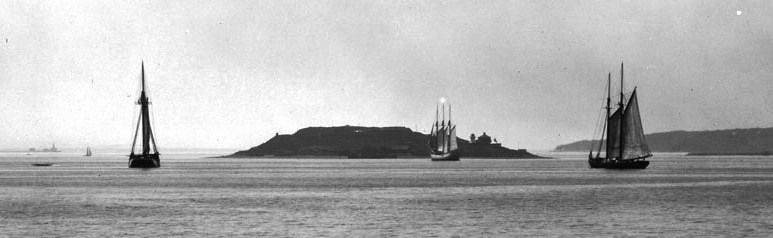
George’s Island, Halifax harbour, early 1900s. Georges Island (named after King George III) is a glacial drumlin and the largest island entirely within the harbour limits of Halifax Harbour located in Nova Scotia’s Halifax Regional Municipality. The Island is the location of Fort Charlotte – named after King George III’s wife Charlotte. Fort Charlotte was built during Father Le Loutre’s War, a year after Citadel Hill (Fort George). The island is now a National Historic Site of Canada. The island is open to the public on the weekends (and Fridays during peak summer season), from June until Thanksgiving weekend. Upon the arrival of Edward Cornwallis and the outbreak of Father Le Loutre’s War, fortifications were established on Citadel Hill (Fort George) (1749) and Georges Island (Fort Charlotte) (1750).
During the Seven Years’ War, two thousand French sailors were imprisoned on the island after the British victory in the Battle off Cape Race, Newfoundland. During the war, Fort Charlotte was one of four forts where Acadians were imprisoned over the nine years of the Expulsion of the Acadians (the others were Fort Frederick, Saint John, New Brunswick; Fort Cumberland and Fort Edward). The Acadian prisoners in the vicinity of Halifax were subject to various degrees of confinement and dependence upon victualization, without the right to own land, continuously, from 1759 to 1768. According to historian Ronnie Gilles-LeBlanc there were approximately 1660 Acadians held prisoner on the island during the deportation (1755–1763), with a maximum of 600 prisoners at one time. Many Acadian men in the region were occupied with road building, fisheries, wharf building, and wood cutting, and lodged close to where they worked.
During the American Revolution the 84th Regiment of Foot (Royal Highland Emigrants) were stationed at the fort to protect the harbour from American Privateers. Numerous American privateers were held prisoner in the fort throughout the war.Georges Island was part of the “Halifax Defence Complex” from the mid-18th century to the Second World War, with Citadel Hill and Fort Charlotte on the island being restored by Parks Canada. For nearly two hundred years Georges Island was the scene of constant military activity. Tales of executions, forts and hidden tunnels surround the folklore associated with the mysterious island. It had an Island Prison Camp, a Look Out Point, an Acadian Prison camp, and a Quarantine Station. The Georges Island Lighthouse was established on the island in 1876. The original wooden tower burned in 1916 and was replaced by an octagonal concrete tower in 1917. The light was staffed until 1972 when it was automated. (Wikipedia)
(Library and Archives Canada Photo, MIKAN No. 3348312)
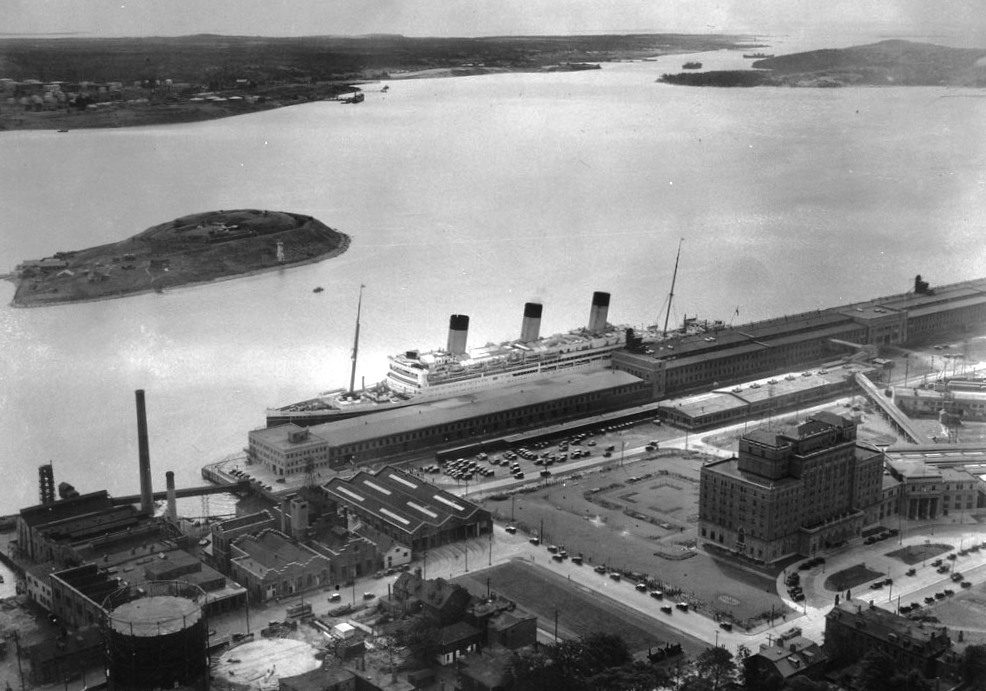
George’s Island and Halifax terminals, 1934.
(Halifax Military Heritage Preservation Society Photo)
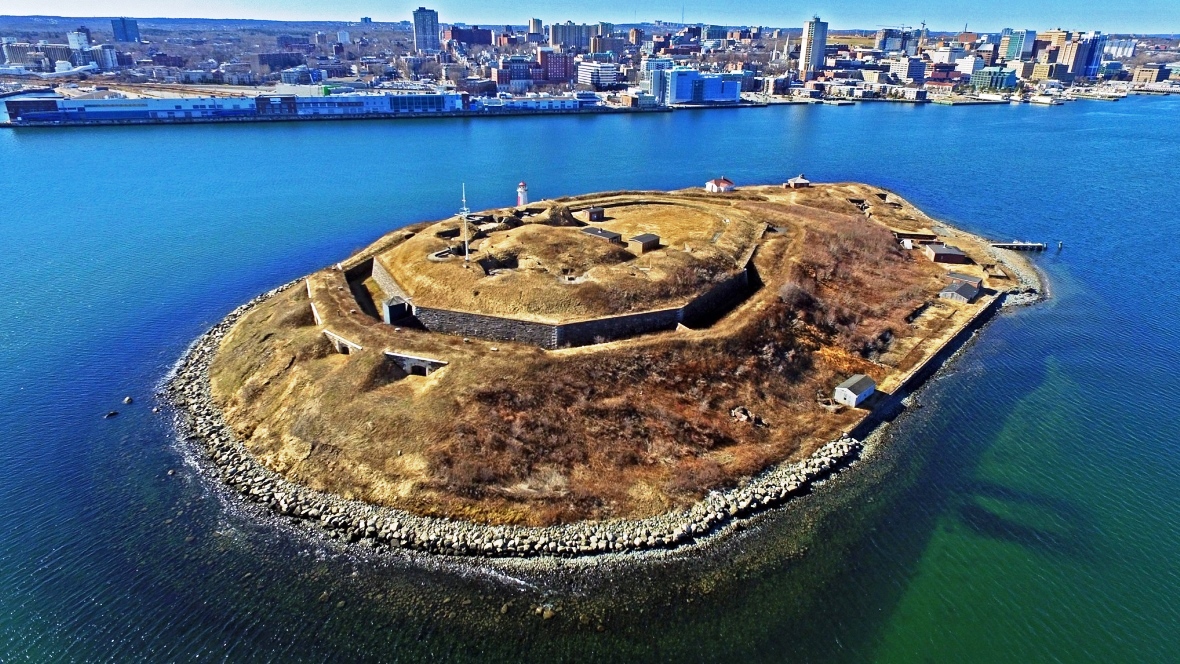
George’s Island, Halifax, Nova Scotia.
(Library and Archives Canada Photo, MIKAN No. 4132690)
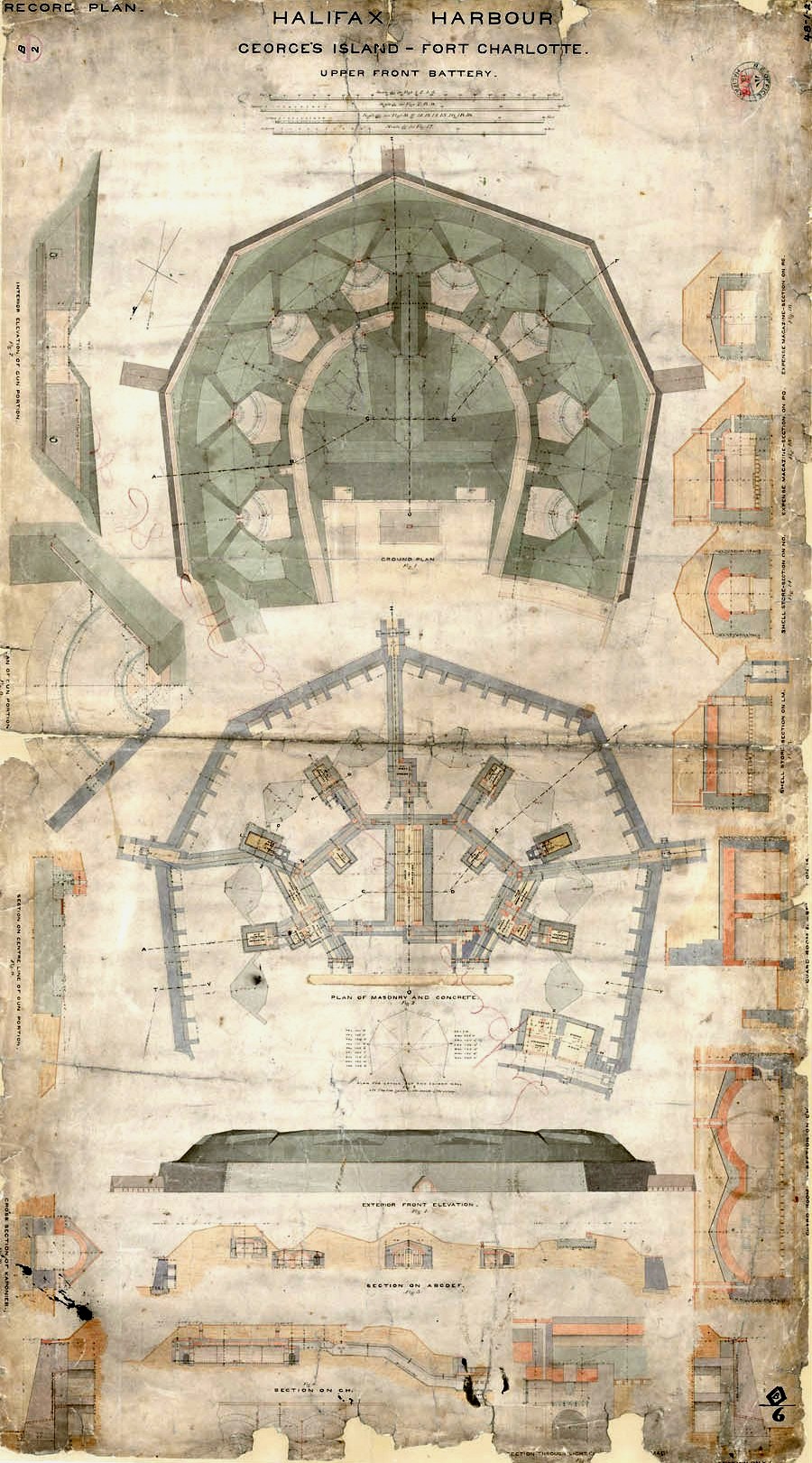
George’s Island-Fort Charlotte, Halifax harbour. Upper front battery. [architectural drawing] 1879.
(Halifax Military Heritage Preservation Society Photo)
Originally there were eight 9-inch 12-ton Mk. II Muzzleloading Rifle with Millar pattern breeching rings, on the Upper Battery, and four 10-inch 18-ton Muzzleloading Rifles in an underground Lower Battery.
At present there are seven 64-pounder 71-cwt Muzzleloading Rifles on the island:
64-pounder 71-cwt Muzzleloading Rifle, No. 1, mounted on wood blocks in the Upper Battery position.
64-pounder 71-cwt Muzzleloading Rifle, No. 2, mounted on wood blocks in the Upper Battery position.
64-pounder 71-cwt Muzzleloading Rifle, No. 3, mounted on wood blocks in the Upper Battery position.
64-pounder 71-cwt Muzzleloading Rifle, No. 4, mounted on wood blocks in the Upper Battery position.
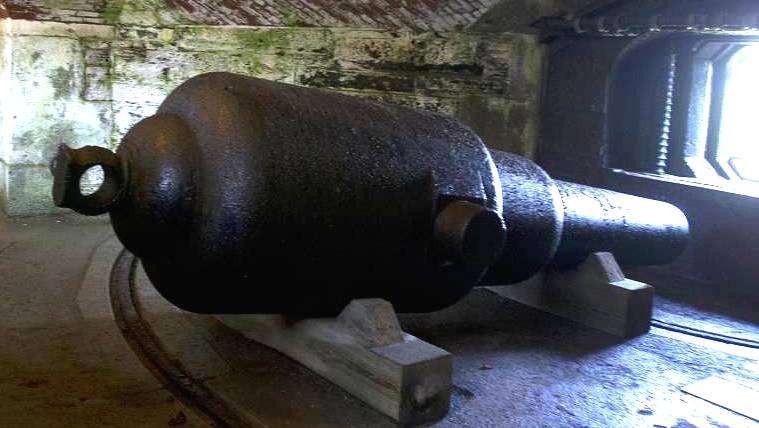
64-pounder 71-cwt Muzzleloading Rifle, No. 5, mounted on wood blocks in the Lower Battery position.
64-pounder 71-cwt Muzzleloading Rifle, No. 6, mounted on wood blocks on the ground behind the ramparts.
64-pounder 71-cwt Muzzleloading Rifle, No. 7, mounted on wood blocks on the ground behind the ramparts.
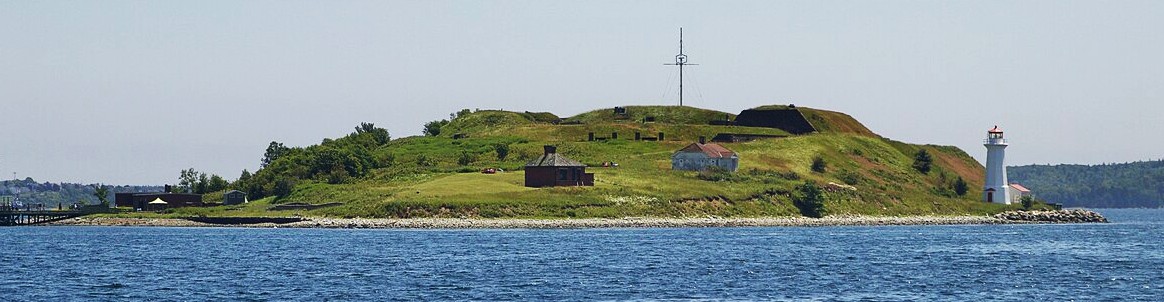
(Hayden Soloviev Photo)
George’s Island viewed from Halifax.