
Captured Focke-Wulf Fw 190 fighters flown and preserved by the USAAF and USN 

(USAAF Photos)
Focke-Wulf Fw 190G-3, (Wk. Nr. 160043), coded DP+HQ, III.-SKG 10A-5, DP, captured in Italy.


(USAAF Photos)
Focke-Wulf Fw 190A-8, (Wk. Nr. 681497), coded 11+-, White 11 of 5./JG 4 at St. Trond airfield, Belgium, circa 1 January 1945. This aircraft was flown during on 1 January 1945 during Operation Bodenplatte by Corporal Walter Wagner who was hit by flak during the attack over St. Trond airfield. The engine died and he had to make an emergency landing. The weapons have obviously been removed. The photo was taken by the resident USAAF 404th Fighter Group.


(USAAF Photos)
Focke-Wulf Fw 190A-8, (Wk. Nr. 681497), coded 11+-, White 11 of 5./JG 4 at St. Trond airfield after being taken over by the USAAF 404th Fighter Group. This aircraft had force-landed during Operation Bodenplatte, a Luftwaffe attack on Allied airfields in France and Belgium on 1 Jan 1945. It was then painted red, but was not flown.


(USAAF Photos)
Focke-Wulf Fw 190A-8, (Wk. Nr. 681497), coded 11+-, White 11 of 5./JG 4. It had been piloted by Gefreiter Walter Wagner, of 5. II/JG4 was slightly damaged by Allied anti-aircraft fire and was forced to land at the airport of St-Trond on 1 January 1945. Wagner had taken part in an attack on 404 Fighter Group 508 Squadron’s airfield at St-Trond, Belgium during Operation Bodenplatte, a front wide attack to destroy allied aircraft on the ground. This aircraft was captured and painted overall bright orange-red to distinguish it from enemy Focke-Wulf Fw 190s. The aircraft’s code, 00–L, is likely related to the Belgian national code for aircraft registration purposes. The L may have been for its intended pilot, Leo Moon, the Squadron’s CO. It appears the aircraft was never flown and was left behind when the 404th left St-Trond.


(USAAF Photo)
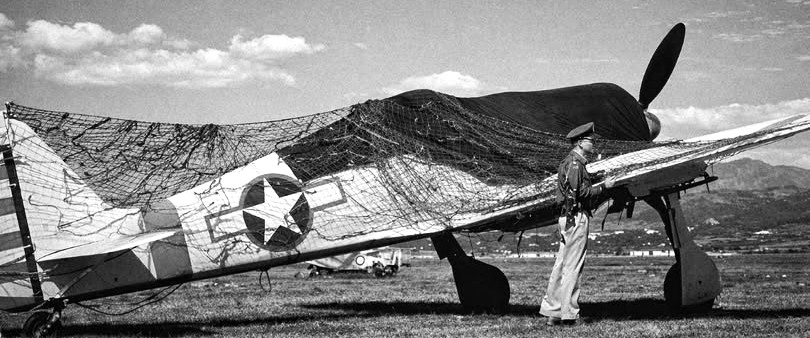
Focke-Wulf Fw 190A-5, (Wk. Nr. unknown), captured in Sicily by the USAAF. This aircraft was painted by the 325 Fighter Squadron (FS) with a bright red cowling and red, white and blue stripes on the tail fin and an American star over an orange square on the fuselage. It was flown by 1st Lt. Jack Shafton of 317 FS from Lesinia airbase near Foggia. The plane was immediately grounded by Colonel Chester L. Sluder (commander of the unit between 1 April 1944 and 11 September 1944) due to worn out tires. After Sluder’s departure from command, several pilots tried to start the aircraft, but during taxiing the canopy fell off and the plane was eventually abandoned.

(USAAF Photo)
Focke-Wulf Fw 190G-3, (Wk. Nr. 160057), one of two captured by ground crews of the 85th Fighter Squadron, 79th Fighter Group at Gerbini Airfield on the Island of Sicily, in September 1943. It was painted in a striking white scheme with red spinner, cowling, fuselage band and USN striped tail. It was shipped to the United States in January 1944, where repairs were made.


(USN Photos)
Focke-Wulf Fw 190G-3, (Wk. Nr. 160057). Later, in 1945 while in the USA, this aircraft was repainted in a standard USN 3-tone non-specular, intermediate blue and insignia white scheme. It was test flown by the Technical Air Intelligence Unit (TAIU) at NAS Anacostia, then moved to NAS Patuxent River in February 1945.
(USAAF Photo)
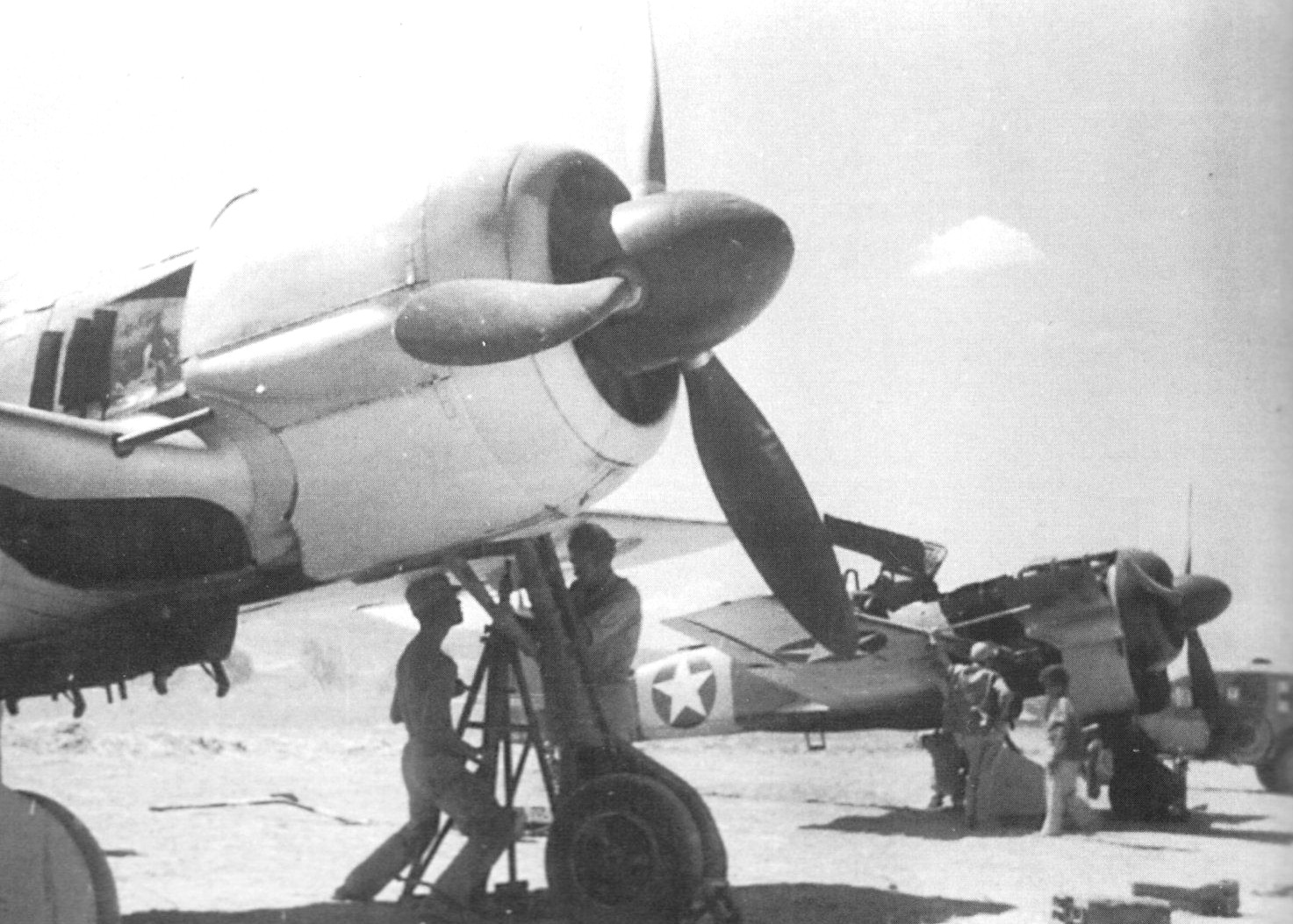
The 79th Fighter Group / 85th Fighter Squadron “Flying Skulls” restored at least three Fw 190s to flying condition. Here are two which they discovered at Gerbini, Sicily in August 1943.
(USAAF Photo)
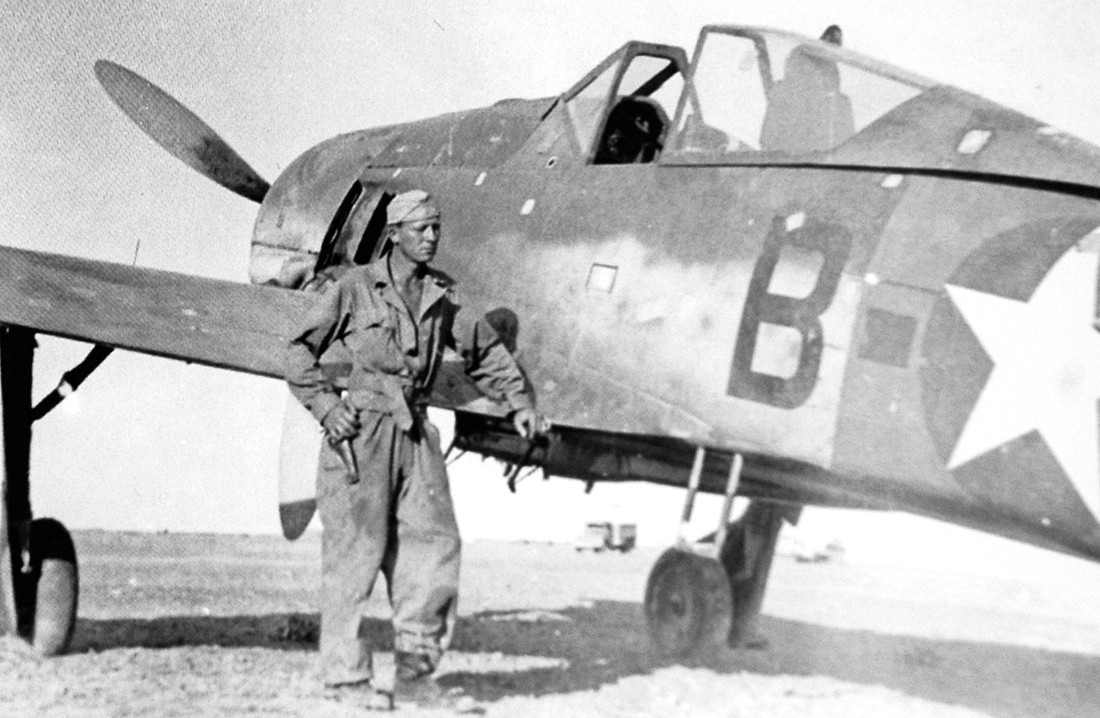
“B” wore the standard Luftwaffe camouflage of RLM 74/75/76 when captured. The US insignia is applied over a yellow band and the Hakenkreutz on the tail has been painted out. The rectangular patch just aft of the “B” within the yellow band on the radio access panel was retained even after the aircraft was repainted.

(USAAF Photo)
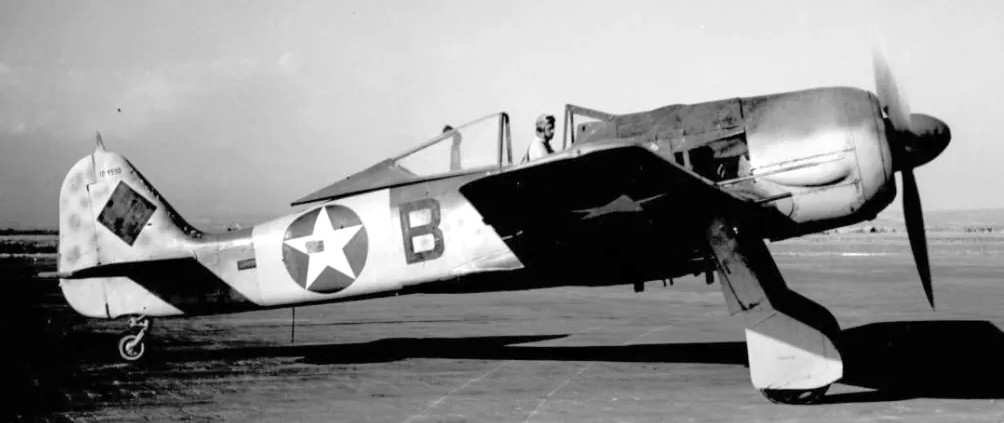
Focke-Wulf Fw 190, (Wk. Nr. 181550), B, captured in North Africa, was flown by the USAAF 85th FS, 79th FG.



(USAAF Photos)
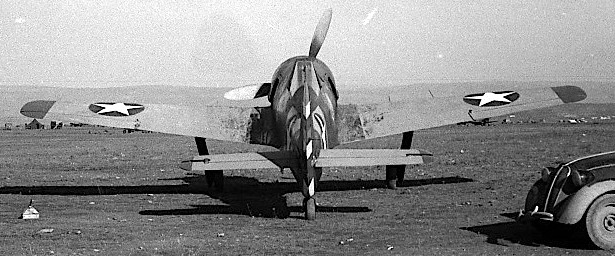
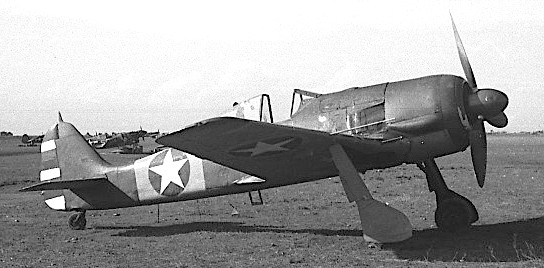
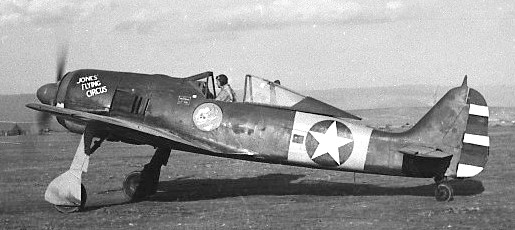
Focke-Wulf Fw 190A-5, (Wk. Nr. unknown), captured and flown by the 85th fighter squadron, 79th fighter group of 12th USAAF in Mediterranean Theatre of Operations (MTO). The aircraft is painted red overall with yellow wings with red wingtips and yellow horizontal stabilizers with red tips. It has USAAF markings (white star in blue roundel) in a broad yellow fuselage band. The plane also bears the squadron insignia of the 85th fighter squadron (flying skulls), “Jones Flying Circus“.


(USAAF Photos)
Focke-Wulf Fw 190A-3, (Wk. Nr. unknown), USAAF EB-101 test flown in the USA in 1944. This aircraft was later renumbered USA FE-497, later T2-497. It was scrapped at Wright Field in 1946.

(USAAF Photo)
Focke-Wulf Fw 190, possibly captured in Italy, USAAF markings ca 1943.

(Luftwaffe Photo)
Focke-Wulf Fw 190F-8, Germany, ca 1945.


(USAAF Photos)
Focke-Wulf Fw 190G-3, (Wk. Nr. 160016), DN+FP, EB-104, later renumbered USA FE-104, later FE-125 and then T2-125, in flight over Wright Field, Ohio, and on the ground at Freeman Field, Indiana, May 1945.

(USAAF Photo)
Focke-Wulf Fw 190F, White 10, USA FE-113, was captured at Neubibiberg, south of Munich and shipped to the USA on HMS Reaper. It received U.S. markings. It was damaged beyond repair 12 Sep 1945 after a crash at Hollidaysburg, Pennsylvania en route to Freeman Field, Indiana.
Focke-Wulf Fw 190F, (Wk. Nr. unknown) USA FE-114, tested at Freeman Field, Indiana post-war, fate unknown.
Focke-Wulf Fw 190F, (Wk. Nr.unknown), USA FE-115, tested at Freeman Field, Indiana post-war, fate unknown.


(USAAF Photos)
Focke-Wulf Fw 190F-8, (Wk. Nr. unknown), factory No. 12053, USA FE-116, later T2-116 in the USA. This aircraft went to Park Ridge, Pennsylvania where it was scrapped in 1946.

(Kogo Photo)

(Nick-D Photo)
Focke-Wulf Fw 190F-8/R1, (Wk. Nr. 931884), initially coded “Yellow 10” from I./SG2. This aircraft was shipped to the USA and designated FE-117. It is restored and currently painted as “White 7”, on display in the Steven F. Udvar-Hazy Center, Chantilly, Virginia.

(airforcefe Photo)
Focke-Wulf Fw 190A-8, (Wk. Nr. 739447), Reg. No. N447FW, on display in the Evergreen Aviation & Space Museum, McMinnville, Oregon.


(Joanna Poe Photos)
Focke-Wulf Fw 190A-8 (Wk. Nr. 732183), from 12./JG 5 as flown by Ltn Rudi Linz, a German ace with 70 victories. This aircraft was shot down over Norway by a British Mustang during the ‘Black Friday’ raid on 9 February 1945. The aircraft is displayed in the Cottbus Hangar of the Military Aviation Museum in Pungo, Virginia.

(Patrick Mack Photo)
Focke-Wulf Fw 190A-9, (Wk. Nr. 980574), Reg. No. NX190RF, on display in the Planes of Fame Museum, Chino, California.
Focke-Wulf Fw 190A-2, (Wk. Nr. 5476), JG 5, owned by Wade S. Hayes and currently located in Texas. It is thought to be one of the oldest Fw 190s still in existence.

(Goshimini Photo)
Focke-Wulf Fw 190A-5, (Wk. Nr. 151227), from IV/JG 54. This aircraft crashed in Voibakala forest, near Saint Petersburg in 1943. It was discovered in 1989. Now airworthy, with the Flying Heritage Collection, Paine Field, Everett, Washington.
Focke-Wulf Fw 190A-6, (Wk. Nr. 550470), from I./JG 26. Owned by Malcolm Laing and located in Lubbock Texas.
Focke-Wulf Fw 190A-8, (Wk. Nr. 173889), from 7./JG 1. This aircraft is owned by Mark Timken, currently under restoration.
Focke-Wulf Fw 190A-8, (Wk. Nr. 350177), from 12./JG 5. This aircraft is located at the Texas Air Museum in Rio Hondo, Texas.