
Canadian Warplanes 6: Canadair F-86E Sabre survivors preserved in Canada
(Author Photo)
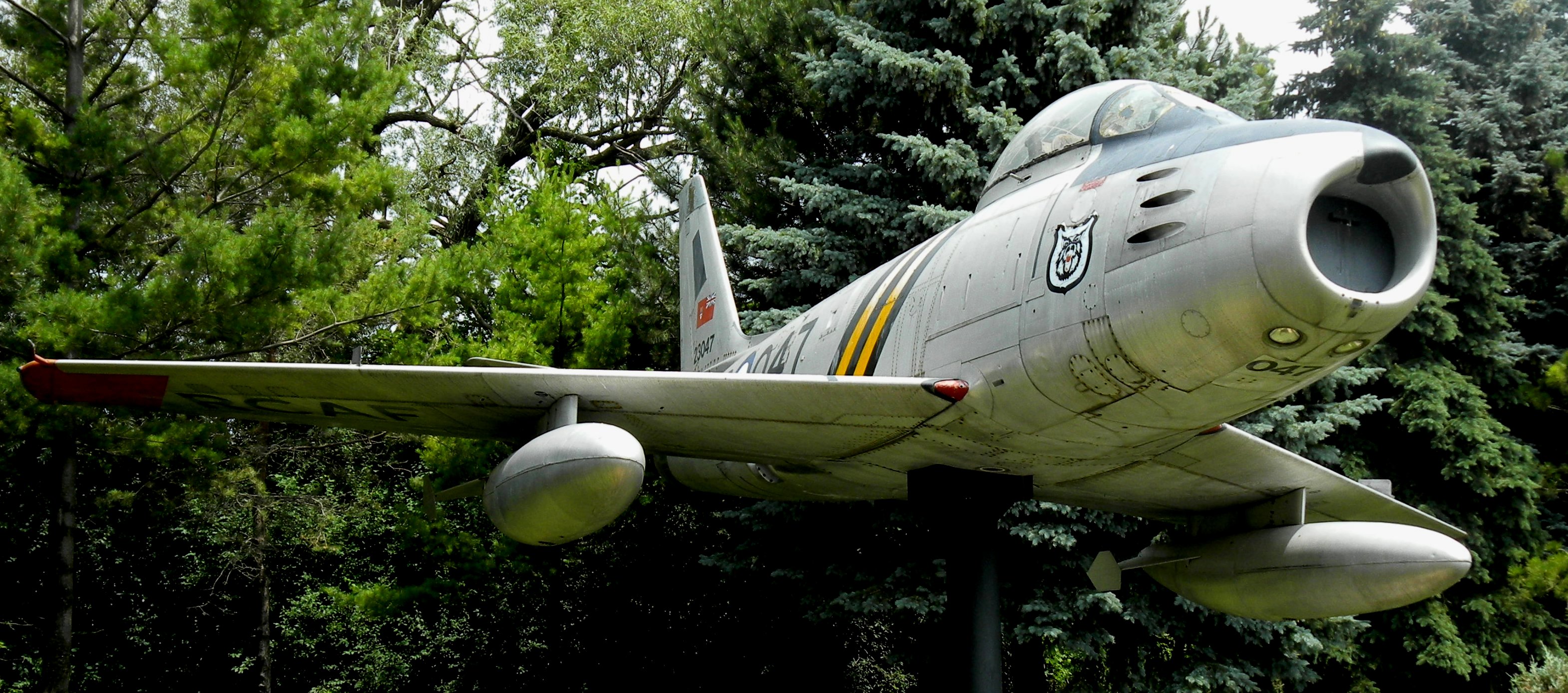
Canadair F-86 Sabre Mk. 5 (Serial No. 23047), Oshawa Airport, Ontario. Mounted on a pylon.
(jiggs11 Photo)
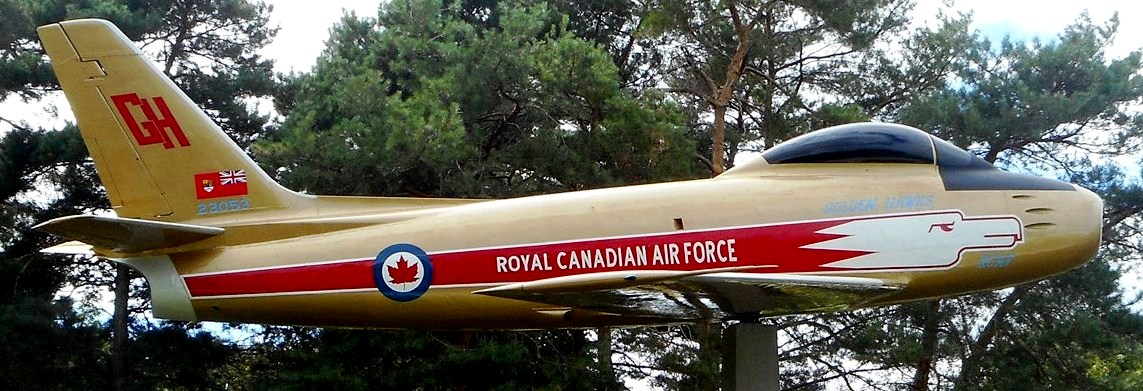
Canadair F-86 Sabre Mk. 5 (Serial No. 23641), painted as (Serial No. 23053), Golden Hawks, mounted on a pylon in the Centennial Park, Zwick’s Island, Belleville, Ontario.
(Author Photos)
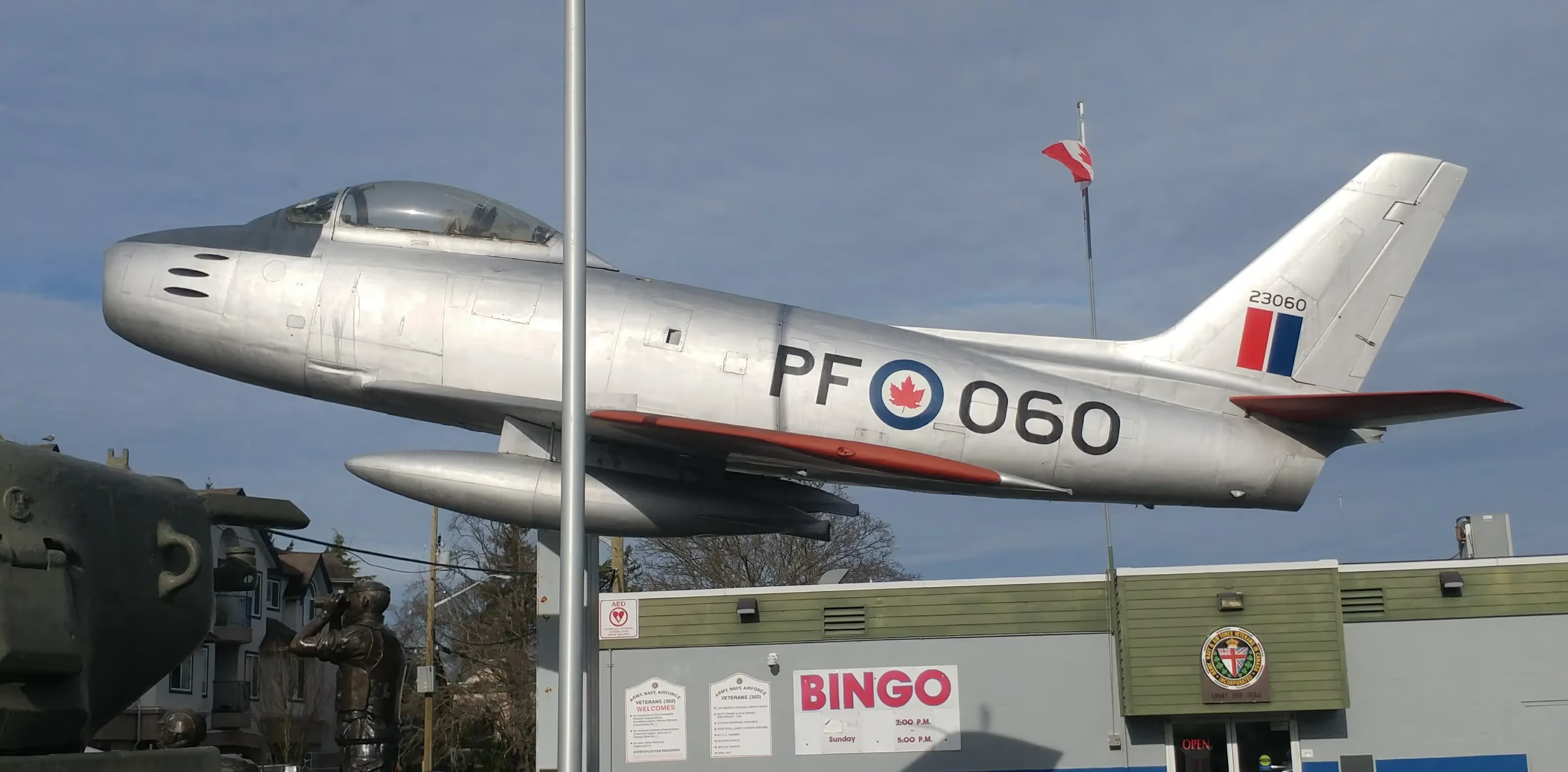
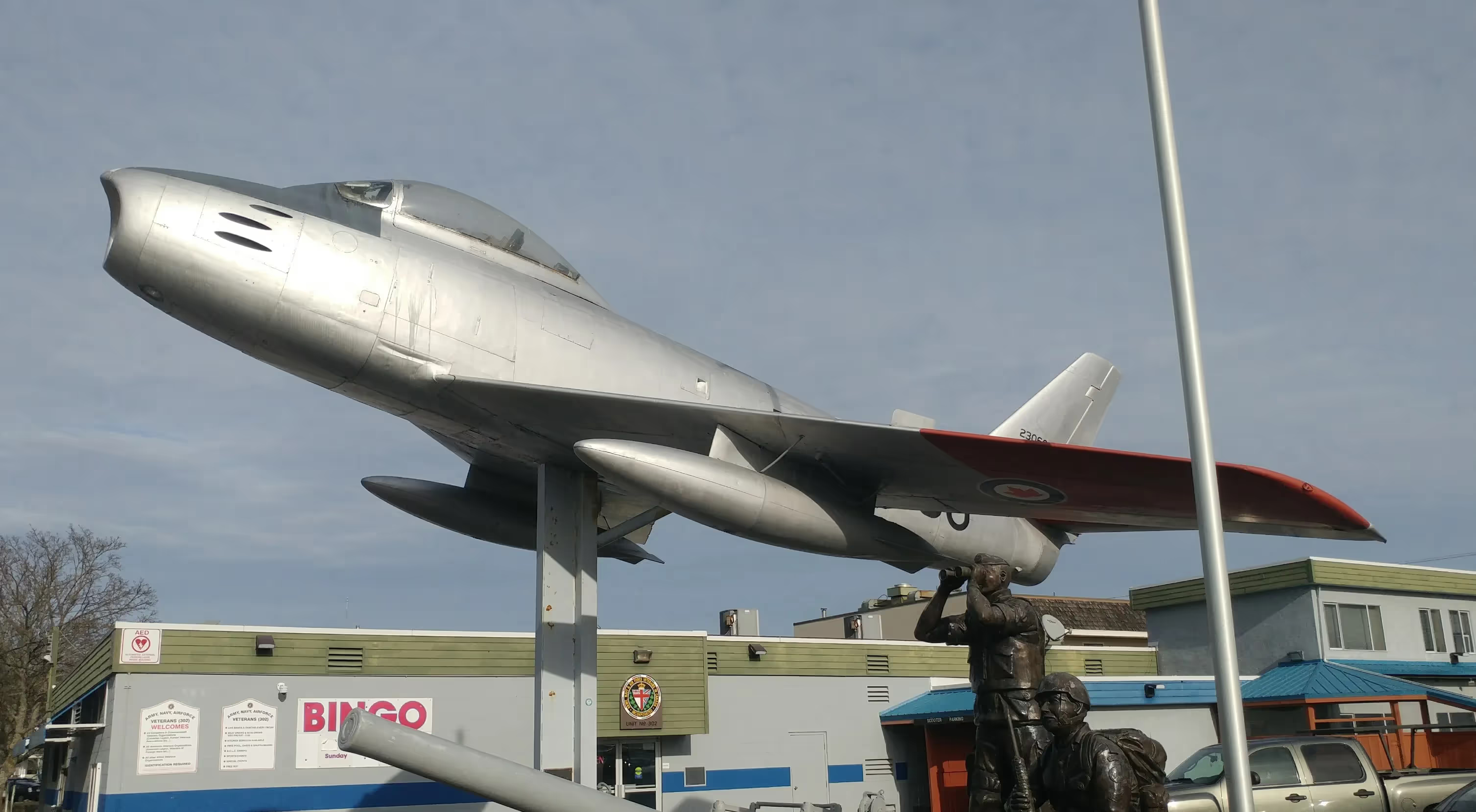
Canadair F-86 Sabre Mk. 5 (Serial No. 23060), coded PF. Mounted on a pylon at Sidney, British Columbia, Army Navy Club Grounds,
(RCAF Photo)
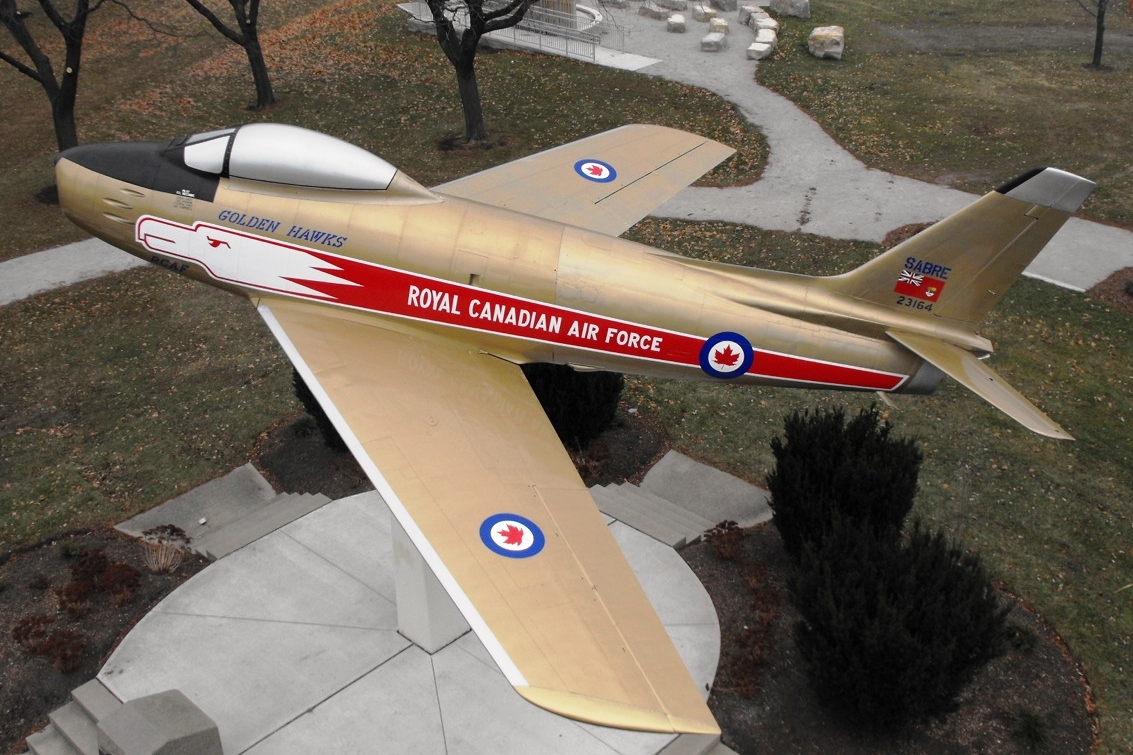
Sarnia, Ontario, Germain Park, Canadair F-86 Sabre Mk. 5 (Serial No. 23164), Golden Hawks. Mounted on a pylon.
(Author Photo)
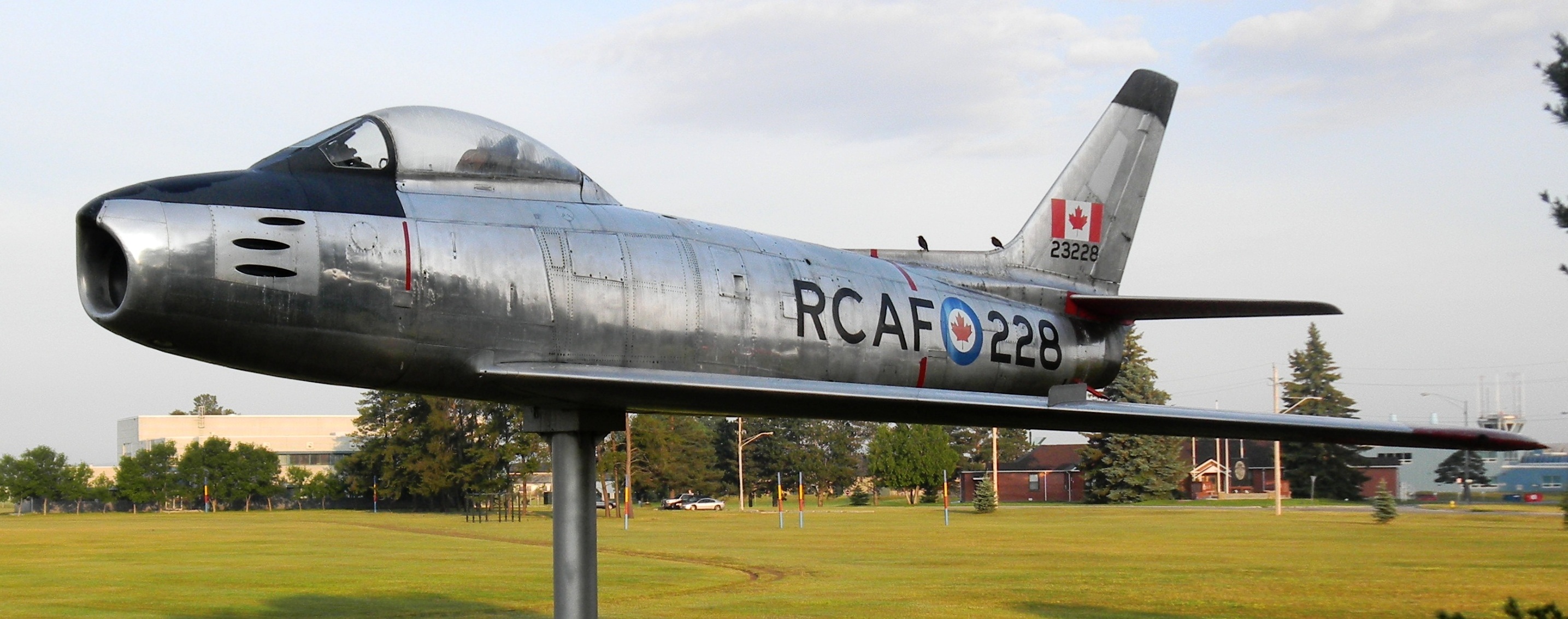
Base Borden Military Museum, CFB Borden, Ontario, Canadair F-86 Sabre Mk. 5 (Serial No. 23228). Mounted on a pylon.
(monkeys4ever Photo)
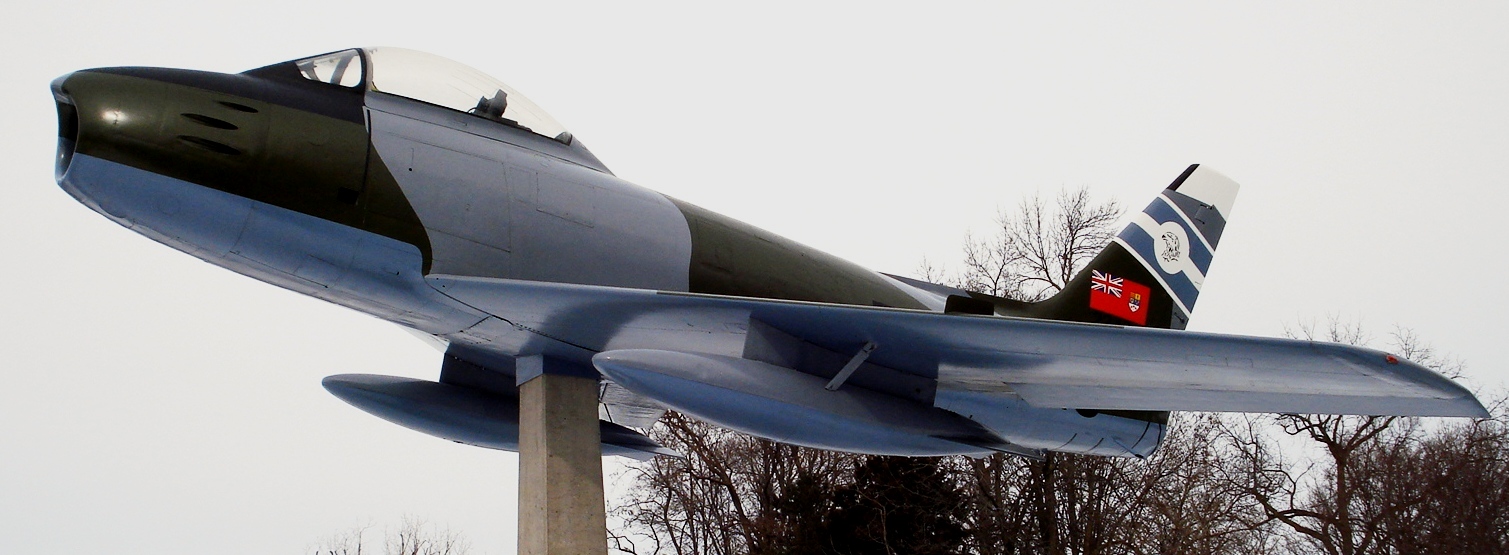
Peterborough, Ontario, 428 Wing RCAFA, Canadair F-86 Sabre Mk. 5 (Serial No. 23245), No. 430 Squadron colours, formerly at Clinton, Ontario. Mounted on a pylon.
(Author Photo)
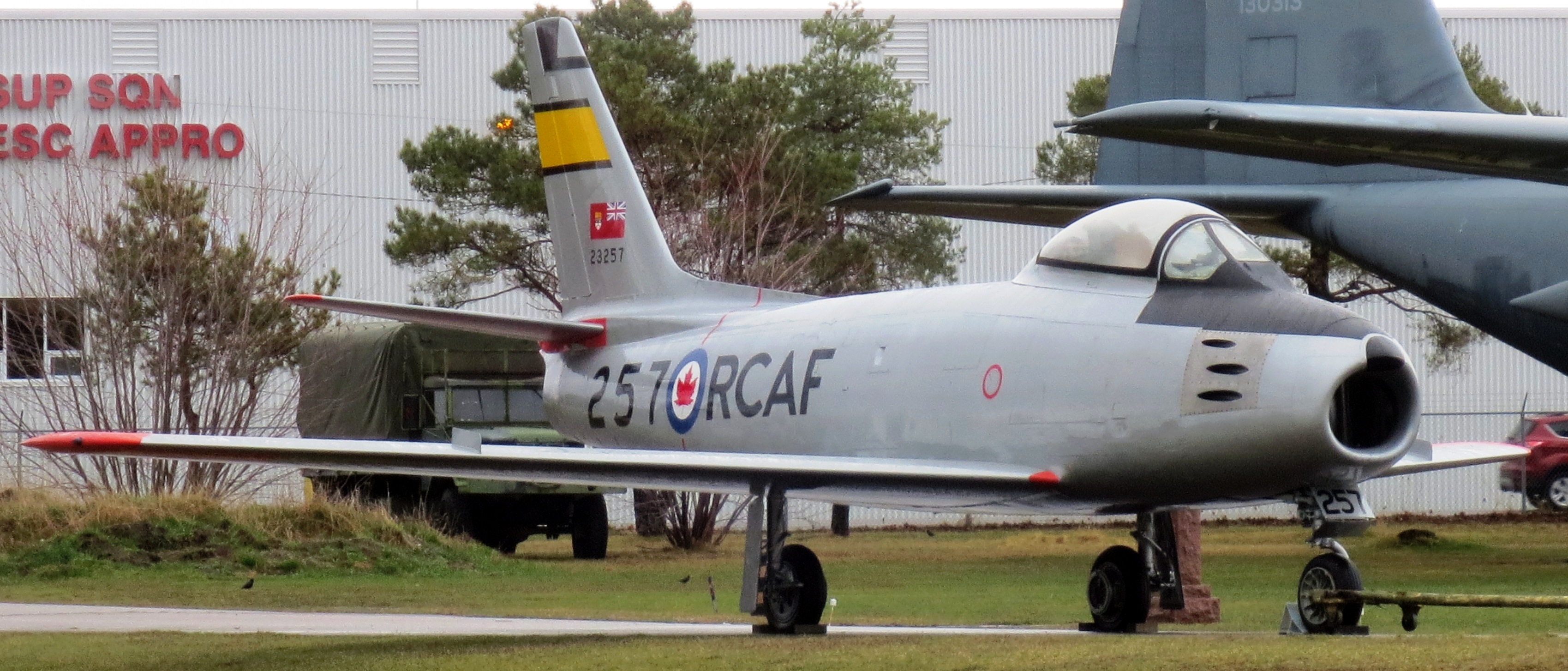
National Museum of the RCAF, CFB Trenton, Ontario, Canadair F-86 Sabre Mk. 5 (Serial No. 23257), previously painted in Golden Hawks colours, currently all silver. Outdoors.
Canadian Air Land Sea Museum, Markham, Ontario, Canadair F-86 Sabre Mk. 5 (Serial No. 23301), International Vintage Aircraft Inc., formerly at Picton, Ontario, silver. Outdoors.
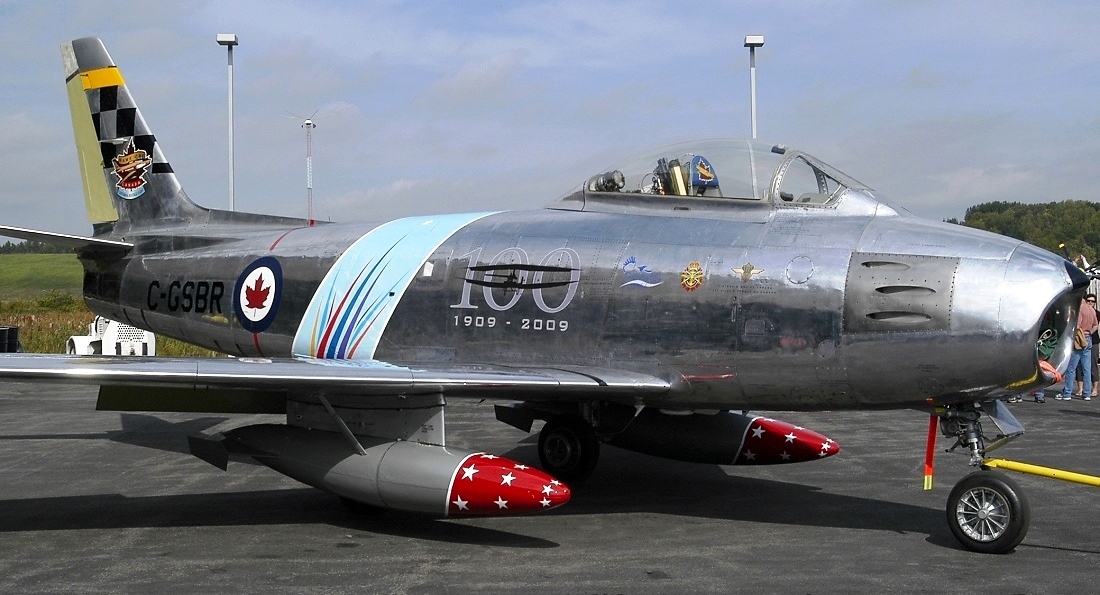
(Alain Rioux)
Canadair F-86 Sabre Mk. 5 (Serial No. 23314), C-GSBR, Hawk 1, 20 Sep 2008. Official unveiling to the public of Hawk One belonging to Vintage Wings of Gatineau, Quebec. 23314 was flown to CFB Cold Lake, Alberta, where it was painted in the colours of a Golden Hawk. It took part in the Centennial of Flight celebrations in Canada in 2009, and appeared at airshows with the 431 squadron Snowbirds
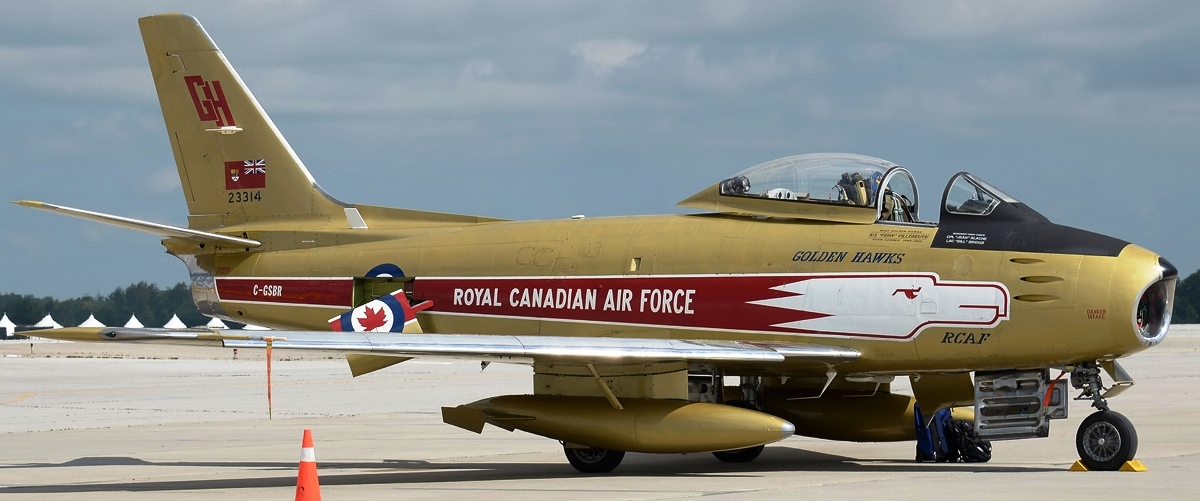
(Aldo Bidini Photo)
Canadair F-86 Sabre Mk. 5 (Serial No. 23314), C-GSBR, Hawk 1,Vintage Wings of Canada, Gatineau, Québec. This aircraft was owned by Michael Potter. It has been sold.
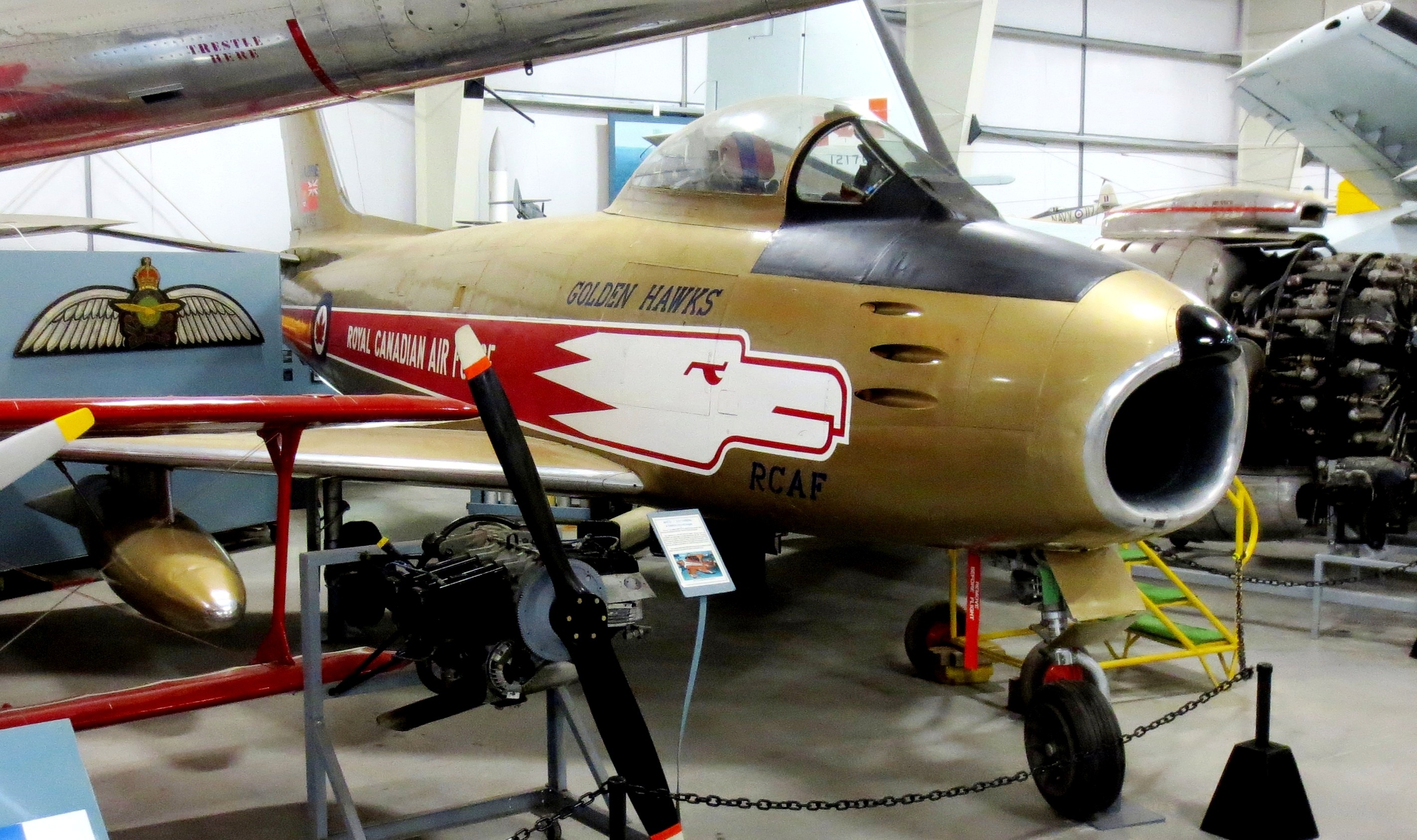
(Author Photo)
Atlantic Canada Aviation Museum, Halifax, Nova Scotia, Canadair F-86 Sabre Mk. 5 (Serial No. 23355), Golden Hawks, formerly at CFB Chatham, New Brunswick. Indoors.
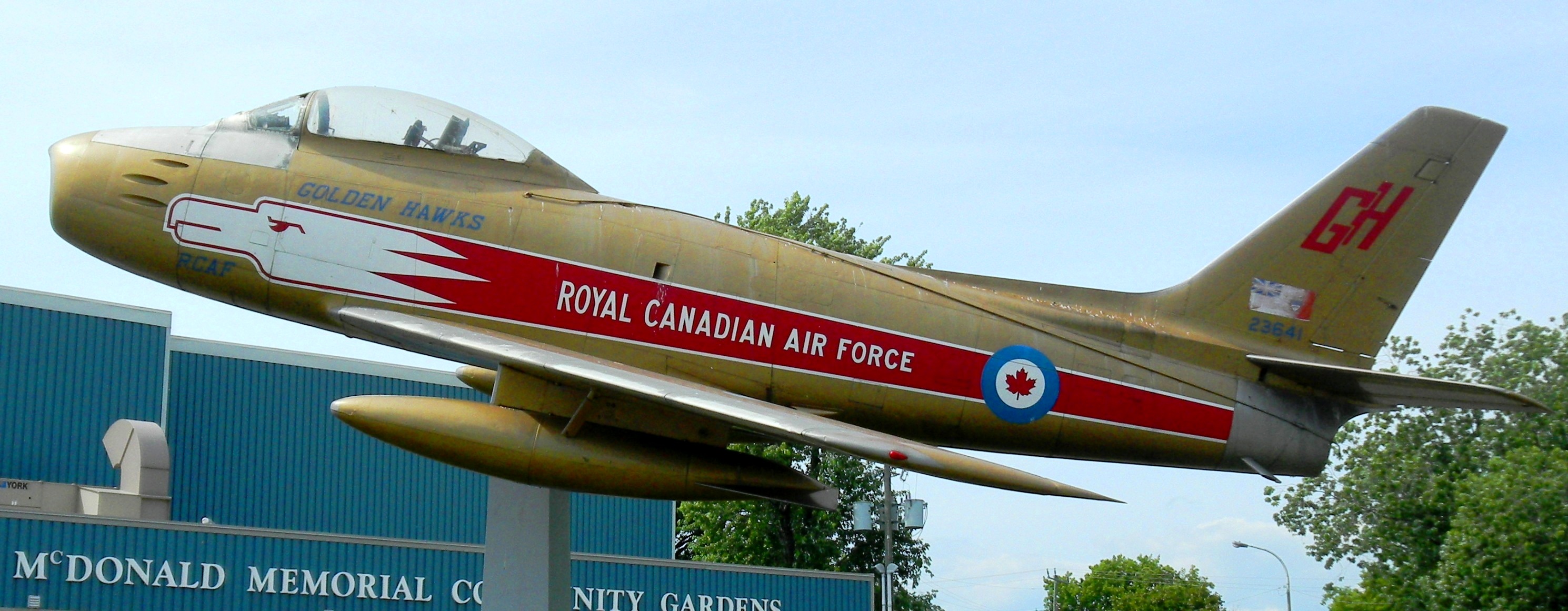
(Author Photo)
Canadair F-86 Sabre Mk. 5 (Serial No. 23457), painted as (Serial No. 23641), Golden Hawks, mounted on a pylon in the town of Trenton, Ontario.
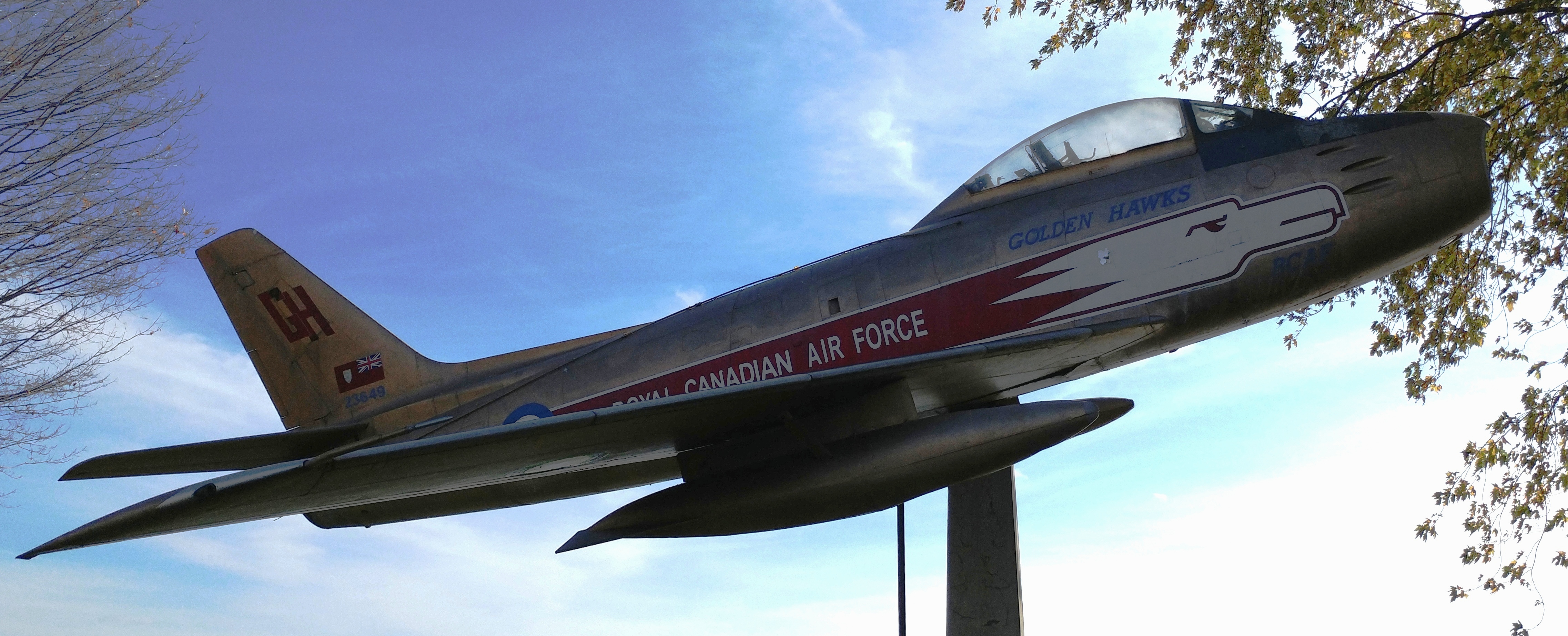
Brockville, Ontario, Canadair F-86 Sabre Mk. 6 (Serial No. 23649), Golden Hawks. Mounted on a pylon.
(Author Photo)
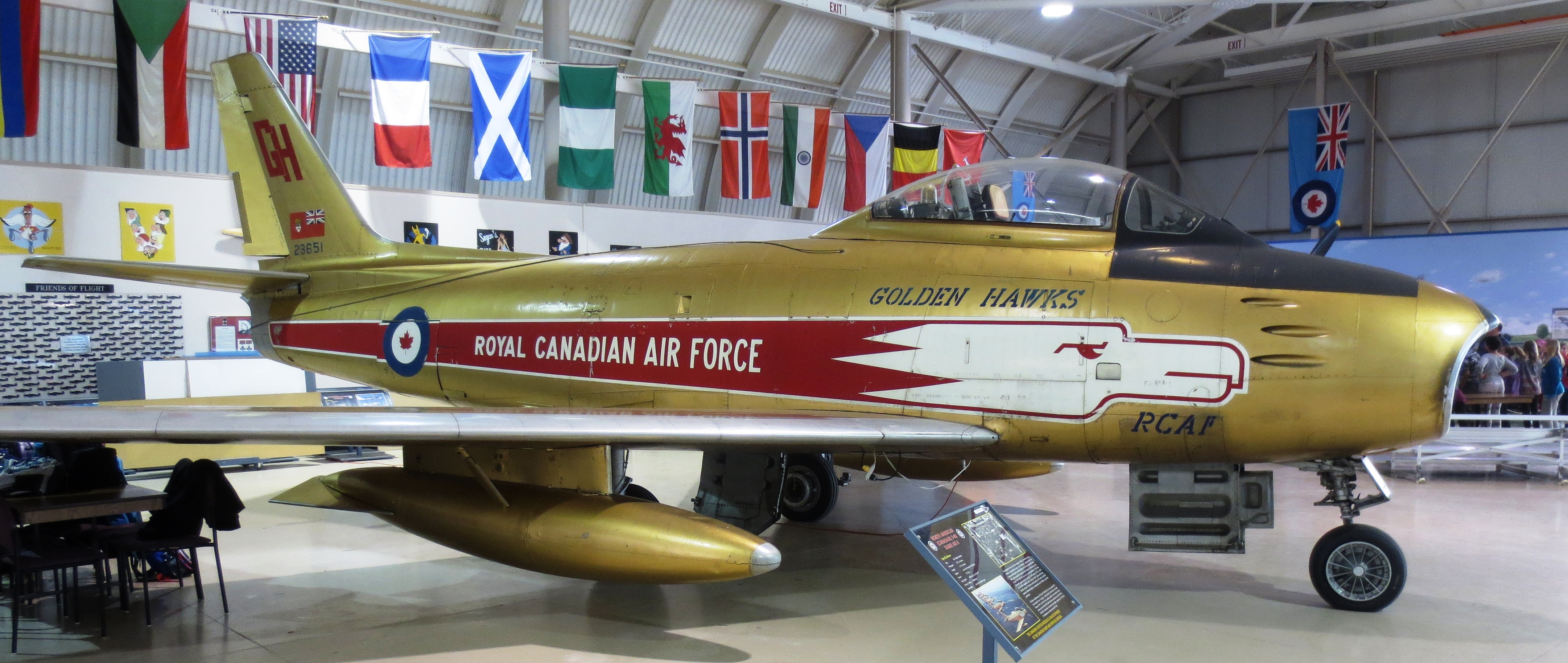
Canadair F-86 Sabre Mk. 5 (Serial No. 23651), c/n 1441, Golden Hawks colours, Canadian Warplane Heritage Museum, Mount Hope, Ontario, on loan from the National Museum of Science and Technology since 25 July 1998. Indoors.
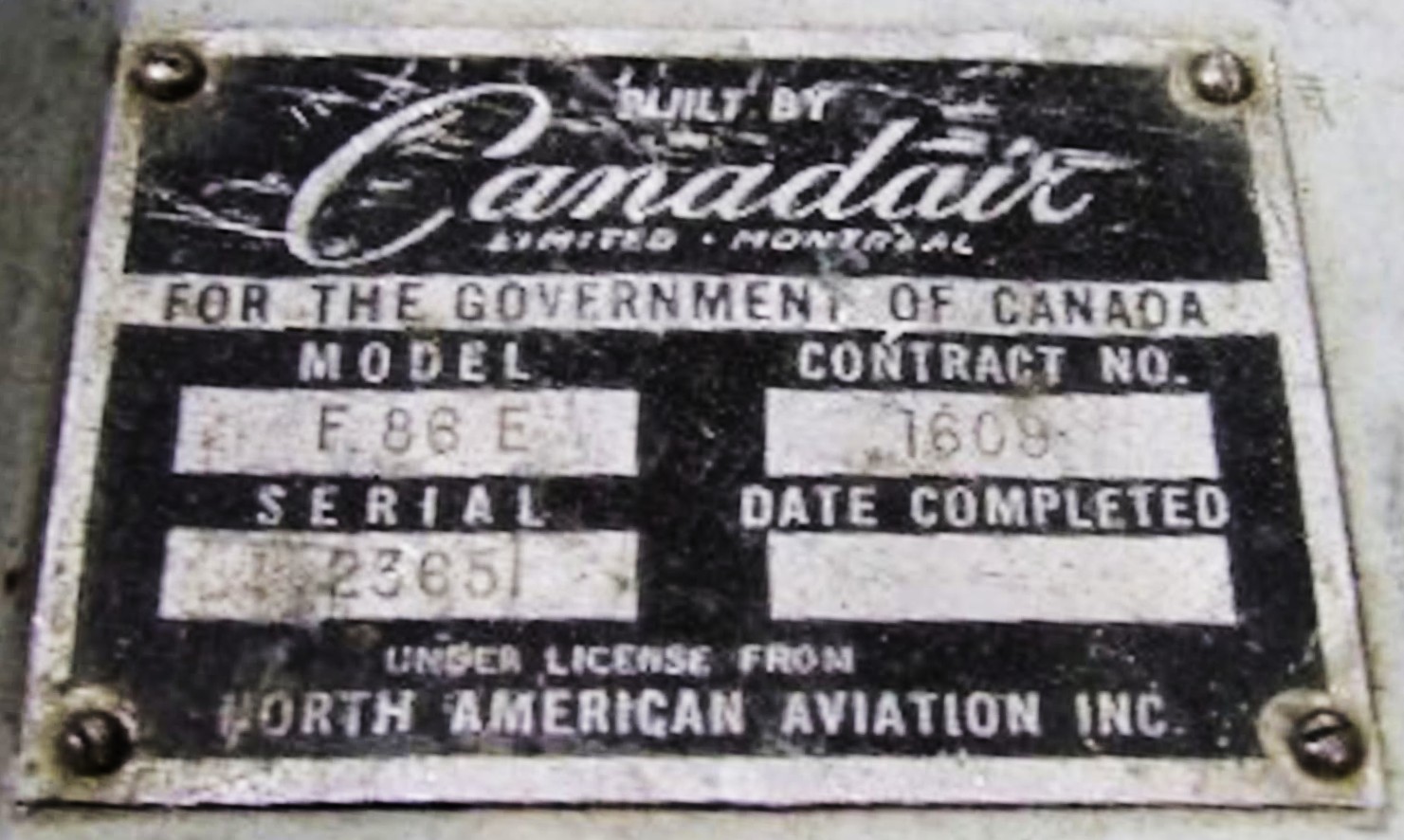
23651, one of the ultimate Canadair F-86B Sabre Mk 6 fighter series, was completed on 5 January 1956. Following the typical contractor’s ground, and flight tests over the next few months, this aircraft was flown and accepted by RCAF test pilot F/O A.H. Hoogen, then taken-on-strength in May 1956. It was sent overseas in June 1956, to serve with the NATO forces of No. 2 (F) Wing, and assigned to No. 421 “Red Indian” Squadron, coded AX-651, based at Grostenquin, France. Later, in 1960, following maintenance and refurbishment at Scottish Aviation Limited in Prestwick Scotland, Sabre 23651 was transferred to No. 1 (F) Wing, to serve with No. 439 “Sabre Tooth Tiger” Squadron, located at Marville, France, before finally returning to Canada at the end of December 1960. It was chosen for the 1961 season of the RCAF Golden Hawks aerobatics team, based at RCAF Station Chatham, New Brunswick. 23651 was flown by F/L Lloyd Hubbard in the ‘number 3’, position on the Left Wing of the formation. On 7 February 1964, the Golden Hawks were officially disbanded.
(Author Photo)
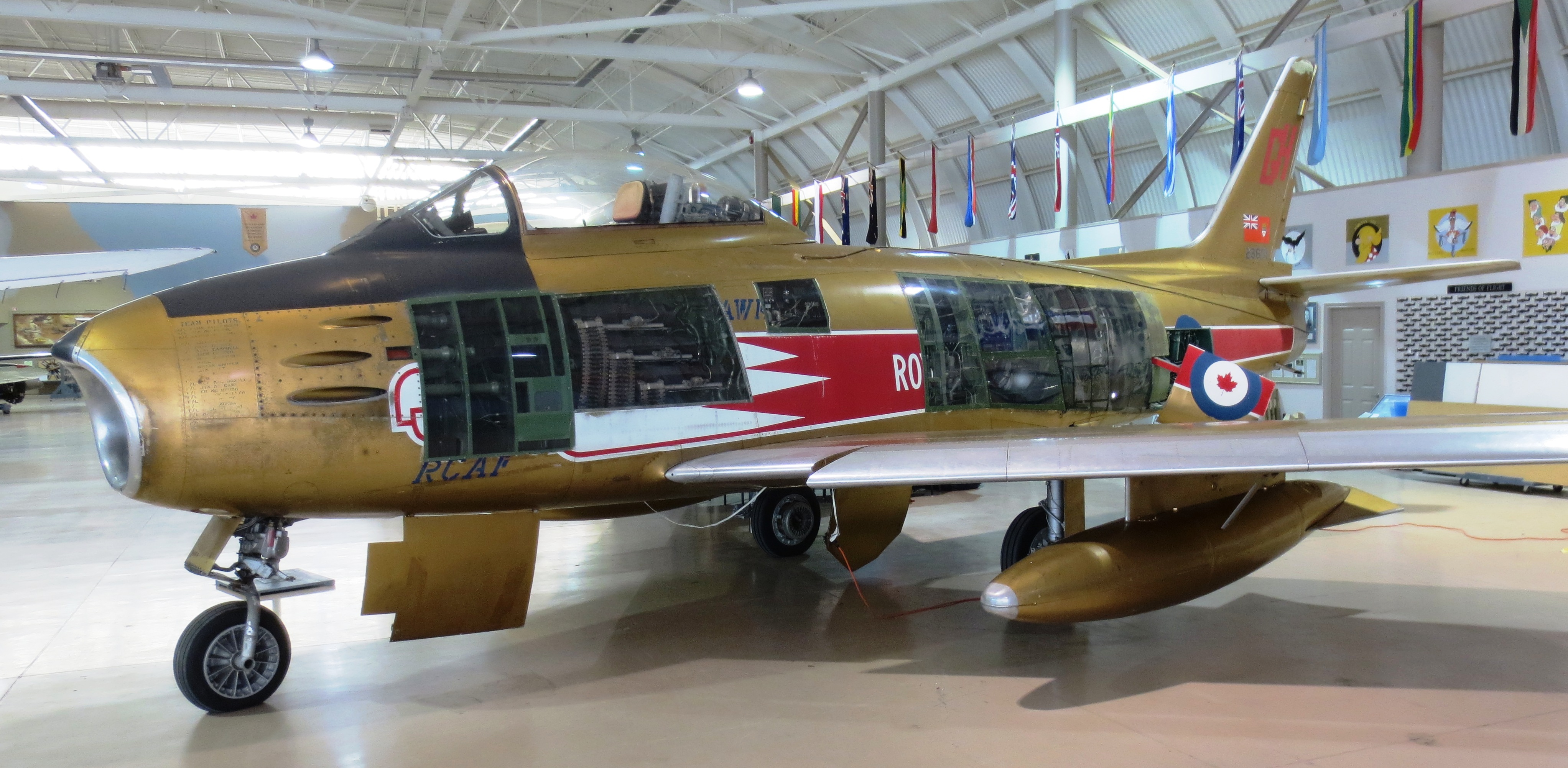
Canadair F-86 Sabre Mk. 6 (Serial No. 23651). Golden Hawks. This aircraft is currently on loan to the Canadian Warplane Heritage Museum, Mount Hope, Ontario.
23651, coded GH, was officially retired, with a total flying time of 1066.15 hours accumulated, and turned over to the No. 6 RD to prepare it for museum static display. Some of the original aircraft skins and panels on the port side of the fuselage were removed and replaced with clear Plexiglas panels in order to display the interior of the armament and engine bay areas. Painted in its 1963-1964 era Golden Hawks’ colours and markings, 23651, complete with its Orenda 14 engine (Serial No. 2066), was donated to the National Aviation Museum (NAM), newly located at the former RCAF Station Rockcliffe Aerodrome facilities, on 8 April 1964. (CASM)
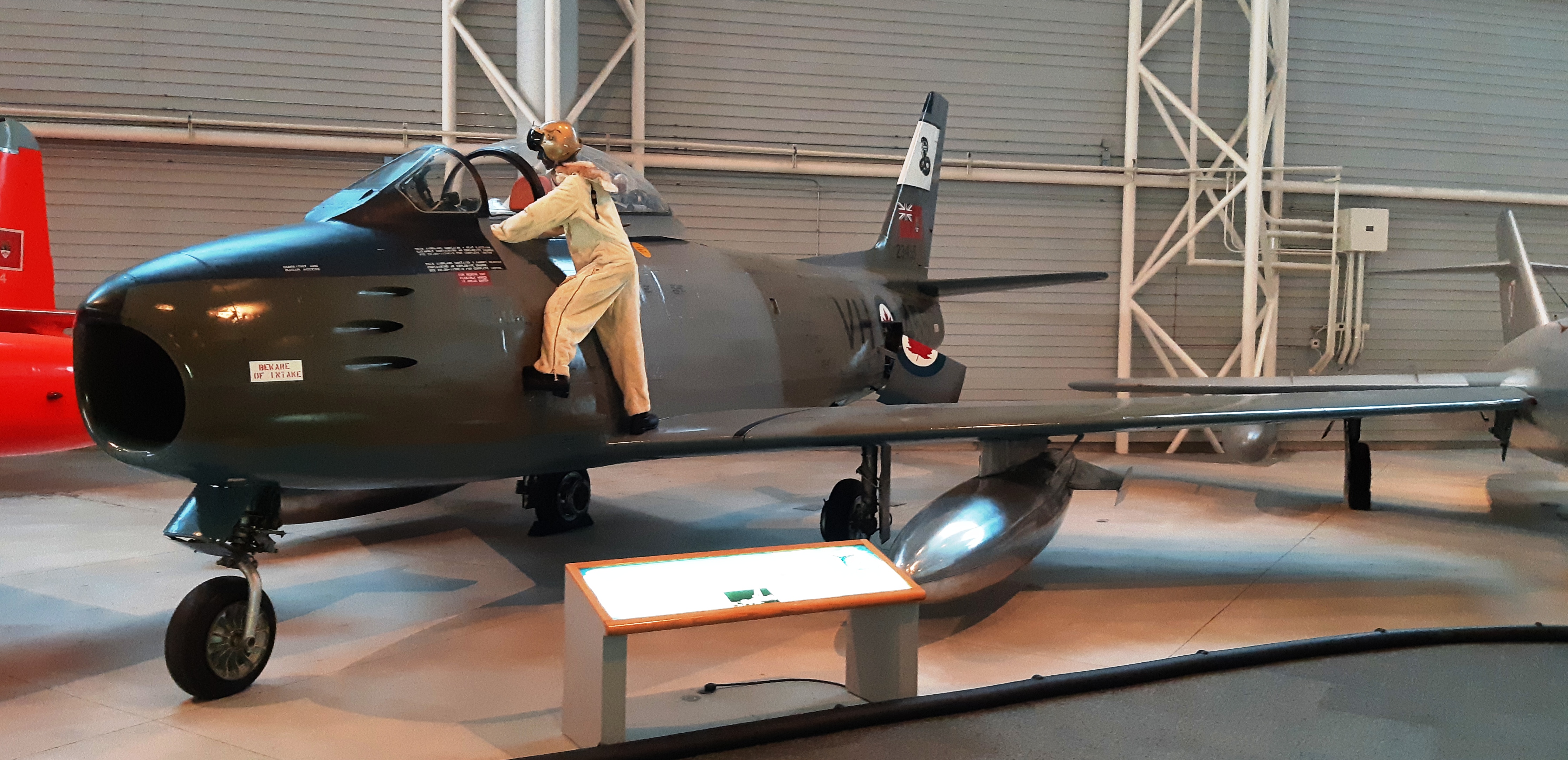
(Author Photo)
Canadair F-86B Sabre Mk. 6 (Serial No. 23455), 1441, No. 444 “Cobra” Squadron, No. 4 (F) Wing, Baden-Soellingen, Germany.
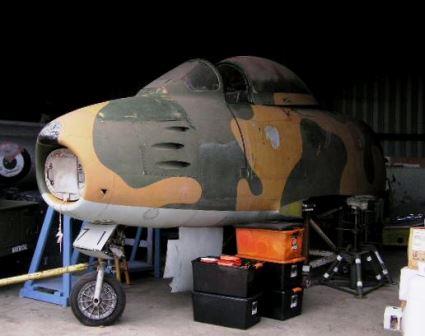
(Robin Sipe Photo)
Canadair F-86 Sabre Mk. VI (Serial No. 23692), c/n 1482, Reg. No. N3844E. This Sabre was purchased from Courtesy Aircraft. It was last operated by the South African Air Force, and is currently in storage in Seattle, Washington, in very good, original, unrestored condition. The aircraft is to be moved to Fort St. John, BC where it will be restored to ground running, taxi capable condition in the short term, with long term plans for full restoration to flying status. The Aerospace & Technology Museum of British Columbia.
(Author Photo)
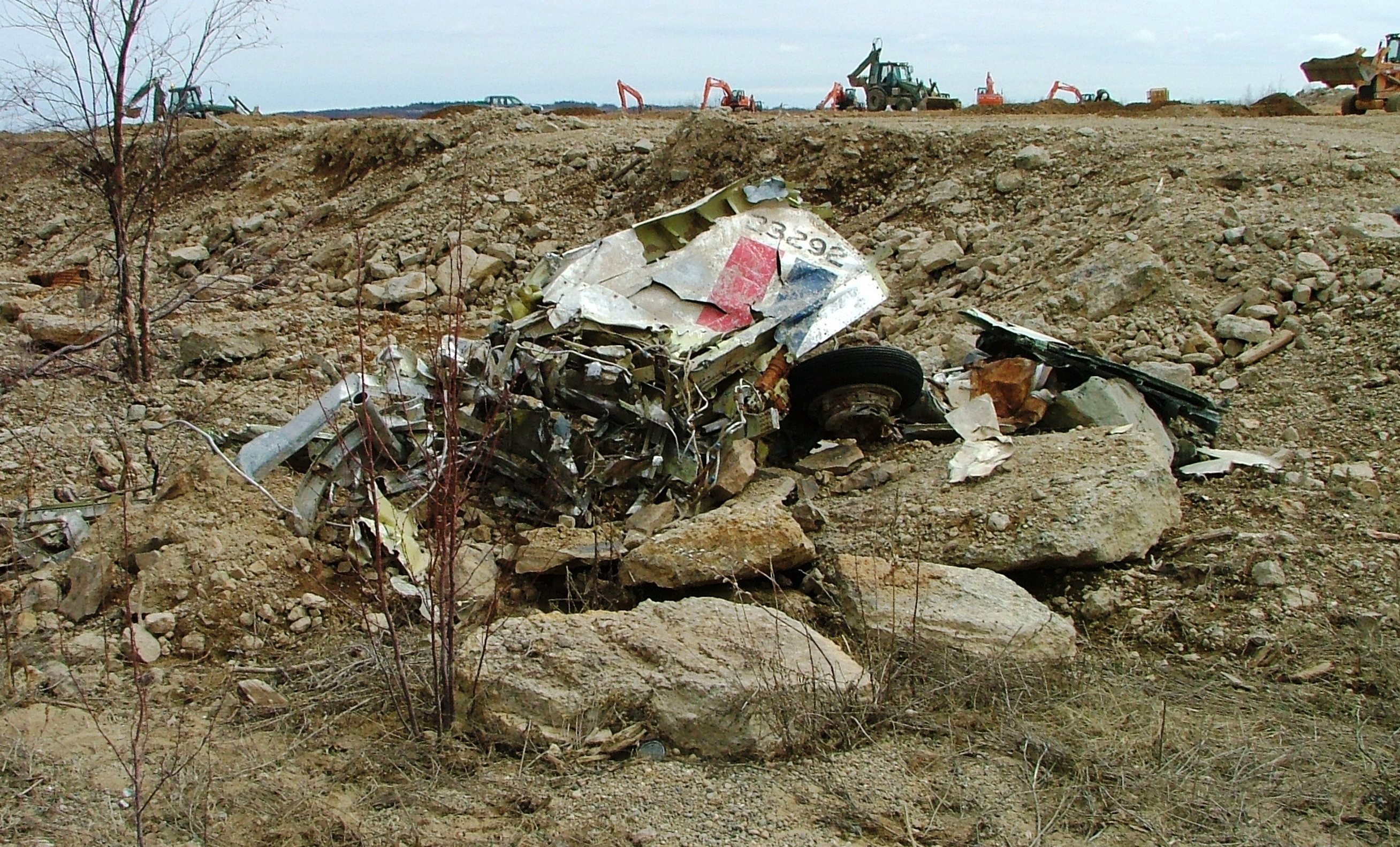
Canadair F-86 Sabre Mk. 5 (Serial No. 23292) wreckage of tail fin and main landing gear, preserved outdoors with the NBMHM, 5 CDSB Gagetown, New Brunswick.
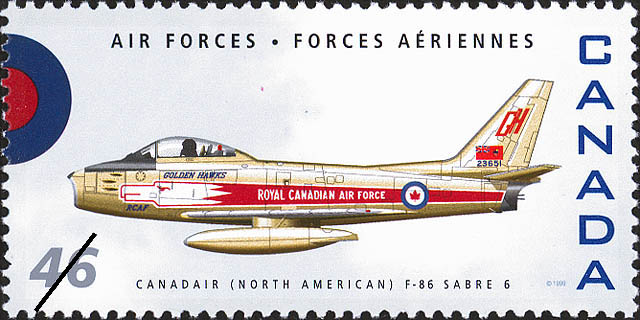
Canadair F-86 Sabre Mk. 6 (Serial No. 23651), Golden Hawk, Canada stamp. (Library and Archives Canada Stamp, MIKAN No. 2266818)
Canadair F-86 Sabre data bank:
The North American F-86 Sabre was first flown on 1 October 1947 and the aircraft quickly proved to be a highly successful design. In 1949, with the formation of NATO the Canadian government made the decision to re-equip the RCAF’s front-line fighter squadrons with modern aircraft and the F-86 Sabre was type selected. Consequently, an agreement was reached between North American and Canadair Limited of Montréal to manufacture 100 F-86As in Canada. Canadair built the Sabre under licence in Canada, with the first one entering RCAF service in August 1950. The Mk. 1 was powered by a General Electric J-47-GE-13 engine. This aircraft is preserved in the AAM, Edmonton, Alberta, Canadair F-86 Sabre Mk. 1 (Serial No. 19101), PX-101.
The RCAF operated only one F-86A. F-86As were also used by RCAF personnel on exchange with the USAF in Korea. The single North American F-86A Sabre was powered by a General Electric J-47 – GE-13 engine. One is preserved in the ASMC, Calgary, Alberta, North American F-86A (Serial No. 47-606), unveiled June 1999, painted as (Serial No. 23175). This Sabre was previously on display in the Seattle Museum of Flight, Washington.
(Author Photo)
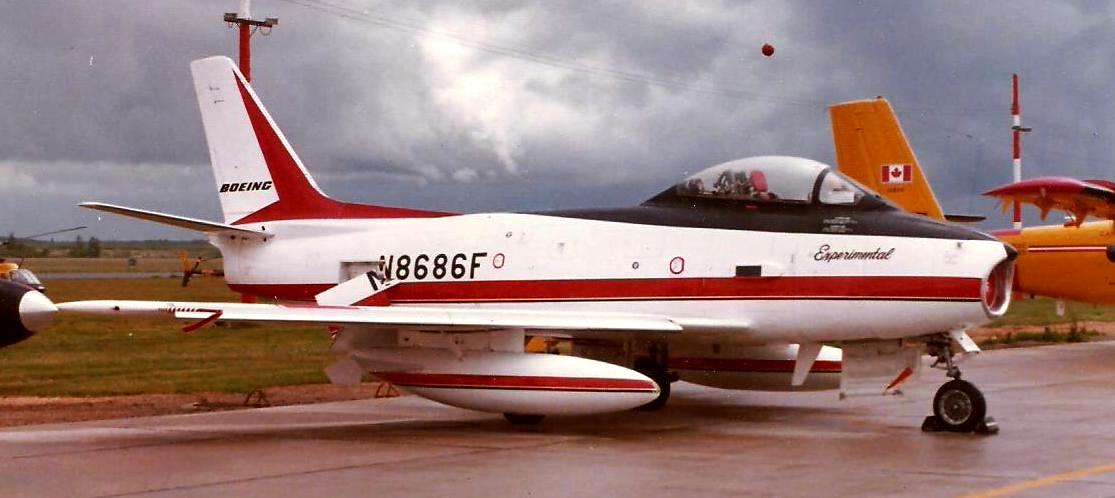
Canadair F-86 Sabre Mk. 5 (Serial No. 23363), Reg. No. N8686F, serving as an Experimental aircraft for the Boeing Company, visiting CFB Cold Lake, Alberta, 1978.
Canadair F-86 Sabre survivors:
Sidney, British Columbia, Canadair F-86 Sabre Mk. 5 (Serial No. 23060), Army Navy Club Grounds.
Belleville, Ontario, Canadair F-86 Sabre Mk. 5 (Serial No. 23641), painted as (Serial No. 23053), Golden Hawks, mounted on a pylon in the Centennial Park, Zwick’s Island.
CALSM, Markham, Ontario, Canadair F-86 Sabre Mk. 5 (Serial No. 23301), International Vintage Aircraft Inc., formerly at Picton, Ontario, silver.
BBMM, CFB Borden, Ontario, CanadairF-86 Sabre Mk. 5 (Serial No. 23228).
CWHM, Mount Hope, Ontario, Canadair F-86 Sabre Mk. 5 (Serial No. 23651), Golden Hawks colours, on loan from the National Museum of Science and Technology since 25 July 1998.
Oshawa, Ontario, Canadair F-86 Sabre Mk. 5 (Serial No. 23047), Oshawa Airport, Ontario.
Peterborough, Ontario, Canadair F-86 Sabre Mk. 5 (Serial No. 23245), formerly at Clinton, Ontario, 428 Wing RCAFA, mounted on a pylon.
Sarnia, Ontario, Canadair F-86 Sabre Mk. 5 (Serial No. 23164), Germain Park, Golden Hawks, mounted on a pylon.
NAFM, CFB Trenton, Ontario, Canadair F-86 Sabre Mk. 5 (Serial No. 23257), painted as (Serial No. 23641), Golden Hawks.
Vintage Wings of Canada, Hull Québec, Michael Potter, Canadair F-86 Sabre Mk. 5 (Serial No. 23314), C-GSBR, Hawk 1 project.
BGMM, CFB Gagetown, New Brunswick, Canadair F-86 Sabre Mk. 5 (Serial No. 23292) wreckage of tail fin and main landing gear.
ACAM, Halifax, Nova Scotia, Canadair F-86 Sabre Mk. 5 (Serial No. 23355), Golden Hawks, formerly at CFB Chatham, New Brunswick.
(Author Photo)
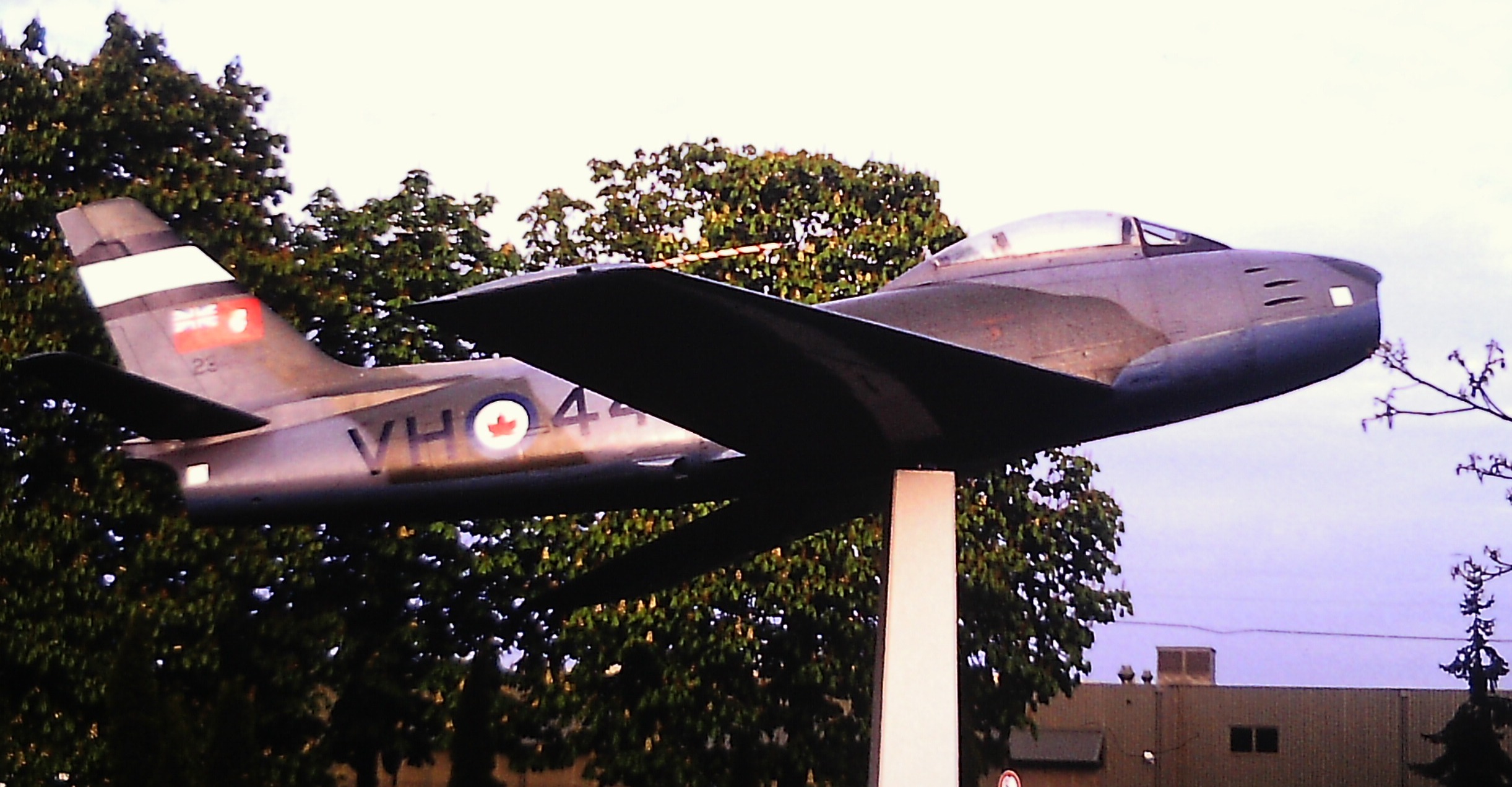
BADM, CFB Bagotville, Québec, Canadair F-86 Sabre Mk. 6 painted as (Serial No. 23444), in No. 444 Squadron colours, on display at the main gate to the airfield at CFB Lahr, Germany, ca 1992. It previously served with the German Air Force (Serial No. JC-373), at Nauhausen, Germany. This Sabre came to CFB Bagotville, Quebec, in 1994. It is now in a silver scheme and is painted as (Serial No. 19454), coded AO, No. 414 Squadron, mounted on a pylon.
(Author Photo)
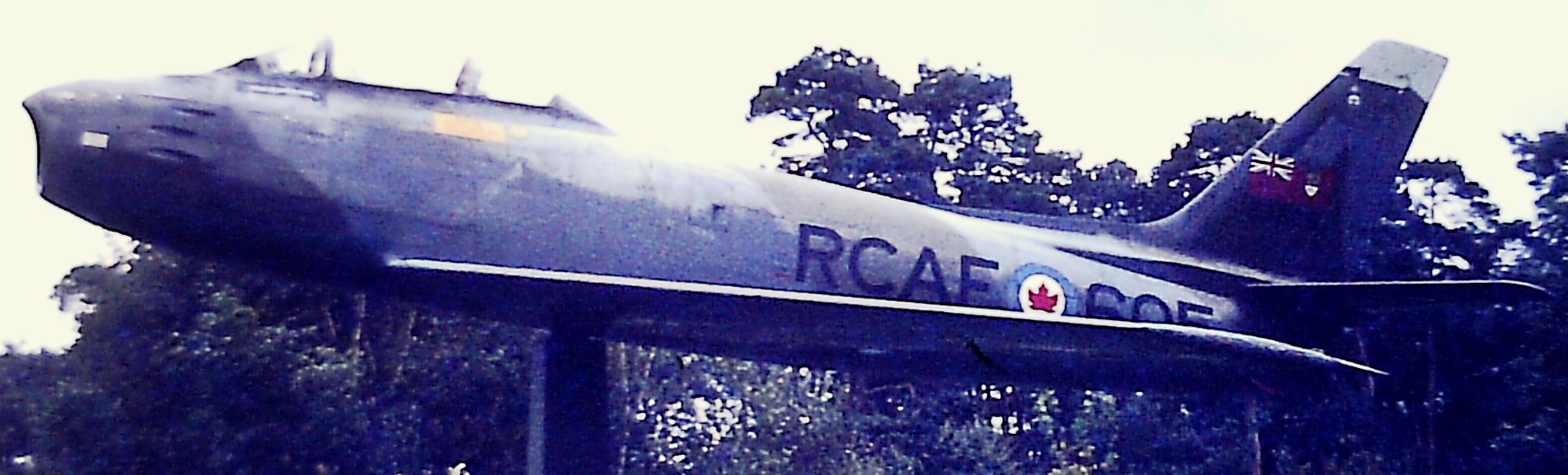
AFHM&AP, CFB Winnipeg, Manitoba, Canadair F-86 Sabre Mk. 6 (Serial No. 23605), No. 439 Squadron colours, camouflaged. It is shown here when it was previously on display at CFB Baden-Soellingen, Germany. It was an ex-German Air Force Sabre, C/N 1605, based at Koln, Germany. It was returned to Canada in July 1981.
ACAM, Winnipeg, Manitoba, Canadair F-86 Sabre Mk. 6 (Serial No. 23760), C/N 1815, Western Canada Aviation & Space Museum, formerly served with the Pakistan Air Force, Masroor AB, Pakistan, served as a decoy, silver.
Brockville, Ontario, Canadair F-86 Sabre Mk. 6 (Serial No. 23649).
CA&SM, Ottawa, Ontario, Canadair F-86 Sabre Mk. 6 (Serial No. 23455).
Kingston, Ontario, Canadair F-86 Sabre Mk. 6 (Serial No. 23221), formerly at Royal Roads Military College (RRMC), now at the Royal Military College (RMC), mounted on a pylon.
Canadair F-86 Sabre survivors outside of Canada:
Canadair F-86 Sabre Mk. 6 (Serial No. 23042), Golden Hawks, displayed in the Auto-Technical Museum (ATM), Speyer, Germany, ex German Air Force BB+283 (Serial No. 1613).
Canadair F-86 Sabre Mk. unknown, (Serial No. unknown), German Air Force Markings, Deutsches Museum, München, Germany.
Canadair F-86 Sabre Mk. 6, German Air Force (Serial No. unknown), coded JC+101, Hermeskeil, Germany.
Canadair F-86 Sabre, Mk. 5, German Air Force (Serial No. 840), JB-111, coded BB+239, International Luftfahrt Museum, Schwenningen, Germany.
Canadair F-86 Sabre Mk. 6, JB+110, German Air Force Markings, Militarhistorisches Museum, Dresden, Germany.
Canadair F-86 Sabre Mk. 6, (Serial No. unknown), coded BB+150, ex BB-250 (Serial No. 895), (01-01).
(Clemens Vasters Photo)
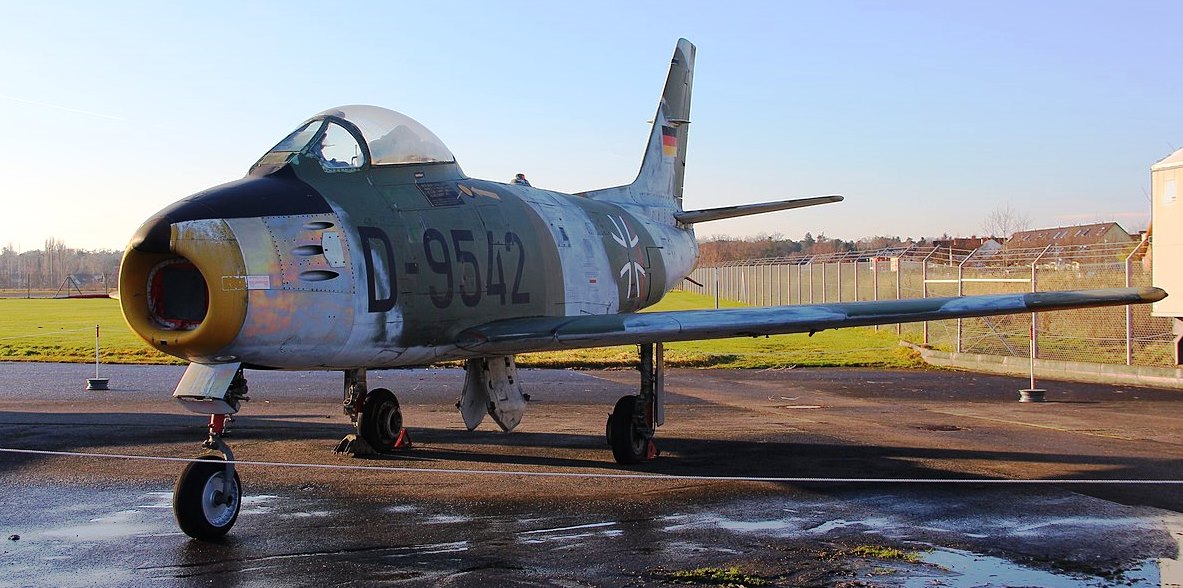
Canadair F-86 Sabre Mk. 6 (Serial No. 1591), German Air Force, D-9542, Luftwaffe Museum, Berlin-Gatow, Germany.
Canadair F-86 Sabre Mk. 6 (Serial No. 1603), German Air Force Markings, Luftwaffe Museum, Berlin-Gatow, Germany.
Canadair F-86 Sabre Mk. unknown (Serial No. unknown), Uetersen, Germany.
Canadair F-86 Sabre Mk. 6, JA-112, Serial unknown, German Air Force Markings, Wittmund German AFB.
Canadair F-86 Sabre Mk. 6 (Serial No. 23363), Haydon-Baillie Aircraft and Naval Collection, UK.
Canadair F-86 Sabre Mk. 6, Museum of Flight, Seattle Washington, USA.
Canadair F-86 Sabre Mk. 6, Blaine Golden Age Aircraft Museum, Minnesota, USA.
Canadair F-86 Sabre Mk. 6, Medford Air Victory Museum, New Jersey, USA.
Canadair F-86 Sabre Mk. 6, Nellis AFB, Nevada, USA, Reg No. N86EX, ex SAAF (Serial No. 380).
Canadair F-86 Sabre Mk. 5, Reg. No. N86FS, Mojave, California, Flight Systems, Mojave, California, USA.
Canadair F-86 Sabre Mk. 5, Reg. No. N91FS, formerly operated by Flight Systems Incorporated at the Mojave Airport, Global Aerospace of Newport Beach, California, USA.
Canadair F-86 Sabre Mk. 6, Reg. No. N38453, restored as USAF F-86F (Serial No. 51-13487), flown by Al Hansen, it flew for the South African Air Force as (Serial No. 378). It was registered by Flight Systems in October 1983 and then to Global Aerospace in September 1992.
Canadair F-86 Sabre, Reg. No. N106JB, SAAF colours, War Eagles Museum, Santa Teresa, New Mexico, USA.
Canadair F-86 Sabre Mk. unknown, (Serial No. unknown), Kempten Park Technical College, RSA, South Africa.
Canadair F-86 Sabre, Mk. and unknown, (Serial No. unknown), Snake Valley, South Africa.
Canadair F-86 Sabre, Mk. and unknown, (Serial No. unknown), Swartop, SAAF Museum, South Africa.
Canadair F-86 Sabre, Mk. unknown (Serial No. unknown), coded 13-1, Italian Air Force Museum, Vigna di Valle, Rome, Italy,
Canadair F-86 Sabre, Mk. unknown, (Serial unknown), Museo Storico, Italy.
Canadair F-86 Sabre Mk. 6, C/N 1792, (Serial No. unknown), Pakistan Air Force Museum, PAF Faisal, Karachi, Pakistan.
[1] Internet: http://en.wikipedia.org/wiki/Canadair_Sabre.
[2] Internet: Http://www.rcaf.com/aircraft/fighters/sabre/index.php?name=Canadair%20Sabre.
[3] Internet: Http://www.rcaf.com/aircraft/fighters/sabre/index.php?name=Canadair%20Sabre.
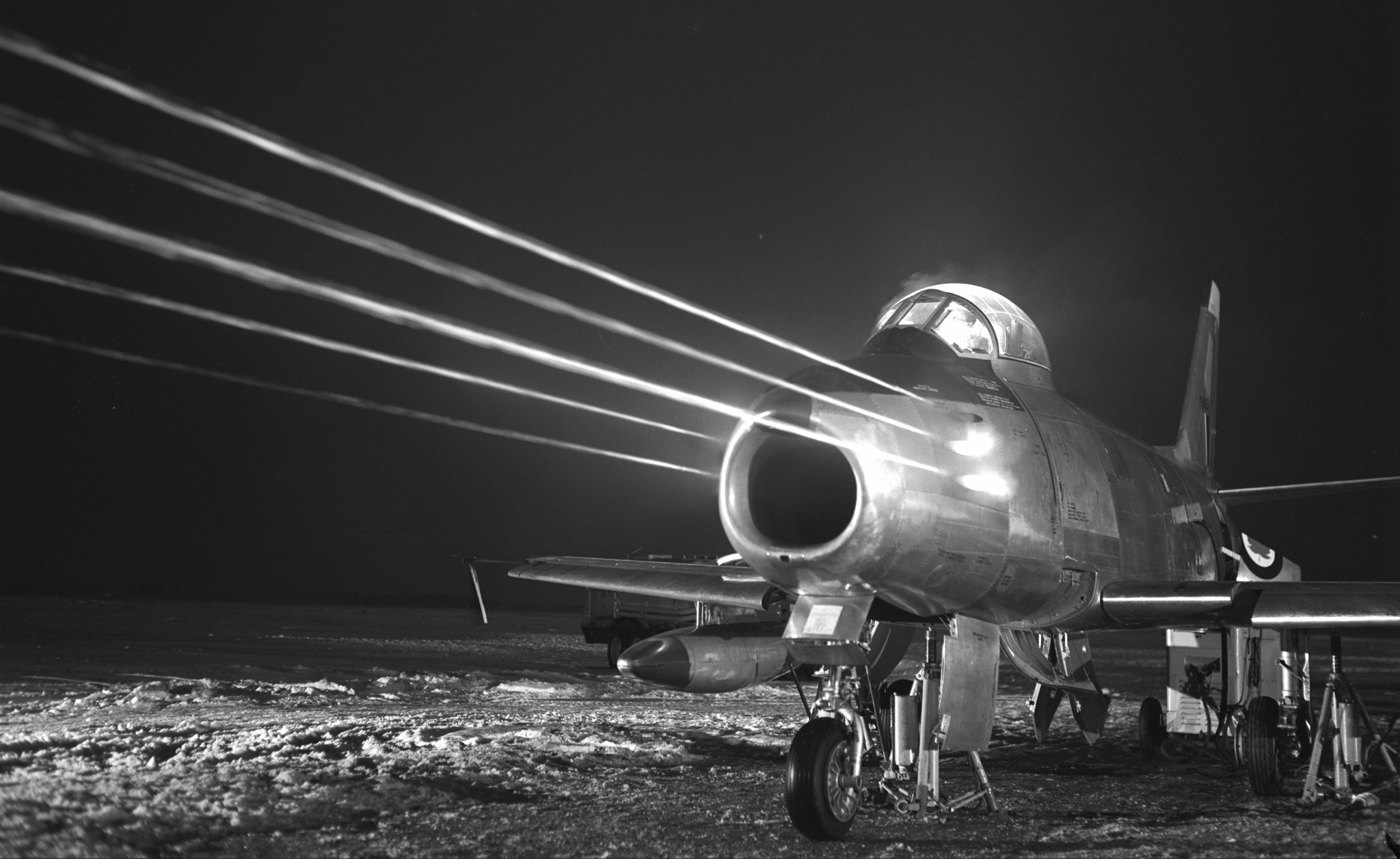
(DND Archives Photo, PL-5576)
Canadair F-86 Sabre test fires its six .50 cal machine guns.
Canadian Sabre pilots in the Korean War, 1950-1953
Twenty-one Royal Canadian Air Force (RCAF) fighter pilots (in addition to Flight Lieutenant Omer Lévesque, who was already serving on exchange with the Americans when the war broke out) volunteered to fly F-86 Sabres with the United States Air Force (USAF), although not all of them saw combat.
They flew with the USAF’s 4th Fighter Interceptor Wing (FIW) at Kimpo or 51st 51st Fighter Interceptor Wing (FIW) at Suwon and served for six months or 50 combat missions, whichever came first. A combat mission usually consisted of flying 200 miles (320 kilometres) over enemy territory to the infamous “MiG Alley” (near the Chinese border) area, patrolling, contacting and fighting with the communists’ MiG-15s. The RCAF accounted for nine MiG “kills”, two “probables” and 10 “damaged”.
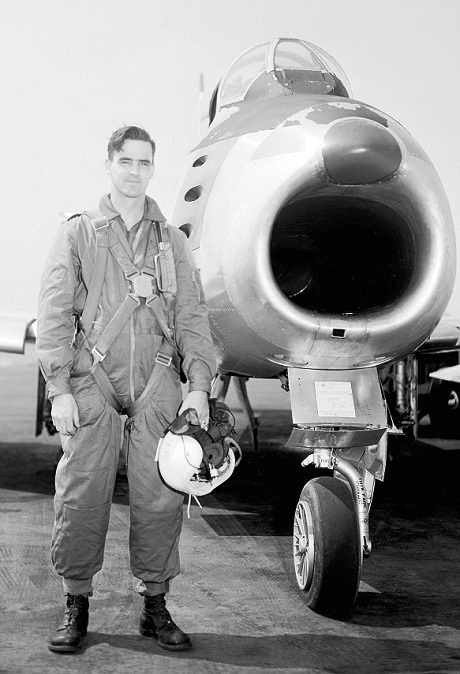
(RCAF Photo)
F/L Ernie Glover shot down three MiG-15s.
High scoring pilots included Flight Lieutenant (F/L) Ernie Glover with three kills and three damaged, and Squadron Leader (S/L) Doug Lindsay with two kills and three damaged. Most RCAF personnel who served in the Korea theatre, approximately 800, belonged to 426 Squadron while the remainder were fighter pilots, flight nurses, and supply, technical and photo intelligence personnel. As well, a number of Canadian Army personnel flew with the USAF as forward air controllers in the 6147 Tactical Air Control Group, informally known as the “Mosquitos”.
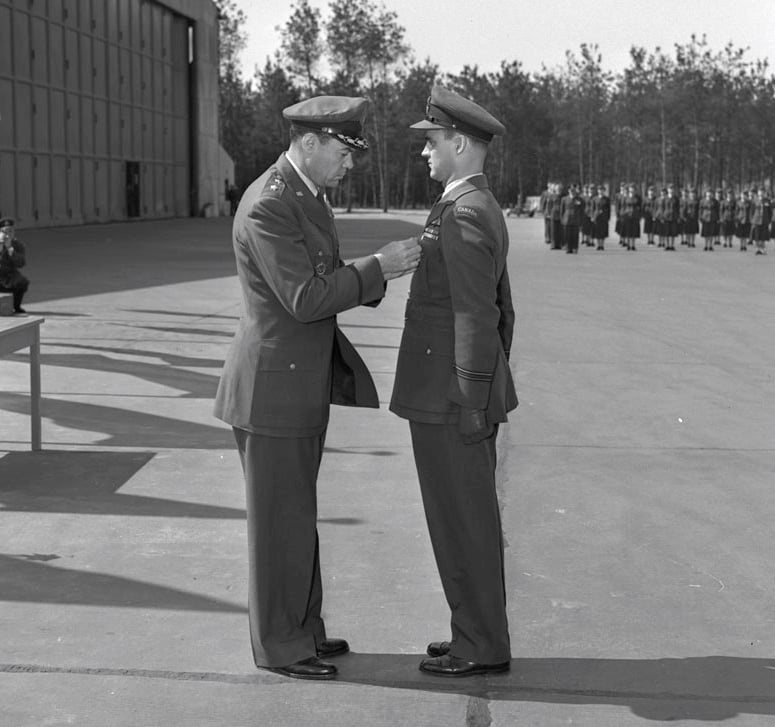
(Library and Archives Canada Photo, MIKAN No. 4816361)
On 13 May 1954, F/L Earnest A. Glover was presented with the American Distinguished Flying Cross (DFC) for his “extraordinary achievements” while flying USAF Canadair built F-86E-6 Sabres in combat in Korea. At the station parade at No. 4 Fighter Wing, RCAF Station Baden-Soellingen, Germany, General Robert Merrill Lee, Commanding General, 4th Allied Tactical Air Force, Trier, Germany, pinned the award on F/L Glover.
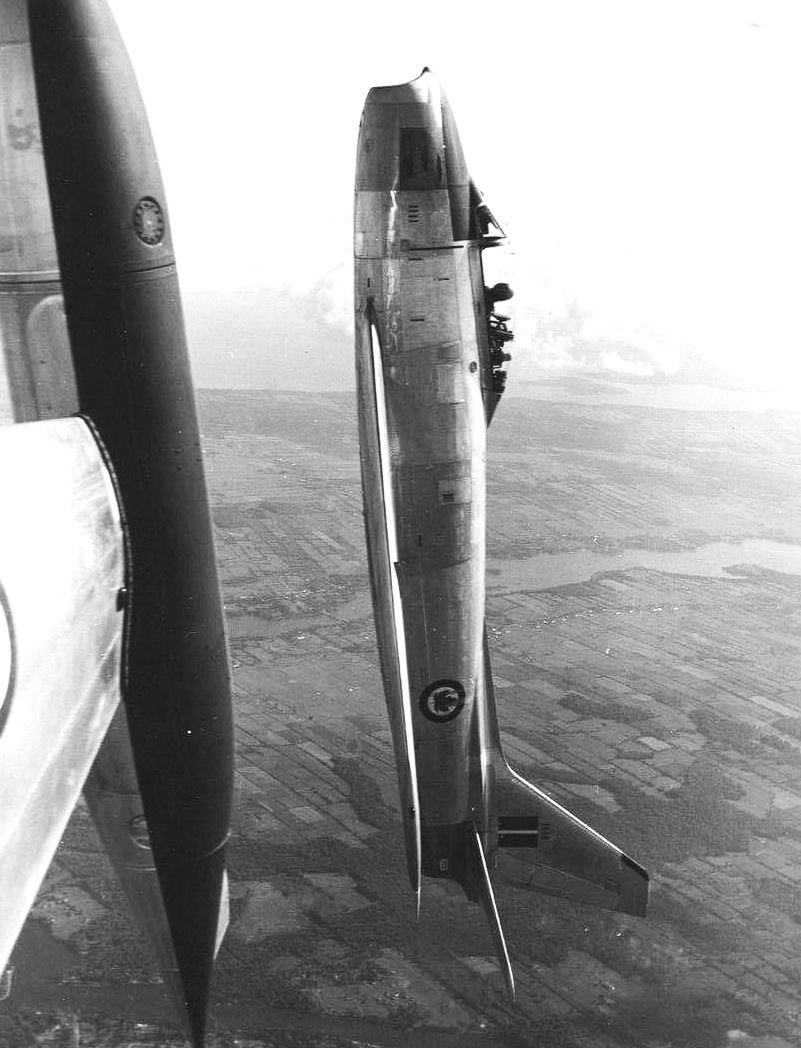
(Canadair Photo via Mario Pompetti)
Canadair F-86 Sabre, test flight out of Montreal, 1958.
(DND Photo)
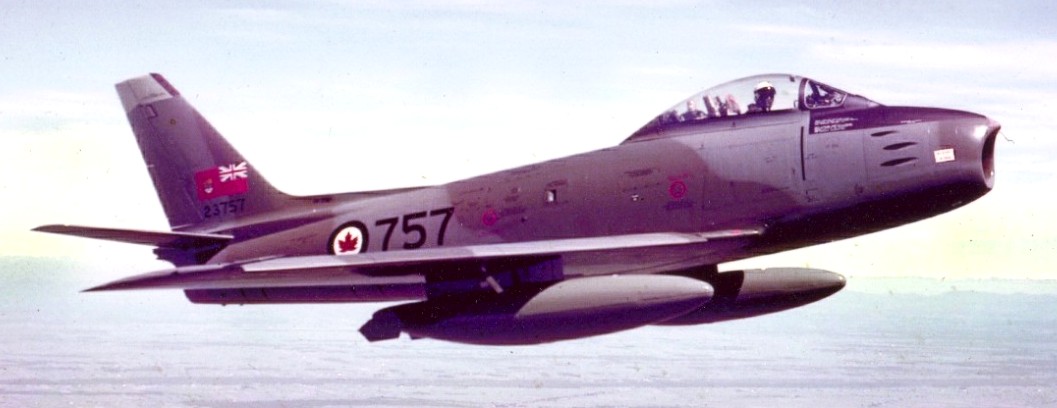
Canadair F-86 Sabre Mk. 5 (Serial No. 23757) was the last version, with Avro Orenda 14 engines that served with the RCAF. This Sabre is carrying the camouflage developed for all RCAF European-based operational aircraft. The photo was taken while the aircraft belonged to No. 1 Overseas Ferry Unit (OFU) based at St. Hubert, Quebec, which was formed in 1953 to ferry Sabres and T-33s across the North Atlantic.
A total of 390 Mk. 6s went to the RCAF with the majority replacing the existing Canadair Sabre Mk. 5s at the Air Division squadrons in West Germany and France. The main air threats to NATO in the 1950s in Central Europe were the early variants of the Soviet MiG- the MiG-15, MiG-17, MiG-19 and MiG-21. Based on the Korean War experience, the selection of the Mk.6 Sabre to provide an effective opposition to the MiG threat proved to be a logical one. Canada’s commitment to NATO was to provide 12 squadrons located at four bases – two in France (Marville and Grostenquin) and two in West Germany (Zweibrücken and Baden Soellingen). Initially, the contribution consisted of only Sabre aircraft; however, later it was decided to include the Avro Canada CF-100 aircraft in the defense package to provide a night and all-weather fighter capability.
Though the main use of the Sabre by the RCAF was in Europe, they were also used by RCAF Auxiliary part-time units in Canada, replacing de Havilland Vampire jets. 400 “City Of Toronto” and 411 “County Of York” Squadrons based at RCAF Station Downsview near Toronto, as well as 401 “City Of Westmount” and 438 “City Of Montreal” Squadrons at RCAF Station St-Hubert near Montreal, were equipped with Sabre 5s, as was 442 “City Of Vancouver” Squadron at RCAF Station Sea Island, near Vancouver. (DND)
(James Craik Photo)
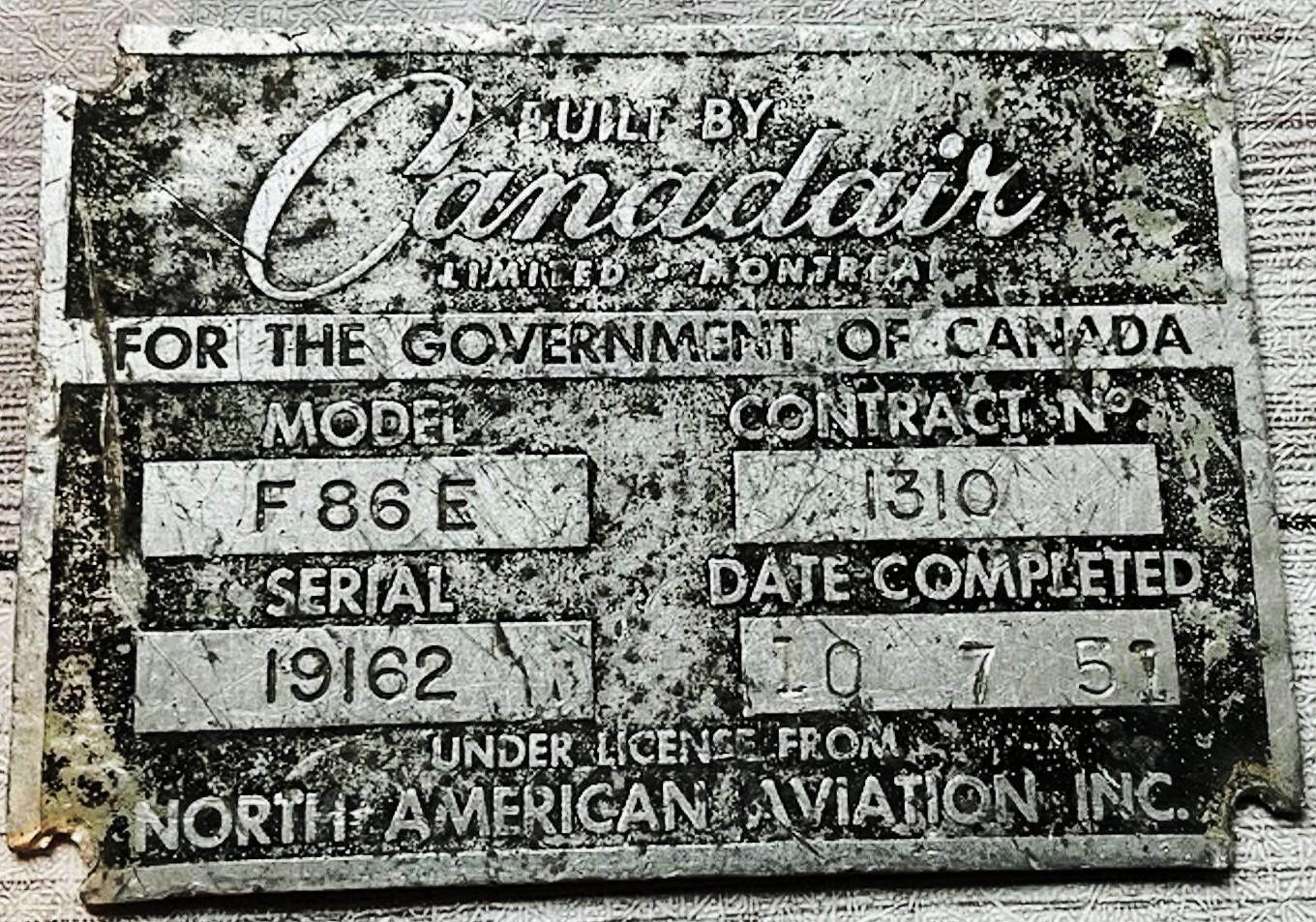
The Canadair Sabre jet fighter was built by Canadair under licence from North American Aviation. It was a variant of the North American F-86 Sabre and was produced until 1958. It was primarily used by the RCAF it was until replaced with the Canadair CF-104 Starfighter in 1962. Several other air forces also operated Canadian-built Sabres. (Wikipedia)
Canadair F-86 Sabre Mk. 1 (1), (Serial No. 19101), Canadair F-86 Sabre Mk. 2 (350), (Serial Nos. 19102-19199, 19201-19452), Mk. 3 (1), (Serial No. 19200), Mk. 4 (71), (Serial Nos. 19453-19463, 19491, 19575, 19579, 19582, 19584, 19585, 19590, 19597-19599, 19601, 19606, 19615-19617, 19619, 19624, 19627-19629, 19631, 19632, 19635-19637, 19639, 19642, 19643, 19647, 19649, 19650, 19652, 19653, 19655, 19657, 19659-19661, 19663-19665, 19667-19671, 19673-19675, 19677, 19679, 19680, 19682, 19684-19686, 19689, 19691, 19695, 19702), Mk. 5 (370), (Serial Nos. 23001-23370), F-86B Mk. 6 (390), (Serial Nos. 23371-23760), plus one North American F-86A (Serial No. 49-1069), for a total of 1,184 of all Canadian Marks of the Sabre.
RCAF On Strength (1191), RCAF 400 Squadron (64), Canadian Aircraft Losses (104), Canadian Manufactured (1554). Detailed records of all known RCAF and Canadian-built aircraft may be viewed on line in the Canadian Aircraft Serials Personnel Information Resource (CASPIR). The CASPIR website is researched, coded, and maintained entirely by Canadian Warplane Heritage Museum (CWHM) volunteers with only one staff assisting periodically. This work has taken several years and is unlikely to be finished as continuing research leads to “new finds” and rediscovered Canadian aviation heritage and history. The CWHM volunteer team looks forward to continuing to update and correct the record as additional information and photos are received. Check here for the Sabre.
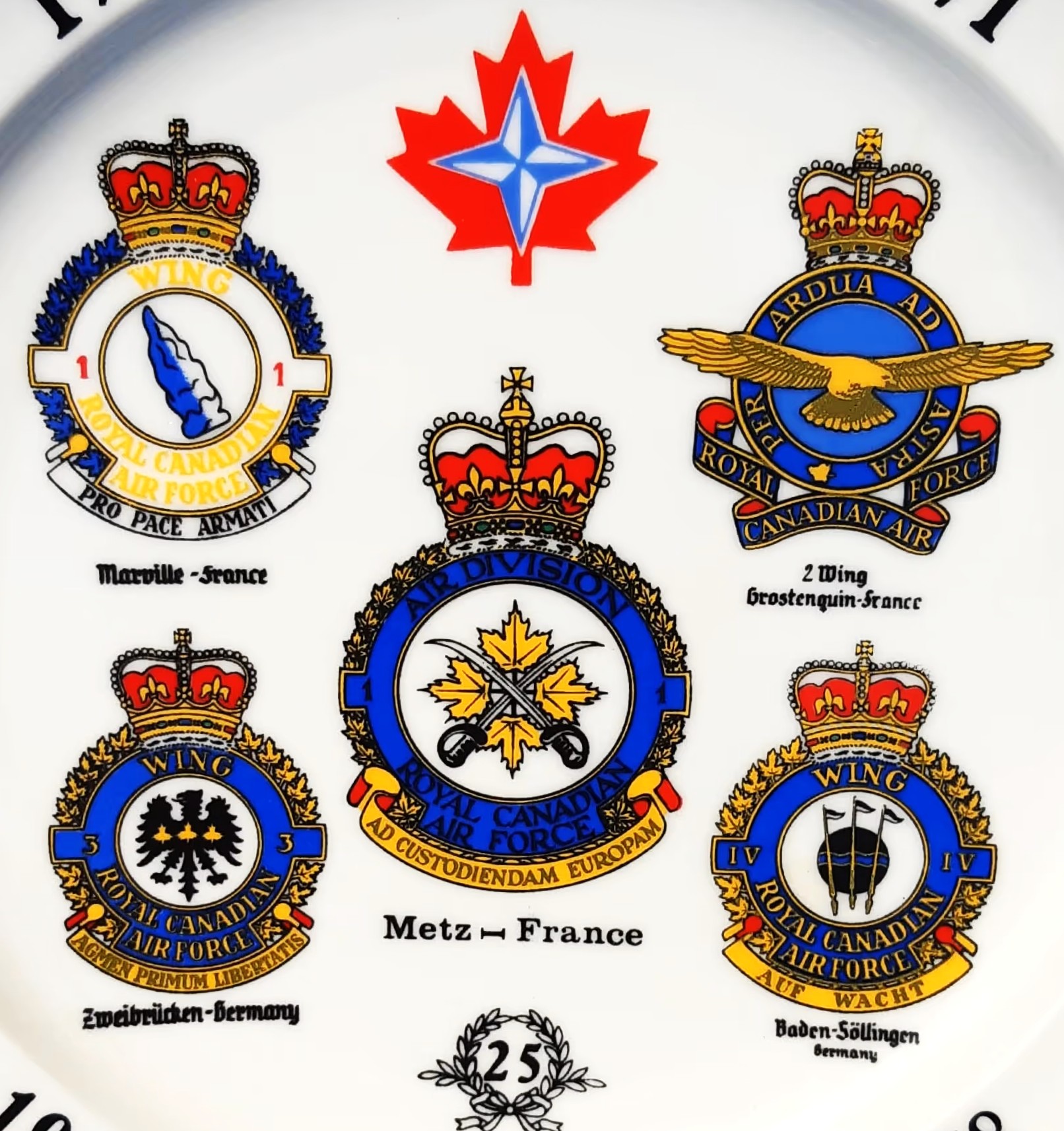
RCAF commemorative plate with the 1 Air Division base crests for France and Germany.
No. 1 Air Division, RCAF (1952-1967)
The division traces its origins to the activation of Headquarters No. 1 Air Division, Royal Canadian Air Force in Paris, France on 1 October 1952. No. 1 Air Division headquarters was relocated to Metz, France in April 1953. No. 1 Air Division was established to meet Canada’s NATO air defence commitments in Europe. It consisted of four wings of of three fighter squadrons each for a total of twelve squadrons located at four bases in France and West Germany. These included RCAF Station Marville, No. 1 (F) Wing, and RCAF Station Grostenquin, No. 2 (F) Wing in France, RCAF Station Zweibrücken, No. 3 (F) Wing, and RCAF Station Baden-Soellingen, No. 4 (F) Wing in West Germany.
The North American F-86 Sabre was first flown on 1 October 1947, and quickly proved a highly successful design. With the formation of NATO in 1949, the Canadian government made the decision to re-equip the RCAF’s front-line fighter squadrons with modern aircraft and selected the F-86 Sabre. Consequently, an agreement was reached between North American and Canadair Ltd. of Montréal to manufacture 100 F-86As in Canada. After the first prototype, designated F-86 Sabre Mk. 1, Canadair immediately began production in earnest with an improved Mk 2 model. The Mk 2 was essentially an F-86E with an “all flying” tail plane to provide better flying characteristics, as well as a flat windscreen. The next major production model was the Mk 4—which was originally to have been powered by an Orenda-designed engine but, to retain commonality with the F-86E, it also carried the J47-GE-13.
Various design improvements were incorporated throughout the aircraft and 438 Mk 4 Sabres rolled off the assembly lines. The Mk 5 Sabre was the first production model with a Canadian engine, using the Orenda 10 version and rated at 6,355-lb thrust. The bigger Orenda engine necessitated a larger diameter opening in fuselage frames and stronger engine mounts. An important structural modification was the introduction of a fixed leading edge to replace the automatic slats on earlier versions. This change was designed to enhance the high altitude performance of the aircraft. Small wing fences were also introduced at the 70 per cent span position. These modifications were successful, but also resulted in a corresponding decrease in low-speed handling characteristics. After the construction of 370 Mk 5 aircraft, Canadair moved on to the final (and best) version, the Mk 6.
This version carried the two-stage Orenda 14 engine with a 7,275 lb thrust rating. The wing leading slats were re-introduced, while retaining portions of the Mk 5 wing configuration. The Mk 6 therefore acquired superb combat manoeuvring. With this combination of engine and aerodynamics, the Mark 6 was widely regarded as the best “dog-fighter” of its era. The Golden Hawks teams of the RCAF initially flew Mk 5 aircraft, but were soon equipped with the excellent Mk 6 aircraft. (DND)