
Canadair F-86E Sabre
(RCAF Photo courtesy of the Canadian Aviation Preservation Association)
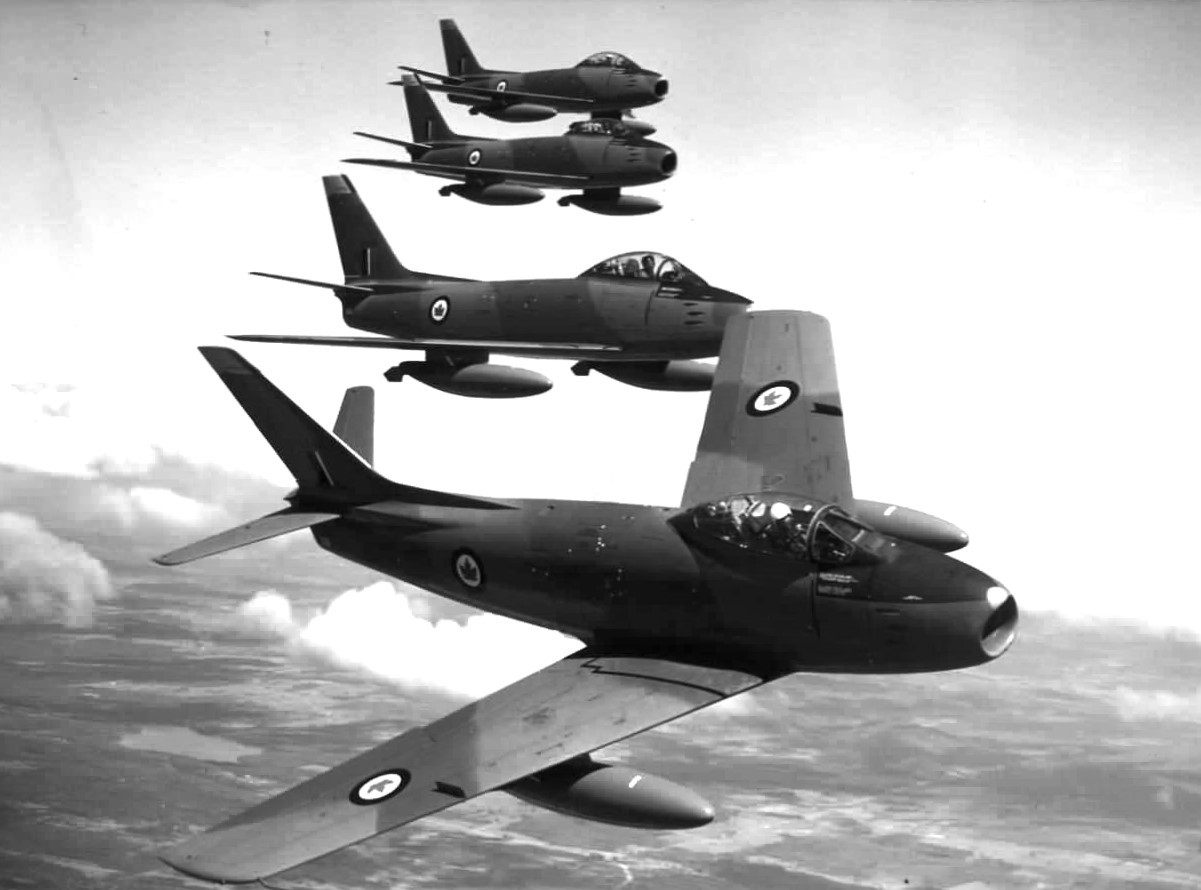
Canadair F-86 Sabre Mk. 5 formation, over Europe.
(James Craik Photo)
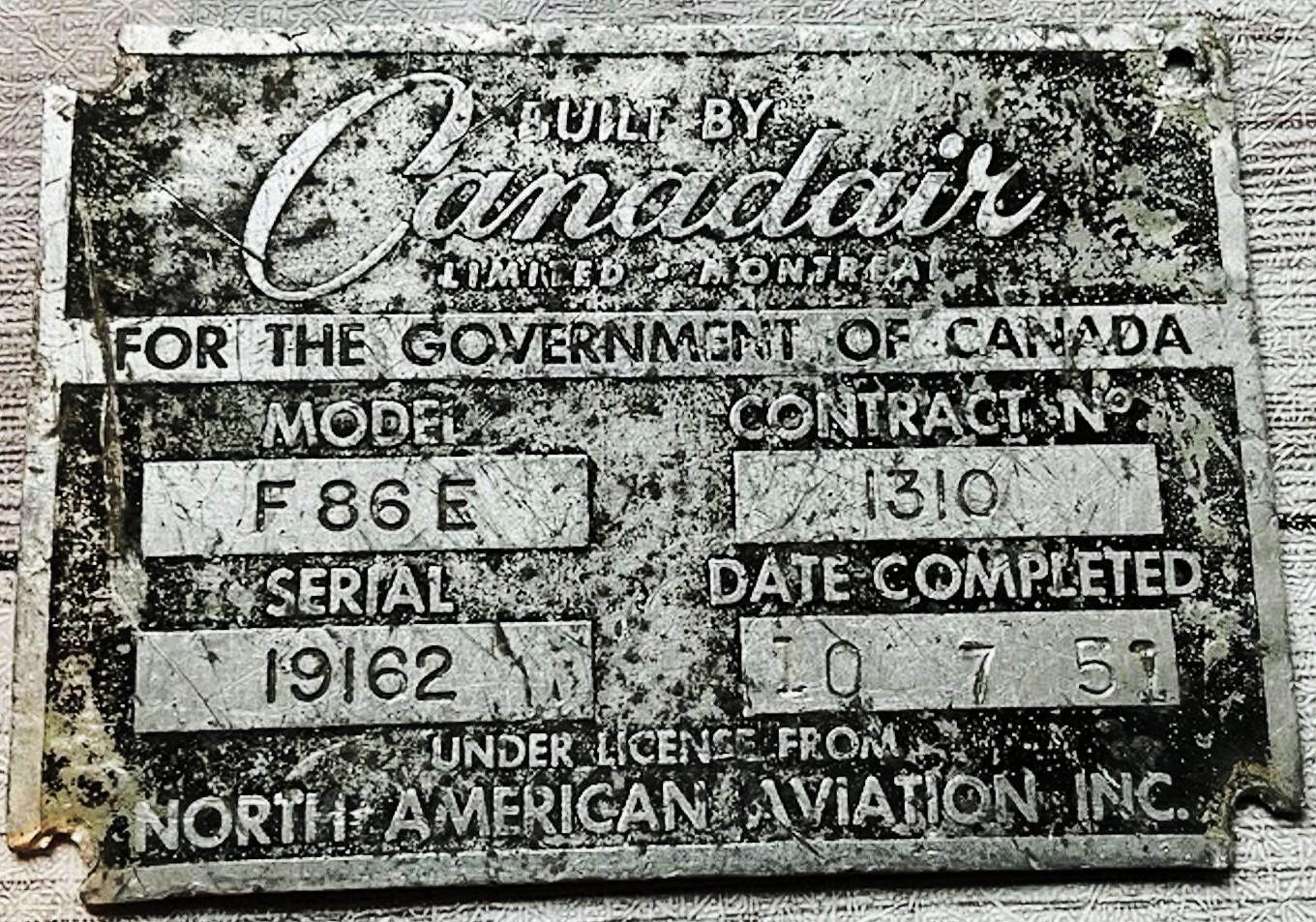
The Canadair F-86E Sabre jet fighter was built by Canadair under licence from North American Aviation. It was a variant of the North American F-86 Sabre and was produced until 1958. It was primarily used by the RCAF it was until replaced with the Canadair CF-104 Starfighter in 1962. Several other air forces also operated Canadian-built Sabres. (Wikipedia)
The North American F-86 Sabre, sometimes called the Sabrejet, is a transonic jet fighter aircraft. Produced by North American Aviation, the Sabre is best known as the United States’ first swept-wing fighter that could counter the swept-wing Soviet MiG-15 in high-speed dogfights in the skies of the Korean War (1950–1953), fighting some of the earliest jet-to-jet battles in history. Considered one of the best and most important fighter aircraft in that war, the F-86 is also rated highly in comparison with fighters of other eras. Although it was developed in the late 1940s and was outdated by the end of the 1950s, the Sabre proved versatile and adaptable and continued as a front-line fighter in numerous air forces.
Its success led to an extended production run of more than 7,800 aircraft between 1949 and 1956, in the United States, Japan, and Italy. In addition, 738 carrier-modified versions were purchased by the US Navy as FJ-2s and -3s. Variants were built in Canada and Australia. The Canadair Sabre added another 1,815 aircraft and the significantly redesigned CAC Sabre (sometimes known as the Avon Sabre or CAC CA-27), had a production run of 112. The Sabre is by far the most-produced Western jet fighter, with a total production of all variants at 9,860 units.
The fighter-bomber version (F-86H) could carry up to 2,000 lb (907 kg) of bombs, including an external fuel-type tank that could carry napalm. Unguided 2.75-inch (70-millimeter) rockets were used on some fighters on training missions, but 5-inch (127 mm) rockets were later carried on combat operations. The F-86 could also be fitted with a pair of external jettisonable jet fuel tanks (four on the F-86F beginning in 1953) that extended the range of the aircraft. Both the interceptor and fighter-bomber versions carried six 0.50 in (12.7 mm) M3 Browning machine guns with electrically-boosted feed in the nose (later versions of the F-86H carried four 20 mm (0.79 in) cannon instead of machine guns). Firing at a rate of 1,200 rounds per minute, the 0.50-inch guns were harmonized to converge at 1,000 ft (300 m) in front of the aircraft, using armor-piercing (AP) and armor-piercing incendiary (API) rounds, with one armor-piercing incendiary tracer (APIT) for every five AP or API rounds. The API rounds used during the Korean War contained magnesium, which were designed to ignite upon impact, but burned poorly above 35,000 ft (11,000 m) as oxygen levels were insufficient to sustain combustion at that height. Initial planes were fitted with the Mark 18 manual-ranging computing gun sight. The last 24 F-86A-5-Nas and F-86Es were equipped with the A-1CM gunsight-AN/APG-30 radar, which used radar to automatically compute a target’s range, which later proved to be advantageous against MiG opponents over Korea. (Wikipedia)
Canadair F-86 Sabre Mk. 1 (1), (Serial No. 19101), Canadair F-86 Sabre Mk. 2 (350), (Serial Nos. 19102-19199, 19201-19452), Mk. 3 (1), (Serial No. 19200), Mk. 4 (71), (Serial Nos. 19453-19463, 19491, 19575, 19579, 19582, 19584, 19585, 19590, 19597-19599, 19601, 19606, 19615-19617, 19619, 19624, 19627-19629, 19631, 19632, 19635-19637, 19639, 19642, 19643, 19647, 19649, 19650, 19652, 19653, 19655, 19657, 19659-19661, 19663-19665, 19667-19671, 19673-19675, 19677, 19679, 19680, 19682, 19684-19686, 19689, 19691, 19695, 19702), Mk. 5 (370), (Serial Nos. 23001-23370), F-86B Mk. 6 (390), (Serial Nos. 23371-23760), plus one North American F-86A (Serial No. 49-1069), for a total of 1,184 of all Canadian Marks of the Sabre.
RCAF On Strength (1191), RCAF 400 Squadron (64), Canadian Aircraft Losses (104), Canadian Manufactured (1554). Detailed records of all known RCAF and Canadian-built aircraft may be viewed on line in the Canadian Aircraft Serials Personnel Information Resource (CASPIR). The CASPIR website is researched, coded, and maintained entirely by Canadian Warplane Heritage Museum (CWHM) volunteers with only one staff assisting periodically. This work has taken several years and is unlikely to be finished as continuing research leads to “new finds” and rediscovered Canadian aviation heritage and history. The CWHM volunteer team looks forward to continuing to update and correct the record as additional information and photos are received. Check here for the Sabre.
All RCAF Canadair F-86 Sabre Squadrons are listed on a separate page on this website.
(DND Photo via James Craik)
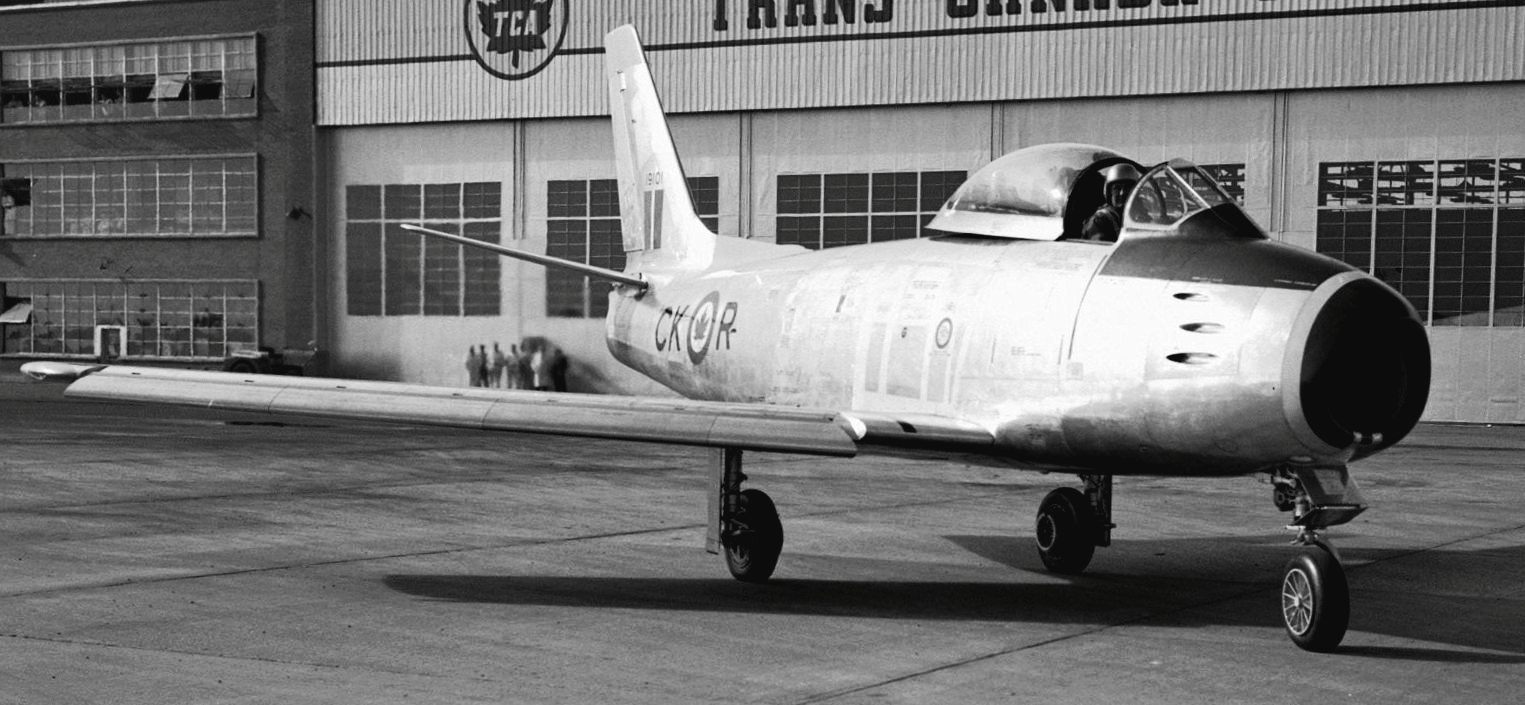
Canadair F-86 Sabre Mk. 1 (Serial No. 19101), coded CK-R, National Aeronautical Establishment (NAE), Experimental Proving Establishment (EPE), ca 1951. This Sabre was assembled from F-86A components supplied by North American. First flight on 9 Aug 1950, after being towed on public streets from Cartierville factory to Dorval airport, Quebec. Flown to Malton, Ontario on 18 Aug 1950, towed to Canadian National Exhibition grounds in Toronto for display. Coded CK-R for early tests. Later operated by Central Experimental and Proving Establishment at RCAF Station Uplands, Ontario, coded PX-101. It was on display on pedestal in front of 700 Wing of the RCAF Association in Edmonton, Alberta from 14 July 1965 to 2009, but is now preserved indoors in the Alberta Aviation Museum, Edmonton, Alberta.
(Library and Archives Canada Photo, MIKAN No. 3584475)
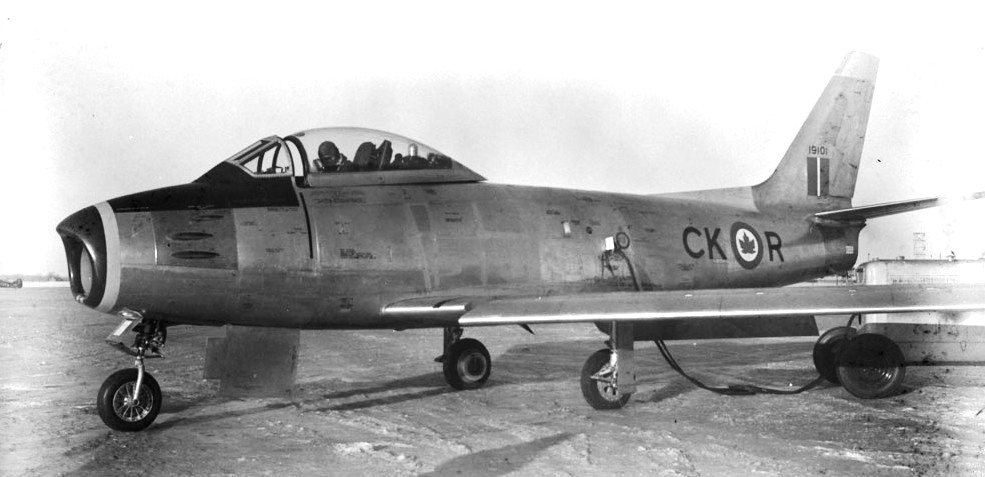
Canadair F-86 Sabre Mk. 1 (Serial No. 19101), coded CK-R, National Aeronautical Establishment (NAE), Experimental Proving Establishment (EPE), 30 Jan 1951.
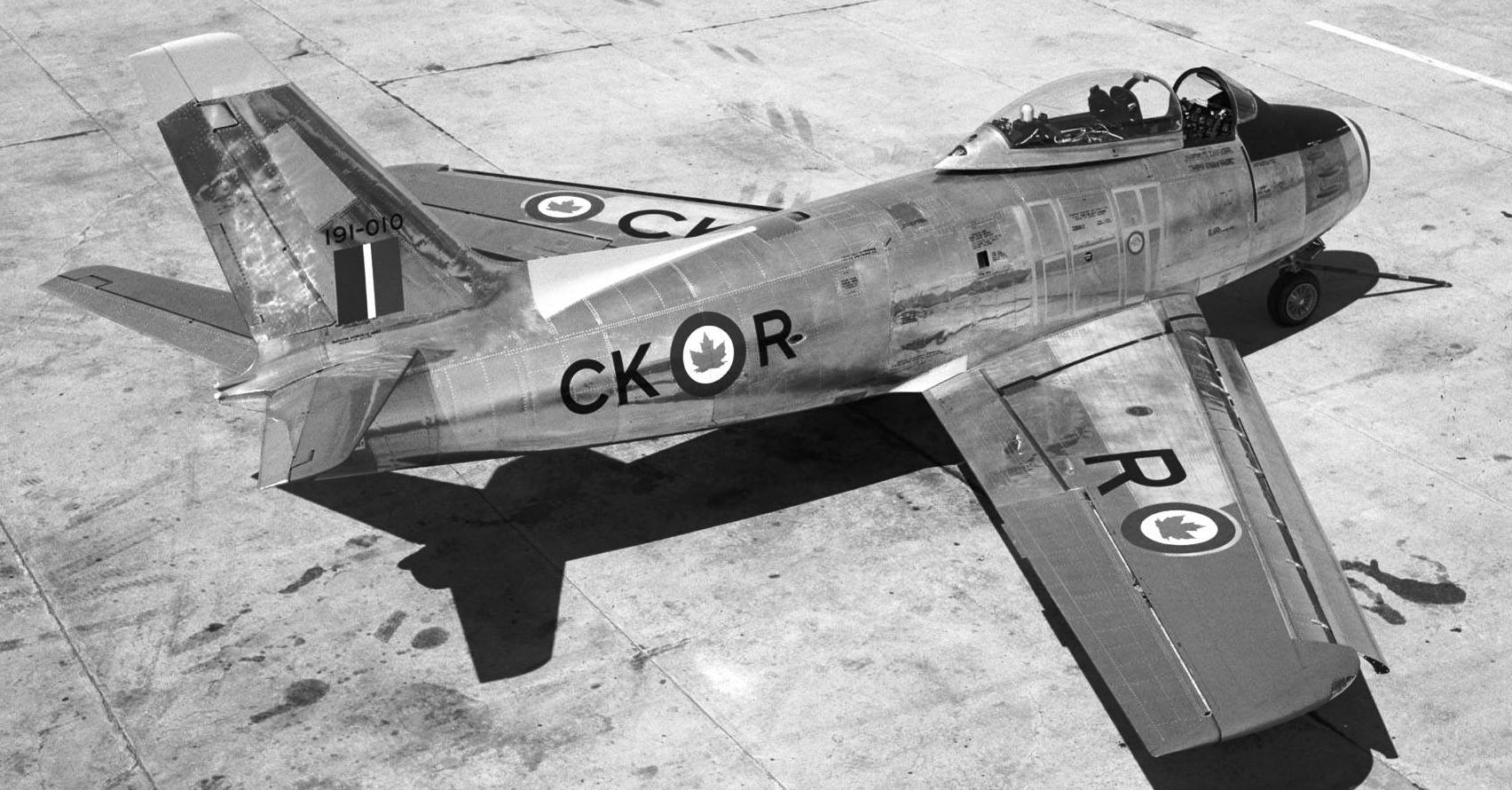
(DND Photo via James Craik)
Canadair F-86 Sabre Mk. 1 (Serial No. 19101), coded CK-R, National Aeronautical Establishment (NAE), Experimental Proving Establishment (EPE), 20 Mar 1951. The original Canadair F-86 Sabre Mk. 1 (Serial No. 19101), first flew at Montreal’s Dorval airport on 9 Aug 1950. This aircraft was primarily built using American-made parts similar to F-86A Sabre.
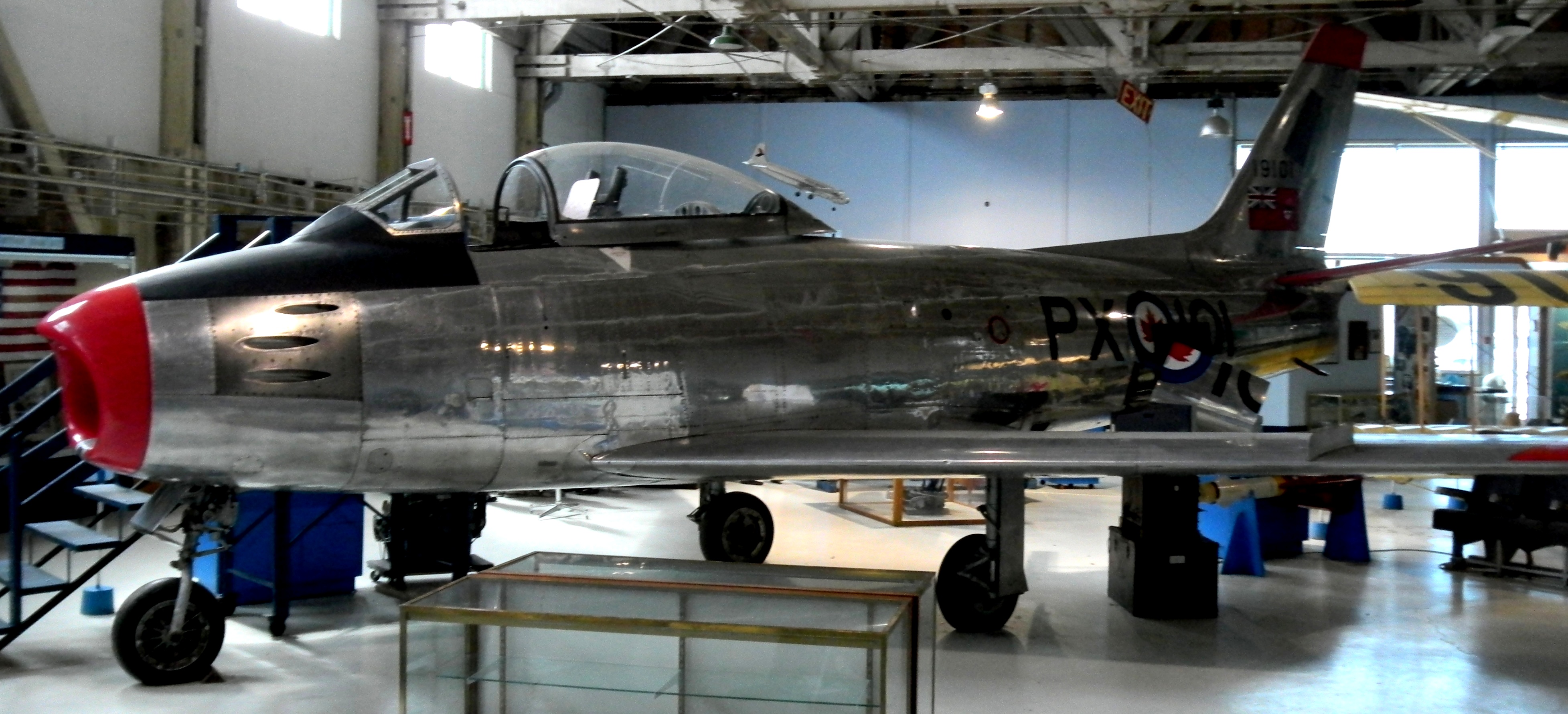
(Author Photo)
Edmonton, Alberta, Alberta Aviation Museum, Canadair F-86 Sabre Mk. 1 (Serial No. 19101), PX-101. Indoors.
After the first prototype, designated F-86 Sabre Mk. 1, Canadair immediately began production in earnest with an improved Mk. 2 model. The Mk. 2 was essentially an F-86E with an “all flying” tailplane to provide better flying characteristics as well as a flat windscreen. The Mk. 2 was also powered by a General Electric J-47-GE-13 engine. The Canadair Sabre was the RCAF’s most numerous post-war fighter. The Sabre was flown with the RCAF’s No. 1 Canadian Air Division in Europe (at one time there were 12 Squadrons of them able to take to the air at the same time). The aircraft was the last Canadian fighter to use guns (six .50 calibre machine guns mounted in the nose) as its primary weapon. During the Korean War, Canada supplied the USAF with 60 F-86 Sabre Mk. 2 (USAF F-86E-6).
One Mk. 2 is preserved at Canadian Forces Base Valcartier, Québec, Canadair F-86 Sabre Mk. 2 (Serial No. 19118), painted as 19318. It previously was painted as 19430 while on display at CMR, St. Jean, Québec.
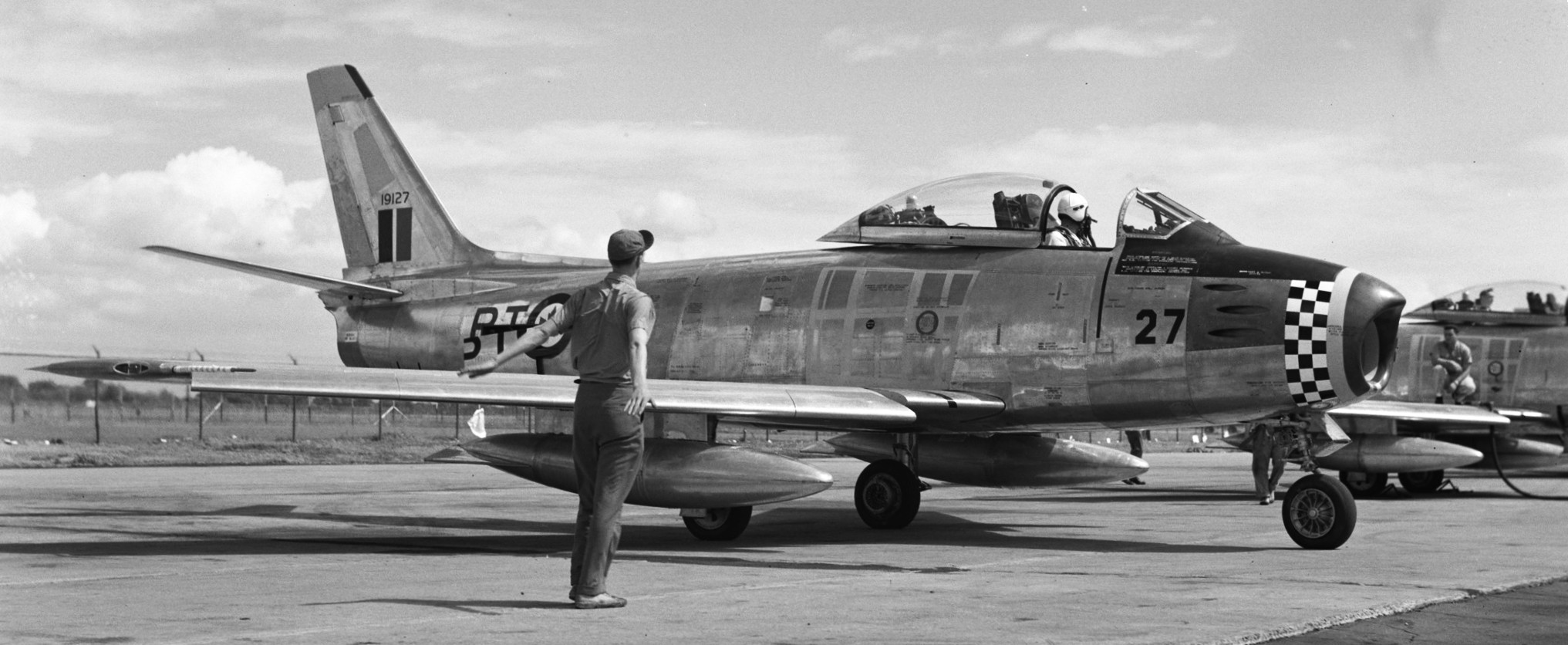
(RCAF Photo)
Canadair F-86 Sabre Mk. 2, (Serial No. 19127), No. 439 Squadron.
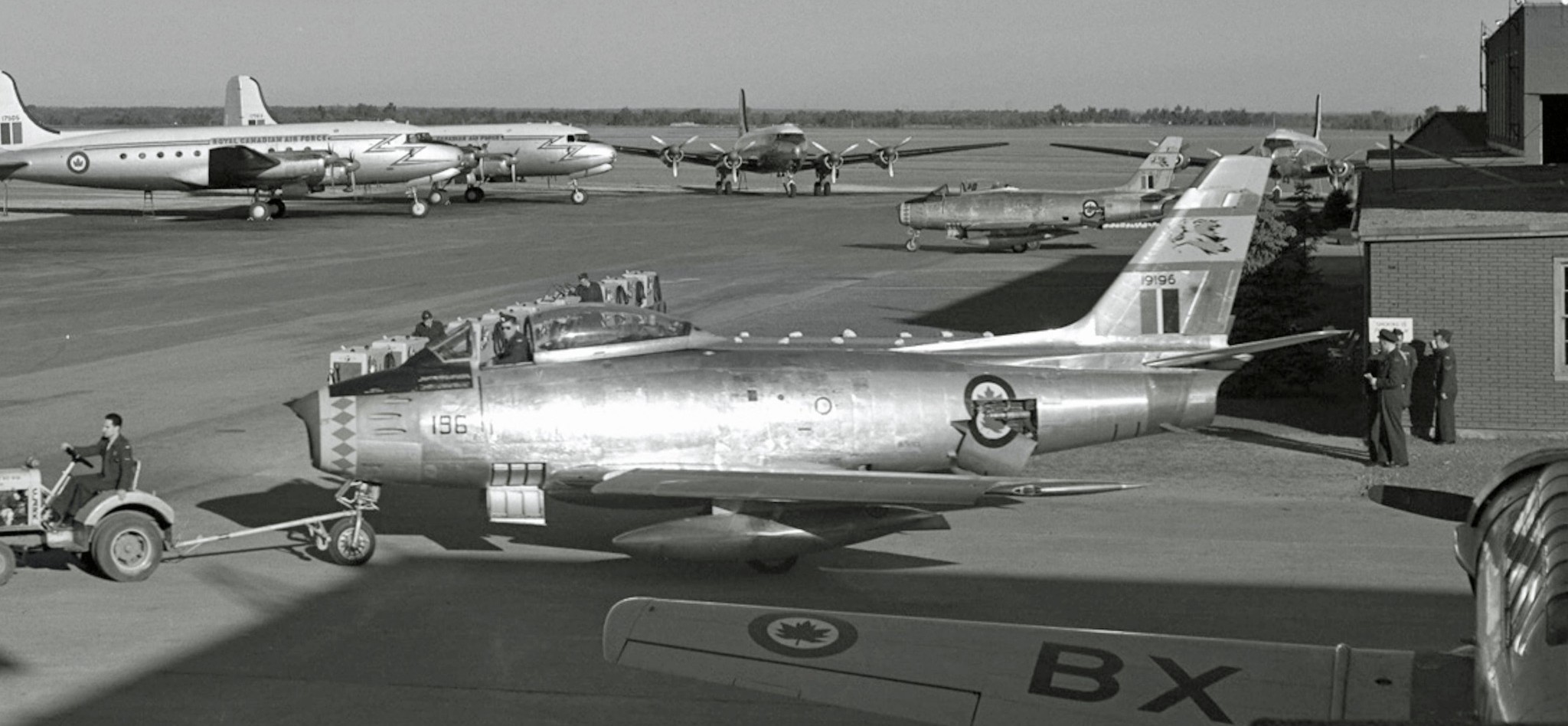
(DND Photo)
Canadair F-86 Sabre Mk. 2 (Serial No. 19196), No. 439 Squadron, Canadair CL-2 North Stars, and a CCF Harvard, at RCAF Station Uplands, Ontario, in 1952.
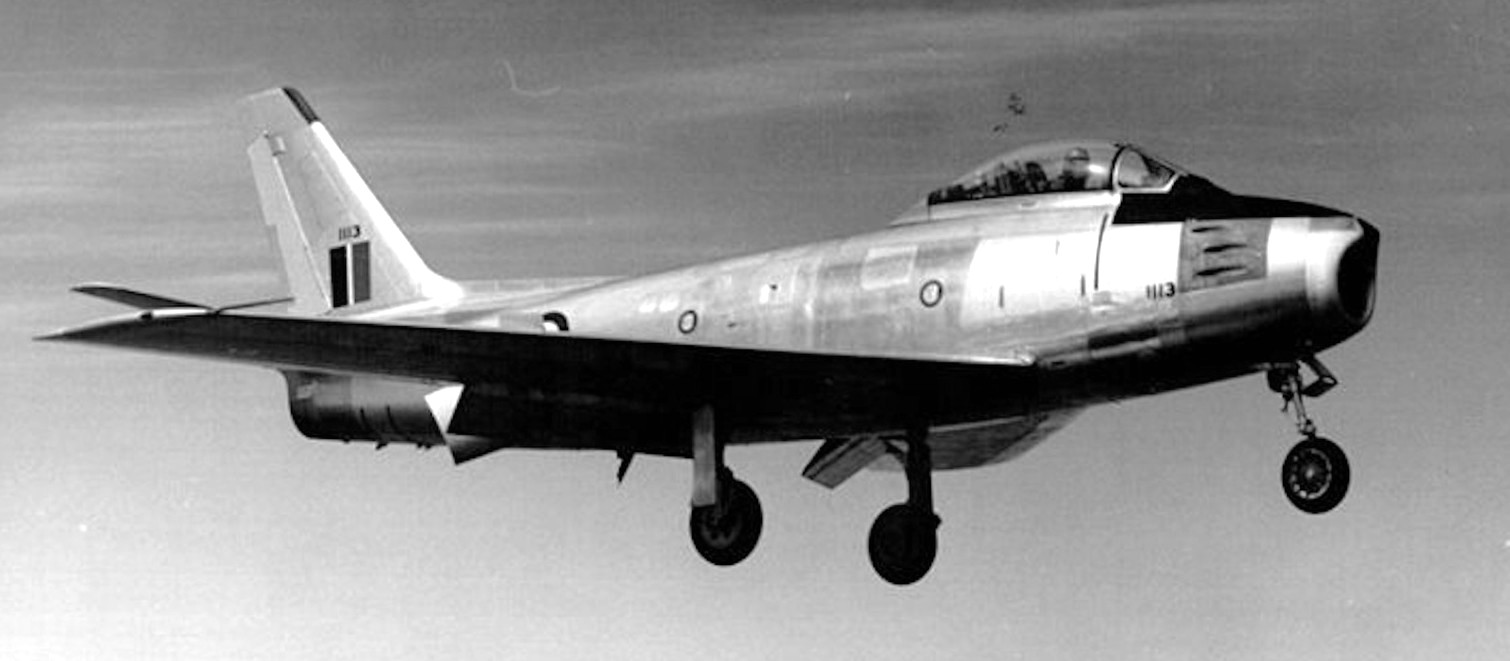
(DND Photo viaJames Craik)
Canadair F-86 Sabre Mk. 2 (Serial No. 19113).
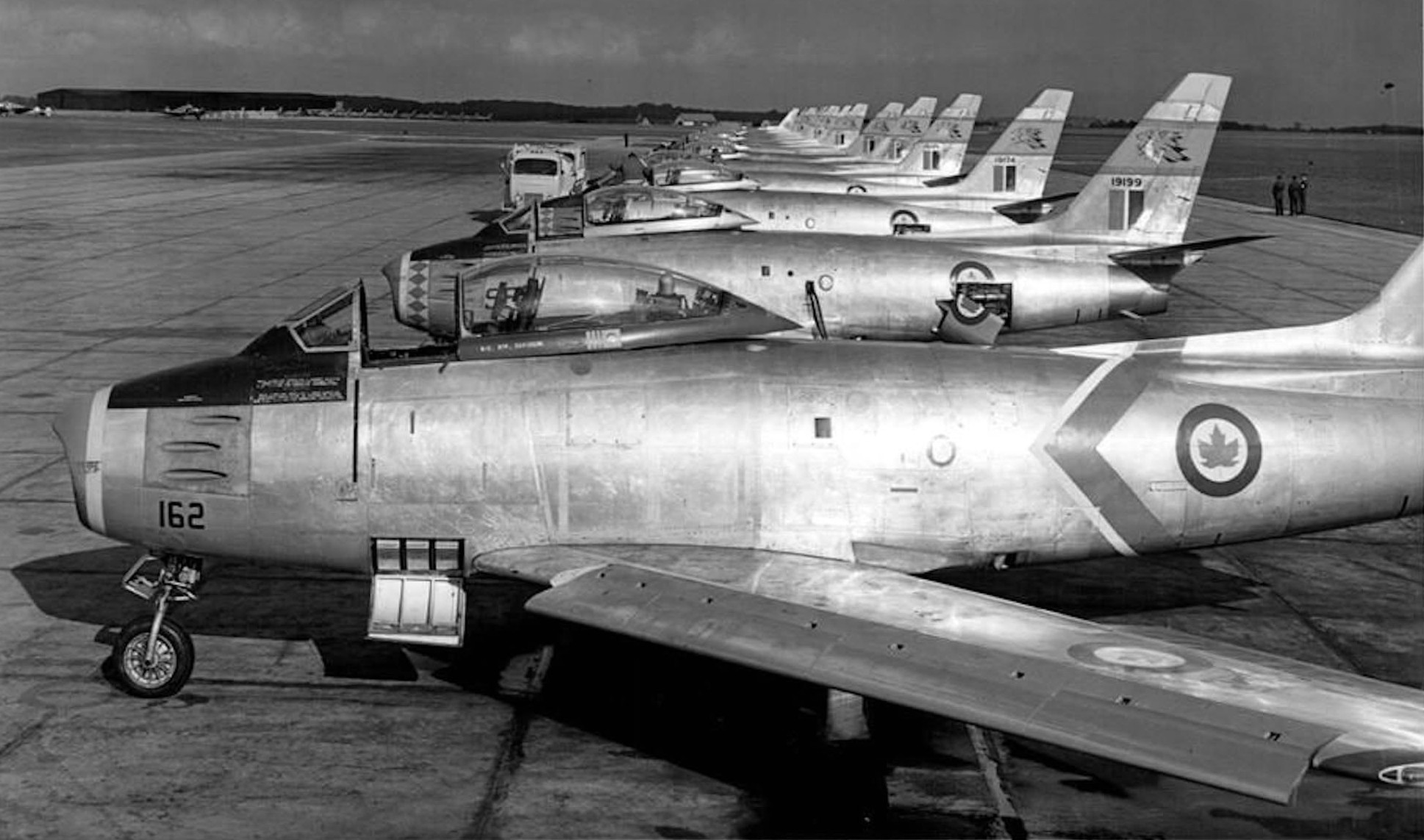
(DND Photo viaJames Craik)
Canadair F-86 Sabre Mk. 2, No. 162, No. 439 Squadron, (Serial No. 19199) visble behind it.
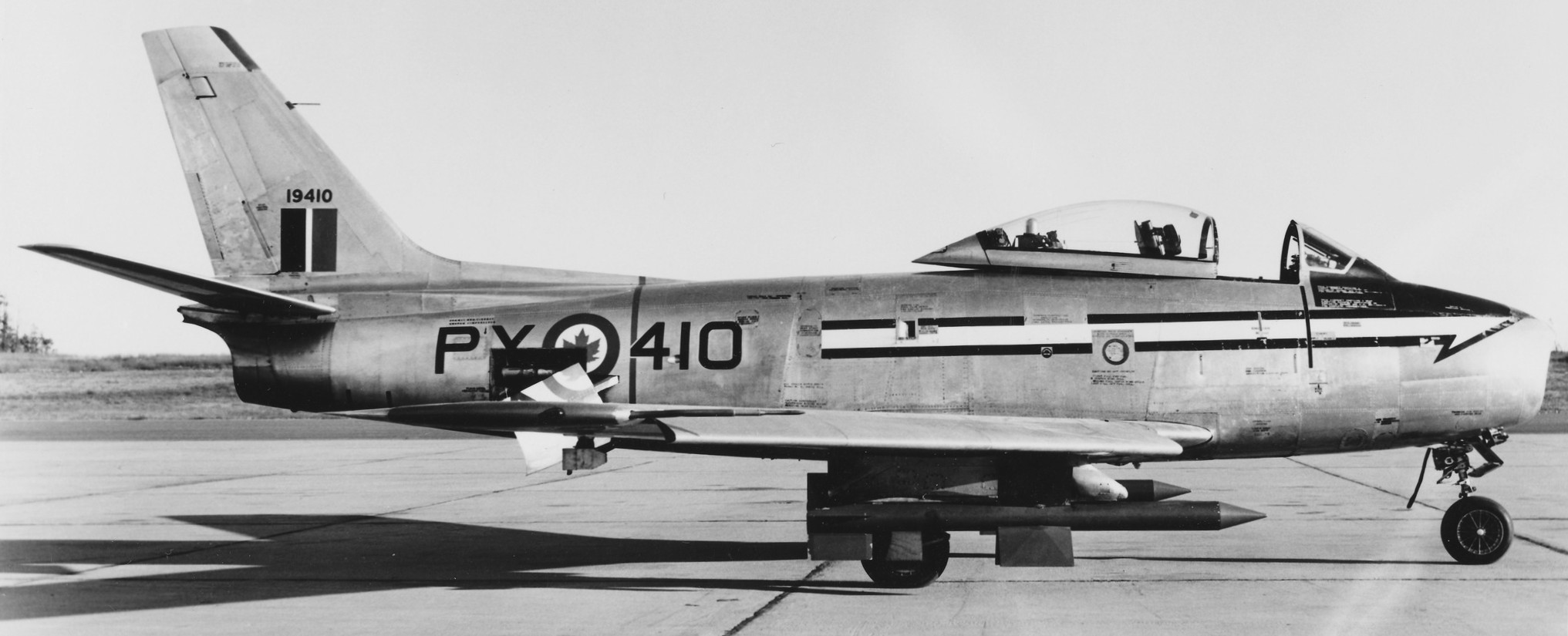
(DND Photo via James Craik)
Canadair F-86 Sabre Mk. 2 (Serial No. 19410), coded PX, with the Canadian Armament Research and Development Establishment (CEPE). CEPE developed the Velvet Glove air-to-air missile. This research took place at what was then known as RCAF Station Cold Lake, now known as CFB Cold Lake, Alberta.
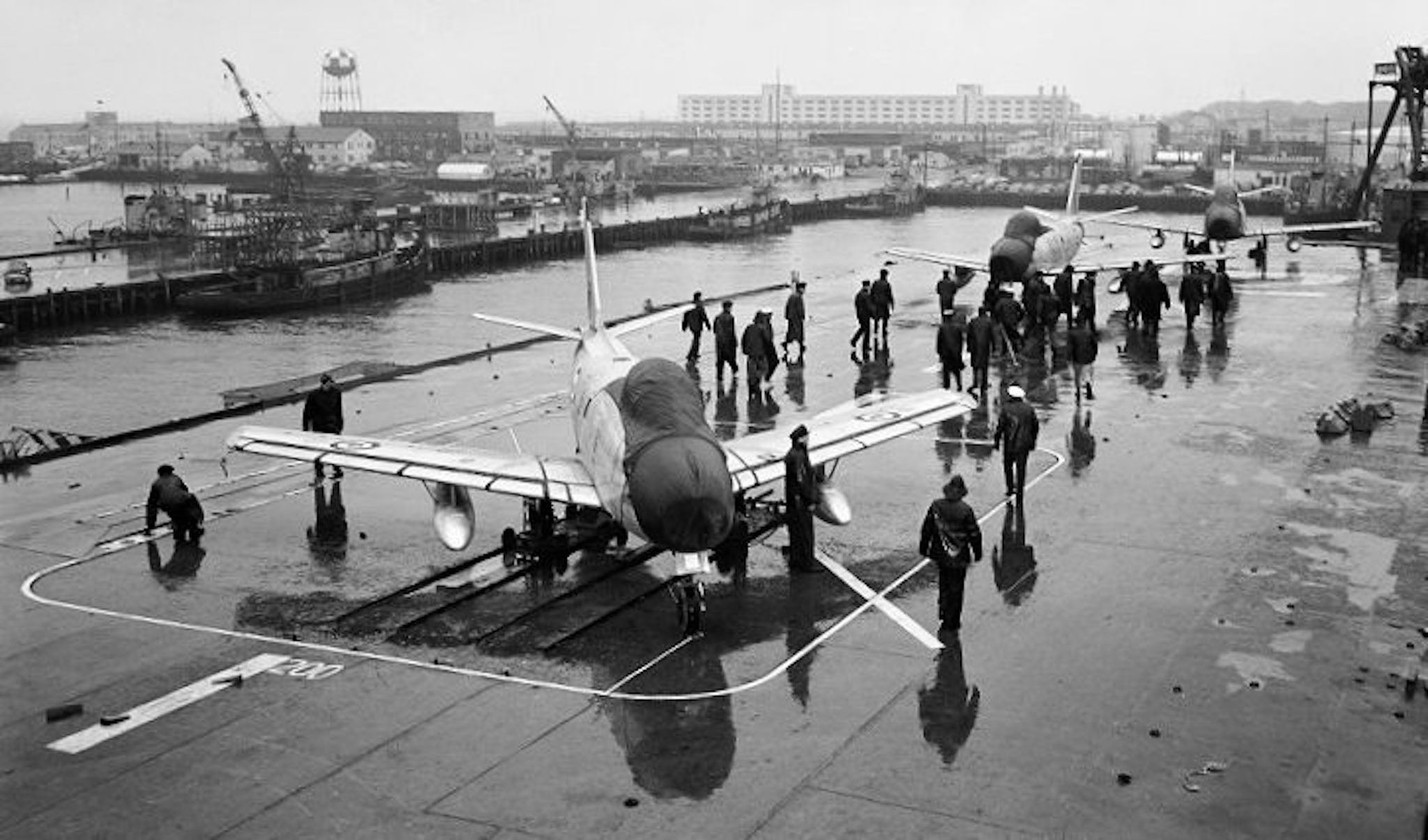
(DND Photo)
Canadair F-86 Sabre Mk. 2, No. 410 Squadron and No. 441 Squadron, on board HMCS Magnificent, Norfolk Virginia, Oct 1951.
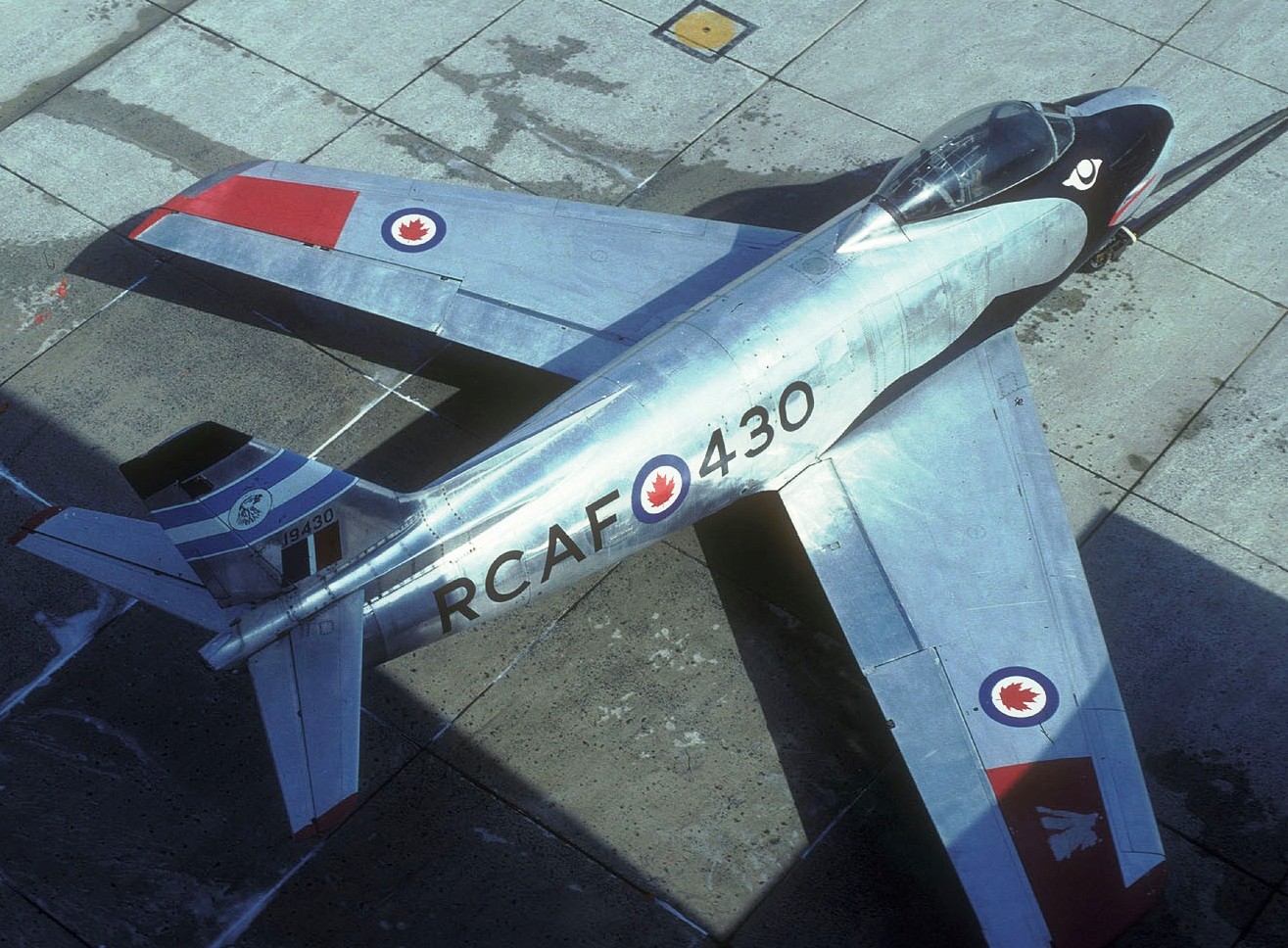
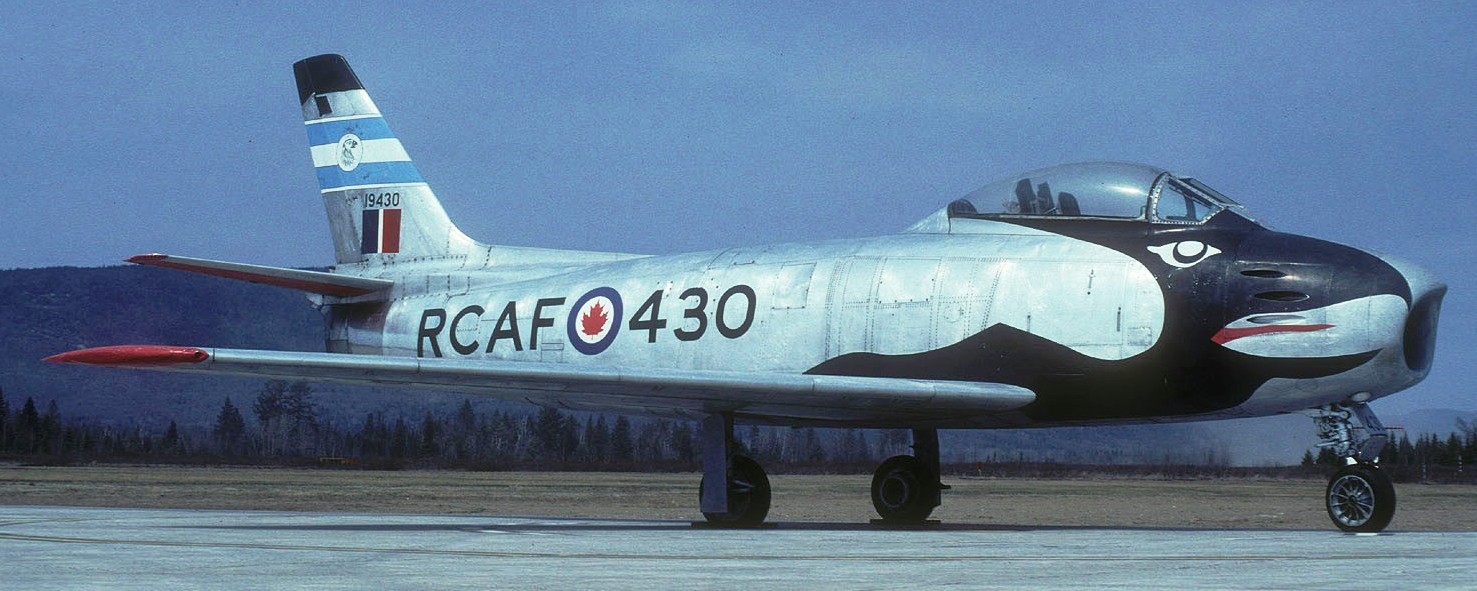
(Philippe Colin Photos)
Canadair F-86 Sabre Mk. 2 (Serial No. 19118), painted as (Serial No. 19430), No. 430 Squadron, CFB Valcartier, Québec.
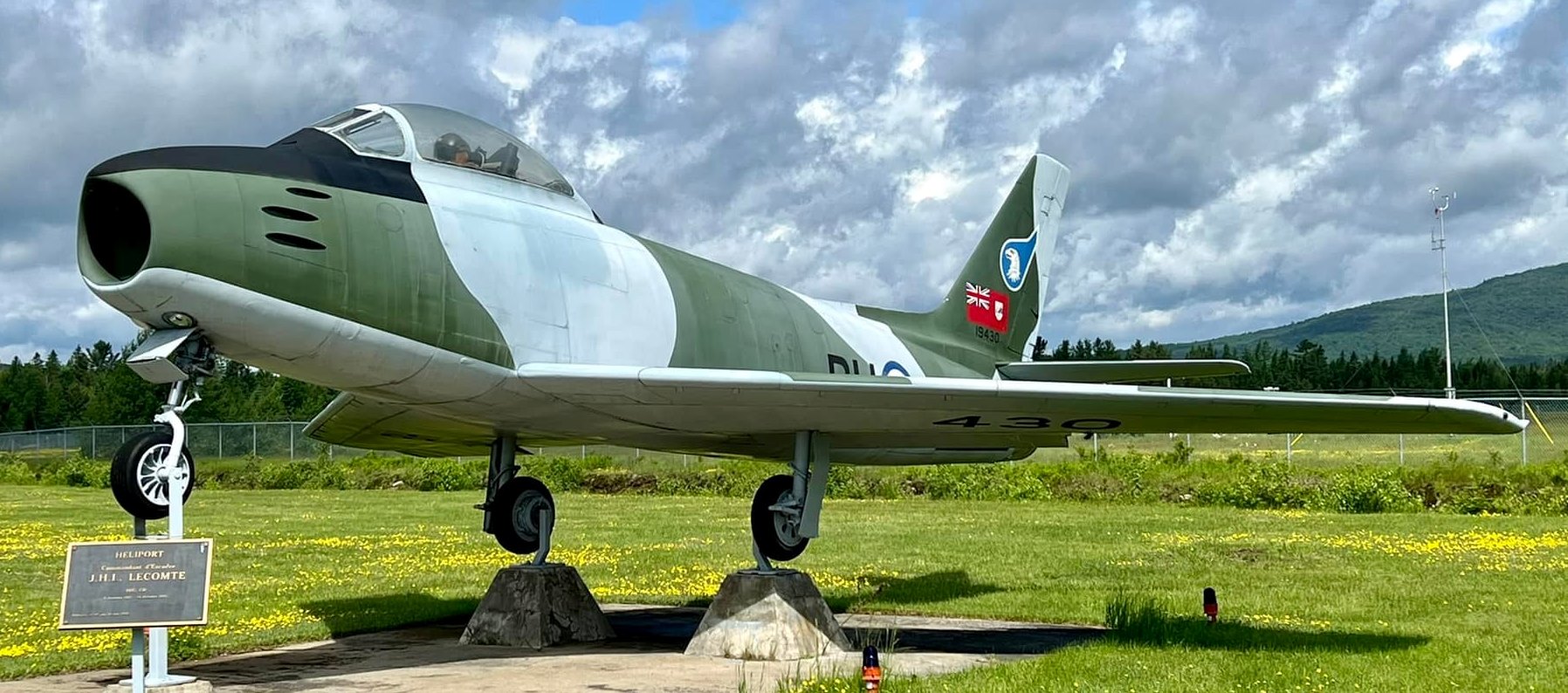
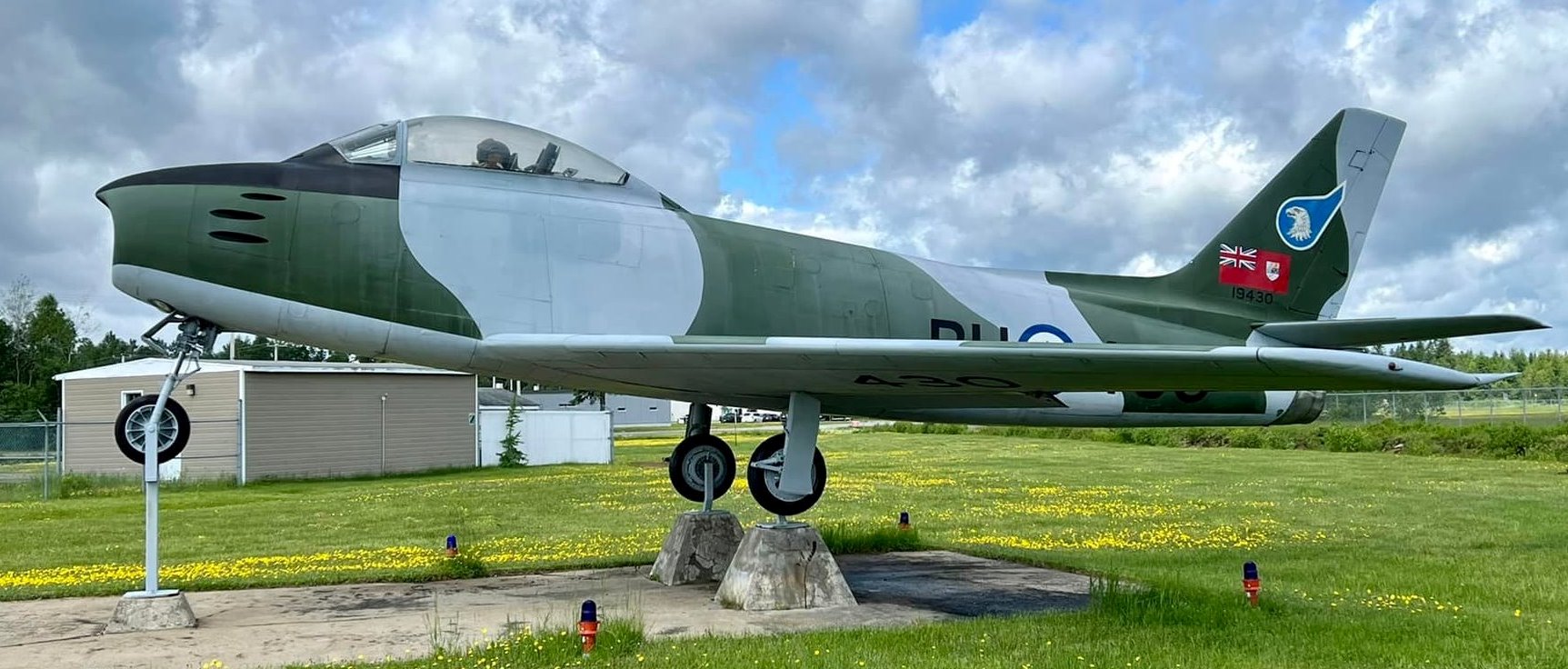
(Eric Desbiens Photos)
Canadair F-86 Sabre Mk. 2 (Serial No. 19118), painted as (Serial No. 19430), No. 430 Squadron, CFB Valcartier, Québec.
(Canadair Photo via Tony Edmundson)
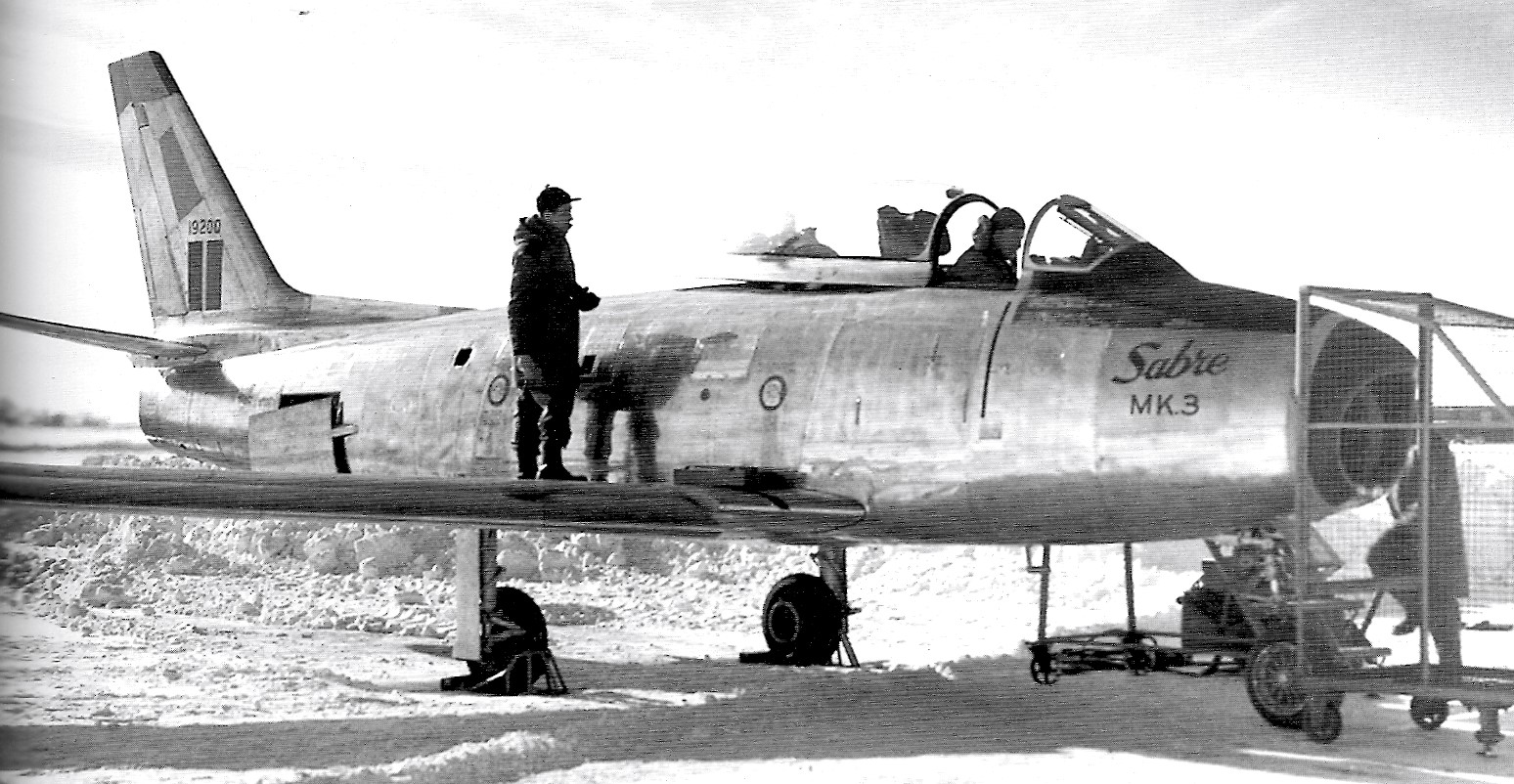
Canadair F-86 Sabre Mk. 3 (Serial No. 19200), initial engine runs at Canadair; note the original slatted short chord wing. With its first flight on 25 Sep 1952, it used by Canadair for trials before being passed to the RCAF. It was nearly lost in high speed dive by Canadair pilot W. Longhurst during early tests, when a spanner left in the cockpit jammed the elevator controls during manufacturers trials. Pilot bent spanner during recovery. To Edwards AFB in California for calibrations and other trials in Apr 1953. Used by Jacqueline Cochran to set 3 world speed records for women in May and June 1953, from Edwards AFB. It carried no markings apart from the serial number on its fin for these flights. She is reported to have become the first woman to fly through the sound barrier during these flights. Later brought up to full Mk. 4 standards, but apparently not redesignated. Reported on display at St. Jean, Quebec, no dates. Preserved, on display at former RCAF Station Downsview, Ontario in the 1980s. Later with the Western Canada Aviation Museum in Winnipeg, Manitoba. By 2000 at the Reynolds Museum in Wetaskawin, Alberta.
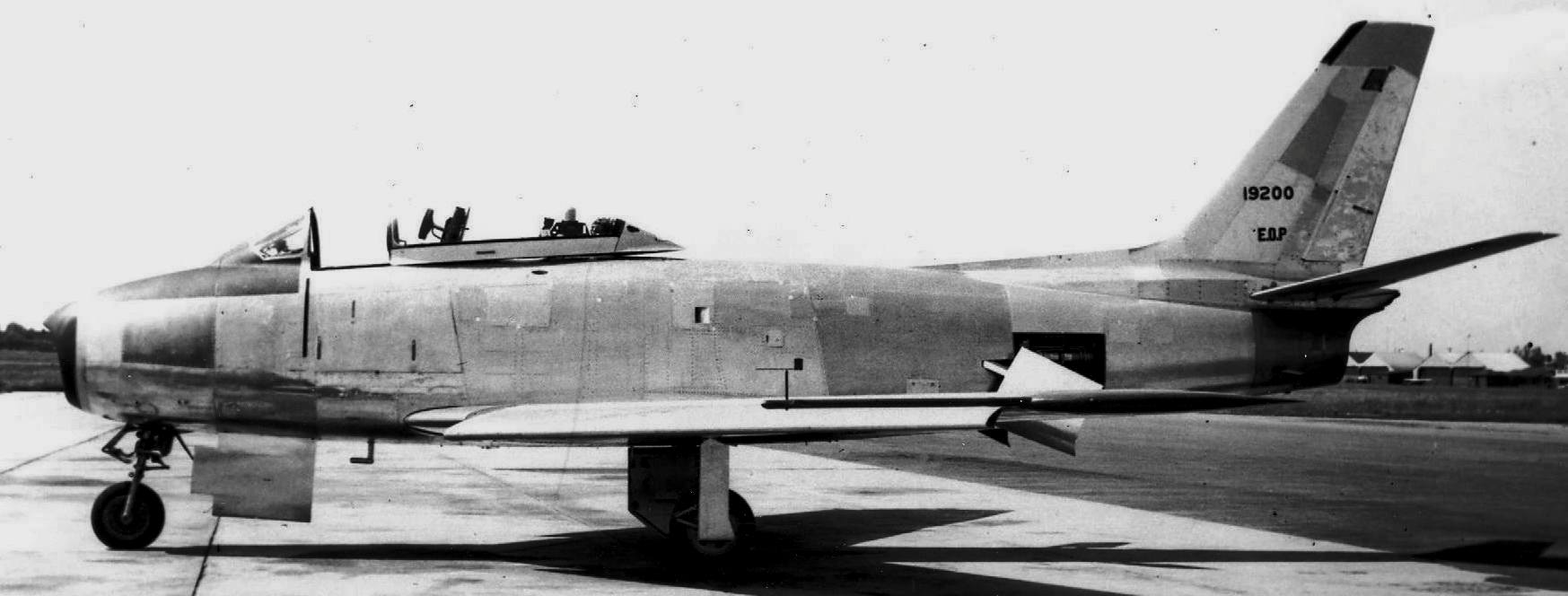
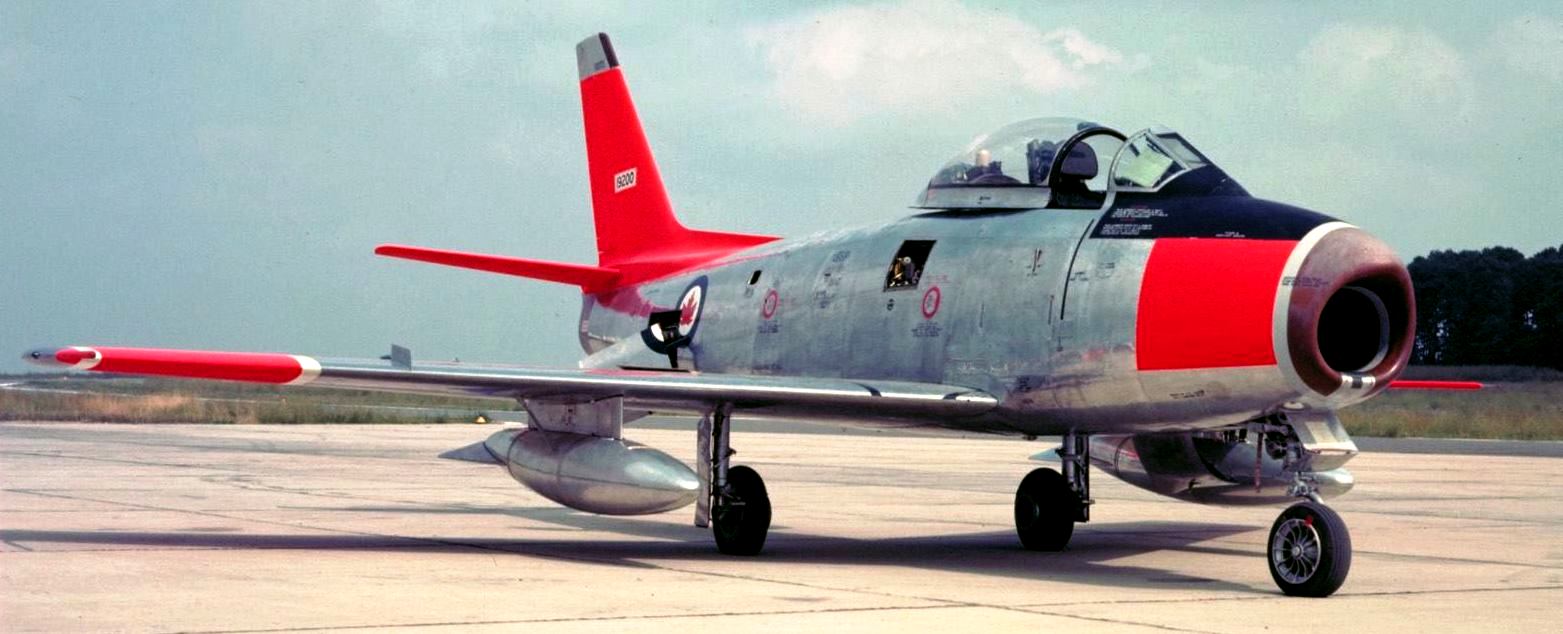
The Mk. 3 Sabre was powered by an Avro Orenda 3 engine. In 1952, Jacqueline Cochran, then aged 47, decided to challenge the world speed record for women, then held by Jacqueline Auriol. She tried to borrow an F-86A from the USAF, but was refused. She was introduced to an RCAF Air Vice-Marshal who, with the permission of the Canadian Minister of Defence, arranged for her to borrow 19200, the sole Sabre Mk. 3. Canadair sent a 16-man support team to California for the attempt. On 18 May 1953, Ms. Cochran set a new 100-km speed record of 1050.15 km/h (652.5 mph). Later on 3 June, she set a new 15-km closed circuit record of 1078 km/h (670 mph). While she was in California, she exceeded 1270 km/h in a dive, and thus became the first woman to exceed the speed of sound.[1] This historic Mk. 3 is preserved with the R-AM, Wetaskiwin, Alberta, Canadair F-86 Sabre Mk. 3 (Serial No. 19200). It was previously held by the WCAM in Winnipeg, Manitoba, up to 2000.
(DND Photo via James Craik)
Canadair F-86 Sabre Mk. 3 (Serial No. 19200).
(DND Photo via Mike Kaehler)
Canadair F-86 Sabre Mk. 3 (Serial No. 19200). This was the only Mk. 3, and was the first Canadair built Sabre with an Orenda engine.
(DND Photo via James Craik)
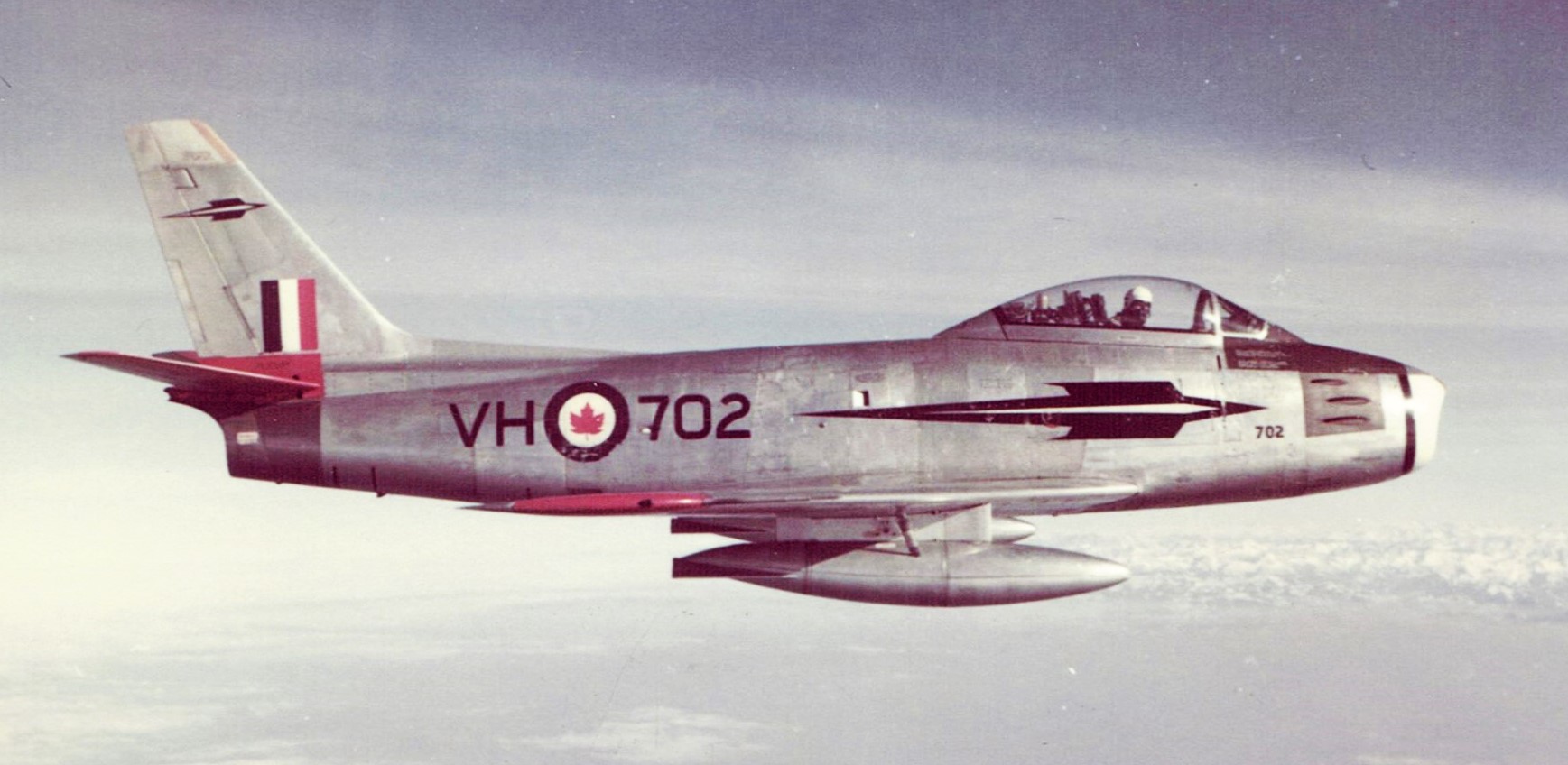
Canadair F-86 Sabre Mk. 4 (Serial No. 19702), coded VH, No. 444 Squadron, A.J. Bauer at the controls.
The next major production model was the Sabre Mk. 4, which originally was to have been powered by an Orenda designed engine but to retain commonality with the F-86E, it also carried the J47-GE-13. Various design improvements were incorporated throughout the aircraft. 438 Mk. 4 Sabres rolled off the assembly lines.
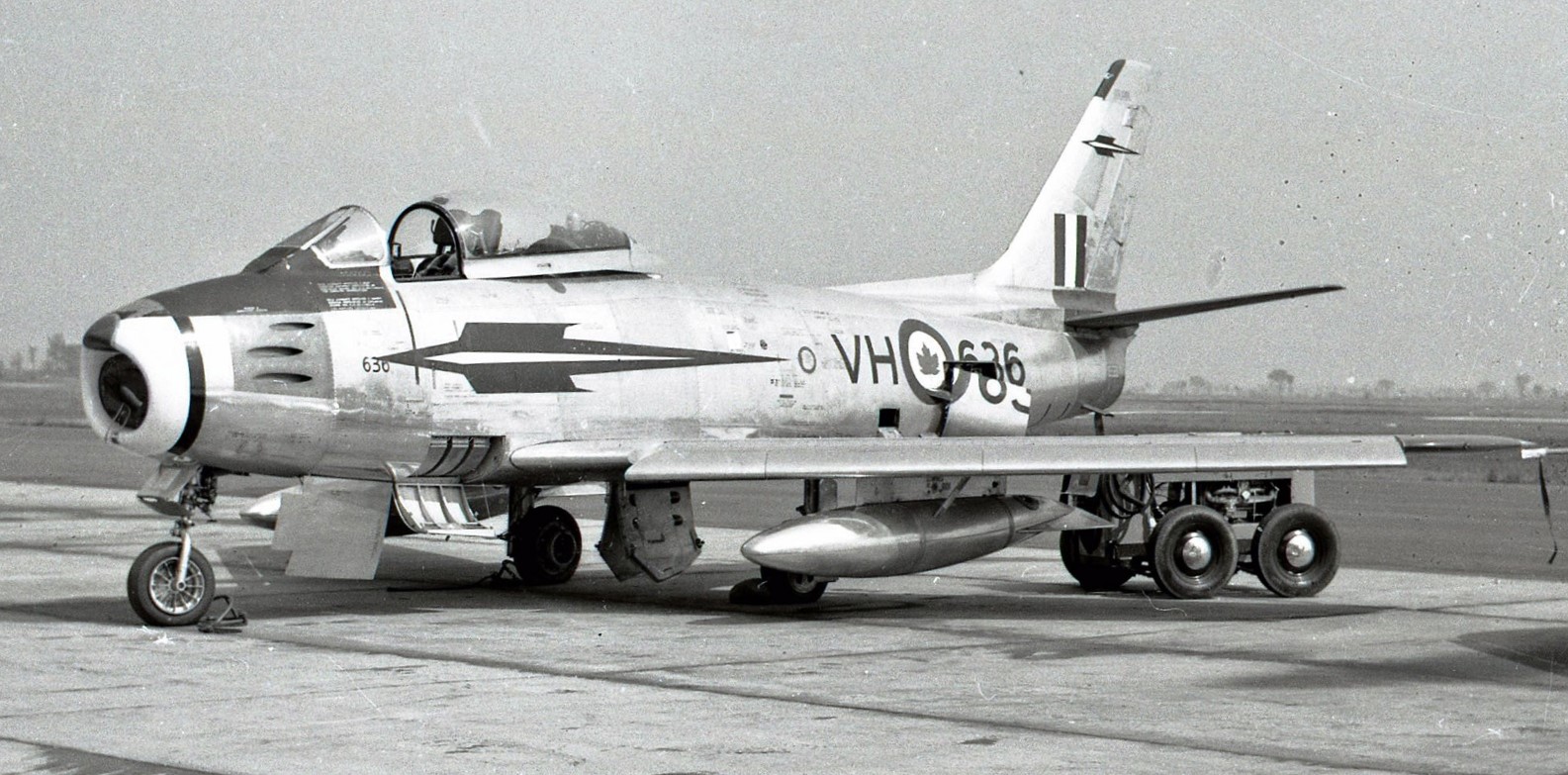
(F/O Rigby John Stamison Photo, from Paul Stamison via James Craik)
Canadair F-86 Sabre Mk. 4 (Serial No. 19636), No. 444 Squadron, coded VH, at RCAF Station St Hubert, Quebec, prior to Leapfrog IV, September 1953.
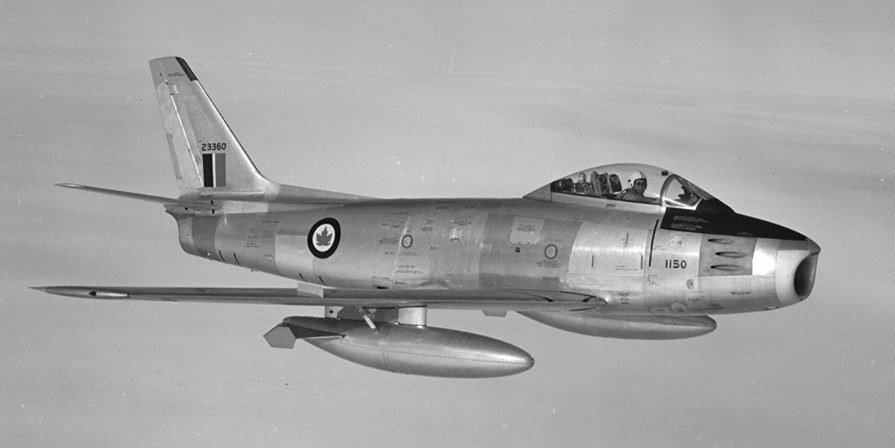
(DND Photo via James Craik)
Canadair F-86 Sabre Mk. 5 (Serial No. 23360), No. 1150.
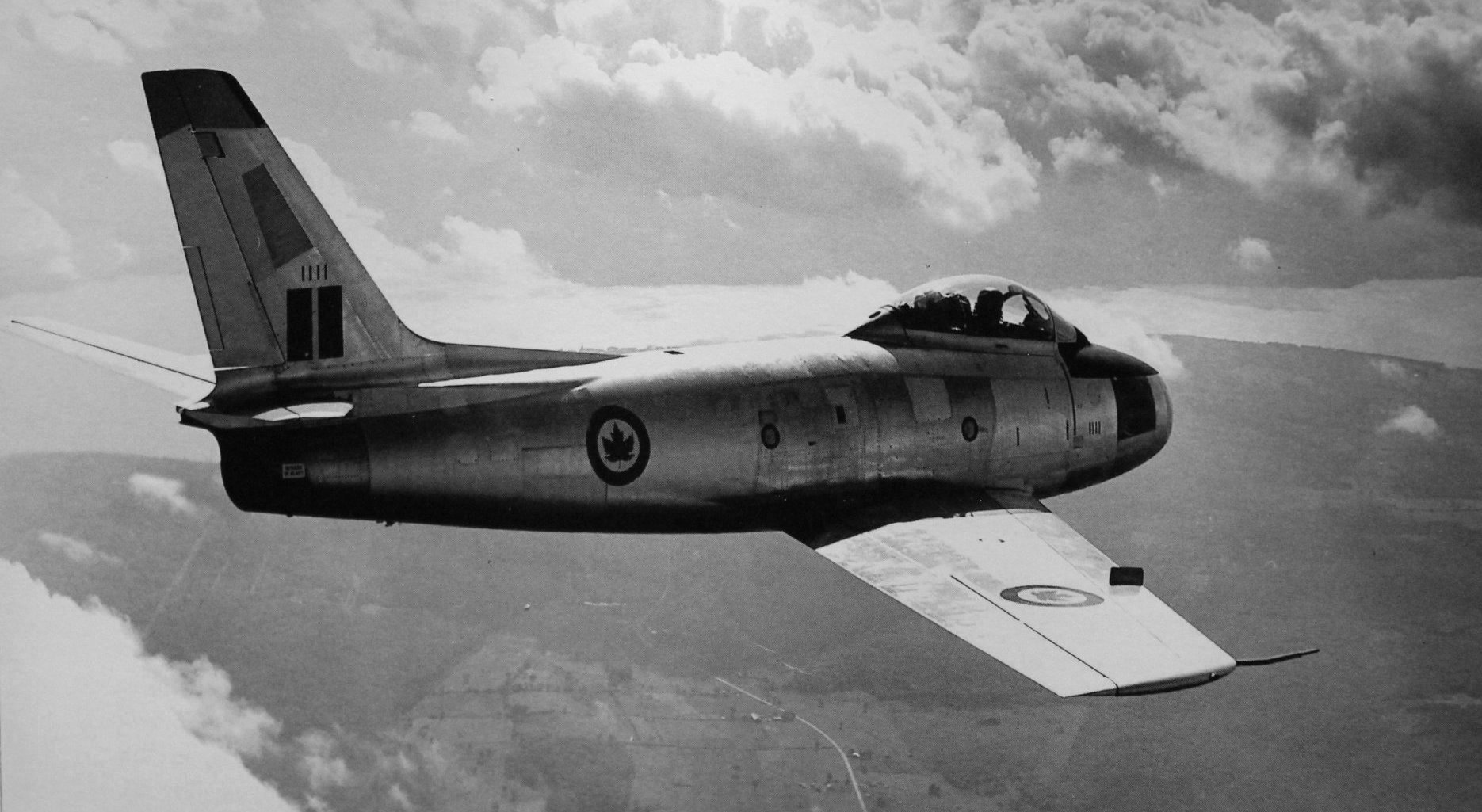
(DND Photo via Serge L’Hostie)
Canadair F-86 Sabre Mk. 5 (Serial No. 1111), on a test flight over Montreal.
The Sabre Mk. 5 was the first production model with a Canadian engine utilising the Avro Orenda 10 engine rated at 6,355-lbs thrust. The bigger Orenda engine necessitated a larger diameter opening in fuselage frames and stronger engine mounts. An important structural modification was the introduction of a fixed leading edge to replace the automatic slats on earlier versions. This change was designed to enhance the high altitude performance of the aircraft. Small wing fences were also introduced at the 70% span position. These modifications were successful but also resulted in a corresponding decrease in low speed handling characteristics. 370 Mk. 5 aircraft were built.
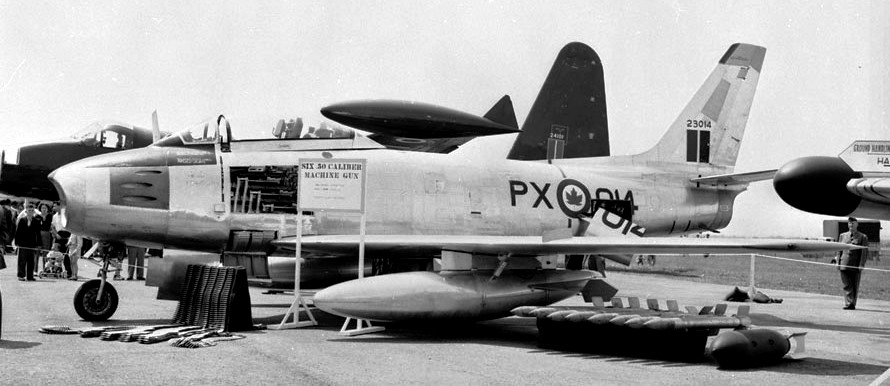
(Library and Archives Canada Photo, MIKAN No. 3585140)
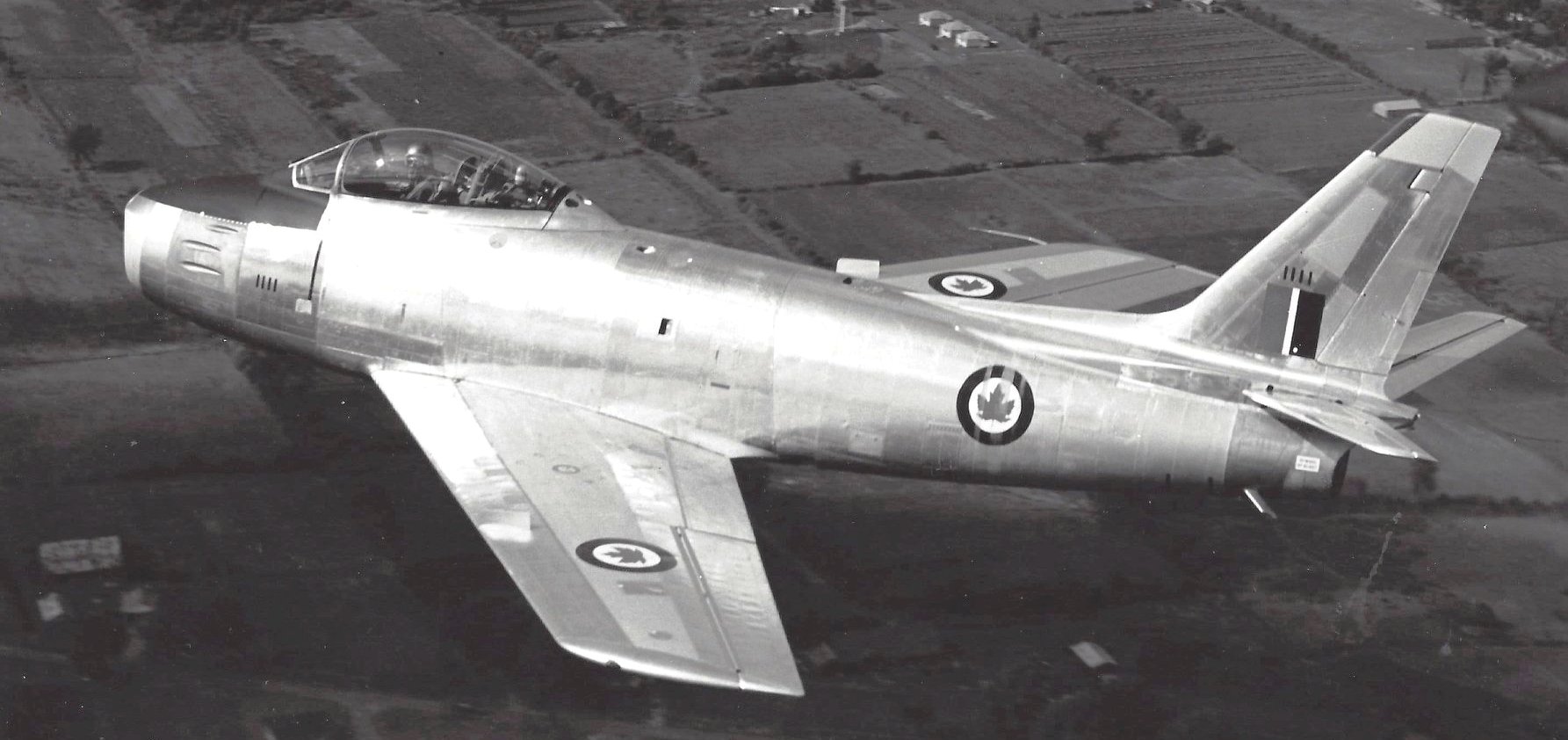
Canadair F-86 Sabre Mk. 5 (Serial No. 23014) coded PX, CEPE, Air Force Day, RCAF Station Rockcliffe, Ontario, 11 June 1955.
(Canadair Photo via Bill Cumming)
Canadair F-86 Sabre Mk. 5 (Serial No. 23321), c/n 1111. This Sabre went to the West German Air Force in 1958.
(DND Photo via James Craik)
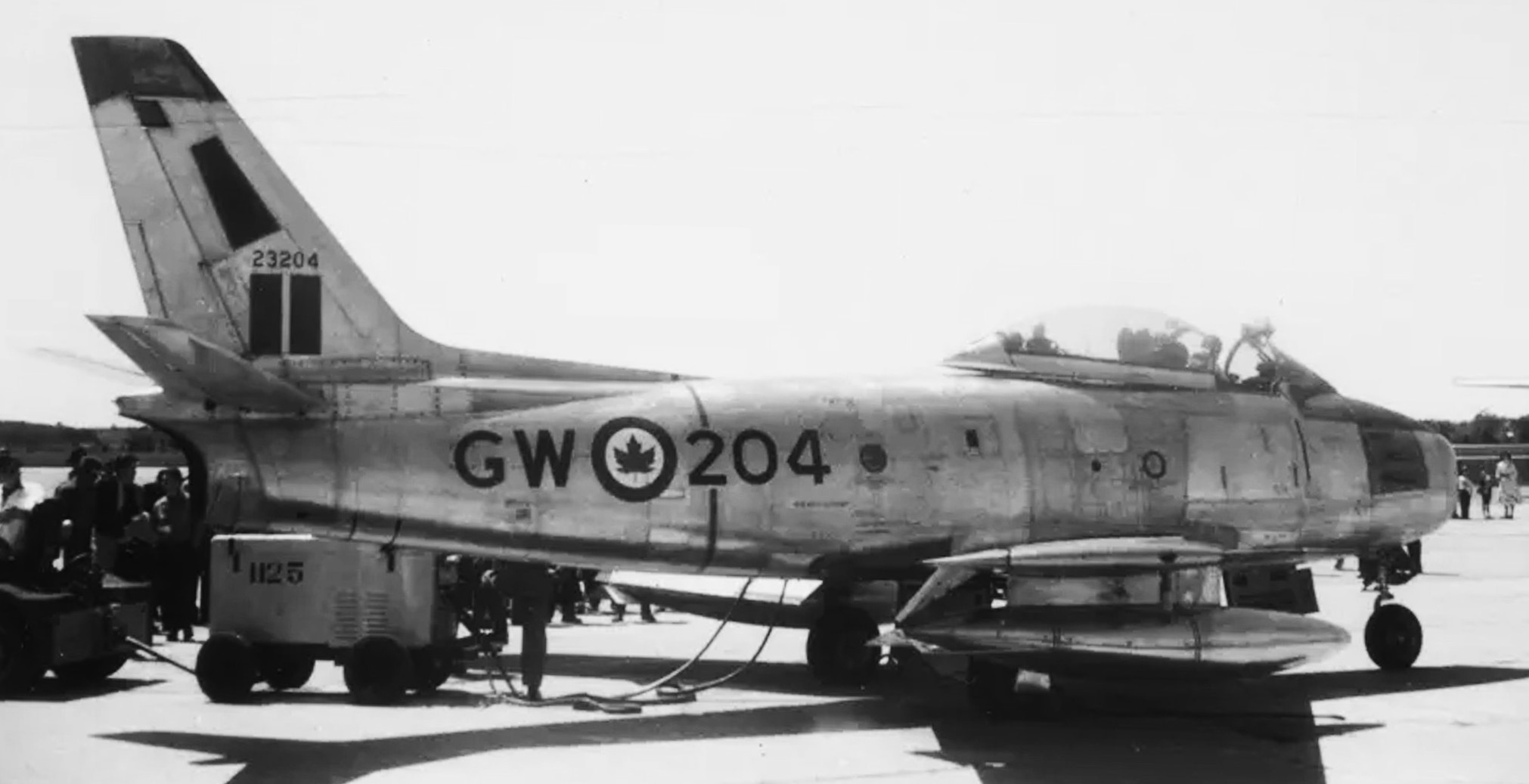
Canadair F-86 Sabre Mk. 5 (Serial No. 23204), No. 400 Squadron, coded GW.
(RCAF Photo via James Craik)
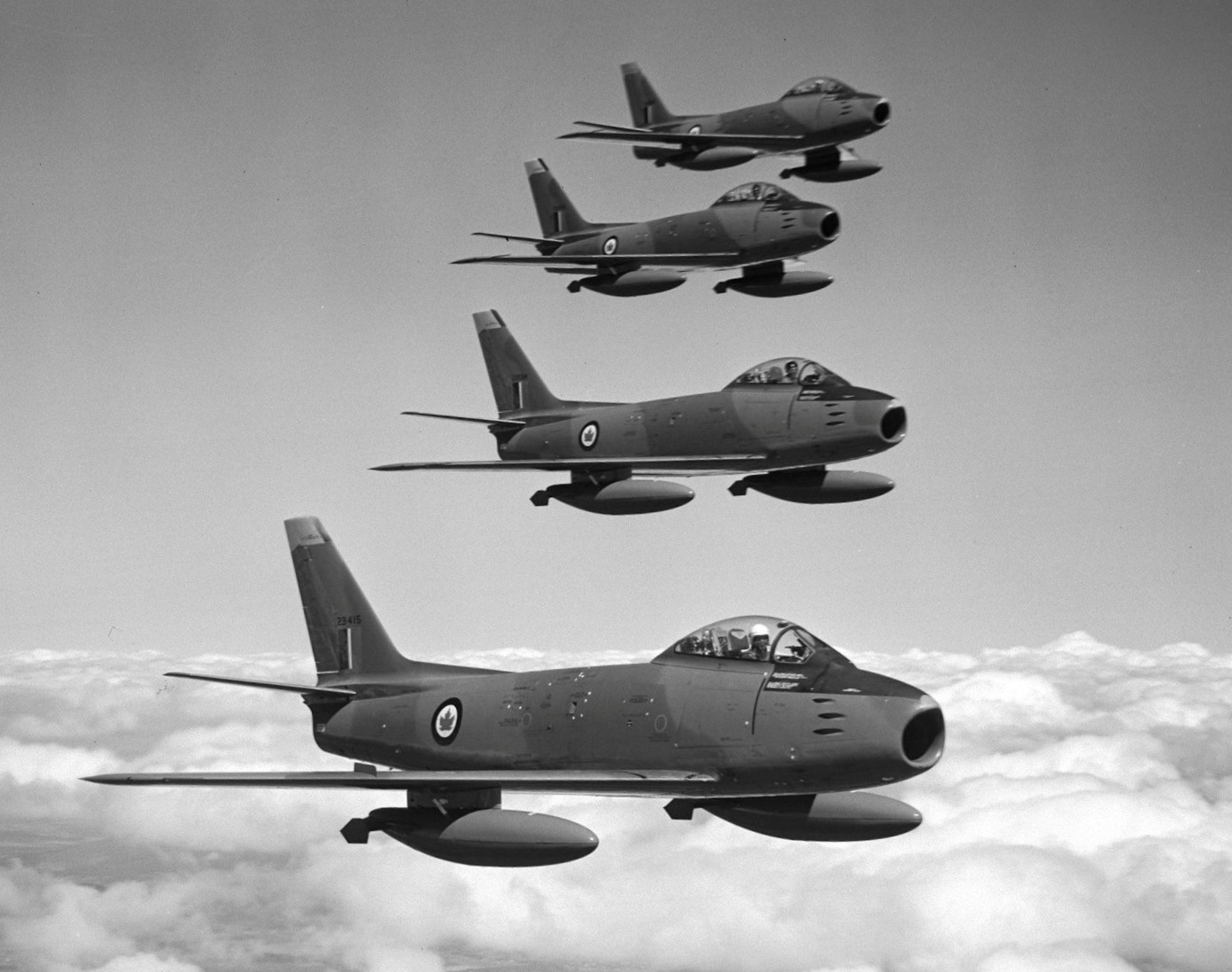
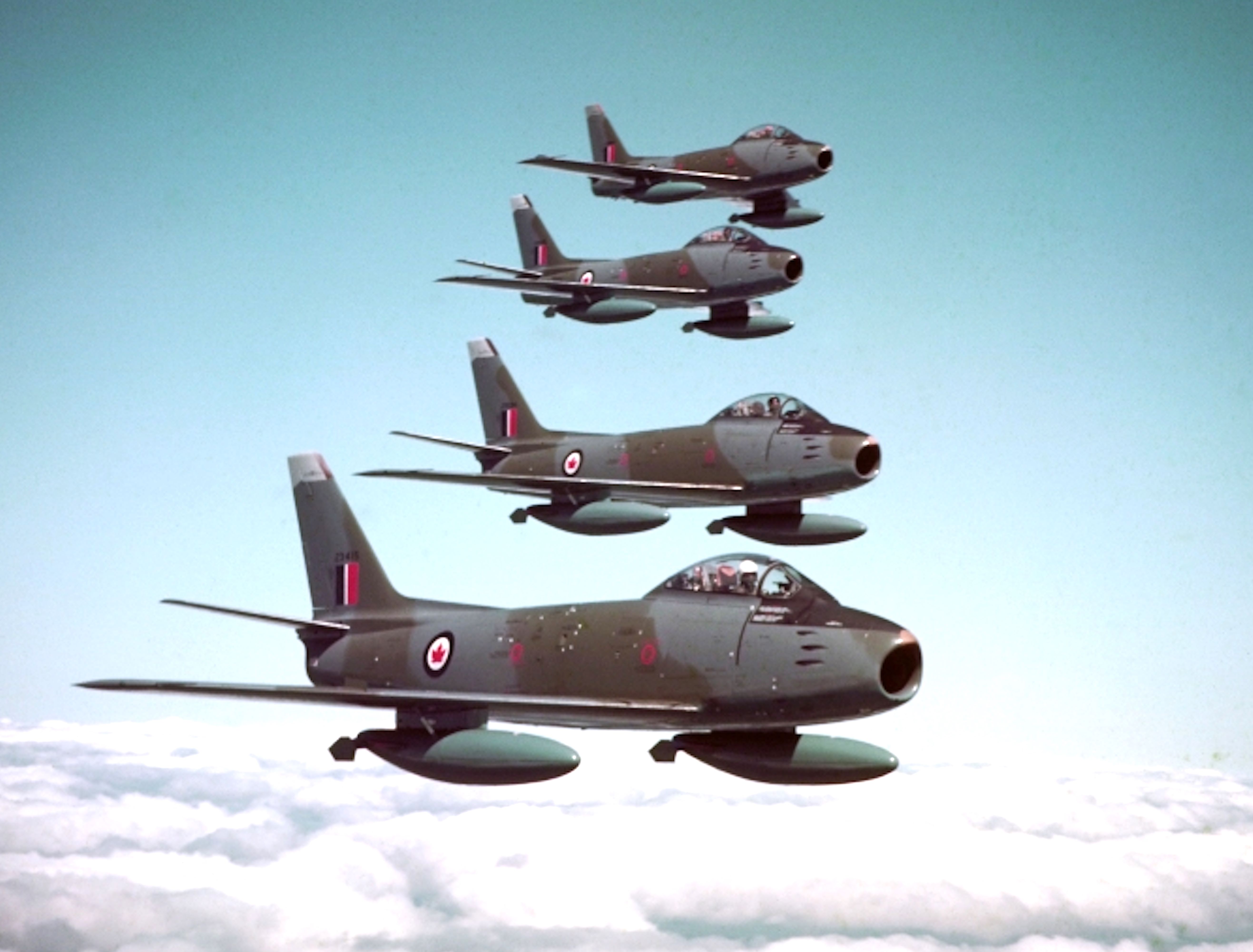
Canadair F-86 Sabre Mk. 5 formation, over Europe.
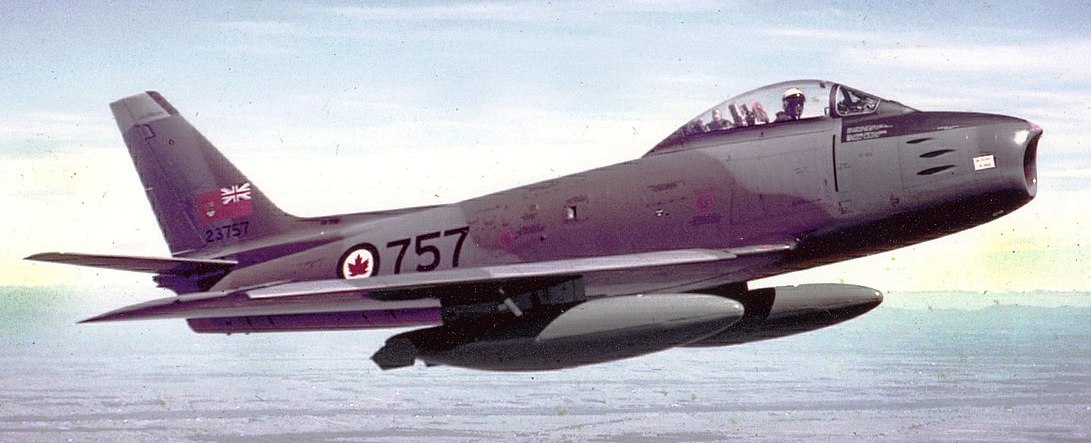
(DND Archives Photo PC-2144)
Canadair F-86 Sabre Mk. 6 (Serial No. 23757), one of 390 Sabre Mk. 6 (the last version, with Avro Orenda 14 engines) that served with the RCAF. This Sabre wears the camouflage developed for all RCAF European-based operational aircraft. The photo was taken while the aircraft belonged to No. 1 Overseas Ferry Unit (OFU) based at St. Hubert, Quebec, which was formed in 1953 to ferry Sabres and CT-133s across the North Atlantic.
The Mk. 6 Sabre was powered by the two-stage Avro Orenda 14 engine with a 7,275-lb thrust rating. Max Speed: 606 mph (975 km/h); Cruising Speed: 489 mph (787 km/h); Service Ceiling: 54,000 ft (16,458 m); Range: 1,486 m (2,391 km), Weight Empty: 10.618 lbs (4,818 kg), Gross: 14,613 lbs (6,634 kg). Span: 37 ft 111/2 in (11.57 m) Length: 37 ft 6 in (11.43 m) Height: 14 ft 9 in (4.50 m) Wing Area: 287.9 sq ft (26.74 sq m). Armament: Six .50 calibre machine guns and provisions for tanks, bombs, & rockets (unguided). Cost: $360,000.
The wing leading slats were re-introduced while retaining portions of the Mk. 5 wing configuration. The Mk. 6 therefore acquired superb combat manoeuvring. With this combination of engine and aerodynamics, the Mk. 6 was widely regarded as the best “dog-fighter” of its era. The RCAF’s Golden Hawks team initially flew Mk. 5, but were soon equipped with the excellent Sabre Mk. 6.[2] The Golden Hawks flew in aerobatic display shows throughout the country until their disbandment in February 1964. Canada’s last Sabre was retired in 1970, although Starfighters had begun to replace them in late 1962.[3]
(DND Photo via James Craik)
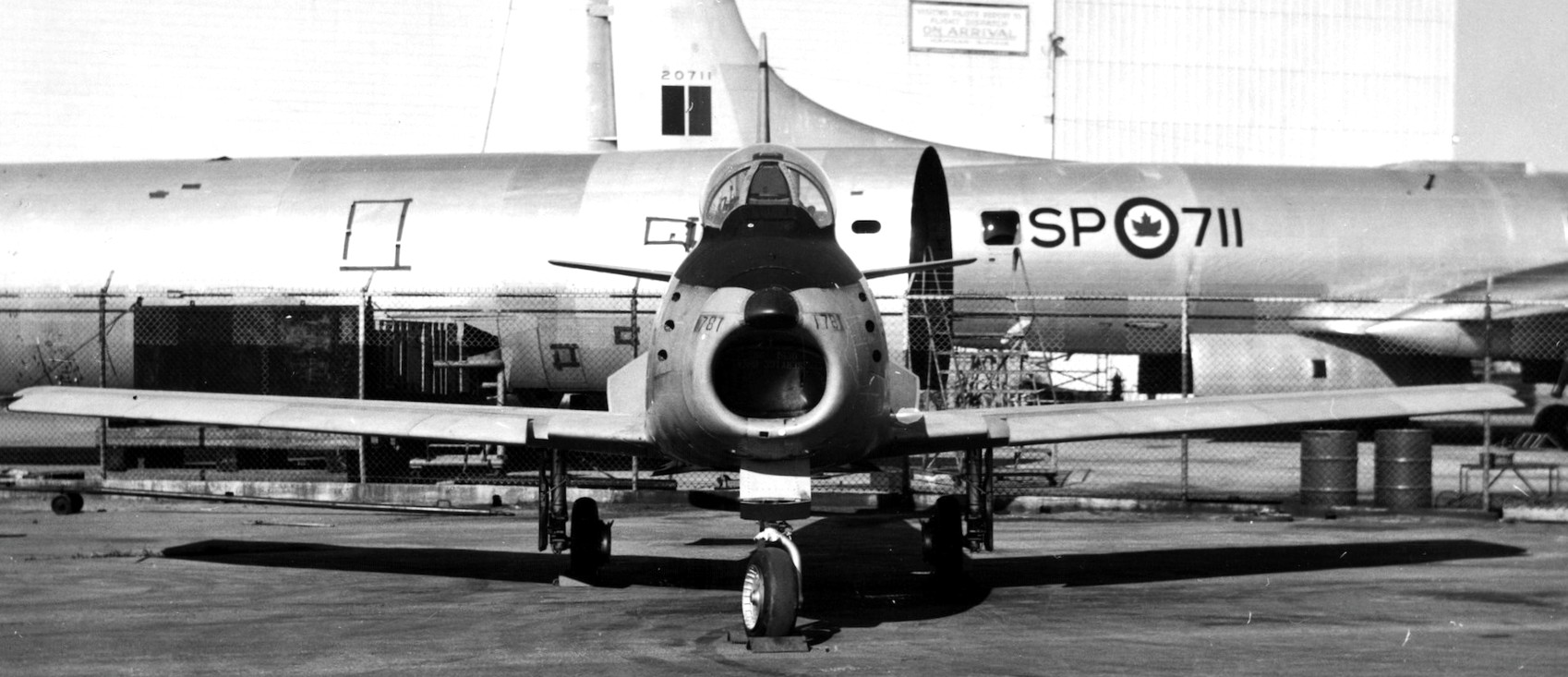
Canadair F-86E Sabre Mk. 6, 1787 ( JA117, JA317 ). At the Canadair plant.
(DND Photo)
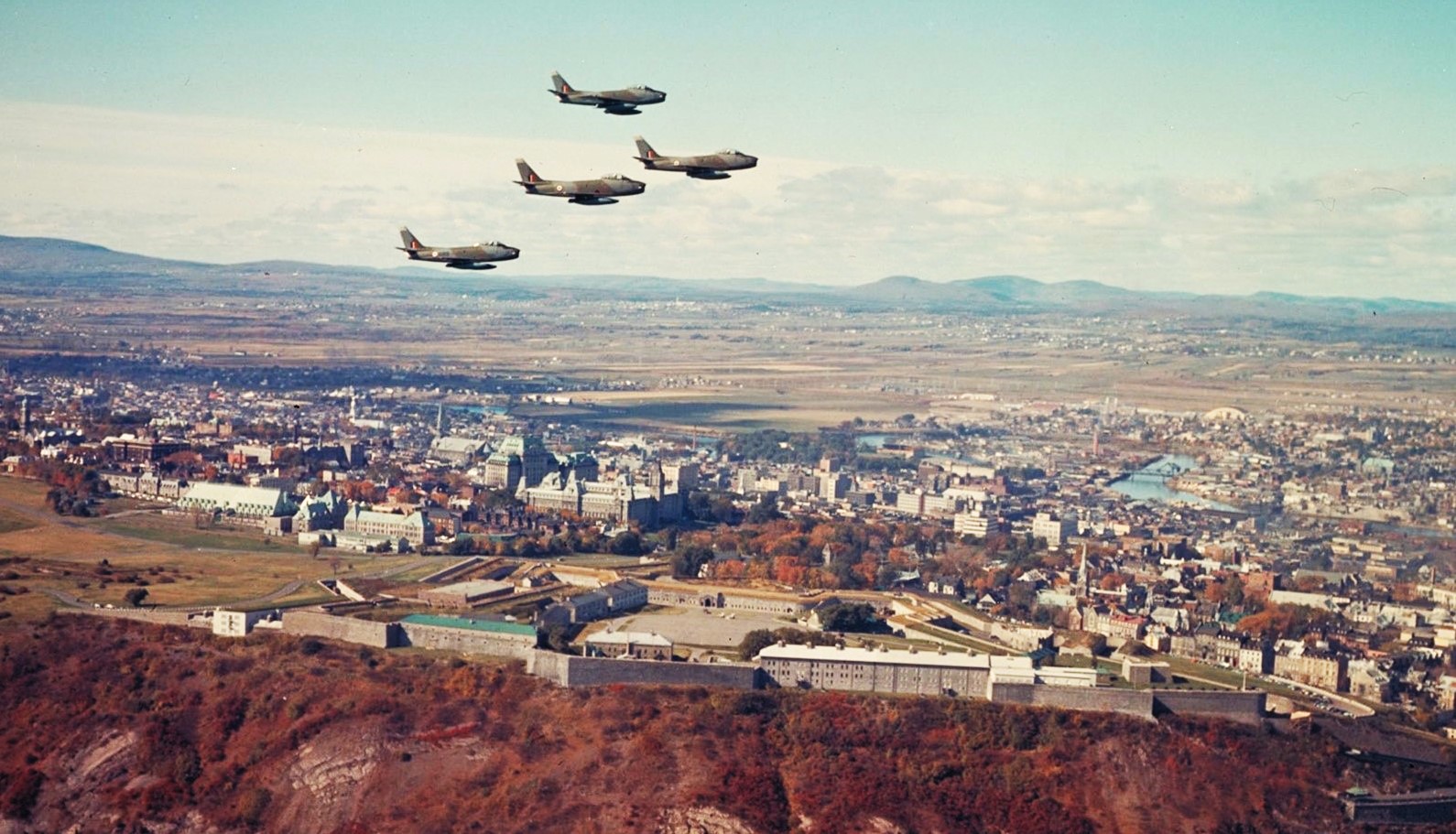
Canadair F-86 Sabre formation, over la Citadelle, Quebec City.
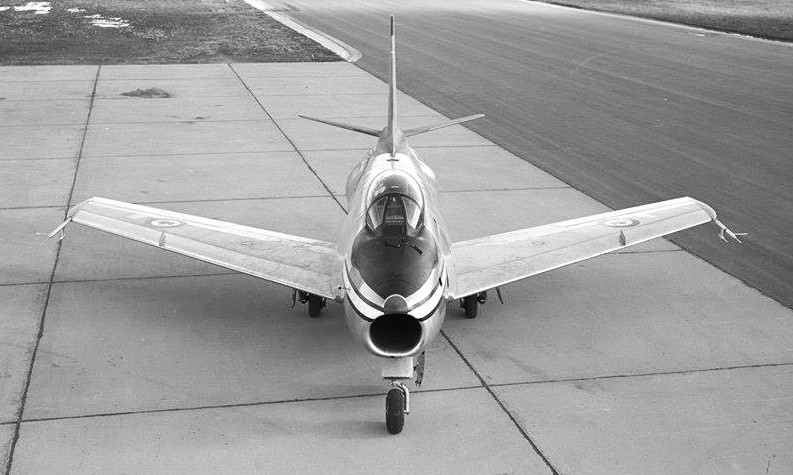
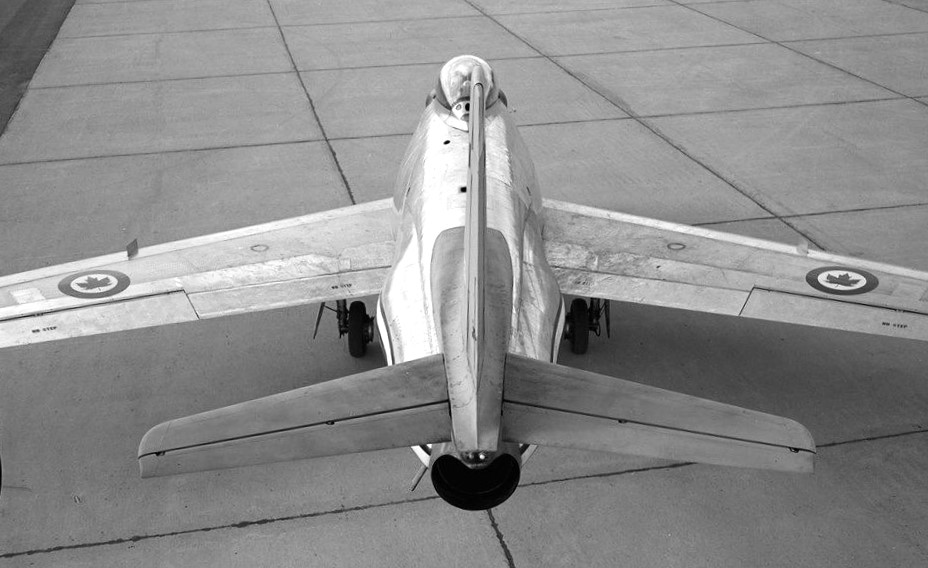
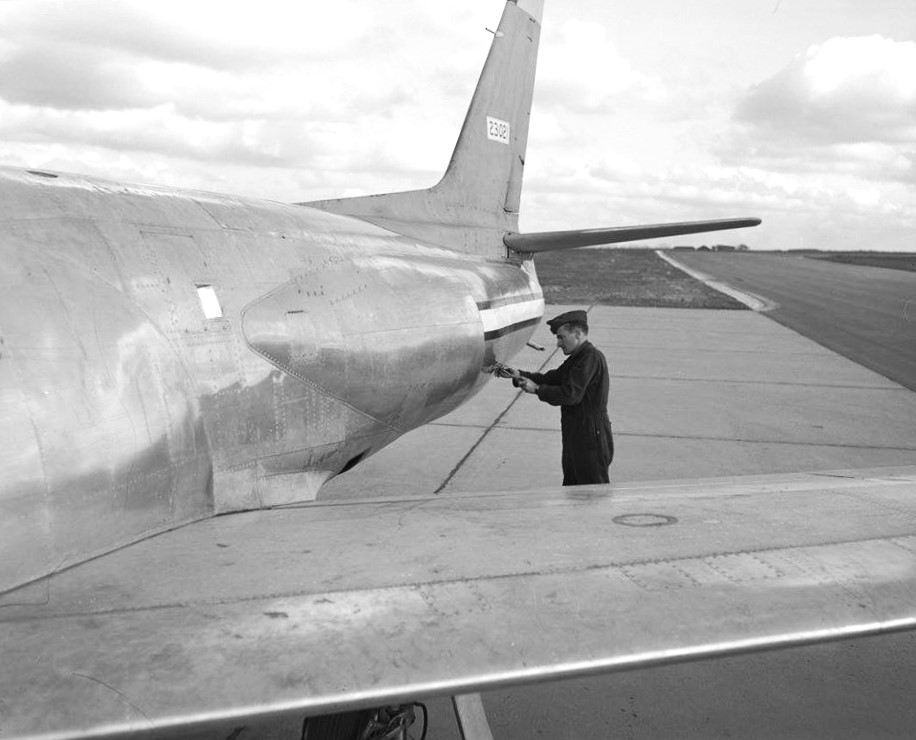
(RCAF Photos via Mike Kaehler)
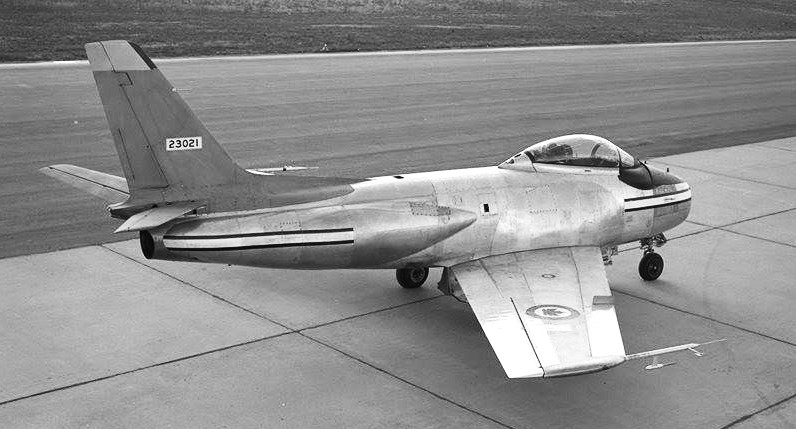
Canadair F-86E Sabre Mk. 5 (Serial No. 23021), designated CL-13E, which was specially modified to the area rule concept. Unfortunately, the marginal performance improvement did not justify such a major modification. Area rule is used to reduce an aircraft’s drag at transonic and supersonic speeds. Note the fuselage bulges. After retirement 23021 went to Flight Systems Inc, Mojave, California, Reg. No. N1046D. 23021 crashed at White Sands Missile Range, New Mexico on 1 Feb 1980.
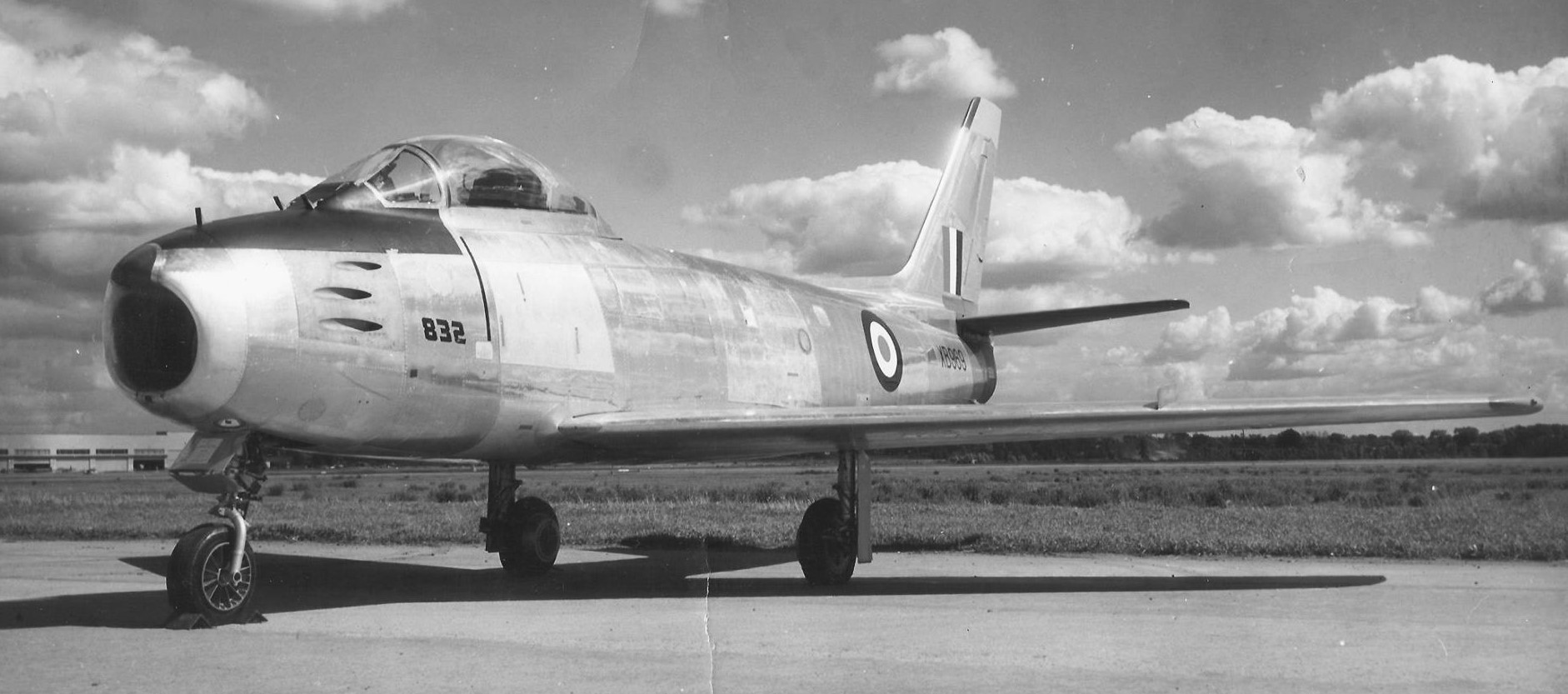
(DND Photo via James Craik)
Canadair F-86 Sabre Mk. 5, RAF (Serial No. XB989), No. 832.
(DND Photo via James Craik)
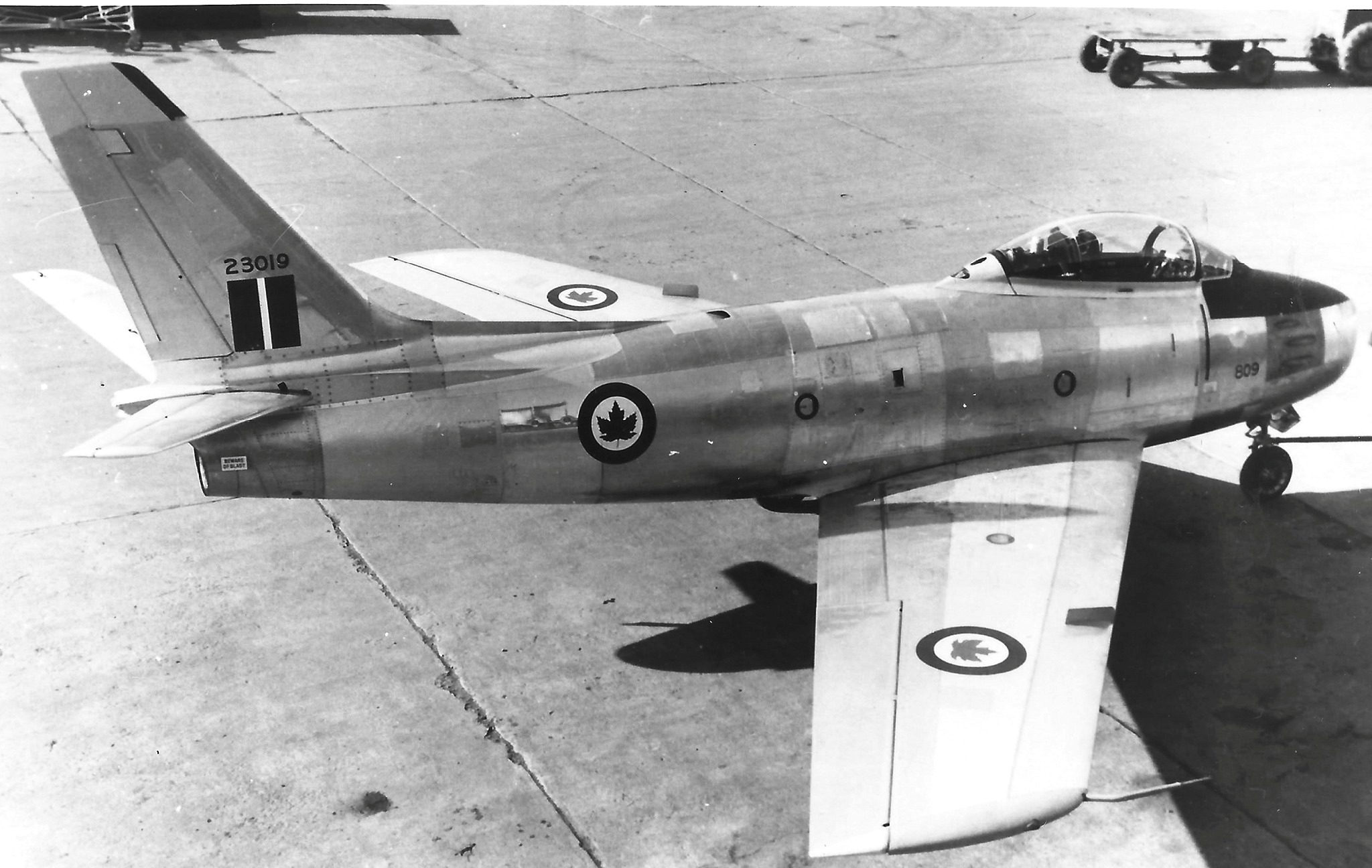
Canadair F-86 Sabre Mk. 5 (Serial No. 23019), factory fresh.
(RCAF Photo)
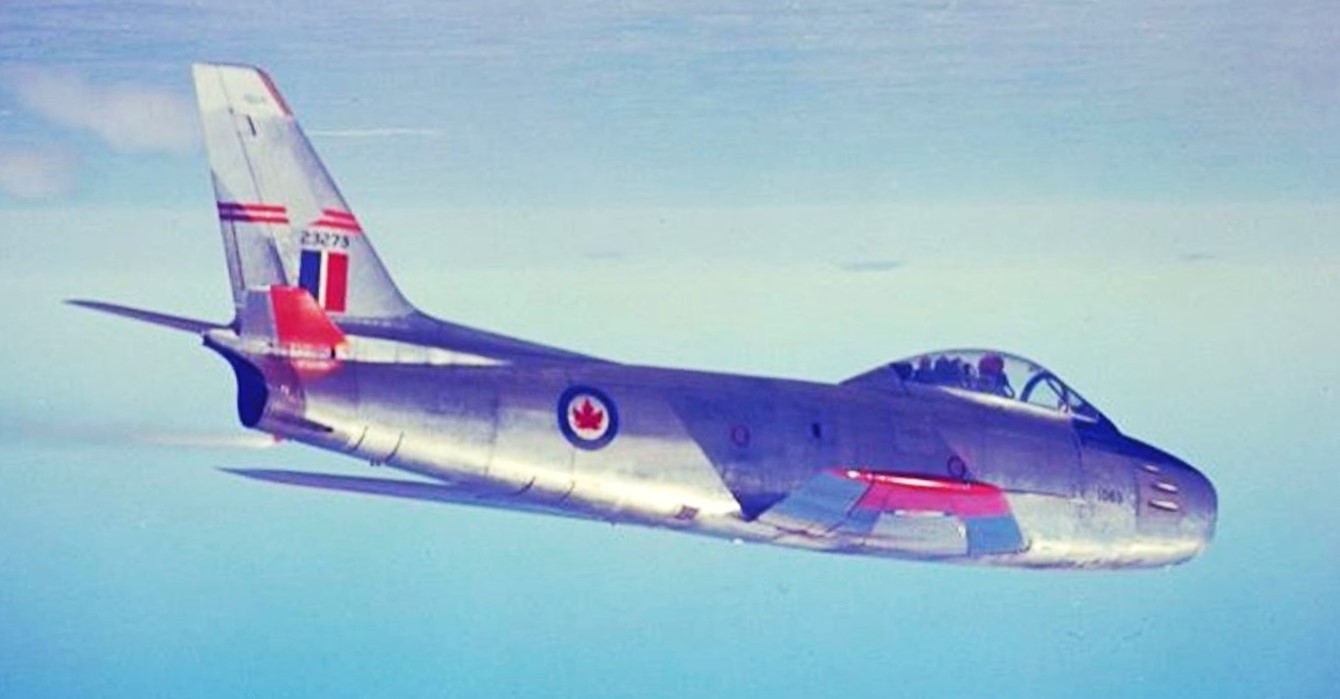
Canadair F-86 Sabre Mk. 5 (Serial No. 23273), with Central Flying School, RCAF Station Trenton, Ontario.
(RCAF Photo)
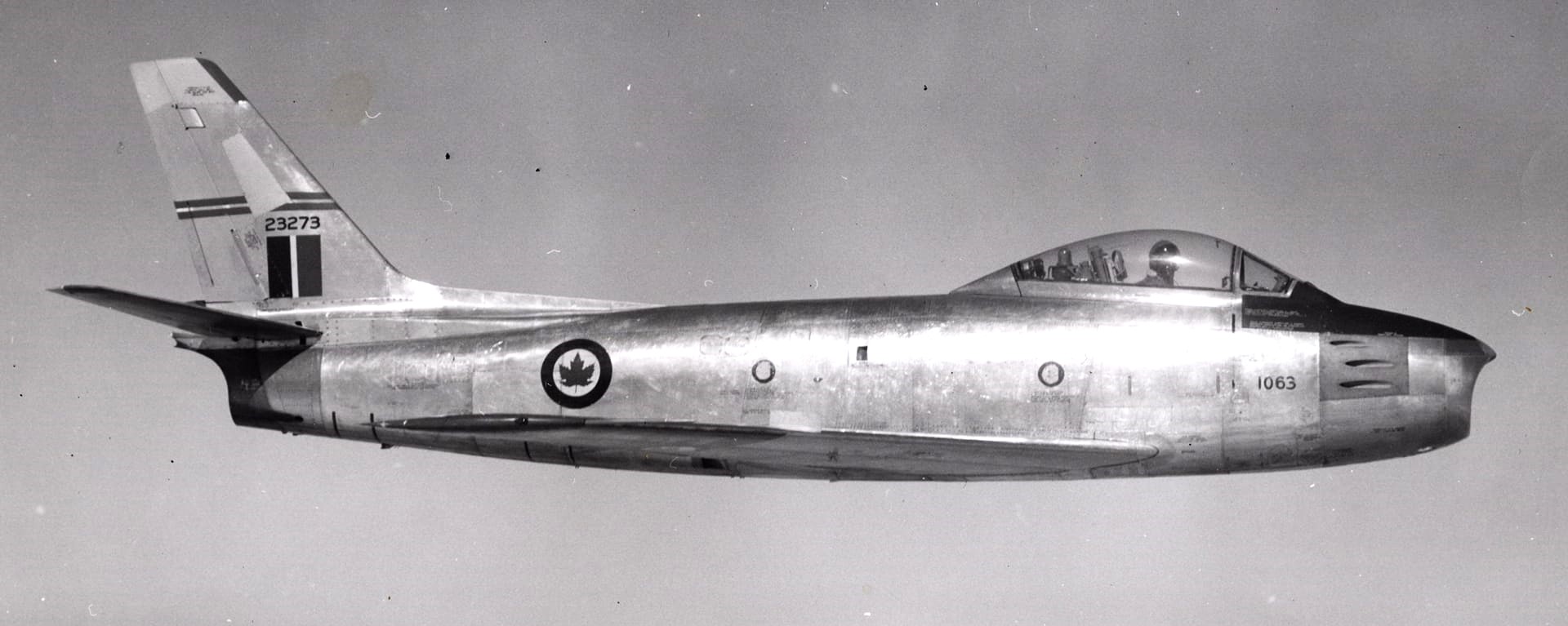
Canadair F-86 Sabre Mk. 5 (Serial No. 23273), No. 1063. This Sabre flew with the Central Flying School at RCAF Station Trenton, Ontario, from 1954-57 and with No. 1 OTU at RCAF Station Chatham, New Brunswick, from 1960 until she was written off in a Category A crash in May 1964.
(DND Photo via James Craik)
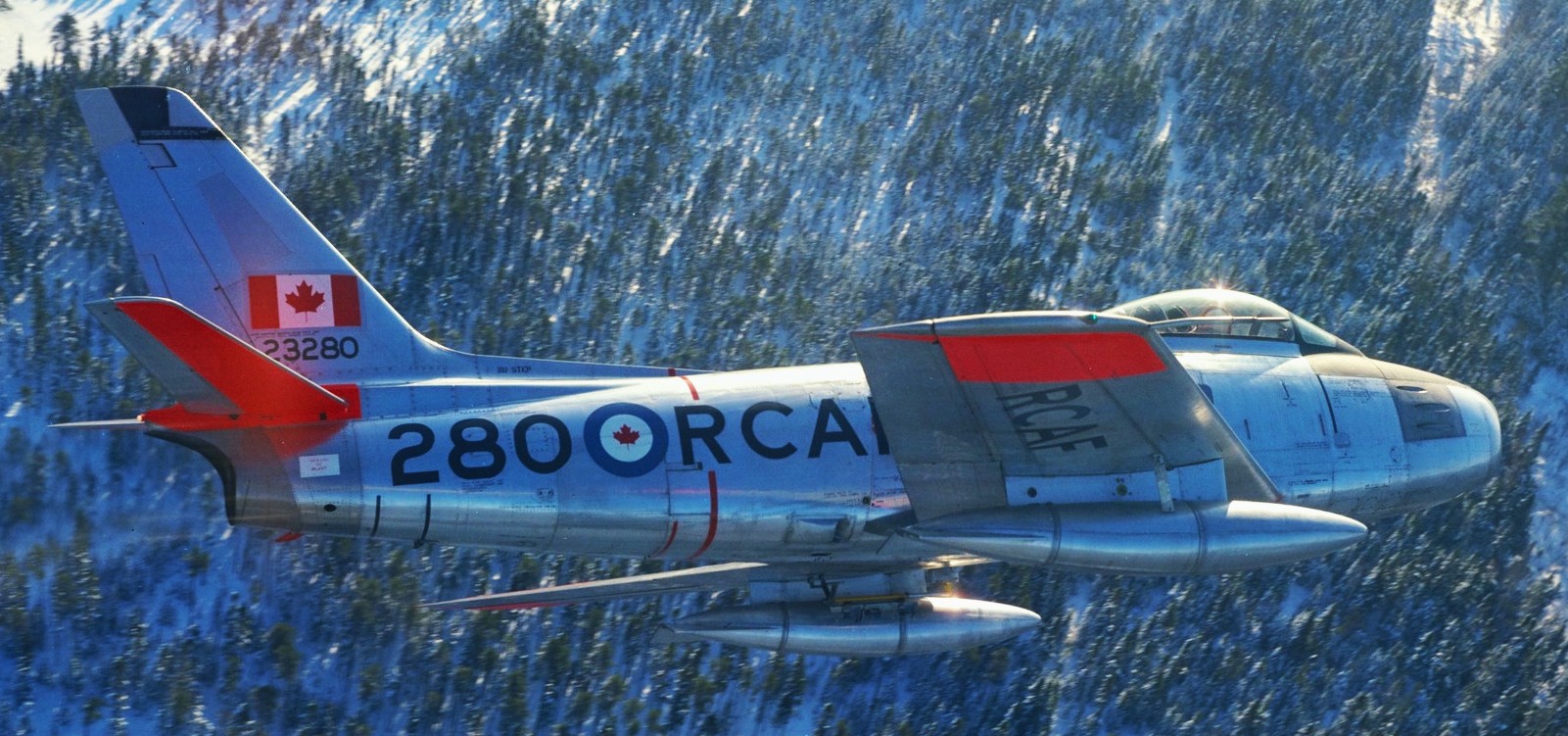
Canadair F-86 Sabre Mk. 5 (Serial No. 23280), No. 1 (F) Operational Training Unit (OTU), RCAF Station Chatham, New Brunswick.
(DND Photo via James Craik)
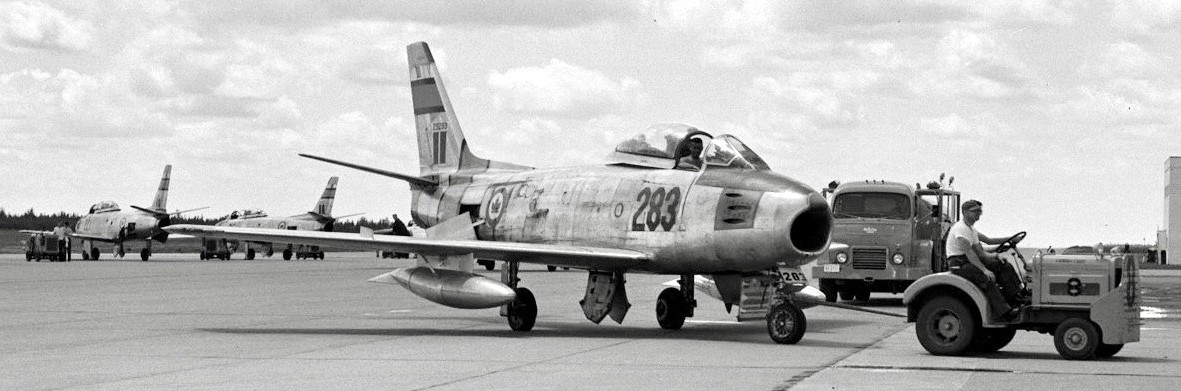
Canadair F-86 Sabre Mk. 5 (Serial No. 23283), No. 1 (F) Operational Training Unit (OTU), RCAF Station Chatham, New Brunswick.
(Mal Joyce Photo via James Craik)
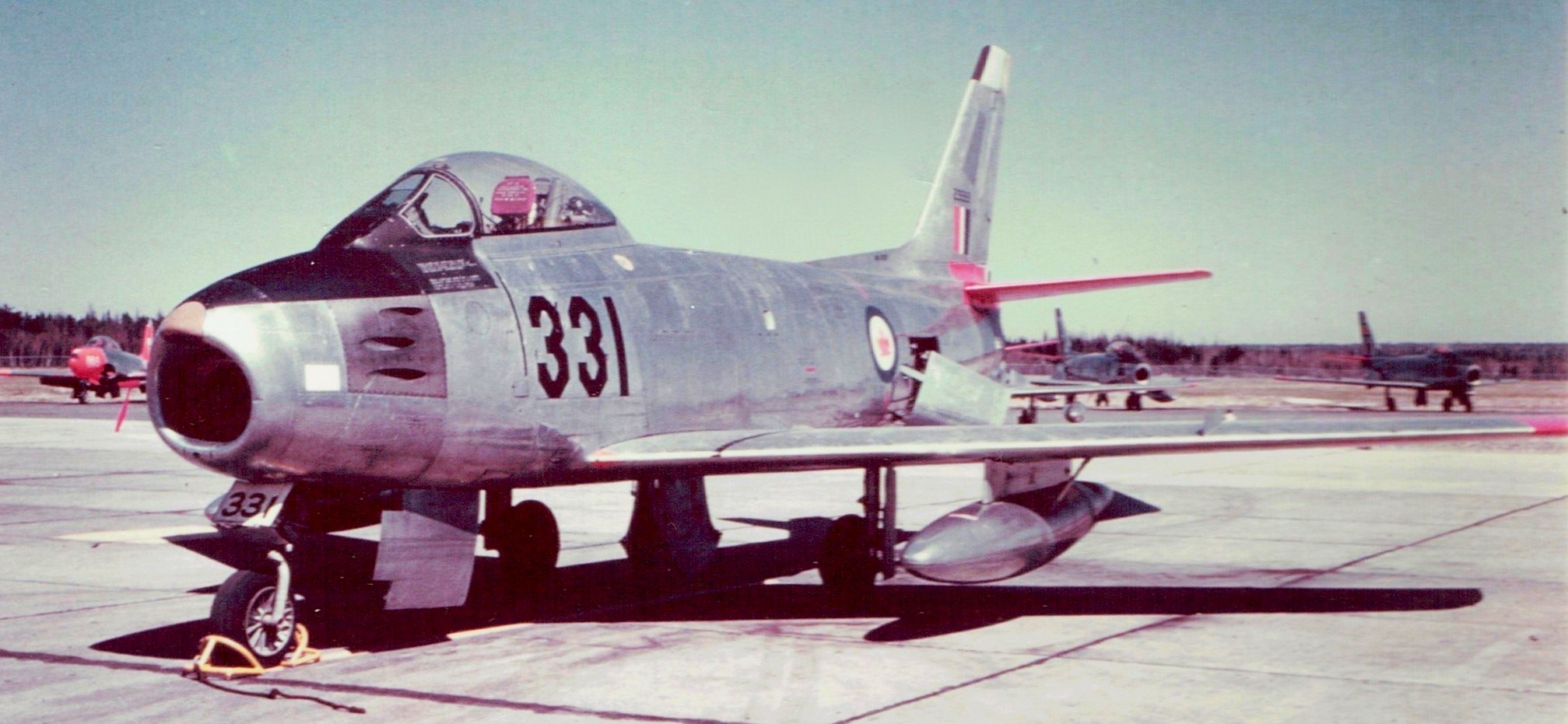
Canadair F-86 Sabre Mk. 5 (Serial No. 23331, No. 1 (F) Operational Training Unit (OTU), RCAF Station Chatham, New Brunswick.
(DND Photo via James Craik)
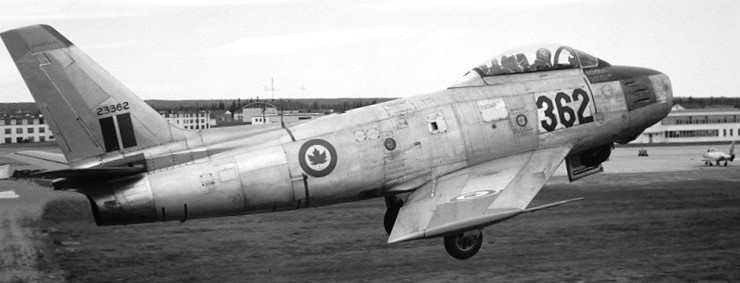
Canadair F-86 Sabre Mk. 5 (Serial No. 23362) launching from CFB Chatham, New Brunswick armed with 3.75-inch rockets.
(DND Photo via James Craik)
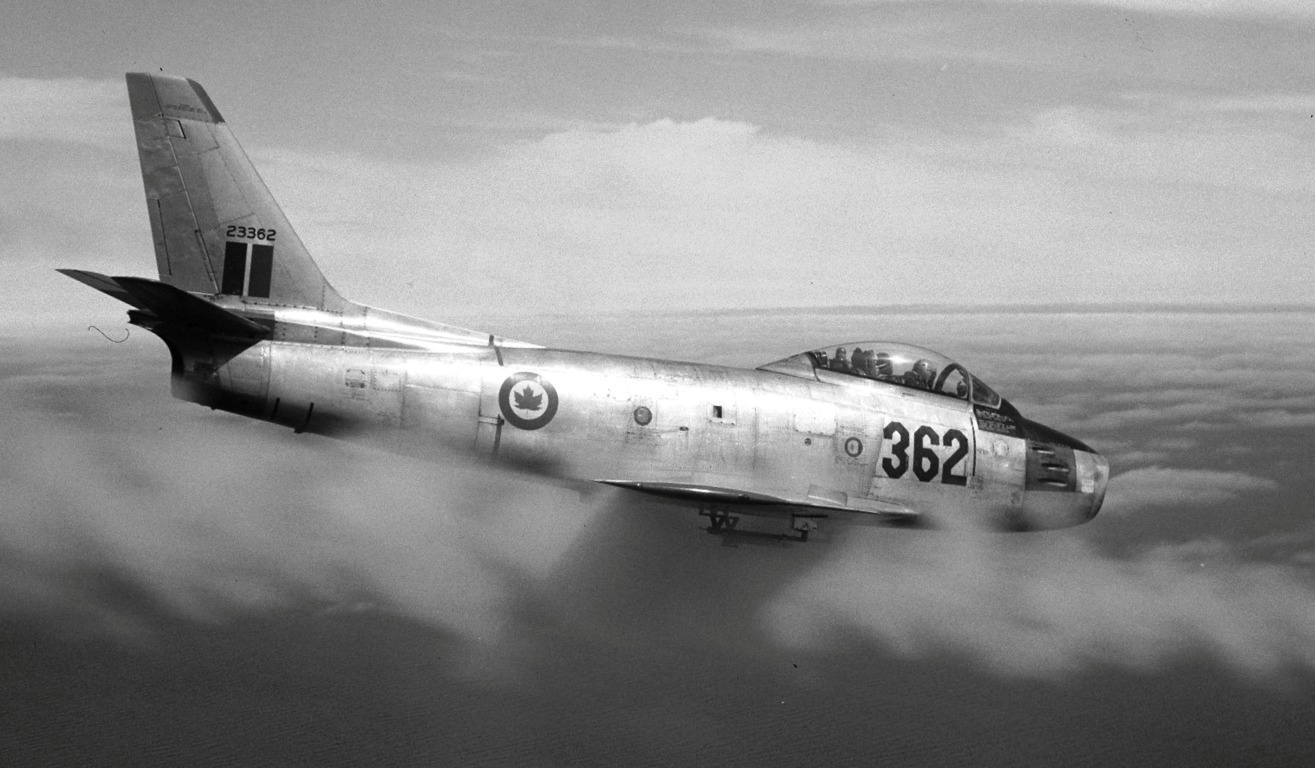
CanadairF-86 Sabre Mk. 5 (Serial No. 23362), No. 1 (F) Operational Training Unit (OTU), RCAF Station Chatham, New Brunswick, firing it’s 3.75-inch rockets.
(DND Photo via James Craik)
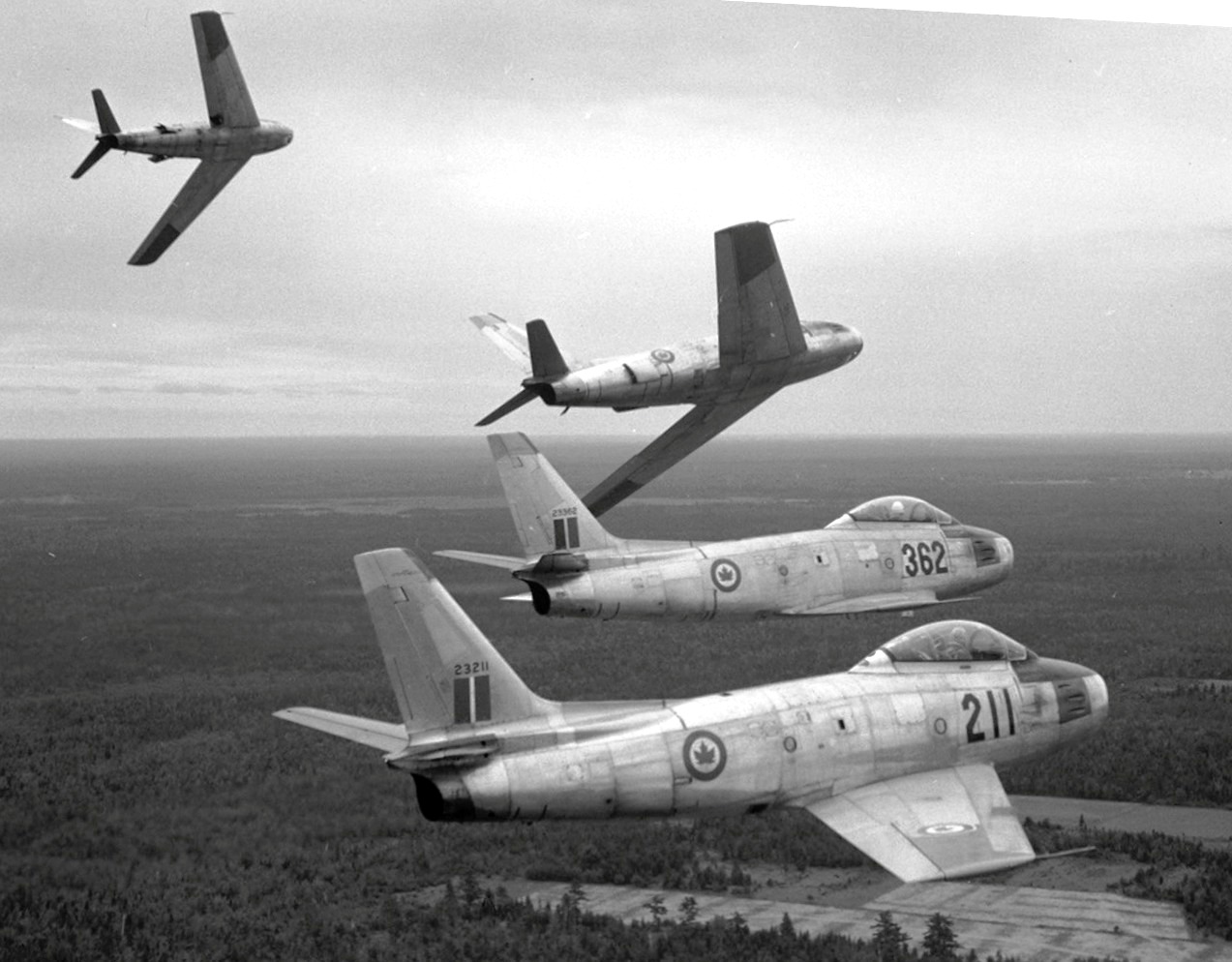
Canadair F-86 Sabre Mk. 5 (Serial Nos. 23211 and 23362), No. 1 (F) Operational Training Unit (OTU), RCAF Station Chatham, New Brunswick.
(DND Photo via James Craik)
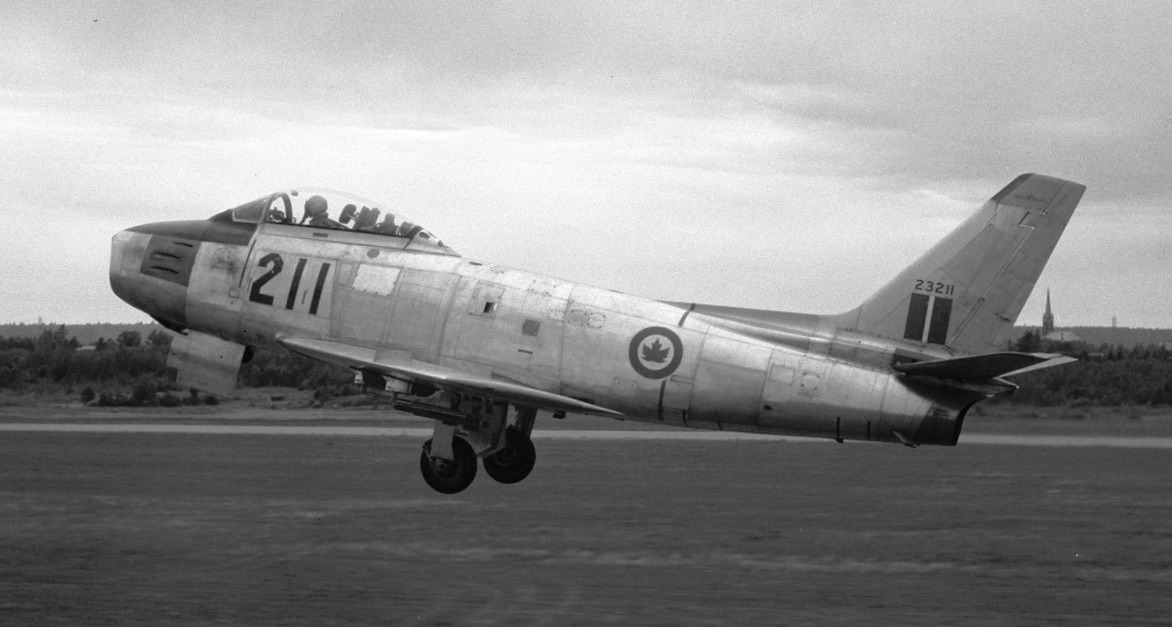
Canadair F-86 Sabre Mk. 5 (Serial No. 23211), No. 1 (F) Operational Training Unit (OTU), RCAF Station Chatham, New Brunswick.
(DND Photo via James Craik)
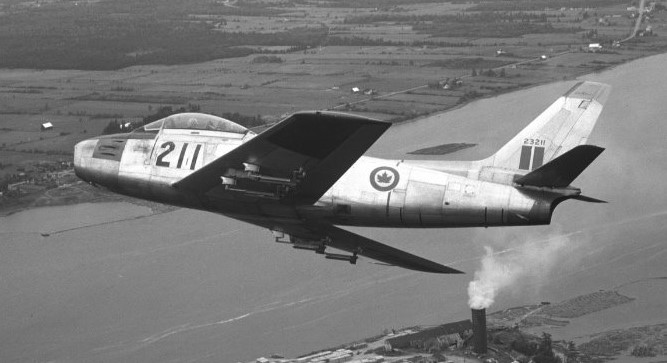
Canadair F-86 Sabre Mk. 5 (Serial Nos. 23211), No. 1 (F) Operational Training Unit (OTU), RCAF Station Chatham, New Brunswick.
(DND Photo via James Craik)
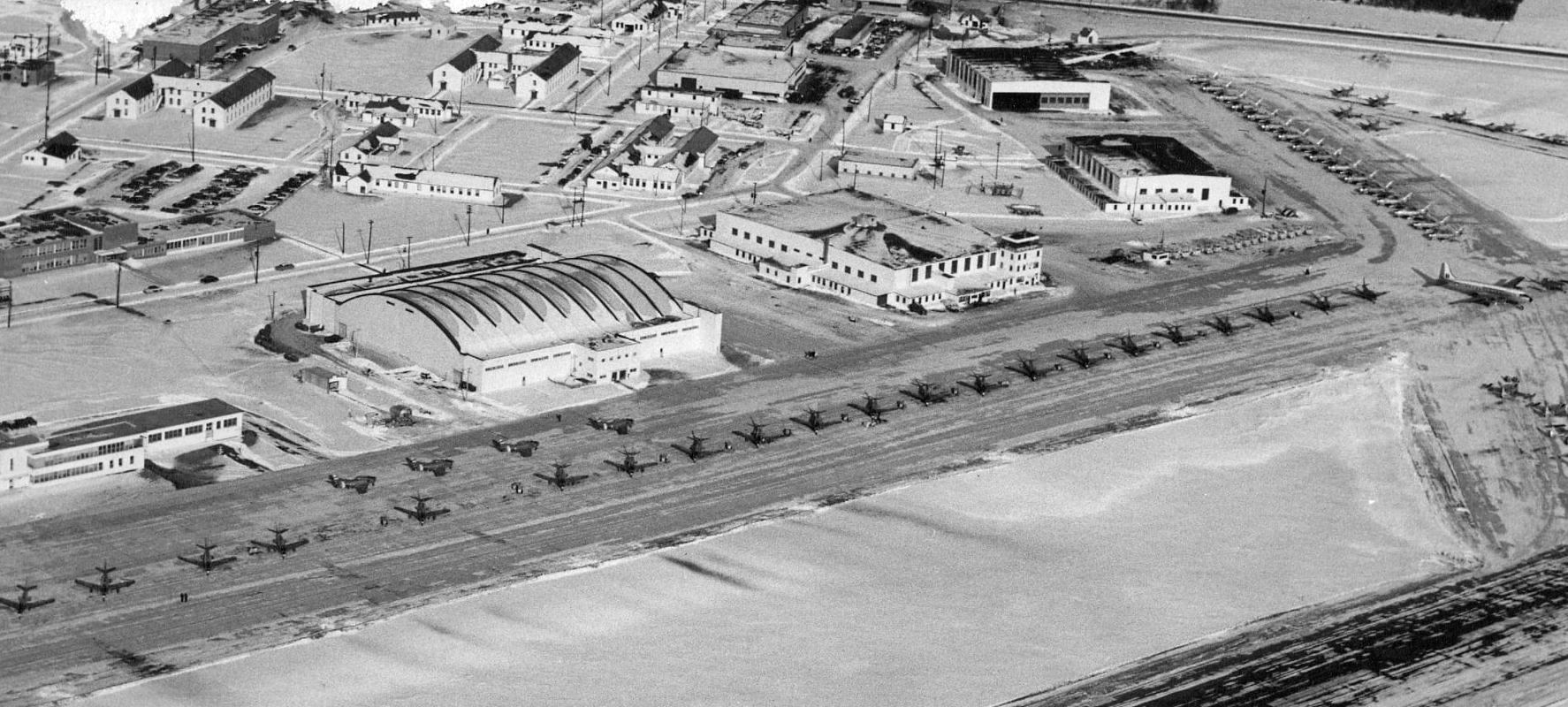
RCAF Station Chatham, New Brunswick, flight line in the mid-19 50s. At least 47 Canadair F-86 Sabres are on the tarmac and one Canadair North Star.
(DND Photo via James Craik)
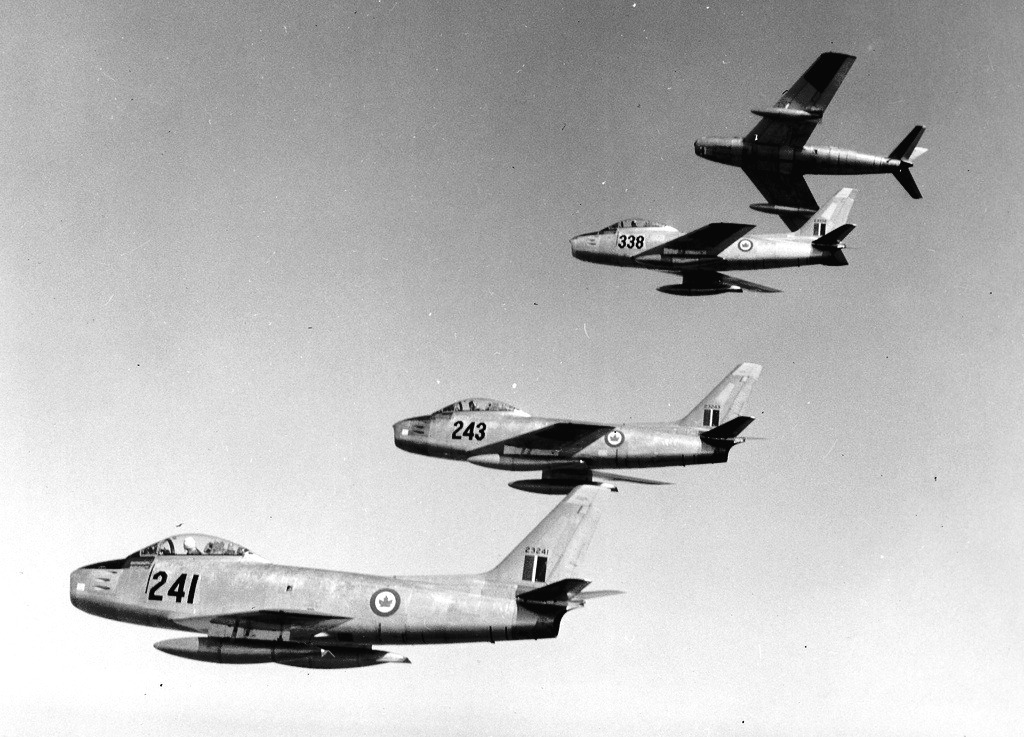
Canadair F-86 Sabre Mk. 5s (Serial Nos. 23235, 23338, 23243 and 23241), from Tactical Flight at RCAF Station Chatham, New Brunswick, are seen in a stepped up formation Echelon Port. The four aircraft were participating in the International Air Display, Toronto, Ontario.
(DND Archives Photo, PC-1311)
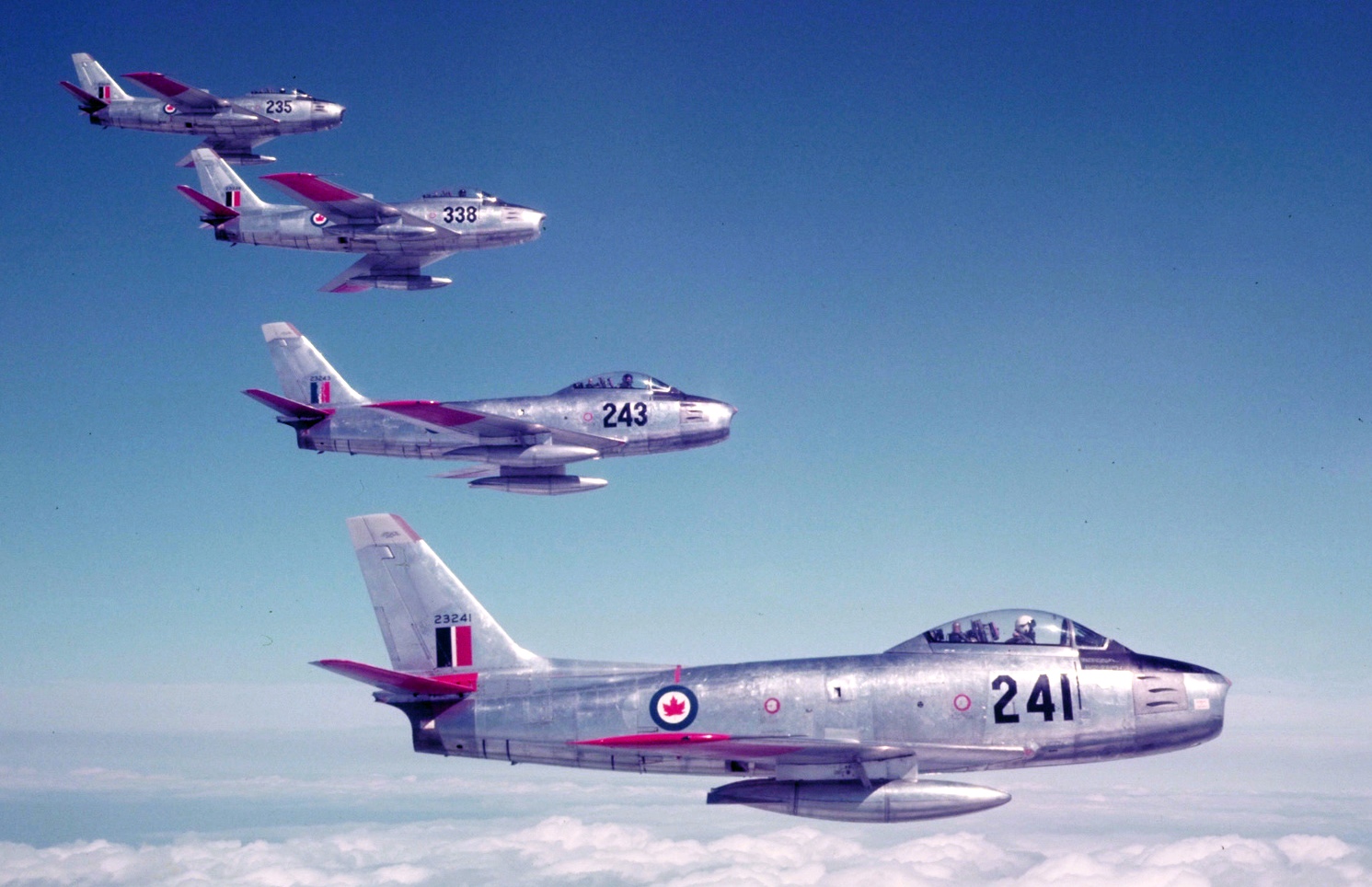
Canadair F-86 Sabre Mk. 5 (Serial Nos. 23235, 23338, 23243 and 23241), from Tactical Flight at RCAF Station Chatham, New Brunswick, are seen in a stepped up formation Echelon Port. The four aircraft were participating in the International Air Display, Toronto.
(RCAF Photo)
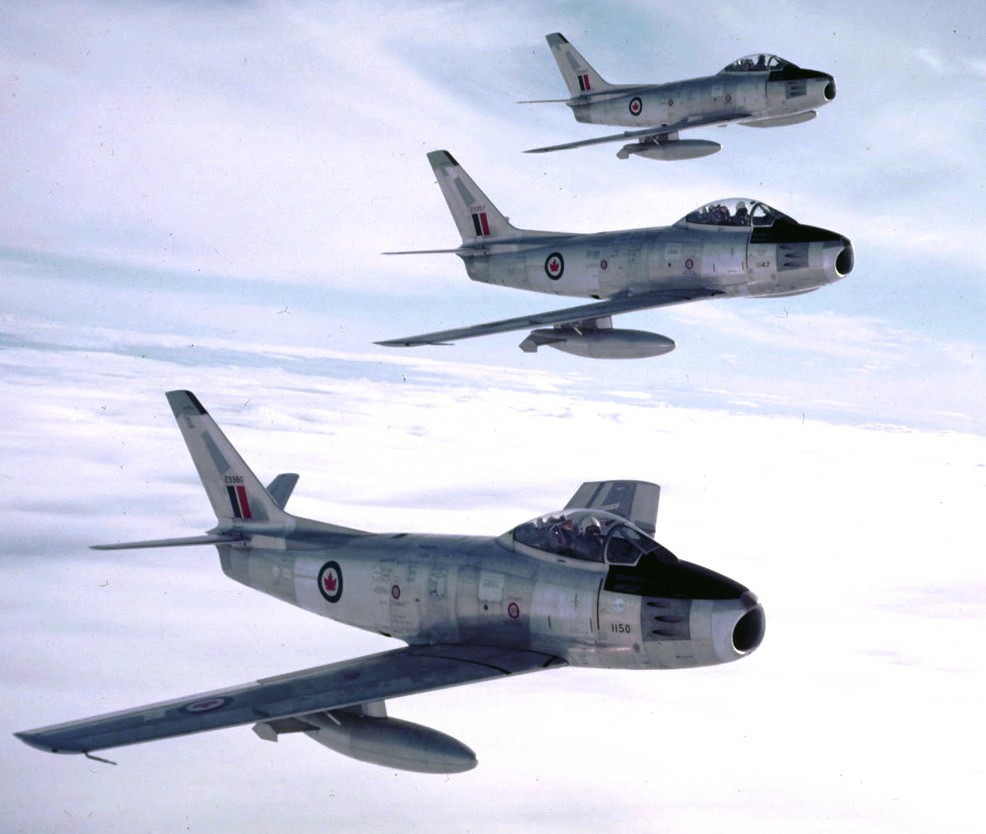
Canadair F-86 Sabre Mk. 5 (Serial No. 23360), formation.
(RCAF Photo)
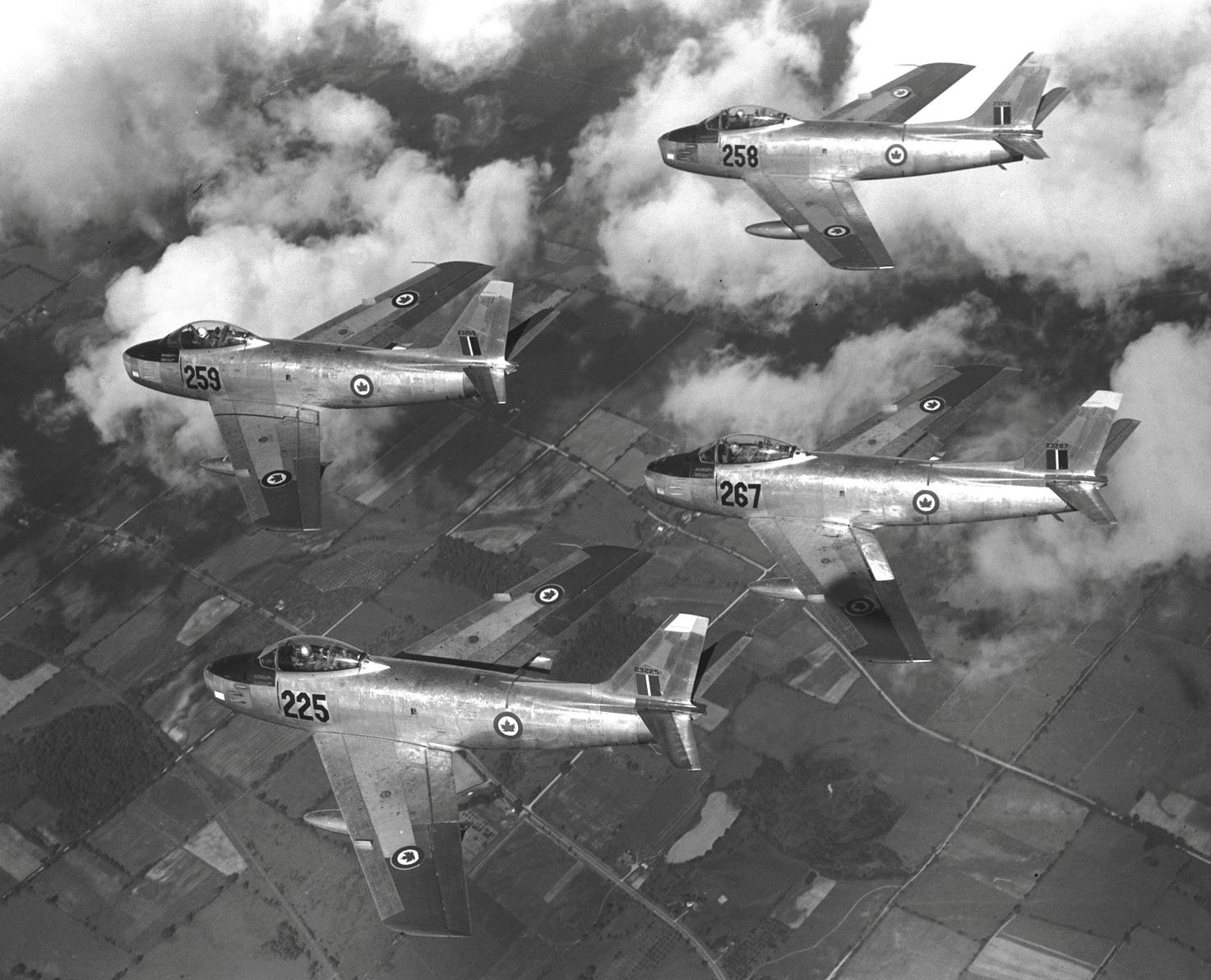
Canadair F-86 Sabre Mk. 5 formation over RCAF Station Chatham, New Brunswick.
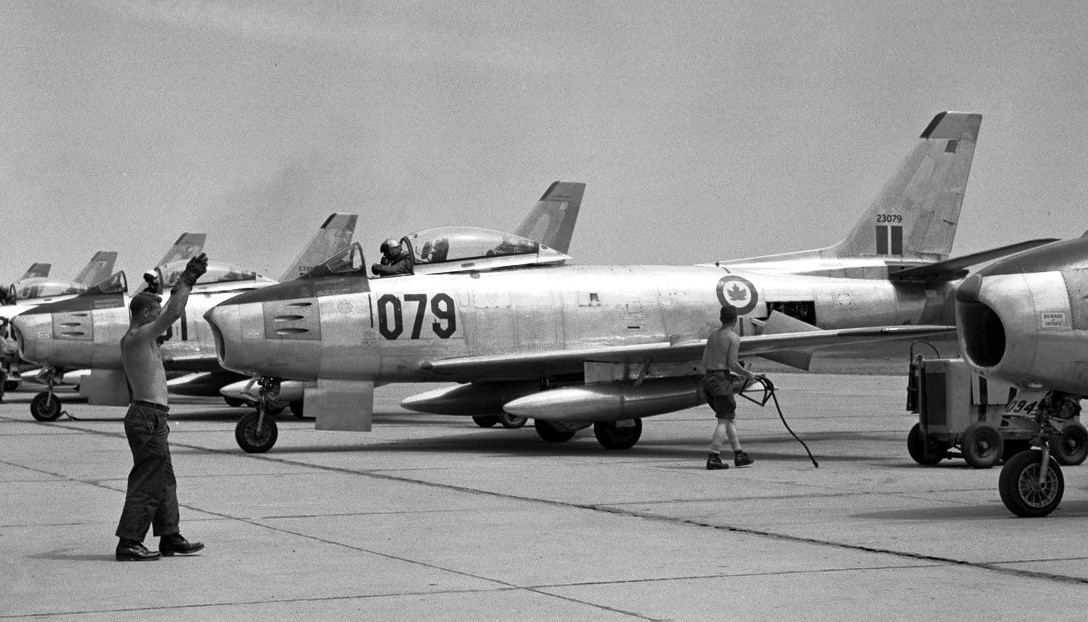
(DND Photo via James Craik)
Canadair F-86 Sabre Mk. 5 (Serial No. 23079), No. 1 (F) Operational Training Unit (OTU), RCAF Station Chatham, New Brunswick, 1968.
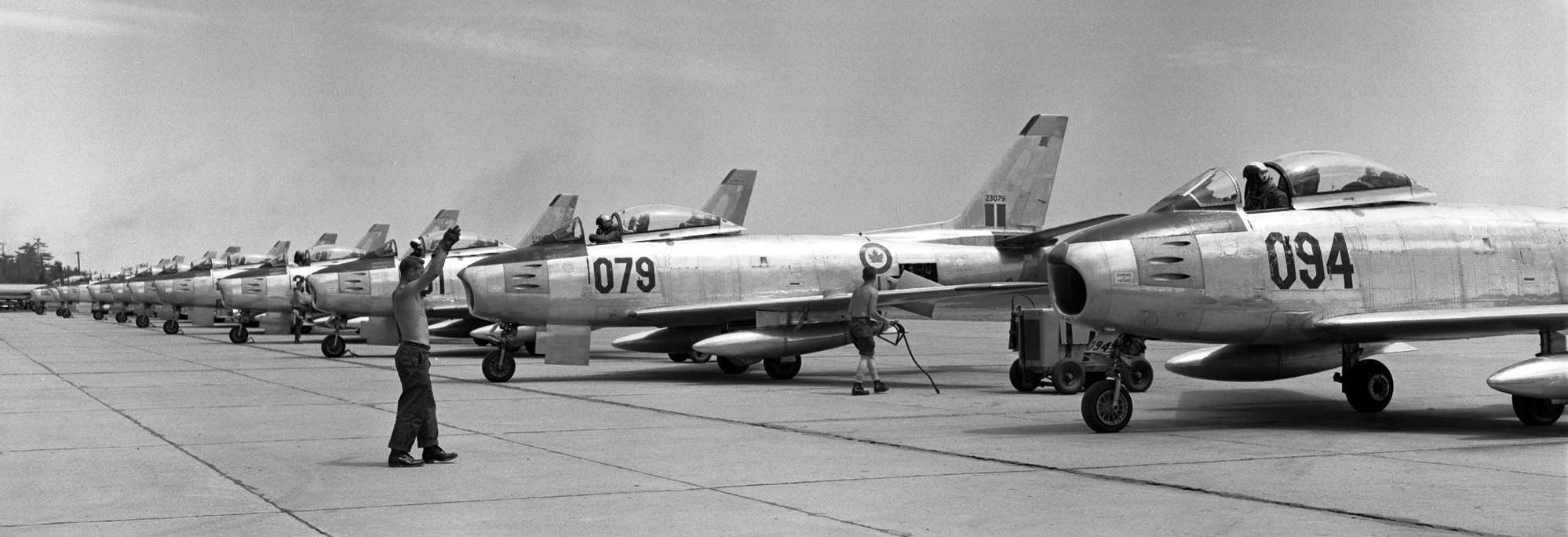
(DND Photo via James Craik)
Canadair F-86 Sabre Mk. 5 (Serial No. 23079), No. 1 (F) Operational Training Unit (OTU), RCAF Station Chatham, New Brunswick, 1968.
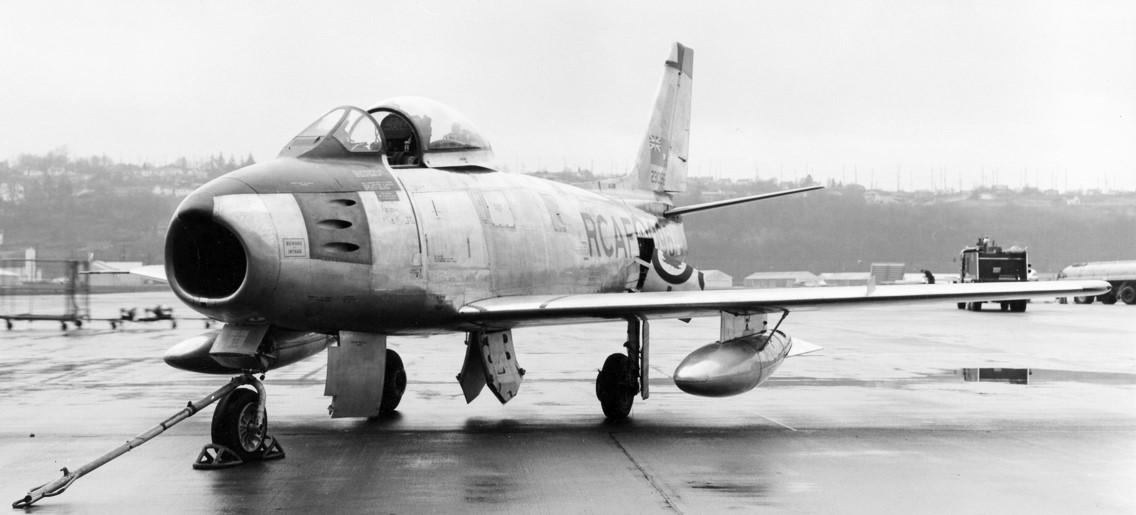
(Boeing Photo via The Jive Bomber)
Canadair F-86 Sabre Mk. 5 (Serial No. 23096), at Boeing Field for its new life as a chase plane in the flight test division, c1962.
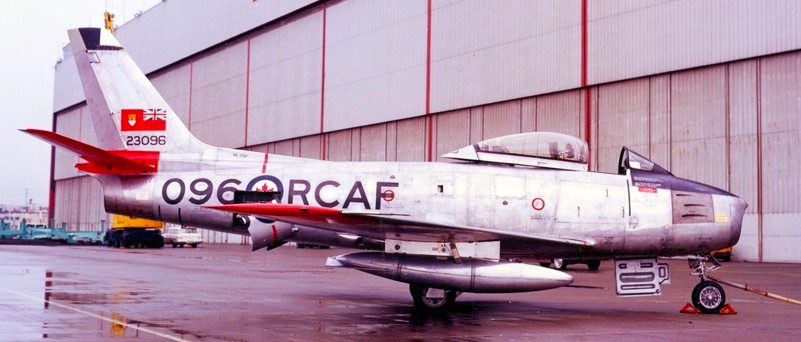
(Boeing Photo via The Jive Bomber)
Canadair F-86 Sabre Mk. 5 (Serial No. 23096), at Boeing Field for its new life as a chase plane in the flight test division, c1962.
(DND Photo via James Craik)
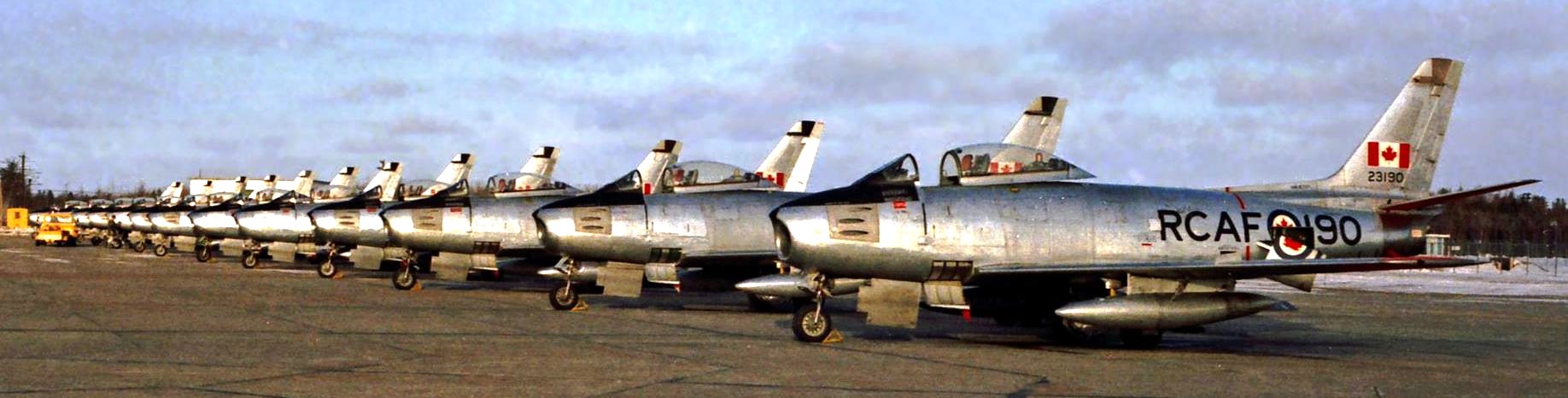
Canadair F-86 Sabre Mk. 5 (Serial No. 23190), CFB Chatham, New Brunswick, 1968.
(DND Photo via James Craik)
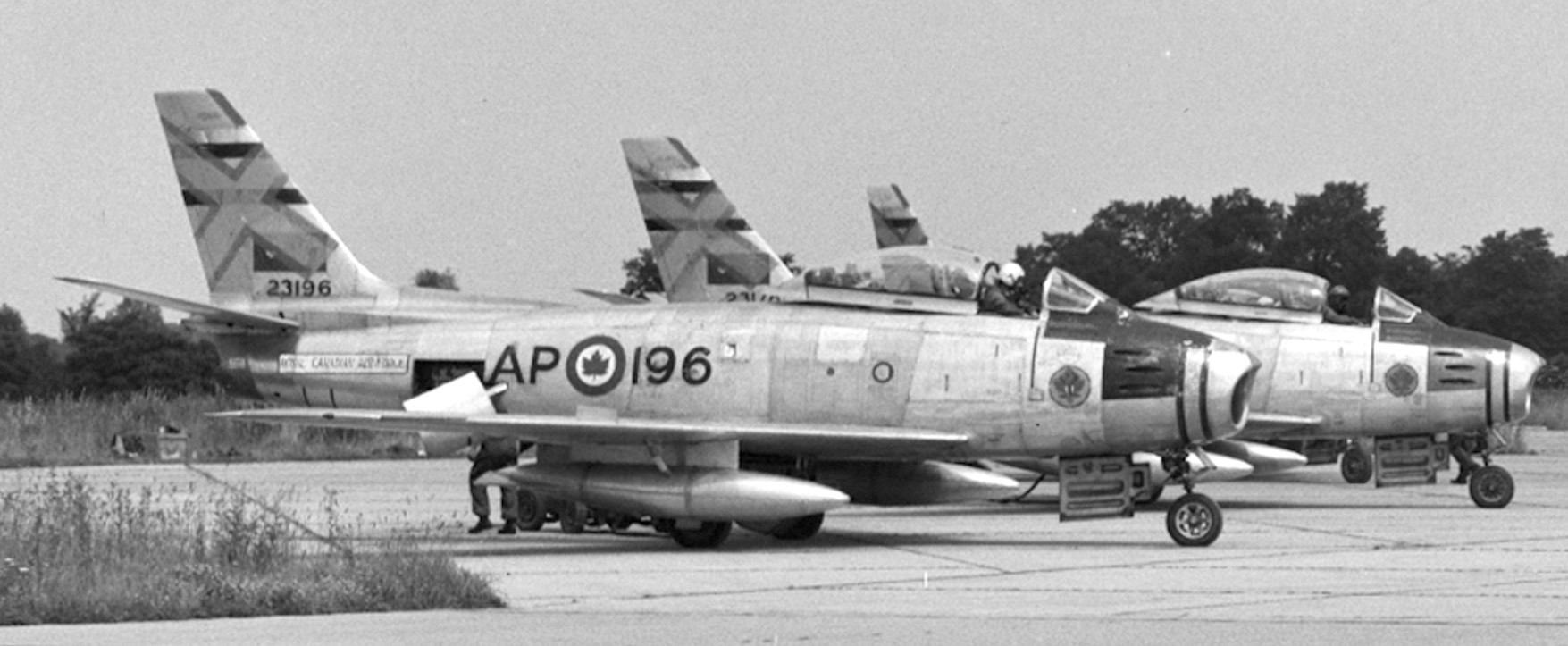
Canadair F-86 Sabre Mk. 5 (Serial No. 23196), No. 413 Squadron, coded AP.
(DND Photo)
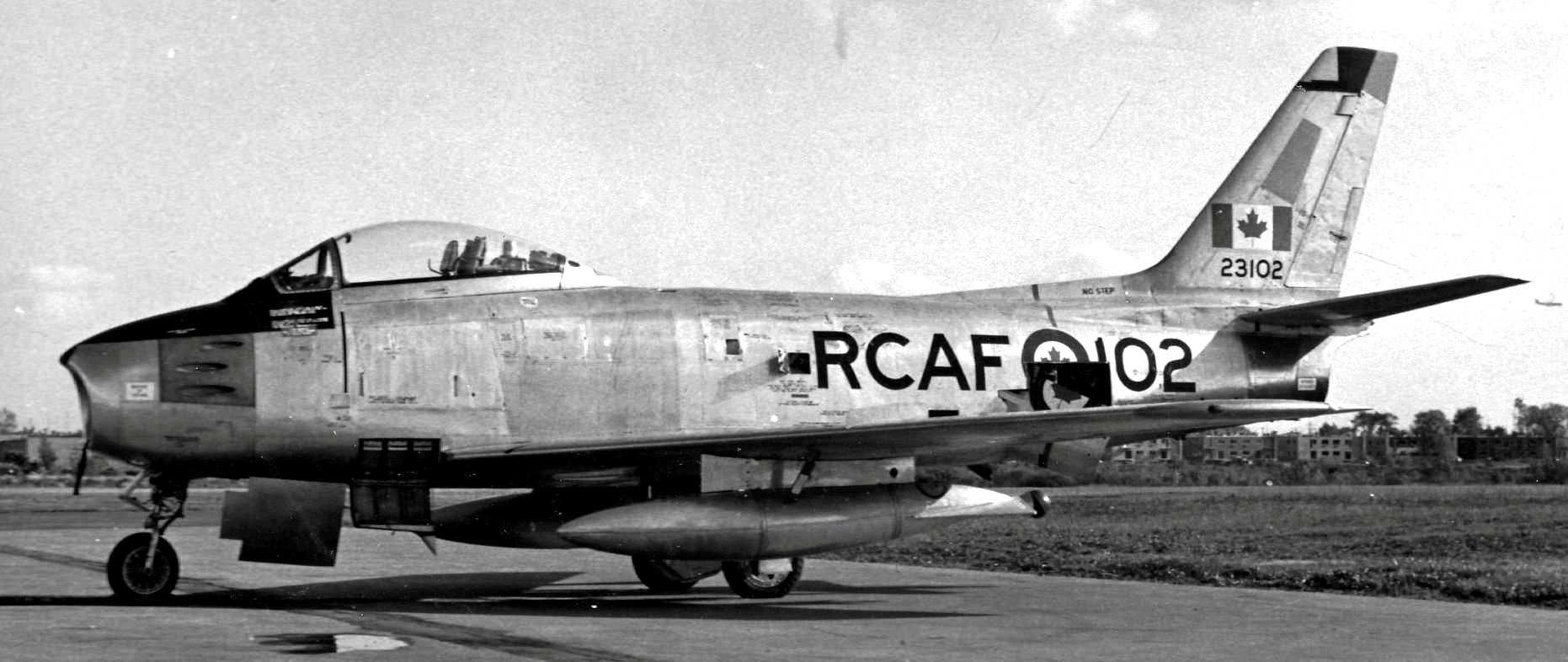
Canadair F-86 Sabre Mk. 5 (Serial No. 23102), STU (Sabre Transition Unit).
(DND Photo via James Craik)
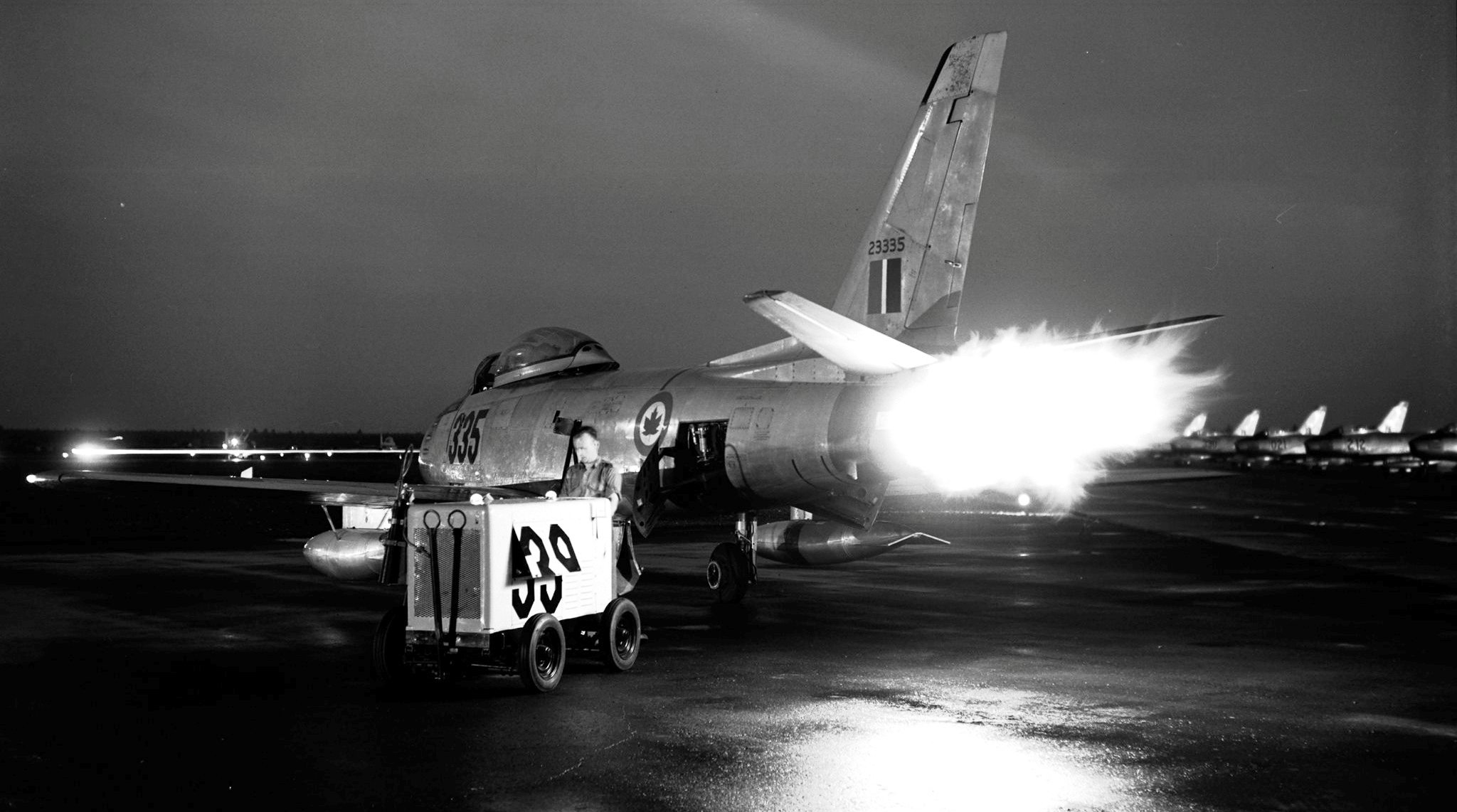
Canadair F-86 Sabre Mk. 5 (Serial No. 23335), night start, CFB Chatham, New Brunswick.
(RCAF photo via Mike Kaehler)
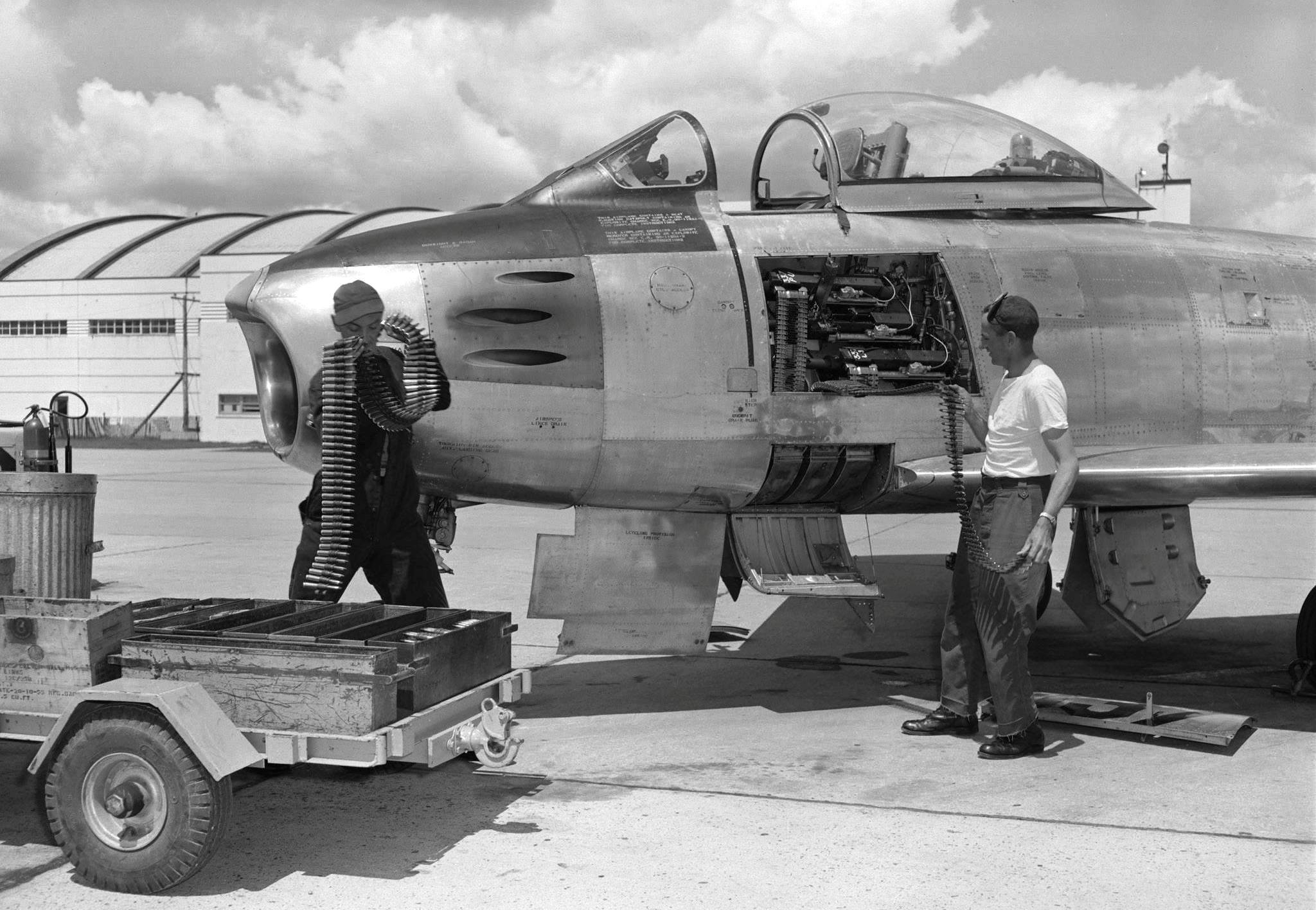
Canadair F-86 Sabre, being de-armed after an air-to-air gunnery exercise, by two Munitions and Weapons Technicians, LAC Roy Mann, M and W Tech, andn LAC Art Murphy, M and W Tech.
(DND Photo via James Craik)
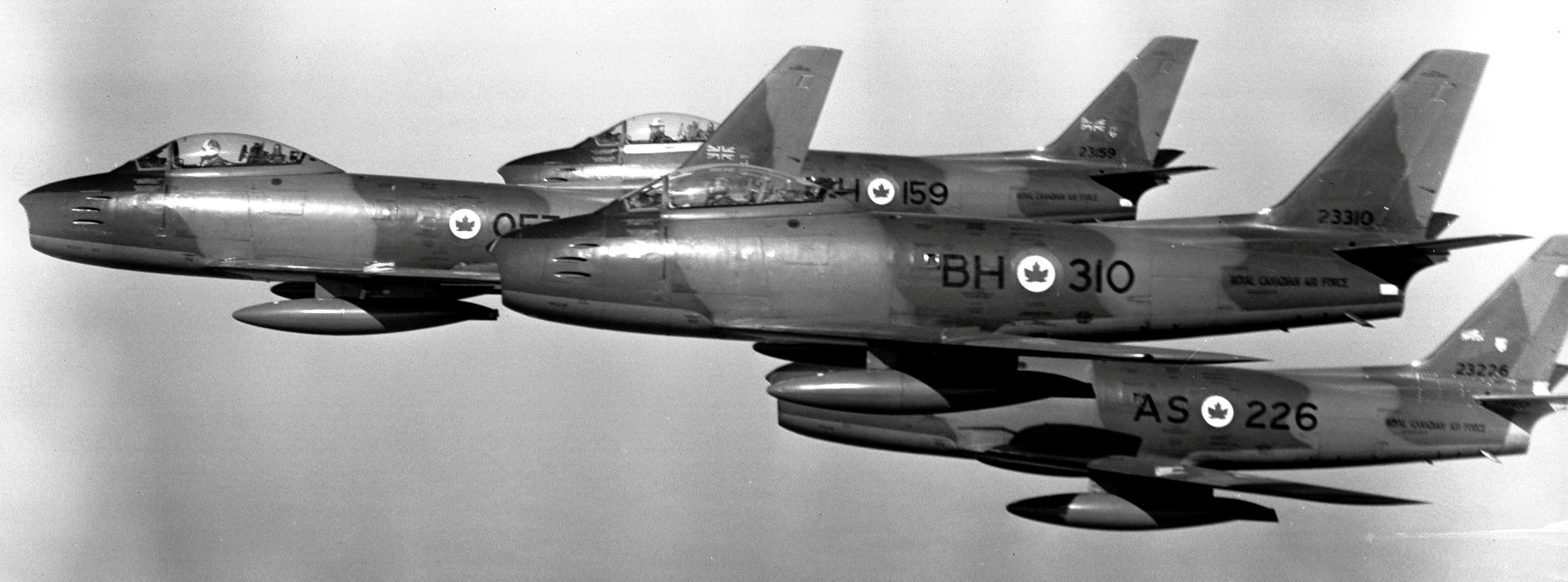
Canadair F-86 Sabre Mk. 5 formation, over Europe. (Serial No. 23310), No. 430 Squadron, coded BH, (Serial No. 23226), No. 416 Squadron, coded AS, (Serial No. 23057), and (Serial No. 23159), 1955.
(DND Photo via James Craik)
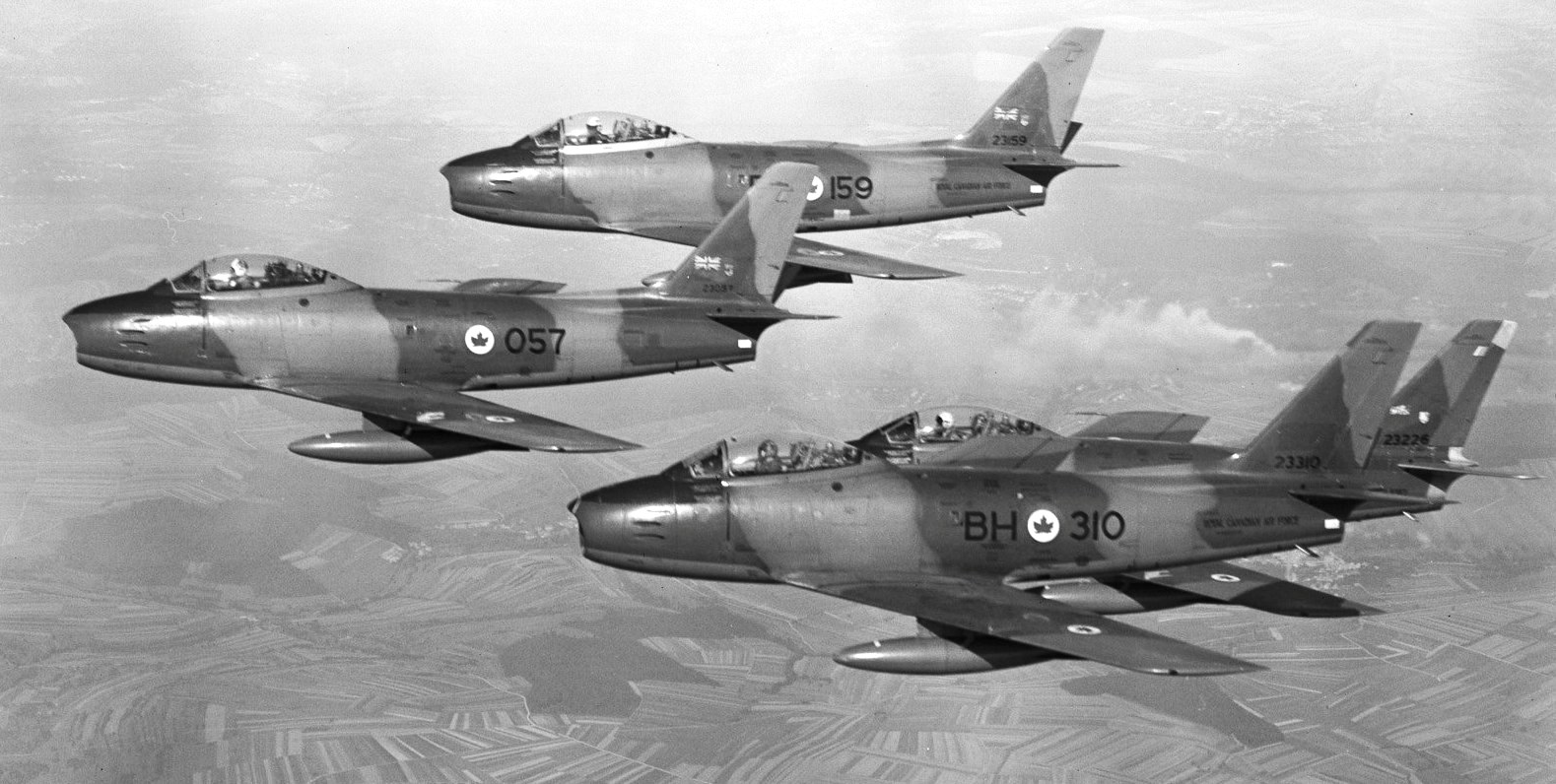
Canadair F-86 Sabre Mk. 5 formation, over Europe. (Serial No. 23310), No. 430 Squadron, coded BH, (Serial No. 23226), No. 416 Squadron, coded AS, (Serial No. 23057), and (Serial No. 23159), 1955.
(DND Photo)
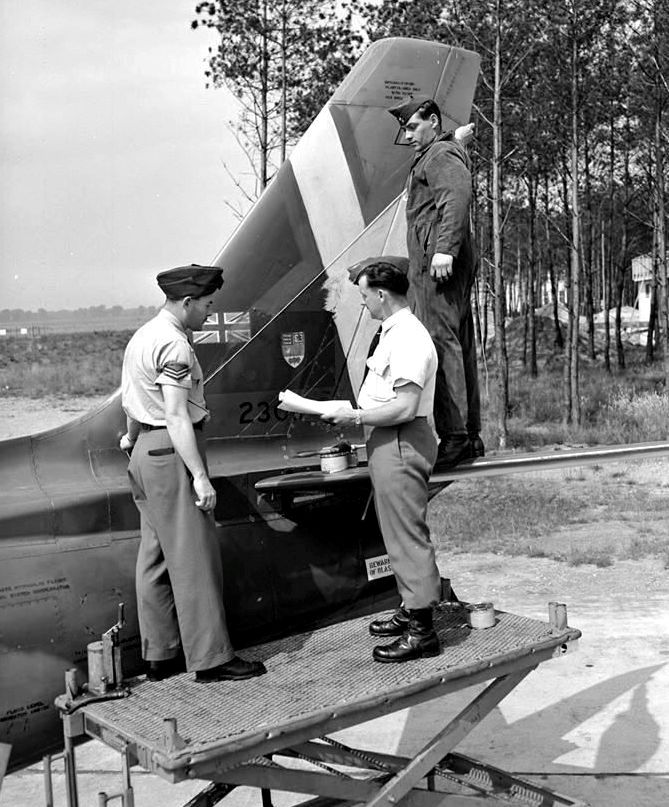
Canadair F-86 Sabre Mk. 5 (Serial No. 230–), 4th ATAF in Exercise Carte Blanche, possibly France, June 1955.
(DND Photo via James Craik)
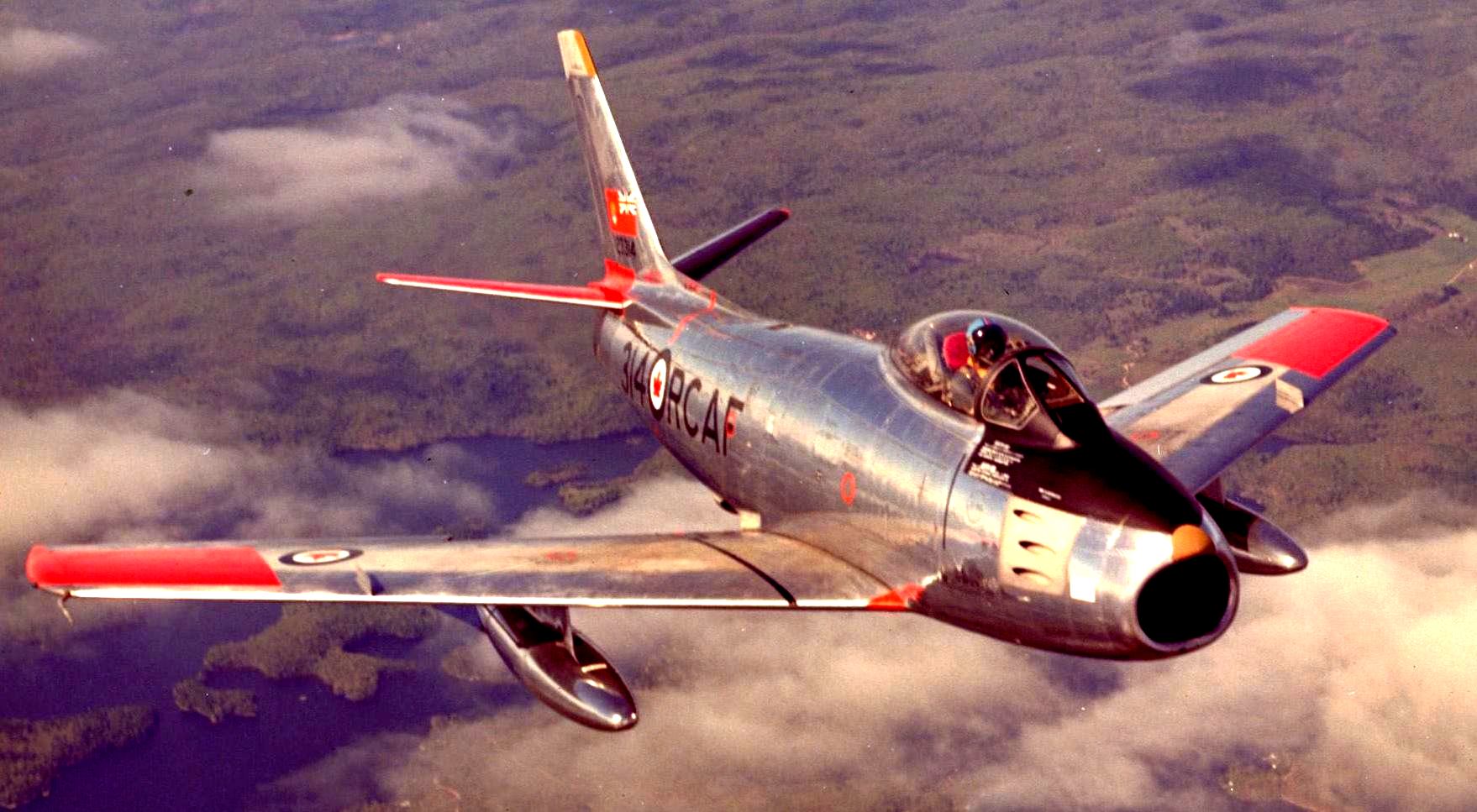
Canadair F-86 Sabre Mk. 5 (Serial No. 23314), now Hawk One.
(DND Photo via James Craik)
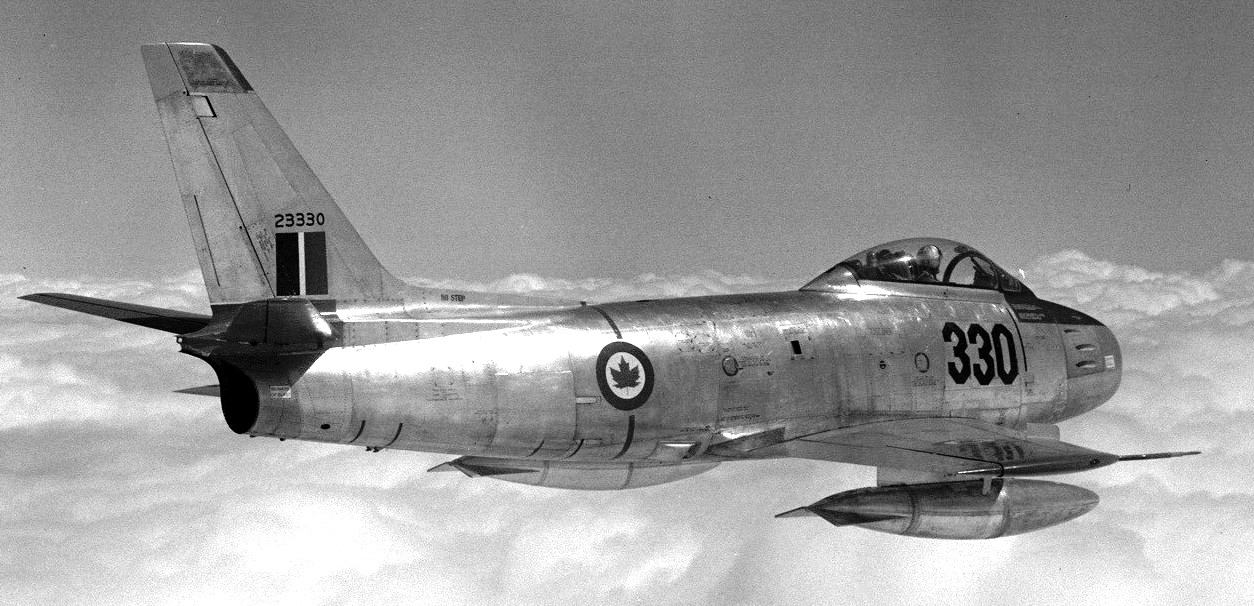
Canadair F-86 Sabre Mk. 5 (Serial No. 23330), No. 1 (F) Operational Training Unit (OTU), RCAF Station Chatham, New Brunswick, mid 1950s.
(RCAF Photo)
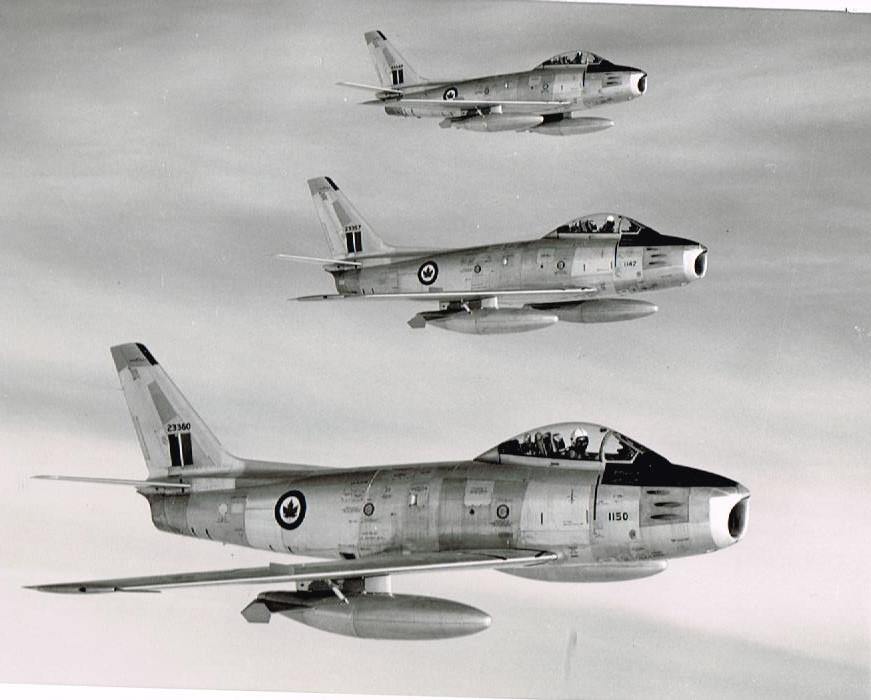
Canadair F-86 Sabre Mk. 5 (Serial No. 23360), three-ship formation.
(DND Photo via James Craik)
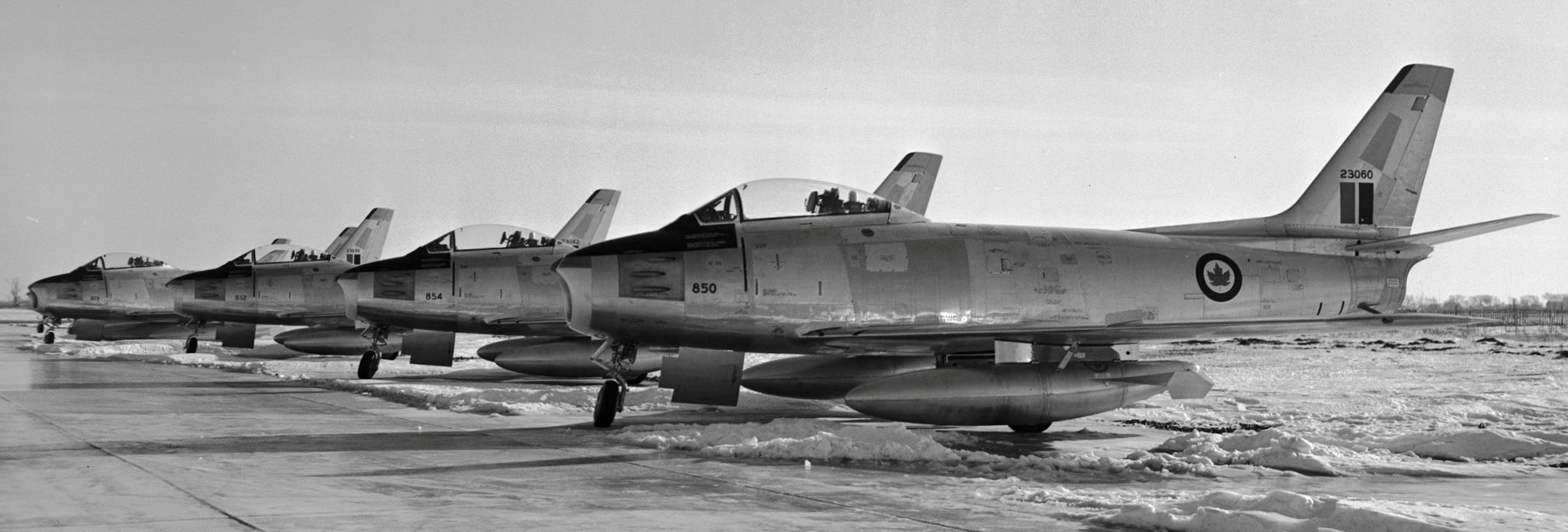
Canadair F-86 Sabre Mk. 5, RCAF (Serial No. 23060), on the way to Europe with the OFU.
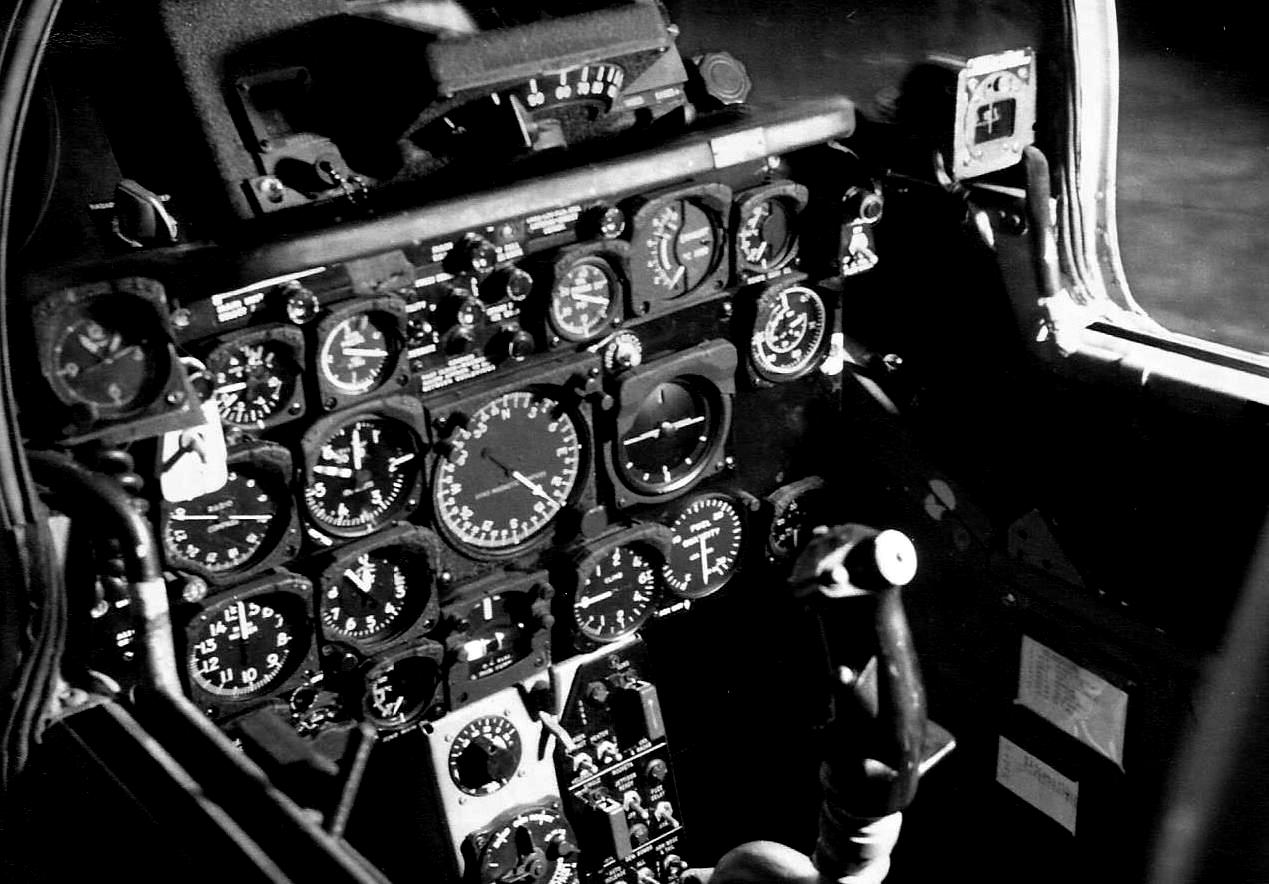
(RCAF Photo)
Canadair F-86 Sabre cockpit, ca 1953.
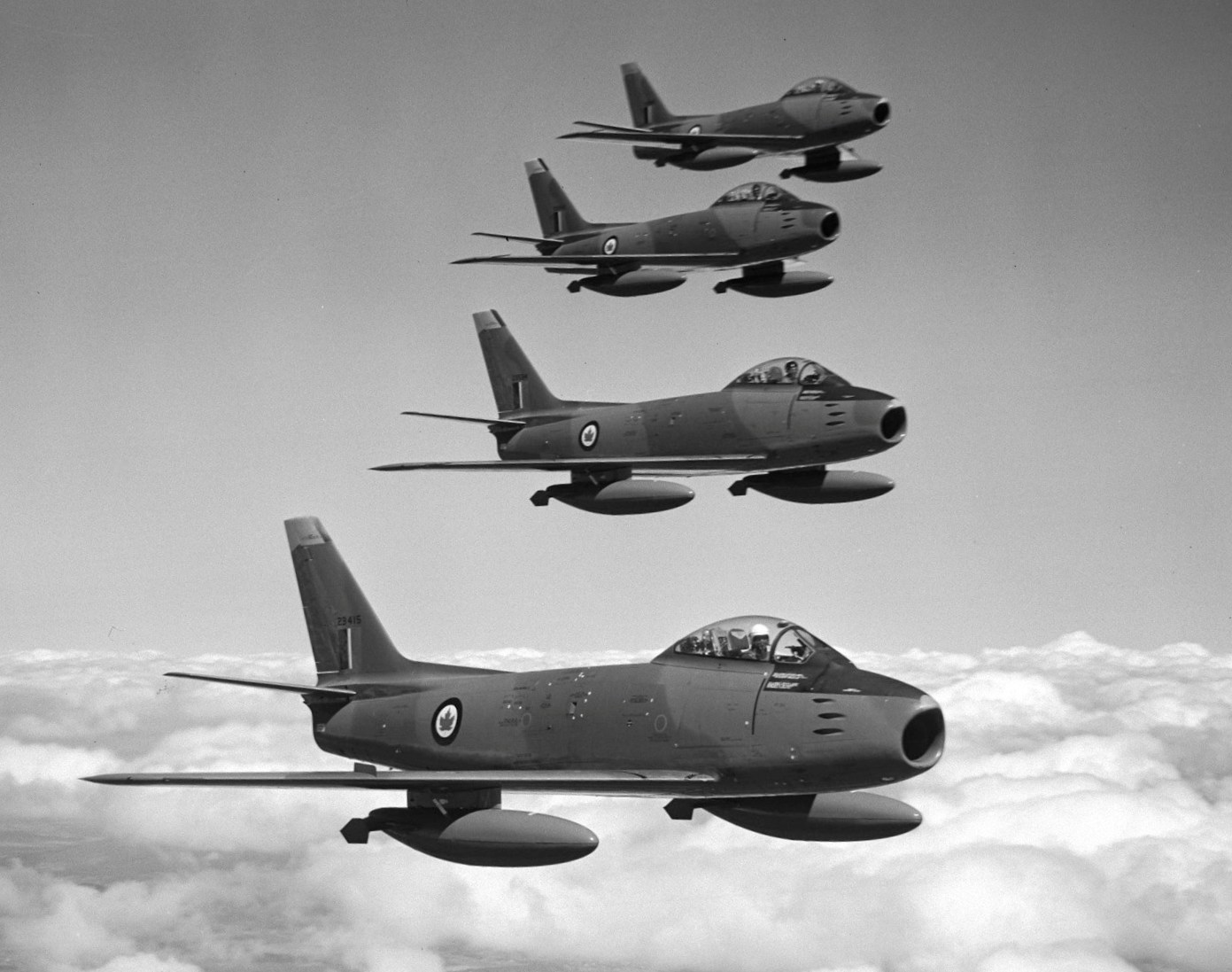
(Library and Archives Canada Photo, MIKAN No. 4948365)
Canadair F-86 Sabre Mk. 6 (Serial No. 23415) in formation over RCAF Station St Hubert, Quebec.
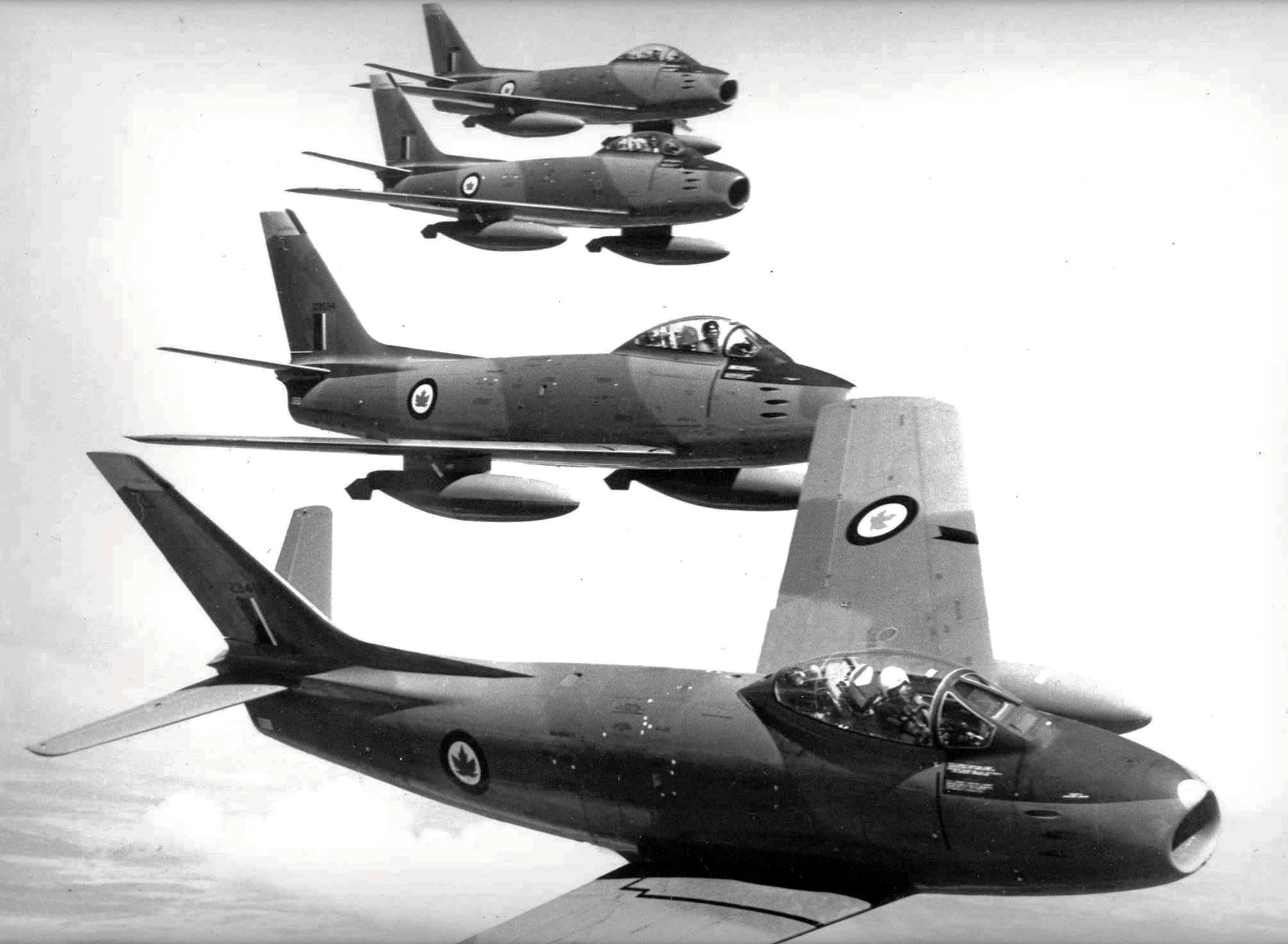
(DND Photo via James Craik)
Canadair F-86 Sabre Mk. 6 (Serial No. 23415) in formation over St Hubert, Quebec.
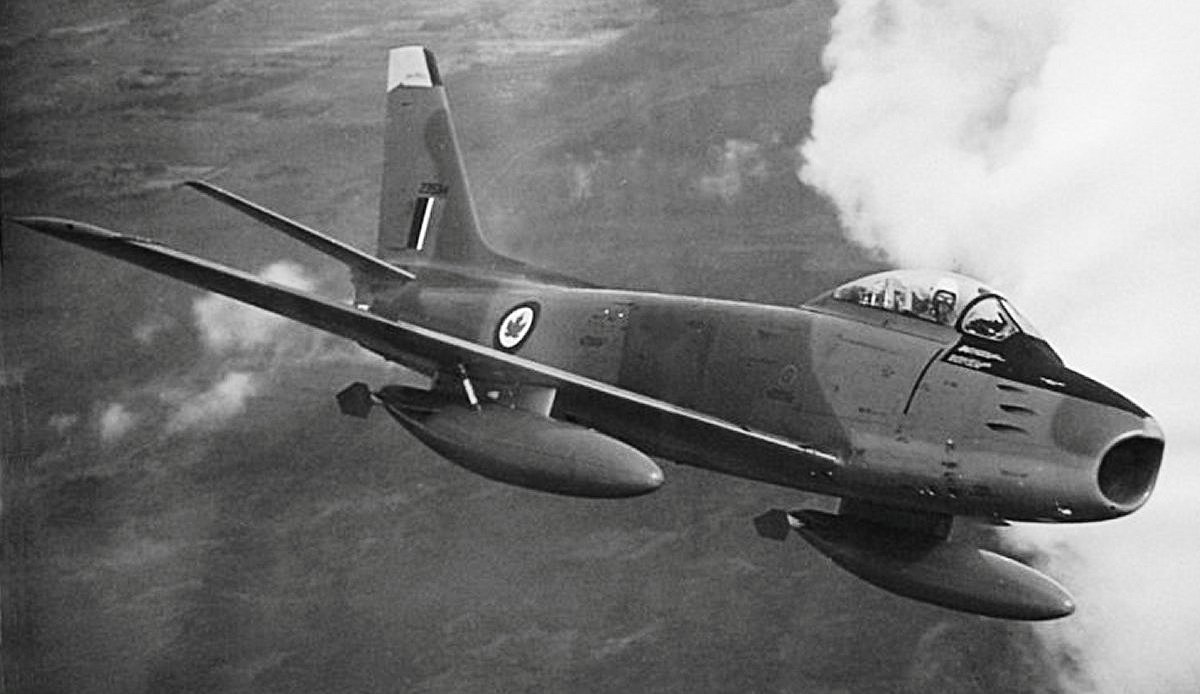
(DND Photo)
Canadair F-86 Sabre Mk. 6 (Serial No. 23534).
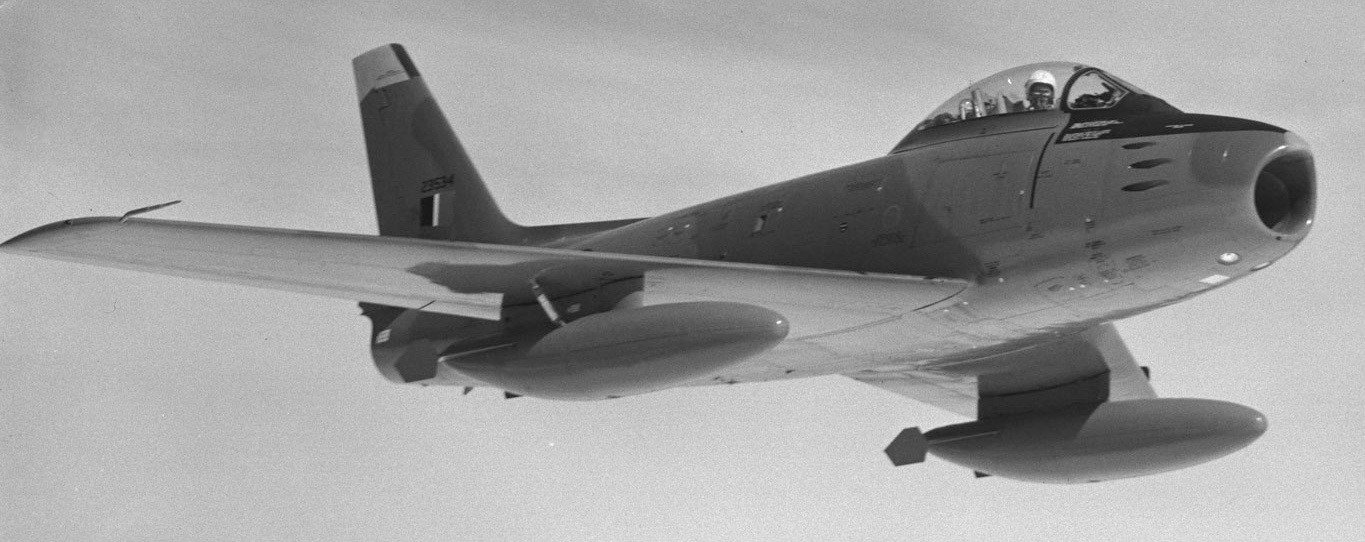
(DND Photo via James Craik)
Canadair F-86 Sabre Mk. 6 (Serial No. 23534).
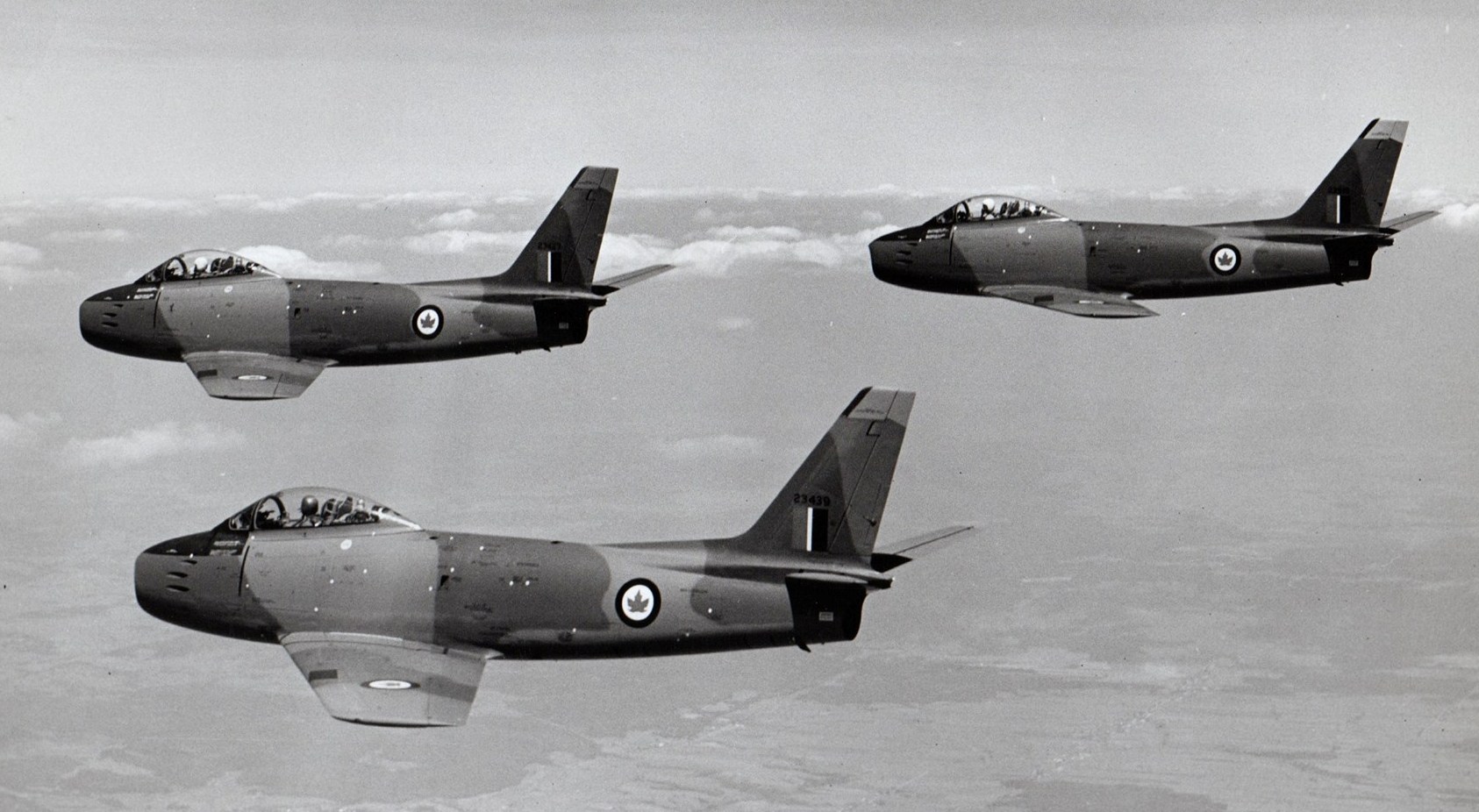
(DND Photo via James Craik)
Canadair F-86 Sabre Mk. 6 (Serial No. 23439) plus two, factory fresh.
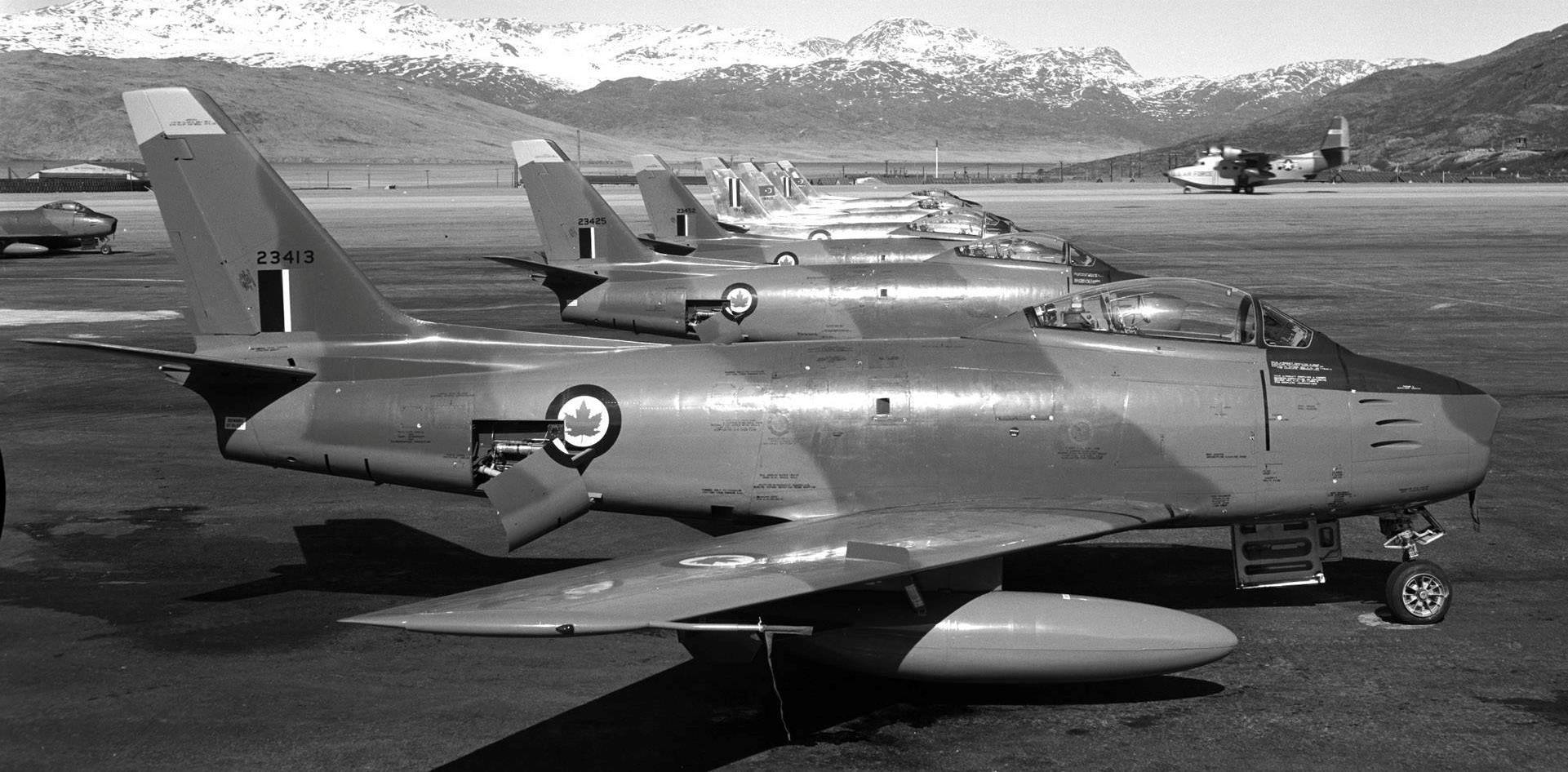
(DND Photo via James Craik)
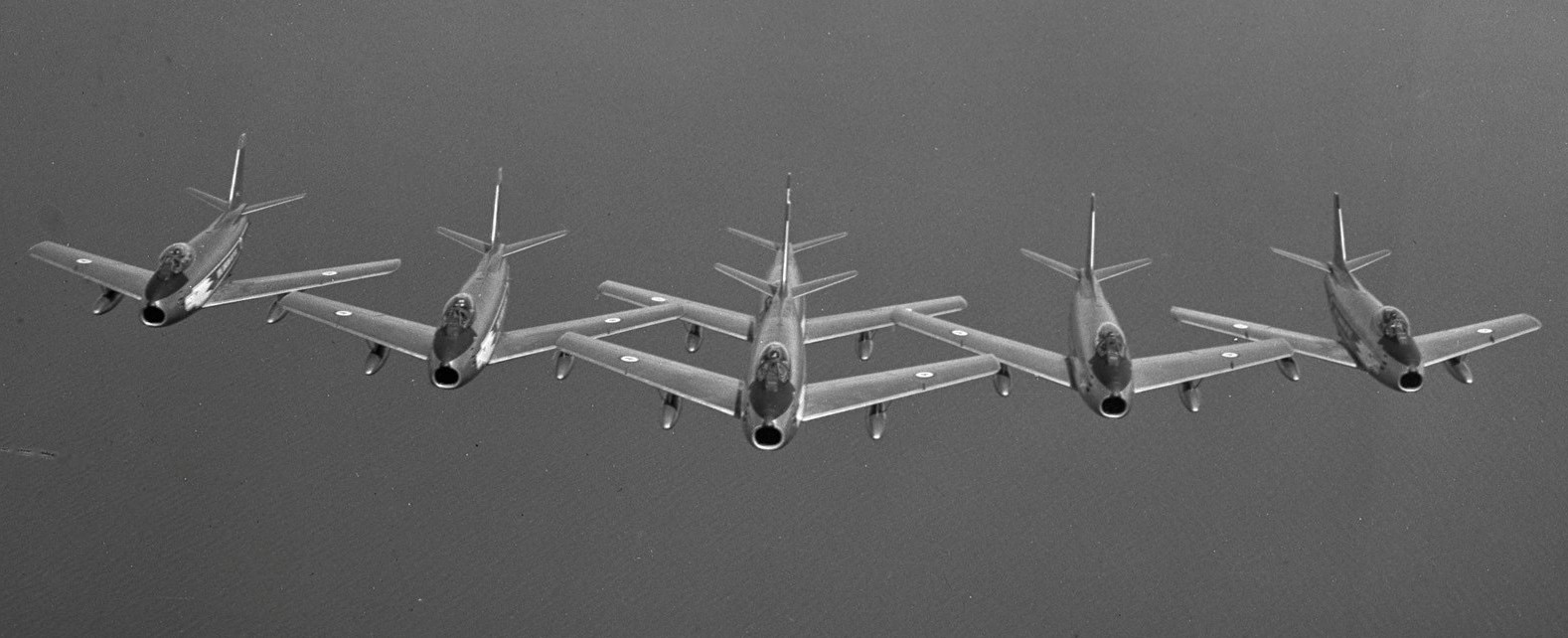
Canadair F-86 Sabre Mk. 6 (Serial No. 23413), Bluie, Greenland, May 1955.
The Golden Hawks
(DND Photo via James Craik)
Canadair F-86 Sabres, Golden Hawk formation, 1959.
A separate page on this website is dedicated to the Golden Hawks.
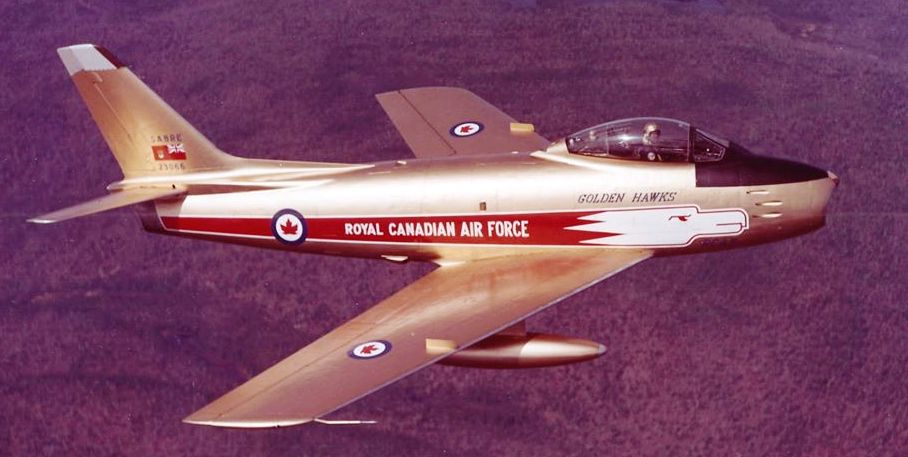
(RCAF Photo)
Canadair F-86 Sabre Mk. 5, RCAF (Serial No. 23066), Golden Hawk.
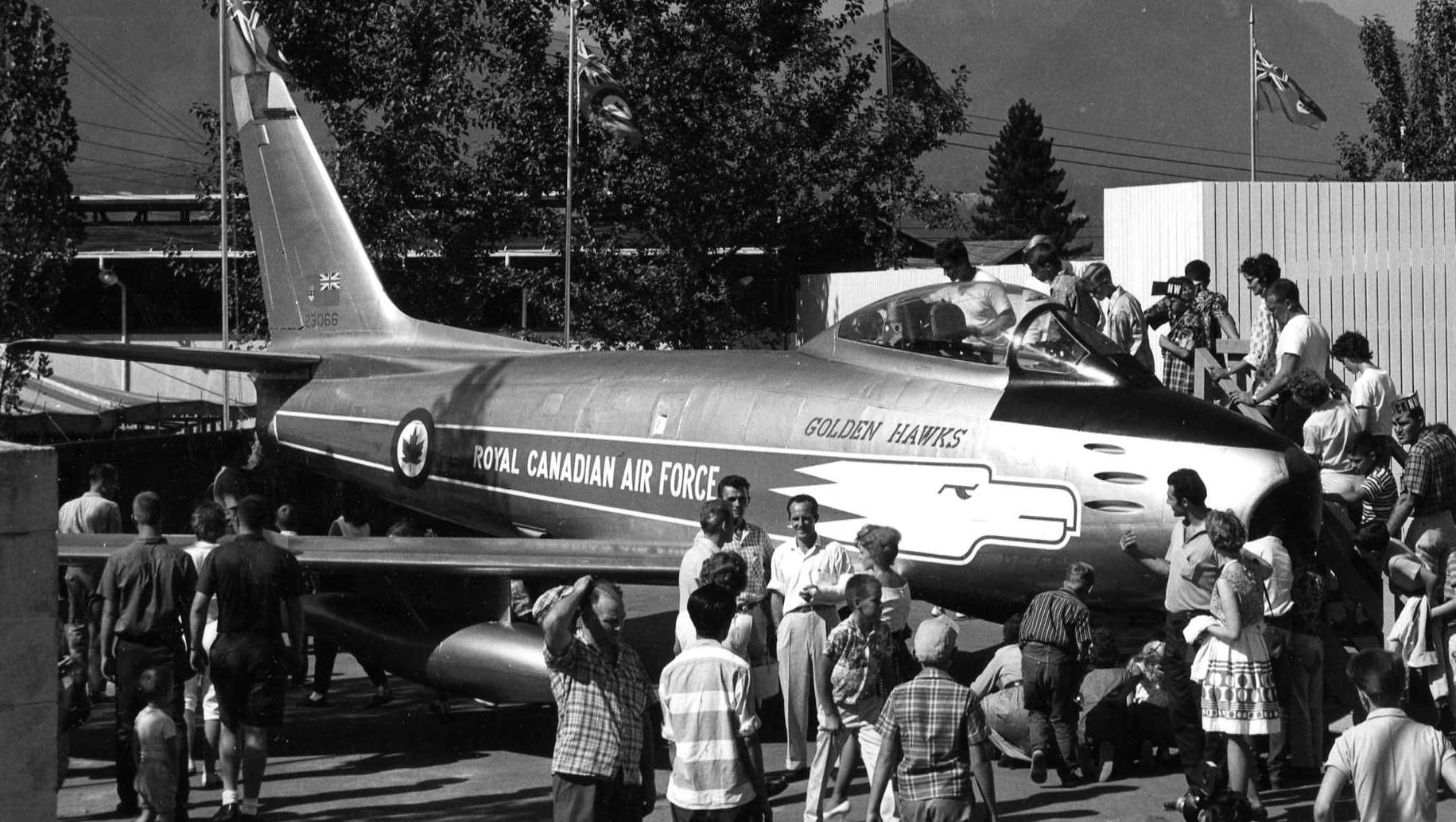
(City of Vancouver Archives Photo, AM281-S8-: CVA 180-5465)
Canadair F-86 Sabre Mk. 5, RCAF (Serial No. 23066), Golden Hawk, Vancouver, 1969.
The Sky Lancers
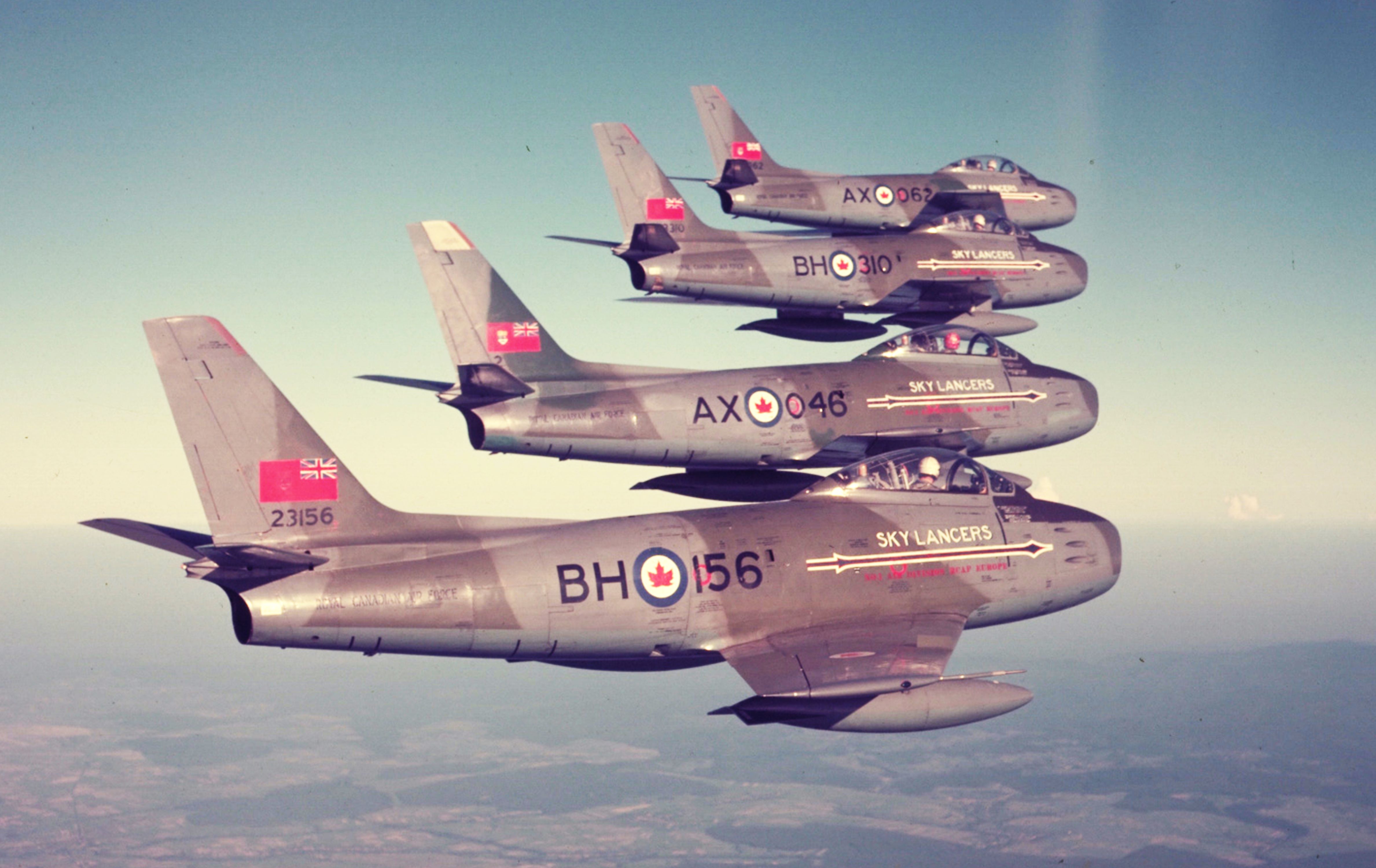
(RCAF Photo via James Craik)
Pilots from all three Sabre squadrons at No. 2 (F) Wing flew with the aerobatic team, the Sky Lancers. The team was formed in March 1955 and performed throughout Europe until October 1955. The following year the team was based at No. 4 (F) Wing. In 1956, No. 4 (F) Wing at Baden-Soellingen, Germany provided the members of the Sky Lancers. On 2 March 1956, while practicing their routine over the Rhine valley, the Sky Lancers crashed near the Vosges mountains south west of Strasbourg killing four of the five team members. This accident put an end to RCAF aerobatic teams for several years.
A separate page on this website is dedicated to the Sky Lancers.
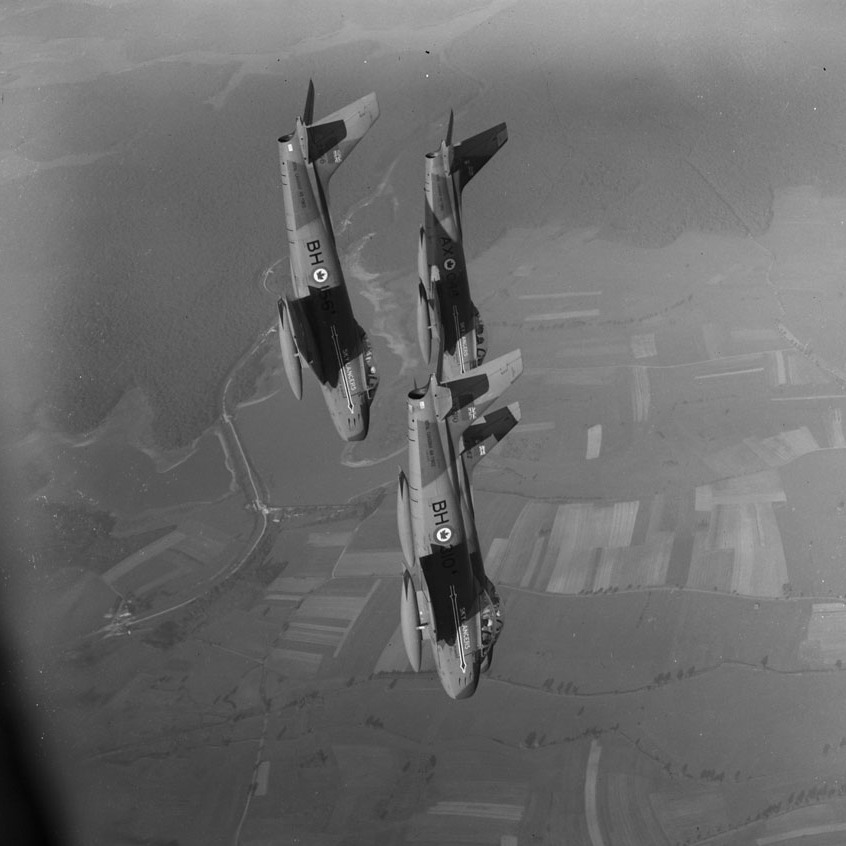
(Library and Archives Canada Photo, MIKAN No. 4948820)
Canadair F-86 Mk. 6 formation, RCAF Sky Lancers, 1955.
Pilots from all three Sabre squadrons at No. 2 (F) Wing flew with the aerobatic team, the Sky Lancers. The team was formed in March 1955 and performed throughout Europe until October 1955. The following year the team was based at No. 4 (F) Wing. In 1956, No. 4 (F) Wing at Baden-Soellingen, Germany provided the members of the Sky Lancers. On 2 March 1956, while practicing their routine over the Rhine valley, the Sky Lancers crashed near the Vosges mountains south west of Strasbourg killing four of the five team members. This accident put an end to RCAF aerobatic teams for several years.
(DND Photo via James Craik)
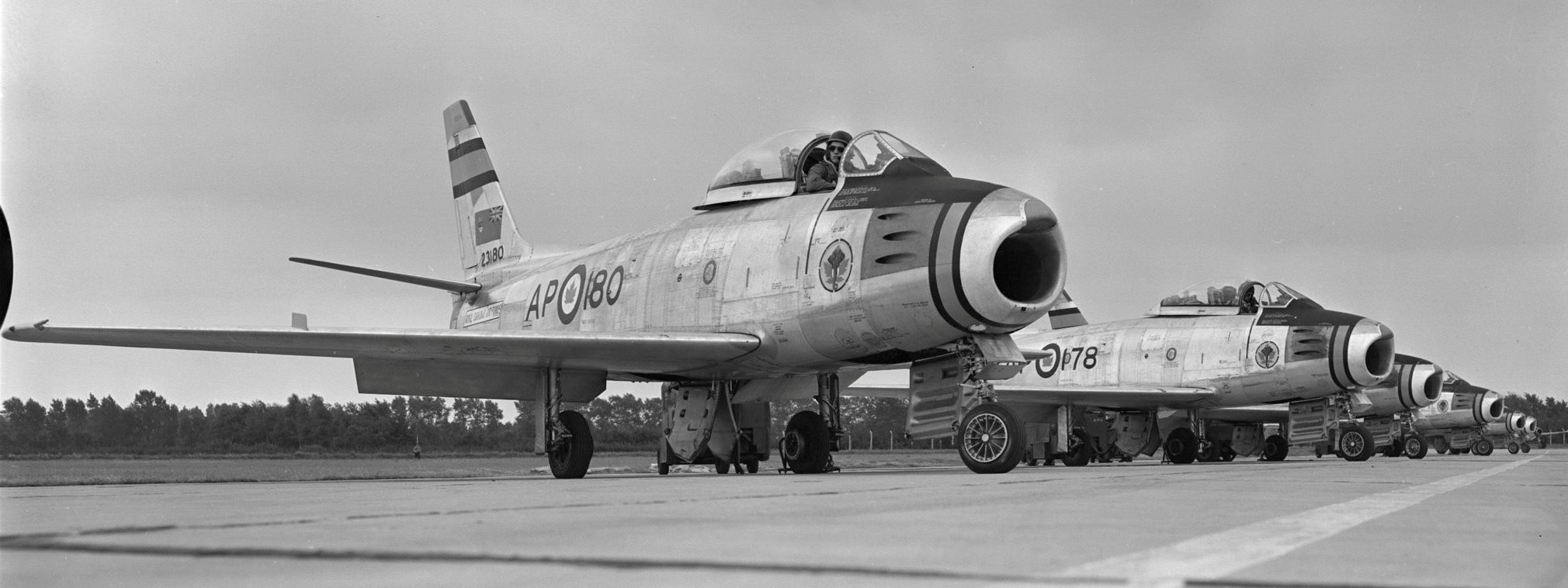
Canadair F-86 Sabre Mk. 5 (Serial No. 23180). Strapped in the cockpits of their Sabre aircraft Pilots of No. 413 Squadron are on two minute readiness awaiting the signal flares which will send them into the air to intercept ‘enemy’ raiders. No. 413 Squadron was on an exchange exercise with the Dutch Air Force, to test mobility and cross-servicing in the late 1960s.x
Photos of Canadair F-86E Sabre survivors preserved in Canada may be viewed on a separate page on this website.