Royal Canadian Navy in the Korean War, 1950 – 1953
On 12 July 1950 three Canadian destroyers, HMCS Cayuga, HMCS Athabaskan, and HMCS Sioux sailed for Korean waters to serve under United Nations Command. From then until the cease-fire in 1953, three Canadian warships on a rotation basis served continuously in the Korean War theatre.
The Royal Canadian Navy, along with navies of other UN Forces including the Republic of Korea, maintained blockades of enemy coasts, engaged enemy shore batteries, protected friendly islands, took part in the Inchon landing and, on the enemy East Coast had great success in “trainbusting”-the destruction of enemy supply trains.
“Train Busting” – These 8 Canadian Destroyers with a total of 3,621 crew members helped to destroy enemy supply trains advancing to South Korea during the Korean War and they patrolled the Korean waters during the UN Peace Keeping Mission until 1955.
HMCS Athabaskan, HMCS Cayuga, HMCS Sioux, HMCS Nootka, HMCS Huron, HMCS Iroquois, HMCS Crusader, and HMCS Haida.
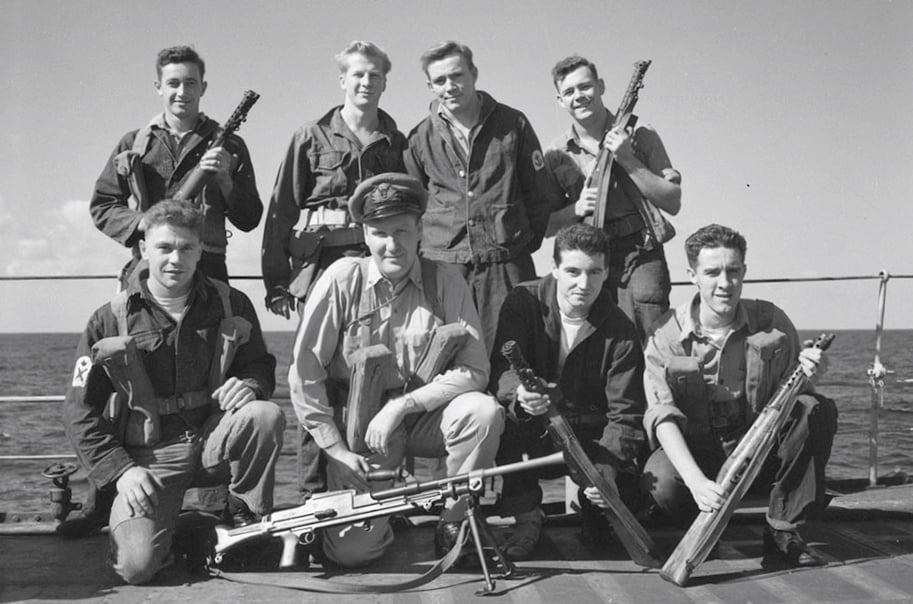
(Library and Archives Canada Photo, MIKAN No. 3207657)
RCN in the Korean War, No. 2 Sam Pan Boarding Party on HMCS Nootka. Front row: L/STO D. McCoy, LT/CDR F.P.R. Saunders, ABSM M. Messervey, L/SCV W.F. Wickson. At the back: ABTD W. Murray, LSCR G. Mason, LSCR R. Hornecastle, ABCR J. MacKinnon, 7 July 1952. The boarding party is armed with a Bren Gun and Lanchester sub-machine guns.
The Lanchester is a submachine gun (SMG) manufactured by the Sterling Armaments Company between 1941 and 1945. It is a copy of the German MP28/II and was manufactured in two versions, Mk.1 and Mk.1*; the latter was a simplified version of the original Mk.1, with no fire selector and simplified sights. It was primarily used by the Royal Navy during the Second World War, and the RCN in Korea. It was also used by RAF Regiment (for airfield protection. It was given the general designation of Lanchester after George Herbert Lanchester, who was charged with producing the weapon at the Sterling Armaments Company.The Lanchester is an open-bolt, self-loading blowback-operated weapon with a selective-fire option (located in front of the trigger) on early versions. A tubular receiver was attached to the front of the wooden stock, which could be pivoted barrel down for maintenance and disassembly. The wooden stock was patterned after that of Lee–Enfield rifle, and a bayonet lug centred below the muzzle accepted the Pattern 1907 sword-bayonet as used on the Lee–Enfield No. 1 Mk. III* (previously called the S.M.L.E.)
It used a straight 50-round magazine containing 9×19mm Parabellum cartridges (special pouches were produced to hold three magazines each) which fit into the magazine housing from the left, with spent cartridges ejected on the right. It was interchangeable with the shorter 32-round Sten magazine. A magazine lo ading tool was needed to load both 32- and 50-round magazines more easily. One of the two magazine pouches had a special pocket on the front for this loader. Mk.1s featured a front blade sight with adjustable rifle-type sights, marked between 100 and 600 yards. Mk.1* featured a much simplified flip-up sight marked 100 or 200 yards.
Manual safety is made in the form of locking cut, made in the receiver, which engages the bolt handle to lock bolt in open (cocked) position. It proved notoriously susceptible to accidental discharge if the weapon were dropped. For cleaning, the weapon had a brass oiler bottle and pull through held inside the butt stock (similar to the Lee–Enfield rifle).
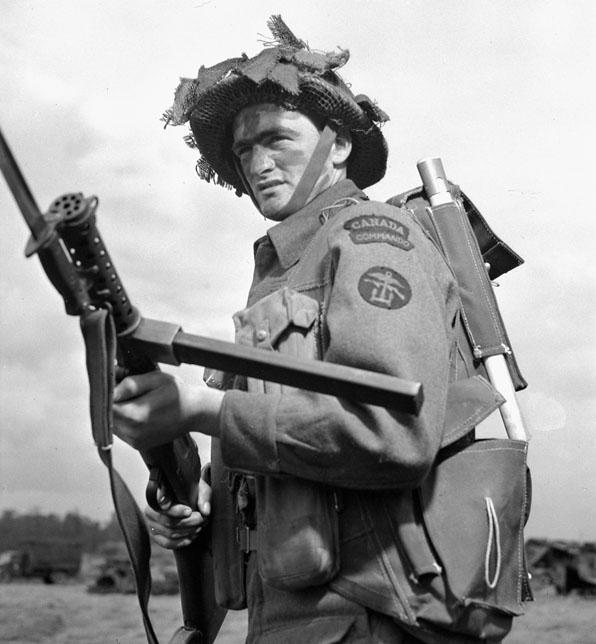
(Library and Archives Canada Photo, MIKAN No. 3201854)
Able Seaman Armand Therien of the Royal Canadian Navy Beach Commandos, armed with a Lanchester sub-machine gun, England, 20 July 1944.
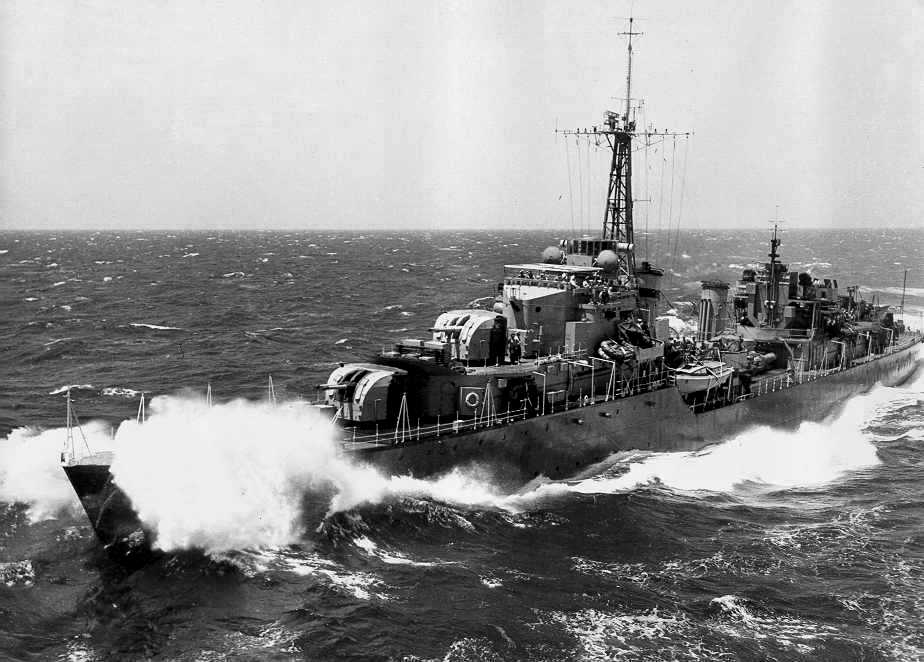
(USN Photo)
HMCS Athabaskan (R79), off the Korean coast, ca 1950. The last of her class to be completed, “Athabee” was commissioned at Halifax on 20 Jan 1948, and sailed in mid-May 1948 for the west coast, where she trained new entries and officer cadets until the outbreak of the Korean War. She sailed from Esquimalt on 05 Jul 1950, for the first of three tours of duty in Korean waters, returning 11 Dec 1953, from the last of them.
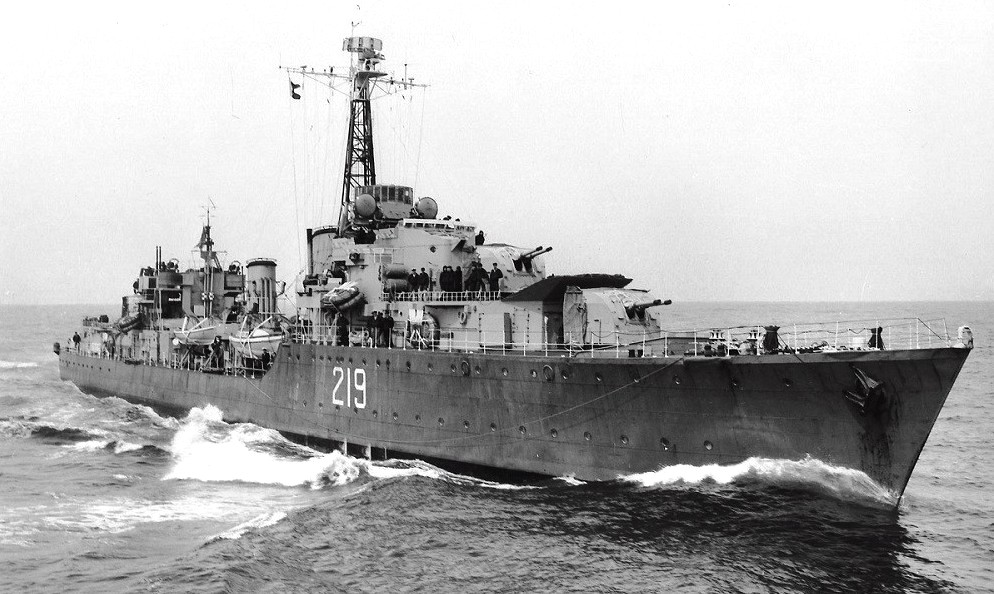
(Steven Hlasny Photo)
HMCS Athabaskan (219), off the Korean coast, ca 1950.
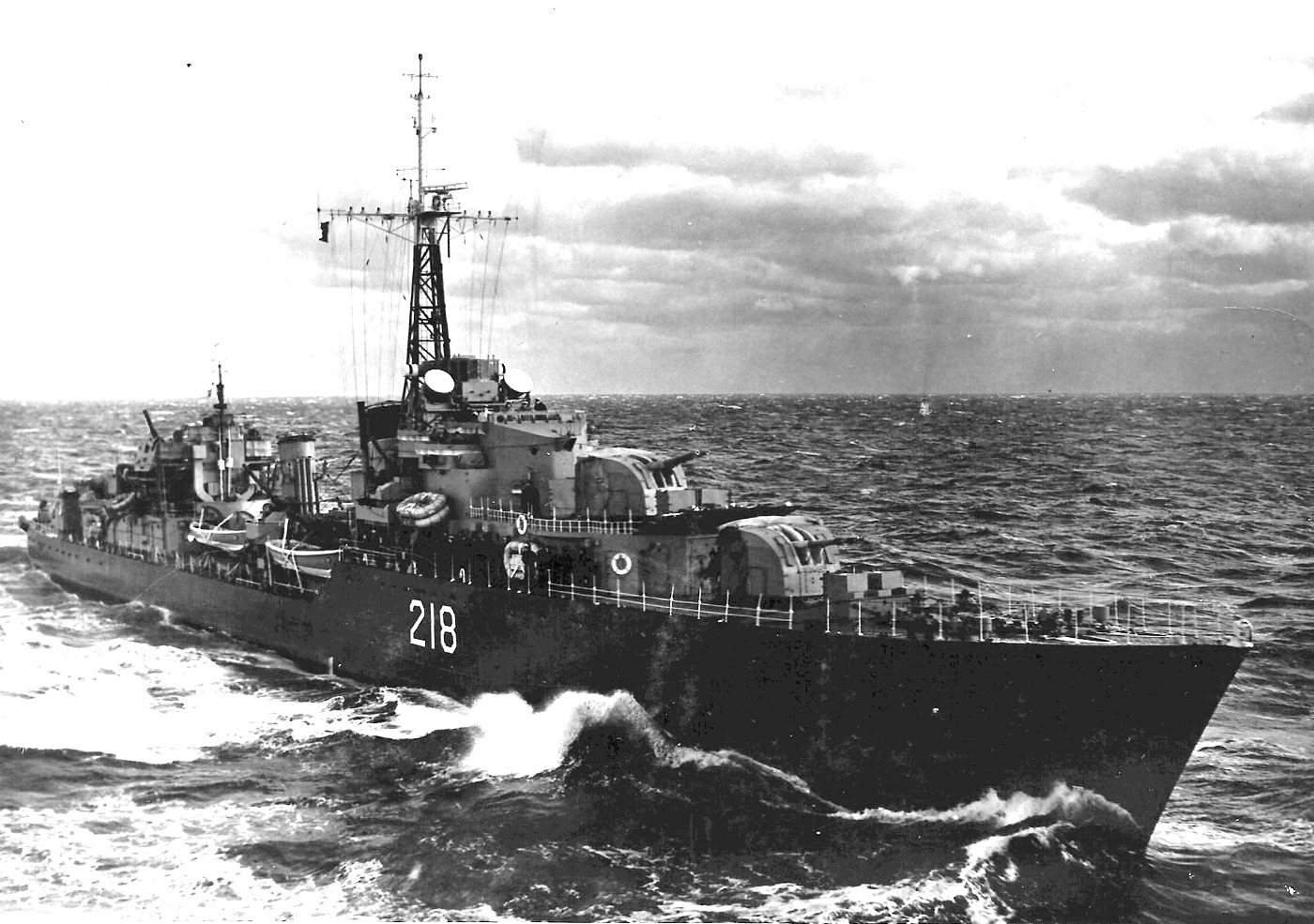
(Bob Theriault Photo)
HMCS Cayuga (218), Korea, 1950.
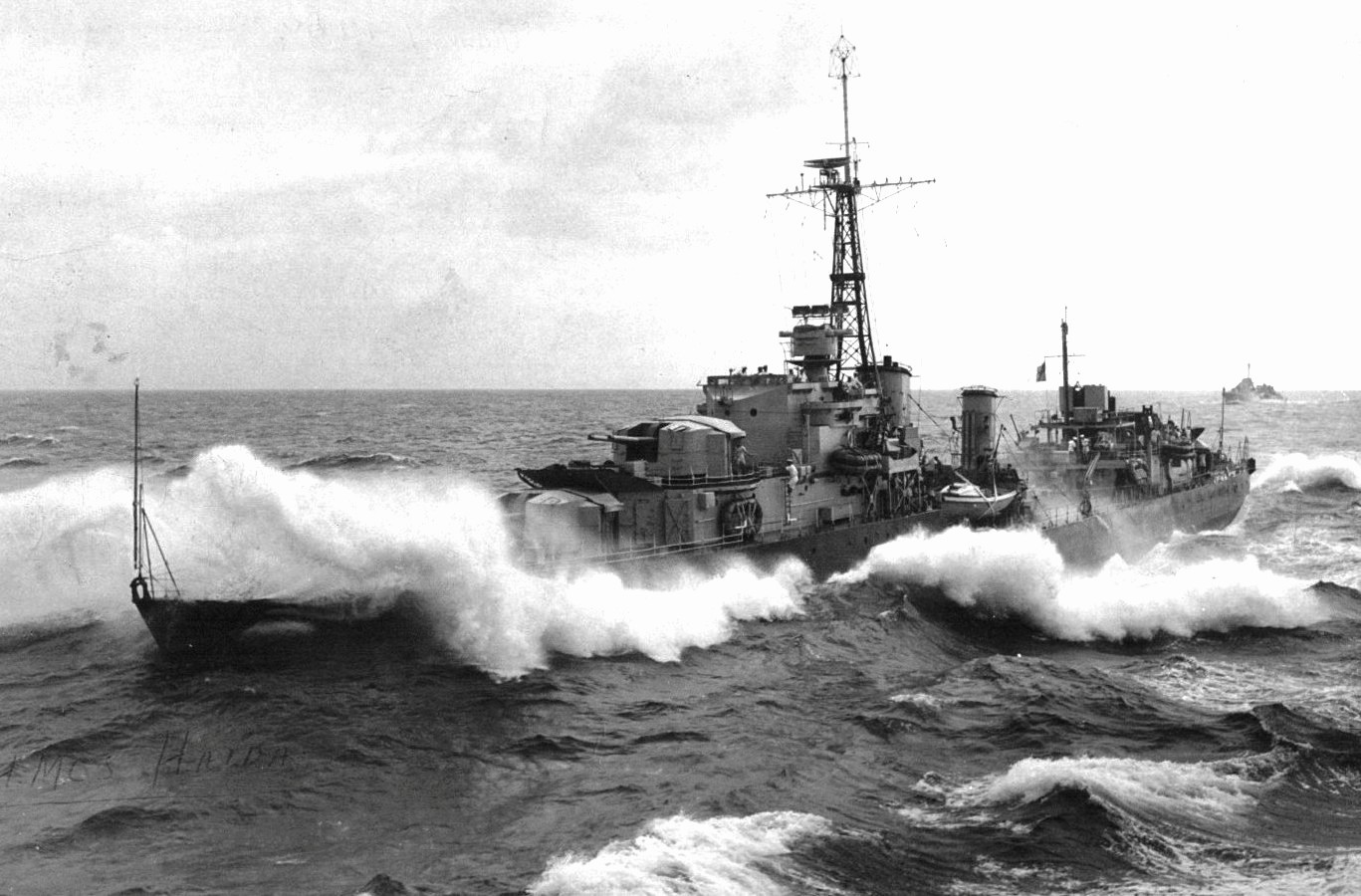
(RCN Photo)
HMCS Haida (G63), 16 March 1949. She gained entry in the Trainbusters Club, destroying a Chinese supply train and engine off Tanch’on, South Korea.
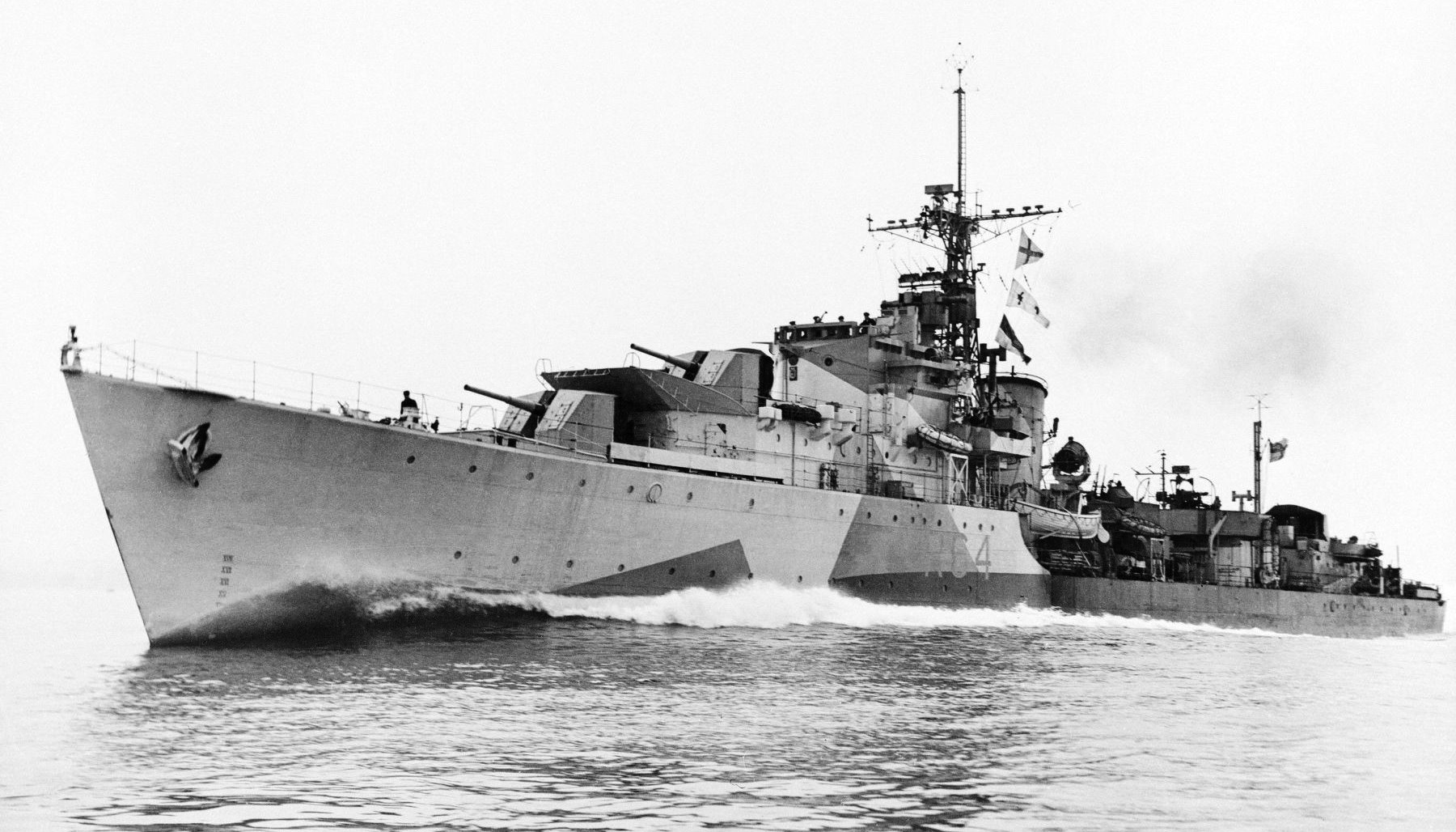
(RCN Photo)
HMCS Sioux (R64) (V-class). Laid down as HMS Vixen, she was commissioned HMCS Sioux at Cowes, Isle of Wight, on 21 Feb 1944, and assigned to the 26th Flotilla of the British Home Fleet. She took part in escorting carrier attacks against the Tirpitz and against German shipping off Norway, and on 28 May 1944 left Scapa for Portsmouth for D-Day duties, bombarding shore targets on the Normandy coast. Returning to Scapa Flow in Jul 1944, she resumed her previous occupation and also escorted four convoys each way to and from Murmansk.
She left the UK on 6 Apr 1945, for her first trip to Canada and, upon arrival underwent a major refit at Halifax. In Nov 1945 Sioux was transferred to Esquimalt, where she was paid off into reserve on 27 Feb 1946. After some modernization she was re-commissioned (225) in 1950, and did three tours of duty in Korean waters, from 1951 to 1955. Following her Korean tours, she returned to her training role.
(Stuart Lory Photo)
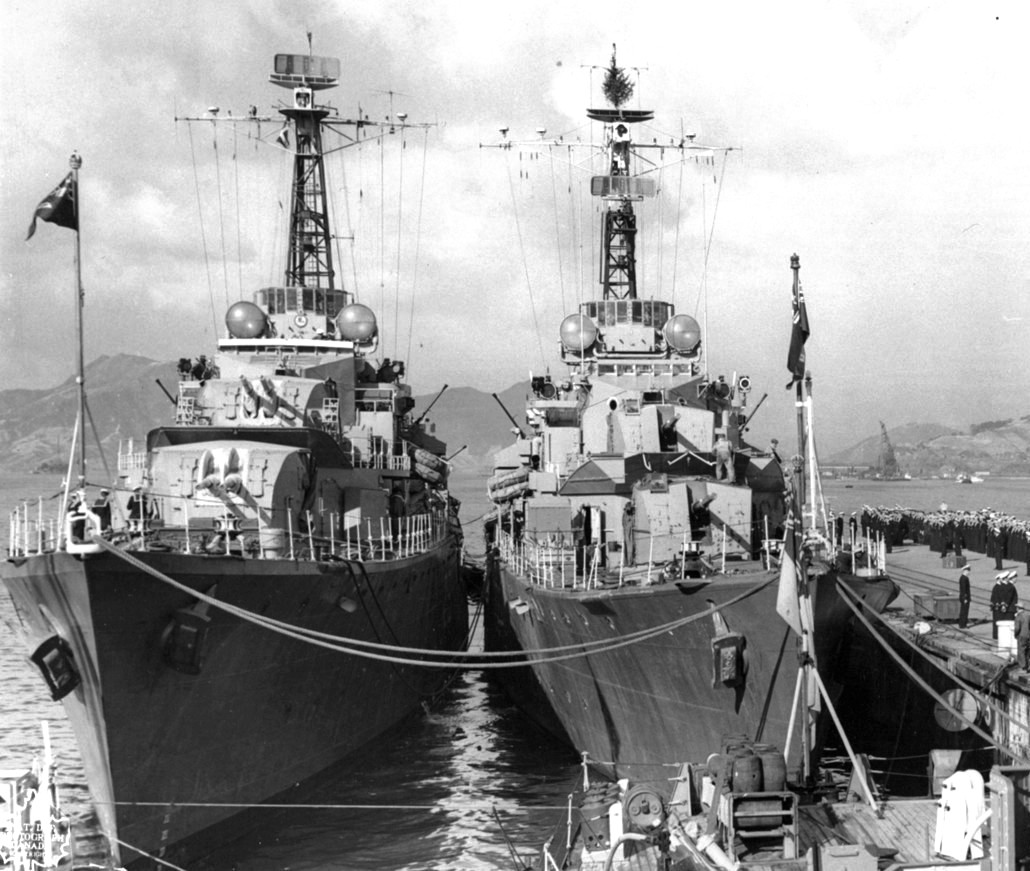
HMCS Athabaskan (219), left, and HMCS Crusader (228), at a jetty in Kure, Japan. HMCS Crusader had been in Korean waters for eight months, while HMCS Athabaskan was on her third tour of Korean duty.