
Canadian Army formations in Germany during the Cold War
1951: 27 Canadian Infantry Brigade (27 CIB)
1953: 1 Canadian Infantry Brigade Group (1 CIBG)
1955: 2 Canadian Infantry Brigade Group (2 CIBG)
1957: 4 Canadian Infantry Brigade Group (4 CIBG)
1968-1993: 4 Canadian Mechanized Brigade Group (4 CMBG)
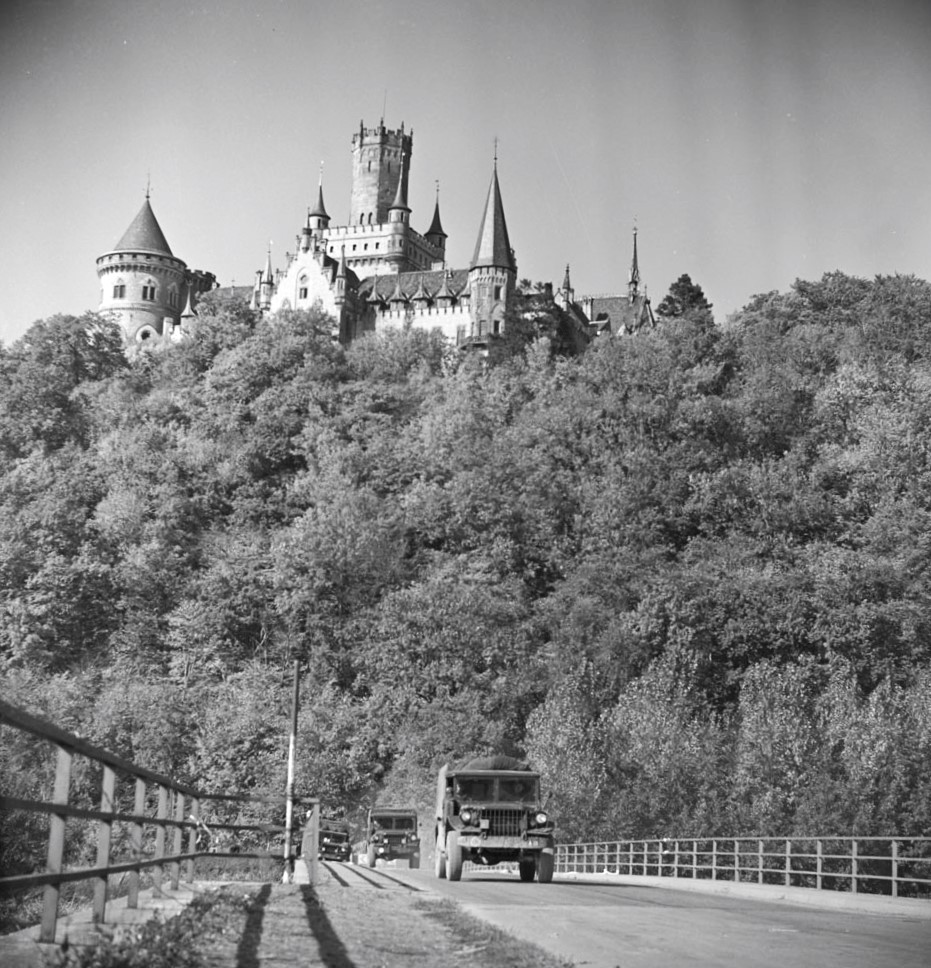
(Library and Archives Canada Photo, MIKAN No. 5394883)
Trucks of the 1st Battalion, The Queen’s Own Rifles of Canada roll across the Leine River bridge as they race to take up positions during Exercise “Keen Blade”, a five-day tactical exercise involving the Canadian NATO brigade and units of the German Army’s 3rd Panzer Brigade. In the background are the battlements of historic Marienburg Castle, 15 Oct 1963.
Canadian Army elements in CFE
Canada had maintained a presence in Europe as part of the NATO forces since 1951, when 27 Canadian Infantry Brigade was initially deployed to Hannover, Germany, attached to the British Army of the Rhine (BAOR). This formation, which was formed primarily with Militia units, moved to the Westphalia area of northern West Germany in 1953. Headquartered at Soest, elements were located in the four cities or towns of Iserlohn (Fort Beausejour and Fort Qu’Appelle), Soest (Fort Chambly, Fort Henry, and Fort York), Werl (Fort St. Louis, Fort Anne, and Fort Victoria) and Hemer (Fort Prince of Wales and Fort MacLeod). There were originally 8 Forts but this was later increased to 10.
Soest – BHQ, 1 x infantry battalion, service units.
Hemer – 1 x infantry battalion, artillery regiment.
Werl – 1 x infantry battalion,engineer regiment, field ambulance.
Iserlohn – armoured regiment.
27 CIB was succeeded by 1 Canadian Infantry Brigade Group (1 CIBG) on 14 October 1953, and in 1954 the dependant wives and children of these soldiers began to arrive.
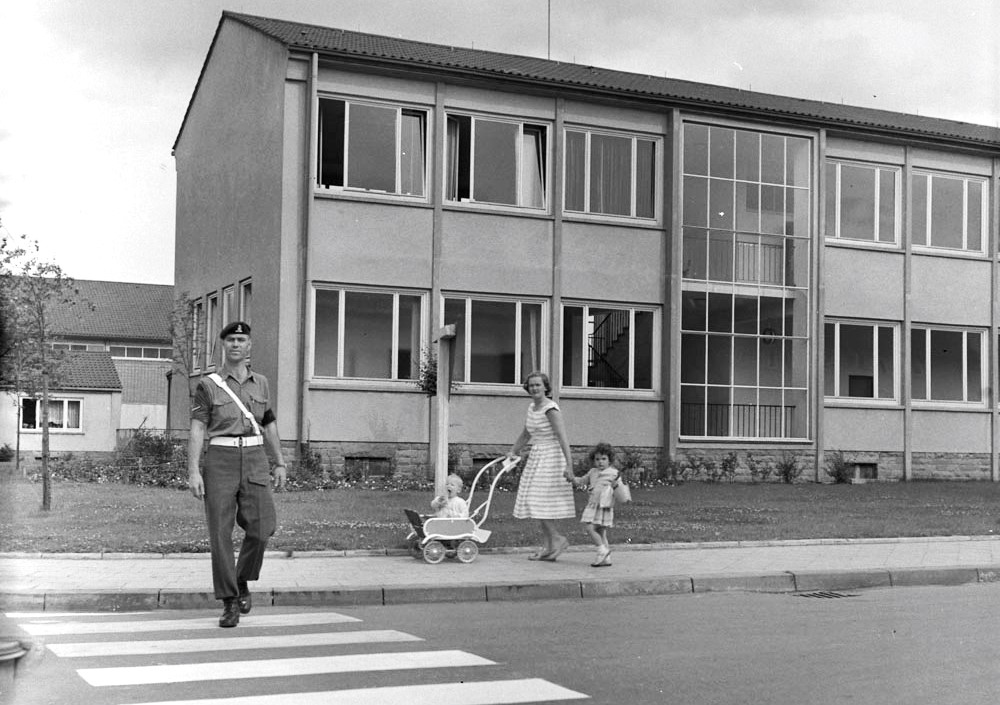
(Library and Archives Canada Photo, MIKAN No. 4949386)
A Canadian family in Soest, 4th Canadian Infantry Brigade, Germany, 1958.
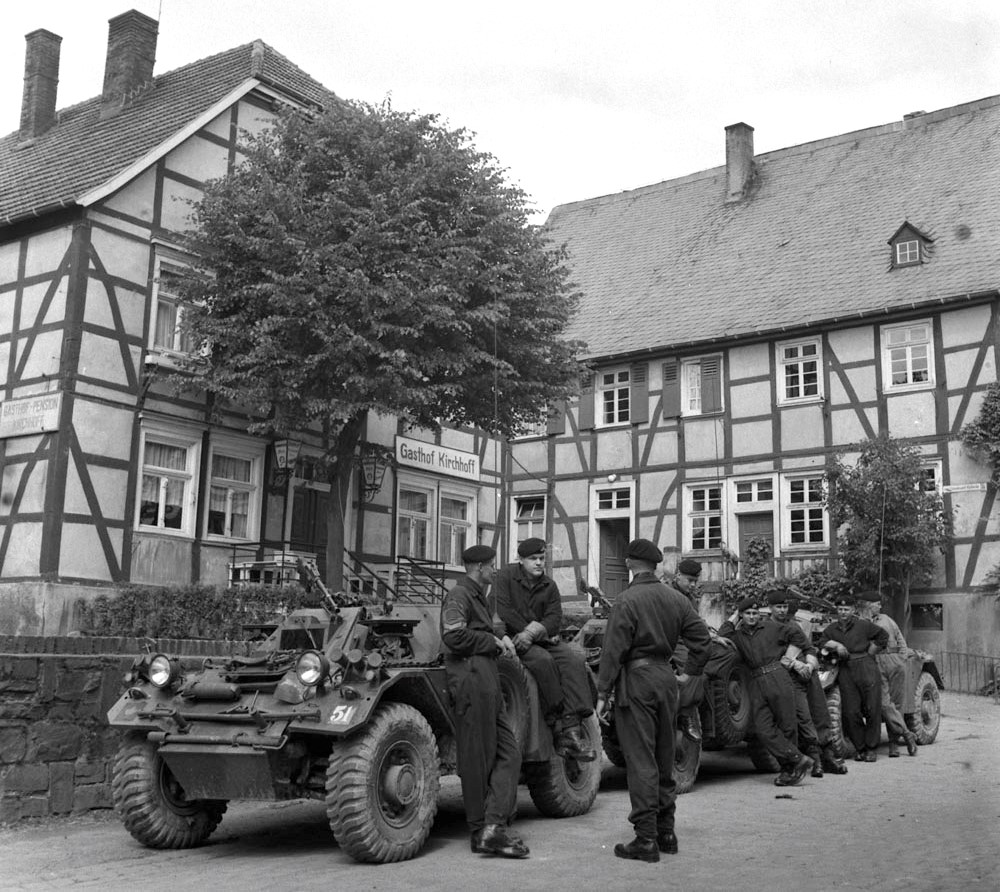
(Library and Archives Canada Photo, MIKAN No. 4949387)
Ferret Scout cars, 4th Canadian Infantry Brigade, Northern Germany, 1958.
The unit was renamed 2 CIBG in 1955, then 4 CIBG in 1957. By 1962, it had become the 4th Canadian Infantry Brigade Group (4 CIBG) and was equal in size and strength to a “light division” because it now had nine CH 112 Nomad helicopters flying in a Horse Artillery Troop as scouts for an Honest John Nuclear missile 1st Surface to Surface Missile (SMM) Battery in Germany.
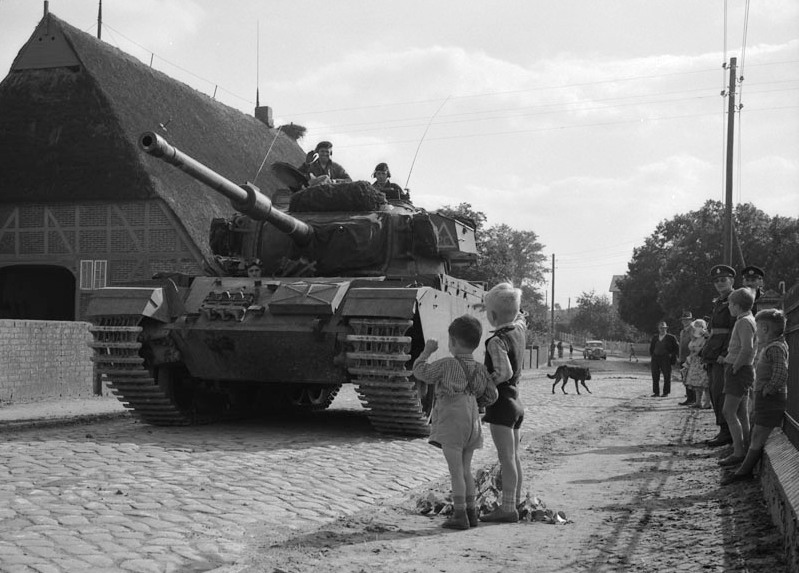
(Library and Archives Canada Photo, MIKAN No. 4976237)
8th Canadian Hussars (Princess Louise’s) Centurion main battle tank being greeted by two small German boys as it moves through the village of Rumpel, northern Germany in 1960. In the turret are Corporal Leonard LeBlanc and Trooper Jean-Paul Roberge and driver Trooper Jean-Pierre Bastien.
The arrival of 4 CIBG saw a significant reinforcement of the formation’s capabilities; prior to this each brigade had only been equipped with a squadron of main battle tanks. The arrival of 4 CIBG saw a full armoured regiment equipped with Centurion tanks and an independent brigade reconnaissance squadron with Ferret scout cars. In 1959, when 4 CIBG’s tour was due to end, a change was made in the reinforcement policy for Germany. Rather than having whole brigades rotating every two years, the decision was made to keep 4 CIBG and its associated brigade units in place, instead rotating the major combat elements to Germany every three years.
The name and symbol, Red Patch, came from the red rectangular badge- the “Somme Patch “ which identified the First World War Canadian 1st Division troops and was worn proudly on the upper right uniform sleeve of all these division soldiers. The 1st Canadian Army “Red Patch” division was reactivated on16 October 1953 and consisted of 1 Canadian Infantry Brigade in the Westphalia area of Germany and two Canadian Army infantry brigades located in Canada. The Red Patch was the symbol identifying the Canadian Army soldier and their dependant children in Scouting in Germany.
In 1959, when 4 CIBG’s tour was due to end, a change was made in the reinforcement policy for Germany. Instead of whole brigades rotating every two years, the decision was made to keep 4 CIBG and its associated brigade units in place, instead rotating the major combat elements to Germany every three years.
The presence of the three mechanized infantry battalions led Canada’s brigade in Germany to be renamed as 4 Canadian Mechanized Brigade Group (4 CMBG) on 1 May 1968, three months after Canada’s three separate armed forces were unified into the single Canadian Forces. Around the same time, a review of Canada’s foreign policy was announced by the Prime Minister, Pierre Trudeau, part of which involved an investigation into the role of 4 CMBG, which was the Canadian military’s main overseas asset. The ultimate result of the investigation was the announcement by the Prime Minister, as part of an overall cut in defence spending, to reduce the Canadian military commitment in Europe by half. 4CMBG was re-roled, and rather than having its attachment as an active part of the British Army of the Rhine (BAOR), it become a reserve force attached to either the VII (US) Corps or II (GE) Corps and relocated to Lahr in Southern Germany. Most notably, this downsizing and re-roling led to the withdrawal of the tactical nuclear weapons capability. 4 CMBG remained in place as part of NATO’s forces throughout the Cold War until the final draw down of Canada’s military presence in Europe when it was disbanded in 1993. (DND)