
Panzerkampfwagens destroyed
Panzerkampfwagen Tiger II Ausf. B (Königstiger)
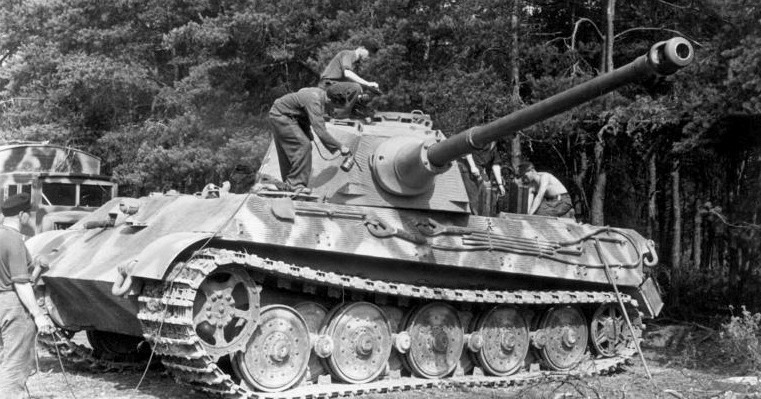
(Bundesarchiv Bild 101I-721-0398-21A)
Tiger II Ausf. B Königstiger, Normandy, France, June 1944.
The German Tiger II was a heavy tank with the official designation of Panzerkampfwagen Tiger Ausf. B, often shortened to Tiger B. The ordnance inventory designation was Sd.Kfz. 182. (Sd.Kfz. 267 and 268 for command vehicles). It was also known informally as the Königstiger (Bengal tiger/King Tiger). Allied soldiers usually called it the King Tiger or Royal Tiger. The Tiger II was the successor to the Tiger I, combining the latter’s thick armour with the armour sloping used on the Panther medium tank. The tank weighed almost 70 tonnes, and was protected by 100 to 185 mm (3.9 to 7.3 in) of armour to the front. It was armed with the long barrelled 8.8 cm KwK 43 L/71 anti-tank cannon. The chassis was also the basis for the Jagdtiger turretless Jagdpanzer anti-tank vehicle.
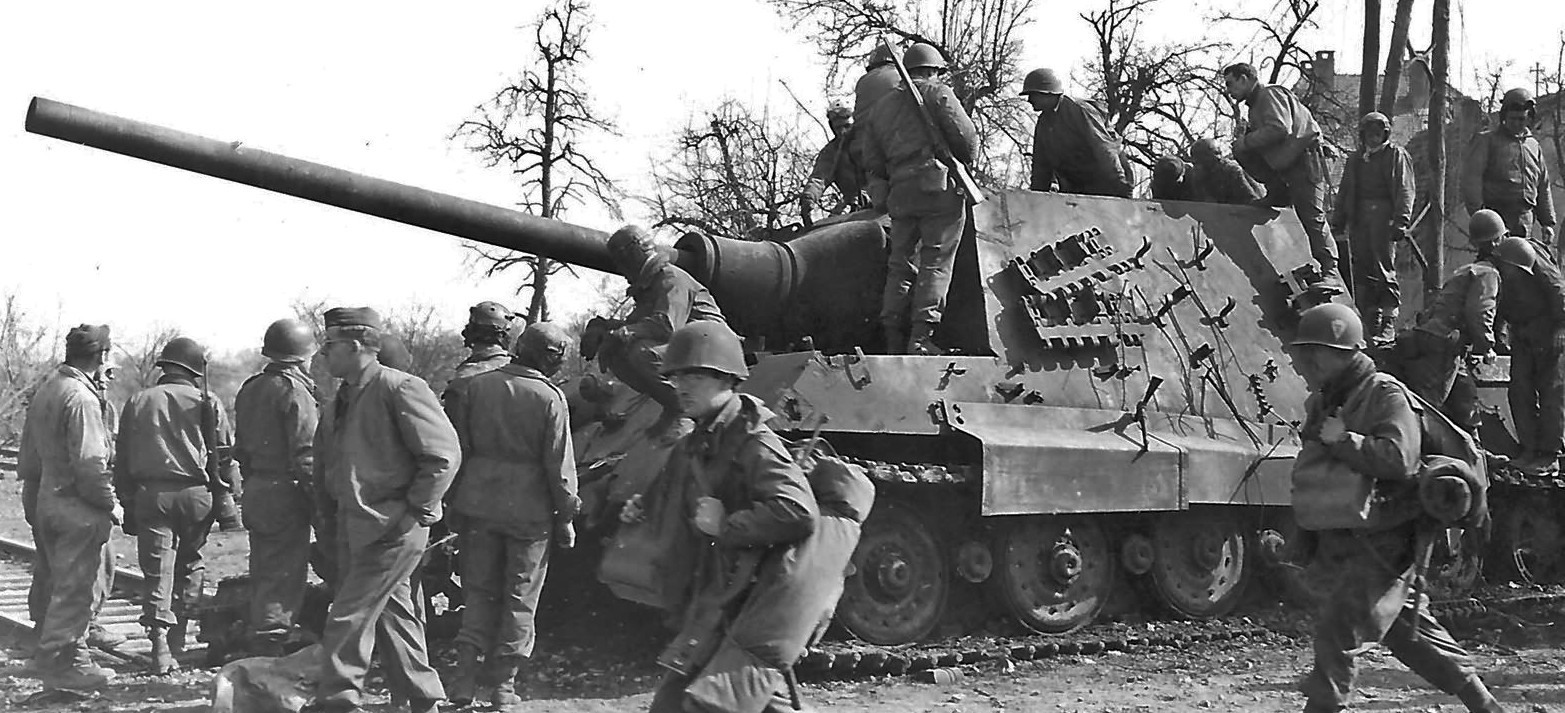
(US Army Photo)
Jagdtiger No. 234 of the 653 sPzJgabt with US troops, Soultz, France, 18 March 1945.
The Tiger II was issued to heavy tank battalions of the Army and the Waffen-SS. It was first used in combat by 503rd Heavy Panzer Battalion during the Allied invasion of Normandy on 11 July 1944; on the Eastern Front, the first unit to be outfitted with the Tiger II was the 501st Heavy Panzer Battalion. Due to heavy Allied bombing, only 492 were produced. (Wikipedia)
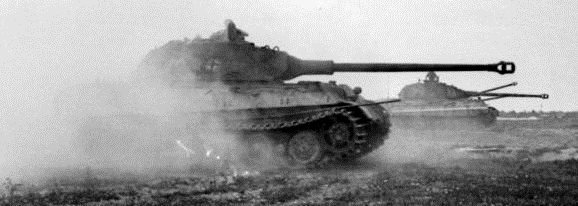
(Bundesarchiv Bild 101I-721-0397-34)
Tiger II Königstiger, on the move in Normandy, France, June 1944. The heavy armour and powerful long-range gun gave the Tiger II an advantage against all opposing Western Allied and Soviet tanks attempting to engage it from head on. In combat, the Tiger II was never penetrated frontally by the QF 17-Pounder anti-tank gun. As a result of its thick frontal armour, flanking manoeuvres were most often used against the Tiger II to attempt a shot at the thinner side and rear armour, giving a tactical advantage to the Tiger II in most engagements. Moreover, the main armament of the Tiger II was capable of knocking out any Allied tank frontally at ranges exceeding 2.5 kilometres (1.6 mi), well beyond the effective range of Allied tank guns.
The first combat use of the Tiger II was by the 1st Company of the 503rd Heavy Panzer Battalion (s.H.Pz.Abt. 503) during the Battle of Normandy, opposing Operation Atlantic between Troarn and Demouville on 18 July 1944. Two were lost in combat, while the company commander’s tank became irrecoverably trapped after falling into a bomb crater created during Operation Goodwood. The Tiger II was also used in significant numbers, distributed into four heavy panzer battalions, during the Ardennes Offensive (also known as the ‘Battle of the Bulge’) of December 1944. At least 150 Tiger IIs were present, nearly a third of total production; most were lost over the course of the offensive. (Wikipedia)
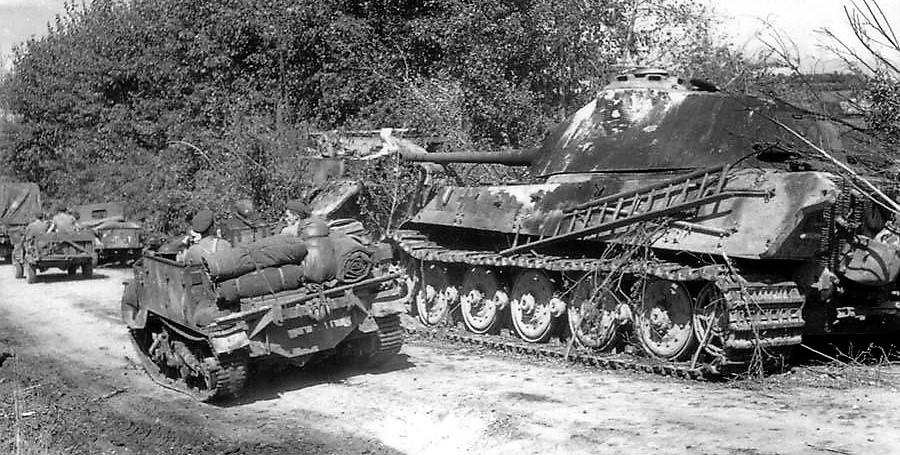
(Library and Archives Canada Photo, MIKAN No. 3209158)
Tiger II Ausf. B Königstiger, 1. Kompanie, Schwere Panzer-Abteilung 503.
By the close of July 1944, Schwere Panzer-Abteilung 503 (s PzAbt 503; Heavy Tank Battalion 503) consisted of the remnants of 1./s PzAbt 503 and 2./s PzAbt 503 (1st. and 2nd. Company, s PzAbt 503). 3./s PzAbt 503 had been so heavily reduced in the strength that it turned over its surviving tanks to 2./s PzAbt 503 and was withdrawn for refitting. On August 1, 1944, s PzAbt 503 was attached to the 21st. Panzer Division with 13 operational tanks and early in the month, the unit was engaged around Mont Pinçon near the village of Plessis-Grimoult which was 20 miles south-west of the city of Caen, a major area of conflict during the Battle of Normandy. By August 10, the unit had shifted to covering positions near Saint-Pierre-Canivet when on August 11, some 30 Allied tanks were taken under fire by two of the battalion’s Tiger tanks positioned to the east of Saint-Pierre-Canivet. The crews claimed 3 Allied tanks knocked out but at the cost of both Tigers. This was the final time that the battalion would be used in combat during the Normandy campaign. During the withdrawals that commenced following the Saint-Pierre-Canivet skirmish, the battalion was forced to abandon, and in some cases, blow up the remainder of their Tiger II tanks. The Tiger II in the photograph belonged to 1./s PzAbt 503 and was abandoned along National Route 179 between Vimoutiers and Canapville. The tank shows fire damage but whether that was due to the crew scuttling the tank or due to an Allied tank shooting it after being abandoned, is unknown. In front of the Tiger II, partially hidden by tree branches and the Bren Carrier, is a Bergepanther which was an armored recovery vehicle based on the PzKpfw V “Panther” medium tank chassis. It was attempting to recover the tank as tow cables had been deployed (visible in other photographs) but it also appears to have been abandoned. (K. Studio)
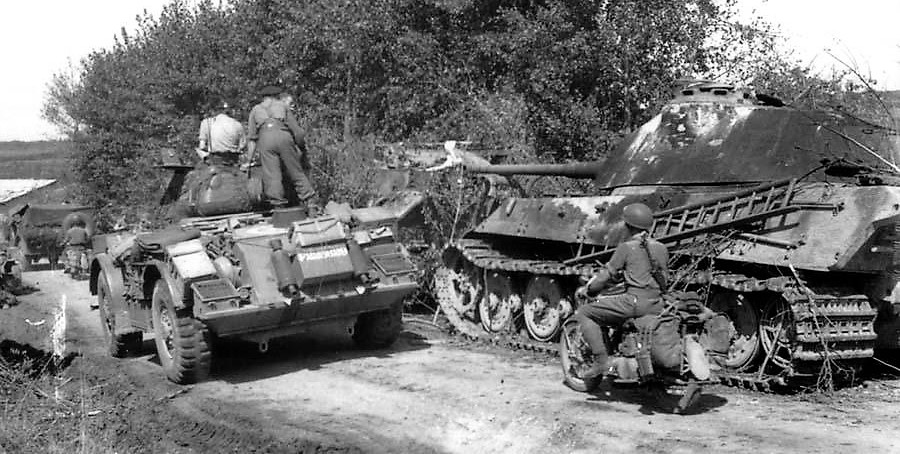
(Library and Archives Canada Photo, MIKAN No. 3209158)
6 Brigade, 2nd Canadian Infantry Division, the T17E1 Staghound is with the 12th Manitoba Dragoons, 18th Armoured Car Regiment, on the road to Vimoutiers, France. The crew and motorcycle rider are passing a destroyed German Tiger II [Panzerkampfwagen Tiger Ausf. B], 22 August 1944. The Tiger II is number 132 1./s.Pz.Abt 503, destroyed by its own crew. A Bergepanther stands in front of the Tiger II, located in la Fauvetiere before Vimoutiers.
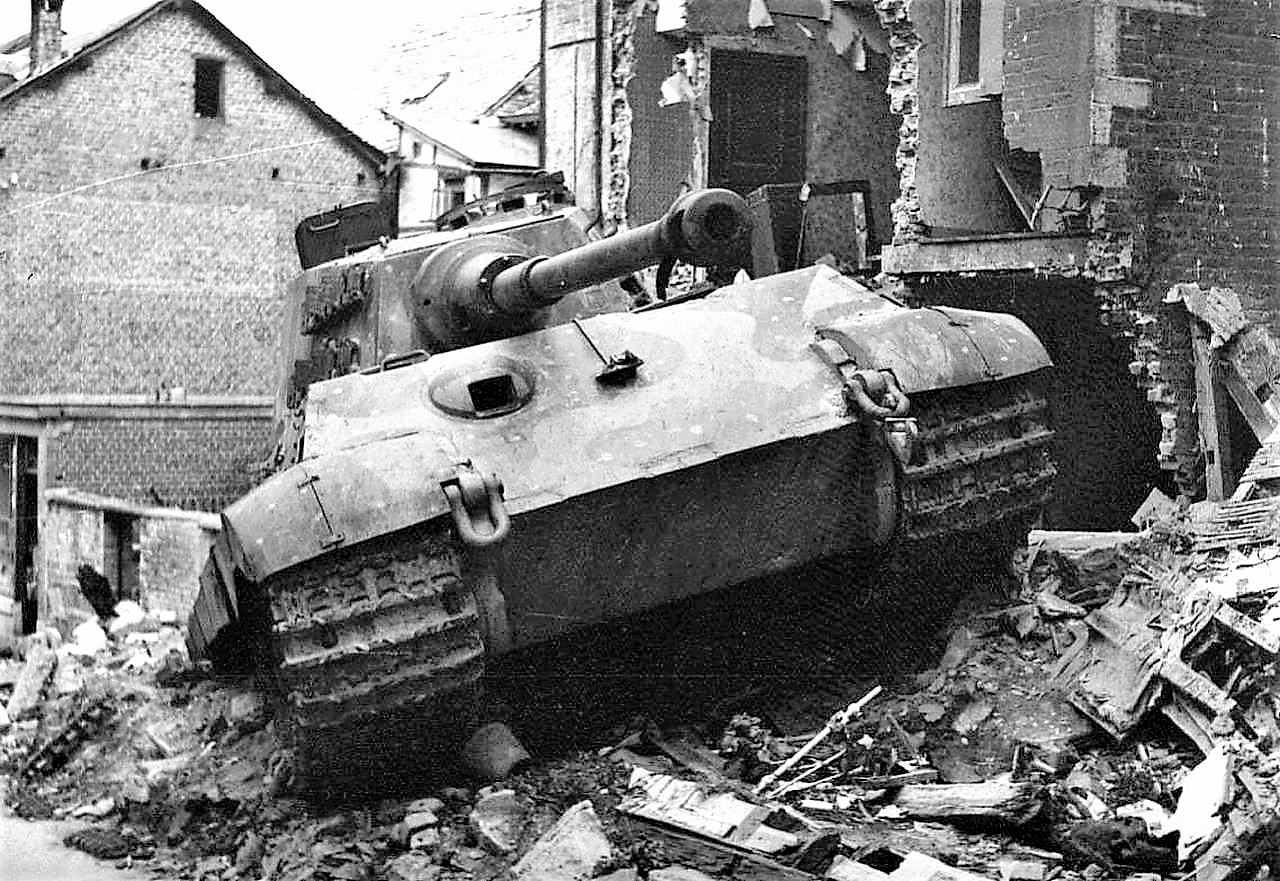
(German military photo, film captured by U.S. Army)
When this King Tiger, No. 105, commanded by SS-Obersturmführer Jürgen Wessel, was struck by bazooka fire, the driver reversed into a the debris of a house and got stuck. The crew abandoned the tank on Rue St. Emilion in Stavelot, Belgium. Wessell jumped on the next tank and continued west towards Trois Ponts, 18 December 1944.
The Tiger II Konigstiger was first used during the Normandy campaign in 1944 and was the most powerful tank on the battlefield at that time. Known variously as the Tiger Ausf. B, Tiger II, King Tiger or Königstiger (the British also referred to it as the ‘Royal Tiger’), 489 Tiger IIs, were produced at the Henschel assembly plant, between January 1944 and March 1945. However, despite lacking in numbers, and being prone to mechanical and mobility issues based on its size and weight, the Tiger IIs combination of devastating firepower and thick sloped armour plate, made it a formidable adversary for Allied forces on the rare occasions it was encountered on the battlefield.
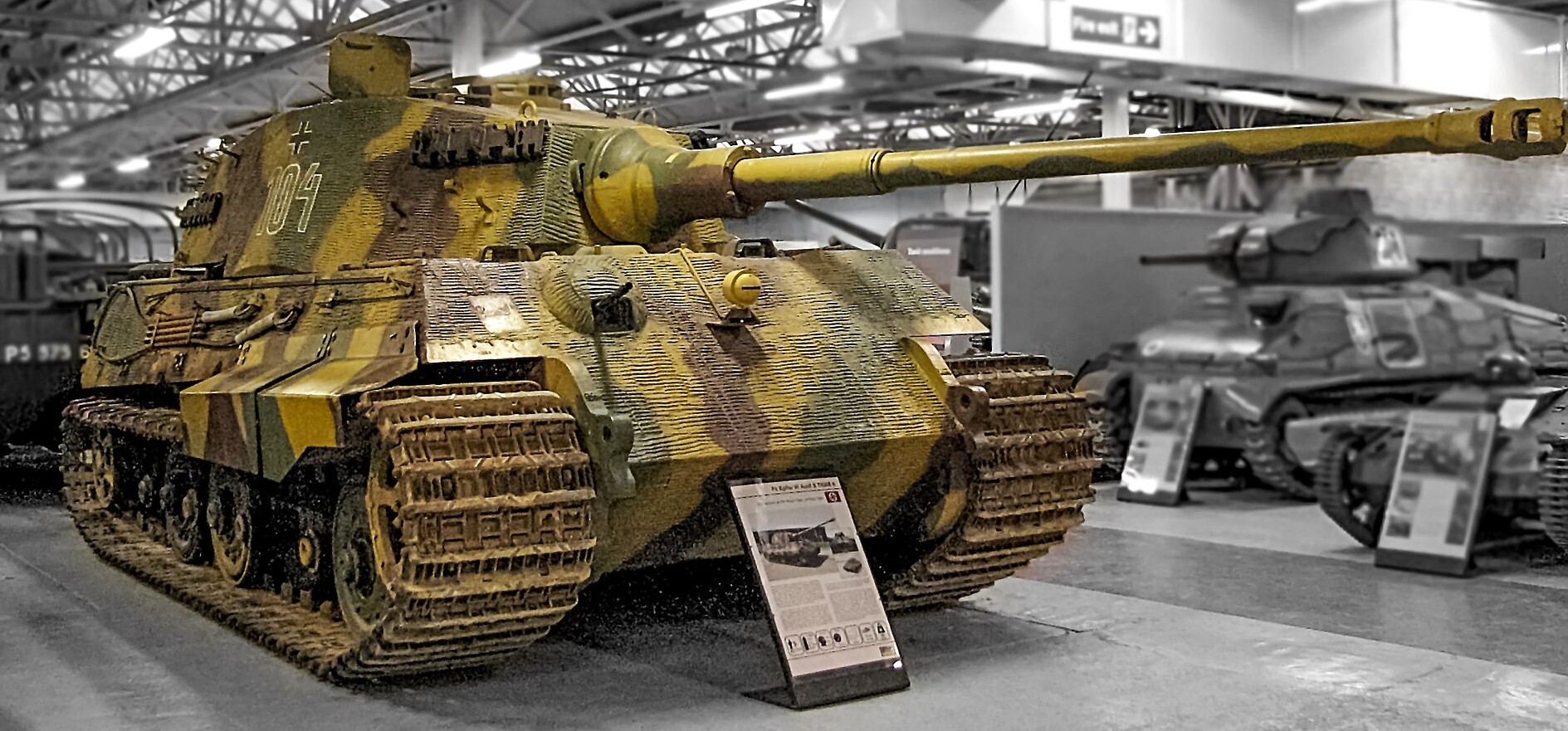
(Georgfotoart Photo)
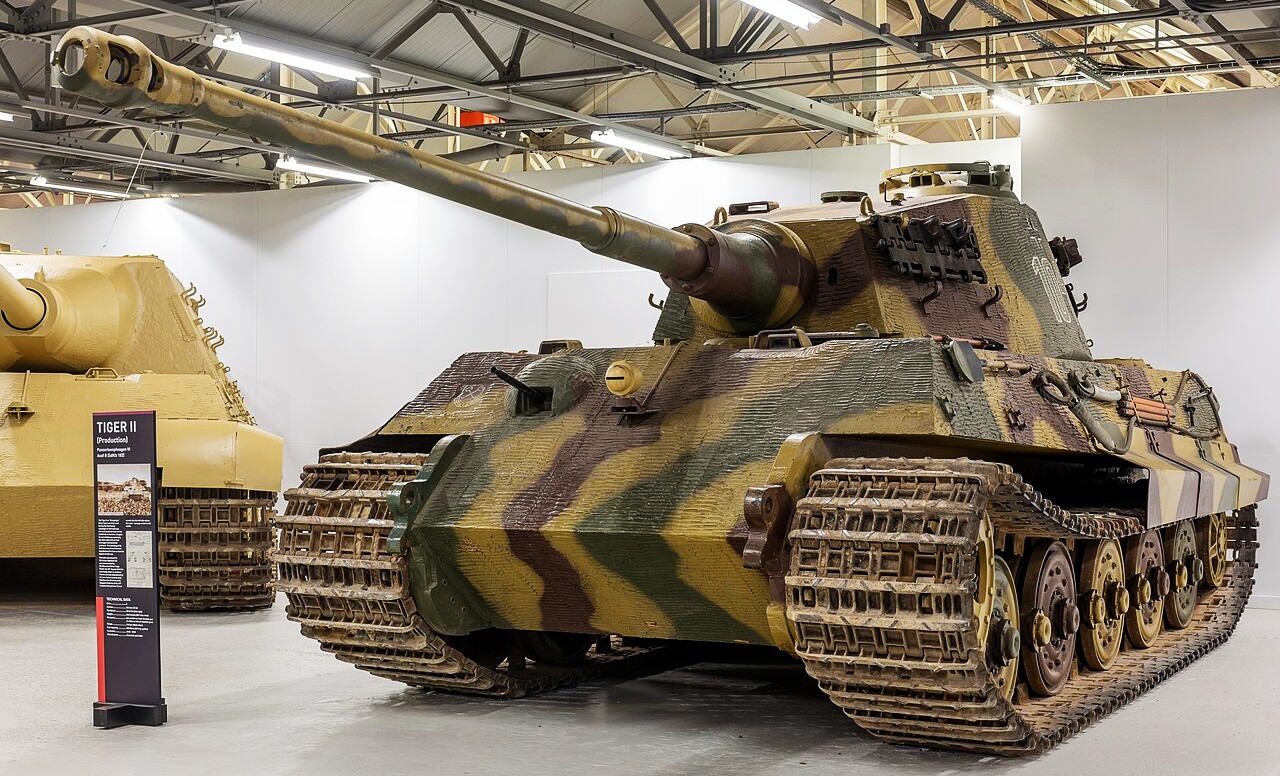
(Morio Photo)
(Morio Photo)
(Alan Wilson Photo)
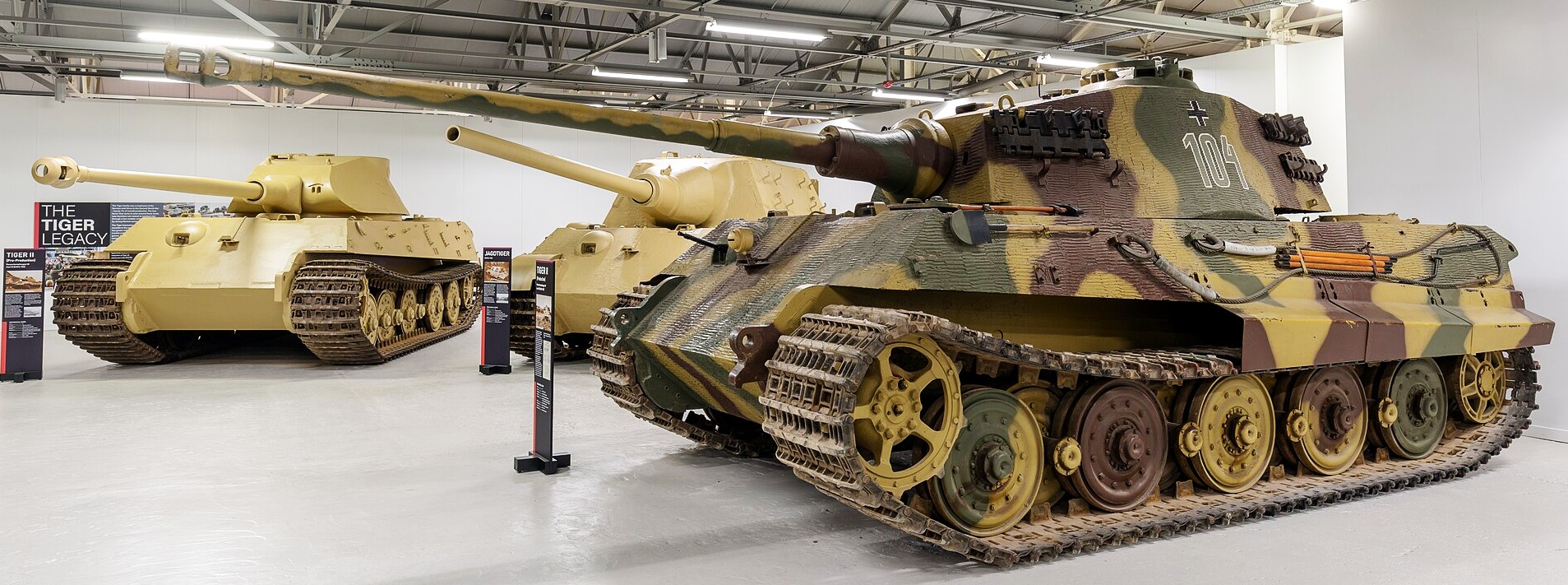
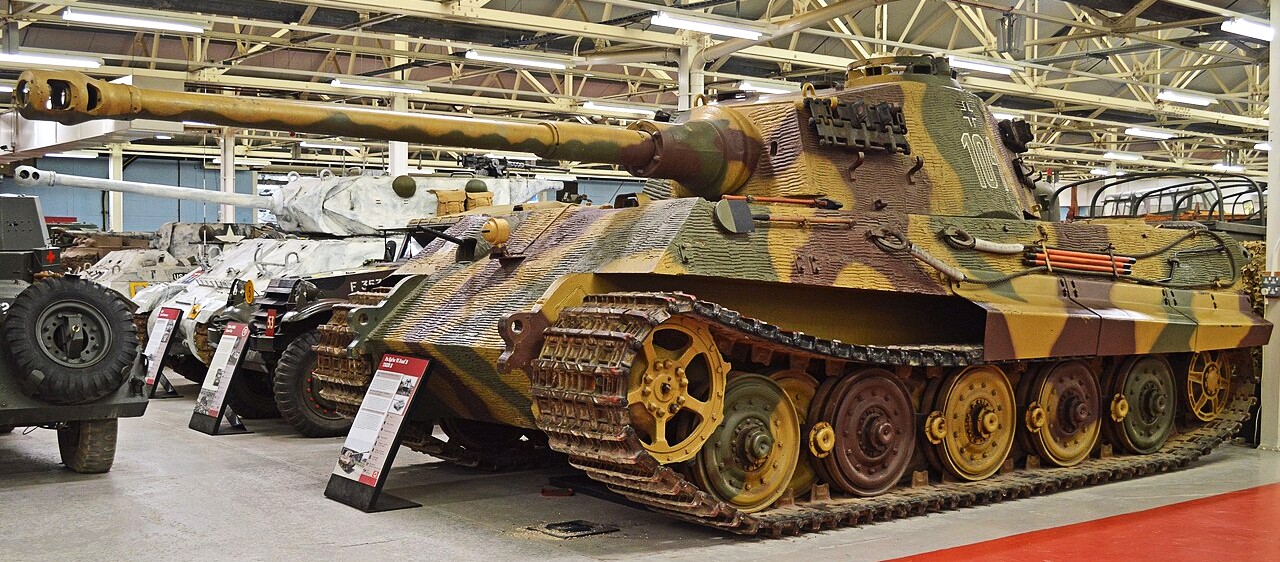
Chassis No. 280093. Official designations:- Sd Kfz 182 Panzerkampfwagen VI Ausf B, VK45.03(H). Built July 1944 by Henschel & Sohn. The Tiger II was developed from the legendary Tiger I and combine thick armour with the Panzer style sloping hull design. Production began in 1944 and 492 had been built by the end of the war. The type was informally known ‘Königstiger’ which is German for ‘Bengal Tiger’. The literal translation, however, is ‘Royal Tiger’ which led to it being known to Allied troops as the ‘King Tiger’ (which does seem somehow appropriate!). The type saw significant use in several major battles in the last year of the Second World War, including in Normandy in July 1944 as well as Operation Panzerfaust (the taking of Budapest) in October 1944, the Ardennes Offensive (The Battle of the Bulge) in December 1944 and the Battle of Berlin leading up to the final days of the war. This is a standard production example fitted with the production turret, often referred to (incorrectly) as the Henschel turret. It was captured by advancing Allied forces on the outskirts of Beauvais, in late August 1944. It had already been abandoned and had clearly been shot at, but details of the actual battle are unclear. Of the eight surviving examples, two are at Bovington, this production example being displayed along with the second prototype (Chassis No V2). The Tank Museum, Bovington, Dorset, UK.
(Alan Wilson Photo)
(Alan Wilson Photo)
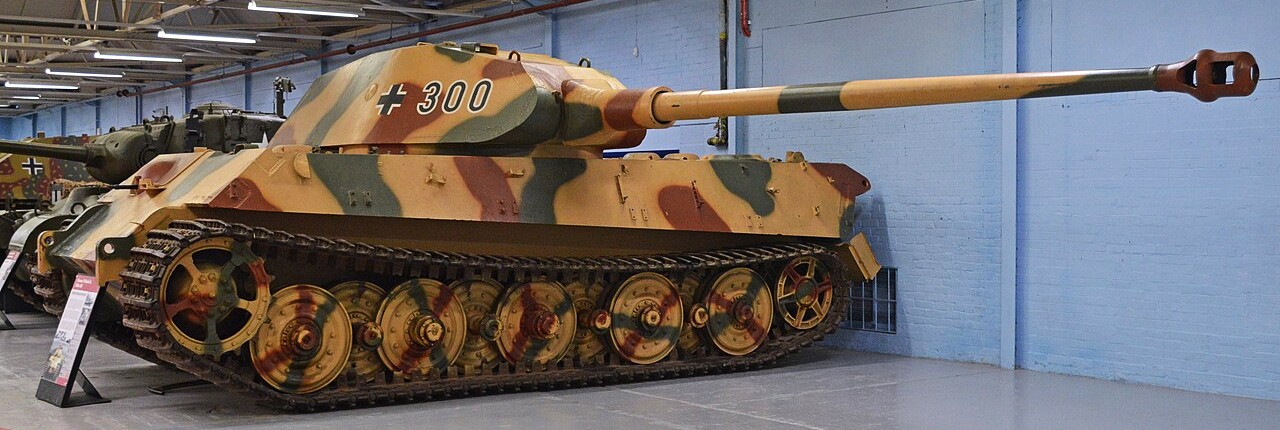
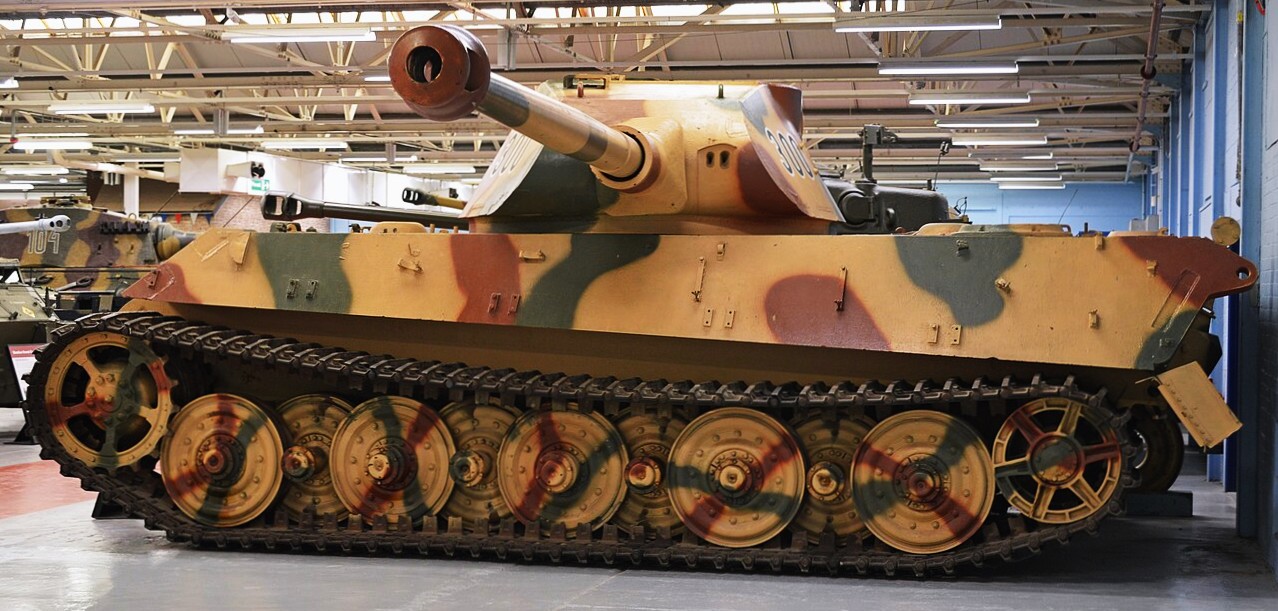
Chassis No. V2 (the second of three prototypes). Official designations:- Sd Kfz 182 Panzerkampfwagen VI Ausf B, VK45.03(H). Built January 1944 by Henschel & Sohn. This is the second prototype of the production design. It was retained by Henschel for trials, eventually being captured at the Henschel testing ground at Haustenbeck. It is fitted with the Krupp turret originally designed for both the Henschel or Porsche prototype designs, the VK45.01(H) and VK45.02(P). After unsuccessful trials these two types were abandoned in favour of a third design, the VK45.03(H), which became production Tiger II. Several Krupp turrets had already been manufactured so the first fifty Tiger IIs were fitted with these left-over Krupp turrets, the remaining Tiger II production having the standard turret. Along with a late production Tiger II, this rare prototype is on display at The Tank Museum, Bovington, Dorset, UK.
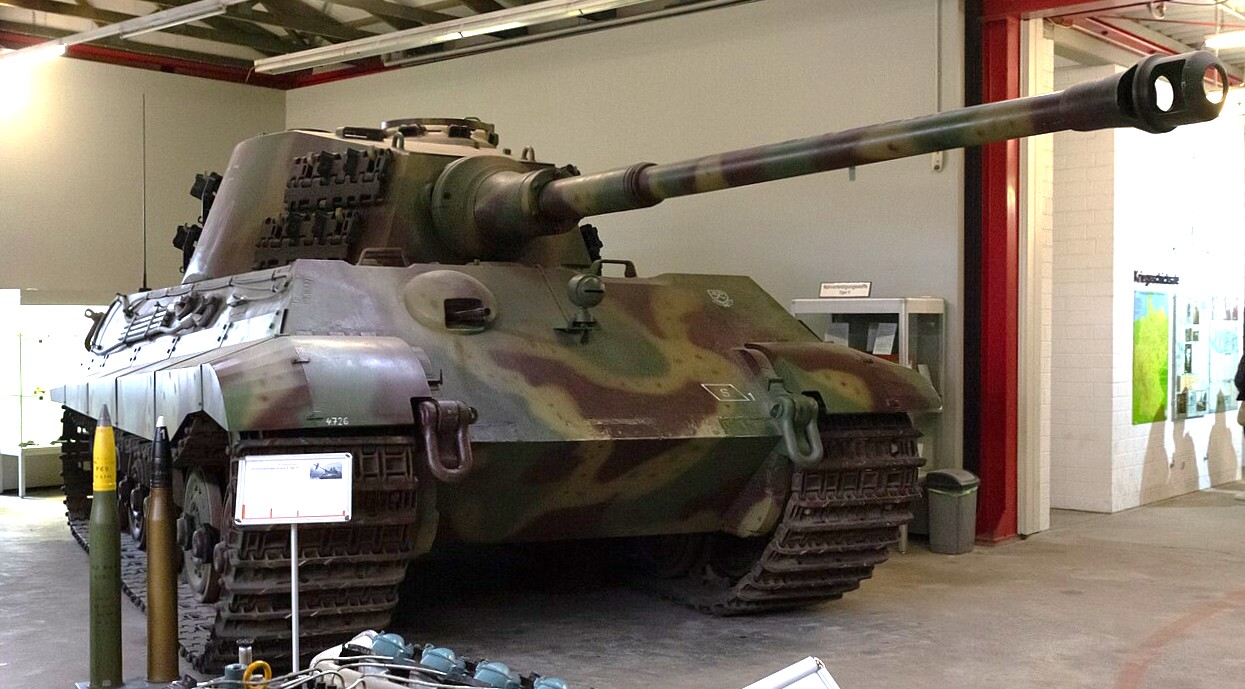
(Clemens Vasters Photo)
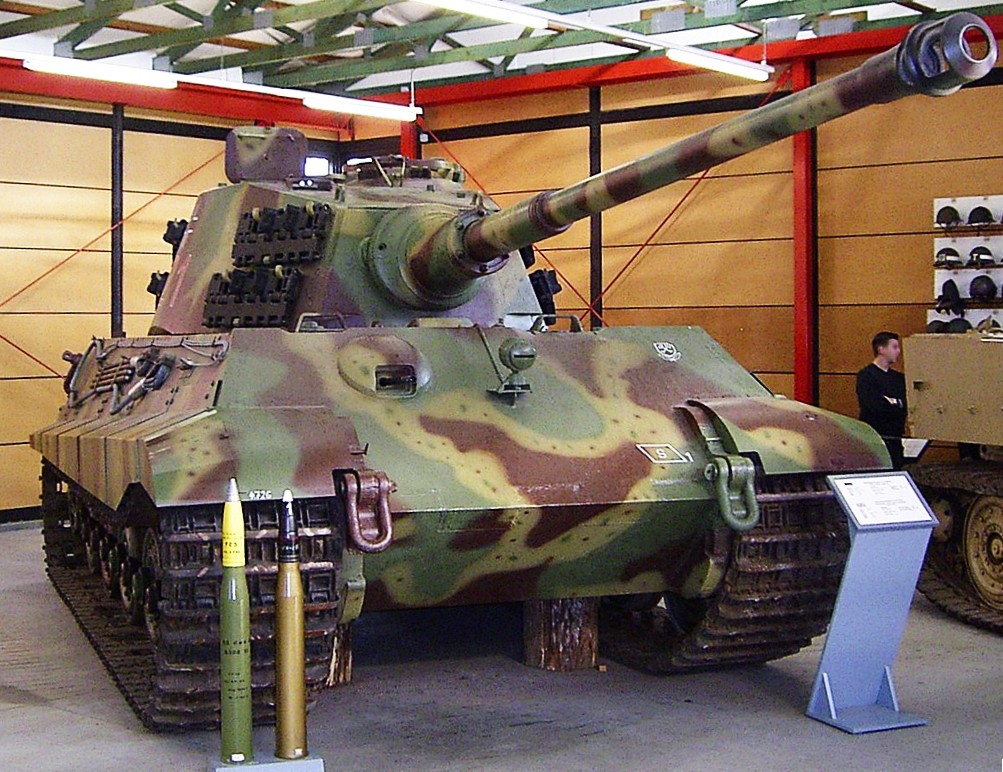
(Werner Willmann hoto)
Panzerkampfwagen VI “Tiger II” Ausf.B (Sd.Kfz. 182) with production (Henschel design) turret on display at the Deutsches Panzermuseum, Munster, Germany.
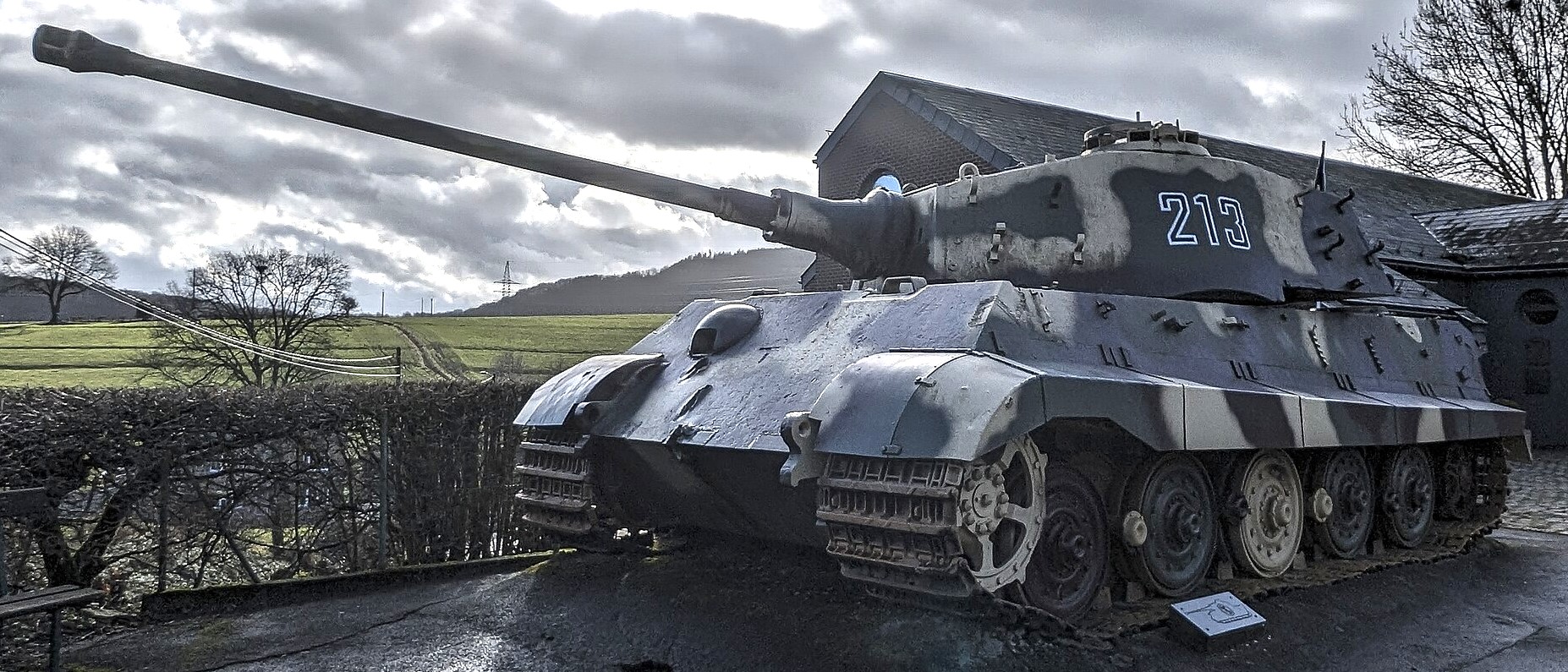
(Paul Hermans Photo)
Panzerkampfwagen VI Ausf.B Königstiger, “Kampfgruppe Peiper”, 1st SS Panzer Division, December 1944 Museum, La Gleize, Belgium. Tiger 213 was commanded by Obersturmführer Dollinger, and was one of the armoured fighting vehicles left behind by Peiper’s 1st SS Panzer about 23 Dec 1944 when it had to withdraw from la Gleize. Instead of playing a defensive role, this Tiger was used as a breakthrough tank. The Kampfgruppe Peipers were forced to leave about six tanks behind. The Americans dueled the Tiger II (turret number 213) with their M4 Shermans and M10 Tank Destroyers during the siege of La Gleize and managed to shoot the gun barrel in half with a fluke shot. The 88-barrel was missing for a long time. It now has a long 75-mm barrel from Panther.
A total of 130 German armoured vehicles were destroyed or left in the region of La Gleize/Stavelt and Ambleve river. This Tiger II was left almost exactly were it is displayed now as a monument. There are three marks on the front of the hull where the US Army attempted to stop the tank with a bazooka.(Charles Whiting)
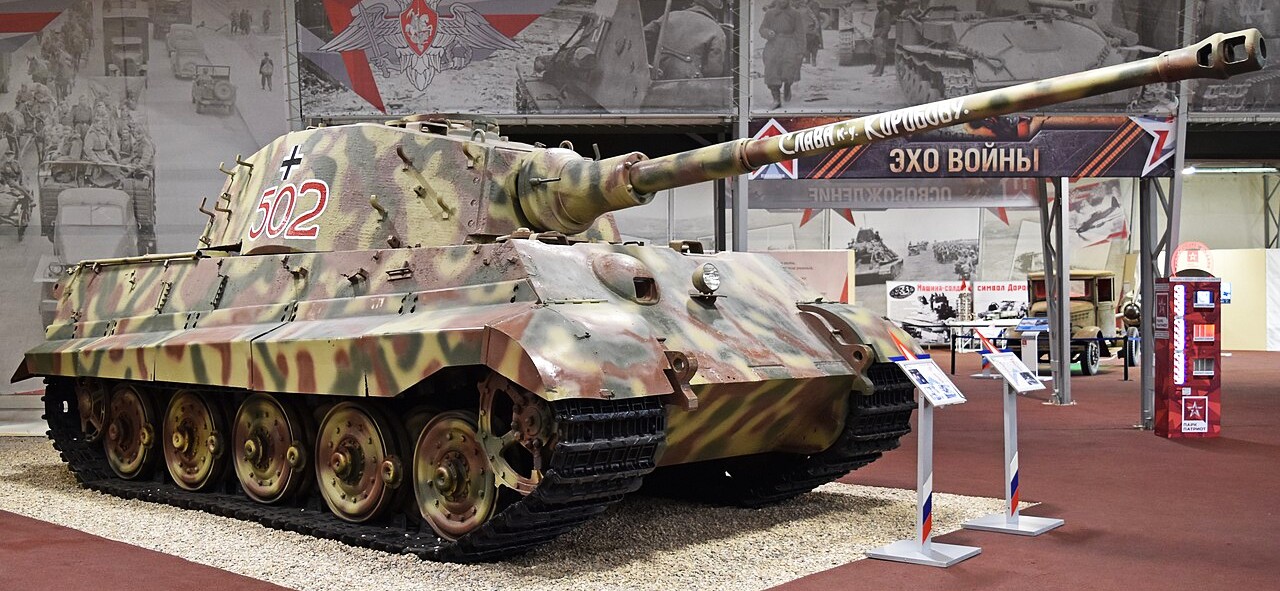
(Alan Wilson Photo)
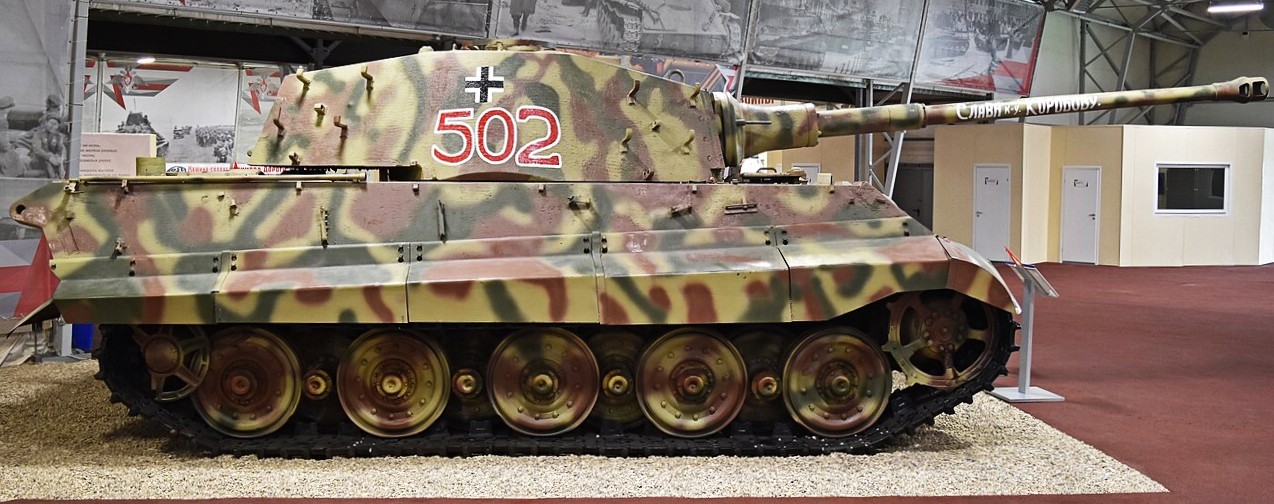
Sd Kfz 267 Panzerbefehlswagen Tiger Ausf B. This was the command tank variant of the formidable Tiger II. Captured after the valiant action described below, it was taken to Kubinka for testing and has remained there since. Recently repainted into accurate colour scheme and markings, it is now on display in Hall 11 of the Patriot Museum Complex. Park Patriot, Kubinka, Moscow Oblast, Russia.
(Alan Wilson Photo)
This is an example of the Panzerbefehlswagen Tiger Ausf B. It was captured in August 1944 near Sandomierz in Poland. It is a SdKfz 267 but it appears to have its mast star aerial fitted in the standard rod aerial position at the back of the turret, and it is fitted with a Russian headlamp in the centre of the glacis plate. It has Russian text painted on the side, part of which translates as “captured 13-8-1944”. It was one of three knocked out by Jr. Lt. Aleksander Oskin commanding a T-34/85 on 12 August 1944, the first time these vehicles had been encountered by the Red Army (source: R. Fleming). He was part of the 53rd Guards Tank Brigade and in the evening of 11 August was ordered to conduct a scouting patrol to the small village of Ogledow. Finding German troops in the village, he stopped and observed them, having camouflaged his tank in a corn field. Before sunset a German tank column entered the village and shot it up, and then halted for the night. Early the next morning the tank unit, part of sPzAbt 501, the first unit in the East to receive the Tiger II, left the village and moved along the road towards Oskin’s tank. His crew did not recognise the vehicles but he had heard of a new German heavy tank and waited until the last minute to open fire. He let the three tanks approach to about 200m before firing at them from the side. After firing a number of rounds in a short space of time he destroyed the first two, both of which later exploded. He then followed the retreating third tank and stopped it with a round through the rear armour. He took some prisoners, and was later awarded the Hero of the Soviet Union (GSS) award for his success. This tank, number “502”, was probably the third tank; it was recovered soon after and sent back to Moscow for examination.”
(Youcef Photo)
(Thesupermat Photo)
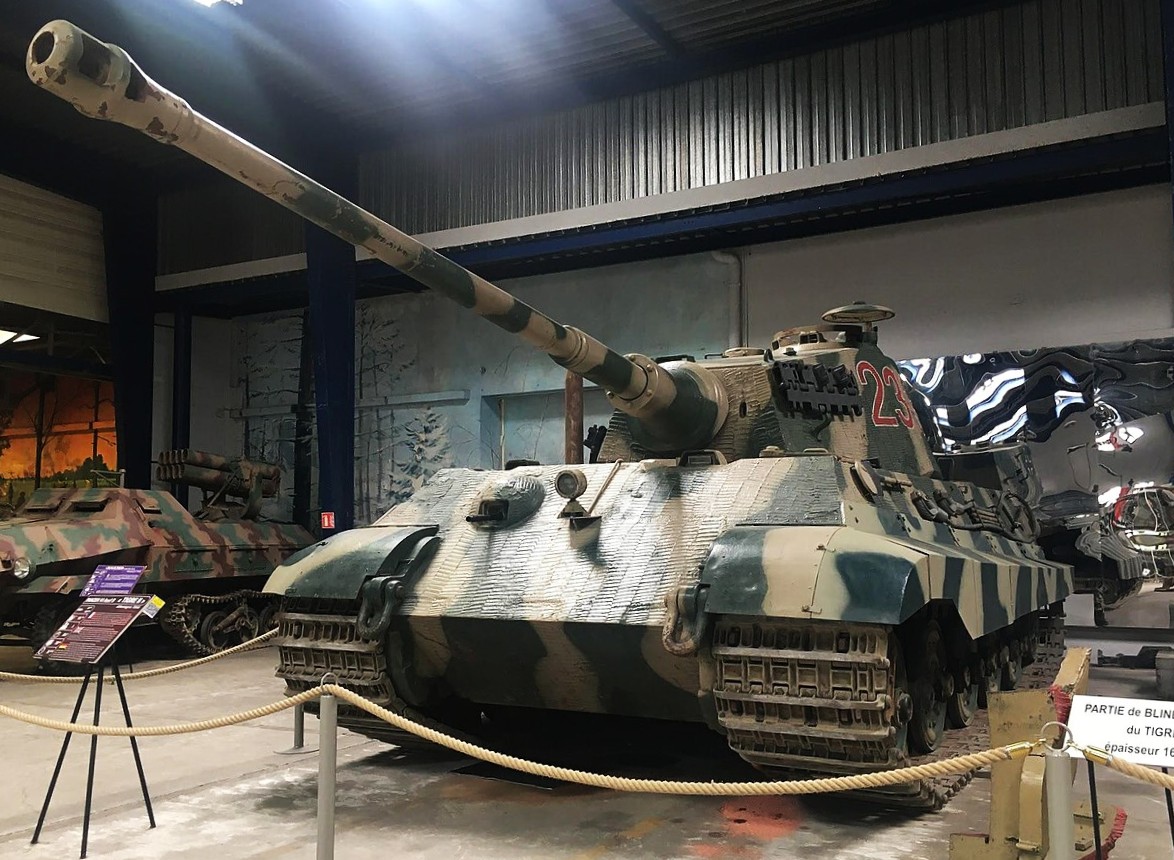
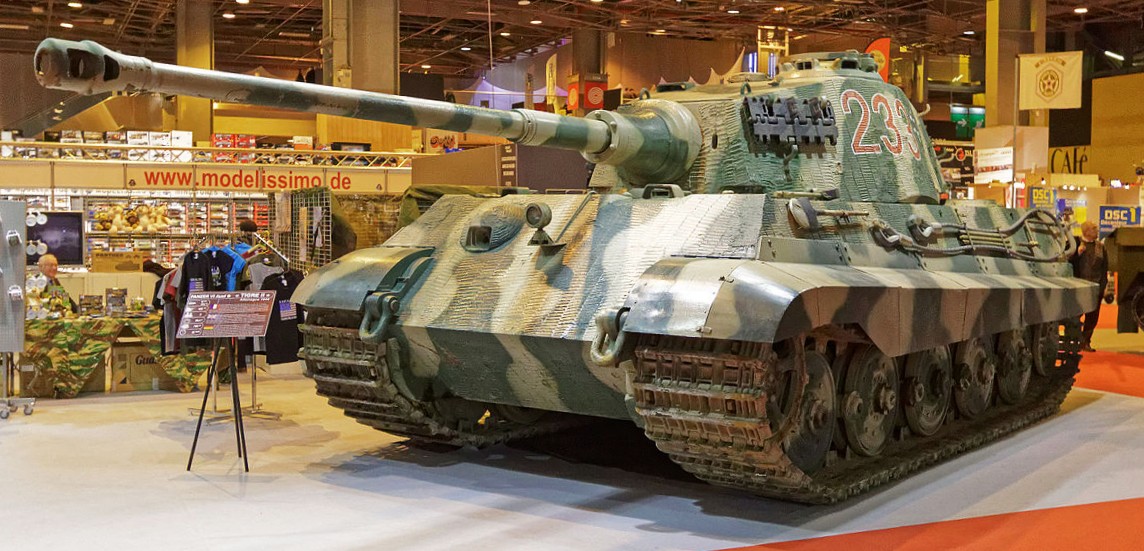
Panzerkampfwagen VI Tiger II in the Musée des Blindés, Saumer, France.
(Bundesarchiv Bild 101I-680-8282A-03A/tormetor4555 Photo)
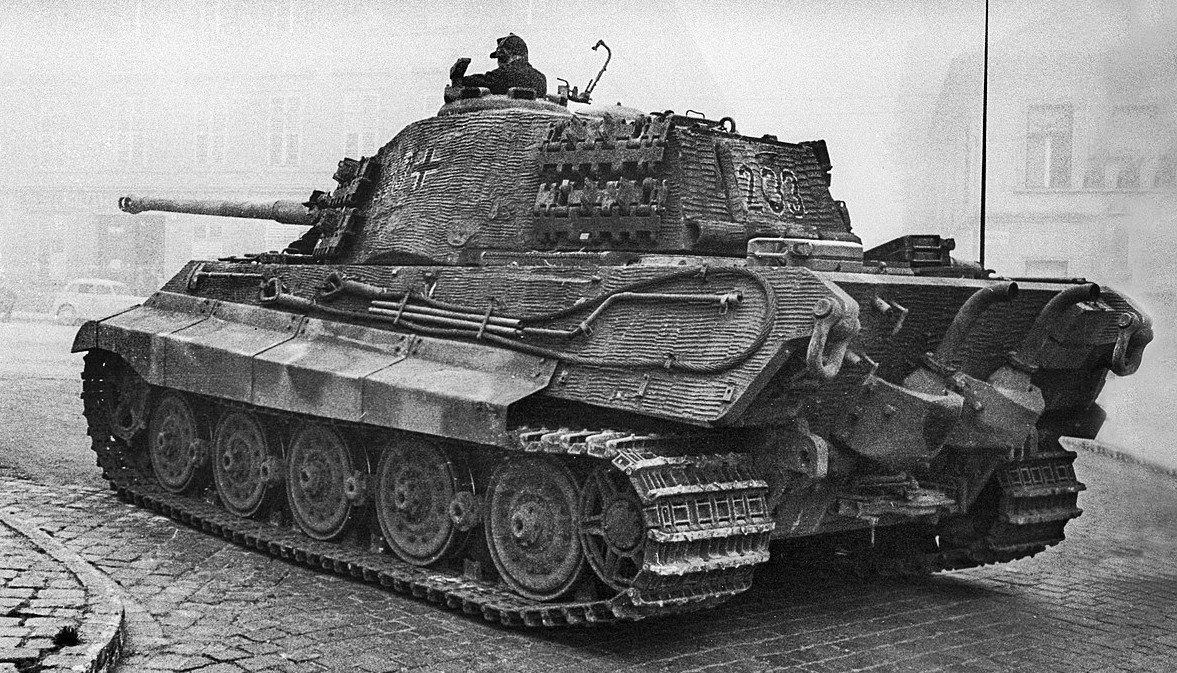
Pz.Kpfw. VI Ausf. B “Tiger II” (223) of the 503rd heavy tank battalion on the streets of Budapest, October 1944.
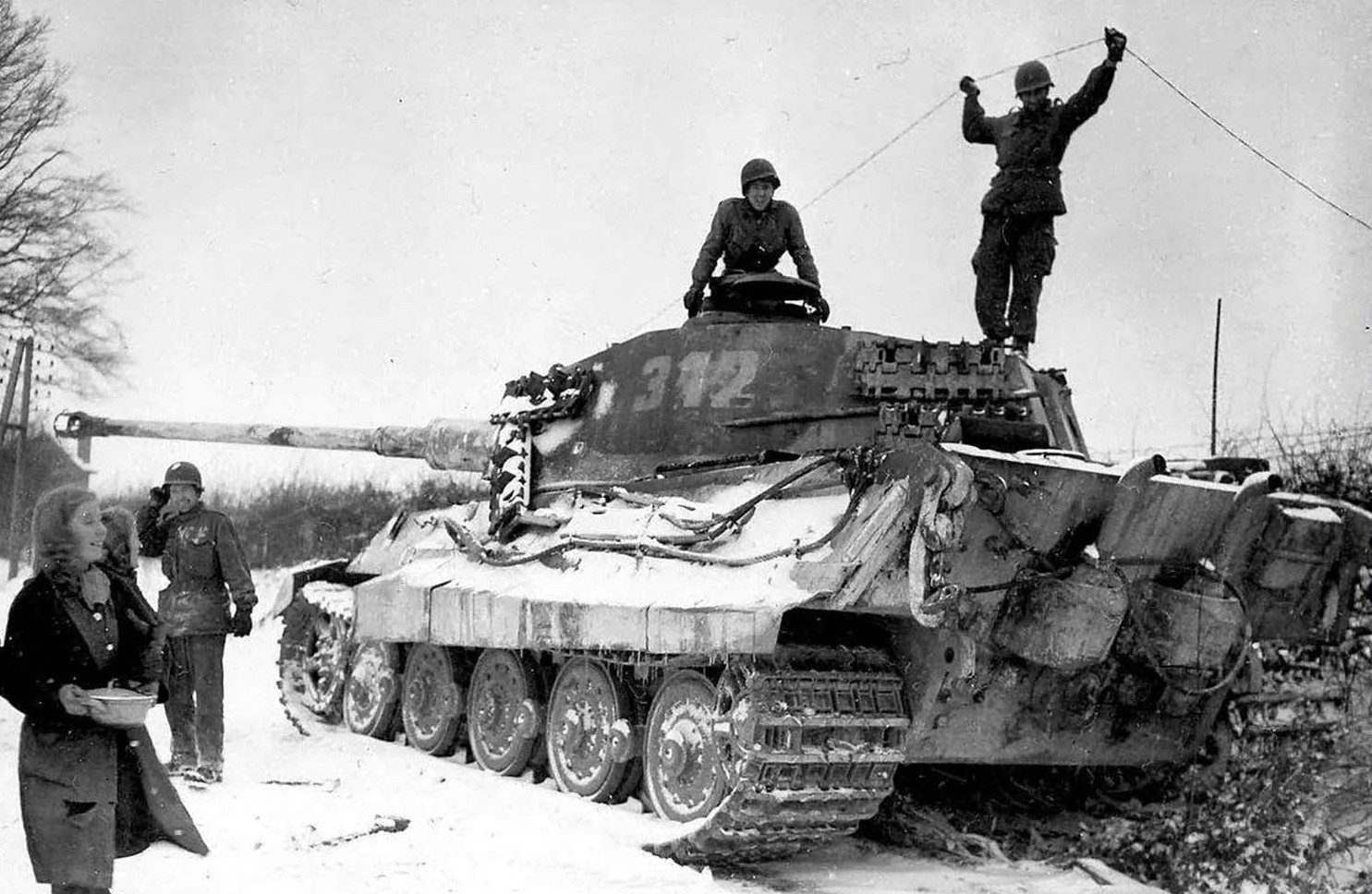
(US Army Photo)
Two 82nd Airborne Division soldiers inspect a destroyed Tiger II, No. 312 at Corenne, Belgium, during the Battle of the Bulge, December 1944.
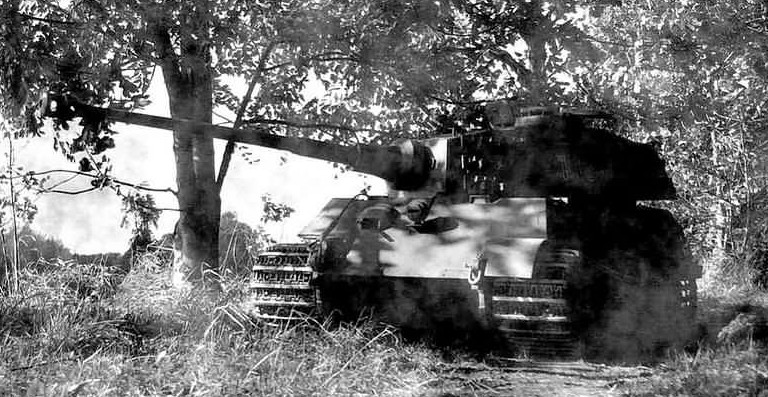
(Wehrmacht Photo)
Tiger II Konigstiger.
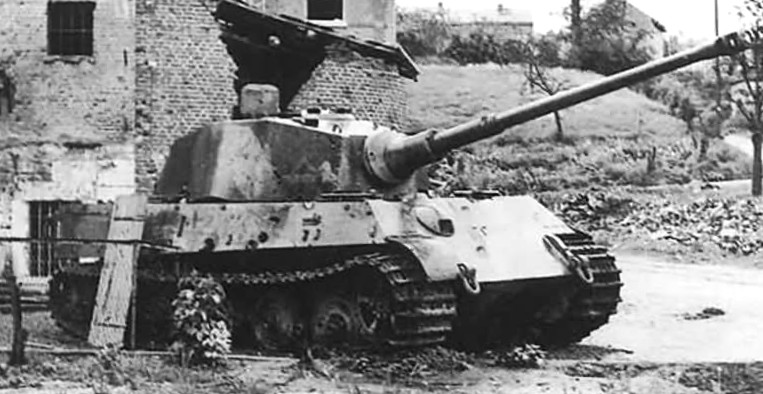
(Wehrmacht Photo)
Tiger II Konigstiger.
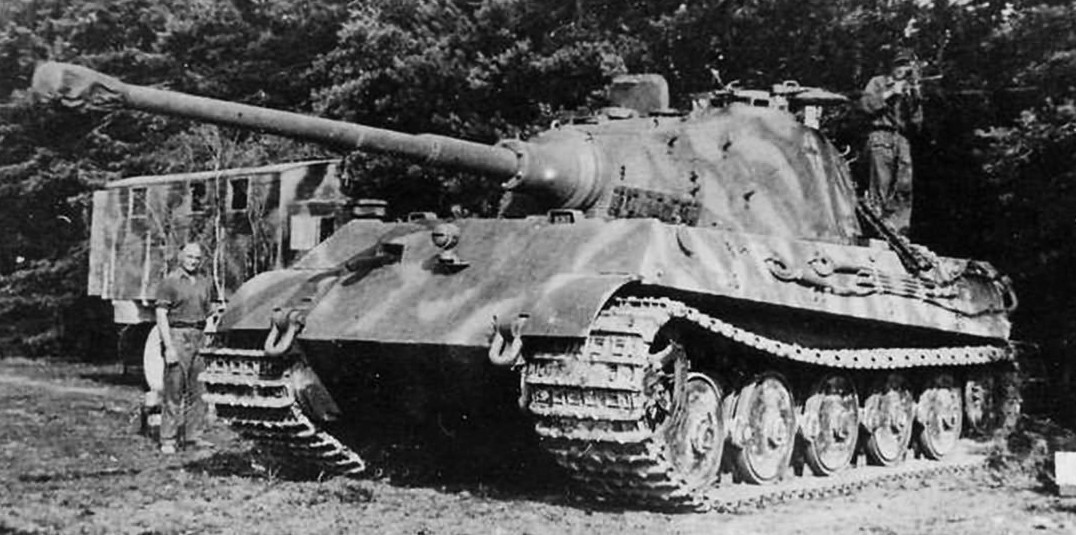
(Wehrmacht Photo)
Tiger II Konigstiger.
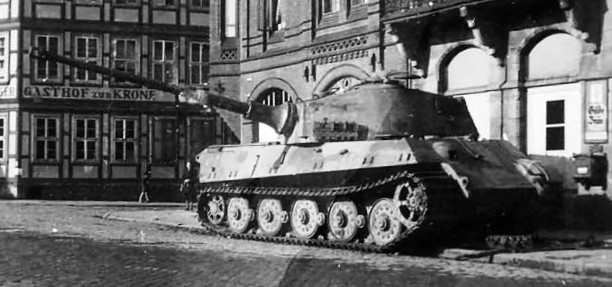
(Wehrmacht Photo)
Tiger II Konigstiger.
Jagdpanther SdKfz 173
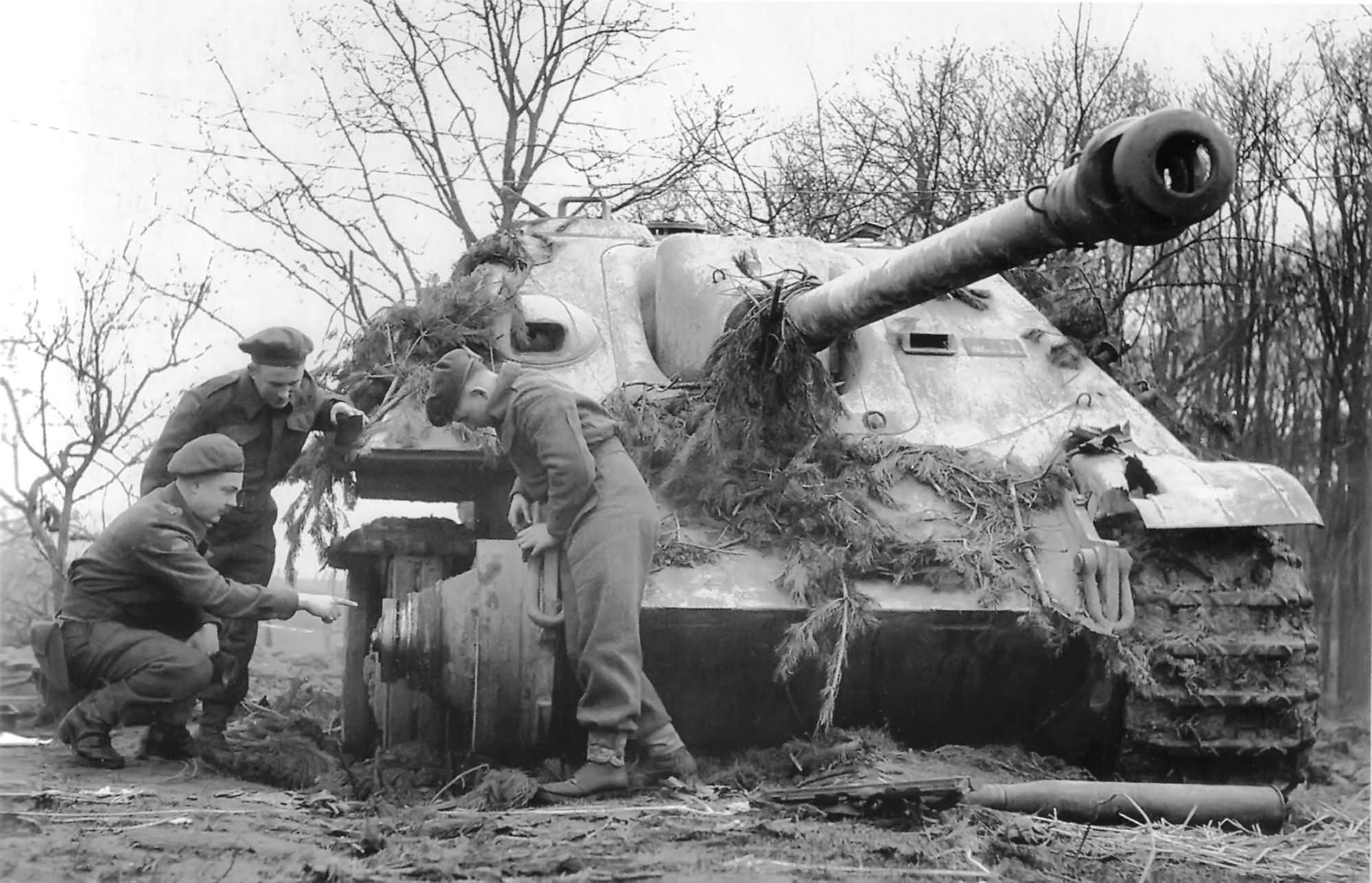
(DND Photo)
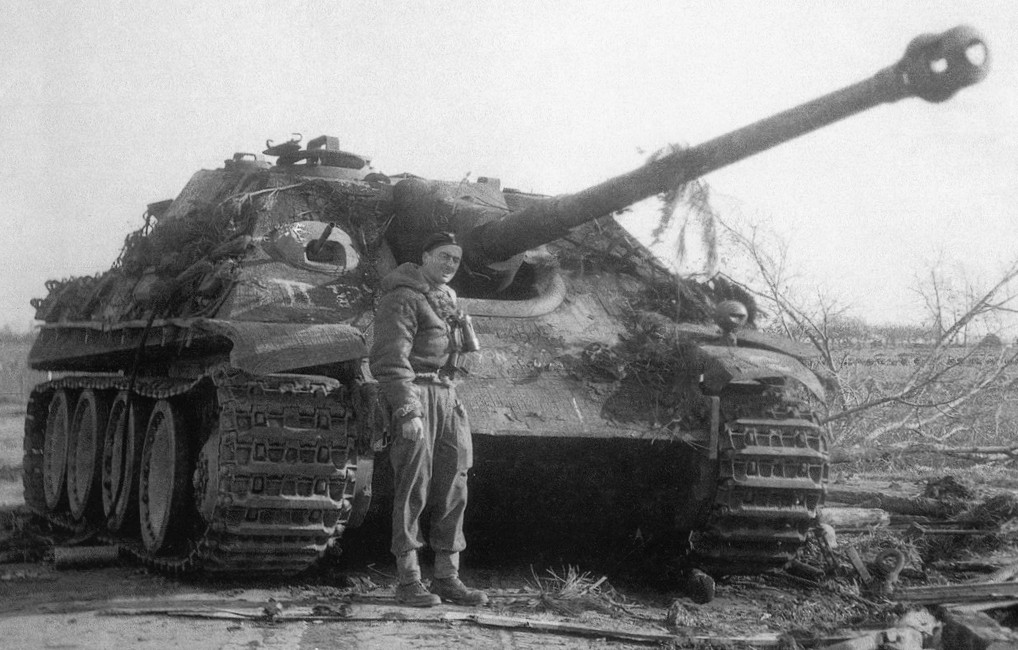
German Jagdpanther SdKfz 173, inspected by Canadian soldiers with the 61st anti-tank Regiment, Royal Canadian Artillery, in the Reichswald on 14th March 1945.
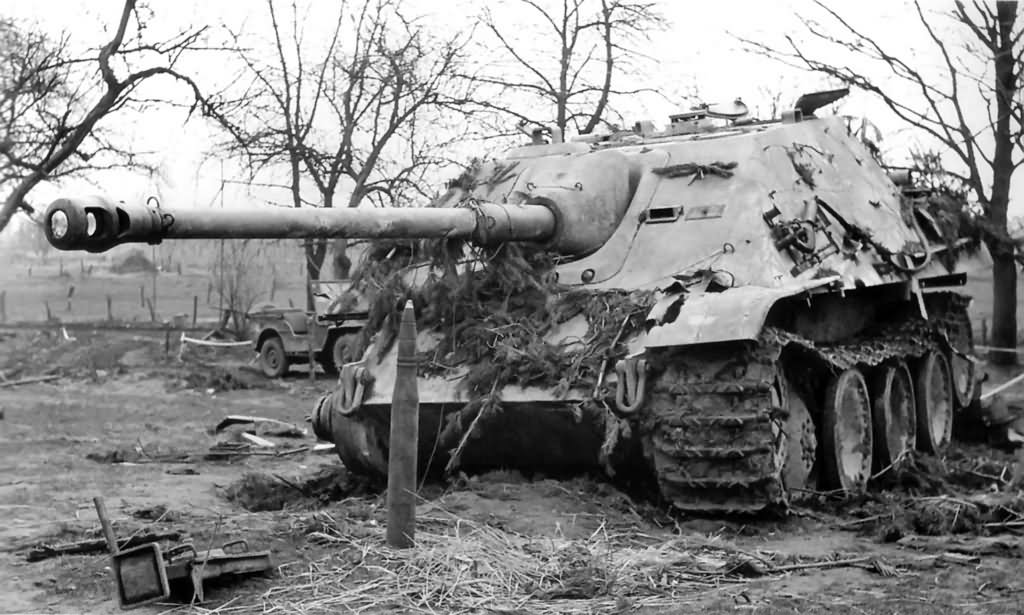
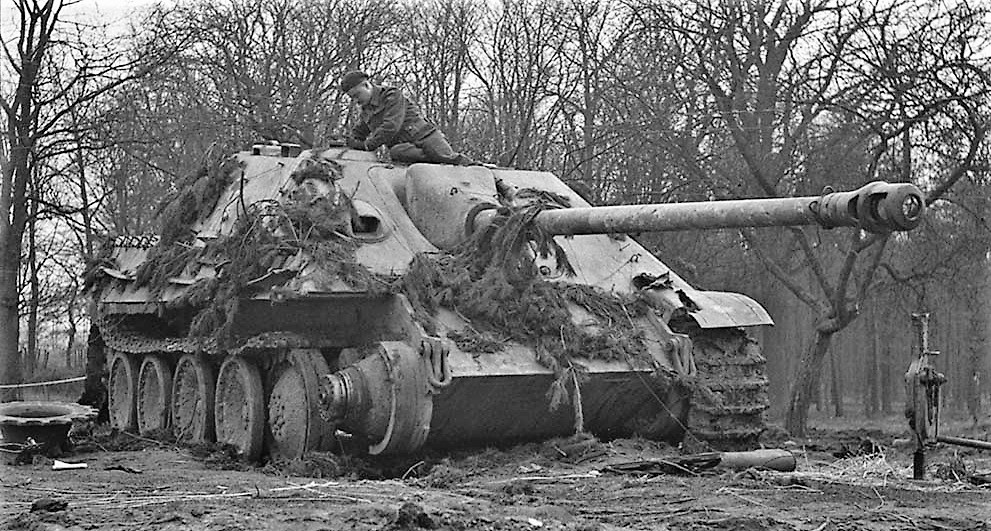
(Library and Archives Canada Photo, MIKAN No. 3520261)
Member of the Royal Canadian Corps of Signals looking over destroyed German Jagdpanther Sd.Kfz. 173 tank destroyer, 15 March 1945.
(IWM Photo)
Jagdpanther Sd.Kfz. 173 of schwere Panzerjäger-Abteilung 559, knocked out by units of the 1st Polish Armoured Division (1 Dywizja Pancerna) at Ramsdonk (Raamsdonk), Netherlands. 1 Nov 1944. The 1st Polish Armoured Division commanded by Generał brygady Stanisław Maczek, served with the First Canadian Army in the Netherlands.
Operation Tractable was the final attack conducted by Canadian and Polish troops, supported by a British tank brigade, during the Battle of Normandy during the Second World War. The operation was to capture the tactically important French town of Falaise and then the smaller towns of Trun and Chambois. This operation was undertaken by the First Canadian Army with the 1st Polish Armoured Division (Generał brygady Stanisław Maczek) and a British armoured brigade against Army Group B of the Westheer in what became the largest encirclement on the Western Front during the Second World War. Despite a slow start and limited gains north of Falaise, novel tactics by the 1st Polish Armoured Division during the drive for Chambois enabled the Falaise Gap to be partially closed by 19 August 1944, trapping about 150,000 German soldiers in the Falaise Pocket.
Although the Falaise Gap was narrowed to a distance of several hundred metres/yards, as a result of attacks and counter-attacks between battle groups of the 1st Polish Armoured Division and the II SS Panzer Corps on Hill 262 (Mont Ormel) the gap was not closed quickly and thousands of German troops escaped on foot. During two days of nearly continuous fighting, the Polish forces assisted by artillery-fire, managed to hold off counter-attacks by seven German divisions in hand-to-hand fighting. On 21 August, elements of the First Canadian Army relieved the Polish survivors and sealed the Falaise Pocket by linking up with the Third US Army. This led to the surrender and capture of the remaining units of the German 7th Army in the pocket. (Wikipedia)
(Tank Museum Photo)
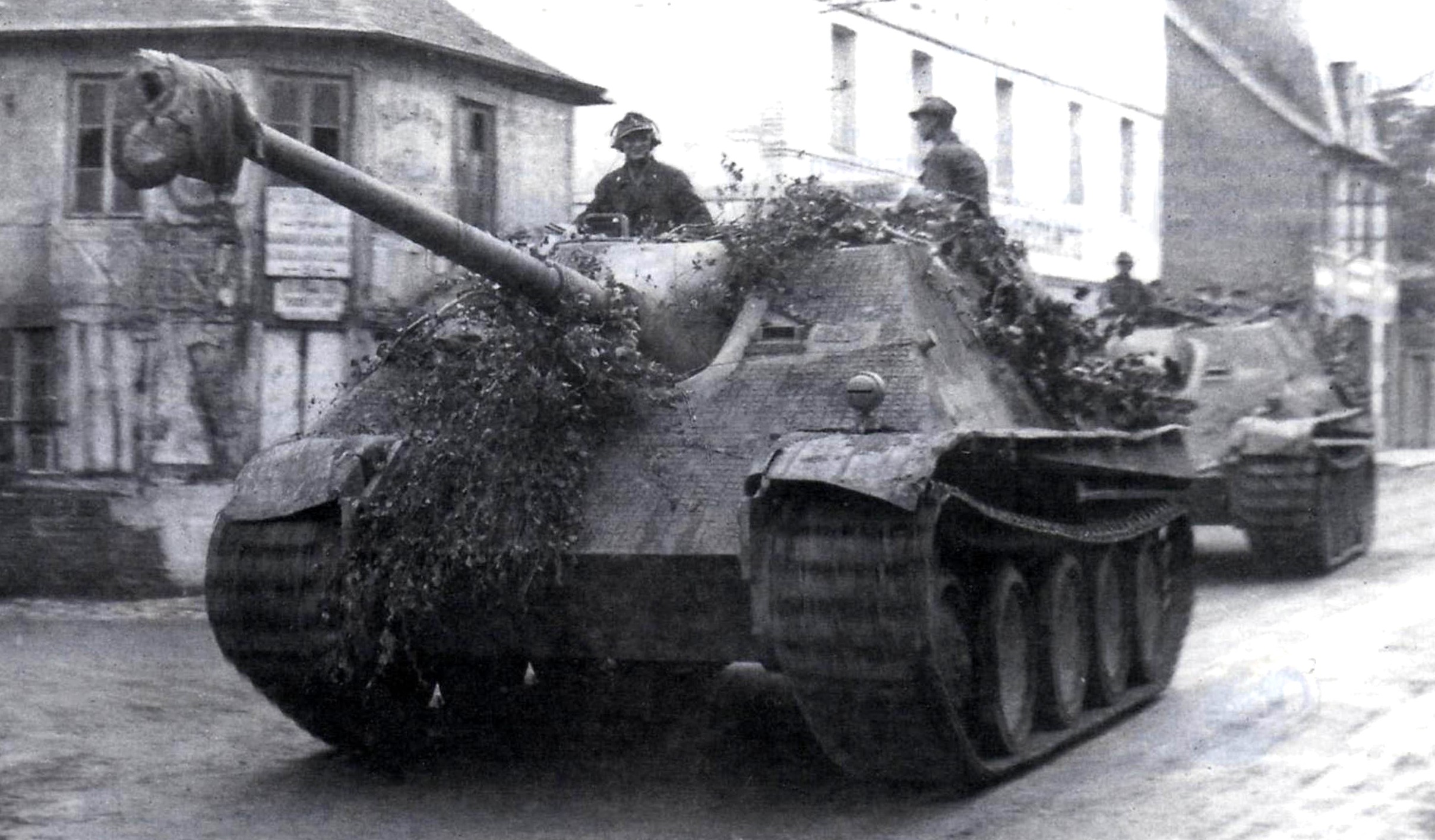
The first action the Jagdpanthers saw was on the 30th of July, when they engaged a squadron of Churchill tanks near St. Martin de Bois. In a two-minute action, three Jagdpanthers managed to take out eleven Churchills, before an additional squadron of Churchills rushed in to help. The 6th Guards tank brigade reported the capture of two Jagdpanthers, which had been left behind due to track damage. Nonetheless, this encounter showed the strength of the new tank destroyer and helped cement its reputation as a threat to any tank that encountered it. (Tank Museum)
(IWM Photo, BU 921)
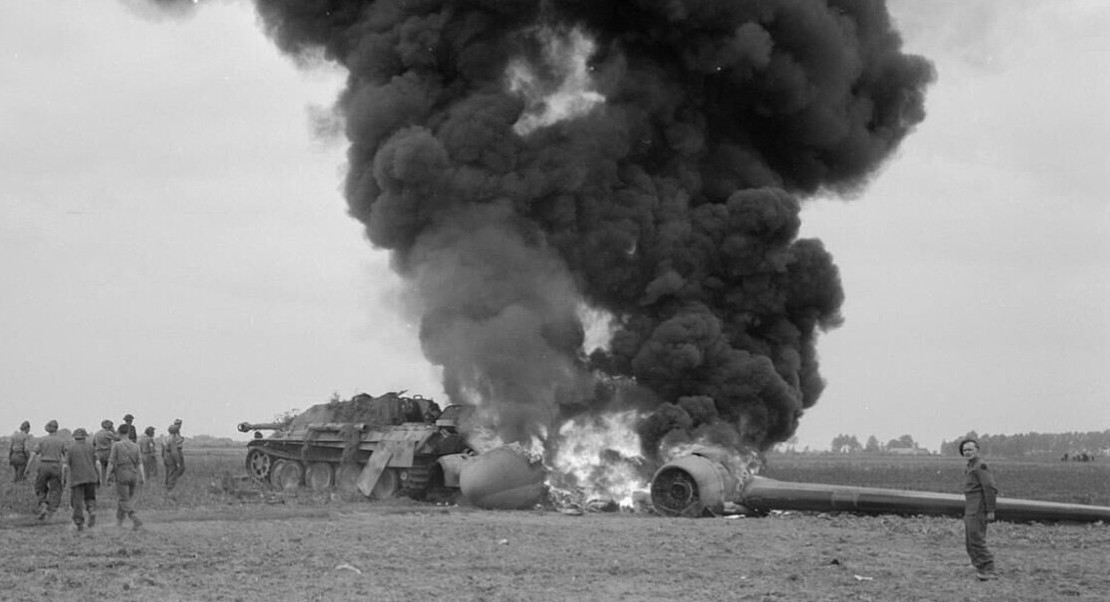
An USAAF C-47 aircraft, hit by flak returning from the Market-Garden drop, burns after crash-landing into a knocked-out German Jagdpanther in a field near Gheel in Belgium.
(baku13 Photo)
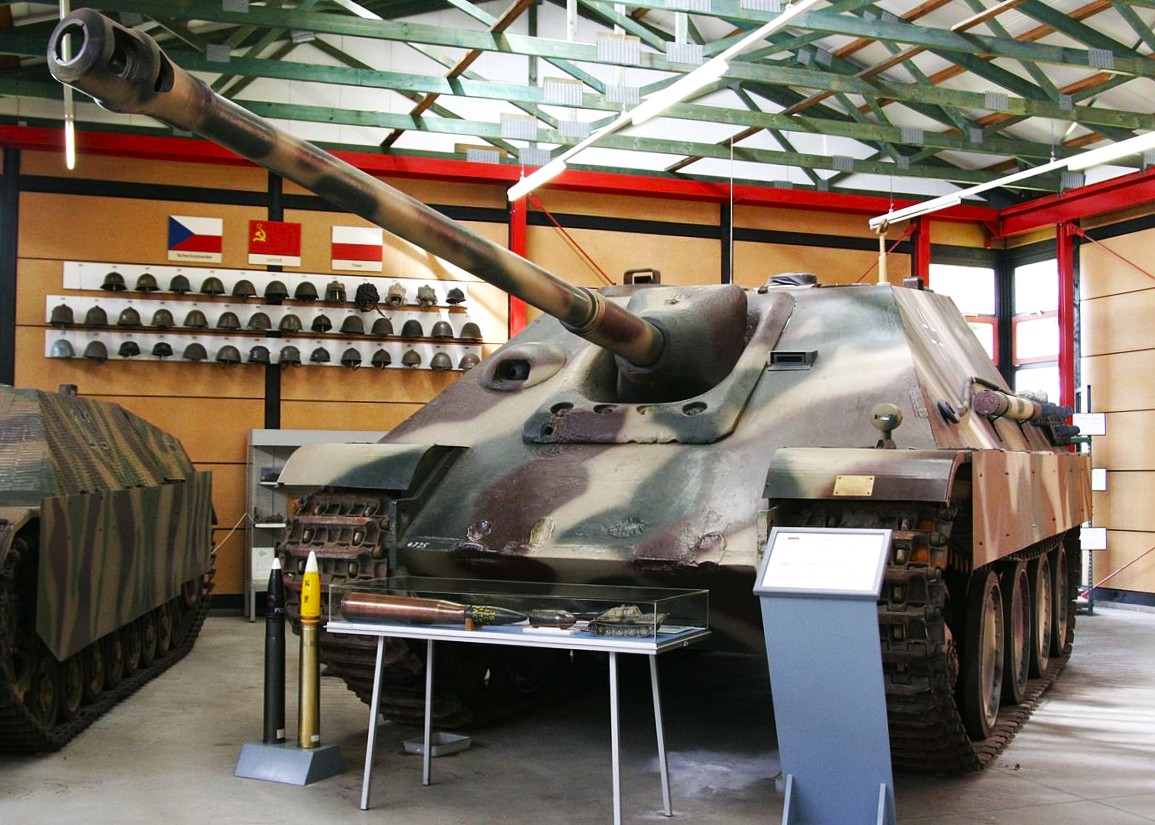
Jaqdpanther Sd.Kfz. 173, on display at the Deutsches Panzermuseum Munster, Germany. There are a number of non-penetrating (bounced-off) hits on the frontal armour.
The Jagdpanther (German: “hunting Panther”), Sd.Kfz. 173, was a tank destroyer (Jagdpanzer, a self-propelled anti-tank gun) built by Germany during the Second World War. The Jagdpanther combined the 8.8 cm Pak 43 anti-tank gun, similar to the main gun of the Tiger II, with the armor and suspension of the Panther chassis. It entered service in 1944 and served on the Eastern and Western Fronts. During the last stages of the war, limited German production resulted in small production numbers, shortage of spare parts, and shortened crew training periods of increasingly young operators. (Wikipedia)
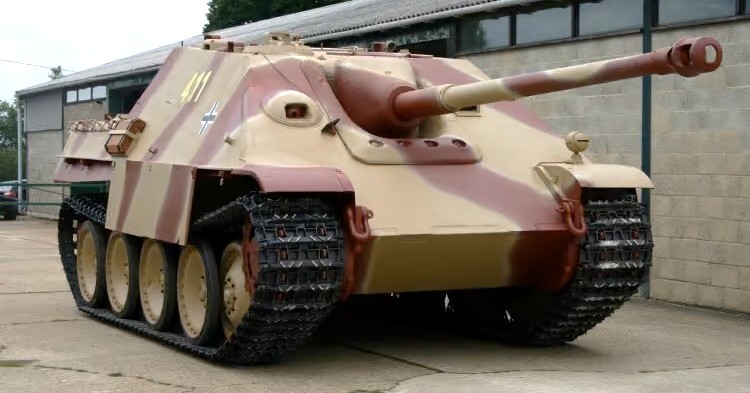
(The Weald Foundation Photo)
Jagdpanther (8.8 cm Pak) – Sd.Kfz.173 Ausf. G2, The Weald Foundation, London, UK. February 1945. Even in the final stages of defeat somehow the assembly plants continued to function. At MNH (Maschinenfabrik Niedersachsen-Hannover) one of the last batches of Jagdpanther were loaded onto a train and dispatched to the front. Among them was Fahrgestell Nr (chassis number) 303086, soon to be lost from sight in the maelstrom of the final days of the Third Reich. Fifty years later in 2000, the Foundation purchased two wrecked Jagdpanther from a collector in Germany.
Unfortunately, after years of being used as range targets, both were riddled with holes and missing substantial parts of their armour. The first Jagdpanther (No.1) had been recovered from the Pirbright ranges, England in the 1970s in exchange for an artillery piece. The second Jagdpanther (No.2) had been salvaged from a British range in northern Germany and was in by far the worse condition.
The first order of business was to establish both Jagdpanther production lineage and then, if possible, their unit histories. An initial survey of Jagdpanther No.1 revealed that the chassis number was unreadable. The second Jagdpanther had chassis number 303 110. 303 being the batch allocated to MNH and 110 – the 110th vehicle off the assembly line. It was decided that Jagdpanther No.1 (Jagdpanther 411) was the candidate for restoration. The overall task not only required obtaining Jagdpanther parts, repairing existing parts, or in some cases manufacturing new parts; it also required extensive research not only involving our research team but also help from various external sources. The Jagdpanther underwent 10 years of restoration. This was a very expensive and complex undertaking which required a considerable amount of outsourced engineering, years of tracking down the required original radio and intercom equipment, main gun etc and a tremendous amount of intricate and backbreaking work. (The Weald Foundation)
Panzerkampfwagen VI Ausführung E
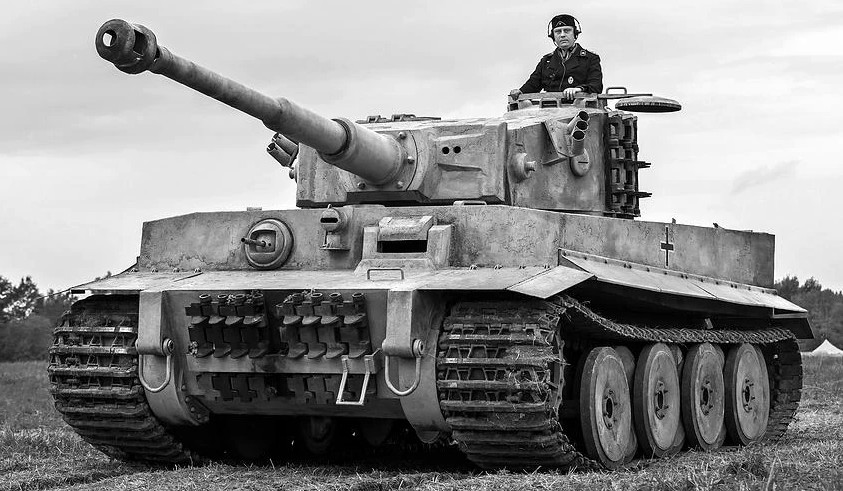
(IWM Photo)
The Tiger I was heavy tank that began operational duty in 1942 in Africa and in the Soviet Union, usually in independent heavy tank battalions. It gave the German Army its first armoured fighting vehicle that mounted the 8.8 cm (3.5 in) KwK 36 gun (derived from the 8.8 cm Flak 36, the famous “eighty-eight” feared by Allied troops). 1,347 were built between August 1942 and August 1944. After August 1944, production of the Tiger I was phased out in favour of the Tiger II. While the Tiger I has been called an outstanding design for its time, it has also been criticized for being overengineered, and for using expensive materials and labour-intensive production methods. In the early period, the Tiger was prone to certain types of track failures and breakdowns. It was expensive to maintain, but generally mechanically reliable. It was difficult to transport and vulnerable to immobilisation when mud, ice, and snow froze between its overlapping and interleaved Schachtellaufwerk-pattern road wheels, often jamming them solid.
The tank was given its nickname “Tiger” by the ministry for armament and ammunition by 7 August 1941, and the Roman numeral was added after the Tiger II entered production. It was classified with ordnance inventory designation Sd.Kfz. 182. The tank was later re-designated as Panzerkampfwagen VI Ausführung E (abbreviated as Pz.Kpfw. VI Ausf. E) in March 1943, with ordnance inventory designation Sd.Kfz. 181. Today, only nine Tiger I tanks survive in museums and private collections worldwide. (Wikipedia)
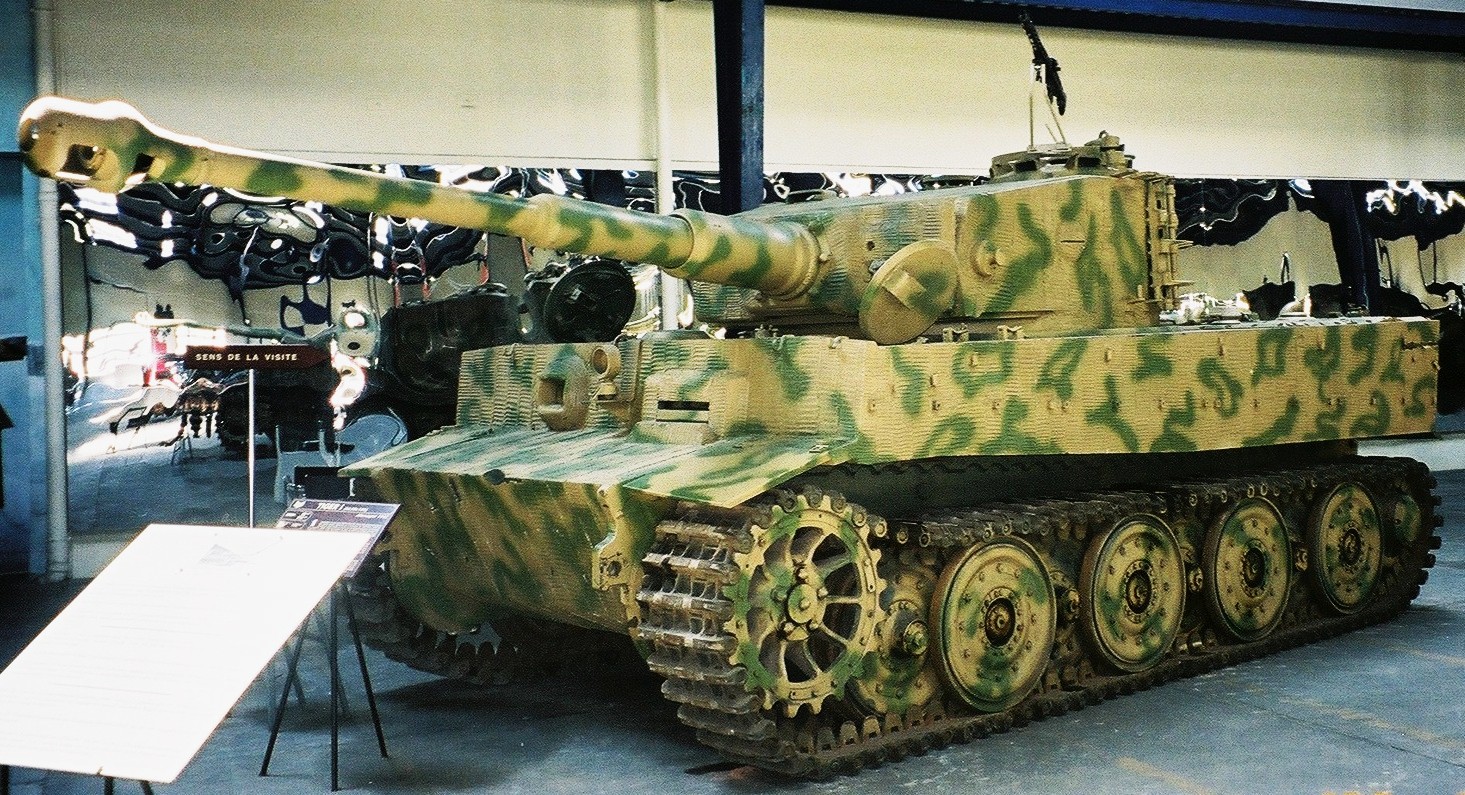
(Hal9001 Photo)
Tiger I Colmar in the Musée des Blindés in Saumur, France.
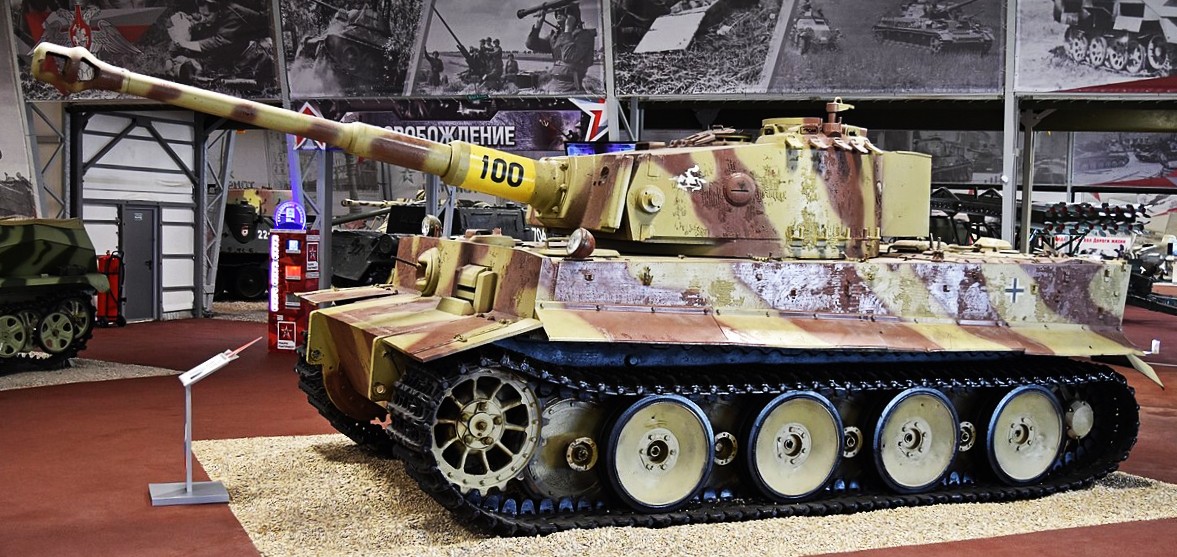
(Alan Wilson Photo)
Panzerkampfwagen VI Ausführung E, Tiger I, 100, Patriot Museum Complex. Park Patriot, Kubinka, Moscow Oblast, Russia.
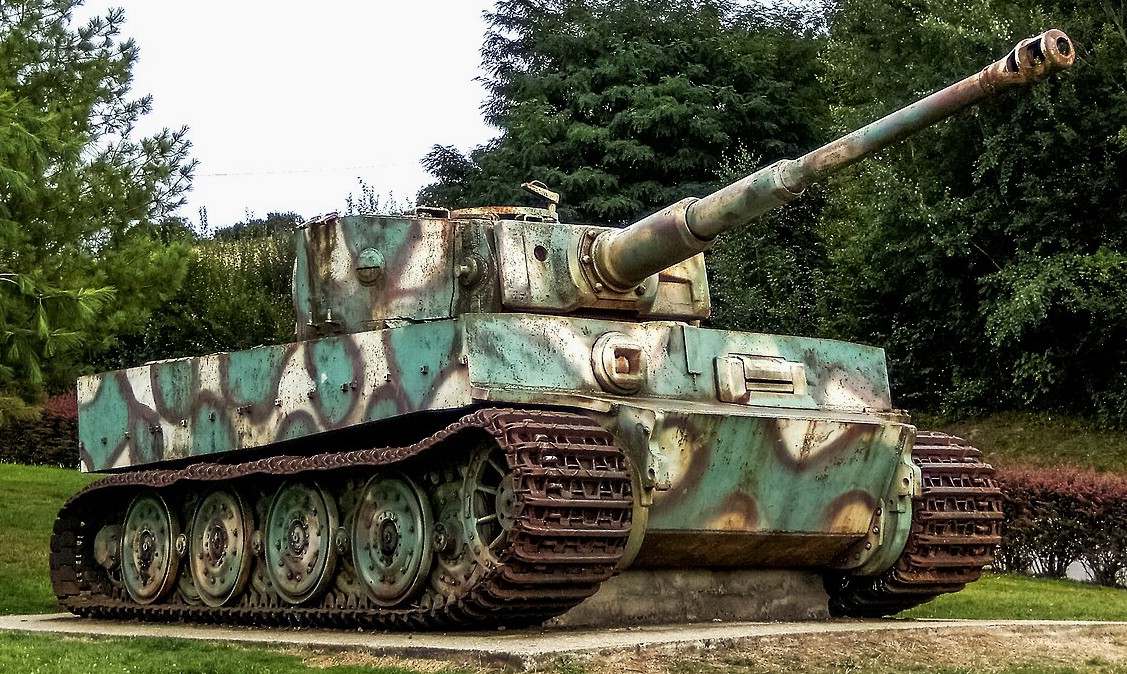
(Georgfotoart Photo)
Tiger I tank abandoned in August 1944 during the closing of the Chambois pocket (Battle of Normandy). Restored in the 1970s, it was classified as a historic monument in 1975. Vimoutiers, Orne, France. On the 19th August 1944 several German tanks from mixed units, including the Vimoutiers Tiger I, were making their way to get refuelled at the Army fuel dump set up in the Chateau de l’Horloge. They had to make a detour along the Vimoutiers-Gace road. They were trying to escape the encirclement of the Falaise pocket. A number of the panzers ran out of fuel on that road, before they got to the Chateau and had to be abandoned. These included a Panzer III, a number of Panzer IVs, three Tiger I tanks and a King Tiger. It is believed that around 60 German tanks were abandoned around the rolling hills and rich dairy farmland that surrounds Vimoutiers during the last days of August 1944. Most were cut up after the war by scrap-metal merchants. The Vitmoutiers Tiger ran out of fuel.
The crew placed the demolition charges they had been given on the engine cover and along the turret. The explosives caused the armoured covers on top of the engine to buckle The turret was jammed by the second explosion. When the Americans liberated the town of Vitmoutiers the disabled Tiger tank was deemed to be causing a traffic obstruction. A US Army bulldozer was used to push it off the road to enable the essential supply lorries to reach the ever moving front.
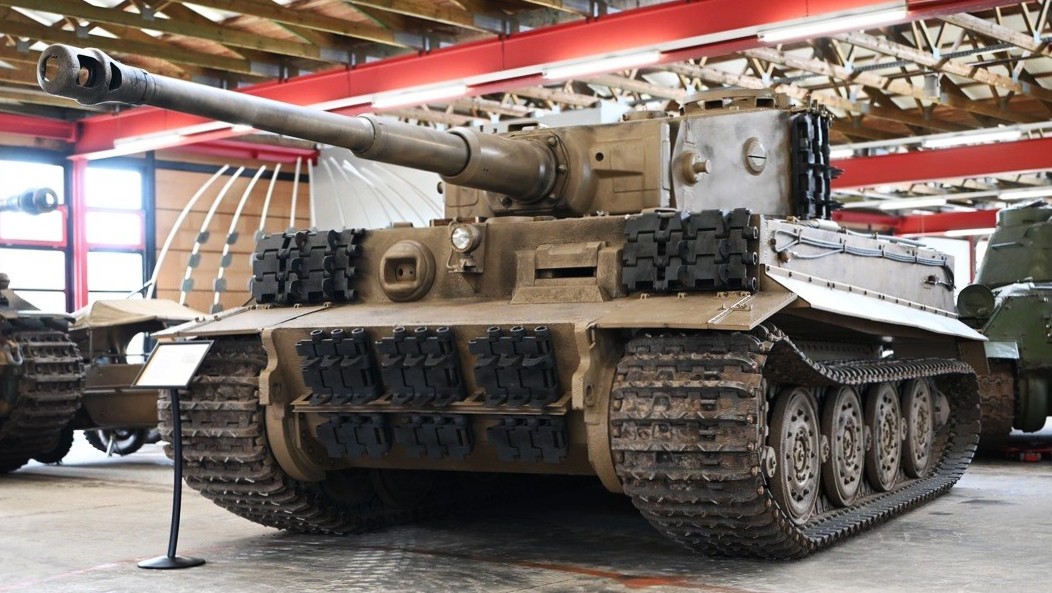
(LandmarkScout Photo)
Tiger I at the Deutsches Panzermuseum Munster, Germany. This Tiger was built using parts recovered from a scrapyard and some parts from the Kurland area in Latvia. Two Panzerkampfwagen VI tanks were salvaged from the scavenged parts of a scrapyard in Trun -Normandy, France,. The Tiger was borrowed and is on display at the Panzer museum.
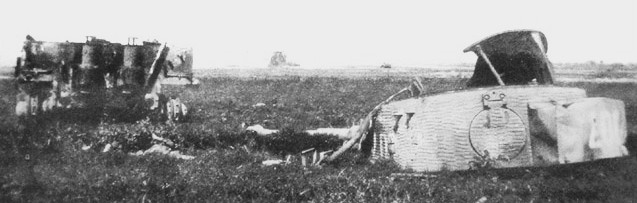
(DND Photo)
German Tank ace Michael Wittman’s was killed when his Tiger I was destroyed in Normandy on 8 August 1944. Michael Wittmann (22 April 1914 – 8 August 1944) was a German Waffen-SS tank commander during the Second World War. He is known for his ambush of elements of the British 7th Armoured Division during the Battle of Villers-Bocage on 13 June 1944. While in command of a Tiger I tank, Wittmann destroyed up to 14 tanks, 15 personnel carriers and two anti-tank guns within 15 minutes before the loss of his own tank. Although the number is disputed, he is credited with destroying 135 to 138 enemy tanks. German tank kills were recorded as a unit. When he was presented with the Oak leaves to his Knights Cross by Hitler on 2 February 1944 his total was 117 tanks.
On 8 August 1944, Anglo-Canadian forces launched Operation Totalize. Under the cover of darkness, British and Canadian tanks and troops seized the tactically important high ground near the town of Saint-Aignan-de-Cramesnil. Here they paused, awaiting an aerial bombardment that would signal the next phase of the attack. Unaware of the reason the Allied forces had halted, SS Hitlerjugend Division Commander Kurt Meyer ordered a counterattack to recapture the high ground.
Wittmann led a group of seven Tiger tanks from Heavy SS-Panzer Battalion 101, supported by additional tanks and infantry. His group of Tigers crossed open terrain towards the high ground. They were ambushed by Allied tanks from two sides. On the right or northeast, British tanks from “A” Squadron 1st Northamptonshire Yeomanry and “B” Squadron 144th Regiment Royal Armoured Corps were positioned in woods. To the left or west, “A” Squadron Sherbrooke Fusilier Regiment was located at a chateau courtyard broadside to the attack, where they had knocked firing positions through the stone walls.[51] The attack collapsed as the Canadian tanks destroyed two Tiger tanks, two Panzer IVs and two self-propelled guns in Wittman’s force, while British tank fire destroyed three other Tigers.[52] During the ambush, anti-tank shells fired from Canadian tanks penetrated the upper hull of Wittmann’s tank, igniting the ammunition. The resulting fire engulfed the tank and blew off the turret.[53] The destroyed tank’s dead crew members were buried in an unmarked grave. In 1983, the German War Graves Commission located the burial site. Wittmann and his crew were reinterred together at the La Cambe German war cemetery in France.
In 2008 a documentary in the Battlefield Mysteries TV series examined the final battle. A historian, Norm Christie, interviewed participants; Sydney Valpy Radley-Walters, Joe Ekins and Ken Tout, and from their testimony and the two German accounts pieced the final battle together. The Tigers left the cover of a hedge near Cintheaux at 12:30 in two prongs; one in the middle of the field with the other—including Wittman—moving more slowly on the right. The British 75mm armed tanks engaged the lead Tiger (Iriohn) hitting it in the transmission, bogies or track and it started going in circles trying to withdraw. Joe Ekins’ tank hit the second Tiger on the right side and knocked it out. As the crew escaped and brought out their wounded, they watched another Tiger north of them go up in flames (Kisters). Iriohn partly withdrew but could not get away and was hit by Ekins—”the one that was mulling around.” Wittmann signalled “Pull back!” He did not realize that a group of the Sherbrookes were immediately to his right, and in a volley they knocked out the two Tigers beside the road. The commander of the second Tiger recalled the position of Wittmann’s tank and specifically the skewed turret. The tank blew up shortly afterwards. Hans Hoflinger in a following Tiger was also attacked by enfilading fire from Sherman Fireflies with powerful 17-pounder guns, and had to abandon his tank. He saw the fire and explosion in Wittmann’s tank, and that the turret was displaced to the right and tilted down to the front somewhat. None of his crew had gotten out.[55] Survivors from Dollinger’s tank passed by the wreck of Wittmann’s tank shortly afterwards. (Wikipedia)
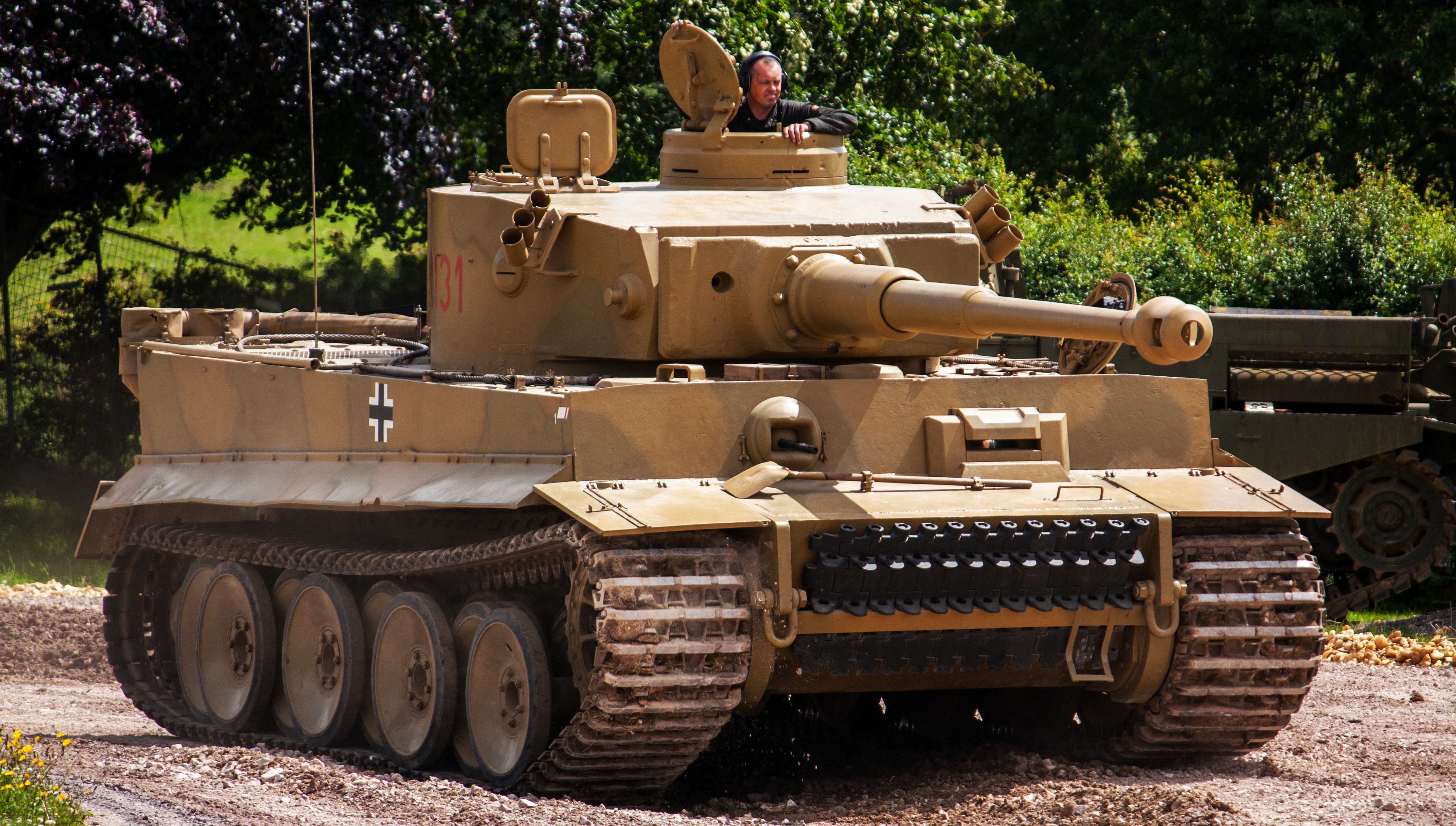
(Simon Q Photo)
Tiger 131, Bovington Tank Museum, United Kingdom. As of 2021, Tiger 131 (captured during the North African campaign) at the UK’s Tank Museum is the only example restored to running order.
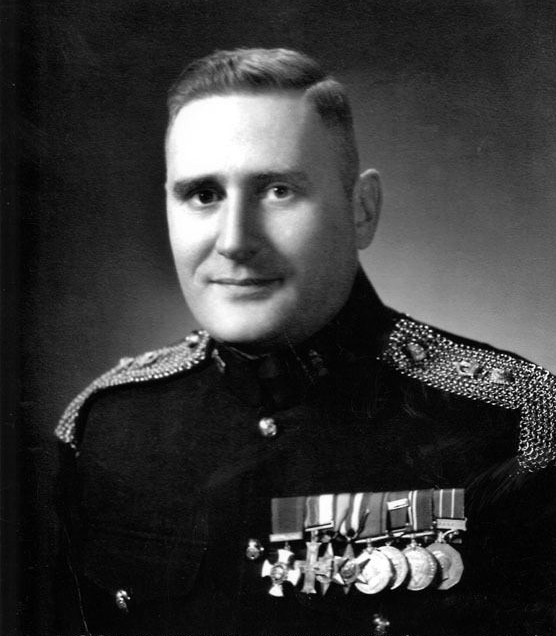
Brigadier-General S.D. Radley-Walters
Legion article by Mark Zuelke, 8 August 2017
On 8 Aug 1944, Sydney Radley-Walters was a newly minted 24-year-old major who had seen his first tank only two years earlier, when the Sherbrooke Fusiliers converted from infantry to armour. “Not one of us knew anything about armour or even what a tank looked like,” he said later. “We hadn’t a clue.”
Radley-Walters learned fast. On June 6, he came ashore commanding A Squadron and the next day he knocked out a Panzer IV—the first of 18 armoured vehicle kills that made him one of Canada’s top tank aces. Two months later, on Aug. 8, the Sherbrookes were in the thick of the action supporting 2nd Canadian Infantry Division during Operation Totalize—the attempt to break out from Caen to Falaise. At noon, the 12th SS Hitlerjügend (Hitler Youth)Panzer Division counterattacked the Canadians with a mixed armour and infantry force. At its head were five Tiger tanks. Weighing as much as 70 tonnes, with armour up to 10 centimetres thick and an 88-millimetre gun, the Tiger was Germany’s deadliest tank.
The German advance passed a château alongside the road next to a village called Gaumesnil. A Squadron was hiding behind the château’s high walls, through which its tankers had cut holes to create firing ports for their main guns. Radley-Walters had eight tanks. Two were the Sherman Firefly, whose new tank-penetrating 17-pounder(76.2-millimetre) guns were more powerful than the standard 75-millimetreSherman guns.
Seeing the Tigers at the head of a column of Panzer IVs, half-tracks and self-propelled guns (SPGs), Radley-Walters yelled over the wireless, “Hold off! Hold off!” Finally, at just 500 metres, he gave the order to fire. The lead tank, closest to the château, took an instant hit and ceased moving. Radley-Walters targeted and destroyed an SPG just behind the Tigers. In mere minutes, the Sherbrookes also knocked out the Tiger at the rear of the leading five, two of the Panzer IVs and another SPG. The other three Tigers fell victim to fire from British tankers on the Canadian left flank and the counterattack collapsed.
A few minutes later, the Tiger closest to the château exploded and the turret bearing the identifying number 007 was blown off. Radley-Walters had no idea this was German tank ace Michael Wittmann’s Tiger. The action had started at 12:30 p.m. and lasted just 25 minutes.
Before war’s end, Radley-Walters had three tanks shot out from under him and was wounded twice. He ended the war a lieutenant-colonel decorated with a Military Cross and Distinguished Service Order. He retired from the army in 1974 with the rank of brigadier-general. Radley-Walters died on 21 April 2015, at age 95.
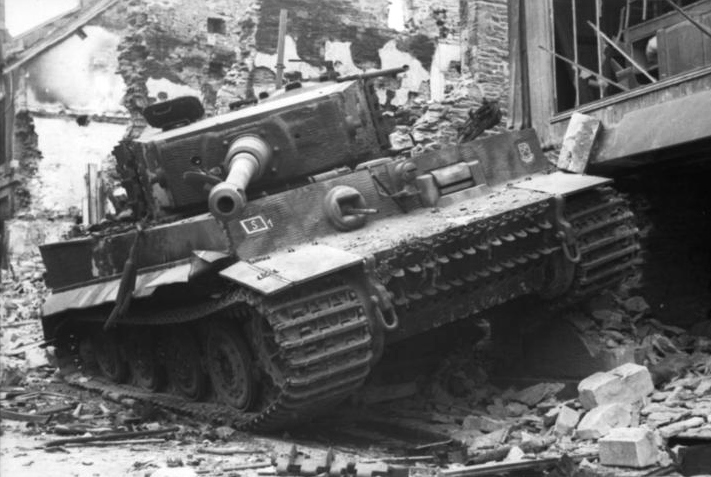
(Bundesarchiv Bild 101I-494-3376-14A)
Panzer VI (Tiger I), Heavy SS Battalion 101, destroyed in Villers-Bocage, Normandy, June 1944.
Hauptsturmführer (captain) Michael Wittmann was reportedly nervous and uncharacteristically indecisive on the morning of 8 Aug. When Standartenführer (regiment leader) Kurt Meyer of the 12th SS Hitlerjügend Panzer Division ordered a counterattack, Wittmann need not have participated. But the designated tank commander was inexperienced and Wittmann said, “I must go with them, for [he] can scarcely cope.”
As Wittmann’s counterattacking force rolled toward battle, Meyer knew he was sending it into a “steely inferno.” Wittmann’s force consisted of seven Tigers, a company of Panzer IVs, a company of SPGs, and supporting infantry in half-tracks. Their goal was to strike the seam between the Canadians and the British 51st (Highland) Division to the left and drive deep in between.
By this time, the 30-year-old Wittmann had earned the nickname the “Black Baron” and held an Iron Cross along with numerous other medals. His status as Germany’s top Panzer ace had made him a minor celebrity at home. Since the invasion of Poland in 1939, Wittmann had amassed a stunning record of143 Allied armoured vehicle kills in fighting on both the eastern and western fronts. On 13 June 1944, he had shocked the 7th British Armoured Division at Villers-Bocage, France, by destroying more than two dozen tanks and transports.
No radio log records exist regarding Wittmann’s advance on Aug. 8. But as his Tiger 007 ground past the château at Gaumesnil, evidence suggests that an armour-piercing round fired by one of the Sherbrooke’s Firefly tanks punched into the air inlet on the left side directly behind the turret. The tank immediately halted, and no crew emerged. Some minutes later, the Tiger was rocked by a massive explosion that hurled its turret pin through the air to land right side up some distance fromthe main tank body.
Wittmann and his crew of four were presumed killed, but their fate remained unconfirmed until 1983, when a road construction crew found their bodies. They were reinterred together at the La Cambe German war cemetery. In the aftermath of his death, there was much controversy about who really killed Wittmann. The British tankers of Northamptonshire Yeomanry’s A Squadron generally got the credit. It was also suggested that a RAF rocket-firing Typhoon made the kill, or even possibly some nearby Polish tankers. But none of these claims bore up against the fact that analysis of Tiger 007 showed the only penetrating wound in its massive armour was the hole in the left side air inlet. The only tanks having an angle of fire capable of delivering that fatal shot were those of A Squadron of the Sherbrooke Fusiliers.
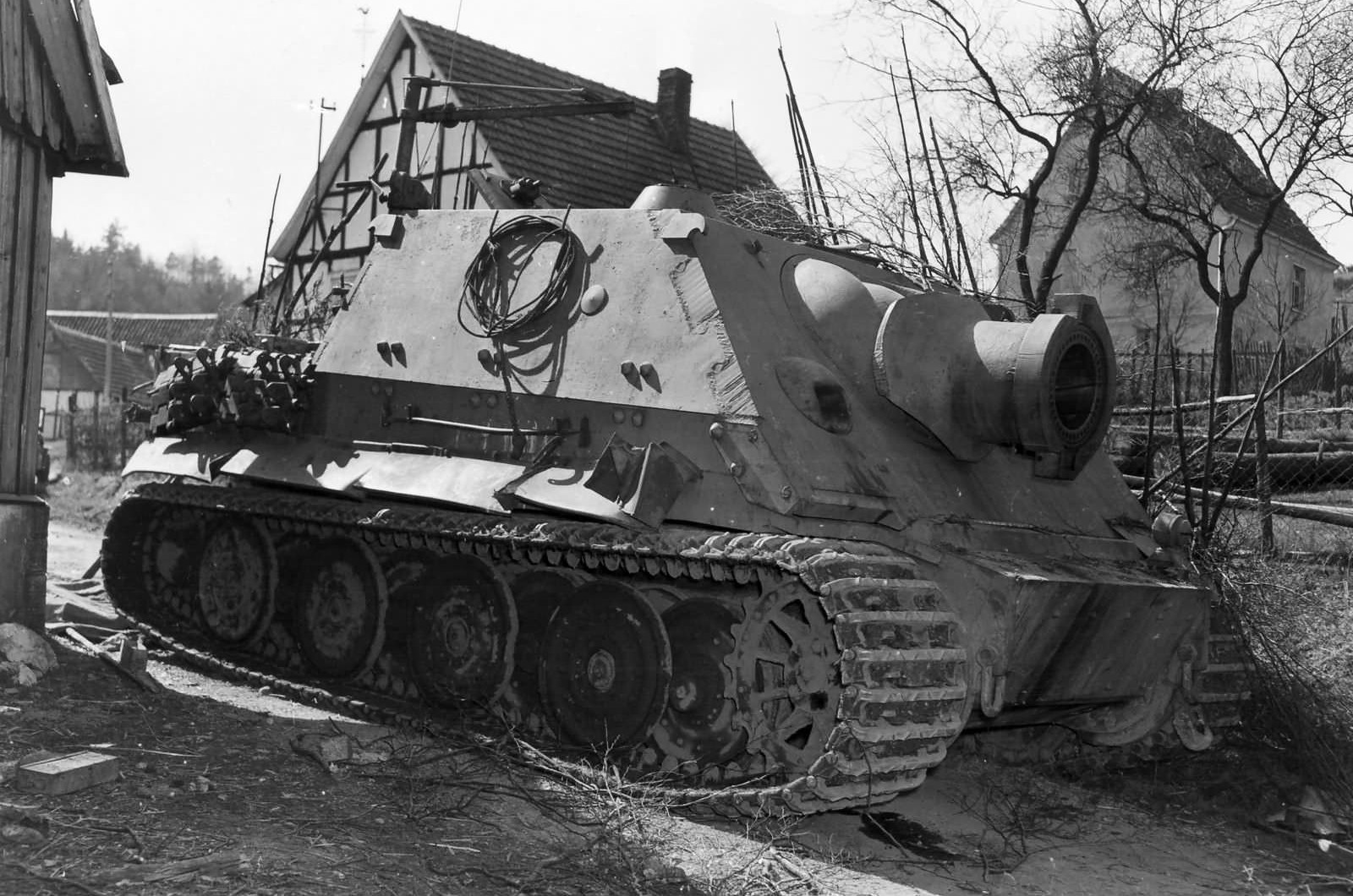
(US Army Photo)
Sturmtiger 1001 Battery, Droishagen, April 1945. Both PzStuMrKp 1000 and 1001 served during the Ardennes Offensive, with a total of seven Sturmtiger. During the battle for the bridge at Remagen, German forces mobilized Sturmmörserkompanie 1000 and 1001 (a total of 7 units) to take part in the battle. The Sturmtiger were originally tasked with using their mortars against the bridge itself, though it was discovered that they lacked the accuracy needed to hit the bridge. During this action, one of the Sturmtigers in Sturmmörserkompanie 1001 near Düren and Euskirchen allegedly hit a group of stationary Sherman tanks in a village with a 380mm round, resulting in nearly all the Shermans being put out of action, and their crews killed or wounded. This is the only tank-on-tank combat a Sturmtiger is ever recorded engaging in.
Sturmtiger (German for ‘Assault Tiger’) German assault gun built on the Tiger I chassis and armed with a 380mm rocket-propelled mortar. The official German designation was Sturmmörserwagen 606/4 mit 38 cm RW 61. Its primary task was to provide heavy fire support for infantry units fighting in urban areas. The few vehicles produced fought in the Warsaw Uprising, the Battle of the Bulge and the Battle of the Reichswald. The fighting vehicle was known by various informal names, among which the Sturmtiger became the most popular. (Wikipedia)
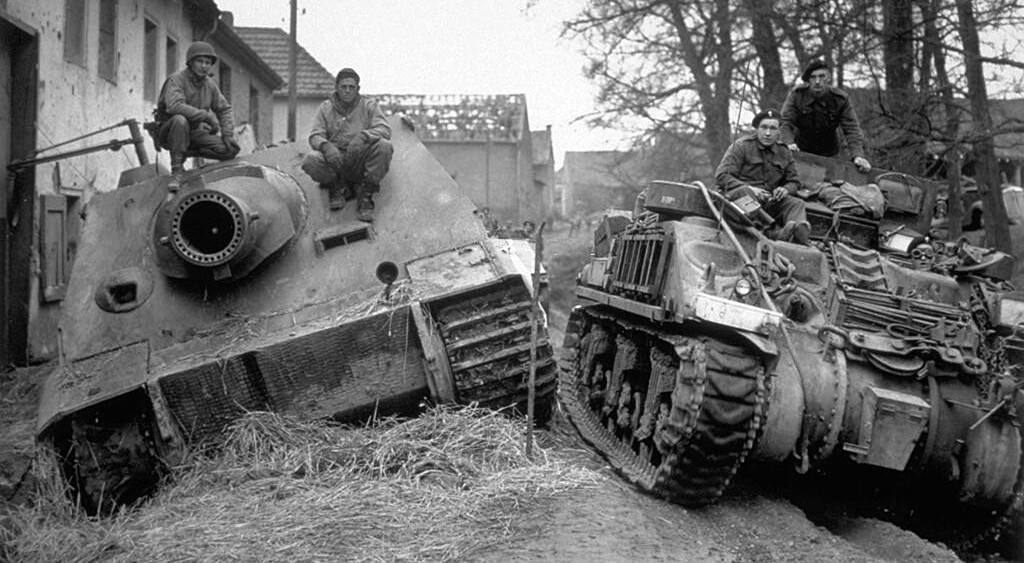
(US Army Photo)
Sturmtiger, abandoned after a breakdown and captured by US troops. On the right is a British ARV on M4 chassis. 28 Feb 1945.
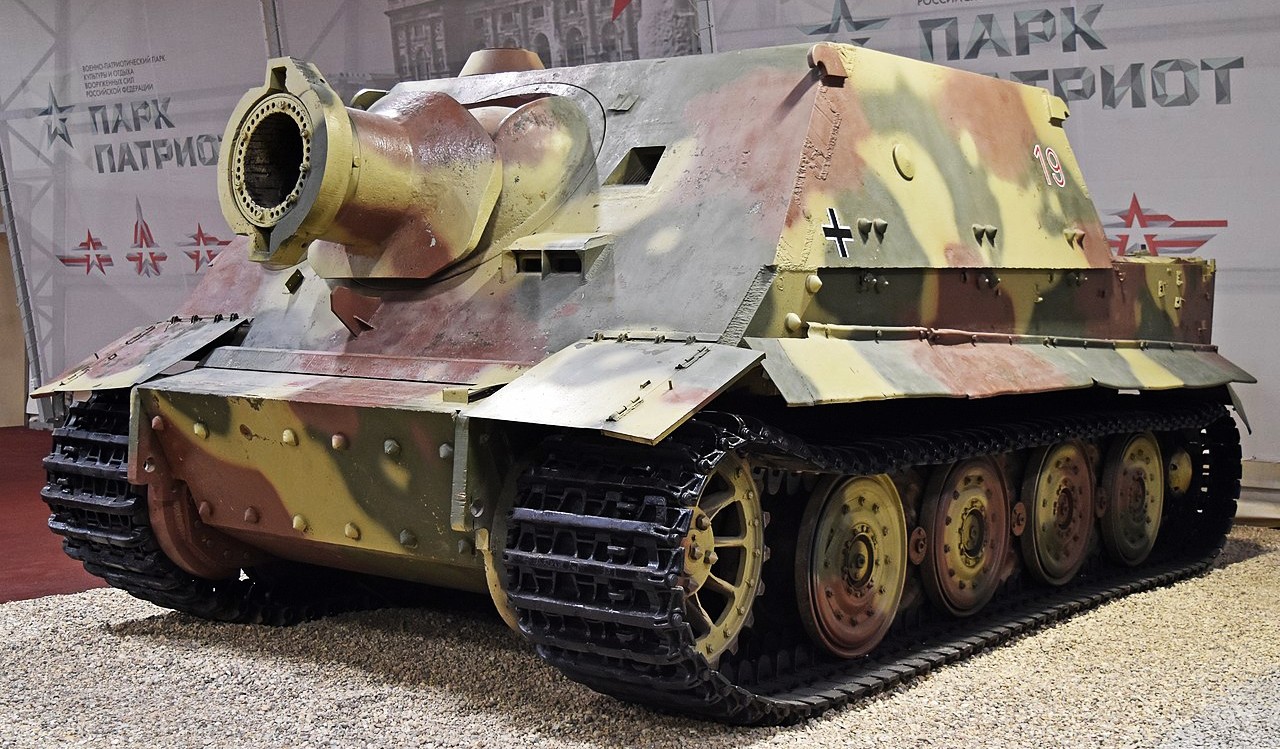
(Alan Wilson Photo)
Sturmmörserwagen 606/4 mit 38 cm RW 61 Manufacturer:- Alkett Built:- October 1943 to January 1945 Total Production:- 19 Main Armament:- 380mm RW61 rocket launcher L/5.4. Captured by Soviet forces in the Elbe area in April 1945, this late model Sturmtiger is one of only two survivors and has recently been repainted into an accurate colour scheme and markings. It is on display in Hall 11 of the Patriot Museum Complex. Park Patriot, Kubinka, Moscow Oblast, Russia.
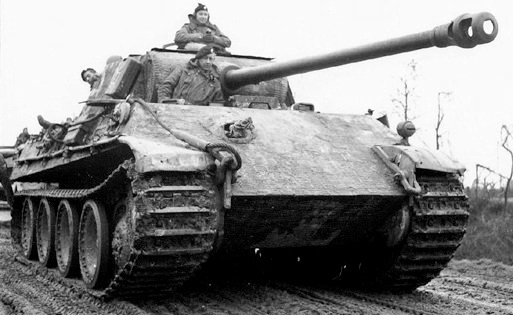
(Library and Archives Canada Photo, PA-115487)
Captured PzKpfw Mk. V, Wyler, Germany, 9 Feb 1945.
The PzKpfw Panther medium tank, officially Panzerkampfwagen V Panther (abbreviated PzKpfw V) with ordnance inventory designation: Sd.Kfz. 171, was used on the Eastern and Western Fronts from mid-1943 to the end of the war in May 1945.The Panther was intended to counter the Soviet T-34 medium tank and to replace the Panzer III and Panzer IV. Nevertheless, it served alongside the Panzer IV and the heavier Tiger I until the end of the war. It had excellent firepower, protection and mobility, although its reliability was less impressive.The Panther had the same Maybach V12 petrol (690 hp) engine as the Tiger I. It had better gun penetration, was lighter and faster, and could traverse rough terrain better than the Tiger I. The trade-off was weaker side armour, which made it vulnerable to flanking fire and a weaker high explosive shell. The Panther proved to be effective in open country and long-range engagements.The Panther was far cheaper to produce than the Tiger I. Key elements of the Panther design, such as its armour, transmission, and final drive, were simplifications made to improve production rates and address raw material shortages. The Panther was rushed into combat at the Battle of Kursk in the summer of 1943 despite numerous unresolved technical problems, leading to high losses due to mechanical failure. Most design flaws were rectified by late 1943 and early 1944, though the bombing of production plants, increasing shortages of high-quality alloys for critical components, shortage of fuel and training space, and the declining quality of crews all impacted the tank’s effectiveness. Though officially classified as a medium tank, at 44.8 metric tons the Panther was closer in weight to contemporary foreign heavy tanks. The Panther’s weight caused logistical problems, such as an inability to cross certain bridges, otherwise the tank had a very high power-to-weight ratio which made it highly mobile. The naming of Panther production variants did not, unlike most German tanks, follow alphabetical order: the initial variant, Panther “D” (Ausf. D), was followed by “A” and “G” variants. (Wikipedia)
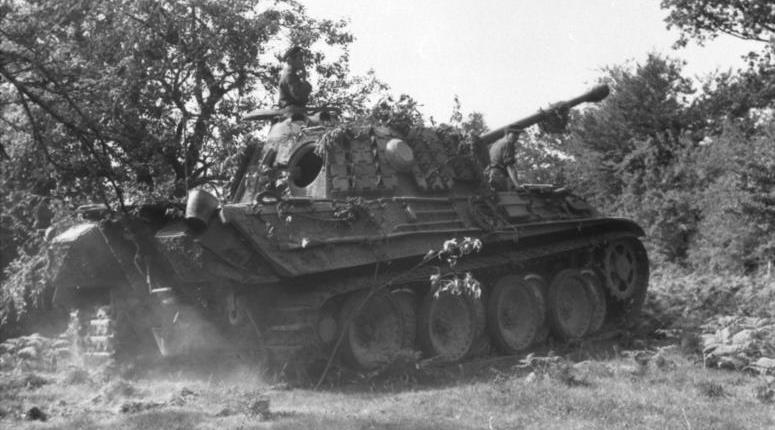
(Bundesarchiv Bild 101I-722-0406-06A)
Panter V in the Normandy bocage, France, 21 June 1944.
At the time of the invasion of Normandy in June 1944, there were initially only two Panther-equipped Panzer regiments in the Western Front, with a total of 156 Panthers between them. From June through August 1944, an additional seven Panther regiments were sent into France, reaching a maximum strength of 432 in a status report dated 30 July 1944.The majority of the German tank forces in Normandy – six and a half divisions – were drawn into fighting the Anglo-Canadian forces of the 21st Army Group around the town of Caen. The numerous operations undertaken to secure the town became collectively known as the Battle of Caen. While there were areas of heavy wooded bocage around Caen, most of the terrain was open fields which allowed the Panther to engage the attacking enemy armour at long range — its combination of superior armour and firepower allowed it to engage at distances from which the Shermans could not respond. Conversely, by the time of the Normandy Campaign, British divisional Anti-tank Regiments were well equipped with the excellent 17-pounder gun, and some US-supplied M10 tank destroyers had their 3-inch gun replaced with the 17-pdr (including the 17-pdr SP Achilles), making it equally as perilous for Panthers to attack across these same fields. The British had begun converting regular M4 Shermans to carry the 17-pounder gun (nicknamed Firefly) prior to the D-Day landings. While limited numbers meant that during Normandy usually not more than one Sherman in each troop of four tanks was a Firefly variant, the lethality of the gun against German armour made them priority targets for German gunners. (Wikipedia)
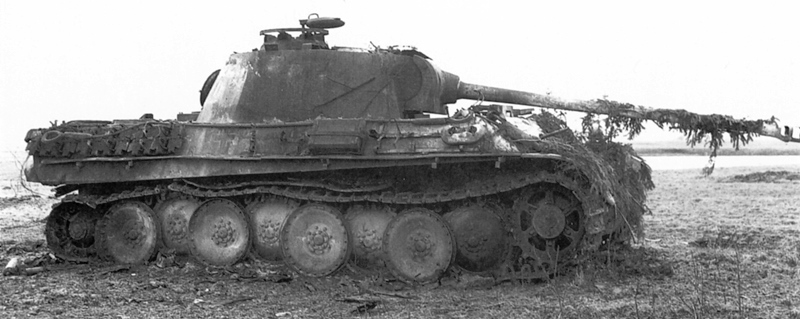
(Allan Finney Photo)
Caption from the book “Panther vs. Sherman” for this photo states: “This Panther Ausf. G of the 1st SS-Panzer Division was knocked out in the fighting near the Baugnez Crossroads (Battle of the Bulge, Dec 1944), and has suffered a catastrophic ammunition fire, evident from the blown-out sponson floor sitting on the tracks (NARA)” The blown-out floor of the side sponson marks the boundaries of the two magazines in the sponson. Note the hole in the side sponson just below the front of the turret, where the Panther tank was struck. Directly behind this hole was the forward-most of two magazines in the side sponson holding ammunition for the Panther’s 75mm main gun; the penetrating round would have exploded right into the propellant casings of the 75mm rounds stored there as the rounds were stored with the shell tips facing towards the middle of the turret. The 50mm armor of the side superstructure on the Ausf. G Panther could be penetrated by all Allied tank and anti-tank guns at normal combat ranges. The 75mm M4 cannon could penetrate this part of the Panther at 400m, and the 76mm M4 cannon at 2800m. Panthers could “brew up” and burn just as fiercely as the M4 Shermans when struck in their ammunition stores.” (Wikipedia)
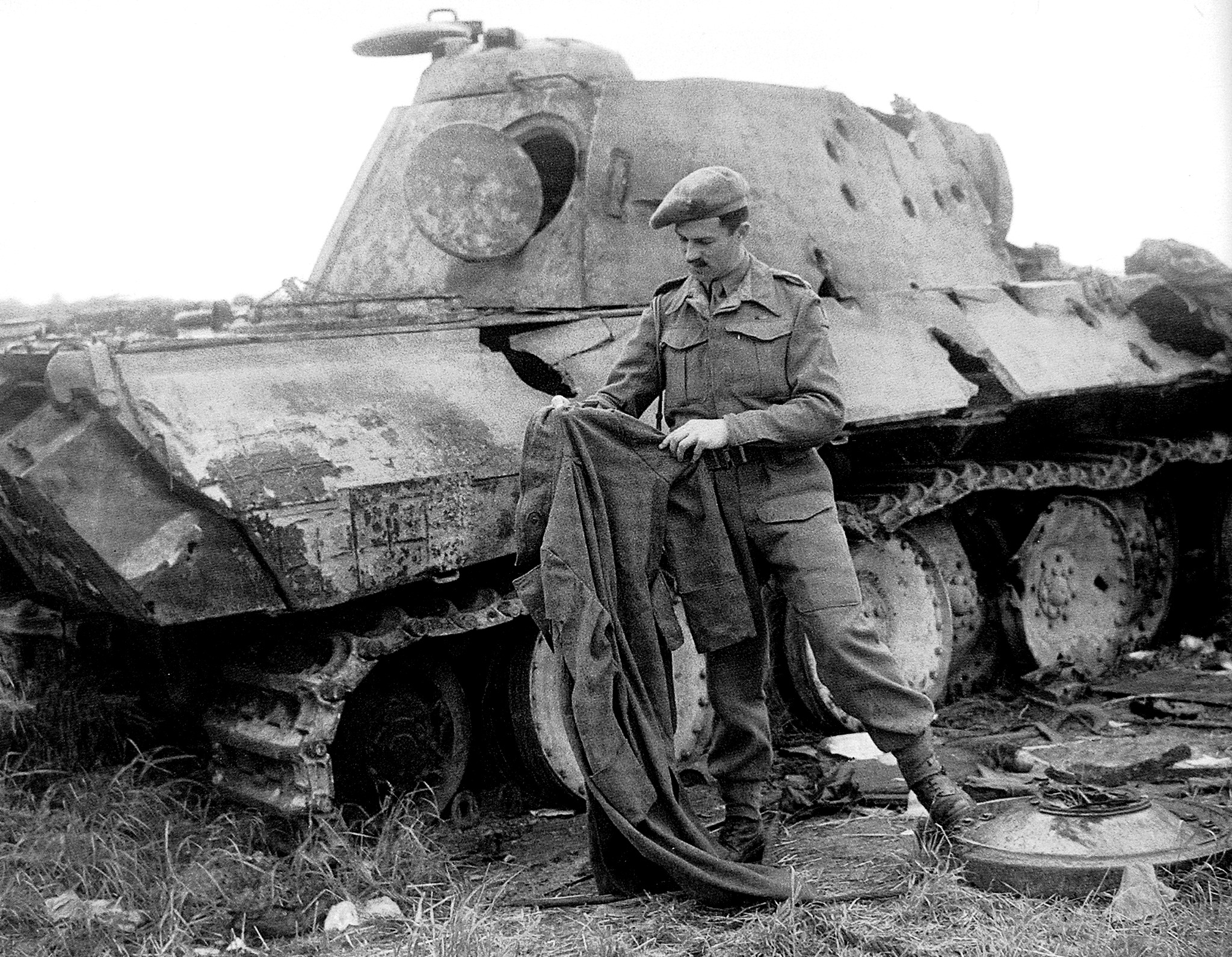
Officer examining German Panzerkampfwagen Panther tank from 3./12. SS-Panzer-Division “Hitlerjugend”, which was knocked out by Canadians at Norrey-en-Bessin, Normandy, 8 July 1944. The shell holes are impacts from direct fire, so the shots came from tank and anti-tank guns.
On the morning of 9 June 1944 Lieutenant Gordon Henry and the crew of “Comtesse de Feu” a Sherman Firefly of the 1st Hussars knocked out 5 Panthers of No. 3 company 12. SS in the space of a couple of minutes. The regimental war diary indicates that these vehicles were used later to allow replacements to zero their guns and get some practice as many of them had yet to fire the 75-mm mounted on the Sherman Firefly. (Steve Hearn)
This was not a surveyed, lane marked, canned battle run kind of range. It would appear to be more of an impromptu pre-arranged field shoot. The unit would have liaised with higher HQ so they don’t panic at the sound of shooting, then take replacement crews in their new tanks out where there were wrecks, and start giving shooting orders. (Terry Warner)
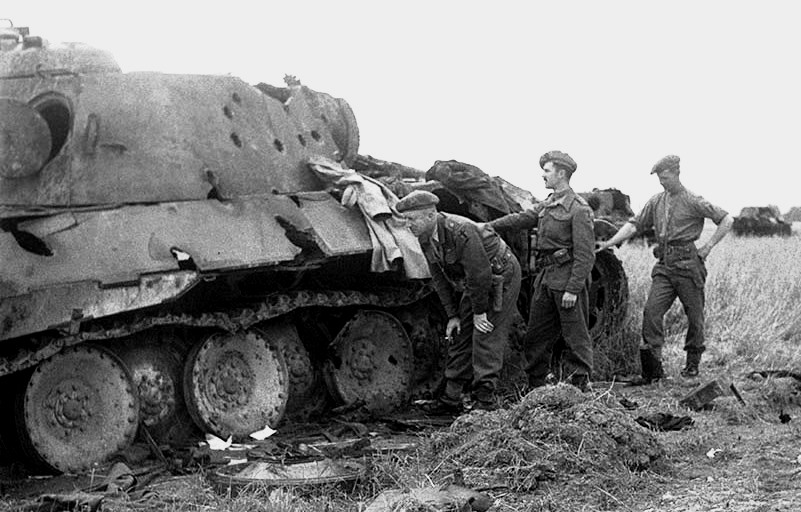
(Library and Archives Canada Photo, MIKAN No. 3226737)
Officers examining German Panzerkampfwagen Panther tank from 3./12. SS-Panzer-Division “Hitlerjugend”, which was knocked out by Canadians at Norrey-en-Bessin, Normandy, 8 July 1944.
D-Day and Normandy
The DD tanks of the 1st Hussars were amongst the allied forces to come ashore in Normandy. The Hussars were to support the infantry landing on the western half of Juno Beach. At 07:15, 19 tanks of ‘B’ Squadron launched their Sherman V DDs from their landing craft into the English Channel some 4000 metres from shore of Nan Green Beach. Of ‘B’ Squadron’s 19 tanks, 15 made it to shore ahead of the Regina Rifles, whom they were tasked to support.
‘A’ Squadron launched some of their DDs some ten minutes later than ‘B’ Squadron, from approximately 1500 meters out and headed towards Mike Beach. Only two of the four LTCs carrying ‘A’ Squadron were able to launch all their tanks off shore. Of ‘A’ Squadron’s 19 tanks, 10 were launched into the channel with seven of those making it to shore. Five tanks were landed directly onto the beach, and four were stranded on a landing craft which struck a mine. The tanks of ‘A’ Squadron were to support the Winnipeg Rifles, who were already fighting on the beach when they came ashore.
At the beach, many of tanks of the 1st Hussars stayed partially submerged just off shore in a hull down position. After dropping their screens, they began engaging the German anti-tank guns, machine-gun nests and other strong points, allowing the infantry to break the beach defences and make its way inland. ‘A’ Squadron made its way inland to the village of Graye-sur-Merr where the Winnipeg Rifles were attempting to capture bridges over the Suelles River. ‘B’ Squadron helped clear Courseulles-sur-Mer before breaking out into the countryside.
At 08:20, ‘C’ Squadron’s Sherman Vc Fireflies and Sherman IIIs were landed directly onto Mike Red beach, along with the regimental Headquarters Squadron. By this time, resistance at the beach had been cleared.
After clearing Courseulles-sur-Mer, The regiment made its way inland. South of Reviers, ‘B’ Squadron encountered a German 88-mm anti-tank gun which knocked out six tanks before being put out of action. Seven Hussar crewmen were killed in the engagement. Due to these losses,’B’ squadron was pulled back to the beach after the encounter. As mentioned above, ‘A’ Squadron moved on to Graye-sur-Mer where the Winnipeg Rifles were fighting to secure the village. ‘A’ Squadron joined the fight in support of the Winnipegs, along with elements of ‘C’ squadron who were catching up. After the village was captured, ‘C’ Squadron pressed on, with 2nd Troop reaching the regiment’s objective of the Caen-Bayeux Highway, becoming the only Allied unit to reach its D-Day objective. One survivor of D-Day said that “A German soldier actually saluted us on our way to the objective. I guess he was surprised to see us this far inland”. However, 2nd troop had to pull back, as they were too far ahead of the rest of the force and too few to hold the objective. At dusk, the regiment pulled back to the channel to rest. The 1st Hussars suffered 21 killed, 17 wounded during the actions of D-Day. ‘A’ Squadron was left with 9 tanks at the end of the day and ‘B’ Squadron was reduced to 4 tanks.
After D-Day, the 1st Hussars continued to support infantry as it advanced and faced German counter-attacks. On 9 June, the 1st Hussars supported the Canadian Scottish as they re-took Putot-en-Bessin and engaged German Panther tanks of the 1st Battalion, SS-Panzer Regiment 12 (of the 12th SS Panzer Division Hitlerjugend), destroying 6.
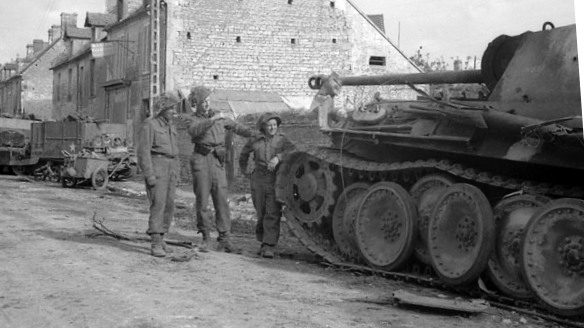
(Library and Archives Canada Photo, MIKAN No. 3405774)
PIAT anti-tank gunners of The Regina Rifle Regiment who knocked out a German PzKpfW V Panther tank thirty yards from Battalion Headquarters, Bretteville-l’Orgeuilleuse, France, 8 June 1944.
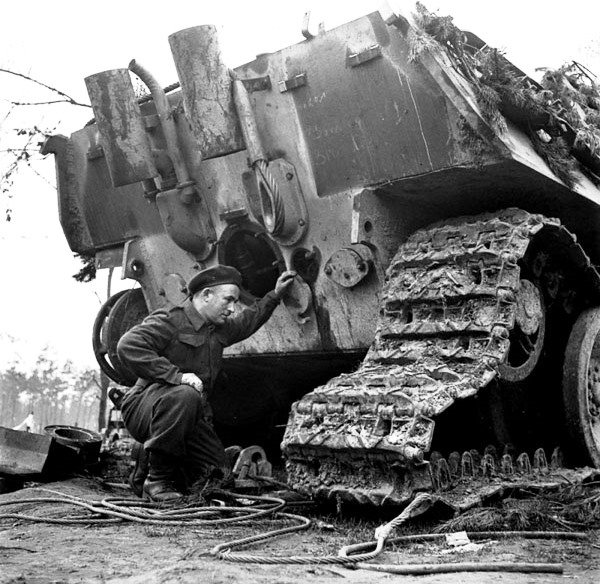
(Library and Archives Canada Photo, MIKAN No. 3203401)
Private W.G. Lourie examining a German Jagdpanther 8.8cm. self-propelled gun which was put out of action by the first shot from a 17-pounder gun of the 6th Anti-Tank Regiment, Royal Canadian Artillery (RCA), in the Reichswald, Germany, 16 March 1945.
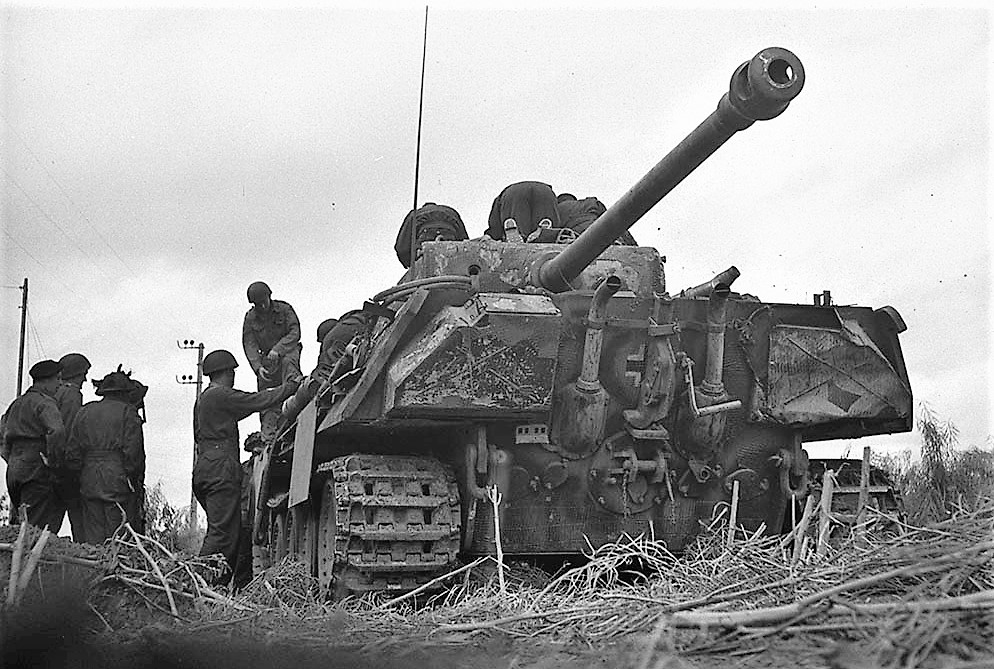
(Library and Archives Canada Photo, MIKAN No. 3226005)
Soldiers of the 7 Canadian Infantry Battalion repairing the turret of a German PzKpfW V Panther tank in Normandy, 9 July 1944.
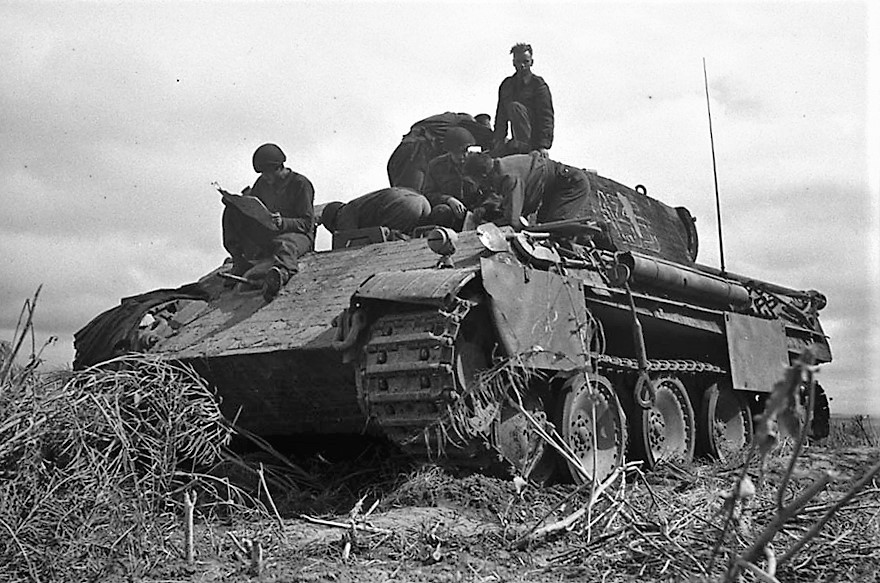
(Library and Archives Canada Photo, MIKAN No. 3226004)
Soldiers of the 7 Canadian Infantry Battalion repairing the turret of a German PzKpfW V Panther tank in Normandy, 9 July 1944.
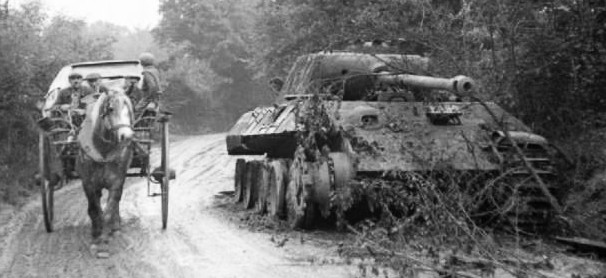
(DND Photo)
French civilians in a pony and trap pass a knocked-out German Panther tank in the Falaise-Argentan area, 22 August 1944.
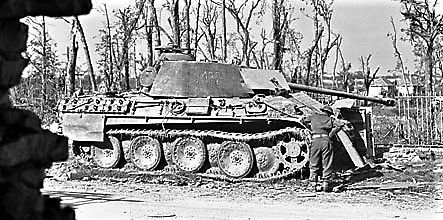
(Library and Archives Canada Photo, MIKAN No. 3401773)
An infantryman of Les Fusiliers Mont-Royal examining a disabled German PzKpfW V Panther tank, St. André-sur-Orne, France, 9 August 1944.
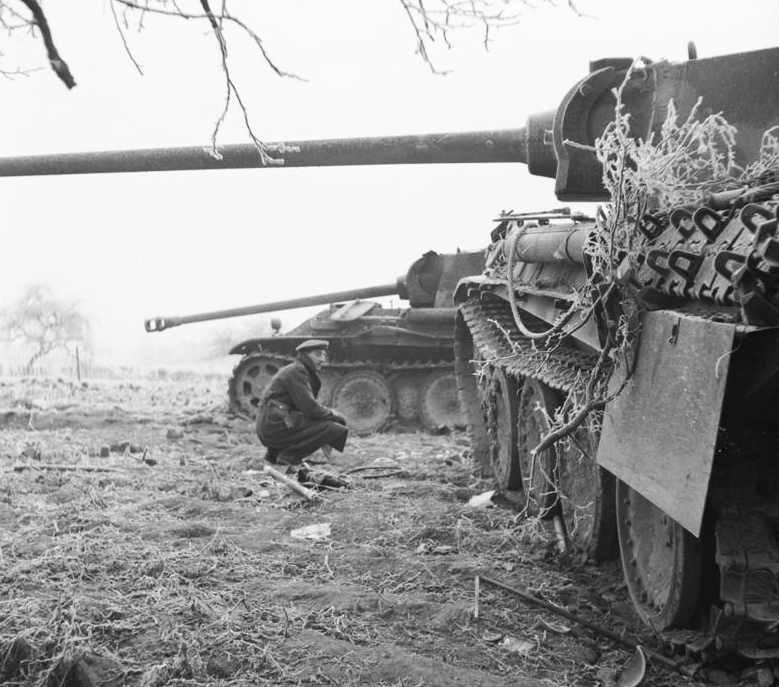
(IWM Photo, B13243)
A soldier inspects two knocked-out German PzKpfw V Panther tanks near Foy-Notre-Dame, Belgium, 29 December 1944.
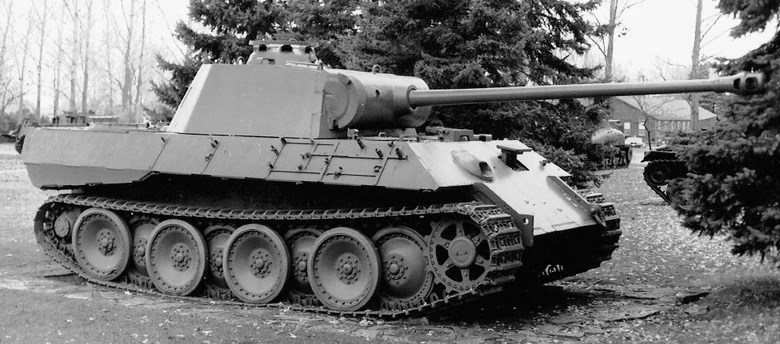
(Author Photo)
Panther Ausf. A on display at CFB Borden, Ontario, which acquired it following V-E celebrations in May 1945. In 2006 it was moved to the Canadian War Museum for restoration.
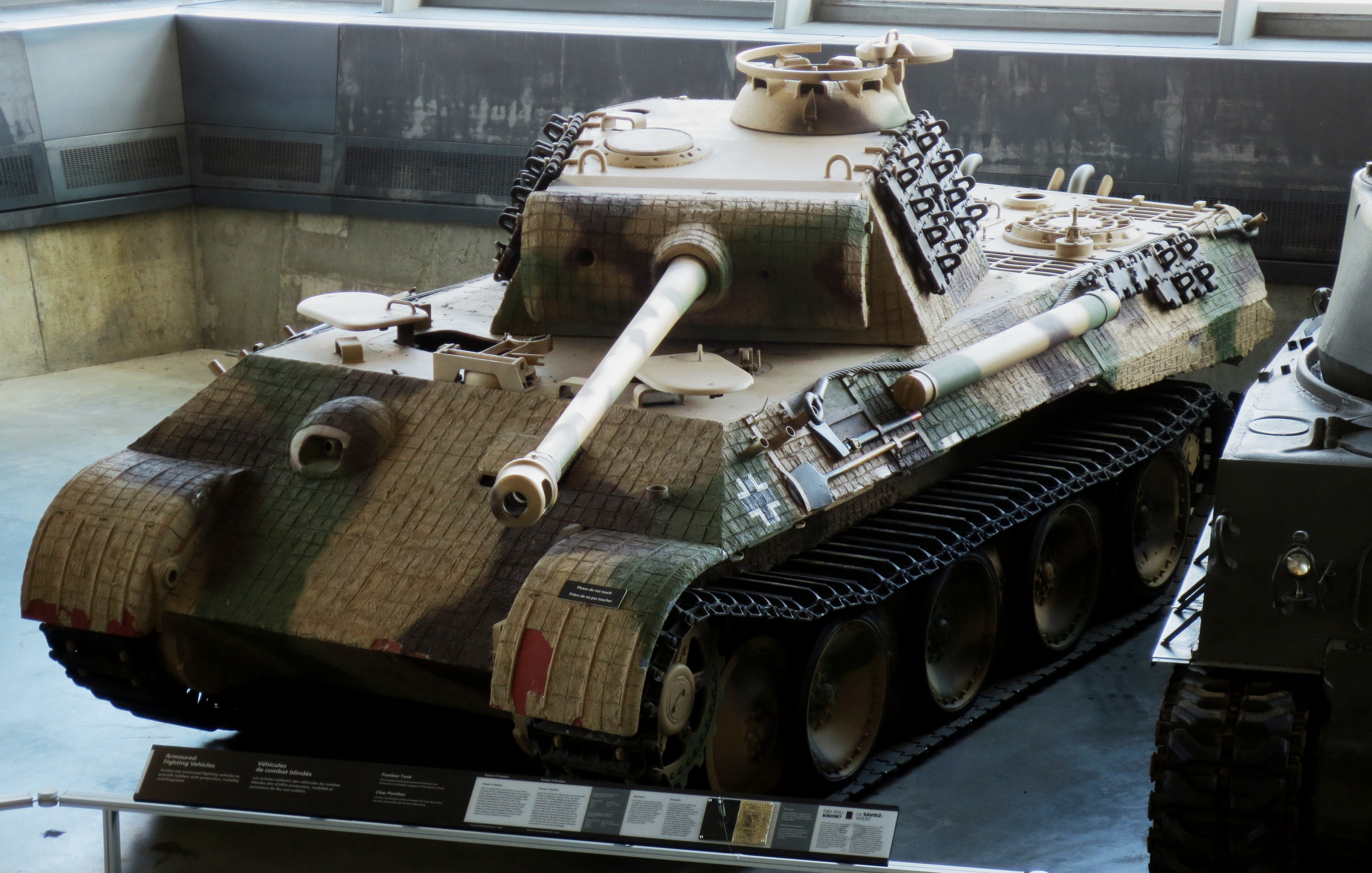
(Author Photo)
In January 2008, the parrtially restored Panther Ausf. A was put on display in the Canadian War Museum in Ottawa, Ontario.
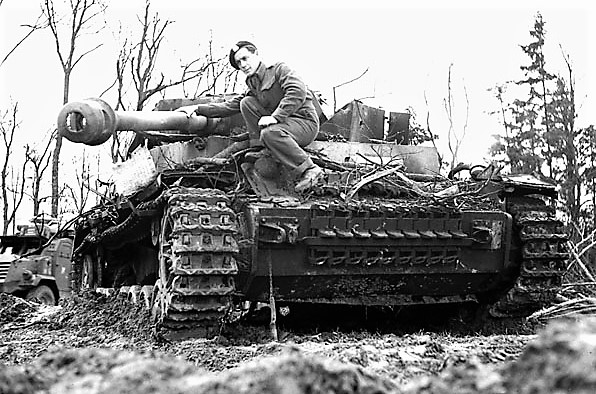
(Library and Archives Canada Photo, MIKAN No. 3401784)
Trooper M.E. Lucy of The South Alberta Regiment examining a German 75-mm Panzerkampfwagen IV tank near Xanten, Germany, 7 March 1945.
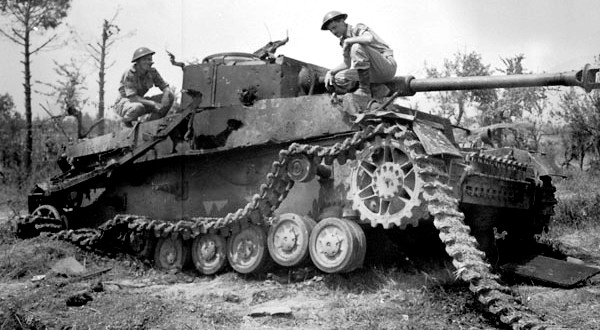
(Library and Archives Canada Photo, MIKAN No. 3405800)
Lance-Bombardier T. Hallam and Signalman A.H. Wharf, both of Headquarters, Royal Canadian Artillery (RCA), 5th Canadian Armoured Division, examining a knocked out German PzKpfW IV tank, near Pontecorvo, Italy, 26 May 1944.
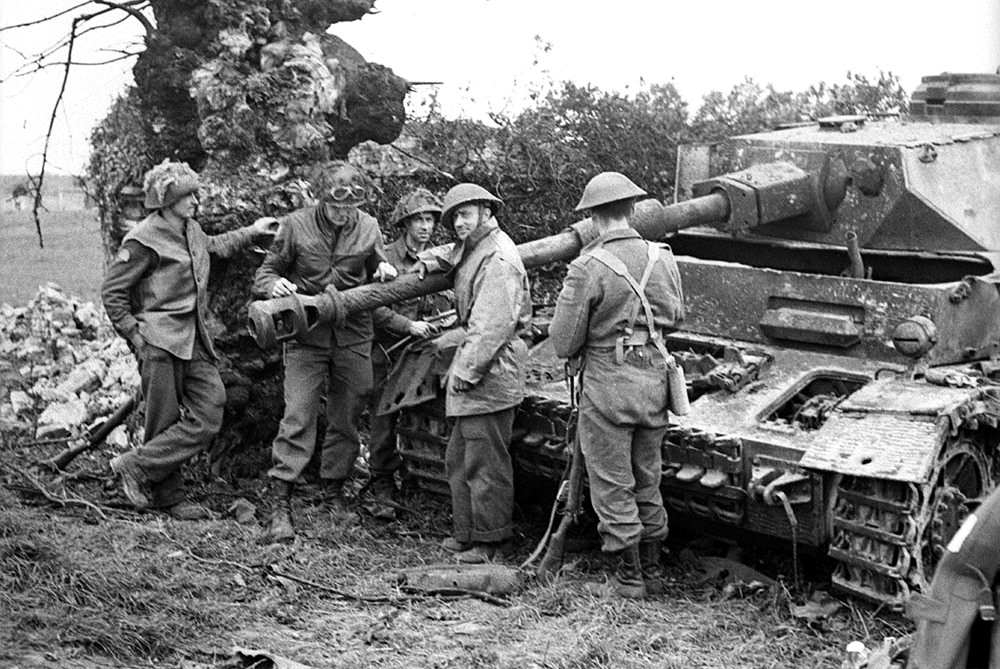
(Library and Archives Canada Photo, MIKAN No. 3226723)
German PzKpfW IV tank, knocked out by Canadians, Guchy, France, 9 July 1944.
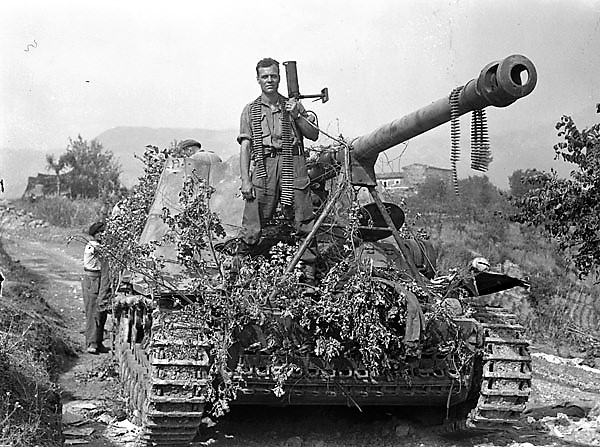
(Library and Archives Canada Photo, MIKAN No. 3231053)
Lance-Corporal J.A. Thrasher of The Westminster Regiment (Motor), who holds the PIAT anti-tank weapon with which he disabled the German self-propelled 88mm. gun on which he is sitting, near Pontecorvo, Italy, 26 May 1944.
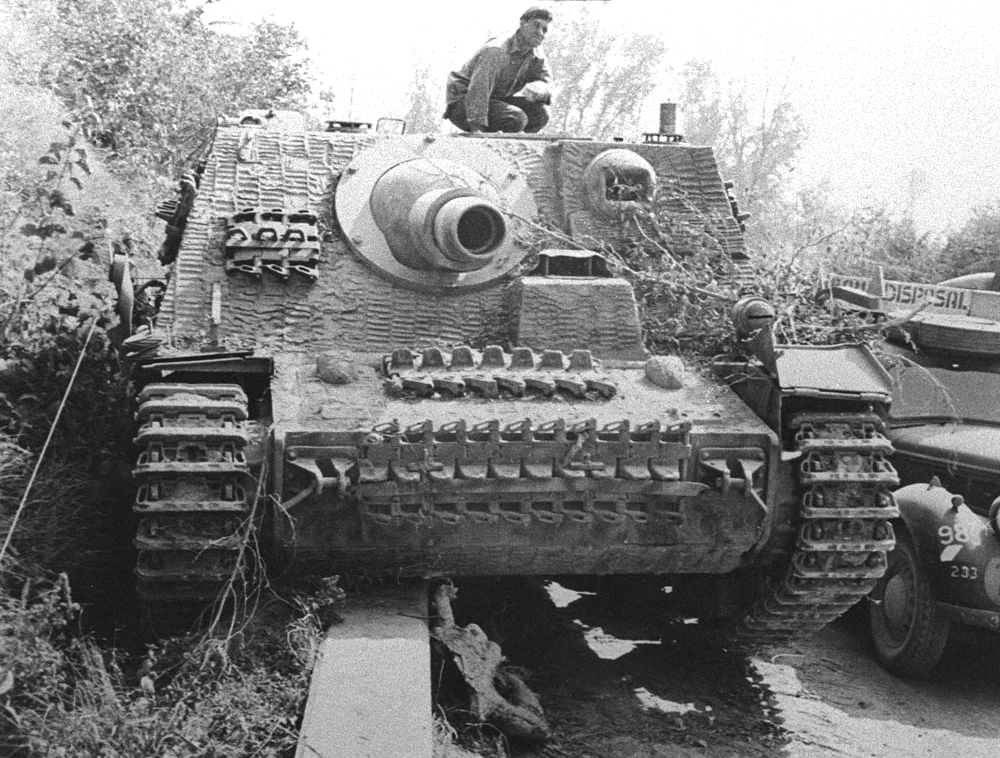
(Library and Archives Canada Photo, MIKAN No. 3401811)
Front view of Brummbär (Grouch) (s Sturmpanzer 43 or Sd.Kfz. 166) armoured infantry support gun based on the Panzer Mk. IV chassis of the Wehrmacht, France, 1944. German soldiers nicknamed it the “Stupa“. Just over 300 vehicles were built and they were assigned to four independent battalions.
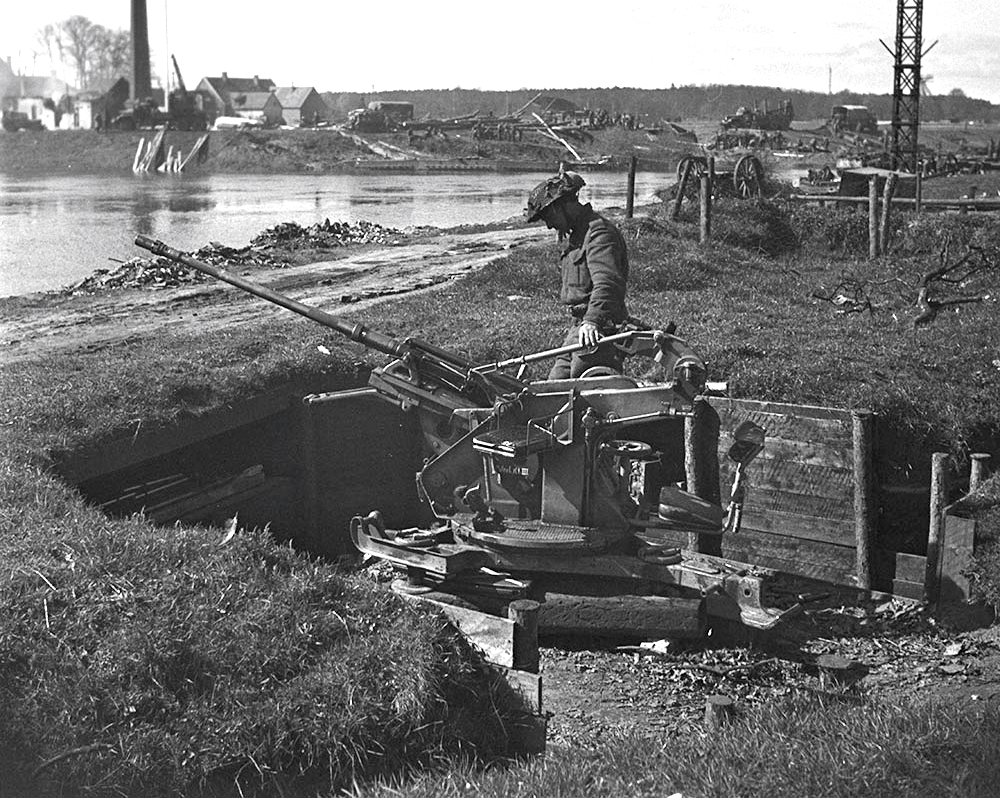
(Library and Archives Canada Photo, MIKAN No. 3224055)
4th Canadian Armoured Division soldier examining a German 20-mm FlaK 30/38 anti-aircraft gun position on the northeast side of the Dortmund-Ems Canal, 8 April 1945. 20-mm anti-aircraft guns were common in the German army and were an effective weapon in the fight against low-flying air targets. Before the Second World War began, the main forces of flak were part of the Luftwaffe. Each division of the Wehrmacht, however, was equipped with the Flak.30/38.
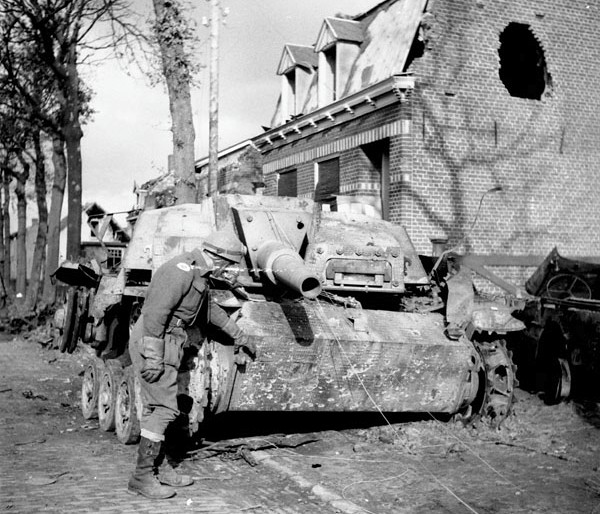
(Library and Archives Canada Photo, MIKAN No. )
Corporal C. Robichaud of Le Régiment de Maisonneuve examining a disabled German Sturmhaubitz 42 105-mm self-propelled gun, Woensdrecht, Netherlands, 27 October 1944.
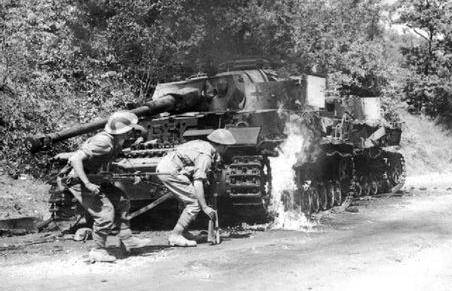
(DND Photo)
Canadians sheltering behind a destroyed Panzer IV tank, hinterland of Salerno. Operation Avalanche. September 1943.
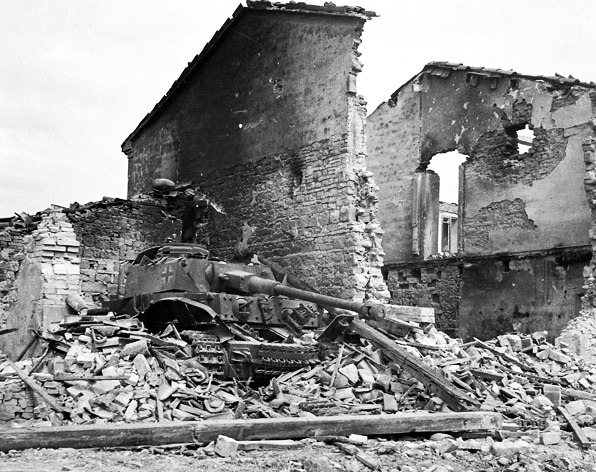
(Library and Archives Canada Photo, MIKAN No. 3718111)
German Panzer IV tank in the ruins of a house near Rimini, Italy, 1944.
(Library and Archives Canada Photo, MIKAN No. 3191557)
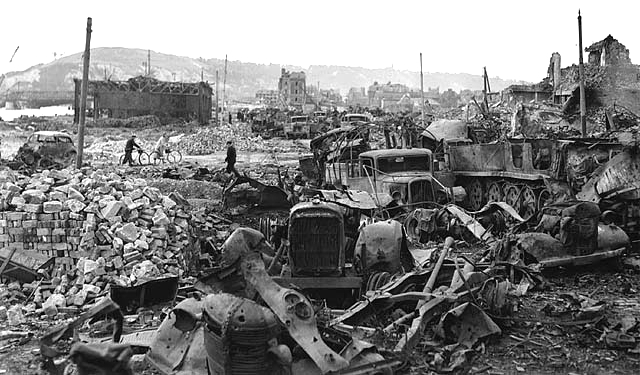
Two thousand vehicles of the German 7th Army destroyed by aircraft of the 2nd Tactical Air Force, 31 December 1944.
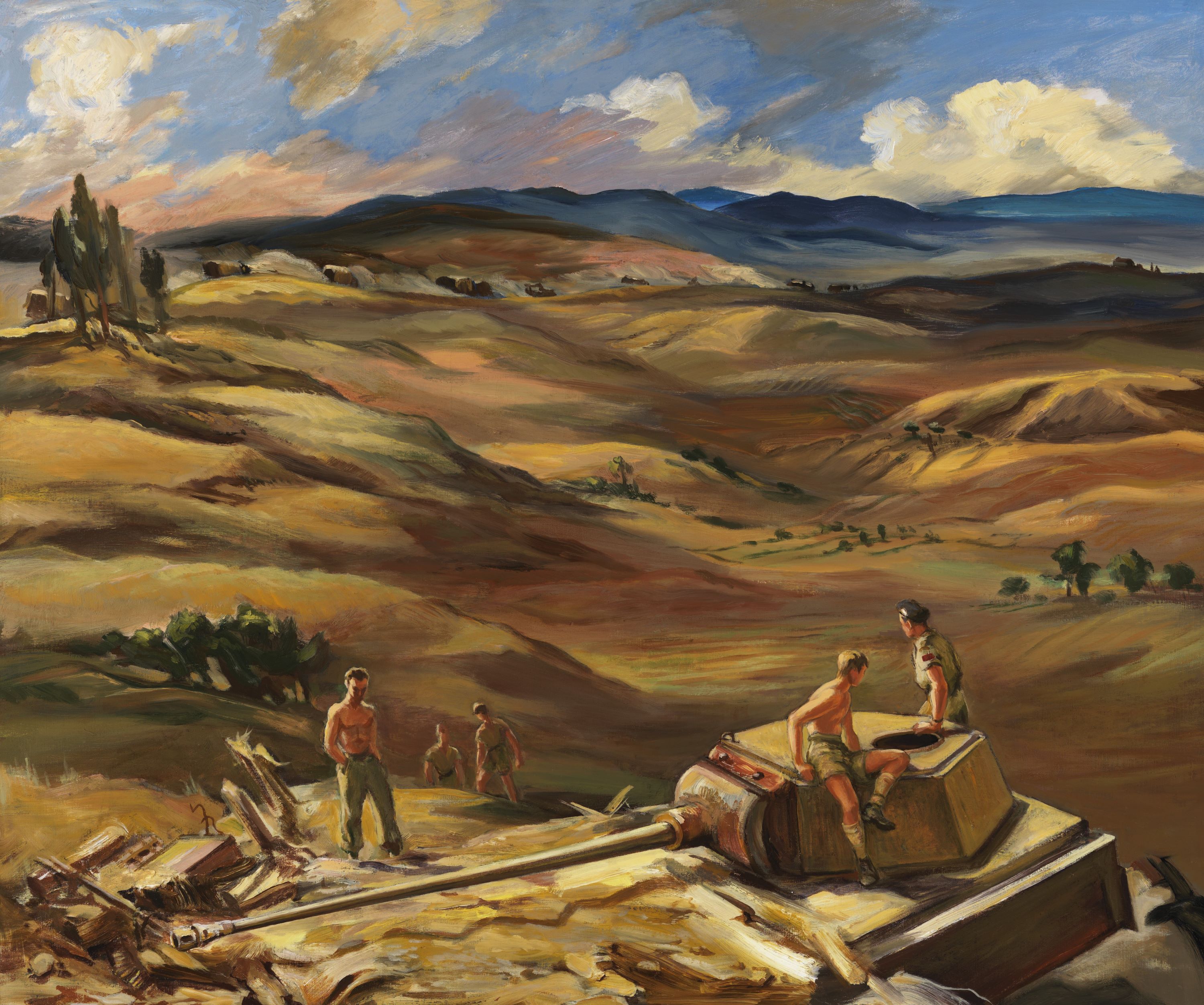
Captain George Campbell Tinning, “The Gothic Line”, 1944. The Allies marched northward to the Gothic Line in August, which the Canadians were tasked with breaking at Pesaro on the Adriatic coast. Striking on 25 August, the 1st Infantry Division sought to open a breach through which the 5th Armoured Division could pass. Encountering line after line of heavy defences, the Gothic Line was not fully overcome until 21 September, at a cost of 4,511 Canadian casualties that included 1,016 dead – among other Allied losses. It took until 20 October to capture the city of Cesena just 20 kilometres from the next offensive’s starting point. Cesena stood alongside the Savio River, and here the following day, Private Ernest Alvia Smith earned a Victoria Cross by staving off a German armoured column.
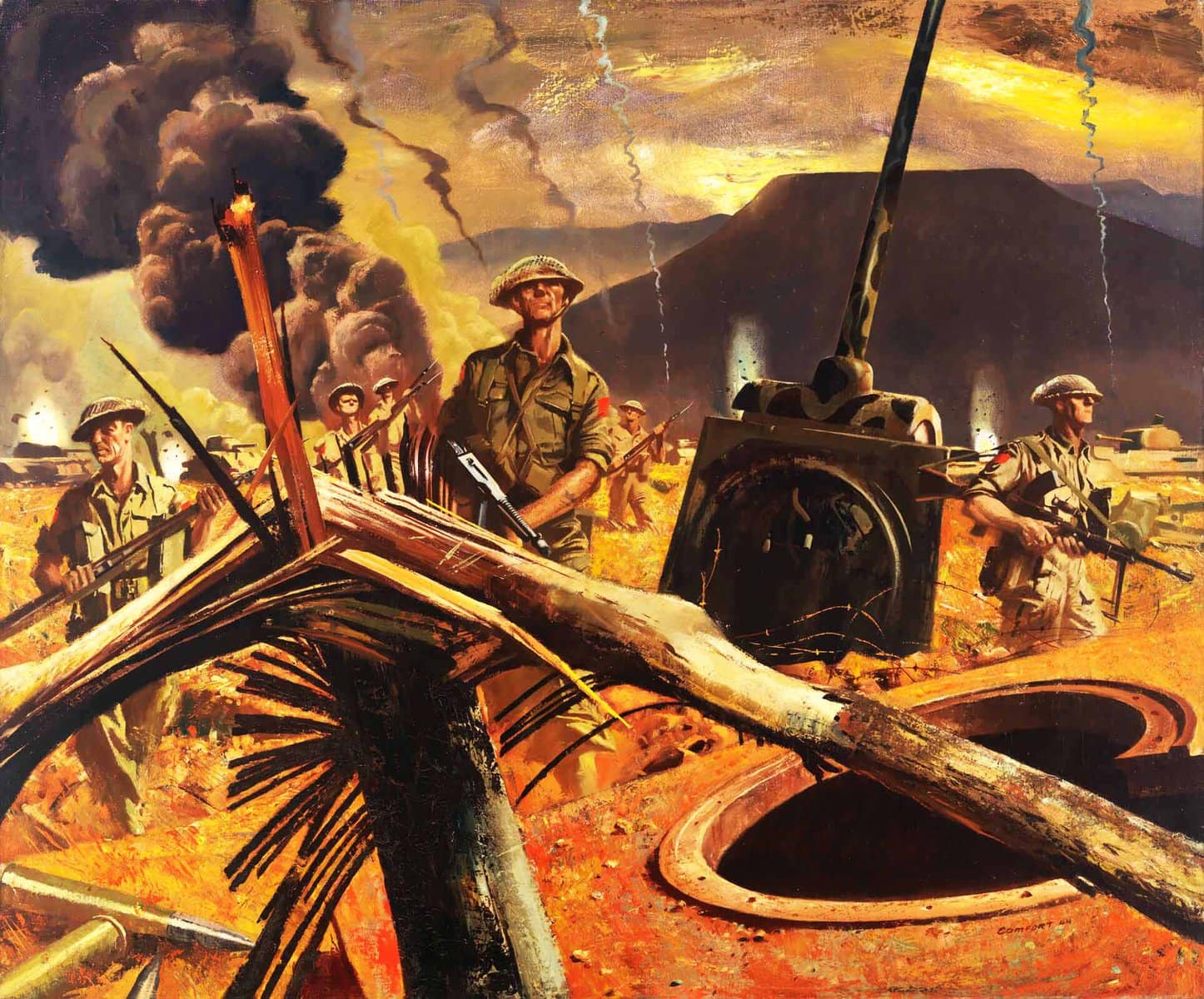
Charles Comfort, “The Hitler Line,” 1944, Oil on canvas. Canadian War Museum, Ottawa.