Lester Bowles Pearson (23 April 1897 – 27 December 1972) was a Canadian politician, diplomat, and scholar who served as the 14th prime minister of Canada from 1963 to 1968. He also served as leader of the Liberal Party from 1958 to 1968 and as leader of the Official Opposition from 1958 to 1963.

(Alexandra Studio Portrait)
Born in Newtonbrook, Ontario (now part of Toronto), Pearson pursued a career in the Department of External Affairs and went on to serve as the Canadian ambassador to the United States from 1944 to 1946. He entered politics in 1948 as Secretary of State for External Affairs, serving in that position until 1957 in the governments of William Lyon Mackenzie King and Louis St. Laurent. Pearson was also the seventh president of the United Nations General Assembly from 1952 to 1953. He was a candidate to become secretary-general of the United Nations in 1953, but was vetoed by the Soviet Union. In 1957, Pearson won the Nobel Peace Prize for proposing the United Nations Emergency Force to resolve the Suez Crisis, for which he received worldwide attention. After the Liberal Party was defeated in the 1957 federal election, Pearson won the leadership of the party the following year. He suffered two consecutive defeats by prime minister John Diefenbaker of the Progressive Conservative Party in the 1958 and 1962 elections. He challenged Diefenbaker for a third time in the 1963 federal election, and won a minority government. In the 1965 federal election, Pearson led the Liberals to a second minority government, again defeating Diefenbaker’s Progressive Conservatives.

(Yousef Karsh Photo, 1965)
During Pearson’s tenure as prime minister, he introduced progressive policies including the Canada Student Loan Program, the Canada Pension Plan, the Canada Assistance Plan, the Canada Labour Code, and universal health care. He established royal commissions on bilingualism and biculturalism and the status of women, oversaw the creation of the Maple Leaf flag after the Great Canadian flag debate, and unified the Canadian Armed Forces. In 1967, Pearson presided over the Canadian Centennial celebrations. In foreign policy, Pearson’s government signed the Auto Pact with the United States and kept Canada out of the Vietnam War. Under his leadership, Canada became the first country in the world to implement a points-based immigration system. After five years in power, Pearson resigned as prime minister and retired from politics.
With his government programs and policies, together with his groundbreaking work at the United Nations and in international diplomacy, which included his role in ending the Suez Crisis, Pearson is considered to be among the most influential Canadians of the 20th century. He is ranked as one of Canada’s greatest prime ministers.
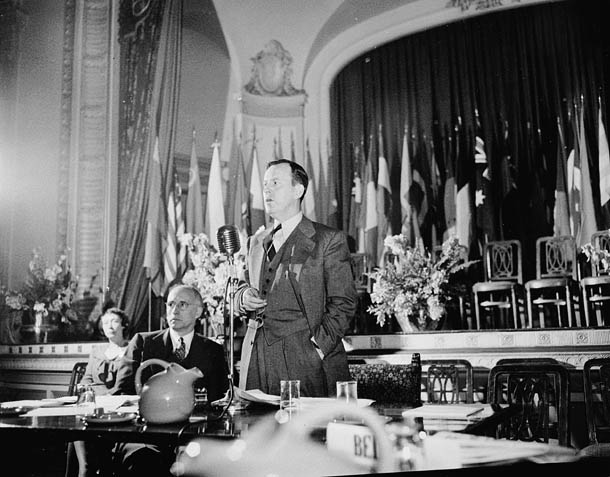
(Library and Archives Canada Photo, PA-117587)
Lester Bowles Pearson presiding at a plenary session of the founding conference of the United Nations’ Food and Agriculture Organization, Oct 1945.
In 1957, for his role in resolving the Suez Crisis through the United Nations one year earlier, Pearson was awarded the Nobel Peace Prize.[27] The selection committee argued that Pearson had “saved the world”, but critics accused him of betraying the motherland and Canada’s ties with the UK. Pearson and UN secretary-general Dag Hammarskjöld are considered the fathers of the modern concept of peacekeeping. Together, they organized the United Nations Emergency Force by way of a five-day fly-around in early November 1956 after the First emergency special session of the United Nations General Assembly. His Nobel medal was on permanent display in the front lobby of the Lester B. Pearson Building, the headquarters of Global Affairs Canada in Ottawa until 2017 when the medal was loaned to the Canadian Museum of History, to be displayed in the ‘Canadian History Hall’.
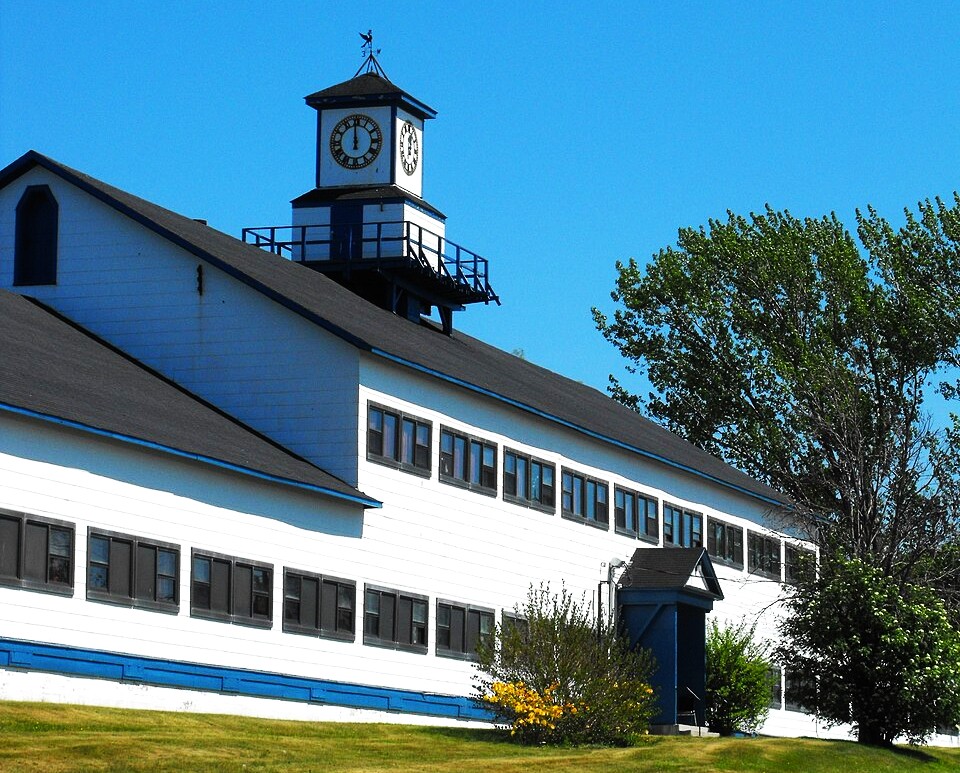
(Verne Equinox Photo)
Administration building, Kespuwik (formerly CFB Cornwallis) Annapolis County, Nova Scotia.
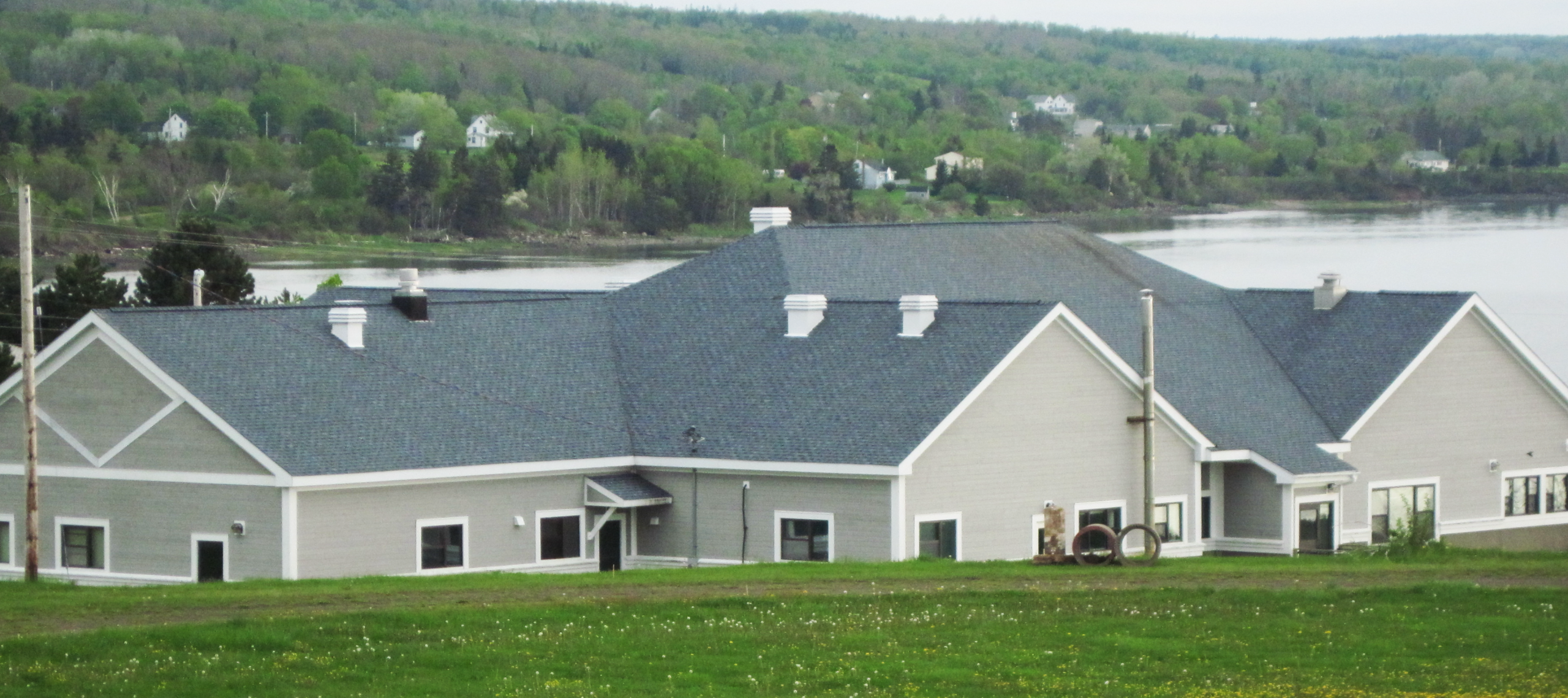
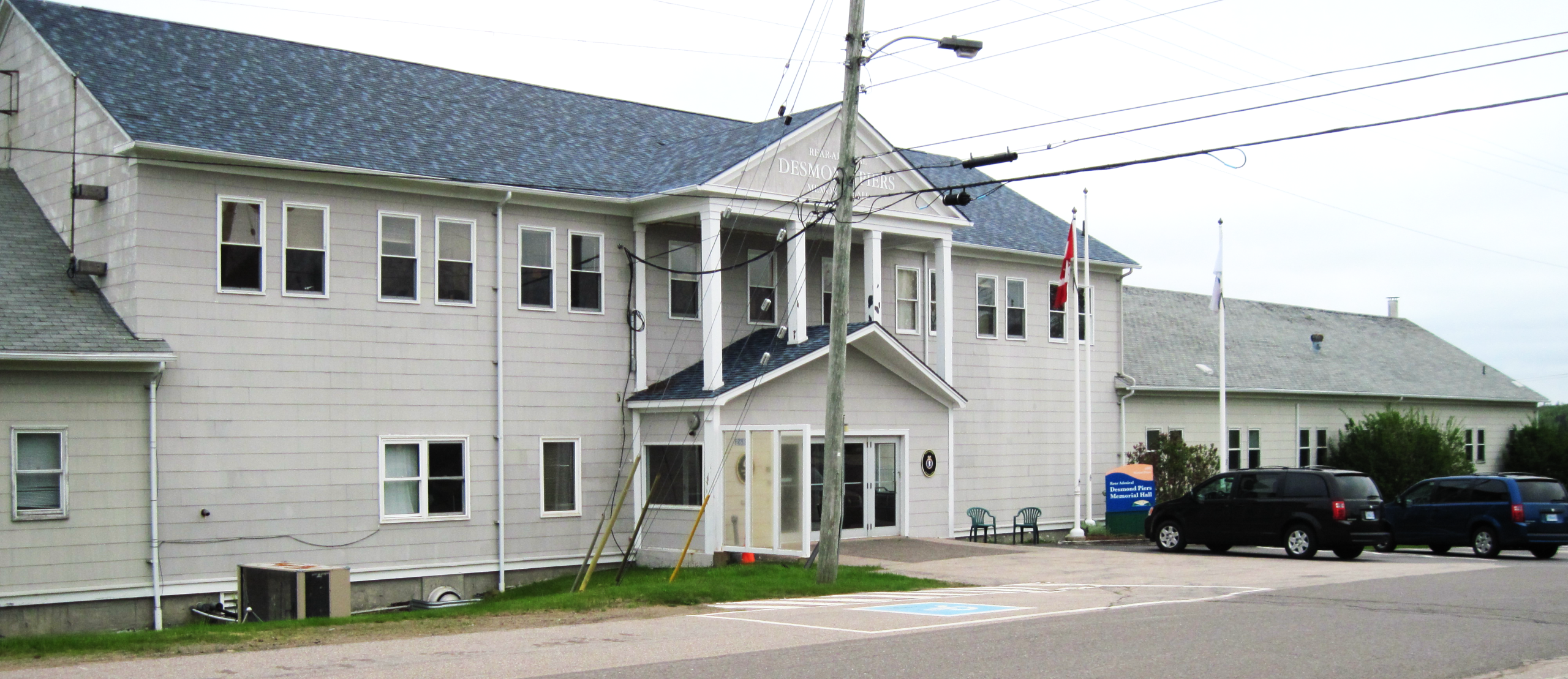
(Jasteena Dhillon Photos)
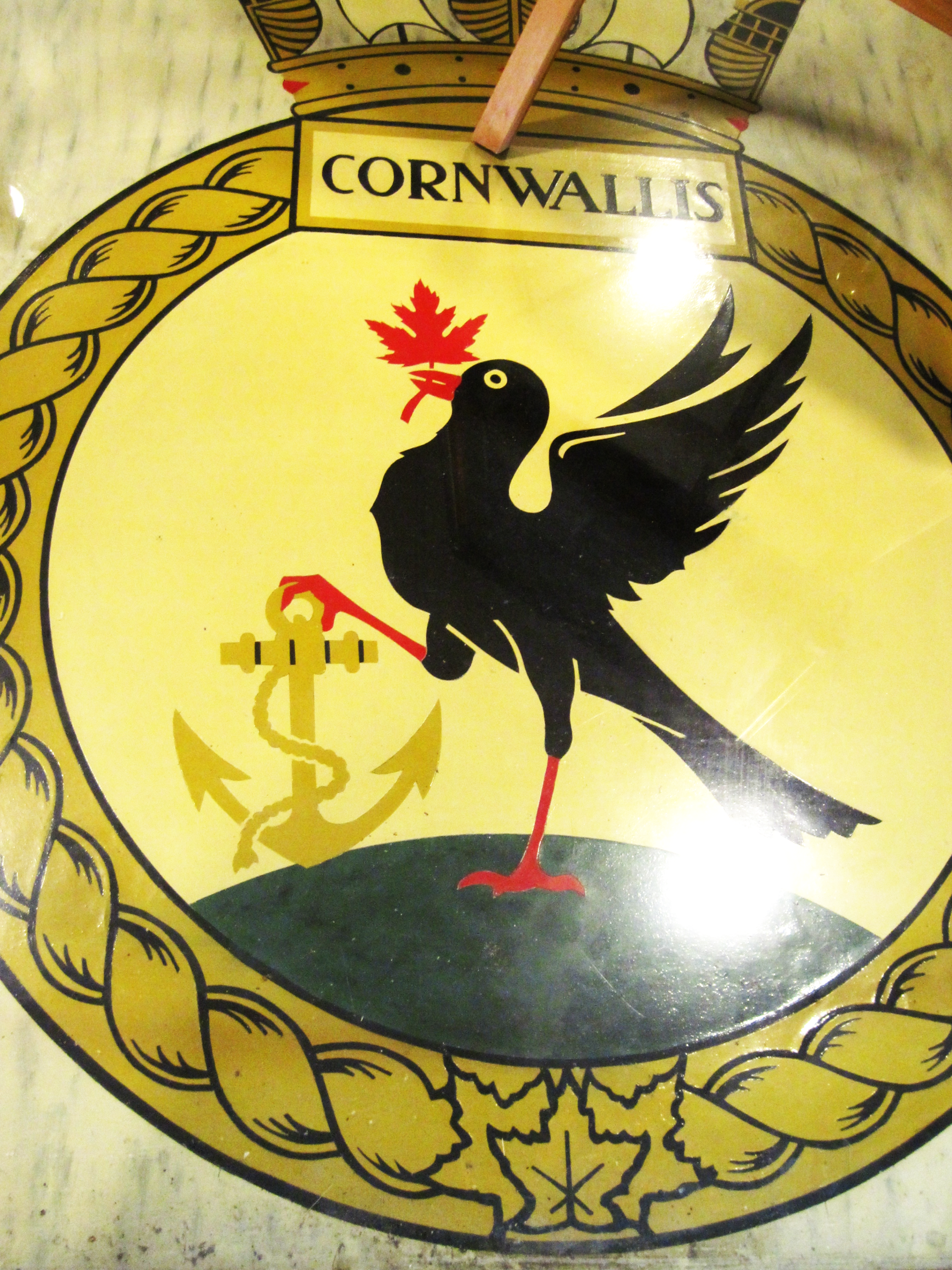
CFB Cornwallis.
Lester B. Pearson Canadian International Peacekeeping Training Centre
Established in 1994 by the Government of Canada as the Lester B. Pearson Canadian International Peacekeeping Training Centre (more commonly the Pearson Peacekeeping Centre, or simply the Pearson Centre) was an independent, not-for-profit organization with its office based in Ottawa, Ontario, Canada. Its mandate was to support Canada’s contribution to international peace and security. Operations ceased and the Centre closed around 2011. The property was sold by the government of Canada to a private individual in November 2013.
The Pearson Centre conducted education, training and research on all aspects of peace operations throughout the world, with the majority of its projects under way in Africa and Latin America. Services ranged from the training of police officers in Rwanda and Nigeria to serve as peacekeepers in Darfur; through delivery of pre-deployment training for Latin American peace keepers in Brasília; to the design and delivery of complex training exercises for use in Europe and Africa. It also raised revenue through its specialized training and management courses, which it ran for individuals, governments and organizations around the world.
While in operation, the Pearson Centre worked with the Kofi Annan International Peacekeeping Training Centre in Ghana. The Centre provided facilitation support to the International Network to Promote the Rule of Law, which is a project of the USIP. The International Association of Peacekeeping Training Centres (IAPTC) was founded on 2 July 1995, at the Pearson Peacekeeping Centre. The Pearson Centre also worked closely with the Canadian extractive sector to implement the Voluntary Principles on Security and Human Rights and provide training strategies to ensure that their security providers adhere to these international standards.
History:
The Lester B. Pearson Canadian International Peacekeeping Training Centre was created as an offshoot of the now-defunct Canadian Institute of Strategic Studies and became an independent organization in its own right in 2001. Named in honour of Lester Bowles Pearson, the former Prime Minister of Canada and recipient of the 1957 Nobel Peace Prize for his role in the inception of peacekeeping, the centre was established initially to train Canadian and foreign soldiers in the art of peacekeeping and conflict resolution for postings with United Nations Peacekeeping missions.
Lieutenant-Colonel Alex Morrison was the first president of the Pearson Peacekeeping Centre, which was established in 1994 by the first Chretien government. He was followed by Sandra Dunsmore, and later Suzanne Monaghan. In 2012, the presidency of the centre was assumed by Kevin McGarr, previously head of CATSA.
In 1994, Jean-Jacques Blais was appointed chair of the centre, holding that position until he retired in 2002. Chairs have included several notable Canadians.
The centre was established at Cornwallis Park, in southern Nova Scotia, using facilities made available by the closure of CFB Cornwallis. Offices were later opened in Montréal, Ottawa and Halifax. Headquarters of the centre were moved during the Harper administration to the Ottawa office in 2008 while most of the operations remained in Cornwallis Park. The Montréal office was closed in 2008 and Halifax wound down by 2010.
As financial support to the centre was progressively withdrawn by the Federal government of Stephen Harper, operations were reduced and transferred to the Ottawa office. The centre’s Cornwallis park facilities formally closed in 2011.
The name was formally changed to the “Pearson Centre” in 2012. On 26 September 2013, the Pearson Centre announced it would be winding down its operations and closing its doors. Operations ceased with the final closure of the office 28 November 2013.
Senior management:
William Alexander Morrison, MSC, CD, (1941– ) was born in Sydney, Nova Scotia, he is a graduate of Xavier Junior College and a historian. He received a Bachelor of Arts degree in 1968 from Mount Allison University. He joined the Canadian Forces in 1959 and retired as a lieutenant colonel in 1990. From 1980 to 1982, he was an instructor at the Royal Military College of Canada where he taught an undergraduate course in Canadian Military History. He was awarded his MSC in 1989. He was the 2002 recipient of the Pearson Medal of Peace, which is awarded for an individual’s “contribution to international service.”
From 1983 to 1989, Morrison was the military advisor to the Canadian permanent representative to the UN. He was vice-chairman of UN Peacekeeping Committee. From 1989 to 1997, he was the executive director of the Canadian Institute of Strategic Studies; and in 1994, he became the founding president of the Pearson Centre.
Philip Murray was chairman and Kevin McGarr president at the time of the centre’s closure in 2013.
References:
- David Davis and Alexander Woodcock. Analytic Approach to the Study of Future Conflict. The Lester B. Pearson Canadian International Peacekeeping Training Centre, Clementsport, NS, Canada, 1996.
- David M. Last. Theory, Doctrine and Practice of Conflict De-Escalation in Peacekeeping Operations. The Lester B. Pearson Canadian International Peacekeeping Centre Press, Cornwallis Park, Clementsport, NS, 1997.
- George Mason University Center for National Security Law and The Lester B. Pearson Canadian International Peacekeeping Centre. Strengthening the United Nations and Enhancing War Prevention. GMU, Fairfax, VA, April 1997.
- Suzanne Monaghan The Pearson Peacekeeping Centre The Cornwallis Group XII: Analysis for Multi-agency Support www.thecornwallisgroup.org/pdf/CXII_2007_03_Monaghan.pdf
- Alex Morrison and James Kiras. UN peace operations and the role of Japan. Clementsport, Canada: Lester B. Pearson Canadian International Peacekeeping Training Centre; 1996. p. cm.
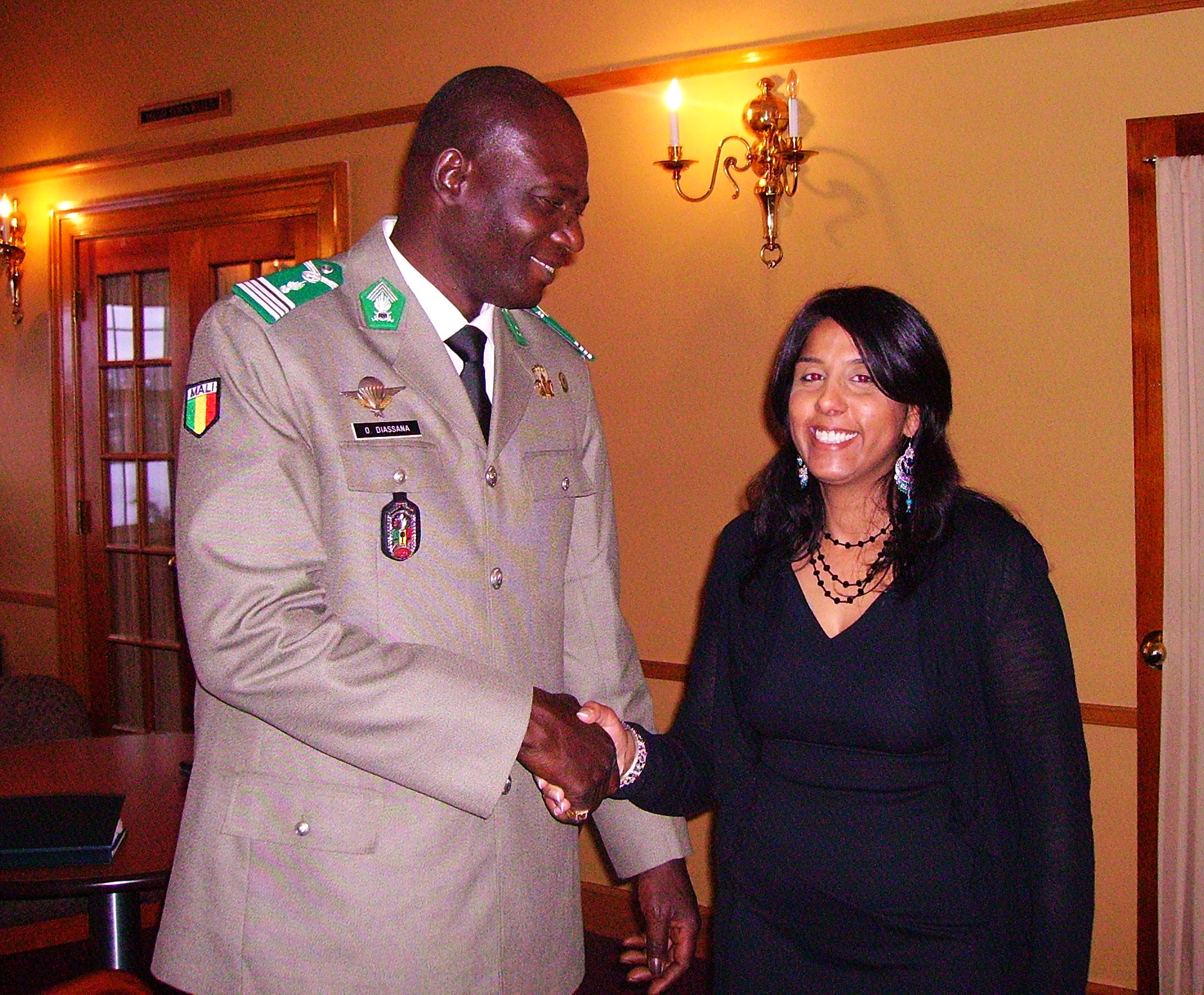
LCol from Mali with Jasteena Dhillon.
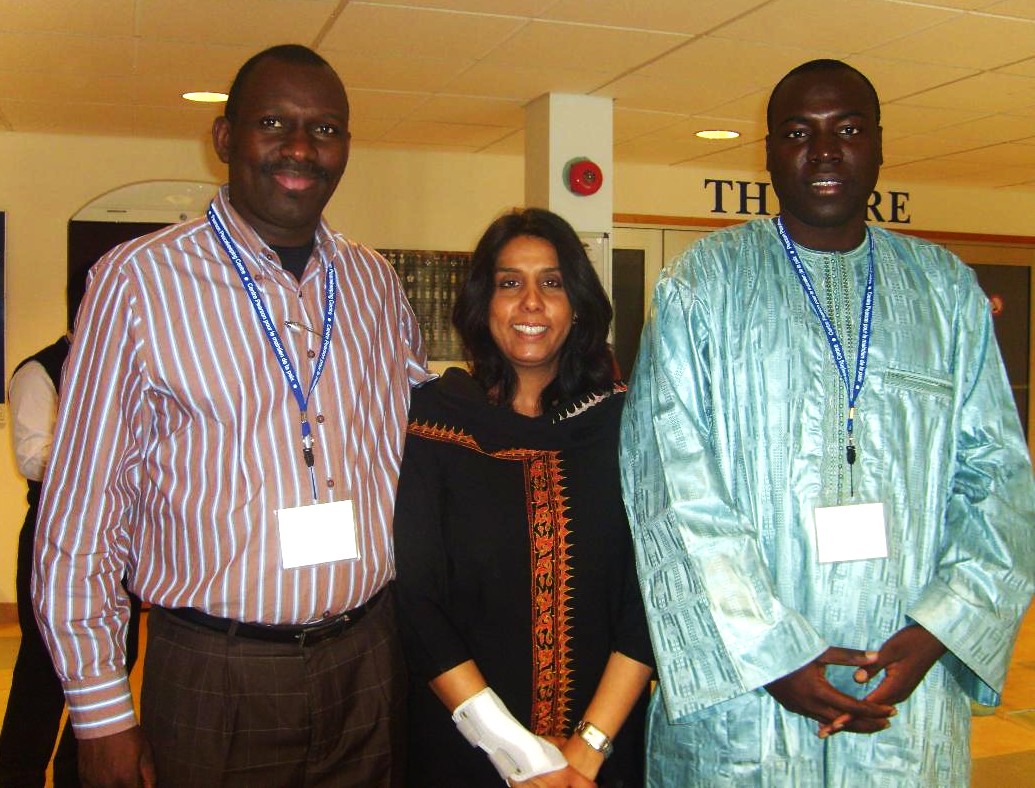
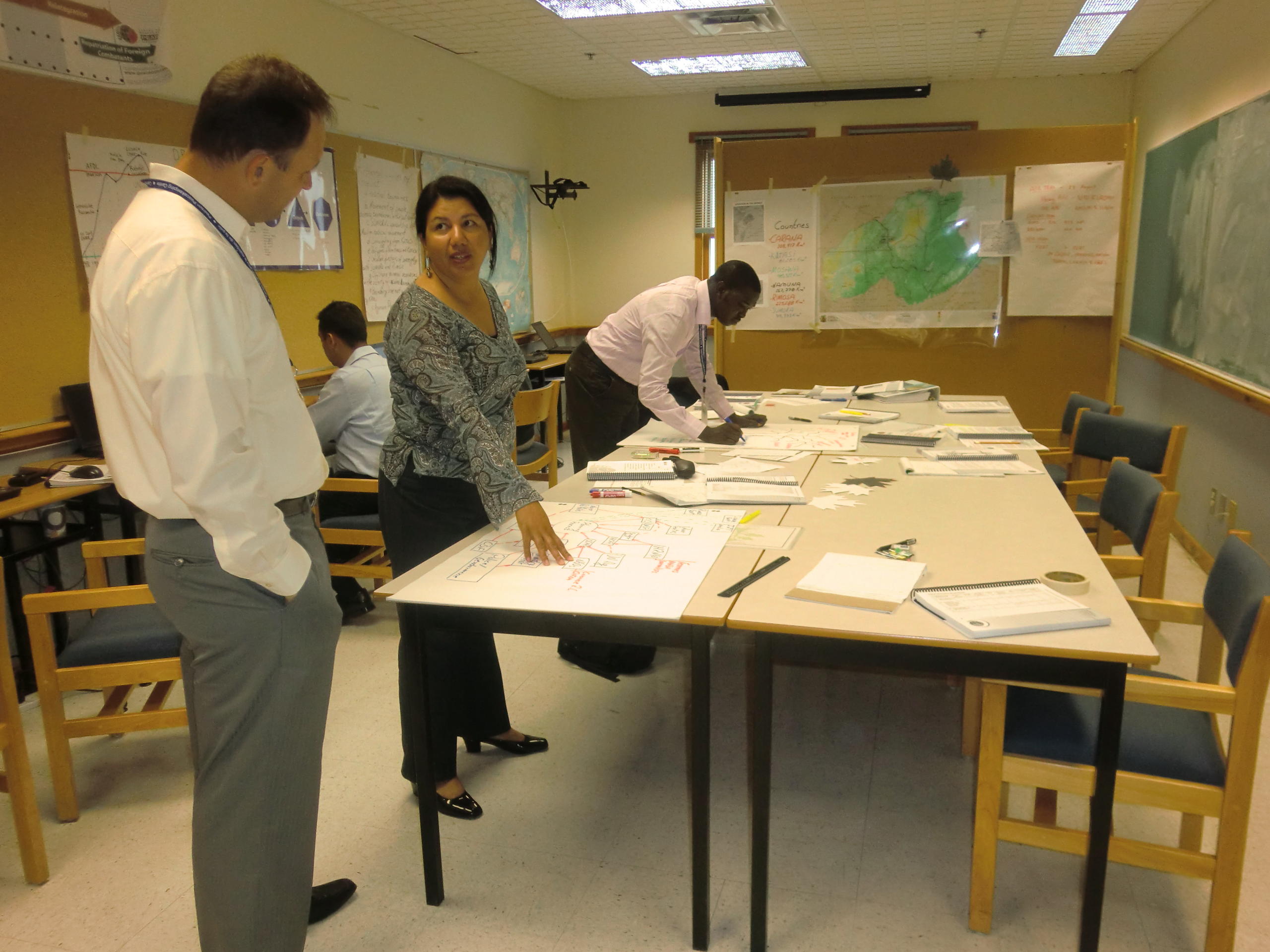
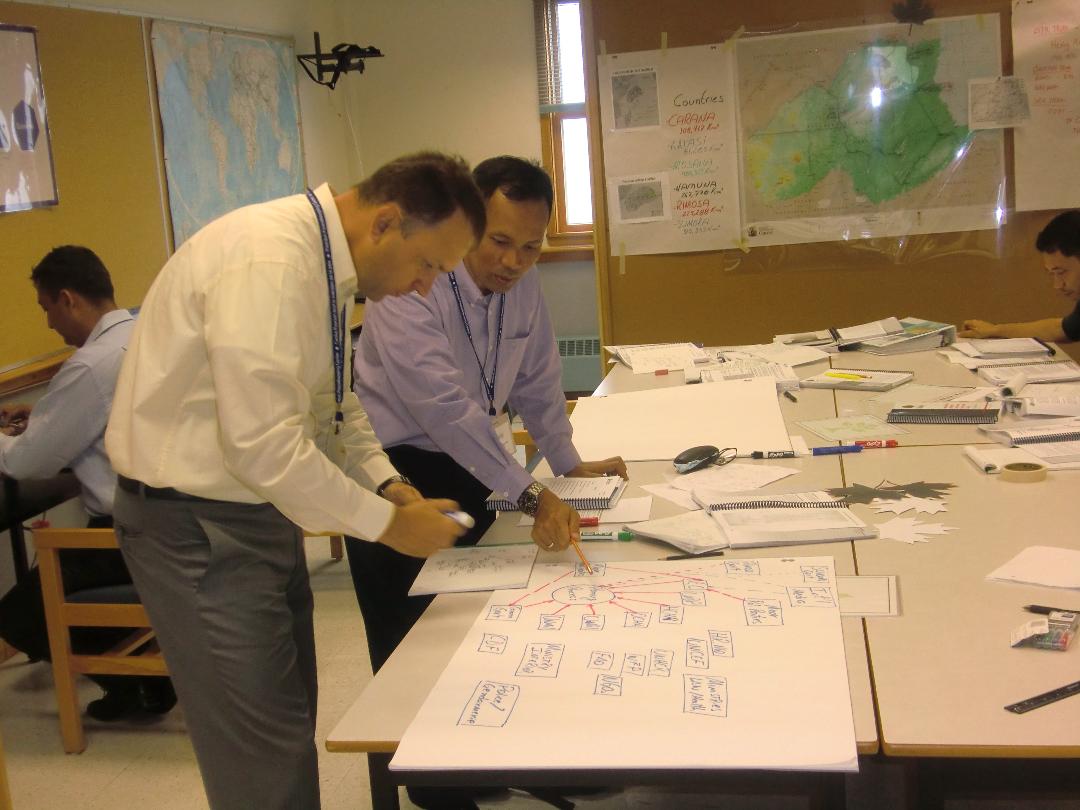
Students working on planning peacekeeping missions, learning the Integrated Mission Planning Process – similar to the JCSP process for CAF.
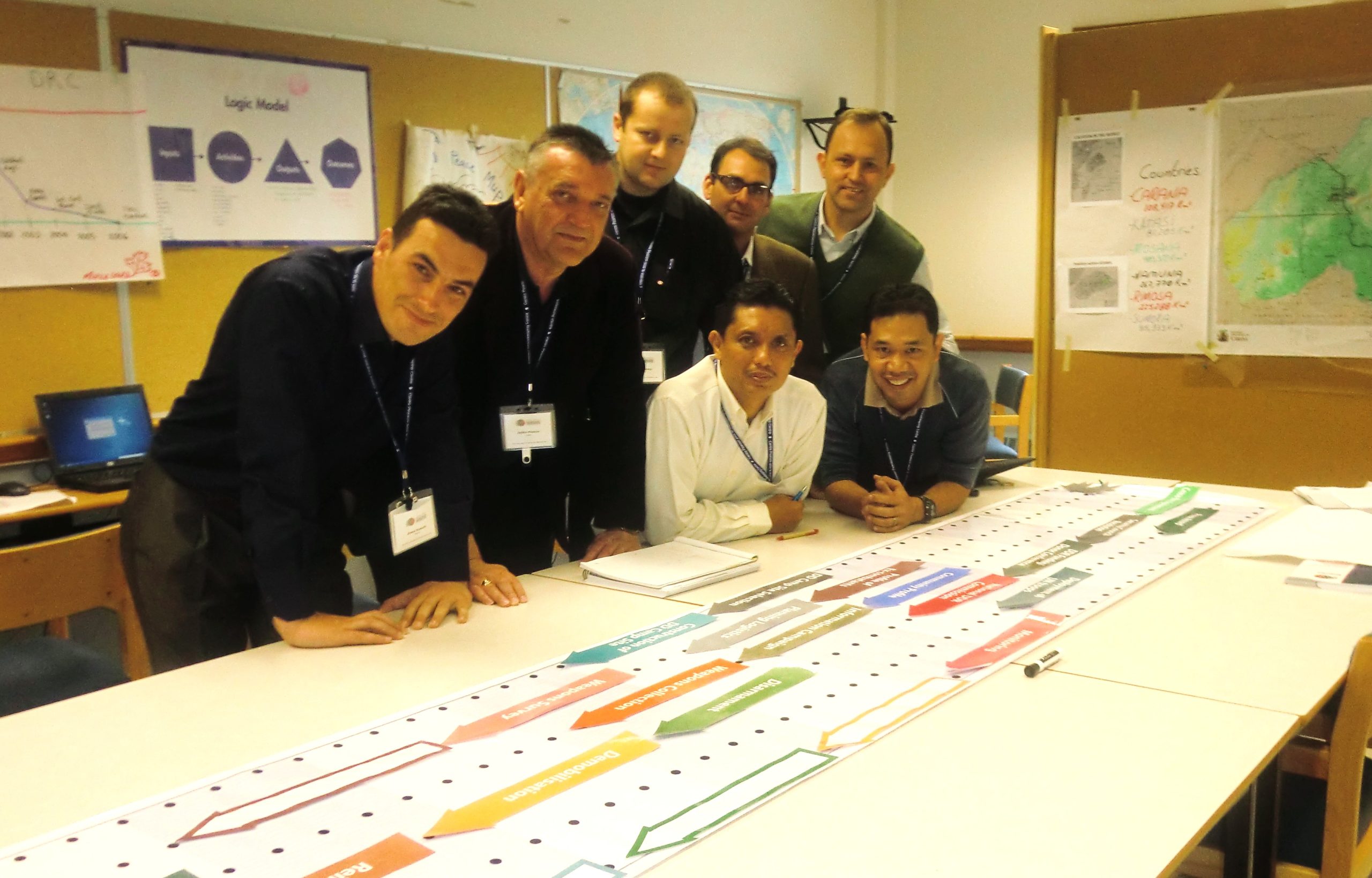
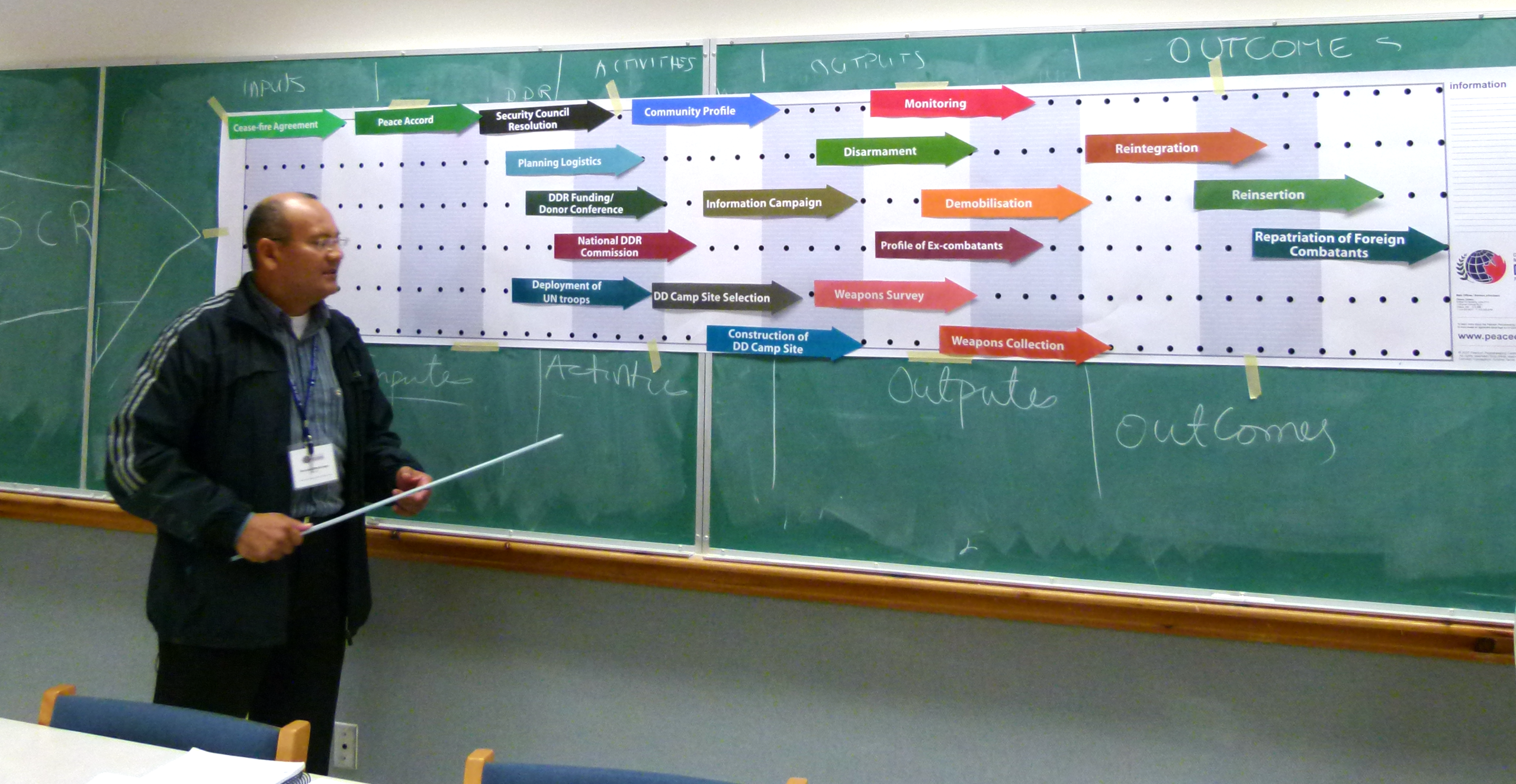
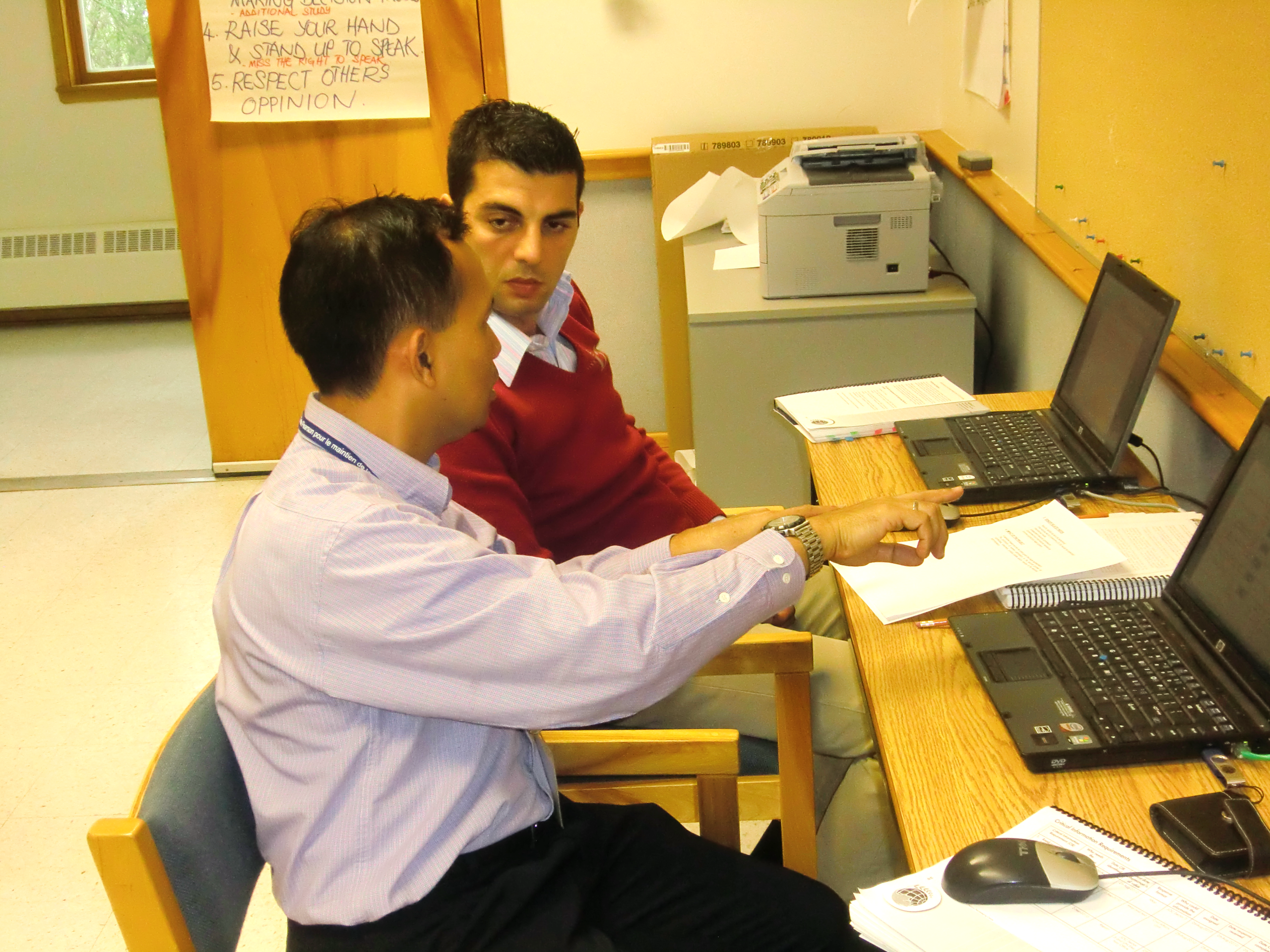
(Jasteena Dhillon Photos)
UNIMSOC (United Nations Integrated Military Senior Officers Course for Majors and Lt Colonels 2013 – Peacekeepers from Albania, Indonesia, Brazil, Pakistan.
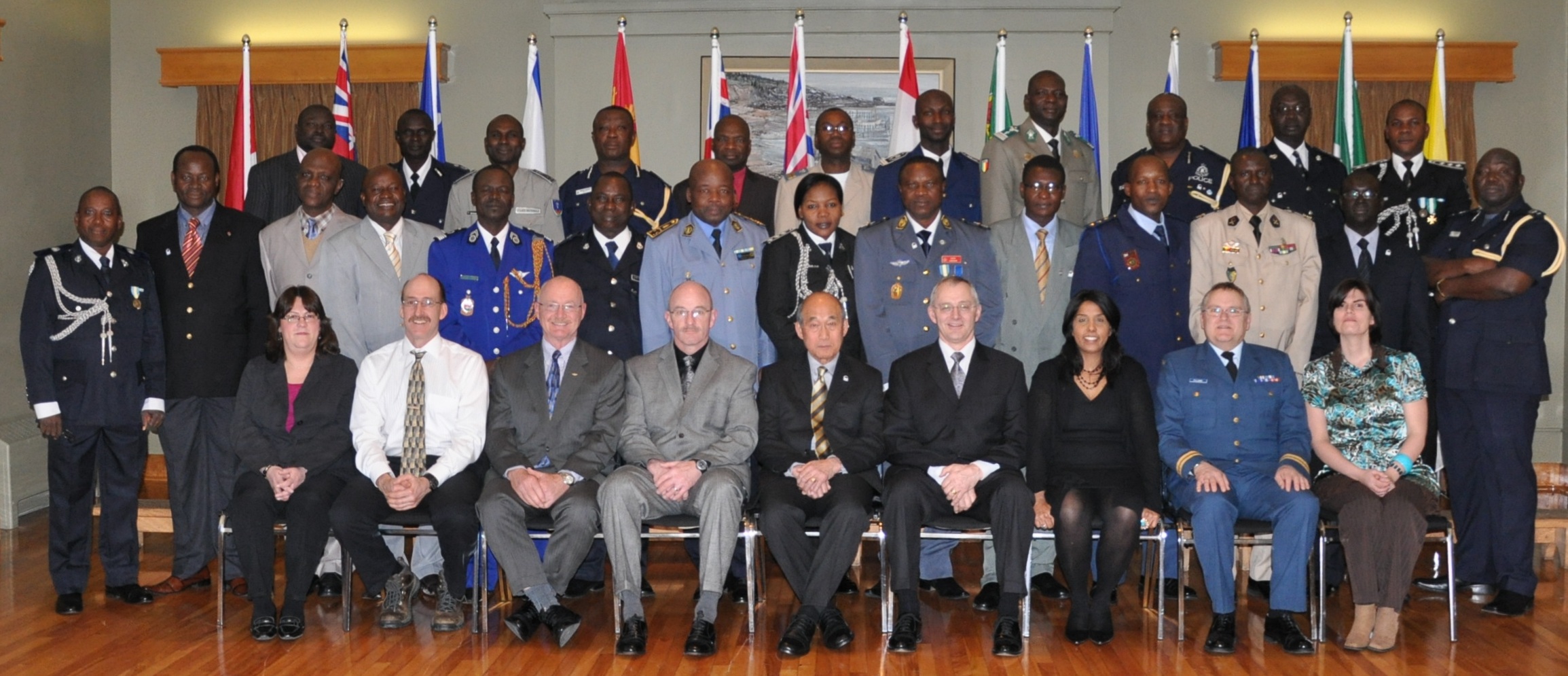
SMC 2012 – Graduating class.
The following is a significant collection of stories spanning 20 years of the life and contributions of a truly Canadian institution compiled by Angela MacKay. Initially compiled for a book, the collection continues to build with the aim of preserving the stories of of those living and those who have already passed on.
The Lester B. Pearson Canadian International Peacekeeping Training Centre
Memories, preface:
Alex Morrison initiated this project some time ago. Contributions are organized in alphabetical order. ‘Pre-marriage’ names- are used as being more familiar to many readers than marriage name changes. Names do not contain title, rank, position or role. Most contributors explain themselves and their connection with the PPC in the body of their texts. In order to maintain the individual ‘voice’ of every contributor, editing has been minimal, only in the interests of clarity, consistency – and a little grammar. For this reason, contributions are significantly different in length, topic and format.
During the past few years a number of our colleagues have passed away. Some of them had already sent contributions of their memories for this project. The memories are followed by an “Acronym” page included as a reminder and reference to de-mystify the thick acronym soup used by all members of the peacekeeping partnership. Some ‘bits and pieces’ of assorted memories, too precious to delete had no obvious home. They are of varying length, are variously amusing, thoughtful, instructive, provocative, and are included under the title “Loose Ends” after the acronym page.
An “In Memoriam” page records the names of those who have passed. While inevitable, it is a reminder that many of those associated with the PPC in its early days are now in their 70s and 80s. It is a reminder also to live life to the full – as we did in those amazing times at the PPC. In the interests of time, efficiency and cost, no pictures or other graphics have been included (with one small exception).
Foreword: Pearson Peacekeeping Centre Memorial
Peacekeeping has been a Canadian international vocation. Our involvement in more than 48 missions marks the high point of Canadian foreign policy and justified our United Nations Security Council membership, non-permanent though it may have been.
It was with his masterful intervention in the Suez Crisis of 1956 that Lester B. Pearson is reputed to have “invented” Peacekeeping. It was only fitting for the name of the recipient of the 1957 Nobel Peace Prize, who subsequently became the Prime Minister of Canada, be affixed to the Peacekeeping Center that began its international mandate and mission in Cornwallis, Nova Scotia in 1994. The idea for the Center was that of Alex Morrison, who as a Lieutenant-Colonel, had seen stellar service as Canada’s military representative to the United Nations in the 1980s and had been a witness to Canada’s peacekeeping reputation. He persuaded the Pearson family of the credibility of his concept of a peacekeeping training center and secured their consent to the use of the former Canadian Prime Minister’s name. Alex was the 2017 recipient of the Pearson Peacekeeping Medal.
This book is also a project that Alex Morrison conceived. It is a collection of the experiences of devoted internationalists engaged in the avoidance of conflict and dealing with its consequences. It is a compendium of expertise in engaging the more positive side of the human spirit. It will prove to be a resource timeless in its use and utility. It should make all Canadians proud of the skills and selflessness revealed in its pages.
I sincerely hope that this book will also serve to recognize the profoundly important, but not sufficiently well-known, global contribution the PPC made as it grew and evolved.
It was 1993 when Alex approached me to Chair of the Canadian Institute of Strategic Studies board. He didn’t tell me at the time, but I am sure he was already thinking of setting up the Center. He saw the election of a Liberal Chrétien administration as a potential source of funding and considered my past as a Pierre Trudeau Minister of National Defence and Solicitor General as helpful in lobbying for funds. I accepted the CISS responsibility and eventually was pleased to help in getting the needed financing to set up the Center at the former Cornwallis Naval Base in Nova Scotia.
For the next decade I chaired the PPC board and saw the growth in the level of peacekeeping training activity and the international recognition of the excellence of PPC personnel and trainees. How proud I was of the scintillating esprit the corps that reigned at Cornwallis under Alex’ leadership among all those involved in the Center as well as the residents of the area and the citizens of Nova Scotia.
My interest in international peace and security dates from the Second World War and my father’s Prisoner of War experience. After the war, my dad pursued his interest in politics and public affairs and answered my many questions on related subjects including our role in the United Nations, the formation of NATO, Canada’s involvement in the Korean War.
I was beginning my Junior Matriculation at Sturgeon Falls High School when Suez occurred. It was a constant topic of conversation around our dinner table for the duration and its eventual solution seared its imprint on the course of my professional career. At University I took a political science course in International Law from Jean-Luc Pépin, who was later to be a colleague in the Pierre Trudeau government and went on to get my law degree, sought public office. In 2001, I obtained my Master’s Degree in International Law after my experience in Bosnia Herzegovina as Deputy Chair of the Provisional Election Commission following on the Dayton Accord.
I left the Board and became its Chairman Emeritus in 2003 when, in January of that year, I accepted a mandate from Elections Canada and the International Foundation for Electoral Systems to act as consultant, in Afghanistan, to various parties, including Canada, the United States, the United Nations and the Afghanistan government in anticipation of coming elections. In October of that year, at the behest of the Americans, I led a mission in Iraq to study the Iraqi electoral capacity in anticipation of the selection of a Constitutional Commission.
My focus on governance both at the national and international levels has been a constant. A focus no doubt enhanced by my having been a member of the government responsible for the adoption of the Charter of Rights and Freedoms in 1982. My relationship with the Pearson Peacekeeping Center gave consequence to that focus. The disappearance of the Center has been a major disappointment to me as it has been for all who have been engaged with it. Even more tragic: an equivalent replacement is nowhere to be found.
Rule of law governance is the antidote to mayhem and violence. Canada has in federal parliamentary democracy, one of the best systems of governance on the globe and it has had it for the longest time. I remember attending a conference on governance in Portugal where I was asked to give a paper on why Canada had never suffered a coup d’état. Canada was the only invited participant that could make that claim. I was able to tell the attendees that: “In Canada, our system of governance channels the use of force to positive ends with a military and police subordinated to civil authority. We don’t waste effort and precious energy in repressing the consent of the governed, our legislative process guarantees that consent.” Demographic diversity Is not a source of conflict, it is a source of wealth and prosperity. We honour it and mediate the differences between its components to achieve the greater good.
Peace, Order and Good Government is a political technology worthy of broad dissemination. Its success lies in the supremacy of laws in control over the use of force. Force to ensure security within and without the body politic. Why are we hiding our success at it under a bushel? Why are we not disseminating our governance expertise broadly throughout an international community looking for solutions to the internal conflicts of its members as well as external threats to its peace and security?
Congratulations and thanks are due to Alex Morrison and Angela Mackay for having taken the initiative in bringing together the history of the Pearson Peacekeeping Center experience. What has been missing as the result of the Center’s disappearance, among so many other losses, is the opportunity of engaging in profitable lessons learned exercises.
Perhaps this publication will renew interest in the lives and experiences lived as found between its covers.
Jean Jacques Blais, P.C.,K.C.
MEMORIES
ROGER ALBERT
I served in the Royal 22d Regiment from 1964 until 2002 – 38 years serving my country. I served first as an Infantryman for 18 years, where I was promoted to the rank of Chief Warrant. I was later commissioned as an Officer at the rank of Captain and was promoted to the rank of Major before I retired.
During that time, I served for NATO in Germany, and for the UN in Cyprus, El Salvador, Rwanda, Iraq, and Congo for a total of four and half years.
After my retirement, a fellow officer suggested I become part of his team teaching at the PPC. I didn’t have a clue what that was all about, but I accepted the job.
My job consisted of teaching military personnel mainly from African countries, and civilians wishing to go on a UN mission. I was responsible to give them a very basic training on operating radios, using the military alphabet, navigation and map reading. The training also included field craft: the do’s and don’ts in the field, like how to recognize a minefield, booby traps, what to do with weapons – how to make them safe and the impacts of shooting/firing – and finally, negotiating techniques.
What I didn’t realize when I accepted the job, was the size of the task. I had to write all my programmes, all the lesson plans, the exercises, the logistics and that I would be alone with 25 or 30 candidates who had little or no experience in the field.
My first classes were on radio procedures, because starting the next morning until the end of the training, I would be training them as if they were on mission, with a radio check at 07h00 in the morning, to make sure they were all alive. They would have to wear their ID badges at all times, otherwise they would not be allowed in class or into the HQ. This was to keep them on their toes.
After two weeks of training there was a field exercise where they would apply all the knowledge acquired in theory. The PPC rented cars for the navigation exercise. We divided the candidates four per car, with maps and a script of about 20 different locations they had to find within a timeframe. Participants also went to a local firing range to test learn how to disable – ‘make safe’ – weapons and to experience the sounds and impact of weaponry firing, from the safety of the firing butts.
Of course, getting lost was a big part of the learning curve. A significant part of the exercise was the use of the radios because each student had to radio in their positions, and advise HQ on departure for their next objective. Finally, their driving skills were also part of the exercise. At the end of the day, all were tired and after debriefing on the experiences of the day we would retire to the lounge for a drink and to re-live the day’s stories.
One of the highlights at the PPC was a mission offer to go to Sudan for three months. We were five: Doug Drysdale, Finn Ola Heggelund, Susan Soux and Bernie Sanders, the mission leader. We received uniforms, hats and boots, new laptops and other equipment. After a long flight to Khartoum we were met by officials and taken to the hotel where we spent a lot of time over the next three weeks as. The Norwegian General in charge of the mission was not ready to have us in the field, since the Headquarters was not fully operational.
But we did have a visit on the river Nile that splits the city and a chance to visit the Pyramids located in the desert in north Sudan close to Egypt.
Our leader negotiated for us to give our course to selected army officers at the hotel. Our mission was to teach both the Sudanese army and the Sudan People’s Liberation Army (SPLA) rebel staff on skills and the hard work of peacemaking. For example, teams including members of both sides were formed to work together at different patrol bases along the blue line. It was a challenge to convince enemies to become partners for this mission. I remember we taught them how to patrol the area between the factions involved; how to drive ATVs and maintain them; map reading, radio operations, negotiation techniques, and so on.
This first course was a trial period for us but we felt, a success. Adjustments made, we were ready and excited to finally get to southern Sudan. It took another couple of weeks to get all the authorizations to travel, get the vehicles, the fuel, the water, rations etc… We finally started on our journey.
We arrived in late afternoon and were met by the mission commander, who was not happy as they were not ready for our visit but we were given quarters and food and started our ordeal.
After another few weeks we finally were able to start our first group in the field. On the first morning one of the rebels was arrested but we got him back and began the course. We were supposed to get a group of rebels but due to the minefields neither we nor they could drive there, so we would fly to the site. Unfortunately, the mission helicopters arrived late so – a few more days of waiting. Once the helicopters arrived we had to wait for the fuel. When it arrived, it was the wrong fuel. Another wait! The fuel finally arrived, and we took off the next morning.
At the site we were given quarters in an abandoned house. We had our folding beds and sleeping bags. Then came another surprise: no electricity. All our course was on slide presentations, so we had to improvise until someone found a generator. We were eventually flown back to the HQ so we could resume our work, but we were told the course participants were not English speakers. The mission ended and we returned home to canada.
I was involved at the PPC for a few more courses over a period of three years where I continued to meet many very interesting people both from among the participants and from among the faculty members. I ended my involvement when it was suggested that my course content was “too brutal.” It wasn’t, I’ve been there. War and the search for peace is both brutal and difficult. I decided that I could not change the way I saw my material being taught so I retired, and went back to my bohemian ways and went backpacking around South America….
In conclusion, I can say the overall experience teaching at the PPC was an excellent one for me and I would do it again.
……….
DALE-SOFIA ANDERSON
More years ago than seems possible, I was finishing a degree in community planning in Halifax when I learned about a program at a UK university in ‘post-conflict reconstruction.’ ‘What a fascinating aspect of planning,’ I thought. ‘How do you get into a field like that?’ Somehow about the same time, I stumbled across the call for interns from the Pearson Peacekeeping Centre which was fortuitously – and figuratively speaking – right down the street. ‘That’s how,’ I thought, so I applied, was accepted, and within short order was newly ensconced in Cornwallis, Nova Scotia, at a former military base – as an intern.
For reasons lost to history, my arrival was delayed by a week or two which resulted in being assigned to the President’s Office rather than the Programmes Office (as I think it was called). What a stroke of luck that was: If you want to be at the heart of the action, there’s no better place than the top. Memo to future self: Try to arrive a week late for new jobs – you never know what good will come of it!
Alex Morrison (spelled with an ‘X’ but pronounced like a ‘K’) was President and staffing the office when I arrived were Stephanie Blair, Executive Assistant, Donna Trimper Admin Manager and Sandy Innes, Secretary, with my fellow intern Darren Gibb arriving soon after. Other staff there at the time were: Russ Russell, James Kiras, Col. Tom Geburt, Capt. Jean Morin, Tim Sparling, Lana Kamennof-Sine, the librarian, Capt. Patrick Rechner, Jo-Anne Vandendorp, and of course the many drivers and housekeeping and dining hall staff.
Just a few of many memories of this time…
The PPC & Campus
Meeting students and staff from across the globe, and making calls all over the world as a regular part of my work
Email addresses that went something like: PPC4, PPC5, PPC6…
Being called ‘ma’am’ (clearly a result of the military influence but a first for this civilian)
Tornado-strength winds capable of literally blowing me down the street
The ‘ghost town’ like base and nearby bridge-trestle which I never found the courage to walk fully across, although I watched in awe as many others did
The dining hall preparing all our meals (it’s been downhill culinary-wise for me ever since)
The most spectacular sunsets I’ve ever seen (Lana remarked to me one night, ‘If you saw that in a painting, you wouldn’t think it was real, would you?’)
Celebratory dinners for each graduating class – as I couldn’t drink at the time and shared with others the two glasses of wine that came with dinner, I became a popular dinner companion
Work in the President’s Office
Alex’s ‘let you loose attitude’ – he told you what you what he needed and gave you lots of scope to do it (a style many bosses could learn from)
The Elvis clock in Sandy’s office with hips that swung like a pendulum (I thought it was because the PPC couldn’t afford a ‘real office clock’ – turns out Sandy was an Elvis fan with two trips to Memphis under her belt!)
Alex saying ‘good word’ upon seeing I had used ‘amongst’ in an editing project
Two conferences the office organized and held in Washington, D.C., and New York, resulting in trips to those places (Score: wouldn’t have got to do that in the Programmes Office!)
Playing the role of the UN in a major international military training exercise in Halifax one spring, which resulted in:
flying in a Sea King helicopter (we survived!!)
touring an impossibly huge American ship with a control room rivaling anything the Sci-Fi world has imagined
Stephanie and I receiving enormous bouquets of lilacs (one of my very favourite flowers!) brought from his garden by the Corporal responsible for escorting us in our UN role
Alex asking if I’d like to stop and watch a ballgame in a Halifax park one evening (completely astonishing me as I’d never seen him take a break before)
The sudden, unexpected death of sweet Fern’s husband – Fern was a sunny presence in the dining hall who graced all with her smiles and kindness. Rides were arranged so everyone could attend his funeral, a gesture of solidarity, during a colleague’s dark hour, that has remained with me ever since
Twenty-five years later, writing in the time of COVID-19, our provincial health officer exhorts us to ‘Be kind, be calm, be safe’ – a sentiment not unaligned with that which still guides peacekeepers around the world today. Being an infinitesimally tiny part of that effort, in the beautiful Annapolis Valley, was an unforgettable experience.
……….
JAMIE ARBUCKLE
In early 1995 I was nearing the end of over 36 years of military service, under-employed and soon to be unemployed. My leaders got a call from somebody named Ben Hoffmann, who wanted help in preparing a course on negotiations and mediation for peacekeepers at what we all already knew as the PPC, in Cornwallis, Nova Scotia. I was to be his guide for an exercise in which most of my colleagues had little interest – what little they knew of the place they thought neither good nor useful, and I was just the chap for that.
Ben was located just steps from National Defence HQ, so one very cold day in February I sloped off to meet him, and in the next few hours my life changed again and for good. We clicked immediately, and I realized that Ben was proposing to teach a skill in which we all thought ourselves highly skilled and experienced, but I was quickly brought to know that such was far from the case.
The year rolled on, and the course was to be taught in April. In March Ben asked for me to be nominated as the military member of a Directing Staff which would have, under him, military, police, political and academic members. Still sort of at loose ends, both my bosses and I thought this was a good place for me, and so in April off I went to the PPC.
But my purpose here is not to relate the history of the PPC, rather I want to remember Ben, and share those memories with you.
Ben created spaces: spaces for people to learn, to be excited, to have fun. We would have on these courses, folks with cumulatively far greater experience than we, and there was little sense of lecturing to them, or even teaching them things they didn’t already know. But with Ben we created those spaces for them to realize and to organize and to utilize skills and knowledge they all had – but often didn’t quite realize that. And in so doing, and by following Ben’s example, we created another space in which we Directing Staff (DS) learned at least as much as we taught. As the course drew to its close, we all knew we just had to go on meeting like this. We all wanted to go on creating these spaces, and then filling them with people and learning – and fun.
In the late summer of that year, I was on retirement leave. I hadn’t enjoyed National Defence Headquarters at all, and was glad to be shut of it. But as I sat in my lovely garden in the Glebe with all the books I had wanted for years to read, I couldn’t help looking up as aircraft came and went at the Ottawa airport, and wondered if this was all there was. And then the phone rang.
It was Alex Morrison on the line. Alex was an old friend – we had been in Staff College together in Kingston in 1969-70. He had retired a bit before me to found, with Ken Eyre, the PPC. The Centre was about to launch what it was hoped would become the flagship course, Command and Staff for Peacekeepers. He needed me to be the military member of a DS team which, just as the previous spring, would consist of military, political, academic and police members. I was very excited by the offer, but Alex had some cautions for me: one of the members was a woman, and she was from the UN Secretariat. Now I never had anything but good experiences with the very few times I had worked with women of officer status. But Alex had been some years in UNHQ in New York, and he knew just how most officers felt about most members of the Secretariat. Well, to tell the truth I was getting bored, and so I told Alex to count me in. Something would get sorted out, and I sort of hoped it would be this Secretariat person.
I arrived in Cornwallis a few days late, and all the other DS were already installed. I then met Ingrid Lehmann, on leave from the UN. She says I stared at her all that afternoon, and for sure I found her fascinating – and I still do. We’ve now been married for 19 years.
The course got off to a good start, but we were sort of stifled by our adult leadership, and there was a lot of squabbling among the support and administrative sections. But we kept it together and thought were we running – directing really – a pretty good course. And then Ben appeared, to lead us in the presentation of a one-week module on Negotiation and Mediation, which was an abbreviated version of that course we had done the previous spring. And Ben again worked his magic, creating once more those spaces to teach and to learn and to work – and to have fun. Though Ben was there only for one week of the ten weeks of the course, we were able to preserve those spaces he had created for us.
The next spring, 1996, there was scheduled a second course on mediation and peacekeeping, and Ingrid and I were to be together again as two of the four DS for the course. There were again Ben’s spaces, and again as we moved through those spaces, we could seize those moments to love what we were doing – and how we were doing it. And Ben seemed to know something about us which was only slowly dawning on us: just before dinner one evening, Ben said to us that we were a wonderful couple.
Ben was a prolific and skilled author. Two of his best books were reviewed in our blog, Peacehawks. The first was of Peace Weaving, reviewed by Neil Patton in August 2015; the second review was The Peace Guerilla Handbook, which we reviewed in July 2017. (See http://www.peacehawks.net/)
Ben lost his battle with cancer on 26 February 2019, but the spaces he created for us live in us still.
……….
SALLY ARMSTRONG
It was such a fine experiment. And such a privilege to be part of it. The parameters were clear at the outset: a particular list of people on the planet could predict the eruption of violence; the early signs of war. They were the military, the humanitarian aid workers, the journalists and the local people. What if you collected them – like the canaries in the mine – together to present data that might, or might not, sound the alarm. What if you got a jump start on the conflict – the early rumblings, the deteriorating conditions, the political maneuvering, and used the collective information to resolve the disputes and shut down the war before it started?
That’s what I understood from Alex Morrison when he first approached me about his interest in creating a centre that would deal exclusively with avoiding conflict and keeping the peace.
Of course, I was interested. As a journalist who covers conflict from the point of view of what happens to women and girls, I knew how much I depended on the humanitarian aid workers for information, on the local people for the inside story. But I also knew there was a strain between us; an unspoken turf war of our own. On the few occasions when I ran into the military men and women on the same assignment – Sarajevo airport, the Golan Heights, Somalia – I was invariably impressed by the knowledge they had (and sometimes enormously grateful for getting me to a story or out of a place I shouldn’t have been). But the trust factor persisted as though I was somehow part of the enemy package. So, I saw the launch of the PPC as a brilliant proposal to make us colleagues rather than adversaries.
There is a story – maybe a cautionary tale but I prefer to think of it as an abstract of the Pearson Peacekeeping Centre. It was 1996. A meeting of the board of directors had been called to take place at the headquarters of the PPC in Cornwallis, Nova Scotia. One of those late winter snow squalls had been forecasted for the region. Another board member, Duncan de Chastelain, agreed that we should meet in the Halifax airport and drive together to Cornwallis. Our flights arrived as scheduled. We met in the airport as planned. We tossed our gear into the backseat of the rental car and prepared to leave for what would be an easy drive across the province and down the valley.
But (there’s almost always a but in a peacekeeping story) the minor snow disturbance was now a major winter blizzard. You could hardly see a few feet ahead. Should we go? Yes. Would be in dangerous? Probably. We white knuckled our way along the highway keeping to the single set of tire tracks and hoping we wouldn’t encounter an oncoming vehicle. We chatted the way people who are trying to escape dread and avoid fear do – back and forth – filling each other in on the details of our families and kids and careers. A lawyer with a military background and a journalist with a yen for story-telling. Three hours later we saw the blurry lights of the gates at Cornwallis as though they were an epiphany of deliverance.
Alex Morrison stood in front of the Officers’ Mess waving us in as though he’d only happened to check on our late arrival a moment before we slid to a stop. The snow on his cap and coat would tell otherwise. He greeted us with his characteristic “we can do anything” style and gave us the on-the-ground appraisal of facts – the storm would blow itself out by morning, the meeting would begin as scheduled and hustled us inside to the roaring fire and welcome wine.
Once the rounds of greetings were complete and the perils of the snow storm recounted, Alex asked, “Who drove the car?” Duncan replied. “We both did but I was at the wheel.”
All these years later I remember that story as the epitome of the Pearson Peacekeeping Centre. The actors in zones of conflict have roles to play. Sometimes they interact. Often they don’t. But zones of conflict are messy places, the rules and indeed the facts are forever being recalculated. If there is an established protocol that hooks the canaries in the mine together when necessary is it not obvious that humanitarian aid workers can get their vitally important work done, that the military can keep the combatants apart and that the journalists can get their story? And that together they can provide information to each other that lessens the load. Like Duncan de Chastelain said, sometimes we both have to drive while only one of us is at the wheel. That was the grand and memorable lesson of PPC.
……….
STEPHANIE BLAIR
Part 1. Before PPC…Yes there was such a time. While studying at Glendon College, York University, I took a course called ‘Security’ without any sense of what a turning point this would be in my life. Of course, the Professor delivering the course was Alex Morrison. Many of the other students said, “If you want to be anyone you have to intern for Alex at the Canadian Institute of Strategic Studies (CISS),” where Alex was the Executive Director. Coincidentally I recently found a box from university days – I didn’t fare so well under the red pen of Alex for my first essay, or indeed subsequently! (He still has a penchant for editing my emails).
I was brave enough to intern the summer following that course. I guess I must have passed. It was a bit of a tactical move as I knew most students would return home or have jobs, and hence there would be little competition – I was correct in my calculation. (I too had full time employment, but without school I had some spare time). There was lots of paper clippings to be cut and filed, and life-long friendships made with Russ Russell and Kevin O’Brien. But the real action was the germination of the PPC which was swirling in the air conceptually with the development of the New Peacekeeping Partner approach and tangibly as an outcome of the global peace dividend following the end of the Cold War and the closure of Canadian military bases.
As I returned to Glendon in the autumn, I was invited by Alex to continue as an intern. My scissor and filing skills at the height of precision. There were trips to Ottawa to meet Geoffrey Pearson, Colonel Tim Sparling, DND, and most importantly Dan Livermore, DFAIT. I will never forget collecting the first cheque for $1,000,000.00 from him. Meanwhile there was conference to organise transforming ARMX in Ottawa into International Peacekeeping in Washington with Baxter Publishing. A fateful trip to New York, walking the halls of the UN and PRMNY, ended with a walk where my fate was sealed: Alex asked simply, “what do you think of this peacekeeping stuff then?”
Before I knew it, I was packing my bags and moving to Nova Scotia. Having never been to a military base, I had visions from movie scenes of long rows of barracks and bunkbeds, lonely dangling lights at the end of corridors and shared bathrooms. Of course, I did ask Alex where I might be sleeping in a recently closed military base based on these images. I have since slept in far less comfortable and less peaceful locations!
Part 2. Transformation: I will never forget driving through the gates during my first visit, which at the time still had a commissionaire. It was slightly daunting as the base was a sad version of its former glory. I recall closing my eyes and hearing the ghost boots of the thousands of soldiers as they marched to the parade ground. The empty houses across the street a reminder of the family life that sustained the military community.
How is an English Language Recruit Training Centre transformed into an international peacekeeping training centre? How indeed? The last serving Administrative Officer, Major Bill Dick of HMCS Cornwallis was key to identifying the buildings that could be brought up to civilian code as a starter. He swiftly steered us away from those that would require significant capital investment towards the buildings that became the PPC corner of the most beautiful spot of the Base, and which became my home for four years.
Our original base was in the ‘Training Building’, which initially housed all of us, with Ken Eyre at the helm of training and exercises, ably supported by Peter Dawson and Julian Chapman, and the first small team building C-99. Sadly, I did not win the argument to keep the bowling alley in the basement as it had to make way for training and syndicate rooms. The expanding training team necessitated the move to the Commandant’s House, where Sherry Titus and Sandy Innes kept Alex and I straight.
Before Lana Kamennoff-Sine arrived to bring her professional librarian skills and magic, there was my peacekeeping bibliography used as a basis to order the original books. While still at the CISS in Toronto Alex had me put all the books on his bookshelf, and all those listed in the bibliography of each into a master bibliography. At the time I had no idea that they would serve as the basis for the PPC library. Those books and the shelves the held them turned a recruit bar which still had the bar fridges and lingering scent of beer ground into the floor, into a proper home for the Major General Indar Jit Rikyhe collection, and provided inspiration for research and innovation, surrounded by the unsurpassed view across the Annapolis Basin.
As the PPC grew so too did the need for expertise. One early recruit was a ‘no-brainer’ (I may have even used those words with Alex at the time). Russ Russell had been at Glendon and was the CISS office manager when I was an intern. He had completed his Masters’ degree at Southampton and his thesis was on the creation of the PPC. I was relieved to have a friend from Toronto and of course one my own age for a few week-ends away in Halifax. There were more than a few hints from the PPC lounge members, Glen and Margaret Hall and (the Scottish couple), that we were a cute couple, which Russ and I swiftly quashed.
A second early recruit was of course the indomitable Angela Mackay. It took one meeting in Ottawa (for me anyway) to determine we needed to lure her away from CARE Canada. She brought experience, spirit, energy, enthusiasm and momentum, as she continues to do. Dinners (possibly better referred to as soirees) at her first home in Granville Ferry were both intellectually stimulating and physically nurturing – I learned how to make hummus from Angela. I recall a dinner where the topic of debate was female genital mutilation (FGM). I learned early on that these occasions were not for the faint-hearted or for fence-sitters.
The real basis of the transformation of the PPC was of course the bedrock of the Centre: the local staff, too numerous to mention, and already some have sadly left us. But my story of the PPC would not be complete without mentioning: Donna Trimper who was the first person to warmly welcome me to the PPC after I met Bill Dick; Pam Law who was always on hand to sort things out, and all of the drivers: Fred, Wayne and Paul, who made those hours between Halifax and Cornwallis speed by (I am sure quite literally on occasion). Of course, no story of the PPC’s transformation would be complete without remembering Billy Walsh, who made the residence as homely as possible. They all made the PPC home for all of us who had the privilege to live-in, with their generosity, kindness and friendship, those Nova Scotian trade-marks.
At the end of my personal tenure, because of everyone’s collective contributions, the PPC had physically breathed fresh air beyond a vision of the Base’s former self, and into a truly internationally recognised centre which was the model for replication around the world.
Part 3. PPC life: PPC life officially started of course with the ‘launch’ and first on-site board meeting led by Chairman Jean-Jacque Blais, capped off by a formal dinner and dance, the result of weeks of planning and coordination. My main concern was what to wear of course. After hours of shopping in Halifax I ended up with a lovely yellow full-length dress – my first, and other than my wedding dress, my last!
Much of PPC life primarily revolved around the bar, Gladys and Dorothy at the helm, the kitchen staff sustaining us, and the PPC members who reminded us of normal life beyond the front gates. Glen and Margaret Hall’s hospitality was beyond legendary, and I counted them among those who I remained in contact long after I left permanent employment at the PPC. What would a turn in the bar be without Doug Drysdale’s shining personality and humour which was a constant staple of enjoyment. For me personally, Charlene Godsoe was indeed a godsend. She became a firm friend both inextricably a part of the extended PPC family, but also beyond the front gates. There were lots of visits to Frenchys and beach bonfires. I am grateful to her for that. So much so that she was my maid of honour!
Good Cheer Dinners sustained us on long cold dark winter’s nights punctuated by the sounds of bagpipes playing the Steamboat song, a favourite of Alex. Anyone who stayed at the PPC long enough could recite Alex’s speech in their sleep. A little piece of Canada and Nova Scotian history and heritage to share with our new found international friends. One repeat participant, Graham Muir, an RCMP officer, even joined in with his own bagpipes
I made the error of having the distinction of being the only person on the base not once but twice – and by choice. A bit silly really as each time Gladys’ ghost stories were ringing in my ears. Each of those returns to the PPC after Christmas inevitably meant arriving at night, in a snowstorm and gale. After a bracing run between the Training Building, past the Mess (with said ghosts), with a glance at the Commandant’s House and the children’s graves, and I found safety in the dark residence. Or had I? Having seen the movie “The Shining” too many times, I would run down the hall into my room, lock the door and yes, I did put a chair under my door!
Work
As the Executive Assistant and latterly the Special Advisor to both the Executive Director of the Canadian Institute of Strategic Studies (CISS) and the President, Lester B. Pearson Canadian International Peacekeeping Training Centre, I wore two hats like Alex. This reflected the original governance of the PPC through the CISS until 2001 when the two became divested.
As an original member of the team which established the PPC and as an integral member of the Office of the President, I had the great privilege, to play a small part across all of the PPC early activities. I assisted and advised Alex on strategic planning for the PPC, I was tasked to represent the PPC and liaise with nation and international organizations and NGOs, and supported our expanding publications though writing and editing. Some real highlights of my role were the New Peacekeeping Partnership, the International Association of Peacekeeping Training Centres and the Internship programme.
The New Peacekeping Partnership
This included contributing to the development of the PPC’s core concept the New Peacekeeping Partnership and its implementation as the foundation for all activities of the PPC. There were many hours of discussion about what the suite of courseware should cover in order to ensure it would complement a multidisciplinary (civilian-military-police-diplomatic-humanitarian-media) cohort. We debated endlessly if the media were a true partner. A particular discussion, among countless, I recall between Alex and I in his office in 1995 was the need for the PPC to address both Gender and Children in conflict. In practice all of this meant elaborating the peacekeeping endeavour as what it has become today embodied in the Comprehensive or Integrated or Whole of Government Approach, and the PPC was at the forefront of this, we really were cutting edge.
The IAPTC
As the rhythm of early PPC life settled into a routine, in 1995 we began to consider who else had an interest in international peacekeeping training and wouldn’t it be interesting to have a small conference? I have the recollection that this idea emerged during a chat with Colonel Tim Sparling at a meeting with him in Ottawa when he was still at DND, (he of course was latterly the Vice President of the PPC, when we snapped him up upon his retirement from the Canadian Army – and another one of the best decisions the PPC made!)
Hours of consulting UN and NATO bluebooks ensued. It was also helpful that we were publishing the International Peacekeeping News (is this the right title?). It was one of my main tasks as a CISS intern to collate monthly the Troop Contributing Countries (TCC) contributions to peacekeeping operations and hence I had a fair idea of where to start. More hours ensued of crafting invitations and standing at the fax machine sending those out. The aim was to discuss the organization of an International Association of Peacekeeping Training Centres (IAPTC) with a view to establishing cooperation between all centres in order to improve the effectiveness of peacekeeping. Would anyone respond, would they come? The silence was punctuated by a few positive responses which trickled in painfully slowly. We were beginning to take this as a sign of lack of interest.
We were on the verge of deciding to cancel the meeting, and then, a reply came from Colonel Steve Riley, of the US Army Peacekeeping Institute. Waving the positive response from Steve I marched into Alex’s office and said with firm resolve: “if the Americans are interested in peacekeeping we are having this meeting.” He is entirely responsible for breathing life in the IAPTC. I might take some small credit too with my determination that even if the first meeting was small, with the US interest it was one worth having.
Alex and I were the Co-Chairs of what became the inaugural meeting of the IAPTC, and those assembled (22 participants from 14 countries, 14 military representatives 2 diplomats, 1 academic, 1 RCMP and 1 from NATO) agreed that the PPC would provide the secretariat, for which Alec and I would be the Secretariat Directors. There was agreement too that there would be an annual meeting hosted by members. Immediately following this meeting Professor Andrea de Guttry of the Scuola Superiore Sant’Anna made such an offer for 1996. This meant many hours more for me wedded to the fax machine to grow the membership and support the organization of the second meeting in Pisa. The numbers for that meeting more than doubled ours– I wonder if it had anything to do with the location? IAPTC was not only born but its tentative steps were assured. There was no consideration then that the IAPTC would outlive the PPC. But it has and it has spawned its own regional variants.
The Internship programme
An early task was to establish the PPC Internship programme. I was determined that a person like me could be an intern – not deterred by the costs of transportation and accommodation. Where would the PPC have been without their legions welcoming participants, in effect being the first face of the PPC for our international friends? They were the real backbone of the PPC machinery. But they also kept us on our toes. But those are their stories to tell!
Participants
Of course, PPC life was about the participants who brought the richness of their cultures and the common bond of the search for peace. One particular early course brought this into stark relief for me. A very early, if not the first 6-week C-99 course had 4 (white) South African officers and a (black) General from Namibia. Apartheid had only officially ended in 1994, and the conflict between South African and Namibia, hard fought in the bush, had only ended in 1990. I witnessed these four South Africans treating this Namibian general as their own, with respect and comradeship.
A Nicaraguan Colonel, Glauco Rebello Cheoning, taught me of the horrors of nasty civil wars, that were intertwined with the Cold War and American meddling in Latin America. During one discussion on the Rules of Engagement, he flatly said, “If that is what it means to be a peacekeeper I am not interested.” Post-PPC life brought me the opportunity to conduct field research in Nicaragua and Glauco was an extraordinary host. It was privilege to learn first-hand of the geo-political realities of conflict from a leading Sandinista.
A highlight of early PPC days was the opportunity to accompany C-99 to New York and Haiti. Stark reminders of the reality of our collective endeavour in the search for peace was highlighted by the loss of Doug Coates. He was a major contributor to the PPC and a true believer in the peacekeeping endeavour. His death in the Haitian earthquake in 2010 which took over 200,000 Haitian lives and 102 UN peacekeepers, shook the entire PPC family as the tragic news travelled far and wide. Perhaps the only thing to say is he was doing work he truly believed in and we will remember him fondly and with great respect for that.
Part 4. Life after the PPC
Life after the PPC has been one of winding roads, a journey of adventure with no fixed destination but the touchstone has always been the PPC. In these intervening years I have gone on to serve both the UN and OSCE, worked for DFAIT/GAC and HMG and have worked in or on what is now stabilisation on stabilisation strategy, creating and supporting Canada’s conflict analysis process (CICAP) and leading UK Joint Analysis of Conflict and Stability (JACS), designing programmes and delivering Monitoring Evaluation and Learning across 26 countries. At the heart of many of these experiences has been training and learning, as a practitioner for the UK Stabilisation Unit delivering courses for over 1500 civilian and military personnel and as an academic and now Honorary Professor of Security and Strategy at the Security and Strategy Institute at the University of Exeter. I inevitably get asked, how did you get into this line of work, and the story starts with the PPC.
I continued to be associated with the Centre long after my permanent departure and returned to support the delivery of courses working with Colonel Mike Morrison, Ted Itani, Ann Wiles, Dominik Knill and Ed Willer, Tim Pitt, Marsh Connelly, Peggy Mason, Anne Livingstone and many others. It was in September 2003 that received my peacekeeping medal for services in Kosovo in 1999 – 2001 presented at a Company of Good Cheer dinner. It arrived in Brussels as the course was running and my husband Ben had it couriered over. I could not have been any prouder on that day to have that medal and to have received it at the PPC. My only regret was that it wasn’t Alex who pinned that medal onto my lapel.
It was during one of my last visits when I met Sarah Meharg, Sarah Noble, Rob Sancton and many others. This opened up a whole new world of the latest PPC interns and young professionals and their network with those who worked in the Ottawa office. This incredible group remain part of my wider PPC network. When I lived in Brussels we would host ‘dislocated Canadians’ dinners which included Rob and my first introduction to Melissa Rudderham. I have had the pleasure of working with many of them in this post PPC life!
A common theme amongst all of these memories will be inevitably working with someone to find out that they too had worked there. There are too many to include here, but the latest such experiences meeting up with Laurel Clegg in Tunis in 2016, working with as recently as a year ago include Eleanor Gordon when we served on the Saferworld Board and Sandra Brown at the UK Stabilistion Unit. The name recognition endures seven years after its closure, when people realise that I was there “before the beginning”, and a long conversation ensues built on a common understanding of what is achievable in working for peace.
What the PPC means to me.
I am the person I am today due entirely to the PPC and to Alex. His vision, determination, knowledge and expertise, and not to mention his tireless work ethic which I could not keep up with(!), created the PPC and laid the foundation for what it became. He was often hard boss, but a patient teacher and I am all the better for it. I am blessed to have had him as my mentor and as a true friend. The simple words thank you seem inadequate.
I am immensely proud of what we collectively created. The ethos of camaraderie and enduring friendships, and common purpose with those who experienced the PPC endures and the legacy of the PPC transcends its former physical structures. It is inherent in all who went passed those front gates of former HMCS Cornwallis. It’s legacy lives on in the staff, the countless interns and participants all who contributed to shared knowledge, innovation and enthusiasm for the search for peace, the IAPTC, and its sister centre, the KAIPTC, and inevitably the improvement of global peacekeeping operations benefiting ultimately those whose lives are blighted by violence and conflict.
……….
JEAN BOYLE
What a great surprise to receive Alex’s missive to participate. I can remember clearly our meetings in 1993 when I was Associate Assistant Deputy Minister (Policy) and we were working together on securing funding for the Pearson Peacekeeping Training Centre. It was also the time we were developing the 1994 Defence White Paper and the PPC was somewhat prominent in our deliberations. If I recall correctly, it became a focal point of our policy on international peacekeeping. In those days, the UN under the leadership of Kofi Annan was a more visible force in international peace and stability. The training of international forces, particularly those from Africa, in the art and complexities of peacekeeping techniques was very topical. Canada, through Alex’s leadership and stewardship, was a major contributor to this training endeavour with the development of the PPC.
I wish you great success in your initiative to “memorialize” the PPTC though a documented history.
……….
SUZANNE BREZINA
I was privileged to have worked with the PPC in 2003 and 2004 on the DDR Course “The Hard Road Home.” I joined thanks to Kees Cornelis Steenken who met me in Rwanda at a World Bank work shop in July 2003 and took me on into that fabulous DDR Trainer Team including Hank Morris, Ian Douglas, Antoine Terrar (then still an intern), Susan Soux, Vidar Holtmoen and Vanessa Farr, among others. Great memories and a fantastic training experience. Forever grateful.
Wonderful memories of the fun times after work during the DDR Course in Ghana 2003: the hopeless search for the Thai Restaurant in Accra (that actually didn’t exist, as we found out after three weeks of evening cruises with our driver Edward/Edwin who must have been the happiest person in Ghana when we finally left); the recurrent fun-making about “minorities” in the team (Vikings, Spaniards, Interns…), and the Bloody Mary and Famous Grouse deliberations on world politics and veteran stories…. never forgotten and cherished forever.
……….
SANDRA BURRELL
What a wonderful idea Alex. My favourite memory was when my father finally understood where I was working. He was a young man of 16 (he lied about his age) when he went to Korea. He served under Col. Ray Wiseman. He started sharing stories with me that about his time in Korea. He never talked about Korea with any of his children before. I bought him the book on Peacekeepers’ stories. He wrote me a six-page letter of his journey to Korea. I think for the first time he realized that there were people in the world who understood what he went through. It was a part of my father’s life story I never knew until the Pearson Peacekeeping Centre. Now my father is much older and time has robbed him of many memories. Thank you for giving me that special gift of bonding with my Dad over his early career.
……….
JULIAN CHAPMAN
My introduction to the PPC came in the form of a phone call in December 1994. Dr. Ken Eyre was looking for someone for the new Pearson Peacekeeping Centre who had experience from the Canadian Army Command and Staff College but who was also a little ‘less military.’ I found out what that ‘less military’ meant when Ken and I first talked. He wanted someone who understood the processes and nature of the College but was a little more open to being flexible in approach and who would not be a traditional ‘army guy.’ My name came up because I was a Major in the Reserves who lived both the life of a civilian and military simultaneously and had attended the College.
So, like everyone who went to the PPC, I next found myself bouncing around in the back of a van on the 2.5hr drive from Halifax airport to Cornwallis Park for in-person interviews with Ken and Alex Morrison. I wasn’t sure what I was getting myself into but soon learned what Ken had planned.
Ken needed a Director of Programmes who understood the methodology of the Army Staff College. In particular, the intent was to modify the Oxford Tutorial approach to teach everyone involved in peacekeeping to think through and understand the face of modern peacekeeping. The Oxford Tutorial approach is still revered as one of the best ways to learn. At the PPC it comprised critical readings, lectures and finally, tutorials with Directing Staff. In time this also led to simulations to enable practical learning. I checked the box for having been exposed to the approach from the Staff College.
We used the term ‘participant’ to describe those attending. Ken was clear that they were not ‘students’ They were adults, each coming with their own unique skill set and experiences. What was essential to make the PPC succeed was to create a culture that was palatable to NGOS and the police – as well as other civilians. The PPC was not to be a military organization. We went to great lengths to embrace the non-military, which is why I was selected as being a little ‘less military.’ I worked hard to achieve that. I kept my background quiet.
The first event of the PPC was the roundtable, ‘Peacekeeping and the Coming Anarchy.’ It had its moments – but came together quickly and in the end was a success. The roundtable brought together likes of Dr James Orbinski of MSF and Major General Roméo Dallaire to discuss the future of the world and what peacekeeping might become.
The guests were suitably amazed at what was being at Cornwallis Park. At this point we were underway.The first training programme was an introduction to peacekeeping and thanks to the military training assistance programme that funded them we had our first international participants from the fledgling Partnership for Peace (PfP) countries and the Commonwealth.
In time we added a variety of specialized programmes: the maritime dimension, negotiation for peacekeepers, logistics, and human rights, to name but a few. All the while we were growing the simulation framework – the fictional territory of ‘Fontinalis.’ Eventually we launched our flagship course, C-99, our version of the Staff College. Col (retired) Bill Minnis and Lieutenant Colonel (retired) Mike Gentles designed C99 together with the Department of Defence representative, Colonel Tom Geburt. So, with that launch, my work was done.
I often reflect on my time at the PPC. I rank it as some of the most meaningful work I have ever done. The PPC was a special place with a unique mandate. I had tremendous experiences and met tremendous people from both near and far. Working there, we had a sense of doing some good for the world. I will always remember that.
……….
DAVID COLLONETTE
Immediately after my return to Parliament in the 1993 election I was honoured to be asked by Prime Minister Jean Chrétien to be Minister of National Defence. However, I was under no illusion about the challenges that lay ahead, particularly since the Liberal Party manifesto, The Red Book, called for a defence policy review and significant budget cuts as part of the newly elected government’s commitment to address the financial deficit which had led to an almost insolvency debt-to-GDP level of 66.8%. Departmental cuts could only be achieved by rethinking defence policy, reducing military and civilian personnel, and closing surplus facilities.
The need for significant reduction in defence spending was also predicated on the view that there should be a peace dividend from the ending of the Cold War. To achieve this, another Red Book promise advocated the creation of a Canadian peacekeeping capability, distinct from the traditional sharp edge regiments that formed the core of the army. The theory was that there was a clear distinction between keeping the peace under the auspices of the United Nations and conventional sharp end combat. It was then no surprise that colleagues pressured me to establish a peacekeeping regiment. Sweden had briefly moved towards this concept but had misgivings about effectiveness.
Both civilian and military leadership at the Department of National Defence believed establishing a dedicated peacekeeping capability was a flawed concept. I concurred. It seemed to me that any peacekeeping operation could quickly degenerate into full scale armed combat and a purely constabulary force would be hard pressed to keep the peace. This was exactly the situation Canada faced with the UNPROFOR operation in Croatia and Bosnia in which we were then engaged. Our brave soldiers were being drawn into an internecine civil war featuring sophisticated weaponry from the former Soviet Union and unspeakable atrocities against civilians. The Mulroney government, which preceded us, had, with the best of intentions, signed Canada on for the UNPROFOR mandate where armed conflict was raging for the first time in Europe since World War II. With “soft” peacekeeping rules of engagement and equipment that was far from robust by the time I became minister, Canadian troops found themselves in very tough conditions and in harm’s way.
Politically I knew we had to discharge the Red Book peacekeeping commitment despite operational flaws and additional costs, not to mention reservations of the army command which viewed such a capability as being on the second tier of military deployment. So, I floated the idea with officials of creating a peacekeeping training centre where Canadians would use their expertise to train officers from the many countries that provided peacekeepers for UN operations. This would show a determined commitment to UN peacekeeping and bring Canada’s expertise to many other countries who lacked our experience and military preparedness. However, it would avoid the cost and bifurcated mandate that would come with establishment of a dedicated peacekeeping regiment. The civilian and military brass enthusiastically signed on to the idea. Prime Minister Chrétien, aware of the trade-offs required by the extensive government wide process of budget cuts, thought my idea was an acceptable compromise between the Red Book commitment and accommodating the military’s operational view.
I thought the centre should be housed at one of the military bases we were about to close, CFB Cornwallis, in Nova Scotia, a province with a storied military commitment but one disproportionally affected by the cuts. The base was an important part of the local economy so retaining some military-related footprint and the revenues generated would soften the impact of closure. The newly elected MP and Liberal colleague, the late Harry Verran, was devastated about the demise of CFB Cornwallis. However, he quickly became an advocate for the peacekeeping facility as an anchor in the provincially established Cornwallis Park Development Authority.
We established the Lester B. Pearson Canadian International Peacekeeping Centre with a board of directors chaired by my former colleague Jean-Jacques Blais who was Minister of National Defence in the Pierre Trudeau years. The hiring of Alex Morrison, a distinguished historian and former army officer who had served as military advisor to Canada’s permanent representative to the United Nations, was the final piece of the puzzle. Under Alex’s inspired and adroit leadership, the Pearson Centre, as it was ultimately called, established a global reputation for training and research into peacekeeping and its relationship with the protection of human rights.
Regrettably, after years of reduced federal government financial support from the Conservative government led by Prime Minister Stephen Harper, the Centre closed operations in 2013. In my view, the original concept of “training the trainers” which underlay the ethos of the Pearson Centre proved its worth and demonstrated Canada’s commitment to international peacekeeping under the auspices of the United Nations. It is an idea that Canada would do well to revisit in these tumultuous times.
……….
COLIN COLVILLE
I first attended the PPC in late summer, 1998, prior to assuming my NATO role as Deputy Commander-in-Chief, Allied Forces Central Europe (DCINCENT). The Brunssum HQ staff were already at the Centre, and were starting the work-up for a new NATO concept: The Combined Joint Task Force, or CJTF, the purpose of which was to prepare nations from the Atlantic Alliance, and others belonging to the Partnership for Peace (PfP), for contingency operations. At this stage, the likely scenarios were unclear, but the NATO political and Military leadership recognised that there was a new threat emerging from uncertain, unpredictable hostile agencies, some state-led, but others consisting of rogue gatherings of fighters with a common mission.
The envisaged scenarios were diverse and complex, drawing on the experiences in the Balkans especially, but also on post-Cold War areas of tension, notably the Middle East. It became clear that the relatively clear-cut responses of the Cold War, triggered by adherence to Article 5 of the Treaty (an attack on one would be deemed to be an attack on all) were totally inadequate for minor in-theatre or even more so, external contingencies. All operations would be truly Joint (Land, Sea and Air Forces), Combined (international constituents) and would need demanding Rules of Engagement (ROE) and strong political and legal oversight.
I confess to being somewhat overawed at the challenge, having spent my previous operational tours addressing the Soviet threat. But the PPC turned out to be the ideal training mechanism to get all ranks, and all levels of command, up to speed and ready for any mission. It was especially important to have at close hand the political, legal, operational and support expertise, both to set realistic training objectives, but also to guide us through the exercise settings. We could not have asked for more. Alex Morrison and his staff had the expertise, enthusiasm and leadership skills to ensure we were trained and tested for the campaigns which lay ahead.
We did not have to wait long, as Kosovo ignited in short order, and a CJTF was mounted from a core HQ at Ramstein, the Southern NATO flank land HQ, which together with Allied Forces South (AFSOUTH) formed an effective Task Force to be deployed into theatre in very short order. This could not have been achieved without the expertise of the embedded, attendant PPC staff, who again provided the settings and staff to prepare the CJTF for its crucial peace-enforcing mission.
Throughout my fascinating command tour as DCINCENT, I knew Alex Morrison and his staff were only a phone call away, and his constant guidance on sensitive and complex legal and political challenges was incalculable. But perhaps the highlight of this period was not a conflict situation at all, but a demonstration to NATO leaders at the 2000 Washington summit of the capabilities we had gained in CJTF operations. Using a mix of simulation and staff, some in Washington, more in their national HQs, we were able to show political and military leaders that in all respects we were ready for operational deployment, anywhere in the NATO area or its fringes.
My last operational task in post was to train and evaluate the armed forces of the Czech Republic to meet the demanding requirements of NATO membership. Again, we were able to call upon the PPC staff to prepare the ground for a realistic and stimulating exercise in Brno, in the south of the country. The results were extremely positive, but none could have been achieved without the stalwart support of the Centre and its core staff.
I have been an operational commander for many of my 39 years in the RAF, but I have benefitted from, and enjoyed immensely the outstanding preparation provided by the PPC; without it, I would have floundered.
……….
RUSS COMEAU
One weekend I received a call from a very irate participant saying that he was at the airport and there was no driver there for him and, not only that, his luggage was nowhere to be found. Knowing that there was a driver at the airport, I politely told him to sit tight and that a driver would be there shortly. I then called the driver, who informed me that he was on his way back to the PPC because the participant was not there. So, I asked the driver who, by this time was around Sackville, to turn around and head back to Halifax International.
About 45 minutes later the driver called me and told me he had had the individual paged and everything but he was a ‘no show’. I told him to wait a little while longer. Sure enough, the participant called me again and he was really ticked off, no driver and still no luggage. Just then a light came on and I asked him what airport he was at. His answer, of course, was Pearson International (Toronto). I just told him politely to take a flight to Halifax and that a driver would be there, together with his luggage.
Another time I got a call from the Canadian Border Service (Customs Officer) at Pearson International asking if I was expecting a certain individual at the PPC. I checked my list and told him, “Yes. Why?” The officer told me the participant was there in Toronto and wanted to take a taxi to the Pearson Peacekeeping Centre. (A distance of close to 2000km)
Here’s one about Val:
One day Val (Lounge Manager) walked into the dining hall and found a stranger there. He asked her where he could find Alex Morrison, and that Alex was expecting him. “So,” she asked him, “And who might you be?” He answered, “I am John Hamm, Premier of Nova Scotia.”
……….
ANN D’EON
I was a member of the PPC Community Host Program from almost from the beginning. What wonderful memories! It was a great pleasure for me. I enjoyed hosting participants from all over the world. It was my pleasure to welcome participants into my home and to my table for some home cooked meals. I still have contact with several of these participants today, thanks to social media.
While I was working as a Provincial Tourism Counsellor in Digby, I was approached to give a “Tourism Talk” of the local area to the participants at the beginning of their course. I was pleased to share my enthusiasm of our local area to the participants and I was able to supply literature of Nova Scotia to the participants to take home, as a souvenir of their stay here in the province. I enjoyed hosting participants in my home for a meal and for fellowship as well as taking them for a local area drive and show them the beauty of our wonderful part of Nova Scotia/Canada that we call “HOME”.
I feel, as a Community Host, we helped participants to not miss their ‘home’ so much and to feel a special bond with Nova Scotia and its friendly people. They felt like they had a ‘Home Away from Home’. I had one participant ask me if he could come to my home and prepare a special meal for me and some of the other participants. Of course, I said, “YES”. It was the best spaghetti and homemade noodles that I have ever had. Thank you, Willie! We all had a wonderful evening together.
One evening, while at the head table for the Good Cheer Dinner, the participant seated beside me, mentioned that he had been disappointed that he had not been able to get out to see the local area. I volunteered to take him for a drive the next day. I picked him up and took him to Digby since he was a Naval Officer. We toured Digby waterfront and Point Prim Lighthouse. Then we did some shopping in Digby for him to pick up some special gifts for his wife and children. He thanked me for making the course complete for him.
I truly miss the PPC and these special times and the people who came to Nova Scotia and returned to their home countries with such a positive impression of Nova Scotia and Canada.
……….
DANA EYRE
Eight hundred words is so few for a place that looms so large in my memories (with echoes into my life today) and which developed answers to many of the challenges the contemporary world faces. I came to PPC at the invitation of Frank Pinch, a Canadian sociologist running a course on “The human dimension” – caring for peacekeepers. I kept coming back because I found a place of innovation, teaching, application, community and caring, and love – I met my wife Marsha there!
I was lucky enough to be involved in developing several courses that were world-level innovations in thinking about the process of building and keeping peace. In addition to Frank’s course (which was vital, but under-appreciated by the very organizations that held a duty of care), there was David Last’s unique “The Use of Force in Peace Building” course. I was lucky enough to co-develop and facilitate it with him, and the course confronted problems (and developed insights) that remain relevant today. Unfortunately, global militaries did not pick up the insights that David inspired and articulated through the course, and we are the worse for that.
The “Civil-Military Cooperation Course” was ground breaking as well. In the course, CIMIC was seen as, not just liaison, but as the active centre of the peace building process. When I was facilitating one instance of that course we, (Marsha and I) led participants as volunteers at the Kosovan refugee reception activity then going on at Greenwood (Marsha was leading the Red Cross support at the base). A hardened career NCO of the Van Doos (the Royal 22nd Regiment) who was leading his unit in the course confided to me how hard he found it to work with the victims of the war up close. Despite multiple tours as a peacekeeper in Bosnia and elsewhere, he had never fully confronted the reality of the victim’s suffering. His understanding of war and peace, and peace building, was transformed by his experience at the PPC. Although his experience may have been unique, similar transformations happened on exercises, in courses, and at the bar, for many participants and facilitators and participants.
Exercises were a key, and sometimes underappreciated, part of the PPC effort. Mostly working with NATO headquarters, often as part of their training effort before rotating into the International Security Assistance Force (ISAF) headquarters in Afghanistan, the PPC helped NATO as it struggled with many of the issues that had already been pioneered by PPC thinking in its courses for many years. As a result, we were able to design exercises and conduct academics that helped NATO understand what it called “the comprehensive approach” – a human security and peace building framework for thinking.
Ken Eyre (no relation to me, though we both proudly claimed the title of “edutainers” and shared a taste for Frenchy’s clothes, scotch whiskey, and working together) and Peter Dawson, along with a list of others too long to name, created the immersive environments that confronted exercise participants with real problems, and gave them the emotional connection to “Fontinallis” and “Trutta” and other lands that made them care, and helped them learn. In particular, Peter’s creative brain built the finest simulated world I have ever worked with, far better than even the one the US Army uses today.
PPC worked because it was a community, and it cared about its mission and its people. Whether helping a participant from an African country confront the reality of March snows, or working with former Warsaw Pact officers adapt to a new world, the PPC was a community that welcomed everyone, even the odd American such as myself. From the serving staff at morning breakfast, to Dorothy and others behind the bar, to Wayne and Fred and the rest of the support staff, PPC lived a commitment to building peace one relationship at a time. It’s a good thing, because my first four-hour drive in from Halifax airport, in the middle of a snowstorm at night, convinced this nervous Californian that he had ended up at the Arctic Circle. But Wayne was a steady driver and we arrived safely; it sounds mundane, but every act by the PPC staff was an act of peace building. PPC helped build a community, and a conversation between everyone. Of course, one had to participate; one day I was too startled, impressed, a bit over-awed (and maybe a bit hungover) when I sat down next to Major General Romeo Dallaire at breakfast. But I learned his lessons from his lecture and passed them on.
That community carried on in gatherings in the Lounge, where stories were traded, course discussions carried on, friendships made, and the problems of the world solved. And friendships between the permanent staff, the visiting staff, and the exercise teams were robust, and extended to parties and dinners together. We knew each other, our strengths and weaknesses. Whether in a pizza parlour at closing time or at too-early breakfasts before the start of the exercise day, the comradery of the team was a key enabler of PPC teaching process. Of course, Canadians on exercise in Germany might involve beer – I’m not sure beer is recognized by doctrine as a tool for world peace – but it certainly worked in making sure the exercise teams overcame tensions in stressful and fast-paced exercise environments.
Maybe not everyone sees the PPC as a place of love, but there was romance in the air. PPC was a special place of love for me: I met my wife Marsha there, and married her there.
PPC was obviously designed by Goldilocks. It was small enough to be innovative and quick on its feet, and to build a real community, but big enough to have a real network of experts and to make an impact on the world’s thinking. Almost every alumni of the PPC I know who has operational experience in that era met another alum in the field. Canada, and the world, is the poorer for its end. Those of us who participated miss it with great fondness, but those who suffer in the world today from war and violence miss it all the more.
……….
PETER F. DAWSON
When I moved to Annapolis Royal with my young family in the winter of 1995 as one of the early members of the PPC team, I had no idea that I would wind up as its longest-serving member on its closure in 2013! I have a collection of business cards that reflects the evolution of the PPC brand, as well as a succession of appointment titles. This perhaps reflects that the organization was dynamic – but ultimately not equipped to survive in an environment where the word “peacekeeping” or the name of a Liberal prime minister could be considered anathema.
The early days at PPC reminded me a bit of the old cavalry adage of the recruit who had never ridden a horse – “here’s a horse that has never been ridden, you can start together!” I think it would be fair to say that no one person had a monopoly on what “peacekeeping training” should comprise, let alone how it should be packaged and marketed. But we had the mandate to do it, and we did it. As the saying goes, “failure was not an option.”
I had had the previous good fortune of having worked with Dr Ken Eyre – indeed, it was arguably Ken who got me the job. His dynamic leadership in the PPC’s program development side, until his retirement in 2010, left an indelible imprint on the PPC brand, as well as on his co-workers. His background in training simulation design encouraged the use of practical scenario-based exercises as a key part of the PPC course methodology.
My first appointment title at PPC was as one of two “training development coordinators.” My colleague, Julian Chapman, was also an Army Reserve officer – who went on to become a Brigadier-General and Deputy Commander of 4th Canadian Division. The original model was that each of us would steer a course through its development stage, then act as the “course manager” for its delivery. After a while, this evolved more to me as the “development guy” and Julian as the “delivery guy.” The development aspect included – for every course – at least one practical exercise, which proved to be a fascinating area to work in.
With an initial vision of running “field” exercises out in the local countryside – as well as a need for immediately available geomatic data – we decided to create a simulated peacekeeping theatre of operations based around mainland Nova Scotia. Thus was born the Republic of Fontinalis, a scenario that supported a series of course exercises. (Fontinalis – and the other countries within the scenario – were all named after species of trout – Ken Eyre’s contribution, as a keen fly fisherman!)
The early Cornwallis years were an amazing experience, as we built a team and a learning community in a beautiful – but remote – environment. There were certainly learning curves for all concerned! What was amazing over the years that followed was to meet people around the world who had passed through the “PPC experience”, and to hear the – mostly positive – things they had to say about it.
While the PPC’s initial focus was on running courses at Cornwallis, President Alex Morrison was always looking for new opportunities. At a time that many military formations were exploring the complexities of “peacekeeping” and “peace support” operations, there was a growing market for providing new dimensions to the traditional military “command post exercise” (CPX). For PPC, this included providing teams of non-military role-players to represent senior UN or other key personalities within an operation. (At an exercise planning conference in Brunssum, Alex Morrison asked me give the scenario briefing – at about ten minutes’ notice – to a room full of senior NATO officers! In fairness, I had built the briefing package, and you never know what you can do until you have to do it!)
A close relationship with the Royal Canadian Navy resulted in work on the MARCOT series of exercises, as well as a series of multilateral wargames involving Canadian, US and various Latin American navies. We ended up getting involved in the scenario development for many of these exercises – many of which featured host nations that were geographically similar to places such as Newfoundland (Nordica) and Prince Edward Island (Aduarda)! By the early 2000s, PPC was also developing its own training facilities as a venue for a series of CPX events, for Canadian, US and NATO clients.
Realistic training in a classroom environment relies a lot on imagination. Fictitious “host nations” such as Fontinalis and Trutta (also a trout species) would be brought to life by featuring plausible languages, histories, cultures, and traditions – all the way down to military uniforms and local beer labels! We also invented fictitious “force-contributing nations” including The Badanian Federation – a tactful way of highlighting lessons of what not to do in peacekeeping, without fingering actual countries whose personnel might be on the course or exercise!
The exercise dimension of PPC grew rapidly in the early 2000s, with a series of major contracts for major NATO and EU Headquarters, in Germany, Italy, Turkey, France, Poland and the Netherlands, as well as Partnership for Peace exercises in Latvia, Romania and the US. Much of my work in these exercises was in developing the scenario documentation – everything from the UN Security Council resolutions to the hostile propaganda! During the exercises, we frequently had to develop new documents and other products at short notice, to react to the direction of exercise play. Again, imagination and a portable printer could achieve a great deal.
A highlight of my later time, working in Halifax, was the completion of the Carana scenario, built for the African Union’s regional peacekeeping training centres. With a team including African experts, we took an existing scenario – whose original mapping comprised a single power-point slide – and created a detailed regional structure intended to represent contemporary African security issues. I recall delivering the final product in Addis Ababa – and realizing that this involved making a short speech to the General Assembly of the AU! That was a humbling experience.
My reflection on the PPC is that it was always greater than the sum of its parts, especially when people recognized the potential in each other and worked together towards common goals. It is fair to say that its cost to Canada was always a drop in the bucket; its contribution to the world was huge, if hard to measure; and its closure was a loss to all concerned.
……….
JEAN DE CHASTELAIN
I well remember the opening of the Pearson Peacekeeping Centre (PPC) in Cornwallis in 1994 and Alex’s role in establishing it. It came at a time when Canada was one of the nations most pre-eminent in peacekeeping in all its forms, and the Centre reflected both the national and international wish to promote such a centre of learning.
When I left the role of Chief of Defence Staff in late 1992, Canada had three battle groups deployed on peace-related missions — one in Croatia, another in Bosnia, and one in Somalia – plus a battalion on UN duty in Cyprus as well as observers employed in a number of UN and other peacekeeping missions from Central America to Kashmir and from the Middle East to East Timor.
This was at the same time as the form peacekeeping took was segueing from its early existence in the 50’s, 60’s, 70’s and 80’s — i.e., inter-positional forces holding belligerents apart and observer missions to oversee ceasefires — to well-equipped units and formations tasked with peace enforcement and using armed force as and when necessary.
When successive governments in Canada cut back on defence spending in the 1990s and early 2000s, it seemed inevitable that our role in peacekeeping would eventually have to bear some of the savings — which happened and the Centre was closed at the end of 2013. That also reflected the fact that the reduction of Canada’s role in international peacekeeping in any form — cut back drastically during the term of the Stephen Harper government – has continued under subsequent administrations.
As noted by an edition of OPENCANADA.ORG dated 17 January 2017:
“At a time of national self-congratulation on our role in the world, it is worth pausing for a moment on these conclusions: Canada is last in its peer group, it contributes a full 40 percent less than average, and it is not even half way to international benchmarks for either collective security or international assistance.”
But that is now. The PPC was then, when it and peacekeeping were important to Canada, and its existence and Alex’s role in it are well worth recording and remembering.
……….
JOHN DREWIENKIEWICZ
I was Major-General in the British Army, late Royal Engineers. And was involved with the PPC for about ten years, from 1996 to 2006. This involvement had three phases:
- From early 1996 to September 1996, in Heidelberg, Germany, getting LANDCENT ready to deploy to BiH as the replacement for the ARRC as the IFOR/SFOR HQ:
- early 1997 to mid-2001: Preparing the next HQ for deployment variously to Bosnia and to Kosovo:
- mid-2001 to the end of 2006: Incorporation of the lessons into the accepted landscape of Peacekeeping through assistance on courses at Digby and in the field with Combined Joint Task Force exercises.
My roles in this time were as follows:
In 1996 and 1997, in Heidelberg as the Director of Support of LANDCENT, and in Sarajevo as the Chief of Staff of HQ IFOR/SFOR from October 1996 to May 1997, and in Zagreb as Chief, SFROR Support Command from May to August 1997.
From January to August 1998, in Sarajevo as the Military Advisor to the International Community’s Civilian High Representative (Carlos Westerndorp).
From September 1998 to April 1999, in Vienna as the Chef Planner for the OSCE Kosovo Verification Mission (KVM), and then in Pristina as the Chief of Operations for the deployed KVM.
From September 1999 to February 2001 as the Senior Army Instructor at the British Royal College of Defence Studies in London, England.
From March to December 2001 as an independent consultant in Peace Support Operations and Security Sector Reform.
From January to August 2002 as the Deputy Head of the Department for Security Cooperation in the OSCE Mission to BiH in Sarajevo.
From August 2003 to December 2003 as an independent consultant in Peace Support Operations and Security Sector Reform.
From January 2004 to December 2005, triple hatted as the Military Advisor to the International Community’s Civilian High Representative (Paddy Ashdown), the Head of the Department for Security Cooperation in the OSCE Mission to BiH in Sarajevo, and the Vice Chair of the BiH Defence Reform Commission.
From January 2006 to the end of 2011 as an independent consultant in Peace Support Operations and Security Sector Reform, working in BiH, Armenia and South Sudan.
Preparation of LANDCENT for deployment
In 1996 HQ LANDCENT, based in Heidelberg, was a NATO Land Component Command HQ, about 300 strong. It was a successor of the two NATO Commands, NORTHAG and CENTAG, but commanded no major formations. It had a post-Cold War legacy role and it exercised through Command Post Exercises in scenarios which were reminiscent of the Cold War but were not allowed to mention the Russians, so the landscape had to be altered. The very infrequent exercises practised dealing with a notional enemy attacking through Switzerland. Its other role was to run Partnership for Peace (PfP) exercises with the former Warsaw Pact armies which were aspiring to join NATO. The pace of life was very gentle and the senior leadership of the HQ (Dutch and German) was unblemished by the realities of any operational experience. In early 1996 early a study period on Peace Agreements was run over two days, moderated by a PPC expert, an Irish ex diplomat (Declan?) who had served in the UN. He covered Implementation of Peace accords and Joint Military Commissions. He was received politely and made little impact. The HQ returned to its focus on PfP exercises and the cocktails to celebrate the National Days of the Nations with representatives in the HQ.
In early July of 1996 the LANDCENT HQ, by now headed by a very capable, professional and experienced US 4* Officer, General William Crouch, was warned for service in the Balkans. The HQ had to be transformed into a Theatre Joint HQ with an Air Component and capable of dealing with the Former Warring Factions and the Civilian Implementation Agencies (UN, OSCE, Office of the High Representative, The Red Cross). This required the HQ to double in size and to establish entirely new staff branches from scratch. During September the HQ was re-organised and the new branches came into being. In late September the (almost) completely manned, but quite novice, HQ was put through a Command Post exercise to prepare for its role implementing the Dayton Peace Accord in BiH.
The four-day exercise was staged in a huge festival tent on the parade square of Campbell Barracks. The NATO Higher HQ, AFCENT, directed the exercise in theory, although their personnel were as inexperienced as the rest. The PPC provided a strong team, led by its Director, Alex Morrison, to create and then to manage the Master Event List and to moderate the exercise play. A succession of incidents was played through, based on the experiences in Bosnia of the IFOR/ARRC. Much effort was put into the Joint Military Commission process.
The exercise helped change the mind-set of the members of the HQ and greatly helped the new arrivals form into teams. There was some grumbling at the brisk pace of the exercise. However, once we were settled in Sarajevo the consensus was that the exercise had covered practically every issue that arose over the winter; the only difference was that the incidents took place at intervals of about 10 days, whereas on the exercise the interval was 10 minutes. (The only area where we were unprepared was in the torrent of high-level international visitors who descended upon us. This was a serious diversion from the key SFOR mission and required us to more than double the size, scope and resourcing of the Joint Visitors Bureau at a time when our increasing competence in all other areas was allowing us to reduce the size of the different cells. The visit of the Pope was a particular unanticipated challenge).
Once down in Bosnia from October 1996 to August 1997 we saw PPC regularly. They came in and sat down with the key players and got feedback on incidents and how they had been handled. The extent to which the Department of Political Affairs (DPA) annexes were in some cases far too detailed and in others quite vague, was identified as a source of unintended consequences in the implementation. One of the visits coincided with an early Joint Military Commission (JMC), which was at this stage becoming a key PPC competency.
It can confidently be stated that the PPC involvement in the preparation for deployment was a vital component of the process of transforming an inexperienced, unfocussed and sluggish HQ into a working operational HQ in four months.
Preparation of Subsequent HQ for Deployment
Over the space of 18 months from January 1998 to mid-1999 I was entirely focused on the Balkans, first in BiH and then in Kosovo. As the Military Advisor to the Civilian High Representative, I was party to the attempts to start a Joint Civil Commission, along the lines of the highly successful JMC. This attempt failed because the DPA had only addressed the issue in passing. All interaction between the Parties/Former Warring Factions and the International Civilian Implementation was interpreted as being along entirely democratic lines and thus entirely voluntary and lacking in sanctions. The Issue was eventually resolved by the Peace Implementation Committee inventing the ‘Bonn Powers’ for the High Representative. I do not think that the PPC was involved in that debate over the powers of the High Representative, but its results fed through to the PPC version of Peacekeeping Best Practice. During this time PPC continued to visit regularly and to observe.
The other strand to my work was to stand up a Standing Committee on Military Matters (SCMM), which was named but not defined in the Dayton Peace Accords. This initially impotent forum was eventually to become the seed of the Defence Reform Commission and the driving force behind the eventual single Ministry of Defence for the Armed Forces of BiH.
At the end of my time as Military Advisor I returned to the UK but was redeployed very soon thereafter when the Kosovo crisis reached a head. I was lent to the UK Foreign Office and then attached to the OSCE in Vienna to plan the Kosovo Verification Mission, which was to be a 2,000 strong unarmed mission, operating inside Kosovo with no military back-up. This was new territory for the international community, and even for the PPC, so we remained in contact reporting back our experiences in this uncomfortable landscape. I was painfully aware that we were in uncharted waters throughout the existence of the KVM.
The experience of working with PPC expertise, and of working in an environment without PPC, convinced me of the benefits of, and vital need for, such an institution.
Having returned from the Balkans in June 1999, I was invited several times over the next 18 months to the PPC in Nova Scotia to deliver presentations and to share experiences, first about the (relatively) orderly creation of the IFOR/SFOR HQ and then about the disorderly creation, deployment and operational performance of the KVM. A visit would often include a dinner in ‘The Company of Good Cheer’, where experiences would be shared, and acquaintances renewed in convivial surroundings.
I was fortunate in that my sister-in-law lived in Kentville Nova Scotia, so I was able to combine a visit to the PPC with an opportunity to catch up with the ‘Canadian cousins.
A Member of the PPC Faculty
In early 2001 I retired from the Army, having reached the maximum age for my rank. In April and May I flew to Digby for a longer stay. The one-month Peacekeeping Course was being run, with a military instructor (myself), an international policeman (Mike O’Brien) and a member of the NGO Aid Community (Tim Pitt). The course consisted of two weeks of instruction followed by a full week in Bosnia and on return to the PPC for a comprehensive, well designed indoor exercise (Fontinalis) based on the population and geography of Nova Scotia. The level of access that the course was given in Bosnia was quite extraordinary, and I was astonished to gain insights which had escaped me in my earlier long stints there. This was an extremely professional course which I greatly enjoyed helping with. It also deepened my acquaintance with more of the PPC staff, who were universally knowledgeable and helpful.
By this stage the reputation of the PPC was very high, for entirely justified reasons. It did not stand still and involved itself in all developments in modern peacekeeping, as well as publishing a number of key texts in its own right.
The focus of NATO Peace Support Operations shifted around then to ‘Combined Joint Task Forces’, (CJTF), which were essentially the IFOR model with some tweaks, and more incorporation of air and maritime operations, probably as a sop to those communities. In November of 2001 the PPC ran Exercise Allied Effort for three weeks in Wroclaw, Poland. The venue was the Polish Officer Academy, which had paused its normal activities to devote its entire resources to helping run this major exercise, which involved 31 countries, some of which had never taken part in any NATO activity before. The Exercise Author was the PPC’s highly talented and original Peter Dawson, and my role was to run the ‘White Cells’, to represent all of the non-military International Community, with myself playing the International High Representative.
The exercise was well scripted and allowed for a gradual build-up of activity. The culmination of the play was to be a Joint Military Commission at which the different rebel military leaders would sign up to the provisions of the Peace Accord which the politicians and diplomats had hammered out. It bore a remarkable resemblance to JMCs which had happened in real life. The Peace Accord was similarly a Dayton lookalike, with very specific provisions side by side with vague expectations of cooperative good behaviour. Each evening the PCC Staff and the ‘White Cell’ personnel, who were billeted in a satellite barracks five miles out of town, spent a couple of hours reviewing the events of the day and adjusting the play for the next session, so as to keep in step with the progress that the CJTF was making.
We put a lot of thought into the preparation for the JMC, as the Exercise CJTF Commander, a German Air Force 3*, was keen but inexperienced, and very aware of his own importance. In the exercise play that involved him meeting with role-players acting as senior members of the International Community, he was decidedly off-hand, demanding a precise script which he read through without eye contact and engaging in no small talk.
The JMC was scripted very carefully, and the Commander had been fully rehearsed, to the extent that he allowed himself to be given advice. It was to involve the rebel military leaders acting correctly but with their own sense of their own importance. They were briefed to stick to the exact provisions of the Peace Accord while staying just on the side of correctness, in line with our experiences in real life. The CJTF Commander began by changing the seating plan at the table, relegating the Civilian High Representative and his Deputy Commander to observer status seats away from the table and seating his Political Advisor (Polad) and his Lawyer at the table to his left and right.
This caused a stir but was complied with. He then started to read a long preamble, without any courtesies. One of the Rebel Commanders (who had been to a real JMC and knew that in real life this would not be permitted) produced a cigarette, sniffed it, played with it, and getting no reaction, lit up. The CJTF Commander continued to drone on through his script, oblivious. The Polad, another self-important chap, shouted out: ‘Put that cigarette out!’ The Rebel looked around, saw there was not any ‘No Smoking’ signage up, and said: ‘Who are you?’ The Polad replied: ‘I am the Political Advisor’. ‘Oh’, said the Rebel, ‘so that is only advice’. By this stage the Commander was engaged and said: ‘Put the cigarette out’. ‘Certainly, dear General’, said the Rebel, and did so promptly.
By now the Commander was rattled and it showed. He finished reading the script. The Rebel then asked to make a statement. In it he explained that the campaign of bombing his forces had been so successful that he was not able to communicate quickly with his units. Therefore, his men could not get to the Assembly Points exactly on time in 48 hours, but would need about 6 more hours. The intent here was to allow the Commander the opportunity to be magnanimous. This wasn’t the reaction. The Commander’s neck went purple, his ears blazed, the veins on his forehead swelled and he said that absolutely no leeway was allowed. The Rebel said that not allowing a little flexibility would endanger the entire Peace Accord, which had been negotiated in good faith with the International Community by his political leaders. ‘No matter’, cried the Commander, ‘in that case the Peace Deal is null and void’.
The teddy bear of the CJTF was thoroughly thrown from the pram. The Exercise Director was horrified and called a break for all parties to review where they were. A long coffee break followed, in which it was explained to the Commander that this was the sort of minor flexibility that was part and parcel of a Peace Process. But he adamantly refused to play, which brought the entire exercise to a premature conclusion, and cemented the view that it was as well that the Commander had been on an exercise and not on a genuine operation.
The unforeseen benefit for me was that a spare afternoon now appeared on the programme and the Polish Brigadier who was the Commandant of the Cadet School took the time to conduct me round the Battlefield, of Leuthen , just west of Wroclaw (then Breslau), which is considered one of Frederick the Great’s key victories.
Later I instructed on a two-week course run by the PPC in Washington DC for South American colonels, memorable only for a massive snowfall. Classes were cancelled and I led to faculty around the Bull Run Battlefield in about two feet of snow, which made it difficult to envisage a battle going on in the height of summer.
My final exercise with the PPC was concerned with the establishment of ‘NATO Battle Groups’, held in southern Bavaria in a German Army barracks. The accommodation and ablution facilities were designed for recruits. The showers were communal and squirted the water out in 60 second bursts. The only way to shower in any sort of privacy was to be there very early in the morning. The downside of this was that the first six or so bursts of water were icy cold, so you had to hit the shower button next to the shower head and sprint backwards out of the icy jet, doing this until eventually hot water worked its way through the system. After a few days of frozen terror one’s sensitivities to showering in a group were greatly reduced!’
In conclusion, I can think of no comparable institution which had the capability to act as an International, neutral mentor and teacher, in particular to NATO, as new missions emerged, and new roles evolved. PPC remained fully engaged and ahead of the curve in assessing lessons and incorporating best practise as it was observed. I personally benefitted hugely from the insights I gained in the early days and was glad to be able to put my experience to good use later with the PPC. It was always a great pleasure, and good fun, to work with the very talented faculty.
……….
DOUG DRYSDALE
It was a bright, crisp, sunny day late in the spring. The PPC was launching a new course for African participants and all the syndicates (groups) were meeting to make personal introductions before the opening ceremonies.
The participants in my syndicate were marveling at the bits of remaining snow and the sparkling, dark waters of the Annapolis Basin. It was all so different from what they knew. What a good start to the course!
The morning continued without issue. At 8:30am we gathered in plenary session in the large classroom for the opening by Alex Morrison. Then came the introduction of staff members to the class. It was an extremely smooth start.
We broke for lunch around noon and I jostled my way through the mass of participants, like everyone else, to head to the dining hall. Suddenly, over the conversations of the departing group, I heard a high-pitched yell coming from my syndicate room.
“Mr. Doug! Mr. Doug! Come quick!”
I elbowed my way through the crowd and went back to my syndicate room. Based on the sound of the shouts I expected to find a disaster of some sort. I was surprised to discover just one participant standing by the window. He was looking between me and what stood outside, his eyes as big as saucers.
“What’s the problem?” I asked, glad to see no blood or apparent injury.
“Mr. Doug! What happened to the water?”
Laughing, I said, “The tide just went out.”
That brought a look of complete confusion. Our African guest had never been near the ocean before. He did not understand its movements. When I realized his shock and fascination, I assured him I would explain fully the concept of tides when our syndicate was together again. It was nothing magical. With that, we left together for the dining hall.
I explained the Bay of Fundy* tides to my syndicate that afternoon and then passed word of my story onto other syndicate leaders so they could explain the Fundy tides to their groups as well. All our African participants were fascinated by the ocean that lay beyond the rocky beach of the PPC and welcomed the explanation of the tides. As for the participant who was initially shocked by the ebbed tide, he was always at the window, watching, and marveling at the new found phenomenon.
……….
MICHAEL DZIEDZIC
After serving as an attaché in El Salvador during the “armed peace” from 1992-4–where I learned about peacekeeping from the Canadian contingent to ONUSAL–I was assigned to the National Defense University’s Institute for National Strategic Studies where I served as the Senior Fellow for Peace Operations. One of the Ambassadors I worked with told me the Canadians had established a peacekeeping center and I should check it out.
To my very good fortune, my outreach led me to Ken Eyre, with whom I shared a passion both for perfecting the art of peacekeeping and exploring the backcountry. I was honored to be asked to lecture periodically on the US perspective on peacekeeping, which allowed me to connect with scores of PPC staff and guest lecturers who became an invaluable support in my endeavors to enhance US peacekeeping capabilities.
After returning from a tour as strategic planner for the UN Mission in Kosovo, where the void in the rule of law was a crippling impediment, I retired and joined the US Institute of Peace (USIP). I undertook to address the deficit in understanding by international judges, prosecutors, and corrections officials about how to advance the rule of law in a polity emerging from conflict.
I asked Ken for advice in creating a network of rule of law practitioners so they could share their experiences and generate a methodology for developing and vetting lessons learned. He suggested convening practitioners with first-hand experience with this challenge to help shape the design for this concept. Ken had many talents but perhaps his most impressive was his ability to guide a discussion among a diverse group of specialists. He led us through two days of exploration of the issues involved in creating a network and how to address them. It was exhilarating to watch him take us by dint of gentle but probing questions from a very embryonic aspiration to a concept that could be and was implemented. I suggested that we celebrate this accomplishment with a lobster fest. I got the lobsters and Ken did the rest, including identifying an idyllic beach and a barrel for boiling the lobsters and ears of corn over a lively campfire.
Other trips to the PPC provided the occasion for birding outings with Ken and conversations about where to take my sons backpacking in Canada. On his advice, we had two of our most memorable excursions on the Shipwrecked Mariners Trail on Vancouver Island and in the trackless wilderness of Gros Morne in Newfoundland. I sorely wish I had had the good sense to take a few extra days to go fly fishing with Ken while visiting the PPC. As he wisely said, God doesn’t count against our time on earth the days spent fly fishing.
After USIP agreed to become the US representative to the Swedish-led Challenges (of peacekeeping) Project, I met Ann Livingston and quickly became the beneficiary of her profound understanding of the internal dynamics and personalities at the UN. She provided incisive advice on how to expand the UN’s ability to close the public security gap using specialized policing capabilities and how to address the local ownership issue when the prevailing police force is part of the spoiler threat. We visited many exotic places together as a result of the Challenges Project, but our last trip together to Istanbul was the most memorable. When the conference was complete, she invited me to go with her to the Hagia Sophia and proceeded to provide an extraordinary guided tour of all the splendors of that historic cathedral. After visiting the Blue Mosque, we went to dinner and, since it was Ramadan, at dusk we witnessed throngs of Muslims celebrating their Iftar.
I terribly regret that Ken and Ann are no longer with us, but I’m filled with joy to remember how thrilling it was to exchange ideas with them and to share their passion for life. Their contributions to peacekeeping continue to reverberate, and they have certainly had an enduring impact on my own work. Even though they are gone, as is the PPC, the demand for effective peacekeeping is enduring. All those of us who knew them and who benefitted from the PPC’s pioneering and vitally needed work, share a bond that I fervently hope will be renewed and reinvigorated by this book of remembrances and live in perpetuity.
……….
TREVOR FINDLAY
My fondest memories of the PPC were the Scottish-themed grand dinners, complete with haggis and bagpipes. I’d never felt so Scottish, even in bonnie Scotland. Another indelible memory was my first long drive to the Centre from Halifax airport in the PPC van, hurtling through the darkening Nova Scotian wilderness. I was bemused by the excitement among the Canadians on board about a promised stop halfway at something called Tim Horton’s. Having no idea that this was a Canadian ‘institution’, and sceptical that one could in any case be found in the desolation of the Nova Scotian muskegs, I was astonished to see a brightly lit café with the famous logo looming out of the fog. The coffee (which I still love) and fruit explosion muffin were a revelation.
A final story: my favourite walk at the base was to a rocky outcrop with some straggly pine trees and hills in the distance. I conjured this up in my imagination to be the view painted by Group of Seven artist A.J. Casson called White Pine. Imagine my delight when I discovered in an Ottawa second-hand store a reproduction of the painting, which I purchased on the spot as a remembrance of the PPC. It turns out that these and other Group of Seven paintings were reproduced en masse for Canadian National Rail stations, but only in outline, and then colourized by talented artists, like a colouring book. Mine is charmingly missing some of the sky in the top left-hand corner, but sits beautifully framed in my home office in Melbourne, Australia, 10,000 miles from its source.
……….
RON FISHER
I was a keen supporter in principle of the PPC during its early years in the 1990s, and also had two practical involvements during that time. I initially came to know Alex Morrison, then Executive Director of the Canadian Institute of Strategic Studies, through the activities of the Canadian Institute for International Peace and Security (CIIPS), where I spent two years as a research fellow from 1989 to 1991. Established by all-party legislation in 1984, CIIPS was a unique and valuable crown corporation mandated to increase knowledge of peace and security from a Canadian perspective. It was in budget and staffing terms on a par with the very successful United States Institute of Peace that was created at the same time and continues to do stellar work to this day. CIIPS’ conferences, programs and publications brought together academics, diplomats, bureaucrats and military personnel into a powerful synergy of policy analyses and on the ground projects that complemented government and scholarly contributions.
Most unfortunately, CIIPS was abolished in a cost-cutting, ‘small-government’ move by the Mulroney conservative government in 1992. The primary decision-maker in the axing of CIIPS was a car salesman from a small town in Alberta, who had risen to the high political office of Minister of Finance. Along with CIIPS, approximately 40 crown corporations, research institutes and think tanks were abolished, only a few of which were able to crawl back into existence. I mean why would you use knowledge and evidence to make policy decisions?!
The PPC was another bright light in Canada’s international focus and commitment, and brought forward a plethora of activities and products in its near 20 years of operation. Alex Morrison played a seminal and all-encompassing role in the early years of the institution. He led the creation and the operation of a training and knowledge centre that built on Canada’s experience and expertise in peacekeeping in order to provide a leading contribution to the theory, research and practice of international peacekeeping. At about the same time that Alex stepped down from PPC, I gave up on Canada ever making a serious contribution to the new field of conflict resolution, and moved to the United States to take up a senior position as Professor and Director Emeritus of International Peace and Conflict Resolution, School of International Service, American University, (a leading-edge graduate program in peace and conflict resolution, practically next door to the United States Institute of Peace).
I had occasion to take part in two practice programs at PPC in the mid-1990s. The first was to give the keynote address at a training program for Canadian and international peacekeepers on new approaches to international security and the complementarity of peacekeeping, peacemaking and peacebuilding. This 10-day training program in 1995, designed and led by my good friends and colleagues Ben Hoffman and Loraleigh Keashly, was I believe the first PPC offering in conflict resolution, including negotiation and mediation.
My second attendance at PPC was occasioned by serving as a co-trainer for a workshop in 1997 provided to Greek and Turkish Cypriots which adapted scenario-building to address the intractability of their conflict. This event was organized by the Institute for Multi-track Diplomacy and the Conflict Management Group with the primary support of Foreign Affairs. Unfortunately, my colleagues and I were unable to persuade Foreign Affairs to provide funds for any further Cyprus initiatives, and I believe this was because unofficial conflict resolution work was seen as too risky in terms of potential criticism from one side or the other. In the 1997 situation, the Turkish-Cypriot administration had closed the Green Line to stop interaction between people from the two communities, and the fear was that holding a bicommunal event off the island would draw criticism. I mean someone could frown at you!
On both of these occasions, PPC served as a very capable and welcoming host for Canadian and international participants to come together, learn from each other and produce useful outcomes. It is a shame that PPC, and its sibling predecessor CIIPS, were not seen as important enough contributors to Canada’s role in working toward world peace in order to deserve continued support. Canada’s role as a trusted intermediary in conflicts has been much diminished over the last few decades and our contribution to peacekeeping is a shadow of its former self. If Lester Pearson could be made aware of these ill-advised moves, I am sure he would roll over in his grave.
……….
THOMAS K. D. GEBURT
The request to submit memories of PPC has caused me to think about a very significant time in my life – in April of 1995, as a newly promoted Colonel in the Canadian Forces (CF), I received word that I was to be seconded to the newly formed Pearson Peacekeeping Centre (PPC) located in Cornwallis, N.S. I was stationed at CFB Gagetown/Combat Training Centre at the time and thus although not far as the crow might fly from Cornwallis, as anyone who attended courses or were staff at the PPC, getting to and from the PPC always presented problems, particularly for guest presenters. For me personally, as the secondment was likely only going to be for a short time, my family remained at CFB Gagetown and I took up the assignment alone – I should have received a discount for ferry tickets between Digby and Saint John as that ended up being the preferred route to reunite with family as time and duties at PPC permitted. I remember (not fondly) being at (rough) sea one February for over five hours as the winds in the Bay of Fundy were overwhelming the engines of the ferry … the tune of the ‘Edmund Fitzgerald’ kept buzzing in my head!
Back to the posting – I assumed that my selection for the PPC was due to my recent peacekeeping experience (Cyprus 91-92, Former Yugoslavia 92-93) during which I commanded reinforced battle group. This proved to be somewhat correct as on my arrival at PPC, Dr. Ken Eyre, the Director of Training at the time, asked me to prepare a presentation comparing the two peacekeeping missions for a course of multinational personnel which was already underway. My initial phone contact with the PPC President, Alex Morrison, indicated that I would be working with Colonel (retired) Bill Minis on the development of a Peacekeeping Management and Command Course PMCSC, which I did do, however, it seemed that where my experience warranted, I would be asked to contribute to a variety of endeavours.
Bill Minis departed the PPC in the summer of 1995 and thus the further development of the PMCSC fell to me. I was ably assisted by another retired CF member (LCol (ret’d) Gentles) as well as a number of very bright an energetic ‘interns’ as well as some permanent PPC staff. The PMCSC was billed as the Centre’s capstone course and during my time at the PPC, we conducted four such courses. As the theme of the PPC was ‘the new peacekeeping partnership’, which included all actors involved in a peacekeeping mission, the instructors for the staff course were drawn from a variety of disciplines – military, academia, law enforcement, politics, non-governmental organizations (NGOs) etc. It was probably this mix of views and experiences about peacekeeping that really set the training/education that the PPC offered apart from that of other institutions and it certainly is what most interested me and perhaps helped shape my philosophy about how to resolve conflict situations.
I will do injustice to some by not mentioning their names (you can only reach so far back in your mind!) but at one time or another, the following persons contributed significantly to the PMCSC as either a guest lecturer or as a Directing Staff/Syndicate Leader and profoundly influenced me: Dr. Henry Wiseman, Ambassador Peggy Mason, Ms. Leslie Leach (International Committee of the Red Cross, ICRC), Inspector Graham Muir (RCMP), Mr. Ted Itani, Colonel (ret’d) Douglas Frazer, Mr. Ben Hoffman, Dr. Loraleigh Keashly, Lieutenant-General (LGen) Roméo Dallaire, LGen Ray Crabbe, Major-General (MGen) Clive Milner, MGen JA MacInnis.
There were of course other staff members who were vital to the success of the PMCSC as well as the PPC: Ms. Lana Kamennof-Sine was the Librarian and provided superb support to instructors and participants as well as the PPC in general which included a verbal history of missions – what ever happened to those records; Mr. Julian Chapman proved invaluable in supporting the course, particularly on visits to Haiti and New York; Ms. Christine Dodge was the course administrator in later courses and I relied heavily upon her to sort out a myriad of problems.
The trips to Haiti and New York were integral to the PMCSC. The idea behind these was that students, aside from being lectured on the various aspect of peacekeeping by guest presenters or discussing matters in syndicates, should actually see a peacekeeping mission in progress and potentially also the ‘new peacekeeping partnership’ in action. Given financial (and security concerns) the new peacekeeping mission in Haiti was chosen as the mission as well as the United Nations Headquarters in New York, where it was hoped we could have access to the major players who organized/authorized a peacekeeping mission.
Contact was established in Haiti with Canadian Forces officers who in Haiti either as part of the mission or with the Canadian embassy (Col. Bill Fulton; Brigadier-General (BGen) Pierre Daigle) to obtain authority to visit as well as contact was established with a variety of NGOs ranging from the Catholic Relief Agency, CARE International and World Food Programme to ‘mom and pop’ players who were local organizations helping their neighbours. For each visit to the mission (four in total) we conducted a reconnaissance visit. This allowed us to meet with the various organizations and set up a proper time table for the eventual course visit (up to 30 plus multinational military officers with some civilians).
The support we received from the active military peacekeeping mission was tremendous. We were welcomed by the various contingents, provided with military transport (helicopters) when civilian transport could not be obtained and allowed fairly free access to all zones on the island. The four trips over a two-year period, allowed the staff at least to watch the progress, or lack there of in certain cases, of the mission. Particularly interesting was the development of the police or rule of law aspect of the mission. As for the visit to UNHQ, we managed this through the good graces of Colonel Peter Lentjes (CF officer) who was the Chief of Training in the Military Division of the Department of Peacekeeping (DPKO). While we received briefings from various key players in DPKO, I must say that the mission experience was more interesting and valuable to all.
As my final remarks I would like to comment on the “away team” as we called ourselves. I participated in three trips, organized by Dr. Ken Eyre – two to Japan and one to Jamaica. The first venture to Japan was to engage with authorities there on peacekeeping in general and perhaps “sell” them on the idea of the new peacekeeping partnership. Japan was considering entering into the field of peacekeeping and thus we were to provide an overview of the various aspect of the topic. I cannot recall the composition of the first trip however on the second trip, directed at the Japanese Defence Forces (JDF), participants were myself, Graham Muir (police), Leslie Leach (ICRC), Peggy Mason (Diplomacy) and Ken Eyre as the team leader. Later, the same team conducted a week-long course in Jamaica for a CARRICOM contingent of military and police offices. I look very fondly on these three ventures – it was a good team of colleagues who learned much from each other and was well managed and mentored by Ken Eyre.
Ken provided a great deal of leadership and knowledge to the PPC and I believe all that worked with him were the better for it. I would be remiss if I did not acknowledge the yeoman service provided on these trips and to the Training Department by Peter Dawson.
My two years at the PPC (April 1995-July 1997) were stressful, exciting and life-changing in regards to my career as a military officer. What I learned from those with whom I interacted assisted me greatly in the remainder of my career, particularly as the Chief of Staff to the Military Adviser at DPKO in UNHQ. I hope that some of what we did at the PPC also had a positive impact on those participants who attended our courses.
……
JOANNE GIBB
I worked on the inaugural six-week Staff Course, with other interns Steve Fourney and Jason Legere. We worked closely with the military course directors, Tom Gebert and Serge Morin. Steve, Jason and I also had the pleasure of traveling with course participants to UNHQ in New York. I continued to Haiti with Julian Chapman as part of the advanced team, yo prepare for the arrival of the participants. The trip to Haiti has left an indelible mark on me. Seeing the utter poverty yet the indomitable spirit of the Haitian people is something I have carried with me ever since. I recall speaking to a teenage boy in Cite Soleil. He asked me about Canada and commented that it is the land of trees. He said he wanted to go to Canada one day and become a doctor so he could return to Haiti and help his people. Although he had no shoes on his feet and lived in squalor, he spoke with conviction and determination. I sure hope he was able to fulfill his dream.
DARREN GIBB
During my six months at the Pearson Peacekeeping Centre, I had the opportunity to work with Alex Morrison, President of the PPC, and Stephanie Blair, Special Advisor to the President, on the publication of the Canadian Defence Quarterly.
I also worked in support of the peacekeeping scenarios associated with MARCOT ’96, the Canadian Armed Forces’ largest geo-political training exercise that year. Both projects were incredibly interesting and rewarding. With the MARCOT ’96 exercise, I had the opportunity to participate as a member of the Special Representative of the Secretary General’s team, working with Canada’s naval leadership and taking part in land and sea operations.
With the Canadian Defence Quarterly, which I continued to support after leaving the PPC, I researched and wrote on the key issues and priorities of the Canadian Armed Forces. The experience that I gained through these projects played an instrumental role in my getting full-time employment with the Department of National Defence (DND) in 1998, and provided me with a good foundation for 14 years at DND, including working for two Ministers of National Defence, David Pratt and Bill Graham, as their Director of Communications and Parliamentary Relations.
While I was at DND, I also had the opportunity to work with the Vice Chief of the Defence Staff, Gary Garnett, the same individual I had ‘bossed’ around during the MARCOT ’96 exercise when he was head of Canada’s Atlantic fleet.
Well beyond the experience that I gained through these projects was the wealth of knowledge and professionalism that I absorbed by working and interacting with Alex, Stephanie, James Kiras, Brad Runions, Davidson Black, Dale Anderson and other fellow interns, a group of some of the brightest minds that I have ever encountered. I feel very fortunate to have spent time with such quality, dedicated and brilliant people so early in my professional career.
……….
CHARLENE GODSOE (now WALKER)
The PPC was such a huge part of my life. My growth as a person, both personally and professionally, was a direct result of being a part of the Centre. I loved being the PPC’s travel agent!
I vividly remember the call from Sherry Titus, saying the new Pearson Peacekeeping Centre would be doing some travel and would I be interested. Little did I know the journey that would begin for me as a result of that phone call. I began by booking a few manageable reservations for the PPC staff, to our beautiful part of Canada. Next, a meeting with the president, Alex Morrison, was arranged. I was quite intimidated when we met, but I decided to fake confidence in my ability to arrange any travel around the world. It was the beginning of a lifelong friendship.
Along with acronym PPC, the codes ACC, PAP, JFK, LGA, EWR, BGI, VIE, FRA, MUC, ZRH, LHR, VNO and more would become as familiar as YYZ (Toronto). I learned the best routings via Europe from Africa, and how to coordinate several flights arriving within very similar times, to fill up the ground transportation van for the 2.5hr. drive to PPC. I learned how to get an entire group from PPC to Haiti a couple of times a year.
The work side was only a part of the incredible experience the PPC
brought to my life. I was invited to “Meet & Greets” and “Good Cheer Dinners” held for each course. Being from a rural area, I was amazed at how these social events gave me an opportunity to meet participants, faculty and interns from the far reaches of the planet. The education I received was immeasurable. I am unsure when the sponsorship program began, however, quite regularly, I would tour participants around the area, have them over for BBQ’s, introduced them to the local seafood, the local Red Raven Pub, and occasionally drag them into Club 98. In the warmer months, I would load up the car with interns and we would head out to Raven Haven for a swim.
Some travels resulted from the friendships I had gained through PPC. I was honoured to stand up with Stephanie Blair at her wedding to Ben in England. I visited Pam Forsyth and Bern Hudson in Ottawa during Winterlude – skated the Rideau Canal and tried a Beavertail. I took a Brigadier General working at the U.N. in New York up on the offer to visit. I toured the U.N., Empire State Building and took a cruise around Manhattan. A travel agent friend of mine and I flew to Montego Bay to visit Col. Linton Graham and his family. We had a Red Stripe in Kingston and tried a local favourite of mannish water at a Jamaican BBQ. When vacationing in Barbados, I stopped by the base to visit friends I had met at the PPC.
I danced, listened to stories, played pool, had sing-a-longs around the piano, tried haggis, and had bonfires on the beach, all the while creating memories in my heart that have shaped who I am today.
……….
ROBERT HAMILTON
I joined the PPC in May 1997 after 35 years’ service in the Royal Canadian Navy (RCN). A number of factors, both personal and professional, contributed to my decision to apply for the position of vice-president. On a personal level there was the wish for change and stability in my life, but the driving factor was a strong professional interest in the concept of peacekeeping, particularly in the Canadian context. Reflecting now over the passage of more than 20 years, I believe that this interest stemmed from my then recent experience as a student at the National Defence College of Canada, where travel to some 20 countries revealed the need for peacekeeping in the broadest sense and also highlighted the esteem in which the Canadian contribution was held.
At the time of my joining, Crown funding through a contribution agreement had just been renewed, and broad interest in Alex Morrison’s concept of the New Peacekeeping Partnership was evident. The opportunities for growth and development were significant. Personally, I am not a visionary; rather my skills and experience were in delivering the creative concepts developed by others. The PPC represented an enormous opportunity; with Alex Morrison’s vision, outreach and constituency building and my hand in getting the job done, it presented as an operating concept ideally made to support growth.
And grow we did! International interest led to the onsite training of NATO forces and the export of the training concept abroad. And the scope of Canadian interest also grew, not only among the Anglophone military and diplomatic elements, but also extended to the Francophone Community. In early 1999 after much outreach, consultation, communication and site-visitation, together with financial support from Foreign Affairs, a partnership was formed with L’École Nationale d’Administration Publique in Montreal. The first course in the French language was delivered there in the spring of that year. Working in both official languages presented some challenges in terms of recruiting the necessary staff, but DND furnished support and in the latter period of my service at the PPC, the New Peacekeeping Partnership training was being delivered abroad in La Francophonie (in Mali for example!)
Of course, little of this would have been possible without significant strengthening of the backfield enablers in the Cornwallis site: infrastructure, transportation and communications to mention a few. With the significant growth in Canadian and internal participation in the PPC training and exercise suite of offerings, a herculean effort was dedicated to improving and expanding the accommodation facilities so as to be fully suitable for the participants. Also, the capability to transport visitors from the Halifax airport was expanded and the communications backbone was strengthened in terms of capacity and sophistication. Naturally this required significant financial investment and I am proud of the fact that the crown baseline contributions, materially strengthened by user pay, (and in the case of entire international sub-unit exercise participation this was significant), together with prudent financial management, proved to be sufficient to the task.
I would also like to add a comment about the PPC internship program. The participation was truly international, and all interns contributed in some fashion to the work of the PPC, while at the same time gaining enormous valuable experience and knowledge. I believe all left the PPC experience better equipped for the future. At present I am deeply involved with two large volunteer organizations, both of which are registered charities, and both seeking to expand their constituency to the youth demographic. The PPC internship program could serve as an exemplary model of success in this regard.
In conclusion, the international environment has changed dramatically, and while peacekeeping per se may have lost its attraction, the need for international cooperation on a multi-disciplinary front (vis the “peacekeeping partnership”) is stronger than ever. It is sad that the international motivation seems lacking.
As for the PPC, its genesis was driven to a large measure by a political motivation to support a constituency damaged by the closure after some 50 years, of CFB Cornwallis. This was a matter which I did not come to fully understand until well after my departure, to take a financial position with the federal public service. Sadly, this driver, although initially a strength, also became a hindrance as political circumstances shifted. I regret that the political tableau de bord framing the genesis of PPC fostered cynicism, which masked its fundamental and important gift to Canada. I can only hope that Alex Morrison’s commemorative work will serve to remind us all of its abiding merit and contribution.
……….
FINN HEGGLUND
After retiring from the Norwegian Army, I was asked if I would like to be the Norwegian representative at a training section of a unit soon to be established to monitor a local peace and ceasefire accord in southern Sudan. It was short notice and, surprisingly, I was not to report for service in Khartoum, Sudan, but to some place called the PPC in Nova Scotia, Canada.
During a few days of preparation at home I followed the media coverage of the country of my new “posting.” The fighting between the different factions in Sudan was tense and not very promising, and the worry was not diminished by the US president announcing Sudan to be “the Axis of evil”.
The preparation of the unit waited for me in Canada, and after arrival at Halifax and a tour through the beautiful landscape to a familiar-looking military camp, the worries for a harsh stay in Sudan were postponed.
I was taken care of very professionally by my new colleagues. The PPC was a perfect place both practically and socially, with a friendly atmosphere among staff and interns, and still with enough of a military touch to be recognizable and “safe” for a retired army major.
My daily runs took me through the beautiful vicinity of the camp, and I had a tour around Nova Scotia in her best spring dress.
There were plenty of delays – before we were deployed to Khartoum in Sudan – and before we could continue to our mission area and the village of Khadugli, close to, at that time, the unofficial border between Sudan and the southern area. This had long been an area of warfare with a vague “front” that frequently moved back and forth.
I was an experienced soldier, familiar with international NATO-operations and UN peacekeeping missions to various areas. But they were within an established and proven set of routines and heavily supported administration. This mission was different.
The aim of the initiative, to support the establishment of, and monitoring of, a ceasefire accord in the Nuba mountain area, supported by a group of 16 nations, outside the frame of international organizations, was a new and challenging operational and administrative situation. Contact with the Sudanese authorities was carried out by ambassadors of respective participating nations.
Administrative arrangements were limited, as was medical and security backup. As a military person I missed my weapon for self-defence in the rather rough environment. But by showing respect and following restraint we were not involved in threatening situations and were helped by the friendliness of the Sudanese.
Our assignment was to educate both the international monitors and the monitors from the local parties involved in the conflict – the Sudanese army and the Sudanese Peoples Liberation Army (SPLA). The intention was to establish combined mixed mobile teams to supervise and monitor the vulnerable truce and peace accord. Despite what we had been told, the first surprise was that the parties had not reached a level of trust to receive training together but wanted it to be separate and in their respective districts of control.
We arranged a basic programme including: general terms of the peace accord; how to work in an international monitoring unit and elementary lectures on behaviour in a war zone. A possibly more valuable effect of the programme on establishing and motivating for a cooperative working environment between the fighting parties was not realized because of separate lectures in different places.
I saw the humour of one of my lessons on mine awareness, when my Sudanese pupils were the ones who had laid the dangerous mines and could tell me details of the different mines.
The, PPC had equipped us with good, new computers and our lectures were based on the use of this. No plan B. Remedies were dependent on our infrastructure. This was not easy. The electricity came and went. The cacophony of sounds, a generator plus people, birds, insects just outside the classrooms – and the heat – was a challenge. Some classrooms had no roof for protection; the computers quite often shut down because of the heat.
A sight I will never forget when we landed in a remote area to teach one of the factions, was a medium size airplane “grounded” forever, at the end of the dirt strip after a bad, last landing. The official border control met us, heavily armed, at the door of the helicopter, insisting we sign a very official notebook. The arrival hall was under a big tree, with limited movement because of the danger of landmines.
“People are people” everywhere. Our students were eager to see us and follow the lectures. It was probably a long time since they had the opportunity to sit in a classroom, in a relaxed atmosphere while shown positive interest by foreigners not directly involved in the conflicts. There were language challenges, but at the same time it was also possible to have informal conversation outside the official programme. It can be hard for us northerners to understand the motivation for long-destructive conflicts like those in this part of Sudan. At the same time religion, culture and traditions, history and the introduction of the new possible wealth from “black gold” can be problems.
This initiative to help this region to a better future was followed by a large UN peacekeeping mission and South Sudan was established as an independent republic in 2011. Looking in the mirror, I hope we were a very small, but still important, piece of a long, long development for a future better and stable life for people of this region that might lead to a better life for the inhabitants in a beautiful area.
My impression of PPC was that it was a perfect support for low scale initiatives outside the big organizations, with flexibility, readiness, independence and a low level of bureaucracy yet within the frame of familiar, solid initiatives to support peaceful development in challenging areas.
For me personally the tour of duty with the PPC was an unreservedly positive experience, with a professional pre-deployment set up and support at Cornwallis Park, experienced and friendly colleagues and, of course, the life time experience of active duty in Sudan. I have had the pleasure to keep contact with some of my team and, despite the distance, lifelong friendship.
……….
TED ITANI
My time at the PPC from 1995 was as an off-site faculty member (Cornwallis) and as on-site in (Ottawa), and lastly as a volunteer humanitarian advisor from 2006 to 2013, was interspersed with various humanitarian missions with the ICRC, the IFRC, the CRC and the PRCS. As well, from 2006 to 2016 I was in the Subject Matter Expert pool for the US State Department Global Peace Operations program that was managed by the Center for Civil Military Relations of the US Naval Postgraduate School in Monterey, CA.
IAPTC
In many cases the PPC was the midwife of numerous peacekeeping education, training and related institutes that today numbers over a hundred individuals, agencies and institutions engaged in supporting peace operations. Foreseeing the need to have a network and a common platform to share research, knowledge and experience led to the creation of the International Association of Peacekeeping Training Centres (IAPTC). Through this forum, especially in the early days, many emerging institutions took advantage of what the PPC offered: training led by research; a unique library; Pearson Papers; methodologies and education and training; and an incomparable internship and secondment program.
The IAPTC, an initiative created by the PPC in 1995 by hosting the inaugural conference, continues to evolve and thrive. The IAPTC is “governed” by a 12-member Executive Committee which consensually establishes an agenda for the coming years, and members volunteer to host annual conferences. The IAPTC continues to foster collaboration within its membership as well as with other regional organizations. An example is the 2007 collaboration of the Folke Bernadotte Academy (FBA) of Sweden and the PPC where select staff of the PPC were co-opted to work with the FBA to bring a measure of cohesion, coordination and normative parameters to peace operations through the Challenges Project.
The New Peacekeeping Partnership
The notion of a partnership among all stakeholders (police, military and civilians) in peace operations was conceived by the PPC. Like the Argentinian “White Helmets,” a reflection of the social fabric of Latin America and the notion of accion civitas, it was decades ahead of its time. Now there is UN Civil Military Coordination that endeavours to coordinate the activities of all UN entities and their NGO implementing partners in the mission area. This is separate from the military Civil Military Cooperation (CIMIC) and its derivatives.
The foregoing has also led to the grudging acceptance of the vital need for Neutral, Impartial and Independent Humanitarian Action (NIIHA), personified by the Red Cross Red Crescent Movement and Médecins sans Frontières (MSF).
One of the enduring legacies of the PPC is the Senior Management Course (SMC) of 2009, jointly funded by the German government and La Francophonie, where police, military and civilian components were represented in equal measure, to learn and practice integrated mission planning at the headquarters (New York) and at mission level. Their learning experience was enhanced immeasurably by the late, inimitable Dr. Ken Eyre, who played the role of the President of the Republic of Fontinalis.
That some of the participants continue to sporadically remain in touch is a testimony of how the notion of the New Peacekeeping Partnership continues to evolve as they move on with their respective careers and remain in touch with each other. The Partnership now includes an equally important stakeholder: affected populations. In recent years the notion of local ownership, notwithstanding the wishes of the host nation, has gained traction.
……….
GLADYS JOHNSON
I was the former Mess Manager for the Officer’s Mess before the closure of CFB/CFRS Cornwallis. In 1994 I was hired as Lounge Manager by Major Bill Dick, Administration Officer of the Pearson Peacekeeping Centre and I worked there until 1999.
I was so fortunate to have worked with a great PPC staff. My immediate supervisor was Donna Trimper in the Admin office. Then there was Valerie Richards and her kitchen staff; Cindy Milberry and Kim Foster, my cleaners, who were fantastic at their job; and Bill (Billie Dee) Walsh and his maintenance staff. They were always on top of every situation and were completely dependable.
I have a funny story about Billie Dee. I would use the work truck for a stock run and turn up the radio volume while I was using it. When Billy would pick up the truck after my run and start it up, of course the volume was at full blast. The next time he would see me, he would say “ Are you (#$!!-*) deaf!” We would laugh.
On a bitterly cold day in January George Burrell and Gary Charlton worked all day and into the evening to restore heat into the PPC lounge building. Another memory of George and Gary was when I needed the furniture to be moved for a scheduled function and I would say, “Where are the boys?”
I have fond memories of our Good Cheer Dinners, especially Senator John Buchanan, as one of the dinner guests singing “Song for the Mira.”[1] Senator John and I remained friends over the years until his passing, October 2019. Another guest I fondly remember is MLA Joe Casey, a ‘Master Story-Teller.’
I have met many people from around the world and had amazing conversations about their culture, their work and their families. It was a wonderful experience to work for the Pearson Peacekeeping Centre.
……….
LANA KAMMENOF-SINE
This is the story of a marvelous moment in time covering the period of 1995-1999, so settle in.
It was a dark and stormy night…
Actually, it was a bright, frosty day, Monday January 30, 1995, when I first met Alex Morrison for an interview for a six-month position to set up a Library for the new Lester B. Pearson International Peacekeeping Training Centre. It may sound trite but it’s true that it was a life changing moment.
I had plenty of library experience, primarily in the health care field, but a position at Kingston, Ontario’s RMC, had introduced me to matters and materials military, just prior to my move to Nova Scotia so I was intrigued at what the Peacekeeping Partnership embodied. It’s a 2.5-hour drive from home to the PPC up the Annapolis Valley, obeying all speed limits, and I recall on our return trip hubby and I talking about how we could manage what the job would entail with two young ones in elementary school and one preschooler. The preschooler piped up that he was all for it. Don’t think it was just due to Alex’s treating him to lunch either.
I remember my first view of the building chosen for the Library, the old Green & Gold Recruit Bar. It was dark on entry and seemed an empty, vast space but full of potential. It was a real treat to finally have a library with space enough not only for the shelves of collection materials, computer work stations, flexible comfy seating area for course participants wanting to relax or small group work, or video viewing, or…. There was even enough room for a proper work area for the ‘behind the scenes’ Library business and – the interns
One of the most popular areas of the Library was the lovely deck on the back which had a glorious view of the Bay. Perfect for sitting and reading; or relaxing with friends and beverage, but also perfect for a winter Canadian version of the Abbey Road album cover, or an early morning introduction to Tai Chi thanks to Ted Itani.
First official day was Monday February 13th. It began early as Nicholas and I needed to be on the road by 05:15 latest. Thanks to input from the fine folks in the Front Office Nicholas could be dropped off at Good Beginning Daycare by 07:30, I could meet with Bill Dick at 08:00 for paperwork and then it was on to a morning spent drafting and submitting an equipment list for Bill’s review and checking with Donna for clerical supplies. The afternoon was spent reviewing INMAGIC database software as our potential catalogue, and some PPC Internet training.
The official opening of the PPC was scheduled for Monday April 24th. April 3rd Norma Wamboldt joined the team as the Library Assistant which was very timely as 110 boxes of books from the defunct CISS Library arrived April 12th. Those early days were busy and long. Developed a functional plan. The objectives of the first functional plan were identifying, prioritizing and acquiring the essential titles/materials needed for the collections, drafting policies, and developing the essential contacts list of publishers, special librarians and archivists, furnishing suppliers, and of course subject experts and authors. I was very fortunate to be able to pick the minds of the fine folks with real world experience, Bill Minnis, Ian Gentles, Ken Eyre, Jean Morin, Thomas Geburt, David Last who were on site and in midst of developing the first courses. CC, C01, C02…
Within an incredibly short while it was not unusual to have one course finishing up and heading out and two others beginning so there was a constant flow of information requests and orientations and new instructors and participants with their own fascinating stories. Angela, Ingrid, Ted, Kees, Patrick….
We also had visitors: Korean delegation, Ukrainian ambassador, Tony Malone a photographer with Washington Times, Tim Dunne PAFO CAF, researcher LtCol Von Dutton, Professor Joekel, Jean Jaques Blais, the Board Chair, Japanese Minister Takashi Koezuka, Swedish Ambassador Stig Elvemarand, and a score of others. We also helped host events like ACUNS and AFCENT. All of this impacted the Library in some way, from aiding in personal research or touring them through the space and explaining what we hoped to accomplish in support of the Peacekeeping Partnership.
Our first Open House included a variety of events. Exercise Green Line lives in my family’s memory.
In May of 1995 responsibility for The Canadian Peacekeeping Press and the Peacekeeping Bookstore landed in my lap for a time with a need for inventory, accounts and ensuring appropriate storage and retail space. Fortunately, it was just for a brief time as both of those areas were busy.
In fact, in our first year alone there were over 250 course faculty and participants from 40 countries. Then there were the seminars, conferences, and meetings.
All of this went forward regardless of power outages, crashed internet servers, snowstorms, and whatever else could possibly impede the smooth flow of events. (There was only one morning I was unable to make it to the PPC. I was driving the Toyota 4-Runner and got stuck less than 1 km from home when the snow on the road was higher than the hood.) Snow was also a fun time. There were a few truly spectacular snowball fights and surprise attacks. My personal favourite snow story came when so much snow fell on a Friday that highways were closed. I was driving a Honda del Sol then and was lucky enough to be able to spend the night at the PPC, and the next morning brushed off the car and headed out. Roads were still fairly snow covered and the normal 2.5-hr drive took closer to 6.5.
There were numerous kind words from both internal and external individuals to help keep the Library team’s spirits up. Personally, I think Alex had his spidery senses constantly attuned as I’d come in one morning to find
“The Library work is proceeding beyond my expectations. Thank you for your hard work and for your infectious enthusiasm.” Once the contract ended and a permanent position was offered and accepted there was –
“…I will always remember your success in building our library…The result has been extraordinary accomplished in a very short period of time…I especially am in awe and admiration of your rapid grasp of the subject material and in your quick and comprehensive response to my many queries.”
The faculty were also very kind –
“Notwithstanding the developmental state of the Library, the librarian provided excellent support to the PMCSC and the participants, researching and obtaining support material…responding to numerous queries for sources, copy editing various papers, and re-allocating intern labour during peak work periods.”
or, for the Library issues workshop for the Interdisciplinary Cooperation Course –
“…Your presentation and assistance later were well received by the participants and performed a key role in the development of their comprehension of Peacekeeping Partnership operations.”
or – “Thanks ever so much for the great research support over the past ten weeks. I believe it allowed me to do my job better.”
I enjoyed the reactions from our various participants too –
“Believe me, it has been our privilege. Librarians have always been my favorite people and you have done nothing to dispel that.” Sam Enstead
“Thank you again for your help. I made an A on my paper” Heather Kernahan.
And one of my personal favourites:
“Dear Lana It was a great presentation! To keep people awake after dinner and keep them interested in a dry topic like library database was only possible through a creative way you used…How did you think of this music and stuff?? Anyway, lots of congratulations!!! from me and colleagues in C01. I am already on internet and can access your database. What is database? Trevor may ask you, but don’t take him seriously!” Zahed Valie
Perhaps the most unusual reference question I ever received, and I’m including every reference question I’ve ever received in a lifelong career was the one from the spouse of a peacekeeper who’d disappeared and who was hoping to track down a photo of a specific commemorative mission jacket to aid in identification.
Good Cheer Dinners were begun as a wonderful, convivial way for local community to come and find out what the PPC was all about as well as course participants, staff, and visiting dignitaries.
The first interns arrived in early May 1995 – Kathleen & Maurice. Over the years others, Nigel, Monty, Stephen, Graham, Tania, Robert, Chris aka Cranman, Donny B, Geke, Brad, Jean-Yves, Kirk, Russ joined in the wonderful, challenging, mad, valuable work at the PPC in general, and the Library specifically. One of my favourite notes from one intern to another was “The following files will have to be merged into one working file. Please see Lana for explicit direction (and bring a fistful of extra-strength Tylenols if you know what’s good for you!!”) The intern was successful and survived the experience without recourse to pharmaceuticals. We certainly could never have accomplished all we did without their knowledge and help.
It has also been fascinating to witness how much of what is experienced and learned at the PPC continues to be put to good use and played forward, as it were. In 1999 I helped our local high school with their Kosovo Project. As Peter Goucher, Principal at Cornwallis District High School, wrote – “To say the event was successful hardly seems to say enough. Watching those refugee students smile and laugh and interact with our students is something I will never forget…you were a key factor in helping us bring some happiness to the refugee students and bring a quality experience to our students.”
Looking back on this experience, where else could you have spent time chatting with Romeo D’Allaire while ironing clothes for dinner? Where else could you have had the opportunity to edit everything from dissertations to peace accords? Where else could you have listened to the RCR Pipes and Drums play their amazing pipe tunes literally right behind you? Where else could you have met with a diverse and fascinating group of individuals, hear their stories and maybe even dance with them in a whole variety of styles at a dinner?
In just over 5 years there were incredible learning and travel opportunities. The trip to New York and the ability to participate in a UN working group; the trip to Haiti, UNMIH mission, with visits to prisons, and an orphanage, and the ability to watch our partnership group almost unanimously leap out of the truck to aid an Ack-Ack that became stuck in the river it was attempting to cross – these will live with me forever. Able to meet movers and shakers from both the regional to international stage, and, best of all made some lifelong friends.
As I draw to a close: Alex, I still take my hat off to you, for your vision and your perseverance. You engaged so many wise and inspirational individuals who have undoubtedly inspired scores of others and the world is a better place for that.
……….
MARSHA EYRE (LAKE)
My journey as a peacebuilder, a journey that ultimately brought me to work in Kosovo, Sri Lanka, Uganda and Puerto Rico, began in rural Nova Scotia. My life in this quiet, peaceful, stable, even isolated, place wouldn’t seem like a foundation for working in Kosovo or Sri Lanka. There’s no place more Canadian than Windsor, Nova Scotia, the “birthplace of hockey”, yet despite the distance from the larger world of this small community, the place of my growing up, the woods and fields, families and communities of the Annapolis Valley gave me tools I needed for a very different journey later in life.
For the most part I grew up down the valley from Windsor, on a Canadian military training base, H. M.C.S Cornwallis. It was the main training base on the east coast of Canada for the Canadian Navy. H.M.C.S stands for, Her Majesty’s Canadian Ship and the motto of the base was ‘Learn to Serve’. The theme of service was common as I grew, and was well developed early on through Girl Guide training, school projects linked to overseas development, and helping my father in his family links work as a ham radio operator.
My father was a Communications Instructor in the Navy, and a ‘sparker’ and ham operator. When other fathers were at sea, my father’s ham radio was a key link with families in the days before email. We knew everyone in my neighborhood and I could still tell you details about each family. It was my early training in how families function, deal with stress, and how family dynamics are the bedrock of the community and how it functions. My father and I would help when a family faced challenges whether an injured father deployed on a destroyer, or a crisis at home while the father is in the North Atlantic. We helped connect the family with resources available and to solve specific problems, but most important was our presence so the family knew it was not alone. My core understanding of people, family, and community grew out of this early experience.
When the Lester B. Pearson Canadian Peacekeeping Training Center opened on the former Cornwallis base, I attended the Centre as a community member. Social functions at the beginning and end of the courses, provided opportunities for community members and participants to ‘meet and greet’ and connect to each other’s worlds.
I talked with people from every corner of the globe and came to learn about what was happening after the end of the cold war and some of the dimensions of the new world order. More important than any geopolitical lessons, however, was the sense I gained of the lives of participants from Eastern Europe to Africa. At countless dinners and outings we talked about Canadian lives, Polish lives, Kenyan lives, Zambian lives, and saw the commonality underlying the diversity.
Working as a provincial government community services case worker, and also involved in adult education and training, I knew that my skills would be useful, and I knew I wanted to be a part of the larger change process in the world. At that point it was an undefined desire.
I remember the conversation with a Canadian Red Cross International Delegate who suggested I join the local Red Cross and see how I liked disaster response in my own neighborhood, when desire turned into an action plan. The conversation was to be the single best piece of advice I received on developing a career path as a civilian peacebuilder.
So, it began. I started by training with the Red Cross as a disaster responder for local emergencies and I would still recommend this as a starting point for anyone interested in responding to complex emergencies. Although responding to a house fire, an airplane crash, or a hurricane might seem very different from working in a war zone, they too feature situations that are challenging and unfamiliar. Such opportunities provide good initial experiences in dealing with people under stress, and help with learning about personal your strengths and weaknesses and resilience in situations that are chaotic, dynamic, and dangerous.
These experiences provided a solid foundation for my next experience in 1999 when the Canadian government responded to the Kosovo crisis by receiving over 10,000 refugees in various Canadian cities and locations. Not many people in Nova Scotia knew very much about where Kosovo, let alone what people in their situation as refugees would require. Refugees were landing by the planeload every day at Greenwood Air Force Base, Nova Scotia.
I joined the team responsible for providing for their needs. It was like having 250 people a day, arriving at your house for a sleepover. This experience provoked me to ask questions about things that I had never thought of before and I began to feel the weight of how much I did not understand. I understood feelings of loss isolation and fear as I saw in their faces some of the same disconnection and fear that I had seen in the families that I had helped as a Red Cross worker, or the families my father and I had helped when I was a child. The dynamics of rural life and the rhythms of connection in a village, seemed very much like those I experienced in a small Nova Scotian village as a child.
Before another year had passed, I was on my way to Kosovo as a part of the United Nations mission there.
The day I landed in Kosovo my belongings did not arrive with me, nor did I have any local currency which, at that time was the deutsche mark. It was a lesson in adaptation… and staying calm and positive.
No one seemed to know I was arriving that day, nor was there concern to assist me. sorting me out. Everyone was overwhelmed. I was to be a generic Civil Affairs Officer. Eventually I was dispatched to Prizren Region in the south of Kosovo to take up my job as Regional Social Welfare Officer.
Rapidly I was working on a variety of complex issues. There was no recipe for what we were doing in Kosovo, and there wasn’t a plan or a common understanding of how to do whatever it was we were supposed to do. There was only most general assignment of areas: I was I was tasked with establishing effective working relationships with the Centers for Social Work, and helping them develop into a system appropriate for the contemporary needs of the people of Kosovo.
These centers were the main bureaucracy for provision of financial assistance to the most vulnerable in Kosovo. The CSW administered small monthly stipends from the Kosovo consolidated budget and had the legal authority and mandate for family and child protection services. As a result of the recent war, the administration was disconnected, and the centers were cold, dark, and staffed by many who were untrained, and many traumatized themselves.
I worked with the military, NGOs, UNHCR and WHO, running from meeting to meeting, trying to build a team to help. My terms of reference were very loosely constructed but I was mainly charged to address a wide variety of complex social problems without a handbook. Implementation of existing laws was next to impossible: the courts were barely functioning; jails and prisons were full: police unsure of their legal authority.
A UNHCR lawyer told me of a 14-year old female was sheltering in their office, seeking protection from family members, who she claimed were trying to kill her. The story was complex. After being sent by her father to live with her uncle, there were with allegations of abuse; frequent disobedience by the girl and subsequent punishment for challenging authority. She claimed her uncle planned to kill her.
I was advised of the responsibility of the UNMIK administration to protect her but at that time the UNMIK administration lacked resources, was not eager to address such complex cases and did not see this case as their responsibility. The administration saw a distinction between building the capacity of the centers for social work, and individual cases whereas I believed in critical continuity between building the capacity of the centers for social work and individual cases. Modeling sound social work practice and establishing human rights protection teaches sound social work.
There was no safe place in Kosovo for this girl, and there was no organization that could protect her if she stayed. Daily there was chilling new information, including a death threat for anyone involved in the case. After such a short time in Kosovo I had a limited understanding of the complexity of cultural norms and the existing applicable law.
This death threat was taken very seriously by everyone. It sent a message: “stop interfering with the issues within this family.” We were confronted with a familiar peacebuilding reality: the balance of working within an existing cultural and political system, while working to change that system. Abruptly I was transferred to another region in Kosovo issued a new identity badge and surprisingly, the classic blue UN helmet, a flak jacket and pepper spray.
Through a collective effort we managed to generate a positive outcome. I built an informal team of people who shared a commitment to the ideals being tested as well as a determination to help. It was a “textbook” case of civil- military cooperation and coordination, as well as diplomacy. Through discussions and cooperation a solution was found. There was a willingness to address a very messy problem, but ultimately this wasn’t because of bureaucratic responsibilities or formal taskings, it was because of their understanding of the problem, as developed through trusted relationships. Connecting to people, overcoming stress and cultural differences, connecting as unique individuals was the key to help address this case, and every other successful effort I have made as a peacebuilder. This young person was eventually provided safe haven and opportunity to live beyond the limitations of structural violence. I will never forget that day.
Now I understood from experience the meaning of some terms of reference for peacekeeping, terms like safe and secure environment, post-conflict peace building, human rights, protection, creative solutions to complex problems. The theory informing the mandates for both civilian and military peace operations came to life in that one case. Throughout all of the cases and issues I worked in Kosovo and elsewhere, in many different cultures our common humanity was always my starting point.
The foundations of the ability to learn, and adapt to a complex environment, came from the basic lessons of life I learned in my quiet Canadian home.
……….
PAM LAW
I was employed with the Pearson Peacekeeping Centre from December 1994 to June 2011 as a Programmes Administrative Assistant. I would tell people that I enjoyed my job and the company would have to close before I would stop working there. That is exactly what happened.
The highlight of my time with Pearson Peacekeeping Centre was when I had the opportunity to travel to Bosnia & Herzegovina, from 16-22 November, 2000 with the C-99 field trip. The 25hour trip was quite an experience. I always said that my husband, Paul, and I are the world’s worst travelers. We hear about people getting deals where they stay, but not us, we pay regular price; or I have seen us spend four days in Halifax taking our granddaughter to hockey games and every time we went to a rink, we would get lost.
I remember being in Heathrow airport and I don’t know what I would have done without Lyndell Findley, who more or less took my hand and guided me to the different places we had to go to catch the next flight. Then we had a three-hour stopover in Zagreb. I was only too happy to stay in the airport and wait the three hours but Lyndell talked me into going down town and was I glad I did. What a beautiful place.
I also remember Mike Morrison telling us that it was not a pleasure trip or vacation and he was right. We went to many interesting and educational group meetings. During the trip to Travnik we saw how poor this place that was once a busy city had become. The hotel had been very beautiful, but now the sheets were torn, the faucets were rusty, water only trickled out of the tap, the shower floor was yucky, the TV didn’t work, while some had power some didn’t. At least it was a place to rest your body after a busy day. On our way home I remember this narrow road and there was a steep, and I mean steep, bank on our side of the road. Once we met a big truck coming quickly towards us and we actually lost a side mirror because it was so close to us.
Sarjevo, I am sure was once a beautiful city but now I experienced seeing houses with no windows, holes in the buildings from gunfire. At night I lay there and imagined being in their position when all the fighting was going on, all the gunfire. Kees Steenken told me about the local bargaining system and I remember going downtown with Doug Drysdale. All experiences I will never forget.
When we returned we were asked to write about our experience and me, who does not say much, ended up writing seven pages.
Another highlight from the PPC was when I won a trip to go anywhere that Air Canada flew. It just so happened that the beginning of December 2007 Paul’s brother from Arizona invited us to go to Hawaii for two weeks. He had lots of travel points so he flew us down there and also covered our hotel costs for two weeks. Shortly after these plans were confirmed, we had a yearly draw for a trip with Air Canada and my name was picked. So, Paul and I went to Edmonton and Medicine Hat, Alberta to visit with my two brothers and families.
I enjoyed my job, the people I worked with, people I met, and the many friends I made. It was a fantastic experience and a learning experience also. I am so thankful to have been employed there.
……….
PAUL LAW
When my contract ended as a security guard of the former CFB Cornwallis base I applied, and was accepted, within the Transport Section of the PPC under the supervision of Russ Comeau together with three other drivers: Fred Bierhorst, Richard Johnstone and Wayne Auby. I worked as a PPC transport driver, 1994 – 2011.
I thoroughly enjoyed my years within this great organization. All the staff treated you like family and were eager help when requested. On occasion, prior to an early morning trip, I would stop in the kitchen for a coffee where the morning breakfast was being prepared for the participants. There was always an offer of a breakfast!
It was very interesting to converse with the participants to and from the Halifax International Airport. On one occasion, I had a few from South Africa and while travelling through the Annapolis Valley they questioned the ownership of all the farmland. They found it very hard to believe that only one family could own so many acres of land.
One early morning, (approximately 2:00 am), I had to leave for the airport with six participants. At that time, we were on a tight schedule of 2 ½ hours. Of the six only five were waiting with luggage ready to load. I went to locate the other individual and to my surprise he was still asleep. I informed him that I would be leaving within five minutes and if he was not ready he was on his own. Within three minutes he appeared outside with clothes in his arms and dragging his suitcase, which was loaded in the van. This of course did not sit well with the others, as we were not able to stop for a coffee at the Tim Hortons in Coldbrook.
On another occasion I had to transport the President, Alex Morrison to the airport. It was a rainy evening and we were a few miles from Coldbrook when the driver’s side wiper stopped working. An attempt was made to fix it along the side of the highway. We decided that Alex would direct me from his side to how far I was from or to the white line on his side. After a few close calls we managed to make it to the garage in Coldbrook and the attendant allowed me to enter the garage and with the use of a couple of his tools we were on the road again.
My most memorable one at the PPC was on a trip to meet some participants at the Airport. Whilst loading their luggage one of the gentlemen informed me that he did not wish to be transported in the same van as another gentleman in the group. After a few minutes of a discussion with him he accepted my direction that he would be seated in the front passenger seat and the other participant would sit in the back of the 13-passenger van.
This is where the results of the hard work of everyone including the participants of the Pearson Peacekeeping Centre truly made a change in our endeavors to bring forth Peace within the worldI was fortunate to transport these two gentlemen on their return trip to the airport. After off-loading their luggage and everyone was saying their “good-byes” these two participants were hugging each other and shaking hands.
……….
JASON LEGERE
I was fortunate enough to “grow up” at the PPC. I started there among the first cohort of PPC Interns in 1995 after finishing my undergrad, and eventually became the IT Manager until my departure in 2000.
There was always a sense that the PPC was “bigger” than it appeared at first glance. The global reach, the reputation and the people who made their way to Clementsport to be involved was a testament to the PPC being a special place with an extraordinary job to do.
An example that stands out was when the PPC hosted staff from Allied Forces Central Europe, one of NATO’s Commands, for a multi-day exercise.
When I first learned we were doing this, I assumed I had misheard the number of people coming (it ended up being over 200, I believe). Surely that many people from their HQ in the Netherlands couldn’t possibly be coming to Nova Scotia for an exercise, could they?
When the gravity and scope of the project became apparent, so did the amount of work required. The IT team had to source, configure and deploy about 150 computers. Also, they all needed to talk to each other on a separate and secure network, which was much bigger than what we were used to. This meant a couple of kilometres of new cabling, new routing devices and all kinds of equipment that was new to us.
With the help of Jamie Arbuckle, who served as a brilliant Project Manager, the IT team sourced truckloads of equipment from nearby Acadia University. With much caffeine and midnight oil, the network was built, the exercise played, and the event declared a huge success.
What stood out to me is what I suspect stands out for many; the spirit of the people of the PPC was a fantastic force. I look back now and cannot believe we did it… more than once.
The people I met at the PPC, the experiences shared and the lessons learned have stayed with me all these years.
In fact, starting my career at the PPC has created a unique and lifelong career challenge for meaning in my work. When you start your career in a place that has such a critical and honourable mission, you really have to dig to find the meaning and gravitas in almost everything else.
Luckily, I continue to work with two PPC alumni, Julian Chapman and Tony Welsh. The stories and memories are never far away.
……….
INGRID LEHMAN
When I received a call from Alex Morrison in July 1995 to join the faculty of the first C-99 at the recently founded PPC, I had reached a low point in my career at the United Nations Secretariat. Following twenty years of challenging and demanding positions in the Secretary-General’s Executive Office, the Departments for Disarmament Affairs and Public Information and two United Nations Peacekeeping Missions (UNFICYP and UNTAG) as a civilian Political Officer, the UN for me had turned into a quagmire. Alex’s invitation to a three-months teaching job fit in nicely with my plans to change my career by getting a doctorate and begin a university career.
Although I had worked well with the military in my previous two years in peacekeeping (see my article “Namibia – an African success story with a blemish,” www.peacehawks.net, 20 January 2020), I was struck by the preponderance of men in uniform at this newly established Centre. Until members of the course arrived, I was the only female directing staff on C-99 and felt somewhat intimidated by, to me, a predominantly military focus of the original course material. We were expected to use powerpoint slides which had been prepared prior to our arrival, an approach I had not encountered before in the teaching world. But soon the four members of the faculty were able to adapt this material, and to add our own insights from the practice and theory of peacekeeping.
When the course participants arrived, it turned out that many of them had striking recent experiences from UN peacekeeping missions in Somalia, Rwanda and Haiti, and had at first-hand encountered the huge challenges of civil wars and mass murder. I will never forget the guest lecture by Roméo Dallaire who had just weeks earlier returned from his horrific experience in Rwanda during the coup and the subsequent genocide. During our encounter at breakfast, General Dallaire commented that he thought there were political forces at work that did not want the United Nations to succeed, a point I fully shared.
On a personal note, I was glad I had brought my car up from Connecticut, where I then lived, and which came in handy for short trips around the Nova Scotia countryside on weekends. These convinced me of the beauty of that (to me) remote part of the world. When I returned with my husband, Jamie, over two decades later to Annapolis Royal and Chester, we were delighted to see Ken Eyre, the first Director of Studies and his wife Carole Milligan, who had been so kind and hosted us in their beautiful home. Much to our regret, we learned that Ken died a few months after our visit. We also recall the warm friendship of Diane Auby, who to me exemplified the kindness of people in Nova Scotia. We still cherish her lovely painted “pet rocks” which continue to remind us of those days in Cornwallis.
……….
DAVE LEWIS
Of all of the time I spent at the PPC, it seems after some reflection, most of my memories revolve round the people that I encountered. Here are a couple reflections.
I remember well arriving about 0730 to meet with Billy Walsh and our maintenance “crew” for coffee and see what the day would bring. Many mornings, a participant would pop in and ask, “Can you find me this”? I cannot recall ever having to say no! We were resourceful! Billy was a great asset to the PPC and is missed in the community. RIP Billy!
Around the maintenance circles there was the common knowledge that Billy Walsh would keep notes/diaries highlighting the day-to-day activities of the PPC, and of course its residents. It was also well known that these notes were at some point in the future to be inked to paper in a publication that was to be called “Memoirs of a Maintenance Man”. There were indications that it would have met some success as many advanced copies were spoken for! Very few knew that there were no diaries or serious plans for the book. It did serve to keep most folks on their toes and in good behavior for the most part!
Maintenance Christmas Parties were legendary. We managed the rooms and the room attendants were in our section as well, so at a busy time we were likely to have a dozen or more employees. Apart from the Company Christmas Dinner, we saw that other sections were having their own “private’ gatherings. The main core of the women staff that we had, were very “crafty” (in a good way). They would decorate the common area in “South Block” for the event. Of course, we were doing a lot of business with local merchants, and they were more than pleased to help fill any voids under the tree! More often than not, Norma Wamboldt would be the Santa Claus. Fun times.
A participant from South Carolina had left behind a cell phone charger at Cornwallis that I ended up searching for – and sent it off to him. He was very happy to get it back. About a month later, Esther (my wife) was moving a horse from Nova Scotia to Florida. Through friends and family she had nightly stops planned along the route with the exception of the South Carolina area. After a couple of phone calls, she had lodging and Thanksgiving Dinner with a new friends.
Debbie and Twila decided that they wanted to hang a small mirror in our Maintenance office. They had the frame they wanted to use but no mirror. I told them that I would teach them to cut the mirror from an “extra” one that we had. I set them up safely with the needed tools and our stock of extra mirrors. In the afternoon the new mirror was hanging prominently in the office. It looked nice. Later when I got to the work room, I saw a large bucket full of broken glass that was produced from several door mirrors to get the perfect 12-inch square!
Ken Eyre. Such an interesting character. Billy and I would be able to find most of what he would need for “Exercises” and such things. He asked me to build a cart once for his hobby of “Cowboy Shooting”. This was done over several evenings with tea and biscuits at my carpenter shop at home. He got me into the game that he played and in the following years, we made several trips throughout Canada and USA representing Canada in the sport. He was a great ambassador for our sport and, of course, the PPC.
I was chatting with Sarah Meharg one day and she mentioned that she was into a sport called Ski Ballet. She went on to say that she was actually ranked 17th in the world in that discipline, “although 17th is not really that great.” I told her to draw a line in the sand and have that 17 on one side and the remaining 5.5 billion on the other, and it may add a different perspective!
“Good Cheer” dinners were a highlight. Esther and I attended the first few and enjoyed them immensely. Over the years we did not miss many. One of the many “social events” that helped make the PPC a “family.”
Early on, perhaps the second or third course, there were two participants that were “return guests” who I had become acquainted with. One was a LtCol, from the Czech Republic, Miroslav Lysina***[2], and Stephen Kovacs from Hungary. At this time our daughter, Lisa, was finishing her Masters in International Business and was leaving in a month for research in both of those countries. Between the time I learned of this Friday night, and Saturday, we were all eating lobsters and riding horses in Bear River. Of course, Lisa received the very best preparation and a list of “contacts” prior to her trip.
……….
BOB LIDSTONE
1996 found me quill-driving as a Senior Staff Officer in the Canadian Forces Recruiting, Education and Training Systems Headquarters. Specifically, I ran the section that dealt with actually getting individual service personnel to connect to training opportunities. It was in this capacity that I found myself asked to select one candidate to attend a course at the newly inaugurated Pearson Peacekeeping Centre early in the spring of that year. The course was entitled Interdisciplinary Co-operation and promised to examine the mandates and cultures of all disciplines involved in peacekeeping operations and to discuss the resulting interrelations in those communities. I won’t say I was thunderstruck by this opportunity, but the issue certainly got my attention in a very immediate sense. “Holy Smoke” I thought, “someone’s been reading my mind!”. This course must have been deliberately created specifically for me, I thought. Let me explain.
In the summer of 1994, I had been sent to Rwanda in response to MGen Romeo Dallaire’s request for more Canadian officers for his mission. Ten of us, who had all been destined for other missions at that time, were immediately diverted and found ourselves thrust into a situation for which we were not prepared. Now, I’m not sure that any of us actually realized that we weren’t prepared for that situation, but I think we all realized it in relatively short order once we got to work. I was tasked with creating and running (as Chief of Staff) a Force Tactical Headquarters in the south-west of the country whose focus was to be on that quarter of the country where the French intervention force (Operation Torquoise) had established the Humanitarian Protected Zone (HPZ). Having established that HQ (although without benefit of a Commander until much later), I was tasked with co-ordinating an attempt to facilitate the return home of the Internally Displaced Persons (IDP). Those IDPs were scattered throughout nearly thirty IDP camps and, overall, it was estimated that the HPZ contained something in the general area of three-quarters of a million IDPs, perhaps more.
One of the principal elements of this activity (titled Operation Rondavel) was the need for co-operation between all the actors. While the military force of UNAMIR was providing the co-ordinating function through Force Tac HQ, communications for moving IDP convoys, some of the vehicles (all at first but fewer over time) and the armed security for the convoys, all support of and outreach to the IDPs, as well as virtually all of the interface with them, was provided by the humanitarian community.
While that may sound like the norm to today’s soldiers, it was a revelation to us in the summer of 1994. It meant sharing planning and resources and goals and confidences and all manner of other things with, from my perspective of the time, a crowd of civilians who did not share my values or my (cultural) language or, from what I could see, anything else. It meant making arrangements for sharing decision-making responsibility of all kinds in ways that raised all kinds of eyebrows in Force HQ when I reported them in my almost daily visits to Kigali (necessitated by a very limited communications capability at the time). But the most noticeable bit of all this was that I was making it up as we went along because I had never been taught about the humanitarian community or IDPs or virtually anything else that we were dealing with.
It was new to me and to all of my peers, from a professional point of view, as there was no training that covered it. And although it was made clear to me that the military element was to be the driving force for the operation, I was to be under no illusions about the supporting role of the military and I was to ensure the continuing and voluntary co-operation of the humanitarians. I see this state of affairs clearly with the benefit of a quarter-century of hindsight but, frankly, at the time, not even the commander (no disrespect intended) could articulate it to the necessary degree or with the necessary clarity. I was told to “…see what you can do.”
Don’t get me wrong. It wasn’t that the army didn’t know what it was doing. I and the rest of my generation had been to various other force-on-force, soldier-to-soldier “classical” peacekeeping operations and succeeded. Which was why I and the 9 other officers who had arrived with me had been selected to deploy as Military Observers in the first place. But the world had been overtaken by the change now described as complex emergencies and those of us at the coalface were barely aware of that change, much less trained to deal with it. In fact, after I left the mission, some colleagues asked what my outstanding memories of the place were. I responded, more than once, that amongst the memories were one or two outstanding questions and, at the top of the list, this: “Who are these NGO characters and what the hell do they really want?”
So, to be confronted with the opportunity to be educated in exactly that area of expertise was an incredible stroke of good fortune. I was to learn later in life that a great many in the humanitarian community knew even less about the larger picture and about their place in it than soldiers generally do. Most humanitarian organizations with whom I’ve dealt over the years lack the capability to appropriately train and prepare their staff members with the predictable result that many have no real idea of the history of the conflict, or the part played by the international community in attempts to resolve it, etc.
Well, I survived the course, made some friends and found myself speaking quite often about Rwanda and both learning myself as well as helping others see the academic models being taught through the lens of real-life experiences. There were a number of AHA! Moments. I was subsequently asked back a few times to present a case study on the mission in Rwanda before being asked to become a member of the distance faculty and participate as a facilitator on various courses over the next several years. And one of the things that all of us took away from the PPC was a very strong sense of community and of comradeship. I recall helping to build those relationships and watching them grow over the duration of a course.
I recall, for instance, the first night at the PPC on a course long since forgotten during which we held the customary meet and greet. An experienced CF officer and an experienced humanitarian found themselves in disagreement and a bit of an argument ensued. Both went to bed miffed that night and it appeared that feathers may have been permanently ruffled. But over the next two weeks, in the close confines of the PPC and it’s “captive audience” effect, I went out of my way to ensure that they worked together, even to the point of having the officer play the role of a humanitarian during exercises and having the humanitarian play the role of the soldier. They were each required to embrace and defend the role and professional culture of the other and, at the closing Dinner of Good Cheer two weeks later, they emerged as the best of friends. They were also, now, of course, ambassadors for the culture and the role of the other and I’m sure they remained so on all of their deployments thereafter. And that was, to me, what the PPC was all about and it is the memory that I will carry with me forever. As one student once pointed out to us all, two weeks at the PPC eliminated the need for at least six months of “on-job training” once he arrived in theatre.
Others will no doubt fill these pages with tales of friendship, memories of good times and shared experiences. And I, too, value all of those things highly and forever. But for me, the outstanding memory will always be the learning opportunities that the PPC offered, the awareness that we are all in it together and the ability to see situations from other perspectives. People who had little to no understanding of the larger picture of peacekeeping came away from the PPC much more informed and much better prepared. And that included folks who had been on missions and included uniformed as well as non-uniformed participants.
My experiences since the passing of the PPC have only made me realize what an important part it played and what a significant loss it was. I continue to work in the world of training and I see, firsthand, in courses and exercises all over the world, the knowledge gap that was filled by the PPC. I spend a lot of time and effort trying to fill that gap and I know that many others do as well, but one voice is never enough. Those who spent time at the PPC had the experience of a lifetime, whether they knew it or not, and one that is unlikely to be repeated. I am forever thankful that I was one of them.
……….
ISTVAN LIPNICZKI
The first time I heard about the L.B. Pearson Canadian International Peacekeeping Training Centre was in April 1999, sitting at a university computer in Budapest, trying to decide what to do after graduation. As I wanted to find a job in the area of peacekeeping, I searched for terms “peacekeeping human rights”. There it was: “Free and Equal: Human Rights and Peacekeeping,” a training course offered by the PPC. As I had just completed an MA in Human Rights, I did not need this course, but looked to see what else was offered. As I navigated the website, I discovered the Internship Programme for university students and recent graduates. The terms of the contract were quite favourable, and the work sounded interesting. I sent my application and within few weeks was offered a at the PPC.
I arrived at Halifax Stanfield International Airport at around 11 pm on August 08, 1999. I was jetlagged but excited too since it was my first time in Canada, and it felt like the beginning of a new adventure. I was met by the PPC driver Wayne Auby, who also picked up few other people, who came to attend a PPC course that started the next day. Wayne was a friendly man, who was ready to answer all the different questions of the new arrivals. The trip between Halifax and Cornwallis took about three hours. The only thing I remember is the stop at the Tim Horton’s that was located somewhere about halfway. There was nothing exceptional about it, but it was such a relief to get some fresh coffee and a doughnut in the middle of the night after a long trip. (It had taken about 15 hours to get from Budapest to Halifax).
Finally, we arrived at Cornwallis, exhausted but happy. I got my room keys and slept immediately. The first thing I did next morning was to look out of my window and I will never forget the stunning view of the Annapolis Basin in the morning sun, with the huge body of water circled by rocks and trees and the distant image of Digby on the other side. I inhaled the fresh air and I felt I was at the right place. And then it all started.
After an introductory tour I was assigned to work at the Research and Development Department. My major task was to undertake research relating to security and personal safety of media personnel in conflict zones and to document my findings in a precis that would form part of the “War-Affected Zone Preparation Training” course offered for members of the Canadian Broadcasting Corporation (CBC).
Later I was reassigned to the Programmes Department and assisted in the preparation and delivery of that course under the superb guidance of Lyndell Findley, the course director. It was a remarkably interesting and rewarding job. Things I learned during those three months of my internship greatly improved my skills and gave me solid basics for my future career as course coordinator at the Hungarian Ministry of Internal Affairs, and later as an international police trainer at the OSCE missions in Kosovo and North Macedonia.
Being an intern at the PPC was not only about work. I soon discovered that the PPC was a melting pot of a great group of people, both interns and staff. No one looked at me strangely if I started a conversation with, “Have you heard what happened in Kosovo?” or “What do you think about the actions of the Australian Government in East-Timor?” Not that we only talked about politics and peacekeeping issues. Au contraire! Most interns lived on campus, so we spent most of our free time together. It was amazing how someone usually came up with a new idea about what to do, where to go, how to have some fun after work. This itself would be a topic for another book.
Some of the activities I remember: excursions to Digby (where most often we ended up in the Red Raven Pub), to the beautiful and historic Annapolis Royal (where I completed the unforgettable candlelight tour of the Garrison Graveyard), to Raven Haven, Bear River, Peggy’s Cove and Halifax. We went whale-watching in the Bay of Fundy, walked the trails around the Annapolis Basin or just chilled on the library deck preparing grills and barbecue.
When there was nothing else to do, we went shopping in a nearby charity shop that sold used clothes (Frenchy’s). I remember how we were excited when we found a nice piece of clothing for few dollars. Not that we were poor, it was just a fun thing to do that ended up being kind of a competition of who could find a valuable piece. I still have a coat that I got in that shop 21 years ago (and it was used already than). In the evenings we met at the bar with a pitcher of beer or watched the news in the mess. There were always the course participants from all around the world to talk with, so many interesting individuals and stories to listen to and to learn from. I will not forget the Company of Good Cheer Dinner and the haggis (that I liked), the lobster dinners, the world-famous Digby scallops, the course welcome and farewell parties, and the numerous cultural events with the participants.
Many of the kitchen staff (especially Mona Baker-Deveau in my case) behaved like second mothers, always wanting to make sure I had eaten enough and that I had enough to eat – even after the kitchen closed. The administration and the support staff were always there to make sure I had everything I needed to do my job and that I felt comfortable even after working hours. Kudos to Billy Walsh (R.I.P.), who could find a solution to any problems I had with the maintenance of my room.
The library was one of my favourite spots, with one of the greatest collections of peacekeeping publications and the librarians (Judy Noonan and Terezia Matus) were always so knowledgeable and helpful in finding information. I made lifelong friendships with some of the other interns, staff, and participants and later we met in different, sometimes odd places. For example, in 2000 I took over an apartment from Daniel Neysmith, an ex-PPC intern, in North Mitrovica, Kosovo, when he left the mission. In 2010 I had a working lunch with Angela Mackay at the restaurant of the Royal Hotel in Monrovia, Liberia, when she came to do research on gender issues. There is just so much to write about, but the space is limited!
Wherever I worked at or travelled in the world I often met someone who knew about the PPC and it was recognized as a leading peacekeeping research and training centre. For me, the three months I spent as an intern at the PPC, and the few occasions I returned as either a course participant a guest speaker or a course facilitator, are among the most valuable and memorable times of my life. But not only that. I felt like I found a second family. And I still feel privileged that I was a part of that family.
……….
ANGELA MACKAY
I remember dancing on the beach in the snow. It was February 1996 and Alex Morrison has just offered me the job as Director of Programmes at the PPC.
It would be fair to say I was ecstatic. No-one was around to see me on the little beach at the side of the training building, the snow was thick, those great big fluffy feathers of flakes that lasted not an instant on the sand but were perfect for my highland jig.
My first encounter with the PPC had been as a participant on one of the first courses in 1995. I loved the place for all the weirdness of living on a former military base, the military artefacts, the sense of being at the back end of nowhere, the ocean on the doorstep. I worked for an NGO and lived in the city, but the ocean and Scotland were in my blood. To crown it all – an invitation to work for the cause of peace – what more could I want?
The timing was perfect – recently divorced, two sons to raise alone, tired of no evident prospects at the NGO, ready for change and challenge. There were both in abundance.
Packing our bags and going to Nova Scotia, working at the PPC was one of the most significant events in my life. It changed that life dramatically and propelled me onto a professional trajectory that endures – to this day.
I had worked in Africa for a number of years, including Somalia during the 1991 civil war and occupation, had witnessed the drama of famine, dislocation, untimely deaths and humanitarian challenges. I had also seen something of peacekeeping. But it was from a limited perspective. The PPC gave me a framework to think about the broader context and that came from the knowledge, expertise, experiences and insights of a global assembly of faculty, staff and participants who had been there, who knew about the ‘pointy end’ of peacekeeping and understood, most importantly, why all the different partners were necessary. It was clear a military solution alone was no solution and all the crucial elements that make a society healthy and functional, particularly national and local authorities were essential to good governance.
The philosophy of having a lean core staff augmented by contracting ‘expert’ faculty was supported by the secondment to PPC Programmes of five Canadian Forces officers representing all three services, most of whom had significant peacekeeping experience.
To ensure the essential balance of civilian experts with current experience in peacekeeping environments, agreements were negotiated with the ICRC and UNHCR to provide seconded personnel with training expertise and recent ‘on the ground’ experience. This arrangement was of mutual value. The tranquil location of the PPC provided an environment where frontline workers could rest and restore while the PPC profited from their expertise as course presenters and writers/reviewers of course materials.
Alessandra Morelli, recently returned from working for UNHCR Rwanda during the genocide, will not be easily forgotten. Bursting into the Training Building in the morning, “Ciao, bella!!” kisses in all directions, she was a powerhouse, passionate, energetic and a born trainer. There were two Italian interns and an Italian academic at PPC at the same time, together with Gianni Rufini, as course faculty. We learned some very useful Italian expressions – and I learned never to let five Italians loose in my kitchen. In Kabul, 2012, Alessandra and I met again, picked up as if there had been no 15-year interval. That’s how it was with PPC people. The bond was very strong. Alessandra still works for UNHCR in Niger.
A growing confidence and expanded ‘stable’ of experienced military and civilian trainers allowed for expansion to deliver ‘offsite’ PPC courses in a number of locations overseas including Japan, Ukraine, Romania and Argentina, all of which created their own particular challenges.
A recurring them, in later years, when I was at UNDPKO HQ in New York and delivering training in all the then major peacekeeping missions, was that slowly growing understanding of the PPC mantra – the need for a “peacekeeping partnership.” Whether at the Kofi Annan Peacekeeping Training Centre in Ghana, a Nepalese Colonel contingent commander, a Bosnian military observer, Red Cross staff in Eritrea, a Kenyan Force Commander, local authorities in Ethiopia, NGO personnel in Sierra Leone – there was that critical recognition together with an increasing awareness, of the institution called the PPC.
It didn’t end there. Living and working in such close proximity and so far from other distractions, strong bonds of friendship formed in every direction. Not only friendship – but trust and reliance. In the years I worked in Kosovo some of us had a private escape plan ready in the absence of a reliable evacuation plan by UNMIK. It was muttered in dark corners: “Meet you in my turbo-Toyota at the cross-roads, then away across the hills to pick up ‘Fred.’”
At any one time I could name at least a dozen PPC-people in Kodovo, scattered amongst all ‘partners.’ When the Canadian Minister of Foreign Affairs, and later the Governor General visited, we were there – front row.
I had the great good fortune to continue with work I love in stimulating and challenging locations, usually in a training context and latterly had the opportunity to specialize in gender related topics – close to my heart. Recently that meant becoming a specialist on “gender and border management,” a critical and sensitive topic that combines much of what I learned, thanks to the PPC, about the complexities of ‘security’ together with the challenges of equality.
The close friendships from those years endure through all the travels and postings, the circuitous routes of our lives. Sometimes we gather on porches, bevvy in hand and re-tell our “war” stories, remember the calamities, the loneliness of remote locations, the unspeakable characters that sometimes end up in charge, the dangers and joys, the adventures and the great, good times.
All this against the remembered backdrop of the intense serenity and beauty of Nova Scotia. Perhaps with a few snowflakes falling.
……….
BRENTON MACLEOD
During my debriefing the at the Canadian Red Cross Society Headquarters in Ottawa, after having served in Mostar, Bosnia with the International Federation of Red Cross and Red Crescent Societies, I was asked if I would be interested in attending a course at the Lester B. Pearson Canadian International Peacekeeping Training Center. I remember thinking what a long name that was!
I live in Prince Edward Island (PEI) and in 1995 the Confederation Bridge that connects PEI to mainland Canada had been completed. This was going to be my first trip across the new bridge, to the former navy training base at Cornwallis, somewhere in the Annapolis valley. I decided to make the trip on my motorcycle and headed out on a very cloudy day in the fall. The rain started as I arrived at the bridge and it turned very cold. As I reached Nova Scotia it got colder and wetter.
I leaned the motorcycle into the wind as I traveled the highway through the Annapolis valley, where I was following a blue truck with Nova Scotia license plates. I stared at the back of that truck through the lashing rain wishing I could put my cycle in the back for the duration of this miserable ride and jump in the cab. It seemed I followed this blue truck for hours – all the way to the Pearson Peacekeeping Centre. When I arrived, I was barely able to dismount the motorcycle. I was cramped, cold, and very, very wet. What a trip.
I went to my room, had a long, hot shower, dressed and headed for the bar – as one does after long, wet, cold hours on a motorcycle. There was one other person in the bar, a certain Doug Drysdale. After introductions we treated each other to beers….and more beers. It turned out that he was the driver of the blue truck I followed all the way down the valley!!
I remain lifelong friends with Doug and co-instructed on many PPC courses with him. Later I was able to introduce him to the Red Cross field/family and he went on to complete the International Delegate training and served in a Red Cross field mission.
I was invited to join the PPC faculty and worked on a number of courses at Cornwallis and offsite at international locations. These training courses were run with others like Doug Drysdale from a great variety of backgrounds – all of them experienced professionals and all willing to help each other, especially when we had to adapt to the unforeseen situations that crop up when working away from the convenience and familiarity of ‘home base.’
Many became friends who I would run into over the years as I served on IFRC and ICRC missions throughout the world. It became a badge of sorts to claim PPC affiliation. I always knew I could count on a ‘fellow PPC-er”. Many of us remain friends today and we still repeat our stories that grow brighter and more dramatic with time. The memories are vivid, the connections strong.
I sold the motorbike.
……….
PEGGY MASON
In 2006 I had the great privilege of being a PPC instructor in the first-ever UN Integrated Mission Staff Officers’ course – UNIMSOC I – an approximately eight-week course with a break in the middle to allow for a field trip. The course was taught at the Pearson Peacekeeping Centre in Cornwallis and the class was comprised of a wide range of military officers, mainly from developing countries.
Among the lectures that I presented were a basic introduction to relevant international humanitarian law and the political/diplomatic aspects of UN peacekeeping. In the lectures, the written materials, the class discussions and role playing, attention was paid to the gender implications, including a detailed review of the UN Secretary-General’s “zero tolerance” policy for sexual harassment and consideration of the UNSC resolution 1325 objectives of increased participation of women in all aspects of UN peacekeeping, from conflict mediation through rule of law and military security roles.
There was, therefore, an effort to weave examples of the myriad roles, contributions and perspectives of women throughout the programme. On the first day, a mini-exercise began the course, with the aim of exposing course participants to the kinds of situations that UN military observers might encounter.
In small groups, participants walked from one vignette to the next, responding to each set of circumstances as best they could. In one setting participants encountered two apparently traumatized victims of a violent attack. Their task was to obtain as much information as possible from these witnesses, one male and the other female.
Despite efforts by the woman to provide important details, most of the course participants focused their attention on the male witness and therefore only learned in the end-of-day debrief that they had missed vital information on the whereabouts of the attackers. The information was known only by the female woman witness.
……….
STEVEN MAURMANN
As NATO’s Allied Forces Central Europe (AFCENT) looked toward expanding into what would become Regional Headquarters, Allied Forces Northern Europe, our Area of Responsibility would greatly expand and our need for professional training on the myriad of missions we could potentially be called upon to execute became more critical. One of those missions was a role as peacekeepers and the Pearson Peacekeeping Centre, in the late 1990’s, was deemed one of the premier training sites for peacekeeping missions.
Key personnel from the AFCENT staff in Brunssum, The Netherlands, traveled to the Centre in Cornwallis Park, Nova Scotia, two years in a row to train and team build. The training covered a wide range of topics related to the role of military, local police, and governmental and non-governmental organizations that have responsibilities in a peacekeeping operation. Experts were brought in to bring the training to life with real world examples. In addition, we were run through a detailed exercise that tested our leadership responses to various scenarios.
In the short training time-frame we gained much on how to effectively carry out our role as military peacekeepers, but just as importantly, we grew closer and more effective as a leadership team. The training, exercises, living accommodations, and evening events hosted by Alex Morrison and the amazing Centre staff all contributed to building camaraderie among our team. Even the haggis served one night with “neeps and tatties” added an element for long term jocularity among our team (I apologize in advance to those of Scottish decent who love haggis).
……….
STEVE McDONALD
I served at the Pearson Peacekeeping Centre at Cornwallis as an external course facilitator, from 1999 – 2002. It was a wonderful experience, full of great people and memorable moments.
The courses that I helped to facilitate included “Negotiation and Conflict Resolution,” and “Human Rights.”
In a prior life I was an officer of the United Nations High Commissioner for Refugees, serving in Africa for a number of years.These courses were a very good fit for me! I am also a professor, teaching courses in social work and human rights at a college back home in Canada. Getting the opportunity to teach at Pearson broadened my horizons, and allowed me to draw on my overseas experience in refugee aid.
I loved the atmosphere. The place was bustling with a wide range of people from all walks of life, both military and civilian, both Canadian and international, who were involved in peacemaking and peacekeeping. There was a feeling of duty and of idealism in the air, which I adored.
I loved the seaside campus, with the sound of the waves and the frequent presence of strong winds. I often went for walks around campus, just to soak it in. I dealt with great PPC personnel in my work, such as Lyndell Findlay and Luc Racine. Lyndell was so small and slight and the wind so strong that I remember once coming out of a door with her into the open air, and the gust was so powerful that it blew her right into me! She really knew her stuff though, and it was a pleasure to serve on courses with her. Luc was so kind and decent, that he had the visiting facilitators over for dinner at his house, and wrote a glowing letter of commendation about me back to the president of my college. I was so touched that I got it framed.
A great deal of thought had gone into preparing the courses, and the visiting facilitators had the chance to get creative and implement the course using their own style. I used to like to try as much as possible to have re-enactments and participatory scenarios to bring the content alive. The Centre was well equipped and we had everything we needed. (A sweet treat after having worked in refugee camps, where you often find yourself with very little of what you need!)
There was a great atmosphere of comradery during courses, between participants, facilitators, and staff. Lots of good learning, but also plenty of opportunities to have fun together. I felt so at home at Pearson that I asked my family to come down and visit me there one time when I was facilitating a course. They stayed at Kees Steenken’s place and my wife and three young daughters were very impressed with Nova Scotia and with the work of the Centre.
I was invited back a number of times over a three-year period as course facilitator, but then things seemed to slow down and and they began to slow down and I heard a while later that the campus had closed.
I was very saddened by this. This was a great loss to the world of peacekeeper education, and to international solidarity.
But will I never forget the great moments and the memories of wonderful idealistic people learning together, and having fun while they were at it!
……….
MIKE McIVOR
Casting back to my times at the Pearson Peacekeeping Centre evoked a number of pleasant memories. It was a stewing pot of multi-ethnic, multi-discipline and multi-cultural thinking and perspectives. As a result, during most courses, the whole became greater than the sum of its parts often in provocative and usually stimulating ways.
One of my favourite recollections is strolling through the grounds of Cornwallis or occasionally, if time permitted, walking one of the neighbouring country roads after classes had ended for the day. All right, I confess, not so much in the winter. But in the spring, summer and autumn these were lovely walks. They provided a quiet time to think about the twists and turns the course had taken that day; the personalities, ethnic perspectives and professional experiences of the participants; and, to ponder their comments and approaches to the subject at hand. Those early evening walks also gave me space and time to wind down and digest the day while at the same time enjoying being outside in the fresh, sea-flavoured air.
As I would head back my thoughts would turn to a pre-dinner drink with participants and teaching colleagues followed by dinner. Both pleasurable affairs and, together with the stroll, fine ways to end a work day at the PPC.
……….
ELIZABETH McMICHAEL
I arrived in Cornwallis Park on a Tuesday, in August 1997, with daughters and dogs in tow. On Wednesday the phone rang from the Pearson Peacekeeping Centre, inviting me to attend the Good Cheer Dinner on Thursday night! I was not familiar with either the dinner or the place but since I didn’t have any groceries in the house I answered ‘Yes’. Thus began a wonderful adventure filled with great memories, dear friends and eventually, a wonderful husband.
I came away from that dinner impressed by the pomp and ceremony of the night. The waiters were all clad in their lovely tartan skirts, the tables were beautifully laid, the speeches were interesting and my dinner seat mate was a fascinating Judge from the Baltics. My take-away from the evening was the experience of all these countries gathered here in this small community in study and friendship. It was my introduction to the PPC and I knew I wanted to be a part of it.
I was employed at the Centre as part-time bartender/wait staff/dish washer, all positions filled with laughter and sore feet! Gladys Johnson hired me and I had the pleasure of working with Dorothy Trimper and Becky Merritt on the bar and several too many to mention in the kitchen and dining room. We served people from all corners of the globe but the most memorable were our own, including a wonderful kind group of Sponsors/Lounge members of which I was a member until I became staff. People from the local community reached out to the participants from around the world. They welcomed them into their homes with true Nova Scotia hospitality. I still communicate with some of these folks and know that others do as well.
Working at the Pearson Peacekeeping Centre was fun. We worked long hours sometimes but we were always made to feel important and valued. I loved my work mates and enjoy touching base with them still. I remember saying following one of my 14 hours days that my feet hurt all the way up to the back of my ears. That remark was made as I was stretched out on top of the big freezer in the back kitchen with my arms in the air and legs up the wall! It became known as the “dead fly” position. That performance follows me to this day.
Another special memory from the kitchen was the day I sprayed Brian Ashe with the big hose I was using to clean the dishes. The kitchen went silent. I think the rest of the staff thought it was my last act!
No night on the bar was complete until Wayne Auby came in following a run from the airport looking for his “Blue Light” before he went home. I loved to see that grin up the side of his handsome face and the twinkling blue eyes. If his run involved bringing the President, Alex Morrison home from one of his globe-trotting adventures we knew Alex would be along shortly for his glass of water with no ice. He would then make his lap around the room and leave.
As the evening wound down we took turns leaving until one person was left alone in that huge – we hoped empty – building to close up and listen to the ghost rattle around upstairs. It was a unique place to work in so many ways. Very special people worked there including one who became a real friend to me, dear Billy Walsh. Billy made me laugh and in the past months he has made me cry with his passing but he left me the treasure of his dog Sam who is now a part of our family and a mate for our dog little Black Magic. Although our days at the PPC are finished I am lucky to live with Alex and Sam, constant reminders of those wonderful days.
……….
SUZANNE MONAGHAN
After retiring from the Public Service of Canada (including four years at the RCMP as the Chief Learning and Development Officer), I was thrilled to join the Pearson Peacekeeping Centre (PPC) as its President from October 2005 to December 2011.
I cannot lay claim to its creation or its great reputation, that belongs to Alex Morrison and those around in the earlier days, but I can say that we – the Board of Directors, the staff, and the many individuals in the Community of Experts – helped maintain and expand its international status as a high calibre institution dedicated to peace operations.
Our great staff included retired and serving (seconded) police and military officers (RCMP and Canadian Forces) and civilians with mission experience and/or peace, security and foreign relations backgrounds. They were dedicated, passionate and committed to making peace operations more effective. The international Community of Experts (practicing and retired academics, diplomats, senior police officers, humanitarian staff, and high-ranking military personnel) provided subject matter expertise in course design and delivery and in consulting support and advice. Their field experience serving in missions provided added credibility to our work.
My most vivid memories from my time at the PPC usually involve seeing firsthand the impact of our work on the ground. I was always immensely proud of the creativity, insight and ability of the staff to understand the needs of peace operations missions, of peacekeepers and the communities they served and to create projects which received funding in support of those needs. A few memorable examples:
– The West Africa Police Project team brought police executives into peace operations missions to support their understanding of the complexity and challenges of a UN Mission. I participated in the visits to the Republic of Cote d’Ivoire, the Democratic Republic of the Congo and the Republic of Liberia and witnessed the participants increased understanding of the roles played by police and the various other actors in the mission. I was inspired by each visit and gained much insight into the impact the PPC was having on peace operations in Africa and beyond.
– Our work on women and gender-based issues was transformative. In support of UN’s objective to increase the participation of women from member states our project and research staff organized roundtables, seminars, training events etc. to encourage discourse on issues pertaining to women in conflict zones and to highlight the operational advantages of a female presence in a peace operations force. I attended workshops in Ottawa and Nigeria and marveled at the talent, strength and wisdom of the female police/gendarmerie officers in attendance who were anxious to take on leadership roles to achieve a more peaceful world.
– The PPC has been developing and delivering major command-post exercises for European military clients for many years. As a civilian, I did not have much of an understanding for the complexity of exercise scenarios until I visited Exercise Eurasian Star, an exercise for the NATO Rapid Deployable Corps headquartered in Istanbul. I was blown away with the realistic display of humanitarian and civil-military cooperation created and executed by our very own Exercise staff and role players from the Community of Experts. A world class activity of such great value was much appreciated by our clients.
– and finally, my greatest joy was attending closing dinners for course participants who were always so grateful for their PPC learning experience. My favorite, however, was the Order of Good Cheer dinners at the conclusion of the courses in Cornwallis. The facilitation staff, course participants, PPC staff, guests and the community hosts (who for many years played an important part in supporting our international course participants) celebrated the end of the evening in true Nova Scotia style with an enthusiastic rendition of ‘Farewell to Nova Scotia’ and enjoyed friendship in the bar afterwards. I will always remember these celebrations fondly.
The best way to know what happened to the PPC is to understand how we were funded. From its creation in 1994, the Government of Canada (GoC) provided the PPC with funding which paid for ongoing operations in Cornwallis. This eventually came to be called “core funding” but because there was no program or government department with a mandate to fund operational costs for our type of organization, from year-to-year funding was never a sure thing. Often the decision was rendered at the last minute. Had the government wished to solve this problem on a permanent basis, they could have considered a range of options (most peacekeeping training centres around the world were some sort of government entity) but no interest was ever demonstrated.
In addition to core funding, prior to and during my time, we received increasing amounts of project funding from the GoC and other governments (eg Germany) and agencies (eg EU, NATO) which paid for specific project activities and their related costs. Core funding continued to pay for corporate management and administrative costs as well as for research and learning design activity. Project revenues continued to grow with solid gains from international clients as a percentage of our total revenue. This provided us with much hope for the future.
Despite the important work we did to support Canada’s contribution to international peace and security, in 2010 the Government announced the termination of core funding effective fiscal year 2012-2013. After much discussion about whether or not it was feasible to continue operations without core funding, the Board of Directors approved the plan to transition to a professional services business model with full costs identified and charged to the client, and with increased emphasis on a diversified international client base. During the two-year transition, many changes to systems and processes were made in preparation for the new operating environment, including staff reductions and the closure of the Cornwallis campus. On my departure at the end of 2011, we had confidence that our plans to target certain programs and products to a broader client base (including private sector) through enhanced business development efforts would yield the results required to be viable and successful. Our plan was ambitious but to quote Lester B Pearson (said in a different context but equally appropriate for our situation) “the only failures are those who fail to try”.
That said, sometimes plans do not deliver the desired results as we have seen with many NGOs in similar circumstances, as funding from governments and other sectors becomes scarce and priorities shift to other issues. While a truly Canadian treasure was lost when the Centre ceased operations in November 2013, the important work we did has made long lasting contributions to knowledge on complex peace operations, on women and gender-based issues, on building capacity of individuals and groups to name but a few.
The Pearson Peacekeeping Centre will forever remain an example of Canadian leadership in the global community and we should be immensely proud of the significant contribution we made.
……….
JEAN MORIN
Le cours en Côte d’Ivoire, (1996).
En septembre 1995, notre équipe sous la direction du Colonel Tom Geburt avait conduit le premier cours sur le commandement et la gestion des opérations du maintien de la paix. Il s’agissait d’un cours de neuf semaines qui comprenait trois voyages, un à la Base de Gagetown, pour se familiariser avec les équipements militaires; un à New York, pour visiter le quartier général des Nations Unies, et un à Haïti, pour visiter une mission de maintien de la paix en cours. J’étais adjoint administratif de ce cours et j’y ai appris énormément, tant dans l’élaboration du matériel didactique, au cours d’un été extrêmement chargé, que dans la gestion des ressources pour les instructeurs pendant le cours.
Suite à ce premier succès, Alex Morrison a enchaîné avec le projet de préparer des cours en français et il m’a donné la responsabilité de monter un premier cours de deux semaines sur la philosophie de base du Centre International Canadien pour la formation en maintien de la paix Lester B. Pearson, soit le «Partenariat» des agences impliquées.
Nous avons donné le premier cours en français au printemps 1996, à Cornwallis, alors que le journaliste du Devoir de Montréal, Jocelyn Coulon, avait été appelé à m’assister. Comme pour tous les cours, des spécialistes de différents domaines avaient été engagés pour enseigner ou faire des présentations sur leur perspective professionnelle.
Le cours avait bien marché et il a été décidé qu’il serait présenté dans des pays francophones pour éveiller l’attention sur la philosophie canadienne du Partenariat. Il s’agissait, j’en ai toujours été convaincu, d’une innovation brillante.
Notre premier voyage à l’étranger, avec ce cours, a été en Côte d’Ivoire, où nous avons joint l’école d’entraînement sur le maintien de la paix de l’Armée française, à Bamacro. Jocelyn Coulon était avec moi (nous étions devenus de bons amis) et trois autres experts pour parler de leur domaine.
Le cours a été une superbe expérience de vie. Nous avons enseigné à des Ivoiriens de divers domaines d’expertise et d’expérience, et il nous a été très agréable de voir comment la philosophie du Partenariat en action leur a plû et a immédiatement suscité leur enthousiasme.
Je pourrais raconter plusieurs anecdotes très intéressantes, mais celle qui me reste à l’esprit s’est produite à la cérémonie de graduation. J’avais oublié un certificat de graduation d’un étudiant au bureau parce que nous avions dû y faire une correction. À la dernière minute, j’ai donc pris une course à toute allure pour me rendre à 500 mètres chercher le certificat. En veston et cravate, il faisait tellement chaud que je suis revenu en titubant, tout près de perdre conscience, malade. Il m’a fallu des heures pour arrêter de mouiller mon linge de transpiration, qui était trempe comme du lavage. J’avais oublié temporairement un bon conseil qu’un officier français m’avait donné: Ici on ne court pas…
……….
HANK MORRIS
In 1996 my first impression, on being invited to Cornwallis from my United Nations post in El Salvador, was “What a great concept….invite foreign students to a small, remote Nova Scotia valley community, bring in active duty players from United Nations missions, to share best practices under the historical backdrop of Lester B. Pearson’s heritage”. A great idea and a successful way to project “soft power” …Canadian style: a Golden Age of Down-Home Diplomacy
In the area of Demobilization, Disarmament and Reintegration, our leader and dynamo was Kees Steenken. Both the English and Spanish-speaking teams he developed and directed at Cornwallis and in the field were always fun and inspirational. The regular introduction of speakers from current peacekeeping missions kept the content fresh, relevant and cutting edge. The close and dynamic association with Hans Thorgen and the Swedish Peacekeeping Centre were crucial for the future and continuity of the DDR project. What a great enduring team. DDR has come a long way since 1989.
The secret of the PPC successes owed much to the team spirit and the familiarity of the course facilitators and guest speakers. Regardless of the venue, whether Accra, Bogota or Sarajevo, it was certain the DDR team would pitch in and be ready to set up in quick time. The rest was a practiced drill of delivering the goods on time in a safe, convivial space. I believe the attendees also appreciated and sensed the camaraderie of the PPC teams.
It was a timely initiative to be able to have Spanish-speaking teams to provide the training in Colombia, Argentina, and Chile as this has great cultural value in any country.
My experience of each course was different and distinctive despite the common denominator of the familiar band of facilitators (as ‘Casablanca’s Captain Louis Renault would say: “Round up the usual suspects”). The PPC team I joined in Prizren, Kosovo, in August 1999, shortly after the conclusion of fighting and the arrival of NATO troops, was probably one of the best-timed missions into a conflict zone. The DDR sessions and briefings were very well received by Kosovo Liberation Army (KLA) ex-fighters and local NATO forces on the ground. The challenge of training with Albanian translations made it a hard slog but everyone seemed appreciative, especially the charismatic KLA Commander “Drini” who, unfortunately, was assassinated in May 2000.
The hospitality of the PPC at Cornwallis was a positive environment for foreign students to enjoy a brief encounter with Canadian culture. The Good Cheer Dinners were a stroke of Alex’s genius. The cocktails, the choreographed ‘walking in’ to the formal dining room, bagpipes skirling ….!! I recall sitting next to a young Japanese intern at one of the dinners, and when the “haggis” was served, I could see her look of disbelief and uncertainty about the protocol. I offered that it was similar to sushi but Nova Scotia style!! That seemed to assuage her apprehension. Good down-home hospitality goes a long way.
The interns were always an essential part of team and vital for the success of courses at home or abroad. Whether teaching them the art of playing crud or how to dance the tango (the young women that is) was always fun. Many glasses were raised to them, from the SAS Ice bar in Stockholm to Gaucho’s Grill in Buenos Aires.
I believe Canada and the Canadian government are indebted to the concept and successes of the Pearson Peacekeeping Centre. Soft diplomatic power at its best.
Well done Alex and Angela and all of the extensive local and international PPC team in Cornwallis and worldwide.
Abrazos y suerte.
……….
GRAHAM MUIR
My first exposure to United Nations (UN) peacekeeping came at mid-career. The deployment of Canadian police officers to UN missions was new and relatively untested. The RCMP had deployed a modest election monitoring contingent to Namibia in 1989. Then came the Balkans and the UN Protection Force (UNPROFOR) in 1992. The Former Yugoslavia became the crucible, I believe, that forged the future of contemporary international peace support operations for policing.
I deployed to Sector South in the spring of 1993 and served as Station Commander at Benkovac for the duration of my tour. It was a happening place. I still shake my head to think of the circumstances and conditions under which we worked as un-armed civilian police monitors in the midst of civil war, gratuitous violence, and unspeakable atrocities visited upon the local population. Suffice it to say, there was no peace to be kept in that moment.
I returned to Canada a changed person and a wiser police officer. I was completely captivated by the intensity of that life experience, the magnitude of the professional challenge, and prospects of future work overseas.
At just that moment, the Pearson Peacekeeping Centre (PPC) came to my attention through a call for resumes for prospective adjunct faculty members. I jumped at the opportunity and quickly found myself part of a merry band of brothers and sisters at Cornwallis. Our founding President, Alex Morrison, lived and breathed a compelling vision as elaborated, in part, through ‘The New Peacekeeping Partnership’. The collective wisdom of the staff was remarkable. There was a palpable sense of energy, urgency, industry and intellectual curiosity. I was grateful to be a part of it all!
Dr. Ken Eyre took a personal interest in ‘all things policing’. He became both friend and mentor to me, as well as to my RCMP confrere, Doug Coates. Both Doug and I went on to make a career-long commitment to peacekeeping. To keep things in context, there was, at that time, precious little home-grown doctrine to frame Canadian police policy and practice abroad. The seminal work occurred at, and through, the PPC.
In 2005 I deployed for one year as the Police Commissioner of the UN Stabilization Mission in Haiti (MINUSTAH). It was touted to be a ‘fully integrated mission’. In my experience it was, in fact, hard-wired with mission integration foremost in mind. It was not perfect, but most assuredly workable. More to the point, it validated much of my early learning at the PPC and provided a pivotal opportunity to lead decisively as an integral part of the Special Representative of the Secretary General’s (SRSG) executive team.
As but one example, we built and staffed a ‘Joint Mission Analysis Centre’ (JMAC). Between the SRSG, Force Commander, Police Commander, and other key actors, it was explicitly understood that there was significant synergy to be had, along with greatly improved efficacy in operations to the extent that institutional silos could be dismantled in favour of shared assets and common purpose.
It was my early grounding at the PPC that gave me the confidence and intuitive foresight to invest heavily in the JMAC and to embrace mission integration as the central means of accomplishing the strategic objectives of the mission. The operational tempo of the mission was grinding and relentless. The stakes were high. Roughly 4,000 UN troops and 2,000 police supported an interim government and much beleaguered Haitian National Police in pursuing institutional reform, while creating sufficient safety and security to successfully delivery the first-ever democratic election of its (then) President, Rene Preval.
As coincidence would have it, amidst all the commotion, I was able to play host to the newly ensconced President of the PPC, Suzanne Monaghan, joined by her Operations Officer, (then) Superintendent Doug Coates. Suzanne, an insightful and bold leader in her own right, had been my former boss in the RCMP while I was responsible for the Force’s national training program. It was most rewarding on a personal level to provide a brief to the PPC President that, in my view, so clearly validated the broader mandate and considerable contributions of the PPC.
I spent the last of my 36 years of service in Afghanistan as the Canadian Police Commander, and part of an extraordinary group of Canadians working between Kabul and Kandahar to deliver on Canada’s commitments to NATO and the International Security Assistance Force (ISAF). This, of course, was a theatre of war and we worked assiduously towards improved policing driven by the exigencies of counter insurgency operations writ large. Yet again, wisdom born of experience from the PPC and the UN were readily transferable.
……….
JUDY NOONAN
I was employed as a Library Technician at the PPC Library, 1998-2004. My position required me to catalogue various materials to be available for use by the course facilitators and participants taking peacekeeping related courses at the PPC. During my time there, I met people from various parts of Canada and from other countries. Some would be participants, faculty or interns. I will always remember the Good Cheer Dinners – the six-course meals (often including haggis with tatties and neeps), the bagpipes, the speeches, and the open dance time.
It was a pleasure to work with my co-workers at the Library and The Centre. I thank Lana Kamennof-Sine, the Librarian at that time, for offering me the Library Technician position. I am also grateful for the opportunity to stay in residence for the first six months before relocating to Cornwallis for the remainder of my term. And, also, thanks to Alex Morrison for establishing The Centre and The Library.
……….
MICHAEL O’RIELLY
I served in the RCMP for 37 years retiring at the rank of Chief Superintendent. During that time I served in two UN Peacekeeping missions in the UN Civilian Police Component; UNTAG SWA, as head of security during the elections and Field Commander on the Angola border; UNPROFOR Former Yugoslavia, as Chief of Staff and Commissioner of the UN Civilian Police for a total of two and one half years. After retiring in 1994 I worked with the UN High Commissioner for Human Rights and the International Committee of the Red Cross in Africa and South East Asia developing, facilitating and mentoring in “train the trainer” police training courses in human rights and policing. I consulted in the development of policy manuals for new police organizations emerging from military influence.
In June 1995 I was invited to attend a meeting at the PPC by Dr Ken Eyre on a recommendation by Major General (retired) Bob Gaudreau, former Deputy Military Commander UNPROFOR. It was the beginning of an exciting and pleasant learning experience that lasted until 2002.The experience equipped me to continue work with the UN partners until 2008. The guidance and tutoring of Eyre, members of the directing staff, especially Mike Morrison and Ted Itani, attuned me to the nuances of military culture which prepared me to be comfortable as presenter, facilitator, mentor of mixed classes of participants in advanced studies in modern peacekeeping and management and staff courses.
The PPC was a place of tranquility and learning at the highest level. The environment lent one to meditate, think, mentally prepare subject matter for classes towards a better world without the interruptions of ordinary life. I was challenged, energized and developed through the preparation of courses and after course discussions with guest lectures, friends of the Centre, especially on Saturdays with Dr Eyre and University summer students. Dr Henry Wiseman and Ambassador Geoffrey Pearson provided friendly insight into the academic and foreign service worlds. The reputation of the PPC, and my attachment to it, opened many doors of opportunity for me to further human rights throughout Asia and Africa and involvement with the Centre of Excellence, Hawaii.
The administration and kitchen and domestic staff went a long way in making my long stays at the centre pleasant. They were kind and caring. The long drives to and from the airport were for the most part entertaining and enduring. I recognized that I could listen to jokes for 2.5 hours in local colloquialisms, as well as learn to care for Nova Scotia woodlots.
Pam Law and her mother ensured that my spiritual needs were met by driving me to church with home visits afterwards. The Friday evening mess gatherings with the local supporters were enchanting.
My cultural learning was crowned by attempting to do a parachute roll off the dining room table (Col. Mike Barr), playing military murder pool, appreciating the bagpipes and attempting Celtic step dancing.
In conclusion, my experiences were enhanced by the creation of an environment by President Alex Morrison and staff that strived for, and delivered an excellence in learning in the Peacekeeping field. I valued the opportunities he provided to me to develop frameworks for training manuals in UNCIVPOL peacekeeping. His requests to me on short notice to prepare appropriate lecture material for his visits to other like-agencies were challenging and inspiring. I appreciate with thanks his personal interest and advice to me when on occasion “people bearing gifts” visited the centre recruiting for their missions.
My take away from the Pearson Peacekeeping Centre was summed up by a former European air force participant I met at an airport lounge in Europe. He noticed the PPC crest on my briefcase. We talked about his experience and the closing of the centre. His parting words were; “The PPC was to peacekeeping what the Avro Arrow was to Canadian and world aviation.”
I enjoyed the whole experience.
……….
AMANDA PECK
I started working at the PPC when I was 19 years old; I had heard through one of the serving staff that PPC was looking for a graphic designer so I went with my portfolio and resume and met with Donna Trimper and was called back for a more formal interview with Sue Armstrong and Terry Tidd.
I started a week after that and was thrilled to find work in my field so close to home. During my orientation I remember a few folks teasing me to be on my best behaviour going to Alex Morrison’s office. So, already being a bit nervous, I felt so foolish when he corrected my grammar the first time we met. And correcting it many more times after that meeting – ha ha. I’ll never forget one day, Alex says to me after correcting me, “You probably think I’m being mean, I’m not. You’re an intelligent young lady and you should sound that way when you speak.”
After that I wasn’t as nervous to deliver papers to his office as I saw him in a different light. The people I worked with are still to this day, one of the most amazing teams of people that I’ve ever met and worked with to learn from or make friendships: Sue Armstrong, Terry Tidd, Tammy Comeau, Tina Mailman, Norma Walmboldt, Sandi Innes, Erin Rice and Billy Walsh are just a few of many people who made an impact on me during the 10 years I spent working at PPC.
I was fortunate to meet many people around the world and experience professional development and travel opportunities. I’ve been lucky to now gain Alex Morrison and Elizabeth McMichael as my neighbors, they are very sweet with my little boy, always treating him on holidays and his birthday.
Billy Walsh used to just live down the road from me, meeting up to walk his dogs and share stories of the “good old days” and stories from the “black book” that I never did see. I sure miss his texts and phone calls and can still hear his unique laugh and smile when I think of him. I will always remember my time at PPC with fond memories and cherish all the special folks I’ve connected with along the way.
……….
GIANNI RUFINI
I started my career in international aid in 1985, driven by the emotive response to the Ethiopian famine of 1984-85 and the impact of Live Aid. My first mission, for an Italian NGO, was in Madya Pradesh in India, bringing water to an ethnic minority community. I soon had the opportunity of a mission to Ethiopia and witnessed the effects of famine during civil war. In 1987, I worked extensively in West Africa, followed by the Palestinian Territories, Jordan and Lebanon, confronting the contradictions of humanitarian neutrality.
In 1994 I felt the need to give a kick to my career. Global events changed my perception of what I presumed was the course of history in the planet. After the fall of the Berlin Wall an impressive number of violent conflicts emerged: dozens of civil wars, failing states, genocides, a new brand of emergencies that were so extreme and brutal that we decided to name them “complex” (an understatement). Crises like Rwanda, Afghanistan, Former Yugoslavia, Central America, West Africa, Sudan, and the effects of the collapse of Soviet Union showed that traditional development and humanitarian work was no longer possible in these contexts. In my professional community there were serious doubts about where we were heading and how the aid worker of the future should be prepared.
One thing was quite firm in my mind: I had to expand my knowledge and become more professional, I needed to refresh and integrate my background, which looked insufficient to cope with the new scenarios. Apart from my acquired experiences, I didn’t know enough about negotiation and mediation, conflict transformation, working with the military, looking at security, dealing with armed groups, and coordinating with a large range of new interlocutors in the field.
Not having the time to attend an MA, I was looking for an institution that might guide me on the path of a more complex and multi-disciplinary approach to humanitarian crises. At that time, I had recently subscribed to my first access to the Internet – but there was no Google to use for research.
In early 1995, I found a post in ‘The Economist,’ advertising the opening of the brand-new L.B. Pearson Peacekeeping Training Centre. The advert was attractive, the courses were very attractive and the environment sounded interesting: military, UN, NGOs, journalists, scholars, practitioners of various disciplines. Finally, Canada. A country I did not know, but I had learnt to appreciate the Canadians I had met in the field and in international meetings. It seemed exactly what I was looking for. I thought it over for a couple of days and decided to call. A nice gentleman answered, he told me that I was lucky and there was one place left for me in the courses (later, he confessed this was a little lie), I enquired about details and finally asked for his name. He replied: “I’m Alex Morrison, I am the Director here”. That name would mean a lot to me, in the following years.
Cornwallis was a somehow magic place: sea, mountains, woods, tiny rural communities of Scots and Acadians, the earliest settlements in North America. I spent a few months in Cornwallis as a student. Later I became PPC faculty and spent many more months there.
In that place, I met people who would become my friends for life: Angela Mackay, Sultan Barakat, Alessandra Morelli and Andrea De Guttry, people I still love and always will, milestones of my relational life. With them, I shared years of friendship, joint work and common experiences. Others I met again in life, on various occasions, and are good friends of mine: Kate White, Ann Fitz-Gerald, Stephanie Blair, Doug Drysdale, Arjuna Kannangara, Ben Hoffman and many others – people who taught me much and gave a kick to my professional adventure.
Most of all, it was that marvellous mix of national and professional identities that found in Cornwallis its melting pot, that produced a strong and caring community of like-minded people. This made me reflect on the importance of our common project: designing a new and better world, something that we could achieve only by acting together. It dismantled many of my prejudices: I learnt what is positive about working with the military, I gave up some of my over-strict humanitarian orthodoxy in favour of a multidisciplinary approach. I realized that sustaining tough field work required research, analysis and reflection. Thus, I also became a trainer to others, and this made me a stronger and better aid worker.
In fact, the PPC has shaped my life and career, over the years. It was the beginning of my big professional leap. Two years later, I was Director of an International NGO network, I began my work with a number of universities, UN agencies and big International NGOs. I became a popular trainer in the humanitarian sector, carried out over 60 missions overseas as a humanitarian expert, saved lives, wrote books, trained NATO commanders, launched hundreds (if not thousands) of aid workers, who are now active all over the world.
I advocated for the International Criminal Court as well as for the international ban on landmines, I lobbied parliaments and institutions, and contributed to the Sphere Standards. Throughout I devoted my best efforts to strengthening the NGO system, building its quality, defining its ethics, rigour and coherence and, most importantly, defending it against political attacks.
I am now the Director General of Amnesty International Italy (2020). I have held the position for the last six years and devoted my work to advocacy and campaigning on behalf of some of the most vulnerable communities in Europe and the World. At a time when human rights have come under great pressure with the refugee crisis, populist xenophobic leaders are on the march, and established values of multilateralism and international cooperation are under threat. I feel I am still fit for the task but, certainly, the long march that began with that phone call to Alex Morrison is getting close to an end.
I linger in the memories of the magic sunsets of Cornwallis, a beer at the mess and the lovely chats with Dorothy, one of the nicest women I ever met, the cheerful crowd of students and trainers from all over the world. I will go back to Cornwallis, one day, on a personal pilgrimage, and will meet again the dear friends who still live in Nova Scotia and across Canada. And we’ll laugh and cheer, and revive those days. Thank you all, I owe you a lot. Together, we left a little mark in the history of this planet. Perhaps, we were not aware of this at the time, but I can see it now.
……….
ROBERT SADLEIR
Arriving in Cornwallis Park that late summer of 1995, my initial recollection was one of anticipation. The Cold War had ended, sores like apartheid in South Africa had been jettisoned. The internet was awakening us to the possibilities of global collaboration giving our generation a real opportunity to reshape the world.
Peacekeeping was not merely a training exercise for me. Having just completed a mission with UNHCR in Bosnia-Herzegovina, the scars of Srebrenica and the failings of peacekeepers were fresh. “How could we strengthen rules of engagement to empower peacekeepers to act?”, “How could we invest peacekeepers in local communities, rather than seeing these missions as six-month tours of duty?”
Our class came from around the globe: most were military – some were seasoned peacekeepers, others soldier diplomats, soldier bureaucrats, and one had been a child soldier and freedom fighter. Despite differing nationalities and background, all had a sense peacekeeping would be the new norm of warfare in the 21st century. And Canada with its proud history of peacekeeping was the appropriate placed to be schooled. I admired the Canadian government for creating such a visionary program.
C-99 – “the capstone course” was indeed visionary. Visionary in bringing together the best teaching methods from officer training schools, business schools and law schools: case studies; exercises; role-playing. Visionary in blending strategy and planning with operational; visionary choosing speakers to inspire whether by swagger and/or by experiences; visionary in showing us the arc of peacekeeping from the UN’s peacekeeping HQ in New York to UNIMIH in Haiti and visionary in the understanding that the new model of peacekeeping was a “partnership” between, military, governments, and humanitarian actors– twenty years before the Sustainable Development Goals created Goal 17.
The course was run with military precision by course director Colonel Tom Geburt who understood the importance of planning, systems, and structure; complemented by Alex Morrison who radiated the hospitality of the Maritimes, and gave those “from away” the insight into the historical context of Arcadia, and the victual rituals of the Company of Good Cheer.
Yet memories linger because they haunt. James Orbinski, the MSF surgeon, gave a harrowing account of the cold calculation of killing by machete during the Rwandan genocide. And General Roméo Dallaire, with a sense of weariness, shared the frustration of a world’s inability to intercede leaving us all in the auditorium with a sense of culpability.
“Are you going to shoot us now?” Those words escaped my mind during Exercise Checkpoint where the class background note ended with ‘failed negotiation would lead to bloodshed’.
That question had been raised calmly and in a naïve voice by a young UN interpreter in Bosnia as a sentry at a checkpoint raised his AK-47 to deter her from visiting a village to monitor human rights. He was disarmed by her innocent insistence and let us through. Courage is an essence of peacekeeping that cannot so easily be taught.
In November 1995, we learned on TV in the PPC Lounge that Yitzhak Rabin had been assassinated. The world became bleaker. The wise Henry Wiseman was crest allen and shook his head.
Memories are reservoirs not for nostalgia but a resource to act. We left Clementsport with a C-99 course certificate. What value was this document? A testament to hang on the wall? A qualification? A covenant? For our military partners, the pathway to future peacekeeping operations was clear. But as a civilian unlocking the value of a Peacekeeping, Management, Command and Staff Course was more complex as building peace and keeping peace, is not for civil society and donors budgeting for quick impact, especially in a world wearied by a ‘war on terrorism’. Even the Canadian government gradually withdrew funding for PPC and let it wither.
Yet it’s hard to ignore the voices of Orbinski, Dallaire et al, particularly when framed by the picturesque setting of wonder sunsets and autumnal splendour of the Annapolis Valley and the crashing surge of the Bay of Fundy. So, I became a peacekeeper wayfarer through missions in Rwanda, and Central Asia. Along the way, I was invited for tea by the one-eyed warlord Pacha Khan above the heights of Khost; nearly suffocated in a dust storm in Zabol; and studied Zen Buddhism. By last November my odyssey took me to the European headquarters of the UN, where I presented my vision of a Peace Management System during Geneva Peace Week. This system calls for corporations operating in fragile states to embed Peace Resources Managers in their organisations, just like such companies have risk managers, environment managers or human resource managers. By building additional peacekeeping capacity, I finally felt I earned my C-99 certificate.
Peacekeeping at Cornwallis Park was like the final lyrics from the song Hotel California:
“You can check out any time you like, but you can never leave…”
……….
EMERY and SHEILA SALSMAN
We were very happy to be part of the PPC since it opened in 1995. It was a great opportunity for us to host the participants from all over the world in our home. We stayed in contact with Bojan Berdon from Serbia and visited with him and his family in Belgrade in 2007.
It was great to be a lounge member so we could meet the participants on the new courses and talk with them about others who had been here from their country. We looked forward to the Friday happy hours to talk to the participants about their week and what they had planned for the weekend. We loved having them at our place for a meal or just a social drink. On one Thanksgiving weekend together with the participants we linked up with other hosts and one place did appetizers, the next place did the main course and the other place did dessert, it was a ball. We will never forget the Good Cheer dinners that we were invited to attend. I loved when the participants wanted lobster and I showed them how a true Nova Scotian ate a lobster.
We were very saddened the day that PPC closed in Cornwallis but nothing will ever take away the memories that we had while it was there. Alex Morrison did a fantastic job as president of the facility here in Cornwallis.
……….
RUTH SMITH
The real joy of the PPC for many of the local families was befriending the participants. Civilian and military people from around the world were welcomed at the Centre and by the community.
Friends and I would attend “Thank Goodness It’s Friday” to meet and greet new students. Over drinks and dinner some bonds were formed and plans made. We would then head out to local pubs to talk and dance into the night. We learned about their families, their lives and their culture. Lucky us! So much to absorb in a short time.
We tried to share our lives with them. A group of us would usually transport several students to surrounding towns and areas for hiking, sightseeing, history and eating. The students were welcomed into our houses and our lives – whether out on the bay fishing for lobsters, enjoying the gigantic tides of the Bay of Fundy, picnicing at national parks or gathering at friends’ houses for impromptu parties and dances – the students were integrated into the local environment. We taught them how to dance the macarena; they taught us to speak a few words of their language.
We were also fortunate to be included in some of their classes, especially mediation and conciliation. This gave us an insight into some of their training and allowed better communication between the students and community.
We would celebrate at their graduation and later send them home with special memories of Nova Scotia and many friends left behind.
……….
MIKE SNELL
When the idea of a Canadian Peacekeeping Centre was being mooted in the halls of National Defence Headquarters (NDHQ), I was in the Policy Group with the responsibility for peacekeeping policy (i.e. liaising with Foreign Affairs and our Permanent Mission in New York (PRMNY) as well as with the United Nations, drafting recommendations for ministerial approval, etc.). I was not a peacekeeper but a policy wonk. Despite the changing nature of peacekeeping at this time with new missions in Namibia, the Western Sahara, Haiti, Central America, Angola, etc.), I remember that there was little enthusiasm within the corridors of NDHQ for training others when we had to train our own. And besides, who wants to come to Canada to train? There certainly was not much enthusiasm for the idea among the uniforms at NDHQ.
I lost track of the file when I left Ottawa in 1992 and did not pick it up again until the autumn of 1995 when I was posted to New York to be the Military Adviser at PRMNY. And then it hit me! The PPC could be an important piece of Canadian diplomacy – an opportunity to influence the world! Over the next seven years at PRMNY, I became increasingly committed to the value of the PPC as I understood what Canada was trying to achieve in Cornwallis. It was great to be part of the experience by welcoming courses to New York to visit the UN and by travelling to Cornwallis to speak to courses about what was happening in New York. One lasting memory is of Alex Morrison arriving in New York after a marathon bus ride from Cornwallis to NYC when the first advanced peacekeepers course visited. Interestingly, it was also the only marathon bus ride that the PPC took to NYC!
Highlights from this period include two separate visits to Cornwallis that I organized for the community of UN Military Advisers in New York. These officers filled attachés-like positions in their national permanent missions to the United Nations. This was an expanding group which was gaining increasing influence in peacekeeping policy discussions within the UN. The first of the two visits took place in 1998 in support of Canada’s campaign to win one of the non-Permanent seats on the UN Security Council. It took the Russian general accompanying us about an hour before he started fishing in the bay.
Having left New York in 2002 and then nicely into retirement, I was asked in 2006 to join the PPC and would be involved off and on again with the Centre for the next seven years. I was hired as the Project Manager for the UN Integrated Mission Staff Officer Course which was to be conducted up to four times a year in Cornwallis but with a week spent in Ottawa. The challenge was that the PPC was now headquartered in Ottawa and I would need to visit the course on a regular basis. Moreover, the course could not be conducted in the summer months when Cornwallis weather is at its finest which meant that, unfortunately, most of my memories of this period are avoiding death during winter drives between the Halifax airport and Cornwallis.
By 2009, the delivery methodology for courses had changed and I became involved in the Latin American Peacekeeping Project (LAPP). Unlike previous projects, LAPP was not conducted at Cornwallis. Rather the various training components of LAPP were conducted in the region. The challenge was both exciting and frightening. Contact had to be established with the various national peacekeeping centres or training organizations. Language issues had to be addressed. Training content had to be identified to meet the needs of the Latin Americans. And finally, we had to work out a schedule that took into account the reality that the seasons are reversed in the hemisphere, meaning that our prime time to conduct an activity did not necessarily match that of our Latin American colleagues.
Putting together a training programme and then delivering it in a Latin American country was both demanding and frustrating. However, over the next three-plus years, we were on the road to Argentina, Bolivia, Brazil, Chile, Colombia, Ecuador, Guatemala, Mexico, Peru, Paraguay and Uruguay. North-south air travel became a norm. Language was frequently a problem for both sides. As English speakers have difficulty with the double “ll” in Spanish words, so do Spanish speakers have problems with the double “ll” in English. For most Latin Americans, my last name was unpronounceable. I simply became known as Señor Mike. It felt like I was a character out of ‘Casablanca’ but it is a wonderful lasting memory of my time with the PPC in Latin America.
……….
TIM SPARLING
In 1995 I was the Director of International Policy in ADM policy. In the lead up to the 1995 budget, DND had made a decision to close a number of bases and institutions, including Canadian Forces Base, Cornwallis. That process included a decision to try and ease the impact on the local economy by creating a Peacekeeping Centre on the former Base.
The President of the Canadian Institute for Security Studies (CISS), Alex Morrison, had been lobbying for some time for the Canadian Government to create a Canadian international peacekeeping centre. Eventually, he was asked to create a private centre, with five years of funding, at a rate of $1 million for operations and $1 million for infrastructure. The Centre was to charge for its product, and was expected to be financially self-supporting by the end of that five- year period.
Alex accepted the challenge, moved to Cornwallis, and began the task of creating an institution from nothing. The first staff were his EA, Stephanie Blair and the Director of Studies, Dr. Ken Eyre. Within a few months they had put together the first course, begun the planning for a Peacekeeping Staff course of nine weeks, and prepared for an Opening Ceremony.
Part of that planning was the decision to seek the approval of the family of the former Prime Minister and Nobel Laureate, Lester B. Pearson, to have his name associated with the Centre. That agreement was reached, with the result that the Pearson Peacekeeping Centre was officially opened in 1995 with the Pearson family in attendance.
It was during that Opening Ceremony that Alex asked me to become the first VP, on my retirement from the CF. I retired on 31 Aug., 1995, and arrived in Cornwallis on Labour Day in time for the start of that first Staff Course.
People
The most amazing thing from my memory of my time at the PPC is the people. Here I am speaking about all the folk who worked at the PPC as well as the friends of the PPC who were regular members of the Lounge. There is something in the air in Nova Scotia which makes everyone friendly and helpful, and that attitude had a great deal to do with the positive comments most of our clients took with them from the Centre.
There was Donna Trimper, who managed to keep us all on the straight and narrow on the administrative side, and Ted Nichols who tried very hard to get the PPC to function on a solid budget.
Lana Kammenof-Sine created and managed the library, which regrettably did not get the amount of research requests it deserved.
Billy Walsh and Dave Lewis who were in the buildings at all hours of the day, night and weekends trying to keep that very antiquated infrastructure functioning. I recall many problems with the boilers in the living quarters, with burst pipes etc., and many discussions with Billy about the future of his beloved Maple Leafs. I also recall the burst pipe in the Lounge office, which had Gladys Johnson, the Lounge Manager and I emptying a large storage cupboard at four in the morning.
Carol Smith was the first contact for anyone calling the Centre; her cheerfulness helped keep us all on an even keel.
The drivers, (Paul, Wayne, Fred and Russ) were the first face of the PPC, greeting the participants at the Halifax airport and giving them their first view of Nova Scotia. Every person who came to the PPC endured that road trip at least twice. One of the drivers told the story of one of our participants, from one of the former member countries of the Warsaw Pact, who commented that he “thought he was being driven to a gulag type work camp,” when all he saw for a couple of hours were trees and more trees! One of the early Tim Horton’s was almost exactly half way to the airport, and many stops were made. The owner of that franchise must have done very well indeed, since there were line-ups even in the middle of the night.
The list of local supporters of the PPC was long, and many of them went out of their way to sponsor some of our international participants. They always gave us a wonderful introduction to life in the Annapolis Valley, at our Happy Hours.
The Dining Room
One of the hazards about living at the PPC was the excellent food prepared by the kitchen staff. The food was good and there was a lot of it, but the kitchen really shone when we conducted the “Good Cheer Dinners” at the end of each course. These events were a five-course dinner with a guest speaker, and were certainly a huge step forward from their origins in the early 1600s, when Samuel de Champlain came up with the idea to keep his band motivated during the long Nova Scotia winters.
The local area
I recall my first view of the Digby wharf, when all you could see of the fishing fleet was the top of the masts, as the tide had gone out causing most of the vessels to be resting on the bottom of the Basin. The enormity of the tide never stopped amazing me despite the fact that it happened twice a day
I became an ardent, although very poor golfer during my time at the PPC. I played at the Annapolis course and a number of times at the Digby Pines, but one of the hidden gems was the course up the French Shore at Clare. Again, I always received a warm welcome and met some great people when I played there.
The winters in the Annapolis Valley were exceptionally variable. I recall one major snow storm which left about 18 inches of snow. I decided it was worth my while to whack out a cross-country ski trail, along the railway track, on the premise that I would improve it each day as I skied. Having spent a couple of hours and made a successful start on my project, the temperature shot above freezing the next day and the snow disappeared. I did not try again.
During one of our courses in the summer we had a participant from the UK who decided to go for a walk towards Annapolis Royal along the old train line. She reported back that she had met a very cute kitten with a white strip down its back. Fortunately, when it did not come to her calls, she decided to let it be, and did not have the experience of meeting an unhappy skunk
Elderhostel
With the weight of having to become financially self-supporting within a few years, we were always on the lookout for a means to earn money. Someone discovered an organization called Elderhostel (now called Road Scholar). This is a not-for-profit organization based in the US which arranges short educational opportunities all over the world for those over the age of 55. We registered to conduct a one-week Peacekeeping course. The course was very well received by the participants, who came from a wide variety of backgrounds, but were all very interested in learning about something new.
The highlight of the course was the final exercise, which involved negotiating between two warlords (I think the scenario was to obtain the release of a hostage). This was quite a realistic scenario, since the UN operation in the former Yugoslavia was still very much alive. Kees Steenken and Hank Spierenburg role-played the warlords and were able to speak the ‘belligerents’ language since they are both native Dutch speakers. The exercise was conducted in an empty store in Annapolis Royal and was videotaped and played back for the participants on our return to Cornwallis. Most of the participants then went on to tour Nova Scotia, so we also did our part to promote the province.
One more anecdote.
We had a guest-trainer come to speak to the courses about the challenge of cultural differences. On one occasion we gathered the course in the Lounge on the evening before her lecture, where she spoke for a while about the importance of culture. To make the point about the cultural mix of Canada she had every member in the room stand – she then had all those not born in Canada sit, followed by those who had one parent born elsewhere, followed by those with grandparents from away. I cannot remember how many generations she went back, but we finally had only one person standing and that was Ted Itani, of Japanese heritage. Ted was there as a member of the teaching faculty and his work over the years with the International Red Cross led to his being appointed as a member of the Order of Canada.
……….
KRISTINE ST PIERRE
I joined the Pearson Peacekeeping Centre in the fall of 2007, as a bright-eyed young professional, freshly back from a year of internships spent researching and analyzing UN peacekeeping missions. These missions, from their sheer breadth and complexity, had become my passion, but I had never dreamt of finding an full-time job doing what I love, and in Ottawa, where I lived. Joining the Pearson Peacekeeping Centre was a dream come true and for the next six years I worked under Dr. Ann Livingstone, first as a research analyst, then gender adviser as well as facilitator and supporting the curriculum design team.
When the Centre closed in the fall of 2013, I had accomplished more than I ever thought I could in such a short time – from publishing innovative research to delivering courses to facilitating workshops and roundtables to military, police and civilian audiences around the world. Most importantly, I had honed my skills and developed an expertise on gender equality and women, peace and security, which has remained my main focus ever since. In my mind, what the Centre did in this space was truly innovative and at the cutting-edge of evidence-based education and training.
The Centre’s work on women, peace and security had already started before my arrival with roundtables in Brindisi (Italy) and Abuja (Nigeria), and I was extremely fortunate to be involved in taking it forward. In 2008, a third roundtable was held in Ottawa, which provided a venue for women leaders to come together to explore and discuss women’s participation in peace and humanitarian operations. The roundtable was an important part of the Centre’s expanding efforts to help inform, guide, and define the way forward on strengthening gender equality in the peacekeeping realm.
We also undertook a series of two-week courses on sexual and gender-based violence, which were delivered in Nairobi, Kenya for women police officers from different African countries currently serving in Darfur. This experience was my first seeing a course ‘in action’, but also working with the Centre’s long list of facilitators, from Canada and around the world.
The work on women, peace and security evolved and grew – from bringing women police officers to the International Association of Women Police (IAWP), to conducting a roundtable on UN Security Council Resolution 1820 in New York City during the 1325 anniversary week, to undertaking research in the DRC on the protection of civilians and sexual violence, to advising the UN Department of Peace Operations on their police and military guidelines for integrating a gender perspective in peace operations, to organizing workshops, roundtables and trainings for police, military and civilians alike on the goal of gender equality and women, peace and security in peacekeeping, and security sector reform more widely.
The Centre not only supported the training of women police officers, but also worked directly with responsible ministries and police services to ensure the development of gender-sensitive policies and training, and to recognize the right to women’s equal participation.
The Centre also took on important work with peacekeeping training centres in Latin America on gender equality and women, peace and security. A real tangible force of the Centre was its ability to convene multiple and diverse actors around complex issues. Our work in Latin America was a great example of this, enabling Latin American peacekeeping training centres to come together on multiple occasions to share and discuss on issues including the protection of civilians, women’s participation and sexual violence in conflict. The face-to-face interactions should not be underestimated and it’s safe to say that our work contributed to the solidification of their own Association of Latin American Peacekeeping Training Centres (ALCOPAZ).
Working on women, peace and security also provided me with the incredible opportunity to meet and work with some of the best individuals in the business of peace. From Betty Bigombe who led peace talks in Uganda with Joseph Kony, Rockfar Sultana, Commander of a 160 member Bangladeshi Female Police Unit deployed to Haiti’s UN Stabilisation Mission, and Major General (ret.) Patrick Cammaeat who served as the UN Force Commander for the Eastern Democratic Republic of the Congo, to Comfort Lamptey, Theresa Kambobe, and Claire Hutchinson (formerly DPKO), and Marcela Donadio, Executive Secretary of the Latin American Security and Defence Network (RESDAL), just to name a few.
While most of our efforts were made outside of Canada, the Centre contributed to the development of Canada’s first National Action Plan on the Implementation of UN Security Council Resolution 1325 in 2010 and was part of the Women, Peace and Security Network-Canada from its launch in 2012.
It’s not every day that you can say that you were part of something big. Being a part of the Centre is what this feels like to me. If I had to use only one word to describe my time at the Centre, it would be “inspiring” for it not only inspired the course of my professional life, but also provided me with lifelong colleagues, mentors and friendships.
I was heartbroken when the Centre closed. I will forever be grateful to the Centre and to a very long list of amazing colleagues for providing me with a space to learn and grow, for the incredible work we accomplished and for igniting in me a life-long passion and commitment to gender equality and women, peace and security.
……….
KEES STEENKEN
In 1995 there was a need for representation from all branches of the Canadian military at the newly-established PPC. Many Army officers had peacekeeping experience but there were relatively few Air Force and Naval officers who had served in, or had peacekeeping mission experience.
Doug Drysdale was the first Navy representative with peacekeeping experience – UNTAC in Cambodia. With his affable wit, great sense of humour and hard work, he helped create the C16 “As Pass on the Seas,” the maritime peacekeeping course, together with senior Canadian naval officers, Tex Thomas and David Griffiths. It was a creative course consisting of a broad range of maritime Peacekeeping operations in support of a UN mandated interventions.
Doug retired from the Canadian Forces and had set a tough standard to follow. I was then posted to PPC on the strength of my training background and peacekeeping experience in El Salvador (ONUSAL) and continued to refine the maritime course which continued for a number of iterations. It is remembered for the unique experience, when based in Aqaba, Jordan, for the course being prepared on the weekend while the trainers floated in the Dead Sea. It is also memorable for bringing together officers from throughout the region, including Egypt and Israel.
C12, “The Hard Road Home,” the Disarmament, Demobilization and Reintegration of Ex-Combatants (DDR) course was begun by Dr. Ken Eyre and David Last whose broad experience and scholarly approach expanded the peacekeeping horizons of peacekeeping training. After attending several international conferences, PPC hosted a round table for course development and invited a broad range of subject matter experts to help frame and design a course. I was included on the basis of my disarmament and demobilization experience in El Salvador and was given the task as course manager, together with a broad academic and practical team to create the world’s first comprehensive DDR Course.
First taught in fall of 1996 with a compendium of the core instructors from several ongoing UN Peacekeeping missions, development agencies, academia, the resulting comprehensive DDR course provided a combination of theory and practice that was well-received and a significant success.
A meeting with Colin Gliechmann from GTZ – the (then) German aid agency – in the process of writing a DDR Booklet as a short compendium of DDR experiences and looking to create a course proved a perfect match. Future DDR courses profited from new versions of background materials together with practical examples, lessons learned from UN missions, World Bank and both practitioners and academics from around the world.
Further links were developed, such as with colleagues at the Norwegian peacekeeping training centre (FOKIV) and the Swedish International Training Centre (SWEDINT) that were developing similar trainings. Rather than compete – a great cooperation ensued between the four groups that launched the “quad,” a four-pronged cooperation to expand the DDR course and associated booklet – “DDR a practical and classroom guide”. As a result of this novel cooperation, costs were shared, as were lessons learned and courses materials to improve DDR training.
The course was delivered in the field with the entire team assisting on developing specific country courses supporting several UN Missions in Bosnia, and early Liberia and Sierra Leone missions. The trainings included a dense schedule of lectures, practical examples with pictures and videos from all over the world, a great balance of classwork and homework, combined with storytelling and collegial times after hours.
The speakers brought knowledge and skills from a wide range of backgrounds and specializations: weapons, storage, camp set-up, livelihoods, infrastructure, jobs, financial assistance and on the cross-cutting issues of gender, groups with special needs and human rights.
This course became one of the most popular courses for the PPC. It was developed in French for conflicts in Africa as part of the incorporation into the ENAP material for the PDCMPS (programme de développement de capacité en maintien de paix et sécurité), which gave several iterations of training at the ENVR (école nationale de vocation régional) in Mali, Gabon, and Cameroun. It was also produced in Spanish for the Colombia and the Central American region.
The DDR material found its way onto several other courses both at the PPC in Canada, the UN, and other training centres. The quad also created the Integrated DDR Training Group to help set a common standard of DDR training courses receiving and sharing information and examples from across the world, this continues today with 19 centres involved.
The course continues to be a staple at the peacekeeping training centres in Norway, Sweden as well as CAECOPAZ in Argentina, CECOPAC in Chile, Kofi Annan Centre in Ghana and as well as in Bamako, Mali. A compendium of the DDR Course material and the “DDR Practical field and Course booklet” was eventually donated to the UN and became the core of the UN Integrated DDR Standards which lives on to this day.
On a sombre note, recognition must be given to the amazing contribution of Dr Ken Eyre and two of the DDR interns who have since passed away. Kirk MacLeod, the dedicated, intelligent and likeable Nova Scotian who went on to work in UN security, and Nicole Dial – whose drive for settling conflict took her to work in Afghanistan where she was killed.
The posting to the PPC, course development and training opportunities changed my life from a Naval Officer to a DDR Specialist. I was given an opportunity by Alex, Ken and Angela to make a real difference in the world and with hard work, travel research, practical assignments in and around war-zones and together with a great group of dedicated, like-minded friends and colleagues to create, design, develop and deliver a global product that is still in use today.
While the Canadian government has stepped back from such endeavours other members of the ‘quad’ like Folke Bernadotte Academi in Sweden and UN DPKO further developed this ‘made in Canada’ DDR training which continues to evolve and be a staple of almost all peacekeeping contexts.
Not bad for a small centre in a remote corner of Canada…you are all missed.
……….
FLAURIE STOREY
Incidental but important learning at PPC: Efforts were made to include participants from NGOs and other civil society organizations, motivated by the attempt to have ‘different voices and experiences’ during courses and thus greater valuing of different roles in the field. One of my strongest memories at PPC entailed an encounter between a female participant from a Toronto-based NGO and a captain of the Canadian military. She, of Chinese origin, was asked by the captain how long she had been in Canada. Her answer went something like this: “I am of the fourth generation of my family here in Canada”.
Experiential learning and having some fun: I taught in the Negotiation and Mediation course where experiential learning was a fundamental aspect of the course. As well, one of the key tenants endorsed the value of a healthy dose of humour. In introducing one course, my colleague and director of the course, Ben Hoffman, expanded in detail about the importance of full participation so to gain the full value of the course.
In memory: Dr. Ben Hoffman
Ben was a man of wide-ranging talents and complex experiences. He operated effectively and efficiently at the macro and micro levels. He envisioned the big picture while at the same time owning a tremendous capacity to address the minute details of a conflict resolution intervention or of a negotiation training program. Ben contributed significantly to access to justice in Canada and abroad. In many ways, Ben was fearless, whether meeting warriors alone in a burnt-out building at mid-night or entering the jungle to meet with Joseph Kony of the Lord’s Resistance Army. He worked tirelessly for social justice and authored several books. At the same time, Ben loved his family and his untimely death is a tremendous loss for Ann, the boys and their families, for his colleagues, for his friends and for the conflict prevention and peacebuilding field.
……….
JOHN SUTCLIFFE
Kosovo refugees at Camp Aldershot
In the spring of 1999, Serb forces and those of ethnic Albanians in Kosovo remained in bitter conflict with one another. At the time, Kosovo was still a province of Serbia with ethnic Albanians making up most of the population. The ongoing movement to break away from Serb domination was largely manifested in the systematic murder of Serb police officers and other officials by the Kosovo Liberation Army (KLA). Serb reaction to the KLA campaign was severe and often directed against Kosovar civilians.
Diplomatic efforts to bring peace to the region were unsuccessful. Serbia was intransigent in its push to quell ethnic Albanian opposition and to keep Kosovo in its grasp. On 22 March, the final attempt to obtain Serb concessions failed. Two days later the NATO air campaign began and would go on for 78 days. Targets in both Serbia and Kosovo were heavily attacked.
Among the many consequences of the conflict, was the displacement of hundreds of thousands of Kosovars from their homes and from Kosovo itself. The refuge they sought in Albania and Macedonia was much exacerbated by the bombing and ongoing Serb aggression in the province.
Germane to our narrative is this humanitarian crisis and Canada’s role in responding to UNHCR’s request for international assistance. On April 4th, after high-level discussions and the sorting out of technical issues, the Minister of Citizenship and Immigration (CIC) signaled that Canada would accept 5,000 Kosovar refugees. The military would play a major role in this undertaking; CFB Greenwood and CFB Trenton were designated as the entry points to Canada, each receiving about 2,500 people. It was also indicated that Camp Aldershot would be one of the “sustainment sites” once initial processing was completed in Greenwood.
The wheels were set in motion; Operation PARASOL was underway. Daily coordination meetings were held by the many agencies involved. As of 9 April, the military was on 72 hours-notice to receive the first flights. This was new territory and a case of the “operation” coming to us rather than us going to it. An initial delay in flights was beneficial, allowing more time for CIC staff, the Red Cross, the Metropolitan Immigrant Settlement Association (MISA), Regional Health officials, Salvation Army, etc. to set up shop in the unfamiliar military environment. The Pearson Peacekeeping Centre (PPC) offered its services as well. Media interest was high.
After several delays, the first flight to Greenwood touched down in the early hours of 6 May. That same afternoon two busloads of refugees arrived at Camp Aldershot; it was the beginning of a new adventure for all concerned.
Of fundamental importance was establishing effective communications and confidence building. Though not specifically trained for this type of work, the character and versatility of Canadian Service men and women were on full display every day. Their positive attitude, smiles and work ethic helped to bridge the gaps imposed by culture and language.
As lead agency, CIC was responsible for the operation overall. Over fifty Albanian speakers were hired from across Canada and from within the refugee group; there was no aspect of interaction with the refugees that did not require translation services. As time went on, practices and procedures were developed that allowed for more openness and the building of a positive rapport between officials and the Kosovar community. CIC requested that the refugees create a representative council that would serve to channel concerns and information in both directions. This proved to be highly effective and helped tremendously in addressing several important issues.
Among its responsibilities, the Red Cross coordinated the participation of volunteers from the local community; the response was quite remarkable. Residents took on a wide range of tasks, many of them mundane but necessary. Through the Red Cross, several events and performances by local bands, orchestras and other entertainers were held and enjoyed by all who attended.
CIC worked across many areas, from the verification of refugee identities to eventual dispatch to sponsor locations across the country. To the extent possible, the integrity of Kosovar family groups was maintained throughout. Some multi-generational, extended families were up to 30 in number, particularly challenging for those arranging travel, accommodation, and sponsorship.
As the host agency in this undertaking, the military provided a coordinating function, contact with local authorities and the range of support services integral to the Camp. To the benefit of all, a major upgrade to Aldershot’s infrastructure was nearing completion. Modern, clean facilities made the job much easier and living conditions quite acceptable. New tasks came our way daily; building a playground, creating a large vegetable garden, and responding to other unusual requests were all part of the job.
The texture of Camp life during this time, including the challenges, was remarkably rich. The mix of agencies and cultures of all stripes provided memorable and rewarding experiences each day. It was a far cry from the usual seasonal support to military training. Not since WWII had Aldershot’s public profile been so high. Visits by many federal and provincial political figures and scores of media reports reflected most favourably on this otherwise quiet Annapolis Valley facility.
Of course, the refugees themselves inspired both curiosity and new friendships. Their numerous young children were a source of joy for everyone. New Canadians were also born during this time, even on Canada Day, how fitting! Rarely a day passed that some incident, comedic or otherwise, failed to impress. The wedding of two young refugees stands out as a unique event, albeit an odd one. A cultural festival in Kentville, organized by the refugees, was a gesture on their part to say thank-you to the local community.
As mentioned, the PPC had an abiding interest in Op PARASOL well before the arrival of the refugees. Apart from its desire to assist, the event provided an opportunity for sharing the real-life experiences of the refugees with course participants; the timing for the discussion was ideal.
Given the multi-disciplinary nature of Op PARASOL, I was asked to present on the general subject to a CIMIC Course at the PPC later in May. I emphasized the importance of understanding the mandate of each organization and bridging the cultural divide among agencies that will naturally exist. I was happy to share our experience, at least to that point in time. Worth mentioning, is the highly cooperative nature among participating agencies at Aldershot.
In the meantime, refugee participation in a discussion on Refugees and Displaced Persons was being organized. A course of the same name would be conducted by the PPC later in June. The experience proved to be of great benefit to both the course participants and the refugees themselves. For a short time, the PPC had access to these wonderful resources who were just one hour away.
Refugees continued to arrive in Aldershot until 23 June. As early as 29 May however, the first sponsorships had been secured and several families left Nova Scotia for Alberta. The departures were always poignant; leaving friends behind and the uncertainty of the days ahead caused many tears to be shed. The scene was repeated many times until 23 July when we bid farewell to the last of our guests. Over the period, Camp Aldershot was home to over 900 Kosovars. The Canadian Government allowed them two years to either return to Kosovo or to become Permanent Residents of the country. Some did return home eventually while others opted for new lives in Canada.
……….
ANTOINE TERRAR
In 2006 the PPC began working to build the capacity of police organizations in West Africa in order that they could contribute officers to peace operations. The PPC would continue this initiative for several years. Under the West African Police Project Tara Denham, Peter Miller and I traveled to Abuja, Nigeria to complete an assessment of the Nigerian Police Force’s existing capacity and needs. The Inspector General was exceptionally gracious, welcoming and supportive of our efforts. We also consulted the Economic Community of West African States (ECOWAS) on their peace operations capacity. Based on these assessments the PPC delivered training courses and workshops throughout West Africa over a number of years.
In Abuja, Nigeria the PPC established a peace operations documentation centre with funding from DFAIT. The concept was to provide officers a place where they could access resources on peace operations ahead of deployment. Canadian Ambassador, David Angell, opened the event with project manager Peter Miller and PPC president Suzanne Monaghan in attendance.
As part of the West African Police Project a workshop/Round Table for all of the Inspector Generals of Police in West Africa was organized to work on the issue of integrating women police officers into peace operations. One of my favourite memories of this event was being given the direct phone number of the Nigerian Inspector General, a ride in his armoured Mercedes and a contingent of officers at my command to help with logistics for the event which was led by Peter Miller and Tara Denham.
……….
SHERRY TITUS (Longmire)
Anyone or any collection of people who experience an unplanned/unwanted job loss will have stories to tell of loss, fear, confusion, uncertainty, anger, and so on. It’s not an easy time especially when it affects a number of communities at the same time. The possibility (and predictability for some) of having to relocate compounds the distress. This was experienced by many of us at the time of the closure of the Cornwallis base in 1984.
Fortunately, I soon found an administrative position with the Cornwallis Park Development Agency. CPDA was established by government to bring in new business opportunities in an attempt the diminish the economic downturn due to base closure.
After a few months at CPDA, I applied for a position at the recently-formed Pearson Peacekeeping Centre as an Administrative Assistant. This was the beginning of a love story for me . . . I loved what the PPC stood for, I loved the management and staff, and I loved the course participants. Never in my life had I met so many smart, kind and caring people! I was particularly impressed by how so many people from so many different countries, so many different cultures, and so many different backgrounds (many military, but also a wide range of civilian expertise), worked, studied and socialized in accord with one another.
The Company of Good Cheer Dinners initiated by Alex Morrison were the highlight of my social life at the PPC. My heart would swell to see the staff turned out in their tartans, the whole company singing “Farewell to Nova Scotia,” and people from around the world connecting in peace and harmony.
Although I had many years of secretarial/administrative experience, the PPC greatly broadened my education and skills. My time working for President Alex Morrison was particularly challenging and educational – there was no “resting on one’s laurels” with Alex! He worked extremely hard and was deeply committed to the aims of the PPC and he expected the same from his staff. And I am so glad that he did – I learned lessons that I will never forget, nor the opportunity to meet brilliant and kind people from around the world.
It was my pleasure and privilege to work with talented and dedicated men and women at Pearson. I won’t try to mention everyone in the President’s Office, because I’ll surely forget someone. Before even heading up those stairs, it was a pleasure to see Jackie Brown’s smiling face.
Three women in particular, Sandra Innes, Carol Sabean and Carol Smith, worked with me in the President’s office.
If you were to ask anyone if they knew Sandi, they would likely say that she’s the Elvis fan! And she certainly loved Elvis, his music, his movies, his black leather outfit & those rocking hips! We had great fun teasing her about it.
Sandi had a soft spot for all animals, especially deer and her dogs. Her husband, Reg, was right up there too! I thoroughly enjoyed her company and appreciated her work ethic (she was one of the first ones at work each morning) and her excellent clerical skills. Sadly, Reg died a few years ago and then Sandi passed away in 2019 after several months of poor health.
Carol Sabean was an excellent administrative assistant and a lot of fun. She was fiercely loyal to her supervisor, Christine Vroom, proving that on more than one occasion. She and Wayne enjoyed a few years together after retirement. Sadly, Carol and Wayne have both passed
Carol Smith was a very empathetic person who made people immediately feel comfortable and appreciated. She, too, was a most capable administrator and was a delight to work with. Carol lost her battle with cancer leaving behind her loving family and many friends.
As PPC progressed and management changed and its Board of Directors guided the institution along a diversified path, I had the privilege to work for Presidents Sandra Dunsmore and Suzanne Monaghan, both intelligent, gifted and caring leaders. The head office for the PPC eventually relocated to Ottawa and my position of Executive Assistant to the President became redundant.
My final position with the PPC was in the Human Resources Department under the capable leadership of Sue Armstrong, an excellent administrator. While assisting with HR policy-writing, like most people, I experienced highs and lows. It was a challenging job that I enjoyed.
The lasting mark of the calibre of people who worked at the PPC has to be their caring, deeply-rooted concern for one another. I am only one of many staff who lost loved ones and experienced grief while employed there. My youngest brother died of cancer in 1999 and three months later, my partner died suddenly of heart failure will not forget the empathy shown by Alex Morrison when, immediately following my brother’s funeral service, he drove to the graveside and put his arm around me during the internment. It’s those kind and caring actions that people always remember and always appreciate.
My position with the PPC ended in 2007 during down-sizing. Whenever anyone asks me where I worked before retirement, I tell them about my lasting impressions of the noble aspirations of the PPC, the wonderful people who worked there and the peacekeepers who attended from around the globe. . . and, of course, my disappointment that the Government of Canada did not have the vision to continue funding the jewel in the crown of Canada’s peacekeeping legacy.
……….
DOROTHY TRIMPER
It started when Gladys Johnson, the PPC Lounge Manager, asked me if I was interested in working as the bartender at the PPC. I laughed. I didn’t drink myself and barely knew the difference between scotch and rye. It was a big learning curve. I listened to people talking so I could figure out what the different drinks were. I’d never heard of bourbon, and who knew Tennessee made whisky.
I met so many people from all over the world – and everyone who came through those doors, regardless of where they came from, shared with us their cultures and their beliefs as well as the conflicts they had endured.
I remember a special dinner had been organized in the dining-room for a visitor from a war-torn country who I saw pacing up and down outside the Lounge. Alex came looking for him a number of times and then asked me to go and invite him in as they wanted to serve dinner. I went out and invited the man to come in. He didn’t want to stop walking.
“It’s so beautiful here,” he said, “where I come from there is nothing like this. No tranquility. We step over the dead bodies.”
We left him to walk until he was ready to join the dinner.
Everyone who came to the bar was called by their first name. There were no ‘Majors” or Ma’ams” or “Sirs.” That was for the classroom, not the bar. No ranks or titles – except for Geoffrey Pearson (son of Lester B Pearson). I couldn’t use ‘love, dear or Geoffrey’ to him – although he told me to, joking that his wife had all manner of names for him.
I remember General Dallaire, mixing with everyone, deep in discussion or roaring with laughter; Bill Blair, Toronto Police Service, later to be Minister of Public Safety; the two Miros – one from Czech Republic, one from Slovakia who joked about coming from a country cut in two, but keeping the same names; Mike Barr in his Cuban heels reciting chunks of dialogue from the movie “Casablanca,” hoping a woman would listen.
I remember a senior African visitor who repeatedly sent his Attaché to collect and pay for drinks at the bar. Each time I carried the drinks to the table together with the change from an array of ‘fanned’ notes he had offered at the bar. After two rounds the senior visitor himself came to the bar for the drinks. The Attaché later told me that it was the first time in 15 years that he had ever collected and paid for the drinks without the Attaché’s help.
There was only one tricky moment when a faculty member, three sheets to the wind, decided to jump over the bar to help himself when my back was turned, cleaning glasses. I turned and told him to get out – by the same route, back over the bar, and I would help him do it.
I was so fortunate to work at the PPC all those years, to meet so many wonderful people, to have learnt so much. I used to feel I could go anywhere in the world and find a place to stay. Several of the participants came to our home and to Bailee Lake and my husband, Bob, enjoyed them as much as I did. All the visitors loved my home-made breads and desserts.
Looking back, I am so thankful for the experience. I consider it a great achievement and a privilege to have been in such a position, where hundreds of people from all over the world treated me as a friend.
……….
EDWIN WILLER
My participation in PPC courses and exercises began as a Subject Expert during my last couple of years with External Affairs as a Foreign Service Officer; upon my retirement in 2000 I became an external faculty member. I took part in courses and exercises from C01 Interdisciplinary Cooperation in April 2000 through to Exercise European Endeavour in 2012. I have done course development and been a Subject Expert, Course Facilitator and Course Director. I have been part of six different courses and fourteen exercises from Allied Warrior 04 in Amersfoort, the Netherlands to European Endeavour 2012 in Wildflecken, Germany.
There are many memories and much I could say as I reflect on these diverse experiences. However, when asked what first came to mind there were three things.
The first word that came to mind was “messy”. I recalled that during the evaluation discussion at the end of a course, likely Interdisciplinary Cooperation, a participant asked, Mr. Willer, do you know what your favourite word is? When I did not, he told me it was “messy” as so often when describing the complex nature of conflicts and challenges of peacekeeping I would say it is “messy”. I agreed things can be messy and that is all the more reason why we need to have members of the mission who are from difference disciplines and nationalities able to work well together, and that is why we were having the course. On one course I counted participants of twelve nationalities.
The second thing that came to mind was that during our first exercise in Europe, in the small town of Amersfoort, we were having dinner in a local pub and when we finished and asked for the bill, we were told that it had been paid. The gentleman who had made the payment told us that he had overhead our discussion and determined we were Canadians, and as this region had been liberated by the Canadians it was the least he could do to show appreciation. During our visits to the area we found the cemetery where the Canadians were buried and learned that the local school children each had an adopted grave to attend to. I felt so welcomed in this town and that I planned many of my later travels so that I could again go to and through the Netherlands. While thinking of the positive experience of that first exercise, I recalled that there were similar welcomes in other European towns including Ulm, Leipheim, Stetten, Baumholder, Oksboel, Lille and Wildflecken. And then there were all the Cornwallis times and the positive reception of the Fundy Shore and the Annapolis Valley.
The third thing that came to mind was a case during an exercise when the local military commander had completed a “snatch and grab” rescuing an abducted person and taking the taking the kidnappers into custody. He was taken aback when our police member told him this was unlawful as he had no powers to arrest and perhaps the next time he should bring a local police officer. The military officer said that they had done this before during their exercises and there was no problem, but they had never had a real experienced police officer engaged. This brought to attention the general problem of military training exercises where everyone was military with some acting roles “you are the police, you the humanitarian, you the Red Cross etc.” Our PPC teams were composed of real professionals with real peace keeping experience. At the time we were the only organization able to provide this resource and we got contracts.
As I conclude I am grateful for having the opportunity to serve as an external faculty member for over a decade with the Pearson Peacekeeping Centre, and for this “PPC Project” to memorialize the PPC requiring me to stop, to remember, to reflect.
ACRONYMS
AFCent Allied Forces Central Europe
AFSouth Allied Forces Southern Europe
ACUNS Association of Canadian Universities in Nova Scotia
ALCOPAZ Association of Latin American Peacekeeping Training Centres
ATV All-Terrain Vehicle
AU African Union
BiH Bosnia Herzegovina
CARICOM Caribbean Community
CDS Chief of the Defence Staff
CHOD Chief of Defence
CIC Citizenship and Immigration Canada
CIIPS Canadian Institute for International Peace and Security
CIMIC Civil Military Cooperation
CISS Canadian Institute of Security Studies
CJTF Combined Joint Task Force
CPDA Cornwallis Park Development Agency
DPPA Department of Political and Peacekeeping Affairs
DDR Disarmament, Demobilization, Reintegration
DFAIT Department of Foreign Affairs and International Trade
DND Department of National Defence
DPKO Department of Peacekeeping Operations
DS Directing Staff
EU European Union
IAPTC International Association of Peacekeeping Training Centres
IAWP International Association of Women Police Officers
ICRC International Committee of the Red Cross
IFOR/SFOR Implementation Force/Stabilization Force (Bosnia)
IFRC International Federation of the Red Cross
ISAF International Security Assistance Force
JCC Joint Civilian Committee
JCM Joint Military Committee
JDF Japan Defence Force
JMAC Joint Mission Analysis Centre
KAIPTC Kofi Annan International Peacekeeping Training Centre (Accra)
KLA Kosovo Liberation Army
KVM Kosovo Verification Mission
MARCOT Maritime Combined Operations Training
MINUSTAH UN Stabilization Mission in Haiti
MIST Military Information Support Team
MSF Medécins sans frontières
NATO North Atlantic Treaty Organization
NCO Non-Commissioned Officer
NGO Non-Government Organization
OSCE Organization for Security and Cooperation in Europe
PfP Partnership for Peace
PRMNY Permanent Mission (Canada’s diplomatic mission at the UN)
RCR Royal Canadian Regiment
SCMM Standing Committee on Military Matters
SPLA Sudanese Peoples Liberation Army
UNFICYP United Nations Peacekeeping Force in Cyprus
UNHCR United Nations High Commissioner for Refugees
UNTAG United Nations Transition Administrative Group (Namibia)
LOOSE ENDS
These contents, of various lengths, are diverse and cover a gamut of emotions, experiences, achievements and memories and a few really loose ends that could find no other home. Most are written by contributors in the body of the “Memories.” Their generous multiple donations could not be ignored.
What happens when a course being delivered away from home base lacks an adequate support system and telecommunications are dubious to non-existent?
What happens when there is serious sickness among the trainers, conflict between participants, difficult living and working conditions, an emergency at home, an international catastrophe, a natural disaster?
Argentina 1998
- Faculty and participants located at Campo de Mayo (home of numerous coups) some 40km from downtown Buenos Aires
- All course material printing to be completed downtown Buenos Aires
- Quick walkabout at location suggests bathrooms not cleaned for weeks
- Course Manager speaks Spanish, but none of the faculty do – Course Manager run ragged
- Male faculty housed in officer’s quarters, female faculty housed in women’s quarters and expected to make bed, clean room, scrub shower
- Winter in Argentina, faculty freeze
- Diplomat participant banished, sent home
- Ukraine 2000
- Luggage lost and never found
- Ancient, beaten-up van as transport for journey from airport to Lvov – 540km
- Keys to telephone room (required for daily call to PPC ) must be wheedled from Ukrainian officer
- Team included in officer’s wedding celebrations – participate in numerous toasts – headache next day
- Poor quality food results in mass sickness
- New mattresses stolen from dorm results in sleeping on skinny straw mattresses and sleepless nights
- Ukrainian and Polish officers switch seats but not name plates and change between morning and afternoon classes – mass confusion
Romania 2001
- 5:00p.m. at the end of “Negotiation” day, course teaching faculty called to Colonel Apostol’s Office and watch second plane hit Twin Towers
- Faculty #1 has distant connection with person who jumped from tower: faculty #2 is concerned that anti-Muslim backlash will affect Bosnian partner returning to Canada: faculty #3 is concerned girlfriend will have difficulty getting entry visa from Guatemala to Canada: faculty #4 discovers, once internet is available, that her children believed her to be in New York. They need comforting.
- Course participants unable to focus, all conversation is of 9/11
- Faculty watching BBC/CNN all night – exhausted
- Course participants object to case study declaring “Romania is not Serbia” – everyone frazzled
- Course intern rushed to hospital emergency – Canadian Ambassador helps arrange flight direct to Canada (ambulance from military hospital to airport, flight to Montreal to hospital: pancreatitis)
- Food invoices at Academy inflated for submission to course Director
- Everyone concerned about available flights home/air space limits and control around Canada
Argentina 2001
Some core memories include; while we were co-teaching at the Argentinian Peacekeeping Trainings Centre CAECOPAZ, somebody came running in saying an aircraft had flown into one of the Twin Towers on 911, 2001 – we turned on the classroom TV and witnessed the second plane impact the other tower and knew it wasn’t an accident, so began our extended stay in Buenos Aires and changed the world we work and live in. On another occasion we were asked to deliver a course in Prizren, Kosovo to former UCK fighters, they were eager to learn alternate life-skills and opportunities during the day, while some of their countrymen were blowing up buildings during the unsettled nights.
Kees Steenken
Sudan 2002
- Roads outside the capital – nightmare! Smoother to ride in the fields than on the tarmac – or what remained of it
- Relay point – is a convent!
- Mission chief – not happy to receive training team
- Electricity needed for computer-based presentations – no electricity. Improvise: find generator
- Helicopter transport arrives without fuel. Wrong fuel delivered. Endless delays
- Course participants do not speak English. No translators
Romania 2003
Hurricane Juan builds in power, density, speed as it travels up the Eastern seaboard. Landfall is predicted at Mahone Bay on Nova Scotia’s south shore. Members of faculty have family and homes in hurricane’s path.
These examples all occurred in the early days of reliable internet, ubiquitous cell phones and other technological advances. In spite of these advances, emergencies still occur and decisions need to be taken, solutions found.
Nova Scotia 2001
Not many people associate the Pearson Peacekeeping Centre (PPC) with the events of 9/11. But I do!
I was in Cornwallis presenting on that fateful morning. I never did finish my presentation but spent seven days in Nova Scotia before I could get back to New York.
Mike Snell
Soundbites
From a US Army Major-General: I brought a group of troops from different nations, totally unprepared for controlling contingency ops. After two weeks at the PPC, I brought back a team that I would happily have taken to any theatre of operations.
From a German Brigadier- General: War is easy; peacekeeping is far more difficult. The PPC helped us prepare the HQ for CJTF ops.
From a Senior NCO: I have learned so much here at the PPC, I now feel confident to do my operational job anywhere.
At the 2000 Washington Summit CJTF demonstration: From a CHOD: ‘Are you telling me you got all this set up, the people trained and scenarios prepared in less than a week?’
Colin Colville
MIST
In 1997 I was a directing staff on the C-99 Command, Management and Training “capstone” course at the PPC which concluded with a trip to Haiti where Canada was contributing both military and police to the UN peacekeeping mission. It was an incredible opportunity to see an extremely innovative Canadian unit at work, the Military Information Support Teams (MIST). Recruited from among francophone members of the Canadian Forces, many of Haitian background, they were taught Creole and the monitoring, observation and negotiation skills of UN military observers.
One day, while we were visiting the UN mission HQ in Port Au Prince, a call came in for a MIST team and we were able to follow along to see them in action.
A crowd had gathered in Cité Soleil, the sprawling slum where the impoverished Haitian majority lived, and folks were becoming more agitated by the minute. The leader of the MIST team of six young Canadians, in uniform but unarmed and without helmets, began to ask people about the problem. They replied that they could no longer endure the lack of running water that they had endured for days. The young Corporal climbed on a box and addressed the crowd. He them that his team would locate the official responsible for their water supply and would bring that person to address the crowd, explain the problem and tell them what he was going to do about it. The Corporal set off, leaving members of his team in place, to reassure the crowd.
And return he did, about 20 minutes later with the local municipal official in question who then gave the crowd the assurances of the immediate action that they needed. The crowd, that 30 minutes before had been on the verge of a riot, began to quietly disperse.
These were people who had no concept – let alone experience – of government officials acting on their behalf. The Canadian MIS Team was able to change that through a tangible demonstration of their government in action.
This is the kind of contribution that a country can make when it understands the possibilities of UN peacekeeping and has the linguistic and multicultural skills to put it into action. It was an inspiring moment for all of us.
Peggy Mason
The following contribution by Peter Dawson, is by no means a ‘loose end.’ It speaks specifically to the longevity, the diversity and creativity that became a password for the PPC’s exercise activities which grew in dimension, renown – and travel points – particularly in the years from 2000 until the closure in 2013
PPC Exercises and the “Halifax Office”
It was always a part of the PPC vision for training that realistic exercises should play an important role. At the “management, command and staff” level that it was focused at, the classic “Command Post Exercise” (CPX) was probably the best methodology.
In a course setting, participants might be grouped into a fictitious organization, ideally reflecting the diversity of their backgrounds. They would “read into” a background scenario involving a conflict and a resulting peacekeeping mission, then would have to use the available information to resolve problems, which could then be presented and discussed. Ideally, their understanding of the situation would evolve with new “injects”, reflecting the dynamic nature of operations.
For an established Headquarters organization, the existing structure would provide the training audience, but they would also need to “read in”, then apply their own procedures to process the information, conduct the planning process and execute the plan. The training aim was not just individual learning, but practicing, testing and validating the performance of the team itself.
PPC began its involvement in major exercises through offering scenario development that reflected the complex operating environment of modern peace and stabilization operations. Military training audiences would have to react within legal constraints, to the actions of one or more hostile forces, together with peacekeeping and other practitioners, including police and civilian agencies. All this would take place under intense media scrutiny.
The media dimension reflected the PPC’s emphasis on the multi-dimensional nature of peacekeeping. Synthetic print and electronic media provided key background information for exercises, as well as dynamic reaction to developing events and the decisions of the training audience. A senior commander leaving their Headquarters to go to lunch might be confronted with a media scrum! Role-playing for this was initially provided by journalism students. Later on, PPC would contract with Carr Communications, a local media consulting firm, to provide a full media simulation package.
PPC hosted a number of these major exercises at Cornwallis around the turn of the century. The existing classroom infrastructure was extensively renovated with voice and data networks. A favourite client was the NATO formation, 1 German-Netherlands Corps, who came back twice! These large command post exercises – usually running for several days or sometimes over a week – were once described as having “many moving parts,” and took a corresponding amount of staging and coordination. They might at times involve the entire PPC staff – sometimes in roles they had not expected!
Even the larger of the exercises run overseas would eventually involve over 40 PPC team members – project management, role-players, scenario developers, IT and administrative support – setting up for two weeks at a time, in locations in Germany, Turkey and France!
PPC also provided a number of smaller teams to provide specialized high-level role-players for other exercises, drawing from its extensive external faculty. A typical team might include the senior representative of the UN, an International Red Cross delegate, a Police contingent commander, and one or more representatives of the non-government organization community. A frequent challenge was persuading military clients that these organizations operated separately, pursued individual mandates, had different legal status, and had no obligation to cooperate perfectly with the Force Commander!
In 2007, the PPC conducted two unique exercises, each with a focus on youth. The first was a “Model UN Mission”, run at the Canadian War Museum in Ottawa, and designed primarily for university students in international relations and related areas. Students from across Canada had a chance to deploy notionally to the Republic of Fontinalis, and a gain first-hand understanding of the challenges faced by modern peacekeepers, learning from a team of experienced peacekeeping professionals.
Later that year, PPC sent a team to the Kofi Annan International Peacekeeping Training Centre in Accra, Ghana, in partnership with the newly-created Roméo Dallaire Child Soldier Institute. Exercise Prodigal Child involved a multidisciplinary examination of child soldier issues, within a PPC-developed scenario. The exercise was led by LGen Roméo Dallaire (retd) himself, and the PPC’s Dr Ken Eyre. Participants included military, diplomatic, police and civilian practitioners, as well as demobilized child soldiers! The findings of the exercise helped to shape the development of best practices in dealing with the international phenomenon of child soldiers.
The Exercise Department relocated from Cornwallis to offices in Halifax’s West End Mall in 2007, to take advantage of the presence of a number of PPC external faculty. These retired senior officers – George Borgal, Greg Burke, Bert Doyle, Jim Knapp, Tom Pyle, Lloyd Sherrard, Tom Stinson – provided exercise project management for a series of major exercises, under the leadership of Peter Kramers (and later, briefly, Greg Mitchell) as Director of Exercises. The full-time staff included Peter Dawson as head of the scenario development team, assisted by Julie Breau, Logan Crowell and Naa Ode Wilson. Nancy Auby provided steadfast administrative support to the Halifax team. A Fine Arts student, Kate Stinson, later joined the team to assist with its mapping project.
The exercise mapping deserves particular mention. While the original exercise mapping for the PPC’s Fontinalis scenario was generated with computer graphics, it became obvious that actual topographic maps were needed for more complex scenarios and exercises. After some initial work with cartography graduates from the College of Geographic Sciences (COGS) in Lawrencetown, NS, the PPC established a long-term relationship with cartographer Todd Burt from the Amherst-based firm, Interpretation Resources Consulting Inc. The result was topographic and thematic mapping in various scales, in both paper and electronic format, bringing the scenario to life by merging actual physical geography with the fictitious place-names and infrastructures of imaginary countries!
In 2010, PPC received major contract through the EuroRECAMP organization, to develop a revised and improved version of the African Union’s Carana scenario. Using the same methodologies as for the Fontinalis and Trutta scenarios, and with the advice of African subject experts, PPC developed a detailed scenario, with detailed mapping, intended to support the AU’s regional peacekeeping training centres, that is still in use today.
The aftermath of the 2008 global economic disaster resulted in the cancellation of a number of proposed major exercises by previous and potential PPC clients, and led to the eventual closure of the Halifax office in 2011. Some of the staff relocated to Ottawa, where the PPC’s centre of gravity had gradually been migrating.
Exercises would continue as a potential product line, as the PPC looked for new markets in the face of declining government support and an evolving global security environment. When the PPC closed in 2013, a team of its former faculty continued to work independently to complete a project for the German Bundeswehr, developing its own scenario for complex operations.
Peter Dawson
A wary intern
As Executive Assistant to the Vice-President, in 2001 one of my earlier tasks was to coordinate the selection of members of the Intern Group, the bright, culturally diverse, highly educated young people who worked alongside full time staff and facilitators. Among their many contributions, their work was vital to the building of curriculum, course delivery and advancing research projects. As a rule, their tenure with the PPC lasted several months.
Intern backgrounds and their personal histories were remarkably diverse. A case in point is that of a person I shall call James, an affable, young man with a good sense of humour. He was Chinese. In the latter part of May 2002, I informed him of a pending visit by a small military delegation from the Peoples Republic of China (PRC) and how he might participate.
A visit by anyone from the PRC was most unusual, let alone from its military.
The notion of James’s involvement with the visit seemed to be opportune. Nothing could be more erroneous. James blanched at the very thought of any interaction with his former countrymen. He revealed that he too had been in the Army but was shy on details about how they parted company. Never quite clear, but it seems he might have deserted and fled the country to seek asylum in Canada, a risky business to be sure.
We quickly abandoned the idea of his meeting with the delegation. In fact, he lay low while the visitors were on campus. The scheduled meetings did proceed, and we had a positive engagement with our guests. Of course they remained unaware of James… as far as we know!
John Sutcliffe
PPC and Kosovo
The 1998 Kosovo Verification Mission, which heralded the end of hostilities prior to the attempted Rambouillet Agreement between the Serbs and Albanians, included the active participation of civilians – including Stephanie Blair. In 1999, subsequent to the short-lived Kumanovo agreement and later the UN Security Council Resolution 1244, UNMIK was launched in Kosovo, based on the participation of four organizations, the UN, OSCE, UNHCR and EU. From then until 2002, an array of PPC people, mainly but not exclusively civilian, played a role in the greater peacebuilding endeavor.
These included Jamie Arbuckle, Kate Birsel, Stephanie Blair, Dana Eyre, Mike Dziedzic, Emma Kay, Marsha Lake, Istvan Lipniczki, Guillermo Lucotti, Angela Mackay, Mike McIvor, Brenton MacLeod, Kirk McLeod, Daniel Neysmith, Bill O’Neill, Tim Pitt, George Service, Al Seward, Cesar Sosa, John Sutcliffe, Chris Waters…and probably a few more who are missing. Apologies.
Cornwallis Matchmaking Ltd.
A little-known feature of PPC’s history (beyond the Annapolis Valley), is the magic of its matchmaking skills. Numerous life partners met there. To name but a few: Jamie and Ingrid, Alex and Elizabeth, Dana and Marsha, Lina and Jean-Yves, Jeremy and Ljerka, Pam and Bernie, Steve and Isobelle.
The Best “Company of Good Cheer” Guest Speakers
The best guest speaker, among many, was journalist, Sally Armstrong OC. Sally related a vivid story of being transferred ship-to-ship between moving vessels at sea. What riveted me was what this must have felt like and also how, metaphorically, the story was a perfect example of the lived experience of so many women.
Sally is sometimes called ‘the war correspondent for the world’s women and girls.’ She went on to talk about the 20,000 women in Bosnia who were raped during the war there. She returned to Canada from Bosnia and made sure that her reporting became public knowledge. In 1998 rape was established as a war crime in the Hague.
Sally Armstrong inspired me in so many ways, most significantly by her focus on the fact that women make up half of the world’s population. As individuals we can take action that not only builds peace but also secures a future for women and girls based on their human rights.
Marsha Lake
The PPC always had a myriad of excellent speakers and for me the finest was General Romeo Dallaire. I was fortunate to hear him speak three times at the PPC and each time, there was not a dry eye in the place. His passion for Rwanda and his perceived failure just wrenched at your heart. He spoke from own his heart and in terms everyone could understand. He was one of the few speakers given the luxury of no time limit. Afterwards, General Dallaire mingled and spoke to all the participants and gave them the same ear they gave him. He was without pretence, sincere and humble in manner and a gentleman to the core. He left a lasting impression on everyone.
The other speaker I remember is Hetty Van Gurp. Hetty was a school principal in Halifax, whose son had died as a result of bullying. Hetty was the PPC’s guest speaker on the subject of bullying. Her entire presentation about bullying and the work she had initiated to teach children how to better deal with conflict was very moving, but her closing “remarks” said it all. She presented a slide show set to the song: “You are the wind beneath my wings.” One could hear a pin drop in the room.
Doug Drysdale
The Gilles Linteau Trophy
During the NHL hockey of 1995/96 Billy Walsh decided to have a PPC Hockey Pool. There were approximately 15 staff members in the pool during the first year. After a few years Major Gilles Linteau, from the famous R22eR,Van Doos, was seconded to the PPC. There were two pools, one for the regular season and one for the playoffs. Gilles’s beloved Montreal Canadiens finally made the playoffs. He was so very happy. When the draw finally happened, Gilles picked all 10 players from the Canadiens.
Well, les Canadiens, were eliminated in 4 games. Poor Gilles only gathered 2 points, a score which will most likely never ever be matched. Billy certainly never missed an opportunity to do so. He said that would mark such an occasion as this. He found a trophy and named it the Gilles Linteau Trophy, awarded annually to the person with the lowest score at the pools.
The pool grew to approximately 20/25 members from various walks of life.
Just a point of interest, David Lightburn with his Vancouver Canucks picks won it a recorded eight times.
RIP – Gilles and Billy
Russ Comeau
IN MEMORIAM
Colette Arnal
Brian Ashe
Diane Auby
Wayne Auby
Joe Bicknell
James Cadell
Doug Coates
Doug Drysdale
Ken Eyre
Doug Fraser
Jackie Handspiker
Ben Hoffman
Sandi Innes
Ted Itani
Jim Knapp
Gilles Linteau
Ann Livingston
Kirk MacLeod
Carolyn McCool
Hank Morris
Diane Milbury
Ted Nichols
Ferne Peck
Luc-Andre Racine
Valerie Richards
Gianni Rufini
Carol Sabean
George Service
Carol Smith
Billy Walsh
Roger Wilson
Barb Windsor
Fred Wyatt
These are the known names. There may be others of whom we are unaware. Apologies are extended for any omissions.
These were our colleagues, our friends, of different ages and stages of life, who filled different roles at the PPC during a period of over 20 years.
We celebrate and remember them for their contributions to the PPC and for the friendships we shared. We miss them.
ACKNOWLEDGEMENTS
Finally, the completion of even such a humble book is the work of many minds – and fingers. Grateful thanks are extended primarily to the contributors, but also to those who went further and supported with editing, sleuthing, keeping records and advising. Special thanks to Pam Law Steve McDonald, Kees Steenken and Peter Dawson for contacts, advice and inspiration; to Russ Russell and Lana for their connections….and to everyone for the memories.
[2] When I visited him in Europe, he kept talking about the black book he consulted so much – turns out it was the PPC instructional material. He and I also had conversations about where we were in Europe during the cold war and what we were once prepared to do to one another – and that now there we were, all together at the PPC. Alex Morrison
** I remember Miro – he attended so many courses. There was a memorable time in Digby, he found a restaurant he liked and encouraged a group of us to go along there for supper. The evening ended with Miro dancing on the tables.
In the summer of 1999 I visited Eastern Europe, including the new Czech Republic and young Slovakia. Miro was a generous host, roaring me to ‘key places to visit’ in an enormous Tatra that seemed to come with the job. The doors were so heavy I think it was also bullet-proof. He was so excited about what he learned at the PPC and anxious to share it all with his military colleagues.
After he left his position at the Pearson Peacekeeping Centre in late 2001 he became involved with Peaceful Schools International – an organization dedicated to providing support to schools worldwide which have declared a commitment to creating and maintaining a culture of peace.
The following anthalogy is a collection of material collated by Angela MacKay:
The Lester B. Pearson
Canadian International
Peacekeeping Training Centre
MEMORIES
A collection of stories spanning 20 years of the life and contributions of a truly Canadian institution
……….
PREFACE
Alex initiated this project almost exactly three years ago. Since then, the impact of the pandemic, shifting work habits, changing responsibilities – and more – slowed it down. After a long gestation it is time for the baby to be born, not to tidy up the files, but because it is owed to you, the contributors.
Contributions are organized in alphabetical order. ‘Pre-marriage’ names- are used as being more familiar to many readers than marriage name changes. Names do not contain title, rank, position or role. Most contributors explain themselves and their connection with the PPC in the body of their texts.
In order to maintain the individual ‘voice’ of every contributor, editing has been minimal, only in the interests of clarity, consistency – and a little grammar. For this reason, contributions are significantly different in length, topic and format.
During the past three years a number of our colleagues have passed away. Some of them had already sent contributions of their memories for this book.
The memories are followed by an “Acronym” page included as a reminder and reference to de-mystify the thick acronym soup used by all members of the peacekeeping partnership.
Some ‘bits and pieces’ of assorted memories, too precious to throw away had no obvious home. They are of varying length, are variously amusing, thoughtful, instructive, provocative, and are included under the title “Loose Ends” after the acronym page.
An “In Memoriam” page records the names of those who we have lost. While inevitable, it is a reminder that many of those associated with the PPC in its early days are now in their 70s and 80s. It is a reminder also to live life to the full – as we did in those amazing times at the PPC.
In the interests of time, efficiency and cost, no pictures or other graphics have been included (with one small exception).
FOREWORD
Pearson Peacekeeping Centre Memorial
Peacekeeping has been a Canadian international vocation. Our involvement in more than 48 missions marks the high point of Canadian foreign policy and justified our United Nations Security Council membership, non-permanent though it may have been.
It was with his masterful intervention in the Suez Crisis of 1956 that Lester B. Pearson is reputed to have “invented” Peacekeeping. It was only fitting for the name of the recipient of the 1957 Nobel Peace Prize, who subsequently became the Prime Minister of Canada, be affixed to the Peacekeeping Center that began its international mandate and mission in Cornwallis, Nova Scotia in 1994. The idea for the Center was that of Alex Morrison, who as Lt. Colonel, had seen stellar service as Canada’s military representative to the United Nations in the 1980s and had been a witness to Canada’s peacekeeping reputation. He persuaded the Pearson family of the credibility of his concept of a peacekeeping training center and secured their consent to the use of the former Canadian Prime Minister’s name. Alex is the 2017 recipient of the Pearson Peacekeeping Medal.
This book is also a project that Alex Morrison conceived. It is a collection of the experiences of devoted internationalists engaged in the avoidance of conflict and dealing with its consequences. It is a compendium of expertise in engaging the more positive side of the human spirit. It will prove to be a resource timeless in its use and utility. It should make all Canadians proud of the skills and selflessness revealed in its pages.
I sincerely hope that this book will also serve to recognize the profoundly important, but not sufficiently well-known, global contribution the PPC made as it grew and evolved.
It was 1993 when Alex approached me to Chair of the Canadian Institute of Strategic Studies board. He didn’t tell me at the time, but I am sure he was already thinking of setting up the Center. He saw the election of a Liberal Chrétien administration as a potential source of funding and considered my past as a Pierre Trudeau Minister of National Defence and Solicitor General as helpful in lobbying for funds. I accepted the CISS responsibility and eventually was pleased to help in getting the needed financing to set up the Center at the former Cornwallis Naval Base in Nova Scotia.
For the next decade I chaired the PPC board and saw the growth in the level of peacekeeping training activity and the international recognition of the excellence of PPC personnel and trainees. How proud I was of the scintillating esprit the corps that reigned at Cornwallis under Alex’ leadership among all those involved in the Center as well as the residents of the area and the citizens of Nova Scotia.
My interest in international peace and security dates from the Second World War and my father’s Prisoner of War experience. After the war, my dad pursued his interest in politics and public affairs and answered my many questions on related subjects including our role in the United Nations, the formation of NATO, Canada’s involvement in the Korean War.
I was beginning my Junior Matriculation at Sturgeon Falls High School when Suez occurred. It was a constant topic of conversation around our dinner table for the duration and its eventual solution seared its imprint on the course of my professional career. At University I took a political science course in International Law from Jean-Luc Pépin, who was later to be a colleague in the Pierre Trudeau government and went on to get my law degree, sought public office. In 2001, I obtained my Master’s Degree in International Law after my experience in Bosnia Herzegovina as Deputy Chair of the Provisional Election Commission following on the Dayton Accord.
I left the Board and became its Chairman Emeritus in 2003 when, in January of that year, I accepted a mandate from Elections Canada and the International Foundation for Electoral Systems to act as consultant, in Afghanistan, to various parties, including Canada, the United States, the United Nations and the Afghanistan government in anticipation of coming elections. In October of that year, at the behest of the Americans, I led a mission in Iraq to study the Iraqi electoral capacity in anticipation of the selection of a Constitutional Commission.
My focus on governance both at the national and international levels has been a constant. A focus no doubt enhanced by my having been a member of the government responsible for the adoption of the Charter of Rights and Freedoms in 1982. My relationship with the Pearson Peacekeeping Center gave consequence to that focus. The disappearance of the Center has been a major disappointment to me as it has been for all who have been engaged with it. Even more tragic: an equivalent replacement is nowhere to be found.
Rule of law governance is the antidote to mayhem and violence. Canada has in federal parliamentary democracy, one of the best systems of governance on the globe and it has had it for the longest time. I remember attending a conference on governance in Portugal where I was asked to give a paper on why Canada had never suffered a coup d’état. Canada was the only invited participant that could make that claim. I was able to tell the attendees that: “In Canada, our system of governance channels the use of force to positive ends with a military and police subordinated to civil authority. We don’t waste effort and precious energy in repressing the consent of the governed, our legislative process guarantees that consent.” Demographic diversity Is not a source of conflict, it is a source of wealth and prosperity. We honour it and mediate the differences between its components to achieve the greater good.
Peace, Order and Good Government is a political technology worthy of broad dissemination. Its success lies in the supremacy of laws in control over the use of force. Force to ensure security within and without the body politic. Why are we hiding our success at it under a bushel? Why are we not disseminating our governance expertise broadly throughout an international community looking for solutions to the internal conflicts of its members as well as external threats to its peace and security?
Congratulations and thanks are due to Alex Morrison and Angela Mackay for having taken the initiative in bringing together the history of the Pearson Peacekeeping Center experience. What has been missing as the result of the Center’s disappearance, among so many other losses, is the opportunity of engaging in profitable lessons learned exercises.
Perhaps this publication will renew interest in the lives and experiences lived as found between its covers.
Jean Jacques Blais, P.C.,K.C.
MEMORIES
ROGER ALBERT
I served in the Royal 22d Regiment from 1964 until 2002 – 38 years serving my country. I served first as an Infantryman for 18 years, where I was promoted to the rank of Chief Warrant. I was later commissioned as an Officer at the rank of Captain and was promoted to the rank of Major before I retired.
During that time, I served for NATO in Germany, and for the UN in Cyprus, El Salvador, Rwanda, Iraq, and Congo for a total of four and half years.
After my retirement, a fellow officer suggested I become part of his team teaching at the PPC. I didn’t have a clue what that was all about, but I accepted the job.
My job consisted of teaching military personnel mainly from African countries, and civilians wishing to go on a UN mission. I was responsible to give them a very basic training on operating radios, using the military alphabet, navigation and map reading. The training also included field craft: the do’s and don’ts in the field, like how to recognize a minefield, booby traps, what to do with weapons – how to make them safe and the impacts of shooting/firing – and finally, negotiating techniques.
What I didn’t realize when I accepted the job, was the size of the task. I had to write all my programmes, all the lesson plans, the exercises, the logistics and that I would be alone with 25 or 30 candidates who had little or no experience in the field.
My first classes were on radio procedures, because starting the next morning until the end of the training, I would be training them as if they were on mission, with a radio check at 07h00 in the morning, to make sure they were all alive. They would have to wear their ID badges at all times, otherwise they would not be allowed in class or into the HQ. This was to keep them on their toes.
After two weeks of training there was a field exercise where they would apply all the knowledge acquired in theory. The PPC rented cars for the navigation exercise. We divided the candidates four per car, with maps and a script of about 20 different locations they had to find within a timeframe. Participants also went to a local firing range to test learn how to disable – ‘make safe’ – weapons and to experience the sounds and impact of weaponry firing, from the safety of the firing butts.
Of course, getting lost was a big part of the learning curve. A significant part of the exercise was the use of the radios because each student had to radio in their positions, and advise HQ on departure for their next objective. Finally, their driving skills were also part of the exercise. At the end of the day, all were tired and after debriefing on the experiences of the day we would retire to the lounge for a drink and to re-live the day’s stories.
One of the highlights at the PPC was a mission offer to go to Sudan for three months. We were five: Doug Drysdale, Finn Ola Heggelund, Susan Soux and Bernie Sanders, the mission leader. We received uniforms, hats and boots, new laptops and other equipment. After a long flight to Khartoum we were met by officials and taken to the hotel where we spent a lot of time over the next three weeks as. The Norwegian General in charge of the mission was not ready to have us in the field, since the Headquarters was not fully operational.
But we did have a visit on the river Nile that splits the city and a chance to visit the Pyramids located in the desert in north Sudan close to Egypt.
Our leader negotiated for us to give our course to selected army officers at the hotel. Our mission was to teach both the Sudanese army and the Sudan People’s Liberation Army (SPLA) rebel staff on skills and the hard work of peacemaking. For example, teams including members of both sides were formed to work together at different patrol bases along the blue line. It was a challenge to convince enemies to become partners for this mission. I remember we taught them how to patrol the area between the factions involved; how to drive ATVs and maintain them; map reading, radio operations, negotiation techniques, and so on.
This first course was a trial period for us but we felt, a success. Adjustments made, we were ready and excited to finally get to southern Sudan. It took another couple of weeks to get all the authorizations to travel, get the vehicles, the fuel, the water, rations etc… We finally started on our journey.
We arrived in late afternoon and were met by the mission commander, who was not happy as they were not ready for our visit but we were given quarters and food and started our ordeal.
After another few weeks we finally were able to start our first group in the field. On the first morning one of the rebels was arrested but we got him back and began the course. We were supposed to get a group of rebels but due to the minefields neither we nor they could drive there, so we would fly to the site. Unfortunately, the mission helicopters arrived late so – a few more days of waiting. Once the helicopters arrived we had to wait for the fuel. When it arrived, it was the wrong fuel. Another wait! The fuel finally arrived, and we took off the next morning.
At the site we were given quarters in an abandoned house. We had our folding beds and sleeping bags. Then came another surprise: no electricity. All our course was on slide presentations, so we had to improvise until someone found a generator. We were eventually flown back to the HQ so we could resume our work, but we were told the course participants were not English speakers. The mission ended and we returned home to canada.
I was involved at the PPC for a few more courses over a period of three years where I continued to meet many very interesting people both from among the participants and from among the faculty members. I ended my involvement when it was suggested that my course content was “too brutal.” It wasn’t, I’ve been there. War and the search for peace is both brutal and difficult. I decided that I could not change the way I saw my material being taught so I retired, and went back to my bohemian ways and went backpacking around South America….
In conclusion, I can say the overall experience teaching at the PPC was an excellent one for me and I would do it again.
……….
DALE-SOFIA ANDERSON
More years ago than seems possible, I was finishing a degree in community planning in Halifax when I learned about a program at a UK university in ‘post-conflict reconstruction.’ ‘What a fascinating aspect of planning,’ I thought. ‘How do you get into a field like that?’ Somehow about the same time, I stumbled across the call for interns from the Pearson Peacekeeping Centre which was fortuitously – and figuratively speaking – right down the street. ‘That’s how,’ I thought, so I applied, was accepted, and within short order was newly ensconced in Cornwallis, Nova Scotia, at a former military base – as an intern.
For reasons lost to history, my arrival was delayed by a week or two which resulted in being assigned to the President’s Office rather than the Programmes Office (as I think it was called). What a stroke of luck that was: If you want to be at the heart of the action, there’s no better place than the top. Memo to future self: Try to arrive a week late for new jobs – you never know what good will come of it!
Alex Morrison (spelled with an ‘X’ but pronounced like a ‘K’) was President and staffing the office when I arrived were Stephanie Blair, Executive Assistant, Donna Trimper Admin Manager and Sandy Innes, Secretary, with my fellow intern Darren Gibb arriving soon after. Other staff there at the time were: Russ Russell, James Kiras, Col. Tom Geburt, Capt. Jean Morin, Tim Sparling, Lana Kamennof-Sine, the librarian, Capt. Patrick Rechner, Jo-Anne Vandendorp, and of course the many drivers and housekeeping and dining hall staff.
Just a few of many memories of this time…
The PPC & Campus
Meeting students and staff from across the globe, and making calls all over the world as a regular part of my work
Email addresses that went something like: PPC4, PPC5, PPC6…
Being called ‘ma’am’ (clearly a result of the military influence but a first for this civilian)
Tornado-strength winds capable of literally blowing me down the street
The ‘ghost town’ like base and nearby bridge-trestle which I never found the courage to walk fully across, although I watched in awe as many others did
The dining hall preparing all our meals (it’s been downhill culinary-wise for me ever since)
The most spectacular sunsets I’ve ever seen (Lana remarked to me one night, ‘If you saw that in a painting, you wouldn’t think it was real, would you?’)
Celebratory dinners for each graduating class – as I couldn’t drink at the time and shared with others the two glasses of wine that came with dinner, I became a popular dinner companion
Work in the President’s Office
Alex’s ‘let you loose attitude’ – he told you what you what he needed and gave you lots of scope to do it (a style many bosses could learn from)
The Elvis clock in Sandy’s office with hips that swung like a pendulum (I thought it was because the PPC couldn’t afford a ‘real office clock’ – turns out Sandy was an Elvis fan with two trips to Memphis under her belt!)
Alex saying ‘good word’ upon seeing I had used ‘amongst’ in an editing project
Two conferences the office organized and held in Washington, D.C., and New York, resulting in trips to those places (Score: wouldn’t have got to do that in the Programmes Office!)
Playing the role of the UN in a major international military training exercise in Halifax one spring, which resulted in:
flying in a Sea King helicopter (we survived!!)
touring an impossibly huge American ship with a control room rivaling anything the Sci-Fi world has imagined
Stephanie and I receiving enormous bouquets of lilacs (one of my very favourite flowers!) brought from his garden by the Corporal responsible for escorting us in our UN role
Alex asking if I’d like to stop and watch a ballgame in a Halifax park one evening (completely astonishing me as I’d never seen him take a break before)
The sudden, unexpected death of sweet Fern’s husband – Fern was a sunny presence in the dining hall who graced all with her smiles and kindness. Rides were arranged so everyone could attend his funeral, a gesture of solidarity, during a colleague’s dark hour, that has remained with me ever since
Twenty-five years later, writing in the time of COVID-19, our provincial health officer exhorts us to ‘Be kind, be calm, be safe’ – a sentiment not unaligned with that which still guides peacekeepers around the world today. Being an infinitesimally tiny part of that effort, in the beautiful Annapolis Valley, was an unforgettable experience.
……….
JAMIE ARBUCKLE
In early 1995 I was nearing the end of over 36 years of military service, under-employed and soon to be unemployed. My leaders got a call from somebody named Ben Hoffmann, who wanted help in preparing a course on negotiations and mediation for peacekeepers at what we all already knew as the PPC, in Cornwallis, Nova Scotia. I was to be his guide for an exercise in which most of my colleagues had little interest – what little they knew of the place they thought neither good nor useful, and I was just the chap for that.
Ben was located just steps from National Defence HQ, so one very cold day in February I sloped off to meet him, and in the next few hours my life changed again and for good. We clicked immediately, and I realized that Ben was proposing to teach a skill in which we all thought ourselves highly skilled and experienced, but I was quickly brought to know that such was far from the case.
The year rolled on, and the course was to be taught in April. In March Ben asked for me to be nominated as the military member of a Directing Staff which would have, under him, military, police, political and academic members. Still sort of at loose ends, both my bosses and I thought this was a good place for me, and so in April off I went to the PPC.
But my purpose here is not to relate the history of the PPC, rather I want to remember Ben, and share those memories with you.
Ben created spaces: spaces for people to learn, to be excited, to have fun. We would have on these courses, folks with cumulatively far greater experience than we, and there was little sense of lecturing to them, or even teaching them things they didn’t already know. But with Ben we created those spaces for them to realize and to organize and to utilize skills and knowledge they all had – but often didn’t quite realize that. And in so doing, and by following Ben’s example, we created another space in which we Directing Staff (DS) learned at least as much as we taught. As the course drew to its close, we all knew we just had to go on meeting like this. We all wanted to go on creating these spaces, and then filling them with people and learning – and fun.
In the late summer of that year, I was on retirement leave. I hadn’t enjoyed National Defence Headquarters at all, and was glad to be shut of it. But as I sat in my lovely garden in the Glebe with all the books I had wanted for years to read, I couldn’t help looking up as aircraft came and went at the Ottawa airport, and wondered if this was all there was. And then the phone rang.
It was Alex Morrison on the line. Alex was an old friend – we had been in Staff College together in Kingston in 1969-70. He had retired a bit before me to found, with Ken Eyre, the PPC. The Centre was about to launch what it was hoped would become the flagship course, Command and Staff for Peacekeepers. He needed me to be the military member of a DS team which, just as the previous spring, would consist of military, political, academic and police members. I was very excited by the offer, but Alex had some cautions for me: one of the members was a woman, and she was from the UN Secretariat. Now I never had anything but good experiences with the very few times I had worked with women of officer status. But Alex had been some years in UNHQ in New York, and he knew just how most officers felt about most members of the Secretariat. Well, to tell the truth I was getting bored, and so I told Alex to count me in. Something would get sorted out, and I sort of hoped it would be this Secretariat person.
I arrived in Cornwallis a few days late, and all the other DS were already installed. I then met Ingrid Lehmann, on leave from the UN. She says I stared at her all that afternoon, and for sure I found her fascinating – and I still do. We’ve now been married for 19 years.
The course got off to a good start, but we were sort of stifled by our adult leadership, and there was a lot of squabbling among the support and administrative sections. But we kept it together and thought were we running – directing really – a pretty good course. And then Ben appeared, to lead us in the presentation of a one-week module on Negotiation and Mediation, which was an abbreviated version of that course we had done the previous spring. And Ben again worked his magic, creating once more those spaces to teach and to learn and to work – and to have fun. Though Ben was there only for one week of the ten weeks of the course, we were able to preserve those spaces he had created for us.
The next spring, 1996, there was scheduled a second course on mediation and peacekeeping, and Ingrid and I were to be together again as two of the four DS for the course. There were again Ben’s spaces, and again as we moved through those spaces, we could seize those moments to love what we were doing – and how we were doing it. And Ben seemed to know something about us which was only slowly dawning on us: just before dinner one evening, Ben said to us that we were a wonderful couple.
Ben was a prolific and skilled author. Two of his best books were reviewed in our blog, Peacehawks. The first was of Peace Weaving, reviewed by Neil Patton in August 2015; the second review was The Peace Guerilla Handbook, which we reviewed in July 2017. (See http://www.peacehawks.net/)
Ben lost his battle with cancer on 26 February 2019, but the spaces he created for us live in us still.
……….
SALLY ARMSTRONG
It was such a fine experiment. And such a privilege to be part of it. The parameters were clear at the outset: a particular list of people on the planet could predict the eruption of violence; the early signs of war. They were the military, the humanitarian aid workers, the journalists and the local people. What if you collected them – like the canaries in the mine – together to present data that might, or might not, sound the alarm. What if you got a jump start on the conflict – the early rumblings, the deteriorating conditions, the political maneuvering, and used the collective information to resolve the disputes and shut down the war before it started?
That’s what I understood from Alex Morrison when he first approached me about his interest in creating a centre that would deal exclusively with avoiding conflict and keeping the peace.
Of course, I was interested. As a journalist who covers conflict from the point of view of what happens to women and girls, I knew how much I depended on the humanitarian aid workers for information, on the local people for the inside story. But I also knew there was a strain between us; an unspoken turf war of our own. On the few occasions when I ran into the military men and women on the same assignment – Sarajevo airport, the Golan Heights, Somalia – I was invariably impressed by the knowledge they had (and sometimes enormously grateful for getting me to a story or out of a place I shouldn’t have been). But the trust factor persisted as though I was somehow part of the enemy package. So, I saw the launch of the PPC as a brilliant proposal to make us colleagues rather than adversaries.
There is a story – maybe a cautionary tale but I prefer to think of it as an abstract of the Pearson Peacekeeping Centre. It was 1996. A meeting of the board of directors had been called to take place at the headquarters of the PPC in Cornwallis, Nova Scotia. One of those late winter snow squalls had been forecasted for the region. Another board member, Duncan de Chastelain, agreed that we should meet in the Halifax airport and drive together to Cornwallis. Our flights arrived as scheduled. We met in the airport as planned. We tossed our gear into the backseat of the rental car and prepared to leave for what would be an easy drive across the province and down the valley.
But (there’s almost always a but in a peacekeeping story) the minor snow disturbance was now a major winter blizzard. You could hardly see a few feet ahead. Should we go? Yes. Would be in dangerous? Probably. We white knuckled our way along the highway keeping to the single set of tire tracks and hoping we wouldn’t encounter an oncoming vehicle. We chatted the way people who are trying to escape dread and avoid fear do – back and forth – filling each other in on the details of our families and kids and careers. A lawyer with a military background and a journalist with a yen for story-telling. Three hours later we saw the blurry lights of the gates at Cornwallis as though they were an epiphany of deliverance.
Alex Morrison stood in front of the Officers’ Mess waving us in as though he’d only happened to check on our late arrival a moment before we slid to a stop. The snow on his cap and coat would tell otherwise. He greeted us with his characteristic “we can do anything” style and gave us the on-the-ground appraisal of facts – the storm would blow itself out by morning, the meeting would begin as scheduled and hustled us inside to the roaring fire and welcome wine.
Once the rounds of greetings were complete and the perils of the snow storm recounted, Alex asked, “Who drove the car?” Duncan replied. “We both did but I was at the wheel.”
All these years later I remember that story as the epitome of the Pearson Peacekeeping Centre. The actors in zones of conflict have roles to play. Sometimes they interact. Often they don’t. But zones of conflict are messy places, the rules and indeed the facts are forever being recalculated. If there is an established protocol that hooks the canaries in the mine together when necessary is it not obvious that humanitarian aid workers can get their vitally important work done, that the military can keep the combatants apart and that the journalists can get their story? And that together they can provide information to each other that lessens the load. Like Duncan de Chastelain said, sometimes we both have to drive while only one of us is at the wheel. That was the grand and memorable lesson of PPC.
……….
STEPHANIE BLAIR
Part 1. Before PPC…Yes there was such a time. While studying at Glendon College, York University, I took a course called ‘Security’ without any sense of what a turning point this would be in my life. Of course, the Professor delivering the course was Alex Morrison. Many of the other students said, “If you want to be anyone you have to intern for Alex at the Canadian Institute of Strategic Studies (CISS),” where Alex was the Executive Director. Coincidentally I recently found a box from university days – I didn’t fare so well under the red pen of Alex for my first essay, or indeed subsequently! (He still has a penchant for editing my emails).
I was brave enough to intern the summer following that course. I guess I must have passed. It was a bit of a tactical move as I knew most students would return home or have jobs, and hence there would be little competition – I was correct in my calculation. (I too had full time employment, but without school I had some spare time). There was lots of paper clippings to be cut and filed, and life-long friendships made with Russ Russell and Kevin O’Brien. But the real action was the germination of the PPC which was swirling in the air conceptually with the development of the New Peacekeeping Partner approach and tangibly as an outcome of the global peace dividend following the end of the Cold War and the closure of Canadian military bases.
As I returned to Glendon in the autumn, I was invited by Alex to continue as an intern. My scissor and filing skills at the height of precision. There were trips to Ottawa to meet Geoffrey Pearson, Colonel Tim Sparling, DND, and most importantly Dan Livermore, DFAIT. I will never forget collecting the first cheque for $1,000,000.00 from him. Meanwhile there was conference to organise transforming ARMX in Ottawa into International Peacekeeping in Washington with Baxter Publishing. A fateful trip to New York, walking the halls of the UN and PRMNY, ended with a walk where my fate was sealed: Alex asked simply, “what do you think of this peacekeeping stuff then?”
Before I knew it, I was packing my bags and moving to Nova Scotia. Having never been to a military base, I had visions from movie scenes of long rows of barracks and bunkbeds, lonely dangling lights at the end of corridors and shared bathrooms. Of course, I did ask Alex where I might be sleeping in a recently closed military base based on these images. I have since slept in far less comfortable and less peaceful locations!
Part 2. Transformation: I will never forget driving through the gates during my first visit, which at the time still had a commissionaire. It was slightly daunting as the base was a sad version of its former glory. I recall closing my eyes and hearing the ghost boots of the thousands of soldiers as they marched to the parade ground. The empty houses across the street a reminder of the family life that sustained the military community.
How is an English Language Recruit Training Centre transformed into an international peacekeeping training centre? How indeed? The last serving Administrative Officer, Major Bill Dick of HMCS Cornwallis was key to identifying the buildings that could be brought up to civilian code as a starter. He swiftly steered us away from those that would require significant capital investment towards the buildings that became the PPC corner of the most beautiful spot of the Base, and which became my home for four years.
Our original base was in the ‘Training Building’, which initially housed all of us, with Ken Eyre at the helm of training and exercises, ably supported by Peter Dawson and Julian Chapman, and the first small team building C-99. Sadly, I did not win the argument to keep the bowling alley in the basement as it had to make way for training and syndicate rooms. The expanding training team necessitated the move to the Commandant’s House, where Sherry Titus and Sandy Innes kept Alex and I straight.
Before Lana Kamennoff-Sine arrived to bring her professional librarian skills and magic, there was my peacekeeping bibliography used as a basis to order the original books. While still at the CISS in Toronto Alex had me put all the books on his bookshelf, and all those listed in the bibliography of each into a master bibliography. At the time I had no idea that they would serve as the basis for the PPC library. Those books and the shelves the held them turned a recruit bar which still had the bar fridges and lingering scent of beer ground into the floor, into a proper home for the Major General Indar Jit Rikyhe collection, and provided inspiration for research and innovation, surrounded by the unsurpassed view across the Annapolis Basin.
As the PPC grew so too did the need for expertise. One early recruit was a ‘no-brainer’ (I may have even used those words with Alex at the time). Russ Russell had been at Glendon and was the CISS office manager when I was an intern. He had completed his Masters’ degree at Southampton and his thesis was on the creation of the PPC. I was relieved to have a friend from Toronto and of course one my own age for a few week-ends away in Halifax. There were more than a few hints from the PPC lounge members, Glen and Margaret Hall and (the Scottish couple), that we were a cute couple, which Russ and I swiftly quashed.
A second early recruit was of course the indomitable Angela Mackay. It took one meeting in Ottawa (for me anyway) to determine we needed to lure her away from CARE Canada. She brought experience, spirit, energy, enthusiasm and momentum, as she continues to do. Dinners (possibly better referred to as soirees) at her first home in Granville Ferry were both intellectually stimulating and physically nurturing – I learned how to make hummus from Angela. I recall a dinner where the topic of debate was female genital mutilation (FGM). I learned early on that these occasions were not for the faint-hearted or for fence-sitters.
The real basis of the transformation of the PPC was of course the bedrock of the Centre: the local staff, too numerous to mention, and already some have sadly left us. But my story of the PPC would not be complete without mentioning: Donna Trimper who was the first person to warmly welcome me to the PPC after I met Bill Dick; Pam Law who was always on hand to sort things out, and all of the drivers: Fred, Wayne and Paul, who made those hours between Halifax and Cornwallis speed by (I am sure quite literally on occasion). Of course, no story of the PPC’s transformation would be complete without remembering Billy Walsh, who made the residence as homely as possible. They all made the PPC home for all of us who had the privilege to live-in, with their generosity, kindness and friendship, those Nova Scotian trade-marks.
At the end of my personal tenure, because of everyone’s collective contributions, the PPC had physically breathed fresh air beyond a vision of the Base’s former self, and into a truly internationally recognised centre which was the model for replication around the world.
Part 3. PPC life: PPC life officially started of course with the ‘launch’ and first on-site board meeting led by Chairman Jean-Jacque Blais, capped off by a formal dinner and dance, the result of weeks of planning and coordination. My main concern was what to wear of course. After hours of shopping in Halifax I ended up with a lovely yellow full-length dress – my first, and other than my wedding dress, my last!
Much of PPC life primarily revolved around the bar, Gladys and Dorothy at the helm, the kitchen staff sustaining us, and the PPC members who reminded us of normal life beyond the front gates. Glen and Margaret Hall’s hospitality was beyond legendary, and I counted them among those who I remained in contact long after I left permanent employment at the PPC. What would a turn in the bar be without Doug Drysdale’s shining personality and humour which was a constant staple of enjoyment. For me personally, Charlene Godsoe was indeed a godsend. She became a firm friend both inextricably a part of the extended PPC family, but also beyond the front gates. There were lots of visits to Frenchys and beach bonfires. I am grateful to her for that. So much so that she was my maid of honour!
Good Cheer Dinners sustained us on long cold dark winter’s nights punctuated by the sounds of bagpipes playing the Steamboat song, a favourite of Alex. Anyone who stayed at the PPC long enough could recite Alex’s speech in their sleep. A little piece of Canada and Nova Scotian history and heritage to share with our new found international friends. One repeat participant, Graham Muir, an RCMP officer, even joined in with his own bagpipes
I made the error of having the distinction of being the only person on the base not once but twice – and by choice. A bit silly really as each time Gladys’ ghost stories were ringing in my ears. Each of those returns to the PPC after Christmas inevitably meant arriving at night, in a snowstorm and gale. After a bracing run between the Training Building, past the Mess (with said ghosts), with a glance at the Commandant’s House and the children’s graves, and I found safety in the dark residence. Or had I? Having seen the movie “The Shining” too many times, I would run down the hall into my room, lock the door and yes, I did put a chair under my door!
Work
As the Executive Assistant and latterly the Special Advisor to both the Executive Director of the Canadian Institute of Strategic Studies (CISS) and the President, Lester B. Pearson Canadian International Peacekeeping Training Centre, I wore two hats like Alex. This reflected the original governance of the PPC through the CISS until 2001 when the two became divested.
As an original member of the team which established the PPC and as an integral member of the Office of the President, I had the great privilege, to play a small part across all of the PPC early activities. I assisted and advised Alex on strategic planning for the PPC, I was tasked to represent the PPC and liaise with nation and international organizations and NGOs, and supported our expanding publications though writing and editing. Some real highlights of my role were the New Peacekeeping Partnership, the International Association of Peacekeeping Training Centres and the Internship programme.
The New Peacekeping Partnership
This included contributing to the development of the PPC’s core concept the New Peacekeeping Partnership and its implementation as the foundation for all activities of the PPC. There were many hours of discussion about what the suite of courseware should cover in order to ensure it would complement a multidisciplinary (civilian-military-police-diplomatic-humanitarian-media) cohort. We debated endlessly if the media were a true partner. A particular discussion, among countless, I recall between Alex and I in his office in 1995 was the need for the PPC to address both Gender and Children in conflict. In practice all of this meant elaborating the peacekeeping endeavour as what it has become today embodied in the Comprehensive or Integrated or Whole of Government Approach, and the PPC was at the forefront of this, we really were cutting edge.
The IAPTC
As the rhythm of early PPC life settled into a routine, in 1995 we began to consider who else had an interest in international peacekeeping training and wouldn’t it be interesting to have a small conference? I have the recollection that this idea emerged during a chat with Colonel Tim Sparling at a meeting with him in Ottawa when he was still at DND, (he of course was latterly the Vice President of the PPC, when we snapped him up upon his retirement from the Canadian Army – and another one of the best decisions the PPC made!)
Hours of consulting UN and NATO bluebooks ensued. It was also helpful that we were publishing the International Peacekeeping News (is this the right title?). It was one of my main tasks as a CISS intern to collate monthly the Troop Contributing Countries (TCC) contributions to peacekeeping operations and hence I had a fair idea of where to start. More hours ensued of crafting invitations and standing at the fax machine sending those out. The aim was to discuss the organization of an International Association of Peacekeeping Training Centres (IAPTC) with a view to establishing cooperation between all centres in order to improve the effectiveness of peacekeeping. Would anyone respond, would they come? The silence was punctuated by a few positive responses which trickled in painfully slowly. We were beginning to take this as a sign of lack of interest.
We were on the verge of deciding to cancel the meeting, and then, a reply came from Colonel Steve Riley, of the US Army Peacekeeping Institute. Waving the positive response from Steve I marched into Alex’s office and said with firm resolve: “if the Americans are interested in peacekeeping we are having this meeting.” He is entirely responsible for breathing life in the IAPTC. I might take some small credit too with my determination that even if the first meeting was small, with the US interest it was one worth having.
Alex and I were the Co-Chairs of what became the inaugural meeting of the IAPTC, and those assembled (22 participants from 14 countries, 14 military representatives 2 diplomats, 1 academic, 1 RCMP and 1 from NATO) agreed that the PPC would provide the secretariat, for which Alec and I would be the Secretariat Directors. There was agreement too that there would be an annual meeting hosted by members. Immediately following this meeting Professor Andrea de Guttry of the Scuola Superiore Sant’Anna made such an offer for 1996. This meant many hours more for me wedded to the fax machine to grow the membership and support the organization of the second meeting in Pisa. The numbers for that meeting more than doubled ours– I wonder if it had anything to do with the location? IAPTC was not only born but its tentative steps were assured. There was no consideration then that the IAPTC would outlive the PPC. But it has and it has spawned its own regional variants.
The Internship programme
An early task was to establish the PPC Internship programme. I was determined that a person like me could be an intern – not deterred by the costs of transportation and accommodation. Where would the PPC have been without their legions welcoming participants, in effect being the first face of the PPC for our international friends? They were the real backbone of the PPC machinery. But they also kept us on our toes. But those are their stories to tell!
Participants
Of course, PPC life was about the participants who brought the richness of their cultures and the common bond of the search for peace. One particular early course brought this into stark relief for me. A very early, if not the first 6-week C-99 course had 4 (white) South African officers and a (black) General from Namibia. Apartheid had only officially ended in 1994, and the conflict between South African and Namibia, hard fought in the bush, had only ended in 1990. I witnessed these four South Africans treating this Namibian general as their own, with respect and comradeship.
A Nicaraguan Colonel, Glauco Rebello Cheoning, taught me of the horrors of nasty civil wars, that were intertwined with the Cold War and American meddling in Latin America. During one discussion on the Rules of Engagement, he flatly said, “If that is what it means to be a peacekeeper I am not interested.” Post-PPC life brought me the opportunity to conduct field research in Nicaragua and Glauco was an extraordinary host. It was privilege to learn first-hand of the geo-political realities of conflict from a leading Sandinista.
A highlight of early PPC days was the opportunity to accompany C-99 to New York and Haiti. Stark reminders of the reality of our collective endeavour in the search for peace was highlighted by the loss of Doug Coates. He was a major contributor to the PPC and a true believer in the peacekeeping endeavour. His death in the Haitian earthquake in 2010 which took over 200,000 Haitian lives and 102 UN peacekeepers, shook the entire PPC family as the tragic news travelled far and wide. Perhaps the only thing to say is he was doing work he truly believed in and we will remember him fondly and with great respect for that.
Part 4. Life after the PPC
Life after the PPC has been one of winding roads, a journey of adventure with no fixed destination but the touchstone has always been the PPC. In these intervening years I have gone on to serve both the UN and OSCE, worked for DFAIT/GAC and HMG and have worked in or on what is now stabilisation on stabilisation strategy, creating and supporting Canada’s conflict analysis process (CICAP) and leading UK Joint Analysis of Conflict and Stability (JACS), designing programmes and delivering Monitoring Evaluation and Learning across 26 countries. At the heart of many of these experiences has been training and learning, as a practitioner for the UK Stabilisation Unit delivering courses for over 1500 civilian and military personnel and as an academic and now Honorary Professor of Security and Strategy at the Security and Strategy Institute at the University of Exeter. I inevitably get asked, how did you get into this line of work, and the story starts with the PPC.
I continued to be associated with the Centre long after my permanent departure and returned to support the delivery of courses working with Colonel Mike Morrison, Ted Itani, Ann Wiles, Dominik Knill and Ed Willer, Tim Pitt, Marsh Connelly, Peggy Mason, Anne Livingstone and many others. It was in September 2003 that received my peacekeeping medal for services in Kosovo in 1999 – 2001 presented at a Company of Good Cheer dinner. It arrived in Brussels as the course was running and my husband Ben had it couriered over. I could not have been any prouder on that day to have that medal and to have received it at the PPC. My only regret was that it wasn’t Alex who pinned that medal onto my lapel.
It was during one of my last visits when I met Sarah Meharg, Sarah Noble, Rob Sancton and many others. This opened up a whole new world of the latest PPC interns and young professionals and their network with those who worked in the Ottawa office. This incredible group remain part of my wider PPC network. When I lived in Brussels we would host ‘dislocated Canadians’ dinners which included Rob and my first introduction to Melissa Rudderham. I have had the pleasure of working with many of them in this post PPC life!
A common theme amongst all of these memories will be inevitably working with someone to find out that they too had worked there. There are too many to include here, but the latest such experiences meeting up with Laurel Clegg in Tunis in 2016, working with as recently as a year ago include Eleanor Gordon when we served on the Saferworld Board and Sandra Brown at the UK Stabilistion Unit. The name recognition endures seven years after its closure, when people realise that I was there “before the beginning”, and a long conversation ensues built on a common understanding of what is achievable in working for peace.
What the PPC means to me.
I am the person I am today due entirely to the PPC and to Alex. His vision, determination, knowledge and expertise, and not to mention his tireless work ethic which I could not keep up with(!), created the PPC and laid the foundation for what it became. He was often hard boss, but a patient teacher and I am all the better for it. I am blessed to have had him as my mentor and as a true friend. The simple words thank you seem inadequate.
I am immensely proud of what we collectively created. The ethos of camaraderie and enduring friendships, and common purpose with those who experienced the PPC endures and the legacy of the PPC transcends its former physical structures. It is inherent in all who went passed those front gates of former HMCS Cornwallis. It’s legacy lives on in the staff, the countless interns and participants all who contributed to shared knowledge, innovation and enthusiasm for the search for peace, the IAPTC, and its sister centre, the KAIPTC, and inevitably the improvement of global peacekeeping operations benefiting ultimately those whose lives are blighted by violence and conflict.
……….
JEAN BOYLE
What a great surprise to receive Alex’s missive to participate. I can remember clearly our meetings in 1993 when I was Associate Assistant Deputy Minister (Policy) and we were working together on securing funding for the Pearson Peacekeeping Training Centre. It was also the time we were developing the 1994 Defence White Paper and the PPC was somewhat prominent in our deliberations. If I recall correctly, it became a focal point of our policy on international peacekeeping. In those days, the UN under the leadership of Kofi Annan was a more visible force in international peace and stability. The training of international forces, particularly those from Africa, in the art and complexities of peacekeeping techniques was very topical. Canada, through Alex’s leadership and stewardship, was a major contributor to this training endeavour with the development of the PPC.
I wish you great success in your initiative to “memorialize” the PPTC though a documented history.
……….
SUZANNE BREZINA
I was privileged to have worked with the PPC in 2003 and 2004 on the DDR Course “The Hard Road Home.” I joined thanks to Kees Cornelis Steenken who met me in Rwanda at a World Bank work shop in July 2003 and took me on into that fabulous DDR Trainer Team including Hank Morris, Ian Douglas, Antoine Terrar (then still an intern), Susan Soux, Vidar Holtmoen and Vanessa Farr, among others. Great memories and a fantastic training experience. Forever grateful.
Wonderful memories of the fun times after work during the DDR Course in Ghana 2003: the hopeless search for the Thai Restaurant in Accra (that actually didn’t exist, as we found out after three weeks of evening cruises with our driver Edward/Edwin who must have been the happiest person in Ghana when we finally left); the recurrent fun-making about “minorities” in the team (Vikings, Spaniards, Interns…), and the Bloody Mary and Famous Grouse deliberations on world politics and veteran stories…. never forgotten and cherished forever.
……….
SANDRA BURRELL
What a wonderful idea Alex. My favourite memory was when my father finally understood where I was working. He was a young man of 16 (he lied about his age) when he went to Korea. He served under Col. Ray Wiseman. He started sharing stories with me that about his time in Korea. He never talked about Korea with any of his children before. I bought him the book on Peacekeepers’ stories. He wrote me a six-page letter of his journey to Korea. I think for the first time he realized that there were people in the world who understood what he went through. It was a part of my father’s life story I never knew until the Pearson Peacekeeping Centre. Now my father is much older and time has robbed him of many memories. Thank you for giving me that special gift of bonding with my Dad over his early career.
……….
JULIAN CHAPMAN
My introduction to the PPC came in the form of a phone call in December 1994. Dr. Ken Eyre was looking for someone for the new Pearson Peacekeeping Centre who had experience from the Canadian Army Command and Staff College but who was also a little ‘less military.’ I found out what that ‘less military’ meant when Ken and I first talked. He wanted someone who understood the processes and nature of the College but was a little more open to being flexible in approach and who would not be a traditional ‘army guy.’ My name came up because I was a Major in the Reserves who lived both the life of a civilian and military simultaneously and had attended the College.
So, like everyone who went to the PPC, I next found myself bouncing around in the back of a van on the 2.5hr drive from Halifax airport to Cornwallis Park for in-person interviews with Ken and Alex Morrison. I wasn’t sure what I was getting myself into but soon learned what Ken had planned.
Ken needed a Director of Programmes who understood the methodology of the Army Staff College. In particular, the intent was to modify the Oxford Tutorial approach to teach everyone involved in peacekeeping to think through and understand the face of modern peacekeeping. The Oxford Tutorial approach is still revered as one of the best ways to learn. At the PPC it comprised critical readings, lectures and finally, tutorials with Directing Staff. In time this also led to simulations to enable practical learning. I checked the box for having been exposed to the approach from the Staff College.
We used the term ‘participant’ to describe those attending. Ken was clear that they were not ‘students’ They were adults, each coming with their own unique skill set and experiences. What was essential to make the PPC succeed was to create a culture that was palatable to NGOS and the police – as well as other civilians. The PPC was not to be a military organization. We went to great lengths to embrace the non-military, which is why I was selected as being a little ‘less military.’ I worked hard to achieve that. I kept my background quiet.
The first event of the PPC was the roundtable, ‘Peacekeeping and the Coming Anarchy.’ It had its moments – but came together quickly and in the end was a success. The roundtable brought together likes of Dr James Orbinski of MSF and Major General Roméo Dallaire to discuss the future of the world and what peacekeeping might become.
The guests were suitably amazed at what was being at Cornwallis Park. At this point we were underway.The first training programme was an introduction to peacekeeping and thanks to the military training assistance programme that funded them we had our first international participants from the fledgling Partnership for Peace (PfP) countries and the Commonwealth.
In time we added a variety of specialized programmes: the maritime dimension, negotiation for peacekeepers, logistics, and human rights, to name but a few. All the while we were growing the simulation framework – the fictional territory of ‘Fontinalis.’ Eventually we launched our flagship course, C-99, our version of the Staff College. Col (retired) Bill Minnis and Lieutenant Colonel (retired) Mike Gentles designed C99 together with the Department of Defence representative, Colonel Tom Geburt. So, with that launch, my work was done.
I often reflect on my time at the PPC. I rank it as some of the most meaningful work I have ever done. The PPC was a special place with a unique mandate. I had tremendous experiences and met tremendous people from both near and far. Working there, we had a sense of doing some good for the world. I will always remember that.
……….
DAVID COLLONETTE
Immediately after my return to Parliament in the 1993 election I was honoured to be asked by Prime Minister Jean Chrétien to be Minister of National Defence. However, I was under no illusion about the challenges that lay ahead, particularly since the Liberal Party manifesto, The Red Book, called for a defence policy review and significant budget cuts as part of the newly elected government’s commitment to address the financial deficit which had led to an almost insolvency debt-to-GDP level of 66.8%. Departmental cuts could only be achieved by rethinking defence policy, reducing military and civilian personnel, and closing surplus facilities.
The need for significant reduction in defence spending was also predicated on the view that there should be a peace dividend from the ending of the Cold War. To achieve this, another Red Book promise advocated the creation of a Canadian peacekeeping capability, distinct from the traditional sharp edge regiments that formed the core of the army. The theory was that there was a clear distinction between keeping the peace under the auspices of the United Nations and conventional sharp end combat. It was then no surprise that colleagues pressured me to establish a peacekeeping regiment. Sweden had briefly moved towards this concept but had misgivings about effectiveness.
Both civilian and military leadership at the Department of National Defence believed establishing a dedicated peacekeeping capability was a flawed concept. I concurred. It seemed to me that any peacekeeping operation could quickly degenerate into full scale armed combat and a purely constabulary force would be hard pressed to keep the peace. This was exactly the situation Canada faced with the UNPROFOR operation in Croatia and Bosnia in which we were then engaged. Our brave soldiers were being drawn into an internecine civil war featuring sophisticated weaponry from the former Soviet Union and unspeakable atrocities against civilians. The Mulroney government, which preceded us, had, with the best of intentions, signed Canada on for the UNPROFOR mandate where armed conflict was raging for the first time in Europe since World War II. With “soft” peacekeeping rules of engagement and equipment that was far from robust by the time I became minister, Canadian troops found themselves in very tough conditions and in harm’s way.
Politically I knew we had to discharge the Red Book peacekeeping commitment despite operational flaws and additional costs, not to mention reservations of the army command which viewed such a capability as being on the second tier of military deployment. So, I floated the idea with officials of creating a peacekeeping training centre where Canadians would use their expertise to train officers from the many countries that provided peacekeepers for UN operations. This would show a determined commitment to UN peacekeeping and bring Canada’s expertise to many other countries who lacked our experience and military preparedness. However, it would avoid the cost and bifurcated mandate that would come with establishment of a dedicated peacekeeping regiment. The civilian and military brass enthusiastically signed on to the idea. Prime Minister Chrétien, aware of the trade-offs required by the extensive government wide process of budget cuts, thought my idea was an acceptable compromise between the Red Book commitment and accommodating the military’s operational view.
I thought the centre should be housed at one of the military bases we were about to close, CFB Cornwallis, in Nova Scotia, a province with a storied military commitment but one disproportionally affected by the cuts. The base was an important part of the local economy so retaining some military-related footprint and the revenues generated would soften the impact of closure. The newly elected MP and Liberal colleague, the late Harry Verran, was devastated about the demise of CFB Cornwallis. However, he quickly became an advocate for the peacekeeping facility as an anchor in the provincially established Cornwallis Park Development Authority.
We established the Lester B. Pearson Canadian International Peacekeeping Centre with a board of directors chaired by my former colleague Jean-Jacques Blais who was Minister of National Defence in the Pierre Trudeau years. The hiring of Alex Morrison, a distinguished historian and former army officer who had served as military advisor to Canada’s permanent representative to the United Nations, was the final piece of the puzzle. Under Alex’s inspired and adroit leadership, the Pearson Centre, as it was ultimately called, established a global reputation for training and research into peacekeeping and its relationship with the protection of human rights.
Regrettably, after years of reduced federal government financial support from the Conservative government led by Prime Minister Stephen Harper, the Centre closed operations in 2013. In my view, the original concept of “training the trainers” which underlay the ethos of the Pearson Centre proved its worth and demonstrated Canada’s commitment to international peacekeeping under the auspices of the United Nations. It is an idea that Canada would do well to revisit in these tumultuous times.
……….
COLIN COLVILLE
I first attended the PPC in late summer, 1998, prior to assuming my NATO role as Deputy Commander-in-Chief, Allied Forces Central Europe (DCINCENT). The Brunssum HQ staff were already at the Centre, and were starting the work-up for a new NATO concept: The Combined Joint Task Force, or CJTF, the purpose of which was to prepare nations from the Atlantic Alliance, and others belonging to the Partnership for Peace (PfP), for contingency operations. At this stage, the likely scenarios were unclear, but the NATO political and Military leadership recognised that there was a new threat emerging from uncertain, unpredictable hostile agencies, some state-led, but others consisting of rogue gatherings of fighters with a common mission.
The envisaged scenarios were diverse and complex, drawing on the experiences in the Balkans especially, but also on post-Cold War areas of tension, notably the Middle East. It became clear that the relatively clear-cut responses of the Cold War, triggered by adherence to Article 5 of the Treaty (an attack on one would be deemed to be an attack on all) were totally inadequate for minor in-theatre or even more so, external contingencies. All operations would be truly Joint (Land, Sea and Air Forces), Combined (international constituents) and would need demanding Rules of Engagement (ROE) and strong political and legal oversight.
I confess to being somewhat overawed at the challenge, having spent my previous operational tours addressing the Soviet threat. But the PPC turned out to be the ideal training mechanism to get all ranks, and all levels of command, up to speed and ready for any mission. It was especially important to have at close hand the political, legal, operational and support expertise, both to set realistic training objectives, but also to guide us through the exercise settings. We could not have asked for more. Alex Morrison and his staff had the expertise, enthusiasm and leadership skills to ensure we were trained and tested for the campaigns which lay ahead.
We did not have to wait long, as Kosovo ignited in short order, and a CJTF was mounted from a core HQ at Ramstein, the Southern NATO flank land HQ, which together with Allied Forces South (AFSOUTH) formed an effective Task Force to be deployed into theatre in very short order. This could not have been achieved without the expertise of the embedded, attendant PPC staff, who again provided the settings and staff to prepare the CJTF for its crucial peace-enforcing mission.
Throughout my fascinating command tour as DCINCENT, I knew Alex Morrison and his staff were only a phone call away, and his constant guidance on sensitive and complex legal and political challenges was incalculable. But perhaps the highlight of this period was not a conflict situation at all, but a demonstration to NATO leaders at the 2000 Washington summit of the capabilities we had gained in CJTF operations. Using a mix of simulation and staff, some in Washington, more in their national HQs, we were able to show political and military leaders that in all respects we were ready for operational deployment, anywhere in the NATO area or its fringes.
My last operational task in post was to train and evaluate the armed forces of the Czech Republic to meet the demanding requirements of NATO membership. Again, we were able to call upon the PPC staff to prepare the ground for a realistic and stimulating exercise in Brno, in the south of the country. The results were extremely positive, but none could have been achieved without the stalwart support of the Centre and its core staff.
I have been an operational commander for many of my 39 years in the RAF, but I have benefitted from, and enjoyed immensely the outstanding preparation provided by the PPC; without it, I would have floundered.
……….
RUSS COMEAU
One weekend I received a call from a very irate participant saying that he was at the airport and there was no driver there for him and, not only that, his luggage was nowhere to be found. Knowing that there was a driver at the airport, I politely told him to sit tight and that a driver would be there shortly. I then called the driver, who informed me that he was on his way back to the PPC because the participant was not there. So, I asked the driver who, by this time was around Sackville, to turn around and head back to Halifax International.
About 45 minutes later the driver called me and told me he had had the individual paged and everything but he was a ‘no show’. I told him to wait a little while longer. Sure enough, the participant called me again and he was really ticked off, no driver and still no luggage. Just then a light came on and I asked him what airport he was at. His answer, of course, was Pearson International (Toronto). I just told him politely to take a flight to Halifax and that a driver would be there, together with his luggage.
Another time I got a call from the Canadian Border Service (Customs Officer) at Pearson International asking if I was expecting a certain individual at the PPC. I checked my list and told him, “Yes. Why?” The officer told me the participant was there in Toronto and wanted to take a taxi to the Pearson Peacekeeping Centre. (A distance of close to 2000km)
Here’s one about Val:
One day Val (Lounge Manager) walked into the dining hall and found a stranger there. He asked her where he could find Alex Morrison, and that Alex was expecting him. “So,” she asked him, “And who might you be?” He answered, “I am John Hamm, Premier of Nova Scotia.”
……….
ANN D’EON
I was a member of the PPC Community Host Program from almost from the beginning. What wonderful memories! It was a great pleasure for me. I enjoyed hosting participants from all over the world. It was my pleasure to welcome participants into my home and to my table for some home cooked meals. I still have contact with several of these participants today, thanks to social media.
While I was working as a Provincial Tourism Counsellor in Digby, I was approached to give a “Tourism Talk” of the local area to the participants at the beginning of their course. I was pleased to share my enthusiasm of our local area to the participants and I was able to supply literature of Nova Scotia to the participants to take home, as a souvenir of their stay here in the province. I enjoyed hosting participants in my home for a meal and for fellowship as well as taking them for a local area drive and show them the beauty of our wonderful part of Nova Scotia/Canada that we call “HOME”.
I feel, as a Community Host, we helped participants to not miss their ‘home’ so much and to feel a special bond with Nova Scotia and its friendly people. They felt like they had a ‘Home Away from Home’. I had one participant ask me if he could come to my home and prepare a special meal for me and some of the other participants. Of course, I said, “YES”. It was the best spaghetti and homemade noodles that I have ever had. Thank you, Willie! We all had a wonderful evening together.
One evening, while at the head table for the Good Cheer Dinner, the participant seated beside me, mentioned that he had been disappointed that he had not been able to get out to see the local area. I volunteered to take him for a drive the next day. I picked him up and took him to Digby since he was a Naval Officer. We toured Digby waterfront and Point Prim Lighthouse. Then we did some shopping in Digby for him to pick up some special gifts for his wife and children. He thanked me for making the course complete for him.
I truly miss the PPC and these special times and the people who came to Nova Scotia and returned to their home countries with such a positive impression of Nova Scotia and Canada.
……….
DANA EYRE
Eight hundred words is so few for a place that looms so large in my memories (with echoes into my life today) and which developed answers to many of the challenges the contemporary world faces. I came to PPC at the invitation of Frank Pinch, a Canadian sociologist running a course on “The human dimension” – caring for peacekeepers. I kept coming back because I found a place of innovation, teaching, application, community and caring, and love – I met my wife Marsha there!
I was lucky enough to be involved in developing several courses that were world-level innovations in thinking about the process of building and keeping peace. In addition to Frank’s course (which was vital, but under-appreciated by the very organizations that held a duty of care), there was David Last’s unique “The Use of Force in Peace Building” course. I was lucky enough to co-develop and facilitate it with him, and the course confronted problems (and developed insights) that remain relevant today. Unfortunately, global militaries did not pick up the insights that David inspired and articulated through the course, and we are the worse for that.
The “Civil-Military Cooperation Course” was ground breaking as well. In the course, CIMIC was seen as, not just liaison, but as the active centre of the peace building process. When I was facilitating one instance of that course we, (Marsha and I) led participants as volunteers at the Kosovan refugee reception activity then going on at Greenwood (Marsha was leading the Red Cross support at the base). A hardened career NCO of the Van Doos (the Royal 22nd Regiment) who was leading his unit in the course confided to me how hard he found it to work with the victims of the war up close. Despite multiple tours as a peacekeeper in Bosnia and elsewhere, he had never fully confronted the reality of the victim’s suffering. His understanding of war and peace, and peace building, was transformed by his experience at the PPC. Although his experience may have been unique, similar transformations happened on exercises, in courses, and at the bar, for many participants and facilitators and participants.
Exercises were a key, and sometimes underappreciated, part of the PPC effort. Mostly working with NATO headquarters, often as part of their training effort before rotating into the International Security Assistance Force (ISAF) headquarters in Afghanistan, the PPC helped NATO as it struggled with many of the issues that had already been pioneered by PPC thinking in its courses for many years. As a result, we were able to design exercises and conduct academics that helped NATO understand what it called “the comprehensive approach” – a human security and peace building framework for thinking.
Ken Eyre (no relation to me, though we both proudly claimed the title of “edutainers” and shared a taste for Frenchy’s clothes, scotch whiskey, and working together) and Peter Dawson, along with a list of others too long to name, created the immersive environments that confronted exercise participants with real problems, and gave them the emotional connection to “Fontinallis” and “Trutta” and other lands that made them care, and helped them learn. In particular, Peter’s creative brain built the finest simulated world I have ever worked with, far better than even the one the US Army uses today.
PPC worked because it was a community, and it cared about its mission and its people. Whether helping a participant from an African country confront the reality of March snows, or working with former Warsaw Pact officers adapt to a new world, the PPC was a community that welcomed everyone, even the odd American such as myself. From the serving staff at morning breakfast, to Dorothy and others behind the bar, to Wayne and Fred and the rest of the support staff, PPC lived a commitment to building peace one relationship at a time. It’s a good thing, because my first four-hour drive in from Halifax airport, in the middle of a snowstorm at night, convinced this nervous Californian that he had ended up at the Arctic Circle. But Wayne was a steady driver and we arrived safely; it sounds mundane, but every act by the PPC staff was an act of peace building. PPC helped build a community, and a conversation between everyone. Of course, one had to participate; one day I was too startled, impressed, a bit over-awed (and maybe a bit hungover) when I sat down next to Major General Romeo Dallaire at breakfast. But I learned his lessons from his lecture and passed them on.
That community carried on in gatherings in the Lounge, where stories were traded, course discussions carried on, friendships made, and the problems of the world solved. And friendships between the permanent staff, the visiting staff, and the exercise teams were robust, and extended to parties and dinners together. We knew each other, our strengths and weaknesses. Whether in a pizza parlour at closing time or at too-early breakfasts before the start of the exercise day, the comradery of the team was a key enabler of PPC teaching process. Of course, Canadians on exercise in Germany might involve beer – I’m not sure beer is recognized by doctrine as a tool for world peace – but it certainly worked in making sure the exercise teams overcame tensions in stressful and fast-paced exercise environments.
Maybe not everyone sees the PPC as a place of love, but there was romance in the air. PPC was a special place of love for me: I met my wife Marsha there, and married her there.
PPC was obviously designed by Goldilocks. It was small enough to be innovative and quick on its feet, and to build a real community, but big enough to have a real network of experts and to make an impact on the world’s thinking. Almost every alumni of the PPC I know who has operational experience in that era met another alum in the field. Canada, and the world, is the poorer for its end. Those of us who participated miss it with great fondness, but those who suffer in the world today from war and violence miss it all the more.
……….
PETER F. DAWSON
When I moved to Annapolis Royal with my young family in the winter of 1995 as one of the early members of the PPC team, I had no idea that I would wind up as its longest-serving member on its closure in 2013! I have a collection of business cards that reflects the evolution of the PPC brand, as well as a succession of appointment titles. This perhaps reflects that the organization was dynamic – but ultimately not equipped to survive in an environment where the word “peacekeeping” or the name of a Liberal prime minister could be considered anathema.
The early days at PPC reminded me a bit of the old cavalry adage of the recruit who had never ridden a horse – “here’s a horse that has never been ridden, you can start together!” I think it would be fair to say that no one person had a monopoly on what “peacekeeping training” should comprise, let alone how it should be packaged and marketed. But we had the mandate to do it, and we did it. As the saying goes, “failure was not an option.”
I had had the previous good fortune of having worked with Dr Ken Eyre – indeed, it was arguably Ken who got me the job. His dynamic leadership in the PPC’s program development side, until his retirement in 2010, left an indelible imprint on the PPC brand, as well as on his co-workers. His background in training simulation design encouraged the use of practical scenario-based exercises as a key part of the PPC course methodology.
My first appointment title at PPC was as one of two “training development coordinators.” My colleague, Julian Chapman, was also an Army Reserve officer – who went on to become a Brigadier-General and Deputy Commander of 4th Canadian Division. The original model was that each of us would steer a course through its development stage, then act as the “course manager” for its delivery. After a while, this evolved more to me as the “development guy” and Julian as the “delivery guy.” The development aspect included – for every course – at least one practical exercise, which proved to be a fascinating area to work in.
With an initial vision of running “field” exercises out in the local countryside – as well as a need for immediately available geomatic data – we decided to create a simulated peacekeeping theatre of operations based around mainland Nova Scotia. Thus was born the Republic of Fontinalis, a scenario that supported a series of course exercises. (Fontinalis – and the other countries within the scenario – were all named after species of trout – Ken Eyre’s contribution, as a keen fly fisherman!)
The early Cornwallis years were an amazing experience, as we built a team and a learning community in a beautiful – but remote – environment. There were certainly learning curves for all concerned! What was amazing over the years that followed was to meet people around the world who had passed through the “PPC experience”, and to hear the – mostly positive – things they had to say about it.
While the PPC’s initial focus was on running courses at Cornwallis, President Alex Morrison was always looking for new opportunities. At a time that many military formations were exploring the complexities of “peacekeeping” and “peace support” operations, there was a growing market for providing new dimensions to the traditional military “command post exercise” (CPX). For PPC, this included providing teams of non-military role-players to represent senior UN or other key personalities within an operation. (At an exercise planning conference in Brunssum, Alex Morrison asked me give the scenario briefing – at about ten minutes’ notice – to a room full of senior NATO officers! In fairness, I had built the briefing package, and you never know what you can do until you have to do it!)
A close relationship with the Royal Canadian Navy resulted in work on the MARCOT series of exercises, as well as a series of multilateral wargames involving Canadian, US and various Latin American navies. We ended up getting involved in the scenario development for many of these exercises – many of which featured host nations that were geographically similar to places such as Newfoundland (Nordica) and Prince Edward Island (Aduarda)! By the early 2000s, PPC was also developing its own training facilities as a venue for a series of CPX events, for Canadian, US and NATO clients.
Realistic training in a classroom environment relies a lot on imagination. Fictitious “host nations” such as Fontinalis and Trutta (also a trout species) would be brought to life by featuring plausible languages, histories, cultures, and traditions – all the way down to military uniforms and local beer labels! We also invented fictitious “force-contributing nations” including The Badanian Federation – a tactful way of highlighting lessons of what not to do in peacekeeping, without fingering actual countries whose personnel might be on the course or exercise!
The exercise dimension of PPC grew rapidly in the early 2000s, with a series of major contracts for major NATO and EU Headquarters, in Germany, Italy, Turkey, France, Poland and the Netherlands, as well as Partnership for Peace exercises in Latvia, Romania and the US. Much of my work in these exercises was in developing the scenario documentation – everything from the UN Security Council resolutions to the hostile propaganda! During the exercises, we frequently had to develop new documents and other products at short notice, to react to the direction of exercise play. Again, imagination and a portable printer could achieve a great deal.
A highlight of my later time, working in Halifax, was the completion of the Carana scenario, built for the African Union’s regional peacekeeping training centres. With a team including African experts, we took an existing scenario – whose original mapping comprised a single power-point slide – and created a detailed regional structure intended to represent contemporary African security issues. I recall delivering the final product in Addis Ababa – and realizing that this involved making a short speech to the General Assembly of the AU! That was a humbling experience.
My reflection on the PPC is that it was always greater than the sum of its parts, especially when people recognized the potential in each other and worked together towards common goals. It is fair to say that its cost to Canada was always a drop in the bucket; its contribution to the world was huge, if hard to measure; and its closure was a loss to all concerned.
……….
JEAN DE CHASTELAIN
I well remember the opening of the Pearson Peacekeeping Centre (PPC) in Cornwallis in 1994 and Alex’s role in establishing it. It came at a time when Canada was one of the nations most pre-eminent in peacekeeping in all its forms, and the Centre reflected both the national and international wish to promote such a centre of learning.
When I left the role of Chief of Defence Staff in late 1992, Canada had three battle groups deployed on peace-related missions — one in Croatia, another in Bosnia, and one in Somalia – plus a battalion on UN duty in Cyprus as well as observers employed in a number of UN and other peacekeeping missions from Central America to Kashmir and from the Middle East to East Timor.
This was at the same time as the form peacekeeping took was segueing from its early existence in the 50’s, 60’s, 70’s and 80’s — i.e., inter-positional forces holding belligerents apart and observer missions to oversee ceasefires — to well-equipped units and formations tasked with peace enforcement and using armed force as and when necessary.
When successive governments in Canada cut back on defence spending in the 1990s and early 2000s, it seemed inevitable that our role in peacekeeping would eventually have to bear some of the savings — which happened and the Centre was closed at the end of 2013. That also reflected the fact that the reduction of Canada’s role in international peacekeeping in any form — cut back drastically during the term of the Stephen Harper government – has continued under subsequent administrations.
As noted by an edition of OPENCANADA.ORG dated 17 January 2017:
“At a time of national self-congratulation on our role in the world, it is worth pausing for a moment on these conclusions: Canada is last in its peer group, it contributes a full 40 percent less than average, and it is not even half way to international benchmarks for either collective security or international assistance.”
But that is now. The PPC was then, when it and peacekeeping were important to Canada, and its existence and Alex’s role in it are well worth recording and remembering.
……….
JOHN DREWIENKIEWICZ
I was Major-General in the British Army, late Royal Engineers. And was involved with the PPC for about ten years, from 1996 to 2006. This involvement had three phases:
- From early 1996 to September 1996, in Heidelberg, Germany, getting LANDCENT ready to deploy to BiH as the replacement for the ARRC as the IFOR/SFOR HQ:
- early 1997 to mid-2001: Preparing the next HQ for deployment variously to Bosnia and to Kosovo:
- mid-2001 to the end of 2006: Incorporation of the lessons into the accepted landscape of Peacekeeping through assistance on courses at Digby and in the field with Combined Joint Task Force exercises.
My roles in this time were as follows:
In 1996 and 1997, in Heidelberg as the Director of Support of LANDCENT, and in Sarajevo as the Chief of Staff of HQ IFOR/SFOR from October 1996 to May 1997, and in Zagreb as Chief, SFROR Support Command from May to August 1997.
From January to August 1998, in Sarajevo as the Military Advisor to the International Community’s Civilian High Representative (Carlos Westerndorp).
From September 1998 to April 1999, in Vienna as the Chef Planner for the OSCE Kosovo Verification Mission (KVM), and then in Pristina as the Chief of Operations for the deployed KVM.
From September 1999 to February 2001 as the Senior Army Instructor at the British Royal College of Defence Studies in London, England.
From March to December 2001 as an independent consultant in Peace Support Operations and Security Sector Reform.
From January to August 2002 as the Deputy Head of the Department for Security Cooperation in the OSCE Mission to BiH in Sarajevo.
From August 2003 to December 2003 as an independent consultant in Peace Support Operations and Security Sector Reform.
From January 2004 to December 2005, triple hatted as the Military Advisor to the International Community’s Civilian High Representative (Paddy Ashdown), the Head of the Department for Security Cooperation in the OSCE Mission to BiH in Sarajevo, and the Vice Chair of the BiH Defence Reform Commission.
From January 2006 to the end of 2011 as an independent consultant in Peace Support Operations and Security Sector Reform, working in BiH, Armenia and South Sudan.
Preparation of LANDCENT for deployment
In 1996 HQ LANDCENT, based in Heidelberg, was a NATO Land Component Command HQ, about 300 strong. It was a successor of the two NATO Commands, NORTHAG and CENTAG, but commanded no major formations. It had a post-Cold War legacy role and it exercised through Command Post Exercises in scenarios which were reminiscent of the Cold War but were not allowed to mention the Russians, so the landscape had to be altered. The very infrequent exercises practised dealing with a notional enemy attacking through Switzerland. Its other role was to run Partnership for Peace (PfP) exercises with the former Warsaw Pact armies which were aspiring to join NATO. The pace of life was very gentle and the senior leadership of the HQ (Dutch and German) was unblemished by the realities of any operational experience. In early 1996 early a study period on Peace Agreements was run over two days, moderated by a PPC expert, an Irish ex diplomat (Declan?) who had served in the UN. He covered Implementation of Peace accords and Joint Military Commissions. He was received politely and made little impact. The HQ returned to its focus on PfP exercises and the cocktails to celebrate the National Days of the Nations with representatives in the HQ.
In early July of 1996 the LANDCENT HQ, by now headed by a very capable, professional and experienced US 4* Officer, General William Crouch, was warned for service in the Balkans. The HQ had to be transformed into a Theatre Joint HQ with an Air Component and capable of dealing with the Former Warring Factions and the Civilian Implementation Agencies (UN, OSCE, Office of the High Representative, The Red Cross). This required the HQ to double in size and to establish entirely new staff branches from scratch. During September the HQ was re-organised and the new branches came into being. In late September the (almost) completely manned, but quite novice, HQ was put through a Command Post exercise to prepare for its role implementing the Dayton Peace Accord in BiH.
The four-day exercise was staged in a huge festival tent on the parade square of Campbell Barracks. The NATO Higher HQ, AFCENT, directed the exercise in theory, although their personnel were as inexperienced as the rest. The PPC provided a strong team, led by its Director, Alex Morrison, to create and then to manage the Master Event List and to moderate the exercise play. A succession of incidents was played through, based on the experiences in Bosnia of the IFOR/ARRC. Much effort was put into the Joint Military Commission process.
The exercise helped change the mind-set of the members of the HQ and greatly helped the new arrivals form into teams. There was some grumbling at the brisk pace of the exercise. However, once we were settled in Sarajevo the consensus was that the exercise had covered practically every issue that arose over the winter; the only difference was that the incidents took place at intervals of about 10 days, whereas on the exercise the interval was 10 minutes. (The only area where we were unprepared was in the torrent of high-level international visitors who descended upon us. This was a serious diversion from the key SFOR mission and required us to more than double the size, scope and resourcing of the Joint Visitors Bureau at a time when our increasing competence in all other areas was allowing us to reduce the size of the different cells. The visit of the Pope was a particular unanticipated challenge).
Once down in Bosnia from October 1996 to August 1997 we saw PPC regularly. They came in and sat down with the key players and got feedback on incidents and how they had been handled. The extent to which the Department of Political Affairs (DPA) annexes were in some cases far too detailed and in others quite vague, was identified as a source of unintended consequences in the implementation. One of the visits coincided with an early Joint Military Commission (JMC), which was at this stage becoming a key PPC competency.
It can confidently be stated that the PPC involvement in the preparation for deployment was a vital component of the process of transforming an inexperienced, unfocussed and sluggish HQ into a working operational HQ in four months.
Preparation of Subsequent HQ for Deployment
Over the space of 18 months from January 1998 to mid-1999 I was entirely focused on the Balkans, first in BiH and then in Kosovo. As the Military Advisor to the Civilian High Representative, I was party to the attempts to start a Joint Civil Commission, along the lines of the highly successful JMC. This attempt failed because the DPA had only addressed the issue in passing. All interaction between the Parties/Former Warring Factions and the International Civilian Implementation was interpreted as being along entirely democratic lines and thus entirely voluntary and lacking in sanctions. The Issue was eventually resolved by the Peace Implementation Committee inventing the ‘Bonn Powers’ for the High Representative. I do not think that the PPC was involved in that debate over the powers of the High Representative, but its results fed through to the PPC version of Peacekeeping Best Practice. During this time PPC continued to visit regularly and to observe.
The other strand to my work was to stand up a Standing Committee on Military Matters (SCMM), which was named but not defined in the Dayton Peace Accords. This initially impotent forum was eventually to become the seed of the Defence Reform Commission and the driving force behind the eventual single Ministry of Defence for the Armed Forces of BiH.
At the end of my time as Military Advisor I returned to the UK but was redeployed very soon thereafter when the Kosovo crisis reached a head. I was lent to the UK Foreign Office and then attached to the OSCE in Vienna to plan the Kosovo Verification Mission, which was to be a 2,000 strong unarmed mission, operating inside Kosovo with no military back-up. This was new territory for the international community, and even for the PPC, so we remained in contact reporting back our experiences in this uncomfortable landscape. I was painfully aware that we were in uncharted waters throughout the existence of the KVM.
The experience of working with PPC expertise, and of working in an environment without PPC, convinced me of the benefits of, and vital need for, such an institution.
Having returned from the Balkans in June 1999, I was invited several times over the next 18 months to the PPC in Nova Scotia to deliver presentations and to share experiences, first about the (relatively) orderly creation of the IFOR/SFOR HQ and then about the disorderly creation, deployment and operational performance of the KVM. A visit would often include a dinner in ‘The Company of Good Cheer’, where experiences would be shared, and acquaintances renewed in convivial surroundings.
I was fortunate in that my sister-in-law lived in Kentville Nova Scotia, so I was able to combine a visit to the PPC with an opportunity to catch up with the ‘Canadian cousins.
A Member of the PPC Faculty
In early 2001 I retired from the Army, having reached the maximum age for my rank. In April and May I flew to Digby for a longer stay. The one-month Peacekeeping Course was being run, with a military instructor (myself), an international policeman (Mike O’Brien) and a member of the NGO Aid Community (Tim Pitt). The course consisted of two weeks of instruction followed by a full week in Bosnia and on return to the PPC for a comprehensive, well designed indoor exercise (Fontinalis) based on the population and geography of Nova Scotia. The level of access that the course was given in Bosnia was quite extraordinary, and I was astonished to gain insights which had escaped me in my earlier long stints there. This was an extremely professional course which I greatly enjoyed helping with. It also deepened my acquaintance with more of the PPC staff, who were universally knowledgeable and helpful.
By this stage the reputation of the PPC was very high, for entirely justified reasons. It did not stand still and involved itself in all developments in modern peacekeeping, as well as publishing a number of key texts in its own right.
The focus of NATO Peace Support Operations shifted around then to ‘Combined Joint Task Forces’, (CJTF), which were essentially the IFOR model with some tweaks, and more incorporation of air and maritime operations, probably as a sop to those communities. In November of 2001 the PPC ran Exercise Allied Effort for three weeks in Wroclaw, Poland. The venue was the Polish Officer Academy, which had paused its normal activities to devote its entire resources to helping run this major exercise, which involved 31 countries, some of which had never taken part in any NATO activity before. The Exercise Author was the PPC’s highly talented and original Peter Dawson, and my role was to run the ‘White Cells’, to represent all of the non-military International Community, with myself playing the International High Representative.
The exercise was well scripted and allowed for a gradual build-up of activity. The culmination of the play was to be a Joint Military Commission at which the different rebel military leaders would sign up to the provisions of the Peace Accord which the politicians and diplomats had hammered out. It bore a remarkable resemblance to JMCs which had happened in real life. The Peace Accord was similarly a Dayton lookalike, with very specific provisions side by side with vague expectations of cooperative good behaviour. Each evening the PCC Staff and the ‘White Cell’ personnel, who were billeted in a satellite barracks five miles out of town, spent a couple of hours reviewing the events of the day and adjusting the play for the next session, so as to keep in step with the progress that the CJTF was making.
We put a lot of thought into the preparation for the JMC, as the Exercise CJTF Commander, a German Air Force 3*, was keen but inexperienced, and very aware of his own importance. In the exercise play that involved him meeting with role-players acting as senior members of the International Community, he was decidedly off-hand, demanding a precise script which he read through without eye contact and engaging in no small talk.
The JMC was scripted very carefully, and the Commander had been fully rehearsed, to the extent that he allowed himself to be given advice. It was to involve the rebel military leaders acting correctly but with their own sense of their own importance. They were briefed to stick to the exact provisions of the Peace Accord while staying just on the side of correctness, in line with our experiences in real life. The CJTF Commander began by changing the seating plan at the table, relegating the Civilian High Representative and his Deputy Commander to observer status seats away from the table and seating his Political Advisor (Polad) and his Lawyer at the table to his left and right.
This caused a stir but was complied with. He then started to read a long preamble, without any courtesies. One of the Rebel Commanders (who had been to a real JMC and knew that in real life this would not be permitted) produced a cigarette, sniffed it, played with it, and getting no reaction, lit up. The CJTF Commander continued to drone on through his script, oblivious. The Polad, another self-important chap, shouted out: ‘Put that cigarette out!’ The Rebel looked around, saw there was not any ‘No Smoking’ signage up, and said: ‘Who are you?’ The Polad replied: ‘I am the Political Advisor’. ‘Oh’, said the Rebel, ‘so that is only advice’. By this stage the Commander was engaged and said: ‘Put the cigarette out’. ‘Certainly, dear General’, said the Rebel, and did so promptly.
By now the Commander was rattled and it showed. He finished reading the script. The Rebel then asked to make a statement. In it he explained that the campaign of bombing his forces had been so successful that he was not able to communicate quickly with his units. Therefore, his men could not get to the Assembly Points exactly on time in 48 hours, but would need about 6 more hours. The intent here was to allow the Commander the opportunity to be magnanimous. This wasn’t the reaction. The Commander’s neck went purple, his ears blazed, the veins on his forehead swelled and he said that absolutely no leeway was allowed. The Rebel said that not allowing a little flexibility would endanger the entire Peace Accord, which had been negotiated in good faith with the International Community by his political leaders. ‘No matter’, cried the Commander, ‘in that case the Peace Deal is null and void’.
The teddy bear of the CJTF was thoroughly thrown from the pram. The Exercise Director was horrified and called a break for all parties to review where they were. A long coffee break followed, in which it was explained to the Commander that this was the sort of minor flexibility that was part and parcel of a Peace Process. But he adamantly refused to play, which brought the entire exercise to a premature conclusion, and cemented the view that it was as well that the Commander had been on an exercise and not on a genuine operation.
The unforeseen benefit for me was that a spare afternoon now appeared on the programme and the Polish Brigadier who was the Commandant of the Cadet School took the time to conduct me round the Battlefield, of Leuthen , just west of Wroclaw (then Breslau), which is considered one of Frederick the Great’s key victories.
Later I instructed on a two-week course run by the PPC in Washington DC for South American colonels, memorable only for a massive snowfall. Classes were cancelled and I led to faculty around the Bull Run Battlefield in about two feet of snow, which made it difficult to envisage a battle going on in the height of summer.
My final exercise with the PPC was concerned with the establishment of ‘NATO Battle Groups’, held in southern Bavaria in a German Army barracks. The accommodation and ablution facilities were designed for recruits. The showers were communal and squirted the water out in 60 second bursts. The only way to shower in any sort of privacy was to be there very early in the morning. The downside of this was that the first six or so bursts of water were icy cold, so you had to hit the shower button next to the shower head and sprint backwards out of the icy jet, doing this until eventually hot water worked its way through the system. After a few days of frozen terror one’s sensitivities to showering in a group were greatly reduced!’
In conclusion, I can think of no comparable institution which had the capability to act as an International, neutral mentor and teacher, in particular to NATO, as new missions emerged, and new roles evolved. PPC remained fully engaged and ahead of the curve in assessing lessons and incorporating best practise as it was observed. I personally benefitted hugely from the insights I gained in the early days and was glad to be able to put my experience to good use later with the PPC. It was always a great pleasure, and good fun, to work with the very talented faculty.
……….
DOUG DRYSDALE
It was a bright, crisp, sunny day late in the spring. The PPC was launching a new course for African participants and all the syndicates (groups) were meeting to make personal introductions before the opening ceremonies.
The participants in my syndicate were marveling at the bits of remaining snow and the sparkling, dark waters of the Annapolis Basin. It was all so different from what they knew. What a good start to the course!
The morning continued without issue. At 8:30am we gathered in plenary session in the large classroom for the opening by Alex Morrison. Then came the introduction of staff members to the class. It was an extremely smooth start.
We broke for lunch around noon and I jostled my way through the mass of participants, like everyone else, to head to the dining hall. Suddenly, over the conversations of the departing group, I heard a high-pitched yell coming from my syndicate room.
“Mr. Doug! Mr. Doug! Come quick!”
I elbowed my way through the crowd and went back to my syndicate room. Based on the sound of the shouts I expected to find a disaster of some sort. I was surprised to discover just one participant standing by the window. He was looking between me and what stood outside, his eyes as big as saucers.
“What’s the problem?” I asked, glad to see no blood or apparent injury.
“Mr. Doug! What happened to the water?”
Laughing, I said, “The tide just went out.”
That brought a look of complete confusion. Our African guest had never been near the ocean before. He did not understand its movements. When I realized his shock and fascination, I assured him I would explain fully the concept of tides when our syndicate was together again. It was nothing magical. With that, we left together for the dining hall.
I explained the Bay of Fundy* tides to my syndicate that afternoon and then passed word of my story onto other syndicate leaders so they could explain the Fundy tides to their groups as well. All our African participants were fascinated by the ocean that lay beyond the rocky beach of the PPC and welcomed the explanation of the tides. As for the participant who was initially shocked by the ebbed tide, he was always at the window, watching, and marveling at the new found phenomenon.
……….
MICHAEL DZIEDZIC
After serving as an attaché in El Salvador during the “armed peace” from 1992-4–where I learned about peacekeeping from the Canadian contingent to ONUSAL–I was assigned to the National Defense University’s Institute for National Strategic Studies where I served as the Senior Fellow for Peace Operations. One of the Ambassadors I worked with told me the Canadians had established a peacekeeping center and I should check it out.
To my very good fortune, my outreach led me to Ken Eyre, with whom I shared a passion both for perfecting the art of peacekeeping and exploring the backcountry. I was honored to be asked to lecture periodically on the US perspective on peacekeeping, which allowed me to connect with scores of PPC staff and guest lecturers who became an invaluable support in my endeavors to enhance US peacekeeping capabilities.
After returning from a tour as strategic planner for the UN Mission in Kosovo, where the void in the rule of law was a crippling impediment, I retired and joined the US Institute of Peace (USIP). I undertook to address the deficit in understanding by international judges, prosecutors, and corrections officials about how to advance the rule of law in a polity emerging from conflict.
I asked Ken for advice in creating a network of rule of law practitioners so they could share their experiences and generate a methodology for developing and vetting lessons learned. He suggested convening practitioners with first-hand experience with this challenge to help shape the design for this concept. Ken had many talents but perhaps his most impressive was his ability to guide a discussion among a diverse group of specialists. He led us through two days of exploration of the issues involved in creating a network and how to address them. It was exhilarating to watch him take us by dint of gentle but probing questions from a very embryonic aspiration to a concept that could be and was implemented. I suggested that we celebrate this accomplishment with a lobster fest. I got the lobsters and Ken did the rest, including identifying an idyllic beach and a barrel for boiling the lobsters and ears of corn over a lively campfire.
Other trips to the PPC provided the occasion for birding outings with Ken and conversations about where to take my sons backpacking in Canada. On his advice, we had two of our most memorable excursions on the Shipwrecked Mariners Trail on Vancouver Island and in the trackless wilderness of Gros Morne in Newfoundland. I sorely wish I had had the good sense to take a few extra days to go fly fishing with Ken while visiting the PPC. As he wisely said, God doesn’t count against our time on earth the days spent fly fishing.
After USIP agreed to become the US representative to the Swedish-led Challenges (of peacekeeping) Project, I met Ann Livingston and quickly became the beneficiary of her profound understanding of the internal dynamics and personalities at the UN. She provided incisive advice on how to expand the UN’s ability to close the public security gap using specialized policing capabilities and how to address the local ownership issue when the prevailing police force is part of the spoiler threat. We visited many exotic places together as a result of the Challenges Project, but our last trip together to Istanbul was the most memorable. When the conference was complete, she invited me to go with her to the Hagia Sophia and proceeded to provide an extraordinary guided tour of all the splendors of that historic cathedral. After visiting the Blue Mosque, we went to dinner and, since it was Ramadan, at dusk we witnessed throngs of Muslims celebrating their Iftar.
I terribly regret that Ken and Ann are no longer with us, but I’m filled with joy to remember how thrilling it was to exchange ideas with them and to share their passion for life. Their contributions to peacekeeping continue to reverberate, and they have certainly had an enduring impact on my own work. Even though they are gone, as is the PPC, the demand for effective peacekeeping is enduring. All those of us who knew them and who benefitted from the PPC’s pioneering and vitally needed work, share a bond that I fervently hope will be renewed and reinvigorated by this book of remembrances and live in perpetuity.
……….
TREVOR FINDLAY
My fondest memories of the PPC were the Scottish-themed grand dinners, complete with haggis and bagpipes. I’d never felt so Scottish, even in bonnie Scotland. Another indelible memory was my first long drive to the Centre from Halifax airport in the PPC van, hurtling through the darkening Nova Scotian wilderness. I was bemused by the excitement among the Canadians on board about a promised stop halfway at something called Tim Horton’s. Having no idea that this was a Canadian ‘institution’, and sceptical that one could in any case be found in the desolation of the Nova Scotian muskegs, I was astonished to see a brightly lit café with the famous logo looming out of the fog. The coffee (which I still love) and fruit explosion muffin were a revelation.
A final story: my favourite walk at the base was to a rocky outcrop with some straggly pine trees and hills in the distance. I conjured this up in my imagination to be the view painted by Group of Seven artist A.J. Casson called White Pine. Imagine my delight when I discovered in an Ottawa second-hand store a reproduction of the painting, which I purchased on the spot as a remembrance of the PPC. It turns out that these and other Group of Seven paintings were reproduced en masse for Canadian National Rail stations, but only in outline, and then colourized by talented artists, like a colouring book. Mine is charmingly missing some of the sky in the top left-hand corner, but sits beautifully framed in my home office in Melbourne, Australia, 10,000 miles from its source.
……….
RON FISHER
I was a keen supporter in principle of the PPC during its early years in the 1990s, and also had two practical involvements during that time. I initially came to know Alex Morrison, then Executive Director of the Canadian Institute of Strategic Studies, through the activities of the Canadian Institute for International Peace and Security (CIIPS), where I spent two years as a research fellow from 1989 to 1991. Established by all-party legislation in 1984, CIIPS was a unique and valuable crown corporation mandated to increase knowledge of peace and security from a Canadian perspective. It was in budget and staffing terms on a par with the very successful United States Institute of Peace that was created at the same time and continues to do stellar work to this day. CIIPS’ conferences, programs and publications brought together academics, diplomats, bureaucrats and military personnel into a powerful synergy of policy analyses and on the ground projects that complemented government and scholarly contributions.
Most unfortunately, CIIPS was abolished in a cost-cutting, ‘small-government’ move by the Mulroney conservative government in 1992. The primary decision-maker in the axing of CIIPS was a car salesman from a small town in Alberta, who had risen to the high political office of Minister of Finance. Along with CIIPS, approximately 40 crown corporations, research institutes and think tanks were abolished, only a few of which were able to crawl back into existence. I mean why would you use knowledge and evidence to make policy decisions?!
The PPC was another bright light in Canada’s international focus and commitment, and brought forward a plethora of activities and products in its near 20 years of operation. Alex Morrison played a seminal and all-encompassing role in the early years of the institution. He led the creation and the operation of a training and knowledge centre that built on Canada’s experience and expertise in peacekeeping in order to provide a leading contribution to the theory, research and practice of international peacekeeping. At about the same time that Alex stepped down from PPC, I gave up on Canada ever making a serious contribution to the new field of conflict resolution, and moved to the United States to take up a senior position as Professor and Director Emeritus of International Peace and Conflict Resolution, School of International Service, American University, (a leading-edge graduate program in peace and conflict resolution, practically next door to the United States Institute of Peace).
I had occasion to take part in two practice programs at PPC in the mid-1990s. The first was to give the keynote address at a training program for Canadian and international peacekeepers on new approaches to international security and the complementarity of peacekeeping, peacemaking and peacebuilding. This 10-day training program in 1995, designed and led by my good friends and colleagues Ben Hoffman and Loraleigh Keashly, was I believe the first PPC offering in conflict resolution, including negotiation and mediation.
My second attendance at PPC was occasioned by serving as a co-trainer for a workshop in 1997 provided to Greek and Turkish Cypriots which adapted scenario-building to address the intractability of their conflict. This event was organized by the Institute for Multi-track Diplomacy and the Conflict Management Group with the primary support of Foreign Affairs. Unfortunately, my colleagues and I were unable to persuade Foreign Affairs to provide funds for any further Cyprus initiatives, and I believe this was because unofficial conflict resolution work was seen as too risky in terms of potential criticism from one side or the other. In the 1997 situation, the Turkish-Cypriot administration had closed the Green Line to stop interaction between people from the two communities, and the fear was that holding a bicommunal event off the island would draw criticism. I mean someone could frown at you!
On both of these occasions, PPC served as a very capable and welcoming host for Canadian and international participants to come together, learn from each other and produce useful outcomes. It is a shame that PPC, and its sibling predecessor CIIPS, were not seen as important enough contributors to Canada’s role in working toward world peace in order to deserve continued support. Canada’s role as a trusted intermediary in conflicts has been much diminished over the last few decades and our contribution to peacekeeping is a shadow of its former self. If Lester Pearson could be made aware of these ill-advised moves, I am sure he would roll over in his grave.
……….
THOMAS K. D. GEBURT
The request to submit memories of PPC has caused me to think about a very significant time in my life – in April of 1995, as a newly promoted Colonel in the Canadian Forces (CF), I received word that I was to be seconded to the newly formed Pearson Peacekeeping Centre (PPC) located in Cornwallis, N.S. I was stationed at CFB Gagetown/Combat Training Centre at the time and thus although not far as the crow might fly from Cornwallis, as anyone who attended courses or were staff at the PPC, getting to and from the PPC always presented problems, particularly for guest presenters. For me personally, as the secondment was likely only going to be for a short time, my family remained at CFB Gagetown and I took up the assignment alone – I should have received a discount for ferry tickets between Digby and Saint John as that ended up being the preferred route to reunite with family as time and duties at PPC permitted. I remember (not fondly) being at (rough) sea one February for over five hours as the winds in the Bay of Fundy were overwhelming the engines of the ferry … the tune of the ‘Edmund Fitzgerald’ kept buzzing in my head!
Back to the posting – I assumed that my selection for the PPC was due to my recent peacekeeping experience (Cyprus 91-92, Former Yugoslavia 92-93) during which I commanded reinforced battle group. This proved to be somewhat correct as on my arrival at PPC, Dr. Ken Eyre, the Director of Training at the time, asked me to prepare a presentation comparing the two peacekeeping missions for a course of multinational personnel which was already underway. My initial phone contact with the PPC President, Alex Morrison, indicated that I would be working with Colonel (retired) Bill Minis on the development of a Peacekeeping Management and Command Course PMCSC, which I did do, however, it seemed that where my experience warranted, I would be asked to contribute to a variety of endeavours.
Bill Minis departed the PPC in the summer of 1995 and thus the further development of the PMCSC fell to me. I was ably assisted by another retired CF member (LCol (ret’d) Gentles) as well as a number of very bright an energetic ‘interns’ as well as some permanent PPC staff. The PMCSC was billed as the Centre’s capstone course and during my time at the PPC, we conducted four such courses. As the theme of the PPC was ‘the new peacekeeping partnership’, which included all actors involved in a peacekeeping mission, the instructors for the staff course were drawn from a variety of disciplines – military, academia, law enforcement, politics, non-governmental organizations (NGOs) etc. It was probably this mix of views and experiences about peacekeeping that really set the training/education that the PPC offered apart from that of other institutions and it certainly is what most interested me and perhaps helped shape my philosophy about how to resolve conflict situations.
I will do injustice to some by not mentioning their names (you can only reach so far back in your mind!) but at one time or another, the following persons contributed significantly to the PMCSC as either a guest lecturer or as a Directing Staff/Syndicate Leader and profoundly influenced me: Dr. Henry Wiseman, Ambassador Peggy Mason, Ms. Leslie Leach (International Committee of the Red Cross, ICRC), Inspector Graham Muir (RCMP), Mr. Ted Itani, Colonel (ret’d) Douglas Frazer, Mr. Ben Hoffman, Dr. Loraleigh Keashly, Lieutenant-General (LGen) Roméo Dallaire, LGen Ray Crabbe, Major-General (MGen) Clive Milner, MGen JA MacInnis.
There were of course other staff members who were vital to the success of the PMCSC as well as the PPC: Ms. Lana Kamennof-Sine was the Librarian and provided superb support to instructors and participants as well as the PPC in general which included a verbal history of missions – what ever happened to those records; Mr. Julian Chapman proved invaluable in supporting the course, particularly on visits to Haiti and New York; Ms. Christine Dodge was the course administrator in later courses and I relied heavily upon her to sort out a myriad of problems.
The trips to Haiti and New York were integral to the PMCSC. The idea behind these was that students, aside from being lectured on the various aspect of peacekeeping by guest presenters or discussing matters in syndicates, should actually see a peacekeeping mission in progress and potentially also the ‘new peacekeeping partnership’ in action. Given financial (and security concerns) the new peacekeeping mission in Haiti was chosen as the mission as well as the United Nations Headquarters in New York, where it was hoped we could have access to the major players who organized/authorized a peacekeeping mission.
Contact was established in Haiti with Canadian Forces officers who in Haiti either as part of the mission or with the Canadian embassy (Col. Bill Fulton; Brigadier-General (BGen) Pierre Daigle) to obtain authority to visit as well as contact was established with a variety of NGOs ranging from the Catholic Relief Agency, CARE International and World Food Programme to ‘mom and pop’ players who were local organizations helping their neighbours. For each visit to the mission (four in total) we conducted a reconnaissance visit. This allowed us to meet with the various organizations and set up a proper time table for the eventual course visit (up to 30 plus multinational military officers with some civilians).
The support we received from the active military peacekeeping mission was tremendous. We were welcomed by the various contingents, provided with military transport (helicopters) when civilian transport could not be obtained and allowed fairly free access to all zones on the island. The four trips over a two-year period, allowed the staff at least to watch the progress, or lack there of in certain cases, of the mission. Particularly interesting was the development of the police or rule of law aspect of the mission. As for the visit to UNHQ, we managed this through the good graces of Colonel Peter Lentjes (CF officer) who was the Chief of Training in the Military Division of the Department of Peacekeeping (DPKO). While we received briefings from various key players in DPKO, I must say that the mission experience was more interesting and valuable to all.
As my final remarks I would like to comment on the “away team” as we called ourselves. I participated in three trips, organized by Dr. Ken Eyre – two to Japan and one to Jamaica. The first venture to Japan was to engage with authorities there on peacekeeping in general and perhaps “sell” them on the idea of the new peacekeeping partnership. Japan was considering entering into the field of peacekeeping and thus we were to provide an overview of the various aspect of the topic. I cannot recall the composition of the first trip however on the second trip, directed at the Japanese Defence Forces (JDF), participants were myself, Graham Muir (police), Leslie Leach (ICRC), Peggy Mason (Diplomacy) and Ken Eyre as the team leader. Later, the same team conducted a week-long course in Jamaica for a CARRICOM contingent of military and police offices. I look very fondly on these three ventures – it was a good team of colleagues who learned much from each other and was well managed and mentored by Ken Eyre.
Ken provided a great deal of leadership and knowledge to the PPC and I believe all that worked with him were the better for it. I would be remiss if I did not acknowledge the yeoman service provided on these trips and to the Training Department by Peter Dawson.
My two years at the PPC (April 1995-July 1997) were stressful, exciting and life-changing in regards to my career as a military officer. What I learned from those with whom I interacted assisted me greatly in the remainder of my career, particularly as the Chief of Staff to the Military Adviser at DPKO in UNHQ. I hope that some of what we did at the PPC also had a positive impact on those participants who attended our courses.
……
JOANNE GIBB
I worked on the inaugural six-week Staff Course, with other interns Steve Fourney and Jason Legere. We worked closely with the military course directors, Tom Gebert and Serge Morin. Steve, Jason and I also had the pleasure of traveling with course participants to UNHQ in New York. I continued to Haiti with Julian Chapman as part of the advanced team, yo prepare for the arrival of the participants. The trip to Haiti has left an indelible mark on me. Seeing the utter poverty yet the indomitable spirit of the Haitian people is something I have carried with me ever since. I recall speaking to a teenage boy in Cite Soleil. He asked me about Canada and commented that it is the land of trees. He said he wanted to go to Canada one day and become a doctor so he could return to Haiti and help his people. Although he had no shoes on his feet and lived in squalor, he spoke with conviction and determination. I sure hope he was able to fulfill his dream.
DARREN GIBB
During my six months at the Pearson Peacekeeping Centre, I had the opportunity to work with Alex Morrison, President of the PPC, and Stephanie Blair, Special Advisor to the President, on the publication of the Canadian Defence Quarterly.
I also worked in support of the peacekeeping scenarios associated with MARCOT ’96, the Canadian Armed Forces’ largest geo-political training exercise that year. Both projects were incredibly interesting and rewarding. With the MARCOT ’96 exercise, I had the opportunity to participate as a member of the Special Representative of the Secretary General’s team, working with Canada’s naval leadership and taking part in land and sea operations.
With the Canadian Defence Quarterly, which I continued to support after leaving the PPC, I researched and wrote on the key issues and priorities of the Canadian Armed Forces. The experience that I gained through these projects played an instrumental role in my getting full-time employment with the Department of National Defence (DND) in 1998, and provided me with a good foundation for 14 years at DND, including working for two Ministers of National Defence, David Pratt and Bill Graham, as their Director of Communications and Parliamentary Relations.
While I was at DND, I also had the opportunity to work with the Vice Chief of the Defence Staff, Gary Garnett, the same individual I had ‘bossed’ around during the MARCOT ’96 exercise when he was head of Canada’s Atlantic fleet.
Well beyond the experience that I gained through these projects was the wealth of knowledge and professionalism that I absorbed by working and interacting with Alex, Stephanie, James Kiras, Brad Runions, Davidson Black, Dale Anderson and other fellow interns, a group of some of the brightest minds that I have ever encountered. I feel very fortunate to have spent time with such quality, dedicated and brilliant people so early in my professional career.
……….
CHARLENE GODSOE (now WALKER)
The PPC was such a huge part of my life. My growth as a person, both personally and professionally, was a direct result of being a part of the Centre. I loved being the PPC’s travel agent!
I vividly remember the call from Sherry Titus, saying the new Pearson Peacekeeping Centre would be doing some travel and would I be interested. Little did I know the journey that would begin for me as a result of that phone call. I began by booking a few manageable reservations for the PPC staff, to our beautiful part of Canada. Next, a meeting with the president, Alex Morrison, was arranged. I was quite intimidated when we met, but I decided to fake confidence in my ability to arrange any travel around the world. It was the beginning of a lifelong friendship.
Along with acronym PPC, the codes ACC, PAP, JFK, LGA, EWR, BGI, VIE, FRA, MUC, ZRH, LHR, VNO and more would become as familiar as YYZ (Toronto). I learned the best routings via Europe from Africa, and how to coordinate several flights arriving within very similar times, to fill up the ground transportation van for the 2.5hr. drive to PPC. I learned how to get an entire group from PPC to Haiti a couple of times a year.
The work side was only a part of the incredible experience the PPC
brought to my life. I was invited to “Meet & Greets” and “Good Cheer Dinners” held for each course. Being from a rural area, I was amazed at how these social events gave me an opportunity to meet participants, faculty and interns from the far reaches of the planet. The education I received was immeasurable. I am unsure when the sponsorship program began, however, quite regularly, I would tour participants around the area, have them over for BBQ’s, introduced them to the local seafood, the local Red Raven Pub, and occasionally drag them into Club 98. In the warmer months, I would load up the car with interns and we would head out to Raven Haven for a swim.
Some travels resulted from the friendships I had gained through PPC. I was honoured to stand up with Stephanie Blair at her wedding to Ben in England. I visited Pam Forsyth and Bern Hudson in Ottawa during Winterlude – skated the Rideau Canal and tried a Beavertail. I took a Brigadier General working at the U.N. in New York up on the offer to visit. I toured the U.N., Empire State Building and took a cruise around Manhattan. A travel agent friend of mine and I flew to Montego Bay to visit Col. Linton Graham and his family. We had a Red Stripe in Kingston and tried a local favourite of mannish water at a Jamaican BBQ. When vacationing in Barbados, I stopped by the base to visit friends I had met at the PPC.
I danced, listened to stories, played pool, had sing-a-longs around the piano, tried haggis, and had bonfires on the beach, all the while creating memories in my heart that have shaped who I am today.
……….
ROBERT HAMILTON
I joined the PPC in May 1997 after 35 years’ service in the Royal Canadian Navy (RCN). A number of factors, both personal and professional, contributed to my decision to apply for the position of vice-president. On a personal level there was the wish for change and stability in my life, but the driving factor was a strong professional interest in the concept of peacekeeping, particularly in the Canadian context. Reflecting now over the passage of more than 20 years, I believe that this interest stemmed from my then recent experience as a student at the National Defence College of Canada, where travel to some 20 countries revealed the need for peacekeeping in the broadest sense and also highlighted the esteem in which the Canadian contribution was held.
At the time of my joining, Crown funding through a contribution agreement had just been renewed, and broad interest in Alex Morrison’s concept of the New Peacekeeping Partnership was evident. The opportunities for growth and development were significant. Personally, I am not a visionary; rather my skills and experience were in delivering the creative concepts developed by others. The PPC represented an enormous opportunity; with Alex Morrison’s vision, outreach and constituency building and my hand in getting the job done, it presented as an operating concept ideally made to support growth.
And grow we did! International interest led to the onsite training of NATO forces and the export of the training concept abroad. And the scope of Canadian interest also grew, not only among the Anglophone military and diplomatic elements, but also extended to the Francophone Community. In early 1999 after much outreach, consultation, communication and site-visitation, together with financial support from Foreign Affairs, a partnership was formed with L’École Nationale d’Administration Publique in Montreal. The first course in the French language was delivered there in the spring of that year. Working in both official languages presented some challenges in terms of recruiting the necessary staff, but DND furnished support and in the latter period of my service at the PPC, the New Peacekeeping Partnership training was being delivered abroad in La Francophonie (in Mali for example!)
Of course, little of this would have been possible without significant strengthening of the backfield enablers in the Cornwallis site: infrastructure, transportation and communications to mention a few. With the significant growth in Canadian and internal participation in the PPC training and exercise suite of offerings, a herculean effort was dedicated to improving and expanding the accommodation facilities so as to be fully suitable for the participants. Also, the capability to transport visitors from the Halifax airport was expanded and the communications backbone was strengthened in terms of capacity and sophistication. Naturally this required significant financial investment and I am proud of the fact that the crown baseline contributions, materially strengthened by user pay, (and in the case of entire international sub-unit exercise participation this was significant), together with prudent financial management, proved to be sufficient to the task.
I would also like to add a comment about the PPC internship program. The participation was truly international, and all interns contributed in some fashion to the work of the PPC, while at the same time gaining enormous valuable experience and knowledge. I believe all left the PPC experience better equipped for the future. At present I am deeply involved with two large volunteer organizations, both of which are registered charities, and both seeking to expand their constituency to the youth demographic. The PPC internship program could serve as an exemplary model of success in this regard.
In conclusion, the international environment has changed dramatically, and while peacekeeping per se may have lost its attraction, the need for international cooperation on a multi-disciplinary front (vis the “peacekeeping partnership”) is stronger than ever. It is sad that the international motivation seems lacking.
As for the PPC, its genesis was driven to a large measure by a political motivation to support a constituency damaged by the closure after some 50 years, of CFB Cornwallis. This was a matter which I did not come to fully understand until well after my departure, to take a financial position with the federal public service. Sadly, this driver, although initially a strength, also became a hindrance as political circumstances shifted. I regret that the political tableau de bord framing the genesis of PPC fostered cynicism, which masked its fundamental and important gift to Canada. I can only hope that Alex Morrison’s commemorative work will serve to remind us all of its abiding merit and contribution.
……….
FINN HEGGLUND
After retiring from the Norwegian Army, I was asked if I would like to be the Norwegian representative at a training section of a unit soon to be established to monitor a local peace and ceasefire accord in southern Sudan. It was short notice and, surprisingly, I was not to report for service in Khartoum, Sudan, but to some place called the PPC in Nova Scotia, Canada.
During a few days of preparation at home I followed the media coverage of the country of my new “posting.” The fighting between the different factions in Sudan was tense and not very promising, and the worry was not diminished by the US president announcing Sudan to be “the Axis of evil”.
The preparation of the unit waited for me in Canada, and after arrival at Halifax and a tour through the beautiful landscape to a familiar-looking military camp, the worries for a harsh stay in Sudan were postponed.
I was taken care of very professionally by my new colleagues. The PPC was a perfect place both practically and socially, with a friendly atmosphere among staff and interns, and still with enough of a military touch to be recognizable and “safe” for a retired army major.
My daily runs took me through the beautiful vicinity of the camp, and I had a tour around Nova Scotia in her best spring dress.
There were plenty of delays – before we were deployed to Khartoum in Sudan – and before we could continue to our mission area and the village of Khadugli, close to, at that time, the unofficial border between Sudan and the southern area. This had long been an area of warfare with a vague “front” that frequently moved back and forth.
I was an experienced soldier, familiar with international NATO-operations and UN peacekeeping missions to various areas. But they were within an established and proven set of routines and heavily supported administration. This mission was different.
The aim of the initiative, to support the establishment of, and monitoring of, a ceasefire accord in the Nuba mountain area, supported by a group of 16 nations, outside the frame of international organizations, was a new and challenging operational and administrative situation. Contact with the Sudanese authorities was carried out by ambassadors of respective participating nations.
Administrative arrangements were limited, as was medical and security backup. As a military person I missed my weapon for self-defence in the rather rough environment. But by showing respect and following restraint we were not involved in threatening situations and were helped by the friendliness of the Sudanese.
Our assignment was to educate both the international monitors and the monitors from the local parties involved in the conflict – the Sudanese army and the Sudanese Peoples Liberation Army (SPLA). The intention was to establish combined mixed mobile teams to supervise and monitor the vulnerable truce and peace accord. Despite what we had been told, the first surprise was that the parties had not reached a level of trust to receive training together but wanted it to be separate and in their respective districts of control.
We arranged a basic programme including: general terms of the peace accord; how to work in an international monitoring unit and elementary lectures on behaviour in a war zone. A possibly more valuable effect of the programme on establishing and motivating for a cooperative working environment between the fighting parties was not realized because of separate lectures in different places.
I saw the humour of one of my lessons on mine awareness, when my Sudanese pupils were the ones who had laid the dangerous mines and could tell me details of the different mines.
The, PPC had equipped us with good, new computers and our lectures were based on the use of this. No plan B. Remedies were dependent on our infrastructure. This was not easy. The electricity came and went. The cacophony of sounds, a generator plus people, birds, insects just outside the classrooms – and the heat – was a challenge. Some classrooms had no roof for protection; the computers quite often shut down because of the heat.
A sight I will never forget when we landed in a remote area to teach one of the factions, was a medium size airplane “grounded” forever, at the end of the dirt strip after a bad, last landing. The official border control met us, heavily armed, at the door of the helicopter, insisting we sign a very official notebook. The arrival hall was under a big tree, with limited movement because of the danger of landmines.
“People are people” everywhere. Our students were eager to see us and follow the lectures. It was probably a long time since they had the opportunity to sit in a classroom, in a relaxed atmosphere while shown positive interest by foreigners not directly involved in the conflicts. There were language challenges, but at the same time it was also possible to have informal conversation outside the official programme. It can be hard for us northerners to understand the motivation for long-destructive conflicts like those in this part of Sudan. At the same time religion, culture and traditions, history and the introduction of the new possible wealth from “black gold” can be problems.
This initiative to help this region to a better future was followed by a large UN peacekeeping mission and South Sudan was established as an independent republic in 2011. Looking in the mirror, I hope we were a very small, but still important, piece of a long, long development for a future better and stable life for people of this region that might lead to a better life for the inhabitants in a beautiful area.
My impression of PPC was that it was a perfect support for low scale initiatives outside the big organizations, with flexibility, readiness, independence and a low level of bureaucracy yet within the frame of familiar, solid initiatives to support peaceful development in challenging areas.
For me personally the tour of duty with the PPC was an unreservedly positive experience, with a professional pre-deployment set up and support at Cornwallis Park, experienced and friendly colleagues and, of course, the life time experience of active duty in Sudan. I have had the pleasure to keep contact with some of my team and, despite the distance, lifelong friendship.
……….
TED ITANI
My time at the PPC from 1995 was as an off-site faculty member (Cornwallis) and as on-site in (Ottawa), and lastly as a volunteer humanitarian advisor from 2006 to 2013, was interspersed with various humanitarian missions with the ICRC, the IFRC, the CRC and the PRCS. As well, from 2006 to 2016 I was in the Subject Matter Expert pool for the US State Department Global Peace Operations program that was managed by the Center for Civil Military Relations of the US Naval Postgraduate School in Monterey, CA.
IAPTC
In many cases the PPC was the midwife of numerous peacekeeping education, training and related institutes that today numbers over a hundred individuals, agencies and institutions engaged in supporting peace operations. Foreseeing the need to have a network and a common platform to share research, knowledge and experience led to the creation of the International Association of Peacekeeping Training Centres (IAPTC). Through this forum, especially in the early days, many emerging institutions took advantage of what the PPC offered: training led by research; a unique library; Pearson Papers; methodologies and education and training; and an incomparable internship and secondment program.
The IAPTC, an initiative created by the PPC in 1995 by hosting the inaugural conference, continues to evolve and thrive. The IAPTC is “governed” by a 12-member Executive Committee which consensually establishes an agenda for the coming years, and members volunteer to host annual conferences. The IAPTC continues to foster collaboration within its membership as well as with other regional organizations. An example is the 2007 collaboration of the Folke Bernadotte Academy (FBA) of Sweden and the PPC where select staff of the PPC were co-opted to work with the FBA to bring a measure of cohesion, coordination and normative parameters to peace operations through the Challenges Project.
The New Peacekeeping Partnership
The notion of a partnership among all stakeholders (police, military and civilians) in peace operations was conceived by the PPC. Like the Argentinian “White Helmets,” a reflection of the social fabric of Latin America and the notion of accion civitas, it was decades ahead of its time. Now there is UN Civil Military Coordination that endeavours to coordinate the activities of all UN entities and their NGO implementing partners in the mission area. This is separate from the military Civil Military Cooperation (CIMIC) and its derivatives.
The foregoing has also led to the grudging acceptance of the vital need for Neutral, Impartial and Independent Humanitarian Action (NIIHA), personified by the Red Cross Red Crescent Movement and Médecins sans Frontières (MSF).
One of the enduring legacies of the PPC is the Senior Management Course (SMC) of 2009, jointly funded by the German government and La Francophonie, where police, military and civilian components were represented in equal measure, to learn and practice integrated mission planning at the headquarters (New York) and at mission level. Their learning experience was enhanced immeasurably by the late, inimitable Dr. Ken Eyre, who played the role of the President of the Republic of Fontinalis.
That some of the participants continue to sporadically remain in touch is a testimony of how the notion of the New Peacekeeping Partnership continues to evolve as they move on with their respective careers and remain in touch with each other. The Partnership now includes an equally important stakeholder: affected populations. In recent years the notion of local ownership, notwithstanding the wishes of the host nation, has gained traction.
……….
GLADYS JOHNSON
I was the former Mess Manager for the Officer’s Mess before the closure of CFB/CFRS Cornwallis. In 1994 I was hired as Lounge Manager by Major Bill Dick, Administration Officer of the Pearson Peacekeeping Centre and I worked there until 1999.
I was so fortunate to have worked with a great PPC staff. My immediate supervisor was Donna Trimper in the Admin office. Then there was Valerie Richards and her kitchen staff; Cindy Milberry and Kim Foster, my cleaners, who were fantastic at their job; and Bill (Billie Dee) Walsh and his maintenance staff. They were always on top of every situation and were completely dependable.
I have a funny story about Billie Dee. I would use the work truck for a stock run and turn up the radio volume while I was using it. When Billy would pick up the truck after my run and start it up, of course the volume was at full blast. The next time he would see me, he would say “ Are you (#$!!-*) deaf!” We would laugh.
On a bitterly cold day in January George Burrell and Gary Charlton worked all day and into the evening to restore heat into the PPC lounge building. Another memory of George and Gary was when I needed the furniture to be moved for a scheduled function and I would say, “Where are the boys?”
I have fond memories of our Good Cheer Dinners, especially Senator John Buchanan, as one of the dinner guests singing “Song for the Mira.”[1] Senator John and I remained friends over the years until his passing, October 2019. Another guest I fondly remember is MLA Joe Casey, a ‘Master Story-Teller.’
I have met many people from around the world and had amazing conversations about their culture, their work and their families. It was a wonderful experience to work for the Pearson Peacekeeping Centre.
……….
LANA KAMMENOF-SINE
This is the story of a marvelous moment in time covering the period of 1995-1999, so settle in.
It was a dark and stormy night…
Actually, it was a bright, frosty day, Monday January 30, 1995, when I first met Alex Morrison for an interview for a six-month position to set up a Library for the new Lester B. Pearson International Peacekeeping Training Centre. It may sound trite but it’s true that it was a life changing moment.
I had plenty of library experience, primarily in the health care field, but a position at Kingston, Ontario’s RMC, had introduced me to matters and materials military, just prior to my move to Nova Scotia so I was intrigued at what the Peacekeeping Partnership embodied. It’s a 2.5-hour drive from home to the PPC up the Annapolis Valley, obeying all speed limits, and I recall on our return trip hubby and I talking about how we could manage what the job would entail with two young ones in elementary school and one preschooler. The preschooler piped up that he was all for it. Don’t think it was just due to Alex’s treating him to lunch either.
I remember my first view of the building chosen for the Library, the old Green & Gold Recruit Bar. It was dark on entry and seemed an empty, vast space but full of potential. It was a real treat to finally have a library with space enough not only for the shelves of collection materials, computer work stations, flexible comfy seating area for course participants wanting to relax or small group work, or video viewing, or…. There was even enough room for a proper work area for the ‘behind the scenes’ Library business and – the interns
One of the most popular areas of the Library was the lovely deck on the back which had a glorious view of the Bay. Perfect for sitting and reading; or relaxing with friends and beverage, but also perfect for a winter Canadian version of the Abbey Road album cover, or an early morning introduction to Tai Chi thanks to Ted Itani.
First official day was Monday February 13th. It began early as Nicholas and I needed to be on the road by 05:15 latest. Thanks to input from the fine folks in the Front Office Nicholas could be dropped off at Good Beginning Daycare by 07:30, I could meet with Bill Dick at 08:00 for paperwork and then it was on to a morning spent drafting and submitting an equipment list for Bill’s review and checking with Donna for clerical supplies. The afternoon was spent reviewing INMAGIC database software as our potential catalogue, and some PPC Internet training.
The official opening of the PPC was scheduled for Monday April 24th. April 3rd Norma Wamboldt joined the team as the Library Assistant which was very timely as 110 boxes of books from the defunct CISS Library arrived April 12th. Those early days were busy and long. Developed a functional plan. The objectives of the first functional plan were identifying, prioritizing and acquiring the essential titles/materials needed for the collections, drafting policies, and developing the essential contacts list of publishers, special librarians and archivists, furnishing suppliers, and of course subject experts and authors. I was very fortunate to be able to pick the minds of the fine folks with real world experience, Bill Minnis, Ian Gentles, Ken Eyre, Jean Morin, Thomas Geburt, David Last who were on site and in midst of developing the first courses. CC, C01, C02…
Within an incredibly short while it was not unusual to have one course finishing up and heading out and two others beginning so there was a constant flow of information requests and orientations and new instructors and participants with their own fascinating stories. Angela, Ingrid, Ted, Kees, Patrick….
We also had visitors: Korean delegation, Ukrainian ambassador, Tony Malone a photographer with Washington Times, Tim Dunne PAFO CAF, researcher LtCol Von Dutton, Professor Joekel, Jean Jaques Blais, the Board Chair, Japanese Minister Takashi Koezuka, Swedish Ambassador Stig Elvemarand, and a score of others. We also helped host events like ACUNS and AFCENT. All of this impacted the Library in some way, from aiding in personal research or touring them through the space and explaining what we hoped to accomplish in support of the Peacekeeping Partnership.
Our first Open House included a variety of events. Exercise Green Line lives in my family’s memory.
In May of 1995 responsibility for The Canadian Peacekeeping Press and the Peacekeeping Bookstore landed in my lap for a time with a need for inventory, accounts and ensuring appropriate storage and retail space. Fortunately, it was just for a brief time as both of those areas were busy.
In fact, in our first year alone there were over 250 course faculty and participants from 40 countries. Then there were the seminars, conferences, and meetings.
All of this went forward regardless of power outages, crashed internet servers, snowstorms, and whatever else could possibly impede the smooth flow of events. (There was only one morning I was unable to make it to the PPC. I was driving the Toyota 4-Runner and got stuck less than 1 km from home when the snow on the road was higher than the hood.) Snow was also a fun time. There were a few truly spectacular snowball fights and surprise attacks. My personal favourite snow story came when so much snow fell on a Friday that highways were closed. I was driving a Honda del Sol then and was lucky enough to be able to spend the night at the PPC, and the next morning brushed off the car and headed out. Roads were still fairly snow covered and the normal 2.5-hr drive took closer to 6.5.
There were numerous kind words from both internal and external individuals to help keep the Library team’s spirits up. Personally, I think Alex had his spidery senses constantly attuned as I’d come in one morning to find
“The Library work is proceeding beyond my expectations. Thank you for your hard work and for your infectious enthusiasm.” Once the contract ended and a permanent position was offered and accepted there was –
“…I will always remember your success in building our library…The result has been extraordinary accomplished in a very short period of time…I especially am in awe and admiration of your rapid grasp of the subject material and in your quick and comprehensive response to my many queries.”
The faculty were also very kind –
“Notwithstanding the developmental state of the Library, the librarian provided excellent support to the PMCSC and the participants, researching and obtaining support material…responding to numerous queries for sources, copy editing various papers, and re-allocating intern labour during peak work periods.”
or, for the Library issues workshop for the Interdisciplinary Cooperation Course –
“…Your presentation and assistance later were well received by the participants and performed a key role in the development of their comprehension of Peacekeeping Partnership operations.”
or – “Thanks ever so much for the great research support over the past ten weeks. I believe it allowed me to do my job better.”
I enjoyed the reactions from our various participants too –
“Believe me, it has been our privilege. Librarians have always been my favorite people and you have done nothing to dispel that.” Sam Enstead
“Thank you again for your help. I made an A on my paper” Heather Kernahan.
And one of my personal favourites:
“Dear Lana It was a great presentation! To keep people awake after dinner and keep them interested in a dry topic like library database was only possible through a creative way you used…How did you think of this music and stuff?? Anyway, lots of congratulations!!! from me and colleagues in C01. I am already on internet and can access your database. What is database? Trevor may ask you, but don’t take him seriously!” Zahed Valie
Perhaps the most unusual reference question I ever received, and I’m including every reference question I’ve ever received in a lifelong career was the one from the spouse of a peacekeeper who’d disappeared and who was hoping to track down a photo of a specific commemorative mission jacket to aid in identification.
Good Cheer Dinners were begun as a wonderful, convivial way for local community to come and find out what the PPC was all about as well as course participants, staff, and visiting dignitaries.
The first interns arrived in early May 1995 – Kathleen & Maurice. Over the years others, Nigel, Monty, Stephen, Graham, Tania, Robert, Chris aka Cranman, Donny B, Geke, Brad, Jean-Yves, Kirk, Russ joined in the wonderful, challenging, mad, valuable work at the PPC in general, and the Library specifically. One of my favourite notes from one intern to another was “The following files will have to be merged into one working file. Please see Lana for explicit direction (and bring a fistful of extra-strength Tylenols if you know what’s good for you!!”) The intern was successful and survived the experience without recourse to pharmaceuticals. We certainly could never have accomplished all we did without their knowledge and help.
It has also been fascinating to witness how much of what is experienced and learned at the PPC continues to be put to good use and played forward, as it were. In 1999 I helped our local high school with their Kosovo Project. As Peter Goucher, Principal at Cornwallis District High School, wrote – “To say the event was successful hardly seems to say enough. Watching those refugee students smile and laugh and interact with our students is something I will never forget…you were a key factor in helping us bring some happiness to the refugee students and bring a quality experience to our students.”
Looking back on this experience, where else could you have spent time chatting with Romeo D’Allaire while ironing clothes for dinner? Where else could you have had the opportunity to edit everything from dissertations to peace accords? Where else could you have listened to the RCR Pipes and Drums play their amazing pipe tunes literally right behind you? Where else could you have met with a diverse and fascinating group of individuals, hear their stories and maybe even dance with them in a whole variety of styles at a dinner?
In just over 5 years there were incredible learning and travel opportunities. The trip to New York and the ability to participate in a UN working group; the trip to Haiti, UNMIH mission, with visits to prisons, and an orphanage, and the ability to watch our partnership group almost unanimously leap out of the truck to aid an Ack-Ack that became stuck in the river it was attempting to cross – these will live with me forever. Able to meet movers and shakers from both the regional to international stage, and, best of all made some lifelong friends.
As I draw to a close: Alex, I still take my hat off to you, for your vision and your perseverance. You engaged so many wise and inspirational individuals who have undoubtedly inspired scores of others and the world is a better place for that.
……….
MARSHA EYRE (LAKE)
My journey as a peacebuilder, a journey that ultimately brought me to work in Kosovo, Sri Lanka, Uganda and Puerto Rico, began in rural Nova Scotia. My life in this quiet, peaceful, stable, even isolated, place wouldn’t seem like a foundation for working in Kosovo or Sri Lanka. There’s no place more Canadian than Windsor, Nova Scotia, the “birthplace of hockey”, yet despite the distance from the larger world of this small community, the place of my growing up, the woods and fields, families and communities of the Annapolis Valley gave me tools I needed for a very different journey later in life.
For the most part I grew up down the valley from Windsor, on a Canadian military training base, H. M.C.S Cornwallis. It was the main training base on the east coast of Canada for the Canadian Navy. H.M.C.S stands for, Her Majesty’s Canadian Ship and the motto of the base was ‘Learn to Serve’. The theme of service was common as I grew, and was well developed early on through Girl Guide training, school projects linked to overseas development, and helping my father in his family links work as a ham radio operator.
My father was a Communications Instructor in the Navy, and a ‘sparker’ and ham operator. When other fathers were at sea, my father’s ham radio was a key link with families in the days before email. We knew everyone in my neighborhood and I could still tell you details about each family. It was my early training in how families function, deal with stress, and how family dynamics are the bedrock of the community and how it functions. My father and I would help when a family faced challenges whether an injured father deployed on a destroyer, or a crisis at home while the father is in the North Atlantic. We helped connect the family with resources available and to solve specific problems, but most important was our presence so the family knew it was not alone. My core understanding of people, family, and community grew out of this early experience.
When the Lester B. Pearson Canadian Peacekeeping Training Center opened on the former Cornwallis base, I attended the Centre as a community member. Social functions at the beginning and end of the courses, provided opportunities for community members and participants to ‘meet and greet’ and connect to each other’s worlds.
I talked with people from every corner of the globe and came to learn about what was happening after the end of the cold war and some of the dimensions of the new world order. More important than any geopolitical lessons, however, was the sense I gained of the lives of participants from Eastern Europe to Africa. At countless dinners and outings we talked about Canadian lives, Polish lives, Kenyan lives, Zambian lives, and saw the commonality underlying the diversity.
Working as a provincial government community services case worker, and also involved in adult education and training, I knew that my skills would be useful, and I knew I wanted to be a part of the larger change process in the world. At that point it was an undefined desire.
I remember the conversation with a Canadian Red Cross International Delegate who suggested I join the local Red Cross and see how I liked disaster response in my own neighborhood, when desire turned into an action plan. The conversation was to be the single best piece of advice I received on developing a career path as a civilian peacebuilder.
So, it began. I started by training with the Red Cross as a disaster responder for local emergencies and I would still recommend this as a starting point for anyone interested in responding to complex emergencies. Although responding to a house fire, an airplane crash, or a hurricane might seem very different from working in a war zone, they too feature situations that are challenging and unfamiliar. Such opportunities provide good initial experiences in dealing with people under stress, and help with learning about personal your strengths and weaknesses and resilience in situations that are chaotic, dynamic, and dangerous.
These experiences provided a solid foundation for my next experience in 1999 when the Canadian government responded to the Kosovo crisis by receiving over 10,000 refugees in various Canadian cities and locations. Not many people in Nova Scotia knew very much about where Kosovo, let alone what people in their situation as refugees would require. Refugees were landing by the planeload every day at Greenwood Air Force Base, Nova Scotia.
I joined the team responsible for providing for their needs. It was like having 250 people a day, arriving at your house for a sleepover. This experience provoked me to ask questions about things that I had never thought of before and I began to feel the weight of how much I did not understand. I understood feelings of loss isolation and fear as I saw in their faces some of the same disconnection and fear that I had seen in the families that I had helped as a Red Cross worker, or the families my father and I had helped when I was a child. The dynamics of rural life and the rhythms of connection in a village, seemed very much like those I experienced in a small Nova Scotian village as a child.
Before another year had passed, I was on my way to Kosovo as a part of the United Nations mission there.
The day I landed in Kosovo my belongings did not arrive with me, nor did I have any local currency which, at that time was the deutsche mark. It was a lesson in adaptation… and staying calm and positive.
No one seemed to know I was arriving that day, nor was there concern to assist me. sorting me out. Everyone was overwhelmed. I was to be a generic Civil Affairs Officer. Eventually I was dispatched to Prizren Region in the south of Kosovo to take up my job as Regional Social Welfare Officer.
Rapidly I was working on a variety of complex issues. There was no recipe for what we were doing in Kosovo, and there wasn’t a plan or a common understanding of how to do whatever it was we were supposed to do. There was only most general assignment of areas: I was I was tasked with establishing effective working relationships with the Centers for Social Work, and helping them develop into a system appropriate for the contemporary needs of the people of Kosovo.
These centers were the main bureaucracy for provision of financial assistance to the most vulnerable in Kosovo. The CSW administered small monthly stipends from the Kosovo consolidated budget and had the legal authority and mandate for family and child protection services. As a result of the recent war, the administration was disconnected, and the centers were cold, dark, and staffed by many who were untrained, and many traumatized themselves.
I worked with the military, NGOs, UNHCR and WHO, running from meeting to meeting, trying to build a team to help. My terms of reference were very loosely constructed but I was mainly charged to address a wide variety of complex social problems without a handbook. Implementation of existing laws was next to impossible: the courts were barely functioning; jails and prisons were full: police unsure of their legal authority.
A UNHCR lawyer told me of a 14-year old female was sheltering in their office, seeking protection from family members, who she claimed were trying to kill her. The story was complex. After being sent by her father to live with her uncle, there were with allegations of abuse; frequent disobedience by the girl and subsequent punishment for challenging authority. She claimed her uncle planned to kill her.
I was advised of the responsibility of the UNMIK administration to protect her but at that time the UNMIK administration lacked resources, was not eager to address such complex cases and did not see this case as their responsibility. The administration saw a distinction between building the capacity of the centers for social work, and individual cases whereas I believed in critical continuity between building the capacity of the centers for social work and individual cases. Modeling sound social work practice and establishing human rights protection teaches sound social work.
There was no safe place in Kosovo for this girl, and there was no organization that could protect her if she stayed. Daily there was chilling new information, including a death threat for anyone involved in the case. After such a short time in Kosovo I had a limited understanding of the complexity of cultural norms and the existing applicable law.
This death threat was taken very seriously by everyone. It sent a message: “stop interfering with the issues within this family.” We were confronted with a familiar peacebuilding reality: the balance of working within an existing cultural and political system, while working to change that system. Abruptly I was transferred to another region in Kosovo issued a new identity badge and surprisingly, the classic blue UN helmet, a flak jacket and pepper spray.
Through a collective effort we managed to generate a positive outcome. I built an informal team of people who shared a commitment to the ideals being tested as well as a determination to help. It was a “textbook” case of civil- military cooperation and coordination, as well as diplomacy. Through discussions and cooperation a solution was found. There was a willingness to address a very messy problem, but ultimately this wasn’t because of bureaucratic responsibilities or formal taskings, it was because of their understanding of the problem, as developed through trusted relationships. Connecting to people, overcoming stress and cultural differences, connecting as unique individuals was the key to help address this case, and every other successful effort I have made as a peacebuilder. This young person was eventually provided safe haven and opportunity to live beyond the limitations of structural violence. I will never forget that day.
Now I understood from experience the meaning of some terms of reference for peacekeeping, terms like safe and secure environment, post-conflict peace building, human rights, protection, creative solutions to complex problems. The theory informing the mandates for both civilian and military peace operations came to life in that one case. Throughout all of the cases and issues I worked in Kosovo and elsewhere, in many different cultures our common humanity was always my starting point.
The foundations of the ability to learn, and adapt to a complex environment, came from the basic lessons of life I learned in my quiet Canadian home.
……….
PAM LAW
I was employed with the Pearson Peacekeeping Centre from December 1994 to June 2011 as a Programmes Administrative Assistant. I would tell people that I enjoyed my job and the company would have to close before I would stop working there. That is exactly what happened.
The highlight of my time with Pearson Peacekeeping Centre was when I had the opportunity to travel to Bosnia & Herzegovina, from 16-22 November, 2000 with the C-99 field trip. The 25hour trip was quite an experience. I always said that my husband, Paul, and I are the world’s worst travelers. We hear about people getting deals where they stay, but not us, we pay regular price; or I have seen us spend four days in Halifax taking our granddaughter to hockey games and every time we went to a rink, we would get lost.
I remember being in Heathrow airport and I don’t know what I would have done without Lyndell Findley, who more or less took my hand and guided me to the different places we had to go to catch the next flight. Then we had a three-hour stopover in Zagreb. I was only too happy to stay in the airport and wait the three hours but Lyndell talked me into going down town and was I glad I did. What a beautiful place.
I also remember Mike Morrison telling us that it was not a pleasure trip or vacation and he was right. We went to many interesting and educational group meetings. During the trip to Travnik we saw how poor this place that was once a busy city had become. The hotel had been very beautiful, but now the sheets were torn, the faucets were rusty, water only trickled out of the tap, the shower floor was yucky, the TV didn’t work, while some had power some didn’t. At least it was a place to rest your body after a busy day. On our way home I remember this narrow road and there was a steep, and I mean steep, bank on our side of the road. Once we met a big truck coming quickly towards us and we actually lost a side mirror because it was so close to us.
Sarjevo, I am sure was once a beautiful city but now I experienced seeing houses with no windows, holes in the buildings from gunfire. At night I lay there and imagined being in their position when all the fighting was going on, all the gunfire. Kees Steenken told me about the local bargaining system and I remember going downtown with Doug Drysdale. All experiences I will never forget.
When we returned we were asked to write about our experience and me, who does not say much, ended up writing seven pages.
Another highlight from the PPC was when I won a trip to go anywhere that Air Canada flew. It just so happened that the beginning of December 2007 Paul’s brother from Arizona invited us to go to Hawaii for two weeks. He had lots of travel points so he flew us down there and also covered our hotel costs for two weeks. Shortly after these plans were confirmed, we had a yearly draw for a trip with Air Canada and my name was picked. So, Paul and I went to Edmonton and Medicine Hat, Alberta to visit with my two brothers and families.
I enjoyed my job, the people I worked with, people I met, and the many friends I made. It was a fantastic experience and a learning experience also. I am so thankful to have been employed there.
……….
PAUL LAW
When my contract ended as a security guard of the former CFB Cornwallis base I applied, and was accepted, within the Transport Section of the PPC under the supervision of Russ Comeau together with three other drivers: Fred Bierhorst, Richard Johnstone and Wayne Auby. I worked as a PPC transport driver, 1994 – 2011.
I thoroughly enjoyed my years within this great organization. All the staff treated you like family and were eager help when requested. On occasion, prior to an early morning trip, I would stop in the kitchen for a coffee where the morning breakfast was being prepared for the participants. There was always an offer of a breakfast!
It was very interesting to converse with the participants to and from the Halifax International Airport. On one occasion, I had a few from South Africa and while travelling through the Annapolis Valley they questioned the ownership of all the farmland. They found it very hard to believe that only one family could own so many acres of land.
One early morning, (approximately 2:00 am), I had to leave for the airport with six participants. At that time, we were on a tight schedule of 2 ½ hours. Of the six only five were waiting with luggage ready to load. I went to locate the other individual and to my surprise he was still asleep. I informed him that I would be leaving within five minutes and if he was not ready he was on his own. Within three minutes he appeared outside with clothes in his arms and dragging his suitcase, which was loaded in the van. This of course did not sit well with the others, as we were not able to stop for a coffee at the Tim Hortons in Coldbrook.
On another occasion I had to transport the President, Alex Morrison to the airport. It was a rainy evening and we were a few miles from Coldbrook when the driver’s side wiper stopped working. An attempt was made to fix it along the side of the highway. We decided that Alex would direct me from his side to how far I was from or to the white line on his side. After a few close calls we managed to make it to the garage in Coldbrook and the attendant allowed me to enter the garage and with the use of a couple of his tools we were on the road again.
My most memorable one at the PPC was on a trip to meet some participants at the Airport. Whilst loading their luggage one of the gentlemen informed me that he did not wish to be transported in the same van as another gentleman in the group. After a few minutes of a discussion with him he accepted my direction that he would be seated in the front passenger seat and the other participant would sit in the back of the 13-passenger van.
This is where the results of the hard work of everyone including the participants of the Pearson Peacekeeping Centre truly made a change in our endeavors to bring forth Peace within the worldI was fortunate to transport these two gentlemen on their return trip to the airport. After off-loading their luggage and everyone was saying their “good-byes” these two participants were hugging each other and shaking hands.
……….
JASON LEGERE
I was fortunate enough to “grow up” at the PPC. I started there among the first cohort of PPC Interns in 1995 after finishing my undergrad, and eventually became the IT Manager until my departure in 2000.
There was always a sense that the PPC was “bigger” than it appeared at first glance. The global reach, the reputation and the people who made their way to Clementsport to be involved was a testament to the PPC being a special place with an extraordinary job to do.
An example that stands out was when the PPC hosted staff from Allied Forces Central Europe, one of NATO’s Commands, for a multi-day exercise.
When I first learned we were doing this, I assumed I had misheard the number of people coming (it ended up being over 200, I believe). Surely that many people from their HQ in the Netherlands couldn’t possibly be coming to Nova Scotia for an exercise, could they?
When the gravity and scope of the project became apparent, so did the amount of work required. The IT team had to source, configure and deploy about 150 computers. Also, they all needed to talk to each other on a separate and secure network, which was much bigger than what we were used to. This meant a couple of kilometres of new cabling, new routing devices and all kinds of equipment that was new to us.
With the help of Jamie Arbuckle, who served as a brilliant Project Manager, the IT team sourced truckloads of equipment from nearby Acadia University. With much caffeine and midnight oil, the network was built, the exercise played, and the event declared a huge success.
What stood out to me is what I suspect stands out for many; the spirit of the people of the PPC was a fantastic force. I look back now and cannot believe we did it… more than once.
The people I met at the PPC, the experiences shared and the lessons learned have stayed with me all these years.
In fact, starting my career at the PPC has created a unique and lifelong career challenge for meaning in my work. When you start your career in a place that has such a critical and honourable mission, you really have to dig to find the meaning and gravitas in almost everything else.
Luckily, I continue to work with two PPC alumni, Julian Chapman and Tony Welsh. The stories and memories are never far away.
……….
INGRID LEHMAN
When I received a call from Alex Morrison in July 1995 to join the faculty of the first C-99 at the recently founded PPC, I had reached a low point in my career at the United Nations Secretariat. Following twenty years of challenging and demanding positions in the Secretary-General’s Executive Office, the Departments for Disarmament Affairs and Public Information and two United Nations Peacekeeping Missions (UNFICYP and UNTAG) as a civilian Political Officer, the UN for me had turned into a quagmire. Alex’s invitation to a three-months teaching job fit in nicely with my plans to change my career by getting a doctorate and begin a university career.
Although I had worked well with the military in my previous two years in peacekeeping (see my article “Namibia – an African success story with a blemish,” www.peacehawks.net, 20 January 2020), I was struck by the preponderance of men in uniform at this newly established Centre. Until members of the course arrived, I was the only female directing staff on C-99 and felt somewhat intimidated by, to me, a predominantly military focus of the original course material. We were expected to use powerpoint slides which had been prepared prior to our arrival, an approach I had not encountered before in the teaching world. But soon the four members of the faculty were able to adapt this material, and to add our own insights from the practice and theory of peacekeeping.
When the course participants arrived, it turned out that many of them had striking recent experiences from UN peacekeeping missions in Somalia, Rwanda and Haiti, and had at first-hand encountered the huge challenges of civil wars and mass murder. I will never forget the guest lecture by Roméo Dallaire who had just weeks earlier returned from his horrific experience in Rwanda during the coup and the subsequent genocide. During our encounter at breakfast, General Dallaire commented that he thought there were political forces at work that did not want the United Nations to succeed, a point I fully shared.
On a personal note, I was glad I had brought my car up from Connecticut, where I then lived, and which came in handy for short trips around the Nova Scotia countryside on weekends. These convinced me of the beauty of that (to me) remote part of the world. When I returned with my husband, Jamie, over two decades later to Annapolis Royal and Chester, we were delighted to see Ken Eyre, the first Director of Studies and his wife Carole Milligan, who had been so kind and hosted us in their beautiful home. Much to our regret, we learned that Ken died a few months after our visit. We also recall the warm friendship of Diane Auby, who to me exemplified the kindness of people in Nova Scotia. We still cherish her lovely painted “pet rocks” which continue to remind us of those days in Cornwallis.
……….
DAVE LEWIS
Of all of the time I spent at the PPC, it seems after some reflection, most of my memories revolve round the people that I encountered. Here are a couple reflections.
I remember well arriving about 0730 to meet with Billy Walsh and our maintenance “crew” for coffee and see what the day would bring. Many mornings, a participant would pop in and ask, “Can you find me this”? I cannot recall ever having to say no! We were resourceful! Billy was a great asset to the PPC and is missed in the community. RIP Billy!
Around the maintenance circles there was the common knowledge that Billy Walsh would keep notes/diaries highlighting the day-to-day activities of the PPC, and of course its residents. It was also well known that these notes were at some point in the future to be inked to paper in a publication that was to be called “Memoirs of a Maintenance Man”. There were indications that it would have met some success as many advanced copies were spoken for! Very few knew that there were no diaries or serious plans for the book. It did serve to keep most folks on their toes and in good behavior for the most part!
Maintenance Christmas Parties were legendary. We managed the rooms and the room attendants were in our section as well, so at a busy time we were likely to have a dozen or more employees. Apart from the Company Christmas Dinner, we saw that other sections were having their own “private’ gatherings. The main core of the women staff that we had, were very “crafty” (in a good way). They would decorate the common area in “South Block” for the event. Of course, we were doing a lot of business with local merchants, and they were more than pleased to help fill any voids under the tree! More often than not, Norma Wamboldt would be the Santa Claus. Fun times.
A participant from South Carolina had left behind a cell phone charger at Cornwallis that I ended up searching for – and sent it off to him. He was very happy to get it back. About a month later, Esther (my wife) was moving a horse from Nova Scotia to Florida. Through friends and family she had nightly stops planned along the route with the exception of the South Carolina area. After a couple of phone calls, she had lodging and Thanksgiving Dinner with a new friends.
Debbie and Twila decided that they wanted to hang a small mirror in our Maintenance office. They had the frame they wanted to use but no mirror. I told them that I would teach them to cut the mirror from an “extra” one that we had. I set them up safely with the needed tools and our stock of extra mirrors. In the afternoon the new mirror was hanging prominently in the office. It looked nice. Later when I got to the work room, I saw a large bucket full of broken glass that was produced from several door mirrors to get the perfect 12-inch square!
Ken Eyre. Such an interesting character. Billy and I would be able to find most of what he would need for “Exercises” and such things. He asked me to build a cart once for his hobby of “Cowboy Shooting”. This was done over several evenings with tea and biscuits at my carpenter shop at home. He got me into the game that he played and in the following years, we made several trips throughout Canada and USA representing Canada in the sport. He was a great ambassador for our sport and, of course, the PPC.
I was chatting with Sarah Meharg one day and she mentioned that she was into a sport called Ski Ballet. She went on to say that she was actually ranked 17th in the world in that discipline, “although 17th is not really that great.” I told her to draw a line in the sand and have that 17 on one side and the remaining 5.5 billion on the other, and it may add a different perspective!
“Good Cheer” dinners were a highlight. Esther and I attended the first few and enjoyed them immensely. Over the years we did not miss many. One of the many “social events” that helped make the PPC a “family.”
Early on, perhaps the second or third course, there were two participants that were “return guests” who I had become acquainted with. One was a LtCol, from the Czech Republic, Miroslav Lysina***[2], and Stephen Kovacs from Hungary. At this time our daughter, Lisa, was finishing her Masters in International Business and was leaving in a month for research in both of those countries. Between the time I learned of this Friday night, and Saturday, we were all eating lobsters and riding horses in Bear River. Of course, Lisa received the very best preparation and a list of “contacts” prior to her trip.
……….
BOB LIDSTONE
1996 found me quill-driving as a Senior Staff Officer in the Canadian Forces Recruiting, Education and Training Systems Headquarters. Specifically, I ran the section that dealt with actually getting individual service personnel to connect to training opportunities. It was in this capacity that I found myself asked to select one candidate to attend a course at the newly inaugurated Pearson Peacekeeping Centre early in the spring of that year. The course was entitled Interdisciplinary Co-operation and promised to examine the mandates and cultures of all disciplines involved in peacekeeping operations and to discuss the resulting interrelations in those communities. I won’t say I was thunderstruck by this opportunity, but the issue certainly got my attention in a very immediate sense. “Holy Smoke” I thought, “someone’s been reading my mind!”. This course must have been deliberately created specifically for me, I thought. Let me explain.
In the summer of 1994, I had been sent to Rwanda in response to MGen Romeo Dallaire’s request for more Canadian officers for his mission. Ten of us, who had all been destined for other missions at that time, were immediately diverted and found ourselves thrust into a situation for which we were not prepared. Now, I’m not sure that any of us actually realized that we weren’t prepared for that situation, but I think we all realized it in relatively short order once we got to work. I was tasked with creating and running (as Chief of Staff) a Force Tactical Headquarters in the south-west of the country whose focus was to be on that quarter of the country where the French intervention force (Operation Torquoise) had established the Humanitarian Protected Zone (HPZ). Having established that HQ (although without benefit of a Commander until much later), I was tasked with co-ordinating an attempt to facilitate the return home of the Internally Displaced Persons (IDP). Those IDPs were scattered throughout nearly thirty IDP camps and, overall, it was estimated that the HPZ contained something in the general area of three-quarters of a million IDPs, perhaps more.
One of the principal elements of this activity (titled Operation Rondavel) was the need for co-operation between all the actors. While the military force of UNAMIR was providing the co-ordinating function through Force Tac HQ, communications for moving IDP convoys, some of the vehicles (all at first but fewer over time) and the armed security for the convoys, all support of and outreach to the IDPs, as well as virtually all of the interface with them, was provided by the humanitarian community.
While that may sound like the norm to today’s soldiers, it was a revelation to us in the summer of 1994. It meant sharing planning and resources and goals and confidences and all manner of other things with, from my perspective of the time, a crowd of civilians who did not share my values or my (cultural) language or, from what I could see, anything else. It meant making arrangements for sharing decision-making responsibility of all kinds in ways that raised all kinds of eyebrows in Force HQ when I reported them in my almost daily visits to Kigali (necessitated by a very limited communications capability at the time). But the most noticeable bit of all this was that I was making it up as we went along because I had never been taught about the humanitarian community or IDPs or virtually anything else that we were dealing with.
It was new to me and to all of my peers, from a professional point of view, as there was no training that covered it. And although it was made clear to me that the military element was to be the driving force for the operation, I was to be under no illusions about the supporting role of the military and I was to ensure the continuing and voluntary co-operation of the humanitarians. I see this state of affairs clearly with the benefit of a quarter-century of hindsight but, frankly, at the time, not even the commander (no disrespect intended) could articulate it to the necessary degree or with the necessary clarity. I was told to “…see what you can do.”
Don’t get me wrong. It wasn’t that the army didn’t know what it was doing. I and the rest of my generation had been to various other force-on-force, soldier-to-soldier “classical” peacekeeping operations and succeeded. Which was why I and the 9 other officers who had arrived with me had been selected to deploy as Military Observers in the first place. But the world had been overtaken by the change now described as complex emergencies and those of us at the coalface were barely aware of that change, much less trained to deal with it. In fact, after I left the mission, some colleagues asked what my outstanding memories of the place were. I responded, more than once, that amongst the memories were one or two outstanding questions and, at the top of the list, this: “Who are these NGO characters and what the hell do they really want?”
So, to be confronted with the opportunity to be educated in exactly that area of expertise was an incredible stroke of good fortune. I was to learn later in life that a great many in the humanitarian community knew even less about the larger picture and about their place in it than soldiers generally do. Most humanitarian organizations with whom I’ve dealt over the years lack the capability to appropriately train and prepare their staff members with the predictable result that many have no real idea of the history of the conflict, or the part played by the international community in attempts to resolve it, etc.
Well, I survived the course, made some friends and found myself speaking quite often about Rwanda and both learning myself as well as helping others see the academic models being taught through the lens of real-life experiences. There were a number of AHA! Moments. I was subsequently asked back a few times to present a case study on the mission in Rwanda before being asked to become a member of the distance faculty and participate as a facilitator on various courses over the next several years. And one of the things that all of us took away from the PPC was a very strong sense of community and of comradeship. I recall helping to build those relationships and watching them grow over the duration of a course.
I recall, for instance, the first night at the PPC on a course long since forgotten during which we held the customary meet and greet. An experienced CF officer and an experienced humanitarian found themselves in disagreement and a bit of an argument ensued. Both went to bed miffed that night and it appeared that feathers may have been permanently ruffled. But over the next two weeks, in the close confines of the PPC and it’s “captive audience” effect, I went out of my way to ensure that they worked together, even to the point of having the officer play the role of a humanitarian during exercises and having the humanitarian play the role of the soldier. They were each required to embrace and defend the role and professional culture of the other and, at the closing Dinner of Good Cheer two weeks later, they emerged as the best of friends. They were also, now, of course, ambassadors for the culture and the role of the other and I’m sure they remained so on all of their deployments thereafter. And that was, to me, what the PPC was all about and it is the memory that I will carry with me forever. As one student once pointed out to us all, two weeks at the PPC eliminated the need for at least six months of “on-job training” once he arrived in theatre.
Others will no doubt fill these pages with tales of friendship, memories of good times and shared experiences. And I, too, value all of those things highly and forever. But for me, the outstanding memory will always be the learning opportunities that the PPC offered, the awareness that we are all in it together and the ability to see situations from other perspectives. People who had little to no understanding of the larger picture of peacekeeping came away from the PPC much more informed and much better prepared. And that included folks who had been on missions and included uniformed as well as non-uniformed participants.
My experiences since the passing of the PPC have only made me realize what an important part it played and what a significant loss it was. I continue to work in the world of training and I see, firsthand, in courses and exercises all over the world, the knowledge gap that was filled by the PPC. I spend a lot of time and effort trying to fill that gap and I know that many others do as well, but one voice is never enough. Those who spent time at the PPC had the experience of a lifetime, whether they knew it or not, and one that is unlikely to be repeated. I am forever thankful that I was one of them.
……….
ISTVAN LIPNICZKI
The first time I heard about the L.B. Pearson Canadian International Peacekeeping Training Centre was in April 1999, sitting at a university computer in Budapest, trying to decide what to do after graduation. As I wanted to find a job in the area of peacekeeping, I searched for terms “peacekeeping human rights”. There it was: “Free and Equal: Human Rights and Peacekeeping,” a training course offered by the PPC. As I had just completed an MA in Human Rights, I did not need this course, but looked to see what else was offered. As I navigated the website, I discovered the Internship Programme for university students and recent graduates. The terms of the contract were quite favourable, and the work sounded interesting. I sent my application and within few weeks was offered a at the PPC.
I arrived at Halifax Stanfield International Airport at around 11 pm on August 08, 1999. I was jetlagged but excited too since it was my first time in Canada, and it felt like the beginning of a new adventure. I was met by the PPC driver Wayne Auby, who also picked up few other people, who came to attend a PPC course that started the next day. Wayne was a friendly man, who was ready to answer all the different questions of the new arrivals. The trip between Halifax and Cornwallis took about three hours. The only thing I remember is the stop at the Tim Horton’s that was located somewhere about halfway. There was nothing exceptional about it, but it was such a relief to get some fresh coffee and a doughnut in the middle of the night after a long trip. (It had taken about 15 hours to get from Budapest to Halifax).
Finally, we arrived at Cornwallis, exhausted but happy. I got my room keys and slept immediately. The first thing I did next morning was to look out of my window and I will never forget the stunning view of the Annapolis Basin in the morning sun, with the huge body of water circled by rocks and trees and the distant image of Digby on the other side. I inhaled the fresh air and I felt I was at the right place. And then it all started.
After an introductory tour I was assigned to work at the Research and Development Department. My major task was to undertake research relating to security and personal safety of media personnel in conflict zones and to document my findings in a precis that would form part of the “War-Affected Zone Preparation Training” course offered for members of the Canadian Broadcasting Corporation (CBC).
Later I was reassigned to the Programmes Department and assisted in the preparation and delivery of that course under the superb guidance of Lyndell Findley, the course director. It was a remarkably interesting and rewarding job. Things I learned during those three months of my internship greatly improved my skills and gave me solid basics for my future career as course coordinator at the Hungarian Ministry of Internal Affairs, and later as an international police trainer at the OSCE missions in Kosovo and North Macedonia.
Being an intern at the PPC was not only about work. I soon discovered that the PPC was a melting pot of a great group of people, both interns and staff. No one looked at me strangely if I started a conversation with, “Have you heard what happened in Kosovo?” or “What do you think about the actions of the Australian Government in East-Timor?” Not that we only talked about politics and peacekeeping issues. Au contraire! Most interns lived on campus, so we spent most of our free time together. It was amazing how someone usually came up with a new idea about what to do, where to go, how to have some fun after work. This itself would be a topic for another book.
Some of the activities I remember: excursions to Digby (where most often we ended up in the Red Raven Pub), to the beautiful and historic Annapolis Royal (where I completed the unforgettable candlelight tour of the Garrison Graveyard), to Raven Haven, Bear River, Peggy’s Cove and Halifax. We went whale-watching in the Bay of Fundy, walked the trails around the Annapolis Basin or just chilled on the library deck preparing grills and barbecue.
When there was nothing else to do, we went shopping in a nearby charity shop that sold used clothes (Frenchy’s). I remember how we were excited when we found a nice piece of clothing for few dollars. Not that we were poor, it was just a fun thing to do that ended up being kind of a competition of who could find a valuable piece. I still have a coat that I got in that shop 21 years ago (and it was used already than). In the evenings we met at the bar with a pitcher of beer or watched the news in the mess. There were always the course participants from all around the world to talk with, so many interesting individuals and stories to listen to and to learn from. I will not forget the Company of Good Cheer Dinner and the haggis (that I liked), the lobster dinners, the world-famous Digby scallops, the course welcome and farewell parties, and the numerous cultural events with the participants.
Many of the kitchen staff (especially Mona Baker-Deveau in my case) behaved like second mothers, always wanting to make sure I had eaten enough and that I had enough to eat – even after the kitchen closed. The administration and the support staff were always there to make sure I had everything I needed to do my job and that I felt comfortable even after working hours. Kudos to Billy Walsh (R.I.P.), who could find a solution to any problems I had with the maintenance of my room.
The library was one of my favourite spots, with one of the greatest collections of peacekeeping publications and the librarians (Judy Noonan and Terezia Matus) were always so knowledgeable and helpful in finding information. I made lifelong friendships with some of the other interns, staff, and participants and later we met in different, sometimes odd places. For example, in 2000 I took over an apartment from Daniel Neysmith, an ex-PPC intern, in North Mitrovica, Kosovo, when he left the mission. In 2010 I had a working lunch with Angela Mackay at the restaurant of the Royal Hotel in Monrovia, Liberia, when she came to do research on gender issues. There is just so much to write about, but the space is limited!
Wherever I worked at or travelled in the world I often met someone who knew about the PPC and it was recognized as a leading peacekeeping research and training centre. For me, the three months I spent as an intern at the PPC, and the few occasions I returned as either a course participant a guest speaker or a course facilitator, are among the most valuable and memorable times of my life. But not only that. I felt like I found a second family. And I still feel privileged that I was a part of that family.
……….
ANGELA MACKAY
I remember dancing on the beach in the snow. It was February 1996 and Alex Morrison has just offered me the job as Director of Programmes at the PPC.
It would be fair to say I was ecstatic. No-one was around to see me on the little beach at the side of the training building, the snow was thick, those great big fluffy feathers of flakes that lasted not an instant on the sand but were perfect for my highland jig.
My first encounter with the PPC had been as a participant on one of the first courses in 1995. I loved the place for all the weirdness of living on a former military base, the military artefacts, the sense of being at the back end of nowhere, the ocean on the doorstep. I worked for an NGO and lived in the city, but the ocean and Scotland were in my blood. To crown it all – an invitation to work for the cause of peace – what more could I want?
The timing was perfect – recently divorced, two sons to raise alone, tired of no evident prospects at the NGO, ready for change and challenge. There were both in abundance.
Packing our bags and going to Nova Scotia, working at the PPC was one of the most significant events in my life. It changed that life dramatically and propelled me onto a professional trajectory that endures – to this day.
I had worked in Africa for a number of years, including Somalia during the 1991 civil war and occupation, had witnessed the drama of famine, dislocation, untimely deaths and humanitarian challenges. I had also seen something of peacekeeping. But it was from a limited perspective. The PPC gave me a framework to think about the broader context and that came from the knowledge, expertise, experiences and insights of a global assembly of faculty, staff and participants who had been there, who knew about the ‘pointy end’ of peacekeeping and understood, most importantly, why all the different partners were necessary. It was clear a military solution alone was no solution and all the crucial elements that make a society healthy and functional, particularly national and local authorities were essential to good governance.
The philosophy of having a lean core staff augmented by contracting ‘expert’ faculty was supported by the secondment to PPC Programmes of five Canadian Forces officers representing all three services, most of whom had significant peacekeeping experience.
To ensure the essential balance of civilian experts with current experience in peacekeeping environments, agreements were negotiated with the ICRC and UNHCR to provide seconded personnel with training expertise and recent ‘on the ground’ experience. This arrangement was of mutual value. The tranquil location of the PPC provided an environment where frontline workers could rest and restore while the PPC profited from their expertise as course presenters and writers/reviewers of course materials.
Alessandra Morelli, recently returned from working for UNHCR Rwanda during the genocide, will not be easily forgotten. Bursting into the Training Building in the morning, “Ciao, bella!!” kisses in all directions, she was a powerhouse, passionate, energetic and a born trainer. There were two Italian interns and an Italian academic at PPC at the same time, together with Gianni Rufini, as course faculty. We learned some very useful Italian expressions – and I learned never to let five Italians loose in my kitchen. In Kabul, 2012, Alessandra and I met again, picked up as if there had been no 15-year interval. That’s how it was with PPC people. The bond was very strong. Alessandra still works for UNHCR in Niger.
A growing confidence and expanded ‘stable’ of experienced military and civilian trainers allowed for expansion to deliver ‘offsite’ PPC courses in a number of locations overseas including Japan, Ukraine, Romania and Argentina, all of which created their own particular challenges.
A recurring them, in later years, when I was at UNDPKO HQ in New York and delivering training in all the then major peacekeeping missions, was that slowly growing understanding of the PPC mantra – the need for a “peacekeeping partnership.” Whether at the Kofi Annan Peacekeeping Training Centre in Ghana, a Nepalese Colonel contingent commander, a Bosnian military observer, Red Cross staff in Eritrea, a Kenyan Force Commander, local authorities in Ethiopia, NGO personnel in Sierra Leone – there was that critical recognition together with an increasing awareness, of the institution called the PPC.
It didn’t end there. Living and working in such close proximity and so far from other distractions, strong bonds of friendship formed in every direction. Not only friendship – but trust and reliance. In the years I worked in Kosovo some of us had a private escape plan ready in the absence of a reliable evacuation plan by UNMIK. It was muttered in dark corners: “Meet you in my turbo-Toyota at the cross-roads, then away across the hills to pick up ‘Fred.’”
At any one time I could name at least a dozen PPC-people in Kodovo, scattered amongst all ‘partners.’ When the Canadian Minister of Foreign Affairs, and later the Governor General visited, we were there – front row.
I had the great good fortune to continue with work I love in stimulating and challenging locations, usually in a training context and latterly had the opportunity to specialize in gender related topics – close to my heart. Recently that meant becoming a specialist on “gender and border management,” a critical and sensitive topic that combines much of what I learned, thanks to the PPC, about the complexities of ‘security’ together with the challenges of equality.
The close friendships from those years endure through all the travels and postings, the circuitous routes of our lives. Sometimes we gather on porches, bevvy in hand and re-tell our “war” stories, remember the calamities, the loneliness of remote locations, the unspeakable characters that sometimes end up in charge, the dangers and joys, the adventures and the great, good times.
All this against the remembered backdrop of the intense serenity and beauty of Nova Scotia. Perhaps with a few snowflakes falling.
……….
BRENTON MACLEOD
During my debriefing the at the Canadian Red Cross Society Headquarters in Ottawa, after having served in Mostar, Bosnia with the International Federation of Red Cross and Red Crescent Societies, I was asked if I would be interested in attending a course at the Lester B. Pearson Canadian International Peacekeeping Training Center. I remember thinking what a long name that was!
I live in Prince Edward Island (PEI) and in 1995 the Confederation Bridge that connects PEI to mainland Canada had been completed. This was going to be my first trip across the new bridge, to the former navy training base at Cornwallis, somewhere in the Annapolis valley. I decided to make the trip on my motorcycle and headed out on a very cloudy day in the fall. The rain started as I arrived at the bridge and it turned very cold. As I reached Nova Scotia it got colder and wetter.
I leaned the motorcycle into the wind as I traveled the highway through the Annapolis valley, where I was following a blue truck with Nova Scotia license plates. I stared at the back of that truck through the lashing rain wishing I could put my cycle in the back for the duration of this miserable ride and jump in the cab. It seemed I followed this blue truck for hours – all the way to the Pearson Peacekeeping Centre. When I arrived, I was barely able to dismount the motorcycle. I was cramped, cold, and very, very wet. What a trip.
I went to my room, had a long, hot shower, dressed and headed for the bar – as one does after long, wet, cold hours on a motorcycle. There was one other person in the bar, a certain Doug Drysdale. After introductions we treated each other to beers….and more beers. It turned out that he was the driver of the blue truck I followed all the way down the valley!!
I remain lifelong friends with Doug and co-instructed on many PPC courses with him. Later I was able to introduce him to the Red Cross field/family and he went on to complete the International Delegate training and served in a Red Cross field mission.
I was invited to join the PPC faculty and worked on a number of courses at Cornwallis and offsite at international locations. These training courses were run with others like Doug Drysdale from a great variety of backgrounds – all of them experienced professionals and all willing to help each other, especially when we had to adapt to the unforeseen situations that crop up when working away from the convenience and familiarity of ‘home base.’
Many became friends who I would run into over the years as I served on IFRC and ICRC missions throughout the world. It became a badge of sorts to claim PPC affiliation. I always knew I could count on a ‘fellow PPC-er”. Many of us remain friends today and we still repeat our stories that grow brighter and more dramatic with time. The memories are vivid, the connections strong.
I sold the motorbike.
……….
PEGGY MASON
In 2006 I had the great privilege of being a PPC instructor in the first-ever UN Integrated Mission Staff Officers’ course – UNIMSOC I – an approximately eight-week course with a break in the middle to allow for a field trip. The course was taught at the Pearson Peacekeeping Centre in Cornwallis and the class was comprised of a wide range of military officers, mainly from developing countries.
Among the lectures that I presented were a basic introduction to relevant international humanitarian law and the political/diplomatic aspects of UN peacekeeping. In the lectures, the written materials, the class discussions and role playing, attention was paid to the gender implications, including a detailed review of the UN Secretary-General’s “zero tolerance” policy for sexual harassment and consideration of the UNSC resolution 1325 objectives of increased participation of women in all aspects of UN peacekeeping, from conflict mediation through rule of law and military security roles.
There was, therefore, an effort to weave examples of the myriad roles, contributions and perspectives of women throughout the programme. On the first day, a mini-exercise began the course, with the aim of exposing course participants to the kinds of situations that UN military observers might encounter.
In small groups, participants walked from one vignette to the next, responding to each set of circumstances as best they could. In one setting participants encountered two apparently traumatized victims of a violent attack. Their task was to obtain as much information as possible from these witnesses, one male and the other female.
Despite efforts by the woman to provide important details, most of the course participants focused their attention on the male witness and therefore only learned in the end-of-day debrief that they had missed vital information on the whereabouts of the attackers. The information was known only by the female woman witness.
……….
STEVEN MAURMANN
As NATO’s Allied Forces Central Europe (AFCENT) looked toward expanding into what would become Regional Headquarters, Allied Forces Northern Europe, our Area of Responsibility would greatly expand and our need for professional training on the myriad of missions we could potentially be called upon to execute became more critical. One of those missions was a role as peacekeepers and the Pearson Peacekeeping Centre, in the late 1990’s, was deemed one of the premier training sites for peacekeeping missions.
Key personnel from the AFCENT staff in Brunssum, The Netherlands, traveled to the Centre in Cornwallis Park, Nova Scotia, two years in a row to train and team build. The training covered a wide range of topics related to the role of military, local police, and governmental and non-governmental organizations that have responsibilities in a peacekeeping operation. Experts were brought in to bring the training to life with real world examples. In addition, we were run through a detailed exercise that tested our leadership responses to various scenarios.
In the short training time-frame we gained much on how to effectively carry out our role as military peacekeepers, but just as importantly, we grew closer and more effective as a leadership team. The training, exercises, living accommodations, and evening events hosted by Alex Morrison and the amazing Centre staff all contributed to building camaraderie among our team. Even the haggis served one night with “neeps and tatties” added an element for long term jocularity among our team (I apologize in advance to those of Scottish decent who love haggis).
……….
STEVE McDONALD
I served at the Pearson Peacekeeping Centre at Cornwallis as an external course facilitator, from 1999 – 2002. It was a wonderful experience, full of great people and memorable moments.
The courses that I helped to facilitate included “Negotiation and Conflict Resolution,” and “Human Rights.”
In a prior life I was an officer of the United Nations High Commissioner for Refugees, serving in Africa for a number of years.These courses were a very good fit for me! I am also a professor, teaching courses in social work and human rights at a college back home in Canada. Getting the opportunity to teach at Pearson broadened my horizons, and allowed me to draw on my overseas experience in refugee aid.
I loved the atmosphere. The place was bustling with a wide range of people from all walks of life, both military and civilian, both Canadian and international, who were involved in peacemaking and peacekeeping. There was a feeling of duty and of idealism in the air, which I adored.
I loved the seaside campus, with the sound of the waves and the frequent presence of strong winds. I often went for walks around campus, just to soak it in. I dealt with great PPC personnel in my work, such as Lyndell Findlay and Luc Racine. Lyndell was so small and slight and the wind so strong that I remember once coming out of a door with her into the open air, and the gust was so powerful that it blew her right into me! She really knew her stuff though, and it was a pleasure to serve on courses with her. Luc was so kind and decent, that he had the visiting facilitators over for dinner at his house, and wrote a glowing letter of commendation about me back to the president of my college. I was so touched that I got it framed.
A great deal of thought had gone into preparing the courses, and the visiting facilitators had the chance to get creative and implement the course using their own style. I used to like to try as much as possible to have re-enactments and participatory scenarios to bring the content alive. The Centre was well equipped and we had everything we needed. (A sweet treat after having worked in refugee camps, where you often find yourself with very little of what you need!)
There was a great atmosphere of comradery during courses, between participants, facilitators, and staff. Lots of good learning, but also plenty of opportunities to have fun together. I felt so at home at Pearson that I asked my family to come down and visit me there one time when I was facilitating a course. They stayed at Kees Steenken’s place and my wife and three young daughters were very impressed with Nova Scotia and with the work of the Centre.
I was invited back a number of times over a three-year period as course facilitator, but then things seemed to slow down and and they began to slow down and I heard a while later that the campus had closed.
I was very saddened by this. This was a great loss to the world of peacekeeper education, and to international solidarity.
But will I never forget the great moments and the memories of wonderful idealistic people learning together, and having fun while they were at it!
……….
MIKE McIVOR
Casting back to my times at the Pearson Peacekeeping Centre evoked a number of pleasant memories. It was a stewing pot of multi-ethnic, multi-discipline and multi-cultural thinking and perspectives. As a result, during most courses, the whole became greater than the sum of its parts often in provocative and usually stimulating ways.
One of my favourite recollections is strolling through the grounds of Cornwallis or occasionally, if time permitted, walking one of the neighbouring country roads after classes had ended for the day. All right, I confess, not so much in the winter. But in the spring, summer and autumn these were lovely walks. They provided a quiet time to think about the twists and turns the course had taken that day; the personalities, ethnic perspectives and professional experiences of the participants; and, to ponder their comments and approaches to the subject at hand. Those early evening walks also gave me space and time to wind down and digest the day while at the same time enjoying being outside in the fresh, sea-flavoured air.
As I would head back my thoughts would turn to a pre-dinner drink with participants and teaching colleagues followed by dinner. Both pleasurable affairs and, together with the stroll, fine ways to end a work day at the PPC.
……….
ELIZABETH McMICHAEL
I arrived in Cornwallis Park on a Tuesday, in August 1997, with daughters and dogs in tow. On Wednesday the phone rang from the Pearson Peacekeeping Centre, inviting me to attend the Good Cheer Dinner on Thursday night! I was not familiar with either the dinner or the place but since I didn’t have any groceries in the house I answered ‘Yes’. Thus began a wonderful adventure filled with great memories, dear friends and eventually, a wonderful husband.
I came away from that dinner impressed by the pomp and ceremony of the night. The waiters were all clad in their lovely tartan skirts, the tables were beautifully laid, the speeches were interesting and my dinner seat mate was a fascinating Judge from the Baltics. My take-away from the evening was the experience of all these countries gathered here in this small community in study and friendship. It was my introduction to the PPC and I knew I wanted to be a part of it.
I was employed at the Centre as part-time bartender/wait staff/dish washer, all positions filled with laughter and sore feet! Gladys Johnson hired me and I had the pleasure of working with Dorothy Trimper and Becky Merritt on the bar and several too many to mention in the kitchen and dining room. We served people from all corners of the globe but the most memorable were our own, including a wonderful kind group of Sponsors/Lounge members of which I was a member until I became staff. People from the local community reached out to the participants from around the world. They welcomed them into their homes with true Nova Scotia hospitality. I still communicate with some of these folks and know that others do as well.
Working at the Pearson Peacekeeping Centre was fun. We worked long hours sometimes but we were always made to feel important and valued. I loved my work mates and enjoy touching base with them still. I remember saying following one of my 14 hours days that my feet hurt all the way up to the back of my ears. That remark was made as I was stretched out on top of the big freezer in the back kitchen with my arms in the air and legs up the wall! It became known as the “dead fly” position. That performance follows me to this day.
Another special memory from the kitchen was the day I sprayed Brian Ashe with the big hose I was using to clean the dishes. The kitchen went silent. I think the rest of the staff thought it was my last act!
No night on the bar was complete until Wayne Auby came in following a run from the airport looking for his “Blue Light” before he went home. I loved to see that grin up the side of his handsome face and the twinkling blue eyes. If his run involved bringing the President, Alex Morrison home from one of his globe-trotting adventures we knew Alex would be along shortly for his glass of water with no ice. He would then make his lap around the room and leave.
As the evening wound down we took turns leaving until one person was left alone in that huge – we hoped empty – building to close up and listen to the ghost rattle around upstairs. It was a unique place to work in so many ways. Very special people worked there including one who became a real friend to me, dear Billy Walsh. Billy made me laugh and in the past months he has made me cry with his passing but he left me the treasure of his dog Sam who is now a part of our family and a mate for our dog little Black Magic. Although our days at the PPC are finished I am lucky to live with Alex and Sam, constant reminders of those wonderful days.
……….
SUZANNE MONAGHAN
After retiring from the Public Service of Canada (including four years at the RCMP as the Chief Learning and Development Officer), I was thrilled to join the Pearson Peacekeeping Centre (PPC) as its President from October 2005 to December 2011.
I cannot lay claim to its creation or its great reputation, that belongs to Alex Morrison and those around in the earlier days, but I can say that we – the Board of Directors, the staff, and the many individuals in the Community of Experts – helped maintain and expand its international status as a high calibre institution dedicated to peace operations.
Our great staff included retired and serving (seconded) police and military officers (RCMP and Canadian Forces) and civilians with mission experience and/or peace, security and foreign relations backgrounds. They were dedicated, passionate and committed to making peace operations more effective. The international Community of Experts (practicing and retired academics, diplomats, senior police officers, humanitarian staff, and high-ranking military personnel) provided subject matter expertise in course design and delivery and in consulting support and advice. Their field experience serving in missions provided added credibility to our work.
My most vivid memories from my time at the PPC usually involve seeing firsthand the impact of our work on the ground. I was always immensely proud of the creativity, insight and ability of the staff to understand the needs of peace operations missions, of peacekeepers and the communities they served and to create projects which received funding in support of those needs. A few memorable examples:
– The West Africa Police Project team brought police executives into peace operations missions to support their understanding of the complexity and challenges of a UN Mission. I participated in the visits to the Republic of Cote d’Ivoire, the Democratic Republic of the Congo and the Republic of Liberia and witnessed the participants increased understanding of the roles played by police and the various other actors in the mission. I was inspired by each visit and gained much insight into the impact the PPC was having on peace operations in Africa and beyond.
– Our work on women and gender-based issues was transformative. In support of UN’s objective to increase the participation of women from member states our project and research staff organized roundtables, seminars, training events etc. to encourage discourse on issues pertaining to women in conflict zones and to highlight the operational advantages of a female presence in a peace operations force. I attended workshops in Ottawa and Nigeria and marveled at the talent, strength and wisdom of the female police/gendarmerie officers in attendance who were anxious to take on leadership roles to achieve a more peaceful world.
– The PPC has been developing and delivering major command-post exercises for European military clients for many years. As a civilian, I did not have much of an understanding for the complexity of exercise scenarios until I visited Exercise Eurasian Star, an exercise for the NATO Rapid Deployable Corps headquartered in Istanbul. I was blown away with the realistic display of humanitarian and civil-military cooperation created and executed by our very own Exercise staff and role players from the Community of Experts. A world class activity of such great value was much appreciated by our clients.
– and finally, my greatest joy was attending closing dinners for course participants who were always so grateful for their PPC learning experience. My favorite, however, was the Order of Good Cheer dinners at the conclusion of the courses in Cornwallis. The facilitation staff, course participants, PPC staff, guests and the community hosts (who for many years played an important part in supporting our international course participants) celebrated the end of the evening in true Nova Scotia style with an enthusiastic rendition of ‘Farewell to Nova Scotia’ and enjoyed friendship in the bar afterwards. I will always remember these celebrations fondly.
The best way to know what happened to the PPC is to understand how we were funded. From its creation in 1994, the Government of Canada (GoC) provided the PPC with funding which paid for ongoing operations in Cornwallis. This eventually came to be called “core funding” but because there was no program or government department with a mandate to fund operational costs for our type of organization, from year-to-year funding was never a sure thing. Often the decision was rendered at the last minute. Had the government wished to solve this problem on a permanent basis, they could have considered a range of options (most peacekeeping training centres around the world were some sort of government entity) but no interest was ever demonstrated.
In addition to core funding, prior to and during my time, we received increasing amounts of project funding from the GoC and other governments (eg Germany) and agencies (eg EU, NATO) which paid for specific project activities and their related costs. Core funding continued to pay for corporate management and administrative costs as well as for research and learning design activity. Project revenues continued to grow with solid gains from international clients as a percentage of our total revenue. This provided us with much hope for the future.
Despite the important work we did to support Canada’s contribution to international peace and security, in 2010 the Government announced the termination of core funding effective fiscal year 2012-2013. After much discussion about whether or not it was feasible to continue operations without core funding, the Board of Directors approved the plan to transition to a professional services business model with full costs identified and charged to the client, and with increased emphasis on a diversified international client base. During the two-year transition, many changes to systems and processes were made in preparation for the new operating environment, including staff reductions and the closure of the Cornwallis campus. On my departure at the end of 2011, we had confidence that our plans to target certain programs and products to a broader client base (including private sector) through enhanced business development efforts would yield the results required to be viable and successful. Our plan was ambitious but to quote Lester B Pearson (said in a different context but equally appropriate for our situation) “the only failures are those who fail to try”.
That said, sometimes plans do not deliver the desired results as we have seen with many NGOs in similar circumstances, as funding from governments and other sectors becomes scarce and priorities shift to other issues. While a truly Canadian treasure was lost when the Centre ceased operations in November 2013, the important work we did has made long lasting contributions to knowledge on complex peace operations, on women and gender-based issues, on building capacity of individuals and groups to name but a few.
The Pearson Peacekeeping Centre will forever remain an example of Canadian leadership in the global community and we should be immensely proud of the significant contribution we made.
……….
JEAN MORIN
Le cours en Côte d’Ivoire, (1996).
En septembre 1995, notre équipe sous la direction du Colonel Tom Geburt avait conduit le premier cours sur le commandement et la gestion des opérations du maintien de la paix. Il s’agissait d’un cours de neuf semaines qui comprenait trois voyages, un à la Base de Gagetown, pour se familiariser avec les équipements militaires; un à New York, pour visiter le quartier général des Nations Unies, et un à Haïti, pour visiter une mission de maintien de la paix en cours. J’étais adjoint administratif de ce cours et j’y ai appris énormément, tant dans l’élaboration du matériel didactique, au cours d’un été extrêmement chargé, que dans la gestion des ressources pour les instructeurs pendant le cours.
Suite à ce premier succès, Alex Morrison a enchaîné avec le projet de préparer des cours en français et il m’a donné la responsabilité de monter un premier cours de deux semaines sur la philosophie de base du Centre International Canadien pour la formation en maintien de la paix Lester B. Pearson, soit le «Partenariat» des agences impliquées.
Nous avons donné le premier cours en français au printemps 1996, à Cornwallis, alors que le journaliste du Devoir de Montréal, Jocelyn Coulon, avait été appelé à m’assister. Comme pour tous les cours, des spécialistes de différents domaines avaient été engagés pour enseigner ou faire des présentations sur leur perspective professionnelle.
Le cours avait bien marché et il a été décidé qu’il serait présenté dans des pays francophones pour éveiller l’attention sur la philosophie canadienne du Partenariat. Il s’agissait, j’en ai toujours été convaincu, d’une innovation brillante.
Notre premier voyage à l’étranger, avec ce cours, a été en Côte d’Ivoire, où nous avons joint l’école d’entraînement sur le maintien de la paix de l’Armée française, à Bamacro. Jocelyn Coulon était avec moi (nous étions devenus de bons amis) et trois autres experts pour parler de leur domaine.
Le cours a été une superbe expérience de vie. Nous avons enseigné à des Ivoiriens de divers domaines d’expertise et d’expérience, et il nous a été très agréable de voir comment la philosophie du Partenariat en action leur a plû et a immédiatement suscité leur enthousiasme.
Je pourrais raconter plusieurs anecdotes très intéressantes, mais celle qui me reste à l’esprit s’est produite à la cérémonie de graduation. J’avais oublié un certificat de graduation d’un étudiant au bureau parce que nous avions dû y faire une correction. À la dernière minute, j’ai donc pris une course à toute allure pour me rendre à 500 mètres chercher le certificat. En veston et cravate, il faisait tellement chaud que je suis revenu en titubant, tout près de perdre conscience, malade. Il m’a fallu des heures pour arrêter de mouiller mon linge de transpiration, qui était trempe comme du lavage. J’avais oublié temporairement un bon conseil qu’un officier français m’avait donné: Ici on ne court pas…
……….
HANK MORRIS
In 1996 my first impression, on being invited to Cornwallis from my United Nations post in El Salvador, was “What a great concept….invite foreign students to a small, remote Nova Scotia valley community, bring in active duty players from United Nations missions, to share best practices under the historical backdrop of Lester B. Pearson’s heritage”. A great idea and a successful way to project “soft power” …Canadian style: a Golden Age of Down-Home Diplomacy
In the area of Demobilization, Disarmament and Reintegration, our leader and dynamo was Kees Steenken. Both the English and Spanish-speaking teams he developed and directed at Cornwallis and in the field were always fun and inspirational. The regular introduction of speakers from current peacekeeping missions kept the content fresh, relevant and cutting edge. The close and dynamic association with Hans Thorgen and the Swedish Peacekeeping Centre were crucial for the future and continuity of the DDR project. What a great enduring team. DDR has come a long way since 1989.
The secret of the PPC successes owed much to the team spirit and the familiarity of the course facilitators and guest speakers. Regardless of the venue, whether Accra, Bogota or Sarajevo, it was certain the DDR team would pitch in and be ready to set up in quick time. The rest was a practiced drill of delivering the goods on time in a safe, convivial space. I believe the attendees also appreciated and sensed the camaraderie of the PPC teams.
It was a timely initiative to be able to have Spanish-speaking teams to provide the training in Colombia, Argentina, and Chile as this has great cultural value in any country.
My experience of each course was different and distinctive despite the common denominator of the familiar band of facilitators (as ‘Casablanca’s Captain Louis Renault would say: “Round up the usual suspects”). The PPC team I joined in Prizren, Kosovo, in August 1999, shortly after the conclusion of fighting and the arrival of NATO troops, was probably one of the best-timed missions into a conflict zone. The DDR sessions and briefings were very well received by Kosovo Liberation Army (KLA) ex-fighters and local NATO forces on the ground. The challenge of training with Albanian translations made it a hard slog but everyone seemed appreciative, especially the charismatic KLA Commander “Drini” who, unfortunately, was assassinated in May 2000.
The hospitality of the PPC at Cornwallis was a positive environment for foreign students to enjoy a brief encounter with Canadian culture. The Good Cheer Dinners were a stroke of Alex’s genius. The cocktails, the choreographed ‘walking in’ to the formal dining room, bagpipes skirling ….!! I recall sitting next to a young Japanese intern at one of the dinners, and when the “haggis” was served, I could see her look of disbelief and uncertainty about the protocol. I offered that it was similar to sushi but Nova Scotia style!! That seemed to assuage her apprehension. Good down-home hospitality goes a long way.
The interns were always an essential part of team and vital for the success of courses at home or abroad. Whether teaching them the art of playing crud or how to dance the tango (the young women that is) was always fun. Many glasses were raised to them, from the SAS Ice bar in Stockholm to Gaucho’s Grill in Buenos Aires.
I believe Canada and the Canadian government are indebted to the concept and successes of the Pearson Peacekeeping Centre. Soft diplomatic power at its best.
Well done Alex and Angela and all of the extensive local and international PPC team in Cornwallis and worldwide.
Abrazos y suerte.
……….
GRAHAM MUIR
My first exposure to United Nations (UN) peacekeeping came at mid-career. The deployment of Canadian police officers to UN missions was new and relatively untested. The RCMP had deployed a modest election monitoring contingent to Namibia in 1989. Then came the Balkans and the UN Protection Force (UNPROFOR) in 1992. The Former Yugoslavia became the crucible, I believe, that forged the future of contemporary international peace support operations for policing.
I deployed to Sector South in the spring of 1993 and served as Station Commander at Benkovac for the duration of my tour. It was a happening place. I still shake my head to think of the circumstances and conditions under which we worked as un-armed civilian police monitors in the midst of civil war, gratuitous violence, and unspeakable atrocities visited upon the local population. Suffice it to say, there was no peace to be kept in that moment.
I returned to Canada a changed person and a wiser police officer. I was completely captivated by the intensity of that life experience, the magnitude of the professional challenge, and prospects of future work overseas.
At just that moment, the Pearson Peacekeeping Centre (PPC) came to my attention through a call for resumes for prospective adjunct faculty members. I jumped at the opportunity and quickly found myself part of a merry band of brothers and sisters at Cornwallis. Our founding President, Alex Morrison, lived and breathed a compelling vision as elaborated, in part, through ‘The New Peacekeeping Partnership’. The collective wisdom of the staff was remarkable. There was a palpable sense of energy, urgency, industry and intellectual curiosity. I was grateful to be a part of it all!
Dr. Ken Eyre took a personal interest in ‘all things policing’. He became both friend and mentor to me, as well as to my RCMP confrere, Doug Coates. Both Doug and I went on to make a career-long commitment to peacekeeping. To keep things in context, there was, at that time, precious little home-grown doctrine to frame Canadian police policy and practice abroad. The seminal work occurred at, and through, the PPC.
In 2005 I deployed for one year as the Police Commissioner of the UN Stabilization Mission in Haiti (MINUSTAH). It was touted to be a ‘fully integrated mission’. In my experience it was, in fact, hard-wired with mission integration foremost in mind. It was not perfect, but most assuredly workable. More to the point, it validated much of my early learning at the PPC and provided a pivotal opportunity to lead decisively as an integral part of the Special Representative of the Secretary General’s (SRSG) executive team.
As but one example, we built and staffed a ‘Joint Mission Analysis Centre’ (JMAC). Between the SRSG, Force Commander, Police Commander, and other key actors, it was explicitly understood that there was significant synergy to be had, along with greatly improved efficacy in operations to the extent that institutional silos could be dismantled in favour of shared assets and common purpose.
It was my early grounding at the PPC that gave me the confidence and intuitive foresight to invest heavily in the JMAC and to embrace mission integration as the central means of accomplishing the strategic objectives of the mission. The operational tempo of the mission was grinding and relentless. The stakes were high. Roughly 4,000 UN troops and 2,000 police supported an interim government and much beleaguered Haitian National Police in pursuing institutional reform, while creating sufficient safety and security to successfully delivery the first-ever democratic election of its (then) President, Rene Preval.
As coincidence would have it, amidst all the commotion, I was able to play host to the newly ensconced President of the PPC, Suzanne Monaghan, joined by her Operations Officer, (then) Superintendent Doug Coates. Suzanne, an insightful and bold leader in her own right, had been my former boss in the RCMP while I was responsible for the Force’s national training program. It was most rewarding on a personal level to provide a brief to the PPC President that, in my view, so clearly validated the broader mandate and considerable contributions of the PPC.
I spent the last of my 36 years of service in Afghanistan as the Canadian Police Commander, and part of an extraordinary group of Canadians working between Kabul and Kandahar to deliver on Canada’s commitments to NATO and the International Security Assistance Force (ISAF). This, of course, was a theatre of war and we worked assiduously towards improved policing driven by the exigencies of counter insurgency operations writ large. Yet again, wisdom born of experience from the PPC and the UN were readily transferable.
……….
JUDY NOONAN
I was employed as a Library Technician at the PPC Library, 1998-2004. My position required me to catalogue various materials to be available for use by the course facilitators and participants taking peacekeeping related courses at the PPC. During my time there, I met people from various parts of Canada and from other countries. Some would be participants, faculty or interns. I will always remember the Good Cheer Dinners – the six-course meals (often including haggis with tatties and neeps), the bagpipes, the speeches, and the open dance time.
It was a pleasure to work with my co-workers at the Library and The Centre. I thank Lana Kamennof-Sine, the Librarian at that time, for offering me the Library Technician position. I am also grateful for the opportunity to stay in residence for the first six months before relocating to Cornwallis for the remainder of my term. And, also, thanks to Alex Morrison for establishing The Centre and The Library.
……….
MICHAEL O’RIELLY
I served in the RCMP for 37 years retiring at the rank of Chief Superintendent. During that time I served in two UN Peacekeeping missions in the UN Civilian Police Component; UNTAG SWA, as head of security during the elections and Field Commander on the Angola border; UNPROFOR Former Yugoslavia, as Chief of Staff and Commissioner of the UN Civilian Police for a total of two and one half years. After retiring in 1994 I worked with the UN High Commissioner for Human Rights and the International Committee of the Red Cross in Africa and South East Asia developing, facilitating and mentoring in “train the trainer” police training courses in human rights and policing. I consulted in the development of policy manuals for new police organizations emerging from military influence.
In June 1995 I was invited to attend a meeting at the PPC by Dr Ken Eyre on a recommendation by Major General (retired) Bob Gaudreau, former Deputy Military Commander UNPROFOR. It was the beginning of an exciting and pleasant learning experience that lasted until 2002.The experience equipped me to continue work with the UN partners until 2008. The guidance and tutoring of Eyre, members of the directing staff, especially Mike Morrison and Ted Itani, attuned me to the nuances of military culture which prepared me to be comfortable as presenter, facilitator, mentor of mixed classes of participants in advanced studies in modern peacekeeping and management and staff courses.
The PPC was a place of tranquility and learning at the highest level. The environment lent one to meditate, think, mentally prepare subject matter for classes towards a better world without the interruptions of ordinary life. I was challenged, energized and developed through the preparation of courses and after course discussions with guest lectures, friends of the Centre, especially on Saturdays with Dr Eyre and University summer students. Dr Henry Wiseman and Ambassador Geoffrey Pearson provided friendly insight into the academic and foreign service worlds. The reputation of the PPC, and my attachment to it, opened many doors of opportunity for me to further human rights throughout Asia and Africa and involvement with the Centre of Excellence, Hawaii.
The administration and kitchen and domestic staff went a long way in making my long stays at the centre pleasant. They were kind and caring. The long drives to and from the airport were for the most part entertaining and enduring. I recognized that I could listen to jokes for 2.5 hours in local colloquialisms, as well as learn to care for Nova Scotia woodlots.
Pam Law and her mother ensured that my spiritual needs were met by driving me to church with home visits afterwards. The Friday evening mess gatherings with the local supporters were enchanting.
My cultural learning was crowned by attempting to do a parachute roll off the dining room table (Col. Mike Barr), playing military murder pool, appreciating the bagpipes and attempting Celtic step dancing.
In conclusion, my experiences were enhanced by the creation of an environment by President Alex Morrison and staff that strived for, and delivered an excellence in learning in the Peacekeeping field. I valued the opportunities he provided to me to develop frameworks for training manuals in UNCIVPOL peacekeeping. His requests to me on short notice to prepare appropriate lecture material for his visits to other like-agencies were challenging and inspiring. I appreciate with thanks his personal interest and advice to me when on occasion “people bearing gifts” visited the centre recruiting for their missions.
My take away from the Pearson Peacekeeping Centre was summed up by a former European air force participant I met at an airport lounge in Europe. He noticed the PPC crest on my briefcase. We talked about his experience and the closing of the centre. His parting words were; “The PPC was to peacekeeping what the Avro Arrow was to Canadian and world aviation.”
I enjoyed the whole experience.
……….
AMANDA PECK
I started working at the PPC when I was 19 years old; I had heard through one of the serving staff that PPC was looking for a graphic designer so I went with my portfolio and resume and met with Donna Trimper and was called back for a more formal interview with Sue Armstrong and Terry Tidd.
I started a week after that and was thrilled to find work in my field so close to home. During my orientation I remember a few folks teasing me to be on my best behaviour going to Alex Morrison’s office. So, already being a bit nervous, I felt so foolish when he corrected my grammar the first time we met. And correcting it many more times after that meeting – ha ha. I’ll never forget one day, Alex says to me after correcting me, “You probably think I’m being mean, I’m not. You’re an intelligent young lady and you should sound that way when you speak.”
After that I wasn’t as nervous to deliver papers to his office as I saw him in a different light. The people I worked with are still to this day, one of the most amazing teams of people that I’ve ever met and worked with to learn from or make friendships: Sue Armstrong, Terry Tidd, Tammy Comeau, Tina Mailman, Norma Walmboldt, Sandi Innes, Erin Rice and Billy Walsh are just a few of many people who made an impact on me during the 10 years I spent working at PPC.
I was fortunate to meet many people around the world and experience professional development and travel opportunities. I’ve been lucky to now gain Alex Morrison and Elizabeth McMichael as my neighbors, they are very sweet with my little boy, always treating him on holidays and his birthday.
Billy Walsh used to just live down the road from me, meeting up to walk his dogs and share stories of the “good old days” and stories from the “black book” that I never did see. I sure miss his texts and phone calls and can still hear his unique laugh and smile when I think of him. I will always remember my time at PPC with fond memories and cherish all the special folks I’ve connected with along the way.
……….
GIANNI RUFINI
I started my career in international aid in 1985, driven by the emotive response to the Ethiopian famine of 1984-85 and the impact of Live Aid. My first mission, for an Italian NGO, was in Madya Pradesh in India, bringing water to an ethnic minority community. I soon had the opportunity of a mission to Ethiopia and witnessed the effects of famine during civil war. In 1987, I worked extensively in West Africa, followed by the Palestinian Territories, Jordan and Lebanon, confronting the contradictions of humanitarian neutrality.
In 1994 I felt the need to give a kick to my career. Global events changed my perception of what I presumed was the course of history in the planet. After the fall of the Berlin Wall an impressive number of violent conflicts emerged: dozens of civil wars, failing states, genocides, a new brand of emergencies that were so extreme and brutal that we decided to name them “complex” (an understatement). Crises like Rwanda, Afghanistan, Former Yugoslavia, Central America, West Africa, Sudan, and the effects of the collapse of Soviet Union showed that traditional development and humanitarian work was no longer possible in these contexts. In my professional community there were serious doubts about where we were heading and how the aid worker of the future should be prepared.
One thing was quite firm in my mind: I had to expand my knowledge and become more professional, I needed to refresh and integrate my background, which looked insufficient to cope with the new scenarios. Apart from my acquired experiences, I didn’t know enough about negotiation and mediation, conflict transformation, working with the military, looking at security, dealing with armed groups, and coordinating with a large range of new interlocutors in the field.
Not having the time to attend an MA, I was looking for an institution that might guide me on the path of a more complex and multi-disciplinary approach to humanitarian crises. At that time, I had recently subscribed to my first access to the Internet – but there was no Google to use for research.
In early 1995, I found a post in ‘The Economist,’ advertising the opening of the brand-new L.B. Pearson Peacekeeping Training Centre. The advert was attractive, the courses were very attractive and the environment sounded interesting: military, UN, NGOs, journalists, scholars, practitioners of various disciplines. Finally, Canada. A country I did not know, but I had learnt to appreciate the Canadians I had met in the field and in international meetings. It seemed exactly what I was looking for. I thought it over for a couple of days and decided to call. A nice gentleman answered, he told me that I was lucky and there was one place left for me in the courses (later, he confessed this was a little lie), I enquired about details and finally asked for his name. He replied: “I’m Alex Morrison, I am the Director here”. That name would mean a lot to me, in the following years.
Cornwallis was a somehow magic place: sea, mountains, woods, tiny rural communities of Scots and Acadians, the earliest settlements in North America. I spent a few months in Cornwallis as a student. Later I became PPC faculty and spent many more months there.
In that place, I met people who would become my friends for life: Angela Mackay, Sultan Barakat, Alessandra Morelli and Andrea De Guttry, people I still love and always will, milestones of my relational life. With them, I shared years of friendship, joint work and common experiences. Others I met again in life, on various occasions, and are good friends of mine: Kate White, Ann Fitz-Gerald, Stephanie Blair, Doug Drysdale, Arjuna Kannangara, Ben Hoffman and many others – people who taught me much and gave a kick to my professional adventure.
Most of all, it was that marvellous mix of national and professional identities that found in Cornwallis its melting pot, that produced a strong and caring community of like-minded people. This made me reflect on the importance of our common project: designing a new and better world, something that we could achieve only by acting together. It dismantled many of my prejudices: I learnt what is positive about working with the military, I gave up some of my over-strict humanitarian orthodoxy in favour of a multidisciplinary approach. I realized that sustaining tough field work required research, analysis and reflection. Thus, I also became a trainer to others, and this made me a stronger and better aid worker.
In fact, the PPC has shaped my life and career, over the years. It was the beginning of my big professional leap. Two years later, I was Director of an International NGO network, I began my work with a number of universities, UN agencies and big International NGOs. I became a popular trainer in the humanitarian sector, carried out over 60 missions overseas as a humanitarian expert, saved lives, wrote books, trained NATO commanders, launched hundreds (if not thousands) of aid workers, who are now active all over the world.
I advocated for the International Criminal Court as well as for the international ban on landmines, I lobbied parliaments and institutions, and contributed to the Sphere Standards. Throughout I devoted my best efforts to strengthening the NGO system, building its quality, defining its ethics, rigour and coherence and, most importantly, defending it against political attacks.
I am now the Director General of Amnesty International Italy (2020). I have held the position for the last six years and devoted my work to advocacy and campaigning on behalf of some of the most vulnerable communities in Europe and the World. At a time when human rights have come under great pressure with the refugee crisis, populist xenophobic leaders are on the march, and established values of multilateralism and international cooperation are under threat. I feel I am still fit for the task but, certainly, the long march that began with that phone call to Alex Morrison is getting close to an end.
I linger in the memories of the magic sunsets of Cornwallis, a beer at the mess and the lovely chats with Dorothy, one of the nicest women I ever met, the cheerful crowd of students and trainers from all over the world. I will go back to Cornwallis, one day, on a personal pilgrimage, and will meet again the dear friends who still live in Nova Scotia and across Canada. And we’ll laugh and cheer, and revive those days. Thank you all, I owe you a lot. Together, we left a little mark in the history of this planet. Perhaps, we were not aware of this at the time, but I can see it now.
……….
ROBERT SADLEIR
Arriving in Cornwallis Park that late summer of 1995, my initial recollection was one of anticipation. The Cold War had ended, sores like apartheid in South Africa had been jettisoned. The internet was awakening us to the possibilities of global collaboration giving our generation a real opportunity to reshape the world.
Peacekeeping was not merely a training exercise for me. Having just completed a mission with UNHCR in Bosnia-Herzegovina, the scars of Srebrenica and the failings of peacekeepers were fresh. “How could we strengthen rules of engagement to empower peacekeepers to act?”, “How could we invest peacekeepers in local communities, rather than seeing these missions as six-month tours of duty?”
Our class came from around the globe: most were military – some were seasoned peacekeepers, others soldier diplomats, soldier bureaucrats, and one had been a child soldier and freedom fighter. Despite differing nationalities and background, all had a sense peacekeeping would be the new norm of warfare in the 21st century. And Canada with its proud history of peacekeeping was the appropriate placed to be schooled. I admired the Canadian government for creating such a visionary program.
C-99 – “the capstone course” was indeed visionary. Visionary in bringing together the best teaching methods from officer training schools, business schools and law schools: case studies; exercises; role-playing. Visionary in blending strategy and planning with operational; visionary choosing speakers to inspire whether by swagger and/or by experiences; visionary in showing us the arc of peacekeeping from the UN’s peacekeeping HQ in New York to UNIMIH in Haiti and visionary in the understanding that the new model of peacekeeping was a “partnership” between, military, governments, and humanitarian actors– twenty years before the Sustainable Development Goals created Goal 17.
The course was run with military precision by course director Colonel Tom Geburt who understood the importance of planning, systems, and structure; complemented by Alex Morrison who radiated the hospitality of the Maritimes, and gave those “from away” the insight into the historical context of Arcadia, and the victual rituals of the Company of Good Cheer.
Yet memories linger because they haunt. James Orbinski, the MSF surgeon, gave a harrowing account of the cold calculation of killing by machete during the Rwandan genocide. And General Roméo Dallaire, with a sense of weariness, shared the frustration of a world’s inability to intercede leaving us all in the auditorium with a sense of culpability.
“Are you going to shoot us now?” Those words escaped my mind during Exercise Checkpoint where the class background note ended with ‘failed negotiation would lead to bloodshed’.
That question had been raised calmly and in a naïve voice by a young UN interpreter in Bosnia as a sentry at a checkpoint raised his AK-47 to deter her from visiting a village to monitor human rights. He was disarmed by her innocent insistence and let us through. Courage is an essence of peacekeeping that cannot so easily be taught.
In November 1995, we learned on TV in the PPC Lounge that Yitzhak Rabin had been assassinated. The world became bleaker. The wise Henry Wiseman was crest allen and shook his head.
Memories are reservoirs not for nostalgia but a resource to act. We left Clementsport with a C-99 course certificate. What value was this document? A testament to hang on the wall? A qualification? A covenant? For our military partners, the pathway to future peacekeeping operations was clear. But as a civilian unlocking the value of a Peacekeeping, Management, Command and Staff Course was more complex as building peace and keeping peace, is not for civil society and donors budgeting for quick impact, especially in a world wearied by a ‘war on terrorism’. Even the Canadian government gradually withdrew funding for PPC and let it wither.
Yet it’s hard to ignore the voices of Orbinski, Dallaire et al, particularly when framed by the picturesque setting of wonder sunsets and autumnal splendour of the Annapolis Valley and the crashing surge of the Bay of Fundy. So, I became a peacekeeper wayfarer through missions in Rwanda, and Central Asia. Along the way, I was invited for tea by the one-eyed warlord Pacha Khan above the heights of Khost; nearly suffocated in a dust storm in Zabol; and studied Zen Buddhism. By last November my odyssey took me to the European headquarters of the UN, where I presented my vision of a Peace Management System during Geneva Peace Week. This system calls for corporations operating in fragile states to embed Peace Resources Managers in their organisations, just like such companies have risk managers, environment managers or human resource managers. By building additional peacekeeping capacity, I finally felt I earned my C-99 certificate.
Peacekeeping at Cornwallis Park was like the final lyrics from the song Hotel California:
“You can check out any time you like, but you can never leave…”
……….
EMERY and SHEILA SALSMAN
We were very happy to be part of the PPC since it opened in 1995. It was a great opportunity for us to host the participants from all over the world in our home. We stayed in contact with Bojan Berdon from Serbia and visited with him and his family in Belgrade in 2007.
It was great to be a lounge member so we could meet the participants on the new courses and talk with them about others who had been here from their country. We looked forward to the Friday happy hours to talk to the participants about their week and what they had planned for the weekend. We loved having them at our place for a meal or just a social drink. On one Thanksgiving weekend together with the participants we linked up with other hosts and one place did appetizers, the next place did the main course and the other place did dessert, it was a ball. We will never forget the Good Cheer dinners that we were invited to attend. I loved when the participants wanted lobster and I showed them how a true Nova Scotian ate a lobster.
We were very saddened the day that PPC closed in Cornwallis but nothing will ever take away the memories that we had while it was there. Alex Morrison did a fantastic job as president of the facility here in Cornwallis.
……….
RUTH SMITH
The real joy of the PPC for many of the local families was befriending the participants. Civilian and military people from around the world were welcomed at the Centre and by the community.
Friends and I would attend “Thank Goodness It’s Friday” to meet and greet new students. Over drinks and dinner some bonds were formed and plans made. We would then head out to local pubs to talk and dance into the night. We learned about their families, their lives and their culture. Lucky us! So much to absorb in a short time.
We tried to share our lives with them. A group of us would usually transport several students to surrounding towns and areas for hiking, sightseeing, history and eating. The students were welcomed into our houses and our lives – whether out on the bay fishing for lobsters, enjoying the gigantic tides of the Bay of Fundy, picnicing at national parks or gathering at friends’ houses for impromptu parties and dances – the students were integrated into the local environment. We taught them how to dance the macarena; they taught us to speak a few words of their language.
We were also fortunate to be included in some of their classes, especially mediation and conciliation. This gave us an insight into some of their training and allowed better communication between the students and community.
We would celebrate at their graduation and later send them home with special memories of Nova Scotia and many friends left behind.
……….
MIKE SNELL
When the idea of a Canadian Peacekeeping Centre was being mooted in the halls of National Defence Headquarters (NDHQ), I was in the Policy Group with the responsibility for peacekeeping policy (i.e. liaising with Foreign Affairs and our Permanent Mission in New York (PRMNY) as well as with the United Nations, drafting recommendations for ministerial approval, etc.). I was not a peacekeeper but a policy wonk. Despite the changing nature of peacekeeping at this time with new missions in Namibia, the Western Sahara, Haiti, Central America, Angola, etc.), I remember that there was little enthusiasm within the corridors of NDHQ for training others when we had to train our own. And besides, who wants to come to Canada to train? There certainly was not much enthusiasm for the idea among the uniforms at NDHQ.
I lost track of the file when I left Ottawa in 1992 and did not pick it up again until the autumn of 1995 when I was posted to New York to be the Military Adviser at PRMNY. And then it hit me! The PPC could be an important piece of Canadian diplomacy – an opportunity to influence the world! Over the next seven years at PRMNY, I became increasingly committed to the value of the PPC as I understood what Canada was trying to achieve in Cornwallis. It was great to be part of the experience by welcoming courses to New York to visit the UN and by travelling to Cornwallis to speak to courses about what was happening in New York. One lasting memory is of Alex Morrison arriving in New York after a marathon bus ride from Cornwallis to NYC when the first advanced peacekeepers course visited. Interestingly, it was also the only marathon bus ride that the PPC took to NYC!
Highlights from this period include two separate visits to Cornwallis that I organized for the community of UN Military Advisers in New York. These officers filled attachés-like positions in their national permanent missions to the United Nations. This was an expanding group which was gaining increasing influence in peacekeeping policy discussions within the UN. The first of the two visits took place in 1998 in support of Canada’s campaign to win one of the non-Permanent seats on the UN Security Council. It took the Russian general accompanying us about an hour before he started fishing in the bay.
Having left New York in 2002 and then nicely into retirement, I was asked in 2006 to join the PPC and would be involved off and on again with the Centre for the next seven years. I was hired as the Project Manager for the UN Integrated Mission Staff Officer Course which was to be conducted up to four times a year in Cornwallis but with a week spent in Ottawa. The challenge was that the PPC was now headquartered in Ottawa and I would need to visit the course on a regular basis. Moreover, the course could not be conducted in the summer months when Cornwallis weather is at its finest which meant that, unfortunately, most of my memories of this period are avoiding death during winter drives between the Halifax airport and Cornwallis.
By 2009, the delivery methodology for courses had changed and I became involved in the Latin American Peacekeeping Project (LAPP). Unlike previous projects, LAPP was not conducted at Cornwallis. Rather the various training components of LAPP were conducted in the region. The challenge was both exciting and frightening. Contact had to be established with the various national peacekeeping centres or training organizations. Language issues had to be addressed. Training content had to be identified to meet the needs of the Latin Americans. And finally, we had to work out a schedule that took into account the reality that the seasons are reversed in the hemisphere, meaning that our prime time to conduct an activity did not necessarily match that of our Latin American colleagues.
Putting together a training programme and then delivering it in a Latin American country was both demanding and frustrating. However, over the next three-plus years, we were on the road to Argentina, Bolivia, Brazil, Chile, Colombia, Ecuador, Guatemala, Mexico, Peru, Paraguay and Uruguay. North-south air travel became a norm. Language was frequently a problem for both sides. As English speakers have difficulty with the double “ll” in Spanish words, so do Spanish speakers have problems with the double “ll” in English. For most Latin Americans, my last name was unpronounceable. I simply became known as Señor Mike. It felt like I was a character out of ‘Casablanca’ but it is a wonderful lasting memory of my time with the PPC in Latin America.
……….
TIM SPARLING
In 1995 I was the Director of International Policy in ADM policy. In the lead up to the 1995 budget, DND had made a decision to close a number of bases and institutions, including Canadian Forces Base, Cornwallis. That process included a decision to try and ease the impact on the local economy by creating a Peacekeeping Centre on the former Base.
The President of the Canadian Institute for Security Studies (CISS), Alex Morrison, had been lobbying for some time for the Canadian Government to create a Canadian international peacekeeping centre. Eventually, he was asked to create a private centre, with five years of funding, at a rate of $1 million for operations and $1 million for infrastructure. The Centre was to charge for its product, and was expected to be financially self-supporting by the end of that five- year period.
Alex accepted the challenge, moved to Cornwallis, and began the task of creating an institution from nothing. The first staff were his EA, Stephanie Blair and the Director of Studies, Dr. Ken Eyre. Within a few months they had put together the first course, begun the planning for a Peacekeeping Staff course of nine weeks, and prepared for an Opening Ceremony.
Part of that planning was the decision to seek the approval of the family of the former Prime Minister and Nobel Laureate, Lester B. Pearson, to have his name associated with the Centre. That agreement was reached, with the result that the Pearson Peacekeeping Centre was officially opened in 1995 with the Pearson family in attendance.
It was during that Opening Ceremony that Alex asked me to become the first VP, on my retirement from the CF. I retired on 31 Aug., 1995, and arrived in Cornwallis on Labour Day in time for the start of that first Staff Course.
People
The most amazing thing from my memory of my time at the PPC is the people. Here I am speaking about all the folk who worked at the PPC as well as the friends of the PPC who were regular members of the Lounge. There is something in the air in Nova Scotia which makes everyone friendly and helpful, and that attitude had a great deal to do with the positive comments most of our clients took with them from the Centre.
There was Donna Trimper, who managed to keep us all on the straight and narrow on the administrative side, and Ted Nichols who tried very hard to get the PPC to function on a solid budget.
Lana Kammenof-Sine created and managed the library, which regrettably did not get the amount of research requests it deserved.
Billy Walsh and Dave Lewis who were in the buildings at all hours of the day, night and weekends trying to keep that very antiquated infrastructure functioning. I recall many problems with the boilers in the living quarters, with burst pipes etc., and many discussions with Billy about the future of his beloved Maple Leafs. I also recall the burst pipe in the Lounge office, which had Gladys Johnson, the Lounge Manager and I emptying a large storage cupboard at four in the morning.
Carol Smith was the first contact for anyone calling the Centre; her cheerfulness helped keep us all on an even keel.
The drivers, (Paul, Wayne, Fred and Russ) were the first face of the PPC, greeting the participants at the Halifax airport and giving them their first view of Nova Scotia. Every person who came to the PPC endured that road trip at least twice. One of the drivers told the story of one of our participants, from one of the former member countries of the Warsaw Pact, who commented that he “thought he was being driven to a gulag type work camp,” when all he saw for a couple of hours were trees and more trees! One of the early Tim Horton’s was almost exactly half way to the airport, and many stops were made. The owner of that franchise must have done very well indeed, since there were line-ups even in the middle of the night.
The list of local supporters of the PPC was long, and many of them went out of their way to sponsor some of our international participants. They always gave us a wonderful introduction to life in the Annapolis Valley, at our Happy Hours.
The Dining Room
One of the hazards about living at the PPC was the excellent food prepared by the kitchen staff. The food was good and there was a lot of it, but the kitchen really shone when we conducted the “Good Cheer Dinners” at the end of each course. These events were a five-course dinner with a guest speaker, and were certainly a huge step forward from their origins in the early 1600s, when Samuel de Champlain came up with the idea to keep his band motivated during the long Nova Scotia winters.
The local area
I recall my first view of the Digby wharf, when all you could see of the fishing fleet was the top of the masts, as the tide had gone out causing most of the vessels to be resting on the bottom of the Basin. The enormity of the tide never stopped amazing me despite the fact that it happened twice a day
I became an ardent, although very poor golfer during my time at the PPC. I played at the Annapolis course and a number of times at the Digby Pines, but one of the hidden gems was the course up the French Shore at Clare. Again, I always received a warm welcome and met some great people when I played there.
The winters in the Annapolis Valley were exceptionally variable. I recall one major snow storm which left about 18 inches of snow. I decided it was worth my while to whack out a cross-country ski trail, along the railway track, on the premise that I would improve it each day as I skied. Having spent a couple of hours and made a successful start on my project, the temperature shot above freezing the next day and the snow disappeared. I did not try again.
During one of our courses in the summer we had a participant from the UK who decided to go for a walk towards Annapolis Royal along the old train line. She reported back that she had met a very cute kitten with a white strip down its back. Fortunately, when it did not come to her calls, she decided to let it be, and did not have the experience of meeting an unhappy skunk
Elderhostel
With the weight of having to become financially self-supporting within a few years, we were always on the lookout for a means to earn money. Someone discovered an organization called Elderhostel (now called Road Scholar). This is a not-for-profit organization based in the US which arranges short educational opportunities all over the world for those over the age of 55. We registered to conduct a one-week Peacekeeping course. The course was very well received by the participants, who came from a wide variety of backgrounds, but were all very interested in learning about something new.
The highlight of the course was the final exercise, which involved negotiating between two warlords (I think the scenario was to obtain the release of a hostage). This was quite a realistic scenario, since the UN operation in the former Yugoslavia was still very much alive. Kees Steenken and Hank Spierenburg role-played the warlords and were able to speak the ‘belligerents’ language since they are both native Dutch speakers. The exercise was conducted in an empty store in Annapolis Royal and was videotaped and played back for the participants on our return to Cornwallis. Most of the participants then went on to tour Nova Scotia, so we also did our part to promote the province.
One more anecdote.
We had a guest-trainer come to speak to the courses about the challenge of cultural differences. On one occasion we gathered the course in the Lounge on the evening before her lecture, where she spoke for a while about the importance of culture. To make the point about the cultural mix of Canada she had every member in the room stand – she then had all those not born in Canada sit, followed by those who had one parent born elsewhere, followed by those with grandparents from away. I cannot remember how many generations she went back, but we finally had only one person standing and that was Ted Itani, of Japanese heritage. Ted was there as a member of the teaching faculty and his work over the years with the International Red Cross led to his being appointed as a member of the Order of Canada.
……….
KRISTINE ST PIERRE
I joined the Pearson Peacekeeping Centre in the fall of 2007, as a bright-eyed young professional, freshly back from a year of internships spent researching and analyzing UN peacekeeping missions. These missions, from their sheer breadth and complexity, had become my passion, but I had never dreamt of finding an full-time job doing what I love, and in Ottawa, where I lived. Joining the Pearson Peacekeeping Centre was a dream come true and for the next six years I worked under Dr. Ann Livingstone, first as a research analyst, then gender adviser as well as facilitator and supporting the curriculum design team.
When the Centre closed in the fall of 2013, I had accomplished more than I ever thought I could in such a short time – from publishing innovative research to delivering courses to facilitating workshops and roundtables to military, police and civilian audiences around the world. Most importantly, I had honed my skills and developed an expertise on gender equality and women, peace and security, which has remained my main focus ever since. In my mind, what the Centre did in this space was truly innovative and at the cutting-edge of evidence-based education and training.
The Centre’s work on women, peace and security had already started before my arrival with roundtables in Brindisi (Italy) and Abuja (Nigeria), and I was extremely fortunate to be involved in taking it forward. In 2008, a third roundtable was held in Ottawa, which provided a venue for women leaders to come together to explore and discuss women’s participation in peace and humanitarian operations. The roundtable was an important part of the Centre’s expanding efforts to help inform, guide, and define the way forward on strengthening gender equality in the peacekeeping realm.
We also undertook a series of two-week courses on sexual and gender-based violence, which were delivered in Nairobi, Kenya for women police officers from different African countries currently serving in Darfur. This experience was my first seeing a course ‘in action’, but also working with the Centre’s long list of facilitators, from Canada and around the world.
The work on women, peace and security evolved and grew – from bringing women police officers to the International Association of Women Police (IAWP), to conducting a roundtable on UN Security Council Resolution 1820 in New York City during the 1325 anniversary week, to undertaking research in the DRC on the protection of civilians and sexual violence, to advising the UN Department of Peace Operations on their police and military guidelines for integrating a gender perspective in peace operations, to organizing workshops, roundtables and trainings for police, military and civilians alike on the goal of gender equality and women, peace and security in peacekeeping, and security sector reform more widely.
The Centre not only supported the training of women police officers, but also worked directly with responsible ministries and police services to ensure the development of gender-sensitive policies and training, and to recognize the right to women’s equal participation.
The Centre also took on important work with peacekeeping training centres in Latin America on gender equality and women, peace and security. A real tangible force of the Centre was its ability to convene multiple and diverse actors around complex issues. Our work in Latin America was a great example of this, enabling Latin American peacekeeping training centres to come together on multiple occasions to share and discuss on issues including the protection of civilians, women’s participation and sexual violence in conflict. The face-to-face interactions should not be underestimated and it’s safe to say that our work contributed to the solidification of their own Association of Latin American Peacekeeping Training Centres (ALCOPAZ).
Working on women, peace and security also provided me with the incredible opportunity to meet and work with some of the best individuals in the business of peace. From Betty Bigombe who led peace talks in Uganda with Joseph Kony, Rockfar Sultana, Commander of a 160 member Bangladeshi Female Police Unit deployed to Haiti’s UN Stabilisation Mission, and Major General (ret.) Patrick Cammaeat who served as the UN Force Commander for the Eastern Democratic Republic of the Congo, to Comfort Lamptey, Theresa Kambobe, and Claire Hutchinson (formerly DPKO), and Marcela Donadio, Executive Secretary of the Latin American Security and Defence Network (RESDAL), just to name a few.
While most of our efforts were made outside of Canada, the Centre contributed to the development of Canada’s first National Action Plan on the Implementation of UN Security Council Resolution 1325 in 2010 and was part of the Women, Peace and Security Network-Canada from its launch in 2012.
It’s not every day that you can say that you were part of something big. Being a part of the Centre is what this feels like to me. If I had to use only one word to describe my time at the Centre, it would be “inspiring” for it not only inspired the course of my professional life, but also provided me with lifelong colleagues, mentors and friendships.
I was heartbroken when the Centre closed. I will forever be grateful to the Centre and to a very long list of amazing colleagues for providing me with a space to learn and grow, for the incredible work we accomplished and for igniting in me a life-long passion and commitment to gender equality and women, peace and security.
……….
KEES STEENKEN
In 1995 there was a need for representation from all branches of the Canadian military at the newly-established PPC. Many Army officers had peacekeeping experience but there were relatively few Air Force and Naval officers who had served in, or had peacekeeping mission experience.
Doug Drysdale was the first Navy representative with peacekeeping experience – UNTAC in Cambodia. With his affable wit, great sense of humour and hard work, he helped create the C16 “As Pass on the Seas,” the maritime peacekeeping course, together with senior Canadian naval officers, Tex Thomas and David Griffiths. It was a creative course consisting of a broad range of maritime Peacekeeping operations in support of a UN mandated interventions.
Doug retired from the Canadian Forces and had set a tough standard to follow. I was then posted to PPC on the strength of my training background and peacekeeping experience in El Salvador (ONUSAL) and continued to refine the maritime course which continued for a number of iterations. It is remembered for the unique experience, when based in Aqaba, Jordan, for the course being prepared on the weekend while the trainers floated in the Dead Sea. It is also memorable for bringing together officers from throughout the region, including Egypt and Israel.
C12, “The Hard Road Home,” the Disarmament, Demobilization and Reintegration of Ex-Combatants (DDR) course was begun by Dr. Ken Eyre and David Last whose broad experience and scholarly approach expanded the peacekeeping horizons of peacekeeping training. After attending several international conferences, PPC hosted a round table for course development and invited a broad range of subject matter experts to help frame and design a course. I was included on the basis of my disarmament and demobilization experience in El Salvador and was given the task as course manager, together with a broad academic and practical team to create the world’s first comprehensive DDR Course.
First taught in fall of 1996 with a compendium of the core instructors from several ongoing UN Peacekeeping missions, development agencies, academia, the resulting comprehensive DDR course provided a combination of theory and practice that was well-received and a significant success.
A meeting with Colin Gliechmann from GTZ – the (then) German aid agency – in the process of writing a DDR Booklet as a short compendium of DDR experiences and looking to create a course proved a perfect match. Future DDR courses profited from new versions of background materials together with practical examples, lessons learned from UN missions, World Bank and both practitioners and academics from around the world.
Further links were developed, such as with colleagues at the Norwegian peacekeeping training centre (FOKIV) and the Swedish International Training Centre (SWEDINT) that were developing similar trainings. Rather than compete – a great cooperation ensued between the four groups that launched the “quad,” a four-pronged cooperation to expand the DDR course and associated booklet – “DDR a practical and classroom guide”. As a result of this novel cooperation, costs were shared, as were lessons learned and courses materials to improve DDR training.
The course was delivered in the field with the entire team assisting on developing specific country courses supporting several UN Missions in Bosnia, and early Liberia and Sierra Leone missions. The trainings included a dense schedule of lectures, practical examples with pictures and videos from all over the world, a great balance of classwork and homework, combined with storytelling and collegial times after hours.
The speakers brought knowledge and skills from a wide range of backgrounds and specializations: weapons, storage, camp set-up, livelihoods, infrastructure, jobs, financial assistance and on the cross-cutting issues of gender, groups with special needs and human rights.
This course became one of the most popular courses for the PPC. It was developed in French for conflicts in Africa as part of the incorporation into the ENAP material for the PDCMPS (programme de développement de capacité en maintien de paix et sécurité), which gave several iterations of training at the ENVR (école nationale de vocation régional) in Mali, Gabon, and Cameroun. It was also produced in Spanish for the Colombia and the Central American region.
The DDR material found its way onto several other courses both at the PPC in Canada, the UN, and other training centres. The quad also created the Integrated DDR Training Group to help set a common standard of DDR training courses receiving and sharing information and examples from across the world, this continues today with 19 centres involved.
The course continues to be a staple at the peacekeeping training centres in Norway, Sweden as well as CAECOPAZ in Argentina, CECOPAC in Chile, Kofi Annan Centre in Ghana and as well as in Bamako, Mali. A compendium of the DDR Course material and the “DDR Practical field and Course booklet” was eventually donated to the UN and became the core of the UN Integrated DDR Standards which lives on to this day.
On a sombre note, recognition must be given to the amazing contribution of Dr Ken Eyre and two of the DDR interns who have since passed away. Kirk MacLeod, the dedicated, intelligent and likeable Nova Scotian who went on to work in UN security, and Nicole Dial – whose drive for settling conflict took her to work in Afghanistan where she was killed.
The posting to the PPC, course development and training opportunities changed my life from a Naval Officer to a DDR Specialist. I was given an opportunity by Alex, Ken and Angela to make a real difference in the world and with hard work, travel research, practical assignments in and around war-zones and together with a great group of dedicated, like-minded friends and colleagues to create, design, develop and deliver a global product that is still in use today.
While the Canadian government has stepped back from such endeavours other members of the ‘quad’ like Folke Bernadotte Academi in Sweden and UN DPKO further developed this ‘made in Canada’ DDR training which continues to evolve and be a staple of almost all peacekeeping contexts.
Not bad for a small centre in a remote corner of Canada…you are all missed.
……….
FLAURIE STOREY
Incidental but important learning at PPC: Efforts were made to include participants from NGOs and other civil society organizations, motivated by the attempt to have ‘different voices and experiences’ during courses and thus greater valuing of different roles in the field. One of my strongest memories at PPC entailed an encounter between a female participant from a Toronto-based NGO and a captain of the Canadian military. She, of Chinese origin, was asked by the captain how long she had been in Canada. Her answer went something like this: “I am of the fourth generation of my family here in Canada”.
Experiential learning and having some fun: I taught in the Negotiation and Mediation course where experiential learning was a fundamental aspect of the course. As well, one of the key tenants endorsed the value of a healthy dose of humour. In introducing one course, my colleague and director of the course, Ben Hoffman, expanded in detail about the importance of full participation so to gain the full value of the course.
In memory: Dr. Ben Hoffman
Ben was a man of wide-ranging talents and complex experiences. He operated effectively and efficiently at the macro and micro levels. He envisioned the big picture while at the same time owning a tremendous capacity to address the minute details of a conflict resolution intervention or of a negotiation training program. Ben contributed significantly to access to justice in Canada and abroad. In many ways, Ben was fearless, whether meeting warriors alone in a burnt-out building at mid-night or entering the jungle to meet with Joseph Kony of the Lord’s Resistance Army. He worked tirelessly for social justice and authored several books. At the same time, Ben loved his family and his untimely death is a tremendous loss for Ann, the boys and their families, for his colleagues, for his friends and for the conflict prevention and peacebuilding field.
……….
JOHN SUTCLIFFE
Kosovo refugees at Camp Aldershot
In the spring of 1999, Serb forces and those of ethnic Albanians in Kosovo remained in bitter conflict with one another. At the time, Kosovo was still a province of Serbia with ethnic Albanians making up most of the population. The ongoing movement to break away from Serb domination was largely manifested in the systematic murder of Serb police officers and other officials by the Kosovo Liberation Army (KLA). Serb reaction to the KLA campaign was severe and often directed against Kosovar civilians.
Diplomatic efforts to bring peace to the region were unsuccessful. Serbia was intransigent in its push to quell ethnic Albanian opposition and to keep Kosovo in its grasp. On 22 March, the final attempt to obtain Serb concessions failed. Two days later the NATO air campaign began and would go on for 78 days. Targets in both Serbia and Kosovo were heavily attacked.
Among the many consequences of the conflict, was the displacement of hundreds of thousands of Kosovars from their homes and from Kosovo itself. The refuge they sought in Albania and Macedonia was much exacerbated by the bombing and ongoing Serb aggression in the province.
Germane to our narrative is this humanitarian crisis and Canada’s role in responding to UNHCR’s request for international assistance. On April 4th, after high-level discussions and the sorting out of technical issues, the Minister of Citizenship and Immigration (CIC) signaled that Canada would accept 5,000 Kosovar refugees. The military would play a major role in this undertaking; CFB Greenwood and CFB Trenton were designated as the entry points to Canada, each receiving about 2,500 people. It was also indicated that Camp Aldershot would be one of the “sustainment sites” once initial processing was completed in Greenwood.
The wheels were set in motion; Operation PARASOL was underway. Daily coordination meetings were held by the many agencies involved. As of 9 April, the military was on 72 hours-notice to receive the first flights. This was new territory and a case of the “operation” coming to us rather than us going to it. An initial delay in flights was beneficial, allowing more time for CIC staff, the Red Cross, the Metropolitan Immigrant Settlement Association (MISA), Regional Health officials, Salvation Army, etc. to set up shop in the unfamiliar military environment. The Pearson Peacekeeping Centre (PPC) offered its services as well. Media interest was high.
After several delays, the first flight to Greenwood touched down in the early hours of 6 May. That same afternoon two busloads of refugees arrived at Camp Aldershot; it was the beginning of a new adventure for all concerned.
Of fundamental importance was establishing effective communications and confidence building. Though not specifically trained for this type of work, the character and versatility of Canadian Service men and women were on full display every day. Their positive attitude, smiles and work ethic helped to bridge the gaps imposed by culture and language.
As lead agency, CIC was responsible for the operation overall. Over fifty Albanian speakers were hired from across Canada and from within the refugee group; there was no aspect of interaction with the refugees that did not require translation services. As time went on, practices and procedures were developed that allowed for more openness and the building of a positive rapport between officials and the Kosovar community. CIC requested that the refugees create a representative council that would serve to channel concerns and information in both directions. This proved to be highly effective and helped tremendously in addressing several important issues.
Among its responsibilities, the Red Cross coordinated the participation of volunteers from the local community; the response was quite remarkable. Residents took on a wide range of tasks, many of them mundane but necessary. Through the Red Cross, several events and performances by local bands, orchestras and other entertainers were held and enjoyed by all who attended.
CIC worked across many areas, from the verification of refugee identities to eventual dispatch to sponsor locations across the country. To the extent possible, the integrity of Kosovar family groups was maintained throughout. Some multi-generational, extended families were up to 30 in number, particularly challenging for those arranging travel, accommodation, and sponsorship.
As the host agency in this undertaking, the military provided a coordinating function, contact with local authorities and the range of support services integral to the Camp. To the benefit of all, a major upgrade to Aldershot’s infrastructure was nearing completion. Modern, clean facilities made the job much easier and living conditions quite acceptable. New tasks came our way daily; building a playground, creating a large vegetable garden, and responding to other unusual requests were all part of the job.
The texture of Camp life during this time, including the challenges, was remarkably rich. The mix of agencies and cultures of all stripes provided memorable and rewarding experiences each day. It was a far cry from the usual seasonal support to military training. Not since WWII had Aldershot’s public profile been so high. Visits by many federal and provincial political figures and scores of media reports reflected most favourably on this otherwise quiet Annapolis Valley facility.
Of course, the refugees themselves inspired both curiosity and new friendships. Their numerous young children were a source of joy for everyone. New Canadians were also born during this time, even on Canada Day, how fitting! Rarely a day passed that some incident, comedic or otherwise, failed to impress. The wedding of two young refugees stands out as a unique event, albeit an odd one. A cultural festival in Kentville, organized by the refugees, was a gesture on their part to say thank-you to the local community.
As mentioned, the PPC had an abiding interest in Op PARASOL well before the arrival of the refugees. Apart from its desire to assist, the event provided an opportunity for sharing the real-life experiences of the refugees with course participants; the timing for the discussion was ideal.
Given the multi-disciplinary nature of Op PARASOL, I was asked to present on the general subject to a CIMIC Course at the PPC later in May. I emphasized the importance of understanding the mandate of each organization and bridging the cultural divide among agencies that will naturally exist. I was happy to share our experience, at least to that point in time. Worth mentioning, is the highly cooperative nature among participating agencies at Aldershot.
In the meantime, refugee participation in a discussion on Refugees and Displaced Persons was being organized. A course of the same name would be conducted by the PPC later in June. The experience proved to be of great benefit to both the course participants and the refugees themselves. For a short time, the PPC had access to these wonderful resources who were just one hour away.
Refugees continued to arrive in Aldershot until 23 June. As early as 29 May however, the first sponsorships had been secured and several families left Nova Scotia for Alberta. The departures were always poignant; leaving friends behind and the uncertainty of the days ahead caused many tears to be shed. The scene was repeated many times until 23 July when we bid farewell to the last of our guests. Over the period, Camp Aldershot was home to over 900 Kosovars. The Canadian Government allowed them two years to either return to Kosovo or to become Permanent Residents of the country. Some did return home eventually while others opted for new lives in Canada.
……….
ANTOINE TERRAR
In 2006 the PPC began working to build the capacity of police organizations in West Africa in order that they could contribute officers to peace operations. The PPC would continue this initiative for several years. Under the West African Police Project Tara Denham, Peter Miller and I traveled to Abuja, Nigeria to complete an assessment of the Nigerian Police Force’s existing capacity and needs. The Inspector General was exceptionally gracious, welcoming and supportive of our efforts. We also consulted the Economic Community of West African States (ECOWAS) on their peace operations capacity. Based on these assessments the PPC delivered training courses and workshops throughout West Africa over a number of years.
In Abuja, Nigeria the PPC established a peace operations documentation centre with funding from DFAIT. The concept was to provide officers a place where they could access resources on peace operations ahead of deployment. Canadian Ambassador, David Angell, opened the event with project manager Peter Miller and PPC president Suzanne Monaghan in attendance.
As part of the West African Police Project a workshop/Round Table for all of the Inspector Generals of Police in West Africa was organized to work on the issue of integrating women police officers into peace operations. One of my favourite memories of this event was being given the direct phone number of the Nigerian Inspector General, a ride in his armoured Mercedes and a contingent of officers at my command to help with logistics for the event which was led by Peter Miller and Tara Denham.
……….
SHERRY TITUS (Longmire)
Anyone or any collection of people who experience an unplanned/unwanted job loss will have stories to tell of loss, fear, confusion, uncertainty, anger, and so on. It’s not an easy time especially when it affects a number of communities at the same time. The possibility (and predictability for some) of having to relocate compounds the distress. This was experienced by many of us at the time of the closure of the Cornwallis base in 1984.
Fortunately, I soon found an administrative position with the Cornwallis Park Development Agency. CPDA was established by government to bring in new business opportunities in an attempt the diminish the economic downturn due to base closure.
After a few months at CPDA, I applied for a position at the recently-formed Pearson Peacekeeping Centre as an Administrative Assistant. This was the beginning of a love story for me . . . I loved what the PPC stood for, I loved the management and staff, and I loved the course participants. Never in my life had I met so many smart, kind and caring people! I was particularly impressed by how so many people from so many different countries, so many different cultures, and so many different backgrounds (many military, but also a wide range of civilian expertise), worked, studied and socialized in accord with one another.
The Company of Good Cheer Dinners initiated by Alex Morrison were the highlight of my social life at the PPC. My heart would swell to see the staff turned out in their tartans, the whole company singing “Farewell to Nova Scotia,” and people from around the world connecting in peace and harmony.
Although I had many years of secretarial/administrative experience, the PPC greatly broadened my education and skills. My time working for President Alex Morrison was particularly challenging and educational – there was no “resting on one’s laurels” with Alex! He worked extremely hard and was deeply committed to the aims of the PPC and he expected the same from his staff. And I am so glad that he did – I learned lessons that I will never forget, nor the opportunity to meet brilliant and kind people from around the world.
It was my pleasure and privilege to work with talented and dedicated men and women at Pearson. I won’t try to mention everyone in the President’s Office, because I’ll surely forget someone. Before even heading up those stairs, it was a pleasure to see Jackie Brown’s smiling face.
Three women in particular, Sandra Innes, Carol Sabean and Carol Smith, worked with me in the President’s office.
If you were to ask anyone if they knew Sandi, they would likely say that she’s the Elvis fan! And she certainly loved Elvis, his music, his movies, his black leather outfit & those rocking hips! We had great fun teasing her about it.
Sandi had a soft spot for all animals, especially deer and her dogs. Her husband, Reg, was right up there too! I thoroughly enjoyed her company and appreciated her work ethic (she was one of the first ones at work each morning) and her excellent clerical skills. Sadly, Reg died a few years ago and then Sandi passed away in 2019 after several months of poor health.
Carol Sabean was an excellent administrative assistant and a lot of fun. She was fiercely loyal to her supervisor, Christine Vroom, proving that on more than one occasion. She and Wayne enjoyed a few years together after retirement. Sadly, Carol and Wayne have both passed
Carol Smith was a very empathetic person who made people immediately feel comfortable and appreciated. She, too, was a most capable administrator and was a delight to work with. Carol lost her battle with cancer leaving behind her loving family and many friends.
As PPC progressed and management changed and its Board of Directors guided the institution along a diversified path, I had the privilege to work for Presidents Sandra Dunsmore and Suzanne Monaghan, both intelligent, gifted and caring leaders. The head office for the PPC eventually relocated to Ottawa and my position of Executive Assistant to the President became redundant.
My final position with the PPC was in the Human Resources Department under the capable leadership of Sue Armstrong, an excellent administrator. While assisting with HR policy-writing, like most people, I experienced highs and lows. It was a challenging job that I enjoyed.
The lasting mark of the calibre of people who worked at the PPC has to be their caring, deeply-rooted concern for one another. I am only one of many staff who lost loved ones and experienced grief while employed there. My youngest brother died of cancer in 1999 and three months later, my partner died suddenly of heart failure will not forget the empathy shown by Alex Morrison when, immediately following my brother’s funeral service, he drove to the graveside and put his arm around me during the internment. It’s those kind and caring actions that people always remember and always appreciate.
My position with the PPC ended in 2007 during down-sizing. Whenever anyone asks me where I worked before retirement, I tell them about my lasting impressions of the noble aspirations of the PPC, the wonderful people who worked there and the peacekeepers who attended from around the globe. . . and, of course, my disappointment that the Government of Canada did not have the vision to continue funding the jewel in the crown of Canada’s peacekeeping legacy.
……….
DOROTHY TRIMPER
It started when Gladys Johnson, the PPC Lounge Manager, asked me if I was interested in working as the bartender at the PPC. I laughed. I didn’t drink myself and barely knew the difference between scotch and rye. It was a big learning curve. I listened to people talking so I could figure out what the different drinks were. I’d never heard of bourbon, and who knew Tennessee made whisky.
I met so many people from all over the world – and everyone who came through those doors, regardless of where they came from, shared with us their cultures and their beliefs as well as the conflicts they had endured.
I remember a special dinner had been organized in the dining-room for a visitor from a war-torn country who I saw pacing up and down outside the Lounge. Alex came looking for him a number of times and then asked me to go and invite him in as they wanted to serve dinner. I went out and invited the man to come in. He didn’t want to stop walking.
“It’s so beautiful here,” he said, “where I come from there is nothing like this. No tranquility. We step over the dead bodies.”
We left him to walk until he was ready to join the dinner.
Everyone who came to the bar was called by their first name. There were no ‘Majors” or Ma’ams” or “Sirs.” That was for the classroom, not the bar. No ranks or titles – except for Geoffrey Pearson (son of Lester B Pearson). I couldn’t use ‘love, dear or Geoffrey’ to him – although he told me to, joking that his wife had all manner of names for him.
I remember General Dallaire, mixing with everyone, deep in discussion or roaring with laughter; Bill Blair, Toronto Police Service, later to be Minister of Public Safety; the two Miros – one from Czech Republic, one from Slovakia who joked about coming from a country cut in two, but keeping the same names; Mike Barr in his Cuban heels reciting chunks of dialogue from the movie “Casablanca,” hoping a woman would listen.
I remember a senior African visitor who repeatedly sent his Attaché to collect and pay for drinks at the bar. Each time I carried the drinks to the table together with the change from an array of ‘fanned’ notes he had offered at the bar. After two rounds the senior visitor himself came to the bar for the drinks. The Attaché later told me that it was the first time in 15 years that he had ever collected and paid for the drinks without the Attaché’s help.
There was only one tricky moment when a faculty member, three sheets to the wind, decided to jump over the bar to help himself when my back was turned, cleaning glasses. I turned and told him to get out – by the same route, back over the bar, and I would help him do it.
I was so fortunate to work at the PPC all those years, to meet so many wonderful people, to have learnt so much. I used to feel I could go anywhere in the world and find a place to stay. Several of the participants came to our home and to Bailee Lake and my husband, Bob, enjoyed them as much as I did. All the visitors loved my home-made breads and desserts.
Looking back, I am so thankful for the experience. I consider it a great achievement and a privilege to have been in such a position, where hundreds of people from all over the world treated me as a friend.
……….
EDWIN WILLER
My participation in PPC courses and exercises began as a Subject Expert during my last couple of years with External Affairs as a Foreign Service Officer; upon my retirement in 2000 I became an external faculty member. I took part in courses and exercises from C01 Interdisciplinary Cooperation in April 2000 through to Exercise European Endeavour in 2012. I have done course development and been a Subject Expert, Course Facilitator and Course Director. I have been part of six different courses and fourteen exercises from Allied Warrior 04 in Amersfoort, the Netherlands to European Endeavour 2012 in Wildflecken, Germany.
There are many memories and much I could say as I reflect on these diverse experiences. However, when asked what first came to mind there were three things.
The first word that came to mind was “messy”. I recalled that during the evaluation discussion at the end of a course, likely Interdisciplinary Cooperation, a participant asked, Mr. Willer, do you know what your favourite word is? When I did not, he told me it was “messy” as so often when describing the complex nature of conflicts and challenges of peacekeeping I would say it is “messy”. I agreed things can be messy and that is all the more reason why we need to have members of the mission who are from difference disciplines and nationalities able to work well together, and that is why we were having the course. On one course I counted participants of twelve nationalities.
The second thing that came to mind was that during our first exercise in Europe, in the small town of Amersfoort, we were having dinner in a local pub and when we finished and asked for the bill, we were told that it had been paid. The gentleman who had made the payment told us that he had overhead our discussion and determined we were Canadians, and as this region had been liberated by the Canadians it was the least he could do to show appreciation. During our visits to the area we found the cemetery where the Canadians were buried and learned that the local school children each had an adopted grave to attend to. I felt so welcomed in this town and that I planned many of my later travels so that I could again go to and through the Netherlands. While thinking of the positive experience of that first exercise, I recalled that there were similar welcomes in other European towns including Ulm, Leipheim, Stetten, Baumholder, Oksboel, Lille and Wildflecken. And then there were all the Cornwallis times and the positive reception of the Fundy Shore and the Annapolis Valley.
The third thing that came to mind was a case during an exercise when the local military commander had completed a “snatch and grab” rescuing an abducted person and taking the taking the kidnappers into custody. He was taken aback when our police member told him this was unlawful as he had no powers to arrest and perhaps the next time he should bring a local police officer. The military officer said that they had done this before during their exercises and there was no problem, but they had never had a real experienced police officer engaged. This brought to attention the general problem of military training exercises where everyone was military with some acting roles “you are the police, you the humanitarian, you the Red Cross etc.” Our PPC teams were composed of real professionals with real peace keeping experience. At the time we were the only organization able to provide this resource and we got contracts.
As I conclude I am grateful for having the opportunity to serve as an external faculty member for over a decade with the Pearson Peacekeeping Centre, and for this “PPC Project” to memorialize the PPC requiring me to stop, to remember, to reflect.
ACRONYMS
AFCent Allied Forces Central Europe
AFSouth Allied Forces Southern Europe
ACUNS Association of Canadian Universities in Nova Scotia
ALCOPAZ Association of Latin American Peacekeeping Training Centres
ATV All-Terrain Vehicle
AU African Union
BiH Bosnia Herzegovina
CARICOM Caribbean Community
CDS Chief of the Defence Staff
CHOD Chief of Defence
CIC Citizenship and Immigration Canada
CIIPS Canadian Institute for International Peace and Security
CIMIC Civil Military Cooperation
CISS Canadian Institute of Security Studies
CJTF Combined Joint Task Force
CPDA Cornwallis Park Development Agency
DPPA Department of Political and Peacekeeping Affairs
DDR Disarmament, Demobilization, Reintegration
DFAIT Department of Foreign Affairs and International Trade
DND Department of National Defence
DPKO Department of Peacekeeping Operations
DS Directing Staff
EU European Union
IAPTC International Association of Peacekeeping Training Centres
IAWP International Association of Women Police Officers
ICRC International Committee of the Red Cross
IFOR/SFOR Implementation Force/Stabilization Force (Bosnia)
IFRC International Federation of the Red Cross
ISAF International Security Assistance Force
JCC Joint Civilian Committee
JCM Joint Military Committee
JDF Japan Defence Force
JMAC Joint Mission Analysis Centre
KAIPTC Kofi Annan International Peacekeeping Training Centre (Accra)
KLA Kosovo Liberation Army
KVM Kosovo Verification Mission
MARCOT Maritime Combined Operations Training
MINUSTAH UN Stabilization Mission in Haiti
MIST Military Information Support Team
MSF Medécins sans frontières
NATO North Atlantic Treaty Organization
NCO Non-Commissioned Officer
NGO Non-Government Organization
OSCE Organization for Security and Cooperation in Europe
PfP Partnership for Peace
PRMNY Permanent Mission (Canada’s diplomatic mission at the UN)
RCR Royal Canadian Regiment
SCMM Standing Committee on Military Matters
SPLA Sudanese Peoples Liberation Army
UNFICYP United Nations Peacekeeping Force in Cyprus
UNHCR United Nations High Commissioner for Refugees
UNTAG United Nations Transition Administrative Group (Namibia)
LOOSE ENDS
These contents, of various lengths, are diverse and cover a gamut of emotions, experiences, achievements and memories and a few really loose ends that could find no other home. Most are written by contributors in the body of the “Memories.” Their generous multiple donations could not be ignored.
What happens when a course being delivered away from home base lacks an adequate support system and telecommunications are dubious to non-existent?
What happens when there is serious sickness among the trainers, conflict between participants, difficult living and working conditions, an emergency at home, an international catastrophe, a natural disaster?
Argentina 1998
- Faculty and participants located at Campo de Mayo (home of numerous coups) some 40km from downtown Buenos Aires
- All course material printing to be completed downtown Buenos Aires
- Quick walkabout at location suggests bathrooms not cleaned for weeks
- Course Manager speaks Spanish, but none of the faculty do – Course Manager run ragged
- Male faculty housed in officer’s quarters, female faculty housed in women’s quarters and expected to make bed, clean room, scrub shower
- Winter in Argentina, faculty freeze
- Diplomat participant banished, sent home
- Ukraine 2000
- Luggage lost and never found
- Ancient, beaten-up van as transport for journey from airport to Lvov – 540km
- Keys to telephone room (required for daily call to PPC ) must be wheedled from Ukrainian officer
- Team included in officer’s wedding celebrations – participate in numerous toasts – headache next day
- Poor quality food results in mass sickness
- New mattresses stolen from dorm results in sleeping on skinny straw mattresses and sleepless nights
- Ukrainian and Polish officers switch seats but not name plates and change between morning and afternoon classes – mass confusion
Romania 2001
- 5:00p.m. at the end of “Negotiation” day, course teaching faculty called to Colonel Apostol’s Office and watch second plane hit Twin Towers
- Faculty #1 has distant connection with person who jumped from tower: faculty #2 is concerned that anti-Muslim backlash will affect Bosnian partner returning to Canada: faculty #3 is concerned girlfriend will have difficulty getting entry visa from Guatemala to Canada: faculty #4 discovers, once internet is available, that her children believed her to be in New York. They need comforting.
- Course participants unable to focus, all conversation is of 9/11
- Faculty watching BBC/CNN all night – exhausted
- Course participants object to case study declaring “Romania is not Serbia” – everyone frazzled
- Course intern rushed to hospital emergency – Canadian Ambassador helps arrange flight direct to Canada (ambulance from military hospital to airport, flight to Montreal to hospital: pancreatitis)
- Food invoices at Academy inflated for submission to course Director
- Everyone concerned about available flights home/air space limits and control around Canada
Argentina 2001
Some core memories include; while we were co-teaching at the Argentinian Peacekeeping Trainings Centre CAECOPAZ, somebody came running in saying an aircraft had flown into one of the Twin Towers on 911, 2001 – we turned on the classroom TV and witnessed the second plane impact the other tower and knew it wasn’t an accident, so began our extended stay in Buenos Aires and changed the world we work and live in. On another occasion we were asked to deliver a course in Prizren, Kosovo to former UCK fighters, they were eager to learn alternate life-skills and opportunities during the day, while some of their countrymen were blowing up buildings during the unsettled nights.
Kees Steenken
Sudan 2002
- Roads outside the capital – nightmare! Smoother to ride in the fields than on the tarmac – or what remained of it
- Relay point – is a convent!
- Mission chief – not happy to receive training team
- Electricity needed for computer-based presentations – no electricity. Improvise: find generator
- Helicopter transport arrives without fuel. Wrong fuel delivered. Endless delays
- Course participants do not speak English. No translators
Romania 2003
Hurricane Juan builds in power, density, speed as it travels up the Eastern seaboard. Landfall is predicted at Mahone Bay on Nova Scotia’s south shore. Members of faculty have family and homes in hurricane’s path.
These examples all occurred in the early days of reliable internet, ubiquitous cell phones and other technological advances. In spite of these advances, emergencies still occur and decisions need to be taken, solutions found.
Nova Scotia 2001
Not many people associate the Pearson Peacekeeping Centre (PPC) with the events of 9/11. But I do!
I was in Cornwallis presenting on that fateful morning. I never did finish my presentation but spent seven days in Nova Scotia before I could get back to New York.
Mike Snell
Soundbites
From a US Army Major-General: I brought a group of troops from different nations, totally unprepared for controlling contingency ops. After two weeks at the PPC, I brought back a team that I would happily have taken to any theatre of operations.
From a German Brigadier- General: War is easy; peacekeeping is far more difficult. The PPC helped us prepare the HQ for CJTF ops.
From a Senior NCO: I have learned so much here at the PPC, I now feel confident to do my operational job anywhere.
At the 2000 Washington Summit CJTF demonstration: From a CHOD: ‘Are you telling me you got all this set up, the people trained and scenarios prepared in less than a week?’
Colin Colville
MIST
In 1997 I was a directing staff on the C-99 Command, Management and Training “capstone” course at the PPC which concluded with a trip to Haiti where Canada was contributing both military and police to the UN peacekeeping mission. It was an incredible opportunity to see an extremely innovative Canadian unit at work, the Military Information Support Teams (MIST). Recruited from among francophone members of the Canadian Forces, many of Haitian background, they were taught Creole and the monitoring, observation and negotiation skills of UN military observers.
One day, while we were visiting the UN mission HQ in Port Au Prince, a call came in for a MIST team and we were able to follow along to see them in action.
A crowd had gathered in Cité Soleil, the sprawling slum where the impoverished Haitian majority lived, and folks were becoming more agitated by the minute. The leader of the MIST team of six young Canadians, in uniform but unarmed and without helmets, began to ask people about the problem. They replied that they could no longer endure the lack of running water that they had endured for days. The young Corporal climbed on a box and addressed the crowd. He them that his team would locate the official responsible for their water supply and would bring that person to address the crowd, explain the problem and tell them what he was going to do about it. The Corporal set off, leaving members of his team in place, to reassure the crowd.
And return he did, about 20 minutes later with the local municipal official in question who then gave the crowd the assurances of the immediate action that they needed. The crowd, that 30 minutes before had been on the verge of a riot, began to quietly disperse.
These were people who had no concept – let alone experience – of government officials acting on their behalf. The Canadian MIS Team was able to change that through a tangible demonstration of their government in action.
This is the kind of contribution that a country can make when it understands the possibilities of UN peacekeeping and has the linguistic and multicultural skills to put it into action. It was an inspiring moment for all of us.
Peggy Mason
The following contribution by Peter Dawson, is by no means a ‘loose end.’ It speaks specifically to the longevity, the diversity and creativity that became a password for the PPC’s exercise activities which grew in dimension, renown – and travel points – particularly in the years from 2000 until the closure in 2013
PPC Exercises and the “Halifax Office”
It was always a part of the PPC vision for training that realistic exercises should play an important role. At the “management, command and staff” level that it was focused at, the classic “Command Post Exercise” (CPX) was probably the best methodology.
In a course setting, participants might be grouped into a fictitious organization, ideally reflecting the diversity of their backgrounds. They would “read into” a background scenario involving a conflict and a resulting peacekeeping mission, then would have to use the available information to resolve problems, which could then be presented and discussed. Ideally, their understanding of the situation would evolve with new “injects”, reflecting the dynamic nature of operations.
For an established Headquarters organization, the existing structure would provide the training audience, but they would also need to “read in”, then apply their own procedures to process the information, conduct the planning process and execute the plan. The training aim was not just individual learning, but practicing, testing and validating the performance of the team itself.
PPC began its involvement in major exercises through offering scenario development that reflected the complex operating environment of modern peace and stabilization operations. Military training audiences would have to react within legal constraints, to the actions of one or more hostile forces, together with peacekeeping and other practitioners, including police and civilian agencies. All this would take place under intense media scrutiny.
The media dimension reflected the PPC’s emphasis on the multi-dimensional nature of peacekeeping. Synthetic print and electronic media provided key background information for exercises, as well as dynamic reaction to developing events and the decisions of the training audience. A senior commander leaving their Headquarters to go to lunch might be confronted with a media scrum! Role-playing for this was initially provided by journalism students. Later on, PPC would contract with Carr Communications, a local media consulting firm, to provide a full media simulation package.
PPC hosted a number of these major exercises at Cornwallis around the turn of the century. The existing classroom infrastructure was extensively renovated with voice and data networks. A favourite client was the NATO formation, 1 German-Netherlands Corps, who came back twice! These large command post exercises – usually running for several days or sometimes over a week – were once described as having “many moving parts,” and took a corresponding amount of staging and coordination. They might at times involve the entire PPC staff – sometimes in roles they had not expected!
Even the larger of the exercises run overseas would eventually involve over 40 PPC team members – project management, role-players, scenario developers, IT and administrative support – setting up for two weeks at a time, in locations in Germany, Turkey and France!
PPC also provided a number of smaller teams to provide specialized high-level role-players for other exercises, drawing from its extensive external faculty. A typical team might include the senior representative of the UN, an International Red Cross delegate, a Police contingent commander, and one or more representatives of the non-government organization community. A frequent challenge was persuading military clients that these organizations operated separately, pursued individual mandates, had different legal status, and had no obligation to cooperate perfectly with the Force Commander!
In 2007, the PPC conducted two unique exercises, each with a focus on youth. The first was a “Model UN Mission”, run at the Canadian War Museum in Ottawa, and designed primarily for university students in international relations and related areas. Students from across Canada had a chance to deploy notionally to the Republic of Fontinalis, and a gain first-hand understanding of the challenges faced by modern peacekeepers, learning from a team of experienced peacekeeping professionals.
Later that year, PPC sent a team to the Kofi Annan International Peacekeeping Training Centre in Accra, Ghana, in partnership with the newly-created Roméo Dallaire Child Soldier Institute. Exercise Prodigal Child involved a multidisciplinary examination of child soldier issues, within a PPC-developed scenario. The exercise was led by LGen Roméo Dallaire (retd) himself, and the PPC’s Dr Ken Eyre. Participants included military, diplomatic, police and civilian practitioners, as well as demobilized child soldiers! The findings of the exercise helped to shape the development of best practices in dealing with the international phenomenon of child soldiers.
The Exercise Department relocated from Cornwallis to offices in Halifax’s West End Mall in 2007, to take advantage of the presence of a number of PPC external faculty. These retired senior officers – George Borgal, Greg Burke, Bert Doyle, Jim Knapp, Tom Pyle, Lloyd Sherrard, Tom Stinson – provided exercise project management for a series of major exercises, under the leadership of Peter Kramers (and later, briefly, Greg Mitchell) as Director of Exercises. The full-time staff included Peter Dawson as head of the scenario development team, assisted by Julie Breau, Logan Crowell and Naa Ode Wilson. Nancy Auby provided steadfast administrative support to the Halifax team. A Fine Arts student, Kate Stinson, later joined the team to assist with its mapping project.
The exercise mapping deserves particular mention. While the original exercise mapping for the PPC’s Fontinalis scenario was generated with computer graphics, it became obvious that actual topographic maps were needed for more complex scenarios and exercises. After some initial work with cartography graduates from the College of Geographic Sciences (COGS) in Lawrencetown, NS, the PPC established a long-term relationship with cartographer Todd Burt from the Amherst-based firm, Interpretation Resources Consulting Inc. The result was topographic and thematic mapping in various scales, in both paper and electronic format, bringing the scenario to life by merging actual physical geography with the fictitious place-names and infrastructures of imaginary countries!
In 2010, PPC received major contract through the EuroRECAMP organization, to develop a revised and improved version of the African Union’s Carana scenario. Using the same methodologies as for the Fontinalis and Trutta scenarios, and with the advice of African subject experts, PPC developed a detailed scenario, with detailed mapping, intended to support the AU’s regional peacekeeping training centres, that is still in use today.
The aftermath of the 2008 global economic disaster resulted in the cancellation of a number of proposed major exercises by previous and potential PPC clients, and led to the eventual closure of the Halifax office in 2011. Some of the staff relocated to Ottawa, where the PPC’s centre of gravity had gradually been migrating.
Exercises would continue as a potential product line, as the PPC looked for new markets in the face of declining government support and an evolving global security environment. When the PPC closed in 2013, a team of its former faculty continued to work independently to complete a project for the German Bundeswehr, developing its own scenario for complex operations.
Peter Dawson
A wary intern
As Executive Assistant to the Vice-President, in 2001 one of my earlier tasks was to coordinate the selection of members of the Intern Group, the bright, culturally diverse, highly educated young people who worked alongside full time staff and facilitators. Among their many contributions, their work was vital to the building of curriculum, course delivery and advancing research projects. As a rule, their tenure with the PPC lasted several months.
Intern backgrounds and their personal histories were remarkably diverse. A case in point is that of a person I shall call James, an affable, young man with a good sense of humour. He was Chinese. In the latter part of May 2002, I informed him of a pending visit by a small military delegation from the Peoples Republic of China (PRC) and how he might participate.
A visit by anyone from the PRC was most unusual, let alone from its military.
The notion of James’s involvement with the visit seemed to be opportune. Nothing could be more erroneous. James blanched at the very thought of any interaction with his former countrymen. He revealed that he too had been in the Army but was shy on details about how they parted company. Never quite clear, but it seems he might have deserted and fled the country to seek asylum in Canada, a risky business to be sure.
We quickly abandoned the idea of his meeting with the delegation. In fact, he lay low while the visitors were on campus. The scheduled meetings did proceed, and we had a positive engagement with our guests. Of course they remained unaware of James… as far as we know!
John Sutcliffe
PPC and Kosovo
The 1998 Kosovo Verification Mission, which heralded the end of hostilities prior to the attempted Rambouillet Agreement between the Serbs and Albanians, included the active participation of civilians – including Stephanie Blair. In 1999, subsequent to the short-lived Kumanovo agreement and later the UN Security Council Resolution 1244, UNMIK was launched in Kosovo, based on the participation of four organizations, the UN, OSCE, UNHCR and EU. From then until 2002, an array of PPC people, mainly but not exclusively civilian, played a role in the greater peacebuilding endeavor.
These included Jamie Arbuckle, Kate Birsel, Stephanie Blair, Dana Eyre, Mike Dziedzic, Emma Kay, Marsha Lake, Istvan Lipniczki, Guillermo Lucotti, Angela Mackay, Mike McIvor, Brenton MacLeod, Kirk McLeod, Daniel Neysmith, Bill O’Neill, Tim Pitt, George Service, Al Seward, Cesar Sosa, John Sutcliffe, Chris Waters…and probably a few more who are missing. Apologies.
Cornwallis Matchmaking Ltd.
A little-known feature of PPC’s history (beyond the Annapolis Valley), is the magic of its matchmaking skills. Numerous life partners met there. To name but a few: Jamie and Ingrid, Alex and Elizabeth, Dana and Marsha, Lina and Jean-Yves, Jeremy and Ljerka, Pam and Bernie, Steve and Isobelle.
The Best “Company of Good Cheer” Guest Speakers
The best guest speaker, among many, was journalist, Sally Armstrong OC. Sally related a vivid story of being transferred ship-to-ship between moving vessels at sea. What riveted me was what this must have felt like and also how, metaphorically, the story was a perfect example of the lived experience of so many women.
Sally is sometimes called ‘the war correspondent for the world’s women and girls.’ She went on to talk about the 20,000 women in Bosnia who were raped during the war there. She returned to Canada from Bosnia and made sure that her reporting became public knowledge. In 1998 rape was established as a war crime in the Hague.
Sally Armstrong inspired me in so many ways, most significantly by her focus on the fact that women make up half of the world’s population. As individuals we can take action that not only builds peace but also secures a future for women and girls based on their human rights.
Marsha Lake
The PPC always had a myriad of excellent speakers and for me the finest was General Romeo Dallaire. I was fortunate to hear him speak three times at the PPC and each time, there was not a dry eye in the place. His passion for Rwanda and his perceived failure just wrenched at your heart. He spoke from own his heart and in terms everyone could understand. He was one of the few speakers given the luxury of no time limit. Afterwards, General Dallaire mingled and spoke to all the participants and gave them the same ear they gave him. He was without pretence, sincere and humble in manner and a gentleman to the core. He left a lasting impression on everyone.
The other speaker I remember is Hetty Van Gurp. Hetty was a school principal in Halifax, whose son had died as a result of bullying. Hetty was the PPC’s guest speaker on the subject of bullying. Her entire presentation about bullying and the work she had initiated to teach children how to better deal with conflict was very moving, but her closing “remarks” said it all. She presented a slide show set to the song: “You are the wind beneath my wings.” One could hear a pin drop in the room.
Doug Drysdale
The Gilles Linteau Trophy
During the NHL hockey of 1995/96 Billy Walsh decided to have a PPC Hockey Pool. There were approximately 15 staff members in the pool during the first year. After a few years Major Gilles Linteau, from the famous R22eR,Van Doos, was seconded to the PPC. There were two pools, one for the regular season and one for the playoffs. Gilles’s beloved Montreal Canadiens finally made the playoffs. He was so very happy. When the draw finally happened, Gilles picked all 10 players from the Canadiens.
Well, les Canadiens, were eliminated in 4 games. Poor Gilles only gathered 2 points, a score which will most likely never ever be matched. Billy certainly never missed an opportunity to do so. He said that would mark such an occasion as this. He found a trophy and named it the Gilles Linteau Trophy, awarded annually to the person with the lowest score at the pools.
The pool grew to approximately 20/25 members from various walks of life.
Just a point of interest, David Lightburn with his Vancouver Canucks picks won it a recorded eight times.
RIP – Gilles and Billy
Russ Comeau
IN MEMORIAM
Colette Arnal
Brian Ashe
Diane Auby
Wayne Auby
Joe Bicknell
James Cadell
Doug Coates
Doug Drysdale
Ken Eyre
Doug Fraser
Jackie Handspiker
Ben Hoffman
Sandi Innes
Ted Itani
Jim Knapp
Gilles Linteau
Ann Livingston
Kirk MacLeod
Carolyn McCool
Hank Morris
Diane Milbury
Ted Nichols
Ferne Peck
Luc-Andre Racine
Valerie Richards
Gianni Rufini
Carol Sabean
George Service
Carol Smith
Billy Walsh
Roger Wilson
Barb Windsor
Fred Wyatt
These are the known names. There may be others of whom we are unaware. Apologies are extended for any omissions.
These were our colleagues, our friends, of different ages and stages of life, who filled different roles at the PPC during a period of over 20 years.
We celebrate and remember them for their contributions to the PPC and for the friendships we shared. We miss them.
ACKNOWLEDGEMENTS
Finally, the completion of even such a humble book is the work of many minds – and fingers. Grateful thanks are extended primarily to the contributors, but also to those who went further and supported with editing, sleuthing, keeping records and advising. Special thanks to Pam Law Steve McDonald, Kees Steenken and Peter Dawson for contacts, advice and inspiration; to Russ Russell and Lana for their connections….and to everyone for the memories.
[2] When I visited him in Europe, he kept talking about the black book he consulted so much – turns out it was the PPC instructional material. He and I also had conversations about where we were in Europe during the cold war and what we were once prepared to do to one another – and that now there we were, all together at the PPC. Alex Morrison.
Pearson Peace Medal awarded to Alex Morrison
Alex Morrison – a man who dedicated his career to upholding the vision of peacekeeping established by Lester B Pearson, and to fostering an expansion of that vision to encompass new and evolving concepts of peacebuilding – is the 23rd recipient of the Pearson Peace medal. The Right Honorable Adrienne Clarkson, Governor-General of Canada, made the presentation in her capacity as Honorary Patron of the United Nations Association in Canada on Thursday, 30 January 2002 at Rideau Hall.
Mr. Morrison served in the Canadian military for over thirty years, commanding troops in national and international assignments and serving in a United Nations peacekeeping force headquarters. He ended his formal military service as Minister-Counsellor at the Canadian Mission to the United Nations, in which capacity he successfully upheld and protected Canada’s international role as a peacekeeper.
After his retirement from the army Mr. Morrison served as the Executive Director and then the President of the Canadian Institute for Strategic Studies. Alex was also one of the key articulate proponents of the idea to establish a centre through which to inculcate the ideas and techniques which would sustain an evolving need to train the men and women who were increasingly being called upon to undertake peacekeeping operations in varied troubled situations around the world. Ultimately he was the founder and first President of the Lester B. Pearson Canadian International Peacekeeping Training Centre, known as the Pearson Peacekeeping Centre, which operates on the former military base Cornwallis in Nova Scotia. Throughout the seven years of his term as President, Mr. Morrison established the Centre as one of the finest in the world. In his vision for a “new peacekeeping partnership,” Alex also recognized the vital role that non-military agencies have to play in peace operations. He was instrumental in imbuing this notion into the core of the Centre’s mate
** I remember Miro – he attended so many courses. There was a memorable time in Digby, he found a restaurant he liked and encouraged a group of us to go along there for supper. The evening ended with Miro dancing on the tables.
In the summer of 1999 I visited Eastern Europe, including the new Czech Republic and young Slovakia. Miro was a generous host, roaring me to ‘key places to visit’ in an enormous Tatra that seemed to come with the job. The doors were so heavy I think it was also bullet-proof. He was so excited about what he learned at the PPC and anxious to share it all with his military colleagues.

(Yousef Karsh Photo)
Prime Minister Lester B. Pearson, 1957.
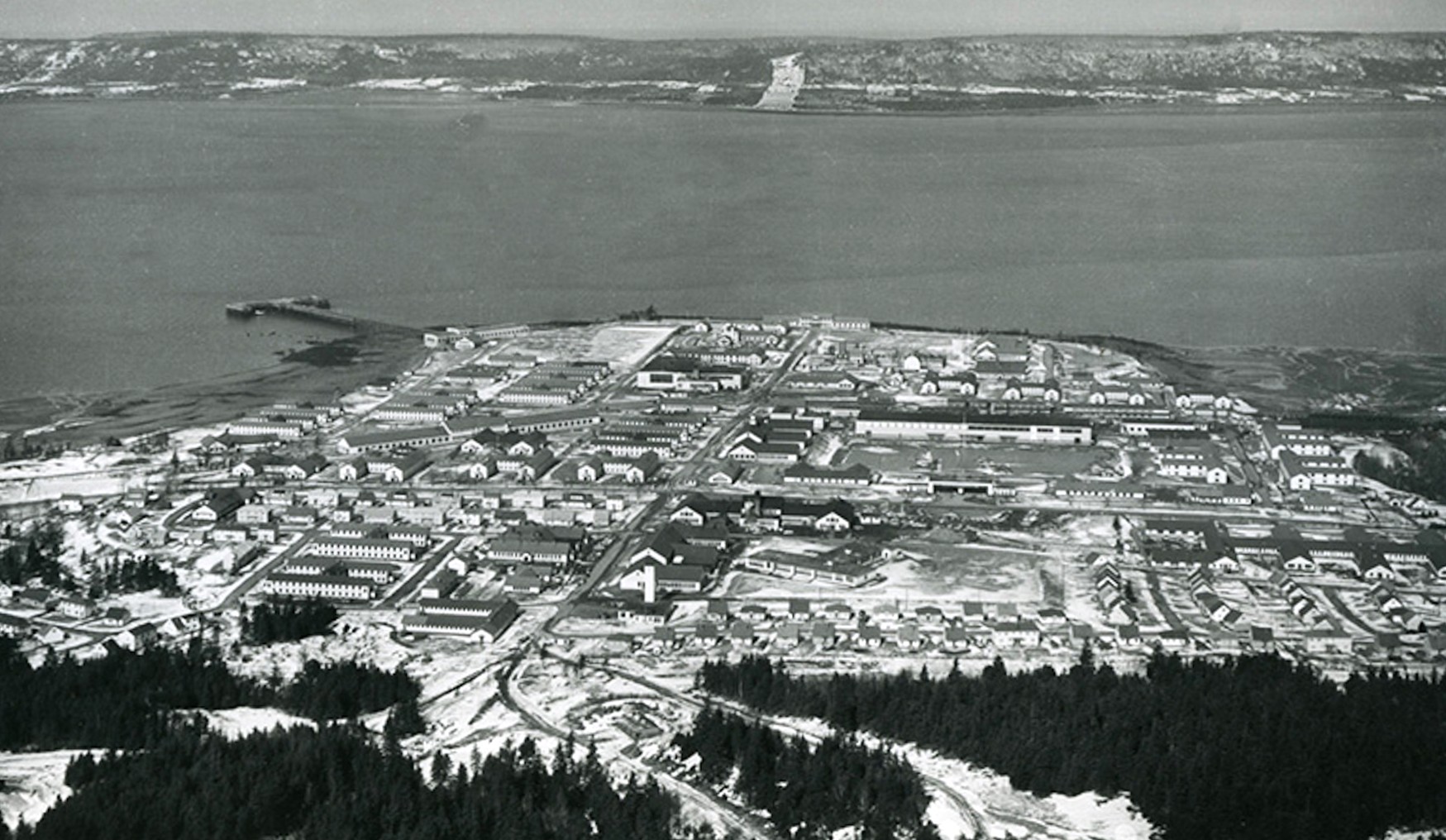
(DND Photo)
HMCS Cornwallis, Deep Brook, Nova Scotia.
Cornwallis served, in one capacity or another, as one of the principle training facilities for the Navy, and later the whole Canadian Forces, for more than 50 years. In that time, she trained more than 500,000 personnel.
HMCS Cornwallis was formed as part of the 1942 reorganization of naval facilities in Halifax, NS. In the early part of the war, base operation and training had been closely associated, principally through HMCS Stadacona. As the size and importance of Halifax grew, this system became inefficient. Stadacona took over all base operations, and training was transferred to the newly established Cornwallis, with plans to move that command out of Halifax as soon as was practical. In April, 1943, she moved to her permanent home at Deep Brook, NS. She was the largest naval training base in the British Commonwealth during the Second World War.
Cornwallis principally did new entry training and seamanship training, leaving officer training for facilities such as HMCS Kings. She also served a number of other important functions. Cornwallis did anti-submarine and ASDIC (an early form of SONAR) training. She also had a number of specialist programs, including accountancy and engine room training, along with a number of specialist facilities, including the HMC Gunnery School and the chemical warfare centre. She would also be a training facility for specialist instruction for the Women’s Royal Canadian Naval Service, or the Wrens, after they had completed their basic training at HMCS Conestoga. After the war, Cornwallis would become the principle training facility for female reservists, once they were permitted to join the RCNVR in 1951.
Cornwallis was closed as a training facility early in 1945, but after the war became a Discharge Transit Centre for navy personnel to help them return to civilian life. HMCS Cornwallis was re-established as a naval training establishment in 1949, only to become Canadian Forces Base (CFB) Cornwallis during the unification of the armed forces in 1968. At this time she became the home of the Canadian Forces Recruit School, the primary training centre for English speaking recruits for all three elements of the Canadian Forces. She served in that capacity until 1994, when it was decided to close her for good. The site is now home to a business park and the Cornwallis Military Museum.